Showing posts with label women. Show all posts

Tuesday, September 11, 2018

Fly Girls

Fly Girls: How Five Daring Women Defied the Odds and Made Aviation History
© 2018 Keith O'Brien
352 pages


"Women must try to do things as men have tried. Where they fail, their failure must be but a challenge to others." - Amelia Earhart, 1937

The subtitle is a bit of an oversell, but Fly Girls  honors five pioneers of aviation,  most of whom died while trying to push the envelope.  Amelia Earhart is the only one of their number who has any name recognition today,  disappearing as she did while trying to accomplish the first trans-pacific solo flight.  She'd previously been the first to fly solo from the United States to Hawaii, as well as the first woman to fly solo across the Atlantic.  Judging by her accomplishments, Earhart is in a class by herself here, but I'm tempted to agree with one of the other featured fliers here, Louise Thaden, who responded to someone asking her how she won the 5th National Air Race by stating it was 25% skill, 25% the airplane, and 50% luck.      Early aviation was a lethal enthusiasm, practiced with evolving tools and planes composed with canvas wings.  When things went wrong -- and flying planes for hours at a time meant something was bound to --  survival came down to circumstance. Sometimes a catastrophe could be survived, but sometimes there was nothing but to accept rapidly-hurtling fate. No one in this book is ever far from death; Earhart, for instance,  was nearly sucked out of her aircraft during the same race that Thaden won. 

Earhart's triumphs could have belonged to other women, like Ruth Nichols:  she refused to give up trying to cross the Atlantic, even after she crashed two planes within a span of four months.  A broken back aside, she was determined to try it again -- only to have Earhart beat her to it.  Another accomplishment of the women here -- who were friends and competitors simultaneously -- was organizing the International Organization of Women Pilots, more popularly known as "The Ninety-Nines" because 99 women attended the first full meeting thereof.  The Ninety-Nines organized in response to the discriminatory policies adopted by air race organizations to keep women out of the racing. The exact kinds of accidents that downed fantastically gifted fliers like Florence Klingensmith occurred to male fliers, but no one demeaned the talent of the male deceased or questioned their mental state at the time. Flying was inherently dangerous, but women, the Ninety-Nines protested, should have the right to accept that danger, and to try for the glory that would be theirs if they were successful.

As much as I enjoyed this look into aviation history,  it does not live up to its title. The subjects were all outstandingly courageous and talented, moreso for continuing to seek their passion despite little support from outside, save for businessmen interested in gaining advertising value by sponsoring the odd attempt to across the Atlantic or set a new endurance record. But if this is a book about early women aviation pioneers, why is someone like Bessie Coleman completely absent, not so much as mentioned?  Unable to take pilot training in the US because of her race, Coleman learned French and traveled to Paris to learn to fly, an incredible demonstration of doggedness that surely belongs here. I think Fly Girls is  therefore more accurately regarded as a book about the women who formed the Ninety-Nines, culminating in their successful re-entry into national air races and Thaden's victory.   They were an impressive group of women who refused to quit, and I'm glad their story is being shared decades after the last of them has left us.

Earhart and the Autogyro prototype, which she used to demonstrate across the country before her Atlantic solo flight. I would have loved to learn more about this!

Thursday, August 9, 2018

Broad Band

Broad Band: The Untold Story of the Women Who Made the Internet 
© 2018 Claire Evans
288 pages


When the ENIAC was first displayed for the public, its proponents bragged that it could do complex mathematical calculations in seconds which would have taken a skilled man hours upon hours.   Well...baloney. The ENIAC was an admirably complex array of metal, but without the human beings who had pored over its every component, turning their brains into maps of circuit boards,  creating the very language that was needed to put that array of metal to work -- it was useless. Hours and hours of human effort had gone into that little calculation, but they weren't man-hours.   The programmers of the ENIAC were six women, descendants of the calculating computer pools of the late 19th century. Broad Band is their story, and the story of other lady pioneers of the computer age.


I'll admit that I had no idea any of these women existed. Histories of of early computing and the internet are a favorite of mine, but I usually begin further along in the story, with more user-friendly machines like the PDP-10 and the advent of networks. I was a little leery of the book given the asinine blurb on the back -- "alpha nerds and brogrammers"?  Really?  Thankfully, the funny title brought me, and glad I am because I never heard of these women...and some of them are really worth knowing.   Grace Hopper, for instance, was deeply involved in the Harvard Mark-1 and the UNIVAC, and she pionered the use of subroutines to speed up coding, as well as created the first compilers.    COBOL, which at one time was the language of 80% of existing code,  was based on her work.  A woman once refused admittance to the services during World War 2 because of her age would become a Rear Admiral before her life's computing work was done. Another remarkable subject here is Elizabeth "Jake" Feinler,  whose Network Information Office created and maintained a directory of...the internet.  Working for the still-nascent ARPANet, Feinler was the master of all information about it. Her team also created many basic protocols, both under-the-hood things most users wouldn't recognize as well as creating the original web extension: ".com".   The women who follow were also trail-blazers, experimenting with social networks (New York's "ECHO" bbs,  which could boast a  40% female population), as well as digital magazines distributed on floppy disks.  Surprisingly, ECHO is still around, though other projects like Word magazine are long gone. 

Broad Band effectively mixes biography and tech history, and the goal from the start doesn't overshadow the actual content.  That is,   most of the subjects should be included in histories of web regardless of their sex, given their importance. I say most because I'm not sure about the website creators of the nineties; I don't know enough about the web at that transitional moment to read Broad Band in context.  There were some claims that seemed specious, like references to Al Gore being the key player in making the internet a thing known to the public, and  there's a huge discrepancy in the estimate given for ECHO membership. Evans says it peaked at 40,000, while The Atlantic marks the peak as...2,000.  There's no way of knowing which is more accurate,  but given that it was only accessible via a paid membership,  I'm tempted to think Evans' is closer -- she interviewed the ECHO host herself.   The meat of the book seems to get leaner and leaner as it wears on, until at the end we're reading about how computers are couched in "masculine" language like..."crash" and "execute".    Despite the late-game weaknesses, there's a lot of fun information here about how the web as we know it evolved.


Wednesday, December 20, 2017

Factory Girls

Factory Girls : From Village to City in a Changing China
© Leslie Chang
420 pages


China as a whole may have a third more men than women because of the one-child rule and a preference for male children, but in Dongguan it's a different story. There, women outnumber the men, for it is they who fill the factories and help expand the Chinese economy.  When Leslie Chang learned how many Chinese women -- girls, really, for many are teenagers -- were leaving their villages to find work on the coast, she wanted to know and tell their story.  In her seven years living in China,  Chang also discovered a link to the lives of these women who opened up to her; her grandfather had once "gone out" of the village and sought his fortune, and both would do their part to build out China's future. Factory Girls is not an expose, but a long-term project of both journalistic  and personal interest, as Chang befriends a few women to learn about their lives as a whole: their work, their leisure, their aspirations,  and their attempts to find meaning in their associations and relationships.

Chang believes there are two key reasons women are so predominant in China's factories. First,  they're more likely to leave home for the factories, as sons are encouraged to stick close to the homes they'll one day inherit.  Men who go to the city are often relegated to dead end positions as cooks and security guards, because factory owners prefer hiring young women -- they being more patient and easier to manage. The Chinese cheerfully embrace sex discrimination in their want ads: tall men are solicited for one job, pretty women for another.  Chang muses that women have embraced the development zones more readily than their male counterparts because they don't have the security of the family  farm to take for granted.   After moving to the cities, few daughters want to go back home, anyway. They might yearn to see their family and visit once a year, but once there they miss the energy of the cities and resent their parents' authority. That authority is further compromised given that these families often depend on the money sent to them by their wandering children.

As with Country Driving, Factory Girls bears witness to the sheer amount of energy on China's southern coast, how companies and people are scrambling. "Jumping factories" to find better positions is the norm, but this does impose a cost on the employees:  no sooner do they make friends at a factory do those friends disappear, sometimes leaving the city altogether.  Although the first generation of migrant employees  were self-conscious of their in-between status, and read magazines and sang songs specifically about the migrant experience,  most women who move to the cities quickly embrace their status as residents of the New China. They constantly re-invent themselves,  trying new hairstyles and styles of clothing seemingly every week.  This is not merely curiosity or vanity;  many takes classes to instruct them in how to find white-collar work, and it's more about presentation than skills. Skills can be learned on the job; what has to be learned before that is how to sell one's self as a confident, personable professional who can shake hands and trot out a little English from time to time. There's also a growing class of courtesans, 'karaoke girls', and prostitutes who take 'selling themselves' somewhat more literally.  With the right madam, in the right area, ladies of the night can make in a week what their sisters in the factories make in a month.   Chang also notes a search for meaning among these new urbanites, who explore previously forbidden religions, including China's traditional occult practices with obscure origins.

Chang  occasionally includes chapters about her own search for her roots, and the discovery  that her grandfather had once "gone out" of China, only to return and be killed by the Communists.  Chang sees a big difference between her grandfather's story and those of her  new friends in China: while he viewed his travels and work as something done to better China and his family, the women were largely concerned with themselves and their own stories. Chang seems to approve of the change, even as she documents the loneliness and restlessness that has resulted from these young people not having any larger purpose in mind in their lives; supporting their parents is obligatory, and done more out of reflexive duty than purposeful choice.

Although this book is approaching its fifteenth anniversary and China's economy and society have presumably changed much in the past two decades, all of his is consistent with books like Country Driving which were published a few years later. Like Country Driving, the chief appeal here is human interest,  concentrating around the lives of  few young women whose stories illuminate the loves of millions of others. Definitely of interest to those curious about modern China, and particularly its women.

Fun fact: Leslie Chang is married to Peter Hessler, author of Country Driving. No wonder there was so much overlap!  They were working the same territory, so to speak..

Thursday, September 28, 2017

Wild Swans

Wild Swans: Three Daughters of China
© 1991 Chang Jung
525 pages

(My edition uses Chang's family name first, following the Chinese custom.)


Read the records of the 20th century totalitarian states, and the number of lives destroyed numbs the brain. Eleven million in Germany, twenty million in Russia -- such a mass of suffering is too large to grasp. Distill that suffering into three lives, however, and it is conveyed with intimate efficiency.  Wild Swans uses the family history of three women -- a concubine of a warlord, a young Communist, and an untrained doctor turned untrained electrician turned writer in exile -- to deliver a history of China's brutal 20th century.   Although a three-part biography, the real weight of of the book lays in the middle, in the lives of the author's mother and father. Through them -- both Communists from their teens on, who  resisted the Japanese and the Kuomintang, who advanced the Communist revolution -- we see the hopes of China turn to ashes as Mao commits everything that isn't worship of the Chairman to the flames.

The story begins at the turn of the 20th century,  when a poor-but-pretty girl caught the eye of a warlord. Though her family's rank and wealth  disqualified her as a marriageable mate,  she was -- just barely -- acceptable as a concubine. Living alone in a gilded cage,  Chang Jung's grandmother had to face the hostility of the warlord's other concubines after she became pregnant. Her response was to escape, faking illness so she could smuggle her daughter and herself out.  Chang's grandmother married a Manchu doctor, a connection that came in handy after the Japanese invaded northern China and created a Manchurian puppet state.   Although the family had to live through the casual tyranny of the Empire and the food shortages of war,  the only fighting that ever threatened their village was between the Nationalists and the Communists guerillas.  Chang's mother, growing up in this environment, looked to the Communists as poor heroes against the imperial Japanese and the utterly corrupt Kuomintang.  As an adolescent, she smuggled in literature and helped the Communists gain intelligence inside the city for their covert actions,  aiding the cause.  Eventually she would meet and marry a young official, who was even more ardent than she. Together, they would witness the triumph of the war against the Kuomintang: the declaration of a People's Republic of China.

The dream would not last long. As this memoir-biography develops,  the faith of these two Communists is stressed, strained, and eventually crushed.  Chang's father was a New Communist Man through and through: he was effectively married to the Party, treating his wife as the other woman.  Devoted to the republic, he stood on principles absolutely, time and again choosing the party before his family.  He was assigned to another province?  Very well, his wife would have to wallk; her rank in the party didn't merit riding in a truck.  Was she pregnant? She would have to work until the delivery, because peasant women didn't have the luxury of taking it easy. Had he been given a ticket to a play for his daughter?  Yes, but she would need to trade it for an inferior ticket. It wouldn't do for a young girl to take a front seat just because her father was a senior official.   Chang's father was a hard man, but he believed that after centuries of imperial corruption, a new China needed to be built on the foundation of principled citizens.   As puritanical and cold as he could seem to his family, readers can only praise him after living through the Cultural Revolution via his family.

There's no shortage of brutality, inhumanity, and mass terror in this book: the Japanese and Kuomingtang give us a taste early on, and as soon as the Communists take control there are the murderous purges and the equally deadly incompetence-induced famine that killed millions.  As the biography develops, however, more and more of the problems have one man at their root: Mao,  who was creating a new imperial system around himself.    After a period of relative freedom of expression he suddenly purged those expressing themselves,  Mao claimed it was a premeditated act designed to draw out the traitors-in-waiting.  But with the cultural revolution, Mao would top himself. He would make Hitler the mean kid on the playground, make Stalin look like a common gangster. Mao, facing resistance from the Party itself, decided to destroy the party, destroy what institutions had been built upon since his victory, and destroy everything from China's past. He appealed to the first generation of children raised in the People's Republic to  rise against their teachers, their parents,  and the legacy of the past:  burn it all. Nothing could be great in China but Mao,  the man who praised poverty and lived in mansions,  who waged war against even the grass.  The Chinese would be set against one another and their own past, creating an atmosphere of constant abuse, paranoia, and savagery.

Chang herself was a student during the Cultural Revolution,  and through her we witness the complete breakdown of society.  Her father, a man of principle who stood on self-control and had reason to be confident in his solid Party Man reputation,  became the target of the "Rebels".  Both he and Chang's mother -- whose youthful devotion to the Party had fast waned thanks to the famine and her treatment during pregnancy --   were detained and tormented, After her parents took the bold step of appealing to Mao personally,  matters grew worst still.  Although many Rebels appreciated his principled defiance -- he refused to recant and declared he would stand against the cultural revolution even if  Mao had ordered it -- a key feature of the  rebel reign of terror is that it was unorganized chaos. At first was was merely bands of students harassing teachers, but their numbers grew and the Party was dumped from power in favor of the new student groups, they began fighting against one another.  Chang's father lost his sanity after one period of detention, and when he died it was a consequence of a long period of constant abuse. Chang could only wonder, as she witnessed her parents' emotional destruction at the hands of the regime -- if this was Paradise, what could hell be like?   The devotion she had for Mao perished in the orgy of murder and mayhem that he inaugurated.

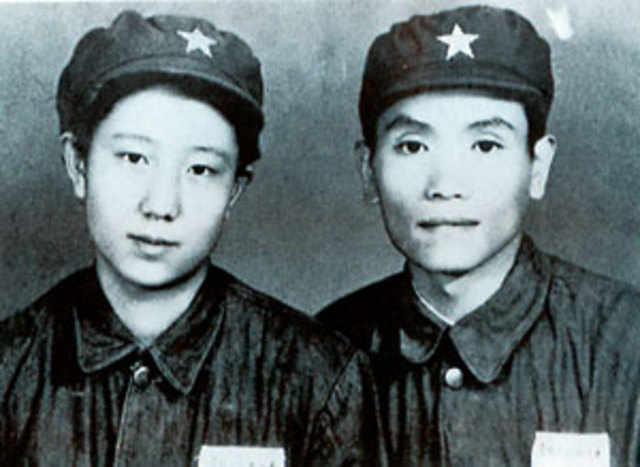
Bao-Quin and Wang-Yu,  Chang's parents


Wild Swans is an incredible look into some of China's most horrible years, particularly given the way the Changs are put on the rack for being too faithful to the cause.  Anyone who has believed in something -- a politician, an ideology, a religion -- and truly loved it, only to have to abandon it because of mounting evidence that it is not what it promised to be -- will sympathize with the Changs' plight. They never changed; Mao did. In fact,  many people were punished throughout Mao's regime for following instructions, merely because the managing authorities had changed.  Reading this and witnessing the idealism of the Communists giving way immediately to nepotism and human nature makes me more aware of both the immutable frailty of human society,  and the treasure that is the rule of law which we in the west enjoyed for so long.


Sunday, April 16, 2017

Sister Queens

Sister Queens: The Noble, Tragic Lives of  Katherine of Aragon and Juana, Queen of Castille
480 pages
© 2011 Julia Fox


Virtually any reader of Tudor fiction is familiar with the sad story of Queen Catherine,  the lawful wife of Henry VIII who was not merely abandoned, but cruelly cut off from her own daughter Mary, after she refused to partake in the murder of her marriage to Henry.   Less known is the equally sad story of Catherine’s family, and particularly her sister Juana -- who was likewise placed under house imprisonment and defamed as a lunatic.   Sister Queens is a joint biography of Katherine and Juana which aims to plumb their full characters, however, not just the one aspect (“tragic wife”/ “tragic mad widow”) that  plucks the heartstrings of readers the most.  At times it wears a little heavy with all the details of court life -- dresses,  draperies, that sort of thing -- but  for those who know little about  Queen Katherine and her family,  Sister Queens is most accessible, and is a book which offers a look at the most influential family in late medieval Europe.

Ferdinand and Isabella are known to American schoolchildren as the patrons of Christopher Columbus’s foolhardy but accomplished voyage across the Atlantic, but in Europe they were the Most Catholic Monarchs, the pair who united Spain and reclaimed it for Christendom against the armies of the caliphs. (And, tragically, by expelling Jewish subjects.)  Their marriage was fruitful, producing five children: Isabella,  Juan, Juana, Catalina, and Maria.  Royal marriages were then the stuff of diplomatic alliances, and all four of the daughters would be married abroad.  Tragedy would visit the family again and and again, claiming Isabella, Juan, and several children -- a theme that continued throughout Juana and Catherine's lives.

Most readers are aware of the general trajectory of Catherine's doomed marriage to the swine-king Henry, of the series of tragic child-deaths and miscarriages that convinced him that their marriage was cursed. Catherine was not merely the King's consort, however, hanging about in the royal chambers and waiting for babies. Catherine's diplomatic role didn't end in marrying into the English dynasty. She served as Spain's primary ambassador,   attempting to keep English preferences aligned against France  Her influence would wane sharply, however, after Henry began wondering if perhaps he shouldn't have married his brother's widow after all.  Even there, Catherine proves herself a wily adversary, sending secret messages, defending herself in trial, and twisting even the Holy Roman Emperor's elbow for aide. It helped that  Emperor Charles was her nephew, the son of Juana.  Fox is somewhat less successful with Queen Juana, though not for lacking of trying; there's just so little evidence to go on about her life once she became a captive resident of Tordesillas.  Fox argues that Juana's histrionics were a form of manipulation -- aimed first at her husband Phillip, and then at her captors --  in the hopes of  effecting her own will. Her captivity was less a matter of illness than control, for after her mother's death Juana was the legitimate heir of the Castilian throne -- and through her name, her father and husband sought to rule  Fox argues that the people who lived with Juana, namely her daughter Catalina, and those who visited her or exchanged letters with her never remarked on any instability.  Only those who tried to control her -- Phillip and Ferdinand, and their agents -- encountered the desperate Juana, who would lash out in tantrums against them.

Unfortunately, there's so little information about the imprisoned Juana that I don't know if this book does too much for her.  Having already developed an appreciation for Queen Catherine's character through other biographies and novels, I enjoyed Sister Queens most as  look into the joined Spanish-Hapsburg dynasty that would create that pivotal character of the reformation, Charles V. (For more information, read Will Durant's The Reformation.  Charles V holds a commanding position throughout.)

Friday, February 24, 2017

I Know Why the Caged Bird Sings

I Know Why the Caged Bird Sings
© 1969 Maya Angelou
304 pages


I Know Why the Caged Bird Sings is an autobiography in the form of a novel, following a young woman’s coming of age as she journeys from a small town in the South to the big city – and then there and back again.  Functionally abandoned by her parents, and constantly worried about her status as not only an awkward and homely girl from a family full of photogenic frames and faces, but being a racial outcast, Maguerite makes her way by a loving grandmother and brother and books aplenty. I read I Know Why the Caged Bird Sings largely out of peer pressure, since it is always mentioned in the hallowed company of books like The Scarlet Letter and Tom Sawyer, hailed as essential American and Southern literature.

Racism dominates Caged Bird just as the wilderness fills the reader’s experience in The Last of the Mohicans;  Angelou writes that segregation was so complete in Stamps, Arkansas that she hardly ever saw a white person.  In her younger years , Stamps’ white citizenry were phantoms who she scarcely regarded as human.  They were cold and distant authority figures, or ‘powhitetrash’ wretches who behaved like little barbarians yet expected the blacks of Stamps to defer to them.  On the rare occasions that Marguerite and her family entered the white side of Stamps to buy goods unavailable in their own neighborhoods, they ran the risk of being refused service – as happened with a dentist.

This book remains controversial because of several scenes of sexual violence, which I approached with some trepidation – intending to skim over them, if need be. There are three scenes like this within the same chapter, and Angelou renders them in a way to convey a child’s confusion and detachment – the sort of detachment one adopts while at the dentist, or in preparation for a surgery, a self-defense against panic. Following these scenes, Marguerite enters a mute period in which she reads more devotedly than ever, before finding a positive vision of womanhood in her community to guide her out of the darkness.

In her path to womanhood, Marguerite was provided with several examples, strong in their own way.   Central to her life is her grandmother, “Momma”, who operates a general store that is also the community center for Stamp’s black community.  While the store never makes them wealthy,  the family’s frugality and Momma’ adaptability allow them to weather even the Depression in mild comfort, lending money even to white business owners – including the dentist who considers his obligation merely fiscal, and refuses to budge from his policy of not treating blacks.    Momma and her family provide a safe haven for the main character and her brother, a haven not found when they visit or live with their parents.   Marguerite’s mother is beautiful and independent, but her world is full of violence; when Marguerite is raped, it is at the hand of one of her mother’s beaus. Her father, too, is handsome but not altogether reliable;  when he takes Marguerite to Mexico to buy supplies,  his drunken revelries force Maguerite as a young teenager to attempt driving for the first time in literal terra incognita – a mountainous descent in rural Mexico.   A third example for Marguerite is the mysterious Mrs. Flowers, who has a regal bearing and a full library, both of which inspire Maguerite to better things. For the most part, she takes those lessons to heart -- fighting a protracted campaign to become a streetcar conductor, the first black woman to enter the service. Yet at the end, she decides to have sex with a boy to determine that she is not a lesbian, promptly becomes pregnant, and after the delivery of her boy, the novel ends. It's as if a story of King David ended abruptly with his having Uriah killed so he could cover his petty lust with Bathsheba.  I know the person of Maguerite -- Maya Angelou -- went on to greatness, but as a novel by itself, it's a weird way to end things.


Wednesday, October 12, 2016

Katherine of Aragon

Katherine of Aragon: The True Queen
© 2016 Alison Weir
624 pages


Mention the Tudor court, and invariably people think of Henry VIII and his famed mistress, Anne Boleyn. But the wife Henry abandoned came from a far more interesting family. Catherine of Aragon was the daughter of Ferninand and Isabella, the power-couple who united Spain and bankrolled Columbus' journey across the Atlantic. Alison Weir, a historian-novelist who has produced both formal histories of the Tudor court and novels hailing English queens, now gives Henry's only true queen her due. She begins the story in on the high seas, where a young Catherine is anxiously wondering what awaits her in England.

I daresay virtually everyone reading this is familiar with the particulars of Catherine's ill-fated marriage to the swinish Henry VIII. We see a Catherine here who, while often at the mercy of the will of her father or English royalty, is not a passive creature. She serves as the de facto Spanish ambassador at one point, and later as regent of England when Henry is off fighting Frenchmen. When Henry's desperation to sire a mini-me destroys the shared sorrow that once brought he and Catherine together and prompts him to begin looking for excuses to shack up with someone else*, she fights as best she can. To her is given an impossible task: to be obedient to her husband, who insists he isn't, and simultaneously protect the marriage he has decided for reasons of state was a fraud. She does fight, though, using her position as the daughter of one of Europe's most intimidating families, the Hapsburgs. She eventually loses all of her support, until like Thomas More digs in on the strength of conscience and honor alone. When my copy of the book vanished into the digital ether, she had been reduced to poverty, and Henry held her in bitter, angry contempt. (Darned magically-disappearing e-book checkouts!) The slow death -- deliberate murder -- of their relationship makes the book. There are other interesting relationships, too, like the appearances of Sir Thomas More, and even letters between Catherine and Erasmus.

Catherine's character is the most compelling reason to read the book; I wasn't particularly awed by the writing -- at one point Henry declares that we can't have every every Tom, Dick, and Harry can going around interpreting the Bible for himself. The phrase can be dated to the 17th century, but it sounds anachronistic -- weird, even. I found Katherine largely enjoyable, but I was excited to find it to begin with; I've previously looked for novels that featured Catherine and Mary sympathetically.

Note: I didn't quite finish this one. I was nearly late to town trying to finish it, and figured I'd take care of the last couple of chapters after work. No such luck; the checkout expired and now I'm #20 in line. If there's a drastic alteration in my opinion based on the very end, I'll repost.

* I could give Henry the benefit of the doubt if he'd made a wife of Anne, was faithful and such, but instead he chopped off her head and married four others. At some point we must call a pig a pig!

Sunday, April 10, 2016

Jane Eyre

Jane Eyre
© 1847 Charlotte Bronte
525 pages


  Years ago an online quiz declared to me that of all the characters in English literature, I was most like…Jane Eyre. It may have been a quiz intended for women, but I had an awful lot of spare time on my hands in high school. Regardless, since that I’ve had a faint interest in reading Jane’s novel, and since I’ve instituted April as English Lit month, why not?   Jane Eyre is the story of a young orphan who must find her way in the world, overcoming both temptation and self-righteousness.  Jane is probably the most personable of the classics I’ve read, using as it does the first-person perspective and beginning not with a storied introduction, but with a seemingly mundane episode in Jane’s life that will set her on her own course.  Charlotte Bronte combines a happy talent for description with wisdom that is neither strident nor impotent.

Jane begins as a ward of her uncharitable aunt, a woman who bemoans the fact that she has been made the guardian of her niece. Rather than bringing Jane up as a member of the family, she instead attempts to reduce Jane to an abused servant.  This injustice so distresses Jane that she collapses in nervous sorrow, and on the advice of a doctor, is sent away to a boarding schools for indigent orphans, where she encounters a saintly young girl who  is an exemplar of virtuous patience and long-suffering.   The young girl perishes, as is the way of saintly mentors, and Jane quickly grows to become a teacher at the school herself.  The real story begins when she, craving something new, advertises for and lands a job as a governess. Her new home is a gloomy place with  an absent master and strange goings-on, some of which won’t be explained until very late in the novel, but presently the owner arrives and things grow steadily more agitated.  Though Jane has no money, no familial connections, and no great beauty, she develops feelings for this Mr. Rochester. Unknown to her,  but fairly obvious to the reader from his wide array of pet names,  Rochester also has feelings for Jane….but things aren’t quite that easy. Rochester isn’t the man he appears to be, and Jane must choose which she prefers: love or honor.

“I will hold to the principles received by me when I was sane, and not mad — as I am now. Laws and principles are not for the times when there is no temptation: they are for such moments as this, when body and soul rise in mutiny against their rigour; stringent are they; inviolate they shall be. If at my individual convenience I might break them, what would be their worth? They have a worth — so I have always believed; and if I cannot believe it now, it is because I am quite insane — quite insane: with my veins running fire, and my heart beating faster than I can count its throbs. Preconceived opinions, foregone determinations, are all I have this hour to stand by: there I plant my foot."

Mad though she may be with love,  since her friend ‘s death she has attempted to live rightly, and it is that habit of seeking the Good, not merely what feels good or can be rationalized, that keeps her beginning a new life with a mistake.  From there she flees into the country, with resources and again fixing for herself alone, winning friends and admiration for her character and kindness. She discovers long-lost relations and encounters a different kind of proposal before returning to where the story began, for a marvelous conclusion.

Readers today might praise Jane for being an independent woman in the Victorian age, but truth be told she is a remarkable character even in today’s age. She is independent, but not self-obsessed. From an early age she is aware of her own dignity, and respects that of the people who  antagonize her; even when she denies them, thwarts them, she is doing it as much for their sake as hers.  Thus we have independence, but not egotism.  Jane’s strength is her character, her compassion. Unlike Pip, another literary orphan, she is not possessed by her wealth;  it leads her to embrace and strengthen her bonds with those "who knew her when", not push them away in search of social status.  (She did have the advantage of having escaped her youth, I suppose. Pre-Helen, Jane might have made Pip's same mistakes.)

Jane Eyre was for me another happy surprise. I intended on reading A Classic. I found myself immediately attached to an admirable and lovely young friend in Jane.


Saturday, February 27, 2016

Equal of the Sun

Equal of the Sun
© 2012 Anita Amirrezvani
431 pages


When Javaher came to the Iranian court, he did so with a secret mission: he intended to find out who murdered his father, and then return the favor.  So intent was he on this that he had himself made a eunuch to qualify for court service.  He quickly found himself at the side of an extraordinary woman, the Princess Pari -- who, standing in for her aging father, effectively ran the government. But when the shah died without designating a successor,  both the realm and the palace are thrown into chaos. Being a woman,  Pari is not allowed to take the reins herself...but she has no intention of letting her family's labors go to waste in civil war.   Her intervention makes her a target in the wave of violence that follows her father's death in the next two years, and eventually ends in tragedy. Equal to the Sun is her faithful servant's contribution to history; though she will be dismissed by the official histories, penned by scribes bowing to the wishes of far inferior and petty potentates,  hers is a story worth telling.

This is Amirrezvani's second novel set in historical Iran, and continues her lovely incorporation of oral tradition within the twists and turns of the text.  The novel's basic plot  is basic court intrigue, albeit with an mesmerizing figure at the center.  Princess Pari was a real personality, though given how little record there is of her life there's a lot of interpretation at work here. Not lost on the author and her characters is the reign of Queen Elizabeth, who is fighting the same battle in England that Pari fights in Iran, that  a woman can reign as effectively as a man.  Amirrezvani draws a few discrete parallels to Elizabeth's story, having Pari declare herself married to her country.  Her possession of the royal farr,  the glory and  essence of sovereignty,  is recognized by increasingly more characters as the novel wears on. In a court of men obsessed with tribalism and looting the coffers, she remembers how glorious Iran once was, and can see danger looming in the restive Ottoman empire, now looking at the internecine chaos as opportunity for its own expansion. Pari's downfall is not jealous men, however, but a jealous woman. Her death is so surprising and abrupt that the reader is almost as horrified as Jahaver.

While Blood of Flowers had a more original premise (telling the story of an unknown artisan who creates exquisitely beautiful tapestries),  I welcome the return of Amirrezvani to  storytelling.  If she had only written a novel set in historical Iran, that would be of interest enough, especially given how passionate her characters are towards one another and their goals. But her integration of  oral tradition -- folk stories in Blood, epic poetry here -- with the text of the novel -- is unique. Her characters are inspired and nurtured by stories old, even as they try to figure out their own destiny.   Parts of the book do bear a the too-heavy stamp of modern writing, though, like the intermittent sex scenes.  I tried to skip through them -- is there anything more awkward than reading a woman's version of a eunuch trying to have sex? --   but pillow talk often turned to political intrigue or mystery-solving.   That aside though...if she writes again, I'll read her again!


Saturday, December 12, 2015

We Band of Angels

We Band of Angels
© 2001 Elizabeth M. Norman
325  pages


When Japan invaded the Philippines and besieged the Bataan peninsula,  the Filipino-American army wasn't the only entity enduring months of dwindling supplies and attritive warfare. Stationed alongside soldiers and sailors were nurses, farm girls from the United States who never intended to go to war, but found themselves in the middle of one. We Band of Angels uses letters, diaries, and interviews with still-living nurses to recount  their increasingly desperate experience, as they set up emergency medical stations behind the lines, a few dozen women tending to thousands of patients as bombs fell and monkeys helped themselves to the scant food and medicine available. It is unusual and attractive in being a non-military memoir of the fall of the Phillipines, the siege of Corregidor, and later imprisonment, and rather lively.

On Bataan and Corregidor, there were no secure rear quarters; the warzone was everywhere, and bombs were just as liable to fall into hospitals as they were vehicle pools. Unlike the soldiers, these nurses -- civilians, really, whose programs were nationalized -- had never trained for conditions this hostile, but they took them on just the same. They tended the injured after every bombardment and raid, and did their best to keep disease from utterly destroying their comrades despite being the walking wounded themselves,  caught in the grips of malaria but attempting to do what good they could. When forced to evacuate, they left part of their hearts behind in the patients abandoned in beds. Some would return to the United States following the fall of Bataan and Corregidor, while others would spent years held prisoner by the Japanese.  Those who returned were aghast to find themselves hailed as saintly heroes; what they they done, other than stick to their duty and make the best of an awful situation?  After the Philippines were liberated, those imprisoned met the same fate, idolized and put to good use selling war bonds and inspiring an increasingly war-fatigued populace.

Their irritation at being used is shared by a sometimes prickly author who resents women being treated any differently than men. When nurses were evacuated to Corregidor shortly before Bataan was abandoned, she fumes against the male egotism that wanted to protect the women, a bizarre judgment given that she had just shared everyone's speculation about a Nanking-style desecration, and the fact that soldiers were being evacuated. (The judgment is proven  tragically faulty when later a nurse is raped by the imperials, and others endure deliberate sexual taunting by the swaggering invaders.)   Norman's scorn for her subject culture doesn't manifest itself too often, however, and the story of the nurses themselves is so fascinating that misplaced political griping does't diminish it. Her core grievance is that the women were idolized as Women -- tender, doting nurses or damsels in distress  -- and not given their proper respect as working professionals, ladies of intelligence, skill, and steadfast devotion to their vocation. It would be a fairer complaint if levied against modern audiences, but for those living the world crisis, seeing all of Eurasia under the command of totalitarian governments, no doubt legends carried more traction than staid reports. There is a time for stories about knights fighting dragons, sustaining faith in a fight against monstrosity.  Norman's book does give them that respect, taking a fuller measure of their character, one we are now safe to appreciate far from the peril of the hour.

Wednesday, October 14, 2015

Called to Serve

Called to Serve: A History of Nuns in America
© 2013 Margaret McGuinness
277 pages


Long before the suffrage and feminist movements allowed women to assume a more publicly active role within society,  women religious were taking an active role in shaping the American landscape.  Although predominately a Protestant country, the United States was never without Catholic citizens,  whether through acquiring land originally settled by France and Spain, or by developing its own through immigration from Italy, Poland, and other parts of Catholic Europe.  The American landscape was for all a great mission, a place to build civilization anew, and  nuns were there nearly from the beginning.

Though some orders restricted themselves to prayer,  more active communities bounded, providing teachers and nurses to areas just being settled, which would have otherwise gone without. The sisters provided religious instruction, naturally, but also taught reading, mathematics, and other educational fundamentals. They also trained people for work, giving the margins of society -- impoverished freedmen and immigrants. especially their women --  the resources to begin building a life for themselves. America's religious sisters were not simply Europeans transplanted to the frontier; their rules of life had to be altered to take the harshness of the wilderness into consideration, though some adaptations were perverse. In the early 19th century,  religious orders owned slaves, for instance, even orders which were filled only with African-American nuns The nuns were far more conscious of the evil nature of slavery, however, ameliorating it as best they could and agitating for abolition much earlier than society at large, or even the Church proper.

Nurturing the margins -- the least of these -- was truly the prevailing mark of American nunneries.  When contagious disease swept American communities, women religious were often the only people willing to nurse the afflicted, sometimes at the cost of their own lines.  The rapidly urbanizing eastern seaboard provided plenty of diseases to battle, and nuns were at the forefront,   managing Catholic hospitals at every level and developing new methods to prevent infection.  As waves of courageous or dispossessed people from Europe swept America, nuns provided settlement houses that welcomed newcomers and helped them find a place for themselves in a new country. Nuns were strangers themselves, often ridiculed and sometimes even attacked by nativists who feared their papish influence.  Ultimately, though, their extraordinary compassion  and proven talent won respect -- and sometimes, even converts.   Despite these accomplishments, however, as the 20th century continued the ranks and influence of religious women fell precipitously, possibly because the gap they served was filled in: religious orders were no longer the sole means of a meaningful career for women, for instance. America's rising  secularization -- both in the sense of diminished religiosity and  the growth of medical, educational, and immigrant-handling government programs -- also diminished their attraction. They continue to serve America,  but frequently have been reduced to the rule of mere social activists, instead of the very creators of civil society as they once were.


Monday, May 5, 2014

More Work for Mother

More Work for Mother: the Ironies of American Housework
© 1985 Ruth Cowan           
288 pages


       Throughout the 20th century,  households were transformed by a new abundance of labor-saving devices, from washing machines to toaster ovens, and processed goods that reduced housewives’ workloads, leaving them free to learn trades and professions of their own and fully participate in the modern world.  But in the second decade of the 21st century, American women are just as  chore-taxed as ever, lamenting of the ‘second shift’ that awaits them upon arriving home. Despite the many machines now investing our homes,  most of the work still has to be done by hand, for Parkinson’s Law holds true there as well as anywhere  else: work expands to fill the time available for its completion. In More Work for Mother, author Ruth Cowan demonstrates how gadgets and goods created new work while eliminating others, and argues that women will not be free from drudgery until housework is freed from the realm of ‘femininity’ to the point that men won’t feel emasculated by laundry.

            The devices and goods of the 19th and 20th century – refrigerators, washing machines, microwaves,  convenient bags of flour, even more convenient no-bake cheesecake mixes, even more convenient instant cereal --  did indeed reduce a lot of labor. In fact, for men they reduced virtually all household work.  More Work for Other opens with a history of housework. Although modern readers might  be aware that women’s traditional role was in the home, men’s traditional role was in the home, as well;  prior to industrialism, men didn’t pack a lunch pail and disappear into the country for a day at work. The home and the work of most families were intimately connected,  typically inseparable. Women may have baked bread, but it was men who gathered and ground it;  women may have washed clothes, but men chopped the wood and let children lug in the water.  But while men’s roles in the household largely vanished, women found that work remained constant.  The availability of affordable clothing reduced the need for sewing and repairing, but increased the burden of laundry, and standards of cleanliness climbed as the ability to clean increased. Laundry and scrubbing agents meant that minor stains could no longer be tolerated, necessitating near-daily cleaning regimens.  And those new labor-saving devices were often fragile things, needing frequent cleaning to avoid their works being gummed up.  Additionally, for middle class or wealthier women, the availability of do-it-yourself machines meant that retaining maids and other servants was a sinful waste – never mind that doing it themselves meant more hours of their own time spent doing the labor, regardless of advertisers’ claims of quick ease-of-use.   There  were options that might have truly revolutionized household chores –  commercial kitchens with thrice-daily delivery,  commercial laundries, cooperatives, apartment hotels – but most fell by the wayside, either because of cultural imperatives or because of market forces.  

         Although not as sweeping as Susan Strasser's Never Done,  what's lost in extensive narrative is replaced by more serious analysis and an abundance of good points made. Cowan notes, for instance, that the increase of standardized products destroyed easy class differences:  while in the mid-19th century a street urchin and the scion of a wealthy businessman would look as different as night and day just judging from their clothes' cleanliness, today both could wear the same products, and the fact that vitually all homes have water and heating means that no one is denied the ability to shower every day.  The interior of homes, too, are far closer than they once were; the absence of gadgets and electricity might have once marked a hovel, but these days not even campers will tolerate going without a refrigerator.  Her driving point is that the fact that homes are now filled with gadgets and manufactured articles doesn't mean that homes are no longer productive; mothers are still 'producing' clean bathrooms, fed children,  and presentable clothing. If the labor women perform was priced as though they were in the open market, people would never assume homemaking to be unproductive. Ultimately, Cowan believes women will be freed from drudgery only when we relax fanatic standards regarding cleanliness and the housework that remains is stripped, through cultural or technological means, of its traditionally female association so that men will pitch in more.  If that argument, made in 1985, has lost some of its edge in a 21st century peopled by "Mr.Moms" , most of the work has not.


Saturday, September 7, 2013

Astronaut Wives Club

The Astronaut Wives Club
© 2013 Lily Koppell
288 pages


When a gang of test pilots joined the Mercury program, they and those who followed them didn't have an inkling of what was to come-- and their wives, their unwitting partners in an unexpected story -- knew even less.   In part, Mercury, Gemini, and Apollo only prolonged the misery they knew as the wives of test pilots: they were married to men who were never home, who had a one in four shot of dying every time they went to work, and whose military career seemed more like juvenile adventurism than noble service.  But when pilots became astronauts, those worried wives became the partners of instant celebrities, subject to more scrutiny than they could have ever anticipated.

The Astronaut Wives Club is the story of the harried women who kept the home fires burning while their men, basking in glory and adulation, put fire in the sky. Lily Koppell is a chatty social historian whose account demonstrates how the ladies of Mercury, Gemini, and Apollo adapted to the new stresses of their celebrity-wife status, whose homes became the backdrops of national dramas every launch, who were accosted in grocery stories by reporters -- including news hacks who beat a path to the doors of new widows to ask how they felt about their husbands' demise, arriving even before the NASA officials who were to respectfully deliver the bad news. In addition to facing the prospect of their husbands dying horribly -- running out of air and leaving bodies to circle in lunar orbit forever, perhaps?  --  and living under the public eye, having to keep the home and kids looking shipshape to satisfy the Powers that Be and shut the mouths of gossip columnists -- the wives also had to contend with the fact that their superstar husbands were taking an endless stream of "Cape Cookies" to bed. The combination of  cocky, accomplished, and adulated men working in Florida states apart from their wives in Houston, and the presence of young things in miniskirts batting their eyes at the big ol' heroes -- was a bad one for the astronaut's home lives: few marriages survived the space program.

Although early on Koppell fancies the idea of the story of the astronaut wives being one of American women coming into their own, a link with the feminist movement never strongly materializes:  the manners and mores of the astronaut homes were a decade behind those of the popular culture at large, though 'progress' in the form of splintering marriages  increased when it became obvious that NASA didn't really care if the astronauts cheated, so long  as public scandal was avoided So long as they were landing on the Moon, who cared about serial affairs?   Absent of precedent, and left to fend for themselves by NASA, the astro-wives fell back on one another, relying on one another for moral and personal support. They met in one anothers' homes to share their worries and woes, especially helpful given that they were under orders not to burden their husbands with anything -- hence why Jim Lovell didn't realize that all three of his children had their tonsils removed until after he and his wife were leaving town. This is more evident in the Mercury program, when there were only seven wives in a tight-knit circle: as their numbers expanded, first with the New Nine and then additional astronaut classes each with a dozen men at least, cohesion faded.  This is sadly true of the book as well. Though it starts out with a clear focus on the response of the Mercury wives to their new role as being to national icons, as more subjects enter the picture, Koppell drifts, and this combined with her casual  approach means the book loses much of its potential punch, feeling scattered by midway.

The Astronaut Wives Club is an interesting  if weak look into the 'home front' of the space program, with appeal for readers who want to learn a little more about an aspect of the space race that is only lightly touched on at best elsewhere, or readers interested in the lives of accidentally-famous women. Though based in part on interviews with living astronaut wives, it's more serviceable as a diversion than a comprehensive treatment of the subjects.

Friday, March 22, 2013

Reviving Ophelia: A Reading


"Most preadolescent girls are marvelous company because they are interested in everything -- sports, nature, people, music, and books. Almost all the heroines of girls' literature come from this age group -- Anne of Green Gables, Heidi, Pippi Longstocking and Caddie Woodlawn. Girls this age bake pies, solve mysteries, and go on quests. They can take care of themselves and are not yet burdened with caring for others. [...] 
Something dramatic happens to girls in early adolescence. Just as planes and ships disappear mysteriously into the Bermuda Triangle, so to do the selves of girls go down in droves. They crash and burn in a social and developmental Bermuda Triangle. In early adolescence, studies show that girls' IQ scores drop and their math and science scores plummet. They lose their resiliency and optimism and become less curious and inclined to take risks. They lose their assertive, energetic, and "tomboyish" personalities and become more deferential, self-critical, and depressed. [...]  
Psychology documents but does not explain the crashes. Girls who rushed to drink in experiences in enormous gulps sit quietly in the corner. Writers such as Slyvia Plath, Margaret Atwood, and Olive Schreiner have described the wreckage. Diderot, in writing to his young friend SOphie Volland, described his observations harshly: 'You all die at 15.' [...]  Simon de Beauvoir believed that adolescence is when girls realize that men have the power and that their only power comes from consenting to become submissive adored objects. They do not suffer from the penis envy Freud postulated, but from power envy.

She described the Bermuda Triangle this way: Girls who were the subjects of their own lives become the objects of others' lives. 'Young girls slowly bury their childhood, put away their independent and imperious selves and submissively enter adult existence.' [...]
Girls know they are losing themselves. One girl said, 'Everything good in me died in junior high.' [...] Parents know only too well that something is happening to their daughters. Calm, considerate daughters grow moody, demanding and distant. Girls who loved to talk are sullen and secretive. Girls who liked to hug now bristle when touched. Mothers complain that they can do nothing right in the eyes of their daughters. Involved fathers bemoan their banishment from their daughters' lives. But few parents realize how universal their experiences are.

pp. 19-21, 23, Reviving Ophelia: Saving the Selves of Adolescent Girls, Mary Pipher.


Sunday, June 24, 2012

Something from the Oven

Something from the Oven: Reinventing Dinner in 1950s America
306 pages
© 2004 Laura Shaprio

     The latter half of the 20th century saw the United States convulsed with social change. Millions of women and blacks who found their role temporarily elevated during the Second World War, when they were called upon to serve in uniform and in the factories, could not simply return to being second-class citizens after war’s end. In Something from the Oven: Reinventing Dinner in the 1950s, Laura Shapiro covers the beginnings of women’s liberation and the feminist movement in the context of America’s changing food market, bookending the text with the question: do women like to cook?

            Initial previews led me to believe this book’s subject was the changing food market itself:  an industry that had to meet the demand for food that could be safely shipped around the world to follow the Allied armies found itself at war’s end with a lot of output and nowhere to sell it  -- unless the civilian market could be expanded considerably.  To do that, advertisers had to convince women to accept their TV trays as dinner, and their new confections as real food. They urged women to reconsider what cooking meant as a craft when women were already beginning to question what cooking and homemaking meant to their lives in general. What did it mean to be a woman?

            Women were not altogether excited to adopt the new foodstuffs. Despite food magazines’ almost-triumphant declaration that old-fashioned cooking was dead, defeated by Scientific Progress,  those same magazines’ letters reveal that women were still looking for traditional recipes. They added the novel products in sparingly, as substitutes for the “real thing”. It was not until the mid-to late fifties when another generation of women came of age – women who, as children, ate the new processed foods without judgment and regarded them as normal – that the substitutes started gaining more traction and replacing the ‘real thing’ in regular use.  Similarly, women reappraising their own role in the home did so at first only reluctantly, until the publication of Betty Friedan’s The Feminnine Mystique spotlighted the “problem with no name” – and gave women the courage to start speaking  more stridently.  Shapiro sees women as coming of age in this period, and their changing relationship with food reflected this. Cooking would not define their lives, but they would also not be patronized to by businesses which attempt to reduce their role in the house to that of simply warming up product from the grocery store.  Cooking was a skill to take pride in, and ultimately women triumph in Shapiro's narrative by becoming the arbiters of both how to incorporate novelty and tradition, and of their own fates.

             Something from the Oven is a bit like gazing through near-transparent stained glass. The food market is certainly an interesting lens to view the birth of feminism through, but unlike a telescope, here the lens -- like stained glass -- is visible, and sometimes it got in the way of the focus on women. This is a book about women and feminism, but culinary marketing and food culture sometimes overshadow the main subject, so the essential point of the book never comes into sharp focus despite appearing very interesting. It's fascinating, yet frustrating.

Sunday, June 10, 2012

Cinderella Ate My Daughter

Cinderella Ate My Daughter: Dispatches from the Front Lines of the New Girlie-Girl Culture
© 2012 Peggy Orenstein
260 pages


When did every little girl become a princess to be bedecked in pink and fawned over? Such is the question posed by Peggy Orenstein, author of numerous books on issues of motherhood and raising women. The answer is at least twofold. First, advertising toward girls in general has emphasized coy, yet overt sexuality, even to the very young: and secondly, in the early 1990s, the Disney Corporation realized there was a lot of money to be had in developing a line of princess goods.  But this isn't really a book on advertising: Orenstein is more concerned about what the princess culture is doing to the minds of girls. The substance of the book is an examination of  how girls view themselves and each other in society.

 What makes a princess special? There's no answer. A princess is special just because. She exists solely to be an object of attention: her specialness is not the result of her accomplishments, her skills, her talents, her character, or anything substantial.Therein lies the problem with the princess culture, for it influences girls to aspire to be objects of appreciation. Their sense of self-worth is an external fair, subject not to what girls feel themselves capable of, but how girls feel others respond to them. If they are not regarded as Special, they feel worthless. Distracted by the quest for attention, they don't bother with the kind of self-growth that would merit attention, or  be fulfilling on its own. Substance is placed by superficiality. This is particularly troublesome in the case of sexuality: in Orenstein's words, girls learn to aspire to be desired before they have desire (of that kind) on their own. Orenstein sees this as a problem for girlhood in general, because the princess culture has utterly hijacked what it means to be a girl. If a helmet isn't pink, it isn't a girl's helmet. If a mother scorns all the fluff, her inadvertent lesson to her daughter is that it's not okay to be a girl.  This being the problem, her solution -- in addition to reversing Reagan's deregulation of children's advertising -- is for parents to focus on teaching girls how to live for themselves, and not for the approval of others; to define themselves and not try to fit Disney's definition of a girl.

Orenstein is a fun author, especially as she covers beauty pageants for four-year-olds and facebook, using phrases like "Sesame street walker".She's also one who has to practice what she preaches, for her own daughter Daisy is one of the afflicted: the account conveys her desperate frustration in trying to raise Daisy to be a strong person in an environment swamped by odious messages in the advertising. It shares themes with Consuming Kids and So Sexy, So Soon and covers similar ground. What So Sexy, So Soon referred to as "age compression", Orenstein calls "KGOY", Kids Getting Older Younger. This refers to the way kids are attracted to objects advertised to older children, hence kiddie thongs and Barbie in the toddler aisle.  Of obvious interest to the parents and guardians of young women, and quite readable.