Showing posts with label social history. Show all posts

Thursday, April 19, 2018

A Time Traveler's Guide to Elizabethan England

A Time Traveler's Guide to Elizabethan England
© 2014 Ian Mortimer
415 pages


Previously Ian Mortimer has offered readers with access to a time machine a handbook for medieval England. Perhaps mystery plays based on Scripture are not your interest, however, and you'd prefer dining with a little more variety. Come then to Elizabethan England, where the secular theater is in its ascendancy, and the rising merchant marine is bringing the world's produce to English plates. The Elizabethan era is commonly thought of as a golden age for England, between its triumph over the Spanish Armada and the appearance of luminaries like Shakespeare, Spenser, and Jonson.   Mortimer warns curious travelers, however, that this is still not an age for the cautious:  death  by disease, crime, war, or the law are never too far away, and Elizabeth's crown is so questioned that "Gloriana" must rule with a firm hand, using a zealous secret service keeping tabs on the population and dealing with those who would foment rebellion.

Although Mortimer breaks from his faux-guidebook style (regarding it as contrived if repeated), he still covers the whole of everyday life in England during its 16th century.  Covered at length are dress and occupations, architecture, law, and the evolution of the theater and literature. Material from the previous book which is still in effect - -the feudal ordering of society, for instance -- is  recapped but not plumbed in full again. Mortimer is forced by Elizabeth to focus an entire chapter on religion,  given that the legal union which gave her birth and rule was a religious and political controversy that led England to break from the Church, and cost many men their heads, from the noble to the base.  (Mortimer still focuses on the political aspects of religion, however, with little on religious practice;   it remains more of a background than a subject considered in full. I thought this was odd in a book on the medieval period, and it's still odd.)

As much interest as there in in the lives of those gone on, and of the structures they created which we still use, I also appreciated Mortimer's general appraisal of the age. He is strikingly empathetic of his medieval subjects, including those in an age which is not quite medieval but definitely not industrial-modern, and conveys this to the reader well. He gives the people who breathed and died in this age their full consideration -- sharing their verse and graffiti, imagining the smells and sights,  putting readers into their heads so that we may read the landscape as they did. To them, hills and rivers were not a Windows XP wallpaper, but places to keep the sheep that kept them alive, and the best transportation away.   Mortimer's final appraisal is that as dangerous and uncertain as their lives could be, we see in the Elizabethan age a growing self-confidence -- one that saw men throw themselves into the unknown expanse of the oceans in search of new lands and possibilities, and one that allowed intellectual knowledge to definitely surpass the aura of classical learning. Despite the perils and problems of the age, it  was also one of hope and ambition, one that spurred England to become the greatest maritime power yet seen.

Oh, earlier in the week Ian Mortimer did an "ask me anything" thread on reddit, inviting questions from the public. He answered questions on his sources, inspirations, etc.

Related:
The Life of Elizabeth I, Alison Weir
The Age of Faith and The Reformation, Will Durant
The works of Frances and Joseph Gies


Tuesday, February 13, 2018

Everyday Life of the North American Indians

Everyday Life of the North American Indian
© 1979 Jon White
256 pages


Everyday Life of the North American Indian is a dated but informative survey of the customs and lifestyles of native peoples across the continent. Most of the content is organized in chapters like "Warrior" and "Artist", which include areas of life connected to warmaking or artistanship; for instance, the chapter on Shamans encompasses religion, spirituality, and mythology in addition to its particular interest on the role of shamans or similar figures. Because the varied peoples of an entire content are being considered, each hailing from radically different landscapes, each has to be addressed in the most general of terms, and the people of Mexico are largely ignored except as they influence various tribes living throughout the southeast and southwest. Although agriculture was practiced in some regions, hunting and foraging remained crucial -- and because local stocks of game could be exhausted, many population employed a strategy of tethered mobility, moving from place to place within a certain region. Religion's core was nature (gods of sun and corn, that sort of thing), not a philosophy of life, and roles for men and women had both fixed and fluid elements: men did the hunting and women did most of the work around the settlement, but both were artisans and both were particiopants in their political systems. As in other pre-industrial societies, children were introduced to their responsibilities fairly early, helping gather resources as tots, watching their younger siblings, and assuming the full mantle of adulthood by their teen years. The kind of massed warfare popular to depict in Hollywood movies was an anomaly: while native peoples were not pacific, they preferred quick raids to settle scores, at least until their societies were disrupted by guns and horses. However, some populations like the Iroquois, were notoriously severe in war: one of the reasons they joined together in a confederacy was to stem their neighborly bloodletting.

Although this is very general, and hasn't aged well in parts, the damage is mostly contained by language. As far as I know, the theory that native Americans first arrived in the Americas via the Bering Land Bridge is still the mainstay, though now it's suggested and understood that the 'bridge' was a more substantial landmass that people lived on, not merely transited through. Some of the author's generalizations were reaching a bit, like suggesting that natives didn't like to disrupt the land too much: I take it the Moundville culture is an exception, since building enormous soil pyramids from Mobile to Illinois would definitely count as disruptive. The author doesn't promote any view of native peoples as gentle nature-loving hippies wearing eagle feathers, though. They are in their own turns aggressive and clement, and those who lived closed to the bone were judicious about their use of resources, while those who lived in abundance were more profligate. Charles C. Mann's more current research into native America demonstrated ably that some native societies altered the landscape to a wide degree.

All things considered, though, Everyday Life of the North American Indian is helpful. It's replete with photographs, to boot.

Sunday, February 11, 2018

The Time Traveler's Guide to Medieval England

The Time Traveler's Guide to Medieval England: A Handbook for Visitors to the Fourteenth Century
© 2008 Ian Mortimer
342 pages


Within minutes of being transported to the time of King Arthur,  Mark Twain's fictional Yankee found himself arrested and facing death.  If only he'd had a copy of Ian Mortimer's Time Traveler's Guide to Medieval England,  he could have avoided such peril.  Mortimer's guide is a winsome social history of the 14th century,  which covers every thing from social structure to city smells to table manners. Herein we are told what to see, what to wear, where to eat, what to do (and more importantly, what not to do -- like enjoying a bit of mutton on Fridays).  Now, it's rather improbable that you or I or anyone else will ever actually have the chance to visit the 14th century, unless we're doing it at the side of Geoffrey Chaucer in The Canterbury Tales But this book's real service to the modern reader is to bring the past alive, to guide readers through a remembrance of old England-- down its crowded, jostling, feces-strewn streets, through alleys of barking vendors, past parades of solemn clergymen, into hovels and palaces and across plains where knights joust and yeomen farm -- to encounter the very real and varied stories which memory has forgotten or abused.  What a delight!

Ian Mortimer is an nigh-unparalleled host to the past, filling a wide table with a treasure of information. What aspect of life are you curious about from the medieval epoch? You will find it here. Clothing? You're covered, literally, from head to foot, from young boys to old women. (Middle-aged men are not covered too well, wearing alarmingly short doublets that show off their expansive hosiery and ridiculously pointed shoes.)   Are you interested in justice, or the miscarriage thereof? Mortimer reviews the structure of law and order, from the neighborhood tithing-man up to the king's courts.  Or perhaps you'd like to poke into medieval medicine? ...well, you can, but you shouldn't. It involves treatments of boiled puppies. One of the more interesting and unexpected chapters was on the medieval character.  Medieval men and women lived much more closer to death than we did, but this manifest itself in different ways: a macabre sense of humor, a love for fleeting beauty, and a ready tolerance of heads on pikes outside the public gates.  There are some curious omissions, like religion:   the Church's social structure appears again and again, of course, from church courts to travelers' inns runs by monks, and  the bits on custom can't avoid religious discussion, whether we're eating fish during Lent or  going to court because it's always held on this-or-that holiday. The ways people worshiped, however, are not addressed.  Obviously Mortimer couldn't cover everything, and so much is tackled that it's a minor fault -- but considering how strongly interconnected religion is with everything else, it's a curious thing to not mention.

On the whole, I was enormously  pleased with this book.  Blame it on watching Men in Tights  as a lad or playing too much Age of Empires, but the medieval epoch is one that has fascinated me  for most of my life.  I used to have a dim view of it, but was cured by encountering Frances and Joseph Gies' medieval history works, books like Life in a Medieval City and Cathedral, Forge, and Waterwheel  The Gies and Mortimer's works are obviously close kin, considering how much they intersect, but the Gies wrote several social histories of that sort and weren't as pressed for space as Mortimer. He delivers an amazing amount of material in just a few hundred pages, but the strength of  this book is not merely its content. Mortimer brings alive the intimate human experiences of the medeval epoch -- the despair of  parents losing their families during the Great Plague, the  passion and tenderness of poets and courtesans, and the inescapable sense of Belonging, as peoples' social ties were everything. Mortimer is also upfront about his sources, whether they're inklings from the Canterbury Tales, or art, or formal histories, court records, that sort of thing.

I look forward to reading the rest of the books in this series, possibly in April given the English connection.

Related:
The works of Frances and Joseph Gies, especially:
Life in a Medieval City, Life in a Medieval Castle, Life in a Medieval Village,  Cathedral, Forge, and Waterwheel, and The Knight in History.
The Other Side of Western Civilization. Articles on various workaday aspects of the ancient and medieval world.
The Age of Faith, Will Durant

Tuesday, January 16, 2018

Amsterdam

Amsterdam: A History of the World's Most Liberal City
© 2013 Russell Shorto
369 pages


In the early 14th century, a group of fisher-folk around the Amstel river came together with a dream: to build a place where people could smoke weed and bicycle to their heart's content.  And so they built a dam, and canals, and a town, and they called it Amsterdam. And they all lived happily ever after, except for the people who toked and cycled simultaneously, because they fell into the canals.

...well, okay. Not really. But there were fishermen, and there was a dam.  Amsterdam: A History of the World's Most Liberal City  reviews the history of the city which took its name from that dam, though it focuses more on Amsterdam's culture of liberality than municipal matters. That culture begins not in the 1960s or even the enlightenment period, but at the very beginning.

Most European cities can point back to a spot of land, the center of the old town, and say "Here is it where it began."  Not so with Amsterdam, which had to be reclaimed from the sea itself, by dredging rivers, redirecting water through canals, building dykes, and driving massive of wood into the Earth to secure a foundation for buildings.  This effort was a joint private-communal affair, as people worked as a corporation to accomplish and maintain projects, but held the results -- the parcels of land raised from the sea--  as private family possessions. Amsterdam's peculiar origins gave the city a unique character, writes Russell Shorto.  It fell outside the feudal system that governed the rest of western Europe, sharply curbing the influence of any native aristocracy, and priming it to reject them totally when cities grew and political authority became a matter of public debate.  The relatively shallow roots of feudalism's cultural authority made it much easier to embrace a  social policy of gedogen -- a game tolerance of difference or vice, so long as it wasn't aggressive.  This tolerance made Amsterdam  a refuge for persecuted minorities (exiled Spanish Jews) and minorities who would love to do the persecuting if the shoe was on the other foot (English Puritans). during the medieval-industrial transition

.Amsterdam's geography meant that it could not be a city with vast estates;  although many of its citizens were staggeringly rich during Amsterdam's golden age, when it was a trading titan that gave its sister-nation England painful competition,  even the wealthy would live in relatively modest townhouses. The broad outlines of Amsterdamer, or at least Dutch, history may be known -- if nothing else, at least the Dutch provinces' early participation in the Protestant movement, and their war of rebellion against the Spanish Hapburgs.  Amsterdam was slow to be caught up in the protestant tide,  as a medieval miracle made it an object of pilgrimages, and made the city as a whole more Catholic -- at least, for a time, before it was quickly supplanted by liberalism. Although the word "liberal" means apparently opposite things on either side of the Atlantic, Shorto holds that both meanings were originally rooted in the supremacy of the individual, and Amsterdam can claim to embody that cause more than any other city.  Compare it to the cradle of Anglo-American democracy, the  home of the House of Commons:  London's streets once fell under the shadow of cathedrals and the Tower; now they falls under skyscrapers.  Amsterdam, however, is a city not of skyscrapers and massive complexes, but of buildings that have remained at the human scale. Its innards, too, have remained human: its streets are dominated by human figures on bicycles, not oversized for speeding automobiles.

Although this is certainly an enjoyable history of Amsterdam's contribution to the human existance,  particularly  on its progress at achieving the golden mean between individual and community life,  those who are curious about Amsterdam's physical expression will probably be a little disappointed. The physical form of the city is covered early on, but after that municipal matters take a distant back seat to the evolving social history. Admittedly, most readers are probably more interested in reading about cars than about canals and such, but I thought it was very odd that Shorto didn't dwell on the rescue of the 'human city' from cars in the 1970s. 

Related:
In the City of Bikes: The Story of the Amsterdam Cyclist, Pete Jordan
The Embarrassment of Riches, Simon Schama. Not one I've read yet, but it's about the Dutch Republic's golden age.

Thursday, January 12, 2017

In the City of Bikes

In the City of Bikes: the Story of the Amsterdam Cyclist
© 2013 Pete Jordan
448 pages

"It is quite possible that all the bicycles in the world are not in Amsterdam, but you'll never be able to convince me."  American tourist, 1956

No sooner had Pete Jordan stepped foot outside the Amsterdam airport than did he nearly get run over by a rushing cyclist.  He met his near-miss with utter delight, for that was precisely why he was in Amsterdam. He'd come as a student to the Netherlands, to study urban design and the role of bikes in Dutch culture.   But the student would become something else, as In the City of Bikes documents his first decade as an Amsterdammer, a man whose career, family, and every joy were nurtured by the closely-knit buildings of this bike-and-canal city, where anything can be walked to but everyone rides bikes instead.  For a reader who sees in Amsterdam hope for humane urbanism,  Jordan's work is a delight through and through.

Why are the Dutch so crazy for bikes? It's not a question they'd ask themselves: in a city where over two-thirds of the people use bikes on a daily basis, the elegant little machines are nothing extraordinary. They don't require helmets, lycra, and a man-against-the-world attitude like cyclists in America bring to the saddle.  Cycles fill Amsterdam -- its streets, its sidewalks, its culture.  Early on, Jordan speculates on why the United States and the Netherlands developed so differently in terms of transportation;  he highlights the comparative availability of land, the scale of the American nation, and the abundance of domestic auto manufacturers as key reasons why the United States quickly embraced hordes of automobiles.   Cars only emerged as a serious rival to Dutch bikes in the 1960s, and just as they were provoking serious resistance  from student movements, the nations of OPEC thoughtfully banned oil exports to the Netherlands and bikes made an epic comeback. (This is, I submit, the greatest gift OPEC ever made to humankind.)

In the City of Bikes is essentially a personal approach to Amsterdam and its cycles that mixes in tales of Jordan's first decade of life in Amsterdam with a narrative history of the city and bicycling.  In the late 19th century, bicycling enjoyed intense support as a short-lived fad in places like the United States, but  the elegant machines had more staying power in a place like Europe with human-scale urbanism and close connections between worthwhile places to be. The Netherlands' flatness made it especially easy to cycle, so cyclists' numbers only grew and grew. The cyclists swarmed in such abundance that mayor after mayor despaired of their anarchism; even the Germans, after seizing the Netherlands, were frustrated.  Rule after rule the new overlords posted, and the Dutch ignored them. (Among the objects of Nazi irritation: Dutch cyclists not staying to the right, as well as holding hands and riding two to a bike.  Roads and bicycles are only for transportation, thank you, no joy allowed.) Only when the Nazis began methodically searching and seizing bicycles for use by their own troops did bicycles disappear --  broken down and squirreled away, or tossed into the canal just to spite the greycoats -- with the exception of those so badly maintained that even fleeing Nazi officers couldn't make use of them.

Cycling in Amsterdam is an utterly democratic mode of transportation: every class uses it regularly, and there's  no real relationship between the wealth of the cyclist and the value of the bike. Parliamentarians and bank executives pedaling to work in their $3000 suits often had the same beaten-up wheels as everyone else. This may owe to Amsterdam's intense amount of bike-thievery:   Jordan lost three bikes in his first two years there, and with theft that common there's no point in sinking money into a machine to begin it. (On that note, the black market in bikes is  amusingly perverted; when people have bikes stolen, they simply buy a stolen bike -- which is then stolen again. It's rather like a twisted kind of bike rental.)    Dutch cycling isn't limited to the young and intense: children grow up on bikes, and bike to school on their own accord. The elderly are mobile -- even pregnant women can cycle. Jordan's wife, for instance, transported herself to the hospital to have her baby, and when she left the place a mother, she returned home by bike.   During bicycling's first flare of popularity, Queen Wilhelmina was an ardent cyclist and remained so throughout her life, taking great pleasure in pedaling about incognito.

In the City of Bikes is not a guide to bicycling infrastructure. It's simply a story of humans living well --  Jordan, and the people of Amsterdam as a whole.  It is connected but free, rebellious but highly functional for human needs. If you like the city at its best, or like cycling, or simply have a care for human flourishing, this is a wonderful little book. I loved it before I bought it, I was thoroughly enblissed while reading it, and I already know it's one I will keep remembering with the thought: this is how life should be.


Friday, January 6, 2017

The Chinese in America

The Chinese in America: A Narrative History
© 2003 Iris Chang
558 pages


Like most Americans, my earliest notion of the Chinese in America is an association with the Transcontinental railroad. As it happened, their story begins before that, with the California gold rush. Poor Chinese men, having caught wind of the bonanza in California, made their way to "Gold Moutain" in hopes  of making a fortune and returning to China with it. While many hit the jackpot and returned, still others made another home in America, becoming actors in its story. In The Chinese in America,  Iris Chang superbly runs together three threads:  a history of China, as the decline of the last empire and the resulting civil strife (including war)  created a need for opportunities and safety to be found abroad;   the history of the United States,  lassoing in the West and needing all the railroad men, miners, and farmers it could get;  and the story of the generations who traveled from one nation to the other, attempting to adjust to a new country without losing their heritage.   It is an admirable story of perseverance amid bewilderment and hardship.

 The earliest Chinese visitors to the United States came not to flee wicked oppression in China, but to make money on Gold Mountain and go home rich men.    A few did strike it lucky and retire wealthy, but many more stayed. Although most of the Chinese who settled in the United States remained on the west coast, not all congregated in urban Chinatowns. They searched for opportunity wherever it might be found; working farms and ranches, mines and railroads, and - occasionally -- even finding their way to New England and the South.   There, despite racially-orientated legislation, they found tacit acceptance, safe in their ambiguous status.  That changed in the 1870s,  when a depression set teeth on edge and prompted unemployed laborers to blame the cheap labor flooding in from the East.   The Chinese Exclusion Act followed, barring most immigration from Asia. Strict quotas were imposed, and only certain professions were entirely welcome.    The Exclusion act would hold until the 1940s, when the United States and the Chinese people became allies, both targets of Japanese imperialism.  (Shortly after World War 2, racial limitations on immigration were ended altogether. even as the war and those which followed generated anti-Asian prejudice)  As one generation pushed the frontier by breaching the Rocky Mountains, linking the coasts and allowing agriculture to prosper in the west, another stretched it still further in aviation and software engineering. Chang doesn't limit herself to politics and economics; a strong reliance on oral history imparts a good dose of social history, as well, like the evolution of  "Chinese" food.

The Chinese-American story is not one I have any experience with -- the South's Asian population is predominately Korean and Vietnamese, at least in my neck of the woods. What little I knew came from histories of San Francisco (particularly Good Life in Hard Times, with a section on Chinese gangs).  This  was, then, a welcome introduction to another aspect of America's mosaic.


Sunday, June 26, 2016

Harvest of Empire

Harvest of Empire: A History of Latinos in America
©  2000 Juan Gonzalez
416 pages


Harvest of Empire is a tale of two civilizations, Anglo and Spanish. In general terms, it recounts the history or rather the plight of Latin America, of people and cultures dominated first by European powers, and then by the colonial rebels turned colonial master, the United States.  The author ends by arguing that the United States owes as much its Hispanic tradition as its Anglo, and that it should embrace Hispanic culture  and make amends to foreign policy which has wreaked havoc throughout the eastern hemisphere.  Divided into three parts, Harvest first dwells on the roots of Anglo-American conflict by recounting the age of discovery and rise of American imperialism, moves to the "branches", in which populations disrupted by war and famine (often linked to American foreign policy) migrate to the United States to seek their fortunes, and then ends with a "harvest" that looks towards a stronger role played by Latino culture in the United States.

 Considering that two of the leading recent  Republican candidates for El Presidente were Cruz and Rubio, 'los hermanos cubanos',  there's no denying the book's relevance, despite its sixteen years of age. Even though neither are in the running now,  immigration  -- the causes and consequences of which are explored here -- remains a big-ticket item.  While some of the author's recommendations (that the United Staces embrace its Hispanic heritage and start promoting and protecting Spanish) are likely to fall flat,  at the very least this review of the United States' catastrophic record of international meddling in central America might give American leadership pause about supporting future debacles.  More convincing is the authors' case for settling the matter of Puerto Rico, which for a century has been a bastard, neither  sovereign, nor a territory or a state.  Harvest has a lot to recommend it, first as a general history of Latin America, secondly by focusing on the widely varying experiences of different Latino groups as they moved to the US.  What name recognition does Puerto Rico have with most Americans, other than the film West Side Story? ("Puerto Rico is en America now!")   The author is right when he points out that the United States is scarcely over two hundred years old, a mere blip in the historical perspective, and the past century of exploitation and dominance by D.C. over Latin America are not likely to last. Latinos will play a larger role in the United States as they continue to migrate here, and will shape D.C's policy as they achieve political influence -- and as the descendants of those who have experienced the consequences of foreign-policy imperialism, they are unlikely to support more of it.


Saturday, March 26, 2016

The Scotch-Irish

The Scotch-Irish: A Social History
© 1989 James Leyburn
397 pages


        Though they have long ceased to be a distinct ethnic group outside of Appalachia, for years the greatest non-English minority in the United States were the Scotch-Irish.   Theirs is a history riven with politics, for they were created by it and became the shapers of it once they moved to America.  The Scotch-Irish appraises not only their political history, however, but the evolution of their character, distinct culture, and social institutions. It is a triptych, the story of a people told across three lands.   The story begins in Scotland, a place slow to join the Renaissance, but quick to grasp the Reformation. Scotland indeed became a  hotbed of diehard Presbyterianism, and as the  Crown began supporting the established Anglican church more firmly, it drove Puritans into the Netherlands and Presbys into Scotland.   Of course, the Crown wanted more Protestants in Ireland; a good strong community of them could withstand Gaelic wiles and serve to consolidate the Crown's position. The Ulster plantation soon developed a culture distinct from Scotland's, despite constant emigration from it, and Leyburn devotes particular attention to the social power of the Presbyterian church as it branched out.  Ultimately, rent hikes would drive many of the "Ulster Scots" to America, where their loathing for the crown and aggressive westward rambling would spur on the Revolution.  Leyburn  offers state-by-state tracking of the Scotch-Irish as they grew in number began filling the interior, making this social history of immense value to students of colonial history, complete with deep background in Irish and Scottish history.


Related:

Friday, March 11, 2016

Dixie's Forgotten People

Dixie's Forgotten People: the South's Poor Whites
© 1979 Wayne Flynt
200 pgs


Just poor people is all we were, tryin' to make a living out of black land dirt..


When Franklin Roosevelt referred to the forgotten man, he was likely thinking of those men in the city's breadlines. The South, however, was home to a host of forgotten men: poor whites, who lost in the land-grab and who industrialism largely left behind. Dixie is a quick survey into the realm of rural white poverty,  succeeded wholly by Flynt's own Poor But Proud. Despite its brevity,  it provides both flavor and substance.

Myths about displaced Norman cavaliers fleeing England to restore the old order in the South not withstanding, most poor whites came from the same stock as those men who became the masters -- at least those in the 'core south', where Flynt primarily draws from.  They emerged as economic losers, families who either arrived late and got the leftovers or soil that had already been picked clean, or who were out-done by the rising gentry creating their vast fiefdoms.  The Civil War left them with even more crushing poverty in the form of tenant farming, and the ruined south was hard to transform into the "new", industrialized south.  A fierce contempt for accepting charity from outsiders frustrated well-meaning missionaries and social reformers, but they were not altogether left behind.  Some tried to escape rural poverty by working in the mills, which were often more dangerous and no guarantor of comfort, and others lobbied for more political power.   Some even overcame racism to create an race-blind tenant farmers union;  from such a union came the latter Civil Rights marching song, "We Shall Overcome".   Racial cooperation in the realm of labor was one of the dashed hopes of the 19th century populist age, however.  The world wars were kind to the South, bringing more industry and money, but the interwar years consisted of an economic slump so dismal that the Great Depression wasn't even noticed.   While the South as a whole became more productive with the advent of machinery,  added jobs constituted only a quarter of those lost to the machines. After World War 2, the Southern economy finally quickened, but many still remain left behind -- especially in Appalachia, which receives a section unto itself.

Dixie's Forgotten People isn't two hundred pages of labor struggles with a southern twang, though, for he also shares the genuine life of the people. Using interviews with adults remembering their youth, Flynt records here folk stories and music. The music shared is that which is fraught with meaning -- melodies that comment on the plight of the family, of working for nothing but trouble, of hoping for rest and relief in the world to come.  The religion of the rural poor was overtly otherworldly,  constantly challenging the elite with the threatening promise that one day the first would be last, and the meek would inherit the earth.  (If "meek" is the  right word for  estatic snake handlers and Pentecostal preachers in unions..) Some of that culture even became mainstream, in the form of country-western, but as it became popular it lost the edge born of desperate poverty and anger. (This is a trend that has fast continued, with 'country' singers slipping into the pop charts with ease, a la Taylor Swift.)   Despite their poverty, the subjects retain a spine -- they are, to borrow Flynt's later title, 'poor but proud'.  Some of that pride, in racial myths, is misplaced, but much of it is legitimate, invested in the rich musical and artistic heritage that was saved from homogeneity by the mountains of Appalachia and dismal transportation.  Now, with interstates and cookie-cutter suburbs sprawling across the South's coastal plains and rugged hills, one wonders if that heritage itself will become the forgotten Dixie instead of just its poor -- lost to ticky-tacky McAmerica,

In short, Dixie's Forgotten People was a quick and varied survey, albeit one supplanted by the weightier Poor But Proud.  Considering that most people think of that obscene film Deliverance when they think of the country poor, Flynt's time spent with them is well needed among American readers.


Related:

Friday, January 29, 2016

Taxi!

Taxi! A Social History of the New York City Cabdriver
©  2007 Graham Russell Gao Hodges
225 pages


No film set in New York City is complete without scenes of Manhattan traffic, dense with yellow cars -- the patrolling ranks of the cabs, shuttling a third of the city hither and yon.  Taxi! is exactly as it describes itself, a social history of New York cabbing.  The author begins in the early days of the automobile and moves forward to 2001.  Much of it is predictable but as-yet unexplored, the tale of cabdrivers' woes throughout the economic turbulence of the 20th century, their struggling to make ends meet against declining social status.  The author has a keen interest in unionization, devoting an entire chapter to it and touching on it several other times.   He sees a failure to successfully unionize as part of static or declining fortunes among cab drivers, although the failure is less political than structural. Cabs are not factories, and the abundance of independent owner-operators sapped what strength was found in bringing together the drivers for the large taxi fleets.  When economic pressures prompted the fleets to reduce their men to independent contractors, the attraction of cab-driving was further diminished as a career, and it became more the occupation of those looking for part-time work, or (in the case of immigrants) for any entrance into the American economy.  That grim economic trend is slightly offset by the author's continued examination of cab drivers in popular media, from the first days of film on. Who knew Babe Ruth once did a cameo in a taxi film?   The films tend to portray cab drivers as lonely commentators on the social scene, and sometimes shed light on cabbys' interesting connections with the criminal world.  In the roaring twenties and the Depression, cabbies sometimes earned extra money by connecting interested passengers to prostitutes and liquor.  The contentious relationship between cabs and cops that Melissa Plaut commented on in her Hack evidently has a long history, though where it begins is a chicken and egg quandary.  Taxi! is  quick read, dry in parts but largely informative and entertaining on the whole, aided by the author's latent passion for a job he once undertook himself.

Related:
Hack: How I Stopped Worrying About My Life and Started Driving a Yellow Cab, Melissa Plaut

Monday, June 8, 2015

The English People on the Eve of Colonization


The English People on the Eve of Colonization
© 1954 Wallace Notestein
302 pages


   If there was ever an exemplar for not judging a book by its cover, The English People on the Eve of Colonization is it. The binding is plain and burdened by an unwieldy title that seems to threaten readers with clouds of dust and pages of population statistics upon opening. Instead,  Wallace Notestein delivers a lively social history that opens the hood (or bonnet, if you prefer, since we’re looking at the English) of Stuart England, revealing the social machinery at work inside.  Here are the daily lives of men both great and small – the details of their work,  their concerns – and an examination of the institutions which create and sustain civilization Notestein’s chatty survey gives life to farm laborers, country gentlemen, sheriffs and justices of the peace; he also takes us to the Inns of Court and the universities, the very marrow of intellectual life.    Although there are brief chapters on Parliament and the corporations that would lead the way in exploring the globe and settling the new world, the emphasis here is on the small and ordinary, and delivered in so personable a fashion that one is immersed in the life of centuries gone by without realizing he’s being educated.  Religion isn't addressed directly, beyond the life of the church as a community,  which is the only hiccup. 

Related:


Monday, May 25, 2015

The Fiery Cross

The Fiery Cross: The Ku Klux Klan in America
© 1998 Wyn Craig Wade
528 pages


Living in the country as I did,  the bus ride to school always lasted over an hour, and in elementary school I remember being utterly petrified by older students telling we younger horror stories. They spoke of monsters in white sheets, demons from hell, who could rise from the ground, or who lived in the woods, and would come out at dusk or emerge from a fog and snatch little children up,  returning to their lairs to eat them.  This was my earliest exposure to the Ku Klux Klan. After having read The Fiery Cross, I wonder if those stories have some basis in 19th century folk history, of parents warning their young against the obscene danger that continued to erupt in the hundred years that followed the Civil War. The Fiery Cross is a history of America's own hydra, of a hooded  beast that has risen and been slain numerous times,  yet always comes back -- the Invisible Empire,  an organization where sheets hide a confusing jumble of motives, fears, and hatreds.

Although Lincoln's armies prevailed against those of the south, the Confederate cause was not totally lost until Andrew Johnson faced off against a Republican congress and was defeated. A southerner himself, Johnson's plan for quickly grafting South back into the Union  left Congress with a bitter taste in its mouth. What had been the point of the war, of those hundreds of thousands of men and boys dying, of all of the money spent, if the South was simply to be welcomed back with open arms?  Not settling for anything less than a total remolding of the south, Congress introduced its own re-admittance programs, incorporating various amendments and federal administrations like the Freedman's Bureau. Southern resistance manifested itself almost immediately, bristling at outside meddling and the humiliation of having been made second-class subjects of the law in their own land. The most forceful opposition came from shattered remnants of the Confederate army, either refusing to give up the fight or seeing resistance easier than submission, and the ranks of the old slave patrols. Both bands of men moved about and acted autonomously, taking the law into their own hands when they saw fit. Their violence against the new invasion of not only Union troops, but northern lawyers, government agents, and teachers, found a means of easy expression in the white robes of the Ku Klux Klan.

Curiously, the Klan proper did not begin as a political organization; according to the author, six young men formed a secret society complete withe elaborate titles and costumes for the pure purpose of gallivanting around the countryside at night, raising hell and having fun. When they started playing pranks on freedmen, however, pretending to be the ghosts of Confederate dead, things grew far nastier.  As the Klan grew in number, it took a life of its own, one demanding purpose -- and that purpose came to protect the supremacy of white southerners, both against the Yankee invader and against the usurping blacks.  The civil war continued again,  this time under cover of night, and fought more with terror than muskets. Although the Klan would be reorganized as a strict hierarchy, anyone with a bedsheet and the desire for vengeance could cause trouble.   Hooded hooliganism so swept the south that the "Grand Wizard" of the Klan ordered  the organization's self-destruction, and President Grant was forced to declare martial law to quell the anarchy.The Klan collapsed when the North washed its hands of the South, ending reconstruction and allowing the old planters to redeem their nation. Soon attempts at subduing blacks through fear and criminal means would find success in binding them by the law.

The Klan would revive in the early 20th century, but not as simple reaction against one government program. Credit for reviving the group is generally given to The Birth of a Nation,  a highly innovative piece of film-making that depicted the Klan as righteous saviors of civilization against moral bankruptcy. In truth, public response to Birth of a Nation was managed carefully by a evangelical preacher who thought the old clan admirable. Reusing old charters and titles, but adding a bit more organization,  he effected a comeback that was more potent and less obvious. The new Klan still maintained its racial message and support of segregation, but it was heavily influenced by the Fundamentalist movement, and drew support from the rising fear of social and moral anarchy. The early decades were a frightening world for many Americans: organized crime was on the rise, immigration from Europe continued apace and brought with it all kinds of new, strange, and sometimes dangerous ideas. Although from the 21st century it is easy to sit in judgment of our predecessors a century go for panicking about flappers and jazz,  this was an age of labor riots and anarchist assassinations,  in which increasingly very little could be taken for granted.  America was changing -- the country emptying out, the cities swelling. Farmers were in debt and industrial workers utterly at the mercy of their employers. Against this chaos, the Klan pitched itself as a rear guard of civilization. If political machines and bribe-taking cops wouldn't keep bedlam in check, the 'caped crusaders' would -- leaving ominous  messages outside the doors of evil-doers like men failing to support their wives, or blacks attempting to move into a white neighborhood. They held high the cross and flag, offering a social club that gave aid to its ailing members and offered them a chance to 'fight back', either as a political organization or through old-fashioned thuggery. They were a cult, a gang, an invisible empire justified unto themselves and utterly sinister.  Between World War 2 and the revelation that a Klan chieftan had kidnapped a young girl and tried to eat her,  however, the second Klan fell apart. Later iterations have never achieved much more than being vague threats; they have certainly lost whatever reputation they cultivated as guardians of civic order (cannibalism will do that) and settled for being lunatics on the fringe, content merely to stir up trouble.

The Fiery Cross is an exceptionally well-done history of a dismal subject, relying heavily on letters and charters for the 1870s clan, and interviews for the modern iteration.  Despite having grown up in the South, I knew next to nothing about the thing that is the clan, and I say thing because there's never been  just the one organization. It is instead an idea, a symbol -- rather like the V for Vendetta masks, not to slander those activists -- that creates association without unification.  One hopes that the Klan's day is now past, despite its occasional resurfacing.  Given that they have descended to becoming recurring characters on The Jerry Springer Show, there is is room for optimism.  The most fascinating section for me was that on the second Klan, given that its perverse masquerade as a civic organization manages to launch it to national success, flouring not only in the South, but in the northeast and especially the midwest.

Related:
Race with the Devil: My Journey from Racial Hatred to Rational Love, Joseph Pearce


Wednesday, January 28, 2015

A Renegade History of the United States

A Renegade History of the United States
 © 2010 Thaddaeus Russell
402 pages


"All of you, you think there's someone just gonna drop money on you? Money they could use? ...well, there ain't people like that! There's just people like me!"  (Jayne Cobb, Firefly )

In A People's History of the United States, Howard Zinn delivered the hitherto-untold story of the common man, the poor and oppressed, fighting nobly for equality, liberty, and justice.  Chumps! Thaddaeus Russell's A Renegade History is a celebration of the unruly side of the common man, a tribute to those who just don't behave the way they oughta.  It's a prickly history, guaranteed to irritate to some degree just about everyone who reads it. At its best, it demonstrates how 'progress' is a subjective label, and something that happens herky-jerky, from a maelstrom of confusion and strife; at its worst, it hails man's cravenness as heroic.

The stage is set when, in the first chapter, Russell delights in how utterly depraved pre-revolutionary America was. There were more taverns than churches;  prostitution, drugs, and dancing abounded, and whatever appetites existed in man's nature could be fed. And then came the American Revolution, and there went freedom. With the war came sternness, moral discipline, and announcements that men must gird their loins not only for the martial fight against the Royal army, but for war against the sins of sloth, cowardice, and gluttony that would smother  liberty in its cradle.   After independence, the nation's leaders were not distant bureaucrats in London, turning an indulgent eye toward the shenanigans of their colonists, but influential scolds like John Adams, who strolled the harbors noting with pleasure the growing American navy, and ignoring with great dignity the whorehouses behind him. The American nation took another direction, a more disciplined one -- but ever since, there have been those who swam against the current, who attempted to turn the drums of a forward march into the beat of a ragtime dance.

Russell's offensive is two-fold, first sneering at both great men and the dignified minorities fighting for rights,  and then Russell's chapter titles give away his delight in overturning expectations -- "The Freedom of Slavery", "How Gangsters Made America a Better Place",  and "How Juvenile Delinquents Won the Cold War".   Although the Founding Fathers might, in defining freedom, look back to the hoplite-citizens of Greece and wax poetic on freedom'z ennobling effect on the human character, for Russell freedom is the ability to gorge, drink, rut, and sleep.  Slaves, he writes, were often better off than free men. To be sure, they were beaten for misconduct, but their legal status as property meant owners were bound by self-interest. They couldn't dismiss a slave, or stop feeding him for slacking on the job:  they would forfeit every dime paid, every resource given before. Compare that to the northern factoryman, Russell urges, who worked long hours to the ruin of his body, who -- if he was injured, sick, or otherwise unable to continue -- was dismissed into the cold entirely. The apparent perversity continues throughout, as when Russell honors the Mafia; their fun habits of extortion, murder, and theft aside,  they saw profit in opening gay bars in the 1970s, so more power to them.  That they were doing this for selfish motives (a la  Adam Smith's butcher) is Russell's concealed point:  humans at their worst can create an environment where people are 'better off' in general.  The obscene becomes the respectable, as when First Ladies began sporting the makeup that once  belonged exclusively to Ladies of the Night.  'Better off' will be a point of contention, however, since Russell's idea of a good life is Pleasure Island from Pinocchio.

Civilization is the taming of human nature, the domestication of it -- perhaps even its suppression. If there is any hope in A Renegade History, it is that human nature is simply too wild to remain in fetters for long: regardless of the dystopian nightmares of Orwell and Huxley, or dreams of politicians to inflict their favored order on us,  humans are an unruly race. A Renegade History is infuriating, but I knew even as I held my nose going through, utterly unforgettable. Not only are there gems to be found shifting through the garbage of history -- startling facts, like that the FBI raid on the Stonewall Inn had more to do with its Mafia-owned status than a campaign of anti-gay persecution, or that Martin Luther King's success was predicated on being the alternative to the violence already sweeping American streets -- but there's some slight comfort in knowing how contrary we are. Russell's heroes aren't protestors; they don't whine. They retaliate. They kick over tables, throw up middle fingers,  and charge off. There's ferocious energy here, the energy of a riot. But while it was  a disorderly, drunken mob that initiated the violence of the American Revolution in Boston, the prosperity that sustained them came from the peaceful, disciplined farms of civilization. It's refreshing to take a draft of the human spirit here -- there's such a kick to it --  but   as always our best hope is the path of moderation -- a little work, a little play.

Related:
The Redneck Manifesto, Jim Goad

Saturday, September 13, 2014

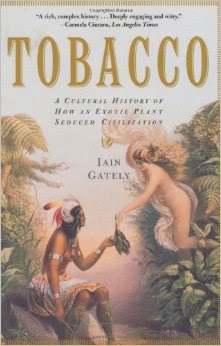
Tobacco

Tobacco: A Cultural History of How an Exotic Plant Seduced Civilization
416 pages
© 2003 Iain Gateley


The age of discovery opened an era of global domination by European culture and power, but in at least one instance, the new world had its own victory. Tobacco, smoked heavily throughout the Americas,  took the world by storm once European sailors started smoking, sniffing, and drinking (!) it. sometimes reaching parts of the planet even before they did in a chain reaction. Tobacco is a straightforward history of the weed's own conquest.

A native of the Americas, tobacco had many roles in the cultures of the Aztecs, Incas, and more. They smoked the plant, but they also applied its juice to their eyes and skin; the principle use of tobacco was in shamanic ritual and herbal medicine.  Europeans dabbled with this (there is no substance on Earth that has not been championed as a cure-all at some point), but  sailors and conquistadors soon used it chiefly for recreation.  Smoking was a completely new phenomenon to Europe, and neither the Catholic nor later the Islamic powers knew what to make of it. It stunk of the devil, but neither the Bible nor the Koran expressly forbade it, and soon enough even priests were taking snuff during Mass. Everywhere European trade-ships went, they took sailors and tobacco, and the people they met spread the good news of smoking with such profligacy that when European explorers penetrated the heart of Africa, they found tobacco already waiting.

Tobacco offered mental stimulation and relaxation without the drunkenness of alcohol, though there was still vomiting involved if one overdid it.. Tobacco was soon grown worldwide, and formed the basis of much of the colonial American economy.  Cigars, like whiskey, weathered Atlantic crossings far better than raw foodstuffs, and could retain value.  Their use as a trade commodity can't be understated; even well into the modern era, tobacco was used as money. In World War 2, for instance, not only did soldiers and prisoners use cigarettes as currency within their respective institutions, but in financially-stressed Nazi Germany,  cartons of cigarettes were used as stable money when the official currency was being played with. (This, despite the official Nazi forbidding of tobacco!)

Besides recreation and money, tobacco served a multitude of ever-changing social roles. Different types of tobacco consumption marked different cultures, like the cigar's association with power and the pipe with middle-class respectability.  The cigarette began as a French invention, and was resisted for the longest by English tabagophiles, who looked askance at anything French. Initially derided as weak, soft, and effeminate,  cigarettes eventually became the standard use of tobacco for various reasons -- their cheapness, ease of use, and near-immediate addictveness among them.  People embraced the cigarette as a way to spit at traditional values; what Oscar Wilde started, flappers continued.  It helped that cigarettes had an enormous media presence; barred from depicting steamy romance onscreen, Hollywood used cigarettes to establish connections between characters and create imagery thick with innuendo. Even after concurrent skyrocketing rates of cigarette consumption and lung cancer indicated a medical crisis in the making, people continued lighting up. If anything, the warning labels and danger increased their allure.

Eventually in the English-speaking world, at least, governments decided to start taking more strident action;  in the United States,   areas where one may smoke are the exception and no longer the norm. Tobacco's rise and possible fall have both happened with stunning rapidity, and Gately is an entertaining guide to its story; he delivers a bounty of information in one rapidly-moving narrative that doesn't tire. . As with Drink,  Tobacco is globetrotting;  America and Europe get most of the attention, but no corner of the globe goes unremarked on.  Even for a nonsmoker like myself, Tobacco has value as cultural history, if only to demonstrate how quickly entire ways of life can be transformed, repeatedly. (It's one of the reasons I like histories of consumer goods so much -- the human capacity for fads is amazing.)  More importantly, it's fun, a history filled with adventurers, rebels, pirates, and scheming businessmen.


Wednesday, September 10, 2014

Living Downtown

Living Downtown: The History of Residential Hotels in the United States
© 1994 Paul Groth
399 pages


Although today hotels are thought of as places for travelers, at its most basic level a hotel is simply a rented room; an apartment without a kitchen. For much of American history,  the 'huddled masses' filling the cities found homes not in detached houses, but in residential hotels.  Buildings giant and small, dilapidated and grand, they catered to the rich and poor alike. Living Downtown examines what lives were like, as lived in different classes of hotels, and tracks their struggle through the 20th century as they became the target of reformers.  This is a social history of urban life in American cities' boomtime.

Suburbanized America thinks of apartments and the like as exceptions to the rule of privately-owned homes, but as Living Downtown reveals, communal life has a strong history in the nation. Wealthy families saw in hotels a place to enjoy servants without the bother of managing them; ambitious middle-class couples could claim a fashionable address and the opportunity to network with their betters; and the working class found a certain independence in cheap rents that allowed them to move easily in pursuit of work, or maintain lodgings even if they were laid off for a short time. Hotels ranged from grand palaces to 2-penny a day flophouses that even the indigent could afford, provided they found an odd job now and again. Hotels also offered more inherent opportunities for socialization;  those midrange and above typically came with cafes, restaurants, and shops attached;  the wealthy could even find rooms reserved for smoking and lounging about.  Lowly flophouses wouldn't sport such facilities, of course, but they were enmeshed in an urban fabric that catered to the needs of their guests.

Living Downtown finds in hotels abounding interest. After  discussing the lifestyles and attractions of the different classes of hotels, Groth moves on to hotels' place in the overall American fabric. Hotels attracted negative attention beginning the Progressive era, where helpful reformers took it upon themselves to clean up American cities and inflict morality upon them.  The idea that rich society wives could lounge about in hotel parlors, not even bothering to keep house, was too much for reformers to bear, as was the inevitable use of hotels of all kinds as playgrounds for prostitution. Establishing and advancing the ideal of American society being rooted in privately-held, detached homes,  the progressive era saw hotels first constricted in growth by regulation, then smothered altogether by aggressive zoning laws that would eventually attempt to deconstruct American cities, turning smartly-organized social arrangements into sprawl. Granted, there were areas that needed attention -- especially in the area of waste sanitation in poorer hotels -- but more has been lost than gained by idealistic zeal.  In addition to social history, there's a little discussion of business practices.

In 21st century America, where the market for cheap housing  has been all but obliterated by aggressive Federal support for welfare tenements of the kind that destroy cities, Living Downtown is a vivid reminder of the variety of housing approaches that once existed, and a look back into American cities when they were truly dynamic from the ground up.


Saturday, August 16, 2014

Drink

Drink: A Cultural History of Alcohol
© 2008 Ian Gately
546 pages


"We should thank God for beer and burgundy by not drinking too much of them." 
- G.K. Chesterton, Orthodoxy

A substance that a third of the world institutionalizes as a religious sacrament and another third expressly forbids  on religious grounds is one to be reckoned with. Since time immemorial, humans have been getting themselves sloshed in one way or another, putting their ingenious minds to work creating alcoholic beverages from whatever plants were available.  Drink is a sweeping history of the potent brew in its many forms, created and consumed by every culture and on nearly every continent.  It's a social history of a sociable subject -- for when people drink, they rarely do so alone. 

Alcohol's roots extend to the beginnings of civilization itself;  where there were grains, there was booze. Wheat rendered beer and rice, sake, and both beverages were the staple of many civilizations' diets. This owes not only to the human race's fondness for getting itself knackered,  but to the fact that bacteria-killing alcoholic content made beer a safer source of water than water itself.  Processing wheat products into potable beverages extended their lives, and sometimes gave people an edge, especially as distillation created drinks with long shelf lives. 

Beyond economic contributions, the communal consumption of alcohol created social ties as well. Not only was wine considered a doorway to inspiration from the muses -- a place later assumed by absinthe -- but drinking it together at feasts loosened tongues and allowed for more honest conversation. Not for nothing did the Romans say "in wine, there is truth.”   Not that true and alcohol were steady partners; mead-drinking also went hand and hand with vigorous boasting about deeds in battle. 

Abuse of alcohol has existed since  its cultivation,  something it lends itself to in affording an escape. Early industrial mill workers steeled themselves with ale to ensure the day, and the Romans were absolutely riotous. While the prevailing  view expressed by people throughout the book is that alcohol is an exquisite complement to life, in moderation,  in view of its power some have attempted to ban it altogether. Islam, for instance, forbids it, and has for centuries. Far less successful was the west's own attempt at prohibition, which led to the rise of organized crime and contempt for government.  

Drink, like those who have imbibed a bit too much, is outstandingly ambitious in trying to render a comprehensive history of alcohol and culture. While he's most thorough covering  the western world,   recurring chapters also address alcohol in China,  Japan, the middle east, and South America.  A 'cultural' history verges on the literal, as Gately examines alcohol's depiction and relationship with art, literature, and the movies.  Yet for all the ground to be covered, Gately does rather well;   the book's bar is well-stocked with stories, and if one doesn't suit your taste another setting and different subject are right behind it.


Related:
A History of the World in Six Glasses, Tom Standage.  A history of the world as told over wine, beer,  coffee, tea, rum, and Coca-Cola.


Tuesday, July 22, 2014

Fighting Traffic

Fighting Traffic: The Dawn of the Motor Age in the American City
© 2008 Peter Norton
396 pages


Stroll into the middle of any American city today, and provided you are not in Detroit, odds are better than not you will be sent flying by a car. Streets are the province of the constant flow of automobile traffic, and anything else -- bicycles, horses, skateboards, pedestrians -- is most unwelcome. This is a comparatively recent development, however;  for most of human history,  streets were an integral part of the human landscape, the site of markets and ad hoc playgrounds. Fighting Traffic details how streets became instead traffic sewers, moving the most cars as quickly as possible, and does so with impressive heft. Its scope is more massive than its size, as in the course of rendering a social history of the urban fabric, Norton also details the shifting evolution of economic and legal  assumptions that policy became a manifestation of.

The automobile was a novelty in human history,  not just for its speed but for its cheapness.  Although horse-drawn wagons and carriages took up as much space per vehicle as cars, if not more,  horse teams were so expensive that their ownership was not universal. Even so, cities throughout history have had congestion problems and attempted to deal with them through legal means. Mass-produced automobiles, however, became so popular in the early 20th century that even the poor owned them, and  they flooded city streets. As their numbers increased, so to did the fatalities they inflicted, driven at speed by people unaccustomed to such power.  The rising spike in deaths prompted public outcry and attempts to bring the beast to heel -- and so began the war.  At the same time that concerned citizens were attempting to curb the car,  automobile owners and auto manufacturers were mobilizing to expand its horizons.

The battle that emerges throughout the two decades of the 1910s and 1920s has a fascinating cast of players who frequently switched sides on one another. The auto lobby first used citizen-groups like safety councils to begin shifting the responsibility of reducing fatalities to pedestrians. In urging for laws to define the rules of the road, they managed to turn ageless human behavior -- crossing the street -- into a crime called jaywalking.  The safety councils were unreliable allies, however, eventually insisting that the safety of the community was most imperiled not by ambling pedestrians, but the reckless speed of the drivers.  The nascent traffic control movement was then employed with good effect;  in the early days policemen were charged with keeping the roads in good order, but they were soon usurped by engineers. The changing world of the 20th century had come to favor their like; cities were now tied together by massive engineering projects like gas pipelines and water mains.  In the wake of their success, why not treat the streets like a public utility, one run by experts?   The reign of engineers would accomplish much in driving people out of the streets; the implementation of synchronized traffic signals so spurred the rate of traffic that pedestrians were forced by survival instinct to cower at the crosswalk until given sanction to pass by the new machines.  But tasked with making transportation more efficient, the engineers eventually stood their ground against the auto lobby:  cars, after all, are far from the most efficient mode of transportation.  They don't use space terribly well, and they require parking -- acres and acres of parking!    

The continuing and rising popularity of cars, however, made victory seemingly inevitable.  Not that cars had triumphed merely owing to the free market; they were, after all,  given a free hand and their roads public financing whereas the trolleys were stifled by regulation. Once cars took to the road in numbers, they effectively destroyed any room for other choices.  The book leaves off at the start of the 1930s, before traffic masters like Miller McClintock began their dream of "gashing through" the cities with auto-only highways,  but even so their triumph was accomplished in physical fact and in law and culture.  Fighting Traffic's history of the city's initial conquest by the automobile impresses with its thoroughness and organization;  Norton is almost lawyer, building a case point by point and constantly reinforcing it.  His ambition was not merely to deliver a history of the city's driven evolution, but to examine how opposing social groups overcome one another in the political sphere, using modes outside the law -- like the clubs' use of organizations like the Boy Scouts to shame pedestrians for not obeying their new signal masters, and of course the newspapers.  The scholarly bent makes it slightly daunting for lay readers, but it's worth digging into.

Related:


Sunday, July 13, 2014

Daily Life in Early America

Daily Life in Early America
193 pages
© 1988 David Freeman Hawke


            Daily Life in Early America examines up-close the new world European colonists were discovering and recreating for themselves.  A social history, focused on daily life, the author begins first in England, reviewing quickly what work and social customs the colonists would have been accustomed to.  It begins and continues as a study in variety, for there was no ‘average’ English colonist; manners and means of living varied widely from county to county, even before they combined with German and Dutch settlers on the North American seaboard.   Although I read this as background for Independence Day readings,  early America well and truly means early.  Hawke tells the tale of men creating a civilization from the wilderness, often borrowing largely from the disease-vanquished native cultures which collapsed or retreated following exposure to European guns, germs, and steel. Although they attempted to recreate what they left behind in North America, creating a  New England on the model of the old,  the challenges and opportunities presented by the vast frontier spurred the evolution of a different culture. Covering everything from floor plans to the art of war, from superstition to politics, Daily Life in Early America delivers an abundance of information in lively style. This is definitely an author to look more into..  

Related:
Life in a Medieval Village,  Life in a Medieval City, Daily Life in a Medieval Castle, Marriage and Family in the Middle Ages;  Frances and Joseph Gies