Showing posts with label Colonial America. Show all posts

Thursday, May 4, 2017

Spain in the Southwest

Spain in the Southwest: A Narrative History
© 2013 John Kessell
480


In the early 1500s, the Spanish triumphed over the Aztecs and established a new Spain -- an empire forged out of the new world.  The equatorial tropics were only the beginning for Spain, however, as far above them loomed the entire continent of North America,  full of possibility.   The Spanish were lured north with simple and expressed motives: there was oro in them thar hills.  They were teased with stories of great cities to the north, rivaling even the splendor of now-perished Tenochtitlan. Their explorations would take them as deep into the interior as Kansas, and create a new province for colonial Spain: "New Mexico". The Spanish in the American Southwest is a history of the Spanish empire in the present-day states of New Mexico, Texas, Arizona and California, one which aims to tell the story of cultures in collision -- or collusion, as the Spanish often relied on alliances with locals, using chronic warfare between populations to make friends.   The province of New Mexico was named such in the hopes that it would prove as abundantly wealthy as Mexico,  but easy loot wasn't to be found. Angry natives were, though, and in abundance -- constantly resisting the dons and once driving them out of the region entirely. Still, the 'new Mexico' would remain a Spanish possession, maintained at great expense for the benefit of seemingly no one but the Church, until Napoleon invaded Spain and provided the opportunity for the New World to declare independence from the old.

As this is billed as a narrative history, what are some of the interesting threads?  Accounts of exploration always have an aura of fascination about them, although the Spanish were more disappointed with the constant lack of golden cities than mesmerized by the landscape.  In this history we see the Spanish grow from explorers to conquerors, and then -- as the generations pass -- men who belong more to New Mexico than they do Spain. They struggle constantly with the neighbors, whose kin they have effectively enslaved and alienated from the local gods -- and later on, the Spanish have to double down on the unproductive province because of other European powers. France is especially aggressive in Louisiana and Texas, and the Anglo-Americans keep eying the west with a certain avaricious glint. The main reason Spain held on to the Southwest prior to strategy becoming a factor, however, was religion, as the religious orders (Jesuits and Franciscans) assured the Crown that they had baptized many souls, people who will be killed by their neighbors should Spain leave.  Speaking of the friars,  don't think of them as gentle souls living lives of poverty and service to their fellow man. The friars in the southwest were potentates, who relied on the forced labor of the locals and who threatened even the Spanish military and civil powers in terms of authority. One early friar -- addled by the desert sun and encouraged by his distance from Italy -- claimed to have the full authority of the Pope in the New World, and another effectively ousted the first governor of New Mexico proper when he (Peralta, the Santa Fe avenue's namesake) challenged the cleric's rule.

More will follow on the Southwest this year, including a travel account based on Coronado's first foray into the region, a history of the region between Mexican independence and the American invasion;  and a modern history of the state of New Mexico itself.

Related:
The Spanish Frontier in North America, David Weber
West of the Revolution: An Uncommon History of 1776, Claudio Sant. Covers the Russo-Spanish contest in California
Death Comes for the Archbishop, Willa Cather.

Tuesday, March 28, 2017

La Florida

La Florida: Five Hundred Years of Hispanic Presence
©  2016 Viviana Díaz Balsera & Rachel A. May
312 pages


Florida, like many places in the United States, bears the name given to it by another culture.  The Spanish, setting first foot on the peninsula in the 'flowery season of Easter',  Florida Paschal,  named it after the flowers of the season. While the Spanish flag has long been removed from the heights of St. Augustine and Pensacola,  Spain's legacy lives on in a new form, its language having made a dramatic return to the land through Cuban and Puerto Rican immigration.  La Florida collects historical articles written on the Spanish heritage and continuing presence in Florida, spanning from Jared Milanich's attempt to fix the actual landing sight of Ponce de Leon, to from Susan Eckstein'ss  analysis of changing Cuban political sympathies. (Few outside of Tampa itself probably appreciate the long history that Cuban immigration has played in that city -- concentrating there long before the Castro coup.)   In between readers are treated to the turbulent history old Spanish Florida,  articles on distinctive aspects of Florida in the South (its role as a haven for escaping slaves, for instance), and Florida's re-flowering in the 20th century.  This then is not a straightforward history, but a collection of very different pieces rooted in Florida's Spanish heritage -- a heritage abandoned, spurned, and then revived.    Midway, for instance, we find an article on the Spanish craze in the United States which manifests itself in Mission Revival architecture across the southwest and old Spanish gulf.   For a student interested in colonial Spain, here are bits of history not only forgotten by standard texts (the 1812 invasion of Florida by Georgia volunteers), but those forgotten by everyone, like the  time Amelia Island was taken over by a pirate and declared a republic.

Related:
Our America: A Hispanic History of the United States

Thursday, March 23, 2017

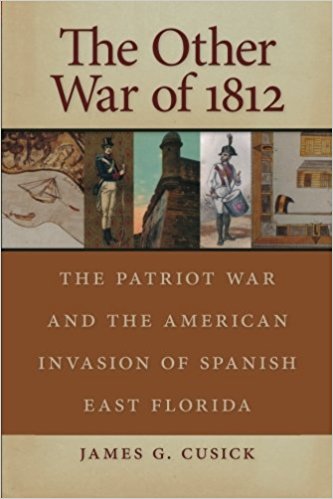
The Other War of 1812

The Other War of 1812: The Patriot War
© 2007 James Cusick
398 pages


If the War of 1812 rings any bells for most Americans, they may associate it with the creation of the Star-Spangled Banner, the national anthem whose lyrics no one seems to know.  Those with a taste for history who look into it may regard it as the United States' unfortunate ensnarement in the Napoleonic Wars,   responding to the attacks on its trade from  both English and French quarters. The invasion of Canada hints that the Americans were not quite perfect innocents, and still more persuasive is the case of the other invasion.  Far to the south, another war with ties to the War of 1812 had already been brewing, and would continue to work out bloody chaos for several years thereafter. I refer, of course, to the Georgian invasion of Florida.

Prior to its final annexation into the American union in 1821, Florida exchanged hands several times between the Spanish and English.  It was, in 1811, a strange sort of colony. Its residents were Spanish subjects, but most of the occupants and even leadership were not Spanish themselves.  Some called themselves Anglo-Spainards, for they hailed from varying parts of the British isles and yet gave Spain their allegiance while they lived in Florida.  Many were free blacks -- some having escaped from Georgia, some manumitted under Spanish law for various reasons.  There were even Minorcans, previously brought in by the English to help rebuild Florida after so many Spanish residents left following the Seven Years War.    Spain, in 1811-1812, was in a bad way:   its king was lost to Napoleonic schemes, its legitimate regent besieged by the French at Cadiz.  Any moment all of Spain would be lost to Napoleon, and then where would little Florida be?

Georgians were asking the same question, but they knew the answer. Little Florida would cling to Great Britain's skirts; they would allow British warships to steam from Floridian ports, there to play hell on American shipping. As war loomed with the English, the thought of the English navy safe at harbor so close to the American coastline was enough to raise anyone's hackles. Spanish Florida was an enormous pain even in good years -- not only did it continue importing new slaves from Africa, but it maintained itself as a safe haven for escaped slaves from Georgia. Worse yet,  these escapees were armed after joining the Florida militia.  And then there were the Indians, who were constantly used as a threat by Spain against the Georgians whenever border disputes loomed.  Getting the Spanish out of Florida would be useful all around.

In today's America, Florida would have never stood a chance. In these early years of the Republic, however ,expansionism was still being reigned in by circumspection and the Constitution; as much as Madison might want to take Florida,   how could he declare war against Spain -- the colonies' first ally! -- and shake them down? It was neither right nor lawful, and no one would let him get away with it.  Instead, Madison encouraged a certain revolutionary war colonel named Mathews to investigate the state of things in Florida,  and find people who wanted a little regime change. If they happened to raise the flag of revolution, kick the dons out of St. Augustine, and raise the American flag, well...then, by golly, who was Madison to stand in their way?

Of course, things didn't quite work out that way. The Other War of 1812, heavy with details of diplomacy and brush combat, tells the story of how the revolution  died before it began, but was artificially resuscitated by a few hundred Georgians pretending to be Floridians with a hankering for Independence.  Because the ranking US Army officer in Georgia maintained that he could not invade Florida, only come to its defense after the local 'authorities' declared independence and requested aide,  the Patriots leading their war against the Spain had to make do on short rations. Their war was grim, 'war even unto the knife'. Part of this was desperation, part of it the misery of battle conditions. (July is not fighting weather in the sunny South.)   The Georgians also had a serious grudge with St. Augustine and Fernandina, those cities who stole their trade and bid their slaves run, and they were especially vicious when fighting the Creeks, Seminoles, and free blacks of whom they lived in fear.    Eventually, the war petered out, but  the author points to the amount of destruction a few Patriots raised as one of Spain's reasons for realizing Florida was a losing proposition.  The Americans were too close and too hungry to be held at bay long.

The Other War of 1812 is a good bit of history -- substantial reading, yet accessible.   The war itself is not a riveting affair, just swamp raids, plantation burnings, and a prolonged siege of St. Augustine. There are a couple of stirring episodes  -- a scouting party cut off for four weeks in hostile terrain, somehow holding its own despite being vastly outnumbered, for instance --  but the real star here is diplomacy. I don't mean commissioners arguing with each other, but rather the light this sheds on how complicated relations were between the Americans, Spanish, English, and native crimes.  The author provides some books for further readings, as he links this Patriot war in with several of the Creek and Seminole uprisings that would erupt in the 18-teens.  I'm now itching curiously, but there's so much ahead of Creek wars in my interest queue.

Further Reading:

  • War of 1812, John K. Mahone. According to Cusick, this text  is singular in integrating the Patriot War, the War of 1812, and the Creek Wars together. 
  • Britain and the American Frontier, James Wright
  • Struggle for the Gulf Borderlands, Frank Owsley
  • The Spanish Frontier in North America, David Weber

Wednesday, March 8, 2017

Florida Under Five Flags

Florida Under Five Flags
© 1945 Rembert Patrick
160 pages


Note: I read from the 1st edition. This cover is from the 5th edition,  which has been updated and presumably revised.

The State of Florida entered the Union in 1845; in 1945, presumably as a centennial celebration, Florida Under Five Flags was published to provide an outline history of the state, from its beginnings as a Spanish frontier post through to the 'present day'. It is a history which can be enjoyed in a single evening, and is amply illustrated with historical art depicting cities like St. Augustine and Jacksonville; photographs of street scenes and prominent personalities are also included.

Florida titular historical accomplishment is having been an object of contention between virtually every European power with an eye toward American colonization. (Fernandina Beach cheekily claims to be the city of eight flags.)  The Spanish arrived first, though Ponce de Leon perished amid his explorations. The French were the first to plant a settlement, though the Spanish bloodily drove them out and began establishing a fuller colony, one with several towns and a network of missions. While Florida was expensive for the Spanish to maintain, its forts were crucial in protecting access to Mexico and the rest of "New Spain". The English quickly took an interest in Florida, but despite capturing the city of St. Augustine, were unable to triumph over its fortress, the Castille de San Marcos. What eluded them in combat was won in treaties, however, and Spanish Florida became British-controlled West and East Florida -- governed from Pensacola and St. Augustine, respectively. Florida flourished under British rule, but would be ceded back to Spain following the American Revolution. Amid the turmoil of the Napoleonic years, Louisiana and Florida were both juggled by France and Spain, and the aggressive interest of the nearby United States made selling the land more feasible than defending it into the poorhouse.

Florida, having been depopulated virtually every time it switched hands, began attracting settlement from the Southern coast; the multitude of planters from Virginia, Georgia, and the Carolinas who took a part in creating a new American state meant that despite Florida's radically different climate, in culture it was part of the South, and would follow where the southern states led. That meant secession only twenty years after becoming formal members of the Union. Florida's ports were immediately targeted by the Union navy, falling before the war was even a year old, but Florida itself was spared most of the devestation of the conflict. Only a few minor skirmishes occured within the state, mostly over the control of salt-works. Florida was still subjected to Reconstruction, but plagued by corruption that set back genuine progress for decades. Florida soon recovered, and as railroads unified the state and linked it more firmly to the rest of the county, its cities began growing all the more. A once economically-sleepy peninsula home only to rude huts and subsistence agriculture had been transformed into a prosperous State, one which played an important role in the Spanish American war and which was poised to participate even more fully in American life.

I read this principally interested in colonial Florida. While it is only an outline history, the narrative is perfectly enjoyable as a story. I suspect parts of it would be rendered differently were it published in the modern era, particularly the author's mere mild condemnation of slavery. I didn't realize how long Florida took to become fully "settled"; the author writes that Florida's frontier wasn't closed until 1920. A book published so long ago is arguably irrelevant for understanding modern Florida, considering how radically it has changed in demographics, culture, and in its standing with the rest of the Union -- but as a survey of Florida's early history, it is perfectly enjoyable and helpful.

Original cover:


A scene from colonial St. Augustine.


Thursday, March 2, 2017

A History of Saint Augustine, Florida

A History of Saint Augustine, Florida
© 1881 William Dewhurst
196 pages


St. Augustine is the oldest European city in North America, founded by the Spanish in 1565.  Sitting at the mouth of the St. John river in northern Florida, it originally served to help defend Spanish ships from mischievous English pirates.   Its history offers students a view at the turbulent story of Florida during the colonial period; first an object of fixation to Spain, France, and Great Britain,  and later on one to Spain, Great Britain, and the United States.   Although Dewhurst's A History of Saint Augustine, Florida is an older work, a product of the 19th century, modern readers will find its author's hatred of slavery and defense of native Seminoles, Creeks a refreshing departure from that century's usual conceits.   It combines colonial history with accounts both tedious and fascinating, and is largely more about colonial affairs using the city than about civic life.

 I didn't realize until reading this how little I have ever thought of historic Florida. During the American Revolution, for instance, it was technically an English possession, a colony even; but because England had acquired Florida from Spain so recently (1763,  a hair over ten years before), and because the initial governors scared all the Spanish away, England had to repopulate the peninsula with new settlers--  and not just English-types and Scots, but Greeks. These newcomers shared no history or notion of common struggle with the northern colonies, and so when thirteen of their neighbors became states, the Floridians ignored invitations to the Continental Congress.  Less is said about St. Augustine during the Civil War, for the city was  captured by the US Navy before the war was a year old. Those who despised  the thought of living under foreign rule left the city, leaving a few loyal Unionists and a larger population who didn't  care one way or another.  The author ends the book by saying that Jacksonville's railroad connection to St. Augustine will keep it popular as a health resort,  winter haven, and site of tourism.

This little introduction to St. Augustine has only confirmed my realization (in reading The Spanish Frontier in North America) that Florida's colonial history warrants more attention!  I will be visiting St. Augustine within a few month's time, so do not be surprised to see more histories of Florida and St. Augustine in the weeks to come...


Wednesday, October 19, 2016

West of the Revolution

West of the Revolution: An Uncommon History of 1776
© 2015 Claudio Saunt
288 pages


In 1776, the bid of thirteen colonies for independence wasn't the only interesting goings-on in North America.  From Alaska to Cuba, colonial and native powers were fighting, trading, exploring, and competing with one another. West of the Revolution begins with Russian forays into the Aleutian islands,  moves south to Calofornia, where Spain frantically attempted to create a safeguard after catching wind of the Russians,  and then takes readers across the Rockies and plains until the Mississippi is reached. There, we travel south to Cuba, which was not only a prospering sugar plantation but a potentially powerful trading partner of the Creek people in the Southeast.   Brief and full of interest,  West of the Revolution not only sheds light on what else was happening in 1776, but provides the context for future developments in American history --  the drive towards the Mississippi and the hunger for Florida.  There's also a rare look into Canada, or rather the Hudson Bay area and still later, a region that encompasses both Canadian and American states. A section on the Black Hills, known to Americans as the home of Mt. Rushmore,  makes plain their importance to the Sioux and other tribes: the Hills are an oasis of rain in a relatively dry region, and for generations a source of food and materials in lean periods.   I discovered this book via a podcast (Ben Franklin's World) and can pass on the recommendation,  no less for the information on Russian and Spanish colonization as for the tour of North America, this most diverse and extraordinary continent.

Monday, July 4, 2016

Our America

Our America: A Hispanic History of the United States
© 2014  Felipe Fernández-Armesto
416 pages


Spain disappears from American history books following the Spanish-American war, in which the tired old empire was given a sound thrashing and retreated from the hemisphere, but Spanish America isn't a thing of the past.  Its heritage is older than English America, not only because the Spanish arrived first but because Spanish colonialism fused itself with the peoples and culture which it found.  Our America is a history of Spanish America, principally Mexico,  delivered from the rare perspective of a Spaniard raised partially in England.  While not nearly as sweeping as Harvest of Empire: A History of Latinos in the United States,  it offers abounding detail on the Anglo-Spanish struggle for power, first around the Gulf Coast and then later in the southwest as English colonies developed their own identity and ambition.  It is problematic, in that a Spanish Brit spends the book lecturing a American audience on what being 'American' is, but the perspective is unusual and at times refreshing.

Fernández-Armesto examines American history not from the east to the west -- which is how, in fact, the history of the United States as a government unfolded -- but from south to north.  He sees the United States as more colonial than European, and interprets affairs like the Revolution and the Civil War as part of general new-world struggles against colonial power. He sees the South's bid for independence as very kin to Mexico's own battles between centrists and decentralists, for instance . As mentioned, Our America's focus is Mexico and the Southwest, with Cubans and Puerto Ricans receiving scant attention at the very end. Our America is thus more a history of "New Spain" -- a label which, prior to the collapse of the Spanish empire during the Napoleonic wars, encompassed both areas.  If Fernández-Armesto actually hailed from Mexico, this could be called a localist history of the United States, rather like a history of the US delivered from the perspective of the South.  The chief weakness of this book is that the author confuses the United States and 'America' when he argues that the United States began with Spanish America. While the Euro-American experience as a whole began with Spanish exploration, the 'United States' is a government formed by thirteen States along the eastern seaboard of North America, ground never trod by the Spanish.  He also attributes European success in the Americas largely to the 'stranger effect' -- an effect which included hospitality given to visiting strangers, respectful awe of travelers from afar, and  the inclusion of them in native government to swing local battles for power one way or another.  While it's a factor to take into account, he completely writes off the 'guns, germs, and steel' triad in favor of this social element.

As a general history of Latin America, I think Harvest of Empire superior; but the amount of detail given to Spain and England's colonial wrangling, and later the American conquest of the southwest, makes it a book of note. It's certainly gotten my interest in the Spanish colonial period fired up!

Related:
American Colonies, Allen Taylor. Colonial history of Spanish, French, English, Dutch, and even Russian America.
The Earth Shall Weep: A History of Native America, James Wilson
Harvest of Empire: A History of Latinos in America, Juan Gonzales

Saturday, March 26, 2016

The Scotch-Irish

The Scotch-Irish: A Social History
© 1989 James Leyburn
397 pages


        Though they have long ceased to be a distinct ethnic group outside of Appalachia, for years the greatest non-English minority in the United States were the Scotch-Irish.   Theirs is a history riven with politics, for they were created by it and became the shapers of it once they moved to America.  The Scotch-Irish appraises not only their political history, however, but the evolution of their character, distinct culture, and social institutions. It is a triptych, the story of a people told across three lands.   The story begins in Scotland, a place slow to join the Renaissance, but quick to grasp the Reformation. Scotland indeed became a  hotbed of diehard Presbyterianism, and as the  Crown began supporting the established Anglican church more firmly, it drove Puritans into the Netherlands and Presbys into Scotland.   Of course, the Crown wanted more Protestants in Ireland; a good strong community of them could withstand Gaelic wiles and serve to consolidate the Crown's position. The Ulster plantation soon developed a culture distinct from Scotland's, despite constant emigration from it, and Leyburn devotes particular attention to the social power of the Presbyterian church as it branched out.  Ultimately, rent hikes would drive many of the "Ulster Scots" to America, where their loathing for the crown and aggressive westward rambling would spur on the Revolution.  Leyburn  offers state-by-state tracking of the Scotch-Irish as they grew in number began filling the interior, making this social history of immense value to students of colonial history, complete with deep background in Irish and Scottish history.


Related:

Saturday, June 13, 2015

American Colonies


American Colonies: The Settling of North America
© 2001 Alan Taylor
526 pages          


American Colonies is a sweeping history of the New World,  one that attempts to convey the full American experience, beginning with the arrival of natives and then covering Spanish, French, English, Dutch,  and Russian colonial efforts in turn.  (Hawaii is also addressed, though it’s a bit of a two-thousand mile stretch to call it ‘American’.)  Taylor's declared intention is to tell more than simply the Anglo-American story, which relegates the Indians and other European powers to the role of villains.  At this, he is largely successful, providing a complete survey of native and European settlement and rendering the history of their relations with one another.  The work demonstrates how profoundly diverse both the natives and the Europeans were, documenting the extent of their tangled military and diplomatic relationships. The tacks taken against the natives by Europe varied not only from country to country (in Spain's case, no tact was involved), but from colony to colony, as varied geography and the nature of the neighbors demanded intelligent adaptation. The story of the New World is not simply one of Europeans plowing over the war-and-disease-ravaged lands of peoples like the Iroquois and the Lakota, however, for Europe’s nations also waged war against one another in this new battlefield.

Taylor's narrative style is pleasant enough, even if bothered with a little factual repetition. The content itself is a different story, being nearly five hundred pages of disease, war, slavery,  misery, and death.  No group discussed here comes off particularly well, not even the one-paragraph Vikings. Both the European and native powers wage war against one another and themselves, and in utterly vicious ways;  every chapter brings descriptions of  women raped, children executed, homes and fields burned, men tortured. There are no noble savages here,  and no exemplars of Christian civilization -- only ambitious and wrathful men with blood on their hands.

Taylor's narrative gives a good general view of European evolution, as explorers turned to nation-builders. Death ended to follow in the wake of the pioneers, as many of the diseases Europeans were exposed to as children never existed in the Americas, particularly those which originated from domestic animals, like smallpox.  Early colonists arrived with varying motives; some seeking fortune,  some to create a new society in their own ideal image, and others because it beat starving to death at home.  Invariably they offended their new neighbors, and war erupted.  Conflict between the native peoples and the newly-arriving colonists forced them to adapt to one another:   after seizing Canada, for instance, the English realized it was easier to give their new neighbors tribute every now and again than to maintain a war-footing. The natives, too, had adjustments to make: in the first pitched battle between European forces and Indians, for instance, the tribe in question attacked in a massed formation that fared none too well against organized gunfire. They quickly adopted the guerrilla tactics now associated with 'Indian warfare'.  

Taylor also puts forth a few theories of his own, all rooted in a worldview that sees economic warfare as the driver of everything else. In his view, the French and Iroquois maintained war between themselves for economic advantage,  as the warzone between their territories prevented regional competition with other powers for their goods. Though no fan of capitalism, Taylor's punches against mercantilism could be thrown by Adam Smith himself, pointing out how mother-country meddling smothered economic development time and again. Intriguingly, he suggests that the tax policies that sparked the American Revolution were not simply enacted to cover the costs of the French and Indian War, but to discourage too much emigration to the colonies. 
Slavery is a recurring topic here; a common byproduct of war,  in the age of discovery and colonization it became an economic institution,  especially as practiced in the colonies of the deep south and in the Caribbean.  The sugar plantations of the Indies were particularly dependent on slave labor; for this reason the abolitionists of William Wilberforce’s day avowed that those who took sugar in their tea might as well be drinking the blood of captives. The ranks of slaves were initially more diverse, consisting of captive natives who died in great numbers, and indentured Europeans who ran away and assumed the identity and status of free settlers.  Africans were already accustomed to Old World domestic diseases, and stood out from among both the native and European populations. Consequently,  the plantation lords drew more from African markets, and slavery assumed a racial-and color-based nature, the legacy of which continues to poison the society of the New World.   Before this, however, African slaves had been treated like any other indentured servants,  freed after a time of service and thereafter at liberty to create their own fortune – sometimes by investing in slaves.

American Colonies is a book to be considered,  taking on centuries of North American history  and taming it. Taylor's stated goal was to go beyond the English colonies on the seaboard, and this he does -- taking the reader as far south as Mexico, and galloping through the plains of the Apache to the northern wastes of Alaska.  He makes the complex comprehensible and is especially valuable in the time spent on Spain and France. He has a particular animus against the English and their American 'spawn' that grows tiresome; to his credit, however, he does not make their rivals into moral paragons.  Perhaps it's not so easy to be detached from one's ancestors as those in academia might wish.

Related:


Friday, June 5, 2015

The Colonial Experience

The Americans: The Colonial Experience
© 1967 Daniel Boorstin
528 pages


   Daniel Boorstin’s The Americans delivers a cultural history of the American colonies, beginning first with profiles on the disparate groups that settled on the eastern seaboard (Puritans, Quakers, and Cavaliers), and then following the growth of American religion, law, and education in the new world.  Though appearing weighty, being five hundred pages or so, the expanse flies by in a multitude of comparatively short chapters, divided (appropriately enough) into thirteen sections.  This is an inbetween America, neither raw nor finished.  For students of American history, this is deftly written, and gives a feel for how truly distinct the settling populations were, both in their origins and in their evolution.  While the Pennsylvania Quakers and New England Puritans set out to create utopias on a fresh plain, for instance,  Virginia’s settlers knew perfectly well that the utopian mark already existed in England, and their intention was to re-create its social institutions. Despite the wide variety of these cultures,  constant resettlement from one area to another in the pursue of fresh land ensured a mix of experience, and  prevented rabid clannishness.   Despite being mostly agrarian, agriculture would be the nascent American civilization’s weak point: flush with land,  no one had any interest in putting a great deal of imagination or work into improving their lot. Once tobacco or cotton had drained the soil, they could simply move on.  Otherwise,  the abounding energy and optimism of the Americas, so distant from the institutions of Europe, allowed for enthusiastic questioning that led to early triumphs in technological and scientific innovation. For Americans interested in the lives of the founders, this provides an enormous amount of  storied context.

Related:
Daily Life in Early America, David Freeman Hawke

Thursday, March 12, 2015

Runaway Slaves

Runaway Slaves: Rebels on the Plantation
© 2000 John Hope Franklin, Loren Schweninger
480 pages


Easily the most horrible aspect of American history, is the institution of slavery.  Indentured servitude had been a historical norm for centuries before, of course,  usually the mark of war, but in America it was paired with racial ideology to become utter evil.  Although it eventually perished in 1865 at the hands of the 13th amendment, those whose lives it claimed were not necessarily willing to wait for freedom to be granted;  instead, they took it. In Runaway Slaves, historians John Hope Franklin and Loren Schweninger establish how chronic absenteeism and escape were throughout the slave states, revealing the institution's gross unnaturalness and complete incompatibility with the human spirit.

Precious few people in the 21st century need to be convinced that slavery was wretched, and the few who maintain that it was a necessary evil, or that its abuses were exaggerated out of proportion, would do well to confront Runaway Slaves, presenting as it does not only one human story after another about men, women, and even children resisting tyranny over their lives, and 'voting with their feet' by  escaping into the wild, but statistical evidence that reveals how persistent a problem runaways were.  Readers might expect the abused to flee, and so they did, but here too are stories of slaves who were treated 'well' -- plantation pets, like the few Jefferson kept in his mansion and doted on.  Even when provided with an allowance, comfortable quarters,  and easy work, slaves still persisted in running off from time to time ,to the utter bewilderment of owners who concluded that some Africans were simply born mad.  The runaways were not simply driven by some principled insistence that they ought to be free;  the most common motive cited here is reunification with family.  Of course, the data is incomplete; many runaways simply disappeared into history, and their motives and stories will never be told. Most did not attempt to to transverse the entire country to make into a free state, or Canada; instead, Franklin and Schweninger report, they either lingered around the edges of plantations (to be close to family, or help them escape), or migrated to a large city like Baltimore or New Orleans, where they could lose themselves in the masses that included substantial populations of free blacks. Because the data the authors work with spans most of the 19th century, readers will also appreciate slavery evolving as an institution;   legal terms of servitude that expire give way to perpetual bondage, and captured African tribesmen still bearing the tattoos and piercings of their tribe's customs become the fathers of generations born into slavery, knowing nothing else.

Runaway Slaves is a solid piece of historical writing, providing human faces to the many thousands gone,  turning a multitude once viewed as a factor of production into lives who must be reckoned.  As soul-wearying as it can be to realize how many lives were wasted away in bondage, there is also room for hope in the fact that resistance was never absent from the scene. Regardless of beatings or bread and circuses, men are, and of a right ought to be, Free.


Thursday, January 22, 2015

Nullification

Nullification: How to Resist Federal Tyranny in the 21st Century
© 2011 Thomas E. Woods, Jr
309 pages


In a game of word association, chances are that 'nullification' would not meet with flattering replies. Nullification is a word associated with the Civil War, or the Civil Rights movement, of the southern states blocking attempts at racial equality by insisting on their own right to declare a federal law unconstitutional, and thus null and void. But nullification has a richer and nobler history than its modern critics realize; in Nullification,  Tom Woods explains the legal basis of the principle, demonstrates its use throughout early American history, and points out areas in which the states have adopted it as a tool today.


Nullification's sanction, Woods argues, rests in the little-c constitution of the United States. Though today the fifty states may seem like mere departments of the national polity, in the beginning this was not so. The united States began life not as a nation, but an agreement between thirteen, and with specific purposes. Treaties from the period enumerate the individual states, demonstrating their primacy. If not the States, who may declare a given law unconstitutional? The Supreme Court has assumed that role ('judicial review'), but as part of the government, how can it be expected to police itself?  The individual States, however, have existence without the national government, and it exists, or was supposed to have existed, as their handmaiden -- not the other way around. Theirs is the right to declare the actions of Congress, the President, and the Court unconstitutional -- but theirs is likewise the responsibility to create measures for frustrating the government's knavish tricks.

This they have done, from as early as the Adams presidency til today. Nullification first came onto the scene after the Federalist congress put into effect the Alien and Sedition Acts, which made defaming the government and its officials a crime. (Defaming the government was, until the rise of baseball, the national sport, and especially loved by Jefferson, Hamilton, and their respective parties.) Straightaway governors began throwing up barriers to federal agents attempting to arrest mouthy citizens. They did the same when, during the Napoleonic Wars, President Jefferson imposed an embargo on Europe -- an embargo that might have driven American trade to its knees. The reality and the threat of nullification continued to force the hands of overambitious executives. Today, legislative sabotage continues as states decriminalize marijuana use even as the federal  government continues to insist it's a no-no.   Given that the US attorney general is now retreating from parts of the War on Drugs (starting with that odd habit of theirs of seizing  property that has been declared guilty of participating in a crime), the principle seems just as potent.

Nullification is a small book (~165 pages, not counting the documents appended to it), but is a very worthy introduction to compact theory, in which the States are legally superior and not subordinate to the national state. It's also a respectable attempt to rescue nullification from its historical taint, but loses some points given that Woods never squarely addresses the threatened use of it during the 1960s, maintaining only that nullification is a weapon that can be used unjustly as easily as it can be for justice.  I was also hoping for other kinds of nullification to be covered (like jury nullification), but Woods focused only on formal measures by the States themselves.  Altogether it's a solid intro to the subject, and I am all for throwing wrenches into the machinery.


Related:
The Liberty Amendments, Mark Levin,  all of which aim to restore to the fifty states their original power over the central government.

Saturday, September 13, 2014

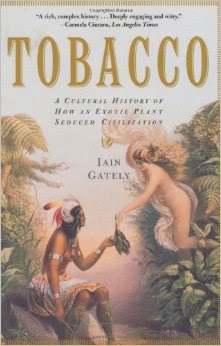
Tobacco

Tobacco: A Cultural History of How an Exotic Plant Seduced Civilization
416 pages
© 2003 Iain Gateley


The age of discovery opened an era of global domination by European culture and power, but in at least one instance, the new world had its own victory. Tobacco, smoked heavily throughout the Americas,  took the world by storm once European sailors started smoking, sniffing, and drinking (!) it. sometimes reaching parts of the planet even before they did in a chain reaction. Tobacco is a straightforward history of the weed's own conquest.

A native of the Americas, tobacco had many roles in the cultures of the Aztecs, Incas, and more. They smoked the plant, but they also applied its juice to their eyes and skin; the principle use of tobacco was in shamanic ritual and herbal medicine.  Europeans dabbled with this (there is no substance on Earth that has not been championed as a cure-all at some point), but  sailors and conquistadors soon used it chiefly for recreation.  Smoking was a completely new phenomenon to Europe, and neither the Catholic nor later the Islamic powers knew what to make of it. It stunk of the devil, but neither the Bible nor the Koran expressly forbade it, and soon enough even priests were taking snuff during Mass. Everywhere European trade-ships went, they took sailors and tobacco, and the people they met spread the good news of smoking with such profligacy that when European explorers penetrated the heart of Africa, they found tobacco already waiting.

Tobacco offered mental stimulation and relaxation without the drunkenness of alcohol, though there was still vomiting involved if one overdid it.. Tobacco was soon grown worldwide, and formed the basis of much of the colonial American economy.  Cigars, like whiskey, weathered Atlantic crossings far better than raw foodstuffs, and could retain value.  Their use as a trade commodity can't be understated; even well into the modern era, tobacco was used as money. In World War 2, for instance, not only did soldiers and prisoners use cigarettes as currency within their respective institutions, but in financially-stressed Nazi Germany,  cartons of cigarettes were used as stable money when the official currency was being played with. (This, despite the official Nazi forbidding of tobacco!)

Besides recreation and money, tobacco served a multitude of ever-changing social roles. Different types of tobacco consumption marked different cultures, like the cigar's association with power and the pipe with middle-class respectability.  The cigarette began as a French invention, and was resisted for the longest by English tabagophiles, who looked askance at anything French. Initially derided as weak, soft, and effeminate,  cigarettes eventually became the standard use of tobacco for various reasons -- their cheapness, ease of use, and near-immediate addictveness among them.  People embraced the cigarette as a way to spit at traditional values; what Oscar Wilde started, flappers continued.  It helped that cigarettes had an enormous media presence; barred from depicting steamy romance onscreen, Hollywood used cigarettes to establish connections between characters and create imagery thick with innuendo. Even after concurrent skyrocketing rates of cigarette consumption and lung cancer indicated a medical crisis in the making, people continued lighting up. If anything, the warning labels and danger increased their allure.

Eventually in the English-speaking world, at least, governments decided to start taking more strident action;  in the United States,   areas where one may smoke are the exception and no longer the norm. Tobacco's rise and possible fall have both happened with stunning rapidity, and Gately is an entertaining guide to its story; he delivers a bounty of information in one rapidly-moving narrative that doesn't tire. . As with Drink,  Tobacco is globetrotting;  America and Europe get most of the attention, but no corner of the globe goes unremarked on.  Even for a nonsmoker like myself, Tobacco has value as cultural history, if only to demonstrate how quickly entire ways of life can be transformed, repeatedly. (It's one of the reasons I like histories of consumer goods so much -- the human capacity for fads is amazing.)  More importantly, it's fun, a history filled with adventurers, rebels, pirates, and scheming businessmen.


Saturday, August 16, 2014

Drink

Drink: A Cultural History of Alcohol
© 2008 Ian Gately
546 pages


"We should thank God for beer and burgundy by not drinking too much of them." 
- G.K. Chesterton, Orthodoxy

A substance that a third of the world institutionalizes as a religious sacrament and another third expressly forbids  on religious grounds is one to be reckoned with. Since time immemorial, humans have been getting themselves sloshed in one way or another, putting their ingenious minds to work creating alcoholic beverages from whatever plants were available.  Drink is a sweeping history of the potent brew in its many forms, created and consumed by every culture and on nearly every continent.  It's a social history of a sociable subject -- for when people drink, they rarely do so alone. 

Alcohol's roots extend to the beginnings of civilization itself;  where there were grains, there was booze. Wheat rendered beer and rice, sake, and both beverages were the staple of many civilizations' diets. This owes not only to the human race's fondness for getting itself knackered,  but to the fact that bacteria-killing alcoholic content made beer a safer source of water than water itself.  Processing wheat products into potable beverages extended their lives, and sometimes gave people an edge, especially as distillation created drinks with long shelf lives. 

Beyond economic contributions, the communal consumption of alcohol created social ties as well. Not only was wine considered a doorway to inspiration from the muses -- a place later assumed by absinthe -- but drinking it together at feasts loosened tongues and allowed for more honest conversation. Not for nothing did the Romans say "in wine, there is truth.”   Not that true and alcohol were steady partners; mead-drinking also went hand and hand with vigorous boasting about deeds in battle. 

Abuse of alcohol has existed since  its cultivation,  something it lends itself to in affording an escape. Early industrial mill workers steeled themselves with ale to ensure the day, and the Romans were absolutely riotous. While the prevailing  view expressed by people throughout the book is that alcohol is an exquisite complement to life, in moderation,  in view of its power some have attempted to ban it altogether. Islam, for instance, forbids it, and has for centuries. Far less successful was the west's own attempt at prohibition, which led to the rise of organized crime and contempt for government.  

Drink, like those who have imbibed a bit too much, is outstandingly ambitious in trying to render a comprehensive history of alcohol and culture. While he's most thorough covering  the western world,   recurring chapters also address alcohol in China,  Japan, the middle east, and South America.  A 'cultural' history verges on the literal, as Gately examines alcohol's depiction and relationship with art, literature, and the movies.  Yet for all the ground to be covered, Gately does rather well;   the book's bar is well-stocked with stories, and if one doesn't suit your taste another setting and different subject are right behind it.


Related:
A History of the World in Six Glasses, Tom Standage.  A history of the world as told over wine, beer,  coffee, tea, rum, and Coca-Cola.


Sunday, July 13, 2014

Daily Life in Early America

Daily Life in Early America
193 pages
© 1988 David Freeman Hawke


            Daily Life in Early America examines up-close the new world European colonists were discovering and recreating for themselves.  A social history, focused on daily life, the author begins first in England, reviewing quickly what work and social customs the colonists would have been accustomed to.  It begins and continues as a study in variety, for there was no ‘average’ English colonist; manners and means of living varied widely from county to county, even before they combined with German and Dutch settlers on the North American seaboard.   Although I read this as background for Independence Day readings,  early America well and truly means early.  Hawke tells the tale of men creating a civilization from the wilderness, often borrowing largely from the disease-vanquished native cultures which collapsed or retreated following exposure to European guns, germs, and steel. Although they attempted to recreate what they left behind in North America, creating a  New England on the model of the old,  the challenges and opportunities presented by the vast frontier spurred the evolution of a different culture. Covering everything from floor plans to the art of war, from superstition to politics, Daily Life in Early America delivers an abundance of information in lively style. This is definitely an author to look more into..  

Related:
Life in a Medieval Village,  Life in a Medieval City, Daily Life in a Medieval Castle, Marriage and Family in the Middle Ages;  Frances and Joseph Gies

Saturday, July 5, 2014

George Washington's Secret Six

George Washington's Secret Six
© 2013 Brian Kilmead
257 pages


Wars are not won by soldiers alone. In the shadows are those silently gathering information, sometimes at great risks to themselves,  to give the nation's leaders an edge over the foe -- or to prevent the foe's own shadowy talents from doing likewise. George Washington's Secret Six is a flashy history of a civilian intelligence ring operating throughout the revolutionary war, a ring that invented by necessity many of the tactics still faithfully and productively employed by intelligence agencies today -- and a ring that accomplished more in the dark than the young nation's struggling army did on the battlefield. It's an area of history which is getting increasing attention these days, but The Secret Six is as its title indicates intended for a popular audience; it's quite casual history, full of energy and fanciful storytelling -- including scenes with dialogue. Given that the book is centered on New York, and that George Washington spends its entirety brooding over reports from the spies that give him little hope for taking the city, the full title seems something of an overreach. Despite the fact that the ring was created to help Washington free New York City from the British, however, they keep turning up information of interest outside that limited theater, like a plot to undermine American currency through counterfeiting.  These episodes link  the spy ring to a war that otherwise seems to be taking place in a place far, far away.  Though limited in scope, and distressingly sparing in cites sources,  the heroism undertaken by the merchants and common men and women is well worth being introduced to, as is their cleverness.  It remains of interest despite being very light history.


Wednesday, July 2, 2014

The American Tory

The American Tory
© 1972 ed. Morten Borden, Penn Borden
141 pages


American colonists yearning for independence from Britain called themselves Patriots, not in opposition against the not-yet-arrived royal army, but to set their cause against that of the Loyalists. Not all colonists supported separation from Britain; even in the steamy summer of 1776, with war already waging, some congressmen were reluctant to shove away any hope of reconciliation with the mother country. They were bristling against their rights offended as Englishmen, were they not?  The American Tory collects the reactions and thoughts of loyalists during the revolutionary period to the turmoil happening around them, as well as accounts of how they were treated by the revolutionaries, and how they and the patriots regarded one another.

'Tory' first described the defenders of the king's cause during the English Civil War, and is sometimes used as a byword for conservative. In the United States, 'tory' seems have been hurled at loyalists with particular hatred. Good, then, that they be given a chance to speak. This is exclusively a collection of excerpts from letters, speeches, assembly minutes, and official proclamations from the period, including two essays comprising histories of the revolution from the patriot and loyalist views. The collection offers a look into the myriad reasons that loyalists gave for staying true; ardent devotion to England,  fear of revolution driving everything to ruin,  and an abiding distrust of those agitating for separation. The Congress made a lot of noise about violated rights, but what if their real motives were more base? What if Adams and Washington simply wanted to create grander names for themselves than peace and cooperation allowed for?  And where did those rights come from, after all, if not the English law, embodied in the person of George III?

Although the patriots liked to dismiss the loyalists as fainthearted and timid, too afraid to make a progressive leap into the future, the abuse many endured for their abiding convictions puts the lie to that. The far easier course would have been the sunshine patriotism Tom Paine grumbled about in The Crisis.  There is pragmatic sense in the tories' belief that rights depended on the application of force -- rights unobserved have no functional existence--  and the able bedrock of the law --  but who wants to depend on the state for the defense of their rights?  The United States still avers to live by natural rights, but do the actions of its government live up to that? Certainly not, and nor did the king and his parliament's.  The struggle between a people's rights and their government's desires is never over, and the strife between the tories and patriots was less a battle between good and evil and more the ancestor of our own debates today.   There is much value in this little book, not only for giving the loyalists a nuanced opinion, but in showing how similarly their passions were expressed.  Both sides used the same language, referring to the respective opposition as a junta, and both taking stands in defense of liberty. The tories saw liberty threatened by disorder and wars; the patriots, by a peace accomplished at the price of subservience; both feared the others' banditti

Such realizations are helpful now, as in any time, to realize how people are more often linked than their passion will allow them to admit. There is still room for civility, here evidenced by one Tory expressing his admiration of George Washington and hoping, if he is defeated, it is a noble defeat, one worthy of the man.   This is in short a fascinating and profoundly helpful work for those seeking to understand the revolution and its causes.


Saturday, June 28, 2014

The Scarlet Letter

The Scarlet Letter
©  1850 Nathaniel Hawthorne
180 pages          


         In 18th century Boston, a young woman stands upon the gallows in the center of town, facing down the contempt of the assembled mob. Having broken the laws of her adopted Puritan home, Hester Prynn must endure its punishment for her crime:  lifelong ignominy. Having conceived a child out of wedlock – and with a man not her absent husband – she will wear forever on her breast the  prominent letter “A”. The Scarlet Letter is a story of morality, persecution, and redemption;  an American classic whose readability belies its status as a classroom staple. 

        Though Nathaniel Hawthorne was writing in a setting a century before his, and including historic personalities like John Winthrope, The Scarlet Letter is less a gritty historical tale and more a legend – and, like all good myths, one with a point. Its heroine is a legend in her own time, a woman whose morality could not be contained by her community. Judged a sinner,  Prynn accepts the verdict of her community, knowing she has broken its rules. She wears the scarlet letter with quiet dignity, but her own skills as a seamstress and moral center give her a strength that carries her through the years, despite being an outcast.  She does not run away from her moral imperfections, nor their consequences, but embraces it,  making her life’s work the support of the poor and infirm -- combating passion with selflessness. Though she bears the titular mark of indiscretion, the piece’s true sinners are her husband and the local minister, both with secrets. The husband arrived in town just in time to see his near-abandoned wife on the scaffold. Perhaps it’s the months spent imprisoned by Indians, but hubby dear is a decidedly nasty sort who decides to adopt the false name Roger Chillingworth, and give himself the quest of finding out who cuckolded him and then destroying the man.   The Reverend John Dimmsdale, who – as you might guess is the third part of this little love triangle --  is equally responsible for Hester’s sin, but cowers from accepting it, fearful of the consequences. Though he professes an admirable concern for his congregation's welfare, his and Chillingsworth’s actions through the piece most decidedly are not, and by its end all actions have found their inevitable fruit. Prynn is redeemed, and the others…well, not so much.

        I expected dreariness of a novel set in the Puritan world, but Hawthorne's characters are highly spirited, especially Prynn and her little daughter, Pearl. Hawthorne writes in clear condemnation of the Puritans' severity, though  it is doubtful that he condemns their morality in general considering Prynn's decision to live in a spirit of penitence thereafter. Although the dialogue is purposely stilted (the Puritans seeming to take the KJV bible as their guide in speech), this is a novel filled with passion that roars along, with moral arguments along for the ride.  The Scarlet Letter is quite laudable.