Showing posts with label American Frontier. Show all posts

Thursday, July 27, 2017

The Mexican Frontier

The Mexican Frontier 1821 - 1846: The American Southwest Under Mexico
©  1982 David Weber (University of New Mexico Press)
440 pages


In 1821, the people of Mexico declared their independence from Spain, recognizing that its Napoleonic straits meant that the mother empire had little future left, either at home or abroad.  Once the bid for independence had achieved its aims, the 'Mexican empire' spanned everything from Oregon down to South America.  Within thirty years, however, the United States had invaded Mexico, seized its capital, and forced the purchase of nearly forty percent of  its northern land.  Sneaky Americanses!  Wicked! Tricksy! False!

Well, not really.  It wasn't David Weber's intention, but having read this history of the Mexican frontier I'm considerably less condemnatory about the treaty of Guadalupe-Hildalgo. Not about the war, of course,  but the treaty itself seems to have only hastened the inevitable break-off of the great northern expanses from Mexico proper. Weber's history begins with  Mexican independence, then details the decline of institutions in the north as the contest for power in central Mexico continued; with a consequentially distinct frontier culture emerging, one that would constantly struggle for its own autonomy. Central to this history is understanding that young Mexico went through several constitutions in those early years,  constantly struggling to find its way. The breaking-away of the north from central Mexico was partially grounded in dispute over which constitution was legitimate: the more republican 1824 constitution, or the more authoritarian 1832 constitution imposed by the ilk of Santa Ana.

The fractures were only made possible by the precipitous decline of institutions in the north that would have tied states and territories like Texas, New Mexico, and the Californias more firmly to the government in Mexico City. The Franciscan missions, for instance, vanished with the Spanish -- in part because they were supported primarily by Spain, in part because many monks were Spaniards more faithful to their patria than their parish,  and in part because  Mexico wanted them out of the way. The missions had all the best land and labor, and if they could be dispatched with, then settlers could move in and hire the newly-emancipated Indians as workers.   Although Mexico officially secularized the clergy -- replaced the Franciscans with state-paid priests --  it did this so slowly that  the Church effectively disappeared in the frontier, and with it marriages and schools and other civil functions that the state was slow in restoring.

Another primary institutional failure was that of the military; because central Mexico's government was so unstable, its  army stayed close to home, either to stave off further intrigues or participate in some. The array of presidios that once guarded the northern frontier, with its independent attachments of cavalry,  was poorly maintained; the soldiers were so scantily paid and armed that not only did civilians have to raise their own militias to defend themselves against Apache raids, but when the militias were on the attack, the presidio cavalry sometimes raided the homes they were supposedly protecting.   In addition, the Mexican government's economic policies -- forcing trade goods in and out of the interior to circulate first through far-distant Vera Cruz -- made supplies rare and expensive. The sheer distances between the frontier and Mexico city added to the eroding attachments between a place like California and Mexico;  the ruling city seemed to be as far away and imperious as Spain. Little wonder that in the 1830s, Texas declared and fought for its independence;  California declared independence but accepted a compromise that allowed it more autonomy; and New Mexico rolled with rebellion several times.

Because of Mexico's instability,  the failure of institutional ties to form or hold, and the sheer distance between cities like  Santa Fe and Mexico City,  the northern expanse of Mexico was increasingly oriented along another axis: it looked east, to America, for cheap, ready, supplies, and  eager settlers and tradesmen. That commercial and cultural Americanization of Mexico's north made it increasingly America's west -- hence why I suspect now that the treaty which ended the United States' unjust invasion of Mexico only hastened the inevitable.  At the risk of condoning Polk, the American federal system finally allowed for the 'home rule' that the restive north fought for in the 1830s.  Had Mexico not struggled so much to create  a stable government early on, it might have held on to much of what the treaty lost -- but it is a difficult thing to create civil society from scratch, let alone when a nation is being constantly invaded by invading Comanche.

Related:
The Spanish Frontier in North America, David Weber

Thursday, March 23, 2017

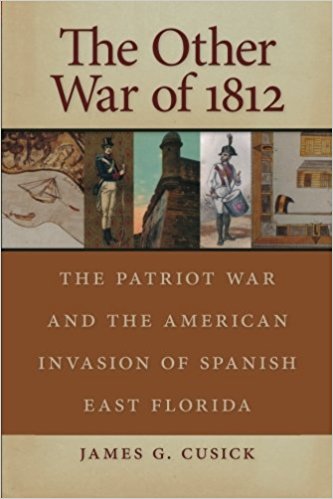
The Other War of 1812

The Other War of 1812: The Patriot War
© 2007 James Cusick
398 pages


If the War of 1812 rings any bells for most Americans, they may associate it with the creation of the Star-Spangled Banner, the national anthem whose lyrics no one seems to know.  Those with a taste for history who look into it may regard it as the United States' unfortunate ensnarement in the Napoleonic Wars,   responding to the attacks on its trade from  both English and French quarters. The invasion of Canada hints that the Americans were not quite perfect innocents, and still more persuasive is the case of the other invasion.  Far to the south, another war with ties to the War of 1812 had already been brewing, and would continue to work out bloody chaos for several years thereafter. I refer, of course, to the Georgian invasion of Florida.

Prior to its final annexation into the American union in 1821, Florida exchanged hands several times between the Spanish and English.  It was, in 1811, a strange sort of colony. Its residents were Spanish subjects, but most of the occupants and even leadership were not Spanish themselves.  Some called themselves Anglo-Spainards, for they hailed from varying parts of the British isles and yet gave Spain their allegiance while they lived in Florida.  Many were free blacks -- some having escaped from Georgia, some manumitted under Spanish law for various reasons.  There were even Minorcans, previously brought in by the English to help rebuild Florida after so many Spanish residents left following the Seven Years War.    Spain, in 1811-1812, was in a bad way:   its king was lost to Napoleonic schemes, its legitimate regent besieged by the French at Cadiz.  Any moment all of Spain would be lost to Napoleon, and then where would little Florida be?

Georgians were asking the same question, but they knew the answer. Little Florida would cling to Great Britain's skirts; they would allow British warships to steam from Floridian ports, there to play hell on American shipping. As war loomed with the English, the thought of the English navy safe at harbor so close to the American coastline was enough to raise anyone's hackles. Spanish Florida was an enormous pain even in good years -- not only did it continue importing new slaves from Africa, but it maintained itself as a safe haven for escaped slaves from Georgia. Worse yet,  these escapees were armed after joining the Florida militia.  And then there were the Indians, who were constantly used as a threat by Spain against the Georgians whenever border disputes loomed.  Getting the Spanish out of Florida would be useful all around.

In today's America, Florida would have never stood a chance. In these early years of the Republic, however ,expansionism was still being reigned in by circumspection and the Constitution; as much as Madison might want to take Florida,   how could he declare war against Spain -- the colonies' first ally! -- and shake them down? It was neither right nor lawful, and no one would let him get away with it.  Instead, Madison encouraged a certain revolutionary war colonel named Mathews to investigate the state of things in Florida,  and find people who wanted a little regime change. If they happened to raise the flag of revolution, kick the dons out of St. Augustine, and raise the American flag, well...then, by golly, who was Madison to stand in their way?

Of course, things didn't quite work out that way. The Other War of 1812, heavy with details of diplomacy and brush combat, tells the story of how the revolution  died before it began, but was artificially resuscitated by a few hundred Georgians pretending to be Floridians with a hankering for Independence.  Because the ranking US Army officer in Georgia maintained that he could not invade Florida, only come to its defense after the local 'authorities' declared independence and requested aide,  the Patriots leading their war against the Spain had to make do on short rations. Their war was grim, 'war even unto the knife'. Part of this was desperation, part of it the misery of battle conditions. (July is not fighting weather in the sunny South.)   The Georgians also had a serious grudge with St. Augustine and Fernandina, those cities who stole their trade and bid their slaves run, and they were especially vicious when fighting the Creeks, Seminoles, and free blacks of whom they lived in fear.    Eventually, the war petered out, but  the author points to the amount of destruction a few Patriots raised as one of Spain's reasons for realizing Florida was a losing proposition.  The Americans were too close and too hungry to be held at bay long.

The Other War of 1812 is a good bit of history -- substantial reading, yet accessible.   The war itself is not a riveting affair, just swamp raids, plantation burnings, and a prolonged siege of St. Augustine. There are a couple of stirring episodes  -- a scouting party cut off for four weeks in hostile terrain, somehow holding its own despite being vastly outnumbered, for instance --  but the real star here is diplomacy. I don't mean commissioners arguing with each other, but rather the light this sheds on how complicated relations were between the Americans, Spanish, English, and native crimes.  The author provides some books for further readings, as he links this Patriot war in with several of the Creek and Seminole uprisings that would erupt in the 18-teens.  I'm now itching curiously, but there's so much ahead of Creek wars in my interest queue.

Further Reading:

  • War of 1812, John K. Mahone. According to Cusick, this text  is singular in integrating the Patriot War, the War of 1812, and the Creek Wars together. 
  • Britain and the American Frontier, James Wright
  • Struggle for the Gulf Borderlands, Frank Owsley
  • The Spanish Frontier in North America, David Weber
Sunday, July 3, 2016

Death Comes for the Archbishop

Death Comes for the Archbishop
© 1927 Willa Cather
297 pages


Poor New Mexico -- so far from God, so close to the United States. The Pope can't help the tide of American -- and very Protestant -- settlement that is sure to follow Polk's war against Mexico, but the church in the southwest can be strengthened. To that end he dispatches Jean-Marie Latour to Santa Fe, there to serve as bishop.  Aided by his faithful friend, Joseph Vaillant,  Latour tarries with the people of New Mexico for decades before being buried by a doting multitude.  Cather combines beautiful descriptions of the landscape -- especially of the Sangre de Cristo mountains -- with lovely little stories about the bishop growing to know and love his new parishioners. Theirs is a world of danger, of ferocious storms, unforgiving heat,  occasional Apache raids, and plenty of brigands. Worse yet, the Americans are coming, and as they continue gaining land at Mexico's expense, the bishop's province grows, stretching from the Rockies to Mexico. He complains, good-naturedly, that it is hard for a poor bishop on a mule to keep pace with the march of history, with thousands of square miles of responsibility placed under his care.

The bishop and his companion compel interest for their gentleness; while he has come to restore discipline in a land where the priests have taken to siring families instead of nurturing the family of the church, he does not rush in where angels fear to tread. He realizes he is in a wholly new environment, and sees in the Indians -- the Apache, the Hopi, the Pueblo, and other peoples who were never reached by Spanish missionaries or forgot them -- a civilization with wisdom and conviction as deep as his.  He is awed by the ancientness of the land and the people upon it,  When he is wronged, as he is by a schismatic priest who refuses to accept oversight, he is still quick to forgive.  The sheer abundance of tenderness here, as generously proportioned as the western skies, make it a perfectly lovely read -- and all the more when Cather's brilliant descriptive writing is taken into account, creating an image of the Southwest with beauty that penetrates even the viewers' bones.


Thursday, June 30, 2016

O Pioneers!

O Pioneers!
© 1913 Willa Cather
230 pages


The history of every country begins in the heart of a man or a woman.


Hannover, Nebraska, is a frontier town on the brink of failing, a temporary camp upon a wild landscape that refuses to give up its bounty. A growing stream of families are selling their land at a loss and retreating back to civilization, there to eke out meager if predictable incomes as employees of someone else.  Alexandra Bergson has been urged to follow them: here she is, managing a homestead and a number of younger siblings on her own, virtually an orphan. For ten years her father labored here, and all he achieved was to pay off debt. But Alexandra loves the land she buried her father in,  senses that the winds will turn, and above all -- believes in her father's dream.  And so, she committs herself to it -- managing her resentful brothers, eagerly seeking out new information and carefully experimenting,  Virtually everyone leaves her. In the decades to come she is the core of her family, the creator of its success, whose growing staff of immigrants dote on her.  Her aim in life  is to see to it that at least one of her younger siblings transcend the farm, to gain entry into the professional class by the fruits of her labor.   Young Emil does, and for a time all seems right with the world -- but domestic bliss is denied to virtually everyone here. The ending, in which Alexandra seems to realize her vocation at the farm is fulfilled and is reunited with a cherished childhood friend, leaves one feeling slightly...unfulfilled.  It has an air of resignation, almost, but at least the writing and characters make the story worthwhile.

Frontispiece:  Grant Wood's Fall Planting. Wood is best known for his American Gothic, though my favorite is Spring in Town.

Related:
Hannah Coulter, Wendell Berry

Saturday, March 26, 2016

The Scotch-Irish

The Scotch-Irish: A Social History
© 1989 James Leyburn
397 pages


        Though they have long ceased to be a distinct ethnic group outside of Appalachia, for years the greatest non-English minority in the United States were the Scotch-Irish.   Theirs is a history riven with politics, for they were created by it and became the shapers of it once they moved to America.  The Scotch-Irish appraises not only their political history, however, but the evolution of their character, distinct culture, and social institutions. It is a triptych, the story of a people told across three lands.   The story begins in Scotland, a place slow to join the Renaissance, but quick to grasp the Reformation. Scotland indeed became a  hotbed of diehard Presbyterianism, and as the  Crown began supporting the established Anglican church more firmly, it drove Puritans into the Netherlands and Presbys into Scotland.   Of course, the Crown wanted more Protestants in Ireland; a good strong community of them could withstand Gaelic wiles and serve to consolidate the Crown's position. The Ulster plantation soon developed a culture distinct from Scotland's, despite constant emigration from it, and Leyburn devotes particular attention to the social power of the Presbyterian church as it branched out.  Ultimately, rent hikes would drive many of the "Ulster Scots" to America, where their loathing for the crown and aggressive westward rambling would spur on the Revolution.  Leyburn  offers state-by-state tracking of the Scotch-Irish as they grew in number began filling the interior, making this social history of immense value to students of colonial history, complete with deep background in Irish and Scottish history.


Related:

Friday, December 5, 2014

Where the Red Fern Grows

Where the Red Fern Grows
© 1961 Wilson Rawls
245 pages


“I suppose there's a time in practically every young boy's life when he's affected by that wonderful disease of puppy love. I don't mean the kind a boy has for the pretty little girl that lives down the road. I mean the real kind, the kind that has four small feet and a wiggly tail, and sharp little teeth that can gnaw on a boy's finger; the kind a boy can romp and play with, even eat and sleep with.”

Few books bring back memories of boyhood as swiftly as Where the Red Fern Grows. I can still remember my third grade teacher beginning to read this out loud, and my having chills as soon as the narration opened on an older man rescuing a tired hound dog and fingering a trophy on the mantle, thinking of two dogs he had loved fiercely as a child.   Where the Red Fern Grows is a classic story of a boy’s yearning for puppies, and the adventures taken on once such friends were found.

 Billy Coleman, the narrator, is a remarkable boy:  raised in the wooded foothills of the Ozarks, a hunter and trapper from the day he could walk, he wants nothing more than a faithful hound at his side.  The price of a hound bred for hunting matches that of a mule, though, and is beyond his family’s means. Undaunted,  Billy earns money  hunting crawdads, picking blackberries, and selling small furs until he has the funds – and then, when there is delay about sending off for the puppies, takes off into the wilderness and advances into the big city of Tahlequah to take delivery of them personally.   Training them personally, teaching them every trick he’s heard of and witnessed in his long hours watching and trapping on his own,  he and they become an inseparable trio, utterly devoted to one another. When the hounds Big Dan and Little Anne tree their first raccoon, Billy keeps his promise to them  to ‘take care of the rest’ by laboring several days and nights at the tree, hatcheting away, and when his strength fails he prays for more.  The dark nights and fast-moving creeks of the Ozarks provide danger aplenty, but they whether it together, even becoming regional champions of coonhunting. Every story has its ending, though, every childhood must end, and so does Billy’s in a violent altercation with a mountain lion. Billy himself survives, but his remembers the losses.


 Where the Red Fern Grows has a brutal ending, especially for young boys who, like me, doted on their own dogs, and felt the desperate pain of separation from them when life’s twists and turns made it so.  Reading now as an adult, I expect the ending, and so it is not quite gut-wrenching. Rather, like the narrator, the ending frames all of the fond memories that unfold in the story that is told before, putting them into focus. I only read this book once or twice in my youth, during the early 90s, but its scenes have buried themselves in my brain. For me this was a visit with an old friend, whose face I have not seen in decades, but not forgotten a line of.   The boy is everything a boy could hope to be -- courageous, intelligent, and beloved, with a pair of friends and a family who cannot be bettered.  This is a book filled with love and adventure, and often the two are intertwined to great effect.  It's also a look back at an America with a frontier, where civilization is contained within scattered sanctuaries and the woods filled with danger and excitement. There are few stories that can be more enticing for a young reader, especially boys!  

Related:

Saturday, June 28, 2014

The Scarlet Letter

The Scarlet Letter
©  1850 Nathaniel Hawthorne
180 pages          


         In 18th century Boston, a young woman stands upon the gallows in the center of town, facing down the contempt of the assembled mob. Having broken the laws of her adopted Puritan home, Hester Prynn must endure its punishment for her crime:  lifelong ignominy. Having conceived a child out of wedlock – and with a man not her absent husband – she will wear forever on her breast the  prominent letter “A”. The Scarlet Letter is a story of morality, persecution, and redemption;  an American classic whose readability belies its status as a classroom staple. 

        Though Nathaniel Hawthorne was writing in a setting a century before his, and including historic personalities like John Winthrope, The Scarlet Letter is less a gritty historical tale and more a legend – and, like all good myths, one with a point. Its heroine is a legend in her own time, a woman whose morality could not be contained by her community. Judged a sinner,  Prynn accepts the verdict of her community, knowing she has broken its rules. She wears the scarlet letter with quiet dignity, but her own skills as a seamstress and moral center give her a strength that carries her through the years, despite being an outcast.  She does not run away from her moral imperfections, nor their consequences, but embraces it,  making her life’s work the support of the poor and infirm -- combating passion with selflessness. Though she bears the titular mark of indiscretion, the piece’s true sinners are her husband and the local minister, both with secrets. The husband arrived in town just in time to see his near-abandoned wife on the scaffold. Perhaps it’s the months spent imprisoned by Indians, but hubby dear is a decidedly nasty sort who decides to adopt the false name Roger Chillingworth, and give himself the quest of finding out who cuckolded him and then destroying the man.   The Reverend John Dimmsdale, who – as you might guess is the third part of this little love triangle --  is equally responsible for Hester’s sin, but cowers from accepting it, fearful of the consequences. Though he professes an admirable concern for his congregation's welfare, his and Chillingsworth’s actions through the piece most decidedly are not, and by its end all actions have found their inevitable fruit. Prynn is redeemed, and the others…well, not so much.

        I expected dreariness of a novel set in the Puritan world, but Hawthorne's characters are highly spirited, especially Prynn and her little daughter, Pearl. Hawthorne writes in clear condemnation of the Puritans' severity, though  it is doubtful that he condemns their morality in general considering Prynn's decision to live in a spirit of penitence thereafter. Although the dialogue is purposely stilted (the Puritans seeming to take the KJV bible as their guide in speech), this is a novel filled with passion that roars along, with moral arguments along for the ride.  The Scarlet Letter is quite laudable. 


Tuesday, December 17, 2013

Little House on the Prairie


© 1933 Laura Ingalls Wilder


I would say that Little House on the Prairie brings back fond memories, but in truth the volume I remember so happily was Little House in the  Big Woods, which recounts author Laura Ingalls Wilder's accounts of growing up in the Wisconsin wilderness in the 19th century. In Little House in the Prairie,  little Laura and her family -- Ma, Pa, big sister Mary and baby sister Carrie --  leave the big woods behind. Wisconsin, once the frontier, is now brimming with people -- and Pa has decided to move the family to Indian country, to the plains. Little House on the Prairie is the story of their journey westward, and of their first year among the wolves, wind, and natives.

 Wilder’s account, partially based on her own childhood, is charming, beginning with its opening – "once upon a time, when all the grandparents were babies" --  exciting, and educational. There’s no end to the dangers faced by the Wilders on the frontier; not only is the landscape rife with creatures that find humans edible, like wolves and panthers, but carving a house out of the wilderness is perilous work.  Gas within the ground poisons men digging wells, the timbers of homes fall, and storms appear out of nowhere.  And then there are the Indians, to whom the country belongs and who have a pretty good idea that the increasing appearance of white settlers within their territory isn’t a harbinger of peace.  Published in 1933, this is not a book that would fare  well among publishers today, given Ma Ingall’s outright loathing fear of the Indians, and the cheerful assertions that the white men have got to take the land in hand and make something of it, creating a civilization where these Indians have let the wilderness remain.  The stories are lessons in history, as when Wilder describes Pa building the cabin in exact detail, or comments on how the settlers didn't know that the disease that swept through their farms was malaria. 

Long after publication, Little House on the Prairie remains a lovely story about American history, giving children an idea of what it was like to head into the wilderness and begin to make a home for themselves. Although today's readers are more removed from Laura's world than her initial audience, the Ingalls remain immanently relatable. 


Thursday, September 8, 2011

The Big Rock Candy Mountain

The Big Rock Candy Mountain
© 1943 Wallace Stegner
563 pages


"The frontier is closed", declared the US census board in 1890. The boundless west has been fenced in and taken, but Bo Mason isn't satisfied to believe it. There must be opportunities for the seizing, rich and virgin soil still yet unplowed. Somewhere, there must be a place where a man of strength and wiles such as himself can get in on the ground floor and make a killing. Driven by this insatiable lust for quick prosperity, Bo roams North America for thirty years pursuing the dream and dragging his family along behind him through peril and poverty. The result is a magnificent, emotionally-demanding character drama and a glorious portrait of the wild, untamed west. Like Grapes of Wrath, it won't leave anyone with a case of the warm fuzzies -- but it's as real and visceral a human story as I've ever read.

The dominating character of Big Rock Candy Mountain is the ever-intense Bo Mason, a man who radiates with energy. His soul forged by an abusive childhood, he distrusts others and refuses to be bound by any other man's chains: strong and intelligent, he seeks to create his own bounty. His forceful personality means that he consumes the book without being its main character. This is a story told mostly by Bo's wife, Elsa, and later his son Bruce -- but despite their own strengths as characters,  Bo looms large over their lives.  At first, his wild individuality makes him a sympathetic character, but as the decades pass that youthful rootlessness and his temper become more damaging than inspiring -- and they affect not only him, but his family as well.  The novel's tension comes from Elsa and Bruce's attempts to grapple with Bo's influence in their lives: Elsa is utterly selfless and longsuffering, seeing through Bo's childishness to the man inside, while Bruce struggles with hatred toward his father, a man who can't seem to grow up and learn the value of endurance.

While the struggle between these characters makes for a fantastic read all on its own, the environment and prose are also outstanding. Stegner has a rare authenticity, and his descriptions of the American west and Canadian wilderness made me long for a home near the mountains -- to look out the window of a big ranch house and see wind-swept fields, a bright, bubbling brook, and stern green trees set against a dazzling blue sky. There's such a vividness to his descriptions. and the environment isn't so much as a piece of background scenery as almost a character itself, something the Masons live with and must often persevere over.

Big Rock Candy Mountain isn't a happy story, and the ending chapters are heart-wrenching to anyone who develops a concern for the character. It forces the reader to deal with Bo, just as Elsa and Bruce do: is he a wretch? What does he deserve, our wrath or our pity? I still don't know.  This was such an intense novel that two weeks later, its questions still hang over my head.

Do experience this if you can.