Showing posts with label history. Show all posts

Saturday, June 22, 2019

American Detective

American Detective: Behind the Scenes of Famous Criminal Investigations
© 2018  Thomas Reppetto
312 pages


I've been playing through L.A. Noire lately, and its use of real-life crime (the Black Dahlia case)  prompted me to look for anything written about it. American Detective only mentions the Dahlia case,  using it in  Reppetto's history of American detective units,  their decline in the late 20th century, and the need for them to make a comeback.  Reppetto writes from both research and experience, having previous been a commander of detectives in Chicago.  American Detective is a mix of straightforward histories of various crimes and enterprises across the United States (mostly in larger cities like New York, Chicago, Los Angeles, and  Cleveland), and including serial killers, bank robbers, and organized crime.    The writing can be dry, especially when it's just one case after another, but Reppetto does warm up, especially when he shifts from fact-delivery to reflection.

  In covering the rise of municipal detective bureaus, Reppetto attributes their takeover of American policing to the complications of mobility and immigration, both of which required more focused, deliberate, and sustained investigations than ordinary patrolmen could offer.  At their prime, American detectives were an elite force  -- patrolling their city, constantly gathering information and building a network of informants who would come in handy in the event of an investigation. Corruption, political and otherwise, coupled with increasing bureaucratization which forced detectives to become specialists who worked cases instead of generalists who worked the city,  diminished their performance , while at the same time  politicians began touting approaches to law enforcement that  emphasized the role of the ordinary patrol officers.  Reppetto believes that "community policing" was never clearly defined, and argues that detective bureaus should reclaim their midcentury prominence. 


As a book, American Detective delivers a lot of interesting back stories behind famous personalities and crimes, along with less interesting ones. That may be a matter of taste, or delivery; I'd liken the book to sitting at a railway intersection and watching a train go by. There's much of interest, but there are also long stretches of literary boxcars,  fairly featureless.    There's a lot of little tidbits in here, though, so  if you're an avid reader of true crime, it's probably worth checking into.  Personally, having spotted that Reppetto has also done some works on the Sicilian Mafia, I may read a little more of him.


Saturday, June 8, 2019

Top Ten Favorite History Reads

My PC was in the shop this past Tuesday (trying to figure out why a new graphics card wasn't working -- turns out the card itself is defective), so I missed the "Books from Your Favorite Genre" list done on Top Ten Tuesday.    


1. The Airman's War, Albert Marrin. Marrin's WW2 trilogy made the war came alive for me,  especially The Airman's War. (Read ~2001)


2. A Man on the Moon,  Andrews Chaikan. The definitive Apollo history.    (Read 2012)

3. On the Shoulders of Giants, Ray Spangenburg and Diane Kit Moser (Read 2008)
A series chronicling the growth of science from the ancient Greeks until the present day, 


4. The Horse in the City, Clay Shane and Joel Tarr   (Read 2015)

5. Living DowntownThe History of Residential Hotels in America, Paul Groth (Read 2014)


6. With Wings Like Eagles: The Battle of Britain, Michael Korda (Read 2011)

7. 1491: Revelations of the Americas before Columbus, Charles Mann


8. Persian Fire: The First World Empire, Tom Holland (Read 2009)
Holland's history of the Persian empire (Achaemenid period)  also explores its culture. I found the religious background of Achamenid Persia most fascinating.

9. The Age of Faith, Will Durant (Read 2011)
The Age of Faith was the biggest  of Durant's volumes in his Story of Civilization, taking readers through not only medieval Europe, but Sasanian-era Persia and the early Islamic period.    I certainly wouldn't have predicted this volume to be my favorite, but so it is.


10. Life in a Medieval City, Frances and Joseph Gies.  (Read...2003, 2004?)
The Gies did many works about medieval culture, but this volume was the first I ever encountered, and remains the most memorable for me.  Cathedral, Forge, and Waterwheel, one of their works focusing on science and technology in the medieval period,  fundamentally changed the way I thought about the era.  George R. R. Martin also drew on Life in a Medieval City for his books.


Wednesday, May 1, 2019

English broadside


Well...this has been the saddest Read of England, and the saddest reading month, since my college days.  At least the few I read were all fairly good! Read of England isn't quite over, as I'll be working on a few more books into May.


Earlier in the month I read Arthur Herman's  To Rule the Waves, a history of the British navy which paid special attention to the impact the Royal Navy had on English and sometimes global history. This went beyond the obvious, in that the British navy was created and maintained by its massive navy, and that it was the main impediment to the plans of Napoleon for subduing the nation of shopkeepers. Although the backbone of the book is a straightforward (and detailed) naval history,  Hermanexplores areas where the navy had influence in politics and navy.  The English Civil War, for instance,  was caused partially by the crown abusing "ship money" taxes,  and the Navy would play a key part of Cromwell's victory, as most seamen supported the roundheads. Much to my delight, Herman also covered the scientific  achievements of the English navy, especially in the 19th century.


Shortly after this I finally finished The Unpleasantness at Baskerville Hall, which...it's hard to describe. When I first picked it up, I thought it was a Jeeves meets Sherlock Holmes parody, which I thought would be interesting.  Jeeves would make an excellent detective, I was sure, and Wooster would provide comic relief. There's no denying that this is a funny novel: from the beginning,  Dolley captured Wooster's voice (or rather, "Worchester",  and Jeeves has become Reeves) splendidly:

"'What ho, what ho, what ho,' I said. 'I’m Roderick, your long lost relation — risen from the sidings, so to speak. Reports of my flattening greatly exaggerated, what? Takes more than the 4:10 from Buenos Aires to keep a good Baskerville-Smythe down.'"

However, when Dolley was focused more on the Sherlock side of things, that Wodehouse razzle-dazzle fades quite a bit, so it's a little....teeter-tottery.  I doubt that's a word, but the meaning's there.  The book is also a..."steampunk" mystery, which is not a thing I've read any of, and to be perfectly honest I don't know what it entails. Here, it mean that there were reanimated bodies, Frankenstein creations, robots, and people sewing animal parts on themselves to function better, like taxidermy meets transhumanism. Altogether it was just a little too weird for me.  


I finished the month up with An Empire on the Edge, in which a British historian who has mostly focused on Puritan America before tries to explain why Parliament wound up fighting its own people and creating through apathy and neglect a new nation. Bunker argues that Parliament paid so little attention to what was going on in America -- viewing it merely as a place that provided raw materials  and a market for the empire, with the humans therein existing only to serve the mercantile economy --  that it  was caught sorely be surprise when the Gaspee burned and the tea was soaked in Boston harbor.   Distracted by continental goings-on (Britain was alone, as the four other great powers had sorted themselves into cozy couples), and not helped by the fact that it was rather new the business of global empire,  the British did not respond to the crisis so much as react and inflame it further.  The Britain of a century later would be far more thoughtful about the way it handled its growing empire in India, but in the 18th century there simply wasn't a plan. There were also blunders on the American side, like the repeated appeals to a king who had no real power: it was Parliament that levied the taxes and intolerable acts upon the colonies, proof that tyranny is not just the product of sole tyrants.  Definitely of interest.

Friday, April 12, 2019

American Gun

 American Gun
© 2013 Chris Kyle
336 pages


Think of English history, and longbows, tall ships, and shieldwalls may come to mind; think of France, and perhaps the image is knights charging across an open field. But American history, from the colonies onward, has been written in guns. Hunting frontiersmen became rebels, created a nation, expanded its borders far and wide, and protected itself from enemies within and without. In American Gun, a much-lauded Navy SEAL reviews the history of ten firearms which have an outsized role in American history. Beginning with the long rifles of the colonial militia and wrapping up with the M-16 that began to be used two hundred years later, Kyle's personable history mixes technical and political history; each chapter delves into the background of the firearm, the circumstances that prompted it to be designed and the path it took to be accepted. These are not all military weapons; the Colt that graces the cover of the book and the Winchester 1873 rifle were pervasive in the late 19th century as settlers filled and civilized the west, and a pistol associated strongly with the police appears in the latter half of the book. The ten guns are mostly rifles and pistols, with the Tommygun being an outlier; there are no shotguns. I read this chiefly because I thought it was such an interesting angle to view American history from, and quite appropriate. I was especially glad to read histories of pieces I have a fondness for, the Colt 1911 and the M1 Garand. There's a lot of fascinating trivia in here; I'd long regarded the scenes of Lincoln firing Spencer repeating rifles on the White House lawn as fanciful, but apparently he was quite the shooting enthusiast. 

(Er...not quite Read of England material, but when I learned of the book I immediately wanted to read it.  The first chapter is all about England, though..it's just that Englishmen are being shot at...)

Wednesday, April 10, 2019

The Time Traveler's Guide to Restoration Britain


Having previously guided readers through the Medieval and Elizabethan eras, Ian Mortimer now welcomes intrepid travelers to the Age of Restoration. The tyrant Oliver Cromwell is dead, and with him went his grim police-state 'republic' and the armed doctrine of puritanism.  Long live the King, the Church, and debauchery!  The return of music, theaters, and lecherous kings isn't the only thing to celebrate;  England's merchant ships are traveling the world and increasing the amount of interesting foods and items to buy by the year, and the razor's edge clarity of science is now being honed.  The country is being re-made by the year; in London's case, literally, because the Great Fire destroyed much of its medieval core and warranted a partial redesign.  This is a transitional age;  more and more people are living in cities, enough that the countryside is developing appeal as a break from the city, and traveling purely for leisure through rural areas develops.  This is still not an age modern travelers would be wholly at ease, in, however;   religious opinions are dangerous to express if they differ too much from Anglican orthodoxy (Quakers and Catholics be warned!),   gentlemen will duel at the drop of a hat, and severed heads on pikes are still civic decor. Here Mortimer revives the tour-guide delivery of the original guide to Medieval England,   detailing the different kinds of lodging and foods to expect,  points of interest, and how to avoid being arrested.   As ever, I thoroughly enjoy this visit with Mortimer.

Friday, March 29, 2019

Tip of the Iceberg

Tip of the Iceberg: My 3,000-Mile Journey Around Wild Alaska, the Last Great American Frontier
© 2018 Mark Adams
336 pages


In 1899, railroad tycoon Edward Harriman organized a multidisciplinary expedition to Alaska, bringing with him some of the best scientists and artists in America. They sailed -- or rather, steamed -- their way around the coast of Alaska, pushing as far north as possible.  Over a century later, Mark decided to repeat their journey,   to discover for himself the stirring beauty of America's 'last frontier', and to compare his experience with those of Harriman's. The result is a winsome mix of history, nature writing, and travel that concludes with Adams' urgent message to readers: if you want to see Alaska,   go now, because  it's a land continually re-created, and even now many of its places are melting away, are being reclaimed by the sea, or likewise stand on the brink of transformation.

The Alaska witnessed by Mark Adams here is, in every respect, an utterly beautiful place -- and a strange one, where people are often more dependent on the ocean and bush pilots for transportation, where a given town's entire population fishes for their own food. In its remoteness, self-sufficiency,  and  scorn for Outside oversight, Alaska fully lives up to its motto of the Frontier state.  I could not help but think of the American west when reading this, or of the eastern frontier even earlier in American history.  There is danger in that isolation; bears are a common menace, and Alaskans actually experience the majority of earthquakes within the United States.  They're more at risk from tusnamis, too; while Hawaaians may have several hours warning of a tsunami, Alaskans may only have minutes to prepare.  To the beauty of the landscape -- the mountains, glaciers, and wilderness expanses --  Adams adds historical interest not only by retelling the story of the Harriman expedition, but pointing to its effects. The conservation movement was born around this same period, urged on not only by near-mystics like John Muir, but by would-be hunters in the form of Harriman and Theodore Roosevelt.  (Roosevelt wanted to go to Alaska, but that bum McKinley got himself shot, so TR had to be president, instead.)

Although I've never previously been interested in Alaska, Tip of the Iceberg has made it a far more compelling place, both for its natural grandeur and its culture.

Sunday, March 17, 2019

The USS Alabama

Images of America: USS Alabama
© 2013 Kent Whitaker & Battleship Memorial Park
128 pages


When visiting downtown Mobile, one can’t help but notice the enormous battleship parked in the bay.  It’s the USS Alabama, tenth to bear the name, and its proud history is recounted in this Images of America book which is as thorough as can be hoped for.  Not only does Kent Whitaker (on behalf of Battleship Memorial Park in Mobile) deliver a full history of the ship (which operated in both theaters of World War 2, earning numerous battle stars) and photographs which explore life aboard her, but  the book explores the histories of other ships named Alabama (including the CSS Alabama, sunk by the Kearsage after an illustrious career sinking Yankee shipping) as well as the particular story of how the Alabama came to be rescued from the scrapheap by children, and found instead a home in the port of its namesake state. 

Given that this Images of America book is image-heavy, I thought I'd share a few.

 The Alabama at work

Cleaning the "big guns", which...are very big indeed. 

Social life aboard the ship

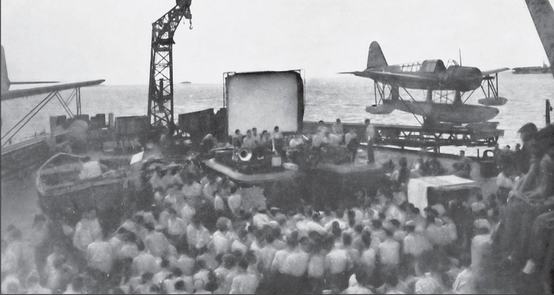
One of the two Kingfisher planes being launched by catapult. These were used for artillery spotting and for search and rescue operations. 

The cross pennant indicated that religious services  were in progress.


Sunday, March 3, 2019

Johnny Reb' s War

Johnny Reb's War: Battlefield and Homefront
pub. 2001 David Williams
102 pages


Johnny Reb's War is a curious collection of two historical articles by David Williams, the contents of which were later encompassed by his impressively depressing People's History of the American Civil War as well as Bitterly Divided: The South's Inner Civil War. The two articles review the miserable conditions of the Confederate army (starving, barely clothed, and shoeless by 1862) on the eve of Antietam, as well as the prolonged plight of the southern poor in Georgia at home. The two intersect nicely, because the wretched conditions at the front, combined with the fact that their wives and children were starving, sick, and being plundered by their own government, led to crippling desertion; Jefferson Davis estimated in 1864 that as much as two thirds of the entire army had simply given up.

Those who have never explored this part of the Civil War before, of course, are in for surprises -- they will learn, from a source who is by no means sympathetic to the southern cause, that most southern combatants were poor yeomen who rallied to the Confederate banner only when Lincoln announced an invasion; that the wealthy planters who voted for secession not only exempted themselves from fighting in the war, but drastically weakened the army by focusing on cash crops they could only sell to the 'enemy', rather than food to supply their countrymen; and that the Confederate government bankrupted its moral support fairly quickly by imposing subscription, suspending habeaus corpus, and not checking corruption.

Williams provides a long train of stories and scathing comments pulled from contemporary newspapers and letters, but -- as with Williams' previous works -- I find myself wishing I could find similar information from different sources to get better perspective.  However, this was absolutely worth reading just for the  excuses southern soldiers would render to their superiors for killing livestock in Maryland. One insisted he'd been attacked by the pig and had been obliged to kill the porker in self-defense;  another claimed he'd felt sorry for all the dislocated animals after the battle and decided to put them out of their misery.   A related chuckle came from the report of a Confederate officer who detailed how Lee ordered a man executed for stealing a civilian hog; Stonewall Jackson left the execution to fate by putting the man into the frontlines. When the man survived Antietam, the recording officer noted that the accused had lost his pig, but saved his bacon.

Saturday, March 2, 2019

Of Caesar, Aeneas, and Selma


This past week I've been dogsitting in the country, and if you've never enjoyed a rural sunset with a glass of wine and Chloe Feoranzo playing in the background, it's an experience I can recommend. While I was away, February ended, and I realized I hadn't commented on either of my classics club readings for the month...mostly because I couldn't think of that much to say about them, really.  I'd already read the 'story' of the Aeneid last year or so, and had been watching videos on it in preparation, and by the time I experienced story in verse I was tired of it.   Of The Conquest of Gaul...well, it's exactly as it says it is, a military history of the invasion of "Gaul", which here means western Europe and a weekend in Britain, with some sociological sketching on the Gauls and Germans by Caesar.  I found that more interesting than the military business, frankly, especially the fact that the German tribes  viewed agriculture with suspicion and frequently uprooted their own people who settled, lest they grow soft and corrupt.


More pleasantly, I re-read a book I stumbled upon ages ago, called The Other Side of Selma.  Though I grew  up here,  I never experienced Selma as a town and place until after college. Before then, I only traveled the commercial sprawl north of the city,  and entered the 'real' city only when I needed to visit the library.  The Other Side of Selma introduced me to it as a beloved city, however -- a place where people lived and loved, not merely a place for politicians to visit prior to elections and make speeches at. Its author, Dickie Williams, grew up in Harper Lee's hometown of Monroeville, but often traveled north to Selma for supplies. When he came of age, he began working at Swift's drug store on Broad Street,, and there began to collect stories he'd heard -- mostly funny,   like of a barber in the Hotel Albert who used to entertain people with sayings and tales from the old country of Russia, only to later be exposed by an actual Russian who visited the city and declared the barber's "Russian" to be  farcical gibberish.  Others are personal, like Williams' account of being asked by a woman in town how these diaphragms for women were inserted and used.  (This was in the fifties, so young Dickie was highly embarrassed to say the least.)    When I first read this, it made Selma come alive for me in a way it never had been: for the first time, I could imagine the Hotel Albert as a place that people went in and out of, where there were businesses and life, instead of  it being just the name of a building what once was and now isn't.  I don't know if that makes any sense, but my interest in re-experiencing that initial joy drove me to find one of two university libraries in the state that have a copy of this book so I could sit and read it. Unexpectedly, it seemed to have more hunting stories than anything else!     Interesting how we can latch on to one aspect of a book and so exaggerate it in our memories.


Wednesday, February 27, 2019

The Gatekeepers

The Gatekeepers: How the White House Chiefs of Staff Define Every Presidency
pub. 2017, Chris Whipple
384 pages


True confession: I never paid that much attention to the chief of staff position within the White  House until I started watching The West Wing, a show marked by its characters' constant movement and work.  In The Gatekeepers, Chris Whipple introduces readers to the office as created by Eisenhower and Nixon, and then reviews how subsequent chiefs have played a pivotal role in executive success or failure.

Whipple traces modern chiefs of staff to Eisenhower's administration. Formerly commander of the Allied forces in Europe in World War 2, Eisenhower was no stranger to a complex, demanding job --and he imposed a little of the organization from the army onto the executive office, relying on a chief to vet  requests and control access to his office.   This proves throughout the book to be a critical role played by the chief, though it wasn't until Nixon that a formal WH staff organization was created.  An abundance of advisers only makes a wash of noise out of otherwise useful information, and distractions keep the executive from accomplishing much of anything. Whipple demonstrates how a good chief of staff can bring order to chaos -- demonstrating to a new-to-town Bill Clinton, for instance, that his office was leaching productivity by wandering from topic to topic within the day, rather than focusing on anything at all.  The chief also directs the flow of information by controlling access to the Oval Office: under an active chief, there might be an astonishingly short list of people permitted to access the office at will (a Cabinet officer or two), while others wait for appointments and the chief as chaperone. 
Another vital role of the chief is as the advisory who will and must say to the most powerful man on the planet -- "No."   Some people in DC are evidently aware of the bubble they live in, and aware that the White House can become host to its own private bubble only dimly aware of the reality  abroad and in the world. (The insulating effects of the Oval Office were explored to great effect in The Twilight of the Presidency).   A good chief of staff is aware  of limits to how much is possible, and pushes back when needed, serving to check his bosses's overreach. This doesn't always happen, and some of the saddest and most expensive mistakes of modern American history happen because no one pushed back enough.  Because the position of chief is so intense,  they rarely last more than two years -- so even an effective chief can quickly give way to one that's not quite up to the task.

I found The Gatekeepers an utterly fascinating work, and one largely nonpartisan -- though Whipple does seem protective of the Clintons,   he doesn't shy away from documenting the disorder that popped up there.  It's certainly an interesting lens to see presidencies through -- viewing, for instance, Carter's ineffectiveness as owing to the utter lack of a chief at all for much of his administration.  Although the book doesn't cover the current administration very much (nor can it, given the publication date),   given the current executive's willfulness and the highly irregular nature of his own staffing decisions, it is unlikely that a future version of this book would regard its chiefs a success stories.

Friday, February 22, 2019

Yesterday: Memories of Selma

Yesterday: Memories of Selma and her People
© 1940 C.C. Grayson
155 pages

(For want of a book cover, I'm including a photograph of Selma's main street in the early 20th century, after 1891 but before 1926.)

In the 1940s, one of Selma's oldest living residents, Claude Grayson, was asked to record his memories of the town. He had made a habit of contributing little recollections to the local paper and apparently created demand for more of the same.  What was produced, in 1940, is an exceedingly rare and personal look at a town from the 1860s to the early 1900s.   It was written in longhand and not organized in the least,  but what interesting times to record! Grayson arrived in Selma as a young lad in 1867,  and found it a town whose two great avenues, Water and Broad,  lay much in ruins from the invading Yankee army of two years before.  He witnessed its revival, as Selma capitalized on its river commerce by investing heavily in railroads.   This was an age when  Selma was one of the leading cities of Alabama, and where Dallas County's massive population gave it a powerful position in state politics. (It wasn't an accident that Selma managed the rare feat of claiming both of Alabama's senators to Washington at one time.)

Much of this is of interest only to locals, of course. I stumbled upon this book while pursuing any and all leads relevant to the Hotel Albert, a historical sketch of which I'm working on on behalf of the city.  (In the photograph above, it's that ornate four-story building.) I quickly learned that Grayson used to walk the third and fourth-floor rafters long before the building was complete shooting pigeons, but I was thereafter fascinated by the myriad of stories Grayson reveals. Some are random, some tender, some weird.  I've only recently learned of a phenomenal man - Goldsby King -- who plowed his fortune into creating and maintaining a private hospital in the city,  who worked himself to death and was hailed as a saint when he perished in his fifties.  King makes an appearance here, but as mentioned the collection is somewhat random -- Grayson gives a full account of the Battle of Selma, and closes with a history of St. Paul's Episcopal Church,  making no attempt at all to be chronological. It's whatever comes to mind, really, so it will probably frustrate an outside reader trying to make sense of it. As a native Selmian and someone whose career involves its history, I was perfectly at home, and found it satisfying to connect the names of buildings and streets to prominent personalities who made Selma such a beautiful and satisfying place to live.  Although since the closing of the Air Force base in the 1970s the town has struggled economically,  so much of the granduer of yesterday still stands, and it's nice to be reminded of it.

Thursday, February 21, 2019

Overthrow

Overthrow: America's Century of Regime Change
pub 2006 Stephen Kinzer
384 pages


The prolonged debacle in the middle east is not, sadly, an exception in modern American foreign policy.  Since the late 19th century,  the powers that be in DC have repeatedly looked abroad – both with  honest avarice and with idealistic dreams of remaking the world in an Empire of Liberty. In Overthrow, Stephen Kinzer delivers a review of its actions, beginning with the seizure of Hawaii,  covering seemingly every country in central and South America save Brazil,  and ending up in the Ozymandian wastes of Afghanistan and Iraq, delivered with a slightly journalistic flair.

Because of the popularity of books like those penned by Howard Zinn,  some of these adventures are not as unknown as they once were. Popular ignorance about the events, however, is chronic.  When Cuba and Iran roiled in revolution and their people spoke of previous interference from America,  few in the United States knew what they meant -- even American leadership. The scales of American involvement in the countries detailed here  -- places as small as the isle of Grenada, and as large a Afghanistan -- vary from  clandestine coups arranged by the CIA, to outright invasions. The interventions often happen in connection with "helping" the people in the target country, either to save them from themselves (Cuba, the Phillipines), to secure democracy (Hawaii, Iraq),  or to prevent worse evils from occurring (most of Central and  South America).  Teddy Roosevelt's role in interventionist wars is no surprise, but Eisenhower  arguably accounts for more.  Considering how he warned the American people about a military-industrial complex  driving all too much of public policy, that comes as something of a surprise. Eisenhower invariably got involved in these outside adventures out of fear of the Soviet Union's rising influence, however, and it's possible that he realized he was manipulated in retrospect, and based his warning on that. This is only speculation on my part, however.

I mentioned Howard Zinn earlier, because his history published decades before exposed more Americans than ever to the bare facts of these events, and Kinzer does not go into that much more detail.   What he has is documented,  but  in tone it struck me as more of a newspaper-esque expose in book form than a work of history, making the regime-change events more dramatic than necessary by having DC attack men on false pretenses every single time.   This kind of foreign intervention can still be argued against even when the persons targeted are objectively awful human beings; it isn't necessary to make them angels first. Frankly, I've been a bit wary about Kinzer since he revealed he keeps a portrait of the dictator Ataturk in his office.

While Americans definitely need to be more aware of their government's history in this regard -- both to guard against future excursions and to understand why  there might be resentment between our neighbors and ourselves --  Overthrow doesn't quite suit the task.

Tuesday, February 5, 2019

The Big Ones

The Big Ones: How Natural Disasters Have Shaped Us (and What We Can Do About Them)
© 2018 Lucy Jones
256 pages


Earth is not a peaceful place; even it were stripped of all life, it would still teem with energy, from vast tectonic plates below, to the rolling seas and fantastic lightening storms above.  Much of that energy is put to use by human ingenuity, but sometimes it lashes out in displays that destroy hundreds or thousands of lives and undermine what we've built. The Big One reviews some of the greatest recorded disasters to strike human civilization, mixing science and history, and closes with some general advice  to the public on how to think about disaster preparation and emergency management.

Jones' background is in seismology, so it's probably no surprise that most of the disasters chronicled here are earthquakes. But disasters that  make history -- the 'big ones' that people remember  -- are rarely by themselves. The great San Francisco earthquake, for instance, did great direct damage, but its greatest impact was the fires it helped create and feed.  Likewise, for the Fukushima affair; the earthquake and tsunami that struck Japan were formidable in themselves, but they compromised and accelerated the demise of a nuclear reactor and led to an altogether different kind.  The most recent 'big ones' covered in this book are the Christmas 2004 tsunami that affected sixteen countries and killed nearly three hundred thousand people, and the Fukushima event.  There are some here which have nearly no name recognition (like the massive earthquake that struck immediately after the chaos of the Cultural Revolution in China, and some I've seen mentioned in other books, like the earthquake and fire that destroyed over eighty percent of Lisbon in 1755. 

In addition to discussing the science behind disasters -- why they happened, what specific forces are causing various calamities, why some earthquakes are more disastrous than others  -- Jones also addresses the long-term effects of these disasters when possible. The timing of the Lisbon earthquake -- on All Saint's Day, during the morning when all the churches were full of faithful parishioners celebrating the memory of saints present and pass --  could not have been better timed for mass death, and it shook the faith of many, just as the Holocaust would centuries later.   Japan and China's traditional way of explaining disasters, as distortions of yin and yang, would be challenged by "big ones' during the dawn of modernity as well.  The disasters around the Mississippi -- a great flood and then Katrina -- also  bring up a discussion of race, and the US government's first forays into federal emergency management. Jones defends FEMA during Katrina, however, arguing that the great failures there happened on the ground, as both the city and state officials were not communicating with one another or with FEMA enough to be at all effective.   In one of the few non-earthquake examples,  Jones points to greater international information-sharing as a result of the 2004 tsunami.   (Which...was triggered by an earthquake. We're really never far removed from that!)

All said, this is an interesting history of how  a few earthquakes have altered nations' responses to disaster response, driving the desire to learn about them and find realistic politics to cope with the aftermath -- topped with advice to citizens at the end that's a little generic ("Educate yourself"). It's not as wide-ranging as I'd hoped, since most of the disasters were earthquakes, but keeping this subject in mind is good for any citizen today. Future disasters will effect proportionally more people, as the global population swells and concentrates, and as the globe becomes fully industrialized we will have more distortive effects on the environment.  Emergency awareness and management should be near to the forefront not just for citizens, but for every level of government.

Wednesday, January 30, 2019

Odd Egg Editor

Odd-Egg Editor
© 1990 Kathryn Tucker Windham
170 pages


Anyone who grew up in Selma, Alabama, prior to 2011 had heard of Kathryn Tucker Windham, and odds were they cherished her.  A master storyteller, she inspired an annual Tale-Tellin' Festival that survives today.  Odd-Egg Editor is a brief memoir of her newspaper days, before she became a local legend.  Beginning with the Montgomery Advertiser in the 1940s,  covering the police beat,  Tucker expanded her career to land a position in Birmingham and later settled in her hometown of Selma just as the civil rights movement was warming up in the 1960s.   This memoir has a lot of little stories, with colorful characters -- a playful judge who once busied himself creating spitballs during testimony,  an inveterate escapee named Billie Jean who counted herself a friend of the cops and her regular judge-- as well as a few sadder stories.  The title of the book comes from Tucker being assigned all the odd stories at the Montgomery Advertiser, and is itself a colorful collection. One could easily read it as two decades of journalism from  mid-20th century Alabama , but I was drawn to it for the author's voice. Although she was too advanced in age to do a lot of storytelling during my youth, I heard her a time or two at Cahaba Day festivals. Even in her last years she was a volunteer at the Selma-Dallas County Library,  firmly ensconced in the town she loved and which loved her back.  I enjoyed this account of her getting started -- of overcoming prejudice against her as a young woman invading male spaces like  the cop beat and the governor's hunting camp -- very well.


Kathryn Tucker Windham, from the second-floor balcony of the Selma-Dallas County Library

Related:

Wednesday, January 23, 2019

Short rounds and the week ahead

On Saturday the library was partially evacuated owing to a tornado warning, and today Father Winter has well and truly hit the town.  I'm currently reading a scrutiny of political utopias, transhumanism, and religious-spiritual ideas about life beyond death (from heaven to ghosts), as well as listening to an audiobook based on a long-favorite podcast of mine, The Skeptics Guide to the Universe. The latter is 15 hours, so it will be a good while before I finish it.   But what about books I have finished? Well, recently, that makes two: The Long Game,  on Obama's foreign policy, and View from the Ground, an anthology of historical articles based on the primary-source materials of solders embroiled in the war between the states.


First up, The Long Game, which argues that President Obama entered office with a distinct foreign policy and that more often than not, he was able to apply it to the problems he encountered, if with mixed results.Chollet describes Obama's approach as the 'long game',  and identifies eight various elements of it.  Summarized: while the United States is in a unique position to effect change globally, it also can't do everything it wants or even needs to do, necessarily. Careful thought should be given to balance the nation's attention and resources between domestic and foreign priorities. Actions taken should be both sustainable in themselves, and lead to stable results. Small moves are best.   Although approaches can be tailored on the fly to adjust to changing circumstances on the ground, or tangible proof that a given policy is not working, patience is also vital. When something has failed, the best thing to do is figure out what to learn from from the experience and move forward, not sink new resources into the mistake.  Chollet then reviews some of the foreign policy stories of the Obama administration,   examining Obama's careful attempts to work with Russia and reluctance to engage with Libya or Syria (pre-2014).  Discussion of North Korea is noticeably absent from The Long Game,  but it's a refreshing reminder of a president who challenged DC in a constructive way.


Next up, View from the Ground,  which I read because a transplanted northern friend of mine was insistent that I read it.  I'd assumed it was just soldiers' recollections of various battles, which I wasn't too much interested in, but after I took a look at it I realized it was far more varied than that. The book is an anthology of different pieces,  examining this or that aspect of life on the ground -- from religious soldiers' attempts to reconcile piety with burning and killing,  to exploring the "abolitionizing" effect the war had on Union soldiers, who began fighting to protect the Union and only later were convinced of the necessity for ending slavery, which in their view  had undermined the south both economically and morally.   There are strictly military-related pieces, too, towards the end.  Given that in college I  used the songs of Civil War soldiers to explore their lives, motives, and view of the conflict as it developed, I largely enjoyed this.

Friday, January 18, 2019

The Limits of Partnership

The Limits of Partnership: U.S.-Russian Relations in the 21st Century
© 2014 Angela Stent
384 pages


The Limits of Partnership examines the Russo-American relationship through four presidential administrations,  reviewing what progress was made  or conflicts each American executive had with his Russian counterpart. Stent offers that the main problems between the United States and Russia have been fairly consistent from Clinton onwards,  and that part of the problem is that each power ultimately wants different things out of the relationship.   While the United States wants Russia to mostly confirm to the ideal of western democracy, Russia wants to reclaim its prestige as a great power

The Limits of Partnership begins on a high note, as the Soviet Union disappears overnight during the tenure of a very seasoned foreign policy executive: George H.W. Bush.  The elder Bush knew that at this extraordinary moment, when the decades-old adversary had suddenly collapsed into  smaller states very unsure of themselves, that care had to be taken not to humiliate Russia's new leadership, but rather encourage them.  Most of Russia's weak transition years unfolded during the administration of Bill Clinton, however, and there some issues that would dog the relationship for decades appeared. The most pervasive source of conflict was colliding interests in the "new independent states" of the former Soviet Union.  The United States was keenly interest in welcoming post-Soviet states into the community of liberal democracies, and sometimes stepped on Russia's toes as both competed for influence in the "new Europe".    Russia, of course, resented the sudden insertion of their old rivals into what used to be part of the Union,  an area they still referred to as "the near abroad" to differentiate it from actual foreign countries.  This was especially so during the Kosovo crisis, when Russian troops on he ground were nearly attacked by NATO forces attempting to secure an airport; only alleged insubordination kept the attack order from becoming reality and initiation a full-scale conflict.

Although the Bush administration initially hit it off with Putin, and were encouraged by the Russian president's early and fulsome vow of support in the 9/11 aftermath,  Bush's "Freedom Agenda combined with Russia's desire to maintain influence in the old Soviet Union put the two nations again and again at loggerheads. At this time, Putin was also becoming....well, Putin, consolidating his power, getting the state into position to better profit from mineral resources, and making the Russian Federation a distinctly more top-down government.  Although Putin had facilitate the creation of US bases in  central Asia to allow for the US invasion of Afghanistan,  the subsequent invasion of Iraq  derailed every attempt of progress; Putin joined the leaders of Germany and France in not only not supporting the toppling of Hussein, but working within the UN to officially chide the US. The arrival of Barack Obama saw a more cautious approach to Russia; Obama was a critic of the Iraq war himself, and wasn't trying to rid the world of evil by making everyone democratic.  At the beginning, Obama was even able to enlist Russian support in moving troops in and out of the area -- but quickly enough, the initial warm period would give way to constant problems, again relating to Russia's desire to control its immediate neighborhood  -- only, during the Obama administration,  Putin's efforts had manifested themselves in actual military interventions in its neighbors,  one which set alarm bells ringing from the Caspian sea all the way to DC.

In connection with the "near abroad" problem were those created by the the emergence of the United States as a solitary superpower. In the Clinton years, the state department made subtle organizations that effectively demoted Russia's importance: instead of having its own department, it merely had a section within a larger Eurasian one. The US also ended its involvement in several treaties that were deemed to be no longer necessary,   which was regarded by Russia's own government as a sign that the United States didn't take it seriously as power.  Resentment over this loss of status was made far worse after the unilateral invasion of Iraq, which -- like increasingly many affairs in central Asia -- was done without Russian consent.  The United States' increasing involvement in the mideast, and its concerns over regional powers like Iran,  also saw the growth of military bases and missile installations -- and  much worse, for Russia, NATO invitations to its neighbors. What had NATO been formed for,  other than as a counter to Russia?   Although early on independent Russia had sought engagement with NATO,  and there had been an idea that it could even join that defensive alliance,  increasingly  Putin  -- strengthened by rising oil prices,  supported by Russians who regarded him as a return to glory-  sought an independent course for Russia, one in which it did not move closer to the west as was hoped, but rather followed its own path.

The Limits of Partnership is a very helpful history of relationships until late 2013, although there were substantial developments in the years that followed -- the debacles of Syria and ISIS, for instance, the midnight expulsion of Russian diplomats during Obama's administration, and the revelation that entities within Russia had been manipulating social media chatter to stir up trouble.   It seems more unlikely than ever that America and Russia will establish a fruitful working relationship, but given how personality-fixed Putin's Russia is, once he retires, things may change, and the growing  global influence of India and China may change that entirely. It may be that instead of Russia brooding over the loss of a bipolar world, it has to learn to adjust to an entirely different one. 

Wednesday, January 16, 2019

How the Internet Happened

How the Internet Happened: From Netscape to the iPhone
© 2018 Brian McCullough
400 pages


Who's ready for a little nostalgia? Brian McCullough, host of the Internet History podcast,  here turns his research and many interviews in a compact history of how the tool of  research scientists became the petri dish of 21st century life.  This isn't a technical history of APRANET slowly maturing; rather, it's a popular history of how the Internet as most experienced it 'happened' -- how it emerged, how it took fire, how different products and services saw it rapidly grow in new ways and transform society as a whole. McCullough uses a series of products and events to tell the story of the digital world, from the first graphical browser that made the network user-friendly, to the arrival of smartphones.  If you were alive and aware in the nineties, and especially if you were growing up with the internet as many readers and quite a few tech billionaires these days did, it's a nostalgia trip in addition to a fun history.

McCullough begins with the Mosaic browser, which later became Netscape, the first browser to bring a Mac-like graphic interface to the browsing experience.  The unusual popularity of Mosaic hinted at the potential popularity of the internet, though the tech giants of the day were slow to catch on.  Microsoft was entirely focused on Windows 95, and while it was thinking about an information highway, it imagined this future revolution would take place via television and cable connections, not low-bandwidth telephone lines.  Once Bill Gates and Microsoft realized they'd made the wrong call, they used all their resources to make good the mistake -- immediately releasing an OS that advertised its web-friendliness, and developing Internet Explorer and the MSN Network,  as well as working with America Online.   America Online was quick to grasp that the internet was fundamentally social, and that they could expand their influence enormously if they promoted chatting, message boards, and the like. (I wasn't even an AOL subscriber, and I used and loved its AIM client.)

The astonishing success of Netscape and AOL meant that New York's financial elite -- and the whole of baby boomer and investment-curious America --  saw it as an avenue for wealth, and  the latter part of the nineties would be marked by a dot-come bubble that crashed in 2000.  An astonishing array of companies sprang into being, promising to sell everything from dog food to cars online, and despite never showing the first sign of profit investors leapt on them. Some -- a few, like Amazon -- had staying power, but most were pipe dreams.  While the resulting crash would dampen enthuasism in the early 2000s, McCullough holds that the bubble played an important role in driving the expansion of the internet's infrastructure, paving the way for affordable broadband just as railway bubbles in England had paved it over in rails despite leaving many people destitute.  In the meantime, more companies were developing that would capitalize on the web's unique nature, like Google and facebook.    All of the companies that McCullough chronicles bring something new to the table: eBay's reputation mechanism, for instance -- or allow users to revolutionize their own experience. Napster, for instance, gave people the strong taste of instant gratification,  and the ability to remix content easily, and Facebook destroyed the wall between reality and the internet world.

The book culminates in the last chapter, amusing titled "One More Thing", covering first the Blackberry, and then of course the iPhone.  This chapter is strangely short, but perhaps that owes to the smartphone being a device still in the process of changing everything.  Smartphone sales are just now reaching their estimated peak, and while a book will certainly be written in the future on how ubiquitous mobile computing has transformed 21st century society, perhaps we're not outside the transformation enough to look back at it.

I for one thoroughly enjoyed How the Internet Happened, in part for nostalgia. I can remember the dot-com bubble commercials, the banner ads, how revolutionary Firefox's  tabbed browsing was,  how spectacularly fun AIM was, etc, and it's nice to see all of this laid out in a history. Despite experiencing it first-hand, I also learned quite a bit, like the origins of Hotmail. (I still type "hotmail.com" when I want to login to Microsoft services, and didn't realize Hotmail began as an independent project before Microsoft bought them to get into the web mail area.)


Related:
The One Device: A Secret History of the iPhone, Brian Merchant

Sunday, January 6, 2019

In the Plex

In the Plex: How Google Thinks, Works, and Shapes Our Lives
pub. 2011 Steven Levy
437 pages


Full disclosure: I was a passionate Googler ten years ago, an early adopter of anything that the Mountain Brook, CA firm produced -- even programs like GoogleDesktop, which I never even used. It was when Google devoured YouTube and started making its mark on there that the plucky upstart of the internet started looking a little more dangerous -- and with every passing year I've become a little more concerned about the amount of internet traffic Google controls.   Regardless of whether one trusts or fears Google, however, it is an incredible company with extraordinary influence on the web. In the Plex is a fanboyish history of how it came to be, from its early origins in a dorm room to its present goliath state, with various aspects of Google's culture and various products being examined in turn.

Those of us logged into the English-speaking net scarcely need to know what Google began as:  Google's initial product was so successful that it's wormed its way into our language. What is most remarkable about Google is how it changed the internet, and changed expectations.  That story really begins with Gmail -- a product which was produced by a Google employee on the side, then officially sanctioned once the triumvirate in charge of Google had experienced it.  Gmail's enormous free storage option -- an entire gigabyte of storage, an amount that flabbergasted Bill Gates when he heard of it --  allowed people the luxury of never having to delete their mail. That didn't just mean they no longer had to save everything to their computers; it meant they could keep every little thing from conversations to emailed receipts online, and considering how much use emails get by other websites, that could mean a sizable amount of their lives would now be shared with Google.  Prior to Google and facebook, privacy was a web hallmark;  unless you were a network engineer monitoring ISP traffic, people couldn't tell who you were unless you told them -- and I was encouraged to not tell or trust anyone. It took years of conversation between close AIM friends before I'd consent to voice chat, let alone sending picture.

Gmail changed that, and it wouldn't be the last time Google changed our expectations about what normal online. Now instead of seeing ads that were  static billboards, erected on websites in the hopes of catching some eyes,  the web would be increasingly filled with very personal ads -- solicitations to buy a book we'd just been looking at online,  ads in Spanish after using DuoLingo or watching Butterfly Spanish on Youtube,  announcements of Caribbean cruises after GoogleMaps is used to look at the Mexican coast.  GoogleMaps' associated project, Latitudes, even tracked users locations --  if they wanted. And when Google ventured into the smartphone market and purchased Android,  location tracking became the norm....and even if user try to opt out, on some level it still occurs because the phone has to communicate with cell towers and satellites.   Other projects were even more controversial, like Google's desire to start scanning the world's books and provide them for free, online.

Google is an unusual company in that it started with the ambition of a nonprofit: to make the world a better place. Levy believes this philosophy is real and still guides Googled despite their incredible wealth and influence on the web.  And there's no denying that Google's products have transformed the internet in a positive way;  GoogleMaps alone is an incredible tool, offering not only maps but information layered within the maps -- reviews of restaurants, the ability to see the street's landmarks, to browse through user-submitted photos.  YouTube, too, isn't just a place for funny clips: it holds hour upon hours of educational content, and allows people to pursue their interests and passions.  Between Google Search, Maps, and YouTube,  we  have the computer databanks of the Enterprise-D at our command.

I thoroughly enjoyed this history of Google  and its facets, but  keep in mind it's written by an ardent admirer, whose love for "cool" firms like Google and Apple manifest itself in a nasty contempt for others, like Microsoft.. He refers to Microsoft employees as "Gates' minions", which makes Levy sound like less a serious author and more like a blogger with an axe to grind.  Levy's admiration for Google also means he doesn't fully examine the  potentials for abuse inherent in one company running so much internet traffic. Chrome, for instance, has virtually taken over, and Microsoft is building a new Edge browser around its source code Chromium. What will it mean when 80% of web traffic is Chrome-based?