Showing posts with label Hail to the Chief. Show all posts

Wednesday, February 27, 2019

The Gatekeepers

The Gatekeepers: How the White House Chiefs of Staff Define Every Presidency
pub. 2017, Chris Whipple
384 pages


True confession: I never paid that much attention to the chief of staff position within the White  House until I started watching The West Wing, a show marked by its characters' constant movement and work.  In The Gatekeepers, Chris Whipple introduces readers to the office as created by Eisenhower and Nixon, and then reviews how subsequent chiefs have played a pivotal role in executive success or failure.

Whipple traces modern chiefs of staff to Eisenhower's administration. Formerly commander of the Allied forces in Europe in World War 2, Eisenhower was no stranger to a complex, demanding job --and he imposed a little of the organization from the army onto the executive office, relying on a chief to vet  requests and control access to his office.   This proves throughout the book to be a critical role played by the chief, though it wasn't until Nixon that a formal WH staff organization was created.  An abundance of advisers only makes a wash of noise out of otherwise useful information, and distractions keep the executive from accomplishing much of anything. Whipple demonstrates how a good chief of staff can bring order to chaos -- demonstrating to a new-to-town Bill Clinton, for instance, that his office was leaching productivity by wandering from topic to topic within the day, rather than focusing on anything at all.  The chief also directs the flow of information by controlling access to the Oval Office: under an active chief, there might be an astonishingly short list of people permitted to access the office at will (a Cabinet officer or two), while others wait for appointments and the chief as chaperone. 
Another vital role of the chief is as the advisory who will and must say to the most powerful man on the planet -- "No."   Some people in DC are evidently aware of the bubble they live in, and aware that the White House can become host to its own private bubble only dimly aware of the reality  abroad and in the world. (The insulating effects of the Oval Office were explored to great effect in The Twilight of the Presidency).   A good chief of staff is aware  of limits to how much is possible, and pushes back when needed, serving to check his bosses's overreach. This doesn't always happen, and some of the saddest and most expensive mistakes of modern American history happen because no one pushed back enough.  Because the position of chief is so intense,  they rarely last more than two years -- so even an effective chief can quickly give way to one that's not quite up to the task.

I found The Gatekeepers an utterly fascinating work, and one largely nonpartisan -- though Whipple does seem protective of the Clintons,   he doesn't shy away from documenting the disorder that popped up there.  It's certainly an interesting lens to see presidencies through -- viewing, for instance, Carter's ineffectiveness as owing to the utter lack of a chief at all for much of his administration.  Although the book doesn't cover the current administration very much (nor can it, given the publication date),   given the current executive's willfulness and the highly irregular nature of his own staffing decisions, it is unlikely that a future version of this book would regard its chiefs a success stories.

Monday, February 19, 2018

9 Presidents Who Screwed Up America

9 Presidents Who Screwed Up America and 4 Who Tried to Save Her
©  2016 Brion McClanahan
354 pages


It is my dearest hope that by the time Donald Trump leaves the West Wing, the office of the presidency will have been so discredited that no one will take it seriously anymore.   Congress will take serious measures to counter executive overreach, and the American people will somberly reflect that it was a bad idea to allow so much responsibility, expectation, and power to rest on the shoulders of one man. My second dearest hope is that pigs will fly.   Brion McClanahan does what he can to take the American monarchy down a few pegs, though, by devoting half his book to exposing the greatness of a few titans as irresponsible hubris, and hailing a few forgotten men for their diligent work thwarting or ameliorating  the excesses of others.

McClanahan scrutinizes each president based on how effectively they fulfilled their  oath to preserve, protect, and defend the Constitution of the United States.   Because Article II of the Constitution, which creates the office of President, does not include a full job description,  McClanahan relies on debates from the Constitutional convention and the States’ ratification proceedings to determine what was expected of the president.  This figure was not to be a king in democratic clothing, but a guardian of the rule of law: his primary job was to keep  Congress, the only legislative body,  in check – the job that George III failed to do when he allowed Parliament to tyrannize the colonies.   Those who maintain a zealous watch are praised here; the rest, like those who invent new powers for themselves, or accept new powers from Congress through legislative fiat instead of constitutional amendment, or presume on the states or other branches' prerogatives, or allow the other branches to presume on the same, are condemned.    In general: 19th century presidents were largely faithful to the job, and 20th/21st century presidents sought to re-invent and magnify the office, and did so to the point that the old republic is now ruled by Jabba the State. (I borrow that, with gratitude and a bellylaugh, from Anthony Esolen.)

McClanahan’s critique is thus very strict, and he does not pardon men for doing pursuing good ends through improper means: that is not how the rule of law works. The Constitution is not a dead decree, a sacred writ that forces us to live in perpetuity by an 18th century society’s rules, but neither is it a piece of clay to be molded in any way. Those who wish to change the structure of US Government must do so through amendment, or  – as the North threatened to do, as the South attempted to do – remove themselves and try again.   McClanahan’s strict adherence to the original intent of the Constitution, and the observance of the rule of law, will no doubt earn the most criticism from those who read this, who believe that the government should periodically assume new powers as it “needs” them, without respecting the appropriate procedures.  But those procedures, the rule of law, protect us from merely being controlled by the whims of men.

So, who are the nine?

  • Andrew Jackson, who terminated the Second Bank of the United States through extralegal means, promoted a dubious tariff that picked sectional favorites, and threatened to order the militia into South Carolina to prevent it from seceding in response to said tariffs;
  • Abraham Lincoln, who failed to recognize the legal separation of the southern States from the Union, illegally made use of State militias to invade a foreign power,   presumptuously revoked habeus corpus, instituted a draft, instituted the income tax,  and helped devalue the currency for starters;
  • Theodore Roosevelt, who made the president a celebrity and  inserted himself into the legislative process, assuming powers not granted to him by the Constitution, including to make presidential proclamations.
  • Woodrow Wilson,  who drove legislation, attempted to institute tariffs that picked sectional favorites,  persecuted and jailed Americans for exercising the first amendment, instituted the Federal Reserve, and created powerfully intrusive regulatory bodies with no constitutional sanction;
  • Franklin D. Roosevelt, who created the American conservative movement by violating so much precedent and expanding the power of his office so quickly that critics didn’t even know where to begin countering his illegal intrusions into lives of people and the economy;
  • Harry S. Truman, who turned America into the guardian of the world and helped establish the military-industrial complex’s power over the American future;
  • Lyndon B. Johnson , who continued overreach in both domestic and foreign policy; like FDR before him and Nixon after him, he created agencies that combined  legislative, judicial, and judicial functions, ignoring the wisdom of checks and balances; 
  • Richard Nixon, who continued the same sorry trend  and pawed at the economy as well, and began the steady erosion of the dollar as a unit of real value; and
  • Barack Obama, who greatly expanded Bush’s illegal wire-tapping, droning, and pushed through the Affordable Care Act, which made the sorry debacle of US healthcare even more onerous .

The two most controversial names on the list are Lincoln and Obama; Lincoln,  because most people will refuse to consider that the constitution of the United States – the little c –constitution – was much different in 1860 than in 2018,  that people did consider themselves members of the State of Maryland or the State of Vermont, and that the Union was a debatable issue;  and Obama,  because he was merely burning down a house that had already had its doors and windows pried off  and its interior walls  torn down  by previous presidents.  Oddly, even though McClanahan refers to Obama as the ‘worst’,   the chapter on said president is rather short. Frankly, I think ranking a then-sitting president was a mistake.

There are some general lessons to be learned. In the 20th century, the easiest way to gain enormous power was  through war -- either real war, or by couching social programs in the language of war.  Two, the most common violation is the president assuming responsibilities -- lawmaking and warmaking -- that are Congress's alone.  The president is not granted the authority to summon militias; only  Congress may do that, and they require a state governors' request. It doesn't matter if Congresses passes a law giving itself power to do this or that  --  that's not how the rule of law works. If they could empower themselves, they should just dispense with the formalities and issue straightforward dicta like honest oligarchs.

Following the rogues' gallery,  McClanahan then devotes the second half of his book to praising  Thomas Jefferson, John Tyler,  Grover Cleveland, and  Calvin Coolidge.  Jefferson is no surprise,  rejecting anything that smacked of monarchy in presidential treatment and , ending as he did the illegal Alien and Sedition acts.  Tyler will be unknown to most Americans; he was the first vice president to assume the office of president after Zachary Taylor died, and he spent most of his time in office vetoing Congressional actions that had no warrant in the Constitution. He was so consistent at it that both parties grew to hate him. Good on ya, Johnny!   Cleveland  was also solid on reining in Congress, and if nothing else he deserves a standing ovation for doing his best to prevent the United States from enveloping Hawaii. Coolidge, of course, has a deserved reputation for being a calm and steady hand on the rudder, intent on reversing growth as best he could within constitutional limits. The sad truth of political economy is that a bad president can increase his powers in violation of the law through his own will, while a good president's own scruples forbid him from violating the law to reverse course.

The book ends with a series of suggested amendments which would in theory curtail the power of el presidente, though given how much bureaucratic power is now vested in the sprawl of executive departments, said amendments only only be a start.  These amendments include limiting the president to one term and sharply enforcing Congress's sole responsibility as a warmaking body.

When I began reading this, I was a little worried about McClananhan's style, which -- when he is lecturing  -- can grow abrasive. It's not a style fit for communicating with people who disagree with you, and I'm happy to report that he largely reins himself in here, though his language grows a little less formal as he comes nearer to the 20th century.  I think he manages to be approachable to those who disagree with him, but very few people care more about rule of law than doing what they think should be done now, and to the devil with the consequences.  That, combined with the fact that human beings frequently revert to some tribal desire for a strong leader who can take charge and restore confidence in the future -- whether he's killing the old shaman for not pleasing the gods, or forcing everyone to buy health insurance to "fix" the cost of insurance -- makes me think all human political experiments beyond a certain scale are doomed to failure.

Happy president's day...

Related:
Recarving Rushmore, Ivan Eland. A very similar but more thorough review of each president based on their contribution to liberty, peace, and rule of law.
The Cult of the Presidency, Gene Healy.  The story of how quiet servants like Tyler and Cleveland were supplanted by celebrities with delusions of grandeur .
The Twilight of the Presidency, George Reedy. A masterful review of how the American monarch is hindered by the sheer expanse of his office


Sunday, January 29, 2017

The Twilight of the Presidency

The Twlight of the Presidency: An Examination of Power and Isolation in the White House
© 1970, 1987
200 pages


In Twilight of the Presidency, George Reedy uses his personal experience as a Johnson aide, along with the study of other administrations of the 20th century, to comment on the apparent decline of the US Presidency as an effective force for serving the public good.   Writing in an age that had seen the ill repute of the Johnson and Nixon administrations, followed by the benign but inept administrations of Ford and Carter,  Reedy was pessimistic about the future of the presidency.  In our own age the imperial presidency has revived and waxed even stronger,  to the degree that  American families may hear or mention the president by name more than their own  relations!    Yet for all the time that has passed, Twilight of the Presidency's insight into how the presidency as an office works remains incredible.

Reedy refers to the office as an elective monarchy, and maintains it had that potential from the beginning.  Yet except for Abraham Lincoln, no president of the 19th century really used the office to its full  authority.   The essential advantage of the presidency, Reedy writes, is the will to action: the Supreme Court can only decide on such issues arrive at its doorstep, and the Congress is an enormous bureuacracy whose wheels are clogged with corruptive grime.  The president can act on his own accord, can be  -- The Decider.    He can seize the initiative and put everyone else on the defense while Congress is still attempting to get a bill from a subcommittee to the floor.     Another advantage in the president's court is the aura of his office; the American president is simultaneously the head of government and the head of state.  He enjoys much of the reverence given to a figure like Queen Elizabeth the II,  escaping direct personal abuse as someone like Tony Blair or Nick Cameron might have to endure during "Question Period".

In one chapter, Reedy dwells on more of the monarchical trappings of the office of POTUS: the fact that the chief executive is surrounded by hundreds of people every day, all of whom are fixated on him. They may be White House staff serving his needs so he can focus on the issues of the day,  or enthralled aides waiting for their chance to bask in the royal farr and be noticed.  This bureaucratic cloud has the effect of isolating the president from society at large;  their own opinions being the only ones the president hears. They're hardly representative: Reedy writes that Johnson couldn't understand the youth rebellion against him, because all of the young men in his employ were  perfectly at ease with the administration's current Vietnam policy.    More substantially, Reedy comments that because the host around the president is there to serve and administer his wishes,  he rarely receives pushback from policy suggestions.  (Reedy alleges that the only president of the 20th century who was nearly completely successful at staying connected to the people, instead of being hemmed-in by his advisors, was FDR. )  Reedy comments mournfully that there were numerous times that  the United States might have resisted further entanglement in Indo-China, but when Johnson passively expected alternatives, all he received were alternating views on what his aides thought he wanted to do -- stay the course.     Staying the course is almost always the easiest thing to do,  even when considered objectively it's unwise. Presidents are not objective,  however; they are the subject of national attention, and of history books. They are the face and will of the nation.   If a private citizen makes a mistake that costs him dearly, he is free to cut his losses and walk away with a slightly reddened face and a lighter wallet. But if a President decides engagement in Vietnam or Iraq was a mistake, he has not only wagered money but lives and honor.   To write off the lives of thousands of young men and women is not a task easy to do in a democracy.

The office's isolation and policy inertia of part of the reason why perfectly intelligent men can make  astonishing missteps in office, whether it's invading Cuba on bad intelligence, or invading Iraq on....can the WMD threat even be dignified as 'intelligence'?. Another aspect, though, is the growth of the office itself: we've come a long way from Washington and his three secretaries.    Because so much authority has been delegated to executive agencies, it is perfectly possible for people of one department to make pivotal decisions under the aegeis of presidential authority without the executive actually knowing about it.  The bureacracy is now so large that it has institutionalized itself;  it moves under its own inertia, and  a particular department's  long-running policies and officers can outlive presidents.  This is why Reedy, despite being a Democrat, thinks it is perfectly possible that Iran-Contra could have been created and implemented without Reagan actually knowing in full what was happening.

Twilight is incredibly insightful, and admirable. Although he wrote out of concern for an office  whose efficiency was fast diminishing,  his exposure of why remains true today.  At least in part, that is; I assume the presidency has become even more isolated from the American people because of security concerns.  The 2016 election results, which took D.C. utterly by surprise, may indicate how out of touch the imperial center is with the people beyond the coasts.  I wonder if such a book could be written today: Reedy had the advantage of witnessing or knowing people who remembered the presidency when it was still boring, before  Hoover and Roosevelt made the office a source of daily fixation. Could an author who has grown up with the imperial presidency analyze it in this fashion? I doubt it.

Related:

  • The Cult of the Presidency, Gene Healy, which quoted on this and recommended it to me. 
  • The Once and Future King, F.H. Buckley. Buckley contends that effective monarchy has re-established itself in the form of the American presidency and the prime ministers of the UK and Canada,  echoing some of Reedy's chapter on the making of the American monarchy. This is one I really must re-read..

Sunday, February 14, 2016

The Cult of the Presidency

The Cult of the Presidency: America's Dangerous Devotion to Executive Power
© 2008 Gene Healy
264 pages


 Every four years, men and women with permanently-fixed smiles assure us that they will end corruption in D.C, get the economy moving, and end our trouble overseas, if only we will elect them President.  The claims are bold – who could budge the vast federal bureaucracy or find a solution to the hornet’s nest that is the middle east? Yet a third of the American public seems willing to believe these and greater claims, from across the political spectrum. Throughout the 20th century, the  presidency has taken on great challenges, willfully or at the urging of the public, and gathered around itself the power to take on those challenges -- or try to.   In The Cult of the Presidency, David Healy argues that not only this is a significant departure from the Constitutionally-sanctioned purpose of the president, but such centralization constitutes a malignant force.  Not only is investing such power and hope in one man dangerous, but the breadth of ambitious and responsibilities we heap upon the president's shoulders is self-defeating.

Healy begins with the Constitution and revisits the intentions of the Founders through the Federalist papers. The republic existed in its Congress, which was granted the bulk of powers, including levying taxes and declaring war. What no one wanted was an elected king, even if Alexander Hamilton did bat around the idea that the president might serve for life.  There were fears, however, that Congress might amass too much power, and thus the executive's responsibility would be to not just carry out Congress' will, but refuse to do so if said will violated the Constitution.  The presidential oath is made not to care for and advance the needs of The People, but to protect the Constitution. For most of the 19th century,  executives held to their constitutional limits; Abraham Lincoln was an obvious exception, serving as he did in extraordinary circumstances. But most of the 19th century executives were forgettable men; how many Americans could even identify men like Franklin, Garfield, and Hayes as presidents?  The opening of the 20th century, however,  revealed a very different presidency. Wealth and power were increasing, and as money and science transformed the nation, they created a distinctly modern mindset. It declared that the power to create the future was in its hands; no institution was spared from novel attempts at completely restructuring them, sometimes in response to the new dangers of the modern era. The presidency, too, empowered not just by wealth but by the ideology of progress, escaped its constitutional bounds to become new creature.   Although lapses in presidential restraint had already happened during the administrations of McKinley and Theodore Roosevelt,  Wilson was the architect of a new order.  An academic who believed the Constitution  had outlived its effective use, saw it as the president’s duty to conduct the Will of the People into action.  The president alone was voted in by the whole of the people; his was the voice that should guide the nation into the future, and the technology of the day allowed he and his successors to project their voice and exercise their will more ably, constitutional limits be damned. (And to the prisons with dissent!)

The world wars did great damage to the American political constitution, in focusing the public's attention through the radio onto the leader -- the leader, who  towered in imaginations, who could view the global conflict and distill all the information, creating a  battle plan.  As the twentieth century progressed, the ambitions of the presidency became ever more ambitious. The president was not merely spearheading a war against a particular foreign power; he was the Leader of the Free World,  casting a watchful eye over the entire globe to save it from the spectre of communism. At home, ambitions were no less awe-inspiring,  as Nixon, Johnson, Reagan and others sought to rid American society of substance abuse and poverty,  companions of the human race from the word go.  Now, when a shooting erupts, or a hurricane  washes over a city, the president is expected to arrive and say soothing things, like daddy reassuring frightened children.  Because one of the few active roles allotted to him by the Constitution is that of Commander-in-Chief,  presidential ambition has been matched by growing and inappropriate use of the military, both abroad and at home.  Although the Vietnam war and Nixon's resignation did tremendous damage to the esteem of the presidency, "Superman Returned" after 9/11, when George W. Bush became the defiant face of the nation toward terrorism.  Whatever he did, he was doing it to Make America Safe, and he didn't need a permission slip to do it -- L'état est George.   

The problem with all this power accruing to the presidency isn't just that it is merely unconstitutional, or manifestly dangerous in the abuses that have already occurred and continue to occur. (There's no shortage: the freewheeling ability to call anyone a terrorist and make them disappear, tried only in secret by the military;  drone assassinations without explicit congressional sanction, even of American citizens;  widespread data collection, and it goes on and on.)   There are limits in nature itself that ensure that the presidency is never as effective as it desires.  American foreign policy in the middle east, for instance, seems to be nothing more than a self-perpetuating stream of debacles. We meddle in Iran, and made an enemy; we used Iraq to attack them, and armed a madman; we attacked the madman, and created ISIS.  Nearer to home, the president may be the object of all our hopes and fears, but he can't stop hurricanes and the economy is not a machine to be manipulated. Like nature, it fights back.   Even when things seem to be going merrily, it's of little avail: the public only cares what fresh triumphs Caesar has wrought. If the economy tanks right before an election, woe to the incumbent party.  All this assumes the president is making competent decisions to begin with, when throughout the 20th century the office-holder has become increasingly isolated from reality -- surrounded by the party faithful and underlings who are awed by the office or have no incentive to tell him he's erring. So much power and adulation is not only dangerous to governance, but to the mental health of the occupant,  held in godlike awe and expectation to fix all the problems, and offer or at least project strength and comfort when a crisis erupts.   

What's the solution? Well, there isn't one, really. Congress can impose limits on the president, as it did with the War Powers act, but it has to be willing to hold him accountable. These days, Congress' chief function seems to be to pay lobbyists and run for office.  Ultimately, reigning in the cult may lie in waking up the cultists, the American people, who instead of being Egyptians genuflecting before Pharoah,  should return to their 18th century roots of viewing with deep suspicion any man presuming to order their lives about.  The current slate of men and women offers little hope in that regard, however, as the adulating masses cheering on Trump and Sanders obviously believe that one man can overcome reality itself.  There may be hope, however, in the fact that two figures with no real affiliation or loyalty to their party have populist support; it is a signal that Americans are weary of business as usual and might respond to third-party approaches.


(Happy president's day.)
Related:Recarving Rushmore: Ranking the Presidents on Peace, Prosperity, and Liberty, Ivan Eland.
The Once and Future King: The Rise of Crown Government, F.H. Buckley. Argues that an over-responsible president or prime minister is a problem not only for the United States, but for the United Kingdom and Canada as well.  I read this last July and will read it again this year in hopes of giving it a proper review. Cult of the Presidency was read last January and again last July.

Tuesday, July 21, 2015

Travelin' man


Hello again, dear readers! I've been on a mini-vacation this past weekend, staying with my sister's in-laws in Atlanta and watching the Atlanta Braves take on the Chicago Cubs.  The game itself was a sleepy affair, with little hitting and  only two accidental runs in the third and fourth innings.  It was a weekend of good company and zero responsibilities, however,  and not until the ride home did I retreat into reading.

 I knocked off Pandora's Lunchbox, a bit of food-journalism in the style of Fast Food Nation that documents how pervasively preservatives are used in our food, even food that seems pure and wholesome.  I may give it a more detailed review, but it's not on the level of Schlosser's aforementioned work or Salt, Sugar, Fat, a somewhat more recent work.  If you don't think much about food, it's certainly enough to make grocery aisles loom like a carnival of horrors.  Fans of Food Inc, Fast Food Nation, and related works will find the ground familiar.  Another book I finished before the mini-vacation was Kevin Gutzman's James Madison and the Making of America, a biography of Madison that focuses on his years as a member of the Constitutional congress and within the Executive branch.   Although Madison is known as the father of the Constitution, Gutzman work shows how every clause was the productive of multiplie personalities, all arguing with one another, and that the end result was a product Madison was reluctant to accept responsibility for. Despite his later alignment with the Republicans,  Madison began as a nationalist who wanted a stronger central union. It was enjoyable enough, but between lectures and books I overdid revolution and the Constitution.

Since returning from vacation I've started John Julius Norwich's Great Cities in History, which I love. It's a beautiful book,  covered in photos of art and of cityscapes,  delivering history from around the world. It's one of those pieces that people stop and admire if they spot it. Look for it soon. After that, the fun will continue!


Wednesday, June 24, 2015

Recarving Rushmore

Recarving Rushmore: Ranking the Presidents on Peace, Prosperity, and Liberty
© 2009 Ivan Eland
527 pages


Presidential rankings tend to favor  those who were most active, reigning during a crisis or creating expansive new programs that alter the nation’s fortunes.  What of the peaceful administrators, however, those men who fulfilled their oaths expertly and restrained themselves from intervening unnecessarily in the lives of the people, or in the affairs of other countries? Recarving Rushmore ranks the presidents based on their performance in peace, prosperity, and liberty, and the results challenge conventional judgments and topple legends.  Here the forgotten men of presidential history are honored, and the mighty, humbled..

Eland’s standards view the accomplishments of most presidents as liabilities. Intervention in foreign affairs, for instance, not only costs American lives and destroys the nation’s resources, but typically leads to further interventions as the area is destabilized at greater risk to now-present American forces.  To add insult to injury, the wars often profit an elite who lobbied for intervention in the first place.  Collusion between the government and economic powers drives, in part, Eland’s continual disapproval of any meddling in the economy, whether it come in the form of denaturing the currency with silver,  forcing wage and price controls, or offering subsidies. The economic downturns of the 19th century, when no attempt was made by the government to  ‘correct’ them, always proved shorter and less intense than the depressions of the 20th century. Eeland sharply condemns not only abuses of power – forced Indian migrations,  civil liberties violations,  uses of the military in a civilian context – but failures to protect and fulfill the rights of minorities, chiefly blacks.   Eland's perspective is consistently libertarian, but errs on the side of federalism in regards to the Civil War and the Civil Rights movement, viewing secession as suspect and offering rare praise to Johnson for his support of civil rights.   The author thus avoids the distracting public-relations pitfall of state's rights.

Eland’s measure favors the unknown and scrutinizes the well-publicized, as expected. There are surprises to be found here, however, as he maintains that some presidents are overrated even  by conventional standards. Teddy Roosevelt may have had a reputation as a  jingoistic trust-buster, but the real work of beginning American Empire was inaugurated by his predecessor, William McKinley.  Given the classically liberal stance, one might expect FDR and his New Deal to be utterly damned.  His gentle thirteen-year reign takes fire, but FDR was only building on inroads carved out by predecessors. Hoover had meddled in the economy,  and it was Wilson who made the presidency an object of fixation and began turning every home into an outpost of the Civil Service. (Wilson holds the inglorious dead-last rank, for the Income Tax, the Federal Reserve, the Great War,  his deliberate segregation of the Armed Forces, his abusive crackdown on those who questioned dissent, and more. Wilson commits practically every presidential sin possible in this book,  the exception being that he never broke an Indian treaty.)   Other presidents who are not unknown, but regarded poorly, actually perform quite well here: Jimmy Carter is designated the best president of the modern era, for instance,  for his almost-consistent avoidance of international entanglement,  and his deregulation of some major industries.  He was also fiscally conservative in a way not rivaled until another Democrat, Bill Clinton, arrived on the scene. (Bill is, surprisingly, "Average".)

Eland has some curiosities as a writer; he refers to Nixon as the last liberal president, for reasons which are never explained. If we are to take liberal in the classical sense, his wage-and-price controls and gold-standard departure would seem to severe him from any claim to that label, and  the welfare/warfare model that marks modern liberals was practiced by virtually every president to follow.  He repeats the tired old canard that JFK referred to himself as a jelly donut (as silly a claim as Taft being remembered for getting stuck inside a bath tub), and describes Selma as the most violent town in the South, which is based on nothing but the March 1965 assault  (The town had no reputation for racial violence before that, and even the Klan was kept away by the city fathers.)   On the whole, however, the facts presented are consistent with conventional histories; only the author's judgement differs.

These marks aside, Recarving Rushmore is a most fascinating book, one that turns appraisals of the executives on their head. Even if one disagrees with Eland’s standards for measurement,  if nothing else they.   This is a text that evaluates its subjects not based on their ability to seduce a crowd, charm the cameras, or ‘inspire’, but on their performance as public administrators. Did they keep the fiscal house in order,  ensure the peace and stability that lead to prosperity, and safeguard the rights of the people?  If so, they are the model of a Constitutional president, one who allows the American people to be the primary actors in their own lives, the creators of their own destiny -- not simply the tools  to be used in some great vision.


Friday, June 27, 2014

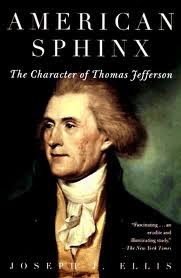
American Sphinx

American Sphinx: the Character of Thomas Jefferson
© 1998 Joseph Ellis
464 pages


Principle author of the Declaration of Independence, partial broker of the Franco-American alliance,  third president --  there is no denying Thomas Jefferson's pivotal place within the revolution.  He is a constant presence in Joseph Ellis'  prior histories concerning the revolutionary period, cast as a complex character -- quixotic one moment, pragmatic the next.  American Sphinx shines a spotlight on his contradictory character, being a study in character by way of a biographical sketch.

Little is known of Jefferson's early life,  owing to his parents' appalling lack of foresight in not realizing future generations would want to know everything about their little scion, and to a fire that consumed what  little documentation of his early life existed. Jefferson would make up for that in his adult life, being a prolific author;  indeed, he is best known for his literary output, like the Declaration of Independence. No fiery orator like John Adams or Patrick Henry, he no less set fire to the world. In Ellis' account, Jefferson appears for the first time on the political stage, producing a series of works that make the patriotic case against British abuses in ever-sharper and ever-seeping language. Jefferson will continue to write on the themes developed in such works as A Summary View of the Rights of British America and the Declaration.  It is the tension between the values he defended, and the actions he committed, that most of the works concerns itself with.

Of all the founding fathers, it is Jefferson's spirit which is most invoked today, hailed by liberals for his commitment to equality and by conservatives for his deep distrust of centralized power.  Jefferson was in turns a liberal and a conservative;  his love affair with the French Revolution, even amid its violence, demonstrated that he had no aversion to destroying the old order completely; but such was his faith in the rationality of man that he believed justice would prevail once the old founts of inequality like monarchy and religion were destroyed.  Government must be kept at minimal levels, however, to ensure that the babe of equality was not smothered in its cradle by power-mad despots (Alexander Hamilton), military juntas (Alexander Hamilton)  and malicious big bankers (Alexander Hamilton*).    Thus he looked for conservative ends through liberal means.

Contradictions abounded elsewhere; though rightly lauded as the author of the Declaration, the words of which have been an ideal Americans have struggled to realize in full ever since -- "We hold these truths self-evident, that all men are created equal...."  -- he did, in fact, keep slaves. Ellis examines both the facts of Jefferson's plantation and his expressed thoughts;   despite his frequent cooing over the nobility of American yeoman farmers,  Jefferson devoted little care to his fields himself, taking an interest only at harvest time. The slaves he spent the most time around were his house servants, mulattoes who appeared to some visitors closer to white than black, and treated with intimate familiarity. They were a world apart from the grisly, bloody reality of most slavery. Even when Jefferson was around his field hands, it was only when he employed them in the farm-saving work of being apprenticing in his nail factory. Yes, Jefferson the agrarian only found solvency by creating a little workshop on the premises. By giving hands such marketable work, he reasoned that he was preparing them for the day when emancipation was possible.

These are only two instances of Jefferson almost being a man of two-minds, but such contradictions are the prevailing theme of the work.  Ellis isn't a sharp critic of Jefferson -- who could be? -- but the work reveals him at worst a romantic, a man who exalted farmers but took little real interest in his, who believe great things but did not take great stands lest they imperil his other dreams. At his best, however, Jefferson was an idealist who could be pragmatic when it counted, as the many compromises through his presidential career showed --  and as even his enemies admitted.  American Sphinx is as promised a fascinating look into Jefferson's mind, though  it's not quite a complete biography.

Related:
Thomas Jefferson: Author of America, Christopher Hitchens.
Alexander Hamilton, Rob Chernow. A look at the Jefferson-Hamilton ragefest from the other side..


Wednesday, October 2, 2013

Taft 2012

Taft 2012
© 2012 Jason Heller
246 pages


In another world, William Howard Taft vanished from history after his presidential term. Rather than going on to become a Supreme Court Justice, he simply -- disappeared. He became the world's most famous missing man, at least until 99 years, whereupon he sprang up from the muddy  ground of the White House lawn, interrupting a press conference given by President Obama before being dutifully shot down by the Secret Service. Fortunately, when you weigh close to 400 pounds, you carry your own kind of bullet-slowing protection. Thus begins Taft 2012, a lightening-quick work of political satire which sees a stodgy lawyer from another era become an objection of obsession to a nation distressed by its disunity and eager to believe in anyone who can rise above the fray. Taft's contempt for partisan or dirty politics makes him a man of the hour, a man whose broad shoulders bear the weight of a nation's hopes and fears -- from liberals who want someone who will really take it to Big Business, to conservatives who want someone who knows how to balance a budget. Taft 2012 combines the easy entertainment of temporal displacement (see Taft stare at biracial couples in astonishment, scarf down a Twinkie, be seduced by Wii Golf, complain about modern music, etc) with more serious cultural observations (television is alienating) and a political campaign centered on food and education. The author mixes a conventional narrative with excerpts from the world he's created -- news articles and twitter conversations about Taft, press releases from the Draft Taft element of the Taft Party -- and the like. There are also pieces from an in-universe history of the Taft presidency, which draw allusions from history to the actions in the story. Within a matter of months, the Rip Van Winkle-like Taft goes from a national curiosity to a serious write-in candidate for the presidency. This is aided by the fact that a great-granddaughter of his, one Ms. Rachel Taft, is a popular independent legislator in her own right -- but there's more sinister workings afoot, and Taft truly comes into his own by novel's end rather than being the man everyone pins their hopes on. This is fast, funny, and sometimes pointed. Most Americans will enjoy it

Friday, July 5, 2013

His Excellency

His Excellency: George Washington
© 2005 Joseph Ellis
352 pages


Most of the Founding Fathers are exalted, but not quite divine. They are icons not without blemish: John Adams had his temper,   Benjamin Franklin his shameless lechery. But George Washington towers above the rest; in the American mythos, he is more divine than Jesus -- Jesus, at least, was tempted. Joseph Ellis' admitted attempt in His Excellency is to capture the demigod and bring Washington down to Earth. His biography succeeds in making Washington more of a human character, one who in his own time recognized he was being made into a legend and did his best to fulfill the reputation, both for the sake of the nation and his quiet sense of pride.

With precious little material to inform historians about his early years, Washington seems to spring into the world in the manner of Athena: fully-formed, and already in the thick of things as an inexperienced officer who accidentally set off the French and Indian War -- making American history without even trying. His military service, marriage into a wealthy family, and natural air of authority led him to early prominence in Virginia, especially as ties between Britain and her colonies became increasingly frayed. He would be first president of the Second Continental Congress, then commander in chief of its army, and still later the first president of the American union.  His adult accomplishments are well known to most, at least their particulars. What motivates Ellis is a desire to understand what made His Excellency tick.  The biography subsequently takes the form of a character study.

From Ellis’ account, control is the presiding theme of Washington’s life:  control over his passions, his finances, his legacy. Though idealized, he emerges here an intensely pragmatic man who expects the worst and works to minimize risks. This is why he prefers a professional army to one composed of militia-men: though a force of citizens which comes together in times of crisis has great romantic appeal, Washington’s own experience saw nothing in a republican fyrd to commend them. Untrained militia melted away in combat, or lost interest in the war. Only discipline and strength could meet adversity. In the face of the challenges the early Republic faced, Washington wanted those values in the saddle, not Jeffersonian hopes.   Of course,  his opponents might argue that decentralized power mitigated the risk of abuse moreso than a strong state, but Washington distrusted a passionate mob more than he did corrupt aristocrats, possibly because he regarded corruption as self-defeating.  Though held as a champion of American liberty, Washington was thus very conservative in his way: he worked for American independence out of practicality, believing that Britain literally could not govern from a distance, and people needed to be governed, both by a government that prevented them from doing harm to one another and by self-imposed limits.  The limits on Washington were all self-imposed: Ellis sees him as pursuing virtue for the practical reasons: not only would he be happier, but his name would be more gloriously remembered. Posterity would judge him not by the power he held, but by the power he refrained from using, and so Ellis places great emphasis on the numerous times Washington voluntarily surrendered power, moves that not only protected him from the charge of monarchism, but gave the American people a legend to idolize: behold, the philosopher-president, the noble Cinncinatus who governs wisely and then retires, avoiding being stained with the purple dye that Marcus Aurelius cautioned himself against being touched by.

I found His Excellency  to be a most...appropriate biography, in that it reveals the Father of his Country to be a man with vices (like a lust for land), but whose pursuit of self-interest led to him becoming an exemplar of civic virtue. It's the American dream.  Both those who want to learn about his human side-- his errors and frailties -- and those who want to learn more about his life without the shining armor being tarnished will find His Excellency a solid contribution to their understanding.

Related:
Nehru: the Invention of India, Shashi Tharoor

Saturday, August 18, 2012

John Adams

John Adams
© 2001 David McCullough
751 pages


The memory of some American presidents looms over the national mind like their monuments tower above the landscape. But John Adams has no monument on the National Mall: his face does not stare down from Mount Rushmore or any piece of currency. He is, or was, until the publication of this book, largely forgotten – a downright shameful fact given the importance of his accomplishments.

Name an aspect of the American Revolution, and John Adams was there.  In the early years, his voice was among the most ardent scolding Britain for its abuse of colonial legal rights: at the Continental Congress, he began and led the charge for independence, championed George Washington as leader of the Continental Army, and defended the Declaration of Independence as its author Thomas Jefferson sat by idly.  During the revolution, he endured a long separation from his wife while working to effect war-winning alliances and afterwards, established the new nation’s  credit. Upon his return to the new United States, he served as vice president and then president, pursuing a solitary course of action that kept America from being embroiled in the Napoleonic wars, earning him the contempt and hostility of both parties, but the praise of historians to come.  John Adams was constantly making American history despite not being born into power, wealth, or influence – he was there because time and again he inserted himself into history’s way and stubbornly stood for what he viewed as the right course of action.

While John Adams isn’t a hagiography,  McCullough’s appraisal of his subject is mostly complimentary.  Adams’ heroic aura comes not from grand idealism – for Adams was a pragmatist – or dashing military deeds, but in more mundane virtues. He was hardworking, morally upright, faithful to his cause, driven by duty to live up to his potential, and ever-constant.  When compared to his mercurial and petty contemporaries, not to mention the current lot of demagogues masquerading as public officials, Adams seems the embodiment of statesmanship. McCullough’s criticism is limited to acknowledging that Adams could have, at times, a bit of a temper.

Modern readers may find Adams’ comparative conservatism more problematic than any hot-headedness. Although Jefferson might have viewed the Revolution as being a progressive step forward in the history of mankind, Adams saw colonial rights as being a function of British, and then American, law: they were not so much newly proclaimed as redeemed from the recent abuses of the king. He put little faith in the judgment of excitable masses especially the judgment of men who didn't own land enough to make them financially independent:  men beholden to bosses were too easily influenced to build a free republic on. He also believed that aristocracies were inevitable, and should be thus planned for – their influenced acknowledged, and limited and removed from actual power – and that a government functioned best with a powerful executive whose decisions could not be easily over ridden. Given his fondness for English law, little wonder that the pro-French party railed against him as a closet monarchist with British sympathies and that members of his own party distanced themselves from him at best (as did George Washington) or openly reviled him, like Alexander Hamilton. With Jefferson conspiring with the French minister and both political parties acting as though civil war was about to break out and planning extralegal martial action, little wonder that Adams sullied his reputation somewhat with the Alien and Sedition acts. To his credit, he lived to regret signing those acts – something Wilson never did, and something it is doubtful Bush or Obama ever will do.

 John Adams was no idealist, but his actions speak louder than the words of those we cherish as champions of human progress, like Jefferson – who repeated the thought that all men were created equal in his Declaration, but persisted in keeping his own slaves.  Adams reviled the practice and refused so much as to hire someone else’s slaves: he and his family did most of the work  on their farm while Jefferson sat idly in Monticello, singing praises of Napoleon and tinkering with his gadgets. And for all his conservatism, Adams looked to the future and prepared the United States for it. While Jefferson dreamt of a pastoral republic filled with gentleman farmers (and their slaves, one assumes), Adams saw the future of the nation writ in industry, and commerce. One wonders – had the Erie Canal been proposed in a second Adams administration, instead of Jefferson’s first, would it have found presidential support instead of being a project of New York State alone?

 John Adams is an extraordinarily rich biography. McCullough’s reputation as an historian speaks for itself: this is as engrossing as a novel, and filled with details about Adams as a husband, father,  farmer, public official, statesman, and friend. Of the three McCullough works I've read, this was the most outstanding, in part because of its subject. I've found in him much to admire.