Passionate Sage: The Character and Legacy of John Adams
© 1993 Joseph Ellis
288 pages
G.K. Chesteron once wrote that the Catholic Church is the only thing that saves a man from the degrading slavery of being a child of his age. I don't know that the Church has a monopoly on timelessness, but some historic personalities have a sense of integrity that bids me think they would remain who they were if they were plucked up bodily and thrown into another age. Robert Ingersoll is one such man; John Adams is another. This sense of integrity isn't magically imbued; it requires a certain force of mind, and the decision to root one's self in deeper principles. Passionate Sage is a rare treatment of John Adams which focuses on him not as an architect of the revolution, or as an executive officer, but as a retired statesman coming to terms with what he and others had wrought -- satisfied with what he'd done, even if he was regarded as an anachronism. He had followed his own convictions, and that was enough.
Ellis' treatment of Adams make me suspect that Adams would be his own man in any time because while classical allusions were rife in the founding era, Adams' very soul was grounded in the classical tradition. Some revolutionaries like Thomas Jefferson believed that the Revolution had made all things new again, that institutions like monarchy which prevented people from fulfilling an innately good nature had been escaped from. Adams held to an older view, however, that man was flawed and would constantly struggle with his inner demons -- that virtue and vice hold us in a perpetual tug of war. Our greatest flaw, Adams believed, was pride and vanity; these would drive men to compete ferociously with one another even if they were economic equals. For Adams, the great problem of politics was how to build a productive government that took human frailty in mind. He was a grim realist in an age of idealism. This led him to promoting unpopular ideas -- for instance, that the presidency should be invested with a certain sense of awe, not to honor the person but for the office and for the law's sake. If people do not believe in the law, have a certain respect for it, it loses its persuasive power. If awe does not work, people resort to brute force -- and things go to pieces. His pragmatism also led him taking a high and lonely road during his administration, when he doggedly pursued a course of non-interference during the Franco-English spats of the time. Federalists looked to trade and defense deals with England, and Republicans looked to France. Adams defied them both, following his studies of philosophy that indicated one must do the right thing even if it was unpopular. Adams hoped that history would vindicate him, and on that matter it has. (Ellis notes that Adams often chose the course of action that would alienate the most people, being suspicious of popularity even as he desired it.)
Although Ellis focuses on Adams' thinking and writing, even still we get glimpses of Adams the man -- reading ferociously, for instance. Adams not only challenged Jefferson in terms of the piles of books they both read, but filled his books with notes arguing and debating the authors. Adams loved a good intellectual bout, though his approach was more a pugnacious boxer's than an exercise in rapier wit. In his exchange of letters to Thomas Jefferson, for instance, he fired off as twice as many letters as he received. Although often bombastic in his criticisms (especially where the "bastard brat of a Scotch pedlar", Alexander Hamilton, was concerned), Adams' delight in conversation meant that he'd mend bridges with people like Jefferson or Mary Otis Warren just so he could lock horns with them again. Although by the time he died Adams was regarded as highly as Jefferson, throughout the 19th century his reputation was steadily surpassed by his old friend, who sometimes seemed to be shadowing Washington. Ellis attributes this to the triumph of Jacksonian democracy, which had and less use for Adams' caution, and still less for his philosophic intransigence.
For my own part, I have found Adams endearing and redoubtable ever since discovering him via 1776 and David McCullough. Although self-conscious about his frailties, particularly his vanity and temper, that never stopped him from charging ahead in a roar, with a mouth firing off fusillades. He had a rare energy that left him only when the grave took him.
Related:
John Adams, David McCullough. Selected Adams quotations from the same.
First Family: John and Abigail Adams, Joseph Ellis
Pursuing the flourishing life and human liberty through literature.
"Once you learn to read, you will be forever free." - Frederick Douglass
Showing posts with label Joseph Ellis. Show all posts
Tuesday, July 11, 2017
Friday, June 16, 2017
Revolutionary Summer - Independence Kickoff
© 2014 Joseph J. Ellis
Earlier in the week I read Joseph Ellis’ Revolutionary Summer to kick off my yearly tribute to American Independence. Ellis should be familiar to readers here, as I enjoy his narrative histories of the revolutionary and early republican period of America enormously. Revolutionary Summer follows two interlapped threads of the revolution, political and military, as they flowed together. That summer was the summer in which a tax rebellion sharpened into a bid for complete independence, and it started before the Declaration of Independence. In May, for instance, the colonies began working on their own constitutions, superseding the earlier ones granted through the king’s authority. British commitment to reversing the rebellion – two diplomat-generals and a task force of 50,000 men, carried on the largest fleet ever seen off the waters of North America – also made it clear that a threshold had been passed: both sides were committed, root, hog, or die.
I’m using Ellis’ book to kick off my annual tribute to American independence, or rather the early Republic since I tend to read little about the war itself. I am no less fatigued with politics than I was last year, however, largely because the political atmosphere here is still charged and turbulent, and so will be cutting the politics with literature and one travel memoir. Expect a biography of a forgotten founder, at least one book on the Constitution, and a bit of literature. I’ll most likely use my Classics Club list to provide the spot of American lit.
Labels:
American Revolution,
history,
Joseph Ellis,
military
Wednesday, September 2, 2015
The Quartet
The Quartet: Orchestrating the Second American Revolution, 1783 - 1789
© 2015 Joseph Ellis
How many men does it take to make a revolution? The American Revolution is usually taken to include the rising animus against the political authority of Great Britain, a desire for independence, and the war against Britain itself. The revolution did not create an independent American nation, however; it created thirteen. United in common cause against the armies of Parliament, peacetime threatened to cause dissolution. The liabilities of the Articles of Confederation, and the threat of the American seaboard becoming some Italian-like quilt of squabbling chiefdoms,, prompted some of the states’ leading lights to vie not only for stronger ties between the states, but for the creation of a more cohesive nation. In The Quartet, veteran Revolution historian Joseph Ellis examines the role of four particular men in effecting a transformational shift in American politics, forging a new American nation out of thirteen. What they created was only the beginning of that union, but it was enough. Here delivered is a history of the Constitutional convention, told through the men who made it so.
Argue as we may over the question of where sovereignty ultimately lies – with the States, or with the national government -- prior to the Constitution no one doubted that the states were sovereign. The Articles of Confederation, written to facilitate the war effort between the colonies-turned-states, gave the central authority virtually no muscle. Genuine authority lay in the States and their respective armies, which frustrated to no end those tasked with the confederation’s responsibilities. Roger Morrison, for instance, initially tasked with getting the fledgling republic’s financial house in order, found virtually no support. The States balked at the smallest contributions, either from short-sighted shrewdness or long-term paranoia. The states’ refusal to help with national provisions, even to pay the soldiers who carried the hope of the rebellion on their shoulders, nearly lead to a militia coup. Only the charisma of George Washington prevented matters from taking a tragic turn; it would not be the last time his shoulders bore the weight of the American enterprise. .John Jay was likewise frustrated trying to arrange treaties, as the States insisted on making their own. Europe gazed across the Atlantic and viewed the new project with derision, almost taking bets on when the states would go their own way.
The Articles were failing to make the American project a go, but this was an age of ambitious and remarkably intelligent men willingly to be bold with their and other people's fortunes. Having taken readers through the stresspoints of the Articles, Ellis shifts to the effort that Madison and Hamilton spearheaded to call a convention to amend the Articles, a convention that replace them altogether. This took some doing; many Americans were quite happy with an impotent central government. Virginians didn't want to be saddled with other states' debts, and Rhode Island didn't want New York and other large states pushing it around. Any effort to strengthen an outside authority -- a foreign power -- smacked of tyranny. Hamilton, Jay, and company were looking ahead, however; they saw that the world's future lay in the American frontier, and the states needed to work together if that was to be taken advantage of. At the first attempt in Annapolis to gather a convention, most of the states were no-shows. But Washington himself supported the cause, and Madison came to the second convention prepared to argue the case for a Constitution. Washington was the trump card, the demigod who imbued the cause with moral authority; he even circulated the odd letter to lend active support. Madison stayed on the floor throughout the constitutional process, and afterwards he and Hamilton -- with a little help from John Jay -- took up the pen to argue for its ratification in New York. Washington remained vital to the constitutional cause even after it was written, signed, and ratified; if the nation's first president were anyone but -- if the electors faltered and put an anti-federalist anywhere near the executive seat -- all efforts might be forfeit. Here Hamilton plays another part, influencing the election to ensure that John Adams didn't come close to threatening Washington's victory. Eventually the Federalists would be routed in what Thomas Jefferson referred to as 'the second American revolution' -- his election -- by then the course of the nation was set.
The Quartet is classic Ellis, seeing history as made by the actions of individual actors, not the inevitable outcome of enormous socio-economic reactions. Ellis' creates an intimate history, one ruled by personal relationships; one chapter called "The Courting" speaks of Washington's seduction and consummation by Jay and Madison into the nationalist cause. While the four aren't as tightly-knitted together as the title suggests ("orchestrating" the revolution as if they were a conspiracy with an intricate plan), their unity at an opportune moment caused a sea change in American political history. Though favoring the Federalist cause, Ellis doesn't too much overplay his hand: he points out for instance that the Federalist Papers only have limited use, being the propaganda work of the nation's most avowed nationalists, and written for a particular New York audience. His emphasis on relationships does prompt a misread of Madison's character: while prior to the Revolution, Madison argued for the Federalists and a national union; afterwards he was the darling of the Democratic-Republican cause against Federalism. Ellis sees this as entirely the result of Jefferson returning to America and Madison abandoning his ideas to support his mentor, as if Madison wasn't capable of having nuanced political sensibilities that supported a golden mean between centralization and anarchy. These are slight quibbles, however; Ellis has yet again produced an enthralling political drama, perfect for a quick dip into Revolutionary history.
Related:
Madison and the Making of America, Kevin Gutzman, focusing entirely on this Constitutional Convention where Madison played center stage.
Founding Brothers, Joseph Ellis. Of all the Ellis I've read, this places the most emphasis on political relationships.
Madison and the Making of America, Kevin Gutzman, focusing entirely on this Constitutional Convention where Madison played center stage.
Founding Brothers, Joseph Ellis. Of all the Ellis I've read, this places the most emphasis on political relationships.
Friday, June 27, 2014
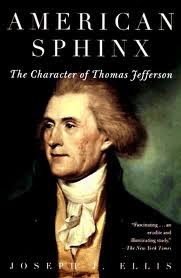
American Sphinx
American Sphinx: the Character of Thomas Jefferson
© 1998 Joseph Ellis
464 pages
Principle author of the Declaration of Independence, partial broker of the Franco-American alliance, third president -- there is no denying Thomas Jefferson's pivotal place within the revolution. He is a constant presence in Joseph Ellis' prior histories concerning the revolutionary period, cast as a complex character -- quixotic one moment, pragmatic the next. American Sphinx shines a spotlight on his contradictory character, being a study in character by way of a biographical sketch.
Little is known of Jefferson's early life, owing to his parents' appalling lack of foresight in not realizing future generations would want to know everything about their little scion, and to a fire that consumed what little documentation of his early life existed. Jefferson would make up for that in his adult life, being a prolific author; indeed, he is best known for his literary output, like the Declaration of Independence. No fiery orator like John Adams or Patrick Henry, he no less set fire to the world. In Ellis' account, Jefferson appears for the first time on the political stage, producing a series of works that make the patriotic case against British abuses in ever-sharper and ever-seeping language. Jefferson will continue to write on the themes developed in such works as A Summary View of the Rights of British America and the Declaration. It is the tension between the values he defended, and the actions he committed, that most of the works concerns itself with.
Of all the founding fathers, it is Jefferson's spirit which is most invoked today, hailed by liberals for his commitment to equality and by conservatives for his deep distrust of centralized power. Jefferson was in turns a liberal and a conservative; his love affair with the French Revolution, even amid its violence, demonstrated that he had no aversion to destroying the old order completely; but such was his faith in the rationality of man that he believed justice would prevail once the old founts of inequality like monarchy and religion were destroyed. Government must be kept at minimal levels, however, to ensure that the babe of equality was not smothered in its cradle by power-mad despots (Alexander Hamilton), military juntas (Alexander Hamilton) and malicious big bankers (Alexander Hamilton*). Thus he looked for conservative ends through liberal means.
Contradictions abounded elsewhere; though rightly lauded as the author of the Declaration, the words of which have been an ideal Americans have struggled to realize in full ever since -- "We hold these truths self-evident, that all men are created equal...." -- he did, in fact, keep slaves. Ellis examines both the facts of Jefferson's plantation and his expressed thoughts; despite his frequent cooing over the nobility of American yeoman farmers, Jefferson devoted little care to his fields himself, taking an interest only at harvest time. The slaves he spent the most time around were his house servants, mulattoes who appeared to some visitors closer to white than black, and treated with intimate familiarity. They were a world apart from the grisly, bloody reality of most slavery. Even when Jefferson was around his field hands, it was only when he employed them in the farm-saving work of being apprenticing in his nail factory. Yes, Jefferson the agrarian only found solvency by creating a little workshop on the premises. By giving hands such marketable work, he reasoned that he was preparing them for the day when emancipation was possible.
These are only two instances of Jefferson almost being a man of two-minds, but such contradictions are the prevailing theme of the work. Ellis isn't a sharp critic of Jefferson -- who could be? -- but the work reveals him at worst a romantic, a man who exalted farmers but took little real interest in his, who believe great things but did not take great stands lest they imperil his other dreams. At his best, however, Jefferson was an idealist who could be pragmatic when it counted, as the many compromises through his presidential career showed -- and as even his enemies admitted. American Sphinx is as promised a fascinating look into Jefferson's mind, though it's not quite a complete biography.
Related:
Thomas Jefferson: Author of America, Christopher Hitchens.
Alexander Hamilton, Rob Chernow. A look at the Jefferson-Hamilton ragefest from the other side..
© 1998 Joseph Ellis
464 pages
Principle author of the Declaration of Independence, partial broker of the Franco-American alliance, third president -- there is no denying Thomas Jefferson's pivotal place within the revolution. He is a constant presence in Joseph Ellis' prior histories concerning the revolutionary period, cast as a complex character -- quixotic one moment, pragmatic the next. American Sphinx shines a spotlight on his contradictory character, being a study in character by way of a biographical sketch.
Little is known of Jefferson's early life, owing to his parents' appalling lack of foresight in not realizing future generations would want to know everything about their little scion, and to a fire that consumed what little documentation of his early life existed. Jefferson would make up for that in his adult life, being a prolific author; indeed, he is best known for his literary output, like the Declaration of Independence. No fiery orator like John Adams or Patrick Henry, he no less set fire to the world. In Ellis' account, Jefferson appears for the first time on the political stage, producing a series of works that make the patriotic case against British abuses in ever-sharper and ever-seeping language. Jefferson will continue to write on the themes developed in such works as A Summary View of the Rights of British America and the Declaration. It is the tension between the values he defended, and the actions he committed, that most of the works concerns itself with.
Of all the founding fathers, it is Jefferson's spirit which is most invoked today, hailed by liberals for his commitment to equality and by conservatives for his deep distrust of centralized power. Jefferson was in turns a liberal and a conservative; his love affair with the French Revolution, even amid its violence, demonstrated that he had no aversion to destroying the old order completely; but such was his faith in the rationality of man that he believed justice would prevail once the old founts of inequality like monarchy and religion were destroyed. Government must be kept at minimal levels, however, to ensure that the babe of equality was not smothered in its cradle by power-mad despots (Alexander Hamilton), military juntas (Alexander Hamilton) and malicious big bankers (Alexander Hamilton*). Thus he looked for conservative ends through liberal means.
Contradictions abounded elsewhere; though rightly lauded as the author of the Declaration, the words of which have been an ideal Americans have struggled to realize in full ever since -- "We hold these truths self-evident, that all men are created equal...." -- he did, in fact, keep slaves. Ellis examines both the facts of Jefferson's plantation and his expressed thoughts; despite his frequent cooing over the nobility of American yeoman farmers, Jefferson devoted little care to his fields himself, taking an interest only at harvest time. The slaves he spent the most time around were his house servants, mulattoes who appeared to some visitors closer to white than black, and treated with intimate familiarity. They were a world apart from the grisly, bloody reality of most slavery. Even when Jefferson was around his field hands, it was only when he employed them in the farm-saving work of being apprenticing in his nail factory. Yes, Jefferson the agrarian only found solvency by creating a little workshop on the premises. By giving hands such marketable work, he reasoned that he was preparing them for the day when emancipation was possible.
These are only two instances of Jefferson almost being a man of two-minds, but such contradictions are the prevailing theme of the work. Ellis isn't a sharp critic of Jefferson -- who could be? -- but the work reveals him at worst a romantic, a man who exalted farmers but took little real interest in his, who believe great things but did not take great stands lest they imperil his other dreams. At his best, however, Jefferson was an idealist who could be pragmatic when it counted, as the many compromises through his presidential career showed -- and as even his enemies admitted. American Sphinx is as promised a fascinating look into Jefferson's mind, though it's not quite a complete biography.
Related:
Thomas Jefferson: Author of America, Christopher Hitchens.
Alexander Hamilton, Rob Chernow. A look at the Jefferson-Hamilton ragefest from the other side..
Friday, July 5, 2013
His Excellency
His Excellency: George Washington
© 2005 Joseph Ellis
352 pages
Most of the Founding Fathers are exalted, but not quite divine. They are icons not without blemish: John Adams had his temper, Benjamin Franklin his shameless lechery. But George Washington towers above the rest; in the American mythos, he is more divine than Jesus -- Jesus, at least, was tempted. Joseph Ellis' admitted attempt in His Excellency is to capture the demigod and bring Washington down to Earth. His biography succeeds in making Washington more of a human character, one who in his own time recognized he was being made into a legend and did his best to fulfill the reputation, both for the sake of the nation and his quiet sense of pride.
With precious little material to inform historians about his early years, Washington seems to spring into the world in the manner of Athena: fully-formed, and already in the thick of things as an inexperienced officer who accidentally set off the French and Indian War -- making American history without even trying. His military service, marriage into a wealthy family, and natural air of authority led him to early prominence in Virginia, especially as ties between Britain and her colonies became increasingly frayed. He would be first president of the Second Continental Congress, then commander in chief of its army, and still later the first president of the American union. His adult accomplishments are well known to most, at least their particulars. What motivates Ellis is a desire to understand what made His Excellency tick. The biography subsequently takes the form of a character study.
From Ellis’ account, control is the presiding theme of Washington’s life: control over his passions, his finances, his legacy. Though idealized, he emerges here an intensely pragmatic man who expects the worst and works to minimize risks. This is why he prefers a professional army to one composed of militia-men: though a force of citizens which comes together in times of crisis has great romantic appeal, Washington’s own experience saw nothing in a republican fyrd to commend them. Untrained militia melted away in combat, or lost interest in the war. Only discipline and strength could meet adversity. In the face of the challenges the early Republic faced, Washington wanted those values in the saddle, not Jeffersonian hopes. Of course, his opponents might argue that decentralized power mitigated the risk of abuse moreso than a strong state, but Washington distrusted a passionate mob more than he did corrupt aristocrats, possibly because he regarded corruption as self-defeating. Though held as a champion of American liberty, Washington was thus very conservative in his way: he worked for American independence out of practicality, believing that Britain literally could not govern from a distance, and people needed to be governed, both by a government that prevented them from doing harm to one another and by self-imposed limits. The limits on Washington were all self-imposed: Ellis sees him as pursuing virtue for the practical reasons: not only would he be happier, but his name would be more gloriously remembered. Posterity would judge him not by the power he held, but by the power he refrained from using, and so Ellis places great emphasis on the numerous times Washington voluntarily surrendered power, moves that not only protected him from the charge of monarchism, but gave the American people a legend to idolize: behold, the philosopher-president, the noble Cinncinatus who governs wisely and then retires, avoiding being stained with the purple dye that Marcus Aurelius cautioned himself against being touched by.
I found His Excellency to be a most...appropriate biography, in that it reveals the Father of his Country to be a man with vices (like a lust for land), but whose pursuit of self-interest led to him becoming an exemplar of civic virtue. It's the American dream. Both those who want to learn about his human side-- his errors and frailties -- and those who want to learn more about his life without the shining armor being tarnished will find His Excellency a solid contribution to their understanding.
Related:
Nehru: the Invention of India, Shashi Tharoor
© 2005 Joseph Ellis
352 pages
Most of the Founding Fathers are exalted, but not quite divine. They are icons not without blemish: John Adams had his temper, Benjamin Franklin his shameless lechery. But George Washington towers above the rest; in the American mythos, he is more divine than Jesus -- Jesus, at least, was tempted. Joseph Ellis' admitted attempt in His Excellency is to capture the demigod and bring Washington down to Earth. His biography succeeds in making Washington more of a human character, one who in his own time recognized he was being made into a legend and did his best to fulfill the reputation, both for the sake of the nation and his quiet sense of pride.
With precious little material to inform historians about his early years, Washington seems to spring into the world in the manner of Athena: fully-formed, and already in the thick of things as an inexperienced officer who accidentally set off the French and Indian War -- making American history without even trying. His military service, marriage into a wealthy family, and natural air of authority led him to early prominence in Virginia, especially as ties between Britain and her colonies became increasingly frayed. He would be first president of the Second Continental Congress, then commander in chief of its army, and still later the first president of the American union. His adult accomplishments are well known to most, at least their particulars. What motivates Ellis is a desire to understand what made His Excellency tick. The biography subsequently takes the form of a character study.
From Ellis’ account, control is the presiding theme of Washington’s life: control over his passions, his finances, his legacy. Though idealized, he emerges here an intensely pragmatic man who expects the worst and works to minimize risks. This is why he prefers a professional army to one composed of militia-men: though a force of citizens which comes together in times of crisis has great romantic appeal, Washington’s own experience saw nothing in a republican fyrd to commend them. Untrained militia melted away in combat, or lost interest in the war. Only discipline and strength could meet adversity. In the face of the challenges the early Republic faced, Washington wanted those values in the saddle, not Jeffersonian hopes. Of course, his opponents might argue that decentralized power mitigated the risk of abuse moreso than a strong state, but Washington distrusted a passionate mob more than he did corrupt aristocrats, possibly because he regarded corruption as self-defeating. Though held as a champion of American liberty, Washington was thus very conservative in his way: he worked for American independence out of practicality, believing that Britain literally could not govern from a distance, and people needed to be governed, both by a government that prevented them from doing harm to one another and by self-imposed limits. The limits on Washington were all self-imposed: Ellis sees him as pursuing virtue for the practical reasons: not only would he be happier, but his name would be more gloriously remembered. Posterity would judge him not by the power he held, but by the power he refrained from using, and so Ellis places great emphasis on the numerous times Washington voluntarily surrendered power, moves that not only protected him from the charge of monarchism, but gave the American people a legend to idolize: behold, the philosopher-president, the noble Cinncinatus who governs wisely and then retires, avoiding being stained with the purple dye that Marcus Aurelius cautioned himself against being touched by.
I found His Excellency to be a most...appropriate biography, in that it reveals the Father of his Country to be a man with vices (like a lust for land), but whose pursuit of self-interest led to him becoming an exemplar of civic virtue. It's the American dream. Both those who want to learn about his human side-- his errors and frailties -- and those who want to learn more about his life without the shining armor being tarnished will find His Excellency a solid contribution to their understanding.
Related:
Nehru: the Invention of India, Shashi Tharoor
Saturday, June 29, 2013
American Creation
American Creation: Triumphs and Tragedies at the Founding of the Republic
© Joseph Ellis
304 pages
In Founding Brothers, Joseph Ellis used a series of nonfictional 'stories' about the founding fathers of the United States to illustrate how their personal relationships with one another shaped the struggle for independence and later the creation of the Republic. In American Creation, he uses the same approach, a series of vignettes, to explore moments which defined the course that Republic would take. Most occur after the revolution is won, and demonstrate how differently the founders dreamed from one another despite their accomplishments working with one another. The result is what I've come to expect of Joseph Ellis: colorful narrative history that doesn't begrudge sympathy to any founder and leaves the reader with a fuller appreciation for the Revolution -- one which sees the founders as men, not demigods, who struggled against not only the prejudices and foibles of third parties, but against one another and their own inner demons.
The titular triumphs are well known, like the Declaration of Independence and the miraculous survival of the Continental Army after Valley Forge, which was effected by both the persistent support of the people for the struggle and Washington's adoption of a strategy that played to his strengths: avoid battle and focus instead on controlling the countryside. Even so, Ellis may pass along new information to students of the period: for instance, months before the storied Declaration of Independence was presented and signed, each American colony drew up a constitution for itself in preparation for the impending separation from England, asserting self-rule in a fashion with immediate practical effects and much less bombast. Of the tragedies, there are three: the failure to strangle slavery, the lack of any effective and just "Indian policy", and the birth of vicious parties. All three have the same mother: the interests of Southern planters, asserting the sovereignty of their individual states and dismissing the authority of any central government influenced by merchants and bankers. Although Ellis is not a partisan historian, the verdict of his pen is more for the Federalists than the Republicans. The closest he comes to outright favoritism is in the chapter on party politics, "The Conspiracy", in which he attempts to answer the question: why were Thomas Jefferson and James Madison so paranoid about the Federalists, acting as though men who had lead the assault against tyranny would become tyrants themselves? Adam's authorization of the Alien and Sedition acts hadn't yet come into being, nor had Hamilton suggested to Adams that South America could do with a proper invasion, but both make the student of history wonder if maybe Republican concerns weren't justified to some degree. Jefferson emerges from the section seemingly like an ambitious lunatic, however -- which, perhaps he was. Though regarded as a man of science, his romantic attachment to the French Revolution, which he devoted service to at the expense of the American government, reveals how profoundly irrational he could be.
None of the founders emerge from this narrative unscathed: even the divine Washington is revealed as only human, unable to will a perfect treaty with a native nation (the Creeks, here) into being: not are the Creeks cleverly led by a man who is treacherous as any Congressional politician, but American settlers have the damndest habit of not doing what the government would wish them to do. They keep flooding into Creek territory without a care in the world for foreign policy. Parliament would no doubt sympathize -- and just wait until you try taxing them, George. Oh, wait -- the whiskey rebellion is also covered. Men who occupy lesser roles in most Revolution narratives get to shine more here, like Roger Livingston, the Forrest Gump of the revolution, always somehow in the middle of the biggest moments of American history. American Creation is a fitting read for the Fourth, one which offers a vision hopeful yet sober of what was created, and what may yet be restored: a nation of the people, by the people, for the people.
© Joseph Ellis
304 pages
In Founding Brothers, Joseph Ellis used a series of nonfictional 'stories' about the founding fathers of the United States to illustrate how their personal relationships with one another shaped the struggle for independence and later the creation of the Republic. In American Creation, he uses the same approach, a series of vignettes, to explore moments which defined the course that Republic would take. Most occur after the revolution is won, and demonstrate how differently the founders dreamed from one another despite their accomplishments working with one another. The result is what I've come to expect of Joseph Ellis: colorful narrative history that doesn't begrudge sympathy to any founder and leaves the reader with a fuller appreciation for the Revolution -- one which sees the founders as men, not demigods, who struggled against not only the prejudices and foibles of third parties, but against one another and their own inner demons.
The titular triumphs are well known, like the Declaration of Independence and the miraculous survival of the Continental Army after Valley Forge, which was effected by both the persistent support of the people for the struggle and Washington's adoption of a strategy that played to his strengths: avoid battle and focus instead on controlling the countryside. Even so, Ellis may pass along new information to students of the period: for instance, months before the storied Declaration of Independence was presented and signed, each American colony drew up a constitution for itself in preparation for the impending separation from England, asserting self-rule in a fashion with immediate practical effects and much less bombast. Of the tragedies, there are three: the failure to strangle slavery, the lack of any effective and just "Indian policy", and the birth of vicious parties. All three have the same mother: the interests of Southern planters, asserting the sovereignty of their individual states and dismissing the authority of any central government influenced by merchants and bankers. Although Ellis is not a partisan historian, the verdict of his pen is more for the Federalists than the Republicans. The closest he comes to outright favoritism is in the chapter on party politics, "The Conspiracy", in which he attempts to answer the question: why were Thomas Jefferson and James Madison so paranoid about the Federalists, acting as though men who had lead the assault against tyranny would become tyrants themselves? Adam's authorization of the Alien and Sedition acts hadn't yet come into being, nor had Hamilton suggested to Adams that South America could do with a proper invasion, but both make the student of history wonder if maybe Republican concerns weren't justified to some degree. Jefferson emerges from the section seemingly like an ambitious lunatic, however -- which, perhaps he was. Though regarded as a man of science, his romantic attachment to the French Revolution, which he devoted service to at the expense of the American government, reveals how profoundly irrational he could be.
None of the founders emerge from this narrative unscathed: even the divine Washington is revealed as only human, unable to will a perfect treaty with a native nation (the Creeks, here) into being: not are the Creeks cleverly led by a man who is treacherous as any Congressional politician, but American settlers have the damndest habit of not doing what the government would wish them to do. They keep flooding into Creek territory without a care in the world for foreign policy. Parliament would no doubt sympathize -- and just wait until you try taxing them, George. Oh, wait -- the whiskey rebellion is also covered. Men who occupy lesser roles in most Revolution narratives get to shine more here, like Roger Livingston, the Forrest Gump of the revolution, always somehow in the middle of the biggest moments of American history. American Creation is a fitting read for the Fourth, one which offers a vision hopeful yet sober of what was created, and what may yet be restored: a nation of the people, by the people, for the people.
Sunday, July 29, 2012
First Family
First Family: Abigail and John Adams
© 2010 Joseph Ellis
320 pages

'Til then, 'til then, I am, as I ever was....yours, yours, yours.
Ellis proved in Founding Brothers that he's a gifted storyteller, and the same strength is at play here. It helps that he has such extraordinary characters to write about. Abigail is no prim and proper personality stifled by petticoats: she's strong, vibrant, and independence, giving as good as she gets in terms of political and philosophical conversations as well as sly innuendo that no one would expect from a couple living in Puritan country. She is in the truest sense of the word, Adams's partner; his dearest friend and most constant source of intellectual stimulation. Her interest in politics influences his career directly, and she takes an active hand in his personal and political relationships with men like Thomas Jefferson. The affection these two feel for one another -- the strength and power of their relationship -- is abundantly evident in their letters, especially when they are estranged during Adams' time as an diplomat in Europe. Abigail's role as confidant allows the reader to see inside Adams' mind, and the man revealed is endearing for his faults and fascinating in his beliefs. Adams' progressive realism contrasts with Jefferson's conservative idealism, and demonstrates the frailty of the false liberal-conservative divide. No man is so easy to box up. Although politics plays a large role given Adams' place in history as revolutionary leader and president, John and Abigail's family is never far from sight, and the losses they endure can't help but inspire sympathy.
I thoroughly enjoyed First Family. To be sure, it does have the weakness of maintaining a one-sided view of the Revolution that sees Britain as entirely in the wrong; here, Britain is taxing America to pay for its empire just because it's fun to be oppressive like that. It's also not quite as varied as Founding Brothers, but even so I couldn't stop reading it. (The story of John and Abigail fairly well enraptures me: even though the Fourth is long past, the taste I had of their relationship in Sacred Honor and Founding Brothers only gave me an appetite for more, and I may wind up having to find and purchase a collection of their letters to find satisfaction!). It's a story of romance, family, and politics -- one which reveals the mind-boggling insanity of the Adams White House, where the second president is beset by friend and foe alike. Not only does his vice president conspire with the French and instruct them not to pay Adams any attention, but a member of his own party has Bonaparte-esque delusions of grandeur and tries not only to run the presidential cabinet in secret, but put himself at the head of an army he can use to root out spies and traitors....like the vice president. If nothing else, First Family demonstrates the remarkable pillar of contrarianism that was Adams more easily than David McCullough' denser biography might.
Related:
- No Ordinary Time, Doris Kearns Goodwin (FDR & Eleanor)
- Founding Rivals,Chris DeRose
- Founding Brothers,Joseph Ellis
- John Adams, David McCullough
Labels:
American Revolution,
biography,
John Adams,
Joseph Ellis
Saturday, June 30, 2012
Founding Brothers
Founding Brothers: the Revolutionary Generation

Laboring always at the same oar, with some wave ever ahead threatening to overwhelm us, and yet passing harmless under our bark, we knew not how, we rode through the storm with heart and hand and made a happy port. (Thomas Jefferson, letter to John Adams)
© 2000
288 pages

Laboring always at the same oar, with some wave ever ahead threatening to overwhelm us, and yet passing harmless under our bark, we knew not how, we rode through the storm with heart and hand and made a happy port. (Thomas Jefferson, letter to John Adams)
The Founding Fathers loom over Americans all of our lives: their portraits hang in our schoolrooms; their likenesses adorn our money. They are a peculiarity: an elite who created a democracy. The same set of men dreamed the American Revolution into being in Boston, fought for it at Trenton and Yorktown, struggled to bring its fruit to bear in Philadelphia, and finally attempted to steer the new ship of state onto a right course in Washington as one after the other assumed the presidency. Joseph Ellis’ eminently entertaining Founding Brothers focuses on how the interactions between these men as friends and rivals shaped the fate of a new nation, telling their story in six pieces.
Interestingly, Ellis opens the book by killing one of the central characters in his drama, Alexander Hamilton. Hamilton perished in a duel against Aaron Burr (as anyone who saw a particular “Got Milk?” commercial in the 1990s will remember vividly), but Ellis doesn’t take us to the misty ridge that is the site of their ritual just for kicks. He digs into the history of Hamilton and Burr’s feud, which – while it became personal – originated from their varying political beliefs, between the Federalists who desired a strong national government and the anti-Federalists (“Republicans”) who despised the idea. Ellis thus establishes early on that the modern penchant for looking back to “the Founders’ intention” is futile, because the Founders were rarely of one mind on any issue. In “The Silence”, two Quakers surprise Congress by asking them to consider the issue of slavery – an issue which they wanted to pointedly avoid. The blaze of debate raged for days thereafter, seeing every argument southerners would cite throughout the early 19th century put into field. They were not blind to the hypocrisy of hailing victory and maintaining slavery, but somehow they found justification – in believing that slavery was a doomed enterprise and would die naturally if left alone, or in arguments from ‘economic necessity’. Throughout the book, these men argue about the meaning of the Revolution, and the ambiguities built in to the Constitution itself become clear. It was not meant to decide what kind of nation the United States was to be – only to give it its start. The Founders’ own uncertainties and passionate disagreements are a central theme.
Although Ellis introduces the founders as an American pantheon, and refers to them (lightly) as demigods throughout, Founding Brothers somehow keeps these men on their pedestals while simultaneously freeing them from being simple marble idols to be admired from afar. In their fraililities and passions, they are manifestly human, and Ellis’ background allows us to step into their minds, to not only sense their emotions and understand their thinking, but to grasp why they were the men they were. This matures into a strangely intimate piece for a history book, especially in the final sections which focus on the relationship between John Adams and Thomas Jefferson – first political allies, then foes, then tired old friends who write letter after letter to one another with the attitude that “we two ought not to die before we have explained ourselves to one another”. This is a beautifully effective way to close out the book, not only because their dynamic is particularly touching but because it allows the reader to linger on the unfinished legacy of the Revolution, to seek an answer for themselves as to what it means.
Founding Brothers is a finely crafted book, a genuine pleasure to read and to consider.
Related:
Washington's Secret War, Thomas Fleming
Subscribe to:
Comments (Atom)