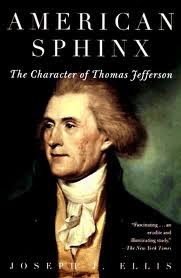
American Sphinx: the Character of Thomas Jefferson
© 1998 Joseph Ellis
464 pages
Principle author of the Declaration of Independence, partial broker of the Franco-American alliance, third president -- there is no denying Thomas Jefferson's pivotal place within the
revolution. He is a constant presence in Joseph Ellis' prior histories
concerning the revolutionary period, cast as a complex character --
quixotic one moment, pragmatic the next.
American Sphinx shines a spotlight on his contradictory character, being a study in character by way of a biographical sketch.
Little is known of Jefferson's early life, owing to his parents' appalling lack of foresight in not realizing future generations would want to know everything about their little scion, and to a fire that consumed what little documentation of his early life existed. Jefferson would make up for that in his adult life, being a prolific author; indeed, he is best known for his literary output, like the Declaration of Independence. No fiery orator like John Adams or Patrick Henry, he no less set fire to the world. In Ellis' account, Jefferson appears for the first time on the political stage, producing a series of works that make the patriotic case against British abuses in ever-sharper and ever-seeping language. Jefferson will continue to write on the themes developed in such works as
A Summary View of the Rights of British America and the Declaration. It is the tension between the values he defended, and the actions he committed, that most of the works concerns itself with.
Of all the founding fathers, it is Jefferson's spirit which is most invoked today, hailed by liberals for his commitment to equality and by conservatives for his deep distrust of centralized power. Jefferson was in turns a liberal and a conservative; his love affair with the French Revolution, even amid its violence, demonstrated that he had no aversion to destroying the old order completely; but such was his faith in the rationality of man that he believed justice would prevail once the old founts of inequality like monarchy and religion were destroyed. Government must be kept at minimal levels, however, to ensure that the babe of equality was not smothered in its cradle by power-mad despots (Alexander Hamilton), military juntas (Alexander Hamilton) and malicious big bankers (
Alexander Hamilton*). Thus he looked for conservative ends through liberal means.
Contradictions abounded elsewhere; though rightly lauded as the author of the Declaration, the words of which have been an ideal Americans have struggled to realize in full ever since -- "We hold these truths self-evident, that all men are created equal...." -- he did, in fact, keep slaves. Ellis examines both the facts of Jefferson's plantation and his expressed thoughts; despite his frequent cooing over the nobility of American yeoman farmers, Jefferson devoted little care to his fields himself, taking an interest only at harvest time. The slaves he spent the most time around were his house servants, mulattoes who appeared to some visitors closer to white than black, and treated with intimate familiarity. They were a world apart from the grisly, bloody reality of most slavery. Even when Jefferson was around his field hands, it was only when he employed them in the farm-saving work of being apprenticing in his nail factory. Yes, Jefferson the agrarian only found solvency by creating a little workshop on the premises. By giving hands such marketable work, he reasoned that he was preparing them for the day when emancipation was possible.
These are only two instances of Jefferson almost being a man of two-minds, but such contradictions are the prevailing theme of the work. Ellis isn't a sharp critic of Jefferson -- who could be? -- but the work reveals him at worst a romantic, a man who exalted farmers but took little real interest in his, who believe great things but did not take great stands lest they imperil his other dreams. At his best, however, Jefferson was an idealist who could be pragmatic when it counted, as the many compromises through his presidential career showed -- and as even his enemies admitted.
American Sphinx is as promised a fascinating look into Jefferson's mind, though it's not quite a complete biography.
Related:
Thomas Jefferson: Author of America, Christopher Hitchens.
Alexander Hamilton, Rob Chernow. A look at the Jefferson-Hamilton ragefest from the other side..