Showing posts with label WW2. Show all posts

Sunday, March 17, 2019

The USS Alabama

Images of America: USS Alabama
© 2013 Kent Whitaker & Battleship Memorial Park
128 pages


When visiting downtown Mobile, one can’t help but notice the enormous battleship parked in the bay.  It’s the USS Alabama, tenth to bear the name, and its proud history is recounted in this Images of America book which is as thorough as can be hoped for.  Not only does Kent Whitaker (on behalf of Battleship Memorial Park in Mobile) deliver a full history of the ship (which operated in both theaters of World War 2, earning numerous battle stars) and photographs which explore life aboard her, but  the book explores the histories of other ships named Alabama (including the CSS Alabama, sunk by the Kearsage after an illustrious career sinking Yankee shipping) as well as the particular story of how the Alabama came to be rescued from the scrapheap by children, and found instead a home in the port of its namesake state. 

Given that this Images of America book is image-heavy, I thought I'd share a few.

 The Alabama at work

Cleaning the "big guns", which...are very big indeed. 

Social life aboard the ship

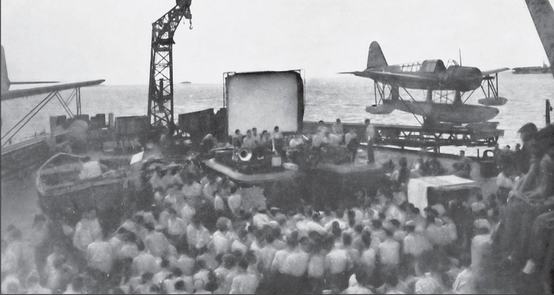
One of the two Kingfisher planes being launched by catapult. These were used for artillery spotting and for search and rescue operations. 

The cross pennant indicated that religious services  were in progress.


Thursday, October 11, 2018

An Iron Wind

An Iron Wind: Europe Under Hitler
©  2016 Peter Fritzsche
376 pages


That crowds that cheered Neville Chamberlain's return to England with a promise of peace in his hand are easy to condemn in hindsight. But no one in the 21st century experienced the Great War that loomed in that crowd's mind -- the war that emptied villages, destroyed families, and snuffed out millions of young lives before their time.   Modern technology promised to complete what the Great War had started: military strategies, aviation experts, and the common chatter of civilians were uniform in their belief that mass bombings would obliterate the continent.  Those fears were both new and rational: World War 2 was the first time the general populace looked at the prospects for war and realized that THEY would be the target, not just the men at the front lines.  But while civilians would be the greatest casualties in the war to come,  the conflict would be much different than expected,  nothing like a twenty-year-old re-run.   What Hitler sought was less a return of the German Empire, and more of the imposition of a new world order.  In An Iron Wind, Peter Fritzsche  uses the letter and literature written during the war to experience the first attempts to create this malicious order.  

An Iron Wind is definitely not a conventional history of World War 2, and not only because it focuses on society rather than politics and military movement.  The book often seems like a gathering of esoterica, at least until the Holocaust-heavy second half, because Fritsche  covers sundry topics like the imposition of German time zones in France,  patterns of graffiti throughout the war, and the spike in popularity of Tolstoy's War and Peace  which followed Hitler's invasion of Soviet Russia.  Fritzsche often emphasizes, however, Hitler's break with the past and his desire to create a new vision of the state.  Hitler mocked Switzerland as a museum antique, a fragile artifact of Victorian democracy that needed to accept the new way or prepare to be crushed by it.  Fritzsche offers a view of the Holocaust that its atrocities were a deliberate baptism in blood for the new way Hitler wanted to create; to  kill millions by cold, efficient bureaucracy --  with deliberation and a vast array to dedicated infrastructure – was to forcefully reject all the mores of the past, and particular ideals like universal brotherhood. While fascism in Italy and Spain could coexist with the church, linked by common enemies like communism,  Nazism regarded Christianity as enfeebling.   Hitler and like-minded ideologues promoted a view of Germany as being encircled by enemies and riddled from within by others;  his mission was to awaken and mobilize German to the threat, marshalling them for combat, with victory at any cost.  Fritzsche  also suggests that when Hitler launched his invasion of Poland,  it was for him less a battle between states than a fight between tribes, as the conflict allowed him to target not just the Polish state (which he methodically disassembled), but diverse groups like the Romani ("gypsies")  which he held in contempt. 

Although this is by no means essential reading for World War 2,  it does explore topics that are obscure enough to have not been mentioned much elsewhere, but still have relevance for understanding the plight of people who were trying to make sense of what was happening both at home and across the continent. 

Saturday, October 6, 2018

Church of Spies

Church of Spies: The Vatican's Secret War Against Hitler
© 2015 Mark Riebling
384 pages


The Catholic Church was one of Hitler's earliest enemies, barring its members from participating in the Nazi party and publicly condemning Hitler's early actions once he had been appointed -- not elected -- to  power.  But then, as the war between Hitler and the west began in earnest, the Church fell silent.   This silence was not cowardice, Mark Riebling argues here, but strategy.   With its people and churches already under attack by the Nazi government,  the pope elected during the early days of crisis (March 1939)  chose work more in silence, attempting to connect the German resistance to western governments, and aid them  with intelligence and shelter. A goal ever in mind was the overthrow of Hitler -- by assassination if necessary, as Catholic doctrine sanctioned the death of oppressive dictators provided plans were in place to  preserve order. 

Having previously learned about the role of the Catholic church in the German resistance, I wanted to read a more detailed history of it.  The book was certainly eye-opening in chronicling how early Pius XII wanted to move against Hitler,  working with members of the German army to attempt an early assassination.  The military contacts' interest never quickened into action, however, and after the war actually began, it was far harder both to find German officers willing to plunge their nation into a leadership crisis in wartime, and to find western audiences. After the fall of France and the beginning of the submarine and bombing siege of Britain, Churchill was especially cold toward representatives of a "decent Germany".

After this promising start the book quickly lost steam for me,  recounting various resistance groups ties to the church; we learn that the White Rose movement began by distributing Catholic sermons decrying Hitler, and that the people involved in the Heydrich assassination were given refuge in a church, hidden in the tombs by priests.  The mention of any Jews given shelter by the Church is barely mentioned here, but presumably is covered better by The Pope's Jews.  Of perhaps more interest is the  ideas Vatican authorities supported for a postwar Europe, one which would stymie destructive internal conflicts via a shared economic community, and politics based on subsidiarity, a key piece of the Catholic social doctrine.  Subsidiarity is still endorsed by the European Union in theory, but how well it is practiced is arguable.

Church of Spies is intriguing, but disappointing.

Related:
German Resistance to Hitler, Peter Hoffman
An Honourable Defeat: A History of German Resistance to Hitler, Anton Gill
The Scarlet and the Black, a film in which Gregory Peck portrays the true story of a priest in Rome who  hid thousands of Jews and sheltered Allied prisoners.

Saturday, September 1, 2018

Yesterday's News: The Shangri-La


When the United States government formally announced that the Doolittle raid -- a flight of B-17s over Tokyo in early 1942 -- had been carried out, President Roosevelt informed a reporter that the bombers had been launched from a secret base in "Shangri-La", an island from a novel popular at the time.   I was thus intrigued to see this ad while searching for obituaries in 1943, encouraging Americans to buy stamps to support the building of the  "mystery ship" Shangri-La. I assumed this was a codename,  but it proves to have been the actual name: a USS Shangri-La was laid down in January 1943, completed in early '44, and put into service in the autumn of that year.   An Essex-class carrier, the ship participated in late-war bombing raids against the Japanese home islands, so this is a rare case of an advertisement getting fairly close to the mark.  According to Wikipedia, the ship served through Vietnam, specializing in anti-submarine warfare,  and was retired in 1974.   Although I'm familiar with war bond campaigns, this is the first I've encountered where bonds or stamps were linked to a specific project, in this case a bonafide ship. 

Friday, August 10, 2018

The Hiding Place

The Hiding Place
© 1971 Corrie ten Boom,  John and Elizabeth Sherrill
241 PAGES


You are my hiding place; You preserve me from trouble; You surround me with songs of deliverance.
Psalms 32

When Corrie ten Boom turned in her family radio to the Nazi officials who had taken control of her town and her country and was asked if anyone else in the home had another set, she looked him square in the face and said "No".  As she departed, she shuddered -- not from the fear of encountering an agent of tyranny, but from how easy it was to lie.    The ten Booms were a deeply religious family whose watchmaking business opened and closed it day with the reading of Scripture, and even lying for the good did not come easy to the ten Boom sisters.  But it would have to, because as the Nazi consolidation of power in the Netherlands began, and their Jewish friends fell under duress, the tiny watchmaking-shop became the hiding place for a group of resistance fighters and Jewish citizens seeking refuge from the government.    It was last until late 1944, but even when the family had been seized by the SS and imprisoned in camps, there still remained one hiding place more.  The Hiding Place is both a wartime memoir and a work of Christian testimony, declaring and demonstrating that light can shine in the darkness.

From the beginning, the hiding place was not a great secret. The hidden compartment was physically well-concealed, but  no one could miss the sheer amount of people entering and exiting the building, and the neighbors had to ask (very quietly)  if they couldn't keep the Hanukkah singing down just a little bit.  The local police also knew, but had no interest in helping their grey-uniformed bosses in persecuting the innocents.   Someone did want to help the Germans, however,  as the family was betrayed and imprisoned. (Their wards, however, escaped notice!)  Eventually Corrie herself would travel to  Ravensbrück, the notorious women's concentration camp.  But that's where the memoir comes something else altogether, as the ten Boom sisters are isolated from one another and forced to rely on nothing but their faith to keep them sane -- and not just sane, but human.  The Gospel stories kept hope alive in the face of brutality -- and kept  them from sinking into despair and deadened souls. The camps destroyed many who survived, inflicting long-lasting psychological trauma, but ten Boom emerged from the war as a more fervent Christian missionary.   Remarkably, she and her sister refused to hate those who abused and humiliated them, and killed their father; they constantly expressed thanks for whatever small mercies they can see, and even when Corrie is being interrogated by an SS official, his skull-and-crossbones staring her down,  she urges him to turn away from the darkness and look to the light.   

In their darkest hours, the ten Boom sisters shared hope for the future -- dreams of what they would do when they were released.  They wanted to turn their home into a refuge for those who had been crippled by it. This was not new to the ten Booms: even during the war they sought to shelter and teach the mentally infirm, who were left without resources by the Nazis and threatened with euthanasia.    ten Boom shared a vision of having a place where former collaborators could redeem themselves  by serving those whom they'd previously oppressed. This, she admits, did not work out well: there were too many fights between both sides, each holding the other in resentment.  Even so, her shelter was one of the few places open to homeless former collaborators.   The ten Booms' refusal to give in to hate is utterly inspiring in a day when  spite and contempt saturate every political argument, when old hatreds are constantly given new life and the bleeding sores of politics never allowed to heal.


"It was a day for memories. A day for calling up the past. How could have guessed as we sat there -- to middle-aged spinsters and an old man -- that in place of memories we were about to be given adventure such as we had never dreamed of. Adventure and anguish, horror and heaven were just around the corner, and we did not know.
Oh Father! Betsie! If I had known would I have gone ahead? Could I have done the things I did?

p. 12

Saturday, May 19, 2018

Alone

Alone: Britain, Churchill, and Dunkirk: Defeat Into Victory
© 2017 Michael Korda
544 pages


Judging by most World War 2 histories, the war only heats up once Hitler's rapid takeover of northern and western Europe is accomplished in the spring of 1940, and England is left facing a continent controlled by two execrable men and Mussolini.  The fall of the low countries and the fighting retreat of the Allied army happen so quickly that they're dispatched almost as a prologue to the greater drama. Alone takes that prologue as its subject, opening at Munich and moving quickly to the invasion of Poland and the state of war which followed.  Readers witness stiff desire not to fight again quickly replaced by a mixture of chivalrous indignation and less chivalrous resignation, as England again dispatches her army to Europe to check the German advance, standing alongside the even more resigned French. Here too are chronicled the desperate struggles by the Dutch and Belgian armies, who though colossally outmatched, refuse to yield .  The finish, of course, is the  great drama of Dunkirk, where the men of the British expeditionary force are surrounded by  the German advance, but escape to safety by means of a fleet of civilian ships, a brilliant of example of England expecting every man to do his duty -- even men out of uniform.  Korda notes that the triumphant escape of Dunkirk sometimes overshadows the sheer awfulness of getting there and enduring it: some regiments lost as many as two-thirds of their men, and the beach itself was a spectacle from Dante, filled with burning debris, scattered bodies, and the stench of both.  Alone is a personal history as well,  as a very young Michael Korda was just old enough to realize  something bad was happening; the Korda family's involvement in British and later American film industry adds an interesting flair to a more familiar subject.   Korda  strikes a good balance between narrative and detail, and includes a generous amount of in-text illustrations of personalities and movements. 

Related:


To end, a quote from one of Churchill's addresses:

"...and I made it perfectly clear then that whatever happened in France would make no difference to the resolve of Britain and the British Empire to fight on, if necessary for years, if necessary alone.

We have before us an ordeal of the most grievous kind. We have before us many, many long months of struggle and of suffering. You ask, what is our policy? I will say: It is to wage war, by sea, land, and air, with all our might and with all the strength that God can give us; to wage war against a monstrous tyranny never surpassed in the dark, lamentable catalogue of human crime. That is our policy. You ask, what is our aim? I can answer in one word: It is victory, victory at all costs, victory in spite of all terror, victory, however long and hard the road may be."


Sunday, January 14, 2018

Munich

Munich
© 2018 Robert Harris
354 pages

By this time tomorrow, Adolf Hitler could be dead...


The year is 1938, and Europe is again sliding into war -- a war that only one man wants.  The man is Adolf Hitler, who is determined to claim all of Czechoslovakia for the Greater German Reich. He's already annexed Austria, and sent the French running from the Rhineland.   The little Bavarian  has opposition, however: across the Channel, Neville Chamberlain is working around the clock to keep another bloodbath from erupting, and at home a group of  German officers who worry for their nation's future are contemplating a little regime change in Berlin .  A last-minute peace conference with hasty security arrangements  might be just the opportunity

Munich must be one of the most famous conferences in western history, remembered in shame as the time when the West hung Czechoslovakia out to dry, and were rewarded with Hitler's breach of trust when he invaded that country and Poland, anyway.  But a good history teacher, when approaching Munich, will put students in Neville Chamberlain's chair -- a seat from which the future cannot be viewed, a seat that sits in the gloom of memory, the memory of a war that emptied villages and destroyed millions of families not twenty years before. Europe cannot survive another war like that.  Even if the Czechs have to give up their border with Germany, it's not as if Czechoslovakia is a real country, anyway --  diplomats invented it not twenty years ago.  And so while Britain and France resentfully prepare for war just in case things go wrong, Chamberlain works like a dog to find any way to get Hitler to the table. And he does, via an Italian connection.

Robert Harris uses two men to  deliver this four-day drama: the first is Hugh Legat, a man attached to Chamberlain's staff who constantly worries that secret from his past will be unearthed as tensions with Germany grow ever greater. The second is Paul Hartmann, a German functionary who serves Hitler by day and helps plan his death by night. Paul and Hugh were Oxford friends,  and Paul hopes to pass information onto England via Hugh that will ensure that the Allies-in-waiting will call Hitler's bluff. Hartmann wants the war, for if Hitler  takes Germany down that crimson path again, the conspiracy can be justified in giving him the fate that he would inflict on so many others:  death.

Harris succeeds in turning a conference whose consequences are a known fact into a thriller with the potential for upset, and humanizes a figure who -- at least in American histories -- is depicted as something of a boob.  The Chamberlain of Munich is not a quiescent, cowering figure: he's resourceful, obstinate, and determined to deny Hitler the war he wants.  Although Munich suffers slightly from the fact that most people know what happened at the conference, it's still a good thriller, in part because of the espionage and anti-Hitler conspiracy.

Related:

  • Fatherland, Robert Harris.  An alt-history detective novel set in a victorious Germany, where Hitler is set to celebrate his 70th birthday by completing the conquest of Russia...but someone is digging up bones from the past. My introduction to Harris, who has kept me reading since 2008.
  • Garden of Beasts, Jefferey Deaver. Another novel set in  prewar Germany, this time during the "Nazi Olympics". 
  • Phillip Kerr's German novels, which always skip around a bit in time but almost always spend time in WW2-era Germany.  Lots of gallows humor, but I have to read him sparingly.

Tuesday, November 14, 2017

The Hemingway Patrols

The Hemingway Patrols: Ernest Hemingway and his Hunt for U-boats
© 2009 Terry Mort
272 pages


For some people, getting involved in the war effort meant collecting cans. For Ernest Hemingway, it meant patrolling the waters between the Florida Keys and Cuba and looking for U-boats.  The Hemingway Patrols  mixes World War 2, biography, and literary reflection to interesting effect. Although Hemingway's attempts to identify U-boats, Nazi supply stashes, and potential spies never bore any military fruit,  the very idea is so audacious as to make a good story in itself. (Hemingway must have thought so, as he incorporated some of his experience in a story about men hunting for a U-boat..)  Hemingway Patrols largely focuses on the character of Hemingway himself, his values and approach to life as expressed in both his actions and in his stories.  His own life was a story that he intended to drive with gusto. It wasn't enough for Hemingway to write about the war as a journalist; he actively hated fascism and other authoritarian movements. (In a crisis, he is quoted, he would look to himself, his family, and his neighbors. The state  could go hang itself.) The author compares Hemingway's patrol for u-boats to his long fishing expeditions, in which one man and a little tackle would try to wrest a great fish from the sea, exposing himself to the elements as he did.  He lived for that moment when the marlin emerged from the sea, fighting, and even if it escaped that moment itself was worth all the waiting.  Had Hemingway encountered a U-boat he would have found a great fish, indeed, and one unlikely to  allow him to throw grenades inside as he planned. Fortunately for him and his later readers, the equipping of planes with sonar ended the worst days of the U-boat peril.

Although  World War 2 in the Carribean and Gulf Coast is a rarely-explored area, the chief appeal here is for Hemingway fans.  I've only read one of his books and a collection of short stories, but was captivated by the idea of a man in a wooden boat hunting for submarines. What a character Hemingway was!