Showing posts with label Alabama. Show all posts

Sunday, March 17, 2019

The USS Alabama

Images of America: USS Alabama
© 2013 Kent Whitaker & Battleship Memorial Park
128 pages


When visiting downtown Mobile, one can’t help but notice the enormous battleship parked in the bay.  It’s the USS Alabama, tenth to bear the name, and its proud history is recounted in this Images of America book which is as thorough as can be hoped for.  Not only does Kent Whitaker (on behalf of Battleship Memorial Park in Mobile) deliver a full history of the ship (which operated in both theaters of World War 2, earning numerous battle stars) and photographs which explore life aboard her, but  the book explores the histories of other ships named Alabama (including the CSS Alabama, sunk by the Kearsage after an illustrious career sinking Yankee shipping) as well as the particular story of how the Alabama came to be rescued from the scrapheap by children, and found instead a home in the port of its namesake state. 

Given that this Images of America book is image-heavy, I thought I'd share a few.

 The Alabama at work

Cleaning the "big guns", which...are very big indeed. 

Social life aboard the ship

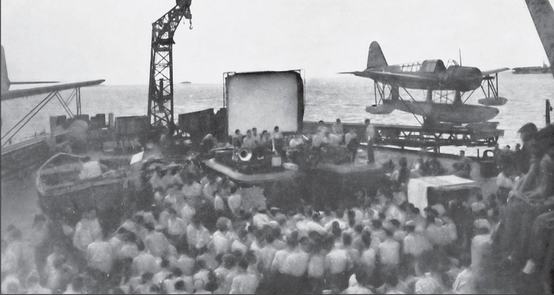
One of the two Kingfisher planes being launched by catapult. These were used for artillery spotting and for search and rescue operations. 

The cross pennant indicated that religious services  were in progress.


Thursday, March 14, 2019

Mockingbird Songs

Mockingbird Songs: My Friendship with Harper Lee
©  2017 Wayne Flynt
251 pages


When I read Poor but Proud by Wayne Flynt some years ago, I never imagined I’d meet the author, let alone help him carry in boxes of books for a book-signing. Such are the perks of working in a small town library. On his last visit here, Flynt shared excerpts from Mockingbird Songs, a collection of letters between he and Harper Lee, bound together by commentary from Flynt about his and “Nelle’s” growing friendship.    They first met through the Flynt family’s friendship with Harper’s sister Louise, but Flynt and Lee were such admirers of the others’ work (and both coconspirators to keep letter-writing alive), that they developed an epistolary friendship of their own that would grow into a full one, complete with Flynt reading  to a bed-stricken Lee whose eyesight was much diminished.  The letters can be both warm and snarky, with most of the snark being levied against those who tried to capitalize on Lee (the town of Monroeville and Charles Shields, an unauthorized biographer, are particular targets). Flynt comments that despite Lee's reputation as standoffish and intensely private,  the woman he knew was outstandingly warm and brilliantly funny. The two were mutual friends of Kathryn Tucker Windham, the storyteller par excellence of Alabama,  and I enjoyed encountering stories about her, as well -- the best being her funeral instructions, in which she informed whatever minister hired to perform the service that people would want to tell stories afterward, so hurry things along.

Saturday, March 2, 2019

Of Caesar, Aeneas, and Selma


This past week I've been dogsitting in the country, and if you've never enjoyed a rural sunset with a glass of wine and Chloe Feoranzo playing in the background, it's an experience I can recommend. While I was away, February ended, and I realized I hadn't commented on either of my classics club readings for the month...mostly because I couldn't think of that much to say about them, really.  I'd already read the 'story' of the Aeneid last year or so, and had been watching videos on it in preparation, and by the time I experienced story in verse I was tired of it.   Of The Conquest of Gaul...well, it's exactly as it says it is, a military history of the invasion of "Gaul", which here means western Europe and a weekend in Britain, with some sociological sketching on the Gauls and Germans by Caesar.  I found that more interesting than the military business, frankly, especially the fact that the German tribes  viewed agriculture with suspicion and frequently uprooted their own people who settled, lest they grow soft and corrupt.


More pleasantly, I re-read a book I stumbled upon ages ago, called The Other Side of Selma.  Though I grew  up here,  I never experienced Selma as a town and place until after college. Before then, I only traveled the commercial sprawl north of the city,  and entered the 'real' city only when I needed to visit the library.  The Other Side of Selma introduced me to it as a beloved city, however -- a place where people lived and loved, not merely a place for politicians to visit prior to elections and make speeches at. Its author, Dickie Williams, grew up in Harper Lee's hometown of Monroeville, but often traveled north to Selma for supplies. When he came of age, he began working at Swift's drug store on Broad Street,, and there began to collect stories he'd heard -- mostly funny,   like of a barber in the Hotel Albert who used to entertain people with sayings and tales from the old country of Russia, only to later be exposed by an actual Russian who visited the city and declared the barber's "Russian" to be  farcical gibberish.  Others are personal, like Williams' account of being asked by a woman in town how these diaphragms for women were inserted and used.  (This was in the fifties, so young Dickie was highly embarrassed to say the least.)    When I first read this, it made Selma come alive for me in a way it never had been: for the first time, I could imagine the Hotel Albert as a place that people went in and out of, where there were businesses and life, instead of  it being just the name of a building what once was and now isn't.  I don't know if that makes any sense, but my interest in re-experiencing that initial joy drove me to find one of two university libraries in the state that have a copy of this book so I could sit and read it. Unexpectedly, it seemed to have more hunting stories than anything else!     Interesting how we can latch on to one aspect of a book and so exaggerate it in our memories.


Friday, February 22, 2019

Yesterday: Memories of Selma

Yesterday: Memories of Selma and her People
© 1940 C.C. Grayson
155 pages

(For want of a book cover, I'm including a photograph of Selma's main street in the early 20th century, after 1891 but before 1926.)

In the 1940s, one of Selma's oldest living residents, Claude Grayson, was asked to record his memories of the town. He had made a habit of contributing little recollections to the local paper and apparently created demand for more of the same.  What was produced, in 1940, is an exceedingly rare and personal look at a town from the 1860s to the early 1900s.   It was written in longhand and not organized in the least,  but what interesting times to record! Grayson arrived in Selma as a young lad in 1867,  and found it a town whose two great avenues, Water and Broad,  lay much in ruins from the invading Yankee army of two years before.  He witnessed its revival, as Selma capitalized on its river commerce by investing heavily in railroads.   This was an age when  Selma was one of the leading cities of Alabama, and where Dallas County's massive population gave it a powerful position in state politics. (It wasn't an accident that Selma managed the rare feat of claiming both of Alabama's senators to Washington at one time.)

Much of this is of interest only to locals, of course. I stumbled upon this book while pursuing any and all leads relevant to the Hotel Albert, a historical sketch of which I'm working on on behalf of the city.  (In the photograph above, it's that ornate four-story building.) I quickly learned that Grayson used to walk the third and fourth-floor rafters long before the building was complete shooting pigeons, but I was thereafter fascinated by the myriad of stories Grayson reveals. Some are random, some tender, some weird.  I've only recently learned of a phenomenal man - Goldsby King -- who plowed his fortune into creating and maintaining a private hospital in the city,  who worked himself to death and was hailed as a saint when he perished in his fifties.  King makes an appearance here, but as mentioned the collection is somewhat random -- Grayson gives a full account of the Battle of Selma, and closes with a history of St. Paul's Episcopal Church,  making no attempt at all to be chronological. It's whatever comes to mind, really, so it will probably frustrate an outside reader trying to make sense of it. As a native Selmian and someone whose career involves its history, I was perfectly at home, and found it satisfying to connect the names of buildings and streets to prominent personalities who made Selma such a beautiful and satisfying place to live.  Although since the closing of the Air Force base in the 1970s the town has struggled economically,  so much of the granduer of yesterday still stands, and it's nice to be reminded of it.

Wednesday, November 22, 2017

These Rugged Days

These Rugged Days: Alabama in the Civil War
© 2017 John Sledge
296 pages


Although Alabama was not the site of as many bloody battles as Virginia and Tennessee in the Civil War, it was not a quiet backwater only troubled at the war’s end. From the Confederacy’s birthplace in Montgomery in 1861 to the coup de grâce burning of Selma in 1865, Alabama saw altercations, skirmishes, and at least one major battle throughout the war. These Rugged Days is a personal history of Alabama in the civil war, in which the accounts of battle are made more intimate and entertaining by unique stories from the ground.

When South Carolina seceded from the union, Alabama was one of the first states to follow, and its central location in the deep south seemed to recommend Montgomery as a capital – one supported by two major commercial rivers, no shortage of rich farmland, a secure port, and ample mineral deposits. As an example of like repelling like, however, the politicians who gathered in Montgomery in that humid spring were put off by the clouds of mosquitos. Although the seat of government moved to Virginia, Alabama’s rail lines and rivers were of great interest to the enemy. Union cavalry raided and captured several cities in northern Alabama early on, only to be driven out. Sledge notes that Florence and Huntsville would change hands several times throughout the war. Although many citizens of northern Alabama were unionists, and the first Union troops were careful not to step on toes, the eventual Union reprisals against civilian populations in the wake of guerilla war alienated the military and their civilian hosts against one another. Larger in scale was the siege of Mobile, the port of which  fell in 1864. Mobile was an important port city for the entire South, hosting blockade runners who darted to Cuba and back with supplies long after New Orleans had fallen. The battle of Mobile Bay involved several ironclads, as well as the use of naval mines (or “torpedoes” – this battle gave birth to the expression, “Damn the torpedos, full speed ahead!”).  The city itself, however, would not be taken until 1865.

Sledge opens the book with a story from his childhood, recounting the moment in which history became real: he and a friend discovered a half-buried Spencer carbine along a creek bed, one presumably dropped by an invading Yankee during Wilson’s raid. Throughout These Rugged Days, he draws on stories that add a human touch to the already lively account of daring raids, rebellious farmhands, and steady action. The chapter on Streight’s Raid, for instance, includes several humorous accounts – though the raid was bound for some level of absurdity from the beginning. It was a cavalry raid conducted on mules, who frequently gave their riders trouble and drew amused crowds. The troopers had their own laughs; in one abandoned town, a few newspapermen turned cavalry broke into the town’s news office and printed a broadsheet that presented the arrival of the Yankees as if they were a group of young men come to pay a social call. (“It is unknown how long the general and his friends will stay with us.”) The conclusion of that raid saw the troopers surrender to a force a third of their size after being bloodily harried for days. The rebel commander Nathan Bedford Forrest ‘put the skeer in’ his opponents by sending aides with orders to nonexistent companies and shuffling his two guns to appear like a battery of fifteen. Streight was not amused when he realized how small a force had taken him in. The book concludes with Wilson’s Raid, a large cavalry action that involved a running battle between carbine-carrying Yank cavalrymen fighting against a much smaller Confederate force led by Forrest. They sparred from Montevallo to Selma, where Wilson achieved his aim in burning the city and its naval foundries, which had helped make Mobile such a tough nut to crack. (Selma’s contribution to the naval war were honored in the good ship Selma, which was the last to surrender at Mobile Bay. )

Although there are other books on Alabama in the civil war, These Rugged Days is easily the most entertaining book I’ve read on the subject. The author has obviously inherited his father’s ability to weave a story that keeps audiences spellbound.


Related:
With the Old Breed, Gene Sledge. (Literally related: Gene Sledge is John's father.)
The Yellowhammer War: The Civil War  and Reconstruction in Alabama

Sunday, May 21, 2017

Visiting Harper Lee


On Saturday I visited the boyhood home of Hank Williams in Georgiana, and then decided -- since I was in the neighborhood -- to drive a bit further into the woods and go to Monroeville, the hometown of Harper Lee. Its former courthouse was used as the model for To Kill a Mockingbird's courthouse, and the building is now used as a museum.  The above photo depicts three Depression-era children reading To Kill a Mockingbird. 


Although I arrived in town long after the museum's scheduled closing at 1 PM, out of utter luck the museum was hosting a production of a Mockingbird stage play that night, and was subsequently open until ten.  The two classic cars to the right of the building are used in the play; a would-be lynch mob arrives in them.


The second floor houses the courthouse and rooms dedicated to Harper Lee and Truman Capote (both of whom grew up in Monroeville), while the first floor shows off general history, with a model lawyer's office circa 1930.


Tuesday, March 21, 2017

The Unvanquished

The Unvanquished
© 1938 William Faulkner
254 pages


Years ago in a ninth-grade literature class,  I chose to read a book by William Faulkner for a class project on the basis that he was a southern writer. My teacher cautioned me against trying The Sound and the Fury, warning me that it was difficult -- a challenge out of  scale for a minor paper. Well, dear readers, I persisted -- for about a chapter. Then, faced with Faulkner's bewildering narrative style --,a torrent of words with few  marks of punctuation, flowing ceaslessly like the Mississippi --  I returned to my teacher with tail between my legs and asked for something else, and thus read The Old Man and the Sea for the first time. Ever since then, the memory of Faulkner has haunted me.  I associate his writing with both brain-melting difficulty and with embarrassment, and yet...still I've wanted to read him. The prevailing reason is the same:   William Faulkner is a southern writer. He is not just a southern writer, though,  he's one of The Southern Writers, always mentioned with Flannery O'Connor as though the two were manufactured as a set, like a pair of pants.

The Unvanquished is the story of a young boy (Bayard Sartoris) who comes of age amid the Civil War and reconstruction, along with his close friend Marengo ("Ringo").  Ringo begins the novel as a slave, but the narrator mentions early on that he and Bayard were so close in age that they suckled at the same breast, and both lived in  dread awe of The Colonel and Granny.  While The Colonel (John Sartoris) is off at war, fighting to keep the damyanks out of Vicksburg,  Granny is the boss.  Actually, I almost suspect she remains the boss when The Colonel is home, for this is a woman who trucks into the middle of a warzone to demand the Yankees return her stolen mules, her slaves, and her chest of silver.  Fearless, she uses fabricated requisition papers to steal and sell livestock to the invading army -- not growing rich, but using the proceeds to support her community of Jefferson, burnt-out by the war.   Shady business brings forth shadier persons, though, and soon death visits the Sartoris family. In the collection's conclusion, young Bayard -- who is now a twenty-something law student -- must confront the man who robbed him of his father  upholding the family's honor but heedful of the consequences should he make the wrong choice.

If you have never read Faulkner, The Unvanquished is a promising work  to test the waters,  It's one of his shorter pieces, and the stories' length allow an unfamiliar reader to dive into Faulkner without chance of drowning.  That style of writing, the torrent of consciousness ("stream" won't do for Faulkner), is present here, but not nearly as overwhelming as I remembered from Sound and Fury.   Although these stories are filled with death, as the State's armies lay waste to the South,  Granny's confrontations with the Yank officers always have humor about them, as the officers regard her with astonished admiration. One of them thanks God that Jefferson David never thought to draft an army of grannies and orphans, for a regiment of Sartorises would be the Union's undoing.


(Bayard and Ringo, Spanish cover)

Friday, March 3, 2017

Selma 1965: The Photographs of Spider Martin

Selma 1965: The Photographs of Spider Martin
© 2015 University of Texas; photography Spider Martin
128 pages, 80  photographs


During the 50th anniversary of the Selma March back in 2015,  one of the more popular exhibits in the city was a public showing of Spider Martin's photography. Martin, named for his skinny, agile frame -- and perhaps his ability to clamber up a tree for particularly engaging shots -- covered  all three march attempts in 1965,   taking some unbelievably  close to the action.   Selma 1965: The Photography of Spider Martin collects Martin's best material to present a visual history of the entire campaign.   Although virtually all of the shots are available in an online gallery,  here they are presented with both a historical introduction covering the Selma movement, and with captions which explain what is happening  and who is involved. The editor emphasizes John Lewis' role, pointing him out in every picture he appears in.   For those readers who have only seen the movie Selma, Lewis was one of the young Selma leaders who reluctantly ceded the leading position of the local movement to King and his organization.    While the photographs are utterly remarkable first for having captured one of the pivotal moments in Civil Rights history, they also have artistry to them; one challenging photo has Brown Chapel mirrored in a man's sunglasses as he stares at the building. Others capture fleeting  instances. While most photos of Martin Luther King depict him in his role as a Civil Rights Leader,  full of confidence and courage,  in one shot he is caught in a more humbly human expression, one which is  curious and anxious,   Martin's gallery is utterly worth looking at, and below is a selected list of links, the title of which describe the moment for those who need a caption.

1. Lewis and others praying before starting the infamous first march which was attacked in Selmont by State Troopers and a county posse.
2.  The first march, descending to meet a line of troopers.
3. The moment in which charging troopers hit the first ranks of the marchers
4.  The marchers flee for their lives, leaving many of their number behind injured. There were no fatalities, however.
5. State troopers pursued and harried the marchers across the bridge and for several blocks back to Brown Chapel
6.  The Tuesday following, King arrived to lead another attempt. Again troopers met them  at the bridge,  reading out a Federal injunction legally forbidding King to march on the state highway until questions of legality and safety were addressed. King here listens as the injunction is read.
7.  After the first bloody march was broadcast on television, King issued a national call to link arms, asking members of the clergy nationwide to join him. The city was flooded with outsiders, much to the horror of those not interested in the movement.  Here Selmians and those who joined them clear the bridge and  start the long three-day trek to Montgomery.
8.  To ensure the marchers' safety, the Alabama National Guard was used by LBJ to stand guard. This highway is now a much wider link between the cities.
9.  The three-day journey would have been a challenge for anyone, but this man apparently did it on crutches.
10. King delivers the "How long? Not long" speech at the State Capitol building, facing Dexter avenue

Monday, February 27, 2017

Selma Shots

As a followup to my review of a recent history of Selma, I'd like to share some photographs of my hometown I took a few years ago (2010 - 2011) when I was trying to experience it as a tourist might.


Sturdivant Hall, easily in the running for Selma's most picturesque building. Originally a home, it now stands as a museum with gardens around it. There are several private residences that rival it for sheer beauty, but Sturdivant Hall  is often used on tourism brochures.


My favorite house in Selma, sited on Lauderdale street. 


A similar home on Parkman Avenue. 


Brown Chapel, headquarters of the Selma movement during the Civil Rights era. 


Temple Mishkan, testament to a Jewish community that was once considerable. In the late 19th century, Jewish merchants lined Broad Street. The interior of the Temple is unusual for having stained-glass windows depicting David and Esther; images of people are not common in Jewish houses of worship. 


My favorite building in Selma. St. Paul''s Episcopal.  When I began walking around Selma I found St. Paul's particularly irresistible. I believe  part of the magic is its courtyard; partially enclosed from the street by a low brick wall, it's framed by the church on the left, a parish hall on the right, and cloistered administrative offices in the rear. 


The tower of First Baptist edges out its neighbors' -- Cornerstone Presbyterian, St. Paul's Episcopal, and Church Street Methodist. It's a neogothic structure that gives Selma part of its signature skyline. 


Who knew Baptists like gargoyles? 


Curiously,  there are just under a dozen homes in the city that have a marked Spanish-southwestern influence to them; some merely used stucco, and one looks like a hacienda buried in the jungle.  This is a sedate example. 


There is no shortage of fine homes standing in Selma,  and since the obscene destruction of the Hotel Albert, the city's citizens have been more conscience of the need to keep some abandoned beauties in good repair.  Many former residences are now offices for lawyers, dentists, and the like. 


Live Oak Cemetery, running alongside Dallas Avenue, is an eerie place to visit; filled with ornate monuments to previous generations, guarded by Spanish moss. 


Not all of Selma's downtown buildings are in use, but both the government and private foundations do their best to ensure that this kind of heritage is preserved. 


Let's end this little peek at Selma with its most iconic structure, the Edmund Pettus Bridge.  That little yellow building on the right is the Bridgekeeper's house, which formerly controlled another bridge which could pivot to allow ships passage. These days the only ships on this stretch of the Alabama are pleasure craft -- fishing boats and the like -- though bodies like the Black Warrior River still bear the odd cargo ship. 


Sunday, February 26, 2017

Selma: A Bicentennial History

Selma: A Bicentennial History
© 2017 Alston Fitts III
384 pages


On December 4th, 1820, the Alabama legislature granted a town charter to a burgeoning community established on a high bluff overlooking the Alabama river. The place, named after a cities of heroes from a Scottish poem in the romantic period, would quickly create its own heroes and stories. In Selma: A Bicentennial History, longtime Selma resident Alston Fitts delivers a celebratory history of the town and its proud yet troubled heritage, in advance of its 200th birthday.  He builds on his initial history (Selma: Queen City of the Blackbelt),  which was published in the 1980s; here, his initial history is greatly expanded, using references to other works to take readers through the Civil War, Reconstruction, and the 20th century through one city's experiences. The work never shies away from the city's most controversial moments, but strives to be fair to all parties. For a Selmian, this is a history that does the city justice, with a multitude of fascinating little stories based not just on old records, but interviews with the city's residents. Their many contributions to the book, in interviews and photographs, make it a true reflection of the city rather than just the view of one author.

To those only familiar with Selma's modern history, as a small city only remembered for being the site of the Civil Rights movement's crowning moment, Selma  reveals another place -- a center of industry and trade that rivaled Montgomery for prosperity and political influence; a city sure enough of its future to argue for its selection as the Confederate capital during the war between the States.  Selma and its mother county, Dallas,  contained some of the richest soil in Alabama, and both civic and business leaders made the most of that wealth by aggressively pursuing railroads; long after the great river had ceased to be the chief commercial artery of the state, Selma's network of banks and railroads were poised to prosper further in the 20th century. Its rails and river made a commercial center, but it was no slouch in regards to industry:  Selma housed an arsenal rivaling Richmond's as well as a principal naval foundry during the war, making it a target for Union troops; still later, during World War 2, Selma hosted an air force base that survived into the 1970s.    Selma's wealth was not merely monetary, however; her citizens were truly dedicated to the city, pouring themselves into creating civil institutions like schools, hospitals, and the library. They created block after block of magnificent buildings, many of which still stand today: the historic district of Selma is one of the nation's largest. 

Selma's past as an agricultural titan would bear unexpected fruit throughout the 20th century, however. The economic culture of the antebellum South meant that Selma and Dallas County' wealth came from fields worked by slaves,  to the degree that Dallas County  has maintained one of the largest black populations in Alabama for generations. When Reconstruction began in the postwar South, it contributed many black businessmen and politicians.  These gains would fade and be reversed by the end of the 19th century, however, culminating in the establishment of Jim Crow segregation laws and the 1901 Alabama Constitution. The latter document established barriers to voting which included poll taxes, property holdings, and the explication of Constitutional articles; these requirements together reduced the black voting population in Dallas County from several thousand to under a hundred.  These barriers, disenfranchising poor blacks and whites alike -- and flying in the face of Alabama's original constitution, which incorporated universal white male suffrage -- would not fall for over sixty years.   Selma entered the national spotlight again in 1965, when a local voting league invited Martin Luther King, Jr. to help draw attention to the cause of suffrage in the city. Fitts notes that the league was able to accomplish what it did largely because the black community in Selma was so healthy, with a strong middle class supporting several hospitals and two colleges. One of the most dramatic moments of the Selma campaign, for instance, was the mass support black teachers lent to it when they absented themselves from teaching to march instead.  Visiting in 1968, King himself was astonished by the progress of the black community, and the strengthening relationship between it and the city's white population.  Legendary mayor, Joe Smitherman, had just been elected to the office in '65, and continued to sit the big seat throughout the rest of the century in part  because he made himself a ready ally of of the black community. Unfortunately, racial harmony would be disrupted as Selma entered the 1990s,  as a certain group of lawyers created such a hostile atmosphere in the city that one of the state's most integrated systems fell to pieces.  Still, the city is doing what it can to move past that episode, as the actors involved are now dying off. Perhaps their bitterness will buried with them.  The city now has a young mayor in Darrio Melton who has already demonstrated  a strong intent to scrape away the old barnacles and begin making progress once more. 

As a modern history of Selma, Dr. Fitts has done a superb job of presenting the most essential elements of previous histories, connecting them to broader histories of the South and southern institutions (black churches, for instance, via use of Wilson Fallin's Uplifting the People),  His heavy use of interviews and the photographs of Selma citizens make it a community story, almost, and one that the generations are able to contribute to given that he references one older history written by a Selma mayor.   As a native son of the Queen City, I found quite a few questions answered here, learned some interesting tidbits along the way, and finished the book feeling ever more affectionate toward this, my storied hometown.


Related:
Selma 1965, Chuck Fager
Reporter: Covering Civil Rights...and Wrongs in Dixie, Al Benn


Sunday, February 19, 2017

Up from Slavery

Up From Slavery
© 1901 Booker T. Washington
332 pages


Up from Slavery is an hopeful reflection by Booker T. Washington on the future of black Americans and the American nation, as he reflects on the thirty-odd years since the abolition of slavery at the time of his writing.  But this is no mere memoir of slavery and reconstruction, for Washington's life as a teacher and founder of the Tuskegee Institute gives him a perspective on education; particularly, what sort of education most befits the cultivation of liberated men and women.  Washington's ideal education, put into practice at the Tuskegee Institute, is 'holistic' in that it places as much value on the practical -- trade skills, agriculture -- as it does book learning. It is moral and social, teaching self-ownership and self-sacrifice,   Although Washington craved knowing how to read even as a child, and his drive for self-improvement was such that he worked his way across a span of a hundred miles to attend school at the Hampton Institute,  he did not see book-learning as a magical solution to the problems of his fellow freedmen.  Some had taken earnestly to the veneer of education, but shared the same disdain towards work that had poisoned the plantation elite.  When he was asked to head the fledgling school for blacks anxious to  uplift themselves, he stressed the dignity of labor, the sense of ownership; he joined students in creating bricks, hewing wood, building the physical structure  of the school.  In this same vein, their practical skills built themselves, gave them the realization that they were capable of producing a good work that they and others could use and value. It is on that foundation that book-learning can rest, and so his students followed a Benedictine schedule of "pray and work", or in his case "study, work, and pray" -- occupied from 5:30 'til 10:00 pm.

Washington was a surprising author in many ways -- opening this memoir up with a joke, and offering insights that I would have never expected. For instance, his writing indicates not a trace of hostility towards the old elite, but rather pity and sympathy ;  his time spent among the wealthy and 'noble', in both America and in England, squelched any notion of viewing them as the enemy.  (If the reader wants to be cynical, he can conclude that Washington is dwelling most on those people like Carnegie who wanted to do some good with their wealth, and putting out of mind the less noble-minded.)   I didn't expect Washington to be as wary of reconstruction as he indicated; he voices suspicion that blacks placed into electoral office were being put there simply out of vengeance against the old aristocrats, and that this would create more racial strife.   On first reading, the Booker T. Washington of Up from Slavery reads rather like saint, a Gandhi-esque figure who endures all things because he hopes and works towards the redemption and progress of all humanity.  I suspect I should read more about Washington to get a better view of the man, but I'm highly partial to his worldview here,  his disdain for the multitude in the cities who "live by their wits" and who would have profited themselves more had they grown up on the land,   living with both body and mind.  His optimism was, alas, misplaced in some respects as the Klan -- which he dismisses as a dead thing which no one would tolerate 'now' -- was reborn with greater power in the 1920s.   His fear that looking to the government for every thing would create a new servility has unfortunately been realized...not just in blacks, but in all of us.   Even so, if illiterate slaves like Frederick Douglass and Booker T Washington could  in their respective youths realize a hunger to conduct themselves like men, sovereign actors in their own lives, there's hope for us all.


Friday, November 25, 2016

TW on the Road: Mountain climbing in Alabama?


Three and a half hours north of me, and perhaps an hour or so east of Birmingham, lies Talledaga National Forest and Cheaha National Park.  The above shot is of Pulpit Rock, the apex of the park's most challenging trail.   I hastened up today, Black Friday, because I figured the  autumn scenery would be gorgeous. I also assumed I'd have the park largely to myself, since everyone else would be out shopping.  I was gloriously right about the scenery, and utterly wrong about the crowd.  The road was lined with parked cars and campers.


While I took many shots, most of them of the view, and that really doesn't translate into cameraphones very well.  Although traveling with a couple of friends, I parked myself  on a rock and gazed into the distance for a good while. I haven't seen an expanse that vast since standing atop Carlsbad Caverns, the wind blowing the grass sideways. On the way home I passed through the cozy square of Ashland, Alabama, and spotted a courthouse so lovely it demanded I swerve into a parking lot and take admiring photos.

With Christmas approaching, it may be a month or so before I jet off again. I passed right by the entrance to DeSoto Caverns today, though...


Sunday, October 30, 2016

Shots from Alabama hill country

My return from New Mexico has left me feeling slightly guilty that there's so much of Alabama I haven't seen.   To start setting things to right, yesterday I traveled several hours north to Winston County, where can be found the Longest Natural Bridge East of the Rockies.


According to the signs, the 'bridge' was created by sandstone eroding out by water, leaving behind the more stubborn iron ore. 


Going underneath the bridge is rather like being inside the lip of a cave, but without the smell of bat poop. 


'Ripples' in the rock, possibly caused by water --there were many spots where water is still leaching out.


Nearby, in Double Springs, there is a curious soldier: a Civil War infantryman holding a broken saber, standing behind both union and rebel flags.  The statue is a memorial to the mixed loyalties of Winston County, which declared neutrality, attempted to exist as the Free State of Winston, but sent soldiers from the same families to fight in both causes.  This soldier was used as the cover of David Williams' Bitterly Divided: the South's Inner Civil War, which I read back in 2012. 


The courthouse itself is small but attractive, far and away the biggest building in Double Springs. 


Approaching Cullman to return to a major highway, I noticed magnificent spires in the distance. They proved to belong to Sacred Heart of Jesus, a Catholic church. Noticing a sign for the Ave Maria Grotto, I decided to take a look there as well.

The grotto is attached to a monastery, which I've thought about visiting because I have an odd obsession with'intentional communities', whether they be hippie communes, monasteries, or survivalist camps in the woods.  (Also: these monks make bread and brew coffee.) One of the monks there, Joseph Zoettl, was a master of bricolage. 

Hanging Gardens of Babylon


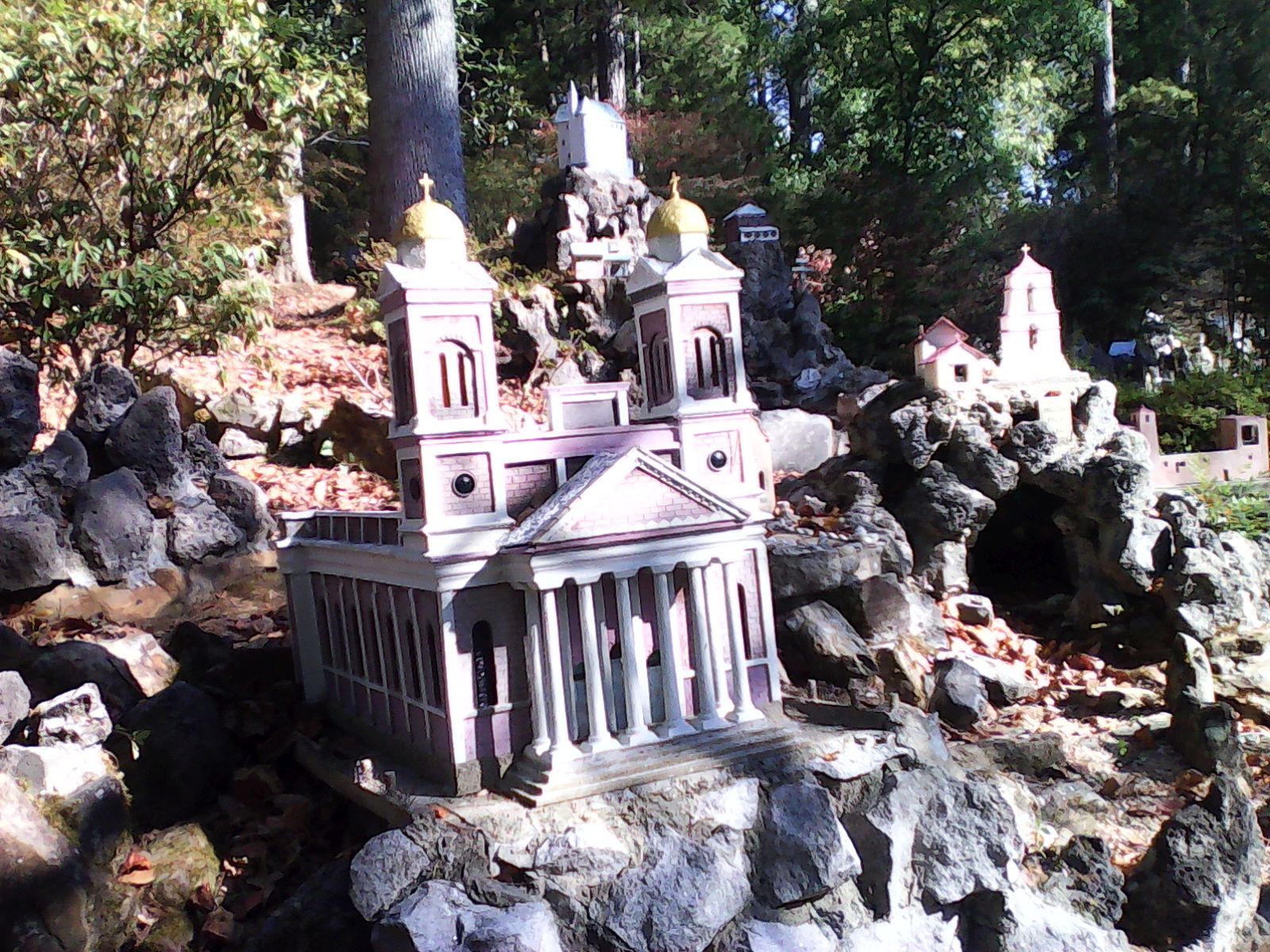
Over the years, he created hundreds of miniature buildings, as well as original abstract pieces. Most of them have a religious connection, being recreations of various Spanish missions


Zoettl's model of the Mobile basilica, and a picture of the basilica itself. (Not mine --I've not yet made it to Mobile's downtown.)


Not every project was a miniature, either:  those stalactites are created from seashells. 


There were scale models of St. Peters in Rome, of Herod's temple ,of the Colosseum, of the wonders of the world, plus an uncountable number of smaller buildings that makes this stretch of hillside mind-boggling.  No trains, though. 


Here's hoping for a few more interesting trips this year!  A few possibilities: De Soto Caverns, De Soto Falls, and Mt. Cheaha, our highest point.