Showing posts with label Images of America. Show all posts

Sunday, March 17, 2019

The USS Alabama

Images of America: USS Alabama
© 2013 Kent Whitaker & Battleship Memorial Park
128 pages


When visiting downtown Mobile, one can’t help but notice the enormous battleship parked in the bay.  It’s the USS Alabama, tenth to bear the name, and its proud history is recounted in this Images of America book which is as thorough as can be hoped for.  Not only does Kent Whitaker (on behalf of Battleship Memorial Park in Mobile) deliver a full history of the ship (which operated in both theaters of World War 2, earning numerous battle stars) and photographs which explore life aboard her, but  the book explores the histories of other ships named Alabama (including the CSS Alabama, sunk by the Kearsage after an illustrious career sinking Yankee shipping) as well as the particular story of how the Alabama came to be rescued from the scrapheap by children, and found instead a home in the port of its namesake state. 

Given that this Images of America book is image-heavy, I thought I'd share a few.

 The Alabama at work

Cleaning the "big guns", which...are very big indeed. 

Social life aboard the ship

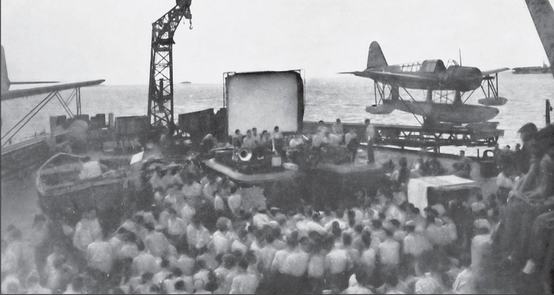
One of the two Kingfisher planes being launched by catapult. These were used for artillery spotting and for search and rescue operations. 

The cross pennant indicated that religious services  were in progress.


Saturday, October 31, 2015

Images of America: Selma

Images of America: Selma
© 2014 Sharon Jackson
168 pages


When I heard that the Images of America series had commissioned a book on Selma, I stood midway between excitement and dread. The series offers a pictoral recounting of small-town America, an experience overlooked by standard histories, but Selma for most is less a town and more an image -- a memory of violence.  This collection of photographs was done by an author who loves the town, however, and accords her a just tribute.  While not overlooking the role of Selma in the Civil War and the Civil Rights movement,  Images renders a view of the town itself, a booming center of agriculture and wholesale commerce, a place that generations have cared for and loved.   Long before nation-wide political movements decided to use the town to make history, Selma had its own proud history.  Sited upon the bluffs of the Alabama river, it found early success as an agricultural boomtown, and the aggressive pursuit by city fathers of railroads ensured it commercial prosperity throughout the 19th century, surviving even the arson of an invading army during the Civil War.  Selma's industrial importance to the Confederacy was then second only to Richmond, a fact lost on modern residents who  see it as a chronic small fry.  Selma attracted its fair share of immigrants during the gilded age, especially Jewish families from central Europe, whose shops lined the stretch of the city's central Broad Street. The city these residents across the generations built was utterly beautiful, and though some of that has faded through the years -- the trees lining Broad Street lost to utility poles, the magnificent Hotel Albert deemed too costly to maintain and bulldozed -- the city still boasts one of the largest intact historic districts in the nation. There is no shortage of homes whose stately columns and beautiful cornices make one feel like a Goth wandering amid the ancient beauty of Rome.    Selma is not merely a celebration of beautiful architecture and booming enterprise, however. Like another book in this series, Montevallo, this is something of a family album.  People, not buildings, dominate the pages -- from city fathers to contemporary politicians, each with their story. Jackson integrates the lives of Selma's citizens with nation-wide social movements, particularly women's suffrage and the Civil Rights movement.  Jackson does not shy away from the darker side of Selma's history, its agricultural expanse going hand-in-hand with a massive population of people held in slavery,  people whose ancestors remained held back by Jim Crow legislation for a full century after the war. Those who fought in '65 -- in both centuries -- are honored for defending their homes and and personhood.  Images of America: Selma is markedly balanced and contains photographs that even someone who collects them -- someone like me -- hasn't seen.


Sunday, June 5, 2011

Montevallo: Images of America

Montevallo: Images of America
© 2011 Clark Hultquist and Carey Heatherly
128 pages


A few years ago, I became a student and resident of the University of Montevallo. I fell madly in love with the town and its university and regard them as my adopted home. You can thus imagine my delight when one of the university's historians decided to produce a pictorial history of the town: the resulting few hours, as I ooh'd and aww'd my way through the city's history, were utterly fascinating and left me with a touch of homesickness

As mentioned, this is a pictorial history, consisting of photographs of people, buildings, and the town landscape with historic commentary. The photographs are typically divided two per page, though one of the aerial views was given a full two-page spread. Those aerial views are particularly noteworthy, for they capture the town's early state in a way unmatched by other city histories which I have read, like Yesterday's Birmingham. Although Montevallo began life as an agricultural center and mining town, its fortune was truly tied to the growth of the university. While  the role of agriculture diminished and the coal mines closed, the university  continued to flourish through the 20th century. Beginning life in 1896 as an  industrial school for women, it matured into a liberal-arts college and then finally into a mixed-sex public university covering multiple disciplines. Although the book's dozens of pictures show clearly how much the town has grown and changed through time, the university population has also allowed much to be preserved: the nearness of a large student body keeps Montevallo's charming Main Street alive and well despite the competition of chain stores.

As fascinating as it is to watch any town grow through the ages, this work will be more compelling to students and residents of the city, for whom it will be like a family album. The personalities who shaped the university, who drove its history, are honored in succession through the decades as the university grew and affixed their names to its many beautiful buildings. I loved seeing the familar campus slowly grow through the years, marveling at what facts history has hidden -- that one generation's soccer pitch was another's science and math complex. Some of the pictures are positively eerie, like the spread of Main Quad, which shows it entirely open. Today, it's home to a dozen or so trees, all grand old majestic beauties whose size and absence from the photo bear witness to the passage of time. All told, the pictures illustrate that much more has transpired upon Montevallo's red brick roads and under her stately white columns than I could ever imagine.

Montevallo is part of an extended series of pictorial histories, and my only caveats seem to be marks of the series as a whole. Because the market for these books is presumably small, the photographs are produced only in black and white (even modern ones), and are not quite as large and some might hope, though the commentary serves to remedy this by pointing out small details which might otherwise go unnoticed. Residents and students at Montevallo will find in this work a treasure.

Dr. Clark Hultquist is professor of history at the University of Montevallo, and chair of the Behavioral and Social Sciences department. Dr. Carey Heatherly is a reference librarian and archivist serving in the Oliver Cromwell Carmichael library.

Related: