Showing posts with label cities. Show all posts

Thursday, March 21, 2019

Romance of the Rails

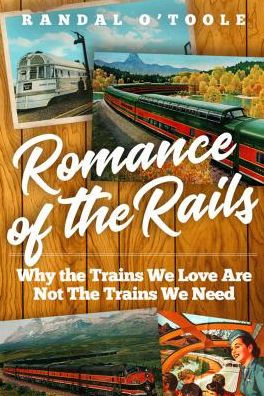
Romance of the Rails: Why the Trains We Love Are Not the Transportation We Need
© 2018 Randal O'Toole
300 pages


"These are the 1930s again, with all the charm and romance, all the gaiety! That was a carefree world, Danny, and I'm gonna make it that way again!"
"You can't! It's nostalgic, it's nice, but it's not true, it's phony!"
"It doesn't have to be phony. If I wish hard enough, it doesn't have to be phony.."
(The Twilight Zone, S01E04. "The 16-Millimeter Shrine")


There was a time when America was knit together with ribbons of steel, linking not only metropolises, but bedroom suburbs.  That time was yesteryear, and it cannot come again – no matter how much we might wish it so. Romance of the Rails is written as a letter to a dying if beloved friend;  former rail advocate author Randal O’Toole reviews the history of passenger trains and their offspring, and scrutinizes the ongoing attempt to bring them back to life, comparing  transit and high-speed rail networks across the globe.  Just as railroads replaced demonstrably less effective modes of transportation,  so they have been replaced – and it is both wasteful and unjust, he argues, to continue propping up a dying industry to benefit a scarce few, in pursuit of recapturing America's boom years.  Although by the end few readers would remain willing to argue for rail transit on economic grounds, O’Toole only briefly touches on other veins of rail support.  

 O’Toole begins with a history of the rise of rail transportation in the United States,   exploring why trains were so successful and what they accomplished.  Trains and other contemporary technologies allowed for a novelty: the  nucleated city, with  superdense business district. Before the Victorian age,  cities consisted of a fairly even mix of residential, commercial, and other areas;    most people traveled on foot (horses and carriages being too expensive), but rails allowed cities to expand outward and upward simultaneously, giving those who could afford it the chance to escape the noise into streetcar suburbs, but also allowing more people ready access into the city. 

In the early 20th century, however,  that began to change – again, because of new technologies. Mass-produced automobiles meant that the same workers who couldn’t afford a carriage a century ago could now afford a different kind of carriage.   Buses, after internal combustion became much cheaper, suddenly emerged as such viable alternatives to trolleys that railroad magnates were investing in them.  The government, too,   was investing in the competition, helping at all levels – from widespread efforts to pave streets, to the federal project of a national highway system.  And then there were airplanes, far faster than trains and buses  and increasingly cheap.  

So it goes. Trains had been completely replaced by services which were cheaper,  which carried more people, which served  more sectors of  the  population, and which were far more nimble.  By every measure,  passenger rail should have been retired to the museums with a hearty “Well done, good and faithful servant”.   Instead, there are continued and expensive attempts to revive rail transit, both trolleys inside cities (which carry less people, at far greater cost,  and consume more space), and passenger rail between cities – either through Amtrak or new high-speed lines modeled on those which were a success in Japan.  Amtrak’s problems are so  severe that even a former creator of the company has written a book urging the public to let it die, and high speed rail is a boondoggle of such great expense that not even California could manage to do it to connect SF and LA.  The economics simply don’t work, O’Toole writes:  trains perform well in Europe and Japan because the populations are so dense and  car ownership so low; that latter is especially important, because it’s why Japanese bullet trains were a success and European ones drove Italy and Spain to the verge of fiscal ruin.  The only thing trolleys do better than at busses, O’Toole says with a bit of snark, is shifting public money from the public itself to the pockets of corporate engineers and lobbyists.  

As someone who has drunk deeply of train nostalgia, I found Romance of the Rails a daunting but sobering read.  I’ve read both histories of trains, and books advocating more mass transit in the form of trolleys, and Romance thoroughly challenges both.  Its amount of documentation is particularly enlightening, as we realize for the cities considered, the introduction of trolley lines to a city already covered by buses often caused a decrease, not an increase, in the amount of transit users. This problem is especially bad when trolleys are deliberately introduced to 'replace' a  bus line, and here O'Toole draws from Human Transit. The history itself was eye opening, as O’Toole argues that commuter trains and inter-city trains were never the transport of the common man, but remained a middle class or above experience.     

There’s part of the story that’s missing here, however,  in that one of the reasons people promote trolleys and such is that they’re more environmentally friendly – not polluting or emitting greenhouse gases.  O’Toole only addresses this lightly, arguing that there is no effective gain in passenger transit over cars, because  passenger trains only displace freight traffic which then has to travel by more polluting trucks. This area of the argument is never explored in full, which I think diminishes the book because it’s such a prominent part of rail advocacy. There's a lot to explore in that vein,  especially given that we can have electric buses which don't have any direct emissions. 

Ultimately, O’Toole believes that there is no evidence-based reason to support trolleys and passenger transit in the United States. Our efforts to do so, he suggests, are based more in nostalgia than the facts. His argument presenting the facts is most impressive, but without  addressing environmental concerns this book is not as excellent as it could have been. Even so,  it's  probably one of the better books on public policy which I’ve read,  and I wish were were more like this, which are written by someone who has changed his position over the years, and so can argue on facts rather than passion which is deaf to any opposition.  Transportation will change enormously in the coming decades, and cities which are serious about a productive transit system would do well to consider how sometimes the best-looking options can perform so poorly. 

And it's not as if cities can't enjoy the best of both worlds....

A bus designed to look like a trolley! (Montgomery, Al.)

Saturday, March 16, 2019

Walkable City Rules

Walkaable City Rules: 101 Steps to Making Better Places
© 2018 Jeff Speck
312 pages

In Walkable Cities, Jeff Speck argued for the virtues of a city optimized for pedestrian travel, and offered ten general guidelines  for making it happen -- from checking forces that destroy walkability, to further empowering pedestrians through connections to other transportation.  That pitch was made to popular audiences, but its success allowed Speck to produce a sequel which went into more detail. That sequel is Walkable City Rules, a collection of one hundred (and one) ways to humanize the  modern city. These rules are not idealistic goals; they have already  been put into practice, and there's nothing here that some city can't take home.  The rules offer a variety of positive steps cities can take, supported by data to make a case for implementing them.

Speck begins this book with  ways for concerned citizens, public officials, and planners to "sell" walkability to their audience -- on the merits of  wealth, health, equity, climate change, and community -- before moving to the array of urban design tweaks . Making a city walkable is a complex challenge -- not because walkable cities in themselves are difficult to make, but because the last half-century of development has not had walkability in mind, and cities now have to contend not with a blank slate, but vast acreages of badly designed urbanism.  Complexity lies in the fact that walkability is not a matter of good sidewalks; walkability is all about connections between where people are and where they want to be.  That means the question of walkability has a great deal to do with housing, for instance, which is why mixed used development  and inclusionary zoning (mixing affordable  developments in with the more lucrative ones) are so important.   It means that commerce has to be nurtured in the right ways, too, by reducing one-way streets and having parking policies that ensure quick lot turnover.

 Speck often pitches his advice to cities on the basis of making the most of what they have, converting a superfluity of extra-wide lanes into a more modest number devoted to cars, making room for bike lanes and trees. (Trees are vital to a city, Speck argues -- not only does their presence slow down cars, but depending on placement they can serve as a barrier between cars and pedestrians, while at the time providing shelter to said pedestrians.)     But the advice isn't all about engineering: Speck also addresses politics, by advising would be reformers to turn the fire chief into an ally instead of an adversary, and  to avoid thinking of pedestrians, cyclists, and motorists as opposing factions: instead,  he advocates using the language of "people walking", "people biking", and "people driving" to emphasize that  human behavior is dynamic and most of us will shift in how we use the city throughout the day -- driving to work, say, and then walking a block or two for errands or lunch.

There's a lot in here, and admittedly it isn't for everyone: Speck commented in an interview that it's really meant for the Strong Towns audience, that is --  city planners, engineers, officials, and citizens passionate about  implications of the built environment for civic life, public health, and private flourishing.  I was, however, disappointed in Speck's occasional abuse of "teabaggers" -- and surprised, given that Speck opens the book with an argument for walkability on the merits of fiscal responsibility. Considering that most of the damage done to cities in the last half century has precipitated by ill-advised federal policies (interstates gutting cities, for instance),  wooing libertarians with walkability would be a cinch.  Instead,  Speck indulges in the same unhelpful us-vs-them mentality he warned his readers against.   Considering his camaraderie with members of the Strong Towns movement, however (who vary from sweater-vested Republicans to Oregon hippies), I don't think it's deep-seated contempt.  In any case, the good ideas argued for in this book far surpass hiccups in the sales pitch.

Related:

Sunday, February 3, 2019

Happy City

Happy City: Transforming Our Lives through Urban Design
© 2013 Charles Montgomery
368 pages


City air makes one free, but -- happy? Throughout the 20th century, Americans fled the urban centers seeking Arcadian bliss. They didn’t find it, and despite an abundance of material wealth the nation continues to writhe in anxiety.  We’re addicted to medication, legal or otherwise;  many live lives of quiet desperation, and others lash out violently in scenes that horrify the imagination.  The suburban experiment was a failure from the start, says Charles Montgomery, because we were made for one another. In leaving the cities to decay, we uprooted ourselves from the social fabric which sustains us. It doesn’t have to be this way; we can come home to the village, even to the city. We can restore our cities to the picture of health, and ourselves in the bargain. Montgomery’s Happy City is a masterful work,  bringing together Greek philosophy, urban economics, and social commentary.

Why care about the city? Globally, the human race is half-urbanized, using a loose definition for urban that includes suburban sprawl. The semi-urban forms we choose to live in can either contribute  to our well-being by meeting our needs, or they can serve to frustrate us. Montgomery opens  with a review of what constitutes 'happiness'  and its connection to the urban form. There are sound objective reasons for wanting to make the setting of most human lives 'better';  traditionally-planned cities are more economically productive and allow for both greener and healthier lives by making it easy for people to walk or bike to work, for instance. Montgomery touches on these arguments, but he's not just writing to city planners or mayors who hold the fate of others in their hands. He writes to appeal to the common citizen, someone less interested in return-on-investment breakdowns and more concerned with the quality of everyday life.  Being able to walk to work or shops is good for our bones and good for the air, but it's also good for our spirits; we're not dependent on a car, we're out in the fresh air, we're seeing and being seen.  There are material pleasures to consider, of course; the concentration of diverse restaurants and stores in dense neighborhoods, and the bliss of pedaling down to the library through leafy streets , but there is more to the human experience than simple sensuality...even though there's nothing like a well-placed park to relax stressed brains.

We are political creatures, wrote Aristotle, not because we like to vote and share "Hooray For Our Side" memes on Facebook, but because people like other people. We like to watch people; we like to bump into them   We don't like to be crowded against people, however; there are tricky dynamics at work that the design of cities and the buildings within have to account for. There's a big difference, for instance, between apartment buildings that are designed around impersonal corridors, and those designed around suites that allow people to occupy a goldilocks area between the private and public realms. The front porch of southern homes in the US had the same effect in detached housing, allowing just the right amount of engagement and privacy. Montgomery is sneaky, exposing readers to brief chats about building codes  and housing policy while offering touching stories about people coming together to make their lives together.  In one neighborhood, for instance, residents turned an intersection into a public square by painting it and filling it with places to sit and talk.  They did this over the protests of the municipal government, which had steadily ignored residents' request for traffic-calming measures at that intersection.  A happy city is one where people can be agents in their own lives. Montgomery also stresses that a happy city is one that works for everyone, where even the poor and marginalized can feel like members of the city, and not just clients of its social services office. He goes into many examples of how even something mundane like traffic infrastructure can frustrate or quicken the ability of a person to thrive.  

Happy City is a supremely thoughtful book on what makes happy, and why urban design is important  in cultivate it.  America is plainly in a bad way judging by the politicians we favor with success.  Maybe we don't know what we want -- from one another, from the places we live. I think Happy City can help with directions. When I first heard someone speak on the importance of the urban form to human flourishing, I was blown away by the insight -- and that came from a grating critic. Montgomery is far more amiable, though not less impassioned.  The book itself offered a look at places that were healthy and growing more so, and both the information it provides and the examples it shows are tremendously encouraging.  

As a final note, this review has been a work in progress since  2015, and the state of it above is more or less the state it's been in since then. I've read the book twice since then, and re-skimmed it a few times more, and every time I just can't hit the button.  Maybe I just don't want to stop thinking about the book? At any rate, it's one of my very favorites. 


Related:
Bowling Alone, Robert Putnam
The Great Good Place, Roy Oldenburg, both on the human need for connection and 'place'.
The Geography of Nowhere, James Howard Kunstler, a history of suburban malaise
Walkable CityPedaling Revolution, and Straphanger 
It's a Sprawl World After All, Douglas Morris, focusing on sprawl's impact on the human need for community.
The Death and Life of Great American Cities, Jane Jacobs; Thoughts on Building Strong Towns, Chuck Marohn; and Suburban Nation, Andreas Duany

Thursday, March 8, 2018

Short rounds: of cybercities and medicinal ectasy

Recently I've read a couple of books that I wasn't particularly impressed with, but  they weren't stinkers enough to merit one of those rare-but-fun-to-write negative reviews.  They're in that "I can manage a paragraph of mixed interest and disappointment" grey zone.


 This had some interesting topics, from growing kidneys to developing Geordi's VISOR from Star Trek, but I was not impressed at all with the author's grounding as a science journalist. Trust and regard sailed out the window when he hailed the average increase of height and bodymass following industrialism as proof that humans can evolve much more quickly than previously expected. Um...no, that's proof that our present geneset can do more when it has better materials to work with, i.e more access to different kinds of food, and less work to do fighting off vicious diseases. Have the South Koreans evolved past their primitive ancestors in the north, or are their shorter northern cousins just malnourished? Kotler also referred to a cure for cancer as a vaccine. Cancer isn't a microbe you fight off with antibodies! Sure, maybe he was dumbing things down to increase potential leadership, but forgive me if I don't take the chapter on medicinal ecstasy too seriously after that.. (In the last part of the book, he explores ecstasy and LSD's potential in helping people deal with end-life terror, as well as PSTD. Steroids are also billed as an anti-aging  superweapon, but by that point I wasn't really taking the author too seriously.

This is not on the level of Michio Kaku. It's more like Newsweek fluff pieces.


Next up, Smart Cities! Ooh, cities meets the digital world, two of my favorite topics. This should be outstanding! ...well....not quite.  The cover is lively, sure,  but the book is more conceptual than practical  in that the author spends most of his time talking about the city as a living machine in abstract, or weighing top-down city government approaches against apps created by ordinary people.    I wanted to read about different ways smart cities were happening, but they're only mentioned from time to time as examples of the more elevated debate.  I think I learned more about a smart transit system from Straphangers, in its chapters on Paris' metro card, then I did here.  Sure. there are mentions of apps for citizens to report problems, and mentions of how other apps can bring the city more to life by leading users to bars and places they've never heard of, but these are only teases.  I bought this book last year, started reading it, quickly lost interested, and mounted another assault this week only to find it wasn't really a hill worth that much worry.  

Ah, well.   They can't all be life-changing books. 

Wednesday, January 17, 2018

Fares Please!

Fares, Please! A Popular History of Trolleys, Horsecars, Streetcar,s, Buses, Elevateds, and Subways
© 1941, 1960 John Anderson Miller
204 pages


With her high starch collar and her high-topped shoes, 
and her hair piled high above her head
She went to find a jolly hour on the trolley and found my heart instead...
("The Trolley Song", written by Hugh Martin and Ralph Blane. I like Frank Sinatra's version.)

My word, what a charming little book this is. Just look at that cover!  When it was first published, the author could claim with confidence that Americans were the world's greatest users of public transit. A lot has changed in the eighty years since this history's first release, but what a history it covers!  Chiefly focused on the United States (but with healthy mentions of London, Paris, and various other systems across the globe),  Miller begins documenting transit services from the first horse-drawn municipal coaches, to the latest invention of the trolley-bus. His history includes a generous amount of photos, as well as illustrations of different mechanisms -- although it is as it describes itself, a popular history. The emphasis is on the general, how new ideas were put into practice in different cities, and received by the public.  Along the way, readers witness a number of inventions that failed, or ideas that were embraced and then rapidly abandoned.

The story begins in 19th century America,  at the very beginning when New York was swelling with immigrants and needed some practicable means of expansion. The answer came  in a kind of stage coach that ran only in the city, and as the idea of it became popular, specialized carriages were built for the idea. This kind of evolution happens a lot in Fares, Please: an old technology is tweaked a bit to a new purpose, and then later succeeded by something especially built for that purpose. As omnibuses developed their infrastructure -- becoming serious businesses that could afford greater investments -- they began running their carriages on rails instead of the open street.  "Horsecars" were the progenitors of the trolley, but it took time for animal power to yield to mechanical.  Eventually they had to because of urban expansion:  as lines' number and length multiplied, so too did the number of horses required. One New York company had to care for eight thousand horses at its greatest point prior to other means of carriage locomotion.

Eventually other means did take over: cable cars were experimented with, but were relatively expensive and lost ground to electricity after an initial burst of enthusiasm. Some manufacturers experimented with internal-combustion carriages, but electricity -- despite fears of public electrocution -- won out for sheer economy.  (The first internal combustion engines were not, shall we say, energy-efficient.)  As trolleys began taking over more and more of city streets -- say, four lanes of a six-lane road -- the residents of particularly crowded cities like New York toyed with the idea of running the trolleys either under the road or over it. Elevated lines were embraced as being easier than subways, but the public tired of having roaring machines overhead blocking out all the light.   Subways were thus developed in a few cities like New York whose density could afford the expense.

Ultimately, it was the rate of expansion that  prompted the original omnibuses to make a comeback:  simply put, they were quicker on their feet. Streetcar lines required a lot of capital investment  (rails, lines,  carriages, support vehicles, etc) and careful planning to expand into new area. Bus companies needed vehicles, a little adjustment to the planning, and they were in business.  Ironically,  streetcar companies were some of the first to adopt buses -- either as cheaper ways of providing the same service, or as cost-efficient ways to gather customers in outlying districts to one of the main streetcar lines.  Although buses and private automobiles had gained a lot of ground in recent years,  Miller remains sanguine about mass transit's hopes going into the 1940s, in part because of the sheer demands of space: one lane of streetcars can carry six times as many people as two lanes of cars, and cities simply don't have room for everyone to toodle about in a car.  Miller probably never imagined we'd tried to solve that problem by destroying the city -- knocking down building after building for parking lots, and then creating automobile-oriented sprawl and leave downtown to rot.  We seem to be moving back in the direction of sanity, dreams of computer-controlled instates full of driverless cars not withstanding.

If you can find a copy of this, it's a delightful little history. I've been trying to find something like it for years.  There is nothing quite like a streetcar to make me think of urban America in its adolescence, roaring with energy and changing every day.


Tuesday, January 16, 2018

Amsterdam

Amsterdam: A History of the World's Most Liberal City
© 2013 Russell Shorto
369 pages


In the early 14th century, a group of fisher-folk around the Amstel river came together with a dream: to build a place where people could smoke weed and bicycle to their heart's content.  And so they built a dam, and canals, and a town, and they called it Amsterdam. And they all lived happily ever after, except for the people who toked and cycled simultaneously, because they fell into the canals.

...well, okay. Not really. But there were fishermen, and there was a dam.  Amsterdam: A History of the World's Most Liberal City  reviews the history of the city which took its name from that dam, though it focuses more on Amsterdam's culture of liberality than municipal matters. That culture begins not in the 1960s or even the enlightenment period, but at the very beginning.

Most European cities can point back to a spot of land, the center of the old town, and say "Here is it where it began."  Not so with Amsterdam, which had to be reclaimed from the sea itself, by dredging rivers, redirecting water through canals, building dykes, and driving massive of wood into the Earth to secure a foundation for buildings.  This effort was a joint private-communal affair, as people worked as a corporation to accomplish and maintain projects, but held the results -- the parcels of land raised from the sea--  as private family possessions. Amsterdam's peculiar origins gave the city a unique character, writes Russell Shorto.  It fell outside the feudal system that governed the rest of western Europe, sharply curbing the influence of any native aristocracy, and priming it to reject them totally when cities grew and political authority became a matter of public debate.  The relatively shallow roots of feudalism's cultural authority made it much easier to embrace a  social policy of gedogen -- a game tolerance of difference or vice, so long as it wasn't aggressive.  This tolerance made Amsterdam  a refuge for persecuted minorities (exiled Spanish Jews) and minorities who would love to do the persecuting if the shoe was on the other foot (English Puritans). during the medieval-industrial transition

.Amsterdam's geography meant that it could not be a city with vast estates;  although many of its citizens were staggeringly rich during Amsterdam's golden age, when it was a trading titan that gave its sister-nation England painful competition,  even the wealthy would live in relatively modest townhouses. The broad outlines of Amsterdamer, or at least Dutch, history may be known -- if nothing else, at least the Dutch provinces' early participation in the Protestant movement, and their war of rebellion against the Spanish Hapburgs.  Amsterdam was slow to be caught up in the protestant tide,  as a medieval miracle made it an object of pilgrimages, and made the city as a whole more Catholic -- at least, for a time, before it was quickly supplanted by liberalism. Although the word "liberal" means apparently opposite things on either side of the Atlantic, Shorto holds that both meanings were originally rooted in the supremacy of the individual, and Amsterdam can claim to embody that cause more than any other city.  Compare it to the cradle of Anglo-American democracy, the  home of the House of Commons:  London's streets once fell under the shadow of cathedrals and the Tower; now they falls under skyscrapers.  Amsterdam, however, is a city not of skyscrapers and massive complexes, but of buildings that have remained at the human scale. Its innards, too, have remained human: its streets are dominated by human figures on bicycles, not oversized for speeding automobiles.

Although this is certainly an enjoyable history of Amsterdam's contribution to the human existance,  particularly  on its progress at achieving the golden mean between individual and community life,  those who are curious about Amsterdam's physical expression will probably be a little disappointed. The physical form of the city is covered early on, but after that municipal matters take a distant back seat to the evolving social history. Admittedly, most readers are probably more interested in reading about cars than about canals and such, but I thought it was very odd that Shorto didn't dwell on the rescue of the 'human city' from cars in the 1970s. 

Related:
In the City of Bikes: The Story of the Amsterdam Cyclist, Pete Jordan
The Embarrassment of Riches, Simon Schama. Not one I've read yet, but it's about the Dutch Republic's golden age.

Monday, September 18, 2017

A Burglar's Guide to the City

A Burglar's Guide to the City
© 2016 Geoff Manaugh
304 pages


There's really no resisting a title like that, is there?  Mind, it's not accurate;  this isn't a guide to how burglars read architecture, a catalog of vulnerabilities that homeowners and businesses can use to check their own weak spots.  The core message of the book, expressed repeatedly with great effusion, is that burglars see and use buildings differently from other people.  Manaugh goes into slight details, but his background as an art historian shows: he's more interested in the idea of burglars interpreting architecture than the details. Consequently, readers are given a great deal of entertainment as he delves into various cases, and even tries to learn skills himself (including lockpicking, from a cop),  but not much in the way of practical security information.

Burglary as defined requires architecture;   breaking and entering isn't possible with something to break into.   But burglars are connected to architecture at a deeper level, writes Manaugh; they are like the characters of The Matrix, who can read the lines of flowing green code and interpret vulnerabilties. They  are plugged into the Matrix of physical form and can manipulate it  at will -- and they do, using buildings in unexpected ways.  They will shimmy up rain gutters to access ledges, shove themselves through ventilation ducts,  take sliding doors off rails, or even carve through drywall to out-flank security alarms.  Some architectural manipulation can be quite elaborate, using the urban form itself.  Consider a case from Los Angeles in the 1980s: a group of  burglars with possible Public Works connections used that city's massive storm drainage system to tunnel into a bank and empty its vaults.   Few burglaries are so thought out, however; most are hasty and opportunistic. Even then, they can use buildings in ways they weren't intended: a massive oak door might be breached simply by breaking the glass windows framing it, then reaching in and opening the door.  Roofs hold back water; no one expects them to provide an entry for an thief.

A Burglar's Guide to the City abounds in interesting cases and general information. I had no idea that Los Angeles operates full time air patrols, for instance: I assumed police helicopters are so expensive by the hour that they're dispatched only in extreme situations, the kind that call for SWAT teams.  Easily the most interesting case for me was the story of Roofman, who used his study of McDonalds' basic building plan and operational policies to invade  and rob several dozen franchises. After being imprisoned, he escaped and took refuge in a Toys R Us, where he built a hiding place and carved into the empty building next door.   From there, surrounded by toys, he used stolen baby monitors from Toys R Us itself to observe employees and plan a  full heist. Fortunately for them, the random dropping-by of a sheriff's deputy foiled the Candy from a Baby stickup.


In short, this book was more fun than informative, but worth the time.

Related:
If you are interested in understanding your home from a security standpoint, I would suggest an ebook I read last year called "Kick Ass" Home Security, written by a retired police sergeant.  It's purely functional reading, like an instructional manual, but I found it helpful.  The essential lesson I remember, beyond any technical information, is that most burglaries are crimes of opportunity -- the less inviting you make your home to casual intrusion, the less likely you are to be burgled.


Thursday, September 14, 2017

Infrastructure: A Field Guide

Infrastructure: A Field Guide to the Industrial Landscape
© 1999, 2014 Brian Hayes
544 pages


Here at last is a book for those of us who constantly gaze out the car window at the fixtures on utility poles, or drums mounted in the sky above the telephone building, and wonder: what are those and what do they do?  Chris Hayes offers in his introduction that there are many books for understanding the various kinds of trees and birds we see around us; his hope is to help readers understand the built environment which can be beautiful in own right. Hayes'  field guide is not a dry catalog of pipes and antennae, organized alphabetically. Instead, he offers a narrative laced with humor that explores the built world, system by system -- beginning with mining raw resources and ending with waste disposal.  In between are covered farming, waterworks, power production, the power grid, telecommunications, roads, bridges, railroads,  aviation, and shipping.  Hayes' writing combines history and description,  allowing the reader to understand not only how things work,  but how they got that way. Photographs abound, most of which were taken by the author himself and include unusual shots.

The fact that this book has gone through three editions indicates it has been a success with readers, and I'm not surprised.  We live in the midst of and are sustained by systems built with human hands, but which few understand. There's enormous appeal in opening the hood on modernity  and gaining even a little knowledge as to how it all works, especially when systems link together. Although this is a guide to the 'industrial landscape',  Hayes' writing brings a strong humanistic touch. The book is about the world humans have created for ourselves, for our needs;  reading the built landscape  is an act not just of technical analysis, but of human interest.   Admittedly,  there are topics in the book harder to appreciate; mining, for instance, usually happens far from where we live.  The majority of this book, however, is the stuff of everyday: traffic lights, radio towers,  food, and highways.  Although I've  done a good bit of reading on infrastructure, Hayes' book was full of interesting facts and stories. For instance,  in the early 1980s a network of eight radio towers were set up to aide in global navigation: one of the stations was maintained by the US Coast Guard in the middle of Nevada. The system only lasted ten years before being supplanted  totally by GPS.

I referred to Kate Asher's The Works as a dream of a book, and I can only repeat the statement here:  it's a gorgeous and helpful piece of work.

Hey, look, it's the Very Large Array!

Related:
The Works: Anatomy of a City, Kate Ascher
On the Grid: A Plot of Land, an Average Neighborhood, and the Systems That Make Our World Work, Scott Huler
Tubes: A Journey to the Center of the Internet, Andrew Blum
The Grid: A Journey to the Heart of Our Electrified World, Phillip Schewe
Divided Highways: Building the Interstates, Transforming American Life, Tom Lewis

Thursday, January 26, 2017

On Bikes

On Bicycles: 50 Ways the New Bike Culture Can Change Your Life
© 2011 ed. Amy Walker
384 pages


On Bicycles collects fifty cycling pieces, collecting in categories on why biking is awesome, how gear can make it better, how biking can improve cities, and how citizens can make a more bike-friendly community happen. But it's not just about the process of getting on a two-wheeled contraption and rolling away into the sunset, because the authors often look at bicycles in the context of community.

Bicycles make good neighbors; they're quiet, except for that pleasant whooshing sound; they don't fill the air with noxious byproducts (except for coffee breath), and they're accessible to everyone while making everywhere more accessible. Accessible to the handicapped? The aged? The pregnant? Yes, yes, and yes. Bikes can be modified. They're versatile machines that can adapted to haul cargo or even serve as a taxi. Their mechanical workings are far simpler than that of a car, and are all out there in the open to see. Anyone can learn to repair a bike, and the process of tinkering and succeeding is an empowering one. Bicycles can bring people together; several interesting pieces I saw here referenced bicycle collectives, shops where people volunteer labor to help others learn to repair their own bikes, and sustaining themselves by offering repairs for free. There are also bike parties, apparently.

Travel by bicycle has its perils, like dogs, but cyclists feel their surroundings as they pass through them. They can smell the air, watch small spectacles like clouds drifting across a pond, and genuinely feel the ground beneath them. There's a reason motorcyclists refer to cars as cages. Bicycles allow their riders to make snap decisions -- if they see something they want to investigate, that's it. They can. They don't have to spend time slowing down and toodling about for a parking space, by which point the initial spark of interest may have expired. Bicycles are also uber-efficient: they use much less space than cars, they can plug into multimodal transport networks more easily than cars, and they don't chew up pavement or guzzle gas. Oh, and they're fun.

If you cycle already, like myself, then this book is a bit of preaching to the choir -- but it covers so much ground there's bound to be something new to discover. For the person who is only curious about bicycles as not just a bit of transportation, but as a part of their life, this is virtually perfect reading.

Related:


Saturday, January 21, 2017

The Big Necessity

The Big Necessity: the Unmentionable World of Human Waste and Why it Matters
© 2008, 2014 Rose George
238 pages


In its initial publication, The Big Necessity may have been an eye-opening look into how many human beings still suffer for want of life-saving sanitation. Already familiar with the sorry state of toilet affairs in parts of the global south, though, I read and enjoyed this more as the story of governments, charitable organizations, private citizens, and small businesses who are steadily working to bring their places to health. The solution is not always technological, although reading about home digesters that convert offal into kitchen gas and fancy Japanese toilets is most interesting. (The digesters are particularly important: not only do they give households a degree of self-sufficiency, they guard against local trees being stripped for fuel, and save China's rural households money in terms of domestic fuel and fertilizer.) A culture of hygiene must always be fostered, and through means that take into account the local culture. The Big Necessity provides a call to arms,  takes readers into the sewers of NYC and London as well as the  Chinese countryside, and offers a view of toiletry's cutting edge. A very interesting book all around, then, and with only the faintest whiff of toilet humor -- the sole instance of which is that George refers to something as execrable.


George is also the author of Ninety Percent of Everything, known in the UK as Deep Sea and Foreign Going: Inside Shipping.


Related:
Flushed! How the Plumber Saved Civilization, W. Hodding Carter

Thursday, January 12, 2017

In the City of Bikes

In the City of Bikes: the Story of the Amsterdam Cyclist
© 2013 Pete Jordan
448 pages

"It is quite possible that all the bicycles in the world are not in Amsterdam, but you'll never be able to convince me."  American tourist, 1956

No sooner had Pete Jordan stepped foot outside the Amsterdam airport than did he nearly get run over by a rushing cyclist.  He met his near-miss with utter delight, for that was precisely why he was in Amsterdam. He'd come as a student to the Netherlands, to study urban design and the role of bikes in Dutch culture.   But the student would become something else, as In the City of Bikes documents his first decade as an Amsterdammer, a man whose career, family, and every joy were nurtured by the closely-knit buildings of this bike-and-canal city, where anything can be walked to but everyone rides bikes instead.  For a reader who sees in Amsterdam hope for humane urbanism,  Jordan's work is a delight through and through.

Why are the Dutch so crazy for bikes? It's not a question they'd ask themselves: in a city where over two-thirds of the people use bikes on a daily basis, the elegant little machines are nothing extraordinary. They don't require helmets, lycra, and a man-against-the-world attitude like cyclists in America bring to the saddle.  Cycles fill Amsterdam -- its streets, its sidewalks, its culture.  Early on, Jordan speculates on why the United States and the Netherlands developed so differently in terms of transportation;  he highlights the comparative availability of land, the scale of the American nation, and the abundance of domestic auto manufacturers as key reasons why the United States quickly embraced hordes of automobiles.   Cars only emerged as a serious rival to Dutch bikes in the 1960s, and just as they were provoking serious resistance  from student movements, the nations of OPEC thoughtfully banned oil exports to the Netherlands and bikes made an epic comeback. (This is, I submit, the greatest gift OPEC ever made to humankind.)

In the City of Bikes is essentially a personal approach to Amsterdam and its cycles that mixes in tales of Jordan's first decade of life in Amsterdam with a narrative history of the city and bicycling.  In the late 19th century, bicycling enjoyed intense support as a short-lived fad in places like the United States, but  the elegant machines had more staying power in a place like Europe with human-scale urbanism and close connections between worthwhile places to be. The Netherlands' flatness made it especially easy to cycle, so cyclists' numbers only grew and grew. The cyclists swarmed in such abundance that mayor after mayor despaired of their anarchism; even the Germans, after seizing the Netherlands, were frustrated.  Rule after rule the new overlords posted, and the Dutch ignored them. (Among the objects of Nazi irritation: Dutch cyclists not staying to the right, as well as holding hands and riding two to a bike.  Roads and bicycles are only for transportation, thank you, no joy allowed.) Only when the Nazis began methodically searching and seizing bicycles for use by their own troops did bicycles disappear --  broken down and squirreled away, or tossed into the canal just to spite the greycoats -- with the exception of those so badly maintained that even fleeing Nazi officers couldn't make use of them.

Cycling in Amsterdam is an utterly democratic mode of transportation: every class uses it regularly, and there's  no real relationship between the wealth of the cyclist and the value of the bike. Parliamentarians and bank executives pedaling to work in their $3000 suits often had the same beaten-up wheels as everyone else. This may owe to Amsterdam's intense amount of bike-thievery:   Jordan lost three bikes in his first two years there, and with theft that common there's no point in sinking money into a machine to begin it. (On that note, the black market in bikes is  amusingly perverted; when people have bikes stolen, they simply buy a stolen bike -- which is then stolen again. It's rather like a twisted kind of bike rental.)    Dutch cycling isn't limited to the young and intense: children grow up on bikes, and bike to school on their own accord. The elderly are mobile -- even pregnant women can cycle. Jordan's wife, for instance, transported herself to the hospital to have her baby, and when she left the place a mother, she returned home by bike.   During bicycling's first flare of popularity, Queen Wilhelmina was an ardent cyclist and remained so throughout her life, taking great pleasure in pedaling about incognito.

In the City of Bikes is not a guide to bicycling infrastructure. It's simply a story of humans living well --  Jordan, and the people of Amsterdam as a whole.  It is connected but free, rebellious but highly functional for human needs. If you like the city at its best, or like cycling, or simply have a care for human flourishing, this is a wonderful little book. I loved it before I bought it, I was thoroughly enblissed while reading it, and I already know it's one I will keep remembering with the thought: this is how life should be.


Thursday, November 24, 2016

The Works

The Works: Anatomy of a City
© 2005  Kate Ascher
240 pages


Cities are, for my money, mankind's most astonishing invention. Their complexity is stupefying -- system within system, handling tons of material at any given time, whether the subject is cars across a bridge or the contents of a thousand home's flushing toilets. And the stakes are always high, with the health and happiness of millions on the line -- or at least, thousands. The Works is a dream of a book, a visual-rich guide to the many systems that keep cities thriving.  Author Kate Ascher throws light not on just the expected -- roads and utilities, say -- but also minor things like the postal service.  Using New York City as case study, Ascher explores systems for transportation, energy, communication, and sanitation in turn.

The Works stunned me again and again with its visuals. Readers are treated to an astonishing array of informative little diagrams: cutaways that show what's inside the Holland tunnel, for instance, or the underbelly of a street-sweeper, or the waterworks inside your average skyscraper. The pictures also demonstrate systems -- the chain of equipment required to convey power from a generating station into the average home, the links involved in a cell phone conversation,  Some of the visuals are clever: for instance, to illustrate the variety of goods a train might carry,  a cartoon representation of a real train runs along the bottom of every page in the chapter, each car marked with its contents. The same tactic is used to illustrate the electromagnetic spectrum in the chapter on communication.  The bounty of visual information here is ludicrous -- showcasing fleets of sanitation vehicles and subway cars,  mapping out train yards and container ship docks, -- it's staggering, really.  Statistics are presented visually, too, and of course there are tons of maps -- including one that shows all the traffic cameras in the city. There are a few sample pages on Streetsblog, all from the chapter on streets.

That's not to say The Works is merely a picture book, because there's no small amount of text here explaining the importance of all these systems, reviewing their evolution within New York City, and sharing the particulars of their operation.  Reading this book is kind of like reading Gone Tomorrow, Picking Up, The Grid,  Flushed! On the Grid, etc, all at once, all rolled into one, and with gobs and gobs and gobs of illustration.   It does lack a chapter on  the infrastructure of the internet, which isn't an oversight that would be made if it were published today.


Sunday, November 6, 2016

Divided Highways

Divided Highways: Building the Interstate Highways, Transforming American Life
©  Tom Lewis 2007, 2013
416 pages


No engineering project in the United States is more impressive than the interstate system; dense with the connections of a street grid, it serves not blocks but an entire continent.  In Divided Highways,  Tom Lewis tells the story of that system's creation, inside a broader history of how motoring in general transformed American life.  Lewis principally concerns himself with the political rise of the highways, and the problems that followed once the ideal became a reality and people realized that reality comes with smells, noises, shadows, and bills.  Lewis connects the drama of the highways with ever-changing American society as a whole. though, integrating their story in which whatever else was happening (the oil crises of the 1970s, for instance) and commenting on the morphing nature of urbanism as downtowns bled out into the broad puddles of edge cities.  Though Lewis is enamored of the interstate, motoring, and the American dedication to constant motion, he doesn't shy away from giving critics a voice.

The story of the highways begins with the automobile, of course, since before then road building wasn't a priority: given the distances involved. water transportation dominated until the train made overland transit more competitive. The rising popularity of automobiles and bicycles -- an individualistic alternative to crowded trolleys and trains controlled by some of the more powerful corporations of the day-- led to a demand for places to  use them, and no road is worth much if it doesn't connect you to other  roads going other places. Enter Thomas Harris MacDonald,  an intensely thorough, dedicated,  and prudent fellow who would dominate the Bureau of Public Roads from the Wilson administration to that of Eisenhower's. MacDonald's prudence was such that he only built roads when they were deemed immediately necessary -- much different from today's build-it-and-they-will-come-and-pay-taxes attitude.  Although not aggressive,  his thoroughness did produce sketches of what a national highway system might look like, and how it might be ordered. Such a system was well underway when he died in retirement, his own fledging highways being supplanted by the limited access freeways that now create a massive asphalt circulatory system for the nation.

Building interstates involved a bit of juggling of responsibility between the state governments and D.C, and this became particularly thorny in regards to cities. The interstate system didn't just connect cities; from the beginning, many cut through cities themselves, becoming a kind of rapid transit system. When President Eisenhower became entangled in freeway construction enroute to Camp David, he made a few terse inquiries as to who was responsible for plowing this great road into the city, whereupon some Nathan-like figure informed him...Mr. President, thou art the man.  (Apparently, the interstate bill he signed was one of the 'we have to pass it to see what's in it' variety....) Running interstates through cities proved the source of most of the system's political problems, as the city spans became quickly congested, occupied large swathes of formerly tax-paying real estate, and functioned as a massive wall running through the cheapest real estate that could be found...that of the poor, who became poorer still when industry began following the interstate out of the city.  In New Orleans, the destruction of the French Quarter's charm by an interstate was narrowly avoided by citizen protests, and in our own time other cities (San Francisco, for instance) have gone to the mattresses to get rid of view-obstructing spurs.

As mentioned, Lewis also comments on the ongoing transformation of American society, the rise of franchise chain stores and the like. This was done with far more detail in Asphalt Nation, but presumably he wanted to write on something more than the exciting world of transportation finance. The connections made to broader US history -- the anti-interstate reaction concurring with the civil rights movement and youth rebellion --  not only make the history more 'personable', but provide welcome  context.  The subtitle of 'transforming American society' isn't a big component of the book, though, and he doesn't mention  influences of the freeway on other transportation infrastructure in general, like the worrisome tendency of larger roads to mimic interstates even though it's dangerous to encourage higher speeds in areas with pedestrians, buildings, and cross traffic.

Useful as a history of how the interstates happened, Divided Highways  deserves praise for hailing the interstate system  while simultaneously delivering the stories of people disrupted by it and rebelling against it.


"We could do anything, then, and do it to excess; our Interstates boldly proclaimed the triumph of engineering. Like our cars, whose fins could not be too high, they made a statement with adolescent vigor. We thought little of the Interstate's ability to rend the landscape, to divide communities, and to alienate citizens. The roads were a concrete snapshot of ourselves when we believed nothing was beyond our reach."


Related:


Sunday, June 5, 2016

Big Box Swindle

Big Box Swindle:  The True Cost of Mega-Retailers and the Fight for America's Independent Businesses
© 2006 Stacy Mitchell
336 pages

What happened? Where did America go? ..everything's Wal-Mart all the time, no more mom & pop five and dime..

(Merle Haggard, "Where did America Go?)

Growing up in Selma, I was aware of two different 'cities':  one was a coherent downtown core that consisted of attractive if decaying and inactive buildings; the other was a twelve-mile stretch of parking lots, boxes, and neon signs running north of the city proper. We went downtown for the library and courthouse; we went down Highland Avenue for everything else.  Millions of towns across the United States, but especially in the Southeast, have a similar brokenness. They were broken by shining lights, promises of jobs and prosperity, and the lie that this kind of 'progress' is inevitable. Big-Box Swindle exposes the seeming triumph of corporate colonialism not as an inevitable result of market economics, but a  product of tax and  zoning policies pitted against widespread public apathy.  In Swindle, Stacy Mitchell argues that accepting and promoting big-box development is economically self-defeating, and shares the stories of citizens who have taken action to push back.   While unashamedly hostile toward the chain stores, it invites political interest from across the spectrum -- whether from progressives, who fear depressed wages, libertarians who object to the public's money being handed over to private corporations, and conservatives who see  the big-box bulldozers as a threat to community life.

Although the first chain stores appeared in the late 19th century, it wasn't until the federal government began taking a heavy interest in playing with development and transportation that they really took off. From the very beginning, big boxes were supported by big government -- and not just in expected ways. To be sure, when Uncle Sam built interstates out into the country and fixed mortgage practices so that loans inside cities were depressed, and loans outside the city proper encouraged, they benefited -- but that's been covered by all kinds of books, especially Suburban Nation.  Another practice that Mitchell shares is that of the government allowing developers to  write off forty years of building depreciation in only seven to ten years. This urged developers to throw up sites, and abandon them once the tax write-off was no longer available. (This is presumably one reason why Wal-Mart stores have a planned life cycle of sixteen years.) Developers enjoyed (and enjoy) a banquet of political favor: cities buy land for them and sell it to them on the cheap, or better yet seize it under eminent domain and turn it over to development;  most states allow large companies to play tax games with subsidiaries and holding companies, the kind that mean annual tax bills under $300.  And for all that help, these boxes are still propped up by public tax subsidies and  infrastructure  --  roads, power, and water  -- that stress city budgets to the point of bankruptcy, especially when the chains move on and leave a vast parking lot whose wastewater still has to be corralled and treated.

Why did cities do this to themselves? Mitchell argues that most of the reasons offered rarely stand up to scrutiny. The chains' prices aren't particularly lower than their competition, at least not after they've established themselves. At the outset prices are low, mostly to build a customer base.  What is lower are wages, because these stores experience high employee turnover and have zero interest in investing in them.  Because independent stores operate on a margin, even losing 10% of their business is enough to send them reeling into bankruptcy. What's worse, because the chains are part of a national network, they don't bother integrating themselves into the local economy. They're not buying products from local factories,  using local ad agencies,  law firms, and banks. Home Office handles that.  They don't even provide jobs, so much as claim existing ones -- just as they claim the existing demand for their wares.    People's communities become nothing more than dots on a map to be conquered by a national strategy: Wal-Mart, for instance, likes to saturate an area with stores and then close redundant ones once it has become the apex.

Mitchell's concern isn't merely with the local economy and the private use of public money; she has a passionate interest in the communal welfare of people, of the ties that bind us to our neighbors and enrich our lives. Independently owned businesses and their employees are invested in the local community; their taxes support the services, and if their parking lot poisons the water, their owner's kids are drinking it.  At times, she borders on the romantic, bringing to mind You've Got Mail: the small business owners love their customers and carefully choose what they might offer, and have long heartfelt conversations with everyone. The box stores leave you to read labels by yourself, and if you're not buying then get out already.   Mitchell's overt hostility toward the chains means they can do nothing right: at one point, she scolds Wal-Mart for being discriminatory about its stock, choosing not to carry gangsta rap cds;  several pages later she gripes against Blockbuster for not discriminating, and carrying dozens of copies of the latest Hollywood production regardless of its quality, while offering only a few copies of an independent film. Well, dear author, should they be picky about what they stock, or shouldn't they?

Big Box Swindle offers a lot of room for thought, and I approached it with caution. I knew I would be predisposed to agree with the author on some points, being a locally-oriented person, but that same small-is-beautiful stance also made me wary what she might declare as the solution:  federal legislation.  They're the ones who helped create the problem, so my suspicion is that corporations will happily co-opt whatever legislation comes down the pike.  D.C. is their city, not the people's. Happily, however, she doesn't. Oh, she mentions D.C. as a redoubt against the worst of corporate abuses, but the 'solutions' third of her book is almost wholly citizen-politics. There she recounts people organizing to protect their communities against outside colonization, either by changing zoning and tax laws to discourage big-box development, or by banding together in business cooperatives to compete with the boxes' economy of scale.  The closest she comes to urging for national legislation is calling for the states to work together to close off certain tax loopholes.  The focus on local activism means a true empowerment of local communities -- of people becoming the primary actors within their own lives, and not just content to let some bull-in-a-china-shop federal agency try to do it for them.


Related:


Now the stores are lined up in a concrete strip
You can buy the whole world in just one trip
Save a penny cause it's jumbo size
They don't even realize
They're killin' the little man
Oh, the little man...
(Alan Jackson, "The Little Man")

Saturday, May 14, 2016

On the Grid

On the Grid: A Plot of Land, an Average Neighborhood, and the Systems That Make Our World Work
© 2010 Scott Huler
256 pages


If modern humans have retained a penchant for magical thinking, little wonder. Our homes accomplish marvels seemingly by the force of will. We want light, we flip a switch.   Thirsty? We turn a knob. Bored? Open a laptop, and hey presto – there’s the complete series of  Kenneth Clark’s Civilisation!  All of civilization is literally at our finger tips, but it’s not magic – it’s a mindboggling array of wires, pipes, routers, and other infrastructure,  put to work by a multitude of engineers.  On the Grid opens the door on the miracle that is the 20th century home. Through it, Huler follows pipes, wires, and garbage men to find out where they go, investigating the operations of water supply, sewage, road construction, traffic control, electricity, waste management, telecommunications, and – for good measure – bus stops and train stations.

The adventure is both social and technical; while  at the beginning he literally stalks a recycling truck and  pokes along in sewers, nearly being run over by a backhoe at one point,  most of his information is gleaned from guided tours by a variety of engineers. Getting inside a nuclear plant, let alone getting a handle on their operation, would be difficult without a guide! By and large the men consulted are enthusiastic about talking about their work, and as Huler learns the ins and outs of more systems, he begins to see commonalities.  Not only do some systems rely on the same infrastructure – power, cable, and telephone all being mounted on a shared utility pole – but the ‘hub and spokes’ model of distribution is commonplace.   This is a wonderfully varied book, in part because of Foley’s respectable ambition. His documentation, however, mixes  science, history, engineering, and a little politics.   He ends with a salute to all of the engineers whose constant vigilance and labor keep the wires buzzing, the pipes open, and the pavement smooth, and a warning to readers not to undervalue infrastructure when it comes to thinking about taxes and leadership.   If, like me, you have a fascinating for knowing how something as complex as a city – or even an ordinary house – operate from day to day, Huler’s sweep offers a beginning spot, and draws on numerous histories  that go into more detail.

Related:


* Included in Huler’s bibliography

Index