Showing posts with label trains. Show all posts

Thursday, March 21, 2019

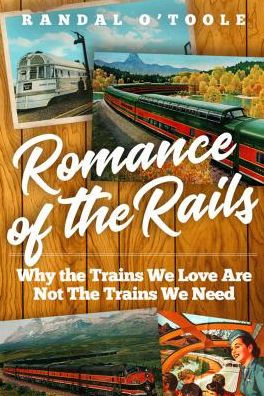
Romance of the Rails

Romance of the Rails: Why the Trains We Love Are Not the Transportation We Need
© 2018 Randal O'Toole
300 pages


"These are the 1930s again, with all the charm and romance, all the gaiety! That was a carefree world, Danny, and I'm gonna make it that way again!"
"You can't! It's nostalgic, it's nice, but it's not true, it's phony!"
"It doesn't have to be phony. If I wish hard enough, it doesn't have to be phony.."
(The Twilight Zone, S01E04. "The 16-Millimeter Shrine")


There was a time when America was knit together with ribbons of steel, linking not only metropolises, but bedroom suburbs.  That time was yesteryear, and it cannot come again – no matter how much we might wish it so. Romance of the Rails is written as a letter to a dying if beloved friend;  former rail advocate author Randal O’Toole reviews the history of passenger trains and their offspring, and scrutinizes the ongoing attempt to bring them back to life, comparing  transit and high-speed rail networks across the globe.  Just as railroads replaced demonstrably less effective modes of transportation,  so they have been replaced – and it is both wasteful and unjust, he argues, to continue propping up a dying industry to benefit a scarce few, in pursuit of recapturing America's boom years.  Although by the end few readers would remain willing to argue for rail transit on economic grounds, O’Toole only briefly touches on other veins of rail support.  

 O’Toole begins with a history of the rise of rail transportation in the United States,   exploring why trains were so successful and what they accomplished.  Trains and other contemporary technologies allowed for a novelty: the  nucleated city, with  superdense business district. Before the Victorian age,  cities consisted of a fairly even mix of residential, commercial, and other areas;    most people traveled on foot (horses and carriages being too expensive), but rails allowed cities to expand outward and upward simultaneously, giving those who could afford it the chance to escape the noise into streetcar suburbs, but also allowing more people ready access into the city. 

In the early 20th century, however,  that began to change – again, because of new technologies. Mass-produced automobiles meant that the same workers who couldn’t afford a carriage a century ago could now afford a different kind of carriage.   Buses, after internal combustion became much cheaper, suddenly emerged as such viable alternatives to trolleys that railroad magnates were investing in them.  The government, too,   was investing in the competition, helping at all levels – from widespread efforts to pave streets, to the federal project of a national highway system.  And then there were airplanes, far faster than trains and buses  and increasingly cheap.  

So it goes. Trains had been completely replaced by services which were cheaper,  which carried more people, which served  more sectors of  the  population, and which were far more nimble.  By every measure,  passenger rail should have been retired to the museums with a hearty “Well done, good and faithful servant”.   Instead, there are continued and expensive attempts to revive rail transit, both trolleys inside cities (which carry less people, at far greater cost,  and consume more space), and passenger rail between cities – either through Amtrak or new high-speed lines modeled on those which were a success in Japan.  Amtrak’s problems are so  severe that even a former creator of the company has written a book urging the public to let it die, and high speed rail is a boondoggle of such great expense that not even California could manage to do it to connect SF and LA.  The economics simply don’t work, O’Toole writes:  trains perform well in Europe and Japan because the populations are so dense and  car ownership so low; that latter is especially important, because it’s why Japanese bullet trains were a success and European ones drove Italy and Spain to the verge of fiscal ruin.  The only thing trolleys do better than at busses, O’Toole says with a bit of snark, is shifting public money from the public itself to the pockets of corporate engineers and lobbyists.  

As someone who has drunk deeply of train nostalgia, I found Romance of the Rails a daunting but sobering read.  I’ve read both histories of trains, and books advocating more mass transit in the form of trolleys, and Romance thoroughly challenges both.  Its amount of documentation is particularly enlightening, as we realize for the cities considered, the introduction of trolley lines to a city already covered by buses often caused a decrease, not an increase, in the amount of transit users. This problem is especially bad when trolleys are deliberately introduced to 'replace' a  bus line, and here O'Toole draws from Human Transit. The history itself was eye opening, as O’Toole argues that commuter trains and inter-city trains were never the transport of the common man, but remained a middle class or above experience.     

There’s part of the story that’s missing here, however,  in that one of the reasons people promote trolleys and such is that they’re more environmentally friendly – not polluting or emitting greenhouse gases.  O’Toole only addresses this lightly, arguing that there is no effective gain in passenger transit over cars, because  passenger trains only displace freight traffic which then has to travel by more polluting trucks. This area of the argument is never explored in full, which I think diminishes the book because it’s such a prominent part of rail advocacy. There's a lot to explore in that vein,  especially given that we can have electric buses which don't have any direct emissions. 

Ultimately, O’Toole believes that there is no evidence-based reason to support trolleys and passenger transit in the United States. Our efforts to do so, he suggests, are based more in nostalgia than the facts. His argument presenting the facts is most impressive, but without  addressing environmental concerns this book is not as excellent as it could have been. Even so,  it's  probably one of the better books on public policy which I’ve read,  and I wish were were more like this, which are written by someone who has changed his position over the years, and so can argue on facts rather than passion which is deaf to any opposition.  Transportation will change enormously in the coming decades, and cities which are serious about a productive transit system would do well to consider how sometimes the best-looking options can perform so poorly. 

And it's not as if cities can't enjoy the best of both worlds....

A bus designed to look like a trolley! (Montgomery, Al.)

Tuesday, February 27, 2018

Atlas Shrugged

Atlas Shrugged
© 1957 Ayn Rand
1168 pages


Sometimes the chains that bind us are made by our own hands.   Dagny Taggart knew as a young girl that she wanted to grow up to be the master of her family’s railroad system. She began working for it in her youth, and so poured her heart and soul into it that the transcontinental system was an extension of her own self. Regardless of what problems she faced – from suppliers, with labor, or  bungling rules from above --  she was determined keep the trains moving so long as there were trains to move. The rails were her pride and joy, and she could keep them alive no matter who tried to strangle them – even if her enemies were getting more use out of the rails than she was.  Atlas Shrugged  chronicles her fighting defeat as her peers resolve to go on strike – to  let a society  which hisses in contempt for them even as it enjoys the comforts they created – go to ruin.

Atlas Shrugged has achieved notoriety in the decades since its release;  people loved to hate Rand, even those who sympathize with her ideas. I was certainly no fan of her when I decided to try Anthem for its dystopian theme, and then The Fountainhead so I could experience her ideas first-hand  --   the latter novel made me realize Rand’s thinking was more interesting than my prejudices. It was my prejudices, however, that led me to Atlas Shrugged in great excitement. I loved the idea of triumphing over the state through civil resistance, loved the idea of characters telling the establishment what it could do with itself.    So, even though  Atlas Shrugged  had some of the same creative problems as Fountainhead, and I don’t regard Rand’s philosophy of life as attractive in full, I had a terrific time reading it.

A book review of Atlas Shrugged is not the place for an essay on Objectivism’s virtues and flaws, although given how philosophical this novel is, that’s an easy way to drift off course. The Fountanhead focused on egoism and integrity;  Atlas Shrugged is more expansive, and much of the content is characters debating one another. It’s less a novel than a philosophical argument in novel form,  something like Galileo’s Dialogue Concerning the Two World Systems, but with Rand’s  ideological enemies playing the part of Simplicio, the slobbering troll.  Throughout the book, Rand and her characters defend the primacy of reason,   the all-importance of the individual, and the real value of money.   Linking them all is the human mind, which alone creates value and determines truth;  for Rand, it is impossible that material things can corrupt a man. Only a man’s mind can corrupt  him,  and only in making choices can he be flawed or perfect.  (“Perfection” for Rand is not arriving at some ideal state, but never failing to act or decide on the best  discernible choice.) For Rand, material things have no inherent value: a rail system is only as good as the people who created it, as the people who sustain its operations  through their ideas and energy.   Rand’s philosophy covers metaphysics, aesthetics, economics, politics, and..sex, apparently.  What surprised me is Rand’s idealism: although an atheist, she regards the modern academy with the same contempt as she does traditional beliefs. She despises those who say that humans are only animate goo, that nothing we do matters -- that nothing we think is real, because logic and reason are an illusion, that everything is relative. This entire book is pregnant with arguments over the Meaning of Life, and the glory of being a thinking being in it.

As a novel, Atlas Shrugged has its problems. The characters aren’t as off as they were in The Fountainhead, but I suspect that’s me getting used to her style. The villains all carry their cards, and unless one is in a vicious mood -- a mood delighted in politicians being berated --  the way they’re depicted scuttling about,  alternatively whining and scheming, might grow tiresome.  I was delighted by the plot, however -- intrigued by the pirate, curious about Who Is John Galt.  I liked the building tension as the beating heart of the American economy slows, as the lights wink out by one, as Dagny’s  rivals, suppliers, and buyers keep ominously disappearing.  Perhaps the best part is the slow torture of Dagny and her supplier-friend, Hank Rearden: both  are sympathetic but reluctant about the strike.   Dagny loves her rails more than principle, and Hank is saddled with those "family" people who keep him from  being a solitary uberman against the world. They both have their moments of realization, but the moments have to build and build on one another before they snap into place and reveal the futility of running in place. While the United States has not (and may never, I hope) succumbed to all of the legislation here, I am not surprised Rand has remained popular in the decades that followed. Who could not think of Atlas when Nixon began playing with wage and price controls?  Not to mention the TARP deal, in which bankers and auto manufacturers survived  not by producing value, but by exercising “pull”.   Throughout Atlas Shrugged, we see the laws of economics corrupted and dominated by politics, so that those who succeed are the ones who play with the political machine.  Rather reminds one of how the same banks funded Obama and Romney -- maintaining their pull no matter who won.

Having now read both of Ayn Rand's epic novels, my opinion of her has improved from the initial revulsion of hearing her praise selfishness on the radio.  I realized in The Fountainhead that her use of the word was misleading. Her characters are not decadent playboys;  they're workaholics who enjoy functional luxuries, like a fast car and a warm coat, but for them the goal of life is to do, to create,  to produce -- not to  consume, to spend.  I think most people ultimately find more value and meaning in their connections with one another, and I'm not particularly surprised that none of Rand's main characters, nor she herself, had children.  When objectivist sex is a philosophical drive and not a biological one, it's only natural that the only thing born are ideas to debate.  However Rand misjudged the character of man in society,  in general I found her ideas  about individual integrity bracing. 


Thursday, September 14, 2017

Infrastructure: A Field Guide

Infrastructure: A Field Guide to the Industrial Landscape
© 1999, 2014 Brian Hayes
544 pages


Here at last is a book for those of us who constantly gaze out the car window at the fixtures on utility poles, or drums mounted in the sky above the telephone building, and wonder: what are those and what do they do?  Chris Hayes offers in his introduction that there are many books for understanding the various kinds of trees and birds we see around us; his hope is to help readers understand the built environment which can be beautiful in own right. Hayes'  field guide is not a dry catalog of pipes and antennae, organized alphabetically. Instead, he offers a narrative laced with humor that explores the built world, system by system -- beginning with mining raw resources and ending with waste disposal.  In between are covered farming, waterworks, power production, the power grid, telecommunications, roads, bridges, railroads,  aviation, and shipping.  Hayes' writing combines history and description,  allowing the reader to understand not only how things work,  but how they got that way. Photographs abound, most of which were taken by the author himself and include unusual shots.

The fact that this book has gone through three editions indicates it has been a success with readers, and I'm not surprised.  We live in the midst of and are sustained by systems built with human hands, but which few understand. There's enormous appeal in opening the hood on modernity  and gaining even a little knowledge as to how it all works, especially when systems link together. Although this is a guide to the 'industrial landscape',  Hayes' writing brings a strong humanistic touch. The book is about the world humans have created for ourselves, for our needs;  reading the built landscape  is an act not just of technical analysis, but of human interest.   Admittedly,  there are topics in the book harder to appreciate; mining, for instance, usually happens far from where we live.  The majority of this book, however, is the stuff of everyday: traffic lights, radio towers,  food, and highways.  Although I've  done a good bit of reading on infrastructure, Hayes' book was full of interesting facts and stories. For instance,  in the early 1980s a network of eight radio towers were set up to aide in global navigation: one of the stations was maintained by the US Coast Guard in the middle of Nevada. The system only lasted ten years before being supplanted  totally by GPS.

I referred to Kate Asher's The Works as a dream of a book, and I can only repeat the statement here:  it's a gorgeous and helpful piece of work.

Hey, look, it's the Very Large Array!

Related:
The Works: Anatomy of a City, Kate Ascher
On the Grid: A Plot of Land, an Average Neighborhood, and the Systems That Make Our World Work, Scott Huler
Tubes: A Journey to the Center of the Internet, Andrew Blum
The Grid: A Journey to the Heart of Our Electrified World, Phillip Schewe
Divided Highways: Building the Interstates, Transforming American Life, Tom Lewis

Thursday, November 24, 2016

The Works

The Works: Anatomy of a City
© 2005  Kate Ascher
240 pages


Cities are, for my money, mankind's most astonishing invention. Their complexity is stupefying -- system within system, handling tons of material at any given time, whether the subject is cars across a bridge or the contents of a thousand home's flushing toilets. And the stakes are always high, with the health and happiness of millions on the line -- or at least, thousands. The Works is a dream of a book, a visual-rich guide to the many systems that keep cities thriving.  Author Kate Ascher throws light not on just the expected -- roads and utilities, say -- but also minor things like the postal service.  Using New York City as case study, Ascher explores systems for transportation, energy, communication, and sanitation in turn.

The Works stunned me again and again with its visuals. Readers are treated to an astonishing array of informative little diagrams: cutaways that show what's inside the Holland tunnel, for instance, or the underbelly of a street-sweeper, or the waterworks inside your average skyscraper. The pictures also demonstrate systems -- the chain of equipment required to convey power from a generating station into the average home, the links involved in a cell phone conversation,  Some of the visuals are clever: for instance, to illustrate the variety of goods a train might carry,  a cartoon representation of a real train runs along the bottom of every page in the chapter, each car marked with its contents. The same tactic is used to illustrate the electromagnetic spectrum in the chapter on communication.  The bounty of visual information here is ludicrous -- showcasing fleets of sanitation vehicles and subway cars,  mapping out train yards and container ship docks, -- it's staggering, really.  Statistics are presented visually, too, and of course there are tons of maps -- including one that shows all the traffic cameras in the city. There are a few sample pages on Streetsblog, all from the chapter on streets.

That's not to say The Works is merely a picture book, because there's no small amount of text here explaining the importance of all these systems, reviewing their evolution within New York City, and sharing the particulars of their operation.  Reading this book is kind of like reading Gone Tomorrow, Picking Up, The Grid,  Flushed! On the Grid, etc, all at once, all rolled into one, and with gobs and gobs and gobs of illustration.   It does lack a chapter on  the infrastructure of the internet, which isn't an oversight that would be made if it were published today.


Thursday, October 13, 2016

Week of Enchantment: Las Cruces


That, dear readers, is always a promising way to start the day. I stayed at the Big Chile Inn, an older place formerly run by a family but now owned by a corporation. Its interior courtyard was lush, and I would end my stay in Las Cruces by lounging happily under palm trees and reading a silly book I discovered while roaming. But the day began with overcast skies, in Old Mesilla.

Mesilla -- Old Mesilla, La Mesilla, varying on the sign -- seems to have been a pueblo that has since been enveloped by the city of Las Cruces itself.


I found it in the early am to be deserted and gloomy, as the rest of the tourists were still slumbering and the shops were empty of even their owners. The smell of cooking tortillas, the faint sound of strings and cymbals,  and the happy clamor of visitors lost in admiration -- an ambiance shared by both Albuquerque and Santa Fe's old town plazas -- wasn't here, not yet.  After exploring a bit I decided to head for downtown, to take in the science and nature museums. I really should have returned to La Mesilla, to see it with its eyes open, but the later plazas would give me plenty of that atmosphere, and Las Cruces had its own attractions.


When first entering Las Cruces, I unwittingly previewed my route downtown as well. The road I'd expected to follow to my motel took me instead to a downtown roundabout, the lanes splitting in opposite directions.  This time I followed it, relying on my 'trip book' (a binder fulled of highway and street maps I'd compiled in the months previous) to guide me to the museum. I arrived just as it opened and was immediately awed by a spinning globe -- a model of Jupiter, I thought.  I stood in admiration watching it rotate, and then realized a screen below allowed me to change it to any planet  and most moons in the solar system.   The museum was just getting started, though!  Among its princely attractions: a large expanse of dirt, preserving or modeling trackways of prehistoric creatures. (I would think it's merely a recreation of an archaeological site!), stuffed Chihuahuan predators (that's the desert, not the noisy mouth with legs), and several live animals. Their reptiles were captivatingly active; as I told one of the staffers, I've never actually seen a snake MOVE inside a zoo. But here, I witnessed lizards clambering about, snakes prowling, and....best of all...a MASSIVE snapping turtle.


Carts: a filling and nutritious snack for your fossil on the go


There were also little hands-on science experiments; a tube filled with fluid and some material, presumably iron shavings, for instance. There were magnets nearby and they could 'pick up' a ball of the shavings.   I put two magnets on either side of the vial and discovered that if I altered the distance or the angle of the magnet, I could see shavings streaming from one ball to the other, looking like galactic intercourse or something. 


This was the highlight of Las Cruces. A nearby art museum featured a display on Japanese art and radios. I attempted to type a message in Morse code, which appeared on a little screen. I tried "What Hath God Wrought?", but it was too ambitious. I settled for "Hello". 


After this, while trying to find a place to eat, I found COAS books.  I've never been inside an independent bookstore before, though I buy most of my books at them through the amazon marketplace.  I asked for their Edward Abbey section, hoping to find a copy of The Brave Cowboy, but no dice. They did have a few Asimov books I've never heard of, and as someone who actively trolls Amazon for used Asimov books, that's saying something.  I only had one suitcase, though, so I settled for The Ends of the Earth, a natural history book by the good doctor on polar regions.  On display I saw a copy of The Night of the Living Trekkies, picking it up for $3.  It made my night!


All the while downtown I'd asked people about the local lunch options, figuring I'd see if one place was named more than the rest. That place was Rosie's, a little Mexican restaurant that was packed at 11. I enjoyed a meal here, then wandered away. 


I left downtown and drove toward the Rio Grande, where I knew I'd find a small park by the river. I didn't linger here long, as some college kids were there blasting AC/DC's "Rock and Roll Ain't Noise Pollution". Sometimes it is.


The Organ mountains from the park


Not too far away was the Las Cruces Railroad Museum, housed in the old passenger depot. This was the first train station I've been to not connected to the Louisville and Nashville;  instead, it was part of the Atchison, Topeka, and Santa Fe. I know this when I asked what AT stood for, the staffer sang the song for me. And then, when a train rolled by, she ran outside screaming and we yelled and identified all the cars together.    I can't say I've ever nerded out about trains with a woman before, but that's the magic of New Mexico. 


An interesting mural across the street, a depiction of transportation with an ATSF train smack in the middle. 

A shot of the Sandias again.


After the train museum, I retired to my motel to read my funny little book under the palms, excited about tomorrow's trip: Nerdvana.


Saturday, April 16, 2016

Murder on the Orient Express

Murder on the Orient Express
© 1934 Agatha Christie
256 pages

"Why does everyone on this train tell lies?!"


A dark and snowy night; the Orient Express, rolling from Istanbul to Paris, slows to a stop in the wilderness, trapped by the growing piles of snow as its passengers sleep. But the slumber of the travelers is disturbed by a sudden cry, the sighting of a figure in a red kimono, and -- the discovery of a dead passenger, stabbed in his sleep.  Murder has been committed -- murder most foul!

..or not. Quickly enough, an officer of the train line enlists his friend, Hercule Poirot, to sort out whodunit, and in the course of their investigation they realize the dead man was a notorious child-killer from America. If anyone deserved to run into a knife several times, it was this fellow. Still, train lines can't have passengers being stabbed willy-nilly; the culprit must be found out. So, with the train still stranded in the wilderness, and no escape available for any suspects, the passengers are summoned to the dining coach one by one and interviewed by the famed detective. The story grows ever more complex; the evidence is contradictory, and everyone seems to have an alibi.  The deceased didn't encounter some malicious vanishing wizard's casting of sectum sempra  -- someone on board must have plotted and committed the deed.

Murder on the Orient Express is my second Christie novel, the first being And Then There Were None, read during the Clinton years. Like that one, the ending here is a terrific twist.  Murder is a story of conversation and deduction, a classic locked-room mystery in which the room is a train cabin. Although the alias of the murdered man leads Poirot to suspect the stabbing had something to do with his notorious villainy in America, the presence of suspects with links to the devastated family confirms it. Only hitch: virtually everyone on the train proves to have some connection to that family.  Unlike the train itself, Poirot's investigation flies  along, with one confusing clue after another baffling the train officials and physician, but giving Poirot some insight into what they are being led to believe happened.   The ultimate resolution is a twist, as mentioned, but not improbable. It is, after all the other alternatives were exhausted, the only possible solution.

Christie definitely lives up to her reputation, and I'll warrant Poirot will appear here again..


Monday, January 4, 2016

Adieu to you, and you and you and you --


As 2015 was ending I finished up a couple of works which merit mentioning. Firstly is Jane Austen’s Emma.  I have read Austen before (Pride and Prejudice), intrigued by mention of Darcy as a model gentleman,  Emma was thus my second foray into the author’s works, though I did not enjoy it nearly as much.  The plot is familiar to most:  Emma Woodhouse is a witty,  self-assured, and quite attractive woman so enormously satisfied with her life that she seeks to manage others. She attempts to pair a few of her single neighbors up, disaster ensues, much chatter follows, and eventually everyone winds up married off – including her. There were quite a few utterly brilliant lines in here – a favorite, following a haughty woman’s “discovery” that Mr. Knightly was a gentleman, noted that he was unlikely to ‘discover’ her to be a Lady, given her manners.  This was only a first reading, I think, given Emma’s reputation as Austen’s “perfect” novel. Perhaps I missed something in the end-year weariness.


Closer to my usual fare was Stagecoach: Wells-Fargo and the American West.  As the title indicates, it is primarily a history of Wells-Fargo’s rise to fame in the 19th century. It was an unusual company, doing its best to fill a vacuum of infrastructure and service in the  still-being-settled west.   Principally, the firm provided banking and express services. Its commercial network provided both communication and transportation, at a dearer rate than the Postal routes but far more efficiently. It became most famous for the mail and treasure that traveled on stagecoach lines, and one chapter sheds a little light on the workings of stages in particular. After nearly dropping the ball on the transition to railroads, Wells-Fargo rebounded and became such a productive company that it drew the attention of trust-busters, who found the collusion of banking and railroads worrisome. The bank that exists today has only a tangential connection to the former behemoth of California, but retains the imagery of a stage coach -- which proved a useful brand image even in the late 19th century, reminding prospective customers of how the west was won.

2016 is off to an excellent start so far, with How I Killed Pluto already read and reviewed, and another fantastic book following that.  Right now I'm nibbling at a couple of books, but I'm really looking forward to what January holds. Today I chanced upon a list of books I scribbled down next year, and I must say...I forget about some of the most interesting books.

Oh! I'm presently watching The Last Kingdom, a BBC miniseries based on my favorite bit of Bernard Cornwell, the Saxon Stories series.  So far it doesn't stack up too well against Vikings, but the latter is...brutal.


Danish tourists inquiring about the time. 

VIKINGS!


Friday, July 17, 2015

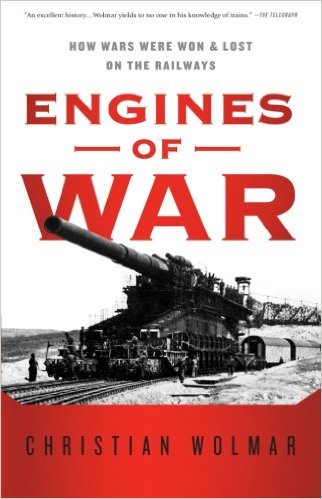
Engines of War

Engines of War: How Wars Were Won and Lost on the Railways
368 pages
© 2010 Christian Wolmar


An army marches on its stomach, but for a hundred years it rode to victory only on the rails.  It was Napoleon who observed the importance of supplies the military,  and well he should know, for the nigh-twenty years of wars he raged on the European continent were the last major conflict prior to the advent of rails. In Engines of War, veteran railway historian Christian Wolmar addresses how trains transformed war,  allowing for greater conflicts to be sustained over a wider front, and often serving as the locus of conflicts themselves.  Although the American Civil War and the Great War feature most prominently, Wolmar also dwells on the Boer and Russo-Japanese wars, and includes many minor episodes which are fascinating. Who knew, for instance, the role of railroads in the Arab revolt from Ottoman rule?

The most important aspect of the railroads to war, of course, is logistics -- the transport of men and material to the battle, including food, ammunition, and forage. Mankind has waged war against itself since human history began, but not until the industrial age did he do it on so terrible a scale. Wars between ancient empires -- the Roman and Carthaginian, for instance -- might last decades, but these lengthy conflicts did not tax their nations they way they do now for most of the 20th century.  Battles were comparatively much smaller, and more seasonal. Invading armies relied on raiding hostile territory to supply themselves, and as professional armies were rare, generally consisting of private subjects whose labor was needed back at home.  Rail lines made projecting and sustaining a force in the field far easier -- as they did early in Crimea, allowing Britain to sustain a siege halfway across the world.  Or, take Sherman's famed march to the sea, for instance, his bloody chevauchée from Atlanta to the southeast coast of Georgia. Despite a reputation for feeding his troops off the land, his initial push was fueled by a rail-fed stockpile.. The incorporation of railroads allowed for intense strategic planning: the Schlieffen Plan, Germany's strategy for a quick resolution to the Great War,  was essentially a train timetable. Despite how quickly trains could deliver men to the front, however, Wolmar maintains that the rails favored defensive warfare more than the offensive. Any advance made by an invading army would take them into territory with sabotaged infrastructure, often incompatible with the invaders' systems.

The rail lines could also be used as weapons themselves; carrying artillery or serving as mobile gunships. Armored cars first appeared in the Boer war, and were used to suppress insurrection in vital areas.  The importance of defending the rails, even with trains themselves, is made obvious by the Arab revolt from Ottoman rule. The Ottomans created a rail line stretching down the Arabian peninsula to allow pilgrims on the hajj to more easily reach Mecca, but during the revolt it was subjected to such chronic attack that  the troops which depended on it for supplies were forced to surrender.  Other methods of attacking rails were less successful:  airplane-born bombs, for instance, were rarely accurate enough to touch down on so narrow a line drawn on the landscape.  Even  when lines were rendered inert, every military of the period created divisions which specialized in rail repair.  Germany was especially diligent about maintaining large stockpiles of extra rail supplies, to allow for nigh-instantaneous repair. Only when its entire war effort was failing did the rail lines finally collapse.  In his other works, Wolmar analyzes the comparative advantages of government and private management of rail systems; here the insistence on efficiency takes on a more awkward tone when it results in more prolonged wars and the horror of the holocaust.

Despite their importance for nearly a century,   so linked to the projection of power that their construction could spark wars (as between Russia and Japan in 1905), even a rail enthusaist like Wolmar has to admit the age of the train is past, militarily speaking.  The nature of war itself has changed.. We are as unlikely to see massed armies butchering each other with Maxims and artillery as we are to see cavalrymen running about with sabers in the next war.  This is the age of cruise missiles, drones, and small groups of soldiers deployed in surgical strikes by helicopters.  Even in larger operations, troop transports that can transverse alien territory are more efficient than building even the light strategic rail of the Second World War.

Engines of War is an altogether fascinating book, revealing how  the vital necessity of rail lines during wars not only altered weapons and strategy, but changed both the role of the government and the behavior of the rail lines in peacetime.


Friday, August 22, 2014

The Age of Steam

A Brief History of the Age of Steam
© 2007 Thomas Crump
288 pages


For most of human history, transportation over land has been prohibitively expensive, limited to highly lucrative goods like silk. Trade grew from the rivers, as did civilization. But in the 18th and 19th century, the advent of industrial technologies, often utilizing steam,  radically transformed society. Not only did wood- and coal-fired engines free factories from the need to locate  beside rivers that powered watermills, but the advent of steam transportation knit cities across the landscape together, creating boundless opportunities for economic expansion. A Brief History of the Age of Steam focuses mostly on steam transportation,  first on boats and then on the rails.  Not surprisingly for an author who also penned A Brief History of Science, it places a lot of emphasis on technical details, like the mechanical workings of the steam engine.  As a rail history, it doesn't compare well to Christian Wolmar's work, since he incorporates both social and technical aspects, but it's a rare history of river steamboats and the rise of oceanic steamers.  A strong point is the close relationship between railroads and imperialism, which he develops.  Even though the writing focuses more on mechanical operations than the human element, the history reads well.  I'm still on the lookout for a naval history of steam transport, however.


F

Monday, May 5, 2014

A Splendid Exchange

A Splendid Exchange: How Trade Shaped the World
© 2009 David Bernstein
496 pages


  History oft moves with the caravans and trade fleets, and its journeys along the routes  of the past and present are given a storied account in A Splendid Exchange. Beginning in ancient Sumer and moving forward to the present day, David Bernstein demonstrates how the lust for goods from afar has linked cities and states together, and driven them apart. The narrative corners nearly every corner of the globe, Antarctica excepting, and ripens into a tentative argument for free trade, though its author isn't too insistent. Bernstein brings a lot to the table; he's a personable author, sometimes wandering off on side-roads but for never too long, and usually delivering something valuable to the reader as a reward for gamely enduring:  understanding of how air compressors work, for instance, or what is meant by the economic phrase, comparative advantage.  He creates in A Splendid Exchange  a marvelously varied history book, following the tale of  trade through city-states to nation-empires, from the middle east to South America -- but as varied as it is, no matter the diversity of goods being traded or fought over, the narrative flows seamlessly aside from a jump in the 20th century.  Those goods range from the exotic to the mundane;  table elements we now take for granted have had far more interesting past lives. Readers may well know that sugar, spice, and all things nice are everything little girls are made of – but they’re also the stuff of world empires and bitter grudges. 
The importance of trade routes affirms the importance of geography; many of the straits endlessly fought over throughout the book remain heavily in use today, underscoring the relevance of the various trading empires' rise and fall.  The same trading routes the Dutch and Portuguese  shot their hearts out as cannons attempting to secure are the ones we employ to transport oil, no mere luxury. Our entire global economy is lubricated by trade, which is why Bernstein cautiously presents arguments for freeing it up, with caveats.  A Splendid Exchange strikes me as popular history at its finest; varied but cohesive, fun to read but intelligently argued and obviously relevant to our contemporary experience. 


Related:

Friday, December 27, 2013

The Men Who United the States

 The Men Who United the States: America's Explorers, Inventors, Eccentrics and Mavericks, and the Creation of One Nation, Indivisible
© 2013 Simon Winchester
496 pages


The Men who United the States is a storied account of how the American people came to realize their ‘manifest destiny’, from the explorers who plied rivers and mapped the vast expanses to the technological tools that knit the continent together. It is organized thematically, utilizing the five elements of Chinese mythology: wood,  earth, water, fire, and metal.  Although most sections cover the full expanse of American history, the focus of each moves forward; ‘metal’ largely concerns revolutions in communications technology,  culminating in the Internet  while ‘fire’ covers the effects of the steam and combustion engines. Politics and war are downplayed: this is the tale of explorers and inventors whose dangerous  and enterprising deeds made political dreams a factual reality.  Winchester is a personable author, often inserting his attempts to retrace the tracks of some intrepid but doomed explorer along mountain passes or through river rapids. It's an odd element in a work of history, but works well enough despite sometimes bordering on off-topic.  Winchester makes for a winsome host through the annals of American explorers, and his work of adventure, history, and technological progress are sure to find a warm reception among readers.


Wednesday, October 2, 2013

Uncommon Carriers

Uncommon Carriers
© 2006 John McPhee
256 pages


Uncommon Carriers invites readers to spend a day in the life of a truck drivers, ocean-going cargo ship and riverbound freight tugboat pilots, train engineers, UPS aviators, and -- just for good measure -- pleasure-canoers sailing the Concord and Merrimack Rivers.  Aside from the odd inclusion of his retracing Henry David Thoreau's oar-beats, the work is part human interest and part-inside look into the transportation service that keeps the world of goods going round. Some sections are more useful to the latter end than others; his chapter on cargo ship pilots takes place at a training school off the coast of France, and communicates the difficulty of moving across something that has a mind of its own, but nothing about the business of commercial freight.  The chapters on river freight and UPS  more conducive to understanding the ins and outs of the industry.  What Uncommon Carriers offers besides that is the personal aspect of these jobs. McPhee's research is all first-hand: he shares the lives of the men who do these jobs, befriending some and enduring the teasing of others. He's especially fond of the truck driver who carries a chemistry book to help him wash his rig, judges truck stops on whether they carry his beloved Wall Street Journal, and who moonlights as a wordsmith. The account is peppered with many lively characters like him. On whole, this was quite an interesting peek into a world we depend on so much.

Related:
Ninety Percent of Everything: Inside Shipping, the Invisible Industry that Puts Clothes On Your Back, Gas in Your Car, and Food On Your Plate. Rose George

Friday, July 19, 2013

Getting There

Getting There: the Epic Struggle  between Road and Rail in the American Century
© 1996 Stephen Goddard
366 pages


Regardless of the status of George Washington, Napoleon Bonaparte, and William Pitt, each man of power traveled at the same speed as the people they governed: no faster than a running horse. But in the early-mid 19th century, the industrial revolution began producing modes of transportation that would shrink continents, reducing journeys of months into a solitary week. Trains first shriveled the distance and their spans allowed for unprecedented economic growth. That growth produced rail's first rival, the automobiles -- and the highways they drove on.  Their competition produced a clear winner in the American  20th century: while the rail lines withered in neglect and passenger service vanished almost entirely,  highways covered the landscape.  But their struggle was not a fair fight between equals, as both looked for government support and the highwaymen's superior politicking created a fixed game. Getting There is a history of how the rail barons squandered public trust,  failed to unite in the face of potent opposition, and continued to flounder as they were supplanted in the lobbying court by a coalition of highwaymen and automobile manufacturers.  The status of the great highways as money pits, however, and the fracturing of that opposing coalition present an opportunity for rail to rally, in Goddard's view.

Goddard begins with a brief history of rail transportation's origins before the struggle between the two ensued, a history pitched toward demonstrating how the rail companies' early success led to abuses of the public, and thus to opposition --  -- both by popular movements, like the Grange movement of farmers protesting high rail prices in the midwest, then by the Interstate Commerce Commission, the first government institution designed to oversee any part of the economy. The ICC proved first tepid, then tyrannical, and for most of the book plays the part of a 'bad ref' or crooked umpire, working the game against  trains and for the highwaymen. While regulations forced  rail companies to quote the same price for hauling freight regardless of circumstances, unregulated truck drivers could change their rates at their own discretion: rail companies were forced to write to D.C. for permission, and by the time said clearance arrived, the opportunity for hauling would have already vanished.  Ironically, the rail companies were partially complicit in their troubles: they promoted the first 'good roads' measures so that trucks would take unprofitable short runs off of their balance streets -- and so that automobiles would relieve the burden of passengers. Those measures would prove to be another unearned advantage  for the automobile industry and highways: while rail companies created and maintained their own lines and stock, car companies, and later car drivers, were given such infrastructure, the funds coming from American taxpayers.

Although the history of American rail is checkered with self-serving episodes, the automobile industry fares no better, as their deliberate campaign to destroy trolley lines in the city and replace them with buses demonstrates. Forcing the rails' decline and letting the infrastructure fall into scrap would be egregiously unwise, in Goddard's view. He outlines the problems of our highway-and-auto dominated system: destruction of cities,  the financial albatross of maintenance, and pollution among them.  While he doesn't launch into an extensive plea for a rail renaissance, he sees one as inevitable -- if government will get out of the way and stop propping up the trains' competitors.  Getting There proves an expansive history -- brimming with detail, but never plodding, and covering social life as well as business and politics.

Related:
Waiting on a Train: A Year Spent Riding Across America, James McCommons
Straphanger: Saving Our Cities from the Automobile, Taras Grescoe
The Great Railroad Revolution: A History of Trains in America, Christian Wolmar
Asphalt Nation, Jane Holtz Keay


Monday, February 25, 2013

Railroad Stations

Railroad Stations: the Buildings that Linked the Nation
© 2012 ed. David Naylor
336 pages


For the past couple of weeks I've been slowly enjoying Railroad Stations: the Buildings that Linked the Nation, a collection of photographs of the United States' wide variety of railroad stations, from humble one-room shacks in the desert to astounding works of art that must rival even the cathedrals of Europe with their grandeur. It was released just last year, and appropriately timed given that Grand Central Station in New York is celebrating a hundred years of service.  The book is a feast for architectural admirers and railfans alike: after an opening section that gives a history of rail in the United States, and stations' role in public and economic life, a tour of the US's depots, stations, and terminals follows.  The photos range from the beginnings of rail days to the early 1980s, and while the majority portray the stations at their best (with crowds, families included, waiting to go on a trip, dressed in their Sunday best...including straw boaters for the men), a few in the southwest section offer a sad look at roundhouses and tracks overgrown by weeds.  Aside from the southwest and Alaska, though, the buildings are magnificent, and often connected to other forms of transit. In New York, for instance, a train station also had ferry landings, and quite a few were visibly part of a trolley ("light rail") network. The photos included often cover a given site from multiple angles, building plans, and offer views of fine details, like a GC mongram emblazoned on the  doorknobs at the Grand Canyon station.  The editor sources the photos as well, so those curious can look for the original collections.

The four-page treatment of Union Station in Montgomery especially delighted me. I only discovered that the station was still standing a few weeks ago, and immediately took a trip there.

Click to enlarge.


Far more humble is the Old Depot, like Union Station part of the Louisville & Nashville line. I took this photo several years ago on an overcast day. 


Saturday, February 9, 2013

Waiting on a Train

Waiting on a Train: the Embattled Future of Passenger Rail Service
© 2009 James McCommons
304 pages


You leave the Pennsylvania Station 'bout a quarter to four,
Read a magazine and then you're in Baltimore!
Dinner in the diner, nothing could be finer
Than to have your ham and eggs in Carolina!

("The Chattanooga Choo-Choo", Henry Warden & Mack Gordon)


Since 2000, U.S. gasoline prices have more than doubled  Not coincidentally, since 2000, ridership aboard the country's only nation-wide passenger rail service, Amtrak,  has risen 49%. In 2008, in the middle of an as-yet-unbroken sting of nine consecutive record-breaking years, James McCommons traveled  the length of Amtrak's many varied routes to gauge the state of the nation's passenger rails. In the wake of an ostensibly transit-friendly president being elected, and in anticipation of some stimulus money being applied toward improving rail infrastructure,  such a journey seemed timely. Chatter about rails is on the rise, and in Waiting on a Train, McCommons offers a sober -- sometimes bleak, sometimes hopeful -- evaluation of the passenger rail services in America, and advice on how restore a largely abandoned service.

There was a time when railroads were the default means of extensive travel for most Americans, every city and town of consequence linked in a network that covered the continent.  A casual glance at the Amtrak map now reveals how drastically the situation for passenger rail has declined: although the northeastern U.S., Chicago, and west coast  are seemingly well-covered,  the majority of the nation receives scant services, and some states none at all.  Throughout his yearlong journey, McCommons explains how this came to be: public distrust of the railroads as large, corporate entities, coupled with enthusiastic popular and governmental support for the automobile and airports relegated them to the sidelines, where stifling, archaic regulations drove them into moribundity until they sloughed off the need for passenger service and focused on freight.  Passenger service became the exclusive domain of Amtrak, a queer public-private corporation that was given access to the freight's rails...or was supposed to have been.

As McCommon's account shows, passenger service is very much the "red-headed stepchild"  of American railroading. Although the rail companies, now purely freight-haulers, are obligated to let Amtrak use their lines, freight is given priority more often than not. Time and again, McCommon's ride is driven into the sidings to allow freight trains to pass them. ("Make way for the cheap crap for Wal-Mart!" said one conductor, disgusted. European passengers were utterly aghast at the concept.) With demand for both freight and passenger services on the rise, limited infrastructure is a worsening impediment to expansion. Not only did railroad companies throw away hundreds of miles of lines in the 1970s in a leanness effort, but many current lines were built for an older generation of slower engines, and their curve ratios can't take speedier modern trains...and especially not the bullet trains which some rail advocates seem to think is the only kind of rail it is possible to enjoy. But the greatest problem is the scantness of the network itself, which a recent article from The Atlantic demonstrates nicely.

The good news is, despite of the weaknesses of the system, in spite of the work that needs to be done,  the situation can’t help but improve. A new generation of officials and service professionals are running Amtrak these days, and they’re not former freight employees who regard passengers as problems to be endured. Even if President Obama conforms to the longstanding Democrat tradition of giving trains lipservice and then ignoring them, states are beginning to take their rail systems into their own hands – and while that’s almost just as well, because local officials know their needs better.  Ultimately, though, McCommons believes restoring passenger rail service will require a substantial investment from the federal government, because the revival of passenger rail will depend on a network that serves the many, that reaches a multitude of destinations – not just one limited to parts of the coasts and Chicago. Forget profitability, McCommons writes; accept that passenger railroads are an investment in the future, a foundation to build around and not a revenue-producer by themselves. Unfortunately, that’s an argument we hear from the highways, too, and these days making investments without some idea of the returns isn’t going to sell well. What will sell well is the fact that since heavily subsidized highways and airports also don’t generate profits , we’re better off with the transportation option that loses the least money – trains.  Future rises in oil prices will help, as well.

 Waiting on a Train is part travelogue, part citizen-advocacy, but a travel tale wherein our guide gives more attention to the means of transportation than the landscape – except when he combines them by reminiscing about how lovely the Rockies looked from the dome-covered observation cars of old.  For Americans  with an interest in reviving passenger rail in the United States, Waiting on a Train is a solid beginning, sizing up the system’s current strengths and weaknesses and at the same time giving rail romantics like myself an appreciation for the practicalities of rail transportation; it is a lesson in railroad logistics.