Showing posts with label Africa. Show all posts

Friday, November 9, 2018

Great Rulers of the African Past

Great Rulers of the African Past
120 pages
© 1965 Lavinia Dobler and William Brown


Most of African history is a complete unknown for me; what few kings I can name outside of Egypt and Carthage are familiar to me only through the Civilization series, namely Shaka and Mansa Musa.  While in the future I would like to do a study series and get to know the cradle of humanity better,  this brightly-illustrated book will serve a taste.  It is a history of five men -- three Muslim, one Christian, one whatever-makes-you-stop-bothering-me -- who created legacies for themselves, either by conquering far and wide or by  relentlessly attempting to connect to the outside world and enrich themselves through trade and courting scholars and technicians.  Three of these lives unfold in northwest Africa, along the Senegal and Niger rivers;   one is set close by, near Lake Chad; and one is alone in being set in the Congo.  This book's size and style indicate it was intended for younger readers, say perhaps middle schoolers,  and there are explanations of important places and people which surface, like Mecca -- which two kings here make pilgrimages to. 

The men chronicled are:

  • Mansa Musa of Mali,  a pious and highly admired king who journeyed to Mecca;
  • Sunni Ali Ber,   forger of the Songhai Empire, who built an empire nearly the size of Western Europe, but disappeared abruptly on campaign
  • Askia Muhammad, general of the armies to Ali Ber's successor-son,  whose political cluelessness so angered his Muslim subjects that they encouraged Muhammad to seize the throne
  • Affonso I, a young prince of Congo who converted to Christianity after Portugal initiated first contact between Europe and southern Africa; he  was alone in his family in taking the new religion seriously
  • Idris Alaoma, another king who died in battle, but not before he discovered gunpowder weapons in Egypt and arranged to have some brought home


Saturday, May 5, 2018

Short rounds: things that are not Star Trek, like North Koreans and Aeneas


Believe it or not, I have been reading books without a Star Trek label appended to them this week. Just recently I finished off Don't Go There, a short collection of travel pieces that interested me with its mention of visits to Turkey,  Chernobyl, and North Korea.    The actual collection contains these along with trips to Israel, Ghana,  China, and a few other places deemed 'interesting'. The first piece, a visit to Istanbul that threw the writer and his girlfriend unwittingly into street protests and clouds of tear gas, sets the stage:  the narrator has no idea what he's doing or why, and seems to stumble into catastrophes just to get a good story to write about.   None  of Fletcher's trips had any reason or planning to them, most developed miserable complications, and when his girlfriend threatens to leave him, the reader must be sympathetic.  If one endures his laughable ignorance in visiting places like Jerusalem (he is annoyed by religious people and religious references, which would be akin to going to DC when one hates politics), and similar episodes, eventually he ends up in North Korea. It's about what you'd expect, but he comes away believing the hostages of Kim are not as brainwashed as is commonly held, and that they would be more expressive if they could get away with it.


My other read during the last few weeks has been a volume called From Achilles to Christ: Why Christians Should Read the Pagan Classics.    Markos opens the book with a remonstrance against the Protestant attitude that anything that predated Christ, or anything outside the Bible, is value-less.  Although a Protestant himself, he regards the Catholic church favorably for its integration of the classic western tradition into its own tradition, in effect building upon and continuing the queries of Aristotle and Plato into the nature of the cosmos, ethics, beauty, etc.  Markos' conviction is the same of CS Lewis'  as expressed in The Abolition of Man, namely that while Christianity is the ultimate truth,  basic truths are also available in other traditions.  The aim of Markos in this volume is to see the truths which the Greco-Roman myths express about the nature of man and meaning. He then guides the reader through the works of Homer, selected works by Greek playwrights and historians, and ends with the Aeneid.    As someone who has been removed from Western Literature I and II for far too long,  I was interested in this chiefly as an accessible  look at Greek literature, a reminder of its stories and writers.  Markos reflects on the themes present in literature, like the struggle between familial duties and loyalty to the polis.  Because the Greek dramatic tradition is in fact a tradition, Markos notes how  differently the same myths might be use by different authors, and examines how the Aeneid is a deliberate Roman tribute to the Illiad and Odyessey,  using its structure, locales, and  elements.  It was not a Latinized copy of the Greek epic, however, but one written with Rome's own history in mind -- and not ancient, but recent, as Aeneas' story can be read as a tribute to Augustus' victory over  Marc Anthony and Cleopatra.  Markos also connects the classical heritage to Christianity when he can, argue at times that the Greeks are foreshadowing the advent of Christ.  This is similar to Luc Ferry's approach in Wisdom from the Myths, in which he argues that the Greek myths and plays constitute a coherent worldview -- a Stoic one.   Markos isn't as insistent as Ferry, however, and the core of the book is merely in seeing what truths the old stories still tell us about ourselves and our relationships to our own polis and the cosmos.


Friday, September 15, 2017

My Life with the Saints

My Life with the Saints
© 2007 James Martin, SJ
414 pages


The church I grew up in consistently referred to Rome as the whore of Babylon, so needless to say I didn't learn anything about saints. I knew Biblical personalities, sure, but was completely oblivious to the hundreds of men and women throughout the Christian era who served as outstanding examples, witnesses, or reproaches to the rest of us. I encountered a few in history books, like St. Augustine,  but they were more statuesque than human. The sole exception was Joan of Arc, who began as a figure from history but became (as I read various biographies) someone I felt an odd sense of affection for.  James Martin grew up Catholic, but his saintly education seems to have been almost as paltry as mine, discovering most of them as he attended seminary and trained to be a Jesuit. In the beginning, Martin notes that Catholics approach saints as both intercessors and companions; the latter approach inspiring most of this book.

My Life with the Saints mixes biography -- his, the saints, and others -- with spiritual reflection. In each chapter, Martin recounts his encounter with each personality, sharing how they shaped and informed his own spirituality while connecting their lives to people he has worked with through the years.  St. Francis,  "the fool for Christ", is revisited in the story of another 'fool', a priest who worked with gangs in Chicago and would try to disrupt fights by walking into the middle of the fracas, dressed in a blue-jean robe.  Martin mixes Biblical, medieval, and modern personalities, and includes a fair few people (notably Thomas Merton and Dorothy Day) who aren't "official" saints.   Although I purchased this hoping to meet a lot of obscure personalities, the mix meant only a handful were  completely new to me. Even so, I found Martin's meditations  refreshing, particularly the conclusion in which he remarked on the variety of the saints -- old, young, rural, urban, intellectual, hardy, mystical, rational -- and the hope that presents  to readers, that sainthood isn't limited to a superhero type.

Related:
The Long Loneliness, Dorothy Day
The Seven Storey Mountain, Thomas Merton
The Personal Recollections of Joan of Arc, Mark Twain

Wednesday, June 14, 2017

Baghdad without a Map

Baghdad without a Map and Other Adventures in Arabia
© 1992 Tony Horowitz
285 pages


So your wife is on extended assignment in Cairo, and you’re a freelance journalist without a regular gig. What do you do? Why not wander around northern Africa, the Arab world, and Iran whenever an opportunity presents itself – chasing stories, even when they led you into dark mountains where grenades and AKs are cheaper than a week’s worth of the local narcotic? Baghdad without a Map presents anecdotes from Tony Horwitz’s time spent in Iraq, Egypt, Libya, Sudan, Jordan, Yemen, and Iran, mixing comedy and tragedy.

Because Horwitz is chasing stories -- a refugee crisis in Sudan, for instance, or the still-simmering conflict between Iraq and Iran on the border -- he is often exposed to misery and danger. He still finds humor in the chaos of Cairo's streets, the chanciness of Egyptian-Sudanese air travel, or the loopiness of Yemense men after a goodly amount of qat-chewing. Horowitz attempts to learn about local cultures and politics as he can on the ground, conversing with people in his rough Arabic, chewing qat, or playing soccer. Although much of the middle east has changed drastically since the 1980s – the invasion of Iraq and the Arab spring just in the last ten years, these snapshots of life in the middle east are worth taking a look at for readers with any human interest in the region.

Saturday, January 21, 2017

The Big Necessity

The Big Necessity: the Unmentionable World of Human Waste and Why it Matters
© 2008, 2014 Rose George
238 pages


In its initial publication, The Big Necessity may have been an eye-opening look into how many human beings still suffer for want of life-saving sanitation. Already familiar with the sorry state of toilet affairs in parts of the global south, though, I read and enjoyed this more as the story of governments, charitable organizations, private citizens, and small businesses who are steadily working to bring their places to health. The solution is not always technological, although reading about home digesters that convert offal into kitchen gas and fancy Japanese toilets is most interesting. (The digesters are particularly important: not only do they give households a degree of self-sufficiency, they guard against local trees being stripped for fuel, and save China's rural households money in terms of domestic fuel and fertilizer.) A culture of hygiene must always be fostered, and through means that take into account the local culture. The Big Necessity provides a call to arms,  takes readers into the sewers of NYC and London as well as the  Chinese countryside, and offers a view of toiletry's cutting edge. A very interesting book all around, then, and with only the faintest whiff of toilet humor -- the sole instance of which is that George refers to something as execrable.


George is also the author of Ninety Percent of Everything, known in the UK as Deep Sea and Foreign Going: Inside Shipping.


Related:
Flushed! How the Plumber Saved Civilization, W. Hodding Carter

Wednesday, November 25, 2015

Oil on the Brain

Oil on the Brain: Petroleum's Long, Strange Journey to Your Tank
© 2007 Lisa Magonelli
336 pages


Every moment, oil is surging up wells, being chemically sorted in vast refineries, sloshing its way across continents in pipelines, and being dispersed throughout the country in trucks to keep over three hundred million Americans mobile. The same  miracle is effected in other nations across the globe. In Petroleum on the Brain, Lisa Margonelli begins at her local gas station and backtracks the supply line – riding with truckers, touring refineries, standing in the pit of oil exchanges,  and filling her hands with ancient dirt that hasn’t seen sunlight in millions of years at the edge of a drilling operation.  Although beginning with the American market,  Margonelli’s travels take on a geopolitical message as she scrutinizes oil’s role in the destabilization of Africa and the middle east, and looks to the future in China.   Although slightly dated (researched and written  in 2004-2005),   the majority of the book’s information remains relevant, and  is delivered in humorous style.  Petroleum brims over with personality, as Margonelli connects with lives across the globe,  and demonstrates through her travels how our lives, too, are knit together with those whose livelihood

Although gas stations are where most consumers of  gasoline/petrol enter the market, and absorb the scorn of disgruntled drivers who see the price continuing to climb,  the seemingly ubiquitous c-stations are the low men on the supply line, in control of nothing and making only a marginal profit on their gasoline during the best days. As witnessed by Margonelli as she spies fleets of trucks from different companies pulling up to the same pipelines,   gasoline sold in the United States is fairly uniform. Some companies add a detergent, but pricing varies more depending on the location and the market than the product.  Given how much oil is being produced, refined, shipped, and sold every hour, the pace of activity becomes frenetic as Margonelli travels further up the supply line, encountering harried supply dispatchers and middlemen.  Although her book is about the oil industry, it's a personal encounter with time invested in relationships on Margonelli's part. For her, the gas station owner, the driver, the genius wildcatter in Texas -- they are men and women of passion and intelligence, whose story is bound up with their profession.

Its beginnings scratch idle curiosity as to how the petroleum industry works, but Margonelli spends more time researching, her text develops broader appeal, examining the role oil plays in U.S. foreign policy.  Here the book threatens to show its age: having virtually exhausted its home reservoirs of oil, she writes that the United States has to secure new supplies across the world, and to that end has been involved in a series of wars, directly or indirectly. A chapter on Iran sees her chat with both American sailors and Iranian oilmen regarding an incident during the Iraq-Iran war, in which half the Iranian navy was sunk by an American fleet despite the United States’ official non-combatant status.  Magonelli also visits petro-states in South America and Africa, where corruption is apparently immortal;  some of the tribal warfare in sub-Saharan Africa has its roots in villages receiving unequal shares of the loot when oil companies discovered their untapped potential.   Ultimately, Magonelli believes we must look beyond petroleum, to cleaner and less volatile energy sources. In her final chapter, the story moves to China, where a then-ascendant economy was not only gobbling up goal, but dumping money into clean energy programs in the hopes of expanding China’s consumer fleet while not further destroying what little clean air remains.

The oil market has continued to evolve in the ten years since this book was originally, first doubling the highest price marked in her original next and then falling beneath it. The United States has become again (however temporarily) a net oil exporter, thanks to technological advices that make extracting oil in harder to reach places easier.  Oil's votility underscores its continuing importance to the world economy and political dramas;  in the middle east, the swinish mob that is ISIS finances itself  partially through the oil market.  Given that oil won't be bowing out to competition anytime soon, learning its cost and vagaries is utterly helpful for citizens of any country, and Magonelli's account offers entertainment value to boot. 

Related:


Wednesday, November 18, 2015

The Foxes of the Desert

The Foxes of the Desert
© 1960 Paul Carell
370 pages


When Erwin Rommel was dispatched to Africa to rescue his nation's ailing ally against the small-but-feisty English Eighth Army, he earned the lasting respect and dread of those commanders tasked with defeating him.  The Desert Foxes delivers the story of the Second World War in Africa from the German perspective, with Rommel's Africa Korps as its stars. Like the English who humbled an Italian army tasked with rebuilding the Roman empire, Rommel would box out of his weight for  two years until he was finally cornered in Tunisia, but the months between victory and defeat created for 'the Fox' a lasting reputation; he is admired even today,  hailed for his chivalry and fighting spirit.  

Although the tanks of the Afrika Korps take center stage, Carell enjoys sharing the wartime version of human interest stories, and occasionally pauses from his storytelling -- which indeed it is, being no less fact-laden for its dramatization --  to deliver accounts of commandos or extraordinary aviation heroics.The action here is frantic, pitting hundreds of tanks against one another in single battles.  Momentum shifts from side to side, and several times both forces hang on the verge of utter defeat, both experiencing victory and desperation in their turn. Time is ultimately against Rommel, as British forces in the air choke him off from what few supplies drift his way, but  sheer audacity takes him  all the way to Egypt where at last he breaks on the battle-worn English defense.  The arrival of green American troops fresh off the boat allows for a few more brazen victories, but ultimately the two allied armies corner the Africa Korps in Tunisia, where -- denied the possibility of retreat by Hitler's declaration that they fight to the last bullet -- the remnant surrenders.  The fast pace and fascinating little stories (like that of a general, separated from his legs by an explosion, using his last moments of life to pen a page-and-a-half letter to his wife) make for engaging history, and Carell's German perspective adds additional interest. His book is not simply about the Germans; here, they are the protagonists,  fighting the good fight against the 'Tommies'. While upholding the Afrika Korps as admirable soldiers and men, Carells' opinion about Germany's political leadership is far less friendly. (The word used for Hitler is "maniac".)    How genuine that contempt is I am not sure, but the book stays well away from Europe and allows the reader to enjoy the narrative of strategy and combat removed from the horror of Nazi-controlled Europe.

Saturday, November 14, 2015

War, spam, and more war


Today I finished Spam Nation, a journalistic takedown of the spam industry which is centered in Russia. The book is a strange collection of memoir and journalism on criminal relationships so entangled that I felt like I was reading about the securities market. There's a fascinating chapter on who actually buys products that are advertised via spam (mostly medicine that's illegal in Europe or too expensive in the US) and how that market compares to legitimate ones, though most of the book is about two Russian  cybercriminals who dominate the arena, whose infighting over turf exposes their dirty laundry and allows the police and other interests to take them on.  It doesn't read as neatly as @ War, but it does shed light on a murky corner of the internet. Essentially, these men use viral programs to coopt other people's computers to send billions and billions of spam messages,  chiefly marketing black market drugs and porn but also launching  other revenue-boosters like scareware, programs that hijack a computer, announce computer infection and bid the victim to buy their security program to get rid of it. I've been on the receiving side of those when trying to fix relatives' computers: they are not fun at all.  (Some disable any executable, including viral protection.)   The book is interesting, though not entirely impressive;  surely these two don't account for all spam, given how much 'real' advertising is done by email these days.  The title is ambitious.

My library is currently packing up some nonfiction books to send to a newly-created rural sister library,  and a lot of books I've kinda-sorta wanted to read but haven't gotten around to because I figured they would be there when I wanted to are on the list.  Trying to read them before they disappear is why I picked up Miracle at Dunkirk a few weeks ago and got into this World War 2 reading kick.


Earlier in the week I read Operation Compass 1940, a short work (80~  pages) on the early war in northern Africa, in which Italian troops set on seizing Egypt were savaged by a far smaller British force on the counteroffensive. The work was strictly military history, with good maps but a fairly narrow scope, focusing just on this particular battle.  The Italian humiliation here seems have prompted the Germans to take Africa more seriously as a campaign ground, so I'm following it with The Desert Foxes by Paul Carell.  It's a strange work, very sentimental and war-smitten. I looked up the author to see if he'd written anything else, and it turns out he's an honest-to-God-Nazi.  Oops. I'm still trying to find out how bad an apple he was.

The World War 2 reading will continue for the time being, though I intend on mixing other subjects in.  For instance, I have an interlibrary loan book on order about a band of Irish immigrants who fought in the US-Mexican war...for Mexico!  Another book on the way involves....horses.  As far as the 2015 Reading Challenge goes, once I take down A Classic Romance, that will be it. I have the Christmas read already purchased, and it's a quickie. (Tease: it's about Jacob Marley.)  My book with antonyms was That Was Then, This is Now. If I didn't have a mound of books on the Great War, World War 2, and cities, plus four books in the mail, I might be tempted to re-read everything Hinton.  I still may.   My self-control regarding books is on the anemic side. I know the stories, I just want to encounter the writing again.

“Your mother is not crazy. Neither, contrary to popular belief, is your brother. He is merely miscast in a play. He would have made the perfect knight in a different century, or a very good pagan prince in a time of heroes. He was born in the wrong era, on the wrong side of the river, with the ability to do anything and finding nothing he wants to do."

(Rumble Fish, S.E. Hinton)


Saturday, September 26, 2015

The Egyptians

The Egyptians
© 1997 Barbara Watterson
368 pages


"We stand where Caesar and Napoleon stood, and remember that fifty centuries look down upon us; where the Father of History came four hundred years before Caesar, and heard the tales that were to startle Pericles. A new perspective of time comes to us; two millenniums seem to fall out of the picture, and Caesar, Herodotus, and ourselves appear for a moment contemporary and modern before these tombs that were more ancient to them than the Greeks are to us. " (Will Durant, Our Oriental Heritage


The Egyptians surveys the entire course of Egyptian history, from ancient settlements to the 1990s, in a mere 300 pages. Were this not ambitious enough, Watterson does not limit herself to mere politics, but includes separate sections on religion, architecture, law, and economy.  The approach is reminiscent of Will Durant's symphonic history. Pyramid-like, The Egyptians is bottom-heavy:   two-thirds of the book is devoted to the ancients, with the Roman, Christian, Islamic, and modern periods sharing the last third together. The scale is immense, as it has been Egypt's fortune or misfortune to be an combatant or an object of interest to nearly every great power around the Mediterranean. Egypt's longevity is such that she has been conquered by two wholly different Persias, an epoch apart.  In the beginning Egypt was star of her own story, an insular union of two kingdoms fixed on the Nile; after outside invasion by the Hyksos, Egypt overcame her conquerors and became an empire in her own right. The land of the Nile would go the way of all empires, however, falling to Persia, then the Macedonians and their successors -- Rome, Constantinople, the caliphate, and Turkey. Through history Egypt has also been the plaything of other empires, like the French and British. Even Hitler attempted conquest, while trying to rescue Italian pretensions of a resurrected Rome.  Aside from a brief interlude during the Islamic civil wars, Egypt had to wait until the 20th century to be ruled by her own people again. Despite the generations of new reigning powers and the trauma they inflicted --  Ptolemies are utterly horrifying in their abuse, what with one king marrying his sister, then his niece, then murdering his own child and sending the body to his sister--wife to taunt her --  Egypt endures. Given the chaos of Egypt in recent years, such resilience is a hopeful sign.  


Friday, July 17, 2015

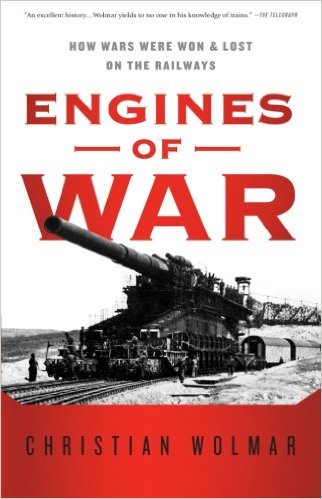
Engines of War

Engines of War: How Wars Were Won and Lost on the Railways
368 pages
© 2010 Christian Wolmar


An army marches on its stomach, but for a hundred years it rode to victory only on the rails.  It was Napoleon who observed the importance of supplies the military,  and well he should know, for the nigh-twenty years of wars he raged on the European continent were the last major conflict prior to the advent of rails. In Engines of War, veteran railway historian Christian Wolmar addresses how trains transformed war,  allowing for greater conflicts to be sustained over a wider front, and often serving as the locus of conflicts themselves.  Although the American Civil War and the Great War feature most prominently, Wolmar also dwells on the Boer and Russo-Japanese wars, and includes many minor episodes which are fascinating. Who knew, for instance, the role of railroads in the Arab revolt from Ottoman rule?

The most important aspect of the railroads to war, of course, is logistics -- the transport of men and material to the battle, including food, ammunition, and forage. Mankind has waged war against itself since human history began, but not until the industrial age did he do it on so terrible a scale. Wars between ancient empires -- the Roman and Carthaginian, for instance -- might last decades, but these lengthy conflicts did not tax their nations they way they do now for most of the 20th century.  Battles were comparatively much smaller, and more seasonal. Invading armies relied on raiding hostile territory to supply themselves, and as professional armies were rare, generally consisting of private subjects whose labor was needed back at home.  Rail lines made projecting and sustaining a force in the field far easier -- as they did early in Crimea, allowing Britain to sustain a siege halfway across the world.  Or, take Sherman's famed march to the sea, for instance, his bloody chevauchée from Atlanta to the southeast coast of Georgia. Despite a reputation for feeding his troops off the land, his initial push was fueled by a rail-fed stockpile.. The incorporation of railroads allowed for intense strategic planning: the Schlieffen Plan, Germany's strategy for a quick resolution to the Great War,  was essentially a train timetable. Despite how quickly trains could deliver men to the front, however, Wolmar maintains that the rails favored defensive warfare more than the offensive. Any advance made by an invading army would take them into territory with sabotaged infrastructure, often incompatible with the invaders' systems.

The rail lines could also be used as weapons themselves; carrying artillery or serving as mobile gunships. Armored cars first appeared in the Boer war, and were used to suppress insurrection in vital areas.  The importance of defending the rails, even with trains themselves, is made obvious by the Arab revolt from Ottoman rule. The Ottomans created a rail line stretching down the Arabian peninsula to allow pilgrims on the hajj to more easily reach Mecca, but during the revolt it was subjected to such chronic attack that  the troops which depended on it for supplies were forced to surrender.  Other methods of attacking rails were less successful:  airplane-born bombs, for instance, were rarely accurate enough to touch down on so narrow a line drawn on the landscape.  Even  when lines were rendered inert, every military of the period created divisions which specialized in rail repair.  Germany was especially diligent about maintaining large stockpiles of extra rail supplies, to allow for nigh-instantaneous repair. Only when its entire war effort was failing did the rail lines finally collapse.  In his other works, Wolmar analyzes the comparative advantages of government and private management of rail systems; here the insistence on efficiency takes on a more awkward tone when it results in more prolonged wars and the horror of the holocaust.

Despite their importance for nearly a century,   so linked to the projection of power that their construction could spark wars (as between Russia and Japan in 1905), even a rail enthusaist like Wolmar has to admit the age of the train is past, militarily speaking.  The nature of war itself has changed.. We are as unlikely to see massed armies butchering each other with Maxims and artillery as we are to see cavalrymen running about with sabers in the next war.  This is the age of cruise missiles, drones, and small groups of soldiers deployed in surgical strikes by helicopters.  Even in larger operations, troop transports that can transverse alien territory are more efficient than building even the light strategic rail of the Second World War.

Engines of War is an altogether fascinating book, revealing how  the vital necessity of rail lines during wars not only altered weapons and strategy, but changed both the role of the government and the behavior of the rail lines in peacetime.


Monday, March 31, 2014

An Ice Cream War

An Ice Cream War
© 1982 William Boyd
408 pages


Although most of the action of the Great War took place in Europe, it spread throughout the world wherever Europe's nations had allies or colonies. An Ice Cream War is a novel of the first world war set in southern Africa, with the battles between British and German colonial forces serving as background for all of the plot threads, and the active component of many. Its principle characters include an English farmer who is displaced and ruined by his German next-door neighbor, for whom the war becomes a personal vendetta, as well as two brothers who come of age as a result of the war and its human cost.  Its title not withstanding, An Ice Cream War is a tragedy with some comic elements.  Both the comedy and tragedy stem from the same root source, the vagaries of fate. Life is unpredictable enough without the chaos of war, but amid it the characters can only respond in absurd ways. The bewildered mirth is overrun by sorrow and horror later in the book, as it waxes depressing. An Ice Cream War can be considered an anti-war book, given that a main character is an ardent pacifist until he joins the Army to flee heartbreak, but only meets more sorrow as he realizes that the war is just a pointless and obscene in fact as he long held it in theory.  An Ice Cream War features an interesting and extravagantly detailed setting, but is definitely on the despairing side by the end.