Showing posts with label transportation. Show all posts

Thursday, March 21, 2019

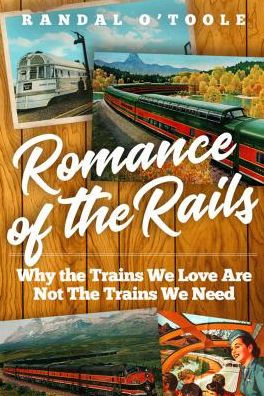
Romance of the Rails

Romance of the Rails: Why the Trains We Love Are Not the Transportation We Need
© 2018 Randal O'Toole
300 pages


"These are the 1930s again, with all the charm and romance, all the gaiety! That was a carefree world, Danny, and I'm gonna make it that way again!"
"You can't! It's nostalgic, it's nice, but it's not true, it's phony!"
"It doesn't have to be phony. If I wish hard enough, it doesn't have to be phony.."
(The Twilight Zone, S01E04. "The 16-Millimeter Shrine")


There was a time when America was knit together with ribbons of steel, linking not only metropolises, but bedroom suburbs.  That time was yesteryear, and it cannot come again – no matter how much we might wish it so. Romance of the Rails is written as a letter to a dying if beloved friend;  former rail advocate author Randal O’Toole reviews the history of passenger trains and their offspring, and scrutinizes the ongoing attempt to bring them back to life, comparing  transit and high-speed rail networks across the globe.  Just as railroads replaced demonstrably less effective modes of transportation,  so they have been replaced – and it is both wasteful and unjust, he argues, to continue propping up a dying industry to benefit a scarce few, in pursuit of recapturing America's boom years.  Although by the end few readers would remain willing to argue for rail transit on economic grounds, O’Toole only briefly touches on other veins of rail support.  

 O’Toole begins with a history of the rise of rail transportation in the United States,   exploring why trains were so successful and what they accomplished.  Trains and other contemporary technologies allowed for a novelty: the  nucleated city, with  superdense business district. Before the Victorian age,  cities consisted of a fairly even mix of residential, commercial, and other areas;    most people traveled on foot (horses and carriages being too expensive), but rails allowed cities to expand outward and upward simultaneously, giving those who could afford it the chance to escape the noise into streetcar suburbs, but also allowing more people ready access into the city. 

In the early 20th century, however,  that began to change – again, because of new technologies. Mass-produced automobiles meant that the same workers who couldn’t afford a carriage a century ago could now afford a different kind of carriage.   Buses, after internal combustion became much cheaper, suddenly emerged as such viable alternatives to trolleys that railroad magnates were investing in them.  The government, too,   was investing in the competition, helping at all levels – from widespread efforts to pave streets, to the federal project of a national highway system.  And then there were airplanes, far faster than trains and buses  and increasingly cheap.  

So it goes. Trains had been completely replaced by services which were cheaper,  which carried more people, which served  more sectors of  the  population, and which were far more nimble.  By every measure,  passenger rail should have been retired to the museums with a hearty “Well done, good and faithful servant”.   Instead, there are continued and expensive attempts to revive rail transit, both trolleys inside cities (which carry less people, at far greater cost,  and consume more space), and passenger rail between cities – either through Amtrak or new high-speed lines modeled on those which were a success in Japan.  Amtrak’s problems are so  severe that even a former creator of the company has written a book urging the public to let it die, and high speed rail is a boondoggle of such great expense that not even California could manage to do it to connect SF and LA.  The economics simply don’t work, O’Toole writes:  trains perform well in Europe and Japan because the populations are so dense and  car ownership so low; that latter is especially important, because it’s why Japanese bullet trains were a success and European ones drove Italy and Spain to the verge of fiscal ruin.  The only thing trolleys do better than at busses, O’Toole says with a bit of snark, is shifting public money from the public itself to the pockets of corporate engineers and lobbyists.  

As someone who has drunk deeply of train nostalgia, I found Romance of the Rails a daunting but sobering read.  I’ve read both histories of trains, and books advocating more mass transit in the form of trolleys, and Romance thoroughly challenges both.  Its amount of documentation is particularly enlightening, as we realize for the cities considered, the introduction of trolley lines to a city already covered by buses often caused a decrease, not an increase, in the amount of transit users. This problem is especially bad when trolleys are deliberately introduced to 'replace' a  bus line, and here O'Toole draws from Human Transit. The history itself was eye opening, as O’Toole argues that commuter trains and inter-city trains were never the transport of the common man, but remained a middle class or above experience.     

There’s part of the story that’s missing here, however,  in that one of the reasons people promote trolleys and such is that they’re more environmentally friendly – not polluting or emitting greenhouse gases.  O’Toole only addresses this lightly, arguing that there is no effective gain in passenger transit over cars, because  passenger trains only displace freight traffic which then has to travel by more polluting trucks. This area of the argument is never explored in full, which I think diminishes the book because it’s such a prominent part of rail advocacy. There's a lot to explore in that vein,  especially given that we can have electric buses which don't have any direct emissions. 

Ultimately, O’Toole believes that there is no evidence-based reason to support trolleys and passenger transit in the United States. Our efforts to do so, he suggests, are based more in nostalgia than the facts. His argument presenting the facts is most impressive, but without  addressing environmental concerns this book is not as excellent as it could have been. Even so,  it's  probably one of the better books on public policy which I’ve read,  and I wish were were more like this, which are written by someone who has changed his position over the years, and so can argue on facts rather than passion which is deaf to any opposition.  Transportation will change enormously in the coming decades, and cities which are serious about a productive transit system would do well to consider how sometimes the best-looking options can perform so poorly. 

And it's not as if cities can't enjoy the best of both worlds....

A bus designed to look like a trolley! (Montgomery, Al.)

Saturday, November 24, 2018

Short rounds and leftovers:

Hello, readers! Here's hoping those of you in the US had an enjoyable Thanksgiving on Thursday. I thoroughly enjoyed the company of my cousins, though I did rather poorly in our board game of choice.  I blame the dice.   Throughout the week I finished up a couple of titles and wanted to comment on them.


First up is The Cathedral and the Bazaar, which is less a book and more of a long essay on Linux, an open-source operating system -- and specifically, how Linux's bottom up, emergent order approach is much different from the controlling top-down approach of Microsoft and Apple.  I was interested because I recently used a boot disk with Ubuntu (a Linux variant)  to access a computer and extract files from it after it stopped booting Windows. I was pleasantly surprised by its intuitiveness, because I'd previously regarded Linux as something of interest chiefly to programmers and system administrators. Everything I had to do I managed through the graphical interface, just like Windows or Apple, and I made another boot disk with another Linux variant (Mint) to test next time.  An interesting quote from the book:

"The Linux world behaves in many respects like a free market or an ecology, a collection of selfish agents attempting to maximize utility which in the process produces a self-correcting spontaneous order more elaborate and efficient than any amount of central planning could have achieved. Here, then, is the place to seek the 'principle of understanding'.

The 'utility function' Linux hackers are maximizing is not classically economic, but is the intangible of their own ego satisfaction and reputation among other hackers. Voluntary cultures that work this way are not actually uncommon; one other in which I have long participated is science fiction fandom, which unlike hackerdom has long explicitly recognized [ego-boosting] as the basic drive behind volunteer activity."

Although a lot of the content of The Cathedral and the Bazaar is over my head (given my status as definitely-not-a-programmer),  I like the idea of the open source movement, and not just because it produces good programs that are free of cost, like VLC Media Player, LibreOffice, and the GNU Image Manipulation Program (GIMP), two of which I use.   Developers are becoming insanely clingy about controlling users, and about what they allow users to control; these days the proprietary software on computers isn't so much owned as rented.  And some of the software produced by these places isn't even that great: my favored music player, Winamp, makes it far more easy to build and edit playlists than iTunes or Groove, and it's been using the same simple approach for all the 15+ years I've been using it.  


Also up is Coffee to Go, a truck-driving...journal from a Scottish author who drove principally between the UK and western Europe. This book was recommended to me on the basis that he travels to Russia, but no such trip was recorded here, with the farthest reaches being Austria and northern Scandinavia. (There may be multiple editions?) Although I like trucking memoirs generally, this one was....well, less a memoir and more of a journal. Hobbs records every bit of his trip, from how much he paid for coffee to what he said to the fellows as customs, and I found it tedious. The last fifth of the book are recollections of his trips from before he started keeping a diary, and those are much more interesting to read because of all the play-by-play action is absent, replaced by a general narrative with thoughts on traveling to tiny places like Andorra. Easily the most interesting chapter were his memories of driving into Western Berlin during the Soviet era, when  the western side of the city was a pocket surrounded by the dismal DDR.  Hobbs seems like a nice guy, but this wasn't one I'll remember much about, I'm afraid.


Friday, March 23, 2018

Skygods: The Fall of Pan Am

Skygods: The Fall of Pan Am
© 2011 Robert Gandt
351 pages


How does a world-class airline fall so quickly from the heights that its pilots are accidentally locked in the building when it closes its doors for the last time, forced to jump from a fire-exit door onto shrubbery below?   The decline and crash of Pan-American Airlines wasn’t as abrupt as memory has it, as Skygods narrative history demonstrates, but a drift toward failure that was nearly corrected a time or two but never long enough.   Skygods' history of Pan-Am uses the stories of its captains, executive, and crew to make personal a proud airline’s fall from glory.

Pan-Am isn’t an airline I ever flew on,  closing as it did when I was six, but as a  brand name I heard about it often enough growing up -- and I witnessed the airline’s complete self-confidence in movies like 2001: A Space Odyssey.   That complete self-confidence was part of its early pilot culture,  when a airline created by a Navy buff adopted aspects of navy lingo and dress.  The planes were “Clippers”, and their crews wore smart uniforms, answering to their lord and commander in the air --  the Master of Ocean Flying Boats.  It wasn’t just a name:  Pan-Am specialized in overseas destinations, beginning with a Key West to Havana run, and to serve the undeveloped world by air, it used floatplanes or flying boats.  Pan-Am captains were alpha males later running jet engines, often wrong but never in doubt.    Juan Trippe, the effective creator of Pan-Am and its chief for decades, was certainly confident in his own vision and the airline. He  pushed commercial aviation into the jet age against its reservations, twisting elbows and manipulating one company against another, forcing them to do his bidding.  Trippe got what he wanted -- jet airlines that could go faster and over greater distances -- but  at a price. The brutal deal-making  clouded Pan-Am’s  reputation,  making it political enemies, and Trippe’s greatest dream, the 747, would bleed the rest of Pan-Am’s life.

Pan-Am had taken on enormous obligations in creating that fleet, but it had enormous assets, too: it wasn’t just an airline, it owned a pricey chain of hotels.   It was an international corporation with an antiquated culture, however; even in the sixties it operated like a small transport firm from the thirties, with such lax accounting measures that no one could tell what lines were profitable or not. When Trippe was dreaming of doubling his capacity with 747s,   flights to Europe on 727s (another Trippe coup) were flying half-empty.   And those “Skygods”, the captains who ruled their ships with an iron hand? They were getting old, with an easy arrogance made more volatile by forgetfulness.  In this period,  eleven new jets, their crews and passengers, were destroyed in spectacular crashes abroad.     Although Pan-Am would reform its approach to command and develop a stellar safety record,, it couldn’t win back political favor: its old monopoly on international routes was slowly pried away, while the old bar on domestic routes was retained.

Although Pan-Am’s profits dwindled into losses year after year, the  downward spiral seemed to be arrested by another CEO, who closed a lot of low-performing lines and put employees on furlough.  The airline began making money again, only to blow it all  in a bidding war  for a southern airline with domestic routes.  The integration of the two airlines was not handled well,  and from then on Pan-Am’s successive directors kept repeating the other’s mistakes:  they’d sell off a performing asset, use the money badly, and come out worse for the wear.    Pan-Am just couldn’t adapt to slug it out in the domestic markets,   and in gutting its international flights to finance the domestic fight, it essentially consumed itself to death.  Outside matters didn't help, from an oil crunch to an act of very public terrorism that saw Pan-Am Flight 103 smeared across the Scottish countyside. 

I don’t know that any extinct airline enjoys the reputation in death that Pan-Am does, receiving adulation in modern films like Catch Me if You Can and the series Pan-Am.  And then there’s the case of a man who spent hundreds of thousands of dollars to recreate a first-class cabin and lounge from a Pan-Am 747 in his garage, then expanded it in a separate building.   Those who remember it -- or those who are simply curious about it -- will find in Skygods an easy but sad  narrative of the airline’s return to Earth.

CBS apparently did a short clip on the anniversary of Pan-Am's closure:


Thursday, March 22, 2018

Door to Door

Door to Door: The Magnificent, Maddening, Mysterious World of Transportation
© 2016 Edward Humes
384 pages


Are you interested in the Port of Los Angeles? Do you hate cars and find hushed reports of every auto death in a single day great reading?  Do you long for the day when you can sit in your Google or Uber shuttle doing your sodoku while it toodles down the road?  Well, here's your book -- Door to Door, a book which describes itself as being about transportation but which is mostly about the aforementioned port, with a few other essays grafted on, vaguely united in their common theme of complaining about cars and aging infrastructure.  What is here is enjoyable to read,  at least for people like myself who find  transportation fascinating, but it's not a good book; the organization and few topics chosen make it seem more like a collection of essays written by someone chiefly interested in Los Angeles.  I've read Humes before, in his Garbology, and according to my notes it was likewise a grab-bag of topics.

In the age of globalization, logistics is a growth industry. Even if robots take the jobs of cabbies and long-haul truck drivers,  the demand for consumer goods is such that more ships and trucks will be required to carry them.  At the Port of Los Angeles, which handles a third of all goods consumed in the United States (from bananas to smartphones),  the managers there are finding themselves in the position of the New York harbormasters in the late fifties:  the ships arriving are too large to handle easily.  When containerization first arrived,  they required infrastructure at so  different a scale than the old break-bulk shpping that it was  easier for cities like New York  and  London to build new docks altogether. But now the container ships have outgrown the commercial docks built especially for them.

The roads, too, are problematic, overburdened by the fact that  everyone drives everywhere; even highways built to link ports and industrial sections are now co-opted for ordinary through traffic, and the sheer number of cars makes it difficult for transit options like buses to take off. Why would people ride the bus when cars so so much faster? Some cities are exploring ways to create better transit efficiency, like creating bus-only lanes; logistics chiefs like a UPS director interviewed here believe a similar approach for freight traffic  would help the gridlock.  Humes deplores the relative spending of China, Europe, and the United States on transportation:  the US simply isn't keeping up, he says, with a gas tax stuck in the nineties and zero mass infrastructure ideas in the works.  If we are stuck with car-centered infrastructure, says Hume, the best alternative may to work to replace the consumer fleets with self-driving cars -- but cars that don't allow humans to take over, because the cars will eventually be better drivers than humans ever can be. And if you doubt that humans are crappy drivers, he has an entire chapter called "Friday the 13th" that tells the story of seemingly every single person killed in the US by automobiles that day.  (Auto deaths by year are usually around 40,000 in the US, averaging out  to 110 people a day.  Guns got nothin' on the automobile.)

A book called Door to Door: The World of Transportation should cover much more than it did.  The two paragraphs above give it far more organization than it had itself, because it was mostly about the port -- with odd chapters like the logistics of soda cans thrown in. There are better books written about infrastructure (Infrastructure: A Field Guide) better books written about transit  options (Straphanger), better books on shipping, ((90% Of Everything), and so on.  Again, this is enjoyable enough to read, it''s just not a good as a book on transportation.


Wednesday, January 17, 2018

Fares Please!

Fares, Please! A Popular History of Trolleys, Horsecars, Streetcar,s, Buses, Elevateds, and Subways
© 1941, 1960 John Anderson Miller
204 pages


With her high starch collar and her high-topped shoes, 
and her hair piled high above her head
She went to find a jolly hour on the trolley and found my heart instead...
("The Trolley Song", written by Hugh Martin and Ralph Blane. I like Frank Sinatra's version.)

My word, what a charming little book this is. Just look at that cover!  When it was first published, the author could claim with confidence that Americans were the world's greatest users of public transit. A lot has changed in the eighty years since this history's first release, but what a history it covers!  Chiefly focused on the United States (but with healthy mentions of London, Paris, and various other systems across the globe),  Miller begins documenting transit services from the first horse-drawn municipal coaches, to the latest invention of the trolley-bus. His history includes a generous amount of photos, as well as illustrations of different mechanisms -- although it is as it describes itself, a popular history. The emphasis is on the general, how new ideas were put into practice in different cities, and received by the public.  Along the way, readers witness a number of inventions that failed, or ideas that were embraced and then rapidly abandoned.

The story begins in 19th century America,  at the very beginning when New York was swelling with immigrants and needed some practicable means of expansion. The answer came  in a kind of stage coach that ran only in the city, and as the idea of it became popular, specialized carriages were built for the idea. This kind of evolution happens a lot in Fares, Please: an old technology is tweaked a bit to a new purpose, and then later succeeded by something especially built for that purpose. As omnibuses developed their infrastructure -- becoming serious businesses that could afford greater investments -- they began running their carriages on rails instead of the open street.  "Horsecars" were the progenitors of the trolley, but it took time for animal power to yield to mechanical.  Eventually they had to because of urban expansion:  as lines' number and length multiplied, so too did the number of horses required. One New York company had to care for eight thousand horses at its greatest point prior to other means of carriage locomotion.

Eventually other means did take over: cable cars were experimented with, but were relatively expensive and lost ground to electricity after an initial burst of enthusiasm. Some manufacturers experimented with internal-combustion carriages, but electricity -- despite fears of public electrocution -- won out for sheer economy.  (The first internal combustion engines were not, shall we say, energy-efficient.)  As trolleys began taking over more and more of city streets -- say, four lanes of a six-lane road -- the residents of particularly crowded cities like New York toyed with the idea of running the trolleys either under the road or over it. Elevated lines were embraced as being easier than subways, but the public tired of having roaring machines overhead blocking out all the light.   Subways were thus developed in a few cities like New York whose density could afford the expense.

Ultimately, it was the rate of expansion that  prompted the original omnibuses to make a comeback:  simply put, they were quicker on their feet. Streetcar lines required a lot of capital investment  (rails, lines,  carriages, support vehicles, etc) and careful planning to expand into new area. Bus companies needed vehicles, a little adjustment to the planning, and they were in business.  Ironically,  streetcar companies were some of the first to adopt buses -- either as cheaper ways of providing the same service, or as cost-efficient ways to gather customers in outlying districts to one of the main streetcar lines.  Although buses and private automobiles had gained a lot of ground in recent years,  Miller remains sanguine about mass transit's hopes going into the 1940s, in part because of the sheer demands of space: one lane of streetcars can carry six times as many people as two lanes of cars, and cities simply don't have room for everyone to toodle about in a car.  Miller probably never imagined we'd tried to solve that problem by destroying the city -- knocking down building after building for parking lots, and then creating automobile-oriented sprawl and leave downtown to rot.  We seem to be moving back in the direction of sanity, dreams of computer-controlled instates full of driverless cars not withstanding.

If you can find a copy of this, it's a delightful little history. I've been trying to find something like it for years.  There is nothing quite like a streetcar to make me think of urban America in its adolescence, roaring with energy and changing every day.


Tuesday, November 7, 2017

Conquest of the Skies

Conquest of the Skies: A History of Commercial Aviation in America
© 1979 Carl Solberg
441 pages


If ever you wanted a history of commercial aviation in the United States, Conquest of the Skies is it. Beginning with the origins of flight and culminating in the 747, Conquest artfully combines business, social, and technical history. That distinguishes it from other books in this vein, like the tech-focused Turbulent Skies. Written for lay readers, Solberg brackets his history with reflections on how the romance of flight became – through persistent tinkering, reckless adventurism, war, and ambition– a perfectly ordinary form of transportation that shrunk the world, opening global vistas to the multitude.

In the beginning, there was the Post Office. Solberg’s first chapter, of course, is about the Wright brothers’ achievement and the rise of airplane manufacturing in the Great War. The story of commercial aviation picks up in earnest, however, after the war, when the US Postal Service began using the US Army airplanes created for the war to deliver mail. Delivering mail sounds tame and routine, but the early airmail service was anything but. These pilots were still flying by sight, looking for landmarks. In fog they were helpless; in turbulent weather, their canvas-and-wood frames were torn apart. (In 1934, a particularly bad winter caused nearly a crash a day.) Yet the Post Office saw the potential in this sort of delivery, and from this service grew the first commercial air companies. As infrastructure and technology for flying improved – as artificially –lighted “lanes” were created across countrysides, and the problem of aerial radio communication nailed down – a growing number of companies bid for airmail contracts and began creating their own fleets.

Modern readers may recognize the names of companies formed in those days: United and American Airlines are two survivors, and most adults can remember TWA and Pan-Am. Although the airmail contracts allowed for a commercial air company to get started, other opportunities for revenue – like passengers – were required for real expansion. In these days, a flight might carry only a handful of people. Even the larger planes of the pre-jet perio were carrying only 35 at most. In the 1920s, the appeal of air travel was largely in its novelty and speed. No one did it for comfort: in those days, passengers had to suck oxygen from tubes throughout the flight, and were constantly jostled amid turbulence. (The first stewardesses were required to have nurses’ licenses.) As the technology improved, however, the airlines strove to imitate the quality of service aboard Pullman coaches, with meals served on actual plates, and liquor on the house.

World War 2 propelled planes to greater heights, concentrating fifty years of advancement into five. The second world war was an air war, beginning with Stukas and ending with the Enola Gay. From the war came radar, legions of pilots, improved navigation, and steadily-improving aircraft design. More important, however, were the airstrips. In the 1920s, Pan-Am could only cover as much of Latin America as it did through flying boats – “clippers” in a more literal sense than its later landplanes with that name. Boats didn’t need airstrips, just a stable body of water and a dock. But the war had freckled the globe with airstrips, saw airlines other than Pan-Am work the overseas routes, and created interest in what lay beyond the Atlantic and Pacific coasts. When jets entered the picture and airlines began experimenting with an “air coach” model -- carrying a lot of lower fares instead of a few expensive ones -- air travel descended from the clouds of fancy into the real world, a miracle rendered mundane…like automobiles, electricity, radio, and trains before it.

Conquest of the Skies is outstanding popular history, uniting three areas of interest; the birth, growth, and evolution of various airline companies, including their involvement with the government; technical advancement; and the actual experience of flying, from the cramped quarters and head injuries of the 1920s to the cozy comforts of the fifties and sixties. I only wish it went beyond 1963, so Solberg could have documented the flight of the Concorde. While Solberg doesn’t footnote his text, the book concludes with an extensive bibliography.

Sunday, October 1, 2017

A Thousand Miles from Nowhere

A Thousand Miles from Nowhere
© 1995 Graham Coster
275 pages


Great literature has been produced from travelers' tales, from those who walked or rode trains or even drove -- but none from a truck, says Graham Coster. In the hopes of filling in a niche, he hitched rides with British and American truckers transversing North American and Europe, to learn about life behind the wheel of a big rig. The memoir is based on three trips undertaken in 1993, but as Coster was not himself a driver, there are only three things he writes about: the drivers, the landscape, and country music. (Also: candy bars. One wonders if Mars, Inc underwrote his trip!) The landscape is almost absent, mentioned only as the background scenery. In Arizona, Coster ruefully notes that his time spent with truckers has altered his perspective: he has visited the state before, noted its beauty, but once embedded in the work routines of a cab it's nothing more than a low hill with a series of truck stops behind it. The places, unless they are extraordinarily abominable (New York City, the bane of truckers) are all ironed out by the constant transience of driving life. The drivers themselves all make for fun company, swapping stories about experiences on the road and ruminating over friends they've lost. In the United States, Coster is more out of his element -- praising presidents who truckers loathe, making jokes about people they admire. Ruminations on music, and especially country music, rival the conversations with drivers for page-space. Coaster is intrigued that the drivers he meets in England and Germany both like American country music, and in the US, they seem to listen to nothing else. It's not an accident that the book takes its title from a Dwight Yoakam piece. Coster likes it well enough himself, though he prefers the country-pop party anthems to the emotional croonings of Hank Williams.

Although this is a topic that greatly interests me, I was completely underwhelmed by this title, in part because I've read other memoirs and encountered nothing new. Even if I were reading it for the first time, however, there's little real information about the trucking industry here: it's just driving and waiting. For information on Eurasia's transcontinental routes, Danger: Heavy Goods, a memoir about the England-Saudi Arabia route, is much better...and written by an actual driver.

Thursday, September 14, 2017

Infrastructure: A Field Guide

Infrastructure: A Field Guide to the Industrial Landscape
© 1999, 2014 Brian Hayes
544 pages


Here at last is a book for those of us who constantly gaze out the car window at the fixtures on utility poles, or drums mounted in the sky above the telephone building, and wonder: what are those and what do they do?  Chris Hayes offers in his introduction that there are many books for understanding the various kinds of trees and birds we see around us; his hope is to help readers understand the built environment which can be beautiful in own right. Hayes'  field guide is not a dry catalog of pipes and antennae, organized alphabetically. Instead, he offers a narrative laced with humor that explores the built world, system by system -- beginning with mining raw resources and ending with waste disposal.  In between are covered farming, waterworks, power production, the power grid, telecommunications, roads, bridges, railroads,  aviation, and shipping.  Hayes' writing combines history and description,  allowing the reader to understand not only how things work,  but how they got that way. Photographs abound, most of which were taken by the author himself and include unusual shots.

The fact that this book has gone through three editions indicates it has been a success with readers, and I'm not surprised.  We live in the midst of and are sustained by systems built with human hands, but which few understand. There's enormous appeal in opening the hood on modernity  and gaining even a little knowledge as to how it all works, especially when systems link together. Although this is a guide to the 'industrial landscape',  Hayes' writing brings a strong humanistic touch. The book is about the world humans have created for ourselves, for our needs;  reading the built landscape  is an act not just of technical analysis, but of human interest.   Admittedly,  there are topics in the book harder to appreciate; mining, for instance, usually happens far from where we live.  The majority of this book, however, is the stuff of everyday: traffic lights, radio towers,  food, and highways.  Although I've  done a good bit of reading on infrastructure, Hayes' book was full of interesting facts and stories. For instance,  in the early 1980s a network of eight radio towers were set up to aide in global navigation: one of the stations was maintained by the US Coast Guard in the middle of Nevada. The system only lasted ten years before being supplanted  totally by GPS.

I referred to Kate Asher's The Works as a dream of a book, and I can only repeat the statement here:  it's a gorgeous and helpful piece of work.

Hey, look, it's the Very Large Array!

Related:
The Works: Anatomy of a City, Kate Ascher
On the Grid: A Plot of Land, an Average Neighborhood, and the Systems That Make Our World Work, Scott Huler
Tubes: A Journey to the Center of the Internet, Andrew Blum
The Grid: A Journey to the Heart of Our Electrified World, Phillip Schewe
Divided Highways: Building the Interstates, Transforming American Life, Tom Lewis

Saturday, January 14, 2017

Mean Streets

Mean Streets: Confessions of a Nightime Taxi Driver
© 2002 Peter McSherry
256 pages


Mean Streets takes readers into the dark side of Canada, or at least the dark side of Toronto. Ever since the 1970s, Peter McSherry has been driving the night shift at various cab companies,  writing about the strange people and stories the night produces along the way. In this volume many columns he's submitted to taxi publications are collected and organized in particular categories --  his experiences with drug dealers, prostitutes, and criminals on the lam, for instance, or the shady practices of tax firms -- spanning his time driving. McSherry isn't simply witness to many of these stories, but an unwilling participant in them; he is often threatened or solicited, and in his younger days was known to give chase to people who tried to stiff him on the cab fare.  Being far removed from Canada, I tend to imagine it as a bland, safe sort of place, nice to visit but not that exciting. McSherry's account certainly presents a different picture! His Toronto is just as grimy and unruly as New York City. with affair after affair recorded here that are worthy of depiction on COPS.   I didn't realize Canada, or at least Toronto, had the sort of racial strife that still besets the United States, though its came from Britain's colonial heritage, rather like France's does today.  Driving a cab was an education for McSherry, too;  originally an idealist who went to school to teach children and believed the best in everyone,  his experiences being cheated by bosses, customers, and city officials alike definitely create a world weariness.  With that, though, comes a genial tolerance both of people's failings (including his own), though he's definitely no pushover.   He readily ignores teenagers, drunks, pushy pimps, and others on the street who bitter experience has taught him are more trouble as fares than they're worth -- and if push comes to shove, he's as ready with a right cross as he is with a kind word. (Melissa Plaut, in her Hack, also learned to discriminate against teenagers, though she felt bad about it.)

Those interested in learning about the business practices of cab companies won't find too much here beyond the 1970s,  but the memoir has the usual appeal to those who like "a day in the life"  tales or true crime stories.  I noticed that McSherry prefers to drive as an independent contractor, just like Melissa in Hack;  this allows himself and other drivers to work as much or as little as they choose to, depending on their circumstances.

McSherry is, at least of 2014, still writing about driving even as he hits 70.

Related:

Thursday, January 12, 2017

In the City of Bikes

In the City of Bikes: the Story of the Amsterdam Cyclist
© 2013 Pete Jordan
448 pages

"It is quite possible that all the bicycles in the world are not in Amsterdam, but you'll never be able to convince me."  American tourist, 1956

No sooner had Pete Jordan stepped foot outside the Amsterdam airport than did he nearly get run over by a rushing cyclist.  He met his near-miss with utter delight, for that was precisely why he was in Amsterdam. He'd come as a student to the Netherlands, to study urban design and the role of bikes in Dutch culture.   But the student would become something else, as In the City of Bikes documents his first decade as an Amsterdammer, a man whose career, family, and every joy were nurtured by the closely-knit buildings of this bike-and-canal city, where anything can be walked to but everyone rides bikes instead.  For a reader who sees in Amsterdam hope for humane urbanism,  Jordan's work is a delight through and through.

Why are the Dutch so crazy for bikes? It's not a question they'd ask themselves: in a city where over two-thirds of the people use bikes on a daily basis, the elegant little machines are nothing extraordinary. They don't require helmets, lycra, and a man-against-the-world attitude like cyclists in America bring to the saddle.  Cycles fill Amsterdam -- its streets, its sidewalks, its culture.  Early on, Jordan speculates on why the United States and the Netherlands developed so differently in terms of transportation;  he highlights the comparative availability of land, the scale of the American nation, and the abundance of domestic auto manufacturers as key reasons why the United States quickly embraced hordes of automobiles.   Cars only emerged as a serious rival to Dutch bikes in the 1960s, and just as they were provoking serious resistance  from student movements, the nations of OPEC thoughtfully banned oil exports to the Netherlands and bikes made an epic comeback. (This is, I submit, the greatest gift OPEC ever made to humankind.)

In the City of Bikes is essentially a personal approach to Amsterdam and its cycles that mixes in tales of Jordan's first decade of life in Amsterdam with a narrative history of the city and bicycling.  In the late 19th century, bicycling enjoyed intense support as a short-lived fad in places like the United States, but  the elegant machines had more staying power in a place like Europe with human-scale urbanism and close connections between worthwhile places to be. The Netherlands' flatness made it especially easy to cycle, so cyclists' numbers only grew and grew. The cyclists swarmed in such abundance that mayor after mayor despaired of their anarchism; even the Germans, after seizing the Netherlands, were frustrated.  Rule after rule the new overlords posted, and the Dutch ignored them. (Among the objects of Nazi irritation: Dutch cyclists not staying to the right, as well as holding hands and riding two to a bike.  Roads and bicycles are only for transportation, thank you, no joy allowed.) Only when the Nazis began methodically searching and seizing bicycles for use by their own troops did bicycles disappear --  broken down and squirreled away, or tossed into the canal just to spite the greycoats -- with the exception of those so badly maintained that even fleeing Nazi officers couldn't make use of them.

Cycling in Amsterdam is an utterly democratic mode of transportation: every class uses it regularly, and there's  no real relationship between the wealth of the cyclist and the value of the bike. Parliamentarians and bank executives pedaling to work in their $3000 suits often had the same beaten-up wheels as everyone else. This may owe to Amsterdam's intense amount of bike-thievery:   Jordan lost three bikes in his first two years there, and with theft that common there's no point in sinking money into a machine to begin it. (On that note, the black market in bikes is  amusingly perverted; when people have bikes stolen, they simply buy a stolen bike -- which is then stolen again. It's rather like a twisted kind of bike rental.)    Dutch cycling isn't limited to the young and intense: children grow up on bikes, and bike to school on their own accord. The elderly are mobile -- even pregnant women can cycle. Jordan's wife, for instance, transported herself to the hospital to have her baby, and when she left the place a mother, she returned home by bike.   During bicycling's first flare of popularity, Queen Wilhelmina was an ardent cyclist and remained so throughout her life, taking great pleasure in pedaling about incognito.

In the City of Bikes is not a guide to bicycling infrastructure. It's simply a story of humans living well --  Jordan, and the people of Amsterdam as a whole.  It is connected but free, rebellious but highly functional for human needs. If you like the city at its best, or like cycling, or simply have a care for human flourishing, this is a wonderful little book. I loved it before I bought it, I was thoroughly enblissed while reading it, and I already know it's one I will keep remembering with the thought: this is how life should be.


Sunday, December 4, 2016

Danger Heavy Goods

Danger Heavy Goods: Driving the Toughest, Most Dangerous Roads in the World
Also known as: Juggernaut: Trucking to Saudi Arabia
© 1988 Robert Hutchinson
288 pages

"Makes Smokey and the Bandit Look Like Smokey and the Boy Scouts"


When is a lorry not a lorry? When it's leaving the country, according to the British drivers here. A continental trip makes a lorry a bonafide truck, and the run covered here puts even American transcontinental trips to shame. In Danger: Heavy Goods,  Robert Author recalls a run from England to Saudi Arabia he participated in in the early 1980s, at a time when Arabian ports were so overcrowded that ships sat at sea for weeks waiting for their turn to unload.  He takes readers through a string of countries which no longer exist, across the Bosporus Bridge, and down to Ar'ar by way of  Iraq -- which is invading Iran. Well, golly.

Where to start with this book?  It is a snapshot of Europe in the early 1980s, where Yugoslavia, Czechoslovakia, and the DDR were still destinations and  Gorbachev is trying to reform the Soviet Union by banning alcohol. It is a road trip of epic proportions and epic aggravation. Time and again the drivers that Hutchinson partnered predict that the middle east run is doomed. The pre-EU customs inspections of Europe -- the frequent scrutiny of their records, the endless paperwork -- was bad enough, but the middle east is a bonafide nightmare. From Turkey to Saudi Arabia, every official from customs agents to parking attendants wants their cut,  a little bit to grease the palm The preferred bribe is cigarettes, and every country has its most-favored denomination: Turkey is Marlboro country,  Syria swears by Gitanes, and Rothmans rule in Saudi Arabia.   Bureaucratic delays are endless, some of them lasting as long as a week, and once the cigarettes are exhausted anything else is up for grabs. English newspapers, catalogs, canned food?  The amount of aggravation drivers throughout Eurasia receive at the hands of customs officials in Iraq and Saudi Arabia  amaze the author: it's like they don't want goods.

If one can get by the customs agents without being arrested for mysterious circumstances, there's still everything else to contend with. Take your pick -- roads that turn into bobsled runs as soon as they're wet,  or threaten to throw trucks into rig-destroying quagmire if they stray from the beaten path. And which is more dangerous, Turkish prostitutes or the fact that Iran and Iraq are bombing one another? Tough call.  There are plenty of surprises which far friendlier, though. Although drivers on the mid-east run are technically in competition with one another, there's a mild level of camaraderie in the face of a common enemy, customs. In one chapter, the British drivers warn a drunken Turk of a heavy police presence despite Turks being the main rival of British firms for transeuropean traffic. (They warn him in German, while in Czechoslovakia.  German is also used as a go-between language in Ar'ar,  Saudi Arabia.)

Danger is a most interesting 'memoir', delivered by a guide who has an honest interest in every country he visits, frequently regaling readers with historical background on the places he and his coworkers are passing through in their two trucks.  Virtually every aspect of the run has been overtaken by history, though. I haven't been able to find any stats on truck traffic to Saudi Arabia from western Europe, but with a few decades of oil money sunk into the ports I doubt it's as thick as it was when featured here

Related:
Truck this For a Living: Tales of a UK Lorry Driver, Gary Mottram

Thursday, November 24, 2016

The Works

The Works: Anatomy of a City
© 2005  Kate Ascher
240 pages


Cities are, for my money, mankind's most astonishing invention. Their complexity is stupefying -- system within system, handling tons of material at any given time, whether the subject is cars across a bridge or the contents of a thousand home's flushing toilets. And the stakes are always high, with the health and happiness of millions on the line -- or at least, thousands. The Works is a dream of a book, a visual-rich guide to the many systems that keep cities thriving.  Author Kate Ascher throws light not on just the expected -- roads and utilities, say -- but also minor things like the postal service.  Using New York City as case study, Ascher explores systems for transportation, energy, communication, and sanitation in turn.

The Works stunned me again and again with its visuals. Readers are treated to an astonishing array of informative little diagrams: cutaways that show what's inside the Holland tunnel, for instance, or the underbelly of a street-sweeper, or the waterworks inside your average skyscraper. The pictures also demonstrate systems -- the chain of equipment required to convey power from a generating station into the average home, the links involved in a cell phone conversation,  Some of the visuals are clever: for instance, to illustrate the variety of goods a train might carry,  a cartoon representation of a real train runs along the bottom of every page in the chapter, each car marked with its contents. The same tactic is used to illustrate the electromagnetic spectrum in the chapter on communication.  The bounty of visual information here is ludicrous -- showcasing fleets of sanitation vehicles and subway cars,  mapping out train yards and container ship docks, -- it's staggering, really.  Statistics are presented visually, too, and of course there are tons of maps -- including one that shows all the traffic cameras in the city. There are a few sample pages on Streetsblog, all from the chapter on streets.

That's not to say The Works is merely a picture book, because there's no small amount of text here explaining the importance of all these systems, reviewing their evolution within New York City, and sharing the particulars of their operation.  Reading this book is kind of like reading Gone Tomorrow, Picking Up, The Grid,  Flushed! On the Grid, etc, all at once, all rolled into one, and with gobs and gobs and gobs of illustration.   It does lack a chapter on  the infrastructure of the internet, which isn't an oversight that would be made if it were published today.


Wednesday, November 23, 2016

Truck This For A Living

Truck This for a Living: Tales of a UK Lorry Driver
© 2014  Gary Mottram
226 pages


After hand-manufacturing woodwind instruments for thirteen years, Gary Mottram was laid off. So naturally, he took up driving. Working through a temp agency, he delivered all manner of loads via vans and small trucks before trying for Class 2 and Class 1 licenses. Truck This for a Living  collects stories from his workdays as he took on ever-more ambitious jobs. Beginning as a lowly delivery man who has to schlep around boxes and do his own unloading, Mottram eventually hits the big-time: hauling containers and then cozying up with a DVD while other guys take over.  

While this is a self-published memoir, the writing is very serviceable and even includes little illustrations to convey the difficulties inherent in squeezing a trailer with a mind of its own into a tight spot.  Having grown up among drivers -- my father and uncle -- I'm fairly familiar with American trucking and was most curious about driving in the United Kingdom and Europe. As it happens, Mottram never quite makes it to Europe -- a buddy of his gets that gig --  but I still picked up a wealth of British trucking lingo. At first  I thought an "artic" might be a refrigerated trailer, but it proved to be short for 'articulated', or a tractor-trailer.   All of the vehicles Mottram mentions were cabovers, like that on the cover. That was a change, as the only time I ever see those on American roads are buses or Isuzu daycabs. Mottram is definitely unlike any truck driver I've met, constantly fretting about the environment and  holding fast to a vegetarian diet. He carries a little pot with him and cooks on the road! From the faint horror he had for most of his fellow drivers, I'm going to guess Mottram is atypical in the UK as well.  I'm waiting for a similar book in the post, memoirs from a driver who has worked in both Britain and across Europe. 

Related:


Tuesday, November 15, 2016

The Road Taken

The Road Taken: The History and Future of America's Infrastructure
336 pages
© 2016 Henry Petroski


What, exactly, is The Road Taken?   Its title declares it a history, which is mostly true. It does have a bounty of historic sketches on the creation of paved roads and interstates in the United States, along with material on the evolution of traffic lights, curbs, and sidewalks. But there are loving tributes to bridges in New York and San Francisco here, with much chatter about cantilever versus suspension. There's even a chapter or two with a focus on finance, which is quite brave indeed -- there's a reason Jim Kunstler titled his own chapter on property taxes in Home from Nowhere, "A Mercifully Brief Chapter On A Frightening, Tedious, But Important Subject". The ending chapter looks to the future of infrastructure, but with the exception of cement mixtures that heal themselves (cracks open and expose bacteria to water, bacteria produce limestone), that's really more about the future of cars than roads.   It's all interesting, but the further along the reader gets the more miscellaneous  it all seems. The author obviously believes that interstates and bridges are a good thing and produce jobs, but the book itself isn't an argument.  He doesn't try to make any connections between infrastructure and economic growth; the jobs mentioned are always in building interstates.

I'd say this is for people who want to read a chapter about the history of interstates instead of a whole book. It's right between the chapter on asphalt and the chapter on stop signs.

Related:
Fighting Traffic, Peter Norton;  Divided Highways, Tom Lewis


Sunday, November 6, 2016

Divided Highways

Divided Highways: Building the Interstate Highways, Transforming American Life
©  Tom Lewis 2007, 2013
416 pages


No engineering project in the United States is more impressive than the interstate system; dense with the connections of a street grid, it serves not blocks but an entire continent.  In Divided Highways,  Tom Lewis tells the story of that system's creation, inside a broader history of how motoring in general transformed American life.  Lewis principally concerns himself with the political rise of the highways, and the problems that followed once the ideal became a reality and people realized that reality comes with smells, noises, shadows, and bills.  Lewis connects the drama of the highways with ever-changing American society as a whole. though, integrating their story in which whatever else was happening (the oil crises of the 1970s, for instance) and commenting on the morphing nature of urbanism as downtowns bled out into the broad puddles of edge cities.  Though Lewis is enamored of the interstate, motoring, and the American dedication to constant motion, he doesn't shy away from giving critics a voice.

The story of the highways begins with the automobile, of course, since before then road building wasn't a priority: given the distances involved. water transportation dominated until the train made overland transit more competitive. The rising popularity of automobiles and bicycles -- an individualistic alternative to crowded trolleys and trains controlled by some of the more powerful corporations of the day-- led to a demand for places to  use them, and no road is worth much if it doesn't connect you to other  roads going other places. Enter Thomas Harris MacDonald,  an intensely thorough, dedicated,  and prudent fellow who would dominate the Bureau of Public Roads from the Wilson administration to that of Eisenhower's. MacDonald's prudence was such that he only built roads when they were deemed immediately necessary -- much different from today's build-it-and-they-will-come-and-pay-taxes attitude.  Although not aggressive,  his thoroughness did produce sketches of what a national highway system might look like, and how it might be ordered. Such a system was well underway when he died in retirement, his own fledging highways being supplanted by the limited access freeways that now create a massive asphalt circulatory system for the nation.

Building interstates involved a bit of juggling of responsibility between the state governments and D.C, and this became particularly thorny in regards to cities. The interstate system didn't just connect cities; from the beginning, many cut through cities themselves, becoming a kind of rapid transit system. When President Eisenhower became entangled in freeway construction enroute to Camp David, he made a few terse inquiries as to who was responsible for plowing this great road into the city, whereupon some Nathan-like figure informed him...Mr. President, thou art the man.  (Apparently, the interstate bill he signed was one of the 'we have to pass it to see what's in it' variety....) Running interstates through cities proved the source of most of the system's political problems, as the city spans became quickly congested, occupied large swathes of formerly tax-paying real estate, and functioned as a massive wall running through the cheapest real estate that could be found...that of the poor, who became poorer still when industry began following the interstate out of the city.  In New Orleans, the destruction of the French Quarter's charm by an interstate was narrowly avoided by citizen protests, and in our own time other cities (San Francisco, for instance) have gone to the mattresses to get rid of view-obstructing spurs.

As mentioned, Lewis also comments on the ongoing transformation of American society, the rise of franchise chain stores and the like. This was done with far more detail in Asphalt Nation, but presumably he wanted to write on something more than the exciting world of transportation finance. The connections made to broader US history -- the anti-interstate reaction concurring with the civil rights movement and youth rebellion --  not only make the history more 'personable', but provide welcome  context.  The subtitle of 'transforming American society' isn't a big component of the book, though, and he doesn't mention  influences of the freeway on other transportation infrastructure in general, like the worrisome tendency of larger roads to mimic interstates even though it's dangerous to encourage higher speeds in areas with pedestrians, buildings, and cross traffic.

Useful as a history of how the interstates happened, Divided Highways  deserves praise for hailing the interstate system  while simultaneously delivering the stories of people disrupted by it and rebelling against it.


"We could do anything, then, and do it to excess; our Interstates boldly proclaimed the triumph of engineering. Like our cars, whose fins could not be too high, they made a statement with adolescent vigor. We thought little of the Interstate's ability to rend the landscape, to divide communities, and to alienate citizens. The roads were a concrete snapshot of ourselves when we believed nothing was beyond our reach."


Related:


Sunday, September 18, 2016

Turbulent Skies

Turbulent Skies: The History of Commercial Aviation
© 1995 T. H. Heppenheimer
408 pages


What a century was the 20th, which turned everyday life into the stuff of yesteryear's science fiction. Who would believe at its dawning that one day people would travel the world primarily through the air, soaring through it in great machines made of iron?  Turbulent Skies is a history of commercial aviation in the United States, Great Britain, and (occasionally) Europe. Part of the Sloan Technology Series, it mixes business and social history with extensive commentary on aviation engineering.  Between the generous expanses devoted to airframe and compressor problems to the play-by-play of mergers and expansion plans, Turbulent Skies is a through bit of reference reading.   The author includes as many diagrams of jet engines as he does of the planes themselves, which I found curious.

Turbulent Skies largely focuses on the United States, with occasional chapters on Britain and a few mentions of French and German development.  The chapter on World War 2 features Germany heavily, but this is not a book of aerial strategy; instead, Heppenheimer records the respective powers'  pursuit of jet technology.  (Germany was able to produce the Me-262, a potential fighter that was thankfully squandered as a light bomber.  Considerable resources were diverted from planes to the V2 bombing programs,  again mercifully.)   What leaps out in Turbulent Skies is how utterly the creature of government air travel is. Unlike trains, which had their origin in commercial mining, the first air-commerce companies in the United States  balanced their budgets on mail contracts.  The world wars were likewise a boon to aviation, producing technologies like radar that were put to use in the consumer market. The amount of airplanes produced for military service and then dumped onto the consumer market likewise produced a multitude of small companies buying planes for pennies and trying to build regional empires.  The government  also bankrolled municipal airports and then forbade city governments from making a fuss about the noise. (Mind your business, peasants...)

With such support behind it, little wonder the airplanes had a quick triumph over their transport rivals, the train companies. (The quickness of aerial ascent is made obvious in the life of Juan Trippe: he created Pan-Am in the early days of aviation, and was still its lord and master when the 747 was created.) Of course, air travel had honest advantages -- speed and novelty.  Passenger ships also lost out to the planes, but the industry as a whole survived by shifting its focus to cruises. The seagoing experience, rather than being a comfortable means of transportation, became instead a vacation in itself: the ship was the party.  (Heppenheimer doesn't mention this, but trains tried doubling-down on luxury, too; unfortunately, toodling along at 30 mph speed limits inside cities isn't quite as relaxing as cruising the Caribbean.)     The happy days didn't last forever, though; in the 1970s, oil crises and recession saw some of the mainstays begin to flounder and perish.  The most notable death, prolonged until 1991, was Pan-Am. It  achieved early success by focusing on connecting the United States to the outside world, snagging a government-granted monopoly of the  Central-South American routes.   The recession and energy spike caught Pan-Am at just the wrong time, when it was borrowing billions to launch a vast period of expansion with 747s.  Perhaps it will be revived when we begin passenger service to the Moon.

Though informative, casual readers should be aware this is more about technology and business contracts than the social/human side of air transport.

Related:
Getting There: The Epic Battle Between Road and Rail, Stephen Goddard
The Great Railroad Revolution, Christian Wolmar

Tuesday, August 23, 2016

The Cargo Ship Diaries

The Cargo Ship Diaries: 44 months, 37 countries, 0 flights 
© 2014 Niall Doherty
133 pages


A few years ago while looking for information on minimalism, I encountered the YouTube presence of one Niall Doherty, an Irishman traveling the world, living and working out of a backpack. Doherty left a comfortable but unfulfilling life in the nine-to-five world to live an adventure, instead. His throwing of himself into the world wasn't merely physical, as he also used new environments to experiment with his life, to impose new challenges on himself.  This is where I encountered him, as every week he seemed to be in a different place, invariably a cafe or club surrounded by laughing people (often women), and posing serious questions to the viewer, like "What would it take for you to change your most fundamental beliefs?"   As it turns out, he was in the middle of a purposeful quest: to travel the world without flying.   In The Cargo Ship Diaries, aboard a commercial freighter traveling from Yokohama to Peru, he shares both his experiences aboard the ship, and reminiscences on his Eurasian journey.  The book ends with his arrival in the Americas, though an epilogue shares diary entries about his time in South America, New Orleans, and later the return to Ireland.

Although his first book, Disrupting the Rabblement, captured his philosophy of life much better, some of it still comes through in this travel diary. As mentioned, it's a two-part book;  the framing narrative tells about life aboard the cargo ship, where for a month he explored, danced, wrote, and studied.   The 'writing' bit is this actual book, recounting his time in Eurasia. Landing in Amsterdam, he bused, biked, and ferried his way across the continent. He was not a 'tourist', and preferred to spend most of his time trying to interact with locals.  Much of that, he admits, was 'chasing tail'; in Amsterdam he challenged himself to flirt with 100 girls in a week, and the book is filled with one-night liaisons and brief relationships. Only when he found a friend to join him did he go on touristy adventures like visiting the Taj Mahal.  (His adventures tended to not be the usual kind: once, for instance, he climbed an abandoned skyscraper. Although reading about his sex life grew tiresome quickly,  I am always astonished at the amount of human goodwill global travelers run into. Doherty entered Iran despite being warned his bank cards wouldn't work, and found himself with the local equivalent of $10 to his name. Yet, through goodwill, local connections, and the internet, he was able to make his way through and out of the country, departing it with fond memories for the Iranian people -- who, he says, live double lives, defying the outside authoritarianism within the privacy of their homes.

Although I was sorely tempted to skim through the many dating episodes, I find Doherty's willingness to throw himself into the unknown admirable -- and of course, as someone who has read books on commercial shipping, this account of life aboard a cargo ship had a distinct attraction for me.

Doherty maintained a web presence throughout his travels, and produced a video about life aboard the ship below.