Showing posts with label Turkey. Show all posts

Sunday, December 4, 2016

Danger Heavy Goods

Danger Heavy Goods: Driving the Toughest, Most Dangerous Roads in the World
Also known as: Juggernaut: Trucking to Saudi Arabia
© 1988 Robert Hutchinson
288 pages

"Makes Smokey and the Bandit Look Like Smokey and the Boy Scouts"


When is a lorry not a lorry? When it's leaving the country, according to the British drivers here. A continental trip makes a lorry a bonafide truck, and the run covered here puts even American transcontinental trips to shame. In Danger: Heavy Goods,  Robert Author recalls a run from England to Saudi Arabia he participated in in the early 1980s, at a time when Arabian ports were so overcrowded that ships sat at sea for weeks waiting for their turn to unload.  He takes readers through a string of countries which no longer exist, across the Bosporus Bridge, and down to Ar'ar by way of  Iraq -- which is invading Iran. Well, golly.

Where to start with this book?  It is a snapshot of Europe in the early 1980s, where Yugoslavia, Czechoslovakia, and the DDR were still destinations and  Gorbachev is trying to reform the Soviet Union by banning alcohol. It is a road trip of epic proportions and epic aggravation. Time and again the drivers that Hutchinson partnered predict that the middle east run is doomed. The pre-EU customs inspections of Europe -- the frequent scrutiny of their records, the endless paperwork -- was bad enough, but the middle east is a bonafide nightmare. From Turkey to Saudi Arabia, every official from customs agents to parking attendants wants their cut,  a little bit to grease the palm The preferred bribe is cigarettes, and every country has its most-favored denomination: Turkey is Marlboro country,  Syria swears by Gitanes, and Rothmans rule in Saudi Arabia.   Bureaucratic delays are endless, some of them lasting as long as a week, and once the cigarettes are exhausted anything else is up for grabs. English newspapers, catalogs, canned food?  The amount of aggravation drivers throughout Eurasia receive at the hands of customs officials in Iraq and Saudi Arabia  amaze the author: it's like they don't want goods.

If one can get by the customs agents without being arrested for mysterious circumstances, there's still everything else to contend with. Take your pick -- roads that turn into bobsled runs as soon as they're wet,  or threaten to throw trucks into rig-destroying quagmire if they stray from the beaten path. And which is more dangerous, Turkish prostitutes or the fact that Iran and Iraq are bombing one another? Tough call.  There are plenty of surprises which far friendlier, though. Although drivers on the mid-east run are technically in competition with one another, there's a mild level of camaraderie in the face of a common enemy, customs. In one chapter, the British drivers warn a drunken Turk of a heavy police presence despite Turks being the main rival of British firms for transeuropean traffic. (They warn him in German, while in Czechoslovakia.  German is also used as a go-between language in Ar'ar,  Saudi Arabia.)

Danger is a most interesting 'memoir', delivered by a guide who has an honest interest in every country he visits, frequently regaling readers with historical background on the places he and his coworkers are passing through in their two trucks.  Virtually every aspect of the run has been overtaken by history, though. I haven't been able to find any stats on truck traffic to Saudi Arabia from western Europe, but with a few decades of oil money sunk into the ports I doubt it's as thick as it was when featured here

Related:
Truck this For a Living: Tales of a UK Lorry Driver, Gary Mottram

Saturday, July 16, 2016

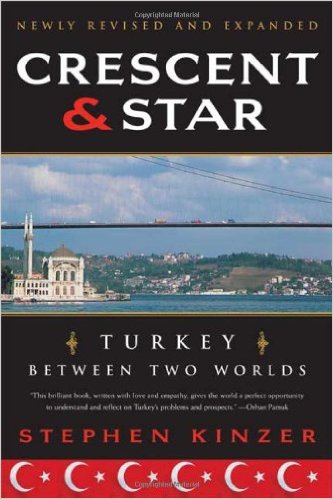
Crescent and Star

Crescent and Star: Turkey Between Two Worlds
© 2001 Stephen Kinzer
288 pages


Turkey is an anomaly. For centuries, it was the dreaded foe of Christendom, twice pushing at the very gates of Vienna. After the Great War, when the victorious west disassembled the Ottoman Empire and reduced the Turks to mere Antaolia, it seemed a total defeat -- but shortly thereafter, a rare Turkish hero of the Great War led a revolution and established a new Turkish Republic, one that -- phoenix like -- drove away its exhausted enemies and even reclaimed a foothold into Europe. It was to Europe that the new  lord looked: not as an object of conquest, but an object of emulation. Like Peter the Great,  Mustafa Kemal would make his life's ambition to modernize and westernize the Turks  whether they wanted it or not.  Using the military to carry forth his will, he declared war on the past: out with fezzes and  zithers, in with fedoras and Bach!  While the other mideastern countries that emerged from the Ottoman disintegration  drifted into tyranny -- religious in Afghanistan, secular in Iraq, both in Iran --  Turkey remained anomalous, discretely controlled by a military that had enforced liberalization, and counted itself the enemy of Taliban-style religious rule, but itself imposed limits on democracy and speech.  But the forced liberalization of Turkey at the hands of an illiberal power, the military state, has long since showed its age. Turks today want more from their 'devlet', their state, than being patronized; they want genuine democracy, genuine freedom to talk about issues the military order would rather have stay buried.

Crescent and Star  is the product of one man falling in love with Turkey while living there for years for the New York Times;  It combines vignettes about life in Turkey with historical-political reporting, both heavily steeped in obvious affection for Turkey as a whole.  It us romantic and at times naive -- Kinzer bubbles that  Turkey could be a world power and admits that portraits of Kemal hang in his office, as they do around Turkey --  but to the total outsider like myself, informative.  Kinzer's passion for Kemalism is never hidden: he wants Turkey to become not merely a member of the European Union, but a genuine European power. Again and again he asserts the cultural bonds that link Turkey and eastern Europe. Greece and Turkey are divided by political bickering over Aegean islands more than anything else, and towards the end he presents a heartwarming account of trans-Aegean brotherhood in the wake of a series of earthquakes. As one earthquake near Istanbul shattered belief in the devlet's competency and humanitarian interests, it also shattered belief in malevolent Greeks:  the Greeks were first to come with aide, and when Greece had its own earthquake days later, the Turks responded to that charity in kind -- charity in the truest sense of the word, caritas, love in action.  For Turkey to fulfill its destiny, Kinzer writes, the military must acknowledge that its paternalism has kept Turkish domestic politics immature.  Its protective intervention in the past, removing incompetent officials whose blundering were pushing the country toward civil war,  have served their purpose: for Turks to become truly European,  they must be set free to create their own destinies.

Crescent and Star brims over with human interest,  created by personal research. Kinzer lived in Turkey for at least four years during his tenure as bureau chief for the New York Times, and he cultivated a variety of friendships, even hosting a blues radio show in Istanbul.  He interviewed Turks and Kurds extensively, and his obvious love for Turkey is not in the least dampened by the stories of Armenians and Kurds who have suffered at the hand of the state.  The Turks have his affection, not  the Turkish government.  While the book's optimism -- stemming from a quiet Kurdish front and ongoing negotiations with the EU -- now dates it,  given how the chaos in Iraq and Syria has turned Turkey's borders into a war zone,  Kinzer's account nontheless illustrates how Turkey's history has given it a pecuilar stamp, a place able to bridge Europe and the middle east not only geographically.  Turkey's close involvement with the Syrian war, its frequent brushes with the Russians and Irans, make it a country worth knowing about. Considering that a faction within the military attempted to assert itself politically once again, there's no denying this kind of book's relevance.


Saturday, February 13, 2016

Lost to the West

Lost to the West: The Forgotten Byzantine Empire that Rescued Western Civilization
© 2009 Lars Brownsworth
329 pages


The Roman empire not not fade quietly into history in 474, when a Gothic warlord decided to run the city of Rome directly instead through a faux-imperial proxy. It went out in a blaze of glory, in an epic battle in which an Emperor himself stood in the line and bid a massing enemy to do its worst.  For Rome continued long after the Empire faded from Italy, and it not only prevailed but flourished against a host of enemies until finally falling a millennium later.  Lost to the West is highly storied introduction to the eastern Roman empire, one that reduces eleven hundred years of war, politics, and religion to three hundred pages. I learned of this book through the author's podcast, "Twelve Byzantine Rulers", and Lost to the West improves on it. Instead of having twelve distinct episodes, Brownsworth moves smoothly through an entire epoch, lingering on leaders and events which were especially impactful. It's essentially a shorter Short History of Byzantium,  even more storied.

For those completely in the dark, the 'eastern' Roman story begins in the third century A.D., when the Emperor Diocletian decided that an empire that wrapped around the entire Mediterranean was more trouble than it was worth, and divided it into administrative halves. His intentions were good, but the move didn't save Rome from the curse of dynastic wars, and when Constantine the Great seized total command, he transformed the entire Empire. Not only did he established a new capital in the east (Constantinople), the better to focus on the realm's Persian foes, but he began the process that turned classical Rome into Christian Rome. His unity didn't hold for long;  distracted by the constant problems of the Balkans and Persia, the Emperor was unable to come to the rescue of the badly-led western realm. Weakened by its own civil wars, the west fell easy prey to rampaging barbarians.  Constantinople would reclaim bits of Italy later on, only to lose them again as the centuries passed, but the heart of the Empire, the heart of western civilization, was fixed in the east.  In comparison, old Italy was a dump, and Europe little more than a wilderness with a few wooden forts occupied by belching brutes.

Religious unity took longer to destroy.  The Bishop of Rome held an esteemed place in Christendom, being one of the five great metropolitans of the Empire with Jerusalem, Antioch, Alexandria, and Constantinople. After the first three fell to the Arabs, however,  Rome and Constantinople were a rivalry of two. While their respective Latin and Greek cultures were different, eventually it was politics that sundered Christendom. The iconoclastic epidemic, for instance, saw the eastern emperor attempting to order Christians throughout the empire to destroy their religious art, either by breaking it or whitewashing murals.  This originated in the emperor's belief that the Empire had become idolatrous, and was being punished by God. To regain divine favor,   Christians should purge themselves of representational art in the manner of the triumphant Muslims and in the ancestral way of the Jews.   The eastern church was coerced into going along with the emperor, but the Roman bishop was incensed that a secular figure would dictate doctrine to the church -- and order the destruction of soul-edifying art, to boot!  So began a merry round of excommunication and growing hostility between east and west, politically and religiously, that was made permanent when a western army sacked Constantinople on its way to redeem Jerusalem yet again.  That tragedy, the Fourth Crusade, came after the 'official' schism, but the eastern Romans suffered so at the hands of the west that they would never submit to the Roman papacy. "Better the Turk's turban," they snarled, "than Rome's miter."

Lost to the West is a story of long, gradual decline, occasionally arrested by great leaders like Justinian, and occasionally hasted by abysmal ones and the plague.  The sporadic maps tell the story; from an empire that appeared to be united Rome at its height, the east declined under constant outside attack and civil war to controlling the  city of Constantinople, a bit of Greece, and bits and pieces of Asia Minor's shoreline. Constantinople would beat foes again and again, but so long lived was it that it would have to face them as they revived, zombie-like.  Eventually woe came from the east: despite surviving the Persians, Arabs, Mongols, and Seljuk Turks,  the Ottoman Turks were able to wear down the great walls of the city with cannon and seize a prize lusted after for centuries by the Islamic world.  New Rome went down fighting, however, achieving an end far more glorious than both  western Rome and the Ottoman Empire which succeeded it.

This is a fast run through a millennium, and for me it was mostly review. I enjoyed Brownsworth's voice, though his title is curiously chosen. He hints at the topic from time to time; in both the defense of Europe against eastern armies and  Constantinople's preservation and increase of knowledge lost to the west during its brooding Gothic phase, but never devotes a lot of attention to a thesis that Byzantium 'saved' the east.  Influence is  covered a little more in books like Sailing from Byzantium, though.


Related:

Tuesday, January 12, 2016

Destiny, Disrupted

Destiny, Disruted: A History of the World Through Islamic Eyes
© 2009 Tamim Ansary
416 pages


When Tamim Ansary was a boy, he loved history. Specifically, he loved narrative history, the kind of drama that brought the past to life.  The problem was that the only histories he could find written in  this style in Afghanistan were written by Europeans, and as such were expressly about European history.  Being unable to find a narrative history about his own people, he decided to grow up and write one. Destiny, Disrupted is a sweeping survey of the middle east, telling the story of Islamic civilization from its own point of view. It is cavalier history, galloping through the centuries and shooting from the hip. Yet for all its breeziness, Ansary offers more insight than idle jollies. Here is the story of what became of Egypt, Babylon, and Persia, of a civilization that brought them together, shone brilliantly for a few centuries, and then fell away. But the past is never dead, as the present turmoil in Syria and Iraq makes all too plain.
The story begins, of course, in the fertile crescent, with city states that become empires. We in the west know of Egypt, Babylon, and Persia because of their connection to our own story, always included as a necessary prelude in any western civ text.  But as the western narrative moves from Greece to Rome, then Europe as a whole, the world of the middle east continued to grow in its own right.  Persia was the greatest power it ever produced, warring – in different iterations – with both Alexander and Rome. For all of its glory, however, Persia was only an antecedent to the state created by Muhammad and his successors.

The beginnings of Islamic civilization – Muhammad and the succeeding caliphs Abu Bakr, Omar, Othman, and Ali – receives outsized attention not only because they were the creators, but because so much of what followed continues to look back on them. Key to Ansary’s account is that Islamic was not merely a religion, but a transformative political community that overcame not only Arab tribal differences, but racial quarrels as the expanding Muslim state captured vast portions of the multiethnic Byzantine and Persian empires. This age was to Muslims what Rome was to the west – and even more so, because it combined the moral and spiritual force of religion with the establishment of law and economic success: imagine if classical Rome and Christian Rome’s golden ages had happened at the same time,  a sudden eruption of law and charity around the Med, and that the only emperors were the Five Good Ones, started off by a figure like King Arthur or the biblical David. This was the weight the founding era held for Muslims, and which has since pressed Muslims on, looking for the restoration and aggrandizement of what once was.  There is no singular school of thoughts on how to restore it;  it has been attempted through feats of arms, like the Turks; through religious martialism, like the Taliban, or through politics, led by both strongmen and populist revolts. As conservative politics look to the golden past, and progressives look to building a golden future, Islam can encompass most visions simultaneously. 
The problem with golden ages and transcendent spells is that they always wear away. After  the assassination of Ali, things went downhill. Islam would fracture into two, then three, then a multitude of polities.  Near the turn of the first millennium,  there were three ‘caliphates’;   successors-by-assassination Abbasid, the lone-survivors of the old  Umayyad’s in Spain, and the Shi’a Fatimids in Tunisia.   Against this disunity came Frankish barbarians from the west and Mongolian barbarians from the east; the capital of golden-age Islam would be utterly ruined, millions killed, and Islam reduced to a sideline player in someone else’s story.  Even later military triumphs at the hands of the Turks, who rebuilt and advanced much of the original empire, even invading Austria, could not bring back the golden age.  The twentieth century is wrought with Islamic nations' attempts to find their way again after being dominated by the industrialized west, and Ansary's count covers revolutions in Turkey, Iran, and Egypt, along with the rise of militias and terrorist organizations in Afghanistan and Palestine.

What Ansary has achieved here is a captivating story of an empire rising in glory, stagnating, falling apart, and then struggling to find itself again. The last few chapters are on various Islamic peoples' attempts to come to grips with modernity -- needing it to catch up to the west, but disagreeing on which aspects to incorporate -- and display the kind of thoughtfulness that makes this work more valuable than just a historical survey. This is on display earlier, too, especially when writing on the role of Shi'ism, starting first as politics, taking on theological importance, and then molding Persian politics.  One section, a European recap prior to beginning the industrialized portion of the book, does give me pause.  He writes, for instance, that the Vikings took over England and thereafter became known as Normans.  Technically the Normans did descend from Vikings, but they settled in France over a hundred years before their progeny ever  entered England.   In another instance, he attributes the split between Catholicism and Orthodoxy to being solely the result of Diocletian splitting the empire, and later describes Christianity as being essentially about the individual. Perhaps he's thinking of Objectivism, but I am tolerably sure Christianity involves a deity,

Aside from the chapter on Europe,  Destiny is a wonderful piece of narrative history, informative and funny. Ansary sometimes sounds as if he is writing for cowboys, what with referring to people as "folks" and to disturbances as "ruckuses".  It has an odd humor about it, like when he refers to the Mongolian treatment of a ruling family: they didn't want to shed royal blood, he writes, it wasn't their way.  They wrapped the royals in curtains and them kicked them to death, instead.  Moral crisis solved!  

Although this slightly predates the Arabic spring and the rise of ISIS, both only affirm this book's relevance. For an insight into the middle east, it seems an unmatched introduction.

Related:


Monday, November 24, 2014

Gallipoli

Gallipoli
© 1956 Alan Moorehead
416 pages


 As the Great War ensnared powers beyond Middle Europe, it became  in truth a world war,  providing the spark to reignite old tensions in places like the middle east.  In late 1914,  the nations of the Black Sea became party to the conflict, and Turk railed against Russian and Bulgar as in conflicts of yore.  After months of bloody stagnation in Europe,  certain persons in Britain had an idea for altering the dynamics of the war;  invade Turkey, the sick man of Europe,  and encourage the Balkan Powers to rise against it. Not only would that force Turkey to release its pressure on Russia – allowing the tsar to concentrate fully on Germany and Austria – but it would put a handful of allied powers right behind in Austria’s backyard if the Balkans joined in.  The Central Powers would be well and truly surrounded.  The invasion would be so easy – use modern ships to blast a way through the narrow channel leading to Constantinople, using landings to help secure the forts if need be, and stand by and smile as the Turks fled before the might of modern military prowess. By awful luck, problems in command, and the feistiness of the Turks, however,  Gallipoli became a year-long tragedy,  a distraction from the west that never realized its promise.

Alan Moorehead’s Gallipoli covers the campaign from its planning through its execution to the end, when the greatest victory of the episode was realized in a bloodless retreat.  Addressing both the naval campaign and the months of trench warfare, and considering both the Turkish and Allied sizes,  Gallipoli impresses with its thoroughness and easy reading despite the grim nature of the work.  He covers the larger maneuvers in full, but during the months of gruesome gridlock breaks way to address the political ramifications of Gallipoli’s floundering, both on the Turkish and Allied sides. The book contains some of the best maps I've seen in a text of this kind, including three-dimensional renderings of the hills that deliver the difficulty of fighting in this terrain much more than a simple topographical map could have.  Gallipoli seems nothing if the difficulties of WW1 warfare concentrated into the narrow stretch of the Hellespont. In some areas of the ANZAC front, the opposing trenches were scarcely ten yards apart from one another, or within a grenade's -- or a tin of jam's - throw. In such confined quarters,  the two sides could not help but realize one another's essential humanity, and this is often a tale of well-meaning men making awful mistakes against one another. Moorehead's Gallipoli is what Churchill's campaign was not: most effective.


Friday, November 7, 2014

A Short History of Byzantium

A Short History of Byzantium, John Julius Norwich
© 1997 John Julius Norwich
431 pages


            Rome fell in a.d. 474? Tell that to the Byzantines, who for centuries persisted in being an afterimage of the classical world, evolving through the medieval before their collapse a century after the west had fallen to barbarism. A Short History of Byzantium takes in over a thousand years of history, from Diocletian’s administrative division of the Roman Empire into two halves to the fall of the great city Constantinople to the Turks.  There is great difficulty in a hurried survey like this,  subjecting the reader to a tide of dates and names, but John Julius Norwich is a storyteller; under his pen, some  events, and some people,  are so outstanding that they serve as landmarks for the rest.

            A Short History of Byzantium begins with a story more familiar, for the first chapters are a history of the Roman Empire as the west remembers it: Roman. Constantine the Great moved the center of the Roman Empire to  the  east, founding a new Rome on the site of an old trading-city, Byzantium,  a city that would later assume his name: Constantinople.  The move created a fresh start, but allowed the Emperor to focus on the nation’s rising threats:  powers to the east, especially the Parthians. Rome vs. Persia; it’s a battle between titans of the classical era.  The book’s scope is such, though, that the classical gives way to a world at its conclusion which is more like ours; we see here the birth of the Holy Roman Empire,  the rise of Islam, the explosive expansion of the Ottoman Turks.  Throughout all this tumultuous change was the Empire,  warring against and making common cause with these changing powers through the ages.  Byzantium was also witness and party to Christianity’s evolution.  The effective founder of the Byzantine heritage, Constantine, was the man who legitimized Christianity within the Empire as a whole, and put it on the path to becoming the binding religion of the west as a whole. But that binding could not quite stand the stressors of the ages, the gulf of cultural differences between Rome proper and the east, and Christianity once unified eventually severed into two halves, Roman Catholicism and Eastern Orthodoxy. But the cut was never a clean one; instead, there were tiny fractures that opened and closed through the centuries, forever dynamic but trending in the end toward rupture.  


            The empire itself is the subject of considerable interest, somehow holding on through the centuries despite the staggering variety of challenges it faced. It defended itself from one invasion after another, from Bulgars, Goths, Vikings, and later on Arabs and Turks, and relied on the oddest allies. In resisting the Norman attack on southern Italy, for instance, it employed disgruntled Anglo-Saxons who had left England in disgusted after  the Normans conquered it. A nation surviving a thousand years of history must have some institutional stability, but it is hard to see after this survey;  only 88 people held the throne in that span,  but they seem to go with great haste,  and often bloodily. At times even western Rome appears sane by comparison, though that’s excepting monsters like Caligula and Nero. Not that Byzantium is without its characters, listing as emperor men like “Michael the Sot”.  There are utter boors and monks, noble heroes and complete, degenerate cowards.   There are women, too, some who reign through their husbands, and some who reign in their own right.  They make for a colorful cast, and though I knew the general trend of the story (an image of the Turks besieging Constantinople has haunted my mind since seeing it in grade school), the turns it took were surprising indeed. The empire rose and fell through the centuries, contending against all manner of adversaries, but the fatal dagger came at the hands of those who ought to have been its defenders; the Crusaders, who in the Fourth Crusade, sacked the city. Even the fluke victory the Turks inflicted on it years prior did not break the empire so badly as that sacking. 

    This was in short quite a treat, exposing me to a world of information previously hidden away, but of utter interest. From the word go, Byzantine history was wrapped up in the west; how its memory became lost is a puzzle, considering how important western powers viewed it almost until the last, straining to wed into its line to unite the  German 'Roman' empire and the empire of Old.  Entertaining in many respects, it also delivers a history of Europe from another aspect, and is quite commendable.

Related: