Showing posts with label memoir. Show all posts

Monday, March 11, 2019

A Forest in the Clouds

A Forest in the Clouds
© 2018 John Fowler
336 pages


John Fowler’s A Forest in the Clouds is his account of studying gorillas alongside famous naturalist Dian Fossey.   Although I picked it up for the gorillas (as one would), the memoir is overwhelmed by Fossey, who by Fowler’s account was an astonishingly eccentric and belligerent woman who viewed the science lab as a necessary evil to allow her to live on the mountain near the wildlife she loved.  Fowler presents Fossey as a  mercurial  control freak who regarded any gathering of students as a potential mutiny and waged a private war against local poachers.  Fowler contends that Fossey had little use for most people, especially the locals who she constantly verbally abused (employing both sounds imitating the gorillas and a polyglot mishmash of profanities to do so), and the amount of time readers spend in this unpleasant company does not make for an enjoyable  book. The narrative is easy to read, but the poor gorillas are nearly relegated to the background;  Fowler writes about what they’re doing often enough, but there’s little to learn about them here, besides the fact that their noses can be used like fingerprints, and they have no qualms about peeing all over a human they’re affectionately holding on to.  I’ve never read anything else about Fossey, so I don’t know if Fowler’s memory is perfect or exaggerating Fosser any. I’ll say this, though: my attempt to find background info on the African setting let me to this stunning photo.

Friday, February 22, 2019

Rebel Without a Green Card

Americanized: Rebel Without a Green Card
288 pages
© 2018 Ssara Saedi


Sara Saedi and her older sister Samira were both born in Iran, but following the revolution their parents fled to America by way of Italy.  Although Sara had virtually no memory of her home country, she was marked by it, growing up as an undocumented resident when her family visa lapsed and the green card applications were endlessly delayed. In Americanized, Saedi offers a memoir of her coming of age,  most of which is humorous takes on the indignities of youth: fighting with older relatives, stressing out over acne and puberty, worrying about boys, etc.  Occasionally, however, the memoir grows more serious when her parents' on-going attempt to move forward with permanent legal residency and citizenship is stalled again and again.   The memoir is obviously political in its intent, as Saedi  frequently frets over residential attitudes regarding illegal immigration,  so Rebel can be read as an attempt to put a human face on an abstract policy. Her family would certainly be poster children for more inclusive immigration policies (being good, passionate people who want nothing more than the freedom to live their lives and pursue their dreams, etc),  but the Saeds are only one family, and not necessarily representative. Immigration offices can be painfully difficult to navigate, however, and needlessly burdensome: as a public librarian, I've personally witnessed struggles by my city's Yemeni and Bangladeshi immigration population to make any any progress with naturalization,  with form after form being rejected because a jot was a little too tiddlish -- there being specific requirements for only using capital letters, for instance. I've no doubt it could be made far more humane.

As a book, Americanized has some interest -- but honestly, it's more of a teen-girl-in-the-90s memoir than a serious discussion about immigration.  Firoozeh Dumas'  Funny in Farsi offers a much fuller idea of the immigrant experience, partially because Firoozeh remembered more of her childhood in Iran. 

Wednesday, January 30, 2019

Odd Egg Editor

Odd-Egg Editor
© 1990 Kathryn Tucker Windham
170 pages


Anyone who grew up in Selma, Alabama, prior to 2011 had heard of Kathryn Tucker Windham, and odds were they cherished her.  A master storyteller, she inspired an annual Tale-Tellin' Festival that survives today.  Odd-Egg Editor is a brief memoir of her newspaper days, before she became a local legend.  Beginning with the Montgomery Advertiser in the 1940s,  covering the police beat,  Tucker expanded her career to land a position in Birmingham and later settled in her hometown of Selma just as the civil rights movement was warming up in the 1960s.   This memoir has a lot of little stories, with colorful characters -- a playful judge who once busied himself creating spitballs during testimony,  an inveterate escapee named Billie Jean who counted herself a friend of the cops and her regular judge-- as well as a few sadder stories.  The title of the book comes from Tucker being assigned all the odd stories at the Montgomery Advertiser, and is itself a colorful collection. One could easily read it as two decades of journalism from  mid-20th century Alabama , but I was drawn to it for the author's voice. Although she was too advanced in age to do a lot of storytelling during my youth, I heard her a time or two at Cahaba Day festivals. Even in her last years she was a volunteer at the Selma-Dallas County Library,  firmly ensconced in the town she loved and which loved her back.  I enjoyed this account of her getting started -- of overcoming prejudice against her as a young woman invading male spaces like  the cop beat and the governor's hunting camp -- very well.


Kathryn Tucker Windham, from the second-floor balcony of the Selma-Dallas County Library

Related:

Saturday, November 24, 2018

Short rounds and leftovers:

Hello, readers! Here's hoping those of you in the US had an enjoyable Thanksgiving on Thursday. I thoroughly enjoyed the company of my cousins, though I did rather poorly in our board game of choice.  I blame the dice.   Throughout the week I finished up a couple of titles and wanted to comment on them.


First up is The Cathedral and the Bazaar, which is less a book and more of a long essay on Linux, an open-source operating system -- and specifically, how Linux's bottom up, emergent order approach is much different from the controlling top-down approach of Microsoft and Apple.  I was interested because I recently used a boot disk with Ubuntu (a Linux variant)  to access a computer and extract files from it after it stopped booting Windows. I was pleasantly surprised by its intuitiveness, because I'd previously regarded Linux as something of interest chiefly to programmers and system administrators. Everything I had to do I managed through the graphical interface, just like Windows or Apple, and I made another boot disk with another Linux variant (Mint) to test next time.  An interesting quote from the book:

"The Linux world behaves in many respects like a free market or an ecology, a collection of selfish agents attempting to maximize utility which in the process produces a self-correcting spontaneous order more elaborate and efficient than any amount of central planning could have achieved. Here, then, is the place to seek the 'principle of understanding'.

The 'utility function' Linux hackers are maximizing is not classically economic, but is the intangible of their own ego satisfaction and reputation among other hackers. Voluntary cultures that work this way are not actually uncommon; one other in which I have long participated is science fiction fandom, which unlike hackerdom has long explicitly recognized [ego-boosting] as the basic drive behind volunteer activity."

Although a lot of the content of The Cathedral and the Bazaar is over my head (given my status as definitely-not-a-programmer),  I like the idea of the open source movement, and not just because it produces good programs that are free of cost, like VLC Media Player, LibreOffice, and the GNU Image Manipulation Program (GIMP), two of which I use.   Developers are becoming insanely clingy about controlling users, and about what they allow users to control; these days the proprietary software on computers isn't so much owned as rented.  And some of the software produced by these places isn't even that great: my favored music player, Winamp, makes it far more easy to build and edit playlists than iTunes or Groove, and it's been using the same simple approach for all the 15+ years I've been using it.  


Also up is Coffee to Go, a truck-driving...journal from a Scottish author who drove principally between the UK and western Europe. This book was recommended to me on the basis that he travels to Russia, but no such trip was recorded here, with the farthest reaches being Austria and northern Scandinavia. (There may be multiple editions?) Although I like trucking memoirs generally, this one was....well, less a memoir and more of a journal. Hobbs records every bit of his trip, from how much he paid for coffee to what he said to the fellows as customs, and I found it tedious. The last fifth of the book are recollections of his trips from before he started keeping a diary, and those are much more interesting to read because of all the play-by-play action is absent, replaced by a general narrative with thoughts on traveling to tiny places like Andorra. Easily the most interesting chapter were his memories of driving into Western Berlin during the Soviet era, when  the western side of the city was a pocket surrounded by the dismal DDR.  Hobbs seems like a nice guy, but this wasn't one I'll remember much about, I'm afraid.


Monday, October 1, 2018

Within Arm's Reach

Within Arm's Length: The Extraordinary Life and Career of a Special Agent in the United States Secret Service
© 2014, 2018 Dan Emmett
320 pages


Dan Emmett was a kid when he witnessed President Kennedy's assassination on television, but instead of being shaken by the abrupt loss, he was intrigued by another person shown on the tape - -a man who, as the shots hit Kennedy, was climbing over the seats in an effort to shield the president with his own body.  After a tour of duty with the Marines, Emmett applied to join the service that he thought so admirable as a child, and served in it for over ten years, protecting three presidents as well as numerous other..  Although not all agents protect the president, he was one of those who did, and in this memoir he tells a little bit about the training and the job.  Readers interested in learning more about the men under protection should not expect to find much of interest here; Emmett considers tell-alls not only unprofessional, but vulgar.  Instead, he writes about the training and some of the practices of the secret service, like having a tail car with a camera for the express purpose of capturing a president's death on camera if it does happen. Secret service agents are expected to be extraordinarily competent, proficient in both combat and triage, and those who work with the presidential detail also have to be diplomats, especially if they're charged with the initial site inspection and preparation for a presidential visits and have to convince local officials to make adjustments in their practices.  Although service agents are regarded as brave, Emmett writes that the intensive training makes responses like jumping in front of the president reflexive. Even so, their choice of occupation is courageous. The presidential detail itself is physically brutal, as agents sometimes forgo meals and sleep in an effort to keep up with a traveling president's schedule. Most burn out within five years, and -- like Emmett -- retire to join another government service.  In Emmett's case, that was the CIA, but of course he says even less about it.


Wednesday, May 9, 2018

Tales from a Mainframe Mechanic

The Computer Guy Is Here! Mainframe Mechanic
© 2018 John Sak
201 pages


When John Sak began his training with IBM as a young college drop out, instructors informed his class that the only constant they could expect from their careers was change. Their jobs would probably not exist before they retired. Sak entered the field when mechanical tabulating machines with some electrical work were giving way to electronic computing units, and ‘continuing ed’ would be a staple of his career at IBM as computers, printers, and computer-driven devices continued to advance. By the time he retired, smaller desktop computers were supplanting the closet towers and basement behemoths. The mainframes Sak and company serviced, of course, were not simply larger and slower versions of PC towers. Although by the end of his career many devices accepted instructions via keyboards and the like , as a younger engineer instructions were fed into computers via stacks of punched IBM cards, with the patterns giving the machine different instructions. Refer to a disk drive today and most may think of a DVD tray, but the unit covered here is the size of a washing machine.

The book is a memoir rather than a personal history, but Sak’s stories cover the many various aspects of field engineers’ work and the IBM culture. Saks and his colleagues weren’t just repairmen, called out to replace or fix faulty mechanisms; they also analyzed new equipment in the field and compared notes to determine if there was a design flaw that could be corrected, or weaknesses which could be improved. This memoir of life as an IBM field engineer combines a few profiles of odd characters with accounts of diagnosing problems, along the way explaining how older room-sized devices operated. (One model, only discontinued in 2005, ran for just over 40 feet and was devoted to letter-sorting.)

Computing has had an amazing history so far, and I greatly appreciated Sak's account of its boom years -- forgiving the primitive cover.


Sunday, February 4, 2018

The Gulag Archipelago: Volume III

Archipeleg GULag / The Gulag Archipelago, 1918-1956: An Experiment in Literary Investigation
Volume III (of III)
© 1973, 1974 Aleksandr I. Solzhenitsyn
576 pages


Throughout The Gulag Archipelago, Aleksandr Solzhenitsyn has taken readers on a tour of the Soviet concentration camps,  where human beings were tortured, manipulated, and exploited to the hilt.  Now, in volume three, the journey has come to an end.  The bulk of volume three, “Katorga”,  focuses on the Siberian work camps that the Soviets resurrected to punish “Nazi collaborators”, a term loose enough to include anyone who remained in western Russia during the Nazi occupation.    Some two-thirds in,  the monstrous Stalin finally succumbs to the fate he’d inflicted on millions of others, but little changes in the gulag system. Solzhenitsyn then reviews his own release into “exile”, and finally his return to Soviet society.

The second volume of Gulag Archipelago is a prolonged review of the architecture of brutality , both physical and political,  used by the Soviet camps. Reading it was to see a human thrown on the rack and tortured, slowly, and only Solzhenitsyn’s  constant mocking of the authorities, and his stubborn efforts to look for the flickers of hope and grace in his fellow prisoners,  made the spectacle bearable.  In “Katorga”, Solzhenitsyn  also explores another avenue of relief: the constant attempts by prisoners to escape.  Although Siberian camps didn’t have as much physical infrastructure inhibiting escapes (sometimes as little as a wire fence),   their location – in sparsely populated wildernesses without reliable sources of food or fresh water  --  made a flight back to civilization nearly impossible.   Although Solzhenitsyn details many escape attempts, almost all of them end in a bitter return to the camp.  Typically, the escapees’ desperate attempts to obtain water or food create an increasingly chaotic trail of mistakes as they encounter more and more people. (Those who help escaped prisoners were threatened with 25 year gulag terms themselves, so only those with a bitter resentment of the government were willing to take the risk of trusting hungry strangers.)

In the final part of this third volume, Solzhenitsyn details the Soviet use of exile, which was a weapon used against  ordinary civilians as well as those accused of crimes: at the Soviet bureaucracy’s whim, whole populations might be ordered to desert their homes and move across the continent to settle an area that the bureaucracy deemed in need of warm bodies.  Many “exiles” were people who had been targeted for  their  skills or stature in smaller communities, like blacksmiths and millers – condemned as a classes for the abuses of a few. Although the shakeup after Stalin’s demise resulted in a few pardons, the Gulag system remained in place –- and books like Fear no Evil by Natan Sharansky fulfill Solzhenitsyn’s hope that future generations would continue  to expose the continuing system of  injustice that the Soviet state embodied, but which was expressed most transparently in its work camps.    Solzhenitsyn ends with an apology that the book is not edited or expanded more properly:  he was forced to rush it  out of his apartment after the government caught wind that he was writing something subversive. Considering the outstanding quality of the  text as-is, particularly given that it is a work in translation,  one wonders what the finished product might have looked like had Solzhenitsyn had the time he desired. (If he was like some authors, we’d never see it,  the desire for perfection forever pushing off the publication date.)

The Gulag Archipelago is a  warning for the ages about the horrors a government with the best of intentions can inflict on its own people, and a reminder that human beings are not fit to hold power over one another.

Monday, October 9, 2017

The Gulag Archipelago: Volume II

Archipeleg GULag / The Gulag Archipelago, 1918-1956: An Experiment in Literary Investigation
Volume II (of III)
© 1973, 1974 Aleksandr I. Solzhenitsyn
679 pages


In the first volume of The Gulag Archipelago, Alexandr Solzhenitsyn used his own experience being arrested, interrogated, and sentenced to a work camp to review the origins of the Soviet police state, delving into its underpinnings of detention centers,  secret police, and transportation networks.  In volume two,  after a brief history of the Gulag system, he focuses on camp life – or rather, the slow death of Gulag existence, the death of both spirit and soul.  Particular sets of the damned have their own sections within the book – women, children, Communist diehards,  even the guards themselves. 

Like books written on the Nazi concentration camps,  Gulag Archipelago is a catalogue of misery, one that lasted for decade after decade.  The monstrous architecture of oppression and humanity began not with the butcher Stalin, but with Lenin himself, as the first instances of forced labor occurred in the early 1920s. The seeds were sown by Marx, who urged that labor was the best response to criminality – ensuring that laggards and reactionaries earned their keep.   That keep was very little; Solzhenitsyn reports meager meals of gruel, largely, with an occasional feast in a roll of black bread.             Official Soviet ideology, which the prisoners were expected to express their conviction in, was that forced labor was also a corrective measure, making the condemned into good soviet citizens.  (The Soviets’ near coreligionists, the National Socialists, expressed that conviction in three words:  Arbeit Macht Frei.)

The easiest summation of Gulag life was that it was miserable in every way. Rations were meager and dismal;  physical shelter was poor, and the authorities denied their wards warm clothing. Those being punished for infractions inside the prison (for voicing dissent, making jokes about the authorities,  making neutral or positive remarks about capitalism or German equipment ) were even worse off. They might be stripped of clothing entirely and made to ‘rest’ in a damp earthen cell, even in the Siberian winter)   The guards were not the only enemies, as the authorities used prisoners against one another. Echoing his remark in volume I that the line between good and evil runs through every human heart,  Solzhenitsyn notes that “informers” were not a separate, malicious category of men, craven weasels who would do anything for a leg up.   Most were ordinary prisoners being manipulated by the guards,  either by the stick (families threatened) or by the carrot. Prisoners could be coaxed into complicity by being asked for more excusable tips, and then later, once their self-respect had been compromised already  they would be grilled for information on what prisoners were saying about Stalin, the guards, the Communist state, etc.  Solzhenitsyn wryly notes midway that while the Soviets had condemned imperial coercion by force, and capitalist coercion by hunger, in their Gulag system they used and perfected both. (One section early in the book compares 19th century serfdom favorably to the plight of the 'new' serfs of communist Russia.)

Although the  Gulag camps were officially designed for labor, not death – there were no Zyklon-B showers --  they were no less efficient at destroying life. In the winter,  the mortal remains of prisoners would be stacked up along buildings, the ground too hard for them to be buried in.  Not only were most of the prisoners on a near-starvation diet, but they were tasked with brutal work – digging canals and logging.  Solzhenitsyn estimated that the death toll in building the White Sea-Baltic canal to have been a quarter of a million people – and for no purpose at all, for the ‘canal’ was too shallow for most ships to transit. It had been done almost for the show of it, a charade of productivity to fulfill the claims of the Five Year Plan.   It is for this reason that we might borrow from the Bible: Hitler has killed his millions, but Stalin has killed his tens of millions.

Solzhenitsyn notes throughout the book that the best way to survive the camps was simply to vanish: don’t talk and don’t work when they’re not looking - -both because working hard for extra rations was counterproductive, and because if a prisoner finished their work they were rewarded with…more work.  Many people did seize what little pleasures they could: Solzhenitsyn records love affairs blooming in the camps before men and women were segregated, as people grasped at whatever affection they could find.  And there were a few guards, he admits, who would look the other way—even if for the most part they acted like dogs, watchful and servile.  Perhaps the most interesting set of characters to consider are the Communist prisoners – diehards and loyalists who were arrested because their zeal stepped on the authorities’ toes.  The system was a kleptocracy, Solzhenitsyn writes, corrupt from toe to head:  anyone placed in a position where they could clip off rations or resources from the unsuspecting (prisoners inside or Soviet subjects outside) would.  Those who believed in something earnestly, be they Orthodox Christians or orthodox communists,  kept disrupting the cozy pool of corruption.   Even in prison, however, the communist ‘loyalists’ insisted that the Party was still good: they had simply made an error, or perhaps local authorities had been compromised by the Germans.  One memorable section includes a mock conversation with a die-hard, who has a pat response to every probing question Solzhenitsyn puts to him about the State and its ideology.

As with the first volume, this book is more daunting for its size and contents than its writing. Solzhenitsyn's mood as a writer mocks the authorities and looks for the best he can find in his fellow prisoners, and the translation is perfectly simple. The third volume promises chronicles of escapes, and the death of Stalin. 


Thursday, September 28, 2017

Wild Swans

Wild Swans: Three Daughters of China
© 1991 Chang Jung
525 pages

(My edition uses Chang's family name first, following the Chinese custom.)


Read the records of the 20th century totalitarian states, and the number of lives destroyed numbs the brain. Eleven million in Germany, twenty million in Russia -- such a mass of suffering is too large to grasp. Distill that suffering into three lives, however, and it is conveyed with intimate efficiency.  Wild Swans uses the family history of three women -- a concubine of a warlord, a young Communist, and an untrained doctor turned untrained electrician turned writer in exile -- to deliver a history of China's brutal 20th century.   Although a three-part biography, the real weight of of the book lays in the middle, in the lives of the author's mother and father. Through them -- both Communists from their teens on, who  resisted the Japanese and the Kuomintang, who advanced the Communist revolution -- we see the hopes of China turn to ashes as Mao commits everything that isn't worship of the Chairman to the flames.

The story begins at the turn of the 20th century,  when a poor-but-pretty girl caught the eye of a warlord. Though her family's rank and wealth  disqualified her as a marriageable mate,  she was -- just barely -- acceptable as a concubine. Living alone in a gilded cage,  Chang Jung's grandmother had to face the hostility of the warlord's other concubines after she became pregnant. Her response was to escape, faking illness so she could smuggle her daughter and herself out.  Chang's grandmother married a Manchu doctor, a connection that came in handy after the Japanese invaded northern China and created a Manchurian puppet state.   Although the family had to live through the casual tyranny of the Empire and the food shortages of war,  the only fighting that ever threatened their village was between the Nationalists and the Communists guerillas.  Chang's mother, growing up in this environment, looked to the Communists as poor heroes against the imperial Japanese and the utterly corrupt Kuomintang.  As an adolescent, she smuggled in literature and helped the Communists gain intelligence inside the city for their covert actions,  aiding the cause.  Eventually she would meet and marry a young official, who was even more ardent than she. Together, they would witness the triumph of the war against the Kuomintang: the declaration of a People's Republic of China.

The dream would not last long. As this memoir-biography develops,  the faith of these two Communists is stressed, strained, and eventually crushed.  Chang's father was a New Communist Man through and through: he was effectively married to the Party, treating his wife as the other woman.  Devoted to the republic, he stood on principles absolutely, time and again choosing the party before his family.  He was assigned to another province?  Very well, his wife would have to wallk; her rank in the party didn't merit riding in a truck.  Was she pregnant? She would have to work until the delivery, because peasant women didn't have the luxury of taking it easy. Had he been given a ticket to a play for his daughter?  Yes, but she would need to trade it for an inferior ticket. It wouldn't do for a young girl to take a front seat just because her father was a senior official.   Chang's father was a hard man, but he believed that after centuries of imperial corruption, a new China needed to be built on the foundation of principled citizens.   As puritanical and cold as he could seem to his family, readers can only praise him after living through the Cultural Revolution via his family.

There's no shortage of brutality, inhumanity, and mass terror in this book: the Japanese and Kuomingtang give us a taste early on, and as soon as the Communists take control there are the murderous purges and the equally deadly incompetence-induced famine that killed millions.  As the biography develops, however, more and more of the problems have one man at their root: Mao,  who was creating a new imperial system around himself.    After a period of relative freedom of expression he suddenly purged those expressing themselves,  Mao claimed it was a premeditated act designed to draw out the traitors-in-waiting.  But with the cultural revolution, Mao would top himself. He would make Hitler the mean kid on the playground, make Stalin look like a common gangster. Mao, facing resistance from the Party itself, decided to destroy the party, destroy what institutions had been built upon since his victory, and destroy everything from China's past. He appealed to the first generation of children raised in the People's Republic to  rise against their teachers, their parents,  and the legacy of the past:  burn it all. Nothing could be great in China but Mao,  the man who praised poverty and lived in mansions,  who waged war against even the grass.  The Chinese would be set against one another and their own past, creating an atmosphere of constant abuse, paranoia, and savagery.

Chang herself was a student during the Cultural Revolution,  and through her we witness the complete breakdown of society.  Her father, a man of principle who stood on self-control and had reason to be confident in his solid Party Man reputation,  became the target of the "Rebels".  Both he and Chang's mother -- whose youthful devotion to the Party had fast waned thanks to the famine and her treatment during pregnancy --   were detained and tormented, After her parents took the bold step of appealing to Mao personally,  matters grew worst still.  Although many Rebels appreciated his principled defiance -- he refused to recant and declared he would stand against the cultural revolution even if  Mao had ordered it -- a key feature of the  rebel reign of terror is that it was unorganized chaos. At first was was merely bands of students harassing teachers, but their numbers grew and the Party was dumped from power in favor of the new student groups, they began fighting against one another.  Chang's father lost his sanity after one period of detention, and when he died it was a consequence of a long period of constant abuse. Chang could only wonder, as she witnessed her parents' emotional destruction at the hands of the regime -- if this was Paradise, what could hell be like?   The devotion she had for Mao perished in the orgy of murder and mayhem that he inaugurated.

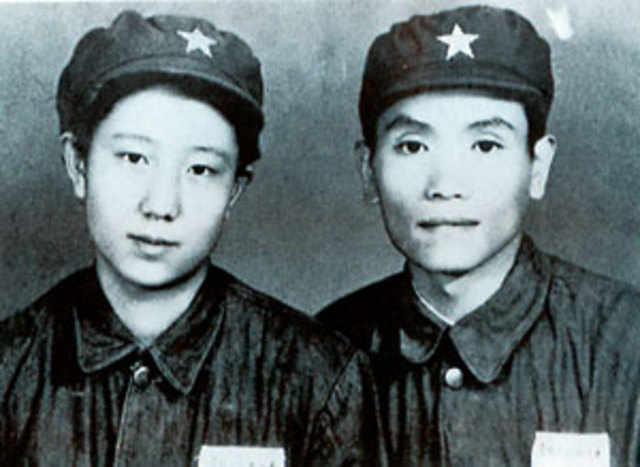
Bao-Quin and Wang-Yu,  Chang's parents


Wild Swans is an incredible look into some of China's most horrible years, particularly given the way the Changs are put on the rack for being too faithful to the cause.  Anyone who has believed in something -- a politician, an ideology, a religion -- and truly loved it, only to have to abandon it because of mounting evidence that it is not what it promised to be -- will sympathize with the Changs' plight. They never changed; Mao did. In fact,  many people were punished throughout Mao's regime for following instructions, merely because the managing authorities had changed.  Reading this and witnessing the idealism of the Communists giving way immediately to nepotism and human nature makes me more aware of both the immutable frailty of human society,  and the treasure that is the rule of law which we in the west enjoyed for so long.


Sunday, September 10, 2017

Eye of the Storm

Eye of the Storm: Inside City Hall During Katrina
© 2007 Sally Forman
260 pages


Although Hurricane Katrina was not the biggest disaster to ever hit an American city, it was New Orleans' greatest crisis -- posing a near-existential threat to the city, and forcing unprecedented measures from its leadership.  Sally Forman was the Communications Director for Mayor Ray Nagin at the time of the storm, with duties that involving trying to steer him away from shooting his mouth off. During the storm, she became an unofficial aide de camp, working to keep members of city hall in touch with one another, and with the county, state, and federal officials who were moving to help New Orleans at varying glacial paces. Eye of the Storm is her memoir, one that portrays NOLA's City Hall doing the best it could under intense pressure with diminishing resources. Forman does not shy away from self-criticism, though her target is always herself and never the office of City Hall.  Civic leaders were proud to have evacuated 80% of the city given that such a general evacuation had never been ordered before, and in their prompt decision to declare martial law after reports began arriving about lootings, police shootings, and violence in the Superdome. Some failures of hurricane response owed to lack of foresight: no portable generator for the City Hall office,  buses not removed to ground high enough, and bus drivers not included in the evacuation exemption. Some owed to the murky jurisdictional disputes between city, state, and federal officials: Nagin expressed his frustrated at not knowing, really, who had ultimate authority since he'd declared martial law, but now FEMA and the National Guard were operating on their own.  Forman ends the memoir with a list of lessons learned.

This is not a full Katrina history by any means, but one of interest to those curious about how municipal governments can react during a crisis.  Unfortunately, Mayor Nagin seems to have acted better during the crisis weeks than during recovery, since he was indicted and made bankrupt by corruption charges.

Related:
Hurricane Katrina Through the Eyes of Storm Chasers, Jim Reed and Mike Theiss
Rescue Warriors, David Helvarg
Disaster 1906, Edward F. Dolan

Saturday, January 14, 2017

Mean Streets

Mean Streets: Confessions of a Nightime Taxi Driver
© 2002 Peter McSherry
256 pages


Mean Streets takes readers into the dark side of Canada, or at least the dark side of Toronto. Ever since the 1970s, Peter McSherry has been driving the night shift at various cab companies,  writing about the strange people and stories the night produces along the way. In this volume many columns he's submitted to taxi publications are collected and organized in particular categories --  his experiences with drug dealers, prostitutes, and criminals on the lam, for instance, or the shady practices of tax firms -- spanning his time driving. McSherry isn't simply witness to many of these stories, but an unwilling participant in them; he is often threatened or solicited, and in his younger days was known to give chase to people who tried to stiff him on the cab fare.  Being far removed from Canada, I tend to imagine it as a bland, safe sort of place, nice to visit but not that exciting. McSherry's account certainly presents a different picture! His Toronto is just as grimy and unruly as New York City. with affair after affair recorded here that are worthy of depiction on COPS.   I didn't realize Canada, or at least Toronto, had the sort of racial strife that still besets the United States, though its came from Britain's colonial heritage, rather like France's does today.  Driving a cab was an education for McSherry, too;  originally an idealist who went to school to teach children and believed the best in everyone,  his experiences being cheated by bosses, customers, and city officials alike definitely create a world weariness.  With that, though, comes a genial tolerance both of people's failings (including his own), though he's definitely no pushover.   He readily ignores teenagers, drunks, pushy pimps, and others on the street who bitter experience has taught him are more trouble as fares than they're worth -- and if push comes to shove, he's as ready with a right cross as he is with a kind word. (Melissa Plaut, in her Hack, also learned to discriminate against teenagers, though she felt bad about it.)

Those interested in learning about the business practices of cab companies won't find too much here beyond the 1970s,  but the memoir has the usual appeal to those who like "a day in the life"  tales or true crime stories.  I noticed that McSherry prefers to drive as an independent contractor, just like Melissa in Hack;  this allows himself and other drivers to work as much or as little as they choose to, depending on their circumstances.

McSherry is, at least of 2014, still writing about driving even as he hits 70.

Related:

Sunday, December 4, 2016

Danger Heavy Goods

Danger Heavy Goods: Driving the Toughest, Most Dangerous Roads in the World
Also known as: Juggernaut: Trucking to Saudi Arabia
© 1988 Robert Hutchinson
288 pages

"Makes Smokey and the Bandit Look Like Smokey and the Boy Scouts"


When is a lorry not a lorry? When it's leaving the country, according to the British drivers here. A continental trip makes a lorry a bonafide truck, and the run covered here puts even American transcontinental trips to shame. In Danger: Heavy Goods,  Robert Author recalls a run from England to Saudi Arabia he participated in in the early 1980s, at a time when Arabian ports were so overcrowded that ships sat at sea for weeks waiting for their turn to unload.  He takes readers through a string of countries which no longer exist, across the Bosporus Bridge, and down to Ar'ar by way of  Iraq -- which is invading Iran. Well, golly.

Where to start with this book?  It is a snapshot of Europe in the early 1980s, where Yugoslavia, Czechoslovakia, and the DDR were still destinations and  Gorbachev is trying to reform the Soviet Union by banning alcohol. It is a road trip of epic proportions and epic aggravation. Time and again the drivers that Hutchinson partnered predict that the middle east run is doomed. The pre-EU customs inspections of Europe -- the frequent scrutiny of their records, the endless paperwork -- was bad enough, but the middle east is a bonafide nightmare. From Turkey to Saudi Arabia, every official from customs agents to parking attendants wants their cut,  a little bit to grease the palm The preferred bribe is cigarettes, and every country has its most-favored denomination: Turkey is Marlboro country,  Syria swears by Gitanes, and Rothmans rule in Saudi Arabia.   Bureaucratic delays are endless, some of them lasting as long as a week, and once the cigarettes are exhausted anything else is up for grabs. English newspapers, catalogs, canned food?  The amount of aggravation drivers throughout Eurasia receive at the hands of customs officials in Iraq and Saudi Arabia  amaze the author: it's like they don't want goods.

If one can get by the customs agents without being arrested for mysterious circumstances, there's still everything else to contend with. Take your pick -- roads that turn into bobsled runs as soon as they're wet,  or threaten to throw trucks into rig-destroying quagmire if they stray from the beaten path. And which is more dangerous, Turkish prostitutes or the fact that Iran and Iraq are bombing one another? Tough call.  There are plenty of surprises which far friendlier, though. Although drivers on the mid-east run are technically in competition with one another, there's a mild level of camaraderie in the face of a common enemy, customs. In one chapter, the British drivers warn a drunken Turk of a heavy police presence despite Turks being the main rival of British firms for transeuropean traffic. (They warn him in German, while in Czechoslovakia.  German is also used as a go-between language in Ar'ar,  Saudi Arabia.)

Danger is a most interesting 'memoir', delivered by a guide who has an honest interest in every country he visits, frequently regaling readers with historical background on the places he and his coworkers are passing through in their two trucks.  Virtually every aspect of the run has been overtaken by history, though. I haven't been able to find any stats on truck traffic to Saudi Arabia from western Europe, but with a few decades of oil money sunk into the ports I doubt it's as thick as it was when featured here

Related:
Truck this For a Living: Tales of a UK Lorry Driver, Gary Mottram

Thursday, September 22, 2016

Deke!

Deke! U.S. Manned Space Flight from Mercury to the Shuttle
© 1994 Deke Slayton and Michael Cassutt
352 pages


Don Slayton knew he wanted to fly as a kid, but he never imagined going as high as the moon  His story is singular; chosen as one of America's first astronauts, he was grounded for medical reasons shortly into the Mercury-Gemini programs. Remaining at NASA in hopes of one day restoring his active-duty status, he was charged first with being head of the Astronaut Office, and later still director of Flight Crew Operations. His memoir of the Apollo program thus covers far more ground than one-flight wonders like Scott Carpenter or John Glenn*;  it also provides extensive information about the technical planning of the Apollo missions, Skylab, and the shuttle program.

 Just as the lunar missions were concluding, Slayton's own mission to return to active service had a happy result: he flew on the last Saturn rocket in the Apollo-Soyuz project. There, he fulfilled a hopeful wish expressed to Alexei Leonov many years prior, that one day they might share a toast in space.  (The material in the "Vodka" bottles was just soup, but it's the thought that counts.) Slayton left NASA as the space shuttle became its focus,  in part exhausted after now decades of a grueling workload, and in part because Reagan's new NASA chief was a "horse's ass".  (Slayton helped inaugurate the shuttle, being head of the Approach and Landing Tests division during its development.)   Slayton wasn't grounded after NASA: he took up a hobby of racing planes, and became a leading administrator in a private space venture, developing rockets for commercial liftng. Slayton fell prey to cancer before the book's publication, but worked on it with his co-author for several years prior to his death.  Alan Shephard's 'co-authored' book with Slayton, Moon Shot, was also published just after Slayton's death, and I suspect it drew on some of the same interviews. The stories Slayton tells about his time in Russia are identical in both books, right down to the astronauts' discovery that their rooms were bugged, and their mischievious decision to put Russian ears to good advaantage. (They would comment on how sad it was they lacked something, like a pool table, only to have one arrive days later..)

Slayton's narration is professional with a hint of irreverence, like the time he hung out ofa helicopter by a rope to collect a goat he'd shot from the air. Tthe men who answered to Slayton's strigent safety procedures at the Cape would never believe his behavior on his own time.   He goes into enormous detail on matters like how he created the mission schedule, but at moments of high emotion he isn't communicative. He often speaks of his close friendship with fellow Mercury astronaut Gus Grissom, but when Grissom perishes in a fire (along with Ed White and Roger Chaffey), he can only terseley say that it was the worst day ever.  Cassutt or Slayton supplement the text with the recollections of Slayton's family or other astronauts, including his son Kent.  These add a human touch and some humor of their own. (Once, Slayton and his son were enjoying a silent game of catch. After being admonished by his wife to talk to his son and bestow some fatherly advice, Slayton pondered and then informed his son to always take a nap and use the head when he had the opportunity. Kent recalls it as one of the funniest moments of his childhood.)  Overall, the memoir delivers a big picture view of the early decades of NASA, from a man who was there at the very beginning.


The Original Capcom

Related:

  • Moon Shot, Alan Shephard and Deke Slayton (forward by Neil Armstrong)
  • A Man on the Moon, Neil Chaikan. Hands down the best Apollo history. 


* Sure, Glenn flew twice, but he wasn't exactly an astronaut the second time.

Thursday, August 11, 2016

The Ordinary Spaceman

The Ordinary Spaceman: From Boyhood Dreams to Astronaut
© 2015 Clayton Anderson
330 pages


Clay Anderson knew when he was nine years old that he wanted to grow up to be an astronaut.. He knew it when he witnessed the crew of Apollo 8 circling the Moon on Christmas Eve.  His passion for the black took him to NASA first as an intern, and then as employee, where he worked for well over a decade before the last of his fifteen applications to the astronaut program proper landed him a spot in the class of 1996.   The Ordinary Astronaut is a memoir of his years at NASA and in the shuttle program, one filled with interesting details but not much in the way of long-term perspective.

Ordinary Spaceman is primarily a work of human interest, since Anderson almost never refers to his scientific work, or comments on the space program as a whole.   Unlike Tom Jones' Sky Walking, which combined Jones' memoirs with a narrative history of NASA during the eighties and nineties to provide background information,  there's no broad review of the organization. We get instead workplace stories which happen to be set in space shuttles, the space station, and Russia's "Star City".  Since this is NASA the work stories can be extraordinary; for instance, early on he was asked by Rick Husband to be a family escort during Husband’s  mission aboard Columbia; ordinarily, this involves driving the family around during launches and landings, getting them punch, and offering reassuring answers to concerned questions.  If the name Husband rings a bell, it should – he commanded the Columbia when it broke apart in orbit, and Anderson became not just a valet, but the immediate focus of the family’s sorrow and despair, helping them to shoulder their emotional burden – a shared one, for he and Husband had trained together.  More cheerful is his account of the extensive time spent with Russian astronauts in Star City.  Anderson's class was required to have a rudimentary grasp on the Russian language, and part of his basic training took place in Russia where he learned their systems as well.   Still more fascinating is his recollection of time spent in NASA's underwater  habitat,  which offered its own difficulty and delight --  the photo of Anderson staring out into the water at a close-range school of fish makes obvious the utter joy it brought to him.

The Ordinary Spaceman is an odd book.  It lives up to its title in that  Anderson seems like a guy off the street, a Nebraska farmer in space. He didn't enter NASA as a hotshot pilot, but as a civilian intern. He met his wife in the cafeteria line and uses Wikipedia as his go-to reference. (The first time he did this, to supplement his memory while remniscing over Saturday morning cartoons, I thought it was funny. The next five times, when he was referring to actual NASA history, not so much.) It abounds in stories about the mundane details of working for NASA, the inns and outs, without drifting into complaining.   (I do mean ins and outs: he goes into great detail on how to use a space-toilet, records at length his body's reaction to returning to Earth by expelling fluid from every possible orifice, chronicles his attempt to self-administer an enema, and proudly counts himself as the only man to poop in four space vessels -- two shuttles, Soyuz, and the ISS.) Towards the end the organization gets odd, very back and forth, frequently chatty -- but ultimately, Anderson is a nice guy who sustains the reader's sympathy and affection.  His career in NASA, by his own account, was undermined by his own weaknesses,  like a short temper. But he's not proud of failing at times, and does his best to make amends. In that, he really is an ordinary guy, doing his best, and picking up the pieces when he goes  off the rails. The Ordinary Spaceman is more useful as an account of a man's living the dream at NASA than about NASA or shuttle spaceflight in general, but a boyhood fantasy turned reality certainly has its appeal.

Anderson's space selfie


Related:

  • Sky Walking, Tom Jones.  Not quite as fun, but more substantive  in regards to appreciating the history of the shuttle program and the creation of the ISS.
  • Two Sides of the Moon, Alexei Leonov and Dave Scott. Joint Apollo-Soyuz history of the space race, with a lot of content on the Russian space program and Star City. 


Wednesday, August 10, 2016

Playing to the Edge

Playing to the Edge: American Intelligence in the Age of Terror
© Michael Hayden 2016
464 pages


As someone who became a civil libertarian in response to the increasingly sweeping powers of the surveillance state during the Bush administration, I began reading this as a hostile audience, more or less. I was chiefly interested in the chapter on cybersecurity, although he says very little about it. The book is part memoir-biography, part defense of the privileged powers given to the United States' intelligence-security programs. While I am still not nor never will be comfortable with the amount of information being collected by these agencies, even if they are staffed by the heroic characters who populate this book under Hayden's pen, recent books on cyber war have made me realize that that agencies like these have actual national-security priorities, with a focus on malevolent organizations outside the U.S.

Hayden is very good at making the enormous amount of data-collecting sound completely mundane, even benign, and is very cagey with details when a plant is bombed or infrastructure sabotaged via computer viruses. Sometimes interesting and sometimes plodding are his comments on CIA-NSA organization, and the organization of the intelligence community (sixteen agencies, including the intelligence depts of other organizations). There's the usual attraction in a political memoir in that formidable media personalities are suddenly reduced to ordinary people: Secretary of State Condeleeza Rice becomes "Condie", the attorney general is "Al", Hayden himself is "Mikey"...it's a little touch of intimacy that a vast bureaucracy, far-removed from the concerns of the people as a whole, is usually without. All that said, I still like having Greewalds and Snowdens to keep the government on its toes.

Saturday, July 23, 2016

Men from Earth

Men from Earth
© 1989 Buzz Aldrin and Malcom McConnell
314 pages


Forty-seven years ago, men from Earth first stepped foot on the moon. There, they left medals commemorating the men of Apollo and Soyuz who perished in this quest for fire in the sky, and a plaque that declared their intentions: "We came in peace for all mankind."    Buzz Aldrin was one of the first men to step foot upon the grey dust of the lunar surface, and in this account -- published in 1989,  twenty years after the triumph of Apollo -- he provides a history of the early space race, a memoir of his own time in the Gemini and Apollo programs, and a final thought about the future.

While there is no shortage of astronaut memoirs, Aldrin's intrigued me at the start because I knew from other books that he  helped create the orbital rendezvous procedures that were practiced in Gemini and essential to pulling Apollo off.  The astronauts weren't just fighter jocks: advanced degrees were required of any astronaut candidate. While the account of the first-ever lunar landing is interesting in its own right, Aldrin attempts to record the whole of the space race. Not only does he devote early chapters to the beginning of German, American, and Russian rocketry, but throughout the book he follows developments on the Soviet side as well.  He draws from other books here,  then-recent scholarship. While sometimes the supporting authors are forced to speculate, given Soviet secrecy, the look across the iron curtain is most welcome. Both programs were beset with similar problems -- not only technical, but political, as program coordinators were being pushed for results by their respective governments for moral and propaganda purposes.

Aldrin's writing is detailed, but shouldn't scare off readers who are wary of too much technical detail. The descriptive writing is sound -- not poetic, but it's hard to compete with A Man on the Moon on that note.  One  sight is especially well conveyed, the eerie and abrupt transition of light when Armstrong and Aldrin left the shadow cast by their lander. According to Aldrin, the effect was total: if he stepped out of the shadow and cast his arm behind him back into it, it almost seem to disappear into another realm.  There was no transition between dark and light; when they left the shadow, the blinding drama was though they'd transported from the depths of Carlsbad Caverns into the middle of the Sahara. Also of note here is a final chapter, covering '1969-2009'.    Writing in the eighties, when the shuttle fleet was active and routine, with the International Space Station still in the future, Aldrin seemed  disappointed but optimistic. He is wary of the Soviets, who continue to support manned spaceflight. While they would collapse within a year or so of this book being published, these days NASA astronauts still hitch rides with Soyuz up to the ISS, so Aldrin's concern is not that far off.   Aldrin remains a space booster, recently writing a book encouraging a manned mission to Mars.

Men from Earth is a shorter history of the space race than A Man on the Moon,  but if you're looking for a history of Apollo as whole it might not satisfy,. He ends with Apollo 11, and some of the most interesting lunar missions -- scientific endeavors with go-karts! -- were thus not mentioned. Still, for a recap of Mercury and Gemini it's quite good, and especially so when the coverage of the Russians is taken into account.

Related:

Sunday, May 15, 2016

Off the Grid

Off the Grid:  Inside the Movement for More Space, Less Government, and True Independence in Modern America
© 2010 Nick Rosen
292 pages


When Nick Rosen put up a website to help his fellow Britons find resources and land reduce their carbon footprint by living off the grid, he was astonished at all of the interest his site received from the United States. He had more American readers than English readers, in fact,  and decided to investigate.  Off the Grid records his visits with various communities which operate outside the electrical grid. Although its subtitle refers to a coherent movement, there is nothing like that actually here. Rosen's account includes many people who simply happen  to be without power, like the homeless and the residents of a small Florida key ("No Name Key") who balked at the enormous cost of electrifying their island. Some of the persons included are positively dull, like the numerous wealthy types who maintained a 'vacation home' off the grid when they needed a retreat from their busy lives.  There are far more interesting characters present, though: an aging woman introduced as the founder of the 2nd Maine Militia, who has a working relationship with a local commune of anarchists,  and another woman who gave up PBS videography to teach SCUBA diving and drive trucks, instead.

 The majority of these interviews take place in the Southwest, where land is cheap and the population sparse. While some of the people included here are gridless because of poverty or remoteness, most have chosen it  while trying to find a more meaningful life. They want freedom from the constant distractions, simplifying their lives to the point of being free from utilities: they aim to put to rout all that was not life.  Another element present in these interviews is fear, of people withdrawing from a system that they view as either criminally exploitative or doomed to failure by its excesses. (While Rosen's grid-free interest mostly stems from environmentalism, he has a contempt for power monopolies that gives him plenty of common ground with this last category.)  Most of the people interviewed have a shade of...quirkiness to them, a possible consequence of living either in their heads or in echo chambers. Rosen brings to life quite a few tangential topics like microcurrencies, the pot economy, and the ins and outs of living in cars during these interviews.

Although I found several of the characters of interest, ultimately Off the Grid disappointed me. Far too many of the subjects just happen to be without power, rather than deliberately choosing to live 'outside the system'.   Those who remain don't share a worldview, and the groups that would (that anarchist cult, for instance, or the hippie commune) aren't explored in a great deal of detail.   Practically nothing is mentioned of how they're getting along, aside from the constant mention of solar panels and a one-paragraph visit to a composting toilet,  and Rosen is a grating narrator who makes fun of his subjects to the reader while he's talking with the people.  He does offer some thoughtful commentary though, especially in discussion with one man who lived by himself until he realized he had it wrong: it's not about self-sufficiency, it's about nurturing healthy and self-sufficient communities.   In connection with others, there is meaning --  off the grid or on.


Related:

  • Desert Solitaire, Edward Abbey. Kind of like Walden, but in the Southwest. 
  • Better Off: Flipping the Switch on Technology, Eric Bende. This is one I read a couple of years ago and should review, as it's the thoughtful work of a married couple who decided to live for a year with a Mennonite community to ponder the role of both technology and labor in their lives.
  • Folks, This Ain't Normal, Joel Salatin. Read three years ago, and is also about  humans, tech, and the right balance. I also need to re-read- and review this one.

Saturday, April 23, 2016

Funny in Farsi

Funny in Farsi: Growing up Iranian in America
© 2003 Firoozeh "Julie" Dumas
240 pages


Imagine a time when most Americans had never heard of Iran, when a little girl from a village thereof might as well be from Podunk, Eurasia.   Such was the case of young Firooezeh, whose father was an Iranian petroleum engineer sent to work in the United States for two years.  With little to prepare them, her family took English lessons from The Price is Right and went off to explore America.  Funny in Farsi is a collection of Firoozech’s comic coming of age in the United States, combining both the awkwardness of the immigrant experience and fond recollections of her childhood in Iran.

Though after the Iranian revolution and the hostage crisis, Iran would take on a sinister charge in the American imagination,  Funny in Farsi isn’t written as a somber reflection on Iranians and the Revolution; virtually all of reminiscences here are written to draw a smile.  They accomplish it regardless of the setting, whether they’re about her uncle taking her halfway across Iran to find his favored brand of ham, or Firooezeh enduring her American classmate’s dearth of geographic knowledge. (“You know China? Iran is on the same continent.”)  Comments on the immigrant experience (why are Americans so enamored of the French? Iranians also eat snails! It’s not fair!) go back and forth with family tales, like her father’s  many attempts to teach her to swim, or  his immense pride in spending as little as possible, as when he obtained lunch by visiting a grocery wholesaler and dining on the free samples.

While these recollections are delightful in their own right -- a reassurance that everyone's family has its odd ducks, regardless of continent -- there's also a useful reminder here that Iran is more than the possession of the reigning ayatollahs, being instead an ancient nation which has endured many a tyrant and will outlast the current breed as well.

Sunday, December 13, 2015

Hack

Hack: How I Stopped Worrying About What to do with my Life and Started Driving a Yellow Cab
© 2008 Melissa Plaut
256 pages


At the age of twenty-nine, Melissa Plaut was let go from her job at an ad agency. She found the layoff liberating instead of terrifying, freeing her as it did from a safe but utterly meaningless job where she felt distinctly like a sell-out. Having spent most of her twenties spinning her wheels at one safe job or another, she opted this time to pursue adventure.   So it was that she braved the labyrinth of New York bureaucracy and the warren of traffic to become a New York City cabbie.Hack collects stories from her blog about working the city streets, and as they are arranged she becomes progressively more miserable, eventually downshifting to the point that driving the cab is a part-time hobby instead of a career.

Although her stories behind the wheel constitute the bulk of the book (the exception being frequent breaks to chat about her social life) there is not a lot of revealed about the inner workings of taxi services in general. A combination of customer service, chronic traffic jams, and steady physical deterioration, taxi driving quickly loses its allure and becomes a daily grind for her. Working with the public at large is not for the faint of heart, and quickly takes an emotional toll on Plaut as she endures all kinds of abuse and contempt from her patronage. Soon she is bypassing types  (teenagers and grizzly men) who she suspects will be fare-jumpers or trouble-makers, and feeling guilty for not being as trusting and open as she once was.  Driving a cab for twelve hours a day also wrecks her physically; the human body was not meant to spend half its time sitting in an odd-shaped seat, one leg constantly working the gas or brakes and the rest comparatively inactive while the driver deals with the constant stress of traffic, hunting fares, and restraining her bladder. One of Melissa's coworkers routinely soils himself, his continence wrecked by years of trying to hold it until demand slowed down.  Being the result of only a year or so behind the wheel, not much is said about the taxi industry in general: readers get a feel for how her particular company's practices work, but that's about it. There are moments of broader import, as when she weighs whether or not to make the most of a transit strike; ultimately, sheer fatigue at trying to work at all overwhelms any thoughfulness. Most of the book consists of stories about abusive customers, pushy cops, and her social life,  rendered with ample vulgarity. As one takes in her growing frustration -- and her inability to find anything outside of work that will meet her needs for meaning or happiness -- sympathy grows, especially when she witnesses a brutal traffic accident that reminds her all too much of her own near-miss, when a car struck her as a pedestrian and she was hospitalized.

Hack is interesting, though often ugly and not particularly useful about learning the ins and outs of the taxi service. It is good exposure to the raw experiences of drivers, especially New York cabbies who find the city government nearly as hostile to them as the public.

Saturday, November 28, 2015

This week: yep, still at war


I don't know how most people spend Thanksgiving, but after a day with family eating sweet potatoes and admiring chickens and a late-fall collard garden, I've been reading nonstop about World War 2.  I'm moving closer to the end of 1941, and the war is shifting east, as Hitler's panzers and Hirohito's carriers are on the move.


I've read two more Time-Life histories of the war: The Rising Sun and Russia Besieged.  I picked up The Rising Sun in hopes that it would address Japan's rise as an industrial and colonial power, but that is mentioned as mere prologue. Time-Life's history is principally about the high point of Japanese power, from the December 7 attacks on the Allies in the Pacific,  to the battles of the Coral Sea and Midway, where Japan was first stopped and then reversed.  Russia Besieged concerns Operation Barbarossa, in which Germany launched the largest land invasion ever witnessed into the heart of Russia. There's a lengthy section on the brutal siege of St. Petersburg, then called Leningrad,  and the book ends with German retreat at Moscow, driven back by "General Winter".  (Fickle, that one. Wasn't he just helping the Finns fight the Russians?!)   


The Sino-Japanese war is a massive gap for me; I'm familiar with the outlines from a survey course, but otherwise, I know little. That's why I read  The Rape of Nanking, which exacted a psychological toll. In hopes of countering it, I read Flying Tiger: Chennault of China,  which is part-memoir, part-tribute. One of the few stories from the Chinese front that I'm familiar with is that of the Flying Tigers, a group of volunteer American pilots who flew old P-40s and harassed the Japanese as best they could.  I read a particularly fun book on these highs in high school, but this wasn't it.  The Tigers are touched on only briefly here, the book mostly being about the author's role in China's American air force (later America's air force in China), and his adulation of Chennault, the Tigers' leader who created the guerilla air tactics they used to counter the Japanese.

In the coming week or two, expect at least one book on the Eastern front, followed by our first forays into the Pacific!  It won't be exclusively war material, of course, as I'll throw other works just as a break. Cities, livestock, science,  Korean philosophy, murder mysteries -- you never know.  I'd like to be done with this WW2 series by the New Year, but it'll probably bleed over depending on how many books about the air war seduce me.