Showing posts with label collective tyranny. Show all posts

Thursday, September 28, 2017

Wild Swans

Wild Swans: Three Daughters of China
© 1991 Chang Jung
525 pages

(My edition uses Chang's family name first, following the Chinese custom.)


Read the records of the 20th century totalitarian states, and the number of lives destroyed numbs the brain. Eleven million in Germany, twenty million in Russia -- such a mass of suffering is too large to grasp. Distill that suffering into three lives, however, and it is conveyed with intimate efficiency.  Wild Swans uses the family history of three women -- a concubine of a warlord, a young Communist, and an untrained doctor turned untrained electrician turned writer in exile -- to deliver a history of China's brutal 20th century.   Although a three-part biography, the real weight of of the book lays in the middle, in the lives of the author's mother and father. Through them -- both Communists from their teens on, who  resisted the Japanese and the Kuomintang, who advanced the Communist revolution -- we see the hopes of China turn to ashes as Mao commits everything that isn't worship of the Chairman to the flames.

The story begins at the turn of the 20th century,  when a poor-but-pretty girl caught the eye of a warlord. Though her family's rank and wealth  disqualified her as a marriageable mate,  she was -- just barely -- acceptable as a concubine. Living alone in a gilded cage,  Chang Jung's grandmother had to face the hostility of the warlord's other concubines after she became pregnant. Her response was to escape, faking illness so she could smuggle her daughter and herself out.  Chang's grandmother married a Manchu doctor, a connection that came in handy after the Japanese invaded northern China and created a Manchurian puppet state.   Although the family had to live through the casual tyranny of the Empire and the food shortages of war,  the only fighting that ever threatened their village was between the Nationalists and the Communists guerillas.  Chang's mother, growing up in this environment, looked to the Communists as poor heroes against the imperial Japanese and the utterly corrupt Kuomintang.  As an adolescent, she smuggled in literature and helped the Communists gain intelligence inside the city for their covert actions,  aiding the cause.  Eventually she would meet and marry a young official, who was even more ardent than she. Together, they would witness the triumph of the war against the Kuomintang: the declaration of a People's Republic of China.

The dream would not last long. As this memoir-biography develops,  the faith of these two Communists is stressed, strained, and eventually crushed.  Chang's father was a New Communist Man through and through: he was effectively married to the Party, treating his wife as the other woman.  Devoted to the republic, he stood on principles absolutely, time and again choosing the party before his family.  He was assigned to another province?  Very well, his wife would have to wallk; her rank in the party didn't merit riding in a truck.  Was she pregnant? She would have to work until the delivery, because peasant women didn't have the luxury of taking it easy. Had he been given a ticket to a play for his daughter?  Yes, but she would need to trade it for an inferior ticket. It wouldn't do for a young girl to take a front seat just because her father was a senior official.   Chang's father was a hard man, but he believed that after centuries of imperial corruption, a new China needed to be built on the foundation of principled citizens.   As puritanical and cold as he could seem to his family, readers can only praise him after living through the Cultural Revolution via his family.

There's no shortage of brutality, inhumanity, and mass terror in this book: the Japanese and Kuomingtang give us a taste early on, and as soon as the Communists take control there are the murderous purges and the equally deadly incompetence-induced famine that killed millions.  As the biography develops, however, more and more of the problems have one man at their root: Mao,  who was creating a new imperial system around himself.    After a period of relative freedom of expression he suddenly purged those expressing themselves,  Mao claimed it was a premeditated act designed to draw out the traitors-in-waiting.  But with the cultural revolution, Mao would top himself. He would make Hitler the mean kid on the playground, make Stalin look like a common gangster. Mao, facing resistance from the Party itself, decided to destroy the party, destroy what institutions had been built upon since his victory, and destroy everything from China's past. He appealed to the first generation of children raised in the People's Republic to  rise against their teachers, their parents,  and the legacy of the past:  burn it all. Nothing could be great in China but Mao,  the man who praised poverty and lived in mansions,  who waged war against even the grass.  The Chinese would be set against one another and their own past, creating an atmosphere of constant abuse, paranoia, and savagery.

Chang herself was a student during the Cultural Revolution,  and through her we witness the complete breakdown of society.  Her father, a man of principle who stood on self-control and had reason to be confident in his solid Party Man reputation,  became the target of the "Rebels".  Both he and Chang's mother -- whose youthful devotion to the Party had fast waned thanks to the famine and her treatment during pregnancy --   were detained and tormented, After her parents took the bold step of appealing to Mao personally,  matters grew worst still.  Although many Rebels appreciated his principled defiance -- he refused to recant and declared he would stand against the cultural revolution even if  Mao had ordered it -- a key feature of the  rebel reign of terror is that it was unorganized chaos. At first was was merely bands of students harassing teachers, but their numbers grew and the Party was dumped from power in favor of the new student groups, they began fighting against one another.  Chang's father lost his sanity after one period of detention, and when he died it was a consequence of a long period of constant abuse. Chang could only wonder, as she witnessed her parents' emotional destruction at the hands of the regime -- if this was Paradise, what could hell be like?   The devotion she had for Mao perished in the orgy of murder and mayhem that he inaugurated.
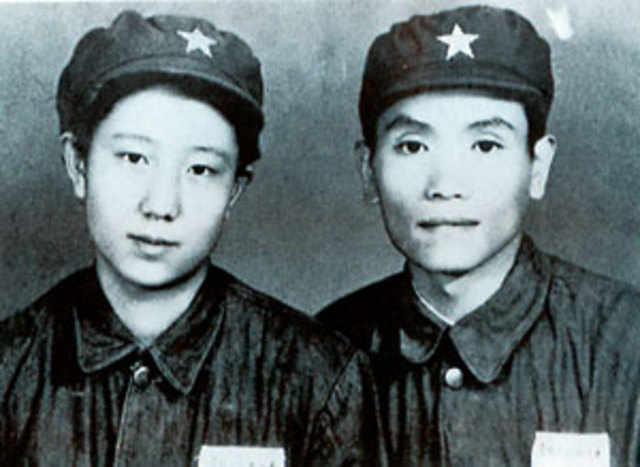
Bao-Quin and Wang-Yu,  Chang's parents


Wild Swans is an incredible look into some of China's most horrible years, particularly given the way the Changs are put on the rack for being too faithful to the cause.  Anyone who has believed in something -- a politician, an ideology, a religion -- and truly loved it, only to have to abandon it because of mounting evidence that it is not what it promised to be -- will sympathize with the Changs' plight. They never changed; Mao did. In fact,  many people were punished throughout Mao's regime for following instructions, merely because the managing authorities had changed.  Reading this and witnessing the idealism of the Communists giving way immediately to nepotism and human nature makes me more aware of both the immutable frailty of human society,  and the treasure that is the rule of law which we in the west enjoyed for so long.


Saturday, September 9, 2017

The Circle

The Circle
2013 Dave Eggers
507 pages

Sharing is Caring.
Privacy is Theft.
Secrets are Lies.

Imagine an internet transformed by a company  so innovative and ambitious that it had swallowed Facebook, Google, etc. whole.  It began with TruYou, a common login that allowed people to use one login for virtually everything online, from their hobbyist forums to their bank accounts.  It ends....well, that's up to you and me. The Circle combines 1984 and The Social Network to present a dystopia-in-the-making,  one most users of internet service will recognize in their own habits. Funny and alarming,  it's easily the most riveting novel I've read this year.

The Circle as a novel begins with the arrival of Mae, a frustrated twenty-something to the customer service desk of the company. As the novel progresses, her willingness to adopt to the Circle culture and work hard to perpetuate it,  take her to the heights of power, to the company's own inner circle. Readers witness her transformation as she grows to ignore the concerns of her ex-boyfriend and her parents that something isn't right about the world the Circle wants to build.  At the center of the Circle are the Three Wise Men -- a reclusive young genius,  a charismatic public face, and an avaricious  financier.  Between the three of them, they want to bring about a techno-utopia by allowing for -- and even mandating -- total transparency.  The Circle isn't just a social network/search engine/marketplace on steroids, it's also an Apple-esque technology company that produces new tools -- tools like small, discrete cameras that allow for live-streaming from multiple locations. The network and its tools grow throughout the novel to allow for technocratic control of society:  child abductions are thwarted by chip implants,  politicians begin wearing bodycams to prove they aren't sitting in smoking rooms hatching conspiracies, and neighborhood watch programs alert residents every time a non-registered person enters their block. Mae's own ascent into the elite happens when  she leads a campaign to turn the Circle political, to make its platform a voting mechanism. When one person drives off a bridge to get away from the Circle, their response is to wistfully say that would have never happened if we could make everyone give up automobiles that aren't self-driving.

The Circle is both warning and dark comedy, mocking compulsive users of social networks while building a threat that is more ominous than hilarious. In an early scene, Mae is called into her supervisor's office to resolve a serious dispute between her and another coworker -- one she has never met, but who invited her to a party for kindred hobbyists, and one who was deeply hurt when she never responded, not even to say "Sorry, no can do".  The world of the Circle demands constant interaction, constant attention, constant sharing.  It's not enough to go to after-work parties: there have to be pictures, shares, tags, likes, and tweets about the party. Mae first approaches her position like a nine to five job; she does her work, she goes home or goes kayaking, she returns. This is not the Circle way. The Circle's social demands  are such that some people simply live on campus, and even when they leave, the idea that they've left the Circle is almost blasphemous. Mae went kayaking....by herself? She didn't tell everyone she was going so they could send her Smiles, and worst of all...she didn't record anything. No one can benefit from her experience except from Mae!  What selfishness.

Although I have my doubts about how effectively this novel could happen (the NSA has problems with storage and cooling, and it's not coping with hundreds of thousands of simultaneous camera feeds),  Eggers' novel makes obvious two dangers of the growing social network apparatus. First, there are people whose histrionic obsession with social media make them not far removed from Circlers. Two, the role that some companies have as web infrastructure -- principally Google,  with its search engine, browser, cloud storage, email, control of YouTube and blogger --  poses a threat to free communication. Google is not a neutral actor; it has an agenda and does not brook dissent, either external or internal.  Facebook is no less threating to privacy; the reclusive genius used in The Circle is a transparent clone of Zuckerberg, complete with hoody.   The greatest problem shown by The Circle is what happens when these two factors combine -- the needy child-mob on social networks, and the infrastructural control they rely on and enabled.


For what it's worth: I maintain a Wordpress copy of this website in case Google ever gets really nefarious.

Related:
4 Alternatives to Google


Wednesday, August 9, 2017

The Tragedy of Liberation

The Tragedy of Liberation: A History of the Chinese Revolution 1945-1957
© 2013  Frank Dikotter
400 pages


Readers who approach Frank Dikotter’s histories of Maoist China (The Tragedy of Liberation, Mao’s Great Famine, and The Cultural Revolution) should brace themselves going in; like  books about the holocaust, or obscenities like the rape of Nanking,  the sheer amount of human misery is overwhelming.  The Tragedy of Liberation opens at the close of World War 2,  in which China became an area of contention not only between the Nationalists and the Communists, but their respective allies – the United States and China.   After documenting the rout of the Nationalists in that context, Dikotter then takes readers through the early 1950s, and first years of Communist rule as the new party-in-power ruthlessly imposed its will and went to work creating the New Sino-Soviet Man.

As Forgotten Ally indicated, Communist China was a creature formed from the Second World War.   In that book, Rana Mitter noted how the war wrecked Nationalists credibility by their heavy-handedness, and execution of desperate measures like blowing dams to slow down the Japanese. Here, another aspect of the war's contribution to Mao's triumph is documented;  we find the Communists being supported by the butcher Stalin, given direct aid by him as well as help in corralling and putting to use Japanese military equipment abandoned in northern China. Chiang Kai-Shek found increasingly little support from the United States as the Japanese retreated, as Truman's intelligence indicated that the Communists were nothing but isolated bands of guerrillas in the extreme north.

The Communist takeover is told in various chapters of misery.  We begin with the almost-immediate economic implosion, as taxes and legislation imposed such a burden on shops and larger businesses that they practically disappeared.  The  countryside  fared no better, subjected to rapidly increasing control of the farms by the state.  As the farms became progressively worse-managed, they produced less food and hemorrhaged labor.  Production declined for many reasons, two being the supervision of services or tasks by politically appointed incompetents,  as well shoddy care given to communal work, including maintenance of vital tools and the land. But a production crisis at a factory is merely a loss;  a production crisis in farms, in a country that has closed itself off to foreign trade, is famine and death.

Matters grow worse. I referred to The Rape of Nanking earlier; that’s not an accident.  If Mao called for a hundred flowers to boom in China, they had plenty of fertilizer.   The amount of people murdered by  Mao's Communist party, either directly or at its prompting, bewilders the mind. The numbers don't register.  Land owners,  peasants, those accused of being close to foreigners, those who fail express sufficient enthusiasm for the Party and the New Democracy -- they are only the beginning of a slaughter not seen in Asia since the Khans.  what began as a state sanctioned punishment regime against 'class enemies' widened into murderous chaos. The slaughter of innocents by those in power is one matter, however;  the culture of death, degradation, and denunciation which grew as a result of the Party's enthusiasm for murder is another subject altogether.   Readers of Roman history may remember how the proscription lists of Sulla's time, in which people were denounced and declared outlaw by the regime -- their lives and money forfeit. This occurred in China on a grand scale, as neighbors looted one another. The society itself became tyrannous, as everyone began policing everyone else's actions, in which the slightest flaw might lead to a death sentence.   Dikotter grimly notes that the Chinese of Mao's time didn't have freedom of silence,  let alone freedom of speech: those who failed to say the right things were marked. Even when Mao seemed to relent after the death of Stalin, encouraging dissent, deadly pushback followed.

The Tragedy of Liberation makes for haunting, sobering reading.  I've known that Mao's regime was deadly for years  -- deadlier even than Stalin's, who put Hitler to shame -- but to know something in the abstract, and to have the bodies placed before the mind's eye, are different.