Showing posts with label 2017 Discovery of Asia. Show all posts

Saturday, December 30, 2017

A journey's end

A few minutes ago, I finished Jawaharlal Nehru's The Discovery of India,  and completed my Discovery of Asia series, or challenge, for 2017.   My goal was to read two books per month on Asian history or culture, primarily Indian and Chinese,  and despite being three months behind in the late fall, I made it!   I'll post comments for Nehru's work in the coming week, and still owe myself a proper summary for This Brave New World.   I'm not finished learning about Asia, however; this was just a breaking of the ground, an establishment of a foundation I can build on later.  I already have some future reads in mind.  For now, however,  it's time to relax with coffee and a piece by Ravi Shankar, "The Discovery of India".


Geography
Land of the Tiger: A Natural History of the Indian Subcontinent,  Valmik Thapar


General History
India in the Global Community, P. Paramundi Karan
The Silk Road: Two Thousand Years in the Heart of Asia, Frances Wood
Genghis Khan and the Making of the Modern World, Jack Weatherford
Japan: A Cultural History, Henri Stierlin
India: A New History, StanleyWolbert
Midnight's Furies: The Deadly Legacy of India's Partition,  Nisid Hajari
The Tragedy of Liberation: The Chinese Revolution, Frank Dikotter
The Wonder That Was India,  Arthur Llewellyn Basham
Embracing Defeat: Japan in the Wake of WW2, John Dower
Heart of the Dragon, PBS
The Emperor Far Away: Travels at the Edge of China,  David Eimer
A History of China, Wolfram Eberhard
The Discovery of India, Jawaharlal Nehru

Asia in the age of Globalism
This Brave New World:  India, China, and the United States, Anja Manuel (Review Pending)
In Spite of the Gods: The Rise of India, Edward Luce
China Road, Rob Gifford
China: An Introduction, Lucien Pye
The Elephant and the Dragon: What India and China's Rise Means, Robyn Meredith
China Wakes: The Struggle for the Soul of a Rising PowerNicholas D. Kristof and Sheryl WuDunn
Korea Reborn Ministry of Patriots
Dragon Rising: An Inside Look at China Today,  Jasper Becker
Country Driving: A Journey through China from Farm to Factory, Peter Hessler
Factory Girls: From Village to City in a Changing China, Leslie Chang


Tuesday, December 12, 2017

Country Driving

Country Driving: A Journey through China from Farm to Factory
© 2010 Peter Hessler
448 pages


First things first: that statue on the cover intrigued me enough that I bought both books that used photographs of it.  Emperor Far Away made nary a mention, but Hessler comes through in the first third, referencing the statue as part of a scarecrow police system in one of China's western rural areas, erected along freeways and at roundabouts to discourage reckless driving. Mounted automobile ruins and signs that keep a running count of how many people have perished on the highway are also part of the safety campaign.    Such measures are needed because China is a nation on the move: its villages are emptying out as people move en masse from villages throughout the country towards the southern and south-eastern coasts. There,  China is being remade month by month as factories and people move, chasing opportunities at a frantic pace. In Country Driving,  Hessler drives China's highways, lives in one of its villages, and explores its burgeoning factory districts.   Country Driving is a China memoir that first seems like a collection of miscellany:  Hessler opens the book like a travel memoir, but halfway through, he's relating village politics and writing about one of the neighbor boys  turning into a couch potato.  Not until the book's end in the factories does the subtitle make sense.

Country Driving's largely appeals on a human-interest basis. The people of China are experiencing the industrial revolution seemingly overnight:  most of the factory managers Hessler spoke with had been farmers as children, and all of them acquired their expertise on the job, often by shoving themselves through the door. Hustling and social connections are more important were more important than degrees.  Lying about one's age to get a job was nothing offensive:  bosses saw it as a sign that that people wanted to work.   The amount of energy in China's development zones is attractive read about: these cities are like New York and Chicago in the late 19th century,  growing voraciously and teeming with newcomers who are creating a new society on the fly.  Like those examples,  these boomtowns aren't necessarily pretty: factory workers often live in dormitories on-site,  and the state-controlled 'union' exists more to provide free movies to workers.  Those who want a better deal have to effect it themselves,  arguing with management or simply leaving without notice.

Hessler refers to the rural-urban move in China as the largest migration in human history, and in his early chapters driving beside the Great Wall, he finds deserted village after deserted village:  the young have left for city work, leaving only the old behind. Rural China, it seems, is literally dying. In his rural travels,  the only young people Hessler encounters are those who are hitching rides to visit their families, typically bearing gifts of food.  Country Driving illustrates the concept of liquid modernity fairly well:  things are changing so fast that no one really seems to know what they're doing. Driving, for instance, is a relatively new skills,  but millions of Chinese are taking to the road: the number of registered drivers doubled in the time that Hessler was living in-country. Driving instructors teach people to use standard-transmission cars in ways that would make a mechanic grimace, and for seemingly arbitrary reasons.  The standard practice is to begin all maneuvers from second gear because it's more difficult, and more difficult means it's worth doing -- even if no driver will ever need to get their tire onto a single plank of wood, it's still part of the exam on the merits of difficulty alone.   What is missing, apparently, is any notion of orderly driving beyond "the bigger the car, the more right of way it has".    Cars jostle against one another the way people rub shoulders in Times Square, and in some cities, no rental agency expects its cars to come back without new dents. Like bugs on the windshield, they are to be expected.

Those who are interested in what life in China is like will find much of interest here, but the organization almost makes it seem unfocused at times. This is the third in a trilogy of China memoirs, however, and might make more sense when combined with the other two -- just as the third section here made the first two more connected.


Saturday, November 25, 2017

Are We There Yet?


(I am officially curious about that statue/statues...)

This year my study series has been the Discovery of Asia, with a stated goal of reading two books in Asian (primarily Indian and Chinese) history per month.   Other challenges and themes have cut into that, aided and abetted by some general sloth,  and I’m five books shy of making my goal.   But I have a month left, and I’m going to see if I can’t make it!     I have two books in the post (Factory Girls and Country Driving: A Journey Through China from Farm to Factory, both ‘life in modern China’-esque books),   two on my Kindle,   Nehru’s Discovery of India, and my local library’s holdings, so I’m fixed for content.    Speaking of, here's another micro-review, this time from a book I was reading during my St. Augustine trip and...er, left in the weekend bag when I threw it in the closet.


Dragon Rising uses each geographical region of China to review an aspect of the country; Shanghai stars in a chapter on China's infrastructure projects, and other areas cover agriculture, manufacture and shipping, the environment, and so on. The final chapter is particularly interesting as it addresses China's influence on other countries in Southeast Asia and abroad, as in Latin America. The photography is beautiful.

Friday, November 24, 2017

China, Japan, and New Mexico

In the last couple of weeks I've finished some books  that haven't gotten full reviews. Here are some quick shots!


First up: New Mexico, A History. This is...exactly what it says it is, a history of New Mexico. Published to celebrate the state's 100th anniversary of being part of the union, it begins with the first known human habitation of the area and proceeds to the present day. In broad strokes:  Pueblos and other tribes settle, the Spanish arrive to preach and mine, Mexico revolts, Texas invades, cattlemen and sheep-ranchers fight, rail lines bring farms and tourism, World War 2 brings a lot of military investment,  Indians organize for civil rights, and the cities pursue their own individual identities:  Santa Fe as the ancient and mysterious capital, Albuquerque as the progressive center of business, Las Cruces as a haven for low-income residents, and Roswell as...well, you know Roswell.  If you have an interest in the state, it's an interesting book, particularly given that New Mexico is home to three cultures which have been rubbing off on one another for centuries.


Next: Embracing Defeat: Japan in the Wake of WW2. When I checked this out I thought it covered the second half of the 20th century, documenting how a war-ravaged empire became a booming democracy whose economic prowess was putting the fear of conquest into people in the 1980s.  The book largely focused on the immediate postwar era, however, on the six years of American occupation in which the Japanese had to figure out what to do in the wake of their worldview being fairly destroyed.  It makes for diverse reading: the author examines new literature and social behavior alongside debates over a political constitution and economic development.


Thirdly, The Heart of the Dragon is a book published in 1985 which surveys Chinese culture.  In the wake of reform, China's economy was on the rise. threatening even Japan. This survey explores China's historical legacy and its growing role in the global economy.  China's culture, not its politics then and now, are the feature;  early chapters cover the arguments between China's biggest schools of thought (Confucianism, Daoism, and Legalism). The first two had their own differences, but both had an optimistic view of human nature at odds with Legalism -- which viewed people as so liable to mischief that only an omnipresent and unyielding mesh of rules could keep them on the straight and narrow.  Although the chapters on agriculture and economics are badly dated,  overall it's an attractive introduction to Chinese society through the ages.


Sunday, October 15, 2017

Korea Reborn

Korea Reborn: A Grateful Nation Honors Veterans for 60 Years of Growth
© 2015 Republic of Korea's Ministry of Patriots
161 pages


Like most Americans, I have very little knowledge of the Korean War, outside of knowing Douglas MacArthur's role there.  When this book appeared at the library, published by the Republic of South Korea to honor US veterans of the conflict,  it seemed like a good place to start.  The book is half-history, half-celebration. Its opening chapters chronicle the invasion of Korea by Japan, and the subsequent split of the country after the Soviets  moved in following Japan's defeat in World War 2.  Kim Il Sung, appointed by the communists to be their client boss in the north, attempted (with permission from his masters) to expand into South Korea. and nearly captured the entire peninsula before UN forces arrived.  The arrival of the US military and other UN allies reversed Kim's charge,   and were it not for the sudden intervention of the Chinese communists, Kim might have been put out of work altogether before his strange spawn could create a family cult around themselves.  The second half of the book is more celebration than history, but shares how the South Korea economy has become a powerhouse, its democracy better rated than even the UN, and its culture an increasing influence in the west -- from K-Pop to Samsung electronics.  A nation which was nearly completely destroyed in war has, through foreign aid and a free economy, become a full participant in the global community -- giving aide and sending soldiers to relieve those in distress.

Although the book isn't a formal or serious history,  I found it helpful in establishing  the basic outline of the war. The latter half is...dare I say, heartwarming, what with all the pictures of bright skyscrapers, happy children, and expressions of friendship between Korea and the United States. 

Thursday, September 28, 2017

Wild Swans

Wild Swans: Three Daughters of China
© 1991 Chang Jung
525 pages

(My edition uses Chang's family name first, following the Chinese custom.)


Read the records of the 20th century totalitarian states, and the number of lives destroyed numbs the brain. Eleven million in Germany, twenty million in Russia -- such a mass of suffering is too large to grasp. Distill that suffering into three lives, however, and it is conveyed with intimate efficiency.  Wild Swans uses the family history of three women -- a concubine of a warlord, a young Communist, and an untrained doctor turned untrained electrician turned writer in exile -- to deliver a history of China's brutal 20th century.   Although a three-part biography, the real weight of of the book lays in the middle, in the lives of the author's mother and father. Through them -- both Communists from their teens on, who  resisted the Japanese and the Kuomintang, who advanced the Communist revolution -- we see the hopes of China turn to ashes as Mao commits everything that isn't worship of the Chairman to the flames.

The story begins at the turn of the 20th century,  when a poor-but-pretty girl caught the eye of a warlord. Though her family's rank and wealth  disqualified her as a marriageable mate,  she was -- just barely -- acceptable as a concubine. Living alone in a gilded cage,  Chang Jung's grandmother had to face the hostility of the warlord's other concubines after she became pregnant. Her response was to escape, faking illness so she could smuggle her daughter and herself out.  Chang's grandmother married a Manchu doctor, a connection that came in handy after the Japanese invaded northern China and created a Manchurian puppet state.   Although the family had to live through the casual tyranny of the Empire and the food shortages of war,  the only fighting that ever threatened their village was between the Nationalists and the Communists guerillas.  Chang's mother, growing up in this environment, looked to the Communists as poor heroes against the imperial Japanese and the utterly corrupt Kuomintang.  As an adolescent, she smuggled in literature and helped the Communists gain intelligence inside the city for their covert actions,  aiding the cause.  Eventually she would meet and marry a young official, who was even more ardent than she. Together, they would witness the triumph of the war against the Kuomintang: the declaration of a People's Republic of China.

The dream would not last long. As this memoir-biography develops,  the faith of these two Communists is stressed, strained, and eventually crushed.  Chang's father was a New Communist Man through and through: he was effectively married to the Party, treating his wife as the other woman.  Devoted to the republic, he stood on principles absolutely, time and again choosing the party before his family.  He was assigned to another province?  Very well, his wife would have to wallk; her rank in the party didn't merit riding in a truck.  Was she pregnant? She would have to work until the delivery, because peasant women didn't have the luxury of taking it easy. Had he been given a ticket to a play for his daughter?  Yes, but she would need to trade it for an inferior ticket. It wouldn't do for a young girl to take a front seat just because her father was a senior official.   Chang's father was a hard man, but he believed that after centuries of imperial corruption, a new China needed to be built on the foundation of principled citizens.   As puritanical and cold as he could seem to his family, readers can only praise him after living through the Cultural Revolution via his family.

There's no shortage of brutality, inhumanity, and mass terror in this book: the Japanese and Kuomingtang give us a taste early on, and as soon as the Communists take control there are the murderous purges and the equally deadly incompetence-induced famine that killed millions.  As the biography develops, however, more and more of the problems have one man at their root: Mao,  who was creating a new imperial system around himself.    After a period of relative freedom of expression he suddenly purged those expressing themselves,  Mao claimed it was a premeditated act designed to draw out the traitors-in-waiting.  But with the cultural revolution, Mao would top himself. He would make Hitler the mean kid on the playground, make Stalin look like a common gangster. Mao, facing resistance from the Party itself, decided to destroy the party, destroy what institutions had been built upon since his victory, and destroy everything from China's past. He appealed to the first generation of children raised in the People's Republic to  rise against their teachers, their parents,  and the legacy of the past:  burn it all. Nothing could be great in China but Mao,  the man who praised poverty and lived in mansions,  who waged war against even the grass.  The Chinese would be set against one another and their own past, creating an atmosphere of constant abuse, paranoia, and savagery.

Chang herself was a student during the Cultural Revolution,  and through her we witness the complete breakdown of society.  Her father, a man of principle who stood on self-control and had reason to be confident in his solid Party Man reputation,  became the target of the "Rebels".  Both he and Chang's mother -- whose youthful devotion to the Party had fast waned thanks to the famine and her treatment during pregnancy --   were detained and tormented, After her parents took the bold step of appealing to Mao personally,  matters grew worst still.  Although many Rebels appreciated his principled defiance -- he refused to recant and declared he would stand against the cultural revolution even if  Mao had ordered it -- a key feature of the  rebel reign of terror is that it was unorganized chaos. At first was was merely bands of students harassing teachers, but their numbers grew and the Party was dumped from power in favor of the new student groups, they began fighting against one another.  Chang's father lost his sanity after one period of detention, and when he died it was a consequence of a long period of constant abuse. Chang could only wonder, as she witnessed her parents' emotional destruction at the hands of the regime -- if this was Paradise, what could hell be like?   The devotion she had for Mao perished in the orgy of murder and mayhem that he inaugurated.

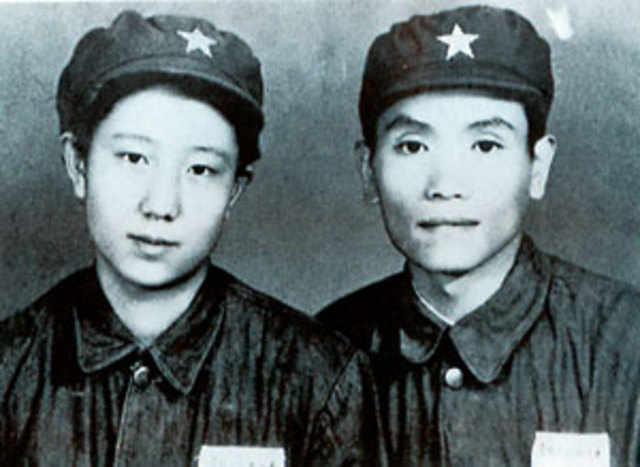
Bao-Quin and Wang-Yu,  Chang's parents


Wild Swans is an incredible look into some of China's most horrible years, particularly given the way the Changs are put on the rack for being too faithful to the cause.  Anyone who has believed in something -- a politician, an ideology, a religion -- and truly loved it, only to have to abandon it because of mounting evidence that it is not what it promised to be -- will sympathize with the Changs' plight. They never changed; Mao did. In fact,  many people were punished throughout Mao's regime for following instructions, merely because the managing authorities had changed.  Reading this and witnessing the idealism of the Communists giving way immediately to nepotism and human nature makes me more aware of both the immutable frailty of human society,  and the treasure that is the rule of law which we in the west enjoyed for so long.


Thursday, September 21, 2017

Of China and Narnia


Late last week I finished China Wakes, the account of two  married American journalists in China during the 1980s and early 1990s.  They found China frustratingly difficult to judge; as much promise as its economic liberalization showed,  the political and economic structure seemed rotten to the core, with civil society barely existent.  The rule of whim and will ruled, not the rule of law; what counted was influence, whether social or monetary.  Nick Kristof arrived in China regarding the Communist takeover as a good thing that had gone wrong;  after extensive interviews with survivors of Mao's "golden age",  Nick's summation echoes Paul Dikotter's: the "liberation" was a bloodsoaked tragedy.  Women's lot was improved by the Communists,  his Chinese-American wife Sheryl admits, but now that the Chinese are growing wealthier,  women are prized less for being economic units and more for their social roles -- girlfriend decorations, or wives and mothers. What the Chinese of this book want -- whether they are the kleptocrats on top or the still-abused peasants at bottom -- is stability.  The wars, famines, and mad chaos of the cultural revolution are bloody specters haunting the imagination of those interviewed,  despite the Party's campaign to control the memory of history.


I've  been listening to the audio drama of Prince Caspian, produced by Focus on the Family Theater, on loan to me from a friend. I say audio drama deliberately, because the production doesn't limit itself to Paul Scofield simply reading the book aloud; instead,  different actors portray various characters, and background audio (music, other characters' reactions to dialogue, etc)  is employed for a full experience.   So far I have listened to two books in this series (The Lion, the Witch, and the Wardrobe being first) and have found both delightful.  Paul Scofield is a joy to listen to, though  Aslan's portayal sometimes borders on hammy.    The dwarves (Trumpkin and Nickabrik) were solid, too.    The world of Narnia (and that of Middle-Earth) has been a welcome relief from all the politics and death of this week,  in both the news (poor Mexico and Puerto Rico!) and in reading.   That's also why I've been cozying up with The Fellowship, a biography of four writers who were part of the Inklings literary circle, contributing to one another's imaginations and honing their craft together.  It's largely about Lewis and Tolkien, which is fine with me as the other two are rather strange.

Friday, September 1, 2017

The Wonder That Was India

The Wonder That Was India
© 1959 Arthur Llewellyn Basham
586 pages


For the past few weeks I’ve been enjoying The Wonder That Was India, a Will Durant-like survey of Indian history and culture prior to the Mughal invasion.  Its opening section covers political history, from the first hints of settled human life through several empires and many periods of fragmentation.  In sections that follow, Basham focuses on society, daily life, economics, art, literature,  religion, philosophy, and metaphysics.  Evolution is a recurring theme; the flowering of languages and religions being the most obvious examples of institutions' varied growth through time. He notes, for instance, that the intermix of Buddhism and Zoroastrianism produced strains of Buddhist thought that looked for a future Buddha, one who would be greater even than Siddhartha Gautama. Basham writes in earnest admiration of Indian civilization, which managed get by without having institutionalized mass slavery – unlike the Roman empire, for instance. The author's pen has a warm elegance that made the sheer amount of information easy to contemplate, and his commentary shed a good bit of light on various subjects for me. For instance, he commented that one reason histories are generally so sketchy about India before Ashoka is that there's little written surviving history to work with.  His own sources for the period were limited; one history applied only to Kashmir, and another was more religious than historical.

Wednesday, August 9, 2017

The Tragedy of Liberation

The Tragedy of Liberation: A History of the Chinese Revolution 1945-1957
© 2013  Frank Dikotter
400 pages


Readers who approach Frank Dikotter’s histories of Maoist China (The Tragedy of Liberation, Mao’s Great Famine, and The Cultural Revolution) should brace themselves going in; like  books about the holocaust, or obscenities like the rape of Nanking,  the sheer amount of human misery is overwhelming.  The Tragedy of Liberation opens at the close of World War 2,  in which China became an area of contention not only between the Nationalists and the Communists, but their respective allies – the United States and China.   After documenting the rout of the Nationalists in that context, Dikotter then takes readers through the early 1950s, and first years of Communist rule as the new party-in-power ruthlessly imposed its will and went to work creating the New Sino-Soviet Man.

As Forgotten Ally indicated, Communist China was a creature formed from the Second World War.   In that book, Rana Mitter noted how the war wrecked Nationalists credibility by their heavy-handedness, and execution of desperate measures like blowing dams to slow down the Japanese. Here, another aspect of the war's contribution to Mao's triumph is documented;  we find the Communists being supported by the butcher Stalin, given direct aid by him as well as help in corralling and putting to use Japanese military equipment abandoned in northern China. Chiang Kai-Shek found increasingly little support from the United States as the Japanese retreated, as Truman's intelligence indicated that the Communists were nothing but isolated bands of guerrillas in the extreme north.

The Communist takeover is told in various chapters of misery.  We begin with the almost-immediate economic implosion, as taxes and legislation imposed such a burden on shops and larger businesses that they practically disappeared.  The  countryside  fared no better, subjected to rapidly increasing control of the farms by the state.  As the farms became progressively worse-managed, they produced less food and hemorrhaged labor.  Production declined for many reasons, two being the supervision of services or tasks by politically appointed incompetents,  as well shoddy care given to communal work, including maintenance of vital tools and the land. But a production crisis at a factory is merely a loss;  a production crisis in farms, in a country that has closed itself off to foreign trade, is famine and death.

Matters grow worse. I referred to The Rape of Nanking earlier; that’s not an accident.  If Mao called for a hundred flowers to boom in China, they had plenty of fertilizer.   The amount of people murdered by  Mao's Communist party, either directly or at its prompting, bewilders the mind. The numbers don't register.  Land owners,  peasants, those accused of being close to foreigners, those who fail express sufficient enthusiasm for the Party and the New Democracy -- they are only the beginning of a slaughter not seen in Asia since the Khans.  what began as a state sanctioned punishment regime against 'class enemies' widened into murderous chaos. The slaughter of innocents by those in power is one matter, however;  the culture of death, degradation, and denunciation which grew as a result of the Party's enthusiasm for murder is another subject altogether.   Readers of Roman history may remember how the proscription lists of Sulla's time, in which people were denounced and declared outlaw by the regime -- their lives and money forfeit. This occurred in China on a grand scale, as neighbors looted one another. The society itself became tyrannous, as everyone began policing everyone else's actions, in which the slightest flaw might lead to a death sentence.   Dikotter grimly notes that the Chinese of Mao's time didn't have freedom of silence,  let alone freedom of speech: those who failed to say the right things were marked. Even when Mao seemed to relent after the death of Stalin, encouraging dissent, deadly pushback followed.

The Tragedy of Liberation makes for haunting, sobering reading.  I've known that Mao's regime was deadly for years  -- deadlier even than Stalin's, who put Hitler to shame -- but to know something in the abstract, and to have the bodies placed before the mind's eye, are different.

Friday, July 21, 2017

Midnight's Furies

Midnight's Furies: The Deadly Legacy of India's Partition
© 2015 Nisid Hajari
352 pages


Although greater India has rarely remained united in its long history, there was every reason to hope that it would emerge from the centuries of British dominion in one piece. Instead, the people of India erupted as two -- then three -- nations,  with armed borders and bloodbaths between them.   Midnight's Furies is a history of how the Partition happened, and a full account of the massacres on every side until the United Nations was able to meditate a cease-fire.  Although its pages are bloodsoaked, no less  than a history of the fighting and civilian slaughters between Hitler and Stalin's empires in WW2,  it does deliver a sad understanding of why tensions between India and Pakistan continue to haunt the region and the world.

The two most prominent personalities of this tale are Jawaharlal Nehru, a key figure in both the independence movement and India's Congress Party, and Muhammad Ali Jinnah,  also a leading voice in the movement but one who relied on Muslim support.  Although both Nehru and Jinnah supported a future for India as a secular state,  the long road to independence and personal quarreling made them feuding allies at best, and rivals at worse.  Gandhi gave the Indian independence movement a strong populist flavor; his supporters were not middle-class Indians, but India's poor masses, and the Mahatma and his followers channeled their desires and energy through Hindu religion. This was exceptionally  off-putting to Jinnah, who not only feared Hindu nationalism given his Muslim background, but had a marked distaste for the underclass, reluctant even to shake hands with his followers. As the movement grew larger and more populist, Jinnah was marginalized and found relevance only by doubling-down on his Muslim background and becoming an stubborn voice for a Muslim state that would protect its citizens' wishes against the Hindu majority.

Although Nehru comes off much better here (confronting the leaders of mass violence, dreaming of a united India)  Hajari does delve into his culpability. As the day of withdrawal grew closer and Indian leadership became a fact, not a proposal,  Nehru targeted his critical energies against Jinnah's partisanship with the same zeal he'd once thrown at the British.  In treating Jinnah  and his followers like the enemy, he aided the two countries' downward spiral of accusation, attack, and counterattack.  The bloodbath that overtook the country  when the Partition came into effect -- as majorities tried to push minorities out -- was not exactly their 'fault', but their inability to work with one another set the stage. (Jinnah's call for "Direct Action" to effect Pakistani independence from India kicked off the blood feud, however, so he seems more culpable than Nehru.)  The violence was not a simply Hindu v Muslim feud;  in the Punjab, where the new state line split the militant Sikh community in two,  it involved Sikhs and Muslims.   The ever-present spiral of violence is obvious here: one community attacks the other ,who attacks the first in self-defense, who attacks the other in reprisal, etc.  The aggression and violence simply keep ratcheting up, until the streets are literally filled with broken bodies, including children, and air is filled with the smell of  blood and the cry of wounded and raped victims.

This is not a book for the faint of heart, though it's not as gruesome as The Rape of Nanking.  Although ending in 1947,  the spasm of brutality documented here continues to effect Indian and Pakistani relations, and particularly Pakistan's foreign-policy worldview. For it, India remains the existential threat and the priority -- not cold wars or terrorism.

Thursday, July 13, 2017

A New History of India

A New History of India
© 2000, sixth edition Stanley Wolpert
471 pages


India isn't an easy place to keep running. Stanley Wolpert's A New History of India gives a chiefly-political, mostly-modern history of one of the world's most ancient civilizations, a land whose soaring mountains and depth of peoples have frustrated long-term attempts at centralized control.  Beyond a geographic introduction,  and some early  content on  Indian religion, culture, and literature,  A New History largely delivers a story of rulers and killings.    The Indian subcontinent seems to have been riven in war for most of its history,  with occasional figures like Ashoka and Akbar rising to reign over largish- and stable-ish parts of the north.   This pattern of central authority giving way to chaos, then back to authority again, has a heart-like rhythm about it.  British India  receives the lion's share of attention (both the accretion of British authority, and the Quit India campaign)  and as the book draws closer to the 'modern' period, the author gets saucier.  In the section on WW2, for instance,  he refers to the Japanese catching the British at Singapore with their gin-and-tonics half-down.   This particular edition covers India (and Pakistan) up to the year 1999, but later editions cover India until until 2008.  Frankly, I found the running commentary on India in Nehru's Glimpses of World History  far more useful as far as pre-modern history goes.   This reminded me a bit of The Persians: Ancient, Medieval, and Modern Iran  in its near-solitary fixation on rulers, deaths, and successions.

I think I may follow this with  Nehru's own The Discovery of India, the name of which I am borrowing for this Discovery of Asia inquiry into Indian and Chinese history.


Friday, May 5, 2017

The Elephant and the Dragon

The Elephant and the Dragon: The Rise of India and China and What It Means for All of Us
© 2007  Robyn Meredith
272 pages


For most of the 20th century, Europe and the United States enjoyed an outsided influence on global trade, in part because  large portions of the world had sealed themselves off, stewing in their own ideological juices and maintaining impoverished populations. As the 20th began to give way to the 21st, however,  the eastern world re-opened. The Elephant and the Dragon begins with a historical note explaining how China and India came to renew their participation in the global economy, then appraises the ways their surging involvement has altered that global system and themselves.  Written and published before the 'great recession' -- observing then things now taken for granted, like offshoring -- the book is presumably not quite as relevant as it was on its publication.  The fundamental transformations Meredith observes, however, are still in effect.

Why the 'elephant and the tiger', instead of 'the Asian tigers'?  Meredith views India's economy as pachydermesque in that while it was slow to get to its feet, slower still to get moving,  it will be all the more harder to stop as it picks up speed.  Its energy will come not from one point -- the Politburo -- but from billions of Indians, driving forward towards the future they want.   India's economic revival came seemingly as a last resort, when in 1992 its leadership recognized that the country was broke.  Although the liberalization that followed allowed India to use its existing resources (a strong number of English-speaking professionals) to better effect,  its lack of more material resources -- infrastructure like highways and modern airports -- prevented it from becoming an instant industrial power like China.   India liberalized at just the right time,  becoming an important part of the expanding information technology sector.  What began with the dot come surge  has continued to the point that India had become the western world's "back office". its workers supplying customer service ,tech support,  computer programming, and the like.  By now (2017), India's economy has grown being merely the support staff of the west, however.

China's own 'liberalization' -- economic, not political -- began in 1978 when Mao's successor realized the middle kingdom was falling far behind the west,  and needed to adopt some of its methods if only out of self defense. (Even during the Mao years, China had learned from Russia's mistakes and so avoided total public control of agriculture.)   Although the communist party's pivot towards capitalism meant ceding constant command of the economy, the Party maintains absolute political control and still 'guides' the economy by establishing long-term goals, like an expansion of the highway system.  Although westerners commonly regard China's trade advantage as being desperately cheap labor, in reality there are many places with cheaper labor.  China combines relatively cheap labor with industrial infrastructure and a government interested in stable growth.

The Elephant and the Dragon is largely oriented toward the world of business, using India and China to illustrate how crucial offshoring and vast supply chains have become to the global economy.  Goods are not simply made in a Chinese factory; they pass from city to city in varying stages of completeness, which is why online retailers can offer so much customization.  "Made in" labels have lost all real meaning, for a given good will have been produced from goods and materials from across Asia, with other components added in by the United States and Europe.  Is a car finished in the United States, but from parts produced in China and Mexico, truly 'made in America'?  

While there are more current books, for someone interested in the course of globalization -- particularly the intermingling of the Asia and western economies -- this is still a good start.

Tuesday, March 14, 2017

China: An Introduction

China: An Introduction
© 1984 Lucian W. Pye
400 pages


Lucien Pye was born in China and later returned there to advise the US government. China: An Introduction is written in that spirit, being a review of the making of Communist China and its attempts to find policies to modernize China from the inside out.

The volume opens with a hundred pages covering Chinese history,  with an emphasis on the  philosophical schools which contended for preeminence in the old Empire: Taoism, Confucianism, and Legalism. That drama is applicable to the more extensive coverage of the evolving Communist party in China, for  Confucianism so under-girded China that it continued to influence the expression of communism in China even after every aspect of the old civilization was set ablaze.  For instance, Chinese communism did not view itself as supremely scientific and inevitable; instead,  Mao and others believed that a cyclical model would continue, and China would ever be tugged between communism and capitalism.  The Confucian emphasis on perfectibility and self-sacrifice in pursuit of social virtue also lent themselves to early propaganda, in which people were expected to labor in hardship and poverty not for themselves, but for the good of the communist experiment in China.

 Pye devotes the bulk of the book to covering the rise of the Communist party, and its internal politics through to the end of the 1970s.  The book indicates to me that Mao was a singular figure, not simply for his role in the revolution but for his conceits in office: intriguingly, Pye writes that Mao scorned cities,  viewing them as hotbeds of capitalism. I also didn't realize how quickly the Chinese learned from Russian mistakes: as early as 1959, they reintroduced privatization in agriculture,  creating private plots that remained unmolested even amid the nightmare of the cultural revolution.

While I am not particularly interested in Communist party politics, I found the discussion of China's early philosophical debates fascinating -- especially because while Confucianism was not a religion, it permeated every level of society and shaped China in the manner that a religion would.  Pye has engendered in me an excitement for reading about Confucianism proper a little later on.


Saturday, March 11, 2017

China Road

China Road: A Journey into the Future of a Rising Power
© 2007 Rob Gifford
352 pages


National Road 312 spans the breadth of China, connecting its sparsely settled and scarcely developed rural interior with the port city of Shanghai,  the largest in the world and the proud symbol of Chinese modernity.   Before ending his decades-long period studying and working in China, Rob Gifford decided to take a farewell trip across the country following this Asian ‘Route 66’,   absorbing the stories of China’s tumultuous 20th century through the personal lives of men and women he interviews along the way.  Some interviews were planned in advance, others spontaneous and candid – but all are unique, and indicate to Gifford that now more than ever,  individuals are going to drive the story of China, not Confucian tradition or Communist orthodoxy.  While a travel book, China Road is also a collective memoir of the rough road that Chinese civilization has traveled as it continues trying to find its way.

China endured hell in the 20th century; beginning it in civil war and at the mercy of both Western colonialists and Japanese imperialists, some measure of peace was not to be had until 1949.  The triumphant Communists, however,  were not done waging war, and in the Cultural Revolution they let loose the furies to kill and burn everything not modern and Maoist.  At long last another generation came to power and begin creating some measure of stability, and even liberalization and subsequent economic growth.   China’s constant struggle to find itself is not told through one author’s narrative, but rather through the lives of an array of Chinese citizens:  truck drivers, businessmen, rural villagers,  young urban Party members in search of their next set of high heels; political dissidents in hiding, teenagers on the cusp of going to college,  weary elders who have seen China destroyed several times in their lives;  Tibetans,  Muslim Uighurs, and still more.    Through their lives Gifford reflects on various aspects of China in mid-transformation:     the withdrawal of the Communist party from everything but political power,  the  government’s awe-inspiring attempts to build not just a country, but an entire continent;  the on-going problem with corruption that he attributes to a lack of checks and balances that was present in the Confucian-imperial state as well;  the economic growth that is allowing the majority of Chinese citizens to live better lives, and so on.

Gifford introduces early on a concept he returns to several times: as much as they are controlled politically,  at a deeper level,  China’s people now drift loose. The old moral order was destroyed wholesale by the Communists, who attempted to recreate a new socialist civil culture.  Virtually all of that has been quietly retired, however, aside from admonishments on billboards to keep the poor in mind. So long as people don’t interfere with the party’s political supremacy, they are in turn left alone.  They are left to wrestle with questions of purpose and identity: what does it mean to be Chinese,  when  so much was earlier condemned to the fires, but what replaced it has retreated?  In one of the first chapters set in Shanghai, Gifford encounters two young Party members out shopping,  and both of them confirm that there’s little guidance to them as to what sort of life they should be looking forward to. One exults in the material freedom, but the other seems struck by some malaise of modernity,    directionless and unsatisfied. Later on, a young woman engaged in a self-destructive career struggles to articulate what exactly she's desiring, and can only conclude -- "It's..difficult being human, isn't it?"

Although China Road is ten years dated, its human stories  make it engaging reading, and provide  easy exposure to China's history and future.

Sunday, March 5, 2017

In Spite of the Gods

In Spite of the Gods: the Rise of Modern India
© 2007 Edward Luce
400 pages


In Spite of the Gods appraises India’s culture as its ancient civilization enters the 21st century as the world’s largest democracy and one of its largest economies.  Its author, Edward Luce, lived in New Delhi for years as the bureau chief for the Financial Times, and traveled throughout India for reports and interviews.   While This Brave New World  evaluated how quickly and thoroughly India was approaching the ‘standards’ of modernity (public health, political and economic participation, etc),  In Spite of the Gods  looks more broadly at how India’s deeply-rooted culture is digesting the momentous changes of the 21st century.  I say digesting because the author holds the view of many that India’s culture has the strength of the ages; it is ancient, diverse, and resilient. It does not collapse in the face of change; it incorporates aspects of change while preserving itself, rather like Buddhism was digested into Hinduism, changing it but not prevailing over it.

  This book is never far from the person and work of Jawaharlal Nehru, who jokingly referred to himself as the last Englishman to rule India.   Nehru was India’s first prime minister after independence, and because so many of the other founding generation died within a few years of achieving their goal, he played an outsized role in shaping the legacy of independence.   Nehru’s statement can be considered seriously not just because he was educated in England, but its modernity shaped his mind and character;  while Gandhi’s vision for India was framed within its own tradition, Nehru’s was more of an English intellectual, a westerner: his view of progress involved massive factories, a state-administered economy, secularism, and so on – not village anarchy and Hindu tradition.   Nehru lives in India not simply through his family, who are invariably involved in national-level politics, but because his legacy is continually tested.

 Nehru’s economic legacy is slowly but surely being discarded, for instance, plank by plank; the “license Raj” that he and his descendants established to ensure that India’s economy didn’t become another outpost of western capitalists has indeed done its work of preventing outside investment in India…but that is increasingly not something people want, and had the further effect of squelching growth within India.  Only when the Raj began being dismantled in the early 1990s did India join China as one of the “Asian Tigers”.     Nehru’s secular vision is likewise being tested by the healthy support of Hindu nationalist organizations.   The essential problem there, Luce maintains, is ethnic-religious nationalism set against India’s diversity will create nothing but partisan reaction and more trouble.  This book was published years before  the election which brought Prime Minister Modi  -- representing a nationalist party – to power.   While Luce presents the BJP as only an ethno-nationalist party, whom he likens to the fascists in their focus on  the tribe and their gods,   another author (Manuel, This Brave New World) attributed the BJP’s success to Indians’ desire for more economic freedom.

Luce covers much else;  the persistent influence of caste, for instance,  which Gandhi deplored and which the ‘untouchables’ continue attempting to escape from via politics and religion.  Likewise, he devotes a chapter to the mythic important of The Village in the Indian imagination, where it is not simply an artifact from the past but infused with the same spiritual importance the west used to place in families and the polis.  Luce notes that much of India’s economic growth has in fact been nurtured by cottage firms that don’t necessarily need metropolises and big factories, and that Nehru’s fixation on massive capital hobbled India with debt at a time when her people  didn’t have an economy to handle it. There is much else to say,  but in short – In Spite of the Gods is compelling for outside audiences who are trying to understand India’s role in the global community. It’s more personal and gossipy than Brave New World, but I would read the two books in tandem.

Friday, February 10, 2017

Genghis Khan and the Making of the Modern World

Genghis Khan and the Making of the Modern World
© 2005 Jack Weatherford
325 pages


For all the differences and tensions between the West, Iran, and China, all can agree on one thing: the Mongols were mean. Genghis Khan roared out of the steppes of Central Asia after uniting regional tribes to create an empire which spanned from the Pacific Ocean into western Russia. His armies emptied Central Asia and under a successor would crush even Baghdad, the capital of the Abbasid caliphate. This history of the Mongolian khanate, from the rise of Genghis to its delayed division after his death, attempts to give the Khan the same sort of hearing that other world-conquerors like Alexander and Napoleon receive, weighing the positive aspects of his realm against the negative mass-slaughter, which in the west renders Genghis as an uber-powered barbarian. Among the virtues of the Khan's realm: general religious tolerance, as Genghis supposedly regarded religion as a private and not a public thing, and liked to hold debates between clerics of competing faiths; Eurasian trade, as Mongolian rule allowed east-Asian goods to flow across to Europe; and a state that valued merit and loyalty more than caste. The author's story is helpful and convincing, but having read Lost Enlightenment only a few weeks ago, I started this extra-conscious of how much vanished under the Khan's wake in central Asia. However, I can now grudgingly admit that some of Khan's destruction had a creative aspect to it as well.

Friday, February 3, 2017

Trade, ancient and modern: from China to the Sharing Economy

Two micro-reviews for you...one on The Silk Road: Two Thousand Years in the Heart of Asia, the other on Mesh: Why the Future of Business is Sharing.


The Silk Road consists of several chapters in central-Asian history, with generous photographs of the landscape or art connected to the region. If readers are interested primarily in the Silk Road's heyday, the volume may be mildly disappointing, as the chapters on exploration, archaeology, and looting in the 'modern' age (19th century and continuing) constitute half the book. There is much of interest, however, and all of that archaeological looting is still firmly connected to central Asia's golden age. I would read it as a supplement to a more substantive history of the Silk Road trade than a history of it, however.


Mesh: Why the Future of Business is Sharing introduces the notion of 'mesh' businesses, which sustain themselves on a great deal of interaction between customers and the business itself, typically involving 'sharing' resources.  Sometimes the business may merely be the platfom through which customers interact with one another -- AirBnB, for instance. The book is written almost as a pitch, urging people in the wake of the Great Recession to consider what kind of mesh businesses they could think of. The author argues that the market is ripe:  because of the recession, trust in traditional brands is or was at an all-time low, and people are more willing to experiment.   Many successful companies were founded amid recessions, says the author, because their founders saw a way to create something useful in the rubble.  Because mesh businesses are all about using goods more efficienctly, they can grow even in an economic crunch: indeed, that's their selling point. Why waste money buying a car when one can be borrowed at-will through Zipcar?  This more efficient use of resources is also more sustainable from an environmental point of view: to use the same example, a Zipcar's pollutants are not only spread out among many people's use, but they and services like Uber mean that cars no longer need to waste their potential sitting around in a parking lot or on the street all day,  consuming space or clogging the arteries of trade.    I found Mesh interesting, but slightly dated, not mentioning services like uber which were technically around back then,but hadn't exploded in popularity the wav they have now.  

Monday, January 30, 2017

Looking ahead & some also-reads


I intentionally launched this year off with some fun reading, so we're off to a good start and there's more on the way.  Yesterday Amazon held a flash sale for science books, and I picked up a few relatively recent releases for the princely sum of $7.   

Read but not reviewed this month have been:


Ask a Science Teacher, a collection of  250 science columns written in response to reader-submitted questions, Many of the initial questions were solicited from schoolrooms, and the book as a whole is targeted to a younger audience -- anywhere from late elementary to early high school, I would think. I found it interesting enough, but laced with corny jokes.


India in the Global Community, P. Paramundi Karan. A brief introduction to India, which I read to grease the rails for a larger and more substantial history. This little book covered geography, politics, industry, religion, culture, diplomacy, etc. all in different chapters. The tone and bounty of photos suggest it was written for younger audiences, like middle school. For whatever reason it was cataloged with my library's adult nonfiction, though, and I stumbled upon it while shelving books.  While it covers a great deal, it's all very superficial. The chapter on political history, for instance, mentions the Aryans, then disorder; Asoka, then disorder; the Mughals, then disorder; the Brits, and then Gandhi & Nehru, followed by several wars with Pakistan.

Coming up this week: a review for another science  book read this week, a possible review for a digital enterprise book, Asian history, and more in my developing "good news for the future" theme.  So far I'm including In the City of Bikes, the Big Necessity, On Bicycles, and The Mesh as part of that series.

Also, last night I watched Bladerunner, which I thought would be a Reads to Reels post. As it happened, the movie references were all subtle, like the offworld settlements and the fake owl. The only major plot element was the lead character's quest to retire some replicants, but one of the best scenes in the book was a no-show.  I didn't mind the abstinence of Mercerism, though.  I found it an odd movie, presumably one that improves upon repeated viewings. 

Sunday, January 15, 2017

In the Land of the Tiger

In the Land of the Tiger: A Natural History of the Indian Subcontinent
© 1997 Valmik Thapar
285 pages


Imagine a Planet Earth episode focused entirely on India, and then presented in book form. The result is In the Land of the Tiger, which takes readers on a guide through the lush natural landscape of the Indian subcontinent, starting from the mountains and following the rivers to the coast, from there visiting islands before examining other disparate areas of the land.  This volume is replete both with photos and picturesque writing, displaying a soul-stirring variety of animals. Many I had no idea existed, like   the Hoolock gibbon, India's only ape,  and the pied hornbill.  The expanse of human settlement has pushed many animals into new territories and created interesting adapational behavior: for instance,  although lions typically hunt in prides,  those who live in India's forested margins must become solo artists. There are also elephants who swim in the open sea between different island. (There is an extraordinary shot of an elephant swimming, taken from below. Talk about perilous photography!)    Land of the Tiger makes more cultural references than Planet Earth or related series did, connecting animals to Hindu religion and folk medicines.   I've been slowly guiding through this the past few days, savoring the photos and writing -- what a great start for the Discovery of Asia series!

When I finished this book I noticed that Land of the Tiger  was actually a BBC nature series. I was more on the nose than I realized!

\


Wednesday, December 28, 2016

2017: The Discovery of Asia


For several years now I have dared myself to take on a formidable challenge:  Asia.  Prior to the 20th century, it is a historical black hole for me. I have caught glimpses of it from time to time, but have never considered it at length, in its own right. Its sheer size -- in geography, abundance of cultures and life -- are daunting. This is the year I'm taking my own dare; and, borrowing from Jawaharlal Nehru's book, The Discovery of India, I've dubbed this personal challenge The Discovery of Asia.

The plan: My minimum target is two books a month, alternating between India and China who will carry Korea and Mongolia in their wake.  I took a course in Japanese history while at uni, but it will still appear here.  While history will reign, I hope to find a good book on Asia's natural geography and intend on looking for at least one read into Chinese philosophies. Then I will attempt books on modern Asia. While I don't have a fixed list of books, I do have some possibilities posted in a public Worldcat list.

As with the 2014: Year of the Great War, I will review my progress every three or four months to see if I'm short-changing one area or the other.