Showing posts with label Japan. Show all posts

Friday, November 24, 2017

China, Japan, and New Mexico

In the last couple of weeks I've finished some books  that haven't gotten full reviews. Here are some quick shots!


First up: New Mexico, A History. This is...exactly what it says it is, a history of New Mexico. Published to celebrate the state's 100th anniversary of being part of the union, it begins with the first known human habitation of the area and proceeds to the present day. In broad strokes:  Pueblos and other tribes settle, the Spanish arrive to preach and mine, Mexico revolts, Texas invades, cattlemen and sheep-ranchers fight, rail lines bring farms and tourism, World War 2 brings a lot of military investment,  Indians organize for civil rights, and the cities pursue their own individual identities:  Santa Fe as the ancient and mysterious capital, Albuquerque as the progressive center of business, Las Cruces as a haven for low-income residents, and Roswell as...well, you know Roswell.  If you have an interest in the state, it's an interesting book, particularly given that New Mexico is home to three cultures which have been rubbing off on one another for centuries.


Next: Embracing Defeat: Japan in the Wake of WW2. When I checked this out I thought it covered the second half of the 20th century, documenting how a war-ravaged empire became a booming democracy whose economic prowess was putting the fear of conquest into people in the 1980s.  The book largely focused on the immediate postwar era, however, on the six years of American occupation in which the Japanese had to figure out what to do in the wake of their worldview being fairly destroyed.  It makes for diverse reading: the author examines new literature and social behavior alongside debates over a political constitution and economic development.


Thirdly, The Heart of the Dragon is a book published in 1985 which surveys Chinese culture.  In the wake of reform, China's economy was on the rise. threatening even Japan. This survey explores China's historical legacy and its growing role in the global economy.  China's culture, not its politics then and now, are the feature;  early chapters cover the arguments between China's biggest schools of thought (Confucianism, Daoism, and Legalism). The first two had their own differences, but both had an optimistic view of human nature at odds with Legalism -- which viewed people as so liable to mischief that only an omnipresent and unyielding mesh of rules could keep them on the straight and narrow.  Although the chapters on agriculture and economics are badly dated,  overall it's an attractive introduction to Chinese society through the ages.


Monday, July 17, 2017

Yokohama Print from Cultural History of Japan


In my "On the Horizon" post, I mentioned a print reproduced in  an art history of Japan which depicted a woman in traditional dress riding a bicycle. The book mentions it only as a Yokohama print, with Fuji in the background.

Source: The Cultural History of Japan, Henri Stierlin.  Printed by Aurum Press in London, 1983.  All photographs and prints were attributed to Stierlin.

Saturday, July 15, 2017

American Independence Wrapup & On the Horizon


Well, gentle readers,  July's halfway marks the conclusion of my American Independence series, at least for another year. What ground did I cover this year?


  • Revolutionary Summer, Joseph Ellis;  a history of the summer of 1776,  in which the States declared their independence, and the British fleet arrived to squash the rebellion.
  • Forgotten Founder, Drunken Prophet, Bill Kauffman;  a biography of Luther Martin which is principally about the Constitutional debates. Martin was the most prominent republican ('anti-federalist") in attendance
  • The Lost Continent:  Bill Bryson travels the United States to revisit childhood trips through small-town America, regaling the reader with memories and reflections. Though Bryson pines for an image of small-town America, whenever he arrives in a small town he complains about the lack of restaurants and the presence of locals.
  • A Place in Time, Wendell Berry. Stories about the Port William membership, a ready remembrance of the America that was.
  • East of Eden, John Steinbeck; a family epic set in the Salinas Valley of California that revisits the story of Cain and Abel.
  • Passionate Sage, Joseph Ellis; on the character and beliefs of John Adams.
  • Unsettled America, Wendell Berry.  Berry's first and most famous defense of agrarian America, doubling as a condemnation of the thing that replaced it.


I'd also been reading Founding Federalist, on the life of Oliver Ellsworth, but halfway in realized I am very tired of reading about the Constitutional convention.  It's time to move along, and resume this year's study series: the Discovery of Asia. I've eased myself back into the waters with Japan: A Cultural History, which is presumably dated given its early-1980s publication,but contains some outstanding photography.  The author takes readers briefly through a sketch of Japanese history that mostly serves to provide context for the art that is commented on;  the era of the pre-Shogunate civil wars is covered in the chapter on castles, for instance.  Architecture is the chief focus here, but there are also sections on laquerware and prints.  A favorite of mine features two Japanese women and a bicycle.


This isn't the print...I am still scouring the web for any digital reproduction of the one I saw.

Earlier in the week I also finished India: A New History, so the Discovery is on the move!


Wednesday, August 31, 2016

When Tigers Fight

When Tigers Fight: The Story of the Sino-Japanese War, 1937-1945
© 1989 Dick Wilson
269 pages

"We Japanese cannot win here. We are trying to plow the ocean."


Before plunging into the abyss of hubris and attempting to claim the entire Pacific as its own  in 1941, the Empire of Japan was hard at work attempting to enlarge itself at the expense of its 'elderly, doddering brother', China.  China was, in the 1930s, in a weak state: riddled with outside colonies and barely unified after a period of feudal civil war, its only defense against Japan's increasing aggression being sheer size and numbers.  After reviewing the early stages of Japanese intervention in China, which included taking over Germany's colonial interests and asserting its own after the Great War,  Wilson uses the Marco Polo Bridge incident as the start of the war and delivers a straightforward military history, concluding in the epilogue that the Sino-Japanese war was a complete waste for both sides. China was ravaged, falling into the hands of an internal dictator, and would not emerge onto the global stage for decades thereafter -- while Japan would, astonishingly, bounce back as a commercial titan.

Before large-scale combat actually began, Japan had effectively annexed a portion of northern China, Manchuria, and placed a surviving member of the Chinese nobility there as their puppet. The armed conflict assumed an air of self-perpetuation escalation, as these things do, and soon Japan's goal was the complete military subordination of China. Its early attacks seized Beijing, in the north, and Shanghai in the south. (The infamous Nanjing sadism followed Shanghai.) From there, Japan labored to link  its spheres of power, resulting in numerous battles  in the mountains and vast expanses between the two cities.   China's Nationalist leaders were able to augment their meager defenses with men and material from the west: not just the United States and Great Britain, but Germany and Russia as well. One of the more interesting tidbits exposed in this book is that Hitler struggled to rid the army of its anti-Japanese types, so while Bavarian's most famous mediocre painter  was looking for alliance with Tokyo,  other German elements were supporting the Rising Sun's scorched victims!)  Once Hitler plunged into his foolhardy invasion of Russia, Japan felt free to  seize Anglo, Dutch, and American East-Pacific holdings and thus began a separate campaign for Burma, which lay between British India and the Japanese empire in China.  After a retreat, the Allies returned in a year to reclaim the territory, and by that time Japan was being slowly pushed back by the US Navy and Marines. Even as it was driven into defeat,  the somnolent internal war in China between Nationalists and Communists became much more active.

For me, this was only the beginning  in trying to get a handle on the Chinese side of the war. It seems like a good outline, and Wilson doesn't skip over important aspects like China's guerrilla warfare or the utter horror the war let loose in China: both from the brutal behavior of the invading army to the  grim measures the Nationalists resorted to, like flooding the country to stymie a Japanese offense but killing and displacing thousands in the bargain.


Related:
Forgotten Ally: China's WW2, Rana Mitter
The Rape of Nanking, Iris Chang


Sunday, August 21, 2016

Miracle at Midway

Miracle at Midway
© 1983 Gordon Prange, Donald Goldstein and,Katherine Dillon,
512 pages


Miracle at Midway is a thorough history of the June 4-7 effort of the Japanese to simultaneously seize the most likely U.S. approaches to the Empire and lure the US Pacific Fleet into a general engagement wherein it might be destroyed in total. Though colossally outnumbered in ships, the US Navy and Army Air Forces on Midway island had a slight advantage in planes which was used to enormous effect; in this David and Goliath battle, the Japanese carriers were the object of a surgical strike, though one of dive-bombers instead of stones. While there was definitely an element of luck on the American side -- one Japanese carrier's planes were caught pants down, trying to refuel and re-arm -- Midway was a victory of intelligence and courage more than fate. Although suffering from a paucity of maps, the authors bring extensive analysis and heavy research into the Japanese side to the table as well. Midway is one of the more important battles of the second World War, at least for Americans: just six months after the humiliating surprise of Pearl Harbor, the Pacific Fleet had utterly reversed its fortunes, destroying in a day the pride of the Japanese imperial fleet. Dai Nippon lost not only four carriers, but hundreds of planes and thousands of veteran men whose talents and experience could not be replaced. It's also an extraordinary moment in the history of naval warfare, the first battle in which the competing surface fleets never saw one another but through their air wings.


Tuesday, August 9, 2016

Rising Sun

Rising Sun
385 pages
© 1992 Michael Crichton


In downtown Los Angeles, in a gleaming tower of Japanese commercial success, a woman lies dead on a boardroom table.  The  grand opening of the Nakamoto Corporation's downtown skyscraper attracted celebrities and politicians alike, all anxious to impress the Japanese businessmen who play such an important part in the U.S. economy. It was supposed to be a festive occasion, but instead it's turned into a source of anxiety and dread:  this murder-in-the-office stuff is very bad for publicity. It turns out to be a major source of trouble for the police assigned to investigate, too, because to Nakamoto, business is war...and if trouble-making cops can't be bribed, they can be 'removed'.

Rising Sun combines a police procedural with a business thriller, and ends with an ominous note from Crichton that the Japanese are taking over the American economy and we'd better do something.  Published just as the Japanese were drifting into their 'lost decade', that warning now makes it seem slightly dated. Despite this, the technological aspect gives the book a solid sci-fi edge;  though set in the 1990s, we see wireless cameras, facial-recognition software,  and image manipulation so intensive that the courts no longer permit imagery as evidence.  Here we have forensic technology long before CSI made it popular,  but most of the character-lecturing is done in regards to Japanese culture, history, and business practices.  I know next to nothing about Japanese economic history, so I don't know when Crichton leaves history  behind for alt-history here. His 1990s-America is virtually a Japanese economic colony, with only its university system keeping it from being an utter subordinate. So awed by the Japanese are these Americans that Japanese lingo has crept into common usage among the political and business elite, and their power is such that LA cops have a time getting the Nakamoto Corp's officers to let them investigate.  I was a little suspicious of Crichton's economic doomsaying; if the Japanese were 'dumping' under-priced goods onto the American market, why couldn't those goods be purchased by American companies and sold as their own?    Crichton's fear is not quite as irrelevant as it seems, because today we hear the same fears about China. right down to the concern that their ownership of so much  American debt is a national security problem.  Awareness that there must be a line between national security and profitable participation in the global economy has become an issue in the presidential debate this year as well.

Despite being dated in some ways, Rising Sun made for a very interesting read, both as a technologically-savvy police novel ahead of the curve, and as an alt-history piece which features Japanese characters and culture heavily.

Saturday, December 19, 2015

Forgotten Ally

Forgotten Ally: China's World War II
© 2013 Rana Mitter
467 pages


Two years before a mad painter's schemes plunged the world into war, China was fighting for its life.  It began the 20th century at a crossroads; the old imperial order had faded away, and in the vacuum that followed, the great land was fair play to a variety of ambitious men from both within and without. Idealists dreaming of building a better future for themselves struggled against opposing visionaries, petty warlords and would-be-colonizers.  Scarcely had the young Republic of China begun establishing itself than it became an object of proprietary interest to the rising Empire of Japan, and after a near-decade long struggle for survival that merged with World War 2, the republic finally fell prey to internal enemies. Postwar politics made forgetting the Chinese trial against Japan easy, but in the eyes of Rana Mitter, China's experience of World War 2 was uniquely formative. The bloodletting wasn't just a tragic episode to be endured, but destroyed what progress had been made in the 20th century and led to a completely new economic and political order. Forgotten Ally is a mostly-political history of the war which views it was nothing less than the birth of modern China, born of a decade of frustration and sorrow.

The odds were against the Republic of China from the start. China is a vast land, and the Republic's command of it was never perfect; the ascendant west pockmarked China's coast with colonies, and internal division reigned, from brigands to communist rebels. Japan, increasing in both wealth and power after its own successful leap into industrialization,  took advantage of that internal weakness to announce itself as Asia's new leader. Positioning itself as a big brother, it promised to chase off Occidental intruders and establish a new order, of Asia for the Asians.  Beginning in the late 19th century, Japan began asserting itself on the Asian mainland, and as its armies grew closer to China, the celestial kingdom stood alone.  Between world wars and depression, the United States and Britain were hardly in a place to stop them. The Russians had made noise before and gotten a bloody nose and a sunken fleet for it, and as another crisis in Europe loomed no one wanted to provoke a Japanese attack on their Asian colonies.  Relations with potential allies were tense to begin with;  Britain had opened a drug market in China and waged war against those who protested it, and Russia frequently flirted with supporting the Republic's armed in-house opposition,  Cooperation did happen, however;  before the United States was ever attacked, American volunteers trained Chinese pilots and helped wage guerrilla aviation, and even after the Japanese had secured much of southeast Asia, the Allies sent what resources they could by air.

In addition to the ordinary destruction of war, made worse by particularly vicious invasion tactics ("Kill All, Loot All, Burn All"), China's chronically stressed government became its own enemy. Its attempt to keep soldiers in the field caused famine, and another strategic move (destroying dikes that checked the Yellow River) slowed down the Japanese advance but led to the deaths of a half-million Chinese civilians.  Both the Nationalist government and the Communist splinter in the north developed brutal police-state agencies throughout the war, attempting to consolidate their power and expunge dissent, but the Nationalists controlled and thus disaffected more people.  Between this and Chiang Kai-Shek's increasingly poor relations with the American commander on the ground (controlling lend-lease supplies), the Republic lost legitimacy both in China and abroad with every passing year.   Throughout the chaos of war, the Communist state grew in strength, its ranks filling with bombed-out and ordered-about peasants who considered Mao a less brutal choice than Chiang;  no sooner had the guns of World War 2 fallen silent than did a civil war erupt in China, one which saw the Nationalists exiled to Taiwan, and China overtaken by the Communists.

Forgotten Ally is largely political history, one in which the war is an essential backdrop but not the express subject.  Mitter is primarily concerned with how the war damaged the prospects of Chiang and allowed Mao's to blossom. Mao began the war as an exiled rebel, forced to retreat to the hinterland, but he would end it as China's new master. That is an accomplishment cut with opportunism, for while the Nationalists were taking the brunt of Japanese assault, having to move entire factories into the interior to keep the war going, the Communists were able to sit pretty, making the occasional raid against Japan but never engaging it in open battle.  Despite the inhumanity of Chiang's regime, considering what followed after, it seems a tragedy that his China fought World War 2 through the end, only to succumb to its wounds afterwards.   Their role in resisting Japan should not be forgotten, although a little more military meat might have served this book well -- demonstrating, for instance, how much of Japan's resources were consumed in fighting the Nationalists that would have otherwise been deployed fighting the United States and the Commonwealth nations across the pacific.  Aside from this quibble,  this is a history well worth considering.


Thursday, December 10, 2015

Bataan: March of Death

Bataan: March of Death
© 1962 Stanley J. Falk
256 pages


Japan’s strike at Pearl Harbor was not a solitary military move, but the opening play in a Pacific strategy. Having disabled the American Pacific Fleet,  Japanese forces would be free to sweep down on Anglo-American holdings in southeast Asia and create its own empire. The plan went into effect with such rapidity that the Philippines,  seized from Spain in the late 19th century,  fell under attack on the  very day of Pearl Harbor. The Rising Sun found stiffer resistance in the Philippines than it met at Wake Island and Guam, however, and not until early spring 1942 did American forces there surrender.  They survived a siege, the weeks of bombardment and short rations, but  the most hellish hours were yet to come.

The defense found endurance in retreating to the rocky Bataan peninsula, where for months they held without support or supplies. Increasingly ravaged by disease and malnutrition, however, eventually they had to accept the inevitable.  Even in defeat, however, they remained a nuisance to the Japanese:  Bataan was the ideal site to launch an attack on the Pacific Gilbralter, the little island fortress of Corregidor whose guns barred Manila Harbor.  The defeated needed to be moved out, immediately, and so began a hike of the damned.  Though the siege offered plenty of time to plan for dealing with P.O.W.s,  Japan’s itinerary of short hikes and feeding/rest areas fell apart almost immediately, overwhelmed by both the sheer number of prisoners and their deteriorated status.   The two factors worsened the effect:  food and supplies were simultaneously much reduced and much more needed.  Every mile of the march saw physically exhausted and disease-ravaged men fall out, and those who did not succumb to injury or infirmity were dispatched with indifferent bayonets .  Though the Death March is regarded in propagandized history as an act of cold malice by the Japanese empire, intent on humiliating and destroying those who surrender instead of fighting to the last and dying honorably,  Falk here builds a case that the atrocity was more a symptom of the chaos and hell of war aggravated but not initiated by Japan’s severe militarism.  The Japanese commanders remained ignorant of both the amount and condition of prisoners headed their way, possibly through errors in translation but also owing to the confused state of American defense: as at Dunkirk, few units were intact; the massed body of ailing defenders were a confused patchwork of commands.   

All this is not to say that Bataan was merely a tragic accident. It was the stage of many a war crime, some casual and others more deliberate.  Early on, an entire division was beheaded for reasons still obscure.  Individual Japanese soldiers practiced chronic and petty acts of cruelty that further bled an already wasted body of men, like the man who amused himself by knocking off the helmets of prisoners who marched by him. Unable to slow down or stop on pain of beating or death, the troops had to leave their precious headgear behind, further exposing them to the roasting tropical sun.  Prisoners were robbed not just of equipment and personal items, expected losses in war, but of what little food they had retained or were given. The Japanese were despairingly inconsistent;  the food given to men by one command might be  taken from them by another.  Some Imperials dispensed cooked rice; others  forced the prisoners to be content with raw grain.  The dehumanization of Japanese military training – in which beatings for small infractions were commonplace – manifested itself in their treatment of the Filipino and American soldiers under their power, but the Japanese government deserves direct scrutiny and condemnation for the “rest areas”, which would have been dangerously overcrowded and wholly unsanitary even if the men shoved into them not been desperately ill with dysentery, constantly soiling themselves and the environment.  Campsites were open latrines in which men were forced to lay in a miasma of rotting bodies and feces.  The quarter of men who were allowed to ride  in trains to the final camp instead of march found  it a more torturous alternative, for the cars were nearly completely sealed, permitted standing room only, and collected such heat that the men inside could not touch the walls for fear of scalding themselves.

In a war of genocide, fire-bombings, and mass starvation,  the competition for horror is fierce.  Though much less severe than the wholesale murder at Dachau and Auschwitz,  Bataan is no less grim in its own right. Here are men as the detritus of war, cut off from every resource, given nothing but abuse and mockery, and left to die. Some 20,000 men perished from disease, execution, exhaustion, live burial, or hunger in the sixty-five mile march.  Stanley Falk’s history is admirable, neither softening the blows nor attempting to propagandize them. He diligently seeks for the causes of the catastrophe, and finds it a bad situation merely made worst by martial brutishness, instead of being an act of deliberate evil.  Bataan is invaluable not just for its information, but for its measured tone.

Monday, December 7, 2015

Pearl Harbor

Pearl Harbor: The Day of of Infamy -- an Illustrated History
© 2001 Dan van der Vat,  illustrations by Tom Freeman
176 pages


Seventy-four years ago,  the Pacific Ocean became awash in the blood of war. Six carriers, operating for days under radio silence, parked north of Hawaii and unleashed a complete airborne arsenal -- fighters, torpedo bombers, dive bombers, and conventional straight line bombers at the small island of Oahu. Their target was the US Pacific Fleet, moored in Pearl Harbor. though the island's US Army defenders would also be savaged by the surprise attack, and the ordinary citizens of Honolulu would be stung by the debris of war. The day following, Franklin Roosevelt declared December 7 to be a day which would live in infamy -- and so it has, to a degree.  Being one of the greatest military disasters in American history, it has at least not been forgotten, 'inspiring' a movie as recently as 2001, and serving as the subject of scores of books.  Dan van der Vat's textual history is light, but rich,delivering on the 'illustrated history' premise. Like the Japanese, van der Vat works Pearl Harbor over location by location, focusing in turn on the key targets: Battleship Row, Hickham Field, Wheeler Field, and so on.  Firsthand accounts from Japanese airmen, US servicemen, and Hawaiian civilians appear with photographs of events as they unfolded, and pictures of artifacts -- the sword of a captured Japanese submariner, the scorched Red Cross patch worn by an aide worker, that sort of thing. Fulls-spread photographs of the Navy's mighty battleships crumbling under bombs and torpedoes abound, but the book also features art by Tom Freeman.  Despite generally depicting scenes of destruction, these pieces fetching to the eye and impressive in their detail, especially near Battleship Row.  There are also full-page spreads of Pearl Harbor itself, which -- given the book's proportions --   make it an excellent visual reference. The author included many "then and now" shots; it's surprising how much of the base has survived since the 1940s.  This illustrated history serves quite well as an overview for the Pearl Harbor attack,  especially given the first hand accounts and the ending chapter which points out that despite the loss of life, for Japan ultimately December 7 was a strategic flub.   The third wave against oil tanks and repair facilities was called off, and most of the ships damaged were revived. Even those which were never restored, like the Arizona and Utah, contributed parts to repair other ships. Within six months the Japanese fleet had been checked and reversed, and the long and grim work of rooting the Empire out island by island had begun.  The extravagant amount of visual media makes the book quite attractive to WW2 buffs, as well.


Thursday, December 3, 2015

Yamamoto

Yamamoto: The Man Who Planned Pearl Harbor
© 1990 Edwin Hoyt
271 pages


Isoroku Yamamoto was the indispensable man of the Japanese navy,  the author of the surprise attack on Pearl Harbor and an object of such interest to the United States that it nearly spoiled its ability to read Japanese codes in order to shoot him from the skies.  He is an intriguing character to study;  as a subject of the emperor, he was loathe to think of Japan at war with the United States. He knew America, had traveled and studied there, and regarded the thought of military contest with her a joke.  As a soldier, however, he strengthened Japan's ability to make war, guiding the strategic development of her fleet into the future, helping create a carrier-focused force that would outmatch the western powers' dreadnought mindset. When he was asked to use that weapon against the United States, he did his best to make it a killing blow.   Yamamoto takes readers through Japan's percolation as an imperial state, from its first tepid expansion in Asia at the turn of the 20th century, to its maturation as a major power who sought not just equality with, but triumph over, the west.   On the sea, Yamamoto develops quickly as an officer to be revered and reckoned with -- a strict, audacious, and strangely humble man who saw that the future of global war lay in aviation.  On land, Yamamoto is tugged reluctantly behind waves of militarism as Japan sees cabinet after cabinet fail. Every attempt to reconcile the military with the less bellicose intentions of the emperor fails and brings the nation as a whole closer to jingoism,  with one attempted coup and a rash of assassinations.  For most of the book, Japan seems mired in China,  its every martial action stressed by a fuel supply that requires constant attention.  Title aside, Pearl Harbor receives little attention here, as Yamamoto receives its results from afar. Hoyt gives generous consideration to the extended brawl for Guadacanal, however, the battle which draws Yamamoto closer to the front lines and eventually exposes him to an assassination by fighter plane soon thereafter.  Various military events are recorded here, Midway included, but none receive the treatment of Guadacanal, and for the most part military content is very general, and is included more to show the book's subject at war, frequently frustrated by his subordinates' timidity in pressing forward.  Although Yamamoto's talents as a commanding officer made him a fearful enemy to the United States, he is despite his ambush not villainous. Surprise was a meager advantage to be pressed; disarm the United States quickly and it might leave Japan to its new empire.  Instead he merely drew blood, incited wrath, and fell prey to it himself.   In Yamamoto we thus see the the death of man at the hand of a war he did not want -- but out of a sense of duty, he had to fight.


Wednesday, December 2, 2015

December 6

December 6
© 2002 Martin Cruz Smith
400 pages


Between his girlfriend and a samurai intent on revenge, Harry Niles isn't sure who will try to kill him first.  Raised in Japan to American parents, Harry is a misfit who trouble would find even if he didn't seem to court it, earning money through less-than-licit gambling and currency exchanges. Yet he does, altering Naval ledgers to provoke suspicion and -- hopefully --  ward the Japanese away from attacking the west, and pursuing the wife of a married man despite having his own very jealous mistress, one with a penchant for honor killings.  Though Harry has no overt reason to think his adopted country is about to wage war against his parents, there's a certain something in the air-- indignation and the will to fight.   December 6 takes place over the course of a couple of days; as Harry, pursued by both the military police and  a frustrated  army officer he last saw (and stymied) in Nanjing,  looks for a plane  out. As much as he loves Japan,  he is not Japanese; his heart may give the emperor loyalty, Tokyo may have been his home for decades, but he will never be accepted as anything other than gaijin, an outsider .  Flashback scenes fill out the book and delivers a sense of Harry's sincere love of the Japanese nation despite his status as a perpetual resident alien, and the growing militarism of the state.  As the hour of Japan's great gamble draws near, the police grow desperately bold, needing to know what exactly Harry knows, and eventually a rash of beheadings ensues. December 6 is most interesting for its setting, pre-war Tokyo, here alive with passion and intrigue, streets filled with laughter and the clamor of trade. Soon it will be a wasteland, consumed in fire after Japan chooses to live by the sword.  Harry is an interesting character, sympathetic for his man--of-both-but-neither-world status if for nothing else.  The man who hunts him is also fascinating, though not at first; he starts off as a psychopath, an agent of the wanton murder  in Nanjing, but his violence proves to have less to do with passion, being filled with dark purpose.   I rather liked the un-expected role he took on in the ending. The writing, too, is lovely at times, much more so than the contents.

Saturday, November 28, 2015

This week: yep, still at war


I don't know how most people spend Thanksgiving, but after a day with family eating sweet potatoes and admiring chickens and a late-fall collard garden, I've been reading nonstop about World War 2.  I'm moving closer to the end of 1941, and the war is shifting east, as Hitler's panzers and Hirohito's carriers are on the move.


I've read two more Time-Life histories of the war: The Rising Sun and Russia Besieged.  I picked up The Rising Sun in hopes that it would address Japan's rise as an industrial and colonial power, but that is mentioned as mere prologue. Time-Life's history is principally about the high point of Japanese power, from the December 7 attacks on the Allies in the Pacific,  to the battles of the Coral Sea and Midway, where Japan was first stopped and then reversed.  Russia Besieged concerns Operation Barbarossa, in which Germany launched the largest land invasion ever witnessed into the heart of Russia. There's a lengthy section on the brutal siege of St. Petersburg, then called Leningrad,  and the book ends with German retreat at Moscow, driven back by "General Winter".  (Fickle, that one. Wasn't he just helping the Finns fight the Russians?!)   


The Sino-Japanese war is a massive gap for me; I'm familiar with the outlines from a survey course, but otherwise, I know little. That's why I read  The Rape of Nanking, which exacted a psychological toll. In hopes of countering it, I read Flying Tiger: Chennault of China,  which is part-memoir, part-tribute. One of the few stories from the Chinese front that I'm familiar with is that of the Flying Tigers, a group of volunteer American pilots who flew old P-40s and harassed the Japanese as best they could.  I read a particularly fun book on these highs in high school, but this wasn't it.  The Tigers are touched on only briefly here, the book mostly being about the author's role in China's American air force (later America's air force in China), and his adulation of Chennault, the Tigers' leader who created the guerilla air tactics they used to counter the Japanese.

In the coming week or two, expect at least one book on the Eastern front, followed by our first forays into the Pacific!  It won't be exclusively war material, of course, as I'll throw other works just as a break. Cities, livestock, science,  Korean philosophy, murder mysteries -- you never know.  I'd like to be done with this WW2 series by the New Year, but it'll probably bleed over depending on how many books about the air war seduce me.

Friday, November 27, 2015

The Rape of Nanking

The Rape of Nanking
© 1997 Iris Chang
290 pages


Long before bombs fell on Pearl Harbor, the Japanese were at war in China.  'War' is not quite the word to describe  the aftermath of their invasion of Nanking, however.  There the vilest work of man was let loose, a genuine catalog of horrors, the ancient glory of China reduced to bedlam that numbs and horrifies the soul.  Throughout history,  cities on the verge of conquest have been offered the same sadistic terms by whatever army approaches: surrender and we'll only steal from you; resist and you and your family will be brutalized and ground into the dust.  Japan's advancing army made good its threats; in the eight weeks that followed the city's capture, every dark impulse, every hidden curiosity, every taboo in the human psyche was pursued and exercised.  Approximately three hundred thousand people were murdered - shot, stabbed, beheaded for sport, thrown in rivers, set on fire, run over, etc --  publicly, coupled with systematic rape, forced sodomy and incest, and the outright desecration of anything imaginable.  The Rape of Nanking testifies to war's ability to make evil corporeal. Some meager consolation is offered in recording the outstanding bravery of the victimized, some who clawed their way out of bits of death, and of a few righteous souls in the city who stood between death and the innocent.  Such courage comes from an unexpected courage, the ranks of mild-mannered professionals, teachers, and physicians working in the city prior to its tortuous wasting. Creating a safety zone and defending it to the best of their ability -- sometimes physically separating bestial soldiers from their intended victims --   their actions preserved the lives and hope of thousands.   The Rape of Nanking was written to horrify;  its author, Iris Chang, had heard stories of it growing up and found the lack of mention in history books disturbing; the incident had become hidden by peacetime politics, the Japanese were seen as a check against postwar Soviet aggression. Chang herself was not an historian, though she does a credible job of presenting differing estimates for the slaughter and draws from Chinese, Japanese, and western accounts alike.  I suspect Chang succeeded in her goal of speaking for the dead and abused;  for this is an account so pointed and severe  that it breaks through mental callouses.  The weight of the horror is hinted at at in the fact that its author later committed suicide at the age of thirty-five.


Friday, April 12, 2013

Rising Powers, Shrinking Planet


Rising Powers, Shrinking Planet
352 pages
© 2008 Michael T. Klare


For much of the 20th century, a handful of industrialized countries enjoyed access to a seemingly infinite supply of oil. But a century of economic progress has seen global demand for oil soar. Ever more countries are scrambling for a bigger piece of the petroleum pie, and there's increasingly less to divide, while appetites the sticky sweet stuff have only just been whetted.  As nations scramble to find new oil deposits to replace those which they've already exhausted, the global balance of power has shifted. Formerly impoverished nations are now fat with wealth, and titans of the global economy have become increasingly anxious beggars on the verge of throwing punches. In Rising Powers, Shrinking Planet,  Michael Klare elaborates on why the global dependency on a resource with an unstable future is a growing threat to world peace and muses on how the great powers, old and new, can turn competitive tension into collaborative energy and prevent quests for energy security from becoming World War III.

Oil (and gas) are potent stuff.  The energy contained within them isn't limited to fuel for transportation: they can  and have brought back to life, Lazarus-style, failed states like Russia which capitalized on its ability to control the flow of fuel to Europe. They've also turned desert wastelands dotted with yurts into spectacles of affluence; goodbye tents, hello opulent towers and water fountains performing music.  This enormous wealth has been generated because global demand for oil is climbing at the same time that supplies are faltering:  the great wells have been drained, discoveries of new ones are falling, and wells are exhausted more quickly than they can found. In addition to our rapacious appetite for fuel wreaking havoc on the environment  (who needs mountains when you can have coal? Aw yeah.), they're not having a happy effect on global politics, either. Not only has the wealth and power given to Russia and the new petrostates been restricted to a relative few, with little of the wealth being invested back into their societies, but the few have used the power to strengthen their hand; petty tribal chiefs now have money and foreign militaries doing their oppressing for them. Which foreign militaries? Those of the United States, Russia, and China, the Big Three who are canvassing the globe in search of resources and playing games with whatever tinpot dictator they can pressure to give it to them -- from the Caspian Sea to Africa, and especially the Middle East. Although Klare's early chapters detail the rising demand for oil, most of the book is given to studying how various powers, the big three in addition to Japan,  India, and a few other states, are competing with one another in board rooms cutting deals, and increasingly on the edge of the battlefield. While no wars have erupted yet, Klare seems to think they're inevitable. His final chapter urges the powers to work together to solve their common problem of energy security, rather than wasting scarce resources trying to stave off the inevitable.

Rising Powers, Shrinking Planet is a book to read if you've any interest in global affairs and the future of energy. It's replete with data to impress (and horrify) your friends: did you know we'll have to double our production of oil to meet predicted demand by 2020?  (Considering that we've been reduced to smashing  greasy rocks together to find it, that's a fairly daunting challenge.) Klare is an engaging writer, making a discussion of production figures seem interesting; it helps that competition for them is causing so much conflict.  Given the importance of the subject, this is a book I think more people should read, but there are a couple of niggling problems: first, this book is four years out of date, and  so many of the facts may have changed.  Russia's Gazprom, for instance, isn't quite as intimidating now as it was in the book, and the new petrostates aren't wasting all of their oil money. Some nations on the Persian Gulf are investing in renewable energy in anticipation of the inevitable day that oil proves to be not magic and runs out, like every other resource.  Additionally, some of his advice seems a bit unhelpful, namely that suggestion that China and America collaborate to make more fuel-efficient cars; those meager contributions be dwarfed by the fact that both nations are aggressive car promoters and yearn for more automobile sales. These are trifling matters, though; the meat of the book is more than food for thought.


Saturday, April 6, 2013

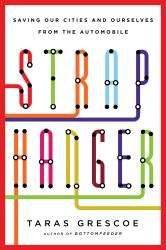
Straphanger

Straphanger: Saving Our Cities and Ourselves from the Automobile
336 pages
© 2012 Taras Grescoe


The cheap energy era is over, unless someone invents a Star Trek replicator that can magick barrels of oil into existence. Cities across the world are working to meet the challenge of keeping millions of people moving and their local economies growing by investing in mass transit. In Straphanger, Taras Grescoe visits thirteen cities in the Americas, Europe, and Asia to experience their transportation systems, finding what what works and what doesn't. These cities include not only those with long-successful and fully integrated systems, like Paris and Tokoyo, but cities like Phoenix which were built for the automobile and which are now trying to transform themselves. Watching these cities strive for the future has for Grescoe all the thrill of attending a rocket launch: when they're successful, it's glorious, but when they fail...the results aren't pretty.  Happily for Grescoe and readers, most of his accounts are of successful takeoffs -- and even the failures have something to teach.

Prior to the automobile, the great urban centers of the industrial age depended on transit systems to keep their expanding population mobile: even small cities could boast a trolley system. But as the automobile zoomed into the historical spotlight, these systems were abandoned and destroyed -- until now. The transit renaissance is not only bringing old systems back to life, but bettering them: only only are trains cleaner and faster these days, but the systems themselves are better thought-out. Take buses, for instance, which are increasingly being taken out of congested traffic and deployed in Bus Rapid Transit systems, in which they're given a full lane of the road, dedicated to them. Those who board these  have pre-purchased tickets, much like train lines -- allowing BRT drivers to more than double the average speed of their buses outside the system. BRT systems are ideal for poorer cities in desperate need of transit, but which lack the means to create more involved systems. like subways.

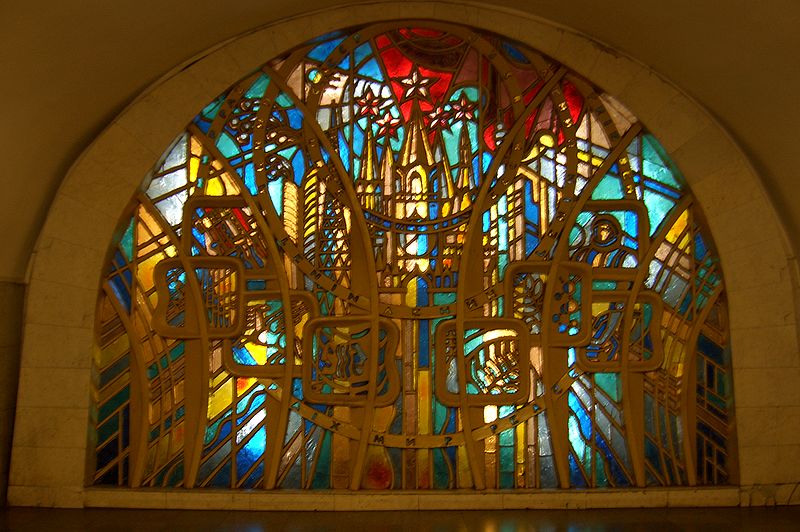
Straphanger combines history and public policy,  covering traditional transit (trolleys,  trains, and subways),  transitional transit with a twist (BRT), and bicycles as well. Although bicyles are individual vehicles, Grescoe demonstrates how they can be connected to cities' mass transit systems. For instance, in Paris, a Metro ticket that allows subway access can also be used to rent a bicycle to take to the train station -- and bus stops there nearby, as well. Copenhagan's history of recent expansion has been done while simutaneously promoting bicycle use, making it in Grescoe's view an excellent choice for American cities to study. The great lesson of Straphanger is that for mass transit to succeed, it must consist of a network that people can actually use to get places. Busses that run erratically are of no use to people who need to get to work on time, and bike lanes that go nowhere do more harm to the cause of bike commuting than good. Integration is a key element of that, both in working in transit options where people live, work, and shop, and in connecting those options to expand people's opportunities.  Paris' achievements in this field make it Grescoe's favorite, but Straphanger's writing doesn't focus just on functionality: he points out how transit can be a place for civic art, as exemplified by Moscow's subway, and expand people's quality of life:  cycling is fun, far more than sitting in gridlock.

Straphanger is a winsome, thoughtful, and entertaining book which should be of interest to citizens who want to make their communities better and more sustainable places to live.

Related:
Walkable City, Jeff Speck
Pedaling Revolution, Jeff Mapes
Waiting on a Train, Jeff McCommons
The Green Metropolis, Jeff  David Owen


Thursday, March 3, 2011

The History of Japan

The History of Japan
© 1918, 1947 Kenneth Scott Latourette
282 pages
""Under a Wave off Kanagawa", Katsushika Hokusai

In Fall 2009 I took a class in Japanese history and enjoyed it tremendously, but given that it's been well over a year, I figure I'm due for a refresher. My home library carried this slim narrative, which did the trick despite being a bit dated -- the most current revision was written in 1946, only months after Japan surrendered and ended the last conflict of the Second World War.

After describing the initial settlement and climate of the Japanese islands (complete with lovely photographs), Latourette begins the long story of the Japanese empire (legendarily declared thus in 660 BCE, around the same time Egypt and Assyria were arguing over who should rule Egypt). It's remarkable to me that a single institution has managed to survive over 1500 years of history, though largely in an impotent fashion. Japan was more strongly unified under the varying shogunates -- military administrations -- but emerged as a world power only in the late 19th century, when the warlords were ousted and the Emperor "restored".  Modernization -- and westernization, for the new government formed itself by drawing from various European powers like Germany and France -- followed, and Japan shifted from late-medievalism to modernity in scarcely more than a couple of decades, a remarkably dramatic transformation. Japan also pursued economic growth in the tried-and-true way of Europe's great powers and the United States -- invading other people, borrowing their resources, and turning them into markets for goods. This eventually led to war, defeat, and revival -- though the book doesn't cover Japan's resurgence.

Latourette is a generally fair author, easy to read for the most part. He doesn't have the patronizing tone I would've expected from an author of this period, though his partiality amused me at times. He cheerily reports the 'peaceful' Perry expedition's role in opening Japan up to the west by saying it was fortunate that this was led by the United States, who had no interests in the Far East.  When writing on the increase of tensions between the United States and Japan, he finally admits the presence of American interests by saying it was the 'unavoidable result of the force of circumstances' that the United States happened to be all over the Philippines and Guam. I'm not sure I carry his meaning.  Did a freak storm carry the US Navy all the way across the Pacific where it bumped into the Spanish navy and accidentally threw invasion troops into the islands, where they were trapped for four years?  Did Spain refuse to treat in peace with the United States unless America agreed met them on the field of battle in Manila? Inquiring minds want to know what this unavoidable force of circumstances was.

Aside from that, which elicited more laughter than anything else, the book proved amply adequate (by which I mean it skirted the line between average and above average)  at reminding me of what I'd learned in class previously. Indeed, it supplemented my knowledge because it placed more emphasis on Japan's rivalry with Russia than I'd witnessed in class, and the author frequently paused in his general narrative to explain how Japan was transforming from decade to decade, economically as well as socially.  It's thus useful, but dated -- and apparently obscure, because I couldn't so much as find a cover for it.

Related:

  • A Modern History of Japan (Andrew Gordon)
  • Peasants, Rebels, Women, and Outcastes: The Underside of Modern Japan, by Mikiso Hane. These two books were used in my course, along with Kokoro, but that's a novel. 
  • The Japanese Experience, W.G. Beasley, which I read in preparation for said class.
  • Our Oriental Heritage, Will Durant, which covers the ancient-to-modern histories of India, Japan, and China along with the ancient-era Mesopotamian history.

Tuesday, October 26, 2010

The Imperial Cruise

The Imperial Cruise: A Secret History of Empire and War
© 2009 James Bradley
387 pages

They may be sovereign countries, but you folks at home forget
That they all want what we've got, but they don't know it yet.

The Gilded Age may be characterized as the United States' coming of age, losing its innocence along the way. The former colony had by the early 20th century become an imperial state on its own -- collecting territories as though they were the spoils of some vast game of marbles. Following the end of the Indian Wars and the 'closing of the frontier', the United States looked outward -- to Cuba and the Philippines. This was the age wherein the United States became an industrial titan and a world power, and Theodore Roosevelt announced the US's entry into the big boy's club with the sailing of the Great White Fleet in late 1907: for just over a year, a large fleet of warships toured the world's oceans, demonstrating to one and all what the Americans were capable of. 

That fleet's voyage, however, is not the imperial cruise covered in this book. Bradley instead looks two years earlier, when a ship of diplomatic envoys made their way to Japan, Korea, and China after checking in on recent acquisitions like Hawaii and the Philippines. There, Roosevelt and his lieutenant, Secretary of War William Taft, made decisions that shaped Asia's history. They did so, Bradley believes, out of conviction in the White Man's Burden. According to Bradley, Roosevelt believed in the innate superiority of the Aryan race: the conquest of the world by the Anglo-Saxons proved it, and it was the Christian duty of Whites to spread the virtues of civilization across the world by any means necessary.  The Imperial Cruise is in essence a scathing condemnation of the United States' birth and expansion which sees the entire history of the US 'til that point as one great race war. This led Roosevelt in his arrogance to proclaim the Japanese "Honorary Aryans" and encourage them to establish a Monroe Doctrine of their own in the east, which put Japan on the course of empire herself -- a course that lead to Pearl Harbor when the Japanese Empire's ambitions succeeded Roosevelt's use for them.   "In this book I don’t so much write about Pearl Harbor, I only bring it up to say, what was the source of this explosion? Every divorce has a first kiss, I was looking for that first kiss...and I found that in the summer of 1905." (James Bradley, interview.)

Bradley makes three general claims: first, that the United States' expansion was motivated by something other than pure humanitarianism; two, that this expansion was fueled primarily by belief in white supremacism and imperial Christianity; and three, that Roosevelt went beyond the responsibilities of his office in sanctioning Japanese expansion in Korea and Manchuria.  Only the second claim is questionable to me, for as powerful as ideals -- even rotten ones -- are,  I see the wheels of history turning more on the basis of power and wealth; specifically, people attempting to accrue more of both to themselves.  Idealism is typically mere décor, justification. That the drivers of American history have been until the last half-century vicious racists is undeniable -- even those who tried to assume the high ground of Christian moralism are drowned by a sea of their own speeches, essays,and letters. I can believe that racism made waging war against others easier, but race as a primary motivation is too great a leap for me to make.

Aside from this, I think Imperial Cruise needs to be read: I only wish it were more effective. Bradley is a popular historian, and even the most uninformed of readers would be able to follow his narrative with ease: unfortunately, the narrative itself gets lost. Bradley starts with the cruise, then shifts to a history of the United States' conquest of Cuba and the Philippines. He returns to the cruise briefly, gives a history of Hawaii's own violent subjugation, and then proceeds to dip into Japanese history before finally returning to Taft's actions in Korea, China, and Japan. Imperial Cruise doesn't flow: it bounces cross the Pacific. Structuring a text with so much content is understandably difficult, but it doesn't appear to have been edited properly: Bradley repeats himself, and more than once I stopped to wonder why he was bringing this particular fact or quotation up again.

The book's weaknesses are disappointing, in part because the subject presents an opportunity to analyze American history critically, and draw lessons that Americans today would profit by: Taft and Roosevelt's repeated statements that the insurrection in the Philippines was almost over mirror Bush and Rumsfeld's  statements to the same effect concerning Iraq.  Done properly, the book could have forced readers to consider the United States' embracing of interventionist causes in the 20th century with a more critical eye -- and Bradley's publishing history (Flags of our Fathers, Flyboys)  would attract more mainstream readers than say, Howard Zinn, whose reputation discourages those less enthusiastic about criticizing American history from considering what he has to say. 


Related:
  • Mark Twain's Weapons of Satire, a collection of articles, essays, and such written against American imperialism against the Phillipines and Cuba.
  • Howard Zinn's People's History of the 20th Century
  • Zinn's People's History of American Empire, which picks up at the close of the Indian Wars.
  • Albert Marrin's The Spanish-American War, which is more apologetic than critical but still admits to the brutal treatment of the Phillipines by American forces. Interestingly, both Marrin and Bradley see McKinley as someone interested in peace, but beaten into submission by the press and warmongers like Roosevelt into sanctioning war against the Spanish. 


Friday, September 3, 2010

Our Oriental Heritage

The Story of Civilization: Our Oriental Heritage
© 1935 Will Durant
1048 pages

"Civilization is social order promoting cultural creation."  (Opening sentence.)

Our Oriental Heritage is the introductory volume of a greater work, an eleven-book set covering prehistory to the last days of Napoleon. Judging from the preface, Durant initially planned to write The Story of Civilization as a five-volume set that went beyond Napoleon, even approaching the 20th century. This first volume begins in prehistory, Durant spending time to comment on the evolution of civilization's economic, political, moral, and mental elements before beginning his trek proper with Sumeria. Egypt, Babylon, Assyria, Judea, Persia, India, China, and finally Japan follow. Although the majority of his subject nations have passed away into extinction, the latter three civilizations are still extant, and Durant follows their story up to the 'present day'.

Our Oriental Heritage is epic history: not only is the timeframe at hand vast, but Durant's approach is to tackle politics, religion, science, art, drama, and artisanry all together, giving his story depth as well as breadth. Despite the abundance of information, his presentation is never confusing. Sections are clearly delineated, and I enjoyed Durant's writing style: he's approachable, but dramatic, often waxing on eloquently about a particular poet, ruler, or philosophy. There's also occasional humor --  dry, of course, as historian humor tends to be.

Throughout Durant's work, civilizations rise and fall like waves crashing on a beachhead: they are born, he says, in stoicism, and perish in epicureanism. Those words are used chronically throughout the book, fading only in the last two general portions. I don't rightly understand that characteristic of his writing. While the misuse of epicureanism is understandable (being common, and objectionable only to people familiar with Epicures) as referring to powerful, rich states that grow sedentary in their success, slowly rotting inside before falling to a more youthful power,  'stoicism' always seemed out of place. He used it most often to refer to newfound religions or philosophical approaches that were puritanically moralistic.

Durant's place in all this seems a bit odd: while he approves of progress and prosperity, they reach their height during these epicurean periods which involve a worship of the intellect and the decline of emotionally-charged elements of civilization, particularly religion. He habitually mourns this decay, thinking of religion as a means by which people put their persistent tendency to believe in the supernatural to use -- strengthening individual characters, offering consolation to the suffering, and strengthening society and social order. Thus he tacitly approves of the vibrant religion of those who finish the decadent civilizations off and establish their own, all the while sadly recounting the horrors that the conquerors visit upon the vanquished. (Hinduism is the only religion in his book that doesn't attack the beliefs or artifacts of other civilizations, apparently because it co-copts them. Buddhism doesn't die in India: Hinduism simply absorbs it.)

As I cannot comment intelligently on much of the content (being wholly ignorant of some of his subjects, particularly early India and China), I can only say that I enjoyed reading the work, quirks included, and that I think my understanding of part of the human story improved for having read it. The book's age is somewhat problematic for the reader looking for a work like this: in Durant's world, the "present day" is the early 1930s -- and much has changed since then. Hitler has been the chancellor of Germany for two years and is swiftly turning it into a totalitarian nightmare;  Great Britain is the master of India, and Imperial Japan has annexed both Korea and a northern province of China, operating it as the puppet-state Manchukwo. Durant speculates on whether Japan and the United States will fight over their competing economic interests in the Pacific: he thinks they will, in all likelihood,  for economic competition has driven war throughout human history. Although old scholarship isn't necessarily bad scholarship, in the nearly eighty years since this book first saw publication, archaeological discoveries or linguistic breakthroughs might have added context that makes Durant's summaries inaccurate. An inconsequential example of this is Piltdown Man, which Durant references in tracking prehistorical hominids across Eurasia: Piltdown Man is a hoax, one not exposed until the 1950s.

There are undoubtedly other books and series written in the subject of ancient history or general surveys,  probably some written within the last decade with up-to-date scholarship. Are there better books in this subject? That I can't answer, not having read any series to recommend this book over. As said before, I did enjoy the book and do think myself edified for having read it. Durant's distinguishing characteristic, I imagine, is his decision to give a history that does not discount one thread of human life for another -- instead, he pursues economics, politics, religion, philosophy, drama, literature, and the like all with equal diligence. That approach is why I decided to start reading the series, it is why I will continue in it, and it is why I think the book worth your investigation if the subject is of interest to you.

Related:

Wednesday, October 7, 2009

Kokoro

Kokoro
© 1957 Natsume Soseki
248 pages

Photobucket

A favorite history professor of mine typically assigns novels as part of his required reading, and for his Modern Japanese History course, I read a novel set in the last years of the Meiji period. The title refers to "the heart of things". My instructor introduced it as being one of his favorite historical novels, and one that doesn't seem foreign in the least. Despite this disclaimer, the novel does not fit western conventions of what a novel "is": the formula of conflict, rising action, climax, and resolution do not easily fit the work. This by no means detracts from the reading experience: it makes it different. The book is divided into three unequal sections: the first two are narrated by a never-named college senior who describes his growing friendship with a resident of Tokyo, a man he refers to only as "Sensei". Their friendship is developed in the first section, and the second section sees our narrator graduate from the university in Tokoyo and return to his parents' home. Although he wants to return to Tokyo to begin his life -- hopefully one like Sensei's, involving no job and plenty of leisure time to putter around and read books -- his father's ailing health prevents him from doing so. As the Meiji period and his father's life come to their end, our narrator receives a long letter from Sensei -- unusual, because Sensei is not in the habit of writing letters, long or otherwise. That letter, "Sensi's Testament", constitutes the bulk of the book and makes him the effective main character of the novel. The book ends with Sensi's revelations, making me wonder how the initial narrator might have reacted or responded to them.

What strikes me most about Kokoro is its sense of melancholy: whenever scenes from the books wrote themselves into my head, the skies were forever grey.The characters moved slowly under them, beset by frowns on their faces. A few characters try to remain chipper, but they can only "whistle in the graveyard". Discussions from a sociological theory class came to mind: the author's focus seems to be on human reactions to increasing modernity, and the resulting sense of alienation and loneliness. Fighting loneliness is a preoccupation of most of the book's characters: the narrator seeks Sensei out as part of that fight, and Sensei's own life has been altered dramatically by his own fight and his role in others' fighting.

I would reccommend the book in the same way I would reccommend an interesting strain of tea: I think it should be experienced, and it leaves a thoughtful aftertaste.

Monday, August 24, 2009

The Japanese Experience

The Japanese Experience: A Short History of Japan
© 1999 W. G. Beasley
299 pages, including glossary and index.

I checked this book out in April 2007. I remember this well, because I tried reading it on April 22. It was Earth Day, and I decided to spend the late afternoon in a field, laying on my back and watching the clouds while occassionally reading from the book and talking to friends. It was a glorious afternoon that ended when I accidently rolled into a patch of stinging nettles. I'd checked the book out then for the same reason I checked it out last week -- to prepare myself for a Japanese history class. I didn't take that class in 2oo7 because it was a night class and I wanted to avoid such a thing, but in the years since I've had two night classes with the same instructor and have found them to be mildly tolerable -- and this next semester, I will be studying Japanese history on Thursday nights from 5 to 7:30.

Although I have performed well in previous classes with the same instructor, I had the advantange of knowing my subject: European history. My knowledge of Japanese history, or of anything relating to Japanese culture, is extremely limited. I know, for instance, that Shinto and Zen Buddhism were once strong there, that Japan went through a period often described as feudral (to the chagrine of another one of my instructors, a medieval historian who insists feudalism is a uniquley western affair), that it adopted modernization to catch up with the west, and that it was hard-hit by the Depression. Outside of this, though, I am unknowledgable, and so Japan seems as foreign to me as a race from Star Trek. Indeed, there were passages in this book where I might as well have been reading background information for a fantasy story: the names and places have utterly no significance to me. I don't want to go into class wholly unprepared, though, so I've decided to do a little background reading before classes start. (Mine do not start until next week, for those curious. We seem to start later than other universities.)

Beasley offers a short history of Japan from the beginnings of its imperial age to the recession of the 1990s. That's a lot to go over in only 300 pages, so Beasley doesn't go into a lot of detail. He tracks political, economic, and cultural changes throughout those hundreds of years, focusing on especially notable leaders and movements. A dominant theme is Japan's place in Asia -- first dominated by China and its culture, and later attempting to reverse the relationship in creating the "Co-Prosperity Economic Sphere". Despite the breadth of information he has to cover, Beasley delivers a fairly readable narrative that -- while having to ignore lots of specifics, I would assume -- gives the reader a general impression of how things have proceeded. The book is supplemented with two sets of plates, mostly consisting of artwork: the two lone photographs are from the late 1930s and mid-1940s.

For those who know little of Japan and wish to know a bit more, I reccommend the book.