Dragon's Teeth
© 2017 Michael Crichton
288 pages
Scientific discovery isn't always a gentlemanly affair. Dragon's Teeth, published by the estate of Michael Crichton in his name, inserts a fictional character into the real-life feud of two paleontologists who went to such lengths to undermine the other that their rivalry was given the name "Bone Wars" and documented in books like Great Feuds in Science. William Johnson, our main character, is an unwitting participant in the Bone Wars who signs up with Professor Marsh of Yale on a bet; he will join Marsh's summer expedition out west or forfeit $1000, no small sum in 1876. Suspected of being a spy for Marsh's nemesis, Edward Cope, Johnson is abandoned in Wyoming and forced to throw in with the man he'd been told to despise and fear. That summer would see him help discover the first evidence of a "Brontosaurus", and later attempt to get the bones back to civilization despite being on the front lines of the Indian wars, with nearby towns like Deadwood scarcely more safe. Although Dragon Teeth is not a typical Crichton novel, it is a western adventure with a science twist. The emphasis is on western adventure, however; Wyatt Earp is an important character in the second half of the book, and the story overall is one of a soft 'down-Easterner' learning how to be a man -- a real man, a man of the west whose hands are hard with work, aiding a mind quick enough to outwit gunslingers, avaricious treasure hunters, and lying dames. Not your typical Crichton, but it's a fun combination of cowboys and dinosaurs.
Pursuing the flourishing life and human liberty through literature.
"Once you learn to read, you will be forever free." - Frederick Douglass
Showing posts with label Michael Crichton. Show all posts
Sunday, August 27, 2017
Tuesday, August 22, 2017
State of Fear
State of Fear
© 2004 Michael Chrichton
672 pages
I stumbled upon State of Fear via Rousseau, oddly enough. Wikiquote’s page on Rousseau included an excerpt from a Michael Crichton article rebuking Rousseau’s “noble savage” myth. The article in question scrutinized political environmentalism, and after reading it I decided to give State of Fear a try. In the article, Crichton drew the same parallel between environmentalism and cultural christianity that I personally observed about peak oil scenarios after I encountered Jim Kunstler*. Crichton‘s work is more cultural criticism than novel, however, given that his introduction effectively spoils the plot: the reader knows in advance that nothing at all is going to happen aside from a few deaths on the far side of the world. The real reason to read the novel is to understand what Crichton means by a ‘state of fear’, and how politics is involved.
The plot in question is fairly simple: an environmental group is preparing the launch of a major initiative, and as part of the campaign they want to engineer a few natural disasters that will unfold within the same week. Their major political donor catches wind that something odd is going on, and in the midst of pulling their funding he seems to commit suicide. A few good guys stumble upon the plot, midway through the Crichton Lecture arrives, and then the novel wraps up just as the introduction indicated it would. I didn't care about any of the characters, and poked along entirely for the author arguments.
The Crichton Lecture is part of any Crichton novel, and usually apprises the reader on the limits of knowledge and the arrogance of power. Here, it speculates that since the end of the Cold War, the powers that be (a political-legal complex supplanting the military-industrial complex) have sought to maintain the same level of constant dread among the American populace through one bogey or another, and at present the imminent collapse of the environment is their favorite. It has proved to have multiple heads; looming extinctions, natural disasters, and resource depletion are but a few. As is usual for a Crichton novel, he presents readers with the same information that the characters are faced with: in this case, graphs. Crichton does not dispute the growing rise of carbon dioxide, or that humans are responsible; what he disputes is that there has been a global increase in temperatures as a result. Crichton mainly uses a series of graphs that indicates that temperatures in North America have been more constant that not, and a series of city heat records that calls the “main” graph, the one showing correlated heat and CO2 rises, into question. He argues, via one of the characters, that the data used in the main graph indicating rising temperatures is based on flawed data. How seriously can we data produced in China during its decades of turmoil, for instance? Other arguments, like that the weakening of Antarctic ice is localized to one peninsula and that Antarctica as a whole has been gaining ice -- after several thousand years of losing it -- are also included.
Frankly, this isn’t an argument I care to wade in to. My environmental sensibilities are rooted in immediate stewardship, not far-off dangers -- in taking care of what is given to us. This means cleaning up after ourselves and not being wasteful; my own interests in humane urbanism and fiscal sustainability promote "environmental" measures. That said, my experience with doom forecasters like Kunstler, and my regular reading of environmental writers like Wendell Berry and Edward Abbey (who have criticized DC‘s mismanagement of land) has induced a heavy amount of skepticism about the efficacy of politically-motivated technocratic intervention However, the bulk of Crichton’s argument was based on that large graph, and not on anything like ice core studies. Since reading the book I’ve been googling about reading articles about particular claims, and the flicker of interest has been squashed down again by the name-calling. I think I will just keep cleaning up after myself. If the oceans rise and we are replaced by dolphins, well -- it’s not that much of a loss.
*To quote from my 2008 "Response", written shortly after listening to Kunstler at my university:
© 2004 Michael Chrichton
672 pages
I stumbled upon State of Fear via Rousseau, oddly enough. Wikiquote’s page on Rousseau included an excerpt from a Michael Crichton article rebuking Rousseau’s “noble savage” myth. The article in question scrutinized political environmentalism, and after reading it I decided to give State of Fear a try. In the article, Crichton drew the same parallel between environmentalism and cultural christianity that I personally observed about peak oil scenarios after I encountered Jim Kunstler*. Crichton‘s work is more cultural criticism than novel, however, given that his introduction effectively spoils the plot: the reader knows in advance that nothing at all is going to happen aside from a few deaths on the far side of the world. The real reason to read the novel is to understand what Crichton means by a ‘state of fear’, and how politics is involved.
The plot in question is fairly simple: an environmental group is preparing the launch of a major initiative, and as part of the campaign they want to engineer a few natural disasters that will unfold within the same week. Their major political donor catches wind that something odd is going on, and in the midst of pulling their funding he seems to commit suicide. A few good guys stumble upon the plot, midway through the Crichton Lecture arrives, and then the novel wraps up just as the introduction indicated it would. I didn't care about any of the characters, and poked along entirely for the author arguments.
The Crichton Lecture is part of any Crichton novel, and usually apprises the reader on the limits of knowledge and the arrogance of power. Here, it speculates that since the end of the Cold War, the powers that be (a political-legal complex supplanting the military-industrial complex) have sought to maintain the same level of constant dread among the American populace through one bogey or another, and at present the imminent collapse of the environment is their favorite. It has proved to have multiple heads; looming extinctions, natural disasters, and resource depletion are but a few. As is usual for a Crichton novel, he presents readers with the same information that the characters are faced with: in this case, graphs. Crichton does not dispute the growing rise of carbon dioxide, or that humans are responsible; what he disputes is that there has been a global increase in temperatures as a result. Crichton mainly uses a series of graphs that indicates that temperatures in North America have been more constant that not, and a series of city heat records that calls the “main” graph, the one showing correlated heat and CO2 rises, into question. He argues, via one of the characters, that the data used in the main graph indicating rising temperatures is based on flawed data. How seriously can we data produced in China during its decades of turmoil, for instance? Other arguments, like that the weakening of Antarctic ice is localized to one peninsula and that Antarctica as a whole has been gaining ice -- after several thousand years of losing it -- are also included.
Frankly, this isn’t an argument I care to wade in to. My environmental sensibilities are rooted in immediate stewardship, not far-off dangers -- in taking care of what is given to us. This means cleaning up after ourselves and not being wasteful; my own interests in humane urbanism and fiscal sustainability promote "environmental" measures. That said, my experience with doom forecasters like Kunstler, and my regular reading of environmental writers like Wendell Berry and Edward Abbey (who have criticized DC‘s mismanagement of land) has induced a heavy amount of skepticism about the efficacy of politically-motivated technocratic intervention However, the bulk of Crichton’s argument was based on that large graph, and not on anything like ice core studies. Since reading the book I’ve been googling about reading articles about particular claims, and the flicker of interest has been squashed down again by the name-calling. I think I will just keep cleaning up after myself. If the oceans rise and we are replaced by dolphins, well -- it’s not that much of a loss.
*To quote from my 2008 "Response", written shortly after listening to Kunstler at my university:
It's a secular doomsday scenario. While religious scenarios see society destroyed by the corruption of sin, followed by the restoration of proper living and morality, this scenario sees society undermined by a dependence on "free energy" and a return to "simpler" living, to 'sustainability'.
Tuesday, August 9, 2016
Rising Sun
Rising Sun
385 pages
© 1992 Michael Crichton
In downtown Los Angeles, in a gleaming tower of Japanese commercial success, a woman lies dead on a boardroom table. The grand opening of the Nakamoto Corporation's downtown skyscraper attracted celebrities and politicians alike, all anxious to impress the Japanese businessmen who play such an important part in the U.S. economy. It was supposed to be a festive occasion, but instead it's turned into a source of anxiety and dread: this murder-in-the-office stuff is very bad for publicity. It turns out to be a major source of trouble for the police assigned to investigate, too, because to Nakamoto, business is war...and if trouble-making cops can't be bribed, they can be 'removed'.
Rising Sun combines a police procedural with a business thriller, and ends with an ominous note from Crichton that the Japanese are taking over the American economy and we'd better do something. Published just as the Japanese were drifting into their 'lost decade', that warning now makes it seem slightly dated. Despite this, the technological aspect gives the book a solid sci-fi edge; though set in the 1990s, we see wireless cameras, facial-recognition software, and image manipulation so intensive that the courts no longer permit imagery as evidence. Here we have forensic technology long before CSI made it popular, but most of the character-lecturing is done in regards to Japanese culture, history, and business practices. I know next to nothing about Japanese economic history, so I don't know when Crichton leaves history behind for alt-history here. His 1990s-America is virtually a Japanese economic colony, with only its university system keeping it from being an utter subordinate. So awed by the Japanese are these Americans that Japanese lingo has crept into common usage among the political and business elite, and their power is such that LA cops have a time getting the Nakamoto Corp's officers to let them investigate. I was a little suspicious of Crichton's economic doomsaying; if the Japanese were 'dumping' under-priced goods onto the American market, why couldn't those goods be purchased by American companies and sold as their own? Crichton's fear is not quite as irrelevant as it seems, because today we hear the same fears about China. right down to the concern that their ownership of so much American debt is a national security problem. Awareness that there must be a line between national security and profitable participation in the global economy has become an issue in the presidential debate this year as well.
Despite being dated in some ways, Rising Sun made for a very interesting read, both as a technologically-savvy police novel ahead of the curve, and as an alt-history piece which features Japanese characters and culture heavily.
385 pages
© 1992 Michael Crichton
In downtown Los Angeles, in a gleaming tower of Japanese commercial success, a woman lies dead on a boardroom table. The grand opening of the Nakamoto Corporation's downtown skyscraper attracted celebrities and politicians alike, all anxious to impress the Japanese businessmen who play such an important part in the U.S. economy. It was supposed to be a festive occasion, but instead it's turned into a source of anxiety and dread: this murder-in-the-office stuff is very bad for publicity. It turns out to be a major source of trouble for the police assigned to investigate, too, because to Nakamoto, business is war...and if trouble-making cops can't be bribed, they can be 'removed'.
Rising Sun combines a police procedural with a business thriller, and ends with an ominous note from Crichton that the Japanese are taking over the American economy and we'd better do something. Published just as the Japanese were drifting into their 'lost decade', that warning now makes it seem slightly dated. Despite this, the technological aspect gives the book a solid sci-fi edge; though set in the 1990s, we see wireless cameras, facial-recognition software, and image manipulation so intensive that the courts no longer permit imagery as evidence. Here we have forensic technology long before CSI made it popular, but most of the character-lecturing is done in regards to Japanese culture, history, and business practices. I know next to nothing about Japanese economic history, so I don't know when Crichton leaves history behind for alt-history here. His 1990s-America is virtually a Japanese economic colony, with only its university system keeping it from being an utter subordinate. So awed by the Japanese are these Americans that Japanese lingo has crept into common usage among the political and business elite, and their power is such that LA cops have a time getting the Nakamoto Corp's officers to let them investigate. I was a little suspicious of Crichton's economic doomsaying; if the Japanese were 'dumping' under-priced goods onto the American market, why couldn't those goods be purchased by American companies and sold as their own? Crichton's fear is not quite as irrelevant as it seems, because today we hear the same fears about China. right down to the concern that their ownership of so much American debt is a national security problem. Awareness that there must be a line between national security and profitable participation in the global economy has become an issue in the presidential debate this year as well.
Despite being dated in some ways, Rising Sun made for a very interesting read, both as a technologically-savvy police novel ahead of the curve, and as an alt-history piece which features Japanese characters and culture heavily.
Sunday, August 7, 2016
Airframe
Airframe
© 1995 Michael Crichton
352 pages
What could happen on a plane to leave three people dead, fifty others seriously wounded, and the passenger cabin in ruins? Why did its pilot only break radio silence shortly before he was due to land in Los Angeles? Thus begins Airframe, a technical mystery from the pen of Michael Crichton, in which one woman has to scramble to find answers before either her company's life-saving contract with China falls through or before a union upset ripens into war on the plant floor. This is the first book I've read by Crichton which is not science fiction, although it's still very much the technical thriller, with a nerd-thrilling abundance of information on aviation and the aeronautics business. It's not merely dumped on the reader, but introduced through characters who stand in for the reader and need to have all of the tech-speak around them translated. Airframe isn't purely technical, as Crichton also develops a business conspiracy angle to make the reader wonder if the accident wasn't one at all. There's also a little bit of author-lecture, as Crichton delivers a rolling barrage at television 'news', condemned as vapid and sensationalistic. None of the characters are particularly compelling, but in a Crichton novel they rarely are. It is the pursuit of the mystery, simultaneously learning a great deal about an important aspect of global 'civilization', that drives this one. I enjoyed it enormously.
© 1995 Michael Crichton
352 pages
What could happen on a plane to leave three people dead, fifty others seriously wounded, and the passenger cabin in ruins? Why did its pilot only break radio silence shortly before he was due to land in Los Angeles? Thus begins Airframe, a technical mystery from the pen of Michael Crichton, in which one woman has to scramble to find answers before either her company's life-saving contract with China falls through or before a union upset ripens into war on the plant floor. This is the first book I've read by Crichton which is not science fiction, although it's still very much the technical thriller, with a nerd-thrilling abundance of information on aviation and the aeronautics business. It's not merely dumped on the reader, but introduced through characters who stand in for the reader and need to have all of the tech-speak around them translated. Airframe isn't purely technical, as Crichton also develops a business conspiracy angle to make the reader wonder if the accident wasn't one at all. There's also a little bit of author-lecture, as Crichton delivers a rolling barrage at television 'news', condemned as vapid and sensationalistic. None of the characters are particularly compelling, but in a Crichton novel they rarely are. It is the pursuit of the mystery, simultaneously learning a great deal about an important aspect of global 'civilization', that drives this one. I enjoyed it enormously.
Saturday, May 7, 2016
Sphere
Sphere
© 1987 Michael Crichton
385 pages
Norman Thomas is accustomed to government officials asking for his assistance to counsel survivors at plane crashes, but traveling fifteen hours into the middle of the Pacific is a first. Upon arrival, John finds not an island with aircraft remains, but a small fleet of ships from the US Navy: and the object of their concern isn’t a crashed vessel at all. It’s a sunken ship…a spaceship….that is three hundred years old. So begins an eerie psychological thriller, as Thomas and a team chosen to make first contact with unknown life forms are taken by sub deep into the bottom of the ocean, into a lightless world of fear and wonder.
Johnson came to the Navy’s attention when, during the Carter Administration, he submitted a report to a committee concerned with extraterrestrial life. It wasn’t a subject he took seriously, but they offered him money for educated guesses, and with a house to pay for he was more than happy to make guesses. Those guesses have become US policy, and the recommendations he made have become his own hand-picked team of zoologists and other professionals. From the beginning Johnson and the other civilians suspect the Navy knows more than it is letting on, but the surprises are only starting: when the craft is breached, it proves to be not of extraterrestrial origin, but is human-made, with English signage and stocked with Coca-Cola! But the interior of the ship has still more surprises, alien and powerful, and after a hurricane scatters the surface fleet the explorers are left marooned thousands of few below. There, as strange happenings start to claim their lives, the slowly-dwindling survivors begin to question their own sanity.
Sphere is a remarkably creepy book, a genuine thriller: from the beginning, its developments incite curiosity, and later dread. How did a human spaceship, whose operating principles and material are far beyond the present’s abilities, come to be buried beneath centuries of coral and the oceans themselves? What was its mission, what is the meaning of its baffling cargo (a mysterious black sphere), and…why do people keep dying? Strange animals keep appearing around the underwater habitat, including a giant squid that can heavily damage it; the built environment around them keeps adding surprises, things suddenly being there that weren’t before…and then there’s 'Jerry', some strange entity attempting to communicate with the crew. “Jerry’s” conversational skills have an uncanny aspect, familiar yet menacing. Ultimately, even the psychologist-narrator seems on the verge of cracking up before an explosive conclusion.
I’ve only read a few of Crichton’s works (Andromeda Strain, Timeline, Jurassic Park, Lost World), but this ranks near the top. It is a psychological thriller, not only because the characters seem to be collectively losing their mind, but because Crichton’s author-lecture addresses perception, imagination, and reality. The alien here is utterly alien; this isn’t a Star Trek humanoid with a bumpy nose, or even a SF monster that has a mouth, eyes, and the desire to eat what it sees. The alien presence here is not comprehensible; the characters don’t even know if they’re seeing an actual sphere, or some part of a transdimensional object that merely looks like a sphere in our plane of existence. Crichton’s writing may be plain, but what a scientifically-inspired imagination!
© 1987 Michael Crichton
385 pages
Norman Thomas is accustomed to government officials asking for his assistance to counsel survivors at plane crashes, but traveling fifteen hours into the middle of the Pacific is a first. Upon arrival, John finds not an island with aircraft remains, but a small fleet of ships from the US Navy: and the object of their concern isn’t a crashed vessel at all. It’s a sunken ship…a spaceship….that is three hundred years old. So begins an eerie psychological thriller, as Thomas and a team chosen to make first contact with unknown life forms are taken by sub deep into the bottom of the ocean, into a lightless world of fear and wonder.
Johnson came to the Navy’s attention when, during the Carter Administration, he submitted a report to a committee concerned with extraterrestrial life. It wasn’t a subject he took seriously, but they offered him money for educated guesses, and with a house to pay for he was more than happy to make guesses. Those guesses have become US policy, and the recommendations he made have become his own hand-picked team of zoologists and other professionals. From the beginning Johnson and the other civilians suspect the Navy knows more than it is letting on, but the surprises are only starting: when the craft is breached, it proves to be not of extraterrestrial origin, but is human-made, with English signage and stocked with Coca-Cola! But the interior of the ship has still more surprises, alien and powerful, and after a hurricane scatters the surface fleet the explorers are left marooned thousands of few below. There, as strange happenings start to claim their lives, the slowly-dwindling survivors begin to question their own sanity.
Sphere is a remarkably creepy book, a genuine thriller: from the beginning, its developments incite curiosity, and later dread. How did a human spaceship, whose operating principles and material are far beyond the present’s abilities, come to be buried beneath centuries of coral and the oceans themselves? What was its mission, what is the meaning of its baffling cargo (a mysterious black sphere), and…why do people keep dying? Strange animals keep appearing around the underwater habitat, including a giant squid that can heavily damage it; the built environment around them keeps adding surprises, things suddenly being there that weren’t before…and then there’s 'Jerry', some strange entity attempting to communicate with the crew. “Jerry’s” conversational skills have an uncanny aspect, familiar yet menacing. Ultimately, even the psychologist-narrator seems on the verge of cracking up before an explosive conclusion.
I’ve only read a few of Crichton’s works (Andromeda Strain, Timeline, Jurassic Park, Lost World), but this ranks near the top. It is a psychological thriller, not only because the characters seem to be collectively losing their mind, but because Crichton’s author-lecture addresses perception, imagination, and reality. The alien here is utterly alien; this isn’t a Star Trek humanoid with a bumpy nose, or even a SF monster that has a mouth, eyes, and the desire to eat what it sees. The alien presence here is not comprehensible; the characters don’t even know if they’re seeing an actual sphere, or some part of a transdimensional object that merely looks like a sphere in our plane of existence. Crichton’s writing may be plain, but what a scientifically-inspired imagination!
Labels:
horror,
Michael Crichton,
science fiction,
sea stories,
thriller
Tuesday, September 7, 2010
Timeline
Timeline
© 1999 Michael Crichton
444 pages

What happens when quantum mechanics and medieval history meet? Specifically, what happens when a team of American archaeologists excavating the site of a ruined medieval fortress-town are approached by the techno-firm ITC which is sponsoring the dig and asked to undertake an expedition into the past to find their missing professor?
In unearthing the foundation of a monastery and castle, the team is already exploring the past -- but ITC offers them an opportunity to do so in an altogether different way. ITC's interest in quantum teleportation inadvertently made a form of time-travel possible, and in the years since they first realized this, they've moved toward capitalizing on the discovery. They have constructed machines capable of sending a person or persons into the past: Professor Johnston, the team's leader, has used one of those machines to enter the world of medieval France during the Hundred Years War. He has not yet returned, and so the two grad students and isolated adults involved in the history site are dispatched to find him.
What follows is a curious blend of science fiction and history as the team attempts to navigate the world of medieval France. It is a world no less dangerous than invented in Crichton's Jurassic Park: the English-held castle being investigated at the outset of the novel is under siege by the French army, and violating social customs carries dangerous of its own -- as one of the grad students, Chris, finds out when he picks up a glove thrown at him by an insulted nobleman and accidentally accepts a challenge to joust. What makes the book a thriller is that so much goes wrong on both ends: while the grad students and their guide try to avoid being taken for witches and spies, overcoming a language barrier and surviving court intrigue, ITC experiences an equipment malfunction that may prevent the expedition members from returning safety.
It's certainly a fun story, and one rich in detail. History is a great love for me, and medieval history is a pet interest: I enjoyed seeing the two students react to their expectations being completely confounded, and found their realizations more interesting than the actual plot. As in Jurassic Park and its sequel, Crichton has a character to lecture throughout the novel: his eccentric Marek is as much fun to read as Ian Malcolm. His lectures were in line what I've been learning about the medieval era through my university studies and outside reading, and I hope that this novel has seduced a reader or two to find out more about history in general, for Crichton comments on its importance more than a few times.
This should be of interest to both SF and historical fiction fans.
Related:
© 1999 Michael Crichton
444 pages

What happens when quantum mechanics and medieval history meet? Specifically, what happens when a team of American archaeologists excavating the site of a ruined medieval fortress-town are approached by the techno-firm ITC which is sponsoring the dig and asked to undertake an expedition into the past to find their missing professor?
In unearthing the foundation of a monastery and castle, the team is already exploring the past -- but ITC offers them an opportunity to do so in an altogether different way. ITC's interest in quantum teleportation inadvertently made a form of time-travel possible, and in the years since they first realized this, they've moved toward capitalizing on the discovery. They have constructed machines capable of sending a person or persons into the past: Professor Johnston, the team's leader, has used one of those machines to enter the world of medieval France during the Hundred Years War. He has not yet returned, and so the two grad students and isolated adults involved in the history site are dispatched to find him.
What follows is a curious blend of science fiction and history as the team attempts to navigate the world of medieval France. It is a world no less dangerous than invented in Crichton's Jurassic Park: the English-held castle being investigated at the outset of the novel is under siege by the French army, and violating social customs carries dangerous of its own -- as one of the grad students, Chris, finds out when he picks up a glove thrown at him by an insulted nobleman and accidentally accepts a challenge to joust. What makes the book a thriller is that so much goes wrong on both ends: while the grad students and their guide try to avoid being taken for witches and spies, overcoming a language barrier and surviving court intrigue, ITC experiences an equipment malfunction that may prevent the expedition members from returning safety.
It's certainly a fun story, and one rich in detail. History is a great love for me, and medieval history is a pet interest: I enjoyed seeing the two students react to their expectations being completely confounded, and found their realizations more interesting than the actual plot. As in Jurassic Park and its sequel, Crichton has a character to lecture throughout the novel: his eccentric Marek is as much fun to read as Ian Malcolm. His lectures were in line what I've been learning about the medieval era through my university studies and outside reading, and I hope that this novel has seduced a reader or two to find out more about history in general, for Crichton comments on its importance more than a few times.
This should be of interest to both SF and historical fiction fans.
Related:
- Virtually anything by Frances and Joseph Gies, especially Cathedral, Forge, and Waterwheel, which Crichton lists in the bibliography.
Labels:
Medieval,
Michael Crichton,
science fiction,
thriller
Tuesday, August 24, 2010
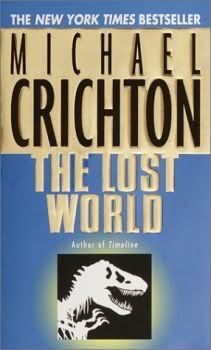
The Lost World
The Lost World
© 1995 Michael Crichton
431 pages

In the 1980s, a biocompany called InGen discovered a way to isolate dinosaur DNA and patented a cloning process intended to bring the dead back to life. Majestic and fearsome beasts who once ruled the Earth were resurrected in laboratories, intended to be the featured attractions of a resort park intended to amuse their successors -- humanity. The park's first visitors -- including paleontologists, a lawyer, and a chaos theorist named Ian Malcolm -- witness the catastrophic failure of the park's systems within hours of spotting their first dinosaur. The park died amidst intrigues from a rival biocompany (BioSyn) and nature's fury -- though Malcolm would insist that so complex a system was doomed from its beginnings. The Costa Rican military and InGen are eager to destroy all evidence of the failed project, but they're not as thorough as they ought to have been -- for now, five years later, corpses from another epoch are washing up on the beaches of Pacific islands.
The Lost World follows the same basic pattern as Jurassic Park: evidence of dinosaurs appears to people who have no idea the park existed, the evidence trickles down to our primary characters, they visit the island and have a "WHOA! Dinosaurs!" moment, and then a deadly pandemonium ensues: the lead characters run around the island losing equipment, sanity, and friends while Dr. Malcolm lectures. In The Lost World, Malcolm applies chaos theory to the efforts by paleontologists to explain the extinction of the dinosaurs. The familiar pattern does not distract from the book: dinosaurs are a powerfully interesting subject, and as the characters talk about various species in an attempt to reason out the best way to escape, the reader is treated to mini-lectures compiling modern dinosaur research from scientists like Jack Horner. In the last novel, Crichton seemingly honored Horner with a proxy character: in this, he acknowledges Horner directly. Crichton does drama well: his text is replete with foreboding descriptions and cliffhanging segments.
The Lost World is terrific fun -- lots of tension, and the dinosaur mini-lectures are certainty informative. Malcolm tends toward the anti-scientific at some points, but I suppose that's in-character for an eccentric iconoclast.
© 1995 Michael Crichton
431 pages

"'Ooh, aah'. That's always how it starts. Then later there's the running and the screaming." - Dr. Ian Malcolm, The Lost World
In the 1980s, a biocompany called InGen discovered a way to isolate dinosaur DNA and patented a cloning process intended to bring the dead back to life. Majestic and fearsome beasts who once ruled the Earth were resurrected in laboratories, intended to be the featured attractions of a resort park intended to amuse their successors -- humanity. The park's first visitors -- including paleontologists, a lawyer, and a chaos theorist named Ian Malcolm -- witness the catastrophic failure of the park's systems within hours of spotting their first dinosaur. The park died amidst intrigues from a rival biocompany (BioSyn) and nature's fury -- though Malcolm would insist that so complex a system was doomed from its beginnings. The Costa Rican military and InGen are eager to destroy all evidence of the failed project, but they're not as thorough as they ought to have been -- for now, five years later, corpses from another epoch are washing up on the beaches of Pacific islands.
The Lost World follows the same basic pattern as Jurassic Park: evidence of dinosaurs appears to people who have no idea the park existed, the evidence trickles down to our primary characters, they visit the island and have a "WHOA! Dinosaurs!" moment, and then a deadly pandemonium ensues: the lead characters run around the island losing equipment, sanity, and friends while Dr. Malcolm lectures. In The Lost World, Malcolm applies chaos theory to the efforts by paleontologists to explain the extinction of the dinosaurs. The familiar pattern does not distract from the book: dinosaurs are a powerfully interesting subject, and as the characters talk about various species in an attempt to reason out the best way to escape, the reader is treated to mini-lectures compiling modern dinosaur research from scientists like Jack Horner. In the last novel, Crichton seemingly honored Horner with a proxy character: in this, he acknowledges Horner directly. Crichton does drama well: his text is replete with foreboding descriptions and cliffhanging segments.
The Lost World is terrific fun -- lots of tension, and the dinosaur mini-lectures are certainty informative. Malcolm tends toward the anti-scientific at some points, but I suppose that's in-character for an eccentric iconoclast.
Labels:
dinosaurs,
Michael Crichton,
science fiction,
thriller
Sunday, July 11, 2010
The Andromeda Strain
© 1969 Michael Crichton
295 pages

Hours after an American space probe crash-landed in the Nevada desert, the entire populace of a small town nearby deserted their homes to die in the streets, where they were noticed by a US air pilot performing a flyover of the scene. There's something rotten in Piedmont.
The US Army is not entirely surprised to find the city a necropolis. They did, after all, design the probe to gather potential microorganisms in Earth orbit for use in biological warfare. In a way, the outbreak is a success: they've got a genuine killer on their hands. Too bad it's out of their control for the moment -- but that won't be the case for long, Moving swiftly, they isolate the area and quarantine suspected contagions. Agents dressed in hazard suits survey the wasted town, and find two survivors: a crying baby and old man spitting up blood. While most of the victims appeared to have died instantly, others appear to have killed themselves in fits of insanity. The scientists and government officials associated with the "Wildfire" project must discern what agent caused these deaths, from where it originated, and how it might be stopped.
Although I expected a The Stand-type horror novel, Crichton's work is altogether different. It reads as a technical documentary, Crichton employing a framing device that cites official reports and includes graphs. The exposition is extremely detailed, describing the whole of the Wildfire installation -- a hidden, underground base used for isolating and containing bio-warfare specimens -- elaborating on possible sources for the virus, its structure, and detailing the ways the scientists' and government officials' thinking and plans went wrong. The narrative voice assures us from the start that things will go to hell, although the reader is left to anticipate to what degree the outbreak will ravage the United States and the world. I can't say I expected the ending: I kept waiting for the other shoe to drop, and it did -- somewhat.
Although the book succeeded in keeping me wondering how the plot would be resolved, what fascinated me most was the origin story for the organism brought down to Earth. The Andromeda Strain is probably worth your while, especially if you enjoy medical and scientific thrillers.
Related:
© 1969 Michael Crichton
295 pages

Hours after an American space probe crash-landed in the Nevada desert, the entire populace of a small town nearby deserted their homes to die in the streets, where they were noticed by a US air pilot performing a flyover of the scene. There's something rotten in Piedmont.
The US Army is not entirely surprised to find the city a necropolis. They did, after all, design the probe to gather potential microorganisms in Earth orbit for use in biological warfare. In a way, the outbreak is a success: they've got a genuine killer on their hands. Too bad it's out of their control for the moment -- but that won't be the case for long, Moving swiftly, they isolate the area and quarantine suspected contagions. Agents dressed in hazard suits survey the wasted town, and find two survivors: a crying baby and old man spitting up blood. While most of the victims appeared to have died instantly, others appear to have killed themselves in fits of insanity. The scientists and government officials associated with the "Wildfire" project must discern what agent caused these deaths, from where it originated, and how it might be stopped.
Although I expected a The Stand-type horror novel, Crichton's work is altogether different. It reads as a technical documentary, Crichton employing a framing device that cites official reports and includes graphs. The exposition is extremely detailed, describing the whole of the Wildfire installation -- a hidden, underground base used for isolating and containing bio-warfare specimens -- elaborating on possible sources for the virus, its structure, and detailing the ways the scientists' and government officials' thinking and plans went wrong. The narrative voice assures us from the start that things will go to hell, although the reader is left to anticipate to what degree the outbreak will ravage the United States and the world. I can't say I expected the ending: I kept waiting for the other shoe to drop, and it did -- somewhat.
Although the book succeeded in keeping me wondering how the plot would be resolved, what fascinated me most was the origin story for the organism brought down to Earth. The Andromeda Strain is probably worth your while, especially if you enjoy medical and scientific thrillers.
Related:
- The Stand, Stephen King
Friday, July 2, 2010
Jurassic Park
Jurassic Park
© 1990 Michael Crichton
399 pages

Professor Alan Grant has spent his life digging in remote desert environs, looking for fossils that offer clues into the lives of dinosaurs. Carefully extracting specimens from the ground, he pieces the puzzles of anatomy and behavior together. His job is made a little easier by enthusiastic supporters like John Hammond, an eccentric old billionaire who finances dinosaur digs all over the world -- although Hammond can be a trifle annoying at times, pestering Grant with questions of what a particular species of dinosaurs might eat, especially as newborns. What possible need could the man have for that sort of information?
When a lawyer in the employ of Hammond visits Grant's latest dig and offers him a substantial fee to visit a resort of Hammond's over the course of a weekend, he reluctantly accepts: that much money will go a long way in maintaining his research. What he, his graduate student, and a quirky mathematician find when they arrive at the resort is beyond belief: a theme park the size of an island, where plants and animals dead for 65 million years live again. Advances in genetic engineering and a novel approach to obtaining dinosaur DNA have allowed Hammond to clone dinosaurs and artificially incubate them. His goal is a worldwide empire of theme parks filled with biological attractions, but his first has yet to see the public. He has all the problems of an amusement park and all the problems of a zoo, the latter particularly difficult in that no one has ever maintained hundreds of dinosaurs in captivity. Hammond responds to his investors' doubt and concerns about the park's delayed opening by inviting his team of consultants -- Grant and company -- to take the first tour. A palaeontologist's approval will go far in soothing their fears.
As impressive as Jurassic Park may be, a system so complex - being a heavily automated park controlled by central computers maintaining a firm hand on a delicate ecosystem -- is doomed to fail at some point, at least in the opinion of Ian Malcolm, the mathematician and chaos theorist invited to tour the park. Malcolm's cassandra-like warning comes to pass (as such warnings are wont to do) when deliberate sabotage on the park of an employee rendering the park's security network inoperative coincides with a massive storm, imperiling not only the tourists but everyone on the isle. Grant, Malcolm, and the rest must pit human technology and intelligence against the dinosaurs' own brute strength, devastating quickness, surprising array of biochemical defense mechanisms, and intelligence. The struggle for existence is a brutal one -- even in the artificially created Jurassic Park.
Jurassic Park is my first read by Michael Crichton, whom I have ignored in the past out of the impression that his works were too technical for reading comfort. I don't know what gave me that impression, but Jurassic Park was a breeze even while employing more scientific exposition than your usual novel. Although my reading experience was augmented by having watched the movie only a night prior, I enjoyed it to the point that I will be browsing Crichton's other works. The book's introduction gives the text the feel of a warning against the dangers of uncontrolled genetic engineering on the part of companies, perhaps an explicit message on Crichton's part. I've not read any of his other works, so I don't know if he employs his novels as warnings or messages in this manner. We'll see, for I plan on looking at The Andromeda Strain next week.
© 1990 Michael Crichton
399 pages

To the south, rising above the palm trees, Grant saw a single trunk with no leaves at all, just a big curving stump. Then the stump moved, and twisted around to meet the new arrivals. Grant realized he was not seeing a tree at all. He was looking at the graceful, curving neck of an enormous creature rising fifty feet into the air. He was looking at a dinosaur. (p. 80)
Professor Alan Grant has spent his life digging in remote desert environs, looking for fossils that offer clues into the lives of dinosaurs. Carefully extracting specimens from the ground, he pieces the puzzles of anatomy and behavior together. His job is made a little easier by enthusiastic supporters like John Hammond, an eccentric old billionaire who finances dinosaur digs all over the world -- although Hammond can be a trifle annoying at times, pestering Grant with questions of what a particular species of dinosaurs might eat, especially as newborns. What possible need could the man have for that sort of information?
When a lawyer in the employ of Hammond visits Grant's latest dig and offers him a substantial fee to visit a resort of Hammond's over the course of a weekend, he reluctantly accepts: that much money will go a long way in maintaining his research. What he, his graduate student, and a quirky mathematician find when they arrive at the resort is beyond belief: a theme park the size of an island, where plants and animals dead for 65 million years live again. Advances in genetic engineering and a novel approach to obtaining dinosaur DNA have allowed Hammond to clone dinosaurs and artificially incubate them. His goal is a worldwide empire of theme parks filled with biological attractions, but his first has yet to see the public. He has all the problems of an amusement park and all the problems of a zoo, the latter particularly difficult in that no one has ever maintained hundreds of dinosaurs in captivity. Hammond responds to his investors' doubt and concerns about the park's delayed opening by inviting his team of consultants -- Grant and company -- to take the first tour. A palaeontologist's approval will go far in soothing their fears.
As impressive as Jurassic Park may be, a system so complex - being a heavily automated park controlled by central computers maintaining a firm hand on a delicate ecosystem -- is doomed to fail at some point, at least in the opinion of Ian Malcolm, the mathematician and chaos theorist invited to tour the park. Malcolm's cassandra-like warning comes to pass (as such warnings are wont to do) when deliberate sabotage on the park of an employee rendering the park's security network inoperative coincides with a massive storm, imperiling not only the tourists but everyone on the isle. Grant, Malcolm, and the rest must pit human technology and intelligence against the dinosaurs' own brute strength, devastating quickness, surprising array of biochemical defense mechanisms, and intelligence. The struggle for existence is a brutal one -- even in the artificially created Jurassic Park.
Jurassic Park is my first read by Michael Crichton, whom I have ignored in the past out of the impression that his works were too technical for reading comfort. I don't know what gave me that impression, but Jurassic Park was a breeze even while employing more scientific exposition than your usual novel. Although my reading experience was augmented by having watched the movie only a night prior, I enjoyed it to the point that I will be browsing Crichton's other works. The book's introduction gives the text the feel of a warning against the dangers of uncontrolled genetic engineering on the part of companies, perhaps an explicit message on Crichton's part. I've not read any of his other works, so I don't know if he employs his novels as warnings or messages in this manner. We'll see, for I plan on looking at The Andromeda Strain next week.
Labels:
dinosaurs,
Michael Crichton,
science fiction,
thriller
Subscribe to:
Comments (Atom)