Showing posts with label dinosaurs. Show all posts

Tuesday, October 31, 2017

The Dragon Seekers

The Dragon Seekers: How An Extraordinary Cicle Of Fossilists Discovered The Dinosaurs And Paved The Way For Darwin
© 2009 Christopher McGowan
272 pages


Ancient bones and magnets were both known to antiquity, but not until the 19th century did their importance begin to be realized.  Attribute that to a quickly-developing worldview that regarded these things not as curiosities to be put aside with a pat explanation, but mysteries that needed to be solved – and mysteries, that once poked in to, transformed our understanding of the world. The quickening pace of fossil discoveries and the rising interest in placing them accurately, were essential in shifting the western understanding of the universe from one small, young, and personal, to one incomprehensibly vast, ancient, and cold as clockwork. 

The “dragon hunters”  driving these discoveries were not pre-Victorian Jack Horners;  long before the days of science funded by governments and pursued by microspecialists,    all that was needed for discovery were simple tools and insatiable curiosity   -- or at least an interest in selling fossils to tourists.  That brought together a mere villager, a clergyman, and a lawyer into the same company as natural historians – and that shared company was literal.  The people of this book were not separate actors, but corresponded and worked together;   in one chapter, a young Charles Darwin accompanied Charles Lyell along with two other fossil-hunters, and together they met another fossil hunter (Mary Anning, the villager) to poke around together, and are nearly trapped in a cliffside cave when the tide comes in.  Together, they argued about what these things in the rocks meant.

While general audiences strongly associate Darwin with the theory of evolution, this chronicle of discovery makes it clear that the  general idea of evolution predated Darwin,  and was ventured by some theorists as ‘transmutation’.   What caused transmutation was then unknown; the fossils discovered here spurred speculation. (Darwin’s  contribution was identify the mechanism of natural selection that spurred speciation.)  Some wondered if perhaps the Earth didn’t regularly shift from cold to tropical epochs and back again,  with the life on Earth following them; perhaps one day these ancient lost creatures would return, like bats at dusk and wild geese in autumn.  That was a little easier to sell than the idea that these strange beings had simply ceased to be, that Creation had chapters untold to men before.  Although the discovery of these bones did not force a shift of worldviews the way Charles Lyells' Principles of Geology and Darwin's Origin of Species did,  they did open the door to those inquiries given how poorly they fit in to the previous understanding.


Sunday, August 27, 2017

Dragon's Teeth

Dragon's Teeth
 © 2017 Michael Crichton
288 pages


Scientific discovery isn't always a gentlemanly affair.  Dragon's Teeth, published by the estate of Michael Crichton in his name, inserts a fictional character into the real-life feud of two paleontologists who went to such lengths to undermine the other that their rivalry was given the name "Bone Wars" and documented in books like Great Feuds in Science.    William Johnson, our main character, is an unwitting participant in the Bone Wars who signs up with Professor Marsh of Yale on a bet; he will join Marsh's summer expedition out west or forfeit $1000, no small sum in 1876.   Suspected of being a spy for Marsh's nemesis, Edward Cope,  Johnson is abandoned in Wyoming and forced to throw in with the man he'd been told to despise and fear.  That summer would see him help discover the first evidence of a "Brontosaurus", and later attempt to get the bones back to civilization despite being on the front lines of the Indian wars, with nearby towns like Deadwood scarcely more safe.  Although Dragon Teeth is not a typical Crichton novel,  it is a western adventure with a science twist.  The emphasis is on western adventure, however; Wyatt Earp is an important character in the second half of the book, and the story overall is one of a soft 'down-Easterner' learning how to be a man -- a real man, a man of the west whose hands are hard with work, aiding a mind quick enough to outwit gunslingers, avaricious treasure hunters, and lying dames.  Not your typical Crichton, but it's a fun combination of cowboys and dinosaurs.

Wednesday, September 28, 2011

Walking with Dinosaurs

Walking with Dinosaurs: A Natural History
© 1999 Tim Haines
288 pages

A dull pre-dawn light spreads across the horizon, illuminating a landscape covered in forest. Rivers trace silvery lines through the dense vegetation, and along their banks icy puddles are melting. It is the beginning of spring at the South Pole.

Take a trip into another world, a world perfectly alien yet somehow familiar -- a world like Earth, but without ice caps, with a surface covered by massive ferns and an endless variety of strangely beautiful and terrifying creatures, the dinosaurs. For 160 million years these great beasts were the dominant species, as ubiquitous as we mammals are today -- but 65 million years ago, their time on Earth came to a terrifying end. Tim Haines walks us through their lives, from the appearance of the first small dinos (220 MYA) to their end. As they rose to rule, the Earth changed beneath their feet, Pangaea giving way to the familiar arrangements of continents we know today. The result is a fascinating and visually stunning work reminiscent of David Attenborough's The Lives of series.

After a short introduction in which Haines makes general observations about dinosaur evolution and the problems inherent in attempting to piece together their behavior, our tour of the past is divided into six sections, spanning from the Triassic (dawn of the dinosaurs) to the late Cretaceous, which is home to familiar beasties like the Tyrannosaurus Rex and the Triceratops.  In between, nearly every species of dinosaur familiar to pop culture is mentioned, with the odd exception of velocioraptors, who became so popular after the release of Jurassic Park. Each setting focuses on a local ecosystem, and begins by introducing the climate and our players. We then follow the various species of dinosaurs through a year, season , or even an entire lifecycle.

Most of the text is presented as a documentary -- based partly in fact, partly in inference, and partly on reasonable guesses. The author mentions that one species of flying dinosaurs spent most of its life riding on the backs of a larger species: in the introduction, he points out that this is completely speculative, as barring time-travel it's not as though we could witness such an event, nor are fossil records likely to comment on interspecies relations. Set off in large blocks throughout the chapters are sections which are strictly scientific, explaining the contributions of a particular geological formation, or commenting on the evolution of birds. Visually, Walking with Dinosaurs is stunning -- a marvel. The quality is astounding for a work done in 1999: the pictures look like photographs, and the creatures aren't merely flat inserts in a background. Somehow they have been modeled in such a way as to appear real, as though they were looking the reader in the eye  as he gazes in wonder at their size, their form, their coloration -- such savage power and grace!  Haines and the visual artists have truly made the world of the Mesozoic come alive with incredible detail, and I'd recommend this easily to anyone interested in dinosaurs -- especially readers who have children.

Related:
New dinosaurs label (retroactively applied to Dinosaur Lives by Jack Horner, as well as Michael Crichton's two novels.)

Tuesday, August 24, 2010

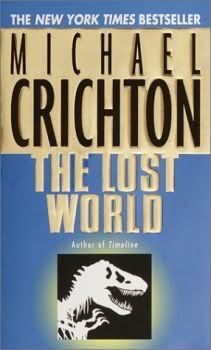
The Lost World

The Lost World
© 1995 Michael Crichton
431 pages

"'Ooh, aah'. That's always how it starts. Then later there's the running and the screaming." - Dr. Ian Malcolm, The Lost World

In the 1980s, a biocompany called InGen discovered a way to isolate dinosaur DNA and patented a cloning process intended to bring the dead back to life. Majestic and fearsome beasts who once ruled the Earth were resurrected in laboratories, intended to be the featured attractions of a resort park intended to amuse their successors -- humanity. The park's first visitors -- including paleontologists, a lawyer, and a chaos theorist named Ian Malcolm -- witness the catastrophic failure of the park's systems within hours of spotting their first dinosaur. The park died amidst intrigues from a rival biocompany (BioSyn) and nature's fury -- though Malcolm would insist that so complex a system was doomed from its beginnings.  The Costa Rican military and InGen are eager to destroy all evidence of the failed project, but they're not as thorough as they ought to have been -- for now, five years later, corpses from another epoch are washing up on the beaches of Pacific islands.

The Lost World follows the same basic pattern as Jurassic Park:  evidence of dinosaurs appears to people who have no idea the park existed, the evidence trickles down to our primary characters, they visit the island and have a "WHOA! Dinosaurs!" moment, and then a deadly pandemonium ensues: the lead characters run around the island losing equipment, sanity, and friends while Dr. Malcolm lectures. In The Lost World, Malcolm applies chaos theory to the efforts by paleontologists to explain the extinction of the dinosaurs. The familiar pattern does not distract from the book: dinosaurs are a powerfully interesting subject, and as the characters talk about various species in an attempt to reason out the best way to escape, the reader is treated to mini-lectures compiling modern dinosaur research from scientists like Jack Horner. In the last novel, Crichton seemingly honored Horner with a proxy character: in this, he acknowledges Horner directly. Crichton does drama well: his text is replete with foreboding descriptions and cliffhanging segments.

The Lost World is terrific fun -- lots of tension, and the dinosaur mini-lectures are certainty informative. Malcolm tends toward the anti-scientific at some points, but I suppose that's in-character for an eccentric iconoclast.

Friday, July 2, 2010

Jurassic Park

Jurassic Park
© 1990 Michael Crichton
399 pages


To the south, rising above the palm trees, Grant saw a single trunk with no leaves at all, just a big curving stump. Then the stump moved, and twisted around to meet the new arrivals. Grant realized he was not seeing a tree at all. He was looking at the graceful, curving neck of an enormous creature rising fifty feet into the air. He was looking at a dinosaur.  (p. 80)

Professor Alan Grant has spent his life digging in remote desert environs, looking for fossils that offer clues into the lives of dinosaurs. Carefully extracting specimens from the ground, he pieces the puzzles of anatomy and behavior together. His job is made a little easier by enthusiastic supporters like John Hammond, an eccentric old billionaire who finances dinosaur digs all over the world -- although Hammond can be a trifle annoying at times, pestering Grant with questions of what a particular species of dinosaurs might eat, especially as newborns. What possible need could the man have for that sort of information?

When a lawyer in the employ of Hammond visits Grant's latest dig and offers him a substantial fee to visit a resort of Hammond's over the course of a weekend, he reluctantly accepts: that much money will go a long way in maintaining his research. What he, his graduate student, and a quirky mathematician find when they arrive at the resort is beyond belief: a theme park the size of an island, where plants and animals dead for 65 million years live again. Advances in genetic engineering and a novel approach to obtaining dinosaur DNA have allowed Hammond to clone dinosaurs and artificially incubate them. His goal is a worldwide empire of theme parks filled with biological attractions, but his first has yet to see the public. He has all the problems of an amusement park and all the problems of a zoo, the latter particularly difficult in that no one has ever maintained hundreds of dinosaurs in captivity. Hammond responds to his investors' doubt and concerns about the park's delayed opening by inviting his team of consultants -- Grant and company -- to take the first tour.  A palaeontologist's approval will go far in soothing their fears.

As impressive as Jurassic Park may be, a system so complex - being a heavily automated park controlled by central computers maintaining a firm hand on a delicate ecosystem -- is doomed to fail at some point, at least in the opinion of Ian Malcolm, the mathematician and chaos theorist invited to tour the park. Malcolm's cassandra-like warning comes to pass (as such warnings are wont to do) when deliberate sabotage on the park of an employee rendering the park's security network inoperative coincides with a massive storm, imperiling not only the tourists but everyone on the isle. Grant, Malcolm, and the rest must pit human technology and intelligence against the dinosaurs' own brute strength, devastating quickness,  surprising array of biochemical defense mechanisms, and intelligence. The struggle for existence is a brutal one -- even in the artificially created Jurassic Park.

Jurassic Park is my first read by Michael Crichton, whom I have ignored in the past out of the impression that his works were too technical for reading comfort. I don't know what gave me that impression, but Jurassic Park was a breeze even while employing more scientific exposition than your usual novel. Although my reading experience was augmented by having watched the movie only a night prior, I enjoyed it to the point that I will be browsing Crichton's other works. The book's introduction gives the text the feel of a warning against the dangers of uncontrolled genetic engineering on the part of companies, perhaps an explicit message on Crichton's part. I've not read any of his other works, so I don't know if he employs his novels as warnings or messages in this manner. We'll see, for I plan on looking at The Andromeda Strain next week.

Wednesday, June 9, 2010

Dinosaur Lives

Dinosaur Lives: Unearthing an Evolutionary Saga
© 1998 John Horner
256 pages


   I picked up John Horner’s Dinosaur Lives  out of idle curiosity, not having read anything about dinosaurs since childhood. They remain of interest, of course, but it’s not an interest I’ve particularly pursued. Horner’s approach is that of a detailed log of his teams’ excavations in the late 1980s and early 1990s that he uses to communicate to the reader how archaeologists work  in piecing together not only skeletons, but theories of understanding based on limited information.  Horner places stronger emphasis on dinosaurs as being apart from reptiles, giving particular consideration to their unique behaviors that carry on today in the form of birds -- the tendency of some species to gather in large colonies during the egg-laying season, and the possibility that some dinosaurs tended to their young just as birds to, instead of abandoning them to instincts alone.

        Fascinating in parts and slightly tedious in others, I enjoyed the book overall and found the update on current trends in paleontology useful.