Showing posts with label geology. Show all posts

Wednesday, July 25, 2018

The Ends of the World

The Ends of the World: Volcanic Apocalypses, Lethal Oceans, and Our Quest to Understand Earth's Past Mass Extinctions
© 2017 Peter Brannen
336 pages


Earth has tried to kill us five times before, and now it's at it again. (To be fair, we're kind of egging it on.)   The Ends of the World is a long natural history of life on Earth which examines five mass extinctions, period in which the majority of life was destroyed. Each time it rebounded as the Earth itself continued to grow, supercontinents forming and breaking up, the air and oceans altering in their chemistry. Although direct causes of species-death vary by incident,   and are sometimes so numerous that it's rather like the murder suspects on Agatha  Christie's Orient Express,   climate is a crucial factor in each one. Specifically, author argues that as carbon dioxide goes, so goes the planet.

We live in a moment in time -- a period when the Earth is rather comfortable for our species and those we rely on.  That wasn't the case for most of Earth's history; oxygen took at least a billion years to arrive, and land-based plants themselves are relatively recent arrivals, appearing 700 million years ago at the earliest.  Even once Earth began to look familiar --  familiar continents, trees,  rabbits, etc -- it wasn't settled    There are geological cycles  -- shifts between glacial and tropical epochs, for for instance -- at work.   Other cycles involve carbon as it travels between land, sea, and air, and this is a cycle that can play hell with life if it gets out of kilter and...oh, turns the Earth into a hothouse, or acidifies the ocean and kills everything there.  And then there's vulcanism -- not only do mass eruptions offload unwieldy tons of CO2 at once, but sometimes they cover areas the size of the United States or Russia in  two mile-deep tide of lava.   Even a prepper with a bulging bug-out bag and a remote hideout would be hard pressed to come back from that.

Geological forces are usually slow and ponderous -- glacial.  But slow forces building up can reach a threshold where everything goes sideways all at once, a catastrophic quantum leap. Think of an earthquake, and the slow-but-accumulating stresses that build up between tectonic plates until they finally slip and a city is reduced to rubble in seconds. Brannen believes this happens with atmospheric and oceanic chemistry, too.   Even when the cause of an extinction seems outside, unavoidable, and sudden -- like the asteroid impact that has the primary credit for killing the dinosaurs,  the climate can't be ignored. The chapter on the K-T extinction argues that the asteroid collision wasn't responsible for the mass extinction on its own: while it would have  done an enormous amount of local damage,  its real contribution was to cause so much tectonic distress that mass volcanic eruptions and outgassing crippled the atmosphere.

If you have anticipated that the book ends with a few pointed remarks about global warming and the present state of the carbon cycle, well -- you're on the mark. Brannen dedicates the last section of the book debating the 'sixth extinction', and humanity's role in clearing the earth of megafauna and challenging the old super-volcanoes in terms of how much gas can be pumped into the atmosphere.   The debate covered shies away from putting the human-induced extinctions of many species into the category of these documented five.  The five are judged to have been global events, near-complete ecosystem collapses: the only survivors were in weird niches, ecological islands. (Or perhaps on literal islands.) While humans have deliberately killed many species and accidentally obliterated more, we've also repopulated the Earth with species under our control: cattle, oxen, sheep,  the like.  Ecosystems have been formed and sometimes destroyed, but we're not facing  imminent and global collapse.    Even so ,the  author argues, the role of the carbon cycle in previous mass extinctions should be foremost in our mind, because it's not just a matter of rising seas.  Ocean acidification from CO2 absorption  is the "other" carbon problem, compromising as it does submarine ecosystems like those centered on coral reefs. (This "other" problem comes up a few times in another science/nature book I'm reading, Lost Antarctica.)


Although it's a little odd to describe a book recording the near-total loss of life on Earth not one but five times as 'fun',, Ends of the World kind of is,  a morbid Planet Earth.  I particularly appreciated being able to sit in on debates in the last two chapters, as Brennan interviews various scientists who are contending (politely) with one another for the most accurate and factually-supported theory..  Ends of the World may expose many readers to the carbon cycle, something I've heard little about,  and there's nothing quite like mile-deep sheets of lava rolling over continents to pique the imagination!


Wednesday, April 25, 2018

Encompassing Flagstaff: Geology Overload


Today's post covers a few of my "driving days", spanning  the AZ/Nevada border almost to the AZ/New Mexico border.  One of my favorite aspects of driving in Arizona was that sometimes I'd top a hill and see what seemed to be the whole of North America laying  and waiting for me to explore it.


So...it turns out that once you've held petrified wood in your hand as a kid and marveled that it's a rock that looks like wood, the novelty wears off. The Petrified Forest consists of essentially what you see above.


Hiking into the Painted Desert


Come on, the water's fine!  


Lady, you don't need a telescope. the crater is literally right there.  This is at the Winslow Crater, where I was tragically denied the opportunity to hike around the rim. Tours stop at three.  

The Pat Shipman Memorial Bridge, over the Colorado River


The Hoover Dam, spanning the Colorado River


And Lake Mead, formed by frustrated Colorado River water. 


Tuesday, October 31, 2017

The Dragon Seekers

The Dragon Seekers: How An Extraordinary Cicle Of Fossilists Discovered The Dinosaurs And Paved The Way For Darwin
© 2009 Christopher McGowan
272 pages


Ancient bones and magnets were both known to antiquity, but not until the 19th century did their importance begin to be realized.  Attribute that to a quickly-developing worldview that regarded these things not as curiosities to be put aside with a pat explanation, but mysteries that needed to be solved – and mysteries, that once poked in to, transformed our understanding of the world. The quickening pace of fossil discoveries and the rising interest in placing them accurately, were essential in shifting the western understanding of the universe from one small, young, and personal, to one incomprehensibly vast, ancient, and cold as clockwork. 

The “dragon hunters”  driving these discoveries were not pre-Victorian Jack Horners;  long before the days of science funded by governments and pursued by microspecialists,    all that was needed for discovery were simple tools and insatiable curiosity   -- or at least an interest in selling fossils to tourists.  That brought together a mere villager, a clergyman, and a lawyer into the same company as natural historians – and that shared company was literal.  The people of this book were not separate actors, but corresponded and worked together;   in one chapter, a young Charles Darwin accompanied Charles Lyell along with two other fossil-hunters, and together they met another fossil hunter (Mary Anning, the villager) to poke around together, and are nearly trapped in a cliffside cave when the tide comes in.  Together, they argued about what these things in the rocks meant.

While general audiences strongly associate Darwin with the theory of evolution, this chronicle of discovery makes it clear that the  general idea of evolution predated Darwin,  and was ventured by some theorists as ‘transmutation’.   What caused transmutation was then unknown; the fossils discovered here spurred speculation. (Darwin’s  contribution was identify the mechanism of natural selection that spurred speciation.)  Some wondered if perhaps the Earth didn’t regularly shift from cold to tropical epochs and back again,  with the life on Earth following them; perhaps one day these ancient lost creatures would return, like bats at dusk and wild geese in autumn.  That was a little easier to sell than the idea that these strange beings had simply ceased to be, that Creation had chapters untold to men before.  Although the discovery of these bones did not force a shift of worldviews the way Charles Lyells' Principles of Geology and Darwin's Origin of Species did,  they did open the door to those inquiries given how poorly they fit in to the previous understanding.


Monday, January 30, 2017

A Whirligig Tour of the Beautiful Basics of Science

The Canon: A whirligig Tour of the Beautiful Basics of Science
© 2007 Natalie Angier
293 pages


Science is amazing! Why is so much of the writing about it so lame?   Natalie Angier's The Canon first reviews the principles of scientific thinking before talking - nay, gushing -- about the basics of physics, chemistry, cosmology, biology,  astronomy, and geology.   But this isn't just a science primer like Almost Everyone's Guide to Science, or Theories for Everything. It is written with a conscious desire to seem fun, so the author is borderline bubbly and generous with cultural references and wordplay.  It's sometimes distracting, but I enjoyed it on the whole.  The personable approach to science also manifests itself in the way Angier works in little stories about her life that relate (like being thunderstruck by an earthquake in her normally placid residence in  D.C.), or interviews with scientists in the field, whose own love and continuing wonder for their subject is part of the delivery.   This is definitely a layman's approach to science -- there's no graphs, equations, or tables to be found, no terrifying mathematics -- but what made a winner for me, from the get-go, were the opening chapters on thinking scientifically. Angier sells the scientific method to readers by connecting it to what they already do: for instance,  the act of troubleshooting a technical problem is similar, as we attempt to narrow down problems by focusing on one variable at a time. A reader who reads Brian Greene with ease may find Angier's lively -- manic, even --  romp through the lab to be silly, but I found her enthusiasm welcome and the wordplay diverting.  A sample from her chapter on geology:


The planet we inhabit, the bedrock base on which we build our lives, is in a profound sense alive as well, animate form from end to end and core to skin. Earth, as I said earlier, is often called the Goldilocks planet, where conditions are just right for life and it is neither too hot nor too cold, where atoms are free to form molecules and water droplets to pool into seas. There is something about Goldilocks, beyond her exacting tastes, that makes her a noteworthy character, a fitting focus for our attentions. The girl cannot sit still. She's restless and impulsive and surprisingly rude. She wanders off into woods without saying where she's headed or when she'll be home. She barges through doors uninvited, helps herself to everybody else's food, and breaks the furniture. But don't blame her. She can't help herself. Goldilocks is so raw and brilliant that she has to let off steam. Like Goldilocks the protagonist, Goldilocks the planet is a born dynamo, and without her constant twitching, humming, and seat bouncing, her intrinsic animation, Earth would not have any oceans, or skies, or buffers against the sun's full electromagnetic fury; and we animate beings, we DNA bearers, would never have picked  ourselves up off the floor.   The transaction was not one-sided, though. The restless, heave-hoing motions of the planet helped give rise to life, and restless life, in turn, reshaped Earth." 


Tuesday, October 4, 2016

Week of Enchantment: Into the Hole He Goes


My first morning in the west opened to a glorious sunrise. I was up with the dawn, for after a ride into town to eat breakfast, I intended to drive the twenty miles out to the Caverns to be there at their opening.

After a hearty breakfast of sausage and waffles, I returned to the wide-open plains south of the town, very much enjoying the 75 MPH speedlimit.  After close to two hundred miles of open horizons, the turn off into the national park area brought a staggeringly impressive change.


  A winding path carved into a rocky hill took me further and further up; this was not a path cut into dirt, but one which surrounded me with walls of rock.  As I neared the top I could feel my small car buffeted by something,  and realized upon parking that I was standing in the strongest wind I've felt since Hurricane Ivan. The grass growing alongside the road was virtually flattened, and I could not decide which was more impressive: that steady and exhilarating, force...or the view.


I've gazed down from mountains before, but the view from Chattanooga's rocky tops was nothing like this. There, the view was hemmed in by other hills, by the abundant forests, by the city itself. Here, I looked across a seemingly infinite landscape. I was riveted, and the view was made all the more spectacular by the vault of the heavens. Far above me the sky threatened with dark gloom, but at one point the sun was breaking through; a half-dozen beams of light pierced it and created a radiant fan. Reluctantly, I broke off from staring into eternity to enter the park. It had just opened, and only a middle-aged couple entered the trail downward before I did. A park ranger briefed us on the rules before our descent into 'the big hole'.


Where is Virgil when you need him?


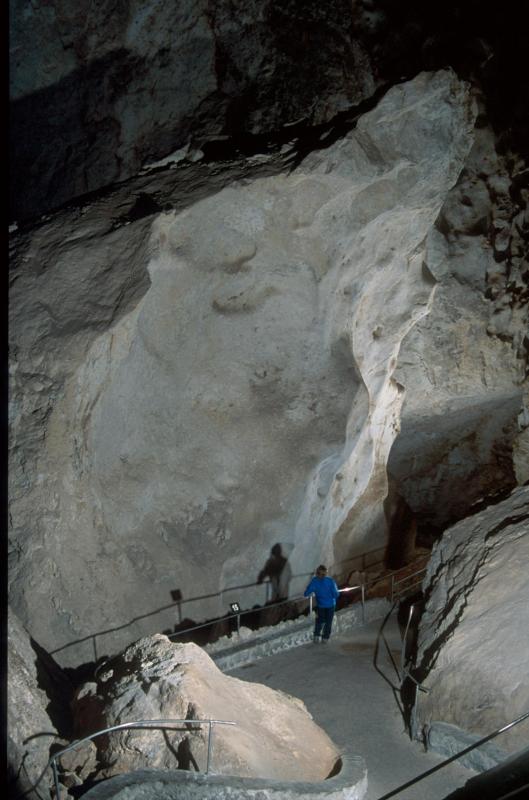
 The entrance smelled, faintly; I couldn't put a finger on it but it had the smell of damp, rot, and possibly bat waste.  That aroma disappeared as we followed the hairpin turns into the cave -- though it's more likely we simply grew used to it. The natural hike takes nearly an hour to complete, and is a spectacle in itself. The cave lighting is spare and tasteful, providing as little illumination as possible while giving the place a strange atmosphere. The lights are there, but hidden.  Our party grew larger, including a pair of younger couples and another middle aged set, this one from Taiwan. I spent most of my time in the caverns traveling with the Taiwanese, who proved very friendly.  The path down was often dark, and we used the faint gleam of the metal handrails to locate it;   although signage urged travelers to use the rails to steady themselves on the damp path, the rails themselves were moist.   If all was still -- if treading steps and beeping cameras were silenced -- the water can still be heard dripping, and in one area we could see the water falling upon the tip of a stalagmite.


Neither my phone nor my camera were up to the task of turning the dim light of the trail or the Big Room into many good pictures, but I will share a few snatches. One memorable sight wasn't captured at all; this was the Iceberg, an enormous rock the size of a small house, which had fallen from the cathedral-like ceiling above us.  There were moments on the trail when even the petite pair I was keeping company with had to duck: personally, I had to crouch-watch.


The two most memorable spots in the Big Room for me were the Hall of Giants, filled with massive round formations which stand column like, and 'fairy land'.  The cavernous aspect of the caverns can't be captured by a photograph, though. One woman I walked with remarked that the place was like a cathedral, and that may convey some aspect of the size. But a cathedral nave is one space, and your eye can create an outline of it, can frame it to ponder. It isn't possible  to do that in the caverns, because the spaces stretch out and vanish in darkness, only to reappear as you draw closer -- and they go off at odd angles. One area is known as "The Top of the Cross", because that part of the room is roughly in the shape of a cross or a large X. In the light, though, that shape isn't discernible from the ground.


Needless to say, going from the top of that hill to deep within the heart of the Earth, to a place where geology isn't something in books but something happening  audibly, visibly, was extraordinary. 


Wednesday, June 8, 2016

Volcanoes in Human History


As with Earthquakes in Human History, this is exactly as it describes itself. A mix of science and history, the authors begin with an explanation of volcanic activity before moving on to cover a few key eruptions. Volcanoes illustrate that the world is constantly remaking itself, forming and destroying islands as the years go by. Like "Earthquakes", "Volcanoes" is most commendable as a collection of the immediate impact of various eruptions, supplemented by scientific explanations. The most 'far-reaching' effect of a volcanic explosion documented here are the disruption of weather patterns across the northern hemisphere; twice in the 19th century, 'summer' practically never came, with famines ensuing.

Sunday, May 15, 2016

The Deep: Extraordinary Creatures of the Abyss

The Deep: the Extraordinary Creatures of the Abyss
253 pages
© 2007 Claire Nouvian


I've been enjoying a gallery book devoted to the extraordinary creatures of the deep sea these past two weeks.  Edited by Claire Nouvian, The Deep collects  some of the best photography produced by the study of the ocean floor in the last decade, along with pieces by marine biologists and geologists commenting on the submarine ecosystem.  The sheer abundance of life on the surface of the Earth boggles the mind, but more than 90% of the planet's estimated biomass is within the oceans.  The Deep is first and foremost a collection of photographs, presented in full-page or two-page spreads.  They are a marvel; while some creatures have vaguely familiar shapes, resembling weird fish or weird octupi, the majority are...sights into themselves.  Some are transparent, others string themselves with organic lights, putting bacteria to work.  They exist in a world without light. While some only live in the deep seasonally, ascending to warmer and brighter waters when there's more food for the taking, others never leave the seafloor. Some feast on the remains of the upper level of the ocean, like the vast carcasses of whales; others life off of chemicals seeping from the sea floor or being expelled.    New species are constantly being discovered here, and many do not even have names; they exist as images that astound the mind with their alienness.  What a treasure Earth is!


Monday, September 8, 2014

This week: hot rocks, war in the east, and Holly Golightly


This week the to-be-read list shrank, as I finished Richard Fortey's Earth -- an introduction to the processes that shape the Earth, while at the same time a travelogue to the planet's most beautiful hotspots.  Fortey is both tourist and technical guide, lingering over settings of Hawaii's lush jungle and shores before traveling to the extremes of Death Valley or Greenland. The picturesque landscape is rivaled only by Fortey's explanation of the principles that are molding the landscape; he likes to use vivid mental images "Imagine a water balloon filled with honey..") to start the reader off. Geology doesn't receive much in the way of popular science books, but Earth was commendable.

Earlier in the week I read through Breakfast at Tiffany's, largely because I rewatch the Audrey Hepburn film every so often and wanted to see how they compare. The story is largely the same, with some film characters having greater roles to play, but the ending is altogether different.  It's not the tidy, neat ending of the movie, and the searching, searching, ever-searching character of Holly is left still craving something more out of life.

Another review is in the works for Drink: A Social History of America, not to be confused with Iain Gately's Drink: A Cultural History of Alcohol.  Presently I'm a third of the way into Collision of Empires, a history of the Great War's eastern front.  Within the next few weeks I'll mount an attack on Galileo's Finger, and dispatch this list completely.


To Be Read Takedown Challenge

Antifragile, Nassim Nicholas Taleb (7/18/14)
The Vikings, Robert Ferguson (6/7/14)
Power, Inc; David Rothkopf (6/14/14)
An Edible History of Humanity, Tom Standage (7/8/2014)
Small-Mart Revolution, Michael Shuman (7/12/2014)
The World Until Yesterday, Jared Diamond (5/29/14)
Fighting Traffic: the Dawn of the Motor Age in the American City, Peter Norton (7/21/14)
Earth, Richard Fortey (9/7/14)
Good Natured, Frans de Waal (6/27/14)
Galileo's Finger, Peter Atkins

Wednesday, May 8, 2013

This week at the library: the cosmos, Jane Austen, zombies, and the Middle Way


-- Minireviews -- 


Some zombies like to lurch about groaning for brains. Some zombies like to ride the escalators, listen to Frank Sinatra, and daydream about their past life. That's R,  a zombie who has forgotten most of his life, even most of his name.  R is of the mobile damned shambling around a ruined Earth, living in a hive of the undead in an abandoned airport. He sometimes goes into the remains of civilization to find someone to nibble on. Brains are especially fun, because eating them allows the diner to experience the memories of the dined-upon. It adds a bit of color to the zombies' dreary, grey not-lives. But when one young man dies saving his girlfriend's life and R munches down on his memories of growing up with her, R unexpectedly develops a crush -- and instead of turning her into a second course, he totes her home and hides her from his moribund brethren.  Such is the beginning of Warm Bodies, a novel of the living and the damned, and the bridge between them.  I checked it out not because I like zombies, but because a friend of mine -- a mature, knows-how-to-manage-her-time-well friend -- stayed up all night reading it. While the premise intrigued me, the humor and earnestness of a zombie yearning for more, even love, snookered me completely. I read it in one sitting, as it's the kind of novel that doesn't let you go away: it continues to rise in intensity until the very end.


With Warm Bodies out of the way, you know now that the title does not refer to my reading Pride and Prejudice and Zombies again. My Jane Austen reference was to The Jane Austen Book Club, a novel  which covers the stories of five women and one man who get together once a month and discuss a given Jane Austen novel, each taking it in turn to host. As a guy who has read Pride and Prejudice, I thought it might be fun to see another fellow go through it. His responses aren't all that remarkable. I hate to admit it, but this is the rare instance wherein a book doesn't compare favorably to its movie  Admittedly, I saw the movie before reading the book, and in fact read the book after finding out it was the source for a money I thought hilarious. (The Austen-reading man is developed far better in the movie: he's a riot: I screamed in laughter at the faces of the women as he, an SF buff, tried to compare the plot of an Austen title with the development relationship of Luke and Leia through the original Star Wars trilogy.  Great movie, all-right book: I might have enjoyed it better had I actually read more than one Austen novel. It made me feel guilty, actually..


I also read Buddhism without Beliefs by Stephen Batchelor, which wasn't as ferociously compelling as I thought it might be, possibly because I've taken Buddhism's extrareligious applicability for granted for a few years now.  Batchelor treats Buddhism as a practice in response to certain realities, and invites readers on meditations to cultivate a sense of compassion within them. Batchelor's philosophical explanations sometimes seemed like vague esoterica (the chapter on emptiness, for instance), others were eye-opening, like the section on no-self. He compared us to clay spinning on a wheel:  the thing that emerges is the result of a lot of actions acting in concert: the constituency of the clay, the pressure, the wheel; there is no ideal Pot that will suddenly materialize there. The same is true for us: there is no ideal Self floating around inside us, or out in the ether: we as beings are being constantly created by drives internal and external.


And on a final note, a book I need to re-read because it's been a few months since I finished it:  The Universe Within reveals the profound connectivity of the universe, exploring the ways our biology has been shaped by astrophysics and geology. But it's not actually about us: his account demonstrates how all of nature is bound together in cycles -- water evaporating into the air, then returning as rain; sea crust being formed at ridges, and dissolved again in volcanic explosions --  and how no field of science can exist without connection to another. A rock can tell you about physics, chemistry, and biology.  Had the book been about the interconnectedness of the sciences, it would have been a triumph. It's supposed to be about how these processes have shaped human beings, though, and the human connection is added in only tangentially at the end.

-------------------------------------------------------------
Today I also received two books through interlibrary loan: Michael Pollan's The Botany of Desire, which examines human-plant coevolution, and Garbage Land by Elizabeth Royte.  I'm looking forward to both:  Pollan is a weird author in that I'll finish his books regarding them too problematic to recommend, and yet I never stop thinking about them. Neither The Omnivore's Dilemma nor In Defense of Food are never far from my mind.

Look for more food books as the spring matures!

Friday, May 20, 2011

Earth Science Made Simple

Earth Science Made Simple
© 2004 Edward F. Albin
224 pages


Earth science! Fun!  I enjoy reading these little guides as introductions to a subject or refreshers on it, and Earth Science Made Simple fits the bill.  Four separate sections cover Geology, Oceanography, Meteorology, and Planetary Science, the last of which applies the principles observed on Earth to understand  the other planets in the solar system.  The book begins with the basics, introducing geology with a primer on atoms and elements. The authors frequently remind readers of material they've surveyed already, when new material is building upon it, mitigating the occasional need to thumb back through the book. The introductions serve the text well, connecting sections together, and the text is replete with illustrations, most of which are helpful. Only one, a list of the planets, seemed more distracting than helpful: while the authors make it clear the planets are not drawn to scale,  they do depict the planets as varying in size (Jupiter being large compared to the rest, Pluto being tiny) -- which will throw readers off when they see Venus (almost as large as Earth) as being drawn slightly smaller than Mercury!
Because this is an introduction to the subject,  more detailed explanations are rare. Were they present, the book would be much larger.  While there are no end-of-chapter quizzes for the reader to test comprehension, the sections open with a glossary of terms that you should be able to identify at section's end, and there are numerous little practical experiments suggested in sidebars that readers can use to see principles at work for themselves -- like witnessing crystal growth after  introducing distilled Epsom salt into a pie pan coated in black construction paper, then leaving it in direct sunlight.  This lives up to the strong expectations I have of the Made Simple series.

Thursday, February 17, 2011

This Week at the Library (9 Feb - 15 Feb)

February has been dominated by fiction so far, helped in part by my recent back of Trek acquisitions which I've not yet exhausted. I've also been in a weird funk as of late, unable to find science and even history books of interest to me: Asimov's history of The Near East was a book I purchased and saved for such just an occasion. It succeeded in whetting my appetite for more history.

Last week I added a new label, 'military', which applies toward works (fiction or otherwise) expressly about combat or military action. I've also added a new page this week, which keeps track of my Nonfiction Reading Challenge reads.

In addition to two excellent Trek works (Summon the Thunder and Over a Torrent Sea), and a short police story, I read A History of Life on Earth by Jon Erickson. I didn't do full comments on it because as I found out, it's more of a reference book focusing on planetary science and evolution, tracking the changing nature of the Earth and the forms of life which dwell upon it.  The book mostly describes the history of life and is laden with charts, maps, and illustrations that range from beautiful to embarrassingly simplistic. Erickson frequently comment on how geography drives evolution, and offers a look into how planetary scientists have struggled to piece together a history of the planet.

I am also halfway through The Ten Great Ideas of Science by Peter Atkins.


Since the challenge began, I have read eight applicable books, two of which I added this week. I've created a 'page' which contains the full list.


  • The Near East (History)
  • A History of Life on Earth (Science)


Next Week's Potentials..

  • I may very well finish The Confessions this week, as for the first time in months I am excited about reading it. I don't know why, but I am feeling recharged in other areas as well. 
  • The Ten Great Ideas of Science, Peter Atkins. I am rather proud of the way I have been faithfully reading this every night, though my pace is variable. I've gone through a chapter in a day before, and spent three days pondering four pages of details on RNA. 
  • I have a history of Japan I checked out last week. It tried to hide itself between the bed and another piece of furniture, but I found it today. 
  • The Revolutionist by Robert Littell is the story of an American who goes off to fight in the Russian Revolution.