Showing posts with label urbanism. Show all posts

Saturday, March 16, 2019

Walkable City Rules

Walkaable City Rules: 101 Steps to Making Better Places
© 2018 Jeff Speck
312 pages

In Walkable Cities, Jeff Speck argued for the virtues of a city optimized for pedestrian travel, and offered ten general guidelines  for making it happen -- from checking forces that destroy walkability, to further empowering pedestrians through connections to other transportation.  That pitch was made to popular audiences, but its success allowed Speck to produce a sequel which went into more detail. That sequel is Walkable City Rules, a collection of one hundred (and one) ways to humanize the  modern city. These rules are not idealistic goals; they have already  been put into practice, and there's nothing here that some city can't take home.  The rules offer a variety of positive steps cities can take, supported by data to make a case for implementing them.

Speck begins this book with  ways for concerned citizens, public officials, and planners to "sell" walkability to their audience -- on the merits of  wealth, health, equity, climate change, and community -- before moving to the array of urban design tweaks . Making a city walkable is a complex challenge -- not because walkable cities in themselves are difficult to make, but because the last half-century of development has not had walkability in mind, and cities now have to contend not with a blank slate, but vast acreages of badly designed urbanism.  Complexity lies in the fact that walkability is not a matter of good sidewalks; walkability is all about connections between where people are and where they want to be.  That means the question of walkability has a great deal to do with housing, for instance, which is why mixed used development  and inclusionary zoning (mixing affordable  developments in with the more lucrative ones) are so important.   It means that commerce has to be nurtured in the right ways, too, by reducing one-way streets and having parking policies that ensure quick lot turnover.

 Speck often pitches his advice to cities on the basis of making the most of what they have, converting a superfluity of extra-wide lanes into a more modest number devoted to cars, making room for bike lanes and trees. (Trees are vital to a city, Speck argues -- not only does their presence slow down cars, but depending on placement they can serve as a barrier between cars and pedestrians, while at the time providing shelter to said pedestrians.)     But the advice isn't all about engineering: Speck also addresses politics, by advising would be reformers to turn the fire chief into an ally instead of an adversary, and  to avoid thinking of pedestrians, cyclists, and motorists as opposing factions: instead,  he advocates using the language of "people walking", "people biking", and "people driving" to emphasize that  human behavior is dynamic and most of us will shift in how we use the city throughout the day -- driving to work, say, and then walking a block or two for errands or lunch.

There's a lot in here, and admittedly it isn't for everyone: Speck commented in an interview that it's really meant for the Strong Towns audience, that is --  city planners, engineers, officials, and citizens passionate about  implications of the built environment for civic life, public health, and private flourishing.  I was, however, disappointed in Speck's occasional abuse of "teabaggers" -- and surprised, given that Speck opens the book with an argument for walkability on the merits of fiscal responsibility. Considering that most of the damage done to cities in the last half century has precipitated by ill-advised federal policies (interstates gutting cities, for instance),  wooing libertarians with walkability would be a cinch.  Instead,  Speck indulges in the same unhelpful us-vs-them mentality he warned his readers against.   Considering his camaraderie with members of the Strong Towns movement, however (who vary from sweater-vested Republicans to Oregon hippies), I don't think it's deep-seated contempt.  In any case, the good ideas argued for in this book far surpass hiccups in the sales pitch.

Related:

Sunday, February 3, 2019

Happy City

Happy City: Transforming Our Lives through Urban Design
© 2013 Charles Montgomery
368 pages


City air makes one free, but -- happy? Throughout the 20th century, Americans fled the urban centers seeking Arcadian bliss. They didn’t find it, and despite an abundance of material wealth the nation continues to writhe in anxiety.  We’re addicted to medication, legal or otherwise;  many live lives of quiet desperation, and others lash out violently in scenes that horrify the imagination.  The suburban experiment was a failure from the start, says Charles Montgomery, because we were made for one another. In leaving the cities to decay, we uprooted ourselves from the social fabric which sustains us. It doesn’t have to be this way; we can come home to the village, even to the city. We can restore our cities to the picture of health, and ourselves in the bargain. Montgomery’s Happy City is a masterful work,  bringing together Greek philosophy, urban economics, and social commentary.

Why care about the city? Globally, the human race is half-urbanized, using a loose definition for urban that includes suburban sprawl. The semi-urban forms we choose to live in can either contribute  to our well-being by meeting our needs, or they can serve to frustrate us. Montgomery opens  with a review of what constitutes 'happiness'  and its connection to the urban form. There are sound objective reasons for wanting to make the setting of most human lives 'better';  traditionally-planned cities are more economically productive and allow for both greener and healthier lives by making it easy for people to walk or bike to work, for instance. Montgomery touches on these arguments, but he's not just writing to city planners or mayors who hold the fate of others in their hands. He writes to appeal to the common citizen, someone less interested in return-on-investment breakdowns and more concerned with the quality of everyday life.  Being able to walk to work or shops is good for our bones and good for the air, but it's also good for our spirits; we're not dependent on a car, we're out in the fresh air, we're seeing and being seen.  There are material pleasures to consider, of course; the concentration of diverse restaurants and stores in dense neighborhoods, and the bliss of pedaling down to the library through leafy streets , but there is more to the human experience than simple sensuality...even though there's nothing like a well-placed park to relax stressed brains.

We are political creatures, wrote Aristotle, not because we like to vote and share "Hooray For Our Side" memes on Facebook, but because people like other people. We like to watch people; we like to bump into them   We don't like to be crowded against people, however; there are tricky dynamics at work that the design of cities and the buildings within have to account for. There's a big difference, for instance, between apartment buildings that are designed around impersonal corridors, and those designed around suites that allow people to occupy a goldilocks area between the private and public realms. The front porch of southern homes in the US had the same effect in detached housing, allowing just the right amount of engagement and privacy. Montgomery is sneaky, exposing readers to brief chats about building codes  and housing policy while offering touching stories about people coming together to make their lives together.  In one neighborhood, for instance, residents turned an intersection into a public square by painting it and filling it with places to sit and talk.  They did this over the protests of the municipal government, which had steadily ignored residents' request for traffic-calming measures at that intersection.  A happy city is one where people can be agents in their own lives. Montgomery also stresses that a happy city is one that works for everyone, where even the poor and marginalized can feel like members of the city, and not just clients of its social services office. He goes into many examples of how even something mundane like traffic infrastructure can frustrate or quicken the ability of a person to thrive.  

Happy City is a supremely thoughtful book on what makes happy, and why urban design is important  in cultivate it.  America is plainly in a bad way judging by the politicians we favor with success.  Maybe we don't know what we want -- from one another, from the places we live. I think Happy City can help with directions. When I first heard someone speak on the importance of the urban form to human flourishing, I was blown away by the insight -- and that came from a grating critic. Montgomery is far more amiable, though not less impassioned.  The book itself offered a look at places that were healthy and growing more so, and both the information it provides and the examples it shows are tremendously encouraging.  

As a final note, this review has been a work in progress since  2015, and the state of it above is more or less the state it's been in since then. I've read the book twice since then, and re-skimmed it a few times more, and every time I just can't hit the button.  Maybe I just don't want to stop thinking about the book? At any rate, it's one of my very favorites. 


Related:
Bowling Alone, Robert Putnam
The Great Good Place, Roy Oldenburg, both on the human need for connection and 'place'.
The Geography of Nowhere, James Howard Kunstler, a history of suburban malaise
Walkable CityPedaling Revolution, and Straphanger 
It's a Sprawl World After All, Douglas Morris, focusing on sprawl's impact on the human need for community.
The Death and Life of Great American Cities, Jane Jacobs; Thoughts on Building Strong Towns, Chuck Marohn; and Suburban Nation, Andreas Duany

Wednesday, February 24, 2016

This Just In


During the weekend I said in comments here that I would love to see a book about spontaneous or emergent order that crossed disciplines. Well, by golly, now there is one -- and it's by Matt Ridley, who penned The Red Queen and Genome. Turns out he's a member of the House of Lords, to boot. He appeared on Monday's EconTalk, which has been the source of some of my favorite reads here in the last few years. They talked about language,  morality,  the history of science, and the reversal of American political parties in the late 19th century, in which the 'liberal' party became illiberal.   Their conversation can be enjoyed or read here.


Bill Kauffman recently joined Jim Kunstler on the KunstlerCast to yak about localism, American literature, and a little politics. (Jim's most recent political post: "Between the Obscene and the Unspeakable.")     I had the rotten luck to discover this one yesterday right  before going to work, and so had wait for hours and hours until I could listen to two very colorful small-town partisans enjoying one another's company.  Kunstler, for those who have joined me recently, penned The Geography of Nowhere and The Long Emergency. The first was a godsend for me,  articulating  a lot of unease and longing, and the latter has sharply influenced me over the past few years.  Kauffman, of course, is a barrel of fun. Neither of these guys can be put into a political party:  Kunstler claims to be a Democrat, but he has such visceral contempt for virtually everyone involved on both sides that I think it's a lesser-of-evils decision for him:  more Democrats than Republicans make mouth-sounds about the futility of playing god overseas.  What brings these fellas together, though, is their shared localism. They both believe in the virtue of small-town America over the suburbs and big cities, though in addition to the communal aspects Kunstler holds small towns to be less fragile, economically. Both gentlemen practice what they preach, living in New York  villages...and Kunstler,  patiently awaiting the collapse of globalization,  homesteads. 

So, if you want to listen to some interesting conversations, this week is off to a good start.

Wednesday, October 2, 2013

Crabgrass Frontier

Crabgrass Frontier:  The Suburbanization of the United States
© 1985 Kenneth Jackson
432 pages


For thousands of years, people lived in either the country or the city, but with the coming of the industrial revolution that changed, and especially in America.   Seemingly as soon as they were able, the wealthy and later the middle class abandoned the cities in favor of neighborhoods set in the country, first commuting into the city and then commuting to other areas outside it once jobs followed the wealth out of town. Why was the traditional urban form abandoned for the suburbs to the degree that it was in the United States, and not in Europe? In Crabgrass Frontier, Kenneth Jackson chronicles urban flight and the making of the 'burbs,  establishing that Americans have an historic cultural distaste for cities,  inherited through England,  and have been trying to have the best of both worlds, city and country, at least since the end of the 18th century.  Wealth and technology first allowed a prosperous minority to establish separate country residences, and later government policy made ex-urban living the easiest choice to make, resulting in it becoming the cultural norm. Jackon begins detached and eventually waxes passionate as the suburbs' success prove to be at the expense of the cities, but he's never caustic.

The Revolutionary War was scarcely over before suburbs appeared on the American scene; even before horsecars, trolley lines, and the automobile, wealthy citizens of New York established their residences on the Brooklyn Heights nearby, and commuted by ferry.  While the borders of cities have historically been slums, home to necessary but despised industries like leather tanneries, in the United States cities came to be ringed by affluence.  Reasons for the wealthy leaving were varied, but a desire to get away from the city's "problems" -- the noise of industry and the presence of common working folk -- ranked high. The simplest explanation, however, is that they could. The United States had more land than it knew what to do with. At first, living outside the city and commuting to it to work was the domain of the very wealthy, but the arrival of railroads allowed moderately wealthy persons to join in.  The trolley and the introduction of balloon-frame homebuilding made suburban living affordable for more people, and saw a manifold increase in the number of these communities. This was not the beginning of sprawl, however: even as they multiplied,  suburban communities remained distinct, walkable places.

It was the automobile which allowed suburbia to truly transform the urban landscape, extending the ease of complete mobility to the entire middle class. At the same time, government policies promoted suburban expansion, directly and indirectly, by promoting home ownership through subsidized loans and highways. Having lost the wealthy and middle classes, their tax base, cities deteriorated further, prompting even more flight. At the same time, home loan and insurance policies favored the suburbs heavily, stifling attempts by those in the city to improve or protect their buildings. These policies were at times openly racist, denying coverage or loans to whole blocks if a Jewish or black family were to move in.

Motivated by a cultural preference for country homes over city living, enabled by the widespread availability of open land --and technological innovations like the rail line and automobile which used that land as a broad canvas to draw an entirely new kind of urban landscape - and further encouraged by government support, the Americans thus became suburbanized.  The work, which Jackson introduces as an extended essay, ends with a reflection on where the suburbs are taking the American people. Built on cheap land, connected by cheap transport, and occupied by cheap buildings,  Jackson believes contemporary sprawl to be not worth much in comparison to the city, and points to trends in the 1980s which might signal a turning point.

Thirty years after the fact, we know that sprawl recovered from those hiccoughs, only for its tide to slow and reverse in the later years of the 21st century's opening decade,  influenced by the financial crisis and the new normal of  high gasoline prices.  The Millennial generation has displayed a sharp preference for city living over the burbs, and car ownership is on the decline. As Americans begin to rebuild their cities and the civilization which they foster, this look back at what caused their disintegration will prove most helpful. This comprehensive history of suburbia not only establishes why American suburbs are so different from those from across the world, but delves into the full range of factors that led to their creation: cultural, technological, economic, and political.  Those wanting to understand the development of suburbia will find it a worthy guide,  especially for its less strident tone as compared to an author like Jim Kunstler.

Related:
The Geography of Nowhere, James Howard Kunstler
Suburban Nation, Andres Duany, Elizabeth Plater-Zyberk, Jeff Speck
Asphalt Nation,  Jane Holtz Keay


Saturday, April 6, 2013

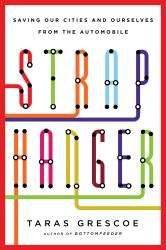
Straphanger

Straphanger: Saving Our Cities and Ourselves from the Automobile
336 pages
© 2012 Taras Grescoe


The cheap energy era is over, unless someone invents a Star Trek replicator that can magick barrels of oil into existence. Cities across the world are working to meet the challenge of keeping millions of people moving and their local economies growing by investing in mass transit. In Straphanger, Taras Grescoe visits thirteen cities in the Americas, Europe, and Asia to experience their transportation systems, finding what what works and what doesn't. These cities include not only those with long-successful and fully integrated systems, like Paris and Tokoyo, but cities like Phoenix which were built for the automobile and which are now trying to transform themselves. Watching these cities strive for the future has for Grescoe all the thrill of attending a rocket launch: when they're successful, it's glorious, but when they fail...the results aren't pretty.  Happily for Grescoe and readers, most of his accounts are of successful takeoffs -- and even the failures have something to teach.

Prior to the automobile, the great urban centers of the industrial age depended on transit systems to keep their expanding population mobile: even small cities could boast a trolley system. But as the automobile zoomed into the historical spotlight, these systems were abandoned and destroyed -- until now. The transit renaissance is not only bringing old systems back to life, but bettering them: only only are trains cleaner and faster these days, but the systems themselves are better thought-out. Take buses, for instance, which are increasingly being taken out of congested traffic and deployed in Bus Rapid Transit systems, in which they're given a full lane of the road, dedicated to them. Those who board these  have pre-purchased tickets, much like train lines -- allowing BRT drivers to more than double the average speed of their buses outside the system. BRT systems are ideal for poorer cities in desperate need of transit, but which lack the means to create more involved systems. like subways.

Straphanger combines history and public policy,  covering traditional transit (trolleys,  trains, and subways),  transitional transit with a twist (BRT), and bicycles as well. Although bicyles are individual vehicles, Grescoe demonstrates how they can be connected to cities' mass transit systems. For instance, in Paris, a Metro ticket that allows subway access can also be used to rent a bicycle to take to the train station -- and bus stops there nearby, as well. Copenhagan's history of recent expansion has been done while simutaneously promoting bicycle use, making it in Grescoe's view an excellent choice for American cities to study. The great lesson of Straphanger is that for mass transit to succeed, it must consist of a network that people can actually use to get places. Busses that run erratically are of no use to people who need to get to work on time, and bike lanes that go nowhere do more harm to the cause of bike commuting than good. Integration is a key element of that, both in working in transit options where people live, work, and shop, and in connecting those options to expand people's opportunities.  Paris' achievements in this field make it Grescoe's favorite, but Straphanger's writing doesn't focus just on functionality: he points out how transit can be a place for civic art, as exemplified by Moscow's subway, and expand people's quality of life:  cycling is fun, far more than sitting in gridlock.

Straphanger is a winsome, thoughtful, and entertaining book which should be of interest to citizens who want to make their communities better and more sustainable places to live.

Related:
Walkable City, Jeff Speck
Pedaling Revolution, Jeff Mapes
Waiting on a Train, Jeff McCommons
The Green Metropolis, Jeff  David Owen


Sunday, March 24, 2013

Pedaling Revolution

Pedaling Revolution: How Cyclists are Changing American Cities
© 2009 Jeff Mapes
288 pages


That's some serious wind resistance there, buddy.

Governments across the world today are beset by problems common to all: rising fuel prices and obesity rates, the ever-present spectre of climate change, and the transportation needs of increasingly urbanized (or re-urbanizing) populations. Enter the humble bicycle: accessible to virtually everyone, regardless of age, sex, or income level; clean, quiet, and an excellent source of exercise. For too long in the United States, bicycling has been the province of a few intense racers and tourers who pride themselves on how miserable a trek they can endure. The end of the cheap oil era, however, has prompted cities to reexamine the bicycle as a means of transportation for the many, despite the car-centric nature of the American city.

Curbing car domination is not a futile hope: in the 1970s,  stirred by soaring oil prices, the Netherlands moved to discourage car use and promote cycling. The city of Amsterdam became a pioneer in modern cycling infrastructure; only Copenhagan can rival it. Both cities boast that nearly half of all trips within their cores happen via a cycle. Fittingly, then, Mapes begins with Amsterdam's story -- but the United States has its own homegrown success in Davis, California, a university town whose early growth was managed by a cycling advocate.  But Davis had it easy:  New York City and Portland, Oregon's success in creating room for cyclists in an already established urban area filled with cars is arguably more impressive.

Mapes' chapters on these cities not only demonstrate their success, but explore how they did it.  There's no authoritative source for how best to integrate bike traffic into transportation infrastructure. Approaches range from the simple (simply painting bike lanes onto existing roads) to the more involved (separate bike paths and even 'bike boulevards') -- and there are some who deny the need for bicycle infrastructure at all, harrumphing that cyclists should just learn to ride safely with auto traffic.  But more than just the built environment have to change to encourage cycling: traffic laws, like right-turn-on-red permits that allow motorists to take over pedestrian and cyclist right-of-ways, must be addressed. The book ends with a section on cycling safety, health benefits, and the important role bikes can play in raising children, and thus in creating a broader, sustainable bike culture.

Pedaling Revolution has great appeal to both cyclists and citizens concerned about the state of American cities, for whom it should prove most encouraging. The argue for cycling more is better made in The Green Metropolis, the cover of which is of a city in bodily form on a bike, but Mapes' account gives the already-converted great reason for hope, and could easily intrigue the curious to becoming part of a bicycling renaissance.


Taken from an April edition of The Selma Morning Times, 1900.

Related:

  • Copenhaganize, a blog covering cities around the world as they move toward being more bike friendly, like Amsterdam Copenhagen.
  • The Green Metropolis: Why Living Smaller, Living Closer, and Driving Less are the Keys to Sustainability, David Owen
  • Walkable City: How Downtown Can Save America, One Step at a Time, Jeff Speck
  • The Sprocket and Critical Transit, two podcasts hosted by urban cyclists....based in Portland, naturally. The Sprocket's tagline is 'Simplifying the Good Life'; I especially enjoy their interviews with carfree parents.


Wednesday, January 30, 2013

Walkable Cities

Walkable Cities: How Downtown Can Save America, One Step at a Time
© 2012 Jeff Speck
312 pages


  For most of human history, cities were limited to the area that people could cover on foot within a day, but the advent of railed transportation and later cars expanded our range, and cities grew enormously, far beyond pedestrian access. In the United States, where most cities were young or as-yet unformed, the automobile effectively created them in its image, to its scale, resulting in vast urban, decentralized urban areas wherin auto transport was assumed to be the norm -- and was, in fact, the only viable means of transportation.But those were the days of cheap energy, of abundant petroleum being used by a minority of the world.  While the 1970s oil crisis prompted European cities to retreat from auto-dependency, supporting instead cycling and passenger rail, the United States was 'lucky' enough to find new reserves...and dig itself a deeper hole.  But today, the prices at the pump aren’t being inflated by a cartel: they’re being driven, instead, by the world's ever-burgeoning thirst for oil, and its ever-real scarcity. The 'changing energy reality' of the 21st century demands a response. For Jeff Speck, city planner and architectual designer, the best adaption is the restoration of the walkable city, and in his first solo release (Walkable City), he timidly explains why walkability is important before more boldly laying out a ten-step path to human-scaled communities.

Although Walkable City eventually proves a work with muscle, it doesn't start out that way.  Speck introduces the book by explaining that it's not the next great piece of urban criticism. The arguments have already been made, he writes: what Americans lack is application. Perhaps for that reason, the section on the why of walkability lacks teeth; instead of championing as the path to municipal solvency (or better yet, dependable prosperity), a solid approach given how concerned Americans are with financial strain, he lists three reasons: walkable cities are green, good for your health, and hip.  He borrows from David Owen's The Green Metropolis for the section on cities' environmental advantages, of course, and that's a superior read for the why of walkability. Speck shines in execution, though.

How do you make a city walkable? First, check the forces that destroy it -- rein in the cars, promote mixed-used development, and for the love of all that is holy, stop building so many parking lots.  These set the stage: they are the foundation from which everything else can spring, although Speck doesn't stress the importance of mixed-used development nearly as much as I'd expect from someone who coauthored Suburban Nation; that section is positively anemic. Speck then stresses that incorporating other modes of transportation, like transit, are crucial. The section on the integration of trolleys into the urban fabric is one of the best in the book, in my option, because Speck doesn't see them as an magic if-you-build-it-they-will-come creator of walkability, but a fertilizer that allows downtown areas to flourish.  Some of his steps are less material, and more aesthetic  like making streets "Places". That will sound familiar to anyone who has read Jim Kunstler, or even The Great Good Place, but aesthetics also have material values. Streets lined with trees,  for instance, not only look appealing, but the trees make the street safer by calming traffic and provide pedestrians relief from the heat,  although they do expose them to the occasional peril of nut-throwing squirrels.  Chuck Marohn opined in Building Strong Towns that in certain instances, solutions to our cities' fiscal problems weren't possible: nothing can be done to save some places completely. What we have are opportunities for rational responses, and Speck takes this view as well,  advocating for urban triage, picking winners and letting some areas wither away.

Walkable Cities is a book to remember. The slow beginning is disappointing: this is a good book that could have been great. It could have been what Speck claimed from the start it wasn't, the next great book on American cities. As it is, Walkable Cities is a solid hit, distilling a lot of literature into one short and punchy work. (Among the books cited: the Holy Bible of urbanism, Jane Jacob's The Death and Life of Great American Cities; Donald Shoup's The High Cost of Free Parking; Jeff Mape's Pedaling Revolution; and Tom Vanderbilt's Traffic). Just as Suburban Nation was a fundamental book for understanding the problems of American urbanism, Walkable City is its complement, a comprehensive citizen's guide for advocacy,  giving people an idea of what measures they can work to effect on the local scale. Bit by bit, neighborhood after neighborhood, Americans can restore their urban fabric and create a nation of strong towns.

Related:


Home from Nowhere

Home from Nowhere: Remaking Our Everyday World for the 21st Century
© 1998 James Howard Kunstler
320 pages
"History doesn't believe anybody's advertising." (p.1)

James Howard Kunstler penned The Geography of Nowhere in an attempt to answer the question: why is America so obscenely ugly? His answer came in the form of a cultural history of the United States, one that introduced lay readers to urban planning and enticed them with its relevance to their lives, not to mention Kunstler's playfully vicious style. As much ground as it covered though, and as hilariously as Kunstler excoriated suburban sprawl and modernist building, he offered no solutions to the problems he detailed, except for the hope that oil would peak and destroy the entire rotten system. Home from Nowhere follows in Geography’s footsteps,  demonstrating how communities can be restored and are being restored– and elaborating on why he is hopeful for our future.

Home from Nowhere is less a book in its own right, and more a continuation, or a fulfillment, of The Geography of Nowhere. It begins by repeating Kunstler’s basic criticisms of the unraveling of America’s urban fabric, detailing his beef with the suburban sprawl which replaced traditional cities.  Kunstler’s perspective is different than that of Chuck Marohn (Strong Towns) or Andres Duany (Suburban Nation). While those authors focus on sprawl as a financial loser, Kunstler examines planning from a more humanistic perspective, probing into how traditional and planning both effect us, as people. Crucial to Kunstler's view of urbanism is a sense of "place". Traditional neighborhoods and cities have this sense of place: they have clear centers and edges. They can be defined. Sprawl, however, is a seemingly endless  and stultifyingly homogenous expanse of asphalt and neon -- a desert of concrete that engenders feelings of lostness and despair in those trapped in it.

Home builds on Geography first in providing ample illustrations -- not photographs,but attractive and elegant sketches which demonstrate architectural or planning concepts (like symmetry and proportion) or by depicting streetscapes and homes which can be emulate. Some chapters elaborate on the problems which inhibit the restoration of American urbanism, like real estate taxing policies ("A Mercifully Brief Chapter on a Frightening, Tedious, but Important Subject") that discourage the erection of fine buildings and promote instead the conversion of downtown into parking lots. The remaining third of the book is dedicated to covering the travails and triumphs of not only new urbanist planners like Andrues Duany and Peter Calthorpe designing communities, but concerned citizen-politicians who have been laboring to effect changes in their own cities, restoring traditional neighborhood development. Part of Home is a response to the criticism of new urbanist projects that most of them have consisted of greenfield development -- new development far from city cores, in effect creating much better suburbs but suburbs all the same.  Working within existing cities means constantly struggling with minds locked into old thinking. This argument is dated now, of course: since the bubble burst in late 2007, the new urbanists have been focusing on infill, on reactivating dead spaces inside cities. The wind is blowing in the direction of urban restoration, and Home from Nowhere chronicles its beginning.

Although the recap of The Geography of Nowhere means that Home could be read by itself,  Kunstler argued so well before that the first third seems watered down in comparison. The encouraging work he reports on is a welcome addition to the jeremiad-like Geography, though, and recommends itself to those concerned about the shape of America's cities. Kunstler's own personality imbues the narrative with strength: he's an interesting man, pining for a lost world of decorum, virtue, and grace and wanting to see it restored -- first through the built environment.


Saturday, October 20, 2012

Thoughts on Building Strong Towns

Thoughts on Building Strong Towns, Volume I
© 2012 Chuck Marohn
174 pages
$9.95


 In California, school districts are being forced to suspend their bus routes. In Alabama,  Jefferson County – home to the state’s largest city, Birmingham – has gone bankrupt. Basic functions of the government are no longer available because the money simply isn’t there. Across the nation, cities and counties are struggling to make ends meet – and although contributing reasons vary from case to case, Chuck Marohn would argue that the fundamental cause is the same: we’re no longer building places that can maintain themselves. Worse, we've tried to finance the present with loans made with the promise of future growth. Now those bills are coming due. Since 2008, engineer and urban planner Chuck Marohn has been writing about the weaknesses of America's urban places, partially out of professional interest but also as a concerned citizen and father, who is casting an eye toward the America his girls will inhabit. Thoughts on Building Strong Towns collects some of the blog's most essential pieces in a compact volume. Marohn is passionately earnest, but reliant more on data and sober arguments than fiery rhetoric.

Marohn isn't alone in elaborating on the fiscal problems of American urbanism: Andrés Duany revealed the same in Suburban Nation, but Marohn's criticism cuts deeper to the bone, examining not only urban planning,  but its very financing, and the beliefs of growth-devoted politicians and the civil engineers who aid them.  His greatest contribution to the new urbanist cause is an analysis of "growth" as a Ponzi scheme, one wherein investors are paid not by productivity, but by more, future investment. Marohn puts forth a number of case studies which amply demonstrate how little return taxpayers receive on infrastructure spending, like the one below:

A small, rural road is paved, with the costs of the surfacing project split evenly between the property owners and the city. We asked a simple question: Based on the taxes being paid by the property owners along this road, how long will it take the city to recoup its 50% contribution  The answer: 37 years. Of course, the road is only expected to last 20 to 25 years. Who pays the difference and when?

Who pays the difference, or who paid, is the federal government: a reliable means of expansion for the past half-century has been dependence on the state for funds to build roads, pipes, and other infrastructure, with the municipality benefiting from them only having to assume the costs of maintenance. But the kind of development that springs up from these grandiose projects doesn't even generate enough tax revenue to meet upkeep, and cities are going broke in their attempt to meet these obligations. But the federal government's own obligations are too numerous for it to continue to cover everyone else's losses.

A new attitude is required. We can no longer buy casually into yesterday's dreams of easy returns: reality is not The Field of Dreams, and throughout the work Marohn advocates toughminded frugalism while lambasting the if-you-build-it-they-will-come  mentality that continues to pervade the minds of government officials and engineers. Instead of chasing growth  (or hunting it, as he puts it  elsewhere), we should maximize the value of what we have already, analyzing every project with the question: does this add value?

I've been a Strong Towns follower for the past couple of years now, being attracted to Marohn's work for its bluntness: while opponents to new urbanism can scoff at arguments made on aesthetic or quality-of-life grounds, Marohn's by-the-numbers criticism isn't partisan and can't be ignored. Like it or not,  the urban fabric of America will change in the coming decades: it is up to the people whether their towns and cities will survive as leaner and more productive, or be ruined.

Thoughts on Building Strong Towns is definitely recommended to the serious-minded citzen, although I did miss the inclusion of Marohn's "The High Cost of Automobile Orientation", which points out how much more productive traditional city blocks are to those used in recent decades.

Related:
StrongTowns.org
Review at National Resources Defense Council


Saturday, June 30, 2012

The Green Metropolis

The Green Metropolis: Why Living Smaller, Living Closer, and Driving Less Are the Keys to Sustainability
© 2009 David Owen
357 pages


Green is probably not the word that comes to mind at the mention of Manhattan, but to David Owen, few places on Earth are as environmentally friendly as the heart of New York City. Its towering skyscrapers and elevated train lines are in fact the very image of verdant. Such a contention is at the heart of Owen’s surprising take on sustainability and environmentalism, his approach as practical as it is counter-intuitive. Owen uses the lens of economy to reveal weaknesses of conventional environmental thinking while demonstrating that the most practical solution to making the most of our energy reserves is to live more intelligently together – in cities.
Owen establishes his work’s prevailing theme early on, declaring, “Sustainability is a context, not a gadget or a technology.”  All of our efforts to be environmentally responsible, to greenwash our lives, are insubstantive when examined against the way we routinely waste energy on a day to day basis, living as we do spread out in suburbs and making virtually every trip in a car. It’s not the Hummer’s gas mileage that makes it an environmental disaster, Owen writes, but the fact that owning a car encourages us to drive it all the time. In fact, he views the rising popularity of SmartCars as a disaster waiting to happen, because such efficient machines will only encourage us to drive more, putting delaying the real change we need to make…which is driving less, living closer, and moving out of our sprawling ranch homes and McMansions into something more sensibly-sized.  
Green Metropolis is a smartly-constructed book. After putting forth his premise, Owen establishes why adaptive thinking on our parts is required. In “Liquid Civilization”, he points out that the entirety of the global economy and our lives is based on burning oil or converting it into products like ever-ubiquitous plastics. Until the mid-20th century, however, only a fraction of the Earth’s population demanded the use of those oils –Europe, the United States, and their colonies, or the “western world”.  Resources were thus relatively abundant, and we have been positively spoiled by the surfeit, so much to the point that we have invented dozens of brands of disposable cups, spoons, forks, and plates that are meant to be thrown away after one use…presumably, because we can’t be bothered to wash a dish. But the days of plenty are over. Now the entire world is demanding a once exclusive lifestyle, and over a century of chronic use has sharply reduced available supplies of oil and natural gas. Unfortunately, the Chinese and Indians seem intent on  making the same mistakes that Americans did in regard to transforming their urban landscapes to make full use of the car, expanding the reaches of the automobile and ever-deepening their dependence on and use of, oil.
The Green Metropolis' argument's primary strength is that its proposed solution is both simple and fundamental. It doesn't require us to do anything we weren't doing already until a temporary bout of prosperity made us lose our collective minds -- people have lived in cities for thousands of years. City-dwellers don't make an effort to be "green": they simply live the way they're use to living. Efficiency is built into the fabric of the place, and that makes the eco-urbanist argument especially appealing to me because I've started to suspect that human beings are too short-sighted to put up a meaningful fight in any other way. This approach to environmentalism doesn't require Constant Vigilance, which I suspect is an impossibility -- it only requires us to return to our senses. Not only this, but returning to proper urbanism will provide immediate, short-term results, which are apparently the only thing we grasp. Restructure the suburbs -- make them walkable, increase density -- and we can add value to the urban landscape  and to our lives. We can free ourselves from fiscal disaster and chronic stress. The problem is motivating ourselves to start making the move.
The Green Metropolis not only makes a strong argument, but it leaves us with room for thought, challenging us to reconsider the way we live in terms of this kind of efficiency. Two areas where Owen especially provoked me were in traffic and food. We might believe that buying local food is more energy efficient, but the sad fact is that the big-box boxs have local grocers beat. I have seen this argument offered by Brian Dunning of Skeptoid as well, who did demonstrate to my satisfaction that a tomato from the supermarket is more "Green" than one from a local farm. However, I still buy from the farmer's market, because the issue of food is more complicated than energy efficiency:  I prefer supporting local economies, for instance, and have an aversion to food products that are more 'product' than food. After considering Owen and Dunning, I can't completely condemn the US food market, but neither can I condone it. We have much to consider, and the answers are not simple.

Related:
Suburban Nation, Andres Duany et. al
Asphalt Nation, Jane Holtz Keay
Your Prius Won't Save You, David Owen
Interview with David Owen on his book, The Conundrum: How Scientific Innovation, Increased Efficiency, and Good Intentions Can Make Our Energy and Climate Problems Worse


Sunday, June 24, 2012

The Great Good Place


The Great Good Place: Cafés, Coffee Shops, Bookstores, Bars, Hair Salons, and the Other Hangouts at the Heart of a Community
© 1989 Ray Oldenburg
336 pages


In Our Oriental Heritage, Will Durant wrote that man is not willingly a political animal, that we do not love society so much as we fear solitude.  As much as I love Durant's work -- the grandness of his historical approach and the rich eloquence of the language with which he expressed it -- here I must disagree with him. We are social creatures at our roots: to borrow from Augustine, we are made for each other, and our hearts are restless until we find companionship together. Such is the lesson of Roy Oldenburg’s magnificent The Great Good Place, which examines the important role of social centers in human lives, discusses the consequences of their decline in the United States today, attempts to account for why they are struggling, and appeals for their resurrection. It is a timely and momentous work.

I’ve long been tangentially familiar with the phrase, “the third place”, which refers to common gathering places for people in their communities, a place apart from home and work (the first and second places in our lives). But here is that phrase’s origin. Oldenburg begins by establishing what the third place is: a site that attracts people and allows for spontaneous meetings between friends and strangers. These places have been ubiquitous in urban environments throughout human history…at least, until the  late 1940s when the United States decided to try a different approach to urban planning, creating ‘sprawls that no longer deserve the the dignity of of being called a city’*.  Oldenburg’s opening chapters document the third place’s vital role in creating a sense of community, in fostering political cohesion and providing a platform for civic engagement. But not only that – they’re fun. People like to spend time together, and giving them a place to do it makes society better and improves our quality of life.After establishing this, Oldenburg then moves on some specific examples:  English and Austrian coffee houses,  French cafes and bistros, American taverns, and main streets. (Although the cover refers to barbershops and salons as third places, the best in his view have been these "watering holes".)  This is a book strongly reminiscent of Robert Putnam's Bowling Alone: the Decline and Revival of American Community, but while Putnam examined the disintegration of American public life at large, Oldenburg zooms in to everyday life.


If the third place is so important, so vital to healthy personal and national life, how have we allowed ours to be destroyed? Hindsight is always perfect vision: in this case, third places are so normal to the human experience that we take them for granted, and only their loss makes us realize their importance. While third places can be destroyed by the short-sightedness of business owners who discourage "loitering" and convert attractive sitting places into yet more display areas, ultimately the problem is foundational: America's urban landscape is atrocious; "badly staged", in Oldenburg's words. Time and again he scolds planners for creating municipalities where no one can walk anywhere, of building pod after pod of "nothing neighborhoods", of abandoning the diverse density of cities for suburbia's lifeless homogeneity.


The Great Good Place is a fascinating combination of sociology and history with a lot of insight. The loss of third places goes beyond people not having a place to have a drink together. One of the consequences Oldenburg explores is that as community life fades as an alternative, people are forced to look for solace on their own, by  attempting to buy happiness in the stores -- and the more they focus on themselves, the less inclined they are to seek connections with other people and the more miserable they are. The fascinating link between alienation and advertising is one of the many gems found in here.

Books like these are why I read in the first place. This isn't a subject of mere academic interest: this is a book that tells us something important about ourselves, with ideas that can change our lives and help Americans concerned about the United States' declining health begin to recover from it.  Although the absence of any mention of the internet might date it (a book like this published today would have to address social networking sites), it's never more timely. Ten years after Oldenburg published this, the New Urbanism movement took off -- and reaffirming and reestablishing community life is at the heart of it. As America's urban pattern is forced to change in recognition of suburban's fiscal failure, I hope when we begin building we keep Oldenburg's insights in mind, and build third places.

I cannot recommend this highly enough.

Related:

  • Bowling Alone: the Decline and Revival of American Community, Robert Putnam
  • Suburban Nation, Andres Duany et. al


* A  turn of phrase borrowed from Robert Bellah. Source: "The Ethics of Polarization in the United States and the World," The Good Citizen.


* A  turn of phrase borrowed from Robert Bellah. Source: "The Ethics of Polarization in the United States and the World," The Good Citizen.

Saturday, June 2, 2012

Suburban Nation

Suburban Nation: The Rise of Sprawl and the Decline of the American Dream
© 2000, 2010 Andres Duany, Elizabeth Plater-Zyberk, and Jeff Speck
294 pages


Compare a modern American city to its European counterparts, or even an older American city, and the contrast is striking: American cities seem to have fallen apart, spewing their innards cross the landscape. Indeed, America has taken a radically abnormal approach to urbanism in the last fifty years, building out instead of up. Even while the city centers have been left to fall apart, ‘greater metropolitan areas’ – the mats of low-density sprawl surrounding those decaying centers – have grown. Why have Americans chosen to live this way, and what are the consequences? Suburban Nation is a citizen’s guide to understanding the new American landscape, a guide to what makes communities function, and a primer for setting our urban areas to rights again.

Duany and Zyberk, a team of urban planners, begin by breaking sprawl down into its five constituent parts. While traditional cities freely mix various kinds of buildings together – shops on a ground floor, apartments or offices above –  the suburban model separates  uses into separate pods. Anyone who lives in the United States can identify them; housing developments, commercial strips, office parks, and industrial parks.  These pods have no  direct connections to one another: navigating from one to the other necessitates traveling on a   ‘collector’ road, which is almost always congested because it is the sole carrier of traffic the pods are too widely spaced apart to make walking feasible or train transit efficient. Municipal buildings are the final element of sprawl, and like the rest are strictly separated and isolated except by cars.

Suburban Nation includes large, wide margins to the side of the text, making the book squarish instead of  rectangular. The authors use those margins for photographs, specifically sets of paragraphs, comparing traditional urban approaches to the new methods favored by modern planners. The contrast is potent, illustrating how wasteful and ugly suburban sprawl can be. But why has it become so popular?  The answer draws on numerous elements of American culture and history: the fact that most American cities came into being during the industrial age, and so Americans tend to associate them with the abuses of that period;  the coming of the automobile just as people were wanting to move away from the cities, the availability of wide open land for people to expand into, and government policies which saw in outward growth a foundation for the American economy – as in the Great Depression, when highway construction was used to put people to work. These elements each influence the other: people’s aversion to living near factories was the genesis of zoning codes, which segregated residential and industrial areas; the availability of automobiles allowed those zones to be far apart; and the generous government subsidies supporting the expansion of roads made such networks feasible. After World War 2, the FHA’s policies encouraged growth outside the cities, offering loans to families who wanted to buy new single-family homes but refusing any to people who wanted to move inside the cities. Banks followed suit.

            We left the cities in pursuit of a dream – a home of our own, far from the noise and pollution of the city. But if there’s a constant in history, it’s that no action is without unintended consequences. Not only did Americans manage to destroy their cities in a manner of decades (with the same money that Europeans were using to rebuild theirs), but suburbia has proven a fiscal nightmare. Its low densities don’t provide the tax base needed to maintain its infrastructure, and the widespread sprawl mires people in traffic, not only forcing everyone to drive everywhere but do so at a snail’s pace, wasting both time and gasoline. In addition, suburban sprawl fails to produce that vital element of human society, a community. There is no coherence in these suburban wastes, no 'place' for a community to coalesce around. Instead, people live apart from one another, and when they venture into society they only do so as part of a mass of strangers, either on the collector roads or in the big box stores.

            Since the mid-1990s, criticism of suburbia has been building steadily. As municipalies and states face budget crises and the threat of insolvency, more people are realizing the pattern of development we’ve been pursuing is no longer a viable option. Duany and Plater-Zyberk also offer steps we may take in getting a handle on these problems. There are ways we can redevelop some existing suburbs and make them livable, for instance, but the 60s-era zoning laws that make proper cities illegal need to be scrapped, as with subsidies which encouraged all that sprawl. Although restoring America's urban fabric seems a vast undertaking, it is doable, and necessary.

Suburban Nation  is the comprehensive book on America's landscape, and consequently a fundamental book for understanding many of our problems -- civic, economic, and social. Its ideal audience is the average American citizen; though Duany and Plater-Zyberk are urban planners by profession, the third author Jeff Speck served to introduce planning concepts in layman's terms -- and even if the text didn't make a particular idea clear, the illustrations do that amply.  This is in short a most excellent book. I doubt it will be rivaled by any others, but  there are more works in this genre (like Kenneth Jackson's Crabgrass Frontier) which I intend to read in the future.

Related:


Wednesday, April 25, 2012

It's a Sprawl World After All

It's a Sprawl World After All: the Human Cost of Unplanned Growth -- and Visions of a Better Future
©  2005 Douglas E. Morris
245 pages


Shortly after the Second World War, the United States completely changed its approach to urbanism.  Abandoning concentrated city centers, the nation instead emphasized outward, horizontal growth, all low-density.  The automobile allowed cities to expand far beyond their original boundaries, and what technology allowed, government mandated. What followed is the scene that every American is familiar with: sprawl, the great mat of highways, housing developments, commercial strips, and office parks that goes on and on, seemingly without it. Sprawl has profoundly shaped American culture since then. It promised the solitude and beauty of the countryside coupled with the many attractions of the cities, but there is no action without an unintended consequence...and suburbia's are many. Suburbia has long had its critics, and a growing body of critical literature is gaining in strength and pointing out the variety of failures in the suburban plan, chief among them its financial unviability.   Douglas E. Morris takes a different tack, however, focusing on how this way of living impacts our quality of life. In particular, Morris sees sprawl as the chief destructor of community (which Robert Putnam hinted at in his Bowling Alone) and the reason why the United States is so fantastically violent as compared to other developed nations. While his account is not as meaty as the subject deserves,  he offers considerable food for thought, especially to those who have never considered that the environment in which they live might influence their happiness.

Morris' idea is that communities are defined by a sense of place: just as a family lives in the same house, so too does a community need to be centered about the same area. This is a need at odds with the design path Americans have chosen, which favors widespread expansion across the land. After over a half-century of this kind of development, American society has not only lost its focal points; it has become so diffuse as to lose cohesion altogether. Our lives are no longer connected, and this is a situation that social creatures such as ourselves cannot tolerate. Before sprawl, people walked the streets with one another; they saw their neighbors at the local stores.They congregated in the shared spaces -- the parks, the nearby cafes. Now we lie in homes distant from one another; we travel alone in our cars to work and on errands. We now travel to huge box stores where we are strangers to the hundreds of other people present -- where we are customers, not patrons. Robbed of the opportunities to fellowship with one another, we console ourselves with television, the Internet, and the creation of what Morris calls "niche communities" like book clubs. Because our lives no longer connect us to one another as a matter of course, we must purposely arrange meetings with one another. Niche communities hardly fill the void, however, and the result is chronic feelings of isolation, of depression and loneliness. Because our lives no longer connect to one another, the behaviors we used to improve those connections, like manners and civility, are lapsing...and the culture of anonymity allows violence impulses to go unchecked, to grow into violent actions.

In addition to this, the new auto dependency marginalizes great portions of the population: the elderly, who when their vision fails cannot go anywhere without assistance; young people, who are forced to rely on their parents for transportation anywhere and are robbed of opportunities to act like autonomous individuals, a necessary part of learning to be an adult; and the poor, who are separated from job opportunities if they happen to be carless, which is quite likely considering the cost of maintaining an automobile.

Morris points out that not only is the United States drastically more violent than any other developed nation, but the usual factors cited for this violence -- television, video games, and violent music -- are present in much safer nations. He doesn't mention America's unique relationship with gun ownership, though, and I'd question whether the saturation of violent music and television is the same in other nations. How much more television do Americans watch than Germans, for instance?

The section outlining the problems of sprawl is disappointingly short: a mere 92 pages. The rest of the book contains solutions for creating a more fulfilling life, which I did appreciate.This section's solution range from individual measures (creating niche communities, being mindful of others, emphasizing the need for manners, volunteering) to community-oriented actions, like removing zoning laws which mandate sprawl, increasing the gas tax to force people to confront the true cost of cars, and adjusting tax policies (for instance, not taxing farmers based on how much their land would be worth if it were developed commercially).  He also includes several lengthy appendices, one of which is a history of sprawl.

I'm left with mixed feelings after reading It's a Sprawl World After All. The subject fascinates me and demands more attention, especially considering the current state of America's economy, finances,  and national spirit.  The lengthy section how we might begin to rectify this sorry situation is commendable, and if someone is completely new to the subject I think it more than adequate to prompt them to think about their own experiences in the light of its criticism. I never realized how fulfilling living in a community could be until I did it -- and didn't realize what I had until I moved away again. Morris' account could provide this perspective to people who haven't experienced it for themselves. Although I would have preferred a more thorough approach, as Morris seems hurried, it's definitely worth reading for Americans. In a few weeks I'll see how it stacks up against Suburban Nation.

Related:


Tuesday, February 14, 2012

Asphalt Nation

Asphalt Nation: How the Automobile Took Over America and How We Can Take It Back
© 1997 Jane Holtz Kay
418 pages

Lord, Mister Ford, I just wish you could see what your simple horseless carriage has become!
It seems your contribution to man has to say the least gotten a little out of hand --
Well, lord, Mister Ford, what have you done?
("Lord, Mister Ford", Jerry Reed)


The United States is in ways a nation without a history. Relatively young, it came of age in the early industrial period, where access to profoundly powerful technologies shaped its growth in a way not seen in Europe or Asia, where new influences worked against what was already there. This is most obviously seen in a comparison of dense, almost compact European cities, and their American counterparts, which sprawl out for mile after dreary mile and -- with some exceptions for cities which date to the 18th century --  often lack a distinctive center. This radically different urban landscape is the mark of the automobile: while Europe's cities were built for people, America's cities and now its sprawl are made for cars. Americans embraced the automobile like no other nation, and now after a century of giving it dominion, are slowly waking up to the price. No green and pleasant land, we are a nation covered in asphalt and mired in traffic. In Asphalt Nation, Jane Holtz Kay examines the consequences of the United States' self-made dependency on the car,  explains how it came to be that way, and offers ways for recovering a sensible approach to urbanism.

Although some of the costs of the automobile are obvious -- pollution; the economic drain of cars on private households to pay for insurance, maintenance, and gas;  and thousands of lives each year -- the greatest harm is more subtle, in deforming the urban landscape. The automobile's effect on American urbanism has been marked by purposeful decentralization and the rise of sprawl, a disaster for the nation. Not only does sprawl create manifestly hideous cityscapes, but it drives cities into bankruptcy as they attempt to cover greater areas with less efficiency. Public transportation becomes especially inefficient. As jobs move away from city centers, those who can't afford transportation to get there are stuck living in areas with few opportunities for work, leading to inner city decay. Once vibrant city centers become home to nothing but poverty and despair.


It didn't have to be this way. After cataloguing the damage, Hay launches into a history of American car use and the rise of a "car-ridden" society.  Although the automobile matched the United States' strong individualistic tendencies nicely, the success of the automobile is far from a triumph of the free market.Cars and the roads they require have always been heavily subsidized by the government: in the 1930s, building the infrastructure for automobile transportation was seen as a way to put people to work. The car companies themselves were proactive about ensuring their dominance, as General Motors eagerly bought up trolley lines and promptly closed them down, allowing its line of buses to flourish. Holtz's history section  can be depressing, as it catalogs the slow decline of American urbanism and the rise of congestion, but it must be read. Every chapter is a lesson in where we went wrong, one that might allow us to find our way back. Interestingly, the rise of the automobile fits into the pattern Neil Postman identified regarding technology;  at first, it was merely a tool to be used, then one with a central role in our lives...and now, for Americans, one our society has become fundamentally dependent on.

The final chapters devote themselves on recovery. Reining in the automobile will be a difficult task, and may prove to be a long term challenge for the 21st century, just as establishing the car's preeminence marked the 20th. First, we stop the ever-increasing expansion of roads, reexamine zoning policies that encourage sprawl and the destruction of our cities; begin restoring transit like trolleys and trains; begin rolling sprawl back and restoring our urban centers; and finally, begin "depaving America",  beginning with the elevated highways that cut cities apart.  The car should also be put in its proper place by no longer being so heavily supported by the official policies of the government.

There's never been a timelier moment for this book, except for perhaps in the 1970s when the oil crisis offered Americans a chance to reconsider their relationship with the automobile. Today the United States is facing a prolonged recession and a difficult century ahead. The infrastructure required for our asphalt nation is an enormous economic liability, one we would do well to shed ourselves of. Ending sprawl and restoring life to the cities will allow government to function efficiently and restore that sense of community that Robert Putnam mentioned in his Bowling Alone. Asphalt Nation is thorough, its author never shrill. I not only recommend it: I think it a must-read.

Related:


Thursday, December 29, 2011

The City in Mind

The City in Mind: Notes on the Urban Condition
© 2001 James Howard Kunstler
272 pages


The study of civilization is nothing less than the study of the culture of cities. Humanity has survived on the Earth for hundreds of thousands of years, but not until we began to aggregate in cities did we truly come into our own. Cities have been the cultural centers of our race and the driving force of our history which unlocked our potential in the last ten thousand years or so, and in The City in Mind, James Howard Kunstler reflects on their role in our history and their contribution to the quality of our everyday lives, focusing on a panel of select cities that may allow us to see what makes a city work and what drives it towards failure.

In The Geography of Nowhere,  Kunstler railed against the disintegration of the American city and the rise of what he sees as an imminently inferior form of urban living -- suburban sprawl. Although a couple of chapters here reflect that theme,  the book is not as intensely focused. It reads something like a collection of essays, each giving the history of a given city's development and emphasizing one particular period or element. The opening chapter on Paris is devoted to Napoleon III and Hausmann's thoughtful redesign of Paris in the 19th century, for instance, and how it led to a fairly ugly medieval city's transformation into a jewel of urban design.  Kunstler visits the classic spirit with Rome, and with Boston shows the reader how a city can recover from decades of thoughtless planning and sprawl.  I bought this book in part because I delight in reading Kunstler when he's on a  critical rampage, destroying atrocious buildings and miles of commercial strips and box stories with biting with -- and two chapters on Las Vegas and Atlanta give him just the excuse. Atlanta is used as a case-study for the failure of edge cities, while Vegas -- which Kunstler surely deems the worst city in America -- showcases a wide variety of failures, from the practical to the spiritual.  Kunstler is not a religious man, but he sees proper urban design as something which enhances the value of life; when done properly, it honors us and creates a place worth living in.

The chapters mentioned are the book's strong points. There were other sections, like that on Mexico City, that I didn't quite understand the point of. Kunstler is informative there -- I'd known nothing about the history of the modern city following the Spanish conquest -- but to what urban design-related end. I had the same reaction to another chapter, possibly because I expected more sections along the lines of Paris and Las Vegas, chapters which clearly point out good and dismal approach at design, whereas Kunstler had a more general focus in mind. Some sections are available on Kunstler's website for your reading pleasure.

Wednesday, November 9, 2011

The KunstlerCast

The KunstlerCast: Conversations with James Howard Kunstler
...the tragic comedy of suburban sprawl.
© 2011 Duncan Crary, James Howard Kunstler
300 pages


James Howard Kunstler is a journalist turned social critic and the author of numerous books, most prominently The Geography of Nowhere and The Long Emergency: Surviving the Converging Catastrophes of the Twenty-first Century. These two books address the seemingly disparate topics of urban planning and the global oil economy, but to Kunstler and like-minded readers, they are troublesomely knit together, intensifying the problems that each causes. For the past three years, Kunstler has talked each week with on these and connected topics with his co-host, Duncan Crary, who has now produced a partial record of their discussions -- a collection which will no doubt please Kunstler's fans, while offering those unfamiliar with his work their first taste of it.

Although his modern work ties to his predictions for the post-oil future, most of Kunstler's nonfiction works fall within the realm of urban criticism. Americans who have never encountered his ire may be staggered by how much of their world he holds in scorn. Just what is it about the modern city and suburban sprawl that he finds so appalling?  In a word, everything. The opening sentence of The Geography of Nowhere, in which Kunstler attempts to summarize why he wrote the book, is a paragraph long.  The growth of American cities and later,  the 'edge' cities that grew out of suburbian sprawl, has centered on the automobile, and the result is the decline of public transit like rail lines in favor of highways -- infrastructure built on the promise of cheap gasoline, and frightfully ugly to behold. Its decentralization destroys the integrity of human communities and is in part responsible for the rising obesity problem in the U.S:  our automobile-fixated culture gives people few opportunities to incorporate activity like walking into their everyday life, for now every trip anywhere demands the car. The results are hideous: compare an eight-line commercial strip lined with box stores,  oceans of pavement, and offensive, neon-colored signs the size of trucks to the charm of what once was, to the tree-lined American Main Street with its cozy stores and pedestrian focus.  The good news, for Kunstler and those who sympathize, is that this horror cannot long remain: it is doomed by its dependency on oil.

The second half of Kunstler's legacy, originating in The Long Emergency and a source of constant chatter among the author and his co-host, is the idea of peak oil and its ramifications. The cancerous growth of urban sprawl has been enabled by the abundance of cheap oil, but that era is drawing to a close. The United States' oil reserves have already dwindled, and soon enough the oil wells of the middle east and Russia will dry, too. The consequences for a global economy built on oil -- oil to run the ships and trucks that connect manufacturing and distribution, oil to process food -- for food is an industrial, not an agricultural product these days -- are dire. Kunstler sees the fabric of globalization partially disintegrating, and local economies reviving. Everything, including the cities, will shrink to a smaller scale -- a human-sized scale. The unviable sprawl will die, and authentic human communities will prosper once more, while bemoaning the amount of resources that were wasted  in the "cheap oil fiesta".

KunstlerCast's conversations tend to focus more on Kunstlers' urban critiques than the peak oil scenario, though the two are connected to the point that the whole of the book flows together well, aside from some small deviations wherein Kunstler takes time to grouch about tattoos. I found these breaks more amusing than anything, and the book as a whole a positive delight, one which prompted me to begin re-reading The Geography of Nowhere.  While Kunstlers' arguments as a whole are more thoroughly presented in the two books previously mentioned, the format of KunstlerCast allows the author and his host to discuss contemporary, related, and specific issues not mentioned in the 1993 book, or only mentioned in passing, like the health consequences of an automobile-centered society or the work of other critics like Jane Jacobs. They also cover ground visited in its lesser-known books, like Home from Nowhere and The City in Mind. I especially enjoyed these sections, as I've not been able to get my hands on these books despite my interest in them. Thus, while covering familiar ground the conversations also introduce new material, making them of interest to Kunstler fans. Newcomers may appreciate a less formal introduction to these issues, especially given how easy it is to "listen" to the banter-filled conversation between these two intelligent and thoughtful men.

Given the present economics of the world, Kunstler's work has never been more relevant, and is now all the more accessible. This is a hit for old fans and the newly interested alike. The KunstlerCast may be found at KunstlerCast.com,  with archives as far back as 2008.

Related:
The Geography of Nowhere, James Howard Kunstler
The Omnivore's Dilemma, Michael Pollan
American Mania: When More Isn't Enough, Peter Whybrow