Showing posts with label EconTalk. Show all posts

Wednesday, January 25, 2017

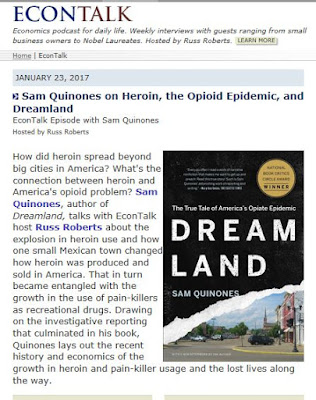
Podcast of the Week: EconTalk discusses "Dreamland"


http://www.econtalk.org/archives/2017/01/sam_quinones_on.html


On Monday, Russ Roberts of EconTalk sat down to talk with Sam Quinones about his book, Dreamland: The True Tale of America's Opium Epidemic.  That book has been on my radar for a couple of years (and was how I discovered that book on Area 51 mythology, also titled Dreamland), so I was excited to give a listen.  Quinone opens with two subjects: first, the history of one Mexican town which became the headquarters of a new wave of heroin addiction in southern California, then spread easterly towards the Mississippi. They made heroin cheaper and safer to purchase, and according to the author shunned violence to prevent undue police attention. The second subject concerns the rise of painkiller addiction in the United States, owing to a change in healthcare culture that convinced itself powerful opioids could be made safe for consumption.  The two meet together in Appalachia and other areas of the central US as people addicted to painkillers begin using cheaper and readily-available heroin to feed the beast inside him.

About the podcast:  EconTalk interviews generally last an hour, but Roberts posts transcripts below his play button  for those who are interested, but would prefer to skim through the discussion.  I stumbled upon EconTalk back in 2011 or so when I was looking for professional podcasts that would let me absorb ways that people like doctors, lawyers, and economists interpreted the world. (I found EconTalk and Lawyer2Lawyer, but nothing for healthcare. Yet.)   The first interview I listened to was an interesting one on the areas in which industry was returning to the United States.  Although in those days I was much more of an interventionist, I found  the reliably free-market Roberts to be so genial, thoughtful, and nice that I kept listening to him. I've been rewarded with some of the most interesting books ever, works like David Owen's The Green Metropolis, Gary Taubes' Why We Get Fat, and a book on digital medicine that I will be reading soon. Despite the name, EconTalk isn't just about economics -- as those book titles, and Dreamland's, indicate.  Roberts' interviews are often conducted with people he disagrees with, as when he invited Thomas Piketty on to talk about Capital.  He's a gentleman and a scholar, well worth listening to -- or reading.

Note: once my own computer is up and running I will edit this post to include some links to books featured on EconTalk that I've read here. In the meantime, just click the "EconTalk" label if you're curiou.


Wednesday, February 24, 2016

This Just In


During the weekend I said in comments here that I would love to see a book about spontaneous or emergent order that crossed disciplines. Well, by golly, now there is one -- and it's by Matt Ridley, who penned The Red Queen and Genome. Turns out he's a member of the House of Lords, to boot. He appeared on Monday's EconTalk, which has been the source of some of my favorite reads here in the last few years. They talked about language,  morality,  the history of science, and the reversal of American political parties in the late 19th century, in which the 'liberal' party became illiberal.   Their conversation can be enjoyed or read here.


Bill Kauffman recently joined Jim Kunstler on the KunstlerCast to yak about localism, American literature, and a little politics. (Jim's most recent political post: "Between the Obscene and the Unspeakable.")     I had the rotten luck to discover this one yesterday right  before going to work, and so had wait for hours and hours until I could listen to two very colorful small-town partisans enjoying one another's company.  Kunstler, for those who have joined me recently, penned The Geography of Nowhere and The Long Emergency. The first was a godsend for me,  articulating  a lot of unease and longing, and the latter has sharply influenced me over the past few years.  Kauffman, of course, is a barrel of fun. Neither of these guys can be put into a political party:  Kunstler claims to be a Democrat, but he has such visceral contempt for virtually everyone involved on both sides that I think it's a lesser-of-evils decision for him:  more Democrats than Republicans make mouth-sounds about the futility of playing god overseas.  What brings these fellas together, though, is their shared localism. They both believe in the virtue of small-town America over the suburbs and big cities, though in addition to the communal aspects Kunstler holds small towns to be less fragile, economically. Both gentlemen practice what they preach, living in New York  villages...and Kunstler,  patiently awaiting the collapse of globalization,  homesteads. 

So, if you want to listen to some interesting conversations, this week is off to a good start.

Wednesday, February 17, 2016

An Economist Gets Lunch

An Economist Gets Lunch: New Rules for Everyday Foodies
© 2012 Tyler Cowen
293 pages


Imagine going out to eat with someone who really likes to talk about food, and imagine that this person is also an economist. That's An Economist Gets Lunch, three hundred pages of very excited chatter about food culture and markets across the world.  There's no argument to be had, just sheer enthusiasm for the subject at hand, one that I had to be wary about reading because it kept giving me the munchies.   Cowan's concoction is a weird mix of  culinary discussion, economics, world travel, and history.  He doesn't produce a set of rules: there's a principle guideline, followed by many little bits of advice. The key principle is this:  food is a product of supply and demand, so look for options where the supplies are fresh, suppliers are creative, and the customers are demanding. The implications of this are broader than "avoid fast food".   Cheap doesn't necessarily mean bad;  most of Cowan's favorite culinary experiences happen while traveling in less-industrialized areas of Mexico,  Nicaragua, Sicily, Thailand (he's very well traveled, this fellow) and other places. Because food markets are predominately local there, supplies tend to be fresh and the creators specialists in their region's offerings. The price is dirt cheap, compared to the cities.  A high price tag doesn't indicate that the food is exquisite, either: often it carries with it the money sunk into creating a luxurious restaurant environment, complete with superfluous staff like valets, or the high rents.Cowan especially disdains the city centers of touristy areas like Paris and Rome. You want good Italian food, hop on a train and head for the back country, he urges. And French? Try Japan.   

Cowan makes for an interesting dinner companion, going from this to that topic. He starts off with a discussion of why American fine dining is largely inferior to Europe's, blaming it on Prohibition, television, and parents who cater to their kids' bland palates.  Later on he devotes an entire chapter to the majestic enterprise that is barbeque, and defends agribusiness. Don't blame agribusiness networks because they produces crappy fast food, says Cowan, any more than you would blame the printing press for producing pulp fiction.  Curiously for someone who is generally aware of the impact politics have on markets, he assumes the entire reason people rally against GMOs is because they're scary. It's not a question of the products being proven safe, but of power and corruption: the companies producing these things are the ones with commanding market shares and accompanying political influence, supposedly regulated by their former coworkers. No sooner has he written on this, however, has he returned to an apparently favorite topic: the ins and outs of good Chinese food. 

This is a book of interest, but it goes back and forth so much I have no idea who the target audience is. There's definitely more information about food than economics, for what it's worth. 

Related:
  • EconTalk interview with Cowen on the book. You can scroll down for a transcript of the conversation and get a lengthier feel for the author's many food interests.


Monday, May 12, 2014

This week: commerce, trade, and shipping

This past week at the library I’ve been mostly reading into commerce and trade, and reviews are posted or will be for all except for Point of Purchase, a “history of how shopping changed America”.  This was a history of American shopping, largely, with some attempt to read meaning into browsing and acquisition;  Consumers’ Republic did that better.  My most recent read was Ninety Percent of Everything, a library book I imagine I’ll end up buying since I dropped it onto a rain-soaked pavement and then splashed coffee onto it for good measure. I wouldn’t mind owning it, as it made for a fantastic read. At least I didn’t overturn an entire glass of milk onto it as in eighth  grade, when I utterly ruined a copy of For Whom the Bell Tolls.  I’m not usually this abusive to books, honest.


Currently I’m engrossed in The White War, a history of the Italo-Austrian front of the Great War. It’s quite impressive so far. Next in the Great War books will be one on airplanes or ships, I think, and then I’ll examine the Eastern Front. Those interested in the war may find a recently-created Twitter handle of note; "RealTimeWW1" will be posting 'news articles' from the war. Presently the fighting hasn't broken out yet. There were a couple of WW1 books on NetGalleys I was hoping to read, but I'm told the advanced review copies are reserved for English-types. Alas. (It's been ages since I read anything from NetGalleys; the last might have well been To End All Wars, on anti-war action in England during the conflict.)

Reviews are  in the works for for Human Scale and Away Down South. 

Books in the "News"
Today's Econtalk podcast features an interview with Chuck Marohn, author of "Building Strong Towns".  Considering that I listen to both of their shows weekly, today's is a special delight. 

The most recent episode of AstronomyCast features an interview with Phil Plait on the topic, "The Universe is Trying to Kill You". Dr. Plait draws from his book, Death from the Skies

Sunday, July 14, 2013

The Price of Everything

The Price of Everything
© 2009 Russell D. Roberts
224 pages


The Price of Everything is an economics novel about the virtues of prices and markets, explaining how they work to maximize efficiency and spread goods out among those who need them and are willing to pay. Like The Invisible Heart, it is a policy treatise in novel form. There, an economics professor fell in love with a liberal English professor and slowly worked his dark-side libertarian magic on her. Here, another economics professor, this one the provost of a university, takes a passionate youth leader with a social-justice agenda under her wing.  Roberts is harder on his ideological opponents here than in The Invisible Heart, possibly there because his doppelganger there was trying to seduce his opponent, while his professor is only trying to turn her target into the man who will bring the free market to Cuba.

The kickoff issue in The Price of Everything is a minor earthquake which causes a run on supply stores. Home Depot and like stores quickly sell out, but Big Box, a megacorporation which makes Wal-Mart look like a mom and pop operation, doubles its prices to take advantage of the uptick in demand. This causes outrage among customers, who are catalyzed by the presence of a pregnant woman who is unable to afford her groceries and led by young Ramon Fernandez, who condemns the store in a speech and then takes up an offering to allow the lady to meet her need.  Having discovered a knack for impassioned rabble-rousing, Fernandez decides to hold a rally on his university campus, protesting the fact that a new building is named after the Big Box corporation, who are donors. That attracts the attention of the professor, who chatting with Fernandez under the pretense of grooming him to be a more effective youth leader, engages him in questions and discussion.In reality,  she's ever-so-slightly steering him toward her point of view. Look at it this way, she says:  before the earthquake, both Home Depot and Big Box had the supplies on hand. After the earthquake, Home Depot maintained its price (fair to the consumer) and Big Box doubled its own.  But from whom did the lady find her supplies? Big Box, because it ensured that the only people taking the supplies were those for whom they were most important.  Had Big Box maintained its normal prices, all the supplies might have been bought up by whoever happened by first and decided to grab some extras. Home Depot's approach might be 'nicer', but  who served the lady's needs? (Well, the crowd did, but that's not the point she wanted to make.)

Roberts' arguments make a horrible kind of sense, though it goes against the grain to hear a defense for 'price gouging'.  More palatable is his attempt to convey the 'genius' of prices as regulating agents, ensuring that everyone looking for lead (his example of choice) gets enough, but not too much, the balancing being set by competition between firms trying to acquire supplies. This argument is especially convincing because the counter is so weak: if markets don't set prices, what will? Who can acquire and process all of the information needed to decide whose needs are greater than anyone else's?  (Maybe Google and the NSA, if they joined forces...) And by what standard are they using? Who plans for whom?

The Price of Everything is not quite as potent as The Invisible Heart, but it's still a fun little way to digest economic arguments from an author who is passionate, but not obnoxious; bold, but altogether pleasant.


Saturday, September 29, 2012

Conundrum


Conundrum: How Scientific Innovation, Increased Efficiency, and Good Intentions Can Make Our Energy and Climate Problems Worse
© 2012 David Owen
272 pages

If only all big problems could be tackled with product substitution. We're consumers at heart, and our response to difficulties of all kinds usually involves consumption in one form or another. My car's a problem? Tell me what to drive instead. Wrong water heater? I'll switch. Kitchen counters not green? I'll replace them. The challenge arises when consumption itself is at issue. The world faces a long list of environmental challenges, yet most so-called solutions are either irrelevant or make the real problems worse. That's the conundrum facing anyone who yearns for "sustainability."

Green is in, but what if we’re doing it wrong – and our earnest attempts to be environmentally responsible are backfiring on us? Such is David Owen’s proposal in The Conundrum, in which he asserts that typical approaches to sustainability are only aggravating the problem, and confronts the reader with the possibility that we already know the most effective way to keep the climate crisis in check…the only question is our will to do it. That’s the conundrum.

Owen turned conventional environmental thinking on its head with his The Green Metropolis, which took an economical approach and asserted that cities were the most environmentally prudent technology on earth, for they allow each human being to use as little energy as possible. Cities are part of the solution, but here Owen is more concerned with driving home the extent of the problem.  In the past we have been concerned with using energy more efficiently, but this only allows us to use more energy.  The price of gas is an obvious example: when prices are high, we drive less. We have an incentive to do so. When prices are low, however, we drive more.  Attempts to make our current lifestyle Green are doomed to failure, because the living patterns of the first world in the 21st century are fundamentally energy intensive. The "little things" like using better lightbulbs or recycling cans can't overcome the fact that society as a whole has become utterly wasteful.* Even our attempts to free ourselves from using dirty ol’ fossil fuels only maintain the pattern: solar power plants might use renewable fuel, but the physical construction of the plants systems requires intensive processing of scarce resources.  Ultimately, he argues, the solution to our energy and climate problems is simple: use less energy.

While he doesn’t elaborate on what that entails (having already pointed out the resiliency of cities in a prior book),  readers must take a long, hard look at their own lives to see where waste has made itself a habit. Extravagance has become the norm in the west, where today’s gas station make more use of refrigeration units than the grocery stores of the 1960s.  Waste inherent in the built environment: because we have air-conditioning, for instance, we've stopped bothering to build homes that can mitigate. Our windows are to look out of, not to provide ventilation. Our shutters are plastic decor, not functional.

It remains to be seen if we will make the hard choices. Eventually we will have to: reality will leave us no alternative. I'd tend to recommend The Green Metropolis over this; it makes the same point in a broader context and proposes some solutions.


Related:


* Not that this means you should stop bothering. Conventional lightbulbs wasted over 90% of their energy as heat, so if you stick to using them you're only getting a dime of value for every dollar you send to the electric company, and not even that much if you take into account the increased expenditures for air cooling to compensate for all that heat...

Saturday, June 30, 2012

The Green Metropolis

The Green Metropolis: Why Living Smaller, Living Closer, and Driving Less Are the Keys to Sustainability
© 2009 David Owen
357 pages


Green is probably not the word that comes to mind at the mention of Manhattan, but to David Owen, few places on Earth are as environmentally friendly as the heart of New York City. Its towering skyscrapers and elevated train lines are in fact the very image of verdant. Such a contention is at the heart of Owen’s surprising take on sustainability and environmentalism, his approach as practical as it is counter-intuitive. Owen uses the lens of economy to reveal weaknesses of conventional environmental thinking while demonstrating that the most practical solution to making the most of our energy reserves is to live more intelligently together – in cities.
Owen establishes his work’s prevailing theme early on, declaring, “Sustainability is a context, not a gadget or a technology.”  All of our efforts to be environmentally responsible, to greenwash our lives, are insubstantive when examined against the way we routinely waste energy on a day to day basis, living as we do spread out in suburbs and making virtually every trip in a car. It’s not the Hummer’s gas mileage that makes it an environmental disaster, Owen writes, but the fact that owning a car encourages us to drive it all the time. In fact, he views the rising popularity of SmartCars as a disaster waiting to happen, because such efficient machines will only encourage us to drive more, putting delaying the real change we need to make…which is driving less, living closer, and moving out of our sprawling ranch homes and McMansions into something more sensibly-sized.  
Green Metropolis is a smartly-constructed book. After putting forth his premise, Owen establishes why adaptive thinking on our parts is required. In “Liquid Civilization”, he points out that the entirety of the global economy and our lives is based on burning oil or converting it into products like ever-ubiquitous plastics. Until the mid-20th century, however, only a fraction of the Earth’s population demanded the use of those oils –Europe, the United States, and their colonies, or the “western world”.  Resources were thus relatively abundant, and we have been positively spoiled by the surfeit, so much to the point that we have invented dozens of brands of disposable cups, spoons, forks, and plates that are meant to be thrown away after one use…presumably, because we can’t be bothered to wash a dish. But the days of plenty are over. Now the entire world is demanding a once exclusive lifestyle, and over a century of chronic use has sharply reduced available supplies of oil and natural gas. Unfortunately, the Chinese and Indians seem intent on  making the same mistakes that Americans did in regard to transforming their urban landscapes to make full use of the car, expanding the reaches of the automobile and ever-deepening their dependence on and use of, oil.
The Green Metropolis' argument's primary strength is that its proposed solution is both simple and fundamental. It doesn't require us to do anything we weren't doing already until a temporary bout of prosperity made us lose our collective minds -- people have lived in cities for thousands of years. City-dwellers don't make an effort to be "green": they simply live the way they're use to living. Efficiency is built into the fabric of the place, and that makes the eco-urbanist argument especially appealing to me because I've started to suspect that human beings are too short-sighted to put up a meaningful fight in any other way. This approach to environmentalism doesn't require Constant Vigilance, which I suspect is an impossibility -- it only requires us to return to our senses. Not only this, but returning to proper urbanism will provide immediate, short-term results, which are apparently the only thing we grasp. Restructure the suburbs -- make them walkable, increase density -- and we can add value to the urban landscape  and to our lives. We can free ourselves from fiscal disaster and chronic stress. The problem is motivating ourselves to start making the move.
The Green Metropolis not only makes a strong argument, but it leaves us with room for thought, challenging us to reconsider the way we live in terms of this kind of efficiency. Two areas where Owen especially provoked me were in traffic and food. We might believe that buying local food is more energy efficient, but the sad fact is that the big-box boxs have local grocers beat. I have seen this argument offered by Brian Dunning of Skeptoid as well, who did demonstrate to my satisfaction that a tomato from the supermarket is more "Green" than one from a local farm. However, I still buy from the farmer's market, because the issue of food is more complicated than energy efficiency:  I prefer supporting local economies, for instance, and have an aversion to food products that are more 'product' than food. After considering Owen and Dunning, I can't completely condemn the US food market, but neither can I condone it. We have much to consider, and the answers are not simple.

Related:
Suburban Nation, Andres Duany et. al
Asphalt Nation, Jane Holtz Keay
Your Prius Won't Save You, David Owen
Interview with David Owen on his book, The Conundrum: How Scientific Innovation, Increased Efficiency, and Good Intentions Can Make Our Energy and Climate Problems Worse


Friday, June 29, 2012

The Great Stagnation


The Great Stagnation: How America Ate all the Low-Hanging Fruit of Modern History, Got Sick, and Will (Eventually) Feel Better
© 2011 Tyler Cowen
110 pages

In The Great Stagnation, Tyler Cowen takes a long view of human economic history,  asserting that the explosive growth that followed the Industrial Revolution has tapered off and been reversed not because of human mistakes, but because the particular situations which allowed for rapid, expansive growth no longer exist,. These conditions are the "low-hanging fruit" of human history. In the United States, this fruit existed in part in the sheer bounty of resources and land the early Republic had access to, and the drastic, rocketing climbs in production that establishing transportation and communication networks allowed. But now we are in the era of diminishing returns: adding extra roads doesn't contribute to our economic strength the way the early interstate system did.  The same goes for consumer goods: while early appliances may have revolutionized the way people lived, saving them hours of work and energy, a new washer today can only be a marginal improvement over yesterday's. The global economy responded to industrialism like a flame roaring in response to gasoline thrown upon it, but now that gas, that low-hanging fruit, is gone. We can no longer experience the industrial boons of yesteryear, and our new service economy, increasingly dominated by healthcare and education,  can only marginally add more value...if any.  However, we have continued to live as though the fruit were still available  The economic crisis, Cowen maintains, was fundamentally an issue of our thinking we were richer than we are.

Cowen says all this and more in just under a hundred pages, and he presents his own low-hanging fruit --  the kind that Tantalus was offered, the kind that seemed so enticing but ever escaped his grasp. Cowen presents a fundamentally insightful idea here,  but he speaks throughout the book in generalizations.This is frustrating not just because it robs the book's big idea of its potential, but because the generalizations Cowen makes sometimes sweep over the issues. He champions the "Reagan Revolution" and its deregulation as reviving the American economy from the 1970s slowdown, ignoring the fact that the absence of oversight allowed and encouraged banks to make risky loans of the kind that led in part to the fiscal fiasco of late 2007. But Cowen absents governments, corporations, and so on of responsibility in this matter, because the key to prosperity in his view is technology, and at the moment we're just waiting for some new breakthrough to ignite a new era of low-hanging fruit. In the meantime, he says, we should just sit tight and..wait.  His chief advice is to raise the social status of scientists to encourage interest and enthusiasm in science, and thus hasten the coming of the next breakthrough.  While there may be potential in that -- I look forward to reading Neil deGrasse Tyson's Space Chronicles, which in part views a new space race as a solution to our economic  sluggishness -- ultimately the casual approach Cowen takes to the  book is disappointing.

Saturday, June 9, 2012

Why We Get Fat

Why We Get Fat: and What To Do About It
© 2011, 2012 Gary Taubes
267 pages


The secret of weight, we are told, is as simple as physics, as the laws of thermodynamics. If we take in more energy in eating than we expend in exercise, we gain weight. If we use more energy than we eat, we lose weight. Hence the constant advice to those concerned about their bellies is to eat less and exercise more. Simple, right? ...then why doesn't it work?  Why do millions of people go on diets every January and struggle so mightily to do make any progress? And how can there be so many societies in history and at present where obesity is linked not to abundance, but to poverty? How can obesity and malnutrition exist in the same family at the same time?  Gary Taubes has an answer, one which explains in full the link between obesity, diabetes, high blood pressure, and cardiac problems while turning everything you think you know about diet on its head.

            Insulin is the key. Taubes writes like a volleyball player, delivering his argument with a bump, a set, and finally the spike. He begins by dismantling conventional explanations about weight control, pointing out that even studies done by institutions which dearly wanted to demonstrate an incontrovertible link between exercise and diet and weight loss have failed to do so. He then prepares the reader by pointing out that we already know that fat is managed substantially by hormones, pointing out the role estrogen plays in shifting body fat around at the onset of puberty. He also points out the way we observe fat utilized in other animals: is a Jersey cow lean because it eats lighter and runs laps around its field? Hardly. Jersey cows are bred as milk cows because their hormones prioritize turning food into milk, and Angus cows are bred as beef because their hormones emphasis turning food into fat and muscle. Calories and exercise have nothing to do with it – not in cows, not in rats, and not in humans.

            In humans, insulin is the chief hormone that manages fat. We’ve known this for decades, but somehow in the WW2 period the United States lost sight of the consequences. Essentially, when insulin is present in the bloodstream, we accumulate fat, and can’t get rid of it. When insulin is absent, our bodies are free to convert fat into fuel. To avoid gaining weight, then, we must avoid foods which stimulate the secretion of insulin, particularly carbohydrates and sugar. No carbs means no grain, no corn, and no rice. The idea of going “carbless” may strike modern readers as positively abnormal, but in truth the diet we’re “used” to is the strange one from the perspective of natural history. Humans evolved eating meat, fruit, and the occasional greens –  our dependence on grains is relatively recent, historically speaking. That dependence is one promoted by the idea which currently holds sway over dietary belief in America, that carbs are good and fat is bad: in most supermarkets, low-fat brands are the only option available. Not only is our love affair with carbohydrates fattening us up, says Taubes, but we've declared anathema a vital part of our diet.  We’re supposed to be eating fat, he says. The more fat in our diet, the more efficiently our bodies run -- and there's nothing to the idea that fatty diets lead to exercise, studies indicate.Here he and Michael Pollan concur.

The effective way to losing weight, then, is to avoid carbohydrates and eat heartily the diet of our ancestors – meat and greens. Fruit is more problematic because modern stocks have been bred to be far more sugary than their antecedents. This approach has been advocated by others; the famous Atkins Diet is based on it, for instance, and it’s very similar to the “Paleo” diet which is now gaining in popularity.  Why is there a link between obesity and poverty? Because poor societies rely on cheap foodstuffs – carbohydrate-rich foodstuff like bread and rice. Why is the Fast Food nation an obese nation?  Because carbohydrates are the appetizer, main course, dessert, and drink under the golden arches.
.
Why We Get Fat is a book of tremendous importance. In the United States today, diets low in fat are emphasized even as sugary sodas are sold in the public schools. Little wonder that despite the prolonged ad campaigns of the past decades,  obesity and its related diseases continue to become worse. Not only are we missing the point, but our attempts to address the problem only exacerbate it. Consider diabetes, a disease defined by our bodies’ inability to manage its blood sugar. The dominant form (Type 2) of diabetes is caused by our bodies becoming resistant to insulin: that is, it is less effective at moving sugar out of the bloodstream and into cells. Thus, our bodies have to produce more of it to do the job, and naturally the body becomes even more resistant to insulin, rather like we build a tolerance for alcohol. When the body’s demand for insulin product exceeds its ability to do so, we recognize diabetes…but our solution is to inject more insulin into the bloodstream.  This is a ‘solution’ that guarantees the problem will never be addressed at its root.  The lesson of Why We Get Fat is that we become insulin-resistant because our diet demands we produce an abnormal amount of the hormone. Change the diet to minimize insulin demand, and our bodies won’t develop that resistance.If that weren't enough, Taubes also pins the blame for high blood pressure and heart disease on it, though the latter is only a correlation.


Taubes has written two books in this vein; Good Calories, Bad Calories and this, Why We Get Fat. As I understand it, Good Calories, Bad Calories is the more substantial of the two, while Why We Get Fat is intended for a larger audience (har har) and emphasizes more application of the research. While Taubes doesn't promote a specific diet, the appendix does list various others (like Atkins) and provides general guidelines to eating. I've been doing my homework on Taubes' work for the last few months, since I first heard him in an extended interview on EconTalk, and I believe Why We Get Fat may be one of the most significant books I have ever read. Definitely recommended. 

Related: