Showing posts with label Technology and Society. Show all posts

Friday, May 31, 2019

Dinosaurs, India, and the smartphone


We in the United States  recently enjoyed a three-day weekend, ostensibly for the purpose of honoring fallen soldiers, though I suspect for most it's just an occasion to shop and cook out before the summer heat becomes unbearable.  I took advantage of the time off to read a few books:  India Connected, The Rise and Fall of the Dinosaurs, and Change Agent, the latter of which has been  reviewed already.   A few more novels are in the offing, including Trouble is my Business (Raymond Chandler), Kill Decision (Suarez), Altered Carbon, and Limited Wish, the sequel to One World Kill.


First, the dinosaurs: as its title indicates, The Rise and Fall of the Dinosaurs is a complete-as-possible history of our Saurian predecessors that focuses special attention on why and how they became such supersized creatures, as well as the demise of most of their kind.  I say most because Brusatte argues that birds did not evolve from dinosaurs, but are literally dinosaurs.   The development of feathers and particularly wings is addressed. The author believes wings first developed for display purpose, and feathers for insulation.   Although remains of feathers have not been found with any T-Rex fossils,  other tyrannosaurs (from small to large)  were feathered, so it's a fair bet that Rex was as well.


Next up,  India Connected. Global civilization is in the midst of change driven by the smartphone,  but nowhere does it have more explosive potential than in India.   The world’s largest democracy may be increasingly wealthy, but many millions of its people remain illiterate and impoverished.   Enter the smartphone, increasingly affordable even to the poorest.  Apps allow the rural villager to teach himself to read; they allow women  freedom to obtain information and look for opportunities for education, employment, and romance that would be otherwise warded away from them;  they allow those who can already read to learn new skills, like English and coding,   and they make it easier for people and India's vast democracy to function.   (And then there's dating..) 


Friday, May 24, 2019

Better Off

Better Off: Flipping the Switch on Technology
© 2004 Eric Bende
256 pages


When Eric and Mary Bendes tied the knot, they chose to kick off their marriage in the traditional fashion: struggling together to make a go of a family farm.  Mary had romantic notions about homesteading, and Eric serious misgivings about the role of technology in human affairs. Together they moved to a quasi-Amish community not attached to a particular religious order, but composed of those too freethinking for the Old Order and too traditional for the modernized Mennonites.  Their mission: to spend a year living in technological simplicity, to discern how much gadgetry was really needed for a flourishing human life. 
Better Off tells the story of the Bendes’ adapting to life  within the community, both socially and technologically. Eric and Mary are outsiders, but so are a fair number of their new neighbors. They are surrounded by those who, like the authors of The Plain Reader, have yearned for a more meaningful life and found it in a community that minimizes those parts of modernity which are most disruptive.  Because it is a farming community,  tending to the family homestead is the major use of time. While this does involve manual labor, often the ‘work’ aspect – the monotony – is completely mitigated by the social aspect.  The members of this community rarely pay strict social visits: instead, relationships are established, built up, and maintained by working together.  Although Eric and Mary both  have their individual   jobs around the house, both are necessary to keep the farm itself functioning:  because they are operating without technology,  more work has to be done by hand. The lack of refrigeration, for instance , means that goods must be canned. The Bendes adopt fairly quickly to their new tech-lite life, aided by generous neighbors who find their new companions to be earnest in their intentions, quick to learn, and hard-working. Bendes is initially surprised to learn that the Minimites are not technophobes; they do not ban any form of mechanical aide on principle, but scrutinize an object’s effects on society before incorporating it.  Tool use is heavy,  but all require human  presence.  The lack of electricity in their community doesn’t require life to be miserable: it just prevents mindless automation.

I read this book years ago (2015) and have been mulling it over once again -- not that I'm tempted to give up technology,   but because society is steadily increasing its own digitalization, and in physical ways so that our homes and automobiles  are increasingly plugged in. Mechanical assistance,  which at least required some human role is now being replaced by total automation. There are dangers there --   more points of failure as things increase in complexity,  the detachment of people from their own lives, the constant generation and possible manipulation of information by smart devices -- but most  embrace things without a thought. It's one thing to become wholly dependent on something outside of ourselves, but we should at least be conscious of it -- and wary, in some cases.  


Friday, March 29, 2019

Alice Roosevelt, Linux, and Death

Approaching the end of the month, as we are, time to post a few also-reads:


Alice and the Assassin, R.J. Koreto. Entertaining historical fiction following the infamous pistol-packing Alice Roosevelt and her cowboy Secret Service bodyguard.  Following the assassination of President McKinely, Alice's father is made president and Alice herself turns detective. Declaring that it doesn't make sense for a feeble-minded Polish anarchist to randomly go after the president, Alice and Agent St. Clair begin following leads on their own -- to the faint horror of Alice's official guardians, Teddy excepting.   The chase takes them into private society clubs and public brothels, alike, consorting with the likes of Emma Goldman, Sicilian crimelords, and members  of the New York yacht club.   Most interesting is the relationship between St. Clair and Alice;  St. Clair is a former cavalrymen, former frontier sheriff turned federal agent, while Alice -- for all her wildness --  is a teenage girl who has been far more sheltered than she realizes. The two have an interesting fondness for one another by the end.


From Here to Eternity, by Caitlin Doughty, visits several cultures around the world to examine particularly interesting death customs, in a bid to convince western readers that pickling the dead and shoving them into an airtight vault at ludicrous costs to ourselves,   is neither normal nor attractive. Although  it doesn't have nearly the strength of her first book (Smoke Gets In Your Eyes, her account if becoming a mortician and developing a funerary style more in keeping with older customs. She promotes, for instance, the practice of families washing and dressing their deceased loved ones themselves, and taking part in the burial or pushing the button on the crematory. Traditions like those are those she explores here,  though she's naturally drawn to more...unusual death traditions, like people collecting and decorating human skulls to use as magical tokens, or  occasionally exhuming their dead kinfolk to  dress them and give them tea.  As with her previous book, this one is laden with humor, both in the writing and in happenstance; at one point Doughty was left alone in a cave of skulls and was stumbled upon by tourists, who immediately asked if they could take her picture in terms taken from Emily Post, circa 1915.    Although the book's contents were not as deep as the last one, I was cheered by the promotion of natural-burial movements within the US,  which is also covered here.


Open Life: The Philosophy of Open Source. Penned in 2004. Open Life offers a history of the open source software movement, an appraisal of its financial prospects, and a look at how the open source philosophy might be applied to matters other than software.  Admittedly, this is esoteric, and...dated. Most people use open source tech, even if they don't realize it: Android devices, for instance,  and even chromeOS, use Linux at their base,  as do many internet servers, and IOT devices will only bring more of it into people's homes.  A lot of the projects that Ingo mentions here (in examining different ways open-source software companies can be profitable while maintaining their roots)  have since been discontinued, though others (Red Hat) are still around.  One of the bigger success stories is Mozilla,  the first great challenger to Internet Explorer which has matured into Firefox. 


Finally, I also read my two classic club entries for this month, both by Walker Percy.  It turns out I'm not much for existentialist novels, even  if they are by a southern author.

Thursday, March 7, 2019

Alone Together

Alone Together: Why We Expect More from Technology and Less From Each Other
© 2011 Sherry Turkle
384 pages


Alone Together has been on my to-read list since it was released, though it’s taken me years to actually read it.  It took so long because I have a wariness of reading books which I know I’ll agree with beforehand, unless I’m in need of more thorough information about a subject – but recent citations of this book have brought it front and center and coaxed me into reading it.  Sherry Turkle has been studying human-machine interactions since the computer age began entry into consumer products, from a psychological point of view. Alone Together builds on her previous thoughts on the subject (produced in the eighties and nineties) to suggest that we have grown accustomed to treating things as people, and people as things
. 
I had my doubts about finishing this book at the start, because the first half proved to focus mostly on human-robot interactions, from the primitive (children and their Speak-n-Spells)  to the elaborate,  of people finding comfort in the ‘company’ of robotic dogs with programming designed to simulate personality and liveliness. Turks takes readers then through the changing relationships of the early internet age, as people created new identities for themselves online, and began having relationships – friendly, romantic,  adversarial – with other ethereal identities. Many people who found their ‘real’ lives less than fulfilling (because of their appearance, their poverty, their location)  began disconnecting from one to immerse themselves in  the others.  

There was an important difference between online relationships and “IRL” ones, however: online relationships were far more convenient. A conversation could be ended by closing a window;  an identity could be altered at will.  This posed interesting questions and concerns, especially to those who developed deep friendships with personalities they only knew from behind the screen;   how could they know if the person they’d been hearing the woes of was real, or just a character being played by someone else for curiosity‘s sake, or to express their own problems in another guise?  How much could these relationships be counted on when the parties could simply disappear without a trace?  

When smartphones and social media entered our lives, the odd nature of online relationships increasingly began to define our real ones. Now it was our family and friends whose messages we felt free to ignore;  it was our real-life profiles that we were putting on display.   Ignoring flashing IMs on a computer screen when we’re trying to focus on something else is one thing; ignoring people we’re with  to continually dip into another world is quite another. Turkle suggests that never-present behavior like this has grown to be endemic, as she records the frustrations of teenagers who have fought for their parents’ attention their entire lives. 

There’s a lot of unpack in a book like this,  which is disturbing throughout.  The unsettling content begins with lonely seniors finding some ersatz  version companionship in robotic pets,  whirring dogs and synthetic babies who ‘need’ their attention and make them feel both useful and connected to something.  It returns in full in the latter third of the book, when Turkle focuses on smartphones. I’ve mentioned the teens lifelong struggle to pull their parents away from their phones, but the kids themselves often report to Turkle how overwhelming their own phones are to them.  They may receive a hundred messages an hour, all of which demand a response, and one of them asked aloud – not of anyone, merely voicing his exhaustion -- “How long do  I have to do this?” 

A book like this is valuable, I think, for making us aware of our own attentive flightiness. Social media isn’t going anywhere, and here’s no question it adds to people’s lives. But those who are  at all concerned about the way technology molds our minds, or those who are interested in living with intention, rather than simply being  passive in letting technology shape our behavior rather than the other way around will find it helpful, if sometimes discouraging. 


Friday, March 1, 2019

Ten of the Most Disturbing Quotes from Alone Together

I recently finished Alone Together and wanted to share some quotes from it while I collect my thoughts. It proved more disquieting than I'd anticipated.  Note:  as I am on my Chromebook until tomorrow evening (I've been dogsitting) I'm posting these quotes sans exterior marks so I don't have to manually adjust all the interior quotation marks.

=================
1. I leave my story at a point of disturbing symmetry : we seem determined to give human qualities to objects and content to treat each other as things.

2. The comparison with pets sharpens the question of what it means to have a relationship with a robot. I do not know whether a pet could sense Miriam’s unhappiness, her feelings of loss. I do know that in the moment of apparent connection between Miriam and her Paro, a moment that comforted her, the robot understood nothing. Miriam experienced an intimacy with another, but she was in fact alone. Her son had left her, and as she looked to the robot, I felt that we had abandoned her as well.

3. A “place” used to comprise a physical space and the people within it. What is a place if those who are physically present have their attention on the absent? At a café a block from my home, almost everyone is on a computer or smartphone as they drink their coffee. These people are not my friends, yet somehow I miss their presence.

4. We are overwhelmed across the generations. Teenagers complain that parents don’t look up from their phones at dinner and that they bring their phones to school sporting events. Hannah, sixteen, is a solemn, quiet high school junior. She tells me that for years she has tried to get her mother’s attention when her mother comes to fetch her after school or after dance lessons. Hannah says, “The car will start; she’ll be driving still looking down, looking at her messages, but still no hello.”

5. The media has tended to portray today’s young adults as a generation that no longer cares about privacy. I have found something else, something equally disquieting. High school and college students don’t really understand the rules. Are they being watched? Who is watching? Do you have to do something to provoke surveillance, or is it routine? Is surveillance legal? They don’t really understand the terms of service for Facebook or Gmail, the mail service that Google provides. They don’t know what protections they are “entitled” to. They don’t know what objections are reasonable or possible. If someone impersonates you by getting access to your cell phone, should that behavior be treated as illegal or as a prank? In teenagers’ experience, their elders—the generation that gave them this technology—don’t have ready answers to such questions.

6 Longed for here is the pleasure of full attention, coveted and rare. These teenagers grew up with parents who talked on their cell phones and scrolled through messages as they walked to the playground. Parents texted with one hand and pushed swings with the other. They glanced up at the jungle gym as they made calls. Teenagers describe childhoods with parents who were on their mobile devices while driving them to school or as the family watched Disney videos.

7 Children have always competed for their parents’ attention, but this generation has experienced something new. Previously, children had to deal with parents being off with work, friends, or each other. Today, children contend with parents who are physically close, tantalizingly so, but mentally elsewhere.

8. Brad says that digital life cheats people out of learning how to read a person’s face and “their nuances of feeling.” And it cheats people out of what he calls “passively being yourself.” It is a curious locution. I come to understand that he means it as shorthand for authenticity. It refers to who you are when you are not “trying,” not performing. It refers to who you are when you are in a simple conversation, unplanned.

9. These young men are asking for time and touch, attention and immediacy. They imagine living with less conscious performance. They are curious about a world where people dealt in the tangible and did one thing at a time. This is ironic. For they belong to a generation that is known, and has been celebrated, for never doing one thing at a time.

10. A 2010 analysis of data from over fourteen thousand college students over the past thirty years shows that since the year 2000, young people have reported a dramatic decline in interest in other people. Today’s college students are, for example, far less likely to say that it is valuable to try to put oneself in the place of others or to try to understand their feelings.29 The authors of this study associate students’ lack of empathy with the availability of online games and social networking.

Friday, February 15, 2019

Why We Hate and How to Heal

Them: Why We Hate and How to Heal
 © 2018 Ben Sasse
272 pages


The tenor of civil 'discourse' in America today is disheartening and distressful, in part for at least over a decade there has been little discourse at all, only yelling.  We seem less a nation and more a mob of three hundred million people who happen to have some connection with DC. Ben Sasse's Them  reveals the author (a fairly new senator from Nebraska whose hope has not been ritually smothered in subcommittee meetings)  to be similarly disturbed.   Despite his occupation, however, this is not a book on politics. It is, rather, a citizen's thinking-over how things deteriorated to this degree and what, if any hope there is for finding our way out of the darkness.  It is a profoundly thoughtful and touching book, and although I don't know if the course Sasse recommends will necessarily be adequate,  his description of the problem, with his heart fully on the line, is insightful.

The greatest problem, Sasse argues, is loneliness - a profound, sickening loneliness that is undermining our physical, mental, emotional, and civic health. We are living in a profoundly disruptive moment in history, in which the snowball effects of technology are making any sort of vocational stability a joke for many Americans.  A vocation is an important thing: it isn't merely a means of putting food on the stable, it is a source of meaning for people, even for people who don't have jobs that allow them to have a profound effect on people, like a teacher, nurse, or artist.   For someone to know that others need them is a vital piece of our interior lives.  Technological change is radically eroding the ability of many people to hold on to it.  This is especially the case in America's poorer segments, who don't have the material or social resources to  adapt quickly to the need for change.  The other major  source of our civic loneliness is the fact that so much of civic society has been destroyed, especially the family.  A poor child born to supportive family can climb their way into financial stability, but not one born into chaotic circumstances.  A supportive family is not just the means to a financial end, however:  families give us deep roots to our places, and meaning to our lives.

Our loneliness, alienation, and frustration are only part of the problem, says Sasse; what makes matters far worse is that we are trying to meet our needs for meaning and community by embracing anti-tribes. We sit at home in front of the television, attaching ourselves to ideological stories and personalities, or lose ourselves  for hours on and throughout the day in the constant roar of social media activity.  We are engulfed in a roar of online chatter, and those voices that we hear above the din are the loudest and the angriness. We do not hear the still, small voice of grace or reason -- we hear only rage.  And it doesn't matter if we're raging against something, or we're being raged against: either way,  our emotions are quickened,  our minds are stirred, and , we are engaged in poisonous rapture, and kept  addicted. It's  good for the professional politicians, and it's wonderful for the hack journalists -- but it is woefully bad for America.

What can be done? First and foremost,  unplug from the noise. Sasse argues that we can and must redefine our relationship with the technology that has overtaken so much of our lives in this past decade, and re-prioritize the people who are physically in our lives.  (He and his family have scheduled 'tech sabbaths'.) Second, people must reject anti-identities -- defining themselves by who they oppose -- and put politics in its place.   The government should not be used as a bludgeon to attack one's enemies, and  each of us should labor to hold everyone to the same standards -- even if they're on "our" side. More importantly, however,  Sasse calls readers to be "Americans, again": to re-affirm our common identity, rooted in the fundamental belief in human dignity declared with our independence on July 4th, 1776.   If we truly took one another's dignity to heart, we could not rail against one another or ignore  our mutual sorrows.  Tying all these together is the need for humility.  Each and every one of us need to admit to acknowledge that we have our limits; to our knowledge, to our personal virtue, to our ability to control things or fate or one another.

We Americans are plainly in a dark place now,  and this earnest plea from Sasse is a welcome reminder that there are people groping in the darkness, trying to find others and a way out of it.   He is very much the citizen-writer here,  earnestly nonpartisan -- quoting from liberals and conservatives alike, acknowledging his own biases as he entreats the reader to consider theirs.   We cannot know now how modern democracies will adjust to the volatile effects of social media, or to the industries of the 21st century.  Continuing to linger in mobwar will only lead to some nightmare like the cultural revolution in China, or greater tyranny still.


Wednesday, January 16, 2019

How the Internet Happened

How the Internet Happened: From Netscape to the iPhone
© 2018 Brian McCullough
400 pages


Who's ready for a little nostalgia? Brian McCullough, host of the Internet History podcast,  here turns his research and many interviews in a compact history of how the tool of  research scientists became the petri dish of 21st century life.  This isn't a technical history of APRANET slowly maturing; rather, it's a popular history of how the Internet as most experienced it 'happened' -- how it emerged, how it took fire, how different products and services saw it rapidly grow in new ways and transform society as a whole. McCullough uses a series of products and events to tell the story of the digital world, from the first graphical browser that made the network user-friendly, to the arrival of smartphones.  If you were alive and aware in the nineties, and especially if you were growing up with the internet as many readers and quite a few tech billionaires these days did, it's a nostalgia trip in addition to a fun history.

McCullough begins with the Mosaic browser, which later became Netscape, the first browser to bring a Mac-like graphic interface to the browsing experience.  The unusual popularity of Mosaic hinted at the potential popularity of the internet, though the tech giants of the day were slow to catch on.  Microsoft was entirely focused on Windows 95, and while it was thinking about an information highway, it imagined this future revolution would take place via television and cable connections, not low-bandwidth telephone lines.  Once Bill Gates and Microsoft realized they'd made the wrong call, they used all their resources to make good the mistake -- immediately releasing an OS that advertised its web-friendliness, and developing Internet Explorer and the MSN Network,  as well as working with America Online.   America Online was quick to grasp that the internet was fundamentally social, and that they could expand their influence enormously if they promoted chatting, message boards, and the like. (I wasn't even an AOL subscriber, and I used and loved its AIM client.)

The astonishing success of Netscape and AOL meant that New York's financial elite -- and the whole of baby boomer and investment-curious America --  saw it as an avenue for wealth, and  the latter part of the nineties would be marked by a dot-come bubble that crashed in 2000.  An astonishing array of companies sprang into being, promising to sell everything from dog food to cars online, and despite never showing the first sign of profit investors leapt on them. Some -- a few, like Amazon -- had staying power, but most were pipe dreams.  While the resulting crash would dampen enthuasism in the early 2000s, McCullough holds that the bubble played an important role in driving the expansion of the internet's infrastructure, paving the way for affordable broadband just as railway bubbles in England had paved it over in rails despite leaving many people destitute.  In the meantime, more companies were developing that would capitalize on the web's unique nature, like Google and facebook.    All of the companies that McCullough chronicles bring something new to the table: eBay's reputation mechanism, for instance -- or allow users to revolutionize their own experience. Napster, for instance, gave people the strong taste of instant gratification,  and the ability to remix content easily, and Facebook destroyed the wall between reality and the internet world.

The book culminates in the last chapter, amusing titled "One More Thing", covering first the Blackberry, and then of course the iPhone.  This chapter is strangely short, but perhaps that owes to the smartphone being a device still in the process of changing everything.  Smartphone sales are just now reaching their estimated peak, and while a book will certainly be written in the future on how ubiquitous mobile computing has transformed 21st century society, perhaps we're not outside the transformation enough to look back at it.

I for one thoroughly enjoyed How the Internet Happened, in part for nostalgia. I can remember the dot-com bubble commercials, the banner ads, how revolutionary Firefox's  tabbed browsing was,  how spectacularly fun AIM was, etc, and it's nice to see all of this laid out in a history. Despite experiencing it first-hand, I also learned quite a bit, like the origins of Hotmail. (I still type "hotmail.com" when I want to login to Microsoft services, and didn't realize Hotmail began as an independent project before Microsoft bought them to get into the web mail area.)


Related:
The One Device: A Secret History of the iPhone, Brian Merchant

Wednesday, January 9, 2019

LikeWar

LikeWar: The Weaponization of Social Media
© 2018 P.W. Singer & Emerson T. Brooking
412 pages


The digital world is not simply one in which people can tweet restaurant reviews from the very table at which they're ignoring their dinner date.  It is a world which has made the border between peace and war practically nonexistent, and allowed virality to become the shaper of reality.  LikeWar introduces us to urban gangs who war not over territory, but their online reps -- to states quickly creating different ways of manipulate both their and others' populaces, and to modern celebrities who have built colossal followings and become world leaders on nothing but theater.  The image created here is frightening, a proposed future where unreality is king.  That's not to say we're abandoned to despair, because the social media platforms themselves are facing increasing pressure to police  the activity they effectively promote, and in the last year have in fact began banning various personalities. That in itself is potentially problematic, carrying a strong odor of partisanship,  and is only the first move in what will presumably be a very long cat and mouse game.

Singer and Brooking begin with a quick history of the internet and of the predominant platforms, chiefly  Google, Facebook, and Twitter.  This is not simply background, because these three dominate social media,  and their success at becoming the primary carriers means the platforms are easy to weaponize; once something ignites there, it can take over.  The algorithms that push rising content accelerate  it all the more, as does negative attention when people comment their boos and hisses.  Politicians, recognizing the power of virality, are following its siren call to become ever more extreme and nonsensical. Other algorithims, helpfully promoting related content to what users are already viewing,  can be used to railroad users into viewing ever more extreme content  -- unless they themselves backtrack. In a such  a way vapid morons become millionaires, and ISIS turns Google into its brand promoter.

If  promoting hate and ignorance were not bad enough,   the railroading takes users deep into a filter bubble,  with the effect that people are now beginning to live in different realities from one another.  There is so much content out there that people can experience an apparent variety of thought which is  in actuality fairly constrained compared to what's outside the bubble.  It is incredibly easy for people to listen to perspectives from their own side, appreciate their apparent rationality, and scratch their heads in wonder that other people don't see this.  But the divergent realities can also be a tool of those who wish to manipulate us; famously, in 2016,  the State of Russia promoted fractiousness within the US by employing social media warriors to create divisive content from different ideologies; others pushed the same content forward by commenting and promoting it.  These were not small scale maneuvers, either; some  were quoted and retweeted by prominent personalities, and would be shared over a hundred million times before they were caught and deleted.  Even worse, some states like that of China's are starting to use people's social media against them directly, by turning it into the basis of "social credit rating" that will help or hinder them in society based on how faithful to the Party they are. 

This is a daunting book, but one those living in the 21st century need to read -- not only so they can understand what they're seeing in society, to appreciate why things have developed they way they have, but so readers can evalute ourselves. No one is immune from this; we all go for narrative, we all follow familiar scents and find our internet bubbles cozy.  No one can keep us off the railroad but ourselves. Actively disengaging,  actively scrutinizing what we see, and actively pursuing other tracks are our only hope for not becoming part of the problem.


Sunday, January 6, 2019

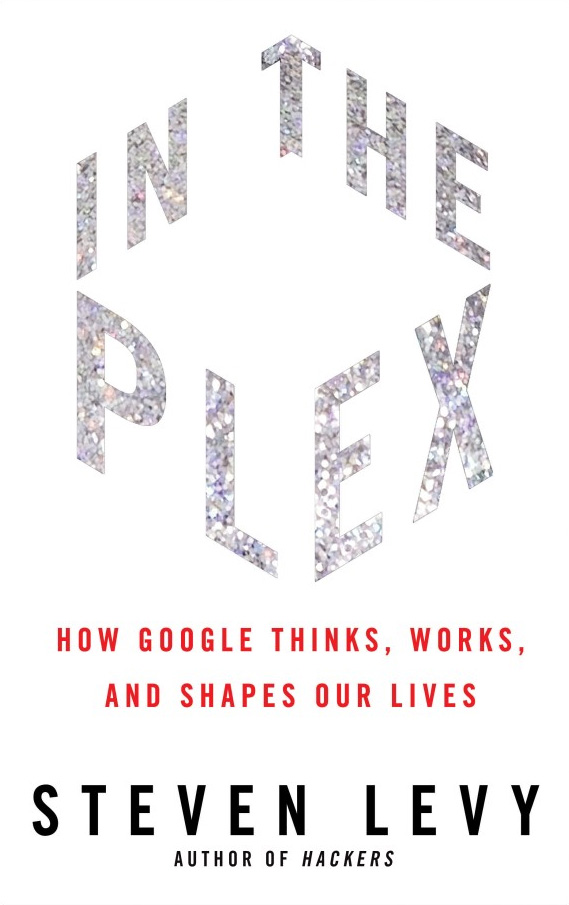
In the Plex

In the Plex: How Google Thinks, Works, and Shapes Our Lives
pub. 2011 Steven Levy
437 pages


Full disclosure: I was a passionate Googler ten years ago, an early adopter of anything that the Mountain Brook, CA firm produced -- even programs like GoogleDesktop, which I never even used. It was when Google devoured YouTube and started making its mark on there that the plucky upstart of the internet started looking a little more dangerous -- and with every passing year I've become a little more concerned about the amount of internet traffic Google controls.   Regardless of whether one trusts or fears Google, however, it is an incredible company with extraordinary influence on the web. In the Plex is a fanboyish history of how it came to be, from its early origins in a dorm room to its present goliath state, with various aspects of Google's culture and various products being examined in turn.

Those of us logged into the English-speaking net scarcely need to know what Google began as:  Google's initial product was so successful that it's wormed its way into our language. What is most remarkable about Google is how it changed the internet, and changed expectations.  That story really begins with Gmail -- a product which was produced by a Google employee on the side, then officially sanctioned once the triumvirate in charge of Google had experienced it.  Gmail's enormous free storage option -- an entire gigabyte of storage, an amount that flabbergasted Bill Gates when he heard of it --  allowed people the luxury of never having to delete their mail. That didn't just mean they no longer had to save everything to their computers; it meant they could keep every little thing from conversations to emailed receipts online, and considering how much use emails get by other websites, that could mean a sizable amount of their lives would now be shared with Google.  Prior to Google and facebook, privacy was a web hallmark;  unless you were a network engineer monitoring ISP traffic, people couldn't tell who you were unless you told them -- and I was encouraged to not tell or trust anyone. It took years of conversation between close AIM friends before I'd consent to voice chat, let alone sending picture.

Gmail changed that, and it wouldn't be the last time Google changed our expectations about what normal online. Now instead of seeing ads that were  static billboards, erected on websites in the hopes of catching some eyes,  the web would be increasingly filled with very personal ads -- solicitations to buy a book we'd just been looking at online,  ads in Spanish after using DuoLingo or watching Butterfly Spanish on Youtube,  announcements of Caribbean cruises after GoogleMaps is used to look at the Mexican coast.  GoogleMaps' associated project, Latitudes, even tracked users locations --  if they wanted. And when Google ventured into the smartphone market and purchased Android,  location tracking became the norm....and even if user try to opt out, on some level it still occurs because the phone has to communicate with cell towers and satellites.   Other projects were even more controversial, like Google's desire to start scanning the world's books and provide them for free, online.

Google is an unusual company in that it started with the ambition of a nonprofit: to make the world a better place. Levy believes this philosophy is real and still guides Googled despite their incredible wealth and influence on the web.  And there's no denying that Google's products have transformed the internet in a positive way;  GoogleMaps alone is an incredible tool, offering not only maps but information layered within the maps -- reviews of restaurants, the ability to see the street's landmarks, to browse through user-submitted photos.  YouTube, too, isn't just a place for funny clips: it holds hour upon hours of educational content, and allows people to pursue their interests and passions.  Between Google Search, Maps, and YouTube,  we  have the computer databanks of the Enterprise-D at our command.

I thoroughly enjoyed this history of Google  and its facets, but  keep in mind it's written by an ardent admirer, whose love for "cool" firms like Google and Apple manifest itself in a nasty contempt for others, like Microsoft.. He refers to Microsoft employees as "Gates' minions", which makes Levy sound like less a serious author and more like a blogger with an axe to grind.  Levy's admiration for Google also means he doesn't fully examine the  potentials for abuse inherent in one company running so much internet traffic. Chrome, for instance, has virtually taken over, and Microsoft is building a new Edge browser around its source code Chromium. What will it mean when 80% of web traffic is Chrome-based?

Thursday, December 20, 2018

Insanely Great

Insanely Great: The Life and Times of Macintosh, The Computer That Changed Everything
© 1994, 2000 Steven Levy
304 pages


Apple Computers had already made its mark before 1984, by pioneering personal computers long before IBM entered the consumer market.  In January 1984, it hoped to make a larger one -- to make a dent in history.   So it did...just not quite the way its creators intended. Insanely Great chronicles the history and influence of the Macintosh computer,  which became the company's chief product before its wildfire consumer products of the 2000s. Originally written in Apple's lost years when it hemorrhaged talent and could not find a stable hand at the rudder,  it includes an afterward on the recent turn of Jobs.  It's a history that doubles as a labor of love, because it has a biographical thread concerning Levy himself -- a man grudgingly seduced by computers. who was so enamored with the promise of the Macintosh that he bought on on release.

Although Jobs would later shanghai the project, the Macintosh originated in the person of Jef Raskin, who wanted to create an extremely cheap but versatile computer, an electronic Swiss Army Knife,  that would be easy for first time users to pick up, with an intuitive interface. While it wouldn't boast any specs worth mentioning, it would have simple tools that ordinary people would find useful, like a word processor.   Raskin wanted to push this computer into the familiar realm of home appliances:  when computers became like phones and calculators, he thought, then they would have arrived. After working with the Lisa project, Apple's first attempt at creating a machine with a GUI which proved to be an extremely expensive dud, Steve Jobs drifted into the Macintosh room and was seized by its potential.  Jobs would take over the team and make the Mac far beefier than Raskin ever intended, eventually, and his obsession with perfecting every detail meant that for all its expanded capacity, the Mac was under-powered for much of its basic operations.  Maintaining a glowing screen full of images, and drawing each bit of text effectively as an image, was asking a lot of 128K memory. And it wasn't going to be like an Apple II, either; users couldn't just open up the hood and add to the Mac's hardware.  (The Mac team snuck around on the side and allowed for the ability to do a little memory expansion, since they knew -- Jobs not withstanding -- the Mac was going to need more as soon as consumers started playing with it.)

Perhaps the Mac was a little too user-friendly.  Although those who tried it loved the operating system, many looked past it. It wasn't a serious machine; it looked like a toy.  Apple II and IBM machines which still ran the DOS system may have required getting used to typing in computer commands,  but they had a well-established library of software, including the business applications people were mostly relying on computers for. Mac was still developing its own, with the help of Microsoft.  Microsoft would use its experience with Macintosh's graphical user interface to develop Windows, though this was not a simple care of Microsoft taking Apple's idea: the pioneers there were Xerox, and  several  GUI systems were in development in the mid 1980s.  Although the little Macintosh would take over the company -- via Jobs, who diverted more resources into it away from the Apple II line, which also had the GUI by now -- and still lives in Apple in name (its current computers are much more like the Macintosh than the moddable Apple II, and have the same working-out-of-the-box approach), Levy admits that its greatest success was achieved by leading to Windows, which took a commanding lead over OSes to the point that prior to Chromebooks, it had an effective monopoly.

Although Insanely Great is sometimes more of a tribute than a serious history, I enjoyed the look at history it offers, both into the Lisa and Macintosh project, and the bit of biography: given that Levy is definitely a tech enthusaist, I was astonished to learn that he had once been anti-computers, and only when he was asked to do Hackers was he won over.  He shared Job's hatred and distrust of IBM, and  for him seduction by the Macintosh was his entry into the world of computers. Therein lies his affection, for the little machine. which literally changed his life.

For a more balanced perspective, I would recommend this video in which an Apple fan argues that the Macintosh was a mistake, and that Jobs hobbled the performance of Apple II's GUI model (GS) to promote the technically inferior yet more expensive Macintosh instead.  It's 8 minutes.  For a look at the "other side",  there's also a video on YouTube of someone unboxing a new 1984 IBM-AT.  That one is much longer, but I was surprised at the amount of software setup required just to get it started, and it helped me  appreciate the "turn on.....ready" approach of the Mac.


Thursday, December 13, 2018

The One Device

The One Device: A Secret History of the iPhone
pub. 2017 Brian Merchant
416 pages


Love them or hate them, smartphones have revolutionized society like few other inventions. Entire sectors of the economy now exist which wouldn’t be there had they had not been invented, and barring  some kind of global collapse it’s unlikely their influence will fade anytime soon.  The One Device: A Secret History of the iPhone reviews not just how a computer company decided to gamble on making what would become the best-selling consumer device ever, but investigates how the various technologies which make it possible came into being, and how everything was finally put together. Merchant illustrates that a lot of key elements were already in existence and argues that Apple’s success was putting them together at the right time,  building on to them, and adopting to market pressures in a few key areas (grudgingly allowing for third-party apps, for instance).  It’s faintly anti-Steve Jobs, for as much as it quotes from Isaacson’s biography it also relegates Jobs himself to the background, choosing to focus instead on the inventors, tinkerers, programmers, and engineers whose ideas and grueling work made the device possible.

Unless you're a fan of retrotech videos like myself,  you'll probably be surprised to learn that the idea of smartphones predates Apple, and that the first was made by Apple's hated foe, IBM -- Big Blue itself.  IBM's "Simon", however, was before its time, with a battery life of a single hour. Other technologies which were later incorporated also had their genesis in a place other than Apple's R&D department.  Merchant suggests that many technologies have a long stewing period before they're truly ready for work. In the mid 2000s,  Apple was at a place where they were looking for an edge. Jobs' experiment in remaking Apple products as a linked digital hub --the iMac and iPod linked together with iTunes, for instance -- was a great success,, but he anticipated iPods being undercut in the future by cell phones and wanted address the problem by turning the iPod in to a phone.  The shuffle wheel, as useful as it was for scrolling through music, was poorly suited for dialing phone number. However, a team working on a tablet computer were onto something with touchscreens, and  Jobs' focus on the phone project was such that the tablet, the "iPad", was shelved until a little later.  The phone didn't meet immediate success, however: Merchant reminds readers that the original only had three apps that weren't Apple products, all from Google,  and there was no App store. It took increasing pressure from people hacking into their iphones to allow for third-party programs to force Apple's hand.  It was immediately advertised as an essential feature of the phone in Apple advertisements, and Merchant suggests that the phone would have never taken off (given its price) were it not for the store.

The One Device blends technical research and business history,  and at times its level of detail may cool the interest of a casual reader.  Merchant is generally more personable than technical,  with the exception of the chapter on the iPhone’s processor, and the subjects covered are diverse -- everything from software to mining to business deals.  There's a lot of surprising content in here, too, so if you've an interest in popular tech,  The One Device will probably be of interest.

Wednesday, December 12, 2018

The Perfect Thing

The Perfect Thing: How the iPod Shuffles Commerce, Culture, and Coolness
pub. 2006 Steven Levy
304 pages


I've never had an iPod, but given that Audible was doing a sale this week and that I seemed to be doing an Apple-related set, why not? The Perfect Thing hails the influence of the iPod and shares its history, both how Apple came to experiment with a consumer device and how it used the device to transform the music industry.  It's light "reading" (I listened to it, so the description is imperfect), and its datedness has appeal: this is an Apple book written before the iPhone took over everything else,  written when Jobs had announced that yes, he had cancer, but it was easily remedied with surgery and all was well now.

When Jobs returned to Apple in 1997 and pushed the company to focus on just four products -- professional and consumer variants of desktop and laptop computers --  his idea for the desktop computers was that they were to become key components in home entertainment, a "digital hub".  The iMac came packaged with software like iMovie and iTunes to allow users to create their own videos and play music from the computer -- and not just play the CD, but copy music onto the computer to allow the iMac to be a digital music library.  Around the same time, the .mp3 coding format had been established, and there were even clunky attempts at a consumer-marketed mp3 player.  Then the inspiration: what if Apple created its own mp3 player, one that would be designed to  link perfectly with iTunes?

Although its price gave cause for balking,  the device's ease of use and attractive design made it a marketplace winner, changing the way people approached music.   Although CD players had already started allowing for more musical freedom --  make it easy to listen to the same song over and over again, or skip weak songs in an album instead of having to manually fast forward and rewind tape -- the iPod and its clones would make it a breeze.  Although a certain artform was lost in the process (having an album that told a story when listened to in entirety, in order),  most people just wanted to listen to the music they lived, when they wanted it. 

The other great influence of the iPod on music was on the industry itself.   In the days of Napster and Kazaa, the record companies were seeing the rug pulled out from under them, with CD sales following as people were able to just help themselves to goodies out there for the taking -- along with viruses,  malicious jokes, and extremely poor information as people shared files with the wrong artist and title names.  Jobs proposed an alternative: iTunes could be more than a music player and CD ripper;  it could become a storefront, allowing the record companies a way to adapt to the  demand for digital music and maintain an income stream, while giving consumers a safe and legal alternative to obtaining music at a fairly good price -- $0.99 a song. 

Levy is a tech enthusiast, an it's therefore not surprising that he completely dismisses all who look askance at the takeover of people by their little devices.  Are people retreating from one another and reality by losing themselves in their music whenever they feel like it? Sure, and why not? Although there is truth in Levy's statement that moral panics always erupt  around new technologies,  it doesn't follow that there aren't legitimate causes for concern when people put themselves into danger or ignore their family and friends (in their very company) by dropping out.

Tuesday, December 11, 2018

Jobs

Steve Jobs
© 2011 Walter Isaacson
656 pages


The past twenty years have been an amazing ride for Apple Computers, in which the ailing and speeding towards bankruptcy company suddenly metamorphosed into the most valuable company in the world, responsible for creating some of the most iconic products of the modern age.  Walter Isaacson's Jobs chronicles the life of the man who co-created Apple, fell out with it, and then came back to orchestrate the biggest brand revival ever   Throughout  it, Isaacson illustrates how pivotal Jobs and Apple were to not just the computer age, but to the opening of the 21st century as a whole. Although I am not an Apple user,  I enjoyed this biography like few others.

While many computer tinkerers of the day, Jobs' partner Steve Wozniak included, were interested in computers as tools, Steve Jobs’  background in the youth movements o the 1960s prepared him to see computers as revolutionary. He saw them as a way to marry technology and the humanities, and to ignite human potential  -- but he took. His lack of zeal for the tech side for it's own merits meant that he wasn’t particularly supportive of building machines that could be physically altered and expanded. He had a vision of how a thing should be, and didn't anyone else tampering with it.

For Jobs, computers were not merely a technological tool; they were more like art in their ability to expand horizons.  He wholly attached himself to his vision, and resisted the view of computers as open systems to be altered at will. Early in his career at Apple, he and Steve Wozniak argued over how many open slots the Apple II board should come with; Jobs only wanted two, for printers or modems, while the tinkerer Wozniak insisted on eight.  While Wozniak won that battle, he would lose all the  rest, as future creations presided over by Jobs were far more closed off to modding. Apple later used custom screws in their products, for instance, to stymie attempts at would-be home modders or consumers who wanted to repair their products at doing so. (Jobs’ vision for controlling products end to end has continue: just recently news broke that OSX systems would soon be capable of identifying hardware changes and then locking themselves down if someone other than an Apple-sanctioned repairman had replaced  a part.) 

Jobs’ insistence on controlling the vision he had for Apple products made him a domineering and mercurial boss, obsessive about seemingly small details and abusive in their implementation.  Associates at Apple joked about the 'reality distortion field' around Jobs,  the means by which he could convince himself that the impossible was practicable, and even convince  others to join him in the pursuit.  (Sometimes, with enough ninety-hour workweeks, they even achieved the impossible.) Such was his behavior that once Apple had grown from a two-man garage company into a full corporation, its board of directors effected his removal, hoping to dampen the disruptuons he caused.  He would later return after Apples’ drifting performance nearly bankrupted it, but in the meantime he developed his own computer system (Next) and  gained more management experience as Pixar. Next would be a failure, hardware wise, but the kernel of its OS would later be incorporated into Mac’s OS and even help Jobs get  his old  position of power back. At Pixar he was more able to pursue the intersection of art and tech, as  computer-generated graphics proved themselves capable of stories that gripped the human soul in Toy Story.

It was after Jobs’ return to Apple that things got really interesting, however. Jobs’ essential personality never changed, but he learned to be less meddlesome and gave to Apple the ability to focus.  He forced them to target on four products instead of a menagerie; these products were to be the best imaginable, “insanely great”. He often used novel designs that played with the imagination. Instead of familiar beige boxes, for instance, the iMacs of 1997 were colorful egg-shaped units that stood out and were advertised as being especially made for the internet, which by then was roaring.  Jobs focused not just on function, but on feeling; he wanted product to resonate with people, to give them a certain joy in using them, and that was part of the reason he was so obsessive about small details. Everything mattered, even the arrangement of the interior which might not ever be seen.  Jobs was the first to make aesthetics a key consideration in build quality. Jobs' vision prove itself when he pushed Apple beyond computers, into consumer products, with the ipod -- and later, the best-selling consumer device of all time, the iPhone.

Although Jobs was not an easy person to work with or know, there can no denying his pivotal role in the making of 21st century technological society. While Apple's hostility towards the right to repair makes me shudder, I can appreciate the commitment to exquisite design that Jobs made part of Apples culture; every time I help someone at work with an iPhone or a MacBook I enjoy the experience.    As much as I prefer the open moddability of Windows and Androids systems,  Isaacs' book made me far more curious about the 'other side' than I would have imagined.

Saturday, November 24, 2018

Short rounds and leftovers:

Hello, readers! Here's hoping those of you in the US had an enjoyable Thanksgiving on Thursday. I thoroughly enjoyed the company of my cousins, though I did rather poorly in our board game of choice.  I blame the dice.   Throughout the week I finished up a couple of titles and wanted to comment on them.


First up is The Cathedral and the Bazaar, which is less a book and more of a long essay on Linux, an open-source operating system -- and specifically, how Linux's bottom up, emergent order approach is much different from the controlling top-down approach of Microsoft and Apple.  I was interested because I recently used a boot disk with Ubuntu (a Linux variant)  to access a computer and extract files from it after it stopped booting Windows. I was pleasantly surprised by its intuitiveness, because I'd previously regarded Linux as something of interest chiefly to programmers and system administrators. Everything I had to do I managed through the graphical interface, just like Windows or Apple, and I made another boot disk with another Linux variant (Mint) to test next time.  An interesting quote from the book:

"The Linux world behaves in many respects like a free market or an ecology, a collection of selfish agents attempting to maximize utility which in the process produces a self-correcting spontaneous order more elaborate and efficient than any amount of central planning could have achieved. Here, then, is the place to seek the 'principle of understanding'.

The 'utility function' Linux hackers are maximizing is not classically economic, but is the intangible of their own ego satisfaction and reputation among other hackers. Voluntary cultures that work this way are not actually uncommon; one other in which I have long participated is science fiction fandom, which unlike hackerdom has long explicitly recognized [ego-boosting] as the basic drive behind volunteer activity."

Although a lot of the content of The Cathedral and the Bazaar is over my head (given my status as definitely-not-a-programmer),  I like the idea of the open source movement, and not just because it produces good programs that are free of cost, like VLC Media Player, LibreOffice, and the GNU Image Manipulation Program (GIMP), two of which I use.   Developers are becoming insanely clingy about controlling users, and about what they allow users to control; these days the proprietary software on computers isn't so much owned as rented.  And some of the software produced by these places isn't even that great: my favored music player, Winamp, makes it far more easy to build and edit playlists than iTunes or Groove, and it's been using the same simple approach for all the 15+ years I've been using it.  


Also up is Coffee to Go, a truck-driving...journal from a Scottish author who drove principally between the UK and western Europe. This book was recommended to me on the basis that he travels to Russia, but no such trip was recorded here, with the farthest reaches being Austria and northern Scandinavia. (There may be multiple editions?) Although I like trucking memoirs generally, this one was....well, less a memoir and more of a journal. Hobbs records every bit of his trip, from how much he paid for coffee to what he said to the fellows as customs, and I found it tedious. The last fifth of the book are recollections of his trips from before he started keeping a diary, and those are much more interesting to read because of all the play-by-play action is absent, replaced by a general narrative with thoughts on traveling to tiny places like Andorra. Easily the most interesting chapter were his memories of driving into Western Berlin during the Soviet era, when  the western side of the city was a pocket surrounded by the dismal DDR.  Hobbs seems like a nice guy, but this wasn't one I'll remember much about, I'm afraid.