Showing posts with label economics. Show all posts

Thursday, January 26, 2017

Laughter is Better than Communism

Laughter is Better than Communism: Politics, Wit, and Cartoons
180 pages
© 2014 Andrew Heaton


 A couple of years ago I stumbled upon Andrew Heaton’s “EconPop”, a series of videos in which he used popular films to illustrate economic concepts in a playful way.  Laughter is Better than Communism  employs a similar approach, collecting satirical pieces on politics and economics written from a libertarian angle. Heaton's pieces include commentary on occupational licensing and gerrymandering, which despite their role in undermining political life and economic growth, don't receive as much attention from libertarians as something like foreign policy. Even when he treads ground covered by other authors, though, Heaton's comic style makes his delivery unique nonetheless. He writes as an entertainer, not a lecturer, and liberally festoons the book with cartoons to illustrate his points. In the chapter on gerrymandering, for instance,  Heaton presents actual maps of congressional districts which have been grotesquely molded to create a certain constituency (a bloc of conservatives in a liberal city, for instance, or  the corralling of black votes into a single district), side by side with illustrations of what those distorted electoral maps might resemble: a man surprised by lightening, for instance, or a lemur throwing a boomerang.


Despite the amount of cheek and comics, though, Laughter has a lot of serious points to make. This is a partial education in political economy and economy in general:  Heaton covers the problem of Congress, for instance, of how the behavior that makes an individual congressman popular in his district (using federal money to build things in that particular state) makes Congress dysfunctional and loathed collectively, because money is constantly being taken from people, only partly reappearing in odd pet projects, and Congress itself  spends all of its time arguing and moving the money.  He hails the salutatory effects of trade between individuals and nations,  noting what he used The Dallas Buyer's Club to illustrate : commerce brings people together who would otherwise despise one another, and gives them a reason not to kill each other.  It also allows them to prosper together,  pooling their expertise and gifts.  Impediments to trade -- like occupational licensing laws which prevent private citizens from developing their own interests and helping people, or burdensome regulations that make growing a small business impossible -- are often erected through bipartisan efforts for good intentions, but often rob the many on behalf of the few, like businesses which have already established themselves and want to squelch further competition.  Heaton alternates between real examples and fictional scenarios, but if you're interested in learning more about how occupational licensing perpetuates poverty,  there's a documentary called Locked Out that may be of interest to you. Listen to a five-minute interview here with that movie's subject, a Tupelo woman named Melanie Armstrong who fought a law forcing her students to obtain an expensive license to braid hair,  read an article on the subject, or read her story directly.  This isn't just about braiding hair, but more largely how occupational licensing serves as  barrier  against self-empowerment, perpetuating poverty in the United States.  The last ten minutes are particularly encouraging, as -- after Armstrong's legal victory --  a wave of impoverished people were able to pursue their own dreams. Hope was restored.

In short, Laughter is Better than Communism fun little collection of Bronx cheers aimed at planners, prudes, and other people who feign to know better than others about how to live their own lives.


More of Heaton:


Revan Paul: And it doesn't matter if it's 'bulk metadata' or not -- who you send holograms to is information about you.

Luke: Ten thousand? We could almost buy our own ship for that!
Ben Kenobi:  The government has increased the cost of risk, and so our supplier is increasing the cost of his services. It's basic economics, Luke. We're gonna do a little lightsaber work, and then I'm going to have you read a lot of Milton Friedman.


The aforementioned economic appraisal of The Dallas Buyers Club

Wednesday, February 17, 2016

An Economist Gets Lunch

An Economist Gets Lunch: New Rules for Everyday Foodies
© 2012 Tyler Cowen
293 pages


Imagine going out to eat with someone who really likes to talk about food, and imagine that this person is also an economist. That's An Economist Gets Lunch, three hundred pages of very excited chatter about food culture and markets across the world.  There's no argument to be had, just sheer enthusiasm for the subject at hand, one that I had to be wary about reading because it kept giving me the munchies.   Cowan's concoction is a weird mix of  culinary discussion, economics, world travel, and history.  He doesn't produce a set of rules: there's a principle guideline, followed by many little bits of advice. The key principle is this:  food is a product of supply and demand, so look for options where the supplies are fresh, suppliers are creative, and the customers are demanding. The implications of this are broader than "avoid fast food".   Cheap doesn't necessarily mean bad;  most of Cowan's favorite culinary experiences happen while traveling in less-industrialized areas of Mexico,  Nicaragua, Sicily, Thailand (he's very well traveled, this fellow) and other places. Because food markets are predominately local there, supplies tend to be fresh and the creators specialists in their region's offerings. The price is dirt cheap, compared to the cities.  A high price tag doesn't indicate that the food is exquisite, either: often it carries with it the money sunk into creating a luxurious restaurant environment, complete with superfluous staff like valets, or the high rents.Cowan especially disdains the city centers of touristy areas like Paris and Rome. You want good Italian food, hop on a train and head for the back country, he urges. And French? Try Japan.   

Cowan makes for an interesting dinner companion, going from this to that topic. He starts off with a discussion of why American fine dining is largely inferior to Europe's, blaming it on Prohibition, television, and parents who cater to their kids' bland palates.  Later on he devotes an entire chapter to the majestic enterprise that is barbeque, and defends agribusiness. Don't blame agribusiness networks because they produces crappy fast food, says Cowan, any more than you would blame the printing press for producing pulp fiction.  Curiously for someone who is generally aware of the impact politics have on markets, he assumes the entire reason people rally against GMOs is because they're scary. It's not a question of the products being proven safe, but of power and corruption: the companies producing these things are the ones with commanding market shares and accompanying political influence, supposedly regulated by their former coworkers. No sooner has he written on this, however, has he returned to an apparently favorite topic: the ins and outs of good Chinese food. 

This is a book of interest, but it goes back and forth so much I have no idea who the target audience is. There's definitely more information about food than economics, for what it's worth. 

Related:
  • EconTalk interview with Cowen on the book. You can scroll down for a transcript of the conversation and get a lengthier feel for the author's many food interests.


Tuesday, July 22, 2014

Fighting Traffic

Fighting Traffic: The Dawn of the Motor Age in the American City
© 2008 Peter Norton
396 pages


Stroll into the middle of any American city today, and provided you are not in Detroit, odds are better than not you will be sent flying by a car. Streets are the province of the constant flow of automobile traffic, and anything else -- bicycles, horses, skateboards, pedestrians -- is most unwelcome. This is a comparatively recent development, however;  for most of human history,  streets were an integral part of the human landscape, the site of markets and ad hoc playgrounds. Fighting Traffic details how streets became instead traffic sewers, moving the most cars as quickly as possible, and does so with impressive heft. Its scope is more massive than its size, as in the course of rendering a social history of the urban fabric, Norton also details the shifting evolution of economic and legal  assumptions that policy became a manifestation of.

The automobile was a novelty in human history,  not just for its speed but for its cheapness.  Although horse-drawn wagons and carriages took up as much space per vehicle as cars, if not more,  horse teams were so expensive that their ownership was not universal. Even so, cities throughout history have had congestion problems and attempted to deal with them through legal means. Mass-produced automobiles, however, became so popular in the early 20th century that even the poor owned them, and  they flooded city streets. As their numbers increased, so to did the fatalities they inflicted, driven at speed by people unaccustomed to such power.  The rising spike in deaths prompted public outcry and attempts to bring the beast to heel -- and so began the war.  At the same time that concerned citizens were attempting to curb the car,  automobile owners and auto manufacturers were mobilizing to expand its horizons.

The battle that emerges throughout the two decades of the 1910s and 1920s has a fascinating cast of players who frequently switched sides on one another. The auto lobby first used citizen-groups like safety councils to begin shifting the responsibility of reducing fatalities to pedestrians. In urging for laws to define the rules of the road, they managed to turn ageless human behavior -- crossing the street -- into a crime called jaywalking.  The safety councils were unreliable allies, however, eventually insisting that the safety of the community was most imperiled not by ambling pedestrians, but the reckless speed of the drivers.  The nascent traffic control movement was then employed with good effect;  in the early days policemen were charged with keeping the roads in good order, but they were soon usurped by engineers. The changing world of the 20th century had come to favor their like; cities were now tied together by massive engineering projects like gas pipelines and water mains.  In the wake of their success, why not treat the streets like a public utility, one run by experts?   The reign of engineers would accomplish much in driving people out of the streets; the implementation of synchronized traffic signals so spurred the rate of traffic that pedestrians were forced by survival instinct to cower at the crosswalk until given sanction to pass by the new machines.  But tasked with making transportation more efficient, the engineers eventually stood their ground against the auto lobby:  cars, after all, are far from the most efficient mode of transportation.  They don't use space terribly well, and they require parking -- acres and acres of parking!    

The continuing and rising popularity of cars, however, made victory seemingly inevitable.  Not that cars had triumphed merely owing to the free market; they were, after all,  given a free hand and their roads public financing whereas the trolleys were stifled by regulation. Once cars took to the road in numbers, they effectively destroyed any room for other choices.  The book leaves off at the start of the 1930s, before traffic masters like Miller McClintock began their dream of "gashing through" the cities with auto-only highways,  but even so their triumph was accomplished in physical fact and in law and culture.  Fighting Traffic's history of the city's initial conquest by the automobile impresses with its thoroughness and organization;  Norton is almost lawyer, building a case point by point and constantly reinforcing it.  His ambition was not merely to deliver a history of the city's driven evolution, but to examine how opposing social groups overcome one another in the political sphere, using modes outside the law -- like the clubs' use of organizations like the Boy Scouts to shame pedestrians for not obeying their new signal masters, and of course the newspapers.  The scholarly bent makes it slightly daunting for lay readers, but it's worth digging into.

Related:


Wednesday, July 16, 2014

The Small Mart Revolution

The Small-Mart Revolution: How Local Businesses Are Beating the Global Competition
© 2007 Michael Shuman
285 pages


Independence has long ceased to be the American credo, supplanted by another: efficiency. Throughout the 20th century, small businesses supporting towns and families were devoured by larger firms, big businesses who gave little back to the communities they colonized other than an infrastructure burden and a handful of jobs. But Michael Shuman holds that it ain't over yet, and in The Small-Mart Revolution this entrepreneur argues that the titans have achilles' heels and citizens still have a choice.  A combination of economic study and political jeremiad, Revolution is concise and feisty.

Shuman establishes a dichotomy early on; this is a story of TINA versus LOIS.  TINA is the there-is-no-alternative mentality, the approach the United States has taken on in the modern age; it is the path of chasing and relying on big businesses for jobs, of sublimating the local economy to the globe. LOIS is the alternative, the locally-owned, import-substituting approach. Shuman begins with arguments for LOIS against TINA;  not only do big firms invariably disappoint those who hunt them,  accepting tax breaks and infrastructure put in on their behalf, only to skip town when another city offers an even better deal -- but the money they produce is lost to the host community. A Wal-Mart store forwards its take to Bentonville, Arkansas;  it doesn't invest it in local banks, and most of the wealth is spent elsewhere. Money spent at a local firm, however, owed and staffed by locals, is subject to a multiplier effect.  There are other considerations, like the folly of depending on fragile systems for vital resources. Why should a town rely on food shipped in from California when its own fields can produce enough to support the population?  Shuman is not blind to David Ricardo's theory of comparative advantage -- that given communities and places are better at doing some things than others, so towns that have fields and mineral deposits might be better off plopping down a mineral-using factory on those fields and having the food shipped in from a place that only has food to specialize in. This makes perfect sense when thinking about people who want oranges in Michigan; the cost of growing them in greenhouses would be prohibitively expensive when they can buy from Florida and California.  But why should people in Alabama buy pork from the Carolinas when only a generation ago, farms that incorporated livestock and agriculture were the norm?  There are factors other than cost to consider, writes Shuman;  shipping food from one side of the continent to the other is a waste of resources and an abusive of the environment, but the chief fact remains that we can't rely on the world's perpetual stability. Sooner or later a  wrench is going to be thrown into the global economy; it may be a financial crisis or peak oil,  but disruptions are inevitable. Centralization can be efficient up to a point,  but decentralization is the option for health and safety.  Reinvigorating local economies will not only restore vitality to our communities, but is prudent for national security as well.

All that is easy enough to say, but how is it to be done? Sure, a city in Alabama can buy local food --but local shoes? Local computers?   For Shuman, the purely-local economy is a hopeless ideal;  he doesn't wholly condemn big businesses, either,  but regards dependence on them as folly. If lessons can be taken from their business practices, so much the better, but his mission is to restore vitality to local communities, an impossible task without restoring the local economy. After making his initial case, Shuman offers advice on how citizens, small businesses, public officials, national leaders, and even globally-minded persons can rely on and expand local economies.. Chapters are committed to each, and end with a list of actions each kind of activist can pursue.  Individual steps are obvious; visit farmers markets, use local hardware stores, invest money in credit unions -- but business owners can ally together in cooperatives to gain some of the advantages of the Goliaths without compromising themselves or their places. Shuman also explores territory outside the usual advice by urging people to invest locally,  something not easy given legal structures that favor the New York exchange.  Dismantling the obstacles to helping big business flourish, from zoning laws to financial support for corporations that are wealthy enough to pay for their own parking lots, is also key.

This is in short quite an interesting book, of considerable interest to those concerned about the wellbeing of their communities, especially their economies.  While no community will ever stop participating in the global economy so long there is wind to fill the sails of ships,  providing more needs locally is a surer course to  curbing high unemployment and staying adaptable than TINA. Prudence is demanded, but Shuman offers ways we can restore communities without falling too much afoul of economic reality.

Related:
Strong Towns, Chuck Marohn. His blog has commented on growing local jobs rather than
Human Scale, Kirkpatrick Sale
The work of Wendell Berry, especially Home Economics
Suburban Nation,  Andres Duany et. al
Eaarth, Bill McKibben

Thursday, May 15, 2014

Human Scale

Human Scale
© 1980 Kirkpatrick Sale
500 pages      


      Human Scale is an ambitious assault on big business, big government -- the very concept of Bigness. Opening with biology, Kirkpatrick Sale first establishes his basic operating principle:  for everything, there is a limit to its size beyond which it cannot grow without being compromised. In its opening third, Human Scale addresses the problems inherent in large, complex systems, then follows that with sections on how society, economy, and politics might function more effectively if scaled down.  On the hefty side itself, Human Scale impresses with its thoroughness; a kindred spirit to E.F. Schumacher's small is beautiful,  the book has largely stood the test of time in putting forth a case for decentralized politics, appropriate technology,  organic locally grown agriculture, and cities and buildings built to the human scale.  Sale creates a synthesis from topics as varying as demographics and aesthetics.. It is at times dated, at least in its optimistic projections for solar energy efficiency.  On the whole, however, it offers insight into government dysfunction and widespread social problems, along with ways people can work to effect change themselves. It is almost an anarchist how-to, a review of ways people can reclaim their lives against the power of centralization, and its enduring relevance is proven in the multitude of authors still advancing its ideas, a number that includes Bill McKibben and Wendell Berry.

Saturday, March 29, 2014

I'll Take My Stand

I'll Take My Stand: The South and the Agrarian Tradition
© 1930 various authors.
410 pages
 "There was a land of Cavaliers and Cotton Fields called The Old South...Here in this pretty world Gallantry took its last bow...Here was the last ever to be seen of Knights and their ladies fair, of Master and of Slave.Look for it only in books for it is no more than a dream remembered. A Civilization gone with the wind.

For most the Roaring Twenties were a celebration of the triumph of progress. The Great War in Europe was over, and its conclusion saw many of the old empires and forces of conservatism defeated by the liberal-democratic allies (or in Russia’s case, by soviet revolutionaries). In America, business was booming; the cities were swelling with people streaming in from the impoverished countryside, going to work in factories and celebrating American triumphs in war and peace by purchasing as many of the new gadgets that filled the stores as they could, and using credit to acquire those they couldn’t afford. But in the late 1920s, on the precipice of the Great Depression, twelve men of letters looked to the future and saw a vision of despair: the Old South’s final defeat by the forces of modernity, and with it the loss of genuine civilization.  I’ll Take My Stand collects essays defending both the South as an entity apart from the rest of the American nation, and the agrarian system of life that for so long was its defining characteristic. Nearly 85 years after its release, their  fears have been realized. Southrons are just as removed from farming as any other Americans, and the interstates  and cookie-cutter subdivisions have reduced the southern aesthetic into the same bland sprawl that plagues the rest of the nation.  Their call to arms urges a defense for a way of life that is now passed. I'll Take My Stand remains of value to modern readers, however, in offering  both an appreciation of the Old South's culture beyond stereotypes and a critique of the automatic cheering-on of anything called progress.

I first heard of the 'Southern Agrarians', the symposium gathered here, in Russell Kirk's The Conservative Mind, and the books are of like temperament in promoting an measured conservative response to cultural change.  Both look for inspiration in tradition, both the rich intellectual, moral, and artistic traditions of the west, but are averse of the modern embrace of the conservative label with the forces of big business.  The gentlemen gathered here are most certainly not fans of business;  they are 'men of letters', intellectuals and artists, who share the old gentry's contempt for the naked materialism of business. A farm is a place to grow corn, not make money, one writes. The authors and those who they look to for inspiration, men like John C. Calhoun, believed in a 'graceful' life;  one supported by work, of course, but devoted not to profit but to the pleasures of a good life;  time with family, living out old traditions;  the art of conversation; music,  and art.  Where Kirk and the Agrarians differ is emphasis on farming;  the southerners see the South's agricultural basis as vital to maintaining civilization, which draws wisdom from the seasons to realize there are limits to everything, and a time and place for everything under the sun.  The north, with its towns and factories, long abandoned the settled wisdom of Europe, which then lived on in the South, wrote the authors; they were given way to madness, to pursuing phantasms.

All this sounds rather lovely, but  the appeal of their Southern Civilization is itself limited; although they look with fear and contempt upon the centralization of wealth in the north, they defend it in their own massive plantations. Farms function better at that large scale, one writes. The virtue of economics vanishes, however, when it threatens them, and the fact that a factory can produce goods more efficiently  than a homestead is dismissed as being beside the point.  That's not to say the agrarians are hypocrites; another praises the Gracchus brothers, the classical heroes of the left, who wanted to break up Rome's great plantations and restore the land to the common man. They are twelve individual authors of varying sentiments and approaches; most write conventional essays, but two tell stories that illustrate the points they intend to make. On the whole, however, they lean toward  'elitism'; this is not just implied given their praise of a life of culture and leisure practiced by very few (yeoman farmers given passing mention, but), but in their disdain for the masses.  One dismisses the people as superstitiously religious Anglo-Saxons who need guidance, as if the southern gentry were Norman lord. If they have that level of disdain for the Saxons, woe betide the Scots-Irish working poor! There's also the matter of race and slavery. Slavery is not quite defended, but blows against it are certainly cushioned as the institution is described as obscene more in theory rather in fact.

I'll Take my Stand is a difficult book, not so much for its writing (some pieces lean toward the abstruse, but not most)  or its arguments, but for those old biases. These are not twelve members of the gentry writing, but intellectuals, and even though some of them rose to culture from farming stock,  their vision of the past is more idealistic than an argument for restorative action can be based on. It's intellectual and cultural history with a little too much romance, rather like the opening of Gone with the Wind which is quoted at the lead.That farming has become the province of industrial corporations is a severe loss for the American people; that our cultural links to the past, in the form of tradition, has been shredded is likewise a tragedy;  we live in an age where home skills like sewing and canning are taught not by family elders, but by government bureaucracies. Yet these arguments will not take root in the modern readers' mind, accompanied as they are by noxious weeds like elitism.  It's a shame, too, because many of the ideas expressed here ought to be considered, especially the notion of a simple life versus one of acquisitive materialism. Given that such ideas are argued in other books, by less impeachable authors,  I'll Take My Stand's greatest enduring appeal is in the area of intellectual history, of understanding the southern mind as it attempted to find the best response to industrialism pushing its way under the Mason-Dixon  line.

Related:


Wednesday, February 26, 2014

Look Away!

Look Away! A History of the Confederate States of America
© 2003 William C. Davis
496 pages


While most Civil War histories concentrate on military campaigns, Look Away! chronicles the history of the Confederacy from a political and social perspective. Its attempt to ignore military matters is almost futile given that the Confederacy was born in war and perished amid it, as its every institution (civic, social, economic) was ravaged by the war and driven into failure. The story of Look Away is one of a doomed nation, riven in contradiction from the start.  Examining the feuds between the southern Congress and its president, the implosion of slavery, the breakdown of law and order,  the trials of women and economic woes, it looks at the southern nation that lay behind the battlefront.  Though I initially avoided reading this on suspicion that it was the work of neo-Confederate ideology (I've seen it sold beside titles like The South was Right!), it proved appropriately moderate, neither overtly friendly nor hostile -- not that its presentation of slavery as the driving force of the war pleased the sputtering reviewer who announced that Gone with the Wind was a superior text to consult.
Davis  begins with the crisis leading to the secession of the southern states, and their gathering together to create a new constitution. The form of their confederate government makes plain slavery's role as a cause of the war; even if one ignores all of the defensive rhetoric from the time,  the fact that no Confederate state could ever dispense with slavery within its borders has challenges the "states' rights" crowd who maintain slavery was incidental. The southerners attempted to create a modified version of the US Constitution which emphasized the sovereignty of the individual states,  but the stresses of war would the dream.

Attempting to forge a nation from scratch in the midst of a war is no easy feat;  while the Continental Congress accomplished it, their task was somewhat easier. Their foes was an ocean away, its resources and attention scattered, its means of communication and transport largely the same as in the days of William the Conqueror.  The north and south, however, were intimate neighbors with intertwined borders: both could and would field armies in the hundreds of thousands, supported by the best of modern technology -- trains, telegraphs, and a robust factory system. The war would be total from the beginning, as Davis' account bears out.

His examination of the home front demonstrates how widespread military enlistment and conscription led to much of society simply failing apart for want of the men needed to maintain it. Not only were civil servants like postmen, peace officers, and the like taken, but so many men were absent either through enlistment or conscription that the farms were left undermanned and vulnerable not only to slave insurrections but raids from bands of highwaymen and deserters.

Complicating matters from the start was the divided political sentiment of the southrons who, though avowing agrarian democracy and political liberty, were led by a plantation elite jealous of their own power and dependent on slavery. The Confederacy was an oligarchy in the form of a democracy, Davis writes, and as the war continued the form of democracy wore off. Civil order collapsed, leaving parts of the south running on martial law, naked power, and the government proved no less dangerous to struggling farmers than raids as it began seizing crops as quickly as they could be grown. Not only was the army of little use in countering the violence of highwaymen, beset on all sides by the Union force, but  the state it served had become an agent of abuse itself. The best of the south's political class had fled Congress for the Army (war being less distasteful than the tenor of debate), leaving the government in the hands of woefully inferior personalities who were only too happy to spend their time bickering while Rome burned, and corrupted by all of the power coalescing in their hands. The longer the war wore on, the more power Richmond collected; not only through self-willed expansion, but by people depending on it as a last resort.  The Confederacy, having begun as a decentralized confederacy, was by war's end a welfare state; an astonishing journey that only war could taken a nation.

Although it offers brief military recaps to give readers an idea for the general course of the war, Look Away!  is first and foremost a history of the southern country at home as it attempted to be a people and a nation at war.  Not only does it offer readers a view of the chaos that the  average family would have been enduring through the war years, it imparts an understanding of the Confederate government far different from the one which exists in popular myth. It's a grimmer view, but one softened by the fact that Davis is plainly sympathetic to his subjects.  Look Away should definitely be of interest to anyone fascinated by the Civil War or southern politics.

Related:

Friday, January 17, 2014

Toward a Truly Free Market

Toward a Truly Free Market: A Distributist Perspective on the Role of Government, Taxes, Health Care, Deficits, and More
© 2011 John C. Medaille 
282 pages

 "I been a-wonderin' why we can't do that all over. All work together for our own thing, all farm our own lan'.[...] I been thinking about us, too, about our people living like pigs and good rich land layin' fallow. Or maybe one guy with a million acres and a hundred thousand farmers starvin'. And I been wonderin' if all our folks got together and yelled..."
(Tom Joad, The Grapes of Wrath)

Toward a Truly Free Market argues for an economic system based on neither an unmoderated free market nor an authoritarian command structure, but on  moral principles that put human needs, not ideological purity, at the center. At the heart of these principles is the concept of distributive justice. After sketching out the general problems of conventional economics, Medaille claims that capitalism and socialism are more alike than different. The constant lack of equilibrium in a capitalist economy, the fact that labor is never paid enough to ‘clear the markets’, dooms capitalism to a series of booms and busts, and it is that cycle that distributive justice is intended to remedy, because attempts to 'fix' capitalism through intervention have only led,  to increased economic and political power in the hands of a few. Toward a Truly Free Market offers a fairly comprehensible 'third way' to economics, one that defies partisan labels and offers a humane vision for the future.

The distrubist worldview envisions a society in which both political power and the ownership of production (on which political power depends) are as widely distributed as possible. In this society, no one is an employee; almost everyone has an owner's stake in society, whether in the form of a family farm, a small business, or membership in a cooperative. The idea doesn't originate with Medaille; although aspects of it have been imagined since modernity began (Thomas Jefferson's agrarianism, for instance),  it was argued for under the name Distributism beginning in the 19th century -- as part of the Roman Catholic church's social doctrine. Then, Catholic authors like G.K. Chesterton argued for it as a moral alternative. as a system that would protect the integrity and autonomy of the family against both the ravages of factory dependence and state socialism; now, with distributist ideas  developing a life of their own outside the Church, Medaille takes an economic tack by first examining the weakness of economics without justice, which attempts to reduce land, people, and money to commodities, and then explaining the principles of distributive justice, moving from the general to the particular.

While classical economics begins with the material ("Economics is the study of how scarce resources with alternative uses are distributed"),  distributist economics begins with people: Medaille describes an economy as how a society is provisioned.  His criticisms of socialism and capitalism bear out that provisioning isn't necessarily material; he laments over the destruction of local economies, the brokenness of families, working long hours at jobs which offer no meaningful compensation, only a paycheck, and the fact that people at all levels of society, from the family up through the neighborhood, city, and state become increasingly dependent on the national government, leading to the death of civic society as Citizens become clients and case numbers.  This is true whether the system chosen is capitalism or socialism,  Medaille's solution includes "remoralizing the market, relocalizing the economy, recapitalizing the poor, and reinvigorating local politics".  Operating principles of distributism include solidarity, or the belief that political decisions should be handled by the smallest capable agent; thus, a city would be responsible for its schools, and a state for its highways. Medaille elaborates on how distributive ideas can inform taxation, industry, healthcare, and government policy.  Although he sees a place for government (keeping the currency sound, pricing in externalities, national defense),  distributism rejects a top-heavy state. Politics, like a house,  must work from the ground up, from civic participation to tax funding.  That funding comes not from income or property, but on the land itself. Decentralization is a recurring theme; Medaille's idea on fixing healthcare includes having a range of licenses, beginning with the quasi-medical and progressing to  doctors of medicine) not only would this allow more people to enter the medical field, as they could more easily move between study and practice (a given person might take a license as a midwife, and then use that to pay for more advanced training in obtstritcs or general medicine), but it would result in better healthcare over all, as seasoned and highly-trained doctors would only see problems that could not be resolved at the lower levels.  He advocates for an end to "supply-push" economics, in which companies produce a given number of goods and then use advertising to gin up interest in them, when general-purpose machinery that can adapt to produce anything that is needed by the local economy ("demand-pull") is a more intelligent and just use of finite resources. Otherwise we are merely producing landfill.  

Toward a Truly Free Market is a fascinating book. The beginning  is the most challenging,with the discussion of the 'distributive' and 'corrective' aspects of justice, and  the difference between use-values and exchange values, but understanding what the author means by justice is rewarding once he begins writing about a system that is based on it. Although distributism proper began in the Catholic church, being developed in papal encyclicals, I've encountered its ideas in various and sundry places:  James Howard Kunstler wrote on the virtue of Georgist taxation in The Geography of Nowhere, Chuck Marohn of Thoughts on Building Strong Towns is a firm believer in subsidarity, and the push for local economies, especially local food movements, is gaining serious traction in the environmental and health movements.  Although some aspects were more harder to imagine, like the revival of guilds or the practicality of cooperatives,  Medaille includes sections on communities like the Mondragon Cooperation which put these principles to work. Although there's some economics to digest, the book picks up steam as it moves toward public policy. A fly in the ointment is that Medaille assumes readers have heard of distributism; he doesn't elaborate on it at the start. He develops the idea throughout the book, so strangers won't be lost, but they have to be willing to jump in. This is perhaps explainable given the book's Catholic publisher; since distributism is part of the Church's social doctrine, it almost has a ready-made audience. The claim that capitalism and the state have an unavoidably symbiotic relationship with one another could have used further development; I've heard the same claim from hard-left circles, too, and would be interested in understanding the full reason why. Medaille operates on the idea that the state is necessary to keep capitalism from destroying itself, but Hayekians believe capitalism would have worked out its inner inconsistencies if meddling interventionists didn't keep getting in the way, like suppressing a fever that's intended to kill an infection. (Medaille takes more than a few shots at the Austrian School throughout, which is amusing given that Hayek drew on a distributist work, The Servile State, in his The Road to Serfdom. )

Many national-level reforms mentioned here don't have a prayer of materializing in the current political climate, but a philosophy as locally-focused as distributism can get along.  Determined people can build little sanctuaries of restoration in their own communities, with or without government sanction;  even urbanites can relocalize their food, and cooperatives of all kinds are possible, and already in practice. There's a lot of cause for hope here, and Medaille offers a thoughtful criticism of our current system which is outside the usual complaints.

Related:
Books and essays by Wendell Berry
small is beautiful, E.F. Schumacher

Monday, January 13, 2014

small is beautiful

small is beautiful: economics as if people mattered
© 1973 E.F. Schumacher
288 pages


Get big or get out, said the Secretary of Agriculture to American farmers in the 1970s. But as the consequences of widespread industrialism and general upheaval began to show their faces, ,the environmental movement was born and another voice, E.F. Schumacher's, rang out against the agribiz giants: not so fast.In small is beautiful, he argues against industrial and agricultural giantism that is not only unsustainable energy-wise, but malignant to the health of developing economies. Taking partial inspiration from “Buddhist economics”, a perspective which considers the impact modes of production have on the persons involved,  Schumacher argues for small-scale production and the implementation of ‘appropriate technology’; that is,  forms of technology that can be implemented into existing societies and increase production gradually, allowing developing nations to adjust without causing the kind of disruption that results in gigantic slums and spasmodic bounts of famine and war. This also applies at the individual level, for appropriate technology can allow laborers to still be personally involved in their work,  not alienated from it as happens with assembly-belt mass production.  Although penned in the 1970s, this is a work which has only increased in relevance:  environmental solutions constantly defer to the need for localism, from community-supported agriculture to roof-mounted neighborhood solar panels feeding into the local grid. Our lifestyle hasn’t become any more sustainable; our rate of progress down the dead-end road of  total consumption has only increased in the last decades.  Small is beautiful is definitely a work to consider if you have any interest at all in environmentalism, ecology, sustainability, or the economy’s impact on society.

Related:
  • Virtually anything by Wendell Berry, whose 'Great Economy'  shares the same humane vision, as does the philosophy of distributism.
  • eaarth, Bill McKibben

Saturday, September 28, 2013

Home Economics

Home Economics
© 1987 Wendell Berry
192 pages

The term economics originally referred to household management, and to Wendell Berry, that's what it should remain still. Home Economics collects essays on the meaning and relation of economy to human life. In it, he deplores the cancerous growth of massive, unwieldy structures like agribusiness, globalization, and the state which destroy culture, communities, and the land, reducing the human experience to economic inputs. He ruminates thoughtfully on the value of more traditional ways of life, and advocates for an approach which is much more finely-grained For Berry, the humane society is one built to a small scale, built on local economies wherein people, not institutions, are the primary actors, and where the relationships between people and the land are respectfully maintained.

Berry is a fascinating author. At first glance, he's manifestly romantic and old fashioned, advocating for the same kind of agrarian  Republic of citizen-farmers that Thomas Jefferson yearned for. Though he's grounded in the past, quoting freely from classical poets and the Bible life, he's not mired by it: he does not despise cities as Jefferson and other agrarians did, and writes that if we wish to preserve the wilderness and farms, we must preserve our cities, too.  Though he doesn't outline his reasoning, it may be similar to that of David Owen's, who sees energy-efficient cities as the best hope for combating climate change. It's certainly a better  hope than car-dependent suburbia, which Berry despises (however much a gentle and aging scholar-farmer can despise something).   Berry urges readers to consider a return to localism not just because it's better for the environment (his veneration for which is religiously inspired), and not just because the new institutions are oppressive and destructive but because Nature has a way of correcting the unsustainable. That which cannot sustain itself will not: eventually it will fail. We will not persist living as we do now forever: our choice is in how and when we change.  In the hereafter, Berry writes, we may ask forgiveness for the crimes Nature has judged us for, but God has never shown any inclination to overturn her just sentences.

At times a warning, the vision of Home Economics is not dire.  In elaborating on the weaknesses of industrialized and globalized modernity,  he affirms that the ongoing desecration of human life and the planet will not long endure -- and in articulating what was lost, he makes clear to modern readers what it is they miss without being able to describe; the bonds of family and community life, attachment to place, and the sense of a life of meaning and purpose. His holistic vision offers to restore those powers laid waste in getting and spending.

Related:
Folks, This Ain't Normal, Joel Salatin. Salatin advocates some of the same ideas, at least in terms of farm ecology. He's more cheerfully manic and provocative, though.
Desert Solitaire, Edward Abbey (on the virtues of the wilderness)

Tuesday, September 24, 2013

Free to Choose, Born to Buy (and Left to Die)


In the past two weeks I've been reading a series of books which connected together despite being on disparate subjects. Milton Friedman's Free to Choose, published in the 1970s, argues for a completely free market -- that is, one with no regulations, tariffs, government licenses, public financing, etc. Friedman follows initial chapter on the power of markets with sections that compare the effects of government attempts to improve safety,  protect consumers against defective products, raise wages, etc.  Time and again he made good points about market efficiency,  but the general attitude advocated is extreme. Friedman is not nearly as extreme as other free marketeers: he respects the potential power of monopolies and advocates for free trade so that potential monopolies are always disrupted from outside, and  (staggeringly, for the 1970s) acknowledges environmental hazards.  Although I'm often tempted to agree with him on principle, in practice caution is warranted. While Friedman is correct in pointing out that people who buy defective products will not be likely to purchase them again,  consumer-driven corrective measures aren't always the best. What would he make of malware, for instance, which invades people's computers and then pretends to be an anti-virus program, which will rid the obvious infection for a fee?   On the whole, this work makes the same arguments as Thomas Sowell's Basic Economics, but Sowell was far more thorough.


A much different view was taken by Juliet Shor, whose Born to Buy examined the commercialization of childhood. After providing a history, an overview of the tactics, and an examination the consequences, Shor argues -- pleads, as a parent -- for regulation and taxation to reign in the corporate invasion of schools, the ubiquity of product placement in television, the insidious attitude in advertising that encourages kids to not only seek approval by buying things, but to assert their coolness by badgering their parents into buying them the latest and greatest -- advertising that blames the parents for being  mean and the cause of their child's misery if they don't. Released in the same year as Susan Linn's Consuming Kids,  Shor's work contains more concrete data, but is not quite as helpful:  Linn focused on especially destructive themes and counseled parents on how they could make decisions in their household and in conversations with their children to counter consumerism and premature sexualization.  Shor largely passes by  media sexualization and only looks at government regulation to reign in the abuse. Considering that the Supreme Court regards corporation as people who can dump however money they'd like into elections,  I would not count the US government as an ally in this fight.   Born to Buy is still very much worth reading, though, just for the numerous interviews with marketing execs, many of whom (parents themselves) left the business when they could no longer reconcile their work with their consciences. (With good reason:  their usurpation of child psychology and carefully planned invasions of home and school borders on villainy.)  A quotation from one:

"Banks [,a marketing agent], believes buzz practitioners are just getting started.
'We'll have ten or fifteen more ways of encircling the consumer in ten years [...] surrounding almost every move you make, that would be the ideal.' Asked about consumers who didn't like being marketed to, Banks didn't hesitate. 'Covert messaging. Use their friends.'"

Born to Buy was published in 2004. Nine years later, 'Banks' must surely be pleased with the ubiquity of facebook, which converts our friends' passions into ads for us, projected across the internet via plugins.

And lastly there was The Working Poor: Invisible in America, which profiled the millions in America who do their damndest to fulfill the promise of the American dream, but cannot seem to escape poverty.  David Shipler attempts to find out why, and realizes the answer is...complicated! Yes, shockingly, a societal problem has nuance. Poverty cannot be reduced to bad character nor oppression inherent in the system. Instead, it's a little of both. More extensive comments on this piece will follow this week.


Sunday, September 1, 2013

Radicals for Capitalism

Radicals for Capitalism: A Freewheeling History of the Modern American Libertarian Movement
© 2008 Brian Doherty
740 pages


Libertarianism has been in the news recently: Julian Assange referred to its rising wave in the Republican party as America's best hope for halting the advance of the police state, and Chris Christie (governor of New Jersey and  rumored as a presidential contender in 2016) scoffed at it, causing a bit of a row between him and libertarian-leaning Senator Rand Paul.  American libertarianism is distinct in holding as sacred something the first libertarians regard as suspect: property. While historically, libertarianism was born out of  the left's distrust for the state, authority, and coercive power -- power created by property and the acquisition of wealth -- American libertarianism is more a renaming of classical liberalism, of the idea that the government should stay out of the economy and out of people's lives.  But this survey of American right-libertarianism is not limited to Adam Smith. It is is a work of economics, yes, but realm of thought covered here  delves into questions as old as philosophy: what is a person's proper relationship with other people?  This expansive volume, which seeks to do for right-wing libertarianism what Russell Kirk did for conservatism in The Conservative Mind,  ranges from the mild, traditional F.A. Hayek to ranting ideologues who dream of being Nietzschean supermen.  Although most helpful in summarizing the contributions and sharing the lives of a wide range of individuals, many of whom history has forgotten entirely, its size may scare many off: at 740 pages, it's no brief read.  The author, as a contributor to Reason magazine ("Free Minds and Free Markets") is wholly sympathetic to his cause, of course, but his being a true believer doesn't diminish the volume's value:  there is a far wider variety of thought in right-libertarianism than one might expect and Doherty is helpful in analyzing the thoughts of conflicting individuals, discerning their shared beliefs and examining why they later came to oppose one another.  Sometimes the narrative wanders into the realm of the obscure, especially  when discussing economic esoterica, but Radicals largely lives up the the promise of being "freewheeling".  This is not a question of editing: Radicals isn't rough around the edges, only written with a deliberate breeziness that seems out of place with the topics being discussed. Referring to "bullshit arguments" and employing 'natch' for 'naturally'  does not inspire confidence in the author's seriousness.

Radicals for Capitalism briefs readers on the lives of scores of persons, some more significant than others. While Hayek, Ludwig van Mises, and Murray Rothbard are names which get a lot of traffic, 'furies of liberty' like Isabel Paterson and Rose Wilder Lane are probably unheard of outside the realm of libertarian historians. The great variety of forceful and opinionated personalities here are generally divided into two groups: economists and philosophers,with some mutual crossover  Whatever their focus, all emphasized the importance of property and the rights of the Individual as supreme. The basic ideas are not new, and Doherty accordingly begins with Enlightenment which birthed classical liberalism. Radicals is a history of how these ideas were fleshed out and expressed in the contexts of their time, as well as passed on to other generations.  The right-wing libertarian movement, judging by this account, seems to have crystallized around opposition to the New Deal. Most of the book's action takes place in the middling decades of the 20th century, in which the American public became increasingly comfortable with the rising role of the state in their lives (through Social Security, conscription, federal involvement in mortgages, transportation, and food, etc).

 Although the libertarians here often worked together in opposition against the rise of the state, they were hardly monolithic. Some, like Hayek, wrote books debating economic policies, and engaged in weekend conferences and discussion groups (Mont Pelerin Society, Circle Bastiat) to study the problems they faced together, and articulate why they thought government policies ill-considered, others like the Foundation for Economic Education sought to educate the populace more directly, by mailing out pamphlets defending the free market.  Some wrote novels with libertarian themes (Rand,  Robert Heinlein), and still others -- entertainingly -- infiltrated the radical student left and tried to convert their energy into furthering the libertarian cause. This book was worth reading just for the idea of staid economists s getting high and then waxing poetic about the beauty of liberty -- then ditching their suits for fatigue jackets and wandering into riots to fight the Man. (And then there are the many attempts of libertarians to buy islands and build their own nations, which read like a series of wacky Wile E. Coyote misadventures.) While men like Hayek and Mises advocated a marginal role (at best) for the government in economic matters for various reasons (government influence caused corruption, economies are too complex to plan efficiently or fairly, etc), others like Ayn Rand and Rothbard were libertarians for ideological reasons, to the point that Rand berated Mises for being a socialist because he didn't condemn government economic involvement for the 'right' reasons. The infighting sapped their energy, but theirs is still a cause on the march: Reagan and Bush may have only given lip-service to it by the advocates' standards, but lovers of the "freedom philosophy" were admitted in the court of presidential politics in the form of Milton Friedman and others Although the Libertarian Party (the history of which is chronicled here)  is not presently strong contender for national elections,  the 20th century produced influential libertarian think-tanks like the Cato Institute, and the growth of the Tea Party and Occupy Wall Street both demonstrate a rising popular contempt for the government's constant intrusions into their lives and business policies.

Radicals for Capitalism is a book to be considered, if carefully. Doherty doesn't write to convince:  the arguments for libertarian here are not aimed at the reader, but are presented for cross-comparison and examination.  Presumably, those willing to read seven hundred pages on a single subject are sympathetic to it to begin with. Those who are interested in learning about the philosophy will find the history worth their while, and be entertained by the unexpected antics of these personalities along the way. This mostly makes up for the grating effect of some of the thinkers featured, like the dazzlingly self-righteous Ayn Rand, who appears early and never seems go away. (Doherty doesn't seem particularly sympathetic to her, despite the fixation.)   Rothbard is another mildly obnoxious star, asserting late in the book that children have no right to expect care from their parents, who are perfectly within their rights to let the little parasitic bastards starve.   I was personally impressed by the variety of thought and people featured within the book, and though it grew wearisome, the thoughtful contributions overcame the manic ones, and the book makes it easier to appreciate right-libertarianism as something more than a sinister tool of big business to free itself of restrictions. The men and women chronicled here came by their ideas honestly, they believed them sincerely, and they argued for them passionately. I would still avoid some of them at a dinner party in real life, but an age of bank bailouts and PRISM, even maniacs for liberty can sound sensible. The book would benefit from being a little less freewheeling, and it focuses more on free markets than on civil liberties.

If you want an idea of how across-the-spectrum the book is, RationalWiki's article on Murray Rothbard is a kind of case study, and is much shorter at one page. (That's Rational as in part of the modern skeptics movement, not rational as in linked to Reason magazine.)

Tuesday, August 13, 2013

Basic Economics

Basic Economics: A Common Sense Guide to the Economy
© 2010 Thomas Sowell
789 pages (4th edition)


Basic Economics is a sweeping introduction  to the fundamental principles of market economics and their application to  constituent elements of the local and global economy like insurance, banking, trade, labor, and housing.  Although the principles chosen emphasize Sowell's value of free markets, Sowell maintains that certain principles  such as the role of incentives, are basic to every economic approach. Drawing from business and political history, Basic Economics is an argument by way of education, one simultaneously impressive and suspicious.

 Its scope is grand, but the  text coherent: though Sowell offers the reader a girth of data to consider, it is presented in a narrative form. Graphs and charts very seldom intrude on what is more often histories of clashes between competing companies, interest groups, and economic ideologies. Sowell first establishes his principles of economics (his working definition of that being, the study of how scarce resources with alternative uses are allocated) , then working from the general to the particular, demonstrates them in action with the aforementioned data. Most of Sowell's examples are drawn from American business or political history, but comparisons between it and the planned  economies of the Soviet Union and pre-1990s India are rife, and he sometimes plucks illustrations from Asia and Africa as well. Each section, containing multiple chapters, concludes with an overview that summarizes the essential points and provides further commentary. After establishing how prices work to moderate demand -- items being demanded less at higher prices, and more at lower prices -- he examines the concept at work in the housing market, demonstrating cases in which rent controls destroyed the market for affordable housing by increasing the demand for cheap housing., and discouraging developers from building further out of fear that regulation will forever squelch any hope they have of profit. By the same factors, Sowell writes, the gas lines in the 1970s were caused not by  the oil crunch, but by the government imposing price controls to keep prices lower than the market would have set them, and thus inflating demand by encouraging people to take advantage of the lower-than-market price.

Though Sowell's argument is mighty, given his reputation as a pundit one wonders if all the facts are in evidence in this 'scientific' approach to economics. Sowell examines history on the basis of his economic principles, and nothing else: he recounting the Bank of America's rise, he asserts its founder succeed because if his local knowledge and intimate ties with the Italian immigrant community, something no central bank or governing authority could do well.  What Sowell doesn't recount is that the  Bank of America prospered because the Great San Francisco earthquake and fire of 1906 consumed so many of its competitors. Sowell's arguments about the consequences of rent and price controls have heft, but economic transactions do not contain all of life;  there are outside circumstances  and greater contexts to consider -- despite the spirit of vae victus, success is its own justification that reigns here. Basic economics is too simplistic: humans are not specimens of Homo economicus,  weighing incentive in our heads and acting rationally in our pure self-interest. In one section on brands, Sowell describes them as a substitute for particular and local knowledge: that is, while you have no idea  how healthy the burgers at a greasy spoon diner in the middle of nowhere are, or how they taste,  upon seeing the Golden Arches towering above the road you can rest easy, knowing that inside is a product that is perfectly predictable, right down to the shape of the fries -- it is food held to  overriding, national standards of safety and appearance  But for Sowell, that's all the brand is: a guarantor of standards.  As true as that may be,  it ignores the psychological aspect of brands on the mind, aspects the commercial firms are themselves aware of and capitalize on,  working overtime to implant affection for their brands in the minds of children so that when tykes grow up to be adults, they will be loyal customers.

Basic Economics offers a great deal of food for thought, but like the offerings of McDonalds which it hails, there are limits to its nutritional value. It is most valuable in explaining the elementary concepts of economics and educating citizens as to why public policy decisions relating to the economy have the unexpected consequences that they do: if the minimum wage is raised, why would companies not seek to  employ fewer works?  Something as complex as an economy, consisting as it does of an infinite number of transactions between buyers and sellers over a similarly uncountable number of goods and services, is perhaps too unwieldy to plan as we hoped. It does not, however, ease concern of what we then ought to do, and Sowell's detachment here, while welcome in explaining the problem, leaves one wondering if in the cold world of economics there is room for more humane considerations.


Wednesday, July 24, 2013

The Choice

The Choice: A Fable of Free Trade and Protectionism
© 2006 Russ Roberts
128 pages


 Imagine that George Bailey in It’s a Wonderful Life had wrestled not with the impulse to throw himself off of a bridge, but with the decision whether or not to endorse a protectionist presidential candidate whose platform promised to bar all imports from American shores – and that he was guided not by Clarence, but by the ghost of a long-dead economist, who showed him two different versions of America: one with free trade, and the other with barriers to imports. This is the premise of The Choice: A Parable of Free Trade and Protectionism, which is like two of Roberts’ other works, a policy argument in the form of a novel.

Like The Price of Everything, it’s short on narrative despite having the most ‘storied’ premise. Instead, the work is a series of debate dialogues about economic issues that join together to constitute one larger argument for tree trade and against protectionism. Some points ring more true than others, for instance Russell’s/Ricardo’s demonstration of how total economic self-sufficiency impoverishes a society. He uses the example of a household that chooses to ‘bar the import of bread’ and begin manufacturing its own bread.  Certainly, this has advantages: homemade bread is of a far superior quality and can be made to suit one’s own tastes. But the time involved in making bread to satisfy constant demand for it will take away from other activities, even if the household chooses to consume less bread.  Other points don’t fly nearly as well, like Roberts maintaining that though American jobs will be through free trade, other opportunities will be created. In the book, an auto plant closes, and the children of that plant’s workers thus look for new opportunities in a pharmaceutical company that opens to sell drugs to Japan. If the plant hadn’t moved to Japan, not only would those children have taken the same job as their parents (bo-ring!), but Japanese people wouldn’t have had money to buy American drugs.  Yes, it sucks to be the parents, but life balances out in the aggregate. I don’t like this argument, and ironically just yesterday I heard Roberts saying he doesn’t like it much either*, as it stinks of utilitarianism.  It’s of poor consolation to the auto workers who lost their livelihood, but – life is change.  Roberts hasn’t quite convinced me, though now I understand more fully the reasoning behind free trade arguments. I balk at embracing the book enthusiastically, however, because Roberts uses such an extreme example to argue with: his choice is between free trade America and an America totally without imports. Pardon may be granted in that it’s difficult to make much of an argument between two more moderate stances, as distinctions are blurred.

Be forewarned: though a work of interest to those thinking on the merits of free trade, or attempting to understand  the economics of such,  this is on the dry side. Lively as Roberts’ writing is, policy debates about systemic interaction can only get so exciting.


*http://www.econtalk.org/archives/2013/07/michael_lind_on.html

Sunday, July 14, 2013

The Price of Everything

The Price of Everything
© 2009 Russell D. Roberts
224 pages


The Price of Everything is an economics novel about the virtues of prices and markets, explaining how they work to maximize efficiency and spread goods out among those who need them and are willing to pay. Like The Invisible Heart, it is a policy treatise in novel form. There, an economics professor fell in love with a liberal English professor and slowly worked his dark-side libertarian magic on her. Here, another economics professor, this one the provost of a university, takes a passionate youth leader with a social-justice agenda under her wing.  Roberts is harder on his ideological opponents here than in The Invisible Heart, possibly there because his doppelganger there was trying to seduce his opponent, while his professor is only trying to turn her target into the man who will bring the free market to Cuba.

The kickoff issue in The Price of Everything is a minor earthquake which causes a run on supply stores. Home Depot and like stores quickly sell out, but Big Box, a megacorporation which makes Wal-Mart look like a mom and pop operation, doubles its prices to take advantage of the uptick in demand. This causes outrage among customers, who are catalyzed by the presence of a pregnant woman who is unable to afford her groceries and led by young Ramon Fernandez, who condemns the store in a speech and then takes up an offering to allow the lady to meet her need.  Having discovered a knack for impassioned rabble-rousing, Fernandez decides to hold a rally on his university campus, protesting the fact that a new building is named after the Big Box corporation, who are donors. That attracts the attention of the professor, who chatting with Fernandez under the pretense of grooming him to be a more effective youth leader, engages him in questions and discussion.In reality,  she's ever-so-slightly steering him toward her point of view. Look at it this way, she says:  before the earthquake, both Home Depot and Big Box had the supplies on hand. After the earthquake, Home Depot maintained its price (fair to the consumer) and Big Box doubled its own.  But from whom did the lady find her supplies? Big Box, because it ensured that the only people taking the supplies were those for whom they were most important.  Had Big Box maintained its normal prices, all the supplies might have been bought up by whoever happened by first and decided to grab some extras. Home Depot's approach might be 'nicer', but  who served the lady's needs? (Well, the crowd did, but that's not the point she wanted to make.)

Roberts' arguments make a horrible kind of sense, though it goes against the grain to hear a defense for 'price gouging'.  More palatable is his attempt to convey the 'genius' of prices as regulating agents, ensuring that everyone looking for lead (his example of choice) gets enough, but not too much, the balancing being set by competition between firms trying to acquire supplies. This argument is especially convincing because the counter is so weak: if markets don't set prices, what will? Who can acquire and process all of the information needed to decide whose needs are greater than anyone else's?  (Maybe Google and the NSA, if they joined forces...) And by what standard are they using? Who plans for whom?

The Price of Everything is not quite as potent as The Invisible Heart, but it's still a fun little way to digest economic arguments from an author who is passionate, but not obnoxious; bold, but altogether pleasant.


Saturday, May 25, 2013

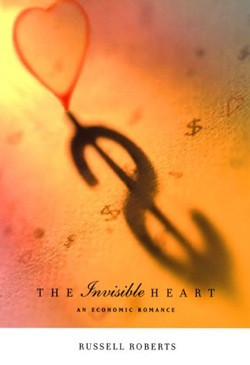
The Invisible Heart

The Invisible Heart: An Economic Romance
© 2001 Russ Roberts
282 pages


The Invisible Heart is an oddly sweet argument introduction to the thinking behind classically liberal economics, taking the form of a dialogue between one Sam Gordon, an economics professor, and Laura Silver, an idealistic English instructor who has just begun working at the same private school as Sam. The two hit it off immediately, even though Laura thinks economists are soulless cretins obsessed with money at the expense of the noble expressions of the human spirit, like art and safety regulations. Sam is a lonely, embattled man, and he wants desperately to be understood by Laura, who -- despite not sharing Sam's  views -- finds his earnest passion fascinating.  And so as a year transpires, the two chance to meet time and again; first accidentally, and then as their friendship develops, deliberately. Their relationship is fed by argument, for the book is an extensive argument for libertarianism.

Laura is, by virtually everyone's meter, a liberal:  she's very much concerned about the poor and oppressed. She believes firmly in safety regulations, minimum-wage laws, environmental protections -- the state exists to right the wrongs created by capitalism, to curb the abuses of the free market. Sam, in contrast, is a "classical" liberal who believes the freer the market, the freer the people. He takes Adam Smith's notion of an invisible hand at work in the marketplace for granted: let the market work, and things will sort themselves out. Companies that produce bad products will go out of business; businesses that don't pay well enough won't be able to find workers.

Although Sam's view is partially pragmatic --letting things flow naturally is considerably easier than trying to engineer everything --  he's also driven by principle. People shouldn't meddle with the lives of others, and they certainly shouldn't try to justify their interference by using the state to do the meddling. Sure, seatbelts are a great idea -- but making it illegal not to wear a seatbelt is an abominable one.  What right does the government have to tell people how they may or may not use their own property?  Sam also points out that meddling always has unintended consequences: when the Baptist ban drinking on Sundays, the moralists may cheer -- but so do the bootleggers, because now they can charge a premium for hooch that day. By the same token, when the state mandates the use of scrubbers to clean factory emissions,  the manufacturers of those scrubbers give a cheer.* Why not simply fine companies that emit noxious fumes and let that be an incentive for them to find their own best way of eliminating emissions, rather than forcing them to buy a particular product, and thus enrich only a few?  Spread the wealth around -- embrace competition.  Environmental protection, incidentally, is the one area where Gordon isn't so much a free marketeer, but still manifestly libertarian. He believes firmly in personal responsibility, which is why he wears seat belts but hates the idea of making other people wear theirs. But whereas a driver choosing comfort over safety only endangers his own life, a company dumping waste into a river or into the air hurts everyone. They should take care of their own messes -- but care should be taken in making them do it, as with the scrubbers example.

It's hard not to like Sam, even if you disagree with him, as Laura does. He's a nice guy; like Laura, he wants a better world, but unlike he thinks he should be brought about in an organic way -- that it should emerge from the bottom-up, from the marketplace, rather than being forcibly constructed by states, from the top down.  His arguments sometimes seem counter-intuitive;  he defies expectations. Although an economist primarily concerned with self-interest, Sam isn't himself particularly focused on wealth. One of his arguments with Laura is over the question: are teachers underpaid? Sam thinks not. Yes, their salary is considerably less than most others, but they're compensated in different ways. They have the summers off, for instance, the work becomes easier with time, and they have the chronic joy of seeing "lightbulbs come on in students' heads". If they were truly underpaid, the school would be unable to find people to fill the positions. Besides, he says; it's so much easier to be content with what you have.   Epicurean simplicity isn't what I would expect from an advocate of capitalism, the ethos of which seems to be MORE!

Although I, like Laura, don't quite agree with all of Sam's arguments, it's difficult not to find his earnestness compelling. His principles are outstanding, but it's easy to argue for the free market when you are protected from the fray. The Invisible Heart's author, Russ Roberts, is essentially Sam Gordon: a genuinely nice and fantastically interesting fellow who teaches economics, though at the university level. How can a university economist, safely ensconced in an 'ivory tower', feel comfortable telling people struggling to get by on a minimum wage that said minimum is a bad idea, as it prices those willing to work less out of the market?  And it's easy to say that a factory that didn't pay enough won't find workers, but that's preposterous: when unemployment is high and people are desperate for food, they will accept despicable conditions because they have no other options. There isn't competition for employment in a one-factory town.

And yet despite these reservations, The Invisible Heart stirs me. I wish I'd purchased it instead of borrowing it through the interlibrary loan system, because it's one I'm going to want to revisit. If you want your assumptions questioned, if you want your mind to be provoked into thought by someone who disagrees with you but who is so nice about it that you feel more invigorated  by the challenge than insulted, this is a book to read.  Although about economics, the 'dismal science', Invisible Heart is anything but dismal, freely using poetry, literature, and philosophy to explore the meaning of life.


* For a more real-world example:  I couldn't help but think of reading about a politician who advocated mandatory drug testing who turned out to be bankrolled by the manufacturers of the testing supplies. Baptists and bootleggers...

Related:
EconTalk, the author's podcast.


Friday, April 12, 2013

Rising Powers, Shrinking Planet


Rising Powers, Shrinking Planet
352 pages
© 2008 Michael T. Klare


For much of the 20th century, a handful of industrialized countries enjoyed access to a seemingly infinite supply of oil. But a century of economic progress has seen global demand for oil soar. Ever more countries are scrambling for a bigger piece of the petroleum pie, and there's increasingly less to divide, while appetites the sticky sweet stuff have only just been whetted.  As nations scramble to find new oil deposits to replace those which they've already exhausted, the global balance of power has shifted. Formerly impoverished nations are now fat with wealth, and titans of the global economy have become increasingly anxious beggars on the verge of throwing punches. In Rising Powers, Shrinking Planet,  Michael Klare elaborates on why the global dependency on a resource with an unstable future is a growing threat to world peace and muses on how the great powers, old and new, can turn competitive tension into collaborative energy and prevent quests for energy security from becoming World War III.

Oil (and gas) are potent stuff.  The energy contained within them isn't limited to fuel for transportation: they can  and have brought back to life, Lazarus-style, failed states like Russia which capitalized on its ability to control the flow of fuel to Europe. They've also turned desert wastelands dotted with yurts into spectacles of affluence; goodbye tents, hello opulent towers and water fountains performing music.  This enormous wealth has been generated because global demand for oil is climbing at the same time that supplies are faltering:  the great wells have been drained, discoveries of new ones are falling, and wells are exhausted more quickly than they can found. In addition to our rapacious appetite for fuel wreaking havoc on the environment  (who needs mountains when you can have coal? Aw yeah.), they're not having a happy effect on global politics, either. Not only has the wealth and power given to Russia and the new petrostates been restricted to a relative few, with little of the wealth being invested back into their societies, but the few have used the power to strengthen their hand; petty tribal chiefs now have money and foreign militaries doing their oppressing for them. Which foreign militaries? Those of the United States, Russia, and China, the Big Three who are canvassing the globe in search of resources and playing games with whatever tinpot dictator they can pressure to give it to them -- from the Caspian Sea to Africa, and especially the Middle East. Although Klare's early chapters detail the rising demand for oil, most of the book is given to studying how various powers, the big three in addition to Japan,  India, and a few other states, are competing with one another in board rooms cutting deals, and increasingly on the edge of the battlefield. While no wars have erupted yet, Klare seems to think they're inevitable. His final chapter urges the powers to work together to solve their common problem of energy security, rather than wasting scarce resources trying to stave off the inevitable.

Rising Powers, Shrinking Planet is a book to read if you've any interest in global affairs and the future of energy. It's replete with data to impress (and horrify) your friends: did you know we'll have to double our production of oil to meet predicted demand by 2020?  (Considering that we've been reduced to smashing  greasy rocks together to find it, that's a fairly daunting challenge.) Klare is an engaging writer, making a discussion of production figures seem interesting; it helps that competition for them is causing so much conflict.  Given the importance of the subject, this is a book I think more people should read, but there are a couple of niggling problems: first, this book is four years out of date, and  so many of the facts may have changed.  Russia's Gazprom, for instance, isn't quite as intimidating now as it was in the book, and the new petrostates aren't wasting all of their oil money. Some nations on the Persian Gulf are investing in renewable energy in anticipation of the inevitable day that oil proves to be not magic and runs out, like every other resource.  Additionally, some of his advice seems a bit unhelpful, namely that suggestion that China and America collaborate to make more fuel-efficient cars; those meager contributions be dwarfed by the fact that both nations are aggressive car promoters and yearn for more automobile sales. These are trifling matters, though; the meat of the book is more than food for thought.