Showing posts with label humanities. Show all posts

Thursday, May 29, 2014

Who Killed Homer?

Who Killed Homer? The Demise of Classical Education and the Recovery of Greek Wisdom
© 1998 Victor Davis Hanson
290 pages


For hundreds of years, the study of the classics was at the heart of a liberal education, thought essential to the cultivation of free men.  Yet today speaking Latin would be regarded as a sign of eccentricity, not erudition. People now attend university for technical  expertise in fields like business, engineering, or nursing, and such a focus is lauded as practical.  A degree in Greek literature would be derided as useless as a degree in art history, the epitome of wasted public finance.  Victor Hanson argues that vocational training is not the point of a university education; an education is not what you know, but how you behave. In Who Killed Homer? he examines the soul-forming virtues of the classical tradition and contemplates their reason for their unnecessary but imminent demise.

Hansen begins by arguing that the greatest virtues of western civilization have their origin, and sustaining permanence, in the Greek tradition.  Drawing from philosophical treatise (to the Greeks, a category broad enough to cover politics, science, and more) in addition to extant literature, Hanson reviews a spectrum of values with origins in Greece.  These range from concepts given overt legal protection (consensual government and the open criticism thereof, armies subordinate to civil power, free enterprise, etc) to ideas understood at a deeper level, and contributing to the others.  These more fundamental appreciations include the belief that every polis' wellbeing depended on the average middling citizen, not the aristocracy or the mob, and that the world was fraught with meaning. Mysterious yet rational, the world was a place imbued with limits -- limits that extended to man. Part of the Greek heritage are more obvious than others; the very shape of US government structures bears witness to their past, and most histories of science will begin with the Greek enterprise. Other appreciations have been forgotten;  like the belief that man was nothing without the polis;  only the power of culture and threat of sanction by others kept the human animal from behaving worse than beasts.  It is in civilization than man finds salvation from his own destruction. This is a hard lesson given an obscene and brutal summation by Hanson: "Man is nothing without the state."  Ultimately, classical education imparted a cohesive view of the world in which science, politics, and philosophy were knit together, a part of the whole.

If these truths are indeed timeless, how have they fallen by the wayside during the 20th century? Hansen lays the blame solely at the feet of the Classicists, who have thrown away the responsibility of their tradition in the pursuit of status and fortune. They ought to know better, and here Hanson's attitude reveals how seriously he takes his belief that education was the moulding of character, not acquisition of knowledge. To Hanson,  those who have committed themselves to knowing the Greek mind, who have studied it in earnest, bear responsibility for practicing it. Just as we expect a minister to conduct himself with greater care than the average parishioner, so to does Hanson expect classicists to be, if not moral champions, at least contenders;  he expects them to live the values of the Greeks, to take their place in the hoplite ranks of the mind and defend what is theirs, to rise to the challenge of revealing the classics' enduring relevance. Instead,  they focus on increasingly more pointless esoterically in pursuit of esteem,  viewing fellow classicists as competition to be beat for choice university positions in which they can focus on their 'research' and leave the actual teaching to grad students, producing not keen minds but papers on mathematical relationships governing the use of similes in The Illiad.  The comprehension of the whole is lost, and insult is added to injury when said scholars apply tortured modern interpretations,laying waste to The Odyssey by accusing it of being the wellspring of western sexism. Instead of defending and advancing the Greek way, classicists have allowed it to become the scapegoat for every moral self-doubt of the west. After outlining his case against his colleagues, Hanson proposes ways to put the focus back on the meaning of the classics,  in part by forcing classicists to teach."Publish or perish" is anathema to this professor who sees his primary vocation as  giving young people a structured education, not advancing his own  prestige. The work ends on a bitter note, however, as he does not expect the modern world's slide into the moral abyss to be arrested. Instead,  we will probably have to wait for civilization to collapse and demand strong men again, men who will rediscover the Greek truths.

That final bitter retort casts a pall over a strongly-argued book already shadowed by contempt for the modern world, especially ideologies like multiculturalism and relativism. The Greeks understood nuance, but in Hanson's view they stood by everlasting truths. Hanson's own stand is strident at times, to the point that he's less a Pericles calling forth citizens to stand with him and more a Leonidas rallying the troops before a final stand. His appraisal of Greek contributions is surpassed by the analysis of why classical studies have faltered, but Who Killed Homer does double duty as a traditionalist critique of modernity and a passionate appraisal of how much value the tradition still holds, even for moderns overawed by their own cleverness. As a classical partisan myself, I found it invigorating, but Hanson's zeal may spook the unconvinced.

Related:


Wednesday, January 30, 2013

Home from Nowhere

Home from Nowhere: Remaking Our Everyday World for the 21st Century
© 1998 James Howard Kunstler
320 pages
"History doesn't believe anybody's advertising." (p.1)

James Howard Kunstler penned The Geography of Nowhere in an attempt to answer the question: why is America so obscenely ugly? His answer came in the form of a cultural history of the United States, one that introduced lay readers to urban planning and enticed them with its relevance to their lives, not to mention Kunstler's playfully vicious style. As much ground as it covered though, and as hilariously as Kunstler excoriated suburban sprawl and modernist building, he offered no solutions to the problems he detailed, except for the hope that oil would peak and destroy the entire rotten system. Home from Nowhere follows in Geography’s footsteps,  demonstrating how communities can be restored and are being restored– and elaborating on why he is hopeful for our future.

Home from Nowhere is less a book in its own right, and more a continuation, or a fulfillment, of The Geography of Nowhere. It begins by repeating Kunstler’s basic criticisms of the unraveling of America’s urban fabric, detailing his beef with the suburban sprawl which replaced traditional cities.  Kunstler’s perspective is different than that of Chuck Marohn (Strong Towns) or Andres Duany (Suburban Nation). While those authors focus on sprawl as a financial loser, Kunstler examines planning from a more humanistic perspective, probing into how traditional and planning both effect us, as people. Crucial to Kunstler's view of urbanism is a sense of "place". Traditional neighborhoods and cities have this sense of place: they have clear centers and edges. They can be defined. Sprawl, however, is a seemingly endless  and stultifyingly homogenous expanse of asphalt and neon -- a desert of concrete that engenders feelings of lostness and despair in those trapped in it.

Home builds on Geography first in providing ample illustrations -- not photographs,but attractive and elegant sketches which demonstrate architectural or planning concepts (like symmetry and proportion) or by depicting streetscapes and homes which can be emulate. Some chapters elaborate on the problems which inhibit the restoration of American urbanism, like real estate taxing policies ("A Mercifully Brief Chapter on a Frightening, Tedious, but Important Subject") that discourage the erection of fine buildings and promote instead the conversion of downtown into parking lots. The remaining third of the book is dedicated to covering the travails and triumphs of not only new urbanist planners like Andrues Duany and Peter Calthorpe designing communities, but concerned citizen-politicians who have been laboring to effect changes in their own cities, restoring traditional neighborhood development. Part of Home is a response to the criticism of new urbanist projects that most of them have consisted of greenfield development -- new development far from city cores, in effect creating much better suburbs but suburbs all the same.  Working within existing cities means constantly struggling with minds locked into old thinking. This argument is dated now, of course: since the bubble burst in late 2007, the new urbanists have been focusing on infill, on reactivating dead spaces inside cities. The wind is blowing in the direction of urban restoration, and Home from Nowhere chronicles its beginning.

Although the recap of The Geography of Nowhere means that Home could be read by itself,  Kunstler argued so well before that the first third seems watered down in comparison. The encouraging work he reports on is a welcome addition to the jeremiad-like Geography, though, and recommends itself to those concerned about the shape of America's cities. Kunstler's own personality imbues the narrative with strength: he's an interesting man, pining for a lost world of decorum, virtue, and grace and wanting to see it restored -- first through the built environment.


Sunday, June 24, 2012

The Great Good Place


The Great Good Place: Cafés, Coffee Shops, Bookstores, Bars, Hair Salons, and the Other Hangouts at the Heart of a Community
© 1989 Ray Oldenburg
336 pages


In Our Oriental Heritage, Will Durant wrote that man is not willingly a political animal, that we do not love society so much as we fear solitude.  As much as I love Durant's work -- the grandness of his historical approach and the rich eloquence of the language with which he expressed it -- here I must disagree with him. We are social creatures at our roots: to borrow from Augustine, we are made for each other, and our hearts are restless until we find companionship together. Such is the lesson of Roy Oldenburg’s magnificent The Great Good Place, which examines the important role of social centers in human lives, discusses the consequences of their decline in the United States today, attempts to account for why they are struggling, and appeals for their resurrection. It is a timely and momentous work.

I’ve long been tangentially familiar with the phrase, “the third place”, which refers to common gathering places for people in their communities, a place apart from home and work (the first and second places in our lives). But here is that phrase’s origin. Oldenburg begins by establishing what the third place is: a site that attracts people and allows for spontaneous meetings between friends and strangers. These places have been ubiquitous in urban environments throughout human history…at least, until the  late 1940s when the United States decided to try a different approach to urban planning, creating ‘sprawls that no longer deserve the the dignity of of being called a city’*.  Oldenburg’s opening chapters document the third place’s vital role in creating a sense of community, in fostering political cohesion and providing a platform for civic engagement. But not only that – they’re fun. People like to spend time together, and giving them a place to do it makes society better and improves our quality of life.After establishing this, Oldenburg then moves on some specific examples:  English and Austrian coffee houses,  French cafes and bistros, American taverns, and main streets. (Although the cover refers to barbershops and salons as third places, the best in his view have been these "watering holes".)  This is a book strongly reminiscent of Robert Putnam's Bowling Alone: the Decline and Revival of American Community, but while Putnam examined the disintegration of American public life at large, Oldenburg zooms in to everyday life.


If the third place is so important, so vital to healthy personal and national life, how have we allowed ours to be destroyed? Hindsight is always perfect vision: in this case, third places are so normal to the human experience that we take them for granted, and only their loss makes us realize their importance. While third places can be destroyed by the short-sightedness of business owners who discourage "loitering" and convert attractive sitting places into yet more display areas, ultimately the problem is foundational: America's urban landscape is atrocious; "badly staged", in Oldenburg's words. Time and again he scolds planners for creating municipalities where no one can walk anywhere, of building pod after pod of "nothing neighborhoods", of abandoning the diverse density of cities for suburbia's lifeless homogeneity.


The Great Good Place is a fascinating combination of sociology and history with a lot of insight. The loss of third places goes beyond people not having a place to have a drink together. One of the consequences Oldenburg explores is that as community life fades as an alternative, people are forced to look for solace on their own, by  attempting to buy happiness in the stores -- and the more they focus on themselves, the less inclined they are to seek connections with other people and the more miserable they are. The fascinating link between alienation and advertising is one of the many gems found in here.

Books like these are why I read in the first place. This isn't a subject of mere academic interest: this is a book that tells us something important about ourselves, with ideas that can change our lives and help Americans concerned about the United States' declining health begin to recover from it.  Although the absence of any mention of the internet might date it (a book like this published today would have to address social networking sites), it's never more timely. Ten years after Oldenburg published this, the New Urbanism movement took off -- and reaffirming and reestablishing community life is at the heart of it. As America's urban pattern is forced to change in recognition of suburban's fiscal failure, I hope when we begin building we keep Oldenburg's insights in mind, and build third places.

I cannot recommend this highly enough.

Related:

  • Bowling Alone: the Decline and Revival of American Community, Robert Putnam
  • Suburban Nation, Andres Duany et. al


* A  turn of phrase borrowed from Robert Bellah. Source: "The Ethics of Polarization in the United States and the World," The Good Citizen.


* A  turn of phrase borrowed from Robert Bellah. Source: "The Ethics of Polarization in the United States and the World," The Good Citizen.

Saturday, June 2, 2012

Suburban Nation

Suburban Nation: The Rise of Sprawl and the Decline of the American Dream
© 2000, 2010 Andres Duany, Elizabeth Plater-Zyberk, and Jeff Speck
294 pages


Compare a modern American city to its European counterparts, or even an older American city, and the contrast is striking: American cities seem to have fallen apart, spewing their innards cross the landscape. Indeed, America has taken a radically abnormal approach to urbanism in the last fifty years, building out instead of up. Even while the city centers have been left to fall apart, ‘greater metropolitan areas’ – the mats of low-density sprawl surrounding those decaying centers – have grown. Why have Americans chosen to live this way, and what are the consequences? Suburban Nation is a citizen’s guide to understanding the new American landscape, a guide to what makes communities function, and a primer for setting our urban areas to rights again.

Duany and Zyberk, a team of urban planners, begin by breaking sprawl down into its five constituent parts. While traditional cities freely mix various kinds of buildings together – shops on a ground floor, apartments or offices above –  the suburban model separates  uses into separate pods. Anyone who lives in the United States can identify them; housing developments, commercial strips, office parks, and industrial parks.  These pods have no  direct connections to one another: navigating from one to the other necessitates traveling on a   ‘collector’ road, which is almost always congested because it is the sole carrier of traffic the pods are too widely spaced apart to make walking feasible or train transit efficient. Municipal buildings are the final element of sprawl, and like the rest are strictly separated and isolated except by cars.

Suburban Nation includes large, wide margins to the side of the text, making the book squarish instead of  rectangular. The authors use those margins for photographs, specifically sets of paragraphs, comparing traditional urban approaches to the new methods favored by modern planners. The contrast is potent, illustrating how wasteful and ugly suburban sprawl can be. But why has it become so popular?  The answer draws on numerous elements of American culture and history: the fact that most American cities came into being during the industrial age, and so Americans tend to associate them with the abuses of that period;  the coming of the automobile just as people were wanting to move away from the cities, the availability of wide open land for people to expand into, and government policies which saw in outward growth a foundation for the American economy – as in the Great Depression, when highway construction was used to put people to work. These elements each influence the other: people’s aversion to living near factories was the genesis of zoning codes, which segregated residential and industrial areas; the availability of automobiles allowed those zones to be far apart; and the generous government subsidies supporting the expansion of roads made such networks feasible. After World War 2, the FHA’s policies encouraged growth outside the cities, offering loans to families who wanted to buy new single-family homes but refusing any to people who wanted to move inside the cities. Banks followed suit.

            We left the cities in pursuit of a dream – a home of our own, far from the noise and pollution of the city. But if there’s a constant in history, it’s that no action is without unintended consequences. Not only did Americans manage to destroy their cities in a manner of decades (with the same money that Europeans were using to rebuild theirs), but suburbia has proven a fiscal nightmare. Its low densities don’t provide the tax base needed to maintain its infrastructure, and the widespread sprawl mires people in traffic, not only forcing everyone to drive everywhere but do so at a snail’s pace, wasting both time and gasoline. In addition, suburban sprawl fails to produce that vital element of human society, a community. There is no coherence in these suburban wastes, no 'place' for a community to coalesce around. Instead, people live apart from one another, and when they venture into society they only do so as part of a mass of strangers, either on the collector roads or in the big box stores.

            Since the mid-1990s, criticism of suburbia has been building steadily. As municipalies and states face budget crises and the threat of insolvency, more people are realizing the pattern of development we’ve been pursuing is no longer a viable option. Duany and Plater-Zyberk also offer steps we may take in getting a handle on these problems. There are ways we can redevelop some existing suburbs and make them livable, for instance, but the 60s-era zoning laws that make proper cities illegal need to be scrapped, as with subsidies which encouraged all that sprawl. Although restoring America's urban fabric seems a vast undertaking, it is doable, and necessary.

Suburban Nation  is the comprehensive book on America's landscape, and consequently a fundamental book for understanding many of our problems -- civic, economic, and social. Its ideal audience is the average American citizen; though Duany and Plater-Zyberk are urban planners by profession, the third author Jeff Speck served to introduce planning concepts in layman's terms -- and even if the text didn't make a particular idea clear, the illustrations do that amply.  This is in short a most excellent book. I doubt it will be rivaled by any others, but  there are more works in this genre (like Kenneth Jackson's Crabgrass Frontier) which I intend to read in the future.

Related:


Wednesday, May 30, 2012

Traffic


Traffic: Why We Drive the Way We Do (And What It Says About Us)
© 2008 Tom Vanderbilt
402 pages


 Take a brain adapted to move a bit over a hundred pounds of flesh at speeds under 20 miles per hour, and have it instead try to move several tons of metal through an environment which didn’t exist a hundred years ago, at speeds hitherto unimaginable. What happens? Well, we’ve only had a few decades to see, but so far the introduction of cars as the predominant form of transport has produced interesting results, like congestion and road rage. In Traffic: Why We Drive the Way We Do,  Tom Vanderbilt examines the psychology of driving, and learns some lessons about being human on the way.

Traffic is a dense book, more a survey than a piece with a specific point to make. There are nine chapters, each with a general theme -- "How Traffic Messes With Our Heads", "Why You're Not as Good a Driver As You Think You Are" -- and content spans the gamut from trivial to potent. Driving is such an expressly different experience than our brains evolved to take in that Vanderbilt believes  we find it difficult to be 'human' behind the wheel. Although driving seems like simply an act of moving around, we're detached from the experience and from each other; drivers can't communicate with one another beyond some simplistic forms of expression (the horn and the finger).  It's also a tremendously complicated procedure: road systems are complex physical objects even without factoring in interacting with hundreds of other drivers, and we are expected to be able to respond to more stimuli per minute than nature would have ever expected to throw our way. On the potent side, this work could help concerned citizens create more sensible transit policies:  there's an entire chapter on how the expansion of roads simply leads to the expansion of congestion. Traffic always swells to match the volume of roads available, so building more roads will only create more congestion. Creating a safer system can happen by making it appear more dangerous, by removing traffic lights, signs, and even road striping.  Humans seem to operate with a particular risk threshold, and when the environment becomes "safer" (thanks to lights, stripes, and so on), we drive more recklessly. This is why roundabouts are safer than four-way cross intersections regulated by traffic lights; when people are forced to take responsibility for themselves and use intelligence to navigate their environment, they pay more attention and accidents fall dramatically.  Counter-intuitive revelations abound in Traffic: bikers may be better off not wearing helmets, because cars take less care when passing a helmeted biker. Often we can arrive at a destination more quickly by slowing down and interrupting globs of congestion.

All told, an interesting book. While it may suffer from the generalized subject, there are some gems in here for  those interested in the subject.

Related:
Asphalt Nation, Jane Holtz Kay

Thursday, December 29, 2011

The City in Mind

The City in Mind: Notes on the Urban Condition
© 2001 James Howard Kunstler
272 pages


The study of civilization is nothing less than the study of the culture of cities. Humanity has survived on the Earth for hundreds of thousands of years, but not until we began to aggregate in cities did we truly come into our own. Cities have been the cultural centers of our race and the driving force of our history which unlocked our potential in the last ten thousand years or so, and in The City in Mind, James Howard Kunstler reflects on their role in our history and their contribution to the quality of our everyday lives, focusing on a panel of select cities that may allow us to see what makes a city work and what drives it towards failure.

In The Geography of Nowhere,  Kunstler railed against the disintegration of the American city and the rise of what he sees as an imminently inferior form of urban living -- suburban sprawl. Although a couple of chapters here reflect that theme,  the book is not as intensely focused. It reads something like a collection of essays, each giving the history of a given city's development and emphasizing one particular period or element. The opening chapter on Paris is devoted to Napoleon III and Hausmann's thoughtful redesign of Paris in the 19th century, for instance, and how it led to a fairly ugly medieval city's transformation into a jewel of urban design.  Kunstler visits the classic spirit with Rome, and with Boston shows the reader how a city can recover from decades of thoughtless planning and sprawl.  I bought this book in part because I delight in reading Kunstler when he's on a  critical rampage, destroying atrocious buildings and miles of commercial strips and box stories with biting with -- and two chapters on Las Vegas and Atlanta give him just the excuse. Atlanta is used as a case-study for the failure of edge cities, while Vegas -- which Kunstler surely deems the worst city in America -- showcases a wide variety of failures, from the practical to the spiritual.  Kunstler is not a religious man, but he sees proper urban design as something which enhances the value of life; when done properly, it honors us and creates a place worth living in.

The chapters mentioned are the book's strong points. There were other sections, like that on Mexico City, that I didn't quite understand the point of. Kunstler is informative there -- I'd known nothing about the history of the modern city following the Spanish conquest -- but to what urban design-related end. I had the same reaction to another chapter, possibly because I expected more sections along the lines of Paris and Las Vegas, chapters which clearly point out good and dismal approach at design, whereas Kunstler had a more general focus in mind. Some sections are available on Kunstler's website for your reading pleasure.

Thursday, September 8, 2011

The Illiad

The Illiad
© 1960 Barbara Leonie Picard
208 pages
Illustrated by Joan Kiddell-Monroe


The Illiad is one of the oldest and most celebrated works of literature of western civilization: a classic among classics, no world literature class would be complete without it.  It is part of the western heritage; from it come phrases like "Trojan horse."  Yet, being a classic, it may intimidate some readers, especially given its form as epic poetry. Barbara Leonie Picard's interpretation of it into a prose should make this lovely piece of western history open to a wider audience, especially considering her introduction and epilogue, and the use of bronze and gold plate illustrations which hearken to ancient Greek pottery.

The story is set during the Trojan War, a decade-long conflict between the city-states of Greece and the state of Troy and its allies. The feud has its roots in mythology, with Paris -- a young prince of Troy --  judging a beauty contest of goddesses and being rewarded with the queen of Sparta, Helen, as his bride. Since Helen is already married to Menelaus, this causes something of a problem -- and the Greeks invade Troy, where they lay siege for ten years.  The Illiad is a story of men and pride, for the pride of two Greek warriors divides their army and weakens their cause.  It begins when King Agamemnon, leader of the Greek alliance, seizes a woman who Achilles -- the greatest Greek warrior --took as a war prize.  Achilles is outraged by Agamemnon's arrogance. He abandons the fight and prays to his mother -- the goddess Thetis -- to ask Zeus to turn the war against Agamemnon, and as the days progress many a Greek will die.

The official author of The Illiad  is a 'blind poet' named Homer. In truth, we do not know when the story arose and it is probably the work of multiple generations, the story expanding with every retelling -- for this is an ancient story, one originally passed on orally. "The use of gods as active characters in the story bears witness to its age:  Zeus, Athena, Apollo, and others are not mere background forces, but take an active but sometimes unseen role on the battlefield. They deflect spears and arrows, cast mists to  prevent foes from seeing one another, and directly assault the players. Although Zeus -- supporting the Trojans -- forbids his children from taking part, Athena never abandons her beloved Greeks, and Apollo does not forsake the Trojans. Sometimes the gods work against one another: when a river-god tries to drown Achilles for his arrogance, Hephaestus creates fires to keep the water away.

The Illiad captivated me: although I am familiar with the general story, I have never read it properly and so experienced the feud in full. The relationship between Achilles and the two princes of Troy especially interested me: Paris is a despicable character, and it amused me greatly to see Hector reliably addressing him as "Most wretched brother".  The story is far fairer to Hector than I anticipated: he is almost as noble here as when he was portrayed by Eric Bana in Troy, though his behavior at Patroclus' death made me think his corpse's being dragged around the city every day at dawn was something of a just dessert.  Perhaps the most striking element of the book is its emphasis on individual heroism: these men are not selfless soldiers of Greece; they fight for glory and reputation. At the same time, there is a bond between them -- and sometimes pride bowed before that camaraderie.

Rarely have I been more entertained by a classic: if you ever have an interest or a need to visit the Illiad, I would suggest looking for this translation. It is commendable.

Thursday, May 5, 2011

The Tragedy of the Moon

The Tragedy of the Moon
© Isaac Asimov 1978
224 pages


The Tragedy of the Moon collects seventeen sundry Asimovian essays  which will prove a delight to most Asimov fans.  The essays were originally published in Fantasy and Science Fiction, but have been edited and arranged specially for the book. This is one of his more diverse collections: while science is a common element of most of the essays, only two are pure or 'hard' science. The rest combine science and culture, as when Asimov writes on the history of calenders and the week in western culture. I'd never really wondered why the week has seven days, at least not enough to look up the answer.  As Asimov deftly explains in "Moon over Babylon", it comes from lunar festivities which occurred every seventh day. This also has some bearing on the Jewish 'Sabbath', and this essay is rich in history and etymology. While the good doctor's nonfiction output is generally fascinating, I liked this collection most for including more of Asimov's informality:  some collections tend to be staid and to the point, but Asimov's winsome personality shines through the pages here as he constantly kids and charms the reader, both in-text and in footnotes.

If "It's by Asimov!" isn't enough for you, the list of essays follows.
  1. "The Tragedy of the Moon" Asimov reflects on how the absence of a moon rotating the earth may have sped up humanity's acceptance of heliocentrism and hastened the growth of scientific progress in general.
  2. "The Triumph of the Moon" examines how the moon has been a boon to humanity, though his three triumphs listed are more indirect than I'd imagined. 
  3. "Moon Over Babylon" concerns the history of the week as a timekeeping period, and is one of my favorites.
  4. "The Week Excuse" sees Asimov argue for a more sensible calender (and make a terrible pun, for he is "not ashamed of myself in the slightest").
  5. "The World Ceres" is both explanatory and speculative, as Asimov ponders how humanity might use Ceres for mining and tourism
  6. "The Clock in the Sky" regales the reader with the story of how humanity figured out the speed of light.
  7. "The One and Only" focuses on carbon's unique suitability for becoming the backbone of life.
  8. "The Unlikely Twins" tackle two very different manifestations of carbon: graphite and diamond, and explain how they can be so different and yet consist solely of the same element.
  9. "Through the Microglass" focuses on the discovery of microscopic beings like bacteria and their importance in the fields of medicine and biology.
  10. "Down from the Amoeba" struggles with the concept of "life": are viruses, sperm,  and red bloodcells 'alive'?
  11. "The Cinderalla Compound" builds on this and addresses the discovery of nucleic acid and DNA. 
  12. "Doctor, Doctor, Cut my Throat" features Asimov reducing his surgeon into a laughing fit and lecturing on hormones.
  13. "Lost in Translation", which also appears either Gold or Magic, is an interesting departure from the rest of the book,  stressing the importance of social and cultural context when translating or reading literature from eras past. He uses the Book of Ruth as his prime example, seeing it as not just a love story, but a triumphant endorsement of universal brotherhood. 
  14. "The Ancient and the Ultimate" sees Asimov slyly defend books while pretending to lecture on the supremacy of cassettes (heh) in the future of communication. 
  15. "By the Numbers" addresses both hypocrisy -- people complaining about technological societies and taxes while freely enjoying the benefits of both -- and the need for a society in which computers manage things. (Such societies often appear in Asimov's works, often using a global computer  called  MULTIVAC.)
  16. "The Cruise and I" relates the story of Asimov's cruise off the Florida coast, where he watched the last Apollo takeoff -- which happened to be the first nighttime launch. Asimov usually avoided travel, so I relished this humorous take which ended in splendor as humanity reached out for the moon yet one more time.  Carl Sagan was on that very same cruise, and he appears in the essay twice.
  17. "Academe and I" sees Asimov look back on his careers as an author and professor of biochemistry, giving a minibiography of himself along the way.

I for one enjoyed myself tremendously reading this.

My own copy, purchased in used condition (obviously so) last week. 


Friday, November 5, 2010

The Mother Tongue

The Mother Tongue: English & How It Got That Way
© 1990 Bill Bryson
270 pages


"More than 350 million people around the world speak English and the rest, it sometimes seem, try to."

While I'm reading this as part of a general English-culture theme this week, I would have inevitably picked it up at some point:  language has fascinated me since high school, and I'm forever writing down words and turns of phrase in my journal to look up their derivations at a later point. I know Bill Bryson only through A Short History of Nearly Everything, which I remember favorably even if I don't recall too much about its contents, having read it perhaps five years ago. 

Although I anticipated The Mother Tongue being a history of the English language, it's more than that. Bryson begins with the development of speech and evolution of languages before moving swiftly to Europe to describe the various German, French, Viking, and  Celtic histories that coalesced in the British isles to give rise to a genuine world language,  English. After this initial history, he dedicates separate chapters to the development of words, accents, pronunciations, spelling habits, grammar, names, profanity, and wordplay before tracking English's spread as a world language and contemplating on its future.  

Bryson is an entertaining author, providing humor in bounds. The book only suffers once or twice from long paragraphs of examples, these being exceptions to the general rule of readability. Bryson's information paints a picture of English changing through the ages detailed enough to provide surprises to even a word-nerd like me. I expected that irregularities in spelling would be ironed out by the introduction of the printing press, but I was not aware that many of English's  Latin spellings (in debt and doubt, for instance) were imposed long after the language came into its own by those who wished to ennoble English -- to root it in the old classical tongues and make it something other than 'vulgar'.  Various attempts have been made to make English orthodox, but nothing appears to stop it from steadily growing and assimilating other languages. The Mother Tongue reveals English to have a long, storied history, one that has given its current versatility and humorous contradictions. I' recommend it if you are at all interested in the subject proper, etymology, or Bill Bryon's work in general. 

Related:


Sunday, October 17, 2010

The Roman Way

The Roman Way
© 1932 Edith Hamilton
281 pages


                                        Slave: He saw the girl.
                                        Master: Oh, hell! How could he?!
                                        Slave: ...with his eyes.
                                        Master: But how, you fool?
                                        Slave: By openin' 'em! ("Merchant", Plautus)

The Roman Way follows up on the success of Edith Hamilton's The Greek Way, and models itself after that first work of Hamilton's, in which she used Greece literature to evaluate it. In Roman Way, she draws on the comedic plays of Terence and Plautus, the histories of Caesar, the letters of Cicero, and the poetry of Catullus and Horace among other authors.  The book's greatest virtue is that Hamilton's choice to reproduce pages from plays and longer passages from letters allows students of Roman history to connect with that history more directly -- to test the waters of literature from another time while protected from confusion by the presence of the author's commentary. Hamilton's writing is strong and flourished, conveying a clear affection for the subject: she reads plays originally written in Latin for pleasure.

When generalizing, Hamilton is golden for the lay reader, though the more focused analyses of poetry and literature are likely to find their best audiences in serious students of literature and Roman history. Being a somewhat serious student myself, I found a lot of value here. I enjoyed reading Roman plays and realizing that for all the centuries that have passed, it's still possible to get a laugh out of them. I found Cicero's  humility (!) in his letters especially endearing:  sensitive about his constant bragging and the disconnect between his political values and the political choices he made, he frets to his brother:  "What will history be saying of me six hundred years hence?"  I also enjoyed the chapters on Roman romanticism and aesthetic values. Broader narratives forget to see the Romans as people at times, and Roman Way makes good on that. Times pass and values change, and the literature reflects it.

Good follow-up to Caesar and Christ;  Romanophiles and those interested in literary history should find it engaging.

Related:

Sunday, August 8, 2010

The 100 Most Influential Books Ever Written

The Most Influential Books Ever Written: the History of Thought from Ancient Times to Today
© 1998 Martin Seymour-Smith
498 pages


In retrospect, the introduction should have served as a warning to me.  Author Martin Seymour-Smith opened his The 100 Most Influential Books by elaborating on the subjectivity of terms like "best" and "greatest", maintaining that he preferred to evaluate books from a more quantifiable or objective basis, that of influence. After this promising start, he chose to spend six paragraphs berating Richard Dawkins and making it dead clear that The Selfish Gene would not appear in his book.  The bewildering viciousness of the seemingly random assault left me a mite puzzled. My facial expression resembled that of an anime-inspired emoticon, "o_O".  Yet for my love of the subject -- for I consider myself a generalist, and enjoy the full buffet of human experience  -- I pressed on.

The subject itself kept me reading the book, for it spans most human endeavors: philosophy, religion, history, science, literature, sociology, and psychology for starters. There were a few names on the list I'd never heard of, leading me onward -- but after two hundred pages in, the book simply ceased to be a pleasant experience.  Seymour-Smith wrote interestingly enough, but tended to ramble on to the detriment of his essays. In one six-page essay, he devoted four pages to biography of his subject and two slim paragraphs to the actual book, and those paragraphs told me nothing. Too many of the essays simply gave a dictionary-type definition of the concept for which a given author might be best known for, although there are a few -- mostly those concerning post-Enlightenment philosophy -- where he treats the subjects properly.  They are unfortunate exceptions: his essay on the Hebrew scriptures consists of a formulaic definition of the Torah followed by his grievances with modern Christianity. While I might share his grievances, I wondered why I was reading them instead of about the influence of the Hebrew scriptures.   It's not as if I'm keen on them, but I thought he might have some insight I had not heard. He didn't even broach the subject.

Seymour-Smith's unprofessionalism turned the already difficult process of reading his disorganized essays into an outright chore. Caustic tirades tended to erupt from his ramblings, confronting the reader with violent paragraphs with little to no connection to their source essays. For instance, while writing on Euclidean geometry Seymour-Smith decided to return to his rant against Dawkins.Christianity, atheism, clerks, and political correctness -- an altogether nebulous term he used so broadly that it lost all cohesion -- were favorite subjects of repeated scorn. The endless barrage of temper tantrums and petulant whining embedded inside paragraphs soured the experience for me, and became dull with repetition besides: how many times can a man refer to political correctness as "neo-Stalinist, tyrannical mediocrity" in one book? Where is his editor? .

One of the reasons I kept reading the book -- especially after he bellowed about both organized religion and atheism --  was to figure out what he did like. Although Seymour-Smith liked to employ scientific methodology as a means of seeming objective, he is no fan of rationalism or materialism. He refers to Epicureanism as an anti-superstitious philosophy and does not mean it as a compliment.  He reveres Jesus, refers to the Kabbalah often and fondly, and seems to enjoy natural philosophers with a background in mysticism (Newton, and to a lesser degree Kepler).  I believe he conflates science and meaning. Like Carl Sagan's fictional Joss Palmer, he rebukes science for failing to do something it was not designed explicitly to do: make people feel good. Science, Karl Popper be praised, isn't bronze-age cosmology.

Enjoyable subject, miserable book. This is one of the few books I regret having read. There's far too much childish kvetching and far too little thoughtful reflection.

Related:

Monday, July 19, 2010

Walking towards Walden

Walking towards Walden: A Pilgrimage in Search of Place
© 1995 John Hanson Mitchell
301 pages


Just before he set out on his journey to the netherworld, the great pilgrim Dante Alighieri had to pass through a lion-haunted forest where the straight way was lost. Here in twentieth-century America, there is a gloomy forest of hemlocks just below the summit of Prospect Hill in Westford, Massachusetts. As we descend this fertile slope, the great pilgrim Barkley Mason begins quoting from the Inferno. He touches his breast and, with a grand sweep, spreads his right arm toward the dark wood below us. "Nel mezzo del cammin di nostra vita mi ritrovai nella selva oscura --'" he declaims.
Kata is used to Barkley's posturing; she interrupts to ask me something about a mutual friend, and in this manner, we three enter the dark forest and enter our journey. (p.11)

While browsing the travel section of my library, I spied Walking Towards Walden, one man's deeply textured account of his pilgrimage trip to Walden Pond, where Henry David Thoreau once lived and wrote.  Mitchell, accompanied by two close friends, determines to sojourn to Walden through the wilderness: shunning roads and trails, the talkative trio intend to see a glimpse of Massachusets' 17th century wilderness. As this trio of intellectuals and romantics cut their way through brambles, wade across swamps, and wander the courses of streams looking for a crossing, Mitchell muses.

A Walk to Walden tells many stories. From the outset, A Walk is steeped in mythology, both classical and native American: Mitchell likens their quest to find Walden to Campell's "hero's journey", imaginatively interpreting the perils along the way as the hero's challenges a la Don Quixote. As they walk, Mitchell explores inner worlds, pondering the role of nature in mythology and poetry. The trio's pilgrimage to Walden is also historical, for their path intersects with that marched by the Massachusetts militiamen on their way to face British regulars at Lexington and Concord. As the journey develops, Mitchell tells their story, the story of explorers like Ponce de Leon who traveled through the "New World" looking for the fountain of youth,  and the story of the men and women who were displaced and ruined when Europeans began to colonize the Concord area.  At the same time, he also remembers other trips he has taken with his friends -- to the Florida Everglades and Hollywood, with touching and humorous anecdotes.

As the narrative matures, Mitchell compares their journey less to a pilgrimage and more to a quest to find a sense of place, a sense of belonging. He uses a Hopi word, tuwanasaapi, to describe a place where the soul of an individual is "centered":  where they are truly home. James Howard Kunstler decried the lack of "place" in the United States, criticizing the boundless expanses of subdivided homes and commercial strips. Mitchell and his friends are likewise bothered by this lack of community and place in modern America:  traveling to Walden allows them to connect to Thoreau's own decision to live deliberately, to find

From the very moment I started reading the book, I wanted to see Concord. Mitchell's affection for the town and the sense of place and community he derives from it are obvious. The day's journey there from Prospect Hill is lush, rich with detail and stories, abounding in tales of interesting people. Mitchell links all of his various trails of thought together, which would have been distracting were the stories themselves not so thoughtful and enjoyable.  Most curiously, the trio never seem to reach Walden Pond proper: the book ends with their eating a period meal at the Colonial Inn, the only hint that they might have gone to the pond and Thoreau's cabin being "So we saunter to the Holy Land...". (Mitchell periodically paid homage to Thoreau by referencing his "sauntering" walks around Concord.) Walking is one of the most enjoyable books I've yet read, and I heartily recommend it -- especially to those partial to Thoreau.

Wednesday, February 24, 2010

The Geography of Nowhere

The Geography of Nowhere: the Rise and Decline of America's Man-Made Landscape
© 1993 James Howard Kunstler
303 pages


Little boxes on the hillside, little boxes made of ticky-tacky
Little boxes, little boxes, little boxes all the same
There’s a green one, and a pink one, and a blue one, and a yellow one --
And they’re all made of ticky-tacky, and they all look just the same
(“Little Boxes”, Pete Seeger)


James Kunstler’s A Geography of Nowhere is a scathing rebuke of land-use and development policies of the past hundred years which do nothing but maximize the profit of developers, enslaving the American economy to a need for expansion, while offering humanity nothing but a soulless and miserable expanse of boxes.He promotes an approach to land development that emphasizes human needs and communities that are not only “human sized”, but worth living in and caring about.

After a brief introduction -- recounting a cartoon villain’s mad scheme to make everyone dependent on freeways which he builds and on cars which he sells -- Kunstler begins the book with a history of development patterns since the first European set foot on American soil.  Kunstler sees the overall pattern of American development as being set against the European pattern that emphasizes the integrity of local communities. In his view, American development has been driven by individual greed and the desire to maximize profit through endless subdivision and mass production of living and working spaces. Most American counties and cities are organized along strict grids that give no thought  to the landscape or to the humans that will live in them.

As the book progresses, Kunstler rants against Modernist building styles and launches into a history of suburbanization, beginning with the first (late 19th century)  trolley-dependent communities. The root of the suburban impulse, Kunstler says, is that people want to escape the cities. In addition to the primary desires to get away from the noise and grime, Kunstler believes American suburbanites are attempting to find escape from the spiritual bankruptcy of the commercial-driven city. Ultimately, given the way suburbs will continue to develop, this is a futile goal. The vast expanses of subdivisions are no better, ultimately: they repeat the failures of urban planning and provide nothing in the way of community, isolating people further.

Kunstler contrasts the failings of modern American cities and suburbs to the ideal of a small town community, placing particular emphasis on the importance of a local economy. In his view, there is no community without a local economy. Not only are American development policies unwise and untenable from a long-term perspective (given their dependence on oil), but they are spiritually void. Kunstler returns to this often, writing on the importance of a sense of “place”, of the connections that tie people together and to the land.  He sees building aesthetics as important to maintaining human happiness within communities, as various elements (T-intersections and tree-lined roads, for instance) give us psychological security.  I find this fascinating, and it’s making me itch to read Alain de Botton’s book on the architecture of happiness.

Kunstler thus presents two premises: one, that suburbanization and urban sprawl are in the long term economically disastrous; and two, that these matters contribute to the unhappiness of the people who live within them. Speaking for myself, my own quality of life increased when I moved from a semi-suburban area dependent on automobiles to a small university town with a genuine sense of community, and one in which I can walk anywhere I want to go. I’ve developed a passion for small-scale human communities and am repulsed by the same sprawl that fascinated and excited me as a child. I am thus an ideal audience for Kunstler.

His ideas are worth considering, I believe, and are not his alone. although I am cautious about recommending the book given Kunstler’s tone. Although easily keeping my attention and often inducing me to laughter, he is exceptionally opinionated -- sometimes bitterly so. This may turn off readers who would have otherwise benefited from the deleterious trends that he points out. There may be better books on the same general topic, and if I read them I will point them out. For the moment, though, this is the only one I know of and I cautiously pass it on to you.


Born in 1948, I have lived my entire life in America's high imperial moment. During this epoch of stupendous wealth and power, we have managed to ruin our greatest cities, throw away our small towns, and impose over the countryside a joyless junk habitat which we can no longer support. Indulging in a fetish of commercialized individualism, we did away with the pubic realm, and with nothing left but private life in our private homes and private cars, we wonder what happened to the spirit of community. We created a landscape of scary places and became a nation of scary people. 

From the book, page 273.

Related:

Tuesday, February 23, 2010

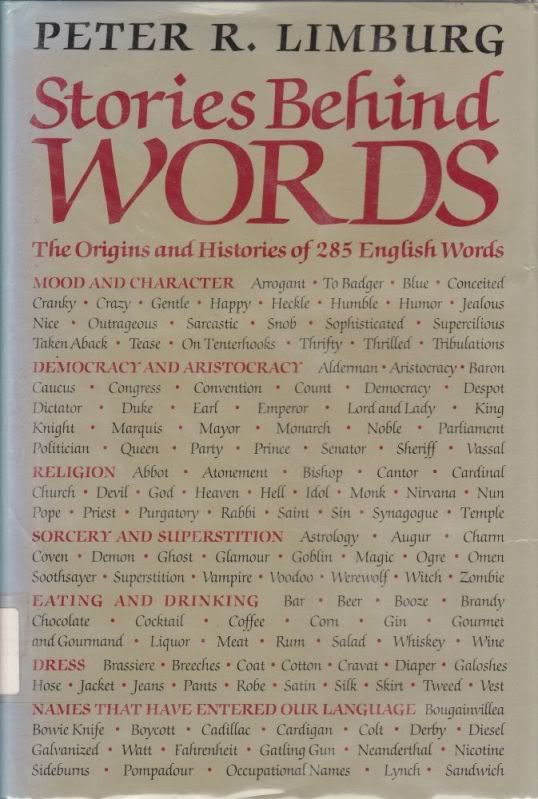
Stories Behind Words

Stories Behind Words: The Origins and Histories of 285 English Words
© 1986 Peter Limburg
288 pages


I have long held an interest in etymology and the history of language, thus this book’s interest to me.  Author Peter Limburg expounds upon the meanings and derivations of hundreds of words in 285 essays sorted into seven general categories. The book’s table of contents -- displayed on the main cover, incidentally, which you may view by clicking the preview image above --  is not quite complete, as Limburg typically discusses similar words that branch off from the topic in the same essay. For instance, the essay “To Badger” gives not only the meaning and history of that phrase, but discusses other words derived from the behavior or perceptions of animals.

The essays tend toward the thorough, with only a few exceptions. Even though I’m a “word nerd” and a student of history, I found here much to inform. I learned why the US legislature is a “Congress” and not a “Parliament” for instance -- and that cathedrals are named after the residing bishop’s throne, the cathedra.  Uncomfortably, there are no citations or references given -- a potential problem for me given that I’ve not heard of some of Limburg’s opinions and would like confirmation. For example, he posits that the medieval church’s chief problem with witchcraft was that it amounted to heresy: only later was the accusation of witchcraft used as a weapon against  people.  Limburg’s tone is conversationally informal: he likes to end the essays with dry humor or a pun, which is appropriate for a book of word-history. My favorite: when Limburg ends the essay on brassieres, he first comments on the changing perception of bras in the modern age and then notes that 'men will be watching future developments with great interest.'

All told, this book of essays on the history of words made for an enjoyable and informing read.  Those interested in the subject -- particularly in the words listed in the table of the contents -- will probably find this book both useful and entertaining.


Thursday, December 17, 2009

When Religion Becomes Evil

When Religion Turns Evil
© 2002 Charles Kimball
256 pages

Published in 2002 before the Iraq War and the rise of the "New Atheism"  Charles Kimball's When Religion Becomes Evil seeks to preserve religion for humanity's sake by elaborating on five ways is corrupted into giving rise to evil: the adoptions of absolute doctrines, blind obedience to authority figures, and the obsession with achieving religious means -- particularly apocalpytic "ideal states" -- by any means necessary, including the declaration of holy war.

Kimball has a balance perspective: raised in a Jewish-Christian home, he attended a Baptist seminary and spent most of his life working in the middle east. Although a believing and practicing Christian, he sees other religions perhaps in the same way as Marcus Borg -- as human responses to interaction with the divine. His emphasis is on the Abrahmic religions, as their size, exclusivism, and missionary efforts make them especially suspectble to committing excesses. I was continually impressed by Kimball's tone, which is balanced without being obviously so. He doesn't need to try, it seems: he approaches the various religions on almost the same level: nontheistic religions make few appearances here. The fairness of his tone makes the book well worth the read for any religious or nonreligious person interested in religion at any level for any reason. I don't believe religion is necessary to achieve the ends he thinks it is, but if religion is here for the long haul as it seems, I am pleased with this book's effort to make it more humane.

Sunday, November 22, 2009

Marx in Soho

Marx in Soho
© 1999 Howard Zinn
88 pages


"Oh, ja -- 'capitalism has triumphed!' -- but over whom?" - Marx, Marx in Soho

Although The Zinn Reader held a near-monopoly on my attention last week, there was a brief thirty-minute timeframe in which I visted my post box, discovered to my happy surprise that a book had come in early, and excitedly read through it. As you might guess from those comments, Marx in Soho is not a lengthy work: it is not even a book in the usual sense, but a play written by Howard Zinn. I came to Marx in Soho by the same means I came to The Zinn Reader:  You Can't Be Neutral on a Moving Train,  a documentary on Zinn's life.  Film from a production of Zinn's speculative play in which Karl Marx visits the present day from the "beyond" featured in the movies, and it intrigued me enough that I started looking for recordings on YouTube. Those were well-done enough to merit my looking for the book, which I did.

As said, the play's premise is one of speculative fiction. Karl Marx, annoyed that his name and life's work are being slandered in the modern world, is able to badger the Powers that Be into letting him visit the living world just for one hour -- although, due to a bureacratic mix-up, he finds himself in Soho, New York instead of Soho, England. The play is a monolouge, although we hear from other characters through Marx's reflectings on the past. Most of his attention is focused firmly on the present, as he admits that his predictions of class revolution and Communism were off, muses on why, and applies his criticisms of capitalism in the 19th century to capitalism in the 20th. Marx is portrayed not as a sage-like Gentleman Scholar in this play, but as an ordinary human who loved his wife and children, endured a bad cough,  turned his home into a salon for the dicussion of economic and political matters, and who is passionate about his work. Zinn's Marx has a sense of humor, sometimes making wry comments to the audience after his more spirited rants have attracted negative attention from "Heaven" -- lightening flashes whenever Marx becomes too animated.

Marx in Soho is a fun little read. It's almost a modern Communist Manifesto, communicating Marx's ideas to a lay audience. It's nowhere near as thorough as the Manifesto, but the 21st century's attention span may be too short to endure even the short work that is the Manifesto.  Marx in Soho is fairly well done -- it's readable, presents the Manifesto's basic tenents, entertains, and humanizes a figure who is more legend than man. My only raised eyebrow comes from Marx speaking in Zinn's voice toward the end.


Saturday, November 21, 2009

The Zinn Reader

The Zinn Reader
© 1997 Howard Zinn
668 pages


When I pulled this book from the shelf, I did so with the intention of checking it out and reading it over the Thanksgiving holiday. I did not anticipate the book monopolizing my interest from the moment I peeked inside on my way downstairs to the circulation desk to check it out until the minute I finished it. That a book of nearly seven hundred pages, often about politics, never lost my interest is impressive indeed.

Last week I watched a biographical documentary about the life of author Howard Zinn, a historian whom I read in the early spring. His People’s History of America and People’s History of American Empire were historical narratives with political messages, wholly interesting to me.  The man who emerged from the documentary and from this book is fascinating: he grew up poor, in the slums of New York, back when the United States had its own labor and socialist movements. He was part of a B-17 crew during the Second World War, and afterwards became a historian and political activist, a combination of roles he sees only as natural. By chance he was sent to the South just as the Civil Rights movement began in earnest, and has written commentary on seemingly every major social and political event of the sixties, seventies, and eighties. This book contains a large sampling of articles, essays, newspaper columns, book introductions, and other literature he produced during the period, and it is a staggeringly communicative book.  Zinn is easily the most captivating political author I’ve ever read, communicating not just history, but the emotional effect of history. Zinn’s indignation, sadness, and anger are obvious, but never overwhelming.

The Zinn Reader is one man’s commentary on his and the United States’ history and development. Zinn is a character in a larger story, responding to the historical events that unfold around him. Zinn is very much involved with history: for him, the idea that the historian is and must be  neutral is wrong, fallacious even.  Historians, and scholars in general, have the right and duty as human beings to respond to what is happening in their world -- to champion the causes they see as righteous and to attack with fervency what injustice and lies they can. He doesn’t write simply on the major events of his life -- World War 2, the Civil Rights movement, Vietnam -- but on the minor parts as well (Boston University’s “battleground” role during the rise of the student left) - -and on the whole scope of American history, from Columbus to the Gilded Age and beyond.

The highest praise I can give to any book is that it added depth to my life in making me think: Zinn addresses questions of mine in regards to civil disobedience (when is it “right”, namely), and makes me examine old ideas and new ones alike. The book swept me away, and I imagine it will be holding sway over my mind for a good long while, in the manner of Neil Postman. I don’t know if I’ll read anything more memorable this year -- I doubt I could. I recommend this to you utterly.

Sunday, November 8, 2009

Off the Books

Off the Books: The Underground Economy of the Urban Poor
© 2006 Sudhir Venkatesh
426 pages


In the spring, I read Sudhir Venkatesh's Gang Leader for a Day, an analysis of gang life in one of Chicago's more prominent street gangs, which Venkatesh referred to as the "Black Kings". Although the book's focus was on the gang, its relationship to the local community showed me how difficult was for people living in that area to simply get by: in the abcense of any federal or municipal help, the people of the community had to make do with what they had, and that often meant relying on the gang for some services even though many community leaders despised them. Another work by Venkatesh, Off the Books, came up in a lecture on urban poverty in a sociology class, and I knew it was a must-read for me.

Off the Books shifts Venkatesh's focus to the community of "Maquis Park" and the unofficial economy that undergirds it.With so few jobs in the area, people make a living however they can. Some of the methods chosen are conventional, but with a twist: an automechanic may pay a fee to a local landowner to use his parking lot or adjoining alleyway as a place to work on cars. Others are unique and defy easy labeling, like the information broker or opportunity realtor who helps hopeful hustlers find a safe streetcorner, parking lot, or alleyway to start working and directs customers to them. Everyone in the community participates in this off-the-books exchange, which involves a fair bit of for-kind or bartering agreements. A more legitimate automechanic with an actual garage may accept payments in the form of appliances, for instance, which he then sells. Venkatesh approaches the underground economy from five angles: he looks first at what families do to get by, then examines the roles business owners, street hustlers, religious leaders, and the local gang play in it. Because these players are typically interacting with another -- a homeless man may be paid by a business owner to sit outside his door at night to keep burgulars away, and he might also be paid by a gang leader to keep an eye out for members of a car theft ring that are cutting into the Black Kings' profits, while religious leaders often mediate conflicts between the gang, hustlers, and residents -- there's a fair amount of reundanancy. I read about the same interactions from different angles, but enough new information was gained from each angle that I don't think this is a mistake on Venkatesh's part.

What strikes me most about the book is what originally drew me to it: these are people doing the best they can to survive a socio-economic situation. Municipal leaders overlook the impoverished communities, so they must take matters into their own hands -- relying on themselves to police the streets, keeping excesses to a minimum. The "us" and "them" roles change frequently: the gang or the homeless may be the problem in one instance and the solution in another. Poverty and the lack of responsive government has lead to a self-governing society of poverty, with its own leaders, courts, police, and "taxes". I'm further interested in what Chicago leaders are trying to do to help the situation, and want to find out what Barack Obama's role was as a "community organizer": as I said in my comments on Gang Leader for a Day, being a community organizer in Chicago's southside is for me an uniminagable challenge. The book is compelling, its stories told well, and its substance educational -- particuarly for me.

Saturday, October 24, 2009

For Everything a Season

For Everything a Season: Simple Musings on Living Well
© 2001 Phillip Gully
220 pages

I don't recall what lead me to reading this book, although I'm sure my fondness for the Hebrew book of Ecclesiastes had something to do with it. I also have a soft spot for Quakers, so a book of stories about the simple life set to themes from Ecclesiastes might have been appealing. An oft-quoted passage of Ecclesiastes, and one perhaps known better for its having been turned into lyrics by Pete Seeger, maintains that in life there is a time to sow, a time to reap, a time to laugh, a time to weep, a time to cast away stones, a time to gather stones together (on the Sabbath, to bean the guy sweeping his porch), and so on. Each of the "A time to" qualities is given a chapter here, consists of a short story about author Phillip Gully's life that in his opinion demonstrates that there is indeed a time for all these things.

Gully is a Quaker minister, hence my earlier reference, any many of the stories reference his experience as a minister in his community. He lives in a small Indiana town, one that seems to have held a get-out-of-change-free card, for most of the simple pleasures he enjoyed as a boy are enjoyed in turn by his boys, with a few exceptions like the lamented Royal Theatre, a teacher of everything that was good in life -- Gully's life, anyway. The stories are very charming -- folksy, but not annoyingly so. Gully has a delightfully dry and self-depreciating humor, and his gentle and kind voice endeared him to me: only once did he border on growing overly preachy.

Although the book and chapter titles come from the Christian scriptures, this is not a religious book: it is more a book about a man and town who are more moved by religion than most people, and in more good ways than bad. Gully is very conservative in his way, but at the same time he has moral values that break conservatism's hold on him. In "A Time to Hate", he writes that he believes hate is to be cast away, that we make a choice to hate just as we make a choice to love.

In short, it's a charming little book of stories about life in a small Quaker town, one where humanity still flourishes without regard to too much of modernity's excesses -- a place the reader might wish to live, so that they might sit on Gully's self-built stone patio and listen to him talk, or simply enjoy the silence. It's a lovely little book.

Wednesday, October 14, 2009

Humanist Anthology

Humanist Anthology
© 1995 ed. Margaret Knight and revised editor James Herrick
220 pages


Know then thyself, presume not God to scan;
The proper study of Mankind is Man.
Plac'd on this isthmus of a middle state,
A being darkly wise, and rudely great:
With too much knowledge for the Sceptic side,
With too much weakness for the Stoic's pride,
He hangs between; in doubt to act, or rest,
In doubt to deem himself a God, or Beast;
In doubt his Mind or Body to prefer,
Born but to die, and reas'ning but to err;
Alike in ignorance, his reason such,
Whether he thinks too little, or too much:
Chaos of Thought and Passion, all confus'd;
Still by himself abus'd, or disabus'd;
Created half to rise, and half to fall;
Great lord of all things, yet a prey to all;
Sole judge of Truth, in endless Error hurl'd:
The glory, jest, and riddle of the world! - Alexander Pope


In a creative mood a few months back, I began assembling a personal anthology of sorts -- collecting philosophical articles, essays, quotations, and poetry that I have found to be inspirational, highly informative, or otherwise helpful in my philosophical-spiritual journey. Thus, I was quickly interested by this book's title, as it seemed similar to what I was doing with my own reading. Humanist Anthology collects religious, scientific, philosophical, political, and literary essays and quotations with a humanistic theme ranging in time from what Karen Armstrong called "the age of transformation" to the end of the 20th century. Authors included exhibit a good deal of diversity: there are obvious choices like Voltaire and Robert Ingersoll, not-so-obvious choices in Seneca and deists, and at least one questionable choice in Herbert Spencer. (I will be cautious in criticizing this: I associate Spencer with the inequality-justifying ideology of Social Darwinism that soils Darwin's name, but Spencer's own views might not have reflected the view of the robber barons and neo-conservatives who espouse it under a different name.)

Themes and some contributing authors to them include:
  • the necessity of free Reason as a means of finding the truth and guiding our lives. (Voltaire, Thomas Paine)
  • the feasibility and indeed superiority of ethical systems based on reason and empathy instead of "revealed" and supernaturally-based premises. (the Stoics, Jeremy Bentham, Charles Darwin, G.E. Moore)
  • criticism of organized religion, particularly Christianity given that the majority of authors included were western thinkers (Mark Twain, Bertrand Russell)
  • criticism of the idea of a benevolent god (Robert Ingersoll, Mark Twain)
  • criticism of pro-deity arguments (T.H. Huxley, Robert Ingersoll)
  • the role of wonder (Albert Einstein, Bertrand Russell)
  • the importance of idealism (Sir Julian Huxley, M.N. Roy)

There's a fair bit of balance here. Contributions are sometimes short, sometimes long: a scoffing paragraph by Twain on religion may follow a passionate plea by Ingersoll for the liberty of thought, again followed by a more serious and involved essay on the substance of ethical living and how one may define "good". Although there are many famous names here, there are also more anonymous ones whose words reveal fascinating lives -- like a French abbot (Jean Meslier) who for years had been a closet skeptic, who used his death to apologize to his flock. The book itself is not self-congratulatory: it doesn't just offer a humanist more eloquent expressions of his or own beliefs. The works here often made me reflect on my own views, and I felt reproached more than once -- mostly by Seneca. The inclusion of humanistic politics was particularly interesting. I think highly of the book, for it is such a marvelously Humanist work -- collecting not only the views of religious skeptics and curmudgeons but of passionate idealists like Ingersoll. Today's humanism could do with more passion.

I would recommend the book to any reader with a high-school reading level, including to religious moderates. Alas, I fear you will be unable to find the book, for it is out of print and used copies on Amazon are being offered for perhaps too high a price. I will be working with the book over the weekend and hope to produce a list of authors included and the works cited for the benefit of those interested who cannot find the book. The results will be posted on my philosophy and humanities blog.


Oh, unhappy human kind
In those grim gods, your own creation,
What anguish for yourselves you find,
For babes born what tribulation!
Not palms in prostrate prayer outspread,
Not all the blood on alters shed
Is piety, but that calm mind,
Whose fruit is tranquil contemplation. - Lucretius, translated by J.S.L. Gilmour and R.E. Lantham