Showing posts with label Isaac Asimov. Show all posts

Wednesday, October 5, 2016

Azazel

Azazel: Fantasy Stories
© 1988 Isaac Asimov
221 pages


George isn't an ordinary fellow, for in times past his ancestors possessed the arcane knowledge required to summon creatures -- demons? aliens? -- from another plane of existence.  The best George can manage personally is a tiny little fellow named Azazel, who -- demonic appearance aside -- conscientiously refuses to use his great powers to help George out.  Azazel will do favors for other people at George's request, purely for philanthropic reasons. Too bad these favors always result in extraordinary trouble for the beneficiaries!   Azazel collects twelve stories featuring the attempts of George to help his friends out,  all of which backfire -- either for George's friend or George himself, since he invariably has an angle for putting his ethereal pocket pal to work.

The misfires are never predictable;  sometimes they're simplistic, caused by George not phrasing his request wisely enough;   other times, the fulfilled wishes simply produce unexpected results.  One woman who wishes to become more beautiful destroys her engagement after the transformation renders her vain and less interested in her homely finance;  one man's favorite singer gives a performance so incredible that all other music is ruined for him forever.  Other times, the wish succeeds brilliantly but it is George's covert desires that are stymied. To a friend suffering from writers' block on a novel, George promises him boundless creativity...if the friend will sign over 50% of his future novel earnings. The wish comes true and the man writes brilliantly -- but not novels, and thus no revenue for George!

 This is light fiction, mere amusement -- but I find Asimov a very companionable writer, one whose offhand comments match my taste for humorous storytelling, and for that reason I hunted a copy of this book down and brought it with me on my weeklong tour of New Mexico.

Wednesday, July 27, 2016

The Ugly Little Boy

The Ugly Little Boy
© 1991 Isaac Asimov, Robert Silverberg. Based on the 1958 short story by Asimov.
290


How would you like to babysit a Neanderthal?   Granted, Edith Fellowes didn't realize that was the job description. She knew she'd be responsible for caring for a small boy from the past -- a wild child,  a true savage who could not discern the difference between a salad fork and a dinner fork --  but never did she imagine working with a true Neanderthal. (Besides her boss, anyway.)  A  company called Stasis, Ltd. has developed the technology to pull small articles from the far past and hold them in a stasis bubble for study, and a young Neanderthal has become the unwitting subject of their experimentation.  There are of course ethical issues at hand, but so long as the newspapers continue to describe him as an ape-boy, who will raise qualms about his capture? No one but Miss Fellowes. As the boy's nurse, his constant companion, his teacher, the closest thing he has to a mother, she sees him not as an experiment but a boy. He is her Timmie, her ward,  a complete person whom she loves despite his jarring looks and growling attempts at English.  Ultimately, when push comes to shove, Fellowes loves Timmie more than she loves her job -- and when they try to end the experiment and send him back after years of isolation, she takes matters into her own hands.

Asimov often referred to "The Ugly Little Boy" as one of his very favorite short stories, though it was never one I particularly cared for. Robert Silverberg's expansion adds much of interest here, as he did with "Nightfall"  and "The Positronic Man".  The characters are fleshed out greatly, and humanized in the case of Fellowes' boss Hoskins. Silverberg  includes another sub-story, one that follows Timmie's increasingly-stressed tribe as their numbers dwindle and they find themselves surrounded by 'Others'.....us.  This provides an interesting contrast to Asimov's development of little Timmie; while the original story relied solely on archaeological evidence, Silverburg offers speculation into Neanderthal culture.  Timmie's tribe doen't create representational art not because they can't grasp creating representational images, but because they don't want to anger the spirits. (Silverberg doesn't delve much into his Neanderthal tribe's religion: it seems vaguely animistic with a central Goddess, presumably an earth mother.)  The two stories ultimately intersect at the end,  with a conclusion that invites  speculation*. Silverberg also adds another angle to the story proper, in the form of a political agitator who harries Stasis, Ltd. to make sure they are providing a healthy environment for the child. The agitator, Mannheim, is the sort who sues companies into bankruptcy, so his increasing interest in 'helping' the incredibly  well-nurtured but lonely Timmie adds urgency to Stasis, Ltd's desire to end the experiment.

While the Neanderthal chapters took some getting used to -- the characters have names like 'Dark Wind', 'Milky Fountain', 'She Who Knows' --   their conflicts with  the 'others' have interest. It is intriguing to reflect that once upon a time there were two distinct kinds of humans, very different from one another physically, but close enough to compete for the same resources and perhaps for even the same dinner dates. Modern research dates the original 1950s facts of Asimov's story, but Silverberg cushions the blow.  I found the story much more appealing in novel form, but perhaps I merely enjoyed it more these days because I am more sentimental now: I find Fellowes' passion for Timmie more engaging than the  technological aspect.   To date I've thoroughly enjoyed the Silverberg-Asimov expansions of Asimov's originals, and The Ugly Little Boy is no exception. It made a story I found fair into one which was truly enjoyable.


* Spoiler: Fellowes decides to puncture the stasis bubble and allows herself to be thrown back into time with Timmie. In the novel, they appear in a blaze of light between the increasingly confused and stressed camps of Cro Magnons and Neanderthals, who are immediately awed by her. Is she worshipped as a god? Do she and Timmie go into business as translators?  Do they all get eaten by short-faced bears?   We'll never know...

(Okay,  no being eaten by short-faced bears. They were a North American thing, and the Neanderthals never got around to doing the pilgrim thing and discovering the new world. They just wandered into the mists of history in Iberia...)


Thursday, February 4, 2016

Ten Stories by Isaac


Back in 2007, I discovered Isaac Asimov's short stories and became a trifle obsessed with him, to the point that I have an entire bookcase devoted to his short stories, essays, novels and books.  Lately I've been feeling the itch to read some old-fashioned SF, and that vein have thought back to some of the dear doctor's more memorable pieces:


1. "The Feeling of Power"

In the near-distant future, Earth suddenly achieves a revolution in space warfare when a rogue scientist invents...math. Those fellows on the other side will find their mere automatons outmatched!

2.  "Nightfall"

On a planet with several suns,   night never falls.  Or...does it?  Lately archaeologists have begun to see a pattern in sites through the world, as if global civilization destroys itself in spectacle of fire every  two thousand years.

3. "Gentle Vultures"

They've seen it before. An intelligent society comes of age, invents nuclear arms, and then destroys itself.  After the collapse, however, our gentle main characters, aliens, step in to help rebuild a nuclear-free future  -- for a fee. Now Earth has achieved nuclear arms, and ...well, they haven't gotten around to destroying themselves. Surely they will. Perhaps they need a little..push?  Best to get it over with so the rebuilding can start, right?

4. "The Obvious Factor"
The Black Widowers are a club of six professional men who meet once a month at a New York restaurant and enjoy dinner in a private room. Each month, a guest joins them, and invariably the guest has a mystery. But now comes a mystery that -- seemingly --  defies logic and rationality.

5. "Bicentennial Man"

My first encounter with Asimov was watching the Robin Williams movie inspired by this tale of an android who seeks to be human.  (This is not to be confused with Positronic Man, also an Asimov story.)

6. "Reason"

One of a series of stories about two human engineers who trouble-shoot mining robots, this one features artificial intelligence gone awry. That's unusual for Asimov, because he believed from the beginning that robots were human tools, and would be by design created for safety.  All of the stories about these two engineers are favorites, but "Runaround Sue" is another worth naming.

7. "Profession"

On their seventh birthday, boys and girls learn to read by being hooked up to a machine. On their sixteenth birthdays, they are analyzed by the machine again and given the knowledge they need for whatever career the machine decides Earth needs. But what if someone can't be molded so easily?

8. "Sally"

A self-driving car? Hah! Try a self-aware car.

9. "It's Such a Beautiful Day"

Something is wrong with little Johnny. He wants...to go outside. Outside! In the open air , without any climate control, with no roof nor walls about him, where insects and mud lie in waiting around every corner.  Kids these days!

10. "Franchise"

The future of voting? In 2008, elections have become so computerized, so influenced by the planet-master MULTIVAC computer, that only one man's input is needed. Every year, the computer in its wisdom finds The Average Voter, the one man or woman who most epitomizes what Americans want in the election, and asks them a few questions.  From such an interview, the next president is chosen.


Now, time to see if there's an Asimov short story I haven't read! Let the hunt begin.


Thursday, July 2, 2015

Asimov and Nimoy read

Since 2007, Isaac Asimov has been my favorite author, possibly because his devotion to the full spectrum of human creativity and knowledge -- science, history, language, name it and he's written about it -- is inspiring.  The retro feel of his SF and charming optimism about the future also help. Tonight I encountered a Boingboing article on facebook sharing clips of both Asimov and Leonard Nimoy reading one of the dear doctor's favorite stories, "The Last Question". 


Wednesday, October 10, 2012

This Week at the Library (10 October)


Fall arrived rather suddenly this week, although I imagine the cooler temperatures won't stay for too long. October 3rd was 'der Tag der Deutschen Einheit', or the day of German Unity. As I did with the United States and France in July, I planned a set of German readings. I'm not quite done with that, partially because Five Germanies I Have Known is denser than I expected and because I keep getting distracted by other books. Here are a few:

In certain remote areas of the United States, there are churches which believe the Bible encourages the faithful to take up poisonous snakes. In Salvation on Sand Mountain journalist Dennis Covington explores their world. Although at the first he seems like an objective investigator, as the story takes on a manifestly personal light as it unfolds. Covington's own family history is connected to the snake handlers, and despite disagreeing with their theology he's entranced by the practice, and is seduced by it to the point that he "takes up the serpent" himself.  The reader is thus partial witness to an intense 'spiritual' experience; Covington retains enough clarity to describe those moments of holding death in his hands as a way of experiencing transcendence  a losing of the self.  It's a disturbing work, but it does shed some light into a dark corner of the fundamentalist mind.

Guyland takes as its subject the extended adolescence of middle-class young men, who instead of assuming the rights and responsibilities of manhood right out of high school or in college, are instead deferring it until their late twenties. In this expansion of boyhood, they spend their time loafing around in college or in dead-end jobs, when they aren't drinking themselves into stupors,  "hooking up" with girls, and staying up all night playing video games. This youth culture is somehow rooted in the Guy Code, which emphasizes being  tough (drinking until you puke is so manly), repressing emotions,   and using women.  Kimmell is sharply critical, but he doesn't quite demonize his subjects, who act like badly behaved chimpanzees, raping and pillaging: they're just as miserable as their victims. There's a lot to consider here, but in the end I'm impressed by one central weakness and one really engaging idea. The weakness is that he tries to address the culture of American young men in general based on the lifestyle of the guys he interviews here, who all come from relatively privileged backgrounds. Of course they're depraved, selfish, and obsessed with entitlement; they've nothing to work forward to. But a recurring theme caught my eye, that of homosociality. Every aspect of the youth culture examined here eventually circled back to how guys relate to other guys, even dating women.  I'm interested in this from an anthropological perspective: how deeply rooted is that behavior?

Fiction has been nowhere to be seen in recent..er, months, but just a couple of days ago I read Fantastic Voyage by Isaac Asimov. It's a bit unusual in that the story isn't Asimov's: it was a movie he was asked to produce a novelization of.  I've not seen the movie, but the novel  is supposed to have removed plot holes and bolstered the scientific content  The story is one of scientific adventure and political espionage, combining the cultural norms of the 1960s with technology beyond today's imagination. In the world of Fantastic Voyage, the globe is still polarized into the NATO and Warsaw camps, and the peace of the Cold War is kept by stalemate: neither side can gain a decisive advantage over the other quite quickly enough. That may change: for years, both have maintained experiments in miniaturization technology (that is, shrinking things), but the technology hasn't proven militarily useful yet because of restrictions. A Soviet scientist has found a way to get around those restrictions, and he has defected to the United States. Astonishingly  the Soviets weren't just willing to let him desert without offering a goodbye kiss, so now he's in the hospital with a blood clot in his brain threatening death or dementia. The American solution is to shrink a submarine to the size of a bacterium, and use it to eliminate the clot with a laser. Unfortunately, one of the crew is a traitor, and so the book's hero, Grant, must ferret that individual out while the ship navigates the perilous world of the human body, a world which must be survived but not fought because fighting it might mean the death of the defector.

It's rather like The Odyssey: what was supposed to be a simple run from the neck to the brain turns into a prolonged and dangerous trip through the entire body, where something goes wrong at every turn. Here the monsters are white blood cells and antibodies, not cyclopes; and here the obstacles are the beating heart and lymph nodes, not Scylla and Charybdis.  The decades since this book and the movie's publication have seen a lot of works inspired by it, like the Magic Schoolbus trips inside the body I watched as a kid, but this original exploration of the body is still fantastically interesting, even  considering the cold war context where a female scientist is an oddity.

Oh, and there's The Lolita Effect, which covered the same material as So Sexy So Soon, but not as well.

Reviews are pending for Hamlet's Blackberry and Gone Tomorrow, and by pending I mean they would have been posted last week had they not gotten deleted accidentally.

This next week...

I'm just about to finish Jesus for the Nonreligious, by John Shelby Spong, and am thinking about doing a few more religion reads. Specifically, lately I've been thinking a lot about the origins of Satan. Ever since 2006, I've been interested in the evolution of Judaism, and how parts of it were transformed into apocalyptic Christianity, with Satan as Mr. Evil and a fallen rebel instead of God's quality-assurance agent, as he was in pre-christian Judaism and is now.  Also, I am considering a book on the plumbing side of waste management.


Monday, May 7, 2012

The Early Asimov

The Early Asimov, or, Eleven Years of Trying
© 1972 Isaac Asimov
400-500 pages


Long-time readers know of my enormous affection for the good doctor Asimov; imagine my delight in finding this anthology of over two dozen of his earlier and previously uncollected works, from his first eleven years as an author. These were stories written in the late 1930s and throughout the 1940s, when young Asimov worked in a candy store to pay for college, later doing civilian work for the army before being drafted. It's a splendid collection for an Asimov fan like myself. Although the stories are rougher than one would expect (judging by his usual standard), seeing him write outside the conventions established by his adult self is fascinating. Aliens abound, for one thing: it's a rare story in this collection which doesn't see Earthmen fighting against wicked Martians, or putting off Venusian rebellions. Asimov has maintained in other works that he disliked the antagonistic relationship editors demanded to exist between humans and aliens, so he established his own human-only universe. His generous use of alien life here hints at the stories' lack of scientific polish; although simple datedness is easy to understand, often Asimov should have known better. Even the science of his day ruled out the possibility of extant life on Mars, and he acknowledges this in his extensive commentary, which knits the book together and makes it semi-autobiographical. The collection also includes his legendary essay, "The Endochronic Properties of Sublimated Thiotimoline", which satirized the language of academic articles.

It is available in either a three-volume set, or this complete edition.


Friday, January 13, 2012

The Positronic Man

The Positronic Man
© 1993 Isaac Asimov and Robert Silverberg
290 pages


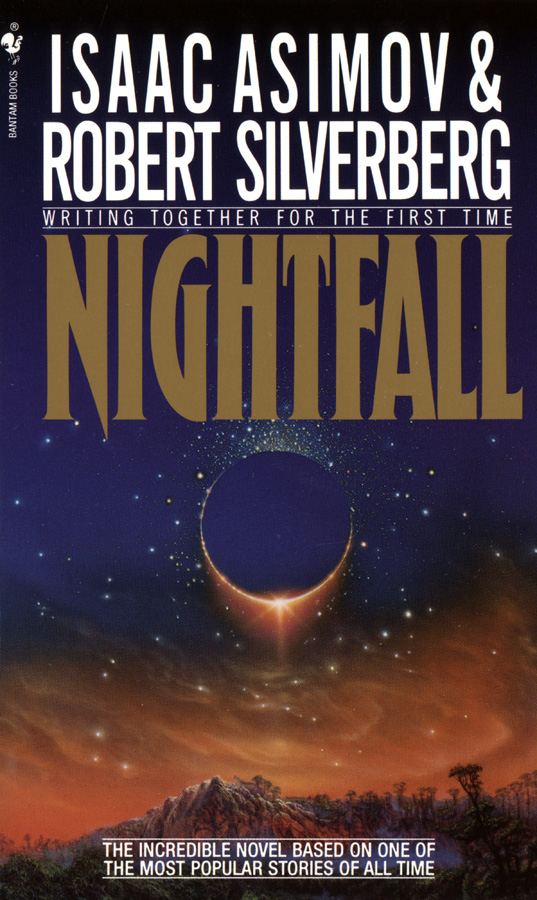
This novel takes me back to high school, where at some point following the release of The Bicentennial Man starring Robin Williams, I checked it out and read my very first Asimov. I'd watched enough Star Trek to know that 'positronic' meant that this was about an android, and thought perhaps the movie was based on it. My guess was right: The Positronic Man is an expansion of Asimov's short story, "The Bicentennial Man", just as Nightfall is an Asimov-Silverberg expansion of "Nightfall".  The tale of Andrew Martin, the robot who wanted to become a man, is one of my favorite Asimov stories. Data from The Next Generation may have predisposed  me to being fascinated with the book's theme -- what does it mean to be a human, to be sentient?

After having read Silverberg and Asimov's expansion of "Nightfall", I cannot read the original story without missing the additional content. It seems like only half a story. The Positronic Man is more conservative on that count,  starting and ending at the same points as Asimov's original story. That can scarcely be avoided, as much of the original story took place in the form of a flashback, as Andrew -- preparing for a surgery that will constitute the 'final' leap and give him either the humanity he desires or the welcome release of death -- recounts how he came to be such an usual creature, the being who is far more a robot and yet, not quite a man. The Positronic Man greatly enriches the experience; events which are summarized in a sentence or two in the original story unfold over the course of a chapter, allowing for a great deal more characterization, both on Andrew's part and his human companions This isn't simply a 'lengthier' version of " Bicentennial  Man": the additions, which flow so well from the original text, allow Andrew to truly evolve throughout the course of the book: he matures before our eyes as a character, not just as a robot who abandons metal coverings for pseudo-skin or gains legal standing. The polite, metallic servant introduced in the first chapter slowly grows into a thoughtful man, accomplished in multiple artistic and intellectual fields, driven by the same impulses that motivate us all.

I enjoyed this work tremendously;  while I don't know how much is Silverberg and how much is Asimov's, the result makes my favorite Asimov story even better.

Monday, October 17, 2011

The Planet that Wasn't

The Planet that Wasn't
© 1976 Isaac Asimov
237 pages


Isaac Asimov routinely penned science essays in various magazines, and given his eagerness to publish books, often produced collections of said science essays. The Planet that Wasn't is one such collection, covering pure science as well as science's perception in society. The title essay refers to the speculated planet of Vulcan, which was thought to exist between Mercury and the Sun, proposed as a way to account for Mercury's slight orbital deviation. Vulcan could never be found, because it did not exist:  our entire understanding of physics had to change (from Newtonian mechanics to Einstein's relativity) before Mercury's orbit was truly understood.  After some initial astrophysics,  a brief series of essays takes us from the versatility of carbon to biochemistry, and Asimov devotes a chapter to the working of the gallbladder, cholesterol, and high blood pressure. The latter essays move from science to its relationship with society: "The Nightfall Effect" addresses the notion that human beings can only settle outer space on other planetary bodies, and not space stations, while "The Flying Dutchman" tackles UFOs.  My favorite essay is "The Bridge of the Gods', which addresses the physics of the rainbow and treated me to a history of optics.

Enjoyable as ever, but I would say that...being an Asimovophile.

Friday, October 7, 2011

The Union Club Mysteries

The Union Club Mysteries
© 1987 Isaac Asimov
210 pages


Evening falls in New York City, and inside the aristocratic Union Club, four gentlemen sit ensconced in their usual chairs in the club library. Three talk softly among themselves while a fourth -- an older gentleman with a white, puffy mustache -- seems to doze. But their conversation makes a turn that interests his still-awake ears, his somnolent mind springs to life, and he takes a sip of his scotch and soda. Griswold has awoken, and that last bit of conversation reminds him of a story...

So begin thirty evenings inside the Union Club, wherein Griswold -- formerly in the employ of a shadowy government Department which gave him plentiful opportunities to solve domestic mysteries and international espionage plots -- regales or abuses his dining comrades with a mystery from his life, a story which he expects them to solve by the end.  If they do not -- and they never do -- he faithfully explains the solution.  Although the setting seems similar to the Black Widowers -- a stag club who meet once a month for conversation and drinks -- Griswold's tales are much shorter, and the appeal of the stories is different. While Black Widowers stories feature the gentlemen discussing literature, science, history, art, and the like in order to find a solution to a given mystery, here the burden is laid entirely upon the reader, and the solution is often more subjective than in a Widower's story. It's a bit like working a crossword puzzle in that in reading, you must try to think like Asimov, to find some odd angle at which to hang the plot.   The solution's clue is usually obvious, but the trick is  matching Asimov in thinking of why that clue is relevant.

I enjoy little puzzlers like these, and have reading a tale or two at lunch every day since I received the book in the mail. Although the stories aren't nearly as entertaining as the Black Widowers tales, I enjoyed most of the mysteries and even solved a fair few of them. There were a few groaners, but on the whole I'd recommend this to short-mystery or Asimov readers.

Wednesday, August 31, 2011

The Gods Themselves

The Gods Themselves
© 1972 Isaac Asimov
288 pages

"Against human stupidity, the gods themselves contend in vain." - Friedrich Schiller

In a small university office, something wondrous has been discovered: an isotope of Plutonium which cannot possibly remain stable according to the laws of known physics. Yet there it sits upon Dr. Hallam's desk, quiet as you like. The search for the isotope's origins creates a powerful new energy source for humanity, one which is effectively inexhaustible and utterly efficient. But nothing comes without a price, and one scientist realizes to his horror that the price of humanity's bounty may be the solar system itself.  The Gods Themselves is a story told in three parts: as two men on Earth and the Moon attempt to find someway of convincing the civilization of Earth to save itself, in another universe (the origin of that isotope) a dissident alien rails against her own people's attempt to save itself -- an attempt which is dependent on Earth's destruction.

The Gods Themselves is one of Asimov's more unconventional works, for the good doctor rarely used aliens in his stories. This may be the readers' loss, for the alien race he invents for The Gods Themselves is far from being a species of "rubber forehead" aliens with strange names. They are creatures far different from us, with three genders and bodies not quite so bound as ours. Wrapping my head around their society took a few pages, but once I'd gotten a handle on the genders I was hooked. Despite their differences, they remain sympathetic-- except for their dispassionate decision to destroy Earth's solar system to ensure their survival. Asimov's world-building on the Moon is also worth noting: it seems to be a popular location for him, as he used it in The Positronic Man and more than a few short stories.  The Gods Themselves is also a 'harder' kind of science fiction than Asimov's other works (like Empire and Robots):  the first third of the novel takes place almost entirely in the laboratory, where atomic chemistry dominates the dialogue.

The essential source of tension in the novel is human short-sightedness: as one character explains to the others,  when people are forced to realize their actions have destructive consequences, we seek to counter the consequences instead of ceasing the actions. Because our human heroes can't overcome human stupidity in this regard, they are forced to find a scientific solution to the problem at hand. I didn't know beforehand if this novel is intended to be set in the same storytelling universe as the Robots, Empire, and Foundation novels, so whether the characters would emerge victorious or go down fighting remained up in the air until the final chapter.

Definitely one of Asimov's more interesting works:  dramatic tension is maintained nicely, surviving even an interesting sidetrack to explore Asimov's alien culture. The most sympathetic character in the novel is an alien, actually: most of the humans are boors, though humanity is redeemed by two characters in the ending section. It remains to be seen if we will redeem ourselves, for the same weakness of Asimov's humans is present today: instead of throwing ourselves into solutions to eliminate our dependence on fossil fuels, we insist on maintaining them for as long as possible, and so invite disaster.

Related:

Saturday, July 9, 2011

Robots and Empire

Robots and Empire
© 1985 Isaac Asimov
383 pages


In Isaac Asimov's robots novels, Earth is home to some eight billion people living in vast underground complexes known as Cities or "caves of steel". In his Empire novels, those billions have vanished: large patches of land are radioactive, and the few who remain hold on bitterly to memories of Earth's past glory.  How did Earth fall from being the heart of humanity to passing out of memory entirely in the Foundation series? Its decline, and the rise of the Galactic Empire, begin in Robots and Empire -- a fantastic novel which uses a plot of political mystery to seamlessly knit together Asimov's series.

Two hundred years have passed since famed Earth detective Elijah Baley died, but his legacy is strong and growing. Baley helped the people of Earth to look again to space, to build civilizations away from the tired old Earth from which they sprang.  Humans had looked outward before, settling some fifty planets, but the people there used robot labor to create lives of leisure for themselves. They ceased to grow, to expand -- and they regarded their less-advanced Earth ancestors with disdain.  It was their power and Earth's fear of change that Baley defeated with the help of others, but now both Baley and his allies are dead.  There are those among the "Spacers" who do not want to see Earth expand again...and they will strike at the planet itself if that is what it takes. They work their plans in secret, but Baley's old partner R. Daneel Olivaw is determined to thwart their plans.

Robots and Empire functions as both an SF political thriller and a  bridge between Asimov's series. He's written other books to serve the same function, and together they tell a story which lasts for thousands of years. Although there are still some loose threads (What happened to the Cities during the Empire novels?), Robots and Empire reveals how Earth decayed and why robots (present in Robots, absent in both the original Empire and Foundation novels)  fell from use. His central character here, and consequently the Robots-Empire-Foundation meta series, is the robot Daneel Olivaw, who is driven by a vision from his friend and partner Elijah Baley that will see its final fruit in the last Foundation books. Still, Robots and Empire is more solidly a Robots novel, featuring Elijah Baley (in flashbacks) and his other associates, the Solarian woman Gladia and a telepathic robot named Giskard, who has his own role to play. It reminds me much of Prelude to Foundation and Forward the Foundation, both in style and in the measure that I enjoyed it.

This is an obvious recommendation to anyone who has enjoyed Asimov's various series. While having read the rest of the books isn't a requirement, catching the multitude of little references added to my appreciation. I would suggest reading the Robots novels (The Caves of Steel, The Naked Sun, The Robots of Dawn) first, since the relationship, history, and culture differences between Earth and the Spacer worlds provide the central conflict here. 

Saturday, June 18, 2011

The Currents of Space

The Currents of Space
© 1952 Isaac Asimov
From Triangle (pp. 1-172). © 1952.

"Frightened people can be very dangerous, my Lady. They can't be counted on to act sensibly."
"Then why do you keep them frightened?"

An entire planet is doomed, and only one man knows enough to care. Pity he's been kidnapped, subjected to a mental probe that cost him his mind, and left in the middle of nowhere to be looked after only by peasants suspicious of the unknown. The farms of Florina aren't quite the middle of nowhere, however: they're the only place in all the galaxy which can produce the miracle fabric 'kyrt',  known for its beauty and versatility, and worn by the elite of the cosmos. Florina's fields have made their conquerors -- the planet of Sark -- immensely rich, and powerful enough to keep Sark free from being annexed by the Trantorian Empire.  But the planet in peril is in fact Florina, and if it goes so does Sark's power -- and the Galaxy belongs to Trantor.  Who attacked this man, and why? What kind of danger could threaten an entire planet? Thus begins a fantastic political mystery and the last novel in the Empire 'trilogy'.

Like The Stars like Dust, Currents of Space is a political-mystery thriller with a futuristic setting. The science fiction elements take a backseat to the puzzle of Rik and Florina's alleged doom and the depiction of Florina and Sark's society.  Their relationship is baldly exploitative: the Florinians generate all of the wealth, but it is stolen by Sark -- and Sark keeps the Florinians impoverished and uneducated, staving off rebellion through means of superior force. If the Florinians could gain outside assistance -- say, from Trantor -- they might be able to break the yoke of their masters.  Given how keenly Trantor would be interested in breaking Sark,  it's a safe assumption they have a part to play in the sinister plots which are afoot. Once the action erupts, the plot advances at breakneck speed over the bodies of anyone who gets in the main characters' way, and it doesn't stop until a revelation in the final pages which surprised me.   I started reading this to take a break from the oddness of Robert Heinlin's The Cat Who Walked through Walls, and it may just be my favorite Empire novel.


I have no idea who this woman is supposed to be, but it convinces me that book covers are an essential part of vintage SF's charm.

Thursday, May 5, 2011

The Tragedy of the Moon

The Tragedy of the Moon
© Isaac Asimov 1978
224 pages


The Tragedy of the Moon collects seventeen sundry Asimovian essays  which will prove a delight to most Asimov fans.  The essays were originally published in Fantasy and Science Fiction, but have been edited and arranged specially for the book. This is one of his more diverse collections: while science is a common element of most of the essays, only two are pure or 'hard' science. The rest combine science and culture, as when Asimov writes on the history of calenders and the week in western culture. I'd never really wondered why the week has seven days, at least not enough to look up the answer.  As Asimov deftly explains in "Moon over Babylon", it comes from lunar festivities which occurred every seventh day. This also has some bearing on the Jewish 'Sabbath', and this essay is rich in history and etymology. While the good doctor's nonfiction output is generally fascinating, I liked this collection most for including more of Asimov's informality:  some collections tend to be staid and to the point, but Asimov's winsome personality shines through the pages here as he constantly kids and charms the reader, both in-text and in footnotes.

If "It's by Asimov!" isn't enough for you, the list of essays follows.
  1. "The Tragedy of the Moon" Asimov reflects on how the absence of a moon rotating the earth may have sped up humanity's acceptance of heliocentrism and hastened the growth of scientific progress in general.
  2. "The Triumph of the Moon" examines how the moon has been a boon to humanity, though his three triumphs listed are more indirect than I'd imagined. 
  3. "Moon Over Babylon" concerns the history of the week as a timekeeping period, and is one of my favorites.
  4. "The Week Excuse" sees Asimov argue for a more sensible calender (and make a terrible pun, for he is "not ashamed of myself in the slightest").
  5. "The World Ceres" is both explanatory and speculative, as Asimov ponders how humanity might use Ceres for mining and tourism
  6. "The Clock in the Sky" regales the reader with the story of how humanity figured out the speed of light.
  7. "The One and Only" focuses on carbon's unique suitability for becoming the backbone of life.
  8. "The Unlikely Twins" tackle two very different manifestations of carbon: graphite and diamond, and explain how they can be so different and yet consist solely of the same element.
  9. "Through the Microglass" focuses on the discovery of microscopic beings like bacteria and their importance in the fields of medicine and biology.
  10. "Down from the Amoeba" struggles with the concept of "life": are viruses, sperm,  and red bloodcells 'alive'?
  11. "The Cinderalla Compound" builds on this and addresses the discovery of nucleic acid and DNA. 
  12. "Doctor, Doctor, Cut my Throat" features Asimov reducing his surgeon into a laughing fit and lecturing on hormones.
  13. "Lost in Translation", which also appears either Gold or Magic, is an interesting departure from the rest of the book,  stressing the importance of social and cultural context when translating or reading literature from eras past. He uses the Book of Ruth as his prime example, seeing it as not just a love story, but a triumphant endorsement of universal brotherhood. 
  14. "The Ancient and the Ultimate" sees Asimov slyly defend books while pretending to lecture on the supremacy of cassettes (heh) in the future of communication. 
  15. "By the Numbers" addresses both hypocrisy -- people complaining about technological societies and taxes while freely enjoying the benefits of both -- and the need for a society in which computers manage things. (Such societies often appear in Asimov's works, often using a global computer  called  MULTIVAC.)
  16. "The Cruise and I" relates the story of Asimov's cruise off the Florida coast, where he watched the last Apollo takeoff -- which happened to be the first nighttime launch. Asimov usually avoided travel, so I relished this humorous take which ended in splendor as humanity reached out for the moon yet one more time.  Carl Sagan was on that very same cruise, and he appears in the essay twice.
  17. "Academe and I" sees Asimov look back on his careers as an author and professor of biochemistry, giving a minibiography of himself along the way.

I for one enjoyed myself tremendously reading this.

My own copy, purchased in used condition (obviously so) last week. 


Wednesday, April 20, 2011

The Stars like Dust

The Stars like Dust (originally titled as The Rebellious Stars)
© 1951 Isaac Asimov
From Triangle, pp. 349 - 516. © 1952


Only a few days before his graduation from the University of Earth, Biron Farril awoke in the middle of the night to the sound of his room clicking happily to itself -- clicking with radiation. No university prank, this seemed more an attack on his life, an attempt to unite Biron with his recently executed father.  And so he flees Earth to seek sanctuary in Rhodia, to ask protection from a friend of his father's. So begins a story of politics, rebellion, and ambition with more plot twists than there are stars in the sky.

Though classified in Asimov's empire series,  this story appears to have been set rather early: humanity has settled a little over a thousand worlds, and while one of those worlds -- the aptly named Tyrann -- has established a fifty-planet sphere of influence for itself, the Empire proper is never mentioned, nor is Trantor.    The focus is instead on the dominion of the Tyranni, who repress scientific advancement in the worlds they control to restrict the possibility of rebellion. Still,  tyranny does not sit well with human beings: there is a conspiracy, and in fleeing Earth Biron has stumbled upon a galactic chessboard to be used by the Tyranni and the rebels-in-waiting, each manipulating him for their own ends. His greatest hope is to find a rumored rebellion world in the Horsehead Nebula, blessedly free from any politics except staunch resistance to the tyrants.

Although Asimov makes passing reference to technology -- ships Jumping through hyperspace, devices which project images into the mind -- the emphasis here is on political mystery, and it kept me thoroughly entertained though I grew weary of the rug constantly being pulled out from under me. The Second Foundation-like ending was a bit of a surprise, but the novel's length shortened the number of possible resolutions. The last words of the novel reminded me a bit of Star Trek's bewildering episode "The Omega Glory".  As with seeing that episode for the first time, I wasn't sure if I found it amusing or bizarrely inspiring or not.

I fully intend to finish the Empire trilogy this year, so I'll probably be reading Currents in Space sometime soon.


Sunday, February 13, 2011

The Near East

The Near East: 10,000 Years of History
© 1968 Isaac Asimov
277 pages

Come, let us sit upon the ground and tell sad stories of the death of kings. ("Richard II", William Shakespeare)

Civilization first began in the 'land between the rivers', Mesopotamia, and as this epic history of the area proves, the near east has been the cradle of many of humanity's ideas throughout the centuries. Asimov's history begins at the birth of agriculture, and so as the story unfolds we witness not only the birth of various political entities, but of civilization proper itself -- the first cities develop, men begin to make tools and weapons of bronze and iron; horses grow into impressive creatures capable of carrying armored men to war, and the first histories and records are read. Religions and philosophies flower in these highlands and deserts that survive today -- either by themselves, or through altered forms. No era  in human history has seen a lull in the action in this land, and The Near East is accordingly an exiting and fascinating read.

Asimov surprised me by committing to such a vast expanse of time: that "ten thousand years of history" starts with agriculture and ends shortly before the Israeli-Arabic wars,  with Asimov penning hopes for peace that seem sad, so many decades into the future with permanent concordance seemingly impossible. The meat of the book is ancient history, though the rise of the Arabs and Turks is given plenty of consideration and I learned far more about the period's fate in the early 20th century that I anticipated. I had no idea that Britain and Russia both invaded the area just to ensure stable communications  The book's emphasis is not misplaced, for the stories of Sumeria, Babylon, Assyria, and others deserve to be told. Egypt is only mentioned tangentially, which seems curious, but is understandable given that Asimov covered the land of the Nile in another book. Egypt's political influence on the affairs of other Near Eastern countries is addressed properly, though.  The book's scope allows one chapter's heroes to be another chapter's mythic legends, and Asimov's narrative shows how kings were constantly trying to co-opt the legacies of prior rulers. I had no idea that the most famous Nebuchadrezzer  lived in entirely different era than his namesake - the original Nebby, who lived not too long after Hammurabi.  That Asimov draws from the Sumerian king lists and 'official histories' is obvious at the start of the book, which emphasizes history as driven by the wills and capabilities of great men.  

Asimov enjoys a reputation as 'professional explainer',  one established by his use of simple, clear language and  general command of many varied subjects. His prowess as a generalist is an enduring inspiration to me, for he wrote books on science, history, poetry, literature, and others with equal ease: that showed here, as he draws facts and conclusions from literary sources like the Jewish bible and Persian epic poetry. I found the book tremendously helpful in understanding the Hellenic period -- all of Alexanders' various generals and their kingdoms confuse me -- and the the history of Persia. I'll be using The Near East as a general reference book for when I want to refresh my knowledge of the period, but the presence of one erroneous fact does give me some pause: when writing on Roman-Persian interaction, Asimov mentions that Hadrian died in 161 and was succeeded by Marcus Aurelius and Lucius Verus, skipping over poor Antonious Pious and his twenty-year reign entirely. (Hadrian died in 138, and was succeeded by Pious, who died in 161.)  I only noticed this because of my fondness for Aurelius. It's a fairly forgivable mistake, as Rome is only being mentioned in connection to Parthia's expansion, Still, I hope it's an error he caught and corrected at some point. 

If you can find this, it should serve well as an introduction to the period, especially for teenagers and such. I say "if you can find it", because Asimov's history books are rare indeed. Some of them don't even have Amazon or eBay entries. (By the way, if you should ever spot the following books in a used bookstore, think of me and we can work out some kind of arrangement: The Roman Republic, The Roman Empire,  The Greeks, The Egyptians, and The Dark Ages.)

 Related:

Wednesday, December 29, 2010

This Week at the Library (29 December)


Aside from the books I've already done full comments on, I also finished The Great American Wolf and The Golden Door.  My observations about them were shortish, so I decided to include them here instead of making seperate, strangely short posts.  The Great American Wolf by Bruce Hampton was placed in my library's Science and Nature section, though it's really more a history of human interaction with wolves in North America. I had no idea wolves were viewed in such a negative light: I've always been fond of them, seeing the grey wolf in particular as intelligent, sociable, and beautiful.  Though native Americans regarded the wolf as a magnificent creatures, Europeans have apparantly shared a long hostility toward them and the colonists who settled in North American acted on it. They regarded the wolves as pests and purposely sought to drive them to extinction -- though this changed in the 20th century, as conservationists and environmentalists pushed to save them.


I also read Isaac Asimov's The Golden Door, a history of the United States from Reconstruction following the Civil War through to the conclusion of the Great War. This period of history happens to be one of my favorites, and Asimov titled his book by drawing from Emma Lazarus' "The New Colossus", engraved upon the Statue of Liberty in New York which welcomed so many immigrants.

"Keep ancient lands, your storied pomp!" cries she
With silent lips. "Give me your tired, your poor,
Your huddled masses yearning to breathe free,
The wretched refuse of your teeming shore.
Send these, the homeless, tempest-tost to me,
I lift my lamp beside the golden door!"

I rather like the poem.  Asimov's history is breezily readable, suitable for younger readers as well as older ones who want an introduction to the period, a refresher, or some mild entertainment: I picked up some trivia while reading it. Asimov's istypically fair and more idealistic than cynical.

Next week's potentials:

  • Seize the Fire, Michael A. Martin. I actually read this yesterday, but I meant for it to be "this" week's Trek reading. Because my library visit and TWATL post have occcured on Wednesday for so long, I tend to think of it as starting a new 'week'. 
  • Over the Hills: A Midlife Escape Across America by Bicycle, David Lamb.  This is the third or fourth book I've read this year in which someone decided to journey across the continent, but the idea of throwing oneself into nature, of seeing where the road goes and having an adventure along the way, appeals to me.
  • In a Sunburned Country,  in which Bill Bryson explores Australia.
  • The Evolution of God, by Robert Wright -- because God is Not One: The Eight Rival Religions That Run the World and Why Their Differences Matter was checked out. 
  • The Burning Land, Bernard Cornwell. The most recent book in the Saxon Chronicles series, which means next week I'll have no Uhtred to enjoy. Whatever will I do?
  • I also have a book on the weather, because on Christmas morning while watching the rain fall I realized that though I understand the water cycle, I have no idea what high- and low-pressure systems mean and why they bring the kind of weather they do. 

Wednesday, December 15, 2010

A Whiff of Death

A Whiff of Death
from A Whiff of Death & Murder at the ABA
© 1958 Isaac Asimov
Pp. 3- 146

"Death sits in the chemistry laboratory and a million people sit with him and don't mind. They forget he's there." 

Louis Brade is an assistant professor of chemistry, supervising PhD candidates and lecturing freshmen on the wonders of valence bonds. He is settled, sedentary -- not keen on attention, position, or great wealth, he only wants to pursue the research that interests him and fulfill his responsibilities to his students. It thus comes as a great shock to him to find one of his more promising wards dead on the laboratory floor, having apparantly mistaken a flask of sodium acetate for a flask of sodium cyanide.  It's a simple error, but not one any chemistry student worth his lab coat would make, and certainly not a graduate student approaching his university career's culmination. Though the university -- eager to avoid a scandal -- is quick to dismiss the death as an accident, or even possibly suicide, something about the situation doesn't sit right with Brade.  He has to find out what happened, but must proceed cautiously lest he attract the police's attention.

The story unfolds in less than a hundred hours.  While mulling over possibilies in his mind, Brade must lecture on carbonytes, spend time with his daughter, humor his demanding mentor's 'requests' to proofread a history of organic chemistry,  entertain a visiting  colleague, and avoid ruffling his wife's feathers -- and she, hell-bent on him achieving tenure, is considerably less than delighted at his decision to stir up trouble by looking into the boy's death.  Though the means of death is chemistry, Asimov's Brade explains it as neatly to the reader as to the very curious detective who takes an interest in the case and determines that if murder is involved, Brade's the only man with enough knowledge of the deceased' pecuilar work habits to do the job.

More a novella than a longer mystery story, A Whiff of Death is short and sweet. Asimov relies on his experience as a chemistry professor (at Columbia University, where he taught while building a reputaiton as a science and history populizer)  to give the reader an inside look into the world of biochemical acadamia.  I never suspected the killer, being put off-guard by Asimov's simple charms. The ending is particularly good -- not for the conclusion of the mystery, but in seeing how much Brade's character has grown in the short space alloted. A perfectly enjoyable afternoon diversion for me, and I think it interesting that the book is paired with Murder at the ABA in this collection: Asimov was a chemist by training and an author for a living, so this volume contains looks into both his worlds.

A Whiff of Death was originally known as The Death Dealers, though why the publishers referred Dealers to his Whiff I can't fathom. He tended to republish works under his own, preferred titles later on. The original cover amuses me, though: it's completely unrelated to the story within.  I suppose a beautiful woman, a smoking gun, and a dead body are more eye-catching than this, though.


Wednesday, August 25, 2010

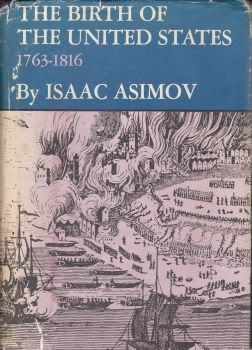
The Birth of the United States

The Birth of the United States
© 1973 Isaac Asimov
274 pages, including a table of dates.


While trolling Amazon in search of elusive copies of Isaac Asimov's Roman history books, I chanced to find evidence of a four-book history series on the United States, beginning with European colonization and ending at the Great War. They're decades out of print, alas, and I won't be able to read all of them. The Birth of the United States picks up at the end of the French-Indian war (known in Europe as the Seven Years' War) and the beginnings of mutual Anglo-American resentment. Asimov then takes us through the Revolution, the Constitutional Convention, and up to the end of the War of 1812.

Asimov didn't achieve success as a writer by being poor at it: Birth is perfectly lucid. I don't think I've followed any account of the Revolutionary War as easily as this one. The political wrangling that followed the war, as the states with varying interests  who proposed national constitutions that protected them from the others, could easily be dull -- but it isn't. Impressively, the normally opinionated Asimov is fair to the various clashing interests he covers. The British are not presented as tyrants, for instance, nor does he take sides when recounting the numerous issues between the states. He simply explains why everyone thought as they did, and detailed the ways in which varying decisions helped and hurt either side. In retrospect I am not surprised at his approach. There are rarely villains in his fiction works: he preferred instead to bounce characters with justified but opposing interests off one another. (He does opine against incompetent generals, though, and disapproves strongly of characters like Banastre Tarleton.) He's obviously fond of the subject matter, being a naturalized citizen of the US and an ardent humanist who believed in the United States' Enlightenment-era ideals. Asimov frequently takes the reader aside to mention trivial tidbits, like that after the Battle of Lexington,  settlers in Kentucky renamed their settlement to commemorate the dawn of America's war for independence.

Reading The Birth of the United States was an experience both helpful and enjoyable. It filled in my own gaps of the period, and I'd recommend it to any reader needing or wanting an introduction to the early United States.

Sunday, July 4, 2010

The Complete Robot

The Complete Robot
© 1982 Isaac Asimov
688 pages


A boom in electronic engineering followed World War 2, one that led to consumer televisions, the first computers, and a wide variety of other electricity-using gadgets. As people looked more toward the future, they conceived of mechanical men: these robots often ran amok in the style of Frankenstein's monster. Isaac Asimov thought this silly: robots were tools explicitly designed by intelligent people. It made no sense for them to run amok. He subsequently developed in full the Three Laws of Robotics, and later wrote a host of stories and novels based on them.


1. A robot may not injure a human being or, through inaction, allow a human being to come to harm.
2. A robot must obey any orders given to it by human beings, except where such orders would conflict with the First Law.
3. A robot must protect its own existence as long as such protection does not conflict with the First or Second Law.


Asimov used his stories to explore how humans might use robots to better the human condition, but he also explored questions of intelligence, creativity, sentience, and prejudice. He coined the phrase robotics and his body of work subsequently left various marks on our culture: the android Lieutenant Commander Data of Star Trek possesses one of Asimov's "positronic brains", for instance. The Complete Robot collects just over thirty of his short stories in this theme, written throughout the fifties, sixties, and seventies. Because other robot stories and essays followed it, its name has not remained accurate: still, the book constitutes the sizable bulk of his robot short fiction, including the Susan Calvin stories and classics like "Robbie".

The stories vary slightly in setting, but cover the latter half of the 20th century and human history throughout the 21st, until the dawn of hyperdrives that allow for interstellar travel. Most of the stories share a same canon: at some point in the late 20th or early 21st century,  the many political entities on Earth unite under a weak confederation. Essential parts of the economic (agriculture, for instance) are planned, and crucial to the planning are large computers. These globe-monitoring computing machines in the style of UNIVAC may be subsidiaries to Multivac -- a massive supercomputer at least the size of a building. Several stories here concern Multivac, the machine that bears all the cares of humanity upon its transistor- and vacuum-tube employing shoulders.


Robots in the style of Commander Data come later: while designed to emulate human beings in essential form and size, they exist chiefly for industrial work or for the amusement of wealthy individuals. The people of Earth later react against the employment of robots in this way, relegating them to maintaining space posts in a dozen or so of the stories here. Three stories follow Mike Donovan and Gregory Powell, two quality-assurance technicians in the employ of US Robots and Mechanical Men, as they observe the latest robot models at work, "manning" the stations that beam intense sunlight to Earth, powering its electric grid. Later on, robots nearly vanish from Earth history altogether: in the Empire age, only humans who have left Earth to colonize other worlds use robots. Little of the Empire age is seen here, though -- only its prelude in a short story about detectives Elijah Baley and R. Daneel Olivaw, the latter being what we call today an android.

Asimov's stories are as ever simple and charming. They bear the mark of the fifties and sixties, not only in their portrayal of marriage (husband goes to work, wife keeps house), but in the way they grapple with the future. Some predictions seem banal by modern standards, others still far off and bordering on fantastic -- but the optimism and hope are undeniable. Asimov is refreshing and endearing, and the retro-feel has its own appeal to me. The Complete Robot is a solid hit, taking me back to that summer in which I first delighted in Asimov's short stories. I definitely recommend it.

Highlights:

  • "Sally", a favorite of mine about automated cars with personalities.
  • "True Love", in which a computer designed to find its maker the perfect match finds his own.
  • "The Tercentenary Incident", set on 4 July 2076, follows the aftermath of an attempted assassination of the US President. The assassins seemed to have only vaporized the president's android decoy -- but who can know that that puff of atoms following the disintegration blast belonged to an android, and not to an unpopular president?
  • "Reason", in which quality-assurance technicians struggle with the first sentient robot after it establishes a religion based on the worshiping the station which it was designed to serve. 
  • "Mirror Image", an unexpected treat featuring the Robots trilogy team of Elijah Baley and Daneel Olivaw as they attempt to settle a matter of academic fraud.
  • "The Bicentennial Man" follows a robot's quest for humanity. Watching the Robin Williams movie of this prompted me to read The Positronic Man back in high school, my first involvement with Asimov. The link leads to the trailer.


"To those of you who have read some (or, possibly, all) of my robot stories before, I welcome your loyalty and patience. To those of you who have not, I hope this book has given you pleasure -- and I'm pleased to have met you -- and I hope we meet again soon." - p. 683, 'the last word'.

Indeed, Dr. A.

Sunday, June 13, 2010

The Roving Mind

The Roving Mind
© Isaac Asimov 1983
350 pages


In the first place, I type quickly -- 90 words a minute, when I am happy, carefree, and in a good mood. And that's my typing rate when I am composing, too, because I don't believe in fancy stuff. In my writing, there is no poetry, no complexity, no literary frills. Therefore, I need only barrel along, saying whatever comes to mind, and waving cheerfully at people who happen to pass my typewriter." (337)

The Roving Mind collects sixty-two essays by Isaac Asimov, the majority scientifically-themed, along with several tributes to the late Asimov by friends and comrades who knew him well. The essays by men like Paul Kurtz and Carl Sagan update a volume originally printed in the early eighties, and the essays reflect the preceding period, particularly the seventies.  Asimov's thoughts on the future are particularly interesting, as he seems to predict consumer-specific advertising and entertainment (as in TiVo and Google) and a computer-oriented marketplace that allows customers to buy goods and reserve hotel rooms through their private consoles. Other essays take on religious dogma and political  matters of interest (censorship), warn of the dangers of increasing population,  reflect on the human condition, and share Asimov's thoughts on the increasing role of technology in everyday lives, particularly in his own: he devotes three essays to his new-fangled Word Processor. Interesting topics abound, as is par for the course given Asimov's many varied interests, and his explanations are both lucid and witty with plenty of eccentric charm. Especially notable for me:

  • "The Reagan Doctrine", a satirical essay tackling the idea that believing in God is necessary for morality. "In every country, you'll find large numbers who claim that the United States fought a cruel and unjust war in Vietnam and that it is the most violent and crime-ridden nation in the world. They don't seem to be impressed by the fact that we're God-fearing. Next they'll be saving that Ronald Reagan (our very own president) doesn't know what he's talking about."
  • "Technophobia", in which Asimov addresses the various reasons people fear society's increasing dependency upon technology, although most of the essay is given over to overcoming people's dislike of having to learn new things. He recounts his experiences with the word-processor, how it was foisted upon him and how he studiously avoided so much as even looking at it.
  • "Pure and Impure" takes on the prejudice intellectuals, particularly theorists and liberal-arts snobs like myself, may have  against applied or "dirty" knowledge. 
  • "Art and Science" sees Asimov write on one of my favorite subjects,  the connections between every field of human knowledge. "If you look at an electron micrograph of a sponge spicule or of a diatom (you can find both in the 1977 Yearbook), you don't know whether to admire them as products of science or as works of artistic beauty -- And it doesn't matter; the two are the same."
  • "The Sky of the Satellites" is a favorite: Asimov imagines what the skies of Jupiter and Saturn's moons look like
  • "The Surprises of Pluto", in which Asimov states: "Pluto is scarcely a respectable planet; it is more like a large asteroid."
  • "The Ultimate in Communication", which Asimov sees as YouTube with VHS cassettes. 
  • "Touring the Moon" is a faux-news essay detailing what visitors to Earth's colony on the moon may expect from their trip. "Nothing, apparently, can prevent [the Moon's gravity] from being a surprise to first-timers. After the initial shock, the reaction is inevitable amusement, and a tendency to try walking, hopping, or jumping, despite the large signs that ring every possible change on the message, "Please do not run or jump, but wait quietly for processing."
  • "The Word-Processor and I" is the first of Asimov's essays detailing his partial conversion from typewriters to word processor. "With the help of my dear wife, Janet, [the Radio Shack guide] set up a 'computer corner' in our living room. Within it, the word-processor was unboxed, hooked together, and plugged in. I did my bit, to be sure. I kept saying, 'I don't think we have any space for a word-processor anywhere,' but no one listened to me."
This is a fun collection particularly of interest to skeptics and humanists, but enjoyable to all who delight in reading Asimov in general.