The Ugly Little Boy
© 1991 Isaac Asimov, Robert Silverberg. Based on the 1958 short story by Asimov.
290
How would you like to babysit a Neanderthal? Granted, Edith Fellowes didn't realize that was the job description. She knew she'd be responsible for caring for a small boy from the past -- a wild child, a true savage who could not discern the difference between a salad fork and a dinner fork -- but never did she imagine working with a true Neanderthal. (Besides her boss, anyway.) A company called Stasis, Ltd. has developed the technology to pull small articles from the far past and hold them in a stasis bubble for study, and a young Neanderthal has become the unwitting subject of their experimentation. There are of course ethical issues at hand, but so long as the newspapers continue to describe him as an ape-boy, who will raise qualms about his capture? No one but Miss Fellowes. As the boy's nurse, his constant companion, his teacher, the closest thing he has to a mother, she sees him not as an experiment but a boy. He is her Timmie, her ward, a complete person whom she loves despite his jarring looks and growling attempts at English. Ultimately, when push comes to shove, Fellowes loves Timmie more than she loves her job -- and when they try to end the experiment and send him back after years of isolation, she takes matters into her own hands.
Asimov often referred to "The Ugly Little Boy" as one of his very favorite short stories, though it was never one I particularly cared for. Robert Silverberg's expansion adds much of interest here, as he did with "Nightfall" and "The Positronic Man". The characters are fleshed out greatly, and humanized in the case of Fellowes' boss Hoskins. Silverberg includes another sub-story, one that follows Timmie's increasingly-stressed tribe as their numbers dwindle and they find themselves surrounded by 'Others'.....us. This provides an interesting contrast to Asimov's development of little Timmie; while the original story relied solely on archaeological evidence, Silverburg offers speculation into Neanderthal culture. Timmie's tribe doen't create representational art not because they can't grasp creating representational images, but because they don't want to anger the spirits. (Silverberg doesn't delve much into his Neanderthal tribe's religion: it seems vaguely animistic with a central Goddess, presumably an earth mother.) The two stories ultimately intersect at the end, with a conclusion that invites speculation*. Silverberg also adds another angle to the story proper, in the form of a political agitator who harries Stasis, Ltd. to make sure they are providing a healthy environment for the child. The agitator, Mannheim, is the sort who sues companies into bankruptcy, so his increasing interest in 'helping' the incredibly well-nurtured but lonely Timmie adds urgency to Stasis, Ltd's desire to end the experiment.
While the Neanderthal chapters took some getting used to -- the characters have names like 'Dark Wind', 'Milky Fountain', 'She Who Knows' -- their conflicts with the 'others' have interest. It is intriguing to reflect that once upon a time there were two distinct kinds of humans, very different from one another physically, but close enough to compete for the same resources and perhaps for even the same dinner dates. Modern research dates the original 1950s facts of Asimov's story, but Silverberg cushions the blow. I found the story much more appealing in novel form, but perhaps I merely enjoyed it more these days because I am more sentimental now: I find Fellowes' passion for Timmie more engaging than the technological aspect. To date I've thoroughly enjoyed the Silverberg-Asimov expansions of Asimov's originals, and The Ugly Little Boy is no exception. It made a story I found fair into one which was truly enjoyable.
* Spoiler: Fellowes decides to puncture the stasis bubble and allows herself to be thrown back into time with Timmie. In the novel, they appear in a blaze of light between the increasingly confused and stressed camps of Cro Magnons and Neanderthals, who are immediately awed by her. Is she worshipped as a god? Do she and Timmie go into business as translators? Do they all get eaten by short-faced bears? We'll never know...
(Okay, no being eaten by short-faced bears. They were a North American thing, and the Neanderthals never got around to doing the pilgrim thing and discovering the new world. They just wandered into the mists of history in Iberia...)
Pursuing the flourishing life and human liberty through literature.
"Once you learn to read, you will be forever free." - Frederick Douglass
Showing posts with label Robert Silverberg. Show all posts
Wednesday, July 27, 2016
Friday, January 13, 2012
The Positronic Man
The Positronic Man
© 1993 Isaac Asimov and Robert Silverberg
290 pages

This novel takes me back to high school, where at some point following the release of The Bicentennial Man starring Robin Williams, I checked it out and read my very first Asimov. I'd watched enough Star Trek to know that 'positronic' meant that this was about an android, and thought perhaps the movie was based on it. My guess was right: The Positronic Man is an expansion of Asimov's short story, "The Bicentennial Man", just as Nightfall is an Asimov-Silverberg expansion of "Nightfall". The tale of Andrew Martin, the robot who wanted to become a man, is one of my favorite Asimov stories. Data from The Next Generation may have predisposed me to being fascinated with the book's theme -- what does it mean to be a human, to be sentient?
After having read Silverberg and Asimov's expansion of "Nightfall", I cannot read the original story without missing the additional content. It seems like only half a story. The Positronic Man is more conservative on that count, starting and ending at the same points as Asimov's original story. That can scarcely be avoided, as much of the original story took place in the form of a flashback, as Andrew -- preparing for a surgery that will constitute the 'final' leap and give him either the humanity he desires or the welcome release of death -- recounts how he came to be such an usual creature, the being who is far more a robot and yet, not quite a man. The Positronic Man greatly enriches the experience; events which are summarized in a sentence or two in the original story unfold over the course of a chapter, allowing for a great deal more characterization, both on Andrew's part and his human companions This isn't simply a 'lengthier' version of " Bicentennial Man": the additions, which flow so well from the original text, allow Andrew to truly evolve throughout the course of the book: he matures before our eyes as a character, not just as a robot who abandons metal coverings for pseudo-skin or gains legal standing. The polite, metallic servant introduced in the first chapter slowly grows into a thoughtful man, accomplished in multiple artistic and intellectual fields, driven by the same impulses that motivate us all.
I enjoyed this work tremendously; while I don't know how much is Silverberg and how much is Asimov's, the result makes my favorite Asimov story even better.
© 1993 Isaac Asimov and Robert Silverberg
290 pages

This novel takes me back to high school, where at some point following the release of The Bicentennial Man starring Robin Williams, I checked it out and read my very first Asimov. I'd watched enough Star Trek to know that 'positronic' meant that this was about an android, and thought perhaps the movie was based on it. My guess was right: The Positronic Man is an expansion of Asimov's short story, "The Bicentennial Man", just as Nightfall is an Asimov-Silverberg expansion of "Nightfall". The tale of Andrew Martin, the robot who wanted to become a man, is one of my favorite Asimov stories. Data from The Next Generation may have predisposed me to being fascinated with the book's theme -- what does it mean to be a human, to be sentient?
After having read Silverberg and Asimov's expansion of "Nightfall", I cannot read the original story without missing the additional content. It seems like only half a story. The Positronic Man is more conservative on that count, starting and ending at the same points as Asimov's original story. That can scarcely be avoided, as much of the original story took place in the form of a flashback, as Andrew -- preparing for a surgery that will constitute the 'final' leap and give him either the humanity he desires or the welcome release of death -- recounts how he came to be such an usual creature, the being who is far more a robot and yet, not quite a man. The Positronic Man greatly enriches the experience; events which are summarized in a sentence or two in the original story unfold over the course of a chapter, allowing for a great deal more characterization, both on Andrew's part and his human companions This isn't simply a 'lengthier' version of " Bicentennial Man": the additions, which flow so well from the original text, allow Andrew to truly evolve throughout the course of the book: he matures before our eyes as a character, not just as a robot who abandons metal coverings for pseudo-skin or gains legal standing. The polite, metallic servant introduced in the first chapter slowly grows into a thoughtful man, accomplished in multiple artistic and intellectual fields, driven by the same impulses that motivate us all.
I enjoyed this work tremendously; while I don't know how much is Silverberg and how much is Asimov's, the result makes my favorite Asimov story even better.
Monday, October 20, 2008
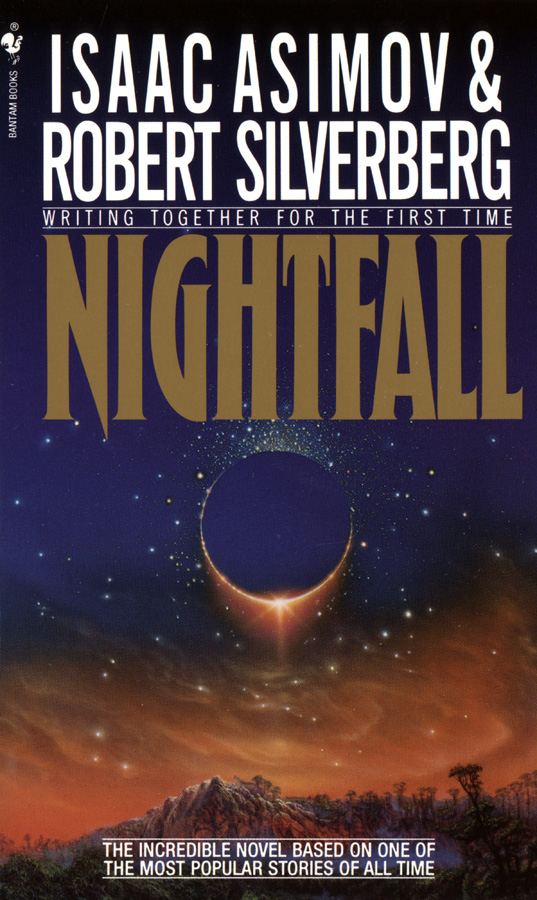
Nightfall
Nightfall
Isaac Asimov and Robert Silverberg, © 1990
Bantam Books, New York
339 pages.
If the stars should appear one night in a thousand years, how would men believe and adore and preserve for many generations the remembrance of the city of God!
A little over a year ago I read my second work of fiction by Isaac Asimov, one that made me a fan and led to the Asimov-binge I enjoyed so thoroughly this summer. Nightfall and Other Stories captivated me. The title story is set in a world occupied by humans, but who have no connection with Earth. A bit like the LOTR series, I suppose -- the humans there live in a completely different but understandable world of their own. The same is true of the humans who live on the planet of Lagesh, whose civilization has never known night -- or has it?
The planet is illuminated constantly by five suns. I'm not quite sure how that works in astronomical terms, but given Asimov's knowledge of astronomy I wouldn't be surprised if he had something in mind. Because of this constant illumination, the humans here have no knowledge of night -- but that will change. The story, apparantly quite well-reviewed, was adapted into a novel in 1990 -- and that is what I have just read.
Although the people of this world have no active memory of ever seeing night, legends of the past state that every 2049 years the Gods examine the people of Lagesh (called Kalgesh in the novel) to see if they are moral or not. When They realize that the people are still sinful, they in their divine fury hide the light of the suns and send the Stars to rain fire down the people to purge them of their wicked ways. These legends are religious in nature, and a powerful group called the Apostles of Flame are more active than ever in the days that begin this novel.
While it is easy to dismiss their rantings about the end of days as nothing more than religious lunacy, those rationalists who the Apostles decry as godless are realizing that something is...off.
As the novel progresses, Beenay and his mentor realize that Kalgesh has a natural satellite, one that they have never seen before because the light reflected from its surface is washed out by the light from Kalgesh's various suns. This satellite is projected to eclipse one of their suns on a day when that sun is the only one in the sky. The result will be hours of darkness. This eclipse, like those of our Sun, can be predicted using gravitational theory -- and they realize that the eclipse has occured before -- and occurs every 2049 years. The onset of Darkness -- which the Kalgeshians fear instinctively -- would be fought by attempts to make fires whenever they could, they reason, and uncontrolled fires breaking out planet-wide could destroy their civilizations. While they have a few lights in internal rooms, the net effect will be hemisphere-wide darkness.
This, coupled with Siferra's archaeologist data, seems to validate the claims made by the Apostles of Flame, who forcast doom and destruction. This is not easy to accept by the rationalists, but eventually they do. They attempt to warn the population, but their claims are discounted by a cynical journalist named Theremon -- who denounces the scientists as having either lost their heads or become worry-warts. (This could concievably be a gentle poke by Asimov at those who mock global warming proponents, since Asimov was attempting to raise awareness about global warming in the 1980s.) As a result, society is largely unprepared on the day when the only sun in the sky begins to be eclipsed by a dark body -- Kalgesh's moon.
As the sun's light gives way to darkness and the stars appear in all their glory, Asimov ended the short story version of this. I believe the last line was something along the lines of "My god, look at the Stars!". This is interesting, because as we find out, it's not the darkness that strives men mad -- it's the overwhelming and terrifying beauty of the stars, whose existence could never be imagined. Nightfall does not conclude with the arrival of the Stars, though: it continues with "Daybreak", where we see the consequences. Only two groups we know of have prepared in any way for the Darkness: the Apostles of Flame, who intend to impose a theocracy from the ashes of their civilization -- and the scientists, who have prepared a small sanctuary with the knowledge of civilization. We are thus prepared for a battle between the forces of irrationality and rationality -- intriuged?
How the story ends I won't say. I will say, though, that the story remains interesting throughout and I recommend it to those who enjoy a good read. The story provokes many interesting questions, at least for me. For instance, it's highly unlikely that every single civilization was graced with clear skies with the advent of the eclipse. If it was the stars rather than the darkness that drove people made, cloud cover would mitigate the effects greatly. Those civilizations that remained intact could serve as the foundation for a new political order. That would be an interesting sequel -- but Asimov is no longer with us. I suppose Silverberg could write it, but I doubt that would happen.
Isaac Asimov and Robert Silverberg, © 1990
Bantam Books, New York
339 pages.
If the stars should appear one night in a thousand years, how would men believe and adore and preserve for many generations the remembrance of the city of God!
A little over a year ago I read my second work of fiction by Isaac Asimov, one that made me a fan and led to the Asimov-binge I enjoyed so thoroughly this summer. Nightfall and Other Stories captivated me. The title story is set in a world occupied by humans, but who have no connection with Earth. A bit like the LOTR series, I suppose -- the humans there live in a completely different but understandable world of their own. The same is true of the humans who live on the planet of Lagesh, whose civilization has never known night -- or has it?
The planet is illuminated constantly by five suns. I'm not quite sure how that works in astronomical terms, but given Asimov's knowledge of astronomy I wouldn't be surprised if he had something in mind. Because of this constant illumination, the humans here have no knowledge of night -- but that will change. The story, apparantly quite well-reviewed, was adapted into a novel in 1990 -- and that is what I have just read.
Although the people of this world have no active memory of ever seeing night, legends of the past state that every 2049 years the Gods examine the people of Lagesh (called Kalgesh in the novel) to see if they are moral or not. When They realize that the people are still sinful, they in their divine fury hide the light of the suns and send the Stars to rain fire down the people to purge them of their wicked ways. These legends are religious in nature, and a powerful group called the Apostles of Flame are more active than ever in the days that begin this novel.
While it is easy to dismiss their rantings about the end of days as nothing more than religious lunacy, those rationalists who the Apostles decry as godless are realizing that something is...off.
- Sheerin 501, a psychologist who is becoming increasingly aware of the negative psychological effects of even a little darkness on the Kalgeshian psyche.
- Siferra 89, an archaologist examining the ruins of an ancient city who discovers to her confusion the existence of six other ruined cities built below it -- each displaying evidence of having been destroyed by fire, with the other cities being built above them before subsequently being burned themselves -- with 2049 years existing between each city's rise and fall, indicating the city was periodically burned to the ground, then rebuilt.
- Beenay 25, a mathmetician who realizes that there's something lacking in his hero and mentor's Theory of Universal Gravitation.
As the novel progresses, Beenay and his mentor realize that Kalgesh has a natural satellite, one that they have never seen before because the light reflected from its surface is washed out by the light from Kalgesh's various suns. This satellite is projected to eclipse one of their suns on a day when that sun is the only one in the sky. The result will be hours of darkness. This eclipse, like those of our Sun, can be predicted using gravitational theory -- and they realize that the eclipse has occured before -- and occurs every 2049 years. The onset of Darkness -- which the Kalgeshians fear instinctively -- would be fought by attempts to make fires whenever they could, they reason, and uncontrolled fires breaking out planet-wide could destroy their civilizations. While they have a few lights in internal rooms, the net effect will be hemisphere-wide darkness.
This, coupled with Siferra's archaeologist data, seems to validate the claims made by the Apostles of Flame, who forcast doom and destruction. This is not easy to accept by the rationalists, but eventually they do. They attempt to warn the population, but their claims are discounted by a cynical journalist named Theremon -- who denounces the scientists as having either lost their heads or become worry-warts. (This could concievably be a gentle poke by Asimov at those who mock global warming proponents, since Asimov was attempting to raise awareness about global warming in the 1980s.) As a result, society is largely unprepared on the day when the only sun in the sky begins to be eclipsed by a dark body -- Kalgesh's moon.
As the sun's light gives way to darkness and the stars appear in all their glory, Asimov ended the short story version of this. I believe the last line was something along the lines of "My god, look at the Stars!". This is interesting, because as we find out, it's not the darkness that strives men mad -- it's the overwhelming and terrifying beauty of the stars, whose existence could never be imagined. Nightfall does not conclude with the arrival of the Stars, though: it continues with "Daybreak", where we see the consequences. Only two groups we know of have prepared in any way for the Darkness: the Apostles of Flame, who intend to impose a theocracy from the ashes of their civilization -- and the scientists, who have prepared a small sanctuary with the knowledge of civilization. We are thus prepared for a battle between the forces of irrationality and rationality -- intriuged?
How the story ends I won't say. I will say, though, that the story remains interesting throughout and I recommend it to those who enjoy a good read. The story provokes many interesting questions, at least for me. For instance, it's highly unlikely that every single civilization was graced with clear skies with the advent of the eclipse. If it was the stars rather than the darkness that drove people made, cloud cover would mitigate the effects greatly. Those civilizations that remained intact could serve as the foundation for a new political order. That would be an interesting sequel -- but Asimov is no longer with us. I suppose Silverberg could write it, but I doubt that would happen.
Subscribe to:
Comments (Atom)