Showing posts with label Alison Weir. Show all posts

Wednesday, October 12, 2016

Katherine of Aragon

Katherine of Aragon: The True Queen
© 2016 Alison Weir
624 pages


Mention the Tudor court, and invariably people think of Henry VIII and his famed mistress, Anne Boleyn. But the wife Henry abandoned came from a far more interesting family. Catherine of Aragon was the daughter of Ferninand and Isabella, the power-couple who united Spain and bankrolled Columbus' journey across the Atlantic. Alison Weir, a historian-novelist who has produced both formal histories of the Tudor court and novels hailing English queens, now gives Henry's only true queen her due. She begins the story in on the high seas, where a young Catherine is anxiously wondering what awaits her in England.

I daresay virtually everyone reading this is familiar with the particulars of Catherine's ill-fated marriage to the swinish Henry VIII. We see a Catherine here who, while often at the mercy of the will of her father or English royalty, is not a passive creature. She serves as the de facto Spanish ambassador at one point, and later as regent of England when Henry is off fighting Frenchmen. When Henry's desperation to sire a mini-me destroys the shared sorrow that once brought he and Catherine together and prompts him to begin looking for excuses to shack up with someone else*, she fights as best she can. To her is given an impossible task: to be obedient to her husband, who insists he isn't, and simultaneously protect the marriage he has decided for reasons of state was a fraud. She does fight, though, using her position as the daughter of one of Europe's most intimidating families, the Hapsburgs. She eventually loses all of her support, until like Thomas More digs in on the strength of conscience and honor alone. When my copy of the book vanished into the digital ether, she had been reduced to poverty, and Henry held her in bitter, angry contempt. (Darned magically-disappearing e-book checkouts!) The slow death -- deliberate murder -- of their relationship makes the book. There are other interesting relationships, too, like the appearances of Sir Thomas More, and even letters between Catherine and Erasmus.

Catherine's character is the most compelling reason to read the book; I wasn't particularly awed by the writing -- at one point Henry declares that we can't have every every Tom, Dick, and Harry can going around interpreting the Bible for himself. The phrase can be dated to the 17th century, but it sounds anachronistic -- weird, even. I found Katherine largely enjoyable, but I was excited to find it to begin with; I've previously looked for novels that featured Catherine and Mary sympathetically.

Note: I didn't quite finish this one. I was nearly late to town trying to finish it, and figured I'd take care of the last couple of chapters after work. No such luck; the checkout expired and now I'm #20 in line. If there's a drastic alteration in my opinion based on the very end, I'll repost.

* I could give Henry the benefit of the doubt if he'd made a wife of Anne, was faithful and such, but instead he chopped off her head and married four others. At some point we must call a pig a pig!

Sunday, May 24, 2015

The Wars of the Roses

The Wars of the Roses
© 1996 Alison Weir
496 pages


The wars of the roses sounds like a gardening contest run amok, but no genteel horticulturists were involved.  The strange appellation refers to a series of dynastic crises in 15th century England, punctuated by mass violence, which leave one dubious about the merits of hereditary monarchy.  The "war" was never declared, and rarely prolonged: at most there were some sixteen weeks of fighting throughout the span of several English kings.  The version of this history I remember faintly from schoolboy days is that the wars erupted near the end of the Hundred Years War and ended with the rise of the Tudors. As Alison Weir's much more thorough political history indicates, however, the succession crises hastened the end of the English in France by keeping them busy bloodying the fields at home.

The story begins with a despot, Richard II, who ruled so badly that the peers of the realm revolted several times before one of his cousins decided to assume command of the family business, throwing dear Rich in prison and leaving him to die. (Not that killing him did any good, as the new king would be bothered with Elvis-like reports of the ousted monarch surfacing and raising an army for decades thereafter.),A loyal opposition being completely alienated and threatened with violence before taking preemptive action and deposing the monarch turns out to be a recurring theme in this narrative.  The new king, Henry IV, would die an early death, weakened by constant resistance and rebellion to his reign. His boy Harry was a godsend for the family, achieving a magnificent victory at Agincourt and eventually humbling the French before dying of dysentary. It is during the reign of his son, Henry VI, that the wars truly take flower.  Little Henry was a baby, and infants are notoriously bad at political decisions: the rule of England was left to politicking peers,  and their divisive bickering would continue to hold sway long after the king had reached his majority. Throughout his reign,  Harry's dismal successor would be dominated either by the nobles or his wife -- a charming princess of Anjou who ruled as though she were the Queen of France. She might have made a superb  French monarch were she not in England, surrounded by men who failed to appreciate being told what to do by a haughty French woman.  Even worse, the king began to have spells of insanity. As court bickering and royal bungling saw England  sink into financial destitution and lose all of its continental territory,  one previously faithful servant decided enough was enough. The king was a catastrophe, even when he was lucid -- he had to go.

When Richard II was made to abdicate his throne, he had an heir apparent -- one who was completely ignored by Henry IV's ambition, and almost forgotten. His heirs knew who they were, however, and one was Richard, Duke of York, sometimes-Lord Protector of England during Henry VI's less-sane periods.  The "sometimes" is crucial, because the duke was frequently on the outs with the Queen's court party, and where the queen was concerned being on the out sometimes meant that you vanished at sea until someone stumbled upon your beached corpse. Rather than falling to that fate during one especially hairy period, York took up arms against his sea of troubles and things get deucedly interesting.   In the turmoil that followed, eventually the Sorry Sixth and his French bride would be run off, and York's son Edward crowned king.   But the story only picks up from there, for he too would be undermined by his wife  -- a common woman he became obsessed about. Not only did he marry her in private and then surprise the court with her, but he insisted on inserting her family into English politics, arranging marriages between her kin and the peers'.   This caused a great deal of aggravation and a great many bloody battles.

At the book's height, things are gloriously complicated.  One king, Henry, is in prison, and his wife exiled to France.   Their existence is a fixation for intrigue by the kings of France and Burgundy, who are delighted to be able to meddle in English politics: after all, the English virtually annexed France by manipulating their own succession crises between the Dukes of Orleans and Burgundy for the French throne. Turnabout is fair play. Despite needing to consolidate his newly-taken hold over English affairs, Edward instead weakens his position by alienating the faithful men who supported him in ousting out the former queen, and in desperation some consider overturning their late friend-turned-king and sticking Henry back on. All this scheming is creates an edge-of-the-seat drama,  even when Weir sometimes makes the multiplicity of Henrys worse by referring to "the king" generically when there's several kings running about.  She draws the tale to an end before the ascension of the Tudors, but the afterword indicates the complete stupidity of everything that has preceded. After all that bloodshed and mental energy exhausted, the silly ass who prevails in the end dies soon thereafter, followed by yet another monster.  One of the early battles, Towton, consumed so many lives that it was proportionately worse than even the Battle of the Somme.

Weir succeeds in creating order, and a riveting story, out of a thicket of English politics. It's information-dense, but her hand keeps it from being overwhelming.


Monday, March 2, 2015

The Marriage Game

 The Marriage Game
©  2015 Alison Weir
416 pages


            In Greek mythology,  the gods punished Tantalus by subjecting him to perpetual hunger, made worse by the fact that food and drink were both seemingly close at hand.His every attempt to drink the water he stood in or to pluck fruit from the limbs hanging low with bounty above him, was thwarted; the objects of his desire both moved away from his touch.  The Marriage Game tantalizes readers in much the same fashion, being the story of how Queen Elizabeth kept half the royal princes of Europe, and one longsuffering English noble, on the string for two decades.  Although touching on diplomacy and war throughout Elizabeth's reign (diplomacy and marriage being interconnected affairs in Tudor days), The Marriage Game is chiefly a tale of emotional manipulation and self-torture.

   Among the requirements for  peace and stability in premodern Europe was a unbroken line of succession among the monarchy. If a king died without a clear heir, competing claimants could ruin a nation with civil war. Such was Henry VIII's urgency to make sure he had an incontrovertible successor that he went through six wives trying to find one who could given him a son who lived. Elizabeth faced the same dilemma to a greater degree, being the offspring of a suspect marriage: she needed a source of legitimacy more than anything. Why, in days steeped in tradition and with so much at stake, did Elizabeth avoid the marriage bed?  Possible motives are teased out through the novel, among them a skepticism of marriage borne of seeing her father's collection of beheaded and divorced wives,  the fear that husbands and sons would be threats to her supremacy, and the fact that the possibility of marriage was an excellent diplomatic tool. So long as the princes of Europe thought Elizabeth might marry into one of their families, they were less disposed to threaten war -- useful, given that Elizabeth's precariousness, the questionably-legitimate ruler of a state divorced from the Catholic faith of all of Europe. If she actually married into those families, all would be lost: England would be entangled into France and the Holy Roman Empire's innumerable conflicts, or worse yet into the brewing religious wars that would set fire to the blood of England's own bloodthirsty radicals and reactionaries. But if she could only make them think they had a shot,  England might safely navigate the rocks and shoals of 16th century Europe.

    Leading on the aristocracy is one thing, leading on herself and a subject she evidently loved -- along with the reader -- quite another. A variety of European princes try to woo Elizabeth's hand; French princes, Spanish kings, a Holy Roman archduke, some Swedish fellow -- but none stood a chance against her own "Eyes", her Master of Horse, her Robert Dudley. Friends since childhood, and heavy-petting companions, Robert and 'Bess' spend the entire novel being miserable over one another. They are in love, regardless of how many people they lead on, but this is one relationship doomed from having its happily ever after.  They are enraptured by one another, yet never find fulfillment; Elizabeth is forever dancing away, either because the country would riot at a queen marrying a lower-born noble whose parents were condemned as rebels, or because it's too diplomatically useful to be courted as a wedding prize, or because she is intimidated by the very act of consummation. Regardless of the reasons, it's utterly exasperating, because the same scenes reenact themselves throughout: Elizabeth and Robert get close, vow marriage, Elizabeth says 'Just wait next year',  expects Robert to support in council her plans for blowing off this European noble to woo that European noble,  then gets huffy when he  glances at women who aren't royal teases. Two decades this goes on, as he gets fat and tired and she gets toothless and wrinkled.   (And then they die.)  Even when Elizabeth's councilors have given up hope of her marrying European royalty, and grown to appreciate her rascal-at-court, she vacillates.  If it weren't based in part on a true story, who on Earth would subject themselves to 300 pages of two people wanting nothing more to be the other's everything, not letting themselves do it, and then dying, buried with more regrets than flowers?

Although The Marriage Game can be enjoyed,   Elizabeth and Dudley are pathetic in the truest sense of the word, and Elizabeth borders on manipulative. Unfortunately,  aside from some slight mentions of diplomacy (hard to skip the Spanish Armada) and a few token mentions of religion (also hard to skip the Pope giving the OK for Elizabeth to be forcibly removed from office), the entirety of the book is taken up with Elizabeth's romance. It is virtually the only thing anyone is concerned with in the novel. Even when the Armada sets off, it seems to be predicated on the Spanish giving up on an Elizabethan romance.  Elizabeth was a woman worthy of awe, and an admirable monarch, but the Bess of this work is a vain, manipulative princess who allows life to waste away with control games. It's a sad story, and an unfortunate sequel to Weir's charming  The Lady Elizabeth.


Monday, September 13, 2010

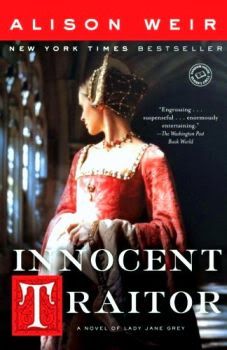
Innocent Traitor

Innocent Traitor: A Novel of Lady Jane Grey
© 2006 Alison Weir
402 pages


I just found Alison Weir this year and have thus far enjoyed her work in history and historical fiction. Innocent Traitor marked her introduction to historical fiction, and since The Lady Elizabeth and Captive Queen were so enjoyable, I looked forward to reading the work that presaged them. Innocent Traitor is set during the same period as The Lady Elizabeth: Henry VIII, the aging Tudor monarch, has  failed despite six wives to generate a brood of sons. All of England's hopes for avoiding a bloody war of succession -- bloodier still now with the Protestant Reformation gaining in strength and promising to make such a war one of religion to boot -- are pinned on the health of Henry's only male offspring, Edward. Meanwhile, charismatic and wily characters compete for power and influence: court intrigue abounds, and our titular character is thrust into it by her ambitious parents.

The Lord and Lady Dorset are mightily displeased at their daughter Jane for having been born a girl, but the timing of her birth -- close to that of Prince Edward's -- and her Tudor blood make her a viable candidate for marriage  to Edward when he reaches his majority. From the moment Edward's birth is announced, Jane's parents scheme to insert her into English politics.  Jane lacks the imperious will of her friend Elizabeth: she has no interest in ruling, or in most affairs of aristocracy. She prefers studying theology and the simple pleasures of reading and conversation to noble sports like hunting, gossip, and conspiracy. Still, the examples of Elizabeth and others put enough steel in her backbone to give those who wish to casually use her pause.

Although Jane is the primary character of Innocent Traitor, hers is not the only voice. Weir relies on a half-dozen voices to tell the story: Queen Katherine (Parr); Frances, Jane's cold and oppressive mother;  Ellen, her governess;  the future Queen Mary, and John Dudley. Weir uses the first-person voice for all of them, which required some getting used to: Dudley's inclusion seemed especially odd at first, although he is instrumental in dragging poor Jane into court in an attempt to prevent the Catholic Mary's succession and the return of England to the "yoke of Rome". Unfortunately for him and Jane, Mary is a force to be reckoned with.

Innocent Traitor is not as tightly focused as The Lady Elizabeth, but it's still a good read: Jane is as sympathetic a character as I've ever read, and Weir's training and work as a historian are put to good use, portraying the flamboyant, dangerous, and miserable world of Tudor-era England in rich colors. The final fifty pages are particularly poignant. Dialogue has a historical flair, but is not overly stilted -- though Jane's childhood narrative chapters have an adult formality to them. (This was also present in The Lady Elizabeth).

All in all, an enjoyable novel, and yet one bettered by Weirs' succeeding works.

Saturday, July 31, 2010

Captive Queen


Captive Queen: A Novel of Eleanor of Aquitaine
© 2010 Alison Weir
478 pages

My life, when it is written, will read better than it lived. Henry Fitz-Empress, first Plantagenet, a king at twenty-one, the ablest soldier of an able time. He led men well, he cared for justice when he could and ruled, for thirty years, a state as great as Charlemagne's. He married out of love, a woman out of legend. Not in Alexandria, or Rome, or Camelot has there been such a queen. (Peter O'Toole as Henry II, The Lion in Winter)

In my youth there were only a handful of English monarchs I could reliably name: George III, the "bad guy" in my elementary history texts; the latter Tudors, chiefly Elizabeth and Henry VIII (who I knew for his many wives); Richard I and John from Robin Hood fame; and  their father, Henry II, whose bitter feud with his captivating wife Eleanor and their children fascinated me early on. 

Although I approached Captive Queen thinking it a biographical novel of Eleanor of Aquitaine, it opens with her spotting young Henry Fitz-Empress for the first time as his father Geoffry pays homage to her husband, French king Louis VII.  The two are immediately swept up by the other, and the rest of the book is their stage:  although Weir's principle character is Eleanor, Henry is by no means a mere supporting character. They are both strong, willful, and wily: they arrange Eleanor to be freed from her marriage from Louis and immediately forge a "marriage of lions". 

Eleanor brings with her the whole of Aquitaine, a substantial portion of France as modern readers know it. Together with the lands from Henry's own Norman legacy and his newly-claimed English throne, these two lions have a domain that rivals any in Europe -- but a mighty nation led by two ferocious partners is not to be, as Eleanor soon discovers. Her heavy-handed, domineering husband rides roughshod over her rights as the Duchess of Aquitaine, and her place at his side in council is lost to the quiet Thomas Becket. Henry's imperiousness lasts his whole life, leading to constant feuds with his children and Eleanor. Their brood of children -- including the aforementioned Richard the Lion-Hearted and John, who is most famous for losing to his barons -- are as willful and self-interested as their parents, and their family feuds lead to war in both England and Europe. 

Captive Queen has drama a-plenty, some of it agonizing. Weir's narrative makes clear that Eleanor and Henry are passionate for one another, wholly captivated by the other in both love and hatred -- but underneath that passion is a long-running, genuine affection for the other so that they both yearn for reconciliation even when sincerely wishing to never see the other again. The relationship between these two dynamic individuals is one of the book's strongest selling points, although it started off a little weak: in the beginning, I thought Weir may have intended this book toward readers who prefer supermarket romances, such was the emphasis on Henry and Eleanor going at each other like rabbits. Happily for me, the book picked up steam with the introduction of Thomas Becket, the troublesome priest who makes Henry's life so difficult when he is promoted from the king's bosom buddy and chancellor to the Archbishop of Canterbury. The resulting drama gives Weir ample opportunity to enthrall readers, and the book remains solid from that point on. It ends neatly, with Eleanor on her deathbed reflecting over the glory and tragedy of her and Henry's combined life together -- and the legacy they leave behind.

Captive Queen lives up to the expectations I had of Weir following The Lady Elizabeth. Though slow to get started Weir provided a romping read through some of England's more interesting years. Her notes at the end of the book explain to the reader how she interpreted or took liberties historical facts, and delighted me by confirming that parts of the novel were inspired by The Lion in Winter and Becket, both of which were continually in my mind while reading this: her approach to Henry and Eleanor reminded me strongly of Lion in Winter's, and she states that she wanted to explore the relationship between these two not just over one explosive winter, but throughout their shared lives.

Related:
  • Becket, in which Peter O'Toole gives a hilarious rendition of Henry II despite the fact that the movie is about the bitter demise of a friendship. Eleanor plays no significant role except to knit and chide Henry about his closeness with Becket, but it's one of my favorite movies. 
  • The Lion In Winter, in which O'Toole is again Henry II -- this time, an older, angry, and despairing king anguished by his sons' perpetual treachery. Katherine Hepburn plays Eleanor, and the two bounce off one another splendidly. The intro quote links to one of the more pivotal moments of the scene. 

Sunday, July 18, 2010

The Life of Elizabeth I

The Life of Elizabeth I
© 1998, 2003 Alison Weir
542 pages


"She certainly is a great queen [...]. Just look how well she governs! She is only a woman, only mistress of half an island, and yet she makes herself feared by Spain, by France, by the Empire, by all! " - Pope Sixtus V, p. 399

When I received a bookstore gift card from my place of work as an end-of-the-school-term gift, I put it to use and bought The Life of Elizabeth I.  Weir's biography of Elizabeth was recommended by Elizabeth's Facebook "fans", and Weir's biographical novel of Elizabeth has been one of the year's most enjoyable reads. I've been meaning to read it, but have been otherwise occupied. Six hours spent accompanying someone to the emergency room and an afternoon without electricity in the wake of a severe thunderstorm gave me ample opportunity to visit Weir's treatment.

Weir chooses to focus on Elizabeth in her role as queen in this novel, beginning with her coronation and ending with her death: Elizabeth's early years were covered in The Children of Henry VIII. She places general emphasis on foreign affairs and life at court, which are tangentially related: more than a few members of her court are involved in urging her to marry one European prince or another, and in an age where nations' destinies were decided by members of interrelated royal families, marriage and politics were conjoined. The Spanish and French empires are Elizabeth's most powerful adversaries, and she spends much of her life delicately arranging the protection of one while avoiding the wrath of the other. This is not always possible: her reign reaches its greatest when Spain's "Grand Armada", intending on delivering an invasion fleet, is destroyed. Scandals among Elizabeth's court constitute most of the text dedicated to domestic affairs, with religious strife occupying the rest. Elizabeth has inherited her father's role as governor of the English church, now formally divided from the Catholic church, but not moving too much in the direction of the Protestants. Religion and politics are closely linked in this age:  her cousin Mary Stuart, a rival to the throne, relies on Catholic resentment  to continually scheme to overthrown the Queen,

Weir's treatment is one grand chronologically-arranged narrative, divided into sections but ever moving forward. Thus we gain a picture of Elizabeth maturing from giddy youth to graceful age, supported by an ever-changing court.  Elizabeth's marriage prospects dominate the opening of the book: as she ages and loses childbearing potential, her rivals and foes choose to attempt to bend England to their will through force: religious insurrections become a constant threat, particularly from Catholic quarters. Although Elizabeth is generally well-liked, both Puritans and Catholics give her cause to grief.  Weir occasionally breaks from the constant stream of stories to offer general assessments of Elizabeth as a person: these segments interested me most. I am particularly interested in Elizabeth as a free-spirited intellectual who loved dancing and who resorted to translating classical orders into English to maintain control of her temper.

The recommendation from Elizabeth's fans was warranted. The narrative is easily digestible and Weir offers plenty of background for fully understanding some of the episodes in her life. I look forward to reading more from this author.

Related:

Saturday, May 15, 2010

The Lady Elizabeth

The Lady Elizabeth
© 2008 Alison Weir
480 pages


"Can you do what you like when you are king? [Elizabeth] asked, a whole new vista of freedom opening up in her mind.
"Of course I can," her father replied. "People have to do my will." There was an edge to his voice that, young as she was, she missed.
"Then," she told him, "I am going to be king when I grow up." (p. 19)

I have long been taken with the personality of Elizabeth the First, the storied 'Virgin Queen of England' who ruled long and well, setting England's course away from the Roman Church and continental wars, and towards Anglo-Scottish union and the New World.  Alison Weir's biography of Elizabeth came highly reccommended to me, but I do not have access to it: I do, however, have access to Weir's biographical novel of Elizabeth. Weir's account begins with the death of Anne Boleyn, Elizabeth's mother, and the royal decree that Elizabeth and her older half-sister Mary are cut off from the line of succession. Weir tells Elizabeth's story beginning with this loss of favor, following the future queen's trials and triumphs until she is at last crowned Queen at the age of twenty-five.

Elizabeth, for me, is an almost-larger-than-life character, and her depiction in this book pays homage to her irrepresible indivduality and strength of will. "Precocius" is nearly an understatement, for even as a toddler Elizabeth is startlingly bold and mature, sounding at times like an adult. This may be due to the inherent difficult of an adult rendering how a young child might think and speak, to the tendecy for royal children to be raised as adults in miniature, or to the fact that Weir's sources -- letters penned by the young Elizabeth and recollections of her by her guardians -- depict a child with supreme self-collection.

Elizabeth's earliest memories are the blizzard of new stepmothers, for her father would marry four more times in his life, having done so six times in all.  Mary and Elizabeth are both bewildered by this quick succession, but their respective responses to their own mothers' fates define their characters: while Mary is partially broken by the humiliation of her mother (Katherine of Aragon) and lives her life forever dependent on others and weeping for the loss of what she loves, Elizabeth is determined not to endure her mother's fate. She develops inner strength, demanding independence and self-effected security for herself. The primary actor in Elizabeth's life is Elizabeth. She steels herself with philosophy -- being especially fond of Cicero -- and meets challenges with bristling defiance.

Elizabeth will need that strength of character to withstand her adolescence: when the king dies, she and her siblings become the pawns of ambitious nobles who seek to increase their fortunes and influence England's course during times of political and religious turmoil. Elizabeth must also resist the advances of lusty suitors, struggling against her body's innate desire to propagate. She scorns marriage, for her father's string of wives proved how little the status of wife is worth, and she distrusts the power her emotions have over her when encouraged.  Early adulthood is no easier, as rebellions against the Sovereign ensnare Elizabeth and send her to the Tower of London, where she occupies the very apartments her mother occupied before her own beheading. Her path to the throne takes her through a vast minefield of religious, political, diplomatic, and personal problems.

Weir took me by surprise: although my interest in the subject character played a part, The Lady Elizabeth was for me a genuine page-turner. Although I kept putting it down in order to read another book, it continually appeared in my hands again. I'm always pleased when authors comment on their sources and discuss how they used (or took liberty with) them, and Weir is generous in providing disclosure. I look forward to reading more of her fiction and nonfiction and recommend this with ease.