Showing posts with label Hundred Years War. Show all posts

Monday, September 28, 2015

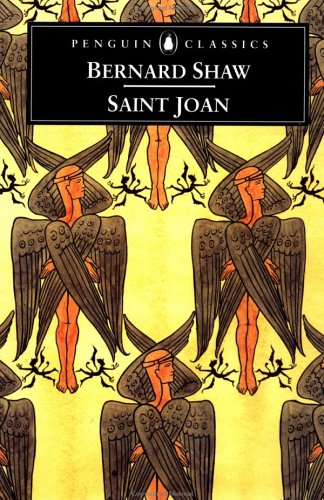
Saint Joan

Saint Joan
© 1924 George Bernard Shaw
160 pages


In the darkest hour of the Hundred Years War, a teenage girl re-inspired both a defeated nation and a despondent king to fight again for what was theirs. She -- Joan of Arc -- would be captured by her enemies and condemned a heretic by the English, but later vindicated by the Church. In 1920, in fact, Joan was pronounced a saint. Shaw's play no doubt follows on the heels of the news of her canonization.  Scoffing at saintly romanticization of the Maid, Shaw chose to pay tribute to her in his own way, making her an apostle of Whiggism.  “Saint Joan” pays tribute to the Maid’s time in the historical sun, relegating unpleasant battle-and-execution bits  to the background and focusing instead on her conflicts with the silly men she is forced to enlighten. Considering that the title character is burned alive, the play is far funnier than it has a right to be, from the opening scene with a duke arguing with his page almost to the end, where the man Joan made king is visited by the shades of his past after her vindication.   Shaw fills the play with modern conceits; his characters seem to wish they were living in the 1920s instead of the rotten ol’ middle ages. They even invent words like Protestant and Nationalism to describe how Joan makes them feel. 

Shaw’s Joan is more ambiguous than this, however; he endeavors to save her from beatification and her enemies from damnation in the same stroke.  Joan as written is not ‘saintly’ she is cheeky. Assuming familiarity with lords of the realm and lords of the church alike, she gives as good as she gets when they argue her down with reason, or scold her for acting so presumptuously. The irreverent, tomboyish Joan may be the star of the play, but her opponents are no villains. They may be guilty of pious fraud at times, but their arguments seem perfectly sensible, and prompt a reader to wonder just where Shaw’s sympathies lie.  When the churchmen accuse Joan’s patriotic  zeal of threatening to divide Christendom into nations and in so doing, dethrone Christ and allow the world to perish in a welter of war,  the graveyards of the Great War do not seem far removed from Shaw’s mind.  They are less villains than men moved to horror through fear, and happily ere the conclusion is reached they experience the genuine crisis of remorse, repenting in turn.  Although Shaw is just as guilty as having the Maid carry his own standard as any of the old romanticists,  “Saint Joan” succeeds in granting both her and her enemies humanity and redemption.


Sunday, May 24, 2015

The Wars of the Roses

The Wars of the Roses
© 1996 Alison Weir
496 pages


The wars of the roses sounds like a gardening contest run amok, but no genteel horticulturists were involved.  The strange appellation refers to a series of dynastic crises in 15th century England, punctuated by mass violence, which leave one dubious about the merits of hereditary monarchy.  The "war" was never declared, and rarely prolonged: at most there were some sixteen weeks of fighting throughout the span of several English kings.  The version of this history I remember faintly from schoolboy days is that the wars erupted near the end of the Hundred Years War and ended with the rise of the Tudors. As Alison Weir's much more thorough political history indicates, however, the succession crises hastened the end of the English in France by keeping them busy bloodying the fields at home.

The story begins with a despot, Richard II, who ruled so badly that the peers of the realm revolted several times before one of his cousins decided to assume command of the family business, throwing dear Rich in prison and leaving him to die. (Not that killing him did any good, as the new king would be bothered with Elvis-like reports of the ousted monarch surfacing and raising an army for decades thereafter.),A loyal opposition being completely alienated and threatened with violence before taking preemptive action and deposing the monarch turns out to be a recurring theme in this narrative.  The new king, Henry IV, would die an early death, weakened by constant resistance and rebellion to his reign. His boy Harry was a godsend for the family, achieving a magnificent victory at Agincourt and eventually humbling the French before dying of dysentary. It is during the reign of his son, Henry VI, that the wars truly take flower.  Little Henry was a baby, and infants are notoriously bad at political decisions: the rule of England was left to politicking peers,  and their divisive bickering would continue to hold sway long after the king had reached his majority. Throughout his reign,  Harry's dismal successor would be dominated either by the nobles or his wife -- a charming princess of Anjou who ruled as though she were the Queen of France. She might have made a superb  French monarch were she not in England, surrounded by men who failed to appreciate being told what to do by a haughty French woman.  Even worse, the king began to have spells of insanity. As court bickering and royal bungling saw England  sink into financial destitution and lose all of its continental territory,  one previously faithful servant decided enough was enough. The king was a catastrophe, even when he was lucid -- he had to go.

When Richard II was made to abdicate his throne, he had an heir apparent -- one who was completely ignored by Henry IV's ambition, and almost forgotten. His heirs knew who they were, however, and one was Richard, Duke of York, sometimes-Lord Protector of England during Henry VI's less-sane periods.  The "sometimes" is crucial, because the duke was frequently on the outs with the Queen's court party, and where the queen was concerned being on the out sometimes meant that you vanished at sea until someone stumbled upon your beached corpse. Rather than falling to that fate during one especially hairy period, York took up arms against his sea of troubles and things get deucedly interesting.   In the turmoil that followed, eventually the Sorry Sixth and his French bride would be run off, and York's son Edward crowned king.   But the story only picks up from there, for he too would be undermined by his wife  -- a common woman he became obsessed about. Not only did he marry her in private and then surprise the court with her, but he insisted on inserting her family into English politics, arranging marriages between her kin and the peers'.   This caused a great deal of aggravation and a great many bloody battles.

At the book's height, things are gloriously complicated.  One king, Henry, is in prison, and his wife exiled to France.   Their existence is a fixation for intrigue by the kings of France and Burgundy, who are delighted to be able to meddle in English politics: after all, the English virtually annexed France by manipulating their own succession crises between the Dukes of Orleans and Burgundy for the French throne. Turnabout is fair play. Despite needing to consolidate his newly-taken hold over English affairs, Edward instead weakens his position by alienating the faithful men who supported him in ousting out the former queen, and in desperation some consider overturning their late friend-turned-king and sticking Henry back on. All this scheming is creates an edge-of-the-seat drama,  even when Weir sometimes makes the multiplicity of Henrys worse by referring to "the king" generically when there's several kings running about.  She draws the tale to an end before the ascension of the Tudors, but the afterword indicates the complete stupidity of everything that has preceded. After all that bloodshed and mental energy exhausted, the silly ass who prevails in the end dies soon thereafter, followed by yet another monster.  One of the early battles, Towton, consumed so many lives that it was proportionately worse than even the Battle of the Somme.

Weir succeeds in creating order, and a riveting story, out of a thicket of English politics. It's information-dense, but her hand keeps it from being overwhelming.

Agincourt

Agincourt: Henry V and the  Battle that Made England
better subtitled in the UK as The King -- The Campaign -- The Battle
© 2006 Juliet Barker
464 pages


In the fourteenth century, nation-states as we know them did not exist. There was a England, and a France, but their borders were more fluid -- and entangled.  The English crown held title to much of France through marriage and ancestry, and because the English royal house descended from a Franco-Norman duke,  the king of England was technically a vassal of France.  This created the kind of tension  released only with knights and massed formations of archers: the Hundred Years War, a series of conflicts between two nations and several royal houses.  One of the most memorable episodes of the war was the upset at Agincourt, in which a small English force triumphed against a larger French array. In Agincourt, Juliet Barker tells the story of the battle in such

Henry V's motives for invading France were varied. The old claim of Edward III which inaugurated the Hundred Years War was not his; Henry could barely claim kingship of England, let alone France. His own father was a naked usurper who died early fighting resistance to his claim, and though the cloud of scandal was mostly lifted by the time the handsome young Harry succeeded, it hovered still.  France needed addressing, however: it remained a nuisance to English interests on the Continent, not only around Aquitaine but in Flanders.  England's prosperity came from trade, lately the Channel had become dangerous for shipping. Securing the coast would make it easier for England to smother piracy, and if the lush interior of France became a crown possession, so much the better!

It was not to be, however.  Initial hopes for a display of overwhelming force against the French countryside fell apart during a siege of a French harbor, Harfleur. The port was taken eventually, but its defenders' obstinacy cost the English army dearly. By the time the gates opened,  the invading force's strength had been sapped by disease. His numbers too much for the battered city to sustain, Henry decided to retire to the English held-port of Calais. He could limp to safety only through a country of enemies, whose watch over the rivers prevented a quick dash north.  After watching the dwindling army for several days, the French finally checked the king's march near the tiny village of Azincourt. Grossly outnumbered and weakened by sickness, the English should have been crushed. Instead, the Battle of Agincourt turned out to be one of the greatest upsets in western history. The  section on the actual battle isn't enormous, this is a story of why Agincourt happened and why it was important, and while the full story of the battle is delivered with talent, this isn't a military history.  The reasons for victory are there:   Henry drawing the French into battle on ground of his choosing, in an area that undermined the French cavalry and allowed the English to make the most of their excellent longbows -- and when the French desperately pushed through the mud and rain of death to assail the archers,  the English knights pounced!    In later campaigns Henry would achieve his aims (briefly) against the French crown; history would see them reversed, however, squandered by less heroic successors. No one save historians can remember the Treaty of Troyes -- but Agincourt has achieved greater fame. Not only did it save Henry from capture or death, but the miraculous upset seemed to impress upon the English that regardless of the spurious actions of his father, Harry was God's own anointed.  Why else would he have been spared? It was a triumph of not just arms, but belief.

There are undoubtedly more detailed military histories of the battle, but Barker's narrative gives the reader both a heroic champion whose surprising victory comes as a delight, and a lot of background information on early 15th-century English society and trade. For an introduction to the battle, it's quite serviceable and easy reading.


Friday, December 12, 2014

The Personal Recollections of Joan of Arc

The Personal Recollections of Joan of Arc
© 1896 Mark Twain
455 pages       


 In 1428,  a young French teenager arrived at the court of Robert Baudricourt and announced that she and he were to be allies in a mission from God: a mission to save France from conquest and disillusion.  The girl, Joan, was to lead an army to the besieged city of Orleans, but she needed first men to take her to Chinon, the residence of king in exile. Skeptical at first, then persuaded by an apparent prophecy,  the astonished Baudricourt sent Joan on her mission, where she took center stage in a complete reversal of the ninety-year conflict between the nobles of England, Orleans, and Burgundy.  Though eventually captured and burned alive by a small council of hostile Anglo-Burgundian partisans,  within a few years of her death Paris was captured,    England’s alliance with Burgundy abandoned,  and France on its way to salvation. Joan would be hailed as France’s savior, declared a saint by the Church, and serve as a icon of hope to the French French in World War 2. Perhaps more remarkable than her military victories, however, is her complete conquest over the melancholic heart of one Samuel Clemens, better known as Mark Twain.

 The Personal Recollections of Joan of Arc is a  biographical novel,  the story of her life as told through a childhood friend.  Sieur Louis de Conte thought she was a marvel even as a child, enchanted with her dreams and startled by her courageous intelligence. When the local priest attacked a 'fairy tree' that the children enjoyed spending time in, delighting in the company of gentle spirits, she argued him into abashedness.  When she confided to Louis that God had spoken to her in a vision and told her she must inspire the dauphin -- the rightful heir to France's throne, disavowed by his mother in the Treaty of Troyes -- to claim his crown by leading an army against the English, he was among the first to join her. Fighting in her every campaign, and then infiltrating Rouen during her trials, securing a position as an assistant court clerk, Louis delivers a full account of her life.  Based on Twain's twelve years of research into  her life, it's remarkable in many respects.  It's easily the most personable biography of Joan I've read;   Louis allows the reader to not just admire her from afar, or idealized her as a remembered saint, but to love her as a friend.  Such adoration is startling from a man like Twain, known for his irreverence and cynicism.  There are traces of the familiar Twain here,  as Louis describes how men are inheritors of their beliefs and foibles, repeating a sentiment expressed more stridently in Connecticut Yankee in  King Arthur's Court.  But this is a story replete with the miraculous;  Joan's visions extend not just to commanding her to battle and giving her moral courage, but she's an intermittent prophet, predicting her own death within a year and -- at the trial -- announcing to her captors that within seven years' time,  disaster will strike and English power in France will be broken for a thousand years.  Louis does not doubt Joan's word; he has no reason not to believe, for throughout the tale she demonstrates foreknowledge. 

Joan's story is easy to enrapture; how could a girl so dramatically change the course of history? There are circumstances Twain overlooks, of course;  the Duke of Bedford is mentioned, but not his marriage to a Burgundian princess that knit England and Burgundy's interests together, turning a French succession war into a very happy phase of England's on-again, off-again attempt to secure its ancient territory in France by subduing the whole of France.  And yet Joan inspires, both as an ideal -- the quinessence of strength, wisdom, courage, innocence, and purity, all at the same time --  and in practice. The trial transcripts do reveal a staggeringly intelligent and feisty woman.  Yes, her family had repute on its own; Jacques d'arc was no struggling peasant, but a man commendable enough to be named the mayor of a village he had immigrated to, how much of his strength had he imparted to Joan, and how much did she create from her own life?  Even if Joan were the purest of fiction, this tale would be a lovely one,  depicting as it does how a band of grizzled war veterans who had known only defeat could become pious, reverent, and driven in her presence; how  masses could leapt to their feet and throne to touch her banner, fixating on a child as their hope. We are strange creatures, we humans, strange and marvelous. Such is are The Personal Recollections of Joan of Arc.    Highly recommended for anyone interested in Joan or the tender side of Mark Twain.

Related:


Thursday, November 20, 2014

Joan of Arc

Joan of Arc: A Spiritual Biography
© 1998 Siobhan Nash-Marshall
176 pages


In 1429, France in her darkest hour was startled by the sudden appearance of a shining star -- a teenage girl from a minor village, wielding a standard and claiming that God had ordered her to  lead the nation to victory. The Hundred Years War,  the long struggle between the French and English nobility over Guyenne, Normandy, and the French crown, had left France seemingly nothing but a lost dream.  France had no leader; her last king had gone mad, his queen denounced the heir, and now civil war between the Dukes of Orleans and Valois paved the way for English triumph. But Joan answered the call, raised an army, and within twenty years the war was over. She is one of the most remarkable characters in European history, and this brief biography is a highly complimentary if slightly restrained story of her life.  Though it avoids being too mythical -- the author discounts stories of animals sounding off in happiness at her birth, and does not attempt to make her out to be a poor peasant girl when her father was a fairly well-established landowner --  it avoids being critical as well. The voices and the miracles attributed to Joan -- her foresight in ordering men to move a bit to the left so they wouldn't be stricken by a cannonball, her raising an infant to life long enough to be baptized so its wee soul would be saved, and not linger in limbo -- are repeated here, without either affirmation or skepticism.  [Author]'s focus is on Joan's drive and intelligence,  whpch imparted courage to the French people and struck a blow to build a victory upon. Even when in the custody of her enemies, assailed and jeered at by a hostile court, she maintained  the presence  of mind and the strength of spirit to deliver enigmatic answers that mocked their wrath --  the fury of a band of warriors, priests, and kings focused on a teenage girl.  [Author] provides solid context, however, demonstrating how the Hundred Years War was less an English invasion of France, and more of a French civil war, and an exercise of feudal peculiarities in which the English king was a vassal to the French king, despite legitimately controlling more of France (through inheritance and marriage) than le roi himself.  It's not the strongest of biographies, but delivers a feeling of Joan that is saintly, strong, and sweet.

Related:
Joan of Arc: Legend and Reality, Frances Gies