Thursday, September 28, 2017

Wild Swans

Wild Swans: Three Daughters of China
© 1991 Chang Jung
525 pages

(My edition uses Chang's family name first, following the Chinese custom.)


Read the records of the 20th century totalitarian states, and the number of lives destroyed numbs the brain. Eleven million in Germany, twenty million in Russia -- such a mass of suffering is too large to grasp. Distill that suffering into three lives, however, and it is conveyed with intimate efficiency.  Wild Swans uses the family history of three women -- a concubine of a warlord, a young Communist, and an untrained doctor turned untrained electrician turned writer in exile -- to deliver a history of China's brutal 20th century.   Although a three-part biography, the real weight of of the book lays in the middle, in the lives of the author's mother and father. Through them -- both Communists from their teens on, who  resisted the Japanese and the Kuomintang, who advanced the Communist revolution -- we see the hopes of China turn to ashes as Mao commits everything that isn't worship of the Chairman to the flames.

The story begins at the turn of the 20th century,  when a poor-but-pretty girl caught the eye of a warlord. Though her family's rank and wealth  disqualified her as a marriageable mate,  she was -- just barely -- acceptable as a concubine. Living alone in a gilded cage,  Chang Jung's grandmother had to face the hostility of the warlord's other concubines after she became pregnant. Her response was to escape, faking illness so she could smuggle her daughter and herself out.  Chang's grandmother married a Manchu doctor, a connection that came in handy after the Japanese invaded northern China and created a Manchurian puppet state.   Although the family had to live through the casual tyranny of the Empire and the food shortages of war,  the only fighting that ever threatened their village was between the Nationalists and the Communists guerillas.  Chang's mother, growing up in this environment, looked to the Communists as poor heroes against the imperial Japanese and the utterly corrupt Kuomintang.  As an adolescent, she smuggled in literature and helped the Communists gain intelligence inside the city for their covert actions,  aiding the cause.  Eventually she would meet and marry a young official, who was even more ardent than she. Together, they would witness the triumph of the war against the Kuomintang: the declaration of a People's Republic of China.

The dream would not last long. As this memoir-biography develops,  the faith of these two Communists is stressed, strained, and eventually crushed.  Chang's father was a New Communist Man through and through: he was effectively married to the Party, treating his wife as the other woman.  Devoted to the republic, he stood on principles absolutely, time and again choosing the party before his family.  He was assigned to another province?  Very well, his wife would have to wallk; her rank in the party didn't merit riding in a truck.  Was she pregnant? She would have to work until the delivery, because peasant women didn't have the luxury of taking it easy. Had he been given a ticket to a play for his daughter?  Yes, but she would need to trade it for an inferior ticket. It wouldn't do for a young girl to take a front seat just because her father was a senior official.   Chang's father was a hard man, but he believed that after centuries of imperial corruption, a new China needed to be built on the foundation of principled citizens.   As puritanical and cold as he could seem to his family, readers can only praise him after living through the Cultural Revolution via his family.

There's no shortage of brutality, inhumanity, and mass terror in this book: the Japanese and Kuomingtang give us a taste early on, and as soon as the Communists take control there are the murderous purges and the equally deadly incompetence-induced famine that killed millions.  As the biography develops, however, more and more of the problems have one man at their root: Mao,  who was creating a new imperial system around himself.    After a period of relative freedom of expression he suddenly purged those expressing themselves,  Mao claimed it was a premeditated act designed to draw out the traitors-in-waiting.  But with the cultural revolution, Mao would top himself. He would make Hitler the mean kid on the playground, make Stalin look like a common gangster. Mao, facing resistance from the Party itself, decided to destroy the party, destroy what institutions had been built upon since his victory, and destroy everything from China's past. He appealed to the first generation of children raised in the People's Republic to  rise against their teachers, their parents,  and the legacy of the past:  burn it all. Nothing could be great in China but Mao,  the man who praised poverty and lived in mansions,  who waged war against even the grass.  The Chinese would be set against one another and their own past, creating an atmosphere of constant abuse, paranoia, and savagery.

Chang herself was a student during the Cultural Revolution,  and through her we witness the complete breakdown of society.  Her father, a man of principle who stood on self-control and had reason to be confident in his solid Party Man reputation,  became the target of the "Rebels".  Both he and Chang's mother -- whose youthful devotion to the Party had fast waned thanks to the famine and her treatment during pregnancy --   were detained and tormented, After her parents took the bold step of appealing to Mao personally,  matters grew worst still.  Although many Rebels appreciated his principled defiance -- he refused to recant and declared he would stand against the cultural revolution even if  Mao had ordered it -- a key feature of the  rebel reign of terror is that it was unorganized chaos. At first was was merely bands of students harassing teachers, but their numbers grew and the Party was dumped from power in favor of the new student groups, they began fighting against one another.  Chang's father lost his sanity after one period of detention, and when he died it was a consequence of a long period of constant abuse. Chang could only wonder, as she witnessed her parents' emotional destruction at the hands of the regime -- if this was Paradise, what could hell be like?   The devotion she had for Mao perished in the orgy of murder and mayhem that he inaugurated.
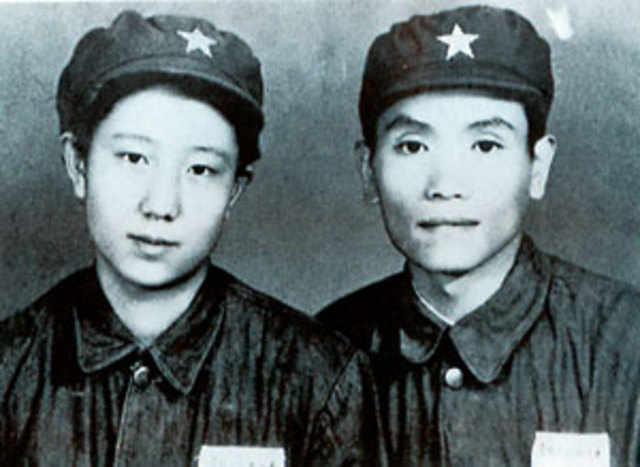
Bao-Quin and Wang-Yu,  Chang's parents


Wild Swans is an incredible look into some of China's most horrible years, particularly given the way the Changs are put on the rack for being too faithful to the cause.  Anyone who has believed in something -- a politician, an ideology, a religion -- and truly loved it, only to have to abandon it because of mounting evidence that it is not what it promised to be -- will sympathize with the Changs' plight. They never changed; Mao did. In fact,  many people were punished throughout Mao's regime for following instructions, merely because the managing authorities had changed.  Reading this and witnessing the idealism of the Communists giving way immediately to nepotism and human nature makes me more aware of both the immutable frailty of human society,  and the treasure that is the rule of law which we in the west enjoyed for so long.


Tuesday, September 26, 2017

Classics Club, Year III


Two years have passed since I declared I was taking the Classics Club challenge, and posted my own list of fifty classics to read.  I've since read 20 classics, which means I am on schedule -- just. Most of that was from my first year, as this past year I've only read 5.3 entries for the list.  My reading plans for the rest of this year should speed up the pace: I'm currently halfway through Dracula and plan on tackling Frankenstein later in October, and a few others are hovering nearby. I have volume II of the Gulag Archipelago at the ready, for instance.

Looking back at the past year, with my paltry handful of books, there's little that can be said:  volume  one of the Gulag Archipelago stands out, but I'm happiest to have gotten Canterbury Tales finished. It was just as intimidating as the Russians!

REMAINING CLASSICS:
  1. The Aeneid, Virgil
  2. The Histories, Herodotus
  3. The Conquest of Gaul, Julius Caesar
  4. The Decline and Fall of the Roman Empire, Vol. I, Edward Gibbon
  5. One Thousand and One Nights, trans. Husain Haddawy
  6. The Three Musketeers, Alexandre Dumas
  7. The Hunchback of Notre Dame, Victor Hugo
  8. The Prince, Machiavelli 
  9. The Brothers Karamazov, Fyodor Dostoeyesky
  10. The Swiss Family Robinson, Johann David Wyss
  11. Frankenstein, Mary Shelley
  12. Dracula, Bram Stoker
  13. The Hiding Place, Corrie ten Boom
  14. The Gulag Archipelago, Alexander Solzhenitsyn (Vol I, Vol II, Vol III)
  15. Leo Tolstoy, War and Peace
  16. The Vicar of Wakefield,  Oliver Goldsmith
  17. Oliver Twist, Charles Dickens
  18. Life on the Mississippi, Mark Twain 
  19. The Education of Henry Adams, Henry Adams
  20. The Federalist Papers, various
  21. Down and Out in Paris and London, George Orwell
  22. The Sun Also Rises, Ernest Hemingway
  23. A Farewell to Arms, Ernest Hemingway
  24. The Jungle, Upton Sinclair
  25. Moby-Dick,  Herman Melville
  26. Catch-22, Joseph Heller
  27. The Grapes of Wrath, John Steinbeck
  28. The Moviegoer, Walker Percy
  29. Love Among the Ruins, Walker Percy
  30. Invisible Man,  Ralph Ellison

Sunday, September 24, 2017

Spock Thoughts | Desiderata

Although I do not consume The News -- that is, the constantly changing, buzzing noise of whatever it is people are excited about for the present day and a half, soon to be abruptly replaced by something else --  occasionally it intrudes. On such occasions -- when my attempt to learn more about something of real importance, like the disasters in Mexico and Puerto Rico is intruded on by chatter about one overpaid lunatic exchanging tweets with another -- I find it useful to remember a prose poem I encountered some years ago through the unlikely venue of Leonard Nimoy's "Spock" cd.   I've posted this before, but it bears repeating.


Go placidly amid the noise and the haste, and remember what peace there may be in silence. As far as possible, without surrender, be on good terms with all persons. Speak your truth quietly and clearly; and listen to others, even to the dull and the ignorant; they too have their story.
Avoid loud and aggressive persons; they are vexatious to the spirit. If you compare yourself with others, you may become vain or bitter, for always there will be greater and lesser persons than yourself. 
Enjoy your achievements as well as your plans. Keep interested in your own career, however humble; it is a real possession in the changing fortunes of time.
Exercise caution in your business affairs, for the world is full of trickery. But let this not blind you to what virtue there is; many persons strive for high ideals, and everywhere life is full of heroism. 
Be yourself. Especially, do not feign affection. Neither be cynical about love; for in the face of all aridity and disenchantment it is as perennial as the grass. 
Take kindly the counsel of the years, gracefully surrendering the things of youth.
Nurture strength of spirit to shield you in sudden misfortune. But do not distress yourself with dark imaginings. Many fears are born of fatigue and loneliness.
Beyond a wholesome discipline, be gentle with yourself. You are a child of the universe no less than the trees and the stars; you have a right to be here.
And whether or not it is clear to you, no doubt the universe is unfolding as it should. 
Therefore be at peace with God, whatever you conceive Him to be. And whatever your labors and aspirations, in the noisy confusion of life, keep peace in your soul. With all its sham, drudgery and broken dreams, it is still a beautiful world. Be cheerful. Strive to be happy.

Desiderata by Max Ehrmann. The recording changes "cheerful" to "careful", because it would be odd for Spock to admonish us to be emotional.

Thursday, September 21, 2017

Of China and Narnia


Late last week I finished China Wakes, the account of two  married American journalists in China during the 1980s and early 1990s.  They found China frustratingly difficult to judge; as much promise as its economic liberalization showed,  the political and economic structure seemed rotten to the core, with civil society barely existent.  The rule of whim and will ruled, not the rule of law; what counted was influence, whether social or monetary.  Nick Kristof arrived in China regarding the Communist takeover as a good thing that had gone wrong;  after extensive interviews with survivors of Mao's "golden age",  Nick's summation echoes Paul Dikotter's: the "liberation" was a bloodsoaked tragedy.  Women's lot was improved by the Communists,  his Chinese-American wife Sheryl admits, but now that the Chinese are growing wealthier,  women are prized less for being economic units and more for their social roles -- girlfriend decorations, or wives and mothers. What the Chinese of this book want -- whether they are the kleptocrats on top or the still-abused peasants at bottom -- is stability.  The wars, famines, and mad chaos of the cultural revolution are bloody specters haunting the imagination of those interviewed,  despite the Party's campaign to control the memory of history.


I've  been listening to the audio drama of Prince Caspian, produced by Focus on the Family Theater, on loan to me from a friend. I say audio drama deliberately, because the production doesn't limit itself to Paul Scofield simply reading the book aloud; instead,  different actors portray various characters, and background audio (music, other characters' reactions to dialogue, etc)  is employed for a full experience.   So far I have listened to two books in this series (The Lion, the Witch, and the Wardrobe being first) and have found both delightful.  Paul Scofield is a joy to listen to, though  Aslan's portayal sometimes borders on hammy.    The dwarves (Trumpkin and Nickabrik) were solid, too.    The world of Narnia (and that of Middle-Earth) has been a welcome relief from all the politics and death of this week,  in both the news (poor Mexico and Puerto Rico!) and in reading.   That's also why I've been cozying up with The Fellowship, a biography of four writers who were part of the Inklings literary circle, contributing to one another's imaginations and honing their craft together.  It's largely about Lewis and Tolkien, which is fine with me as the other two are rather strange.

Monday, September 18, 2017

A Burglar's Guide to the City

A Burglar's Guide to the City
© 2016 Geoff Manaugh
304 pages


There's really no resisting a title like that, is there?  Mind, it's not accurate;  this isn't a guide to how burglars read architecture, a catalog of vulnerabilities that homeowners and businesses can use to check their own weak spots.  The core message of the book, expressed repeatedly with great effusion, is that burglars see and use buildings differently from other people.  Manaugh goes into slight details, but his background as an art historian shows: he's more interested in the idea of burglars interpreting architecture than the details. Consequently, readers are given a great deal of entertainment as he delves into various cases, and even tries to learn skills himself (including lockpicking, from a cop),  but not much in the way of practical security information.

Burglary as defined requires architecture;   breaking and entering isn't possible with something to break into.   But burglars are connected to architecture at a deeper level, writes Manaugh; they are like the characters of The Matrix, who can read the lines of flowing green code and interpret vulnerabilties. They  are plugged into the Matrix of physical form and can manipulate it  at will -- and they do, using buildings in unexpected ways.  They will shimmy up rain gutters to access ledges, shove themselves through ventilation ducts,  take sliding doors off rails, or even carve through drywall to out-flank security alarms.  Some architectural manipulation can be quite elaborate, using the urban form itself.  Consider a case from Los Angeles in the 1980s: a group of  burglars with possible Public Works connections used that city's massive storm drainage system to tunnel into a bank and empty its vaults.   Few burglaries are so thought out, however; most are hasty and opportunistic. Even then, they can use buildings in ways they weren't intended: a massive oak door might be breached simply by breaking the glass windows framing it, then reaching in and opening the door.  Roofs hold back water; no one expects them to provide an entry for an thief.

A Burglar's Guide to the City abounds in interesting cases and general information. I had no idea that Los Angeles operates full time air patrols, for instance: I assumed police helicopters are so expensive by the hour that they're dispatched only in extreme situations, the kind that call for SWAT teams.  Easily the most interesting case for me was the story of Roofman, who used his study of McDonalds' basic building plan and operational policies to invade  and rob several dozen franchises. After being imprisoned, he escaped and took refuge in a Toys R Us, where he built a hiding place and carved into the empty building next door.   From there, surrounded by toys, he used stolen baby monitors from Toys R Us itself to observe employees and plan a  full heist. Fortunately for them, the random dropping-by of a sheriff's deputy foiled the Candy from a Baby stickup.


In short, this book was more fun than informative, but worth the time.

Related:
If you are interested in understanding your home from a security standpoint, I would suggest an ebook I read last year called "Kick Ass" Home Security, written by a retired police sergeant.  It's purely functional reading, like an instructional manual, but I found it helpful.  The essential lesson I remember, beyond any technical information, is that most burglaries are crimes of opportunity -- the less inviting you make your home to casual intrusion, the less likely you are to be burgled.


Friday, September 15, 2017

My Life with the Saints

My Life with the Saints
© 2007 James Martin, SJ
414 pages


The church I grew up in consistently referred to Rome as the whore of Babylon, so needless to say I didn't learn anything about saints. I knew Biblical personalities, sure, but was completely oblivious to the hundreds of men and women throughout the Christian era who served as outstanding examples, witnesses, or reproaches to the rest of us. I encountered a few in history books, like St. Augustine,  but they were more statuesque than human. The sole exception was Joan of Arc, who began as a figure from history but became (as I read various biographies) someone I felt an odd sense of affection for.  James Martin grew up Catholic, but his saintly education seems to have been almost as paltry as mine, discovering most of them as he attended seminary and trained to be a Jesuit. In the beginning, Martin notes that Catholics approach saints as both intercessors and companions; the latter approach inspiring most of this book.

My Life with the Saints mixes biography -- his, the saints, and others -- with spiritual reflection. In each chapter, Martin recounts his encounter with each personality, sharing how they shaped and informed his own spirituality while connecting their lives to people he has worked with through the years.  St. Francis,  "the fool for Christ", is revisited in the story of another 'fool', a priest who worked with gangs in Chicago and would try to disrupt fights by walking into the middle of the fracas, dressed in a blue-jean robe.  Martin mixes Biblical, medieval, and modern personalities, and includes a fair few people (notably Thomas Merton and Dorothy Day) who aren't "official" saints.   Although I purchased this hoping to meet a lot of obscure personalities, the mix meant only a handful were  completely new to me. Even so, I found Martin's meditations  refreshing, particularly the conclusion in which he remarked on the variety of the saints -- old, young, rural, urban, intellectual, hardy, mystical, rational -- and the hope that presents  to readers, that sainthood isn't limited to a superhero type.

Related:
The Long Loneliness, Dorothy Day
The Seven Storey Mountain, Thomas Merton
The Personal Recollections of Joan of Arc, Mark Twain

Thursday, September 14, 2017

Infrastructure: A Field Guide

Infrastructure: A Field Guide to the Industrial Landscape
© 1999, 2014 Brian Hayes
544 pages


Here at last is a book for those of us who constantly gaze out the car window at the fixtures on utility poles, or drums mounted in the sky above the telephone building, and wonder: what are those and what do they do?  Chris Hayes offers in his introduction that there are many books for understanding the various kinds of trees and birds we see around us; his hope is to help readers understand the built environment which can be beautiful in own right. Hayes'  field guide is not a dry catalog of pipes and antennae, organized alphabetically. Instead, he offers a narrative laced with humor that explores the built world, system by system -- beginning with mining raw resources and ending with waste disposal.  In between are covered farming, waterworks, power production, the power grid, telecommunications, roads, bridges, railroads,  aviation, and shipping.  Hayes' writing combines history and description,  allowing the reader to understand not only how things work,  but how they got that way. Photographs abound, most of which were taken by the author himself and include unusual shots.

The fact that this book has gone through three editions indicates it has been a success with readers, and I'm not surprised.  We live in the midst of and are sustained by systems built with human hands, but which few understand. There's enormous appeal in opening the hood on modernity  and gaining even a little knowledge as to how it all works, especially when systems link together. Although this is a guide to the 'industrial landscape',  Hayes' writing brings a strong humanistic touch. The book is about the world humans have created for ourselves, for our needs;  reading the built landscape  is an act not just of technical analysis, but of human interest.   Admittedly,  there are topics in the book harder to appreciate; mining, for instance, usually happens far from where we live.  The majority of this book, however, is the stuff of everyday: traffic lights, radio towers,  food, and highways.  Although I've  done a good bit of reading on infrastructure, Hayes' book was full of interesting facts and stories. For instance,  in the early 1980s a network of eight radio towers were set up to aide in global navigation: one of the stations was maintained by the US Coast Guard in the middle of Nevada. The system only lasted ten years before being supplanted  totally by GPS.

I referred to Kate Asher's The Works as a dream of a book, and I can only repeat the statement here:  it's a gorgeous and helpful piece of work.

Hey, look, it's the Very Large Array!

Related:
The Works: Anatomy of a City, Kate Ascher
On the Grid: A Plot of Land, an Average Neighborhood, and the Systems That Make Our World Work, Scott Huler
Tubes: A Journey to the Center of the Internet, Andrew Blum
The Grid: A Journey to the Heart of Our Electrified World, Phillip Schewe
Divided Highways: Building the Interstates, Transforming American Life, Tom Lewis