Showing posts with label environmentalism. Show all posts

Friday, March 29, 2019

Tip of the Iceberg

Tip of the Iceberg: My 3,000-Mile Journey Around Wild Alaska, the Last Great American Frontier
© 2018 Mark Adams
336 pages


In 1899, railroad tycoon Edward Harriman organized a multidisciplinary expedition to Alaska, bringing with him some of the best scientists and artists in America. They sailed -- or rather, steamed -- their way around the coast of Alaska, pushing as far north as possible.  Over a century later, Mark decided to repeat their journey,   to discover for himself the stirring beauty of America's 'last frontier', and to compare his experience with those of Harriman's. The result is a winsome mix of history, nature writing, and travel that concludes with Adams' urgent message to readers: if you want to see Alaska,   go now, because  it's a land continually re-created, and even now many of its places are melting away, are being reclaimed by the sea, or likewise stand on the brink of transformation.

The Alaska witnessed by Mark Adams here is, in every respect, an utterly beautiful place -- and a strange one, where people are often more dependent on the ocean and bush pilots for transportation, where a given town's entire population fishes for their own food. In its remoteness, self-sufficiency,  and  scorn for Outside oversight, Alaska fully lives up to its motto of the Frontier state.  I could not help but think of the American west when reading this, or of the eastern frontier even earlier in American history.  There is danger in that isolation; bears are a common menace, and Alaskans actually experience the majority of earthquakes within the United States.  They're more at risk from tusnamis, too; while Hawaaians may have several hours warning of a tsunami, Alaskans may only have minutes to prepare.  To the beauty of the landscape -- the mountains, glaciers, and wilderness expanses --  Adams adds historical interest not only by retelling the story of the Harriman expedition, but pointing to its effects. The conservation movement was born around this same period, urged on not only by near-mystics like John Muir, but by would-be hunters in the form of Harriman and Theodore Roosevelt.  (Roosevelt wanted to go to Alaska, but that bum McKinley got himself shot, so TR had to be president, instead.)

Although I've never previously been interested in Alaska, Tip of the Iceberg has made it a far more compelling place, both for its natural grandeur and its culture.

Wednesday, February 15, 2017

Garbology

Garbology :Our Dirty Love Affair with Trash
© 2012 Edward Humes
288 pages


Readers who are passionate about garbage -- a description which includes sanitation workers, victims of SimCity, and ecologists, I assume -- will find no shortage of books on the subject.  Susan Strasser has a history of waste, for instance, and Gone Tomorrow and Garbage Land both follow  refuse through the waste stream.  Garbology has a little history, a little waste-stream-kayaking, and a little of other  trashy topics:  landfill archaeology and oceanic stewardship, for instance.    You may have heard of the Great Pacific Garbage Patch, but it is less an island of debris and more a vast expanse of water filled with tiny bits of plastic, a chowder of sorts which is an enormous challenge both to clean and to understand the impact of. How does that much plastic particulate affect the human food chain?   Much of the trash comes from the plastic that covers every aspect of our everyday lives: the plastic wrapping around anything we buy from the grocery store, the plastic inside boxes of goods, etc. Accordingly the rise of plastic merits its own chapter, as does the story of one woman who was driven by economy to reduce as much waste  as she could.  Eventual author of The Zero Waste Home, Bea Johnson's interview offers many ideas for replacing expensive consumer products with homemade alternatives, like three-ingredient cleaning supplies that can handle pretty much anything.     There are other stirring tales of ordinary citizens being inspired to take action, like one man who launched a campaign to end ubiquitous one-time use of plastic bags.   For the reader with a vague interest in waste and environmental stewardship, Garbology affords a brief look at many different aspects of the question, though more detailed works are out there. They include the ones I mentioned in the beginning, as well as works like Plastic: A Toxic Love Story.    Although there's not an enormous amount of information on any one particular topic, I liked the scientific aspects and the zero waste author's approach. Humes' fundamental conviction -- that consuming natural resources to produce goods and then immediately shoving them underground, consuming more resources to lock them away,  is staggeringly wasteful and sloppy -- bears repeating.


Related:
Garbage Land:  on the Secret Trail of Trash, Elizabeth Royte
Waste and Want: A Social History of Garbage, Susan Strasser
Picking Up: On the Streets and Behind the Trucks with the Sanitation Workers of NYC, Robin Nagle
Gone Tomorrow: The Hidden Life of Garbage, Helen Rogers
Plastic: A Toxic Love Story, Susan Freinkel

You know what's strange? All of these books about garbage are by women. It doesn't strike me as topic that would necessarily have a strong sex bias, but at least now Humes has broken the monopoly.

Sunday, February 12, 2017

Affluenza

Affluenza: the All-Consuming Epidemic
© 2001, 2004, 2014  John de Graaf, David Wann, Thomas Naylor
288 pages


In getting and spending, we lay waste to all our powers -- so sayeth the poet. Originally published in 2001, Affluenza is a critique of consumerism, which it depicts as a disease affecting not just the body politic, but the environment. The authors use visual language drawn from medicine -- "feverish expectation", "hardening of the traffic arteries", "community chills" to argue that rampant consumerism is not only making us unhappy,  it has unraveled communities and is presently sacking the Earth.  This book has been on my radar for many years now, but I've always resisted it given that I'm in the choir this is preaching to.  I found it more varied than expected, and it does an admirable job of attempting to be nonpartisan. This third edition is genuinely valuable in keeping the material up to date,  using the sharing economy as a way of demonstrating of how we can do more with less,  Most of the suggestions for cutting back are appropriate only for an affluent audience, however, so I suspect the target audience is the comfortable-yet-feeling-guilty.

Affluenza has a pronounced emphasis on environmentalism, but it opens with a more diverse array of topics.  There's a disappointingly small section on the psychology of desire, how we pursue happiness through the acquisition or consumption of things but are then left feeling unsatisfied.  Their history of consumerism draws from works like Susan Strasser's Satisfaction Guaranteed indicate that the family-based consumer dream of the 1950s quickly became an individual-based consumer dream, with society being re-made to match.   Stores, for instance, became locations to go to and consume, rather than being part of the community; compare walking down the street and mingling with fellow citizens, then buying goods in a small bookstore owned  by someone in the community, whose business interacted and supported other businesses (local accountants and sign-makers, for instance), to a solitary individual driving by himself to a large box owned and sustained by a corporation outside the community.   The  mass focus on maximizing individual consumption -- the cheapest price, at any cost -- has reactions that not only unravel the very fabric of communities, but create lonelier people in the bargain.  Technology is something of an enabler in this regard: people whip out cell phones to stay "connected" the moment there is a lull in their activity, but in so doing lose focus of the very people they are with.  I think Erich Fromm -- who wrote in To Have or to Be? that we have become a people obsessed with having, with possessing and attempting to mount our happiness on that -- would have much to say about people who attend a play or go to the zoo and spend the entire time staring at their phones.....so concerned with capturing the experience they actually remove themselves from the experience.

The chapters on the despair of consumer therapy have the authors at their nonpartisan best. They report with delight that the Mormons are even more concerned about consumerism -- or rather, materialism -- than the students of Berkley.  They quote William Ropke's A Humane Economy: the Social Framework of the Free Market, in which the conservative offers a measured defense of free markets -- measured in that the free market is a necessary element of a free society, but  that it cannot be  the definer of its values.  Elsewhere,  they continually use the conservative label to refer to  anyone in league with advertisers and plutocrats, so I don't think they're very used to seeing anti-consumerism as a nonpartisan issue.  They marvel at Ropke,  asking readers if they could imagine any conservative writing such a thing today. Well...yes?  Rob Dreher, Wendell Berry,  and Anthony Esolen are a few who come to mind immediately, and just about anyone writing for The American Conservative.    Another hiccough is that the authors don't seem to be paying attention to what they write:  shortly after proposing a series of laws with the object of improving quality of life by reducing hours and mandating vacation/sick/universal paternity-maternity care,  they discuss a factory that reduced its operations to four days a week to save money, despite the union's protests.  After fighting to resume the five-hour day, the union's members immediately realized they actually preferred the extra day off, and so petitioned to reverse their previous petition. The authors comment that it was unfortunate that the  initial choice was forced on people,  apparently not realizing that its previous list of mandatory this--and-thats are also forced.  Ditto for the authors hailing regulatory agencies and in the same breath lamenting that said regulatory agencies are in cahoots with the people they're supposed to be policing.   Regulatory capture, dear authors --  problems can't be dispatched with a bill from Congress.

I found Affluenza an interesting book, quoting from a good range of authors --  diverse in fields as well as core beliefs. Its overall emphasis is a little weak, I think -- "Someday we're going to run out of resources and that will suck". Environmental stewardship is always an easier sell from the  immediate quality of life angle (clean air and water) than the more abstract (bad things...eventually..in the future).   The same is true for anti-consumerism and advocacy for simple living; they would be better served with an emphasis on the misery of getting-and-spending than on matters that can only be handled by the national government at large, i.e public policy.


Related books which were cited:
Satisfaction Guaranteed, Susan Strasser
Bowling Alone: the Collapse and Revival of American Community, Robert Putnam
The Geography of Nowhere, Jim Kunstler
American Mania: Why More is Never Enough, Peter Whybrow

Cited and on my to-read list:
Alone Together, Sherry Turkel
A Humane Economy: The Social Framework of the Free Market

Related:
The Plain Reader, various authors

Thursday, July 21, 2016

The Journey Home

The Journey Home: Some Words in Defense of the American West
© 1977 Edward Abbey
242 pages


The desert is no place for decent men, which is why Edward Abbey likes it so much. Born on the eastern seaboard,  on a farm between the cities and the woods,  young Abbey was seized by wanderlust and wandered westward. There he found mysterious monoliths, painted deserts, winding canyons penetrated only by the foolhardy, and interminable expanses of prickly plants and even pricklier critters.  Prickly might  well describe Abbey -- or irascible, or cantankerous, or resentful, even indolent.  Most of those  terms are self-applied here as Abbey describes first his journey to the American west, his finding a home in Arizona, and his disgust at realizing that Industrial Civilization was following close on his heels.  They ruined the view with power lines, flooded canyons with dams, and filled the air with smoke -- and so he writes, not to defend pretty views but to defend the very idea of wildness. Man  is wild, can't be broken completely -- and he needs undisturbed space to go crazy in every once in a while.

There are two reasons to read books by Edward Abbey; the first is for his descriptive writing, which wholly absorbed me when I first read Desert Solitaire years ago. The man is a grumpy poet writing prose; he describes the land like a lover, though he doesn't use so intimate a language as say, the author of Song of Solomon.   Certainly he finds enough here to wax poetic about. Making cloudbanks marvelous in Desert Solitaire was child's play; here  he even makes a poisonous tick sound intriguing.   The early book is biographical, but once he arrives at the mountains, they take over, for there are small ranges all over the southwest. The second is for Abbey's personality, which is...colorful, to say the least, and a delight in small doses.  Rough-hewn is Abbey; there's no machine-made box to slide him in. He is a passionate loather of big business and big government, but his contempt for the EPA lies in the fact that it isn't doing enough to curb the industrialization of the west, that it sides with the power plants and oilers over the small ranchers and rambling eccentrics.  His passion borders on reckless. He writes that his motto regarding wilderness hikes is  "be prepared", but that his practice is to go off half-cocked, daring Nature to do its worst. One story has him utterly destroying his fiance's brand new gift-from-daddy convertible to transverse a washed-out road. That particular relationship didn't survive the long hike back. In another account, he follows a mountain lion's tracks and encounters the fearsome creature, poetry and power in one awe-inspiring package.

What Abbey fears most is the triumph of deary mediocrity. He can appreciate the city, as he does in here in a piece on Hoboken and Manhattan. It's not a loving appreciation, but he does recognize that urban life has its consolations. But man is too wild a thing for the city, and the city itself can only be endured for long if there is some place to escape to. Abbey likens it to prisoners of Siberia, able to endure their brutal treatment by the sight of the beckoning expanse of forest; never mind that the forest has its own dangers,  it is there -- unconquered, open, a warren of escape.   Abbey shudders to see Tuscon and Phoenix marching toward one another, soon to form one long contiguous blob of parking lots  and neon -- and not just because their unchecked growth is draining water reserves or concentrating filth, but because it makes escape ever more difficult.  We crave adventure, Abbey writes, danger  -- the wilderness offers it.  Abbey If we live in constant security and predictability, we're effectively living the life of zoo animals.  We climb mountains for the same reason we fill the air with soaring music and vibrant poetry: our souls are restless and craving.  Craving what? Something to do, some meaning, some thrusting of ourselves into reality.

There is a lot to ponder in this slim little collection of essays and bar-room ramblings given life in paper.  Certainly, as far as 'current' crises go, the book is dated. I am certain many battles have been lost since the decades since Abbey first discovered the soul-stilling expanse of the west.  Given Abbey's gruffness here, I would refer new readers to Desert Solitaire...but once a friendlier introduction is made then by all means return here to experience more of that beautiful description, that delightful cussedness, that adventurous what-the-hell-carpe-diem view Abbey took to life, its appeal aided by his thoughtfulness.


Friday, July 1, 2016

The Monkey Wrench Gang

The Monkey Wrench Gang
© 1975 Edward Abbey
352 pages

"Three things my daddy tried to learn me. 'Son', he always said, 'remember these three precepts and you can't go wrong. One, never eat at a place called Mom's. Two, never play cards with a man named Doc.'
'That's only two.'
'I can never recollect the third, and that's what worries me.'"


They say you can't stop progress, but with with plastic explosives, thermite, and a few friends, it's worth a shot.  The Monkey Wrench Gang is the madcap adventure story of four very disgruntled folk -- a brain surgeon with a predilection for chainsawing billboards, a wayward Mormon, a Green Beret out to wage a one-man war, and a lady-type --  who join together to wage a war of sabotage against the industrialists despoiling the Southwest. New Mexico, Utah, Arizona -- wherever there's an unguarded bulldozer, they'll gum its workings and set it on fire.  Where there's a bridge built at public expense for private gain, with smoggy air thrown in as a bonus gift, they'll blow it. And where there's a dam...they will dream and pray for a way to destroy it. The Monkey Wrench Gang chronicles their private beginnings, their chance meeting at the Grand Canyon, and their joint missions which draw down not only entirely too many helicopters, but the wrath of a bishop of the Mormons, who is working on his gubernatorial prospects and can't have a bunch of anarchists running around setting fire to his plans.   Time and again they narrowly escape, but eventually things go south. This is a novel for those who see in the wilderness relief from lunacy, who have wished for a "pre-cision" earthquake to topple the godawful constructs that often mar it.

The Monkey Wrench Gang is a adventure novel in which explosive sabotage mixes with similarly fiery dialogue and humor.  A reader who has already encountered Edward Abbey will see him again in these characters; his ardent love for the southwestern wilderness, the thoughtful yearning that it not be ruined, both for its sake and for humanity's, the contempt for the outsized.  It comes through in his characters' conversations with one another, in their narrative of their ambitions and plight.  Abbey is sometimes serious, sometimes farcical.  What he takes seriously is the desert wilderness, a vast landscape of breathtaking beauty: what he does not take seriously is ego of man, who thinks he can tame it. Tame it, never -- ruin it for others, maybe.  That's what Abbey and his characters aim against. They are against coal factories puffing vile plumes into the open air of the desert, against power lines and roads that only said factories and mines put to use;  against the invasion of the southwest by 'consumers" who want to check the Grand Canyon off their list, for whom the desert is not a profoundly moving  -- challenging, even -- experience, and merely a section of the photo album.   Each of the characters have their separate motives:  the Green Beret is furious that his home is being ruined by the same corporate SOBs who sent him to Vietnam, Seldom Seen Smith has lost his living because of the damned dam damming up the damned river, and the brain surgeon attributes growing health problems to the increasing amount of factories and mines. (The lady-type is involved because she majored in Classic French Literature, and what else are you going to do with that degree but blow up billboards?) .  Mostly, however, there is the conflict between the grand wilderness and the corporate-government complex that has delusions of grandeur but is only a major pain in the tuchus for the common man.  Abbey is, and his characters are shadows, of a kind of anarchism. Not the bomb-throwing type (they carefully set their bombs, no reckless flinging-about), but the kind that rages against the Man, embodied in the corporate-government complexes of power plants, mines, and the like.

I enjoyed The Monkey Wrench Gang,  having long found in Abbey a kindred spirit, at least as far as his small-is-beautiful political convictions and love for the wilderness go. (I hasten to add that I do not share Abbey's habit of billboard-sawing.)   Although Abbey's books were written during the dawn of the environmentalist movement, no one will find in him a stereotype. His characters, for instance, enthusiastically litter the highways they hate with beer cans,   because the vista has been so bespoiled that they are really only defacing the defacement.   While the Monkey Wrench Gang isn't exactly a moral mark to aim at, the dialogue makes this a fun novel, especially if you share Abbey's preference for decentralization. It's a nice rebels against the Man sort of tale, at any rate. Abbey is a man to spend time with. What a kick he must have been a few sheets to the wind...


Sunday, May 15, 2016

Off the Grid

Off the Grid:  Inside the Movement for More Space, Less Government, and True Independence in Modern America
© 2010 Nick Rosen
292 pages


When Nick Rosen put up a website to help his fellow Britons find resources and land reduce their carbon footprint by living off the grid, he was astonished at all of the interest his site received from the United States. He had more American readers than English readers, in fact,  and decided to investigate.  Off the Grid records his visits with various communities which operate outside the electrical grid. Although its subtitle refers to a coherent movement, there is nothing like that actually here. Rosen's account includes many people who simply happen  to be without power, like the homeless and the residents of a small Florida key ("No Name Key") who balked at the enormous cost of electrifying their island. Some of the persons included are positively dull, like the numerous wealthy types who maintained a 'vacation home' off the grid when they needed a retreat from their busy lives.  There are far more interesting characters present, though: an aging woman introduced as the founder of the 2nd Maine Militia, who has a working relationship with a local commune of anarchists,  and another woman who gave up PBS videography to teach SCUBA diving and drive trucks, instead.

 The majority of these interviews take place in the Southwest, where land is cheap and the population sparse. While some of the people included here are gridless because of poverty or remoteness, most have chosen it  while trying to find a more meaningful life. They want freedom from the constant distractions, simplifying their lives to the point of being free from utilities: they aim to put to rout all that was not life.  Another element present in these interviews is fear, of people withdrawing from a system that they view as either criminally exploitative or doomed to failure by its excesses. (While Rosen's grid-free interest mostly stems from environmentalism, he has a contempt for power monopolies that gives him plenty of common ground with this last category.)  Most of the people interviewed have a shade of...quirkiness to them, a possible consequence of living either in their heads or in echo chambers. Rosen brings to life quite a few tangential topics like microcurrencies, the pot economy, and the ins and outs of living in cars during these interviews.

Although I found several of the characters of interest, ultimately Off the Grid disappointed me. Far too many of the subjects just happen to be without power, rather than deliberately choosing to live 'outside the system'.   Those who remain don't share a worldview, and the groups that would (that anarchist cult, for instance, or the hippie commune) aren't explored in a great deal of detail.   Practically nothing is mentioned of how they're getting along, aside from the constant mention of solar panels and a one-paragraph visit to a composting toilet,  and Rosen is a grating narrator who makes fun of his subjects to the reader while he's talking with the people.  He does offer some thoughtful commentary though, especially in discussion with one man who lived by himself until he realized he had it wrong: it's not about self-sufficiency, it's about nurturing healthy and self-sufficient communities.   In connection with others, there is meaning --  off the grid or on.


Related:

  • Desert Solitaire, Edward Abbey. Kind of like Walden, but in the Southwest. 
  • Better Off: Flipping the Switch on Technology, Eric Bende. This is one I read a couple of years ago and should review, as it's the thoughtful work of a married couple who decided to live for a year with a Mennonite community to ponder the role of both technology and labor in their lives.
  • Folks, This Ain't Normal, Joel Salatin. Read three years ago, and is also about  humans, tech, and the right balance. I also need to re-read- and review this one.

Friday, February 6, 2015

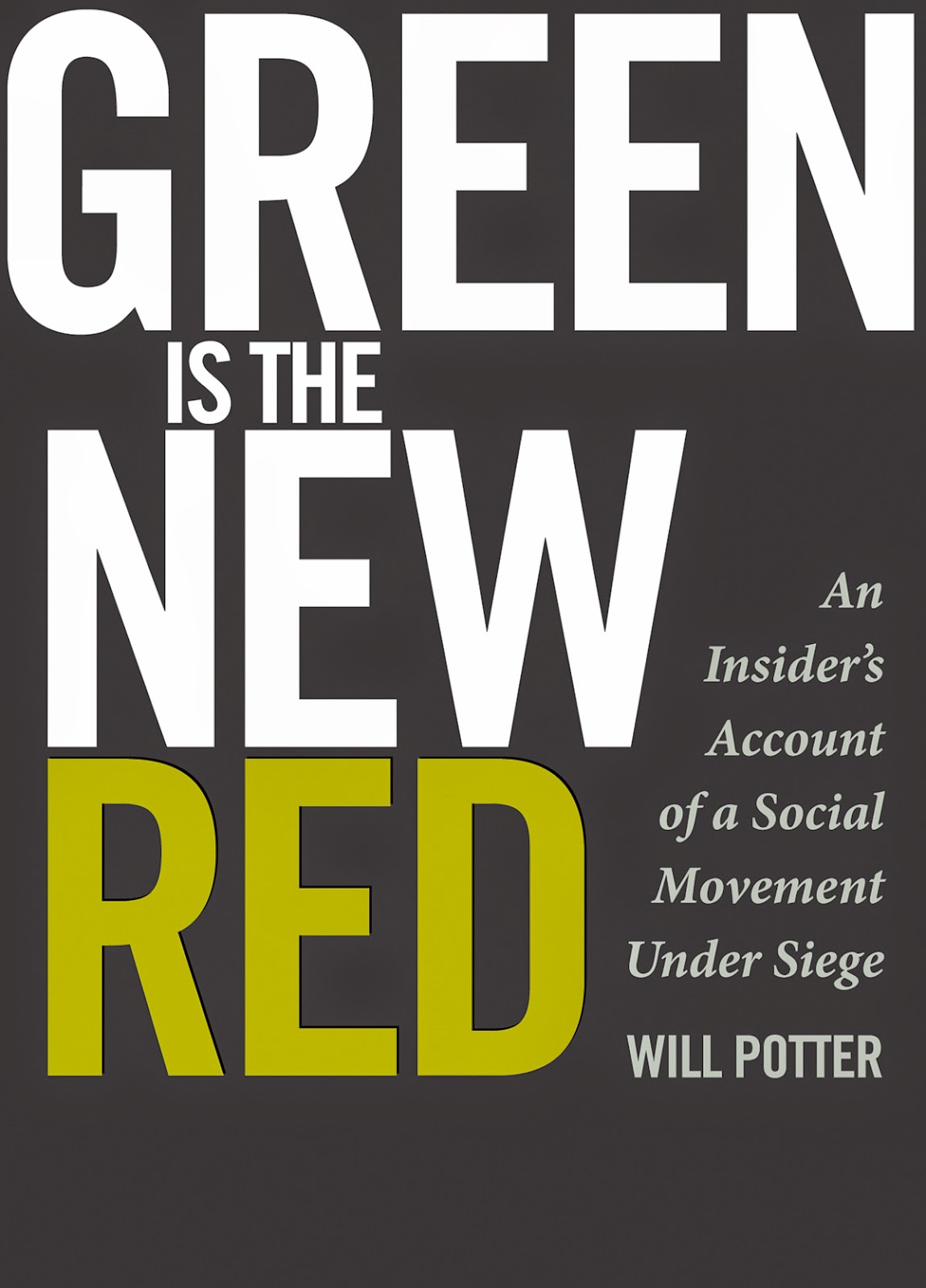
Green is the New Red

Green is the New Red: An Insider's Account of a Social Movement Under Siege
© 2011 Will Potter
256 pages


Is passing out flyers the moral equivalent of flying a plane into a skyscraper and killing thousands of people?  Well, in some legal circles, yes. Will Potter found out how eager Uncle Sam is to take down 'disruptive elements' when he passed out flyers as part of an animal rights campaign after years of writing about the activism of others and feeling guilty for not changing the world himself.  Federal agents showed up at his door and forcefully suggested he tell them everything he knew about the organization, or else he might find himself on a terrorist watch list.  Shaken by their visit, and disgusted at his fear, Potter decided to dig into  how and why the government had become so interested in consumer activism. Green is the New Red, the story of a group of young people called the SHAC-7 arrested and jailed for political crimes, is the result.

Although its title may indicate that environmentalism itself is under siege by the government,the focus here is animal rights activism. The SHAC 7 were associated with a movement called Stop Huntington Animal Cruelty, a campaign aimed against an animal-testing lab in the US and the UK. While SHAC itself was not a formal organization that carried out actions, it collected  and published information that could be used in campaigns -- information like the names and addresses of the lab's employees, executives, and shareholders.  Organizations like the Animal Liberation Front used that information to carry out actual attacks, which ranged from the benign (leaftlet campaigns) to the dangerous (arson). This collated information was also of service to demented individuals who broke into one woman's home, stole her dirty underwear, and used it to threaten rape. An aspirational activist, Potter does not shy away from the fact that some of the information-sharing was irresponsible. His concern here is not necessarily to exonerate the group, but to but to reveal and criticize the ferocious Federal response against them.  The seven, and other animal rights activists, are being treated as not only violent criminals, but capital-T Terrorists on the level of Al-Quaeda.  The SHAC-coordinated attacks on HLS were a triumph, reducing the company's stock so swiftly that lenders abandoned it as a credit risk, but no one was hurt. Property was damaged during the numerous lab-torchings, but no blood was shed. Potter compares the severe handling of the seven to groups that actually threaten and visit violence on others, like militia groups, the odd anarchist, and a few misguided pro-lifers. Whereas ordinary criminal laws applied to these acts of aggression, those associated with SHAC were interned in the same maximum-security sites as jihadists, and their names uttered in the same breath. Potter believes that the state's ferocity is provoked by its economic ties to the corporations whose bottom line is being disrupted.

That the State exists to protect and advance the interests of property is undisputed. Indeed, most attracted to a book of this kind about political activism will probably hold it as the truth. More to the point is the problem Potter identifies of the government's modern ability to freely label activists as enemies of the state. The problem lies in the many and nebulous definitions of terrorism, and the fact that once someone is declared a terrorist that normal rights, procedures, and the like go out the window. Although ALF did seek to use the threat of violence to force HLS to alter or stop the most abusive of its practices, its intent was not to incite terror in a population, and especially not through hurting innocents.  The PATRIOT Act's definition of terrorism is so vague that most acts of civil disobedience, including those practiced by Martin Luther King, qualify.  Modern presidents have an actrocious track record where civil liberties are concerned, and any threat to them must be checked. While Potter is somewhat hopeful that government persecution will create a larger problem than it solves -- he points out that the trial only caused an upsurge in activist attacks on HLS --  a more recent round of arrests has effectively ended the SHAC campaign.   The specter of federal agents arresting anyone who makes a fuss is arguably more daunting than the thought of a company losing equipment to arson:  civil liberties are much harder to restore than buildings.


Related:
The Ethical Assassin, David Liss. Said fellow is an animal rights warrior. 

Friday, March 7, 2014

dirt

dirt: the erosion of civilizations
© 2007 Peter R. Montgomery
295 pages


            Civilizations rise or crumble on the soundness of their dirt, says David Montgomery. The life of a people is tied to the life of its soil, in its ability to manage it well. In dirt: the erosion of civilizations he delivers a history of societal collapses. Humanity is not a species known for moderation, and the pages of history are checkered with fallen empires whose demand for food has strangled the golden goose. After opening with a few chapters on science (beginning with Charles Darwin’s discovery that worms are responsible for reducing organic matter to humus) that explain why soil works the way it does,  subsequent chapters trace human agriculture and soil management from Egypt to modern times.  It is largely a history of failure, as great empires and minor chiefdoms alike exhaust their ground – from Rome to Easter Island.  We have not fared better in our age of scientific and technological mastery, either, as the Dust Bowl proved and as the rapidly diminishing returns of the Green Revolution bear out. Ultimately, Montgomery writes, the story of soil demonstrates that there are limits to growth and ambition; we must learn to adapt our agricultural approaches to the land that is ours, not force one convenient style of farming on every place we discover.   dirt is fascinating if a bit esoteric.


Tuesday, February 18, 2014

The Gift of Good Land

The Gift of Good Land
© 1981 Wendell Berry
281 pages


Wendell Berry is a philosopher, poet, and more, but before all else he is a farmer. He is a faithful son of Kentucky devoted to the land, to the stewardship of the Earth, to the obedience to the first commandment given in his religious tradition: to dress and keep the garden. Berry has produced other collections of essays that focused primarily on agriculture, but this is the first I've read, and while I haven't set foot on a proper farm since elementary school, Berry's crafted hand makes a man ache to experience the gift of land he writes on here.  Although these essays primarily address farming, life is the subject; when Berry writes on the virtues of mowing with scythes, the essay is on man's relation with his tools. Does he use them to his intended ends or is he compelled to use them toward theirs?  A piece on the role of horses addresses the need for appropriate solutions, for sensible and sustainable approaches to the cultivation of food. A few essays simply reflect on the thoughts a farm naturally brings to mind, like those of motherhood when Berry is helping deliver a calf; he is profoundly grateful, not annoyed, to have been able to play a part in bringing the new life into the world.  Berry is an author who radiates wisdom; he notes, in considering the discovery of the New World, that we, like our ancestors come "with visions, but not with sight. We did not see or understand where we were or what was there, but we destroyed what was there for the sake of what we desired."  The partial purpose of these essays is to generate an understanding, not of what we know, but of how little we know.  As Berry muses on the patterns of nature, and attempts to teach readers how to discern and plan within those patterns -- to solve agricultural problems through agricultural means, for instance -- his study reveals how painfully arrogant we have been in the 20th century, to simply decide life was a machine that could be engineered to produce whatever outputs we wanted. Life remains stubbornly organic, temperamental even,  and responding to it requires the watchful eye, gentle hand, and sharp mind of a careful husband of the flock, a steward of the land; a farmer.

Related:
Folks, This Ain't Normal, Joel Salatin


Monday, January 13, 2014

small is beautiful

small is beautiful: economics as if people mattered
© 1973 E.F. Schumacher
288 pages


Get big or get out, said the Secretary of Agriculture to American farmers in the 1970s. But as the consequences of widespread industrialism and general upheaval began to show their faces, ,the environmental movement was born and another voice, E.F. Schumacher's, rang out against the agribiz giants: not so fast.In small is beautiful, he argues against industrial and agricultural giantism that is not only unsustainable energy-wise, but malignant to the health of developing economies. Taking partial inspiration from “Buddhist economics”, a perspective which considers the impact modes of production have on the persons involved,  Schumacher argues for small-scale production and the implementation of ‘appropriate technology’; that is,  forms of technology that can be implemented into existing societies and increase production gradually, allowing developing nations to adjust without causing the kind of disruption that results in gigantic slums and spasmodic bounts of famine and war. This also applies at the individual level, for appropriate technology can allow laborers to still be personally involved in their work,  not alienated from it as happens with assembly-belt mass production.  Although penned in the 1970s, this is a work which has only increased in relevance:  environmental solutions constantly defer to the need for localism, from community-supported agriculture to roof-mounted neighborhood solar panels feeding into the local grid. Our lifestyle hasn’t become any more sustainable; our rate of progress down the dead-end road of  total consumption has only increased in the last decades.  Small is beautiful is definitely a work to consider if you have any interest at all in environmentalism, ecology, sustainability, or the economy’s impact on society.

Related:
  • Virtually anything by Wendell Berry, whose 'Great Economy'  shares the same humane vision, as does the philosophy of distributism.
  • eaarth, Bill McKibben

Sunday, August 18, 2013

What Are People For? (Comments & Selections)

What Are People For?
© 1990, 2010 (2nd Edition) Wendell Berry
210 pages


Did the Lord say that machines oughta take the place of livin'? ("John Henry", Johnny Cash)

Wendell Berry is a softly outspoken critic of the triumph of inhumanity. What are People For? collects essays both literary and critical, with topics ranging from poetry to economy, but settling most around the meaningful life and obstacles to it. Before locavorism and community-supported agriculture, Berry preached the diverse benefits of local, organic agriculture: before James Howard Kunstler, he talked about the value of Place, and mourned the destruction of it by the expansion of sprawl. But Berry is no progressive prodigy: he is, in fact, a traditionalist, who sees great value in a nation of small agriculturists and great danger in one of big agribusiness corporations and consumers. Berry sits in judgment of a modernity that destroys families, communities, people's connection to the land, and their ability to derive pleasure and independence from it. He has little regard for economic arguments for Free Markets that allow tumorously huge food-factories to drive out the little farmer: he moved by a man of flesh and blood, more concerned with his "fellow humans, neighbors, children of God, and citizens of the Republic" than economic principles and statistics that prove people are better off even as their places are destroyed by progress.  You can't stop progress, Berry might say with a sigh, but you can wish mightily for it to choke on its own exhaust.

One need not agree with Berry in entirety to appreciate his work, and I have found this collection of his essays, the first I've read (aside from "Health is Membership" in The Plain Reader), to be full of a great many humbling, gracious, and troubling thoughts. Below are a few excerpts.

-----------------------------------------------------------------------------------------------

"Waste"
The truth is that we Americans, all of us, have become a kind of human trash, living our lives in the midst of a ubiquitous damned mess of which we are at once the victims and the perpetrators, but we must count ourselves among the guilty nonetheless. In my household we produce much of our own food and try to do without as many frivolous 'necessities' as possible -- and yet, like everyone else, we must shop, and when we shop we must bring home a load of plastic, aluminum, and glass containers designed to be thrown away, and 'appliances' designed to wear out quickly and be thrown away.

I confess that I am angry at the manufacturers who make these things. There are days when I would be delighted if certain corporate executives could somehow be obliged to eat their products. I know of no good reason why these containers and all other forms of manufactured 'waste' -- solid, liquid, toxic, or whatever -- should not be outlawed. There is no sense and no sanity when objecting to the desecration of the flag while tolerating and justifying and encouraging as a daily business the desecration of the country for which it stands."

"Economy and Pleasure"
In the right sort of economy, our pleasure would not merely be an addition or by-product or reward; it would be both an empowerment of our work and its indispensable measure. Pleasure, Ananda Coomaraswamy said, perfects work. In order to have leisure and pleasure, we have mechanized and automated and computerized our work. But what does this do but divide us ever more from one another and the world?

"The Pleasures of Eating"
"Like industrial sex, industrial eating has become a degraded, poor, and paltry thing. Our kitchens and other eating places more and more resemble filling stations, as our homes more and more resemble motels. 'Life is not very interesting,' we seem to have decided. 'Let its satisfactions be minimal, perfunctory, and fast'. We hurry through our meals to go to work and hurry through our work to 'recreate' ourselves in the evenings and on weekends and vacations. And then we hurry, with the greatest possible speed and noise and violence, through our recreation -- for what? To eat the billionth hamburger at some fast-food joint hellbent on increasing the 'quality' of our life? And all this is carried out in a remarkable obliviousness to the causes and effects, the possibilities and the purposes, of the life of the body in this world."

"Word and Flesh"
"Our understandable wish to preserve the planet must somehow be reduced to the scale of our competence -- that is, to the wish to preserve all its humble households and neighborhoods. [...]
We must achieve the character and acquire the skills to live much poorer than we do. We must waste less. We must do more for ourselves and each other. It is either that or continue merely to think and talk about changes that we are inviting catastrophe to make."

"Why I Am Not Going to Buy a Computer"
I should give my standard for technological innovation in my own work. They are as follows:
1. The new tool should be cheaper than the one it replaces.
2. It should be at least as small in scale as the one it replaces.
It should do work that is clearly and demonstrably better than the one it replaces.
4. It should use less energy than the one it replaces.
5. If possible, it should use some form of solar energy, such as that of the body.
6. It should be repairable by a person of ordinary intelligence, provided that he or she has the necessary tools.
7. It should be purchasable and repairable as near to home as possible.
8. It should come from a small, privately owned shop or store that will take it back for maintenance and repair.
9. It should not replace or disrupt anything good that already exists, and this includes family and community relationships.
Do engines get rewarded for their steam? ("John Henry", Johnny Cash)


Tuesday, October 2, 2012

Waste and Want


Waste and Want: A Social History of Trash
© 2000 Susan Strasser
368 pages


     Consider your trash can. In all likelihood, you cannot imagine not using it. What else would you do all with the trash generated in the course of day to day living? And yet trash cans haven't always been a fixture in our homes; until the 19th century, people invariably fond uses for whatever extraneous materials they produced, so much so that waste was an anomaly  But now,  disposing of it is a mammoth task, handled by the government and large corporations. In Waste and Want Susan Strasser reveals how waste rose to such heights, and despite its subject matter it manages to be charming rather than 'offal'.

Throughout most of human history, material goods have been too precious to waste. Every article represented hours of hard labor, where that work was invested in the sewing of clothing,  the milking of cows, or the manufacture of pottery. Economy forced prudence, not to mention self-reliance:  people made their own candles out of cooking fat because they needed candles, and like all skill made objects they were not easy to come by, being either rare or expensive. If an item broke, it was repaired; if beyond repair, it was put to future use. Clothes were extensively modified to extend their lives, and passed down through the generations (as were most household items). Cloth remains too small to be used in clothing could be sewn into quilts. Food scraps were fed to animals, who converted refuse into more food -- and if nothing else, the items were burned as fuel in the family hearth.  Even if a given family didn’t possess all the skills and time required to recapture the value of every scrap, local economies thrived on communal recycling. But all that changed with industrialization.

Although the first factories, like paper mills, inserted themselves into the garbage cycle seamlessly -- using refuse like rags to produce paper -- soon the industrial process broke a circle of endless reuse to the one-directional “waste stream”, the stream that has turned into a torrent by the 21st century and is fast filling up landfills, incinerators, and the open ocean. This disruption began as industrialization became increasingly efficient through economies of scale: large operations that relied on waste for their manufacturing (like the paper mills) demanded too much to be satisfied by communities: instead, they had to be fed by other factories, and the trash of the common people fond itself without an outlet. Transformations in the home (like gas stoves) removed the use of garbage as fuel. Factories also made consumer goods cheaply: as they became abundant, they lost value. Why repair when you can replace?  In the 20th century, companies seized on that idea and encouraged it, first through changes in fashion (cars replaced by new models every year, the only real distinction being aesthetics), and then through Planned Obsolescence, wherein items were manufactured with the intent of their breaking down within a relatively short time frame  and requiring replacement. (They could be repaired, at first, but then someone hit on the bright idea of engineering every part in a given machine so that they would all begin breaking down at roughly the same time…)

The results? Trash -- lots of it. Dealing with the trash has required new technologies and systems of organization to cope with it. The pressing demand for waste management is mitigated (ever so much) by recycling, but our pitiful attempts at reusing resources are nothing like those our ancestors managed. Recycling is a meager flame overwhelmed by the mighty ocean of garbage that consumerism encourages and our economy relies on. The amount of waste necessitated by modern life is staggering: next time you visit a grocery store or supermarket, consider how almost every item in the store comes in a cardboard box, and inside it may be goods wrapped in plastic. We cannot possibly find uses for so many boxes, and what on earth would we do with even one ice-cream wrapper, let alone the dozens or hundreds we are liable to rip off in a year?

Waste and Want is a fantastic little  bit of history and indirect social criticism.  While garbage is on the cover, it’s really a history of us, of how we relate to the world through our use of its material resources and how that has changed. It’s a fun read, sure, but by its end one can’t help but be impressed by the fact that waste is an issue we must think about. Environmentalism aside: in this era of austerity, how can we possibly justify throwing way so many resources and even consuming more resources to manage the waste?  It behooves us to act more responsibly, and as the 21st century progresses I can only hope that our worsening economic condition will force a rebirth the prudence of our forebears.

Related:
Cheap: the High Cost of Discount Culture; Ellen Shell
No Logo, Naomi Klein
 

Saturday, September 29, 2012

Conundrum


Conundrum: How Scientific Innovation, Increased Efficiency, and Good Intentions Can Make Our Energy and Climate Problems Worse
© 2012 David Owen
272 pages

If only all big problems could be tackled with product substitution. We're consumers at heart, and our response to difficulties of all kinds usually involves consumption in one form or another. My car's a problem? Tell me what to drive instead. Wrong water heater? I'll switch. Kitchen counters not green? I'll replace them. The challenge arises when consumption itself is at issue. The world faces a long list of environmental challenges, yet most so-called solutions are either irrelevant or make the real problems worse. That's the conundrum facing anyone who yearns for "sustainability."

Green is in, but what if we’re doing it wrong – and our earnest attempts to be environmentally responsible are backfiring on us? Such is David Owen’s proposal in The Conundrum, in which he asserts that typical approaches to sustainability are only aggravating the problem, and confronts the reader with the possibility that we already know the most effective way to keep the climate crisis in check…the only question is our will to do it. That’s the conundrum.

Owen turned conventional environmental thinking on its head with his The Green Metropolis, which took an economical approach and asserted that cities were the most environmentally prudent technology on earth, for they allow each human being to use as little energy as possible. Cities are part of the solution, but here Owen is more concerned with driving home the extent of the problem.  In the past we have been concerned with using energy more efficiently, but this only allows us to use more energy.  The price of gas is an obvious example: when prices are high, we drive less. We have an incentive to do so. When prices are low, however, we drive more.  Attempts to make our current lifestyle Green are doomed to failure, because the living patterns of the first world in the 21st century are fundamentally energy intensive. The "little things" like using better lightbulbs or recycling cans can't overcome the fact that society as a whole has become utterly wasteful.* Even our attempts to free ourselves from using dirty ol’ fossil fuels only maintain the pattern: solar power plants might use renewable fuel, but the physical construction of the plants systems requires intensive processing of scarce resources.  Ultimately, he argues, the solution to our energy and climate problems is simple: use less energy.

While he doesn’t elaborate on what that entails (having already pointed out the resiliency of cities in a prior book),  readers must take a long, hard look at their own lives to see where waste has made itself a habit. Extravagance has become the norm in the west, where today’s gas station make more use of refrigeration units than the grocery stores of the 1960s.  Waste inherent in the built environment: because we have air-conditioning, for instance, we've stopped bothering to build homes that can mitigate. Our windows are to look out of, not to provide ventilation. Our shutters are plastic decor, not functional.

It remains to be seen if we will make the hard choices. Eventually we will have to: reality will leave us no alternative. I'd tend to recommend The Green Metropolis over this; it makes the same point in a broader context and proposes some solutions.


Related:


* Not that this means you should stop bothering. Conventional lightbulbs wasted over 90% of their energy as heat, so if you stick to using them you're only getting a dime of value for every dollar you send to the electric company, and not even that much if you take into account the increased expenditures for air cooling to compensate for all that heat...

Tuesday, July 31, 2012

The Ghosts of Evolution

The Ghosts of Evolution: Nonsense Fruit, Missing Partners, and Other Ecological Anachronisms
© 2000 Connie Barlow
291 pages

Grocery stores are excellent places to encounter ghosts. They lurk in the fruit section, feasting on anachronisms.


The biological world is a wondrous web of connections between various animals and plants, and such connections are the source of evolution’s “endless forms most beautiful”. Not only does the contest between predators and prey – a biological ‘arms race’ – drive evolution, creating faster feet, sharper brains, and more discrete camouflage, but the mutually-supportive relationships between species shape them toward one another’s uses, , like leather molding itself into a glove over an offered hand. But what happens to the glove when the hand is ripped away – when one part of a cooperative pair vanishes into the mists of history and leaves its partner alone? Said partner becomes a living anachronism, and such anachronisms and their ghostly partners are the subject of this fascinating bit of science journalism that may be most readers’ introduction to the field of paleoecology.

Like an ethereal spectre waiting at a window for her beloved, every spring trees throughout the western hemisphere produce fruit for animals which no longer exist to consume them. The two American continents once looked very much like Africa,  being home to massive beasts. While some are familiar to us, like the mammoth, others are fantastic (sloths that make grizzlies look like pups?) and still others just seem misplaced, like American species of lions and tigers (andbearsohmy).  Barlow and her associates take a forensic approach to uncovering relationships between extinct and extant species. Although some bits of evidence seem obvious -- fruits and seeds which are too large for the mouth of any living species, but would have been easily gobbled up by the elephant-like gomphotheres --  her work relies on a wide variety of evidence.  Mouth sizes aren't everything: a given animal's intestines must also be taken into consideration. Some fruit require the digestive assistance of bacteria; some seeds need to be softened by stomach acid, or battered by gizzard stones before they can germinate.  So varied are the pieces of the puzzle that Barlow establishes a diagnostic profile for ascertaining if a given species is anachronistic, one that also determines the degree of anachronism.  While some species have found new markets for their produce (so to speak) in the form of horses and cattle brought over from Europe, others see their entire offering of fruit go to waste every year, and have survived the death of the megafauna only because they're exceptionally long-lived species who sometimes get lucky.In addition fruit, Barlow also illustrates how many plants are attempting to defend themselves against the muzzles and digestive systems of animals who haven't been around for centuries


Ghosts of Evolution is one of the most fascinating science books I've read in a long while. Like Sherlock Holmes taking Watson along to investigate a mystery in Victorian London, so Barlow takes the reader through the Pleistocene jungles with a grand mystery of her own. The text isn't as formal as most -- more a journalistic account of Barlow's investigation, and replete with dialogue between herself and a colleague as they puzzle matters through - but it's teeming with interest. Not only does she illustrate the rich biological heritage of the Americas while piecing together the puzzle, but what she does find offers lessons for modern-day conservation efforts. If we can figure out what kind of dynamics kept the landscape healthy in the past, perhaps we can make efforts to restore it. Her epilogue contains information about ecological approaches that have been inspired by work in this field: for instance, the idea that camels should be introduced to the North American desert plains to feast on certain pervasive species of scrub that have been allowed to become overly dominant thanks to a lack of natural predators....a lack created when said predators suddenly disappeared shortly after the arrival of humans in the Americas.


Saturday, June 30, 2012

The Green Metropolis

The Green Metropolis: Why Living Smaller, Living Closer, and Driving Less Are the Keys to Sustainability
© 2009 David Owen
357 pages


Green is probably not the word that comes to mind at the mention of Manhattan, but to David Owen, few places on Earth are as environmentally friendly as the heart of New York City. Its towering skyscrapers and elevated train lines are in fact the very image of verdant. Such a contention is at the heart of Owen’s surprising take on sustainability and environmentalism, his approach as practical as it is counter-intuitive. Owen uses the lens of economy to reveal weaknesses of conventional environmental thinking while demonstrating that the most practical solution to making the most of our energy reserves is to live more intelligently together – in cities.
Owen establishes his work’s prevailing theme early on, declaring, “Sustainability is a context, not a gadget or a technology.”  All of our efforts to be environmentally responsible, to greenwash our lives, are insubstantive when examined against the way we routinely waste energy on a day to day basis, living as we do spread out in suburbs and making virtually every trip in a car. It’s not the Hummer’s gas mileage that makes it an environmental disaster, Owen writes, but the fact that owning a car encourages us to drive it all the time. In fact, he views the rising popularity of SmartCars as a disaster waiting to happen, because such efficient machines will only encourage us to drive more, putting delaying the real change we need to make…which is driving less, living closer, and moving out of our sprawling ranch homes and McMansions into something more sensibly-sized.  
Green Metropolis is a smartly-constructed book. After putting forth his premise, Owen establishes why adaptive thinking on our parts is required. In “Liquid Civilization”, he points out that the entirety of the global economy and our lives is based on burning oil or converting it into products like ever-ubiquitous plastics. Until the mid-20th century, however, only a fraction of the Earth’s population demanded the use of those oils –Europe, the United States, and their colonies, or the “western world”.  Resources were thus relatively abundant, and we have been positively spoiled by the surfeit, so much to the point that we have invented dozens of brands of disposable cups, spoons, forks, and plates that are meant to be thrown away after one use…presumably, because we can’t be bothered to wash a dish. But the days of plenty are over. Now the entire world is demanding a once exclusive lifestyle, and over a century of chronic use has sharply reduced available supplies of oil and natural gas. Unfortunately, the Chinese and Indians seem intent on  making the same mistakes that Americans did in regard to transforming their urban landscapes to make full use of the car, expanding the reaches of the automobile and ever-deepening their dependence on and use of, oil.
The Green Metropolis' argument's primary strength is that its proposed solution is both simple and fundamental. It doesn't require us to do anything we weren't doing already until a temporary bout of prosperity made us lose our collective minds -- people have lived in cities for thousands of years. City-dwellers don't make an effort to be "green": they simply live the way they're use to living. Efficiency is built into the fabric of the place, and that makes the eco-urbanist argument especially appealing to me because I've started to suspect that human beings are too short-sighted to put up a meaningful fight in any other way. This approach to environmentalism doesn't require Constant Vigilance, which I suspect is an impossibility -- it only requires us to return to our senses. Not only this, but returning to proper urbanism will provide immediate, short-term results, which are apparently the only thing we grasp. Restructure the suburbs -- make them walkable, increase density -- and we can add value to the urban landscape  and to our lives. We can free ourselves from fiscal disaster and chronic stress. The problem is motivating ourselves to start making the move.
The Green Metropolis not only makes a strong argument, but it leaves us with room for thought, challenging us to reconsider the way we live in terms of this kind of efficiency. Two areas where Owen especially provoked me were in traffic and food. We might believe that buying local food is more energy efficient, but the sad fact is that the big-box boxs have local grocers beat. I have seen this argument offered by Brian Dunning of Skeptoid as well, who did demonstrate to my satisfaction that a tomato from the supermarket is more "Green" than one from a local farm. However, I still buy from the farmer's market, because the issue of food is more complicated than energy efficiency:  I prefer supporting local economies, for instance, and have an aversion to food products that are more 'product' than food. After considering Owen and Dunning, I can't completely condemn the US food market, but neither can I condone it. We have much to consider, and the answers are not simple.

Related:
Suburban Nation, Andres Duany et. al
Asphalt Nation, Jane Holtz Keay
Your Prius Won't Save You, David Owen
Interview with David Owen on his book, The Conundrum: How Scientific Innovation, Increased Efficiency, and Good Intentions Can Make Our Energy and Climate Problems Worse


Saturday, June 16, 2012

Hot, Flat, and Crowded

Hot, Flat, and Crowded: Why America Needs a Green Evolution: And How it Can Renew America
© 2006 Thomas Friedman
438 pages


   The world is changing. Regardless of the consoling reassurances of corporations, industries, and the silk-tongued politicians who lobby on their behalf, our environment is deteriorating – and that loss is driven by our actions as a global society.  Our comfortable and relatively carefree days are numbered. But the changes to come need not be our undoing. The challenges of the future may indeed be a boon, forcing us to work hard to meet them, fueling innovation and creating new sources of strength. Such is the premise of Hot, Flat, and Crowded, a thought-provoking work of interest to anyone concerned about the future or the health of their respective nation, or the human enterprise in general.

            Friedman begins by establishing the conditions – hot, flat, and crowded. Global warming is a fact, not media myth or political hyperbole. His account illustrates amply that even minor changes in temperature can cause drastic changes in the weather, spurring on calamitous flood/famine patterns and making the environment as a whole more chaotic, wrecking havoc on our ecological systems. We need those systems to make sense, because we have ever-more people to feed. We are already seven billion strong, but our task isn’t limited to simply feeding those billions. As the developing world continues to mature, more people in the old ‘third world’ are demanding the lifestyle of the first. (“Flat” refers to the elimination of barriers between various populations; the idea is that free trade agreements, globalization, and the Internet are putting more people on even ground.)  And they should get it, says Friedman: it’s simply not fair to deny them the same opportunities the west has enjoyed for the last century and a half.  So how on Earth are we going to meet those ‘needs’?

            Well, we need to figure that out. We need ideas, because our current approach isn’t cutting it. We’re still thinking like 19th century industrialists, but the old ways are defunct. The resources aren’t there to support them, and even if they were, we can’t absorb the damage anymore. Green has gone global: even coal is billing itself as “clean”. But green adverts don’t mean a thing: we’re not putting in an effort, Friedman says, we’re having a party. We have to change the way we live on a fundamental level, not just be content with throwing a can in the recycling bin instead of the trash and patting ourselves on the back. One idea Friedman proposes is an ‘energy internet’, interlinking all of our devices which require electricity, and having them coordinated by a home computer which itself is integrated with the computer system of the power company, so that usage can be managed to minimize waste.

 Today the global economy is slowing down: even China’s momentous growth is finally feeling friction. Some fear that forcing companies to limit themselves in order to maintain the environment will cause stagnation, even depression…but Friedman also demonstrates how ‘going green’ can make companies more financially resilient –  more efficient and stable – as well as competitive, for the company that finds a better way of doing things will  vault over their rivals.  Even so, Friedman acknowledges that we have done a poor job of helping these new companies get their start. Despite already having an easy time of it – abundant resources, little regulation – the old coal and oil companies enjoy comfortable subsidies to boot.  There’s nothing to be gained in propping them up,  especially when those financial resources could be put to work building a future. Friedman speaks for the need for strong, visionary leaders who are willing to face up to the impressive challenges of the future, and his account gives some reason for hope, as it is sprinkled with stories of political and business leaders who have revolutionized their sphere of influence.


Hot, Flat, and Crowded commends itself, but not without reservation. These are ideas everyone needs to consider, at least those who are contemplating being alive within the next few decade. Young people considering their future career plans or just settling into the responsibilities of adulthood and considering civic engagement are the ideal audience here: the "Millennial" have their work cut out for them, and Friedman makes a great many fundamentally good points. In "If It Isn't Boring, It Isn't Green", for instance, he drives home the idea that sustainability has to be foundational, so much the background for what we do that we take it for granted. Right now green is just garnish -- decor to entice us to buy one brand of bottled water instead of another. He advocates for "cradle to cradle" manufacturing, for instance, an idea also mentioned in Cheap: the High Cost of Discount Culture as the polar opposite of our current approach, which is to produce useless garbage (broken fiberboard bookshelves from Wal-Mart) from useful raw materials.Cradle to cradle manufacturing consists of making products which can be completely broken down and either reused by the part, or biodegradable to the point that their materials can break down and be reused atomically. Waste must be eliminated, not lessened. Similarly, Friedman suggests improving what we've got when we can: instead of throwing money at projects we hope might work, let's first devote it toward maximizing the value of what we have. It reminded me of what the town of Littleton, Colorado has accomplished with its "economic gardening" approach.This last idea is especially key, because the amount of work Friedman is suggesting will consume an enormous amount of capital -- capital we may no longer have, given the crisis of 2008. Friedman is writing for a popular audience, so naturally he hopes to offer hard ideas with a soft coating to help them go down easier, but the idea that China and India will be able to convert to "western" style consumerism simply isn't believable to me. By 2050, our energy consumption alone is expected to double. That is a staggering prediction (by the Shell Energy Group).  Something's got to give.

The great limitation of Hot, Flat, and Crowded is that Friedman still believes we change the outcome by altering what we consume. He praises new cars, for instance, which get better gas mileage, but ignores the fact that marginal improvements in efficiency don't matter when the entire system is broken. Beyond Friedman lies the American landscape, a nation of parking lots and freeways in which everyone must drive.  Fuel efficiency is a band-aid on a bullet wound. However, the economic gardening approach which Friedman advocates can be used to transform suburban sprawl into communities with economic and social value.  Supposedly his later book, That Used to be Us, addresses transportation matters. If so, I look forward to reading it. In the meantime, I'm still glad to have found this. For its weaknesses, it seems a good starting point for people concerned about the shape of the human future here on planet Earth. The need for a revolution is also a good rallying point for Americans of all political persuasions, whether they are concerned by fiscal or social health. In this age of polarization, Americans need to find common ground in matters like this.

Related:
At One with Nineveh: Politics, Consumption, and the Human Future. Paul and Barbara Ehrlich
Green Metropolis: Why Living Smaller, Living Closer, and Driving Less are the Keys to Sustainability, David Owen 


Friday, June 8, 2012

Cheap

Cheap: the High Cost of Discount Culture
© 2009 Ellen Ruppel Shell 
296 pages 

A few weeks ago I read Cheap: The High Cost of Discount Culture, which is a critical history of  the 20th-century trend in business toward cheaper goods. The history begins in the 19th century, with the rise of bulk retailing department stores. The existence of a business atmosphere that didn’t prioritize the lowest prices possible seems surreal to someone like myself, who came of age in the era of Wal-Mart triumphant.  But according to Shell, traditional businessmen were positively scandalized by the ambitions of new retailers, who opted to make their profits by selling an enormous amount of cheap merchandise rather than a respectable amount of more moderately priced items. The new business model transformed the world, but there are consequences to every action.  

Shell covers some of the same ground as was covered in The Wal-Mart Effect: the new model shifts the balance of power in business relationships from suppliers to retailers, which is bad news given that the retailers tend to be more monolithic, concentrating power in the hands of a few. Consumer expectations for cheap goods has disastrous environmental consequences: cheap is an adjective that once meant not just inexpensive, but inferior, and that meaning remains valid. The goods manufactured and sold by Wal-Mart and IKEA are produced as cheaply as possible, using the cheapest – most inferior – materials as possible. Not only do these cheaply-made goods wear out quickly, but they can’t be made into anything else. Although they cost the consumer little, they are a grave waste of resources in an age that can’t afford such waste. The costs that the consumers are spared are paid by cheap, abused labor, and the global environment.  Shell also writes on price mechanisms and the psychology of selling, opining that the retailers’ success in convincing consumers that items can be sold this cheaply has distorted our concept of what things should truly cost, and ends by extolling the virtues of craftsmanship – a value I'm given to share. I despise purchasing items that won't last, or visiting stores where service is nonexistent because there the only reason people are hired is to restock merchandise and check goods out.

            How convincing this is, I can’t say: The Wal-Mart Effect familiarized me with most of the key concepts. I was struck most here by the notion that we are creating garbage goods from garbage materials. Unfortunately, I can’t see that most people will decide to start buying more expensive goods, even if the discount culture depresses wages and wastes resources. However,  as the 21st century progresses, the scarcity of resources will force people to use them more intelligently regardless of their wishes. 
Related:
The Wal-Mart Effect, Charles Fishman
Hot, Flat, and Crowded: Why America Needs a Green Revolution, Tom Friedman  

Saturday, June 2, 2012

Suburban Nation

Suburban Nation: The Rise of Sprawl and the Decline of the American Dream
© 2000, 2010 Andres Duany, Elizabeth Plater-Zyberk, and Jeff Speck
294 pages


Compare a modern American city to its European counterparts, or even an older American city, and the contrast is striking: American cities seem to have fallen apart, spewing their innards cross the landscape. Indeed, America has taken a radically abnormal approach to urbanism in the last fifty years, building out instead of up. Even while the city centers have been left to fall apart, ‘greater metropolitan areas’ – the mats of low-density sprawl surrounding those decaying centers – have grown. Why have Americans chosen to live this way, and what are the consequences? Suburban Nation is a citizen’s guide to understanding the new American landscape, a guide to what makes communities function, and a primer for setting our urban areas to rights again.

Duany and Zyberk, a team of urban planners, begin by breaking sprawl down into its five constituent parts. While traditional cities freely mix various kinds of buildings together – shops on a ground floor, apartments or offices above –  the suburban model separates  uses into separate pods. Anyone who lives in the United States can identify them; housing developments, commercial strips, office parks, and industrial parks.  These pods have no  direct connections to one another: navigating from one to the other necessitates traveling on a   ‘collector’ road, which is almost always congested because it is the sole carrier of traffic the pods are too widely spaced apart to make walking feasible or train transit efficient. Municipal buildings are the final element of sprawl, and like the rest are strictly separated and isolated except by cars.

Suburban Nation includes large, wide margins to the side of the text, making the book squarish instead of  rectangular. The authors use those margins for photographs, specifically sets of paragraphs, comparing traditional urban approaches to the new methods favored by modern planners. The contrast is potent, illustrating how wasteful and ugly suburban sprawl can be. But why has it become so popular?  The answer draws on numerous elements of American culture and history: the fact that most American cities came into being during the industrial age, and so Americans tend to associate them with the abuses of that period;  the coming of the automobile just as people were wanting to move away from the cities, the availability of wide open land for people to expand into, and government policies which saw in outward growth a foundation for the American economy – as in the Great Depression, when highway construction was used to put people to work. These elements each influence the other: people’s aversion to living near factories was the genesis of zoning codes, which segregated residential and industrial areas; the availability of automobiles allowed those zones to be far apart; and the generous government subsidies supporting the expansion of roads made such networks feasible. After World War 2, the FHA’s policies encouraged growth outside the cities, offering loans to families who wanted to buy new single-family homes but refusing any to people who wanted to move inside the cities. Banks followed suit.

            We left the cities in pursuit of a dream – a home of our own, far from the noise and pollution of the city. But if there’s a constant in history, it’s that no action is without unintended consequences. Not only did Americans manage to destroy their cities in a manner of decades (with the same money that Europeans were using to rebuild theirs), but suburbia has proven a fiscal nightmare. Its low densities don’t provide the tax base needed to maintain its infrastructure, and the widespread sprawl mires people in traffic, not only forcing everyone to drive everywhere but do so at a snail’s pace, wasting both time and gasoline. In addition, suburban sprawl fails to produce that vital element of human society, a community. There is no coherence in these suburban wastes, no 'place' for a community to coalesce around. Instead, people live apart from one another, and when they venture into society they only do so as part of a mass of strangers, either on the collector roads or in the big box stores.

            Since the mid-1990s, criticism of suburbia has been building steadily. As municipalies and states face budget crises and the threat of insolvency, more people are realizing the pattern of development we’ve been pursuing is no longer a viable option. Duany and Plater-Zyberk also offer steps we may take in getting a handle on these problems. There are ways we can redevelop some existing suburbs and make them livable, for instance, but the 60s-era zoning laws that make proper cities illegal need to be scrapped, as with subsidies which encouraged all that sprawl. Although restoring America's urban fabric seems a vast undertaking, it is doable, and necessary.

Suburban Nation  is the comprehensive book on America's landscape, and consequently a fundamental book for understanding many of our problems -- civic, economic, and social. Its ideal audience is the average American citizen; though Duany and Plater-Zyberk are urban planners by profession, the third author Jeff Speck served to introduce planning concepts in layman's terms -- and even if the text didn't make a particular idea clear, the illustrations do that amply.  This is in short a most excellent book. I doubt it will be rivaled by any others, but  there are more works in this genre (like Kenneth Jackson's Crabgrass Frontier) which I intend to read in the future.

Related:


Friday, January 27, 2012

Do One Green Thing

Do One Green Thing: Saving the Earth through Simple, Everyday Choices
© 2010 Mandy Pennybacker
270 pages


Environmentalism, once the province of hippies and college students on the fringe in the 1970s, is finally percolating into the national consciousness. It's never been more important, but awareness doesn't always translate into activism. Those who are interested in living intelligently and doing right by one another by protecting the environment may not know how to make steps in that direction, or feel relatively powerless in the grand scale of things.  Mandy Pennybacker has produced a functional but light green reference guide for consumers, devoting distinct sections to Food and Drink, A Green and Healthy Home, Personal Care and Apparel, and Transportation.  Pennybacker first explains why consumer choices in these areas matter; in the section on drinking water, for instance, she points out the hidden environmental cost of water. The amount of processing that disposable bottles require increases the actual cost of that water threefold: even though those costs haven't been passed on to buyers yet,  drinking tap water (using the filter, if you're squeamish) and using refillable bottles is a better choice by far. She then lets readers know how and where they can find the superior products, offering general advice on what to look for as well as the names of specific sellers -- like Ecolution, in the case of hemp clothing.

These days green awareness is so mainstream that companies have co-opted it, greenwashing their goos by advertising them as environmentally friendly when in fact they've made no actual effort to fundamentally improve their product. Pennybacker is especially useful in addressing this, providing readers with lists of advertising labels that are legitimate (official seals of approval from third parties), questionable, or outright meaningless. The last includes vague claims like 'free range' and unspecific references to 'green' and 'organic'.  Michael Pollan showed how insubstantial these claims can be in his The Omnivore's Dilemma.

While the book is a useful reference guide to buying responsible, safe products (or making one's own; Pennybacker includes recipes for environmentally safe floor cleaner and the like), the singular emphasis on consumer choices (with little mention given toward lifestyle changes) disappointed me. The section on lighting tells you which bulb to buy, but doesn't suggest ways to minimize the use of lighting in general. The section on transportation mentions bicycling exactly once; in the title. There's no actual information on the viability of bicycle commuting.  Even so, Do One Green Thing should be a good start for those new to environmentally responsible living.