Showing posts with label civic activism. Show all posts

Thursday, July 20, 2017

Consent of the Networked

Consent of the Networked; The Worldwide Struggle for Internet Freedom
© 2012 Rebeca MacKinnon
352 pages


A couple of weeks ago I read Who Controls the Internet, which covered in part nation-states’ role in reasserting national boundaries in cyberspace. Consent of the Networked  examines threats to the open internet, both from states and corporations.  The threats are not always overt, like the Chinese state apparatus that keeps the Chinese internet connected to the global net only through a half-dozen filtered gateways, or the common suppression of social networks in times of social unrest, as we witnessed in Tunisia and Egypt during their respective revolutions, and in Iran during the controversial reelection of former president Mahmoud Ahmadinejad.   The author also examines more indirect threats to an open internet; the  irresponsible privacy policies at Facebook, for instance, which  issue updates that change privacy settings without giving appropriate forewarning. In some countries, a policy update that exposes bloggers, tweeters, etc’s real identities can lead to imprisonment or worse.  Other threats include the end of Net Neutrality,  an end which might channel people into using particular social networks. If those networks are as cavalier about user info as places like Yahoo and Facebook have been,  activists and others could be compromised all too easily. MacKinnon also sees overly-aggressive attempts by companies to protect their intellectual property as a threat to free expression.

Intriguingly, MacKannon does not demonize solely the private sector or the public; both have compromised people, and the free democracies have few bragging rights: just recently, the United States and United Kingdom were both named as ‘enemies of the Internet’ for their intensive surveillance.   (Sometimes public and private work together, as when Cisco became a partner to China in its firewall enterprise, and Yahoo thoughtlessly handed over user info when requested…again, by China.) MacKinnon isn’t particularly enthusiastic about the United Nations, either, but  holds that international agreements are a necessary road forward given the internet’s global nature.  While the only surprise here for me was the degree of European governments' internet surveillance and strictures. Given their constant run-ins with Google over privacy, I'd had the impression they were better about safeguarding private internet security than the U.S.


Wednesday, February 15, 2017

Garbology

Garbology :Our Dirty Love Affair with Trash
© 2012 Edward Humes
288 pages


Readers who are passionate about garbage -- a description which includes sanitation workers, victims of SimCity, and ecologists, I assume -- will find no shortage of books on the subject.  Susan Strasser has a history of waste, for instance, and Gone Tomorrow and Garbage Land both follow  refuse through the waste stream.  Garbology has a little history, a little waste-stream-kayaking, and a little of other  trashy topics:  landfill archaeology and oceanic stewardship, for instance.    You may have heard of the Great Pacific Garbage Patch, but it is less an island of debris and more a vast expanse of water filled with tiny bits of plastic, a chowder of sorts which is an enormous challenge both to clean and to understand the impact of. How does that much plastic particulate affect the human food chain?   Much of the trash comes from the plastic that covers every aspect of our everyday lives: the plastic wrapping around anything we buy from the grocery store, the plastic inside boxes of goods, etc. Accordingly the rise of plastic merits its own chapter, as does the story of one woman who was driven by economy to reduce as much waste  as she could.  Eventual author of The Zero Waste Home, Bea Johnson's interview offers many ideas for replacing expensive consumer products with homemade alternatives, like three-ingredient cleaning supplies that can handle pretty much anything.     There are other stirring tales of ordinary citizens being inspired to take action, like one man who launched a campaign to end ubiquitous one-time use of plastic bags.   For the reader with a vague interest in waste and environmental stewardship, Garbology affords a brief look at many different aspects of the question, though more detailed works are out there. They include the ones I mentioned in the beginning, as well as works like Plastic: A Toxic Love Story.    Although there's not an enormous amount of information on any one particular topic, I liked the scientific aspects and the zero waste author's approach. Humes' fundamental conviction -- that consuming natural resources to produce goods and then immediately shoving them underground, consuming more resources to lock them away,  is staggeringly wasteful and sloppy -- bears repeating.


Related:
Garbage Land:  on the Secret Trail of Trash, Elizabeth Royte
Waste and Want: A Social History of Garbage, Susan Strasser
Picking Up: On the Streets and Behind the Trucks with the Sanitation Workers of NYC, Robin Nagle
Gone Tomorrow: The Hidden Life of Garbage, Helen Rogers
Plastic: A Toxic Love Story, Susan Freinkel

You know what's strange? All of these books about garbage are by women. It doesn't strike me as topic that would necessarily have a strong sex bias, but at least now Humes has broken the monopoly.

Thursday, January 26, 2017

On Bikes

On Bicycles: 50 Ways the New Bike Culture Can Change Your Life
© 2011 ed. Amy Walker
384 pages


On Bicycles collects fifty cycling pieces, collecting in categories on why biking is awesome, how gear can make it better, how biking can improve cities, and how citizens can make a more bike-friendly community happen. But it's not just about the process of getting on a two-wheeled contraption and rolling away into the sunset, because the authors often look at bicycles in the context of community.

Bicycles make good neighbors; they're quiet, except for that pleasant whooshing sound; they don't fill the air with noxious byproducts (except for coffee breath), and they're accessible to everyone while making everywhere more accessible. Accessible to the handicapped? The aged? The pregnant? Yes, yes, and yes. Bikes can be modified. They're versatile machines that can adapted to haul cargo or even serve as a taxi. Their mechanical workings are far simpler than that of a car, and are all out there in the open to see. Anyone can learn to repair a bike, and the process of tinkering and succeeding is an empowering one. Bicycles can bring people together; several interesting pieces I saw here referenced bicycle collectives, shops where people volunteer labor to help others learn to repair their own bikes, and sustaining themselves by offering repairs for free. There are also bike parties, apparently.

Travel by bicycle has its perils, like dogs, but cyclists feel their surroundings as they pass through them. They can smell the air, watch small spectacles like clouds drifting across a pond, and genuinely feel the ground beneath them. There's a reason motorcyclists refer to cars as cages. Bicycles allow their riders to make snap decisions -- if they see something they want to investigate, that's it. They can. They don't have to spend time slowing down and toodling about for a parking space, by which point the initial spark of interest may have expired. Bicycles are also uber-efficient: they use much less space than cars, they can plug into multimodal transport networks more easily than cars, and they don't chew up pavement or guzzle gas. Oh, and they're fun.

If you cycle already, like myself, then this book is a bit of preaching to the choir -- but it covers so much ground there's bound to be something new to discover. For the person who is only curious about bicycles as not just a bit of transportation, but as a part of their life, this is virtually perfect reading.

Related:


Sunday, June 5, 2016

Big Box Swindle

Big Box Swindle:  The True Cost of Mega-Retailers and the Fight for America's Independent Businesses
© 2006 Stacy Mitchell
336 pages

What happened? Where did America go? ..everything's Wal-Mart all the time, no more mom & pop five and dime..

(Merle Haggard, "Where did America Go?)

Growing up in Selma, I was aware of two different 'cities':  one was a coherent downtown core that consisted of attractive if decaying and inactive buildings; the other was a twelve-mile stretch of parking lots, boxes, and neon signs running north of the city proper. We went downtown for the library and courthouse; we went down Highland Avenue for everything else.  Millions of towns across the United States, but especially in the Southeast, have a similar brokenness. They were broken by shining lights, promises of jobs and prosperity, and the lie that this kind of 'progress' is inevitable. Big-Box Swindle exposes the seeming triumph of corporate colonialism not as an inevitable result of market economics, but a  product of tax and  zoning policies pitted against widespread public apathy.  In Swindle, Stacy Mitchell argues that accepting and promoting big-box development is economically self-defeating, and shares the stories of citizens who have taken action to push back.   While unashamedly hostile toward the chain stores, it invites political interest from across the spectrum -- whether from progressives, who fear depressed wages, libertarians who object to the public's money being handed over to private corporations, and conservatives who see  the big-box bulldozers as a threat to community life.

Although the first chain stores appeared in the late 19th century, it wasn't until the federal government began taking a heavy interest in playing with development and transportation that they really took off. From the very beginning, big boxes were supported by big government -- and not just in expected ways. To be sure, when Uncle Sam built interstates out into the country and fixed mortgage practices so that loans inside cities were depressed, and loans outside the city proper encouraged, they benefited -- but that's been covered by all kinds of books, especially Suburban Nation.  Another practice that Mitchell shares is that of the government allowing developers to  write off forty years of building depreciation in only seven to ten years. This urged developers to throw up sites, and abandon them once the tax write-off was no longer available. (This is presumably one reason why Wal-Mart stores have a planned life cycle of sixteen years.) Developers enjoyed (and enjoy) a banquet of political favor: cities buy land for them and sell it to them on the cheap, or better yet seize it under eminent domain and turn it over to development;  most states allow large companies to play tax games with subsidiaries and holding companies, the kind that mean annual tax bills under $300.  And for all that help, these boxes are still propped up by public tax subsidies and  infrastructure  --  roads, power, and water  -- that stress city budgets to the point of bankruptcy, especially when the chains move on and leave a vast parking lot whose wastewater still has to be corralled and treated.

Why did cities do this to themselves? Mitchell argues that most of the reasons offered rarely stand up to scrutiny. The chains' prices aren't particularly lower than their competition, at least not after they've established themselves. At the outset prices are low, mostly to build a customer base.  What is lower are wages, because these stores experience high employee turnover and have zero interest in investing in them.  Because independent stores operate on a margin, even losing 10% of their business is enough to send them reeling into bankruptcy. What's worse, because the chains are part of a national network, they don't bother integrating themselves into the local economy. They're not buying products from local factories,  using local ad agencies,  law firms, and banks. Home Office handles that.  They don't even provide jobs, so much as claim existing ones -- just as they claim the existing demand for their wares.    People's communities become nothing more than dots on a map to be conquered by a national strategy: Wal-Mart, for instance, likes to saturate an area with stores and then close redundant ones once it has become the apex.

Mitchell's concern isn't merely with the local economy and the private use of public money; she has a passionate interest in the communal welfare of people, of the ties that bind us to our neighbors and enrich our lives. Independently owned businesses and their employees are invested in the local community; their taxes support the services, and if their parking lot poisons the water, their owner's kids are drinking it.  At times, she borders on the romantic, bringing to mind You've Got Mail: the small business owners love their customers and carefully choose what they might offer, and have long heartfelt conversations with everyone. The box stores leave you to read labels by yourself, and if you're not buying then get out already.   Mitchell's overt hostility toward the chains means they can do nothing right: at one point, she scolds Wal-Mart for being discriminatory about its stock, choosing not to carry gangsta rap cds;  several pages later she gripes against Blockbuster for not discriminating, and carrying dozens of copies of the latest Hollywood production regardless of its quality, while offering only a few copies of an independent film. Well, dear author, should they be picky about what they stock, or shouldn't they?

Big Box Swindle offers a lot of room for thought, and I approached it with caution. I knew I would be predisposed to agree with the author on some points, being a locally-oriented person, but that same small-is-beautiful stance also made me wary what she might declare as the solution:  federal legislation.  They're the ones who helped create the problem, so my suspicion is that corporations will happily co-opt whatever legislation comes down the pike.  D.C. is their city, not the people's. Happily, however, she doesn't. Oh, she mentions D.C. as a redoubt against the worst of corporate abuses, but the 'solutions' third of her book is almost wholly citizen-politics. There she recounts people organizing to protect their communities against outside colonization, either by changing zoning and tax laws to discourage big-box development, or by banding together in business cooperatives to compete with the boxes' economy of scale.  The closest she comes to urging for national legislation is calling for the states to work together to close off certain tax loopholes.  The focus on local activism means a true empowerment of local communities -- of people becoming the primary actors within their own lives, and not just content to let some bull-in-a-china-shop federal agency try to do it for them.


Related:


Now the stores are lined up in a concrete strip
You can buy the whole world in just one trip
Save a penny cause it's jumbo size
They don't even realize
They're killin' the little man
Oh, the little man...
(Alan Jackson, "The Little Man")

Friday, February 6, 2015

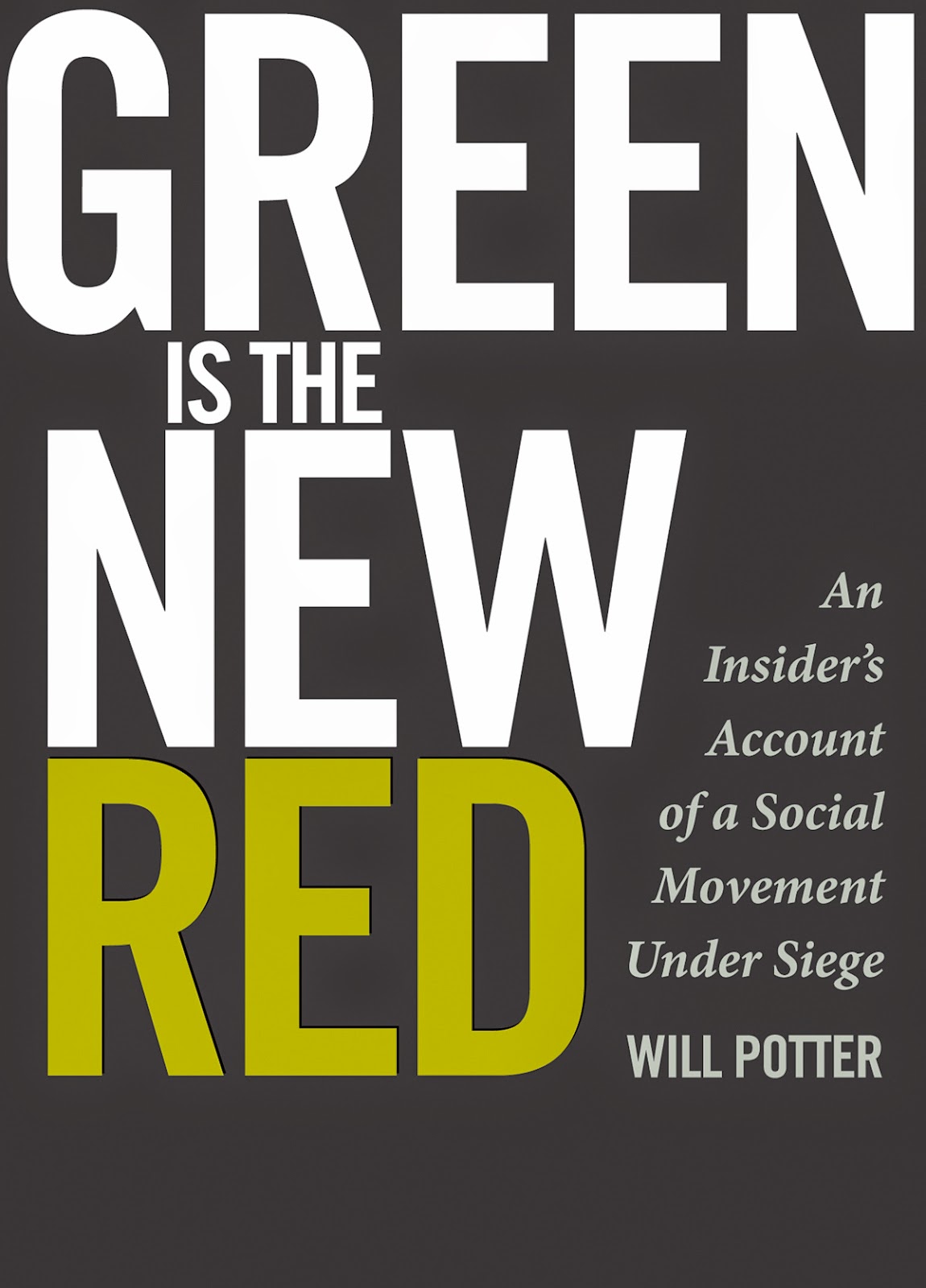
Green is the New Red

Green is the New Red: An Insider's Account of a Social Movement Under Siege
© 2011 Will Potter
256 pages


Is passing out flyers the moral equivalent of flying a plane into a skyscraper and killing thousands of people?  Well, in some legal circles, yes. Will Potter found out how eager Uncle Sam is to take down 'disruptive elements' when he passed out flyers as part of an animal rights campaign after years of writing about the activism of others and feeling guilty for not changing the world himself.  Federal agents showed up at his door and forcefully suggested he tell them everything he knew about the organization, or else he might find himself on a terrorist watch list.  Shaken by their visit, and disgusted at his fear, Potter decided to dig into  how and why the government had become so interested in consumer activism. Green is the New Red, the story of a group of young people called the SHAC-7 arrested and jailed for political crimes, is the result.

Although its title may indicate that environmentalism itself is under siege by the government,the focus here is animal rights activism. The SHAC 7 were associated with a movement called Stop Huntington Animal Cruelty, a campaign aimed against an animal-testing lab in the US and the UK. While SHAC itself was not a formal organization that carried out actions, it collected  and published information that could be used in campaigns -- information like the names and addresses of the lab's employees, executives, and shareholders.  Organizations like the Animal Liberation Front used that information to carry out actual attacks, which ranged from the benign (leaftlet campaigns) to the dangerous (arson). This collated information was also of service to demented individuals who broke into one woman's home, stole her dirty underwear, and used it to threaten rape. An aspirational activist, Potter does not shy away from the fact that some of the information-sharing was irresponsible. His concern here is not necessarily to exonerate the group, but to but to reveal and criticize the ferocious Federal response against them.  The seven, and other animal rights activists, are being treated as not only violent criminals, but capital-T Terrorists on the level of Al-Quaeda.  The SHAC-coordinated attacks on HLS were a triumph, reducing the company's stock so swiftly that lenders abandoned it as a credit risk, but no one was hurt. Property was damaged during the numerous lab-torchings, but no blood was shed. Potter compares the severe handling of the seven to groups that actually threaten and visit violence on others, like militia groups, the odd anarchist, and a few misguided pro-lifers. Whereas ordinary criminal laws applied to these acts of aggression, those associated with SHAC were interned in the same maximum-security sites as jihadists, and their names uttered in the same breath. Potter believes that the state's ferocity is provoked by its economic ties to the corporations whose bottom line is being disrupted.

That the State exists to protect and advance the interests of property is undisputed. Indeed, most attracted to a book of this kind about political activism will probably hold it as the truth. More to the point is the problem Potter identifies of the government's modern ability to freely label activists as enemies of the state. The problem lies in the many and nebulous definitions of terrorism, and the fact that once someone is declared a terrorist that normal rights, procedures, and the like go out the window. Although ALF did seek to use the threat of violence to force HLS to alter or stop the most abusive of its practices, its intent was not to incite terror in a population, and especially not through hurting innocents.  The PATRIOT Act's definition of terrorism is so vague that most acts of civil disobedience, including those practiced by Martin Luther King, qualify.  Modern presidents have an actrocious track record where civil liberties are concerned, and any threat to them must be checked. While Potter is somewhat hopeful that government persecution will create a larger problem than it solves -- he points out that the trial only caused an upsurge in activist attacks on HLS --  a more recent round of arrests has effectively ended the SHAC campaign.   The specter of federal agents arresting anyone who makes a fuss is arguably more daunting than the thought of a company losing equipment to arson:  civil liberties are much harder to restore than buildings.


Related:
The Ethical Assassin, David Liss. Said fellow is an animal rights warrior. 

Wednesday, July 16, 2014

The Small Mart Revolution

The Small-Mart Revolution: How Local Businesses Are Beating the Global Competition
© 2007 Michael Shuman
285 pages


Independence has long ceased to be the American credo, supplanted by another: efficiency. Throughout the 20th century, small businesses supporting towns and families were devoured by larger firms, big businesses who gave little back to the communities they colonized other than an infrastructure burden and a handful of jobs. But Michael Shuman holds that it ain't over yet, and in The Small-Mart Revolution this entrepreneur argues that the titans have achilles' heels and citizens still have a choice.  A combination of economic study and political jeremiad, Revolution is concise and feisty.

Shuman establishes a dichotomy early on; this is a story of TINA versus LOIS.  TINA is the there-is-no-alternative mentality, the approach the United States has taken on in the modern age; it is the path of chasing and relying on big businesses for jobs, of sublimating the local economy to the globe. LOIS is the alternative, the locally-owned, import-substituting approach. Shuman begins with arguments for LOIS against TINA;  not only do big firms invariably disappoint those who hunt them,  accepting tax breaks and infrastructure put in on their behalf, only to skip town when another city offers an even better deal -- but the money they produce is lost to the host community. A Wal-Mart store forwards its take to Bentonville, Arkansas;  it doesn't invest it in local banks, and most of the wealth is spent elsewhere. Money spent at a local firm, however, owed and staffed by locals, is subject to a multiplier effect.  There are other considerations, like the folly of depending on fragile systems for vital resources. Why should a town rely on food shipped in from California when its own fields can produce enough to support the population?  Shuman is not blind to David Ricardo's theory of comparative advantage -- that given communities and places are better at doing some things than others, so towns that have fields and mineral deposits might be better off plopping down a mineral-using factory on those fields and having the food shipped in from a place that only has food to specialize in. This makes perfect sense when thinking about people who want oranges in Michigan; the cost of growing them in greenhouses would be prohibitively expensive when they can buy from Florida and California.  But why should people in Alabama buy pork from the Carolinas when only a generation ago, farms that incorporated livestock and agriculture were the norm?  There are factors other than cost to consider, writes Shuman;  shipping food from one side of the continent to the other is a waste of resources and an abusive of the environment, but the chief fact remains that we can't rely on the world's perpetual stability. Sooner or later a  wrench is going to be thrown into the global economy; it may be a financial crisis or peak oil,  but disruptions are inevitable. Centralization can be efficient up to a point,  but decentralization is the option for health and safety.  Reinvigorating local economies will not only restore vitality to our communities, but is prudent for national security as well.

All that is easy enough to say, but how is it to be done? Sure, a city in Alabama can buy local food --but local shoes? Local computers?   For Shuman, the purely-local economy is a hopeless ideal;  he doesn't wholly condemn big businesses, either,  but regards dependence on them as folly. If lessons can be taken from their business practices, so much the better, but his mission is to restore vitality to local communities, an impossible task without restoring the local economy. After making his initial case, Shuman offers advice on how citizens, small businesses, public officials, national leaders, and even globally-minded persons can rely on and expand local economies.. Chapters are committed to each, and end with a list of actions each kind of activist can pursue.  Individual steps are obvious; visit farmers markets, use local hardware stores, invest money in credit unions -- but business owners can ally together in cooperatives to gain some of the advantages of the Goliaths without compromising themselves or their places. Shuman also explores territory outside the usual advice by urging people to invest locally,  something not easy given legal structures that favor the New York exchange.  Dismantling the obstacles to helping big business flourish, from zoning laws to financial support for corporations that are wealthy enough to pay for their own parking lots, is also key.

This is in short quite an interesting book, of considerable interest to those concerned about the wellbeing of their communities, especially their economies.  While no community will ever stop participating in the global economy so long there is wind to fill the sails of ships,  providing more needs locally is a surer course to  curbing high unemployment and staying adaptable than TINA. Prudence is demanded, but Shuman offers ways we can restore communities without falling too much afoul of economic reality.

Related:
Strong Towns, Chuck Marohn. His blog has commented on growing local jobs rather than
Human Scale, Kirkpatrick Sale
The work of Wendell Berry, especially Home Economics
Suburban Nation,  Andres Duany et. al
Eaarth, Bill McKibben

Thursday, May 15, 2014

Human Scale

Human Scale
© 1980 Kirkpatrick Sale
500 pages      


      Human Scale is an ambitious assault on big business, big government -- the very concept of Bigness. Opening with biology, Kirkpatrick Sale first establishes his basic operating principle:  for everything, there is a limit to its size beyond which it cannot grow without being compromised. In its opening third, Human Scale addresses the problems inherent in large, complex systems, then follows that with sections on how society, economy, and politics might function more effectively if scaled down.  On the hefty side itself, Human Scale impresses with its thoroughness; a kindred spirit to E.F. Schumacher's small is beautiful,  the book has largely stood the test of time in putting forth a case for decentralized politics, appropriate technology,  organic locally grown agriculture, and cities and buildings built to the human scale.  Sale creates a synthesis from topics as varying as demographics and aesthetics.. It is at times dated, at least in its optimistic projections for solar energy efficiency.  On the whole, however, it offers insight into government dysfunction and widespread social problems, along with ways people can work to effect change themselves. It is almost an anarchist how-to, a review of ways people can reclaim their lives against the power of centralization, and its enduring relevance is proven in the multitude of authors still advancing its ideas, a number that includes Bill McKibben and Wendell Berry.

Saturday, November 9, 2013

A Consumers' Republic

A Consumers' Republic
© 2002 Lizbeth Cohen
576 pages


What is the meaning of citizenship? To the Romans, and to the early Americans, citizenship was an exclusive state of being that depended on owning land, and so a stake in society. In the early twentieth century, however, as suffrage waxed more universal and markets were flooded with goods made for the masses, citizenship took on a different meaning. To be a citizen of a modern, capitalist  democracy was to be a Consumer;  voices rang out most strongly at the marketplace, not the ballot box.  In A Consumer's Republic, author Lizbeth Cohen examines the way the burgeoning consumer market effected political activism.  Beginning with consumer activist groups who protested high prices amid the Depression, her history examines the Civil Rights and feminist movements through the lens of consumption.  Consumer equality, not income distribution, would create a classless society. Women fought for the right to have their own bank accounts and lines of credit in addition to equal wages;  blacks labored for just prices in stores as well as unhindered access to the vote.  This is an account of social, political, marketing history, intertwined together.  Consumption didn't just serve individual desires; as Keynsianism became the dominant economic philosophy, intellectuals and citizen-consumers alike saw their compulsive buying as not only fun, but patriotic: their every new gadget grew the economy.  The consumers' republic began to die in the 1970s  and 1980s amid economic turbulence; even though people continued to buy more and more,  the political aspect of their purchasing, the meaning they had given it, fell away, both because the economy no longer responded as Keynes promised and their motives became more purely self-focused and only tangently connected to the thought of improving the nation's fortunes.

  Although occasionally touching on the negative aspects of the rapidly expanding consumer culture -- the growth of suburbia, for instance --  A Consumers' Republic is not a polemic raging against consumerism, and effects open to interpretation,  like the consequences of consumerism on citizens' peace of mind, are not touched on. It has a scholarly feel, though a 'popular' look;  the art is well-done, including plenty of large black and white photographs that demonstrate the point at hand, and stylized headings that bring to mind advertisements from the 1950s. One particularly effective illustration shows the evolution of advertising in Ebony magazine from the 1950s to the 1970s, as white-owned haircare manufactures realized that (1) blacks were a market and (2) that black people were a different market. They gradually transition from a white model demonstrating hair treatment lotion to a black model advertising products related to 'natural' hair.   Republic is a fascinating look at another side of the rise of consumption,  impressively thorough in that respect, and free of scathing criticism if not critical substance.


Sunday, July 7, 2013

Edens Lost and Found

Edens Lost and Found: How Ordinary Citizens are Restoring Our Great American Cities
©  2006 Harry Wiland, Dale Bell,  Joseph D'Agnes
285 pages


I can hear Atlanta crying loud as she looks for hope and change / but we can’t count on a government to create a life we want to see.. (“Our Cities”, The Wild)

The 20th century was not kind to American cities, and the challenges of the 21st, resource scarcity and climate change among them, seem hardly more favorable, especially as the national government continues to flounder. But across the country, citizens are taking challenges for opportunities, and effecting positive change in their own cities.  In Edens Lost and Found, the authors share stories from all stripes of people in Chicago, Los Angeles, Philadelphia, and Seattle who are doing their part to make their cities more ecologically-savvy, resilient, and overall better places to live.

Adapted from a PBS series, the book is divided into four larger chapters, each containing a half-dozen or so sections of stories about individuals or groups making a difference. The chapter starts off with a history of its host city, one which briefly details the city’s unique challenges and strengths: Los Angeles, for instance, is or was in the strange spot of simultaneously stressing about flooding and having to import water for its citizens’ needs. The citizen-actions range from the small-scale (a man stubbornly removing trash from an abandoned lot so that his daughters could have a clean place to play) to the somewhat larger, as when citizen actions catch the government’s attention and it decides to fund their efforts, as it did when  Chicagoans attempted to safeguard the prairies from further development.  Not every action is done by an individual person: one section in Seattle, for instance, covers the decision of one sporting-goods store to become environmentally friendly and more compelling at the same time by catching rainwater and channeling it to safety in the form of a waterfall. Their actions address a variety of needs, all adding value but in different areas. There are artists here, who transform empty walls into murals,  as well as those who convert an abandoned building into a hydroponics garden that doubles as an urban farmer’s market.  The editor-authors also add sidebars for those who want to recreate  the actions celebrated her: one such column offers advice on creating a nature trail.

Although the individual stories didn't mesh together well beyond sharing the same setting, the authors' attempt to create cohesion with an introduction to each city, and the marginal use of shared themes (managing watersheds, for instance),  serves the book well. It succeeds less on narrative and more on substance: these accounts of citizens engaging in direct action and rebuilding their cities are most inspiring,  giving reason for hope.


Saturday, May 4, 2013

eaarth

earth: making a life on a tough new planet
© 2010 Bill McKibben
253 pages


Oh, we're in trouble.  For two decades, forward-thinking politicians have made noise about climate change. "We've gotta do something to save the world for our grandchildren," they say. But the consequence of our actions as a global society are no longer the future's problem. The future is here. We're living on a new Earth, one considerably more unstable and less congenial to our kind of life than the one which has existed for hundreds of thousands year prior. This new Earth, which McKibben dubs eaarth, won't be kind to us, or anyone else. Life as you know it is over, and the sprawling governments of Earth can't possible adapt quickly enough. The good news is, there there are no solutions, there are ways to minimize the damage. After establishing how utterly up the creek we are, McKibben delivers an impassioned case for the revival of localism and citizen-led change.

Change will come regardless of our attitude, but we're really not ready for the four horsemen of the developing climate catastrophe -- pestilence, drought, flooding, and famine. We're starting to run out of the energy we use to make changes, including the kind of changes responding to this new eaarth requires. This is doubly problematic considering how much we rely on petroleum, now peaking,  to keep our global food network going, trucking food hither and yon and processing it into all manner of fun things with unpronounceable ingredients.  Starvation isn't imminent: it's now. The amount of food per acre is decreasing, while the rate of malnourished is on the rise -- and somewhere in the shadows of history, a vindicated Thomas Malthus laughs bitterly.

Chaos is going to be the new normal; we can't fix it, we can only ride out the wave, but maybe if we start early enough we can find ourselves someplace worthwhile when all is said and done. In the second half of his work, McKibben offers ideas as to how we can keep people feed, maintain a functioning electric grid, and stay online.  McKibben advocates a more fine-grained approach: instead of having great big farms of monocultures, grow different kinds of foods everywhere you can, using ecology to work for your behalf: eliminate waste  by turning it into compost. Stop using gadgets that constantly drain power, and start generating your own by covering the roof with solar panels and turning streams into little hydropower plants. People all over, and especially Americans, have to start doing this because the national government is now completely dysfunctional beyond blowing up kids in Pakistan or spying on its citizenry:  the changes to be made have to be made by us.

eaarth is simultaneously alarming and invigorating.


Tuesday, April 30, 2013

Crunchy Cons

Crunchy Cons: How Birkenstocked Burkeans, gun-loving organic gardeners, evangelical free-range farmers, hip homeschooling mamas, right-wing nature lovers, and their diverse tribe of counterculture conservatives plan to save America (or at least the Republican party)
© 2006  Rob Dreher
272 pages


Imagine a Republican who praised Jimmy Carter instead of dedicating a Two-Minute Hate to him. That's Rob Dreher. In an age of bitter partisan rancor, it's refreshing to encounter someone who looks beyond the asnine liberal-conservative divide and realizes that politics and values aren't as simple as they tell you on the television. Alas, values are still simple to Dreher, who knows there's still an Us and a Them; it's just that the Thems and the Us's sometimes swap sides.  The Us's are those people on the left and right who seek a meaningful life and are prompted by their inner convictions to live differently than the mainstream; the Thems are those wretched modernists, the consumerists, the cafeteria Catholics, and the individualists who defy culture and brazenly think for themselves. (You know, because thinking for yourself makes you so mainstream.)

The title alone may give you a feel for the goings-on of crunchy cons. Various sections cover Dreher's (who is the authority on who may be and who cannot be a Crunchy Con) thoughts on consumerism and technological dependence (bad), food (industrial food bad, CSAs awesome), homes (modern architecture bad -- read Jim Kunstler), and religion (orthodoxy for the win). While the thoughts as expressed can be found in other books*, Dreher's positions and criticisms are couched in the language of conservatism and traditionalism; he attacks agribusiness not on the grounds of social justice (as Eric Schlosser did in Fast Food Nation and Reefer Madness), but because he wants  to promote the rugged  old values of small farmers and promote self-reliance.  Dreher doesn't attack consumerism because mindless consumption plays into the hands of the bourgeoisie, or destroys Mother Earth; his hostility stems from the fact that there's more to life than owning stuff, and the idea of our being able to buy happiness is not only unhealthy, it's impious.

Religion undergirds Dreher's approach: for him, being a 'crunchy conservative' means living sacramentally; "viewing the physical aspects of life -- the food we eat, the places we live, the world in which we move -- as being inseparable from spiritual reality."  Dreher's aim in being a crunchy con is to live a meaningful life, and for him, religion supplies that meaning. The problem with mainline conservatism is that world changes too quickly for traditionalism-for-principle's-sake to mean anything. Yesterday's raging liberals are today's  conservatives, because the status quo is a moving target. Dreher's people stand out among  other conservatives by defining what they intend to conserve, instead of being content to resist change on principle. Hence, while most conservatives are fine defending relatively recent developments like automobile oriented sprawl, Dreher is still defending the old-fashioned, traditional, human-oriented cities that have now been embraced by progressives.

There's a lot to like about Crunchy Cons, but there were a few too many flies in the soup for me. Like the authors of The Plain Reader, Dreher puts a lot of stock behind parents being the chief cultivators of their children.  And while I get the reason for concern -- I, too, would prefer not exposing children to television for numerous reasons, the values it imparts among them --  as someone who was raised in a "conservative", no-television household, I'm awfully glad I was able to view TV and other media from time to time that let me see the world beyond the prison walls of my controlled environment. I was able to compare my parent's worldview with another, and figure out what I wanted out of life. This obsession with controlling children, witnessed in both The Plain Reader and in Crunchy Cons, and displayed in the authors' hatred for public schools and media, strikes this escapee as sinister and unhealthy. Your values mean nothing if children cannot grow into adults who can make a choice. And therein lies the rub with Dreher's work, for as much as he advocates choice in other areas -- people should be free to run small farms, instead of being forced to play by agribusiness' rules; people should be freed from compulsory education, raising their children whatever way they decide; when it comes to belief, people should Learn their Place and believe what they're told. Tradition is God, and if you think you can modify it you are a degenerate loser who is responsible for the imminent destruction of humanity.

At times, Crunchy Cons was an eye-opening delight. Like The Plain Reader, it demonstrates how people can lives of purpose and value amid the noise of an entertainment-obsessed world.  The author's contempt for those who do not seek more meaning, however, and his anti-human belief in the primacy of tradition, left me feeling sick. The Plain Reader was a far better example of a conservative counterculture, and though problematic in ways, it was far gentler.

 *In Praise of Slow, The Omnivore's Dilemma, Fast Food Nation, The Geography of Nowhere, Technopoly, Amusing Ourselves to Death, To Have or to Be, American Mania, and Bowling Alone.


Sunday, March 24, 2013

Pedaling Revolution

Pedaling Revolution: How Cyclists are Changing American Cities
© 2009 Jeff Mapes
288 pages


That's some serious wind resistance there, buddy.

Governments across the world today are beset by problems common to all: rising fuel prices and obesity rates, the ever-present spectre of climate change, and the transportation needs of increasingly urbanized (or re-urbanizing) populations. Enter the humble bicycle: accessible to virtually everyone, regardless of age, sex, or income level; clean, quiet, and an excellent source of exercise. For too long in the United States, bicycling has been the province of a few intense racers and tourers who pride themselves on how miserable a trek they can endure. The end of the cheap oil era, however, has prompted cities to reexamine the bicycle as a means of transportation for the many, despite the car-centric nature of the American city.

Curbing car domination is not a futile hope: in the 1970s,  stirred by soaring oil prices, the Netherlands moved to discourage car use and promote cycling. The city of Amsterdam became a pioneer in modern cycling infrastructure; only Copenhagan can rival it. Both cities boast that nearly half of all trips within their cores happen via a cycle. Fittingly, then, Mapes begins with Amsterdam's story -- but the United States has its own homegrown success in Davis, California, a university town whose early growth was managed by a cycling advocate.  But Davis had it easy:  New York City and Portland, Oregon's success in creating room for cyclists in an already established urban area filled with cars is arguably more impressive.

Mapes' chapters on these cities not only demonstrate their success, but explore how they did it.  There's no authoritative source for how best to integrate bike traffic into transportation infrastructure. Approaches range from the simple (simply painting bike lanes onto existing roads) to the more involved (separate bike paths and even 'bike boulevards') -- and there are some who deny the need for bicycle infrastructure at all, harrumphing that cyclists should just learn to ride safely with auto traffic.  But more than just the built environment have to change to encourage cycling: traffic laws, like right-turn-on-red permits that allow motorists to take over pedestrian and cyclist right-of-ways, must be addressed. The book ends with a section on cycling safety, health benefits, and the important role bikes can play in raising children, and thus in creating a broader, sustainable bike culture.

Pedaling Revolution has great appeal to both cyclists and citizens concerned about the state of American cities, for whom it should prove most encouraging. The argue for cycling more is better made in The Green Metropolis, the cover of which is of a city in bodily form on a bike, but Mapes' account gives the already-converted great reason for hope, and could easily intrigue the curious to becoming part of a bicycling renaissance.


Taken from an April edition of The Selma Morning Times, 1900.

Related:

  • Copenhaganize, a blog covering cities around the world as they move toward being more bike friendly, like Amsterdam Copenhagen.
  • The Green Metropolis: Why Living Smaller, Living Closer, and Driving Less are the Keys to Sustainability, David Owen
  • Walkable City: How Downtown Can Save America, One Step at a Time, Jeff Speck
  • The Sprocket and Critical Transit, two podcasts hosted by urban cyclists....based in Portland, naturally. The Sprocket's tagline is 'Simplifying the Good Life'; I especially enjoy their interviews with carfree parents.


Saturday, June 30, 2012

The Green Metropolis

The Green Metropolis: Why Living Smaller, Living Closer, and Driving Less Are the Keys to Sustainability
© 2009 David Owen
357 pages


Green is probably not the word that comes to mind at the mention of Manhattan, but to David Owen, few places on Earth are as environmentally friendly as the heart of New York City. Its towering skyscrapers and elevated train lines are in fact the very image of verdant. Such a contention is at the heart of Owen’s surprising take on sustainability and environmentalism, his approach as practical as it is counter-intuitive. Owen uses the lens of economy to reveal weaknesses of conventional environmental thinking while demonstrating that the most practical solution to making the most of our energy reserves is to live more intelligently together – in cities.
Owen establishes his work’s prevailing theme early on, declaring, “Sustainability is a context, not a gadget or a technology.”  All of our efforts to be environmentally responsible, to greenwash our lives, are insubstantive when examined against the way we routinely waste energy on a day to day basis, living as we do spread out in suburbs and making virtually every trip in a car. It’s not the Hummer’s gas mileage that makes it an environmental disaster, Owen writes, but the fact that owning a car encourages us to drive it all the time. In fact, he views the rising popularity of SmartCars as a disaster waiting to happen, because such efficient machines will only encourage us to drive more, putting delaying the real change we need to make…which is driving less, living closer, and moving out of our sprawling ranch homes and McMansions into something more sensibly-sized.  
Green Metropolis is a smartly-constructed book. After putting forth his premise, Owen establishes why adaptive thinking on our parts is required. In “Liquid Civilization”, he points out that the entirety of the global economy and our lives is based on burning oil or converting it into products like ever-ubiquitous plastics. Until the mid-20th century, however, only a fraction of the Earth’s population demanded the use of those oils –Europe, the United States, and their colonies, or the “western world”.  Resources were thus relatively abundant, and we have been positively spoiled by the surfeit, so much to the point that we have invented dozens of brands of disposable cups, spoons, forks, and plates that are meant to be thrown away after one use…presumably, because we can’t be bothered to wash a dish. But the days of plenty are over. Now the entire world is demanding a once exclusive lifestyle, and over a century of chronic use has sharply reduced available supplies of oil and natural gas. Unfortunately, the Chinese and Indians seem intent on  making the same mistakes that Americans did in regard to transforming their urban landscapes to make full use of the car, expanding the reaches of the automobile and ever-deepening their dependence on and use of, oil.
The Green Metropolis' argument's primary strength is that its proposed solution is both simple and fundamental. It doesn't require us to do anything we weren't doing already until a temporary bout of prosperity made us lose our collective minds -- people have lived in cities for thousands of years. City-dwellers don't make an effort to be "green": they simply live the way they're use to living. Efficiency is built into the fabric of the place, and that makes the eco-urbanist argument especially appealing to me because I've started to suspect that human beings are too short-sighted to put up a meaningful fight in any other way. This approach to environmentalism doesn't require Constant Vigilance, which I suspect is an impossibility -- it only requires us to return to our senses. Not only this, but returning to proper urbanism will provide immediate, short-term results, which are apparently the only thing we grasp. Restructure the suburbs -- make them walkable, increase density -- and we can add value to the urban landscape  and to our lives. We can free ourselves from fiscal disaster and chronic stress. The problem is motivating ourselves to start making the move.
The Green Metropolis not only makes a strong argument, but it leaves us with room for thought, challenging us to reconsider the way we live in terms of this kind of efficiency. Two areas where Owen especially provoked me were in traffic and food. We might believe that buying local food is more energy efficient, but the sad fact is that the big-box boxs have local grocers beat. I have seen this argument offered by Brian Dunning of Skeptoid as well, who did demonstrate to my satisfaction that a tomato from the supermarket is more "Green" than one from a local farm. However, I still buy from the farmer's market, because the issue of food is more complicated than energy efficiency:  I prefer supporting local economies, for instance, and have an aversion to food products that are more 'product' than food. After considering Owen and Dunning, I can't completely condemn the US food market, but neither can I condone it. We have much to consider, and the answers are not simple.

Related:
Suburban Nation, Andres Duany et. al
Asphalt Nation, Jane Holtz Keay
Your Prius Won't Save You, David Owen
Interview with David Owen on his book, The Conundrum: How Scientific Innovation, Increased Efficiency, and Good Intentions Can Make Our Energy and Climate Problems Worse