Showing posts with label New Mexico. Show all posts

Saturday, February 17, 2018

House of Rain

House of Rain: Tracking a Vanished Civilization Across the American Southwest
© 2007 Craig Childs
482 pages


Throughout the southwest United States and northern Mexico there are ruins from a people long gone, people remembered as the Anasazi. The name is not theirs; it was applied by the Apache later on, and has a mocking connotation - -the old ones, the rotten ones, the defunct ones. The ruins of cliffside dwellings, abandoned signal towers, and brightly colored ceramics reveal a technically accomplished people, one whose lore contained information gleaned from hundreds of years of close observations: their sites often incorporate features which mark astronomical events, events that no doubt played a part in their mythos. Who were these people, and why did they leave?

Well, they didn’t, says Craig Childs. Or at least, it’s inaccurate to say they planted their flag in New Mexico and Arizona and such places, and then for some reason decided to abandon their ancestral homes. In search of answers, Craig Child hiked and drove throughout the Southwest, venturing far off the beaten track by himself or with archaeology students, to study the land, the light, and these spaces which remain to absorb what understanding can be had. Many of the people he walked with were specialists in the region -- archaeoastronomers, say, or those who can identify the region that preserved wood or pottery came from by their chemistry,

Findings from archaeological digs indicate that this was a fluid population, one that frequently moved in response to environmental stresses. The rivers of this region are fickle, alternatively flooding and vanishing The transient ancients were following the water, and an interior nether-world of gods – a place beneath the soil where water was plentiful but released slowly in mountain streams or sudden springs -- appears to have been on their mind. Ritual appears to have had a role in their leaving, as well: some sites are thought to have been torched deliberately, by the inhabitants, rather than destroyed in war. Some of their locations appear to have been settled communities, while others were mere migrant camps that could not have supported a large population, but were used as a short-term residence. Eventually these people dispersed in their travels to become the various pueblo peoples, like the Hopi.

House of Rain is neither a travel guide nor a comprehensive history, but rather an attempt to make sense of one through the other. The full story will never be known, though parts can be garnered by studying what was left behind and other pieces are locked away in the lore of native peoples who (for good reasons) do not wish to share their oral histories with outsiders – even outsiders as serious and respectful as Childs. Childs is a native son of the southwest who traveled extensively within it before writing this book, and the amount of contacts he nursed before engaging in this project reveals his sincere interest in the subject. House of Rain isn’t a novelty travel guide – “Ghost Towns of the Ancient West!” – but the chronicle of one man pursuing his passion, to learn as much as he could about those who lived in and loved the same landscape he did. Those who find the mountains and vistas of the Four Corners enchanting will appreciate this tour of a civilization that was.


Tuesday, August 29, 2017

Tyrannosaur Canyon

Tyrannosaur Canyon
© 2006 Douglas Preston
416 pages


What do a 'misplaced' lunar sample and a fossil hunter shot dead in the high mesas of New Mexico have in common?  Their shared secret is one that would answer one of humanity's oldest questions...and threaten our extinction. Preston, who has traveled Arizona and New Mexico extensively on horseback, puts his intimacy with the landscape of the Four Corners to use here, leading readers through ancient and winding canyons, perfect for ambushes and plot twists.

For the most part, Tyrannosaur Canyon seems like a straightforward murder mystery, made perfectly interesting by its setting of paleontological intrigue. Before going the way of the dinosaurs, the slain fossil hunter conveys a message to a local, swearing him to secrecy and begging him to get a notebook of mysterious numbers to his daughter, Robbie.  The notebook is coveted by the murderer and the man who hired him, and eventually by a retired CIA spook turned Benedictine novitiate, but when a mysterious organization armed with Predator drones surfaces, everyone realizes they're in over their heads.  At stake is not a lusted-for paleontological prize,  but something more dangerous -- so dangerous that it merits a black-ops detachment known only by a number to monitor and contain it.

Tyrannosaur Canyon found a happy audience in me for various reasons;  its main character, who values his word more than his fear;  the setting of New Mexico;  the supporting character whose contribution was her scientific work, which was shown to the reader and not merely declared;  and of course, the dinosaur angle.  Science and mystery give way to action scenes halfway through, but there are four unfolding simultaneously, involving all the characters.  Prolonged peril loses its point, but on the whole I enjoyed this first encounter with Preston's fiction.

Note:  reading this and Dragon Teeth side by side was an accident. I started this one first, then a long-forgotten hold for Crichton's came in on Friday, with a short-term loan. Worked out well, though..

Related:
The Monkey Wrench Gang, also involving long chases in slot canyons.

Thursday, August 3, 2017

Cities of Gold

Cities of Gold: A Journey Across the American Southwest in Pursuit of Coronado
© 1992 Douglas Preston (Walter Nelson, Photographs)
480 pages


Sometimes, history has got to be pursued from the back of a horse.  Douglas Preston wasn't sure what took him to New Mexico -- he had a nice life in Manhattan before he abruptly decided to move to Santa Fe, to see the adobes washed in red sunlight --  but it took him further still, to the border of Arizona and Mexico.  There, along with a friend and a hired horse wrangler, he purposed to re-create the journey of Francisco  Vázquez de Coronado, the first Spainard to explore the Southwest.   They would discover the Four Corners as the Spanish did, on horseback -- carrying their own supplies,  following the water. Their mission -- to search what it might have been like to enter into these enormous spaces for the first time, and travel through them to the seven cities of Cibola.  Preston and company were warned against the pursuit; there was a very real chance such a journey would kill them. The desert is kind to no one, and Preston proposed to navigate through sheer wilderness, during the summer, amid a drought.  But fate is kind to fools, drunks, and Americans, and Preston's royal-flush team prospered through their wits, the kindness of strangers, and a mix of luck and grit.   The product is for me the best piece of travel writing I've yet read.

Along for the ride with Preston were a cantankerous neighbor of his, Walter, and a hired woodcutter who professed to be a horse wrangler.  Eusebius's only virtue for the reader proves to be his comic rage that reveals itself with every mesquite tree, barbed-wire fence, and thrown horse-shoe; the man is as experienced with horses as you or I. (His virtues for the party are practically nil, although his incompetence forced Walter and Doug to become jacks of all trades, which probably saved their lives after the fake-wrangler quit.)  The country they proposed to cross was desperately hostile. The voyage opened in a thick swath of mesquite trees, for instance, which turned a proposed one-day journey into four days of hacking, cussing, and chasing horses.   They crossed mountains so far off  the beaten track that the closest thing to a path was a cut made by the riders of the Pony Express.  Their journey takes them through the detritus of ruined civilizations and communities, the residents and their hopes long-dead -- both mysterious Anasazi remains, and the less mysterious array of abandoned silver boomtowns.   They encountered an array of interesting people: rattle-snaker trappers,  ranchers and cowboys, echoes of the dying Old West.  They also spent considerable time visiting with native Americans as they pass through  Zuni and Acoma reservations, learning some of their stories.  While the travelers were sometimes greeted with a shotgun, Doug and Walter certainly didn't look like tourists after the first few hundred miles of hard riding, and after explaining their mission, virtually everyone offered them hospitality with open arms and admiring eyes -- even from old ranchers who lived over a hundred miles from everybody else and did everything around their homesteads themselves.  (The only exception was a man who assured them that nobody named Coronado  came this way because the road hadn't been built until last year, and anyway that would have been trespassing.)

Cities of Gold expertly mixes adventure, history, photographs, and encounters with interesting people. As Doug and Walter pass through the landscape, so we learn the story of Coronado's exploration of the Southwest, and the story of the West in general: the trials of the Hopi, Apache, Zuni, and other people through the last two centuries, the triumphs and tribulations of traders, trappers, and gold-strikers;  the rise and fall of the cowboy. But there's more to the memoir than history, for both the Zuni and the cowboys have something to say about stewardship, of the husbandry of the land. They argue that the land has been much abused by outsiders who came in with great confidence and little knowledge, from the first ranches to the present Forestry Sevice.  Numerous citizens condemn the heavy-handedness of the Forestry Service's no-burn rule: the attempt to keep so much of the country in stasis is smothering it to death. The antelope herds that once flourished by eating young-growth forests, for instance, have dwindled as the old-growth cedars continue to expand, unchecked by fire.  As this journey was taken in 1989, I don't know if matters have improved. (What has not improved is Albuquerque traffic, which these two took horses through!)

While my prolonged fascination with the Southwest greased the skids here,  Cities of Gold  is most impressive.  The entire premise is awe-inspiring: this is a journey of a thousand miles on horseback, through thickets and quicksand, over mountains, across barren stretches of salt lakes and desert, through valleys and up mesas.  The people, as mentioned, are fascinating into themselves, both the living and the dead. I did not recognize the name Coronado before I began reading this book, and I learned enormous amounts about him, the native cultures, and the history of the West in general as I followed Doug and Walter through these magnificent, storied landscapes.


Thursday, July 27, 2017

The Mexican Frontier

The Mexican Frontier 1821 - 1846: The American Southwest Under Mexico
©  1982 David Weber (University of New Mexico Press)
440 pages


In 1821, the people of Mexico declared their independence from Spain, recognizing that its Napoleonic straits meant that the mother empire had little future left, either at home or abroad.  Once the bid for independence had achieved its aims, the 'Mexican empire' spanned everything from Oregon down to South America.  Within thirty years, however, the United States had invaded Mexico, seized its capital, and forced the purchase of nearly forty percent of  its northern land.  Sneaky Americanses!  Wicked! Tricksy! False!

Well, not really.  It wasn't David Weber's intention, but having read this history of the Mexican frontier I'm considerably less condemnatory about the treaty of Guadalupe-Hildalgo. Not about the war, of course,  but the treaty itself seems to have only hastened the inevitable break-off of the great northern expanses from Mexico proper. Weber's history begins with  Mexican independence, then details the decline of institutions in the north as the contest for power in central Mexico continued; with a consequentially distinct frontier culture emerging, one that would constantly struggle for its own autonomy. Central to this history is understanding that young Mexico went through several constitutions in those early years,  constantly struggling to find its way. The breaking-away of the north from central Mexico was partially grounded in dispute over which constitution was legitimate: the more republican 1824 constitution, or the more authoritarian 1832 constitution imposed by the ilk of Santa Ana.

The fractures were only made possible by the precipitous decline of institutions in the north that would have tied states and territories like Texas, New Mexico, and the Californias more firmly to the government in Mexico City. The Franciscan missions, for instance, vanished with the Spanish -- in part because they were supported primarily by Spain, in part because many monks were Spaniards more faithful to their patria than their parish,  and in part because  Mexico wanted them out of the way. The missions had all the best land and labor, and if they could be dispatched with, then settlers could move in and hire the newly-emancipated Indians as workers.   Although Mexico officially secularized the clergy -- replaced the Franciscans with state-paid priests --  it did this so slowly that  the Church effectively disappeared in the frontier, and with it marriages and schools and other civil functions that the state was slow in restoring.

Another primary institutional failure was that of the military; because central Mexico's government was so unstable, its  army stayed close to home, either to stave off further intrigues or participate in some. The array of presidios that once guarded the northern frontier, with its independent attachments of cavalry,  was poorly maintained; the soldiers were so scantily paid and armed that not only did civilians have to raise their own militias to defend themselves against Apache raids, but when the militias were on the attack, the presidio cavalry sometimes raided the homes they were supposedly protecting.   In addition, the Mexican government's economic policies -- forcing trade goods in and out of the interior to circulate first through far-distant Vera Cruz -- made supplies rare and expensive. The sheer distances between the frontier and Mexico city added to the eroding attachments between a place like California and Mexico;  the ruling city seemed to be as far away and imperious as Spain. Little wonder that in the 1830s, Texas declared and fought for its independence;  California declared independence but accepted a compromise that allowed it more autonomy; and New Mexico rolled with rebellion several times.

Because of Mexico's instability,  the failure of institutional ties to form or hold, and the sheer distance between cities like  Santa Fe and Mexico City,  the northern expanse of Mexico was increasingly oriented along another axis: it looked east, to America, for cheap, ready, supplies, and  eager settlers and tradesmen. That commercial and cultural Americanization of Mexico's north made it increasingly America's west -- hence why I suspect now that the treaty which ended the United States' unjust invasion of Mexico only hastened the inevitable.  At the risk of condoning Polk, the American federal system finally allowed for the 'home rule' that the restive north fought for in the 1830s.  Had Mexico not struggled so much to create  a stable government early on, it might have held on to much of what the treaty lost -- but it is a difficult thing to create civil society from scratch, let alone when a nation is being constantly invaded by invading Comanche.

Related:
The Spanish Frontier in North America, David Weber

Thursday, May 4, 2017

Spain in the Southwest

Spain in the Southwest: A Narrative History
© 2013 John Kessell
480


In the early 1500s, the Spanish triumphed over the Aztecs and established a new Spain -- an empire forged out of the new world.  The equatorial tropics were only the beginning for Spain, however, as far above them loomed the entire continent of North America,  full of possibility.   The Spanish were lured north with simple and expressed motives: there was oro in them thar hills.  They were teased with stories of great cities to the north, rivaling even the splendor of now-perished Tenochtitlan. Their explorations would take them as deep into the interior as Kansas, and create a new province for colonial Spain: "New Mexico". The Spanish in the American Southwest is a history of the Spanish empire in the present-day states of New Mexico, Texas, Arizona and California, one which aims to tell the story of cultures in collision -- or collusion, as the Spanish often relied on alliances with locals, using chronic warfare between populations to make friends.   The province of New Mexico was named such in the hopes that it would prove as abundantly wealthy as Mexico,  but easy loot wasn't to be found. Angry natives were, though, and in abundance -- constantly resisting the dons and once driving them out of the region entirely. Still, the 'new Mexico' would remain a Spanish possession, maintained at great expense for the benefit of seemingly no one but the Church, until Napoleon invaded Spain and provided the opportunity for the New World to declare independence from the old.

As this is billed as a narrative history, what are some of the interesting threads?  Accounts of exploration always have an aura of fascination about them, although the Spanish were more disappointed with the constant lack of golden cities than mesmerized by the landscape.  In this history we see the Spanish grow from explorers to conquerors, and then -- as the generations pass -- men who belong more to New Mexico than they do Spain. They struggle constantly with the neighbors, whose kin they have effectively enslaved and alienated from the local gods -- and later on, the Spanish have to double down on the unproductive province because of other European powers. France is especially aggressive in Louisiana and Texas, and the Anglo-Americans keep eying the west with a certain avaricious glint. The main reason Spain held on to the Southwest prior to strategy becoming a factor, however, was religion, as the religious orders (Jesuits and Franciscans) assured the Crown that they had baptized many souls, people who will be killed by their neighbors should Spain leave.  Speaking of the friars,  don't think of them as gentle souls living lives of poverty and service to their fellow man. The friars in the southwest were potentates, who relied on the forced labor of the locals and who threatened even the Spanish military and civil powers in terms of authority. One early friar -- addled by the desert sun and encouraged by his distance from Italy -- claimed to have the full authority of the Pope in the New World, and another effectively ousted the first governor of New Mexico proper when he (Peralta, the Santa Fe avenue's namesake) challenged the cleric's rule.

More will follow on the Southwest this year, including a travel account based on Coronado's first foray into the region, a history of the region between Mexican independence and the American invasion;  and a modern history of the state of New Mexico itself.

Related:
The Spanish Frontier in North America, David Weber
West of the Revolution: An Uncommon History of 1776, Claudio Sant. Covers the Russo-Spanish contest in California
Death Comes for the Archbishop, Willa Cather.

Wednesday, February 15, 2017

Week of Enchantment Video


Interested in seeing how Windows Movie Maker and Youtube worked, I "made" a video with 100 of my Week of Enchantment photos, set to music. Enjoy!

Friday, October 28, 2016

Week of Enchantment: Santa Fe, the City Beautiful


I headed for Santa Fe in the early dawn, driving even as the sun rose.  I'd been assured that the capital's traffic was nothing like Albuquerque's, and found this to be the case. It didn't want for cars, but the roads didn't lend themselves to Daytona imitations. (Santa Fe is also considerably smaller, both in population and in physical expression; when I climbed a hill north of town,  it made a happy picture, a quiet little city whose buildings didn't tower over the trees.)   I'd been warned that the main road is a confusing horseshoe, and I did get properly lost trying to navigate it into Old Town. But because it's a horseshoe, all roads lead to Paseo de Peralta, and  -- to end a long story -- I managed to find a parking lot just a street behind an Old Town entrance, and still have no idea how I managed it.

La Fonda


The parking lot attendant was marvelous, using my trip book to tell me where I was (just off the map by an inch), and soon sending me on my way. I wandered, first, going up and down streets willy nilly, soaking in the architecture so completely different from anything I'd ever ever seen. Even the subdivisions in Santa Fe are built in a style imitative of pueblos; it's a code ordinance.  My two foremost objects of desire were San Miguel's and the Palace of the Governors. Respectively, they are the oldest church in North America, and the oldest continually-used public building in North America. (Oddly, St. Augustine in Florida is the oldest European city in North America, but can't dispute Santa Fe's titles.  St. Augustine was razed at least once, though, so that may have cost it a few building records.)


It was just after seven a.m. here, the morning as cool as all the others I had expected. (Fun fact: I packed a suitcase full of shorts, with one pair of jeans for Carlsbad Caverns.  The days were so cool I spent the entire week wearing the same two pairs of blue jeans.)


Nothing was open for gawkers yet, but San Miguel made for a marvelous shot.  After obtaining a superior map from the visitor's center, I returned to my sight seeing.  Santa Fe kept me in awe from seven until late in the afternoon.


First up was the Loretto Chapel, which is beautiful inside and out.  This is no longer a chapel, but a museum maintained by the city, and -- as grateful as I am that this building has been preserved by their administration --   what has not been saved is any sense of atmosphere.   The crowd didn't kill it for me, nor even did the man taking tickets inside the building itself. Some perverse soul decided to mount loudspeakers throughout the space that drone on about the history of the building and the staircase.   I found it appalling. Loudspeakers? Why not mount televisions, too,  so the kiddies won't be bored?  


 The big attraction here, apparently, was the staircase. I'd never heard of it and assumed (from its mentioned appearance on 'Unsolved Mysteries' -- it had a ghost associated with it, or healed people who climbed it, something like that.  I took a cursory shot of it but was more interested in the Stations of the Cross, easily the most elaborate of any I'd see.


The actual story with the staircase, as I learned later, was that the church architect died before creating access to the choir loft. The nuns prayed for help from St. Joseph, traditionally a carpenter, and lo! Some mysterious stranger showed up, constructed it without any visible means of structural support, without nails, and then vanished.  


After extracting myself from the building, I followed the Exit signs and found myself in a classy downtown hotel; they're joined at the hip.


I returned to San Miguels, this time to see its open insides. I had plenty of company, but the women staffing it inside  were enthusiastic and friendly;  personable, not businesslike. They gave the visit a special kind of warmth.  Now hungry, I stopped at a nearby pizzeria (The Upper Crust), which was a favorite of people who actually LIVE in Santa Fe, and enjoyed a couple of slices before moving on.


Next I sought out the Basilica, the largest building in Santa Fe and one that looked so glorious on Wikipedia I knew I'd seek it out.  The basilica is named after  St. Francis, and proved to be too grand to really capture in a picture.  Draw close, and its size fills the eye; retreat, and it is coyly veiled behind trees and other buildings.


 Its interior is vast, so large that even the amount of visitors couldn't diminish the awe it inspired. I sat for a while to admire some of the detail on the ceilings and pillars.  There are buildings that would require a lifetime of daily visitation to take in half their glory, the graceful touches that long-dead artisans added, and this is one of them.   I'd never been in a church so large than the sanctuary seem effectively in the middle, though I have seen them on TV.  


To the left of the sanctuary was a chapel devoted to La Conquistadora, the oldest icon of Mary in North America.


Not too far away was the old Plaza itself, and I knew I'd found the Palace of the Governors when I spotted Alabama flags. (Not really, of course, but the Spanish 'Burgundy Cross' is derived from St. Andrew's cross, which both Alabama and Florida use as our state flag.)  The palace itself is a museum devoted to Spanish colonial history ,and connects to a more modern building that covers New Mexico's 20th century.


It contained a fair few artifacts from colonial days -- Spanish armor, weaponry, a full-size wagon from the days of the Santa Fe trial connecting New Mexico to the east -- as well as native American pottery.  The building itself was an exhibit, though, with glass 'windows' built into the floor  revealing parts of the foundation.


My PC wallpaper since Oct 1st. 


What a delight that plaza was!  Now in the full of the day,  people filled it with music , food, and happy chatter. I ignored most of the gift shops, being more interested in the architecture, but "The Christmas Shop" had to be looked into. I saw one in Albuquerque's old town, too.  I searched for the proprietor and told him about the coincidence, asking if it was a New Mexico thing -- when they said Christmas all year, I assumed it only meant a mixture of green and red chile sauce -- or a tourist thing.  It's the latter, according to him. My curiosity mollified, I moved on.


My day in Santa Fe involved a lot of back and forth movement, but the last place I sought after was the Cross of the Martyrs, a concrete cross mounted on a hill, dedicated to the friars who died when the Pueblos drove the Spanish out of New Mexico for a little while. Here, I made my boob-of-the-day decision. I didn't look for approaches to the hill, but beelined for it. Going around a small building, I noticed steps leading to the hill proper, and what seemed to be a dirt trail.  I realized as I clambered up, though, that I hadn't seen a dirt trail, just dirt; the hill's vegetation was patchy.  I pressed on, though, the rising slope and its challenge making the journey only seem more authentic, more pilgrimage-y.  When I slid down and hit something spikey, so much the better!

Twas then that I heard laughter, and - - now high enough that I could  see around the hill -- spied two people strolling along. So there WAS an easy way! No matter. I'll climb this the pilgrim way!


Ah, well.  After  repeated falls,  I realized I was just making an fool of myself for machismo or extra credit tourist points. I eased around the hill to where I'd seen the strolling pedestrian. Getting back on THAT path required threading myself through a barbed wire fence, but soon I was strolling along in tight S-curves up the hill.  Having arrived at the cross, the pilgrimy thing to do was to kiss it. I settled for wetting my index finger and touching it.   There was more to the hill, a path going to what I think was a picnic place, but I was worn out from my Ascent of Idiocy.


My last visit in Santa Fe was to the public library, where I printed off my boarding passes for my morning flight.  I found it a little surreal.  People sitting around reading,  or quietly looking at information on the computers -- where were the moms with screaming children,  the librarians running around juggling?  The same attendant at the parking lot gave me easy directions back to the interstate, and soon I was on my way.


I have a few regrets from Santa Fe, but they couldn't be helped. I had intended to visit the  branch of St. John's here, a genuine liberal arts college. I say 'genuine' because St. Johns actually takes the Great Books seriously; they're used to form the mind and character of the students. I drove right past the Missionary Hill sign,  too tired to remember St. Johns being down that road. Still later, once I hit the interstate, I was too tired to contemplate turning off to take the Sandia Peak Tramway.  This is a little cable car that can take visitors up the mountain, there to bask in the countryside. I'm sure it would be marvelous, but I'd been seeing Epic Vistas for a week now.   What I wanted more than anything, with my heavy eyes, was to return to my motel and sprawl in bed.


The next morning was a sad day, of course, but had a triumphant start.  Waking up long before dawn, I checked out and hit the interstate in the dark.  I'd slept  fitfully the night before, and at three am was listening to the never-easing rush from the freeway itself; now I joined it.  I had to find the airport for the first time  and return my car before the dawn, but I also had to find gas. My trip book came with the answers, though; a lone station near University Blvd that would take me to the airport.  I reluctantly turned over the keys to that Kia Rio, in which I'd spent so much time, and ran (suitcase in hand) to catch a shuttle-bus that got me to the airport's check in counters.   Even so early, just after six,  people filled the lobby for early flights, and despite my early rising I still wondered if I might make it out in time.  All went well, and as much as I disliked leaving the vistas of New Mexico behind, I was able to savor my flight home in the knowledge that I had planned and executed everything to great success.  This week of constant travel was the most ambitious thing I've ever done, and I return knowing I have the traveling bug.

I will visit New Mexico again, assuredly, hoping to land in Sante Fe and explore it more fully, then heading north to Taos. My experience of Albuquerque and Santa Fe was slightly warped by my being there during the start of the Balloon Fiesta, so both cities were crowded. Apparently it's a Very Big Deal, but I had no idea of its existence when I made my arrangements.

A month later, I still see the New Mexico countryside streaming by when I close my eyes, can still imagine the roar of ABQ's interstates, and still long to see Santa Fe again.  What a week, what a place, what an adventure!


Wednesday, October 26, 2016

Week of Enchantment: The Garden of Eden is Missing its Critters


From here  I moved to the attached Gardens, one of the most beautiful, romantic, and sometimes weirdest spots in New Mexico.  Beauty first:  Moorish gardens open the area,  ending in a tree-lined walkway that is utterly  peaceful


This goes around a park with a lagoon, and following the arbor-laden path took me to several greenhouses. The greenhouses are massive, multiple-story places.


  Another area of the gardens is done up in Japanese style, including round stones buried in the water used as a stepping bridge. The strangest part of the gardens, though, is the multi-acre farm in the middle.


"Farm"? Yes, farm. In the middle of Albuquerque,  there are apple orchards, vineyards, and rows of other crops.  Despite the abundance of rusting old farm equipment and the penned-in steer and horses, this isn't a museum. There's a barn on the premise that actually makes cider.  The irrigation used, at least in part, is traditional, as the farm is maintained here to remember how agriculture on the Rio Grande used to be.


Downtown Albuquerque, everyone!


One exceptional and enclosed area houses butterflies, who flit by constantly. I made it my mission to take a picture of one of the blue ones in flight, although the young woman on station warned me it was impossible.

A nearby building housed bugs, which were far less photogenic. I deleted several pictures of leaves before I remembered those were shots of LEAF INSECTS. D'oh.


The gardens took an enormous amount of time to enjoy, and that cypress walk was just as lovely going back. If I lived in ABQ, it would be an obvious place to go on a date.

After this, I headed for the zoo. Not that I hadn't seen enough animals this week, but it was two miles away; how could I resist?  I didn't realize how late in the day it was, and in fact I very nearly got kicked out of the zoo at closing.   There were three kinds of exhibits: the ones where the animals were not there for explained reasons, the ones where the animals were not there for unexplained reasons, and the ones with actual animals.  The polar bears were no-shows, and I arrived just in time to see the chimpanzees disappearing into a wall like hairy Oompa-Loompas.   Bear in mind this wasn't at closing, but starting around 4 a lot of the animals were being wheeled in,  so I wound up doing a lot of trekking and not seeing much at all.   After an hour and a half of wandering, booming voices warned me the zoo was closing in fifteen minutes, at which point I started scurrying.

In total, waste of energy, time, and $8.  I did see a few things, though:

Breathing steam! ...or mist.


Is it five o'clock yet?


Zoom issues again, hence the blurriness. 

I came back to admire this fella after being disappointed by another exhibit, and was just in time to see him turn his back on a group of people.  Heh.


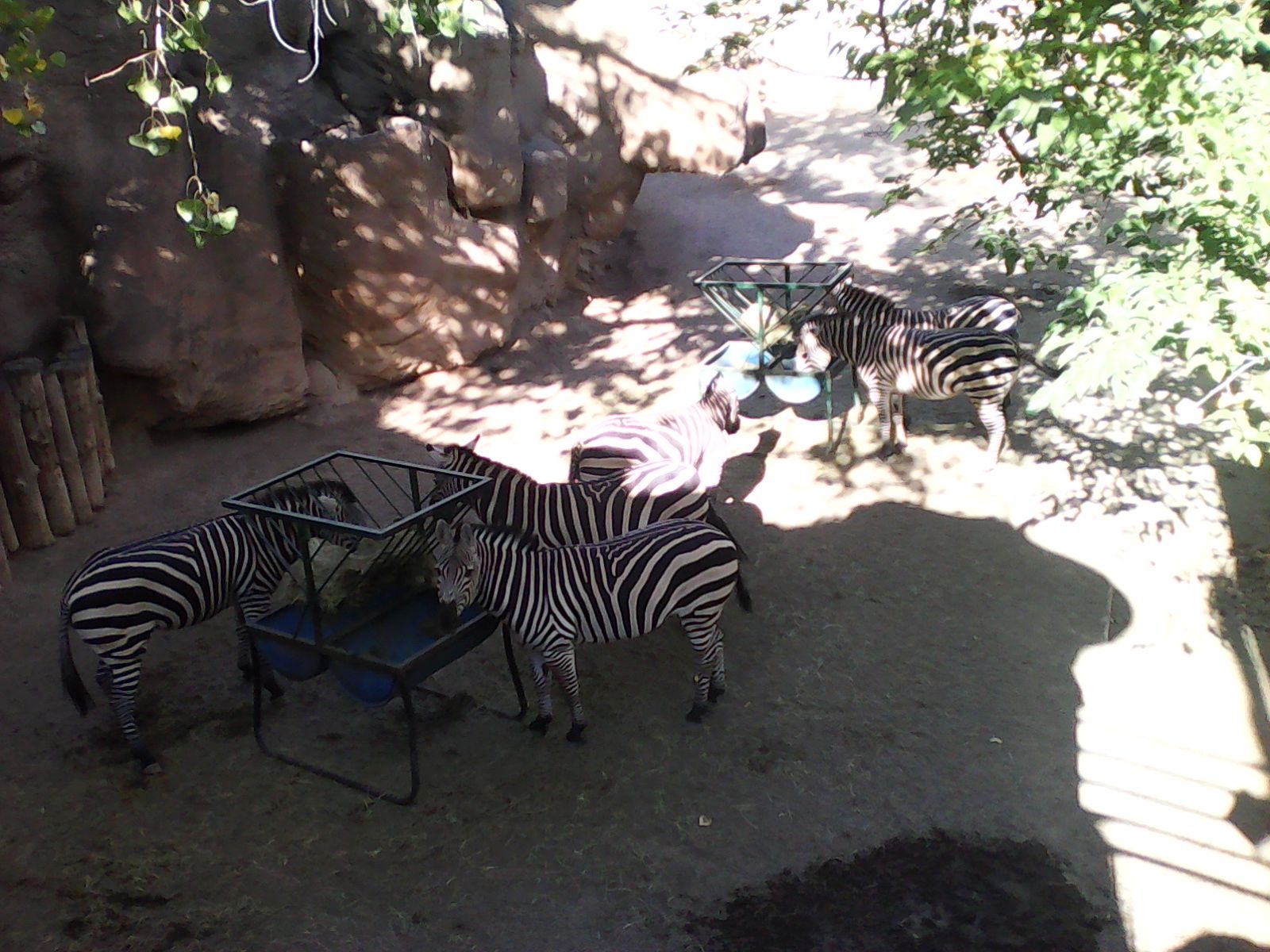
Grant's Zebra. I'd like to know who this Grant fellow was. Every zoo I go to, he's donated zebras. 


A hippo! 


The only primate I managed to see before closing, and at this point I was frantically trying to find a way out so men in carts didn't come after me. 

Although I'd planned to go downtown and look at a piece of 'pueblo deco' architecture, at this point I was so tired of walking the only thing I wanted to do was return back to my room.

And so, back up Central I went, passing under something claiming to be Rt. 66, home to rest up for Santa Fe and my last day in New Mexico.