Altered Carbon
© 2002 Richard K. Morgan
416 pages
Takeshi Kovacs, soldier-turned-commando-turned rogue, is rudely awakened with a job. Imprisoned for two hundred years, he’s now being offered the chance of parole if he can solve a murder. Or should it be attempted murder? The victim’s head was blown off, but being rich, a backup copy of his consciousness was simply downloaded into a waiting clone. You can do that in the future, you know: your consciousness is stored on a chip within your neck, and if you die...well, if you’ve the means your friends or family can just copy your consciousness into any available body. (There’s likely to be quite a few, since people imprisoned go into digital storage, their bodies rented out.) Kovacs’ patron is an exceedingly long-lived and unthinkably rich fellow who wants to find out who killed him, and why they tried to mock it up like a suicide. Although Kovacs has never been to Earth before, between his past service in the interstellar military and his training, he’s more than prepared to learn what he needs and solve the mystery. As cynical as he is, however, Kovacs is about to enter a story grimier than he could have imagined.
I’ve been in a science fiction mood as of late, and recently watched Altered Carbon on Netflix in its entirety. Finding and reading the original novel was an obvious followup, although the background of Tak and of the chief antagonist vary quite a bit between the mediums. What hasn’t changed is the main plot and premise: in this future, human civilization is interplanetary, but the few who need to travel between settled worlds do so by transferring their consciousness to a body-for-hire (a "sleeve") there. Tak is an expert in sleeve-switching, having done it professionally and usually with a dose of psychotropics that inhance intelligence, creativity, etc. A manufactured killer, Tak has enormous incentive to figure out what who tried to kill his patron -- especially when he narrowly escapes being killed by a squad of hitmen at his hotel. They knew him by name, despite the fact he's never been on planet and has been on ice for quite some time.
Although Tak's personality is not exactly winsome, he does have allies, chiefly a cop who keeps showing up. Kristin Ortega has her own reasons for shadowing Tak: he doesn't know it, but he's wearing the body of her boyfriend, imprisoned on suspicion of being a bent cop. Together they explore a story and a world saturated in sex and violence. It turns out that when you live for century after century, there's really no limit to how depraved you can get. Frankly, it makes for disgusting reading at times, and I continued with the show and the book only because the premise was and continues to be...well, absorbing. The chip integrated into the neck -- the cortical stack -- doesn't just allow for immortality for those with the means and the desire. It allows people to spend time in virtual realities -- sometimes against their will, as those being interrogated know. The cortical stack expands the human potential for experience: not only can people explore different bodies, but drugs can be fine-tuned for their specific metabolism. All this available pleasure creates an atmosphere of jadedness, however, not of contentment, and the sad restlessness that permeates the world here is not all that unfamiliar. The detective story, when it's not submerged in blood, sex, and sadism, is genuinely interesting -- even considering that I'd already experience the story. The antagonist has a special connection to Tak in the Netflix series which makes their interactions with Tak all the more tragic in the endgame, but that relationship is absent here, and...well, it makes things less intense.
Despite the frequent...unpleasantness, I imagine Altered Carbon will be one of those books I can't forget about at the end of the year. I don't think I'll be continue in the series, though -- the sex and violence are too detailed for my tastes.
German title, just because it looks cool:
Pursuing the flourishing life and human liberty through literature.
"Once you learn to read, you will be forever free." - Frederick Douglass
Showing posts with label thriller. Show all posts
Thursday, June 6, 2019
Wednesday, June 5, 2019
Kill Decision
Kill Decision
© 2012 Daniel Suarez
512 pages
Seemingly every day people within the United States are killed, destroyed in apparent bomb attacks. The victims have no obvious connections, but they are not random – nor were they bomb victims. A new generation of cheap, lethal drones are waging an undeclared war on American soil, and no one knows who is behind them. Enter Linda McKinney, a young American scientist, whose study of weaver ants in Africa was interrupted when she was kidnapped, shortly before her cabin was incinerated. McKinney hasn’t been abducted by terrorists, however: she is the last hope of a black ops organization hunting for the drones’ controllers. The few leads they have indicate that the same people who stole software allowing for the drones’ facial recognition software also copied McKinney’s research into swarm intelligence.
Kill Decision is a horse of a different color from Suarez’ other works: although still a mix of technothriller and science fiction, there’s far less speculation here than in Change Agent and Freedom. Frankly, the plot of Kill Decision seems like the sort of thing that could happen this afternoon. I’ll admit to not being up to date on the latest drone technology, but given the current status of facial recognition technology, machine intelligence, and the price of consumer electronics....the premise of Kill Decision is speculative only in the “What if this did happen” sense, and not the “What if this could happen” sense. The novel follows the un-named group investigating the drone attacks as their efforts to get to the root of the problem only increase in the planned-for campaign being ramped up, leading to a prolonged action sequence where the chasee- and chaser swap places several times, with brief interludes between the bloody chaos.
Although drones aren’t a particular interest of mine, Kill Decision succeeded in keeping my attention, in part because the drones’ behavior strongly mimics that of...weaver ants, complete with using chemical compounds for swarm communication. The drones of Kill Decision have total autonomy behind their prescribed targets, evaluating and taking care of unexpected threats on the fly. The drones combine the innate horror of swarm insects with the cold dread of being hunted most effectively, especially when the team encounters the base of operations.
Although I hadn't intended to read Suarez' remaining works, both of are beyond the near-future subgenre I most prefer, having read so much of him recently has me itching to give one of them a try, if only to experience more of the author!
Thursday, May 30, 2019
Change Agent
Change Agent
© 2017 Daniel Suarez
417 pages
Deep into the 21st century, global civilization has been transformed by bioengineering. Consumer products which were once manufactured are now grown, from knives to car bodies; the streets are illuminated not by bulbs, but by bacteria; and lab-grown meat is common. Although gene editing has also been used to cure several prominent diseases in human babies, parents are increasingly interested in going beyond repair: they want to make their children into designer augments, with heightened intelligence, physical strength, and so on. Enter Kenneth Durand, who uses statistical analysis to figure out where "baby labs" are so that the police can shut them down. But the many labs shut down by Durand's ingenuity aren't independent operations: they're all run by the same criminal enterprise, and they - -the Huli jing -- will have their revenge in a most insidious way. A violent encounter at a train station leaves Durand writhing on the platform, and he wakes up weeks later -- after a prolonged period of intense pain and semi-consciousness -- to find himself transformed. His own genes have been edited to make him into the monster he was chasing. Friendless and the subject of an international manhunt, a once pacifistic statistician must find new strength within himself as he escapes police custody and descends into the underworld looking for answers and a way to reclaim his identity.
First of all, there's a lot of really cool things going on in the background here. Logistical drone lanes, for one: there are so many commercial drones that they've been given air lanes to travel in, just like airplanes. Screen interfaces are largely a thing of the past; as most people have the means to have images cast directly into their eyes. (This can be a nuisance, with the advertisements, but there are countermeasures.) All this advanced technology makes Durand's life considerably more difficult after he's branded a criminal; one push notification from the police and a crowdsourced manhunt makes it impossible for him to move in civilized society. He does, however, have one asset: the criminal whose body he's inhabiting happens to be incredibly intimidating, and since he wasn't expected to survive the transformation (the gang wanted the police to think their most-wanted man had been assassinated) , there have been no countermeasures put in place to stop Durand from taking advantage of his appearance. Once the Huli jing realize he's escaped and on the move, another product of bioengineering is tasked with hunting him down.
Using CRISPR and succeeding technology opens up a world of possibilities, and Suarez explores both the good and bad. Durand's journey will culminate in discovering horrors he couldn't imagine people capable of, though if he'd read Brave New World he wouldn't be so darkly surprised. Both the worldbuilding, and Durand's struggle to hold on to his identity -- trapped in another body, forced into doing things he'd never otherwise do -- succeed in creating a fast-moving and immersive tale of tomorrow.
© 2017 Daniel Suarez
417 pages
Deep into the 21st century, global civilization has been transformed by bioengineering. Consumer products which were once manufactured are now grown, from knives to car bodies; the streets are illuminated not by bulbs, but by bacteria; and lab-grown meat is common. Although gene editing has also been used to cure several prominent diseases in human babies, parents are increasingly interested in going beyond repair: they want to make their children into designer augments, with heightened intelligence, physical strength, and so on. Enter Kenneth Durand, who uses statistical analysis to figure out where "baby labs" are so that the police can shut them down. But the many labs shut down by Durand's ingenuity aren't independent operations: they're all run by the same criminal enterprise, and they - -the Huli jing -- will have their revenge in a most insidious way. A violent encounter at a train station leaves Durand writhing on the platform, and he wakes up weeks later -- after a prolonged period of intense pain and semi-consciousness -- to find himself transformed. His own genes have been edited to make him into the monster he was chasing. Friendless and the subject of an international manhunt, a once pacifistic statistician must find new strength within himself as he escapes police custody and descends into the underworld looking for answers and a way to reclaim his identity.
First of all, there's a lot of really cool things going on in the background here. Logistical drone lanes, for one: there are so many commercial drones that they've been given air lanes to travel in, just like airplanes. Screen interfaces are largely a thing of the past; as most people have the means to have images cast directly into their eyes. (This can be a nuisance, with the advertisements, but there are countermeasures.) All this advanced technology makes Durand's life considerably more difficult after he's branded a criminal; one push notification from the police and a crowdsourced manhunt makes it impossible for him to move in civilized society. He does, however, have one asset: the criminal whose body he's inhabiting happens to be incredibly intimidating, and since he wasn't expected to survive the transformation (the gang wanted the police to think their most-wanted man had been assassinated) , there have been no countermeasures put in place to stop Durand from taking advantage of his appearance. Once the Huli jing realize he's escaped and on the move, another product of bioengineering is tasked with hunting him down.
Using CRISPR and succeeding technology opens up a world of possibilities, and Suarez explores both the good and bad. Durand's journey will culminate in discovering horrors he couldn't imagine people capable of, though if he'd read Brave New World he wouldn't be so darkly surprised. Both the worldbuilding, and Durand's struggle to hold on to his identity -- trapped in another body, forced into doing things he'd never otherwise do -- succeed in creating a fast-moving and immersive tale of tomorrow.
Tuesday, May 21, 2019
Freedom™
Freedom™
© 2010 Daniel Suarez
416 pages
The global economy is crashing, nearing its end, but few are willing to recognize it. The sinking markets, soaring inflation and unemployment, and civil chaos are regarded by those in power as merely another hiccup, one which can be weathered out with enough money thrown at the problem. But away from the old centers of power, inside server rooms and sewer tunnels, a new order is being created -- one driven by the vision of a legendary AI programmer, now deceased, whose death triggered the activation of a distributed AI intelligence which -- in the events of Daemon -- began spreading and recruiting human agents to effect its will. In the midst of a global depression, many are dropping out of the old economy and tuning into another: the darknet economy of the Daemon, But the one cannot tolerate the other, and in Freedom™, we witness their final grapple.
Both Daemon and Freedom™ are all kinds of interesting; the former, for its technical premise; the latter, for its sociological premise. The Daemon has evolved from the first novel, though I don't want to go into many details for fear of spoiling anything. Suffice it to say....the cold, ominous voice in the head no longer stars here, but rather what it and its human recruits have created does. The distributed intelligence of the Daemon is becoming a distributive economy and democracy, one counter to the globalized commercial order. The imprint of the Daemon's creator, Sobol is still very strong, as agents are ranked by classes and levels and given quests to fulfill; those who succeed gain levels and access to additional technological abilities made possible by the augmented reality that Daemon agents live in. However, the members of this new society also guide its goals, and the quest of a main character is to prove that humanity merits freedom rather than total control by the Daemon.
Any adult will recognize the imprint of the 2008 recession on this book, from the anxiety and fear over the economic future to the outrage over abuses of corporate power. Anti-corporatism pervades this book, in part because their greed and corruption has created the global crisis-- not just the inflation and such, but increasing fragility of people and nations, depending on as they do delicate ribbons of trade and a steady stream of raw materials mined without a thought to the future. The corporate powers also target the darknet counter-economy, fighting against it through means both subtle and obvious. As with Daemon, I truly didn't know where the novel was going to end until we'd arrived. What's most fascinating about Freedom, though, is Suarez' implied argument about the inherent fragility of global society and the need for social structures which are more resilient.
Daniel Suarez is so effective a writer that after I finished this, I started reading Daemon again -- just to experience the chilling birth of the series once more. I've gotta see if Suarez's craft is so strong when he's not basing his story on his experience as a network engineer and D&D dungeonmaster, and so I have purchased his Kill Decision and Change Agent, tech thrillers about autonomous drones and biotech respectively.
Related:
Triangulation interview with Suarez about his book "Change Agent"; extensive interview which goes into the writing of Daemon and Freedom.
© 2010 Daniel Suarez
416 pages
The global economy is crashing, nearing its end, but few are willing to recognize it. The sinking markets, soaring inflation and unemployment, and civil chaos are regarded by those in power as merely another hiccup, one which can be weathered out with enough money thrown at the problem. But away from the old centers of power, inside server rooms and sewer tunnels, a new order is being created -- one driven by the vision of a legendary AI programmer, now deceased, whose death triggered the activation of a distributed AI intelligence which -- in the events of Daemon -- began spreading and recruiting human agents to effect its will. In the midst of a global depression, many are dropping out of the old economy and tuning into another: the darknet economy of the Daemon, But the one cannot tolerate the other, and in Freedom™, we witness their final grapple.
Both Daemon and Freedom™ are all kinds of interesting; the former, for its technical premise; the latter, for its sociological premise. The Daemon has evolved from the first novel, though I don't want to go into many details for fear of spoiling anything. Suffice it to say....the cold, ominous voice in the head no longer stars here, but rather what it and its human recruits have created does. The distributed intelligence of the Daemon is becoming a distributive economy and democracy, one counter to the globalized commercial order. The imprint of the Daemon's creator, Sobol is still very strong, as agents are ranked by classes and levels and given quests to fulfill; those who succeed gain levels and access to additional technological abilities made possible by the augmented reality that Daemon agents live in. However, the members of this new society also guide its goals, and the quest of a main character is to prove that humanity merits freedom rather than total control by the Daemon.
Any adult will recognize the imprint of the 2008 recession on this book, from the anxiety and fear over the economic future to the outrage over abuses of corporate power. Anti-corporatism pervades this book, in part because their greed and corruption has created the global crisis-- not just the inflation and such, but increasing fragility of people and nations, depending on as they do delicate ribbons of trade and a steady stream of raw materials mined without a thought to the future. The corporate powers also target the darknet counter-economy, fighting against it through means both subtle and obvious. As with Daemon, I truly didn't know where the novel was going to end until we'd arrived. What's most fascinating about Freedom, though, is Suarez' implied argument about the inherent fragility of global society and the need for social structures which are more resilient.
Daniel Suarez is so effective a writer that after I finished this, I started reading Daemon again -- just to experience the chilling birth of the series once more. I've gotta see if Suarez's craft is so strong when he's not basing his story on his experience as a network engineer and D&D dungeonmaster, and so I have purchased his Kill Decision and Change Agent, tech thrillers about autonomous drones and biotech respectively.
Related:
Triangulation interview with Suarez about his book "Change Agent"; extensive interview which goes into the writing of Daemon and Freedom.
Wednesday, March 20, 2019
Magnificent Nine
Firefly: The Magnificent Nine
pub. 2019 James Lovegrove
384 pages
Jayne Cobb is not the most conventionally faithful man aboard the good ship Serenity; he did, after all, enter Mal's service for purely mercenary ends. But there's more to him than a surly hired gun; he is, as the show indicated, a man who works to support an ailing mother and brother. He has loyalties, and when he receives a wave from an old friend whose planet is being taken over by a criminal gang who ape Reavers,, that troth-keeping Jayne emerges. Though Serenity is, as usual, flying on a wing and a prayer, with little reserves in food, money, or ammunition, Mal is too good a man to pass up a hopeless cause involving fighting cretinous bullies. When the old flame reveals she has a daughter....named Jane....things get complicated.
Magnificeent NIne is a straightforward action tale, though replete with the fun banter one expects from the Firefly crew, and a couple of ridiculous situations. Lovegrove again displays a good grasp on the characters' voices and the interplay of their personalities; Zoe and Wash are especially fun, but of increasing interest in this book is that between Jayne and River. As with Lovegrove's previous novel, every member of Serenity has a role to play. I thoroughly enjoyed the story, as well as the deepening of Jayne Cobb.
pub. 2019 James Lovegrove
384 pages
Jayne Cobb is not the most conventionally faithful man aboard the good ship Serenity; he did, after all, enter Mal's service for purely mercenary ends. But there's more to him than a surly hired gun; he is, as the show indicated, a man who works to support an ailing mother and brother. He has loyalties, and when he receives a wave from an old friend whose planet is being taken over by a criminal gang who ape Reavers,, that troth-keeping Jayne emerges. Though Serenity is, as usual, flying on a wing and a prayer, with little reserves in food, money, or ammunition, Mal is too good a man to pass up a hopeless cause involving fighting cretinous bullies. When the old flame reveals she has a daughter....named Jane....things get complicated.
Magnificeent NIne is a straightforward action tale, though replete with the fun banter one expects from the Firefly crew, and a couple of ridiculous situations. Lovegrove again displays a good grasp on the characters' voices and the interplay of their personalities; Zoe and Wash are especially fun, but of increasing interest in this book is that between Jayne and River. As with Lovegrove's previous novel, every member of Serenity has a role to play. I thoroughly enjoyed the story, as well as the deepening of Jayne Cobb.
Wednesday, December 26, 2018
The Reckoning
The Reckoning
© 2018 John Grisham
432 pages
On an otherwise unremarkable autumn morning in rural Mississippi, an idolized war hero traveled from his farm into town, visited the preacher, and shot him. The sheriffs found the shooter patiently waiting for them on his front porch, where he offered neither resistance nor explanation. The entire town is dumbfounded to see two of its favorite sons turn on one another so inexplicably, and in a way that will destroy the families as the criminal trial and then a wrongful death trial wear on. The trials here are quick and brutal; instead, the meat of The Reckoning lies in an account of the Bataan Death March and the plight of two children whose lives and homes are destroyed by their parents' decisions.
Say what you will about The Reckoning, but it's decidedly different from anything else Grisham has written, set completely in the 1940s and featuring an aspect of the Pacific War (American resistance in the Philippines to Japanese occupation) few will be familiar with. The first third of the novel addresses the immediate consequences of the preacher-killing, before shifting several years prior, to tell the story of a country farmer turned jungle commando, who barely survived the Bataan death march and escaped to take up with American and Filipino soldiers in the mountains who were engaged in guerilla warfare against the Japanese occupational forces. The novel then shifts back to the aftermath of the killing and the trials, which....is about as uplifting as reading about the Japanese torturing and starving thousands of men after Bataan. That bit in the middle about the resistance was nice, though.
I can't deny that I enjoyed reading The Reckoning -- I only received it Christmas morning and now write this less than 24 hours later, like a few other Grisham reads over the years. The first two thirds are unexpected, and with all the Faulkner references (characters are constantly reading him, and the writer himself appears as a minor character) I thought Grisham might produce a completely unexpected conclusion. Why did the hero shoot the preacher? Was this the hero's way of immolating himself for not living up to his own legend, and taking another secret ne'er do well with him? Was the preacher a Japanese sympathizer? In the end it comes down to a very old story, which is unsatisfying given how depressing the novel was as it reached the conclusion.
While I was appropriately intrigued and riveted by The Reckoning, it's mostly melancholy.
© 2018 John Grisham
432 pages
On an otherwise unremarkable autumn morning in rural Mississippi, an idolized war hero traveled from his farm into town, visited the preacher, and shot him. The sheriffs found the shooter patiently waiting for them on his front porch, where he offered neither resistance nor explanation. The entire town is dumbfounded to see two of its favorite sons turn on one another so inexplicably, and in a way that will destroy the families as the criminal trial and then a wrongful death trial wear on. The trials here are quick and brutal; instead, the meat of The Reckoning lies in an account of the Bataan Death March and the plight of two children whose lives and homes are destroyed by their parents' decisions.
Say what you will about The Reckoning, but it's decidedly different from anything else Grisham has written, set completely in the 1940s and featuring an aspect of the Pacific War (American resistance in the Philippines to Japanese occupation) few will be familiar with. The first third of the novel addresses the immediate consequences of the preacher-killing, before shifting several years prior, to tell the story of a country farmer turned jungle commando, who barely survived the Bataan death march and escaped to take up with American and Filipino soldiers in the mountains who were engaged in guerilla warfare against the Japanese occupational forces. The novel then shifts back to the aftermath of the killing and the trials, which....is about as uplifting as reading about the Japanese torturing and starving thousands of men after Bataan. That bit in the middle about the resistance was nice, though.
I can't deny that I enjoyed reading The Reckoning -- I only received it Christmas morning and now write this less than 24 hours later, like a few other Grisham reads over the years. The first two thirds are unexpected, and with all the Faulkner references (characters are constantly reading him, and the writer himself appears as a minor character) I thought Grisham might produce a completely unexpected conclusion. Why did the hero shoot the preacher? Was this the hero's way of immolating himself for not living up to his own legend, and taking another secret ne'er do well with him? Was the preacher a Japanese sympathizer? In the end it comes down to a very old story, which is unsatisfying given how depressing the novel was as it reached the conclusion.
While I was appropriately intrigued and riveted by The Reckoning, it's mostly melancholy.
Thursday, June 21, 2018
Daemon
Daemon
© 2006 Daniel Suarez
444 pages
When a incomparable programming genius known for his immersive games and uncanny AI dies, his greatest creation awakes. A sophisticated program running in the background begins putting into action a plan that will remain unknown to the reader throughout most of the novel, hidden except for when its actions result in death or global panic. So begins a technological thriller, featuring a faceless enemy which grows more daunting by the moment as it steadily increases its power, imposing a new technological order over a world that has grown too complex for its own good. The world is to be reprogrammed, and resistance is futile.
The kernel of Daemon's story is that a doomed genius (Matthew Sobol) once courted by the NSA created a program which scanned the news for announcement of his death, and then began a hostile takeover of anything powered by silicon chips. Effecting the deaths of opponents, recruiting human agents through a video game, taking over computerized systems and using their resources for its own expansion, it lurks in the background except for when it issues press releases to manipulate public reaction. The Daemon's greatest strength is that it is a distributed program, a global botnet; it has no master server to destroy, no switch which can be thrown. The Daemon is autonomous, persistent, and pervasive. When it sends instructions to its human agents through wireless headsets, it concentrates its demands for action into YES/NO prompts. While Sobol presumably could have created an AI that can parse spoken sentences, the nature of this machine-human communication makes the Dameon seem like an alien intelligence, instead of a naughty instance of Alexa.
As the story progresses, readers encounter a pair of battered men who are trying to unravel the Daemon and expose it, as well as a few individuals who come agents of the Daemon. The Daemon entices them in different ways, each according to their ambitions: a sociopathic identity thief finds his calling in enlisting to the machine's service as its greatest champion, the Sauron to its Morgoth (or the Saruman to its Sauron, but without the initial resistance), and a criminal is given freedom, and a frustrated TV tabloid reporter is given the chance to become a Serious Journalist. All they have to do is listen to the remorseless voice in their head and follow its instructions. The Daemon's ability to manipulate systems grows throughout the novel, to the point where it controls physical infrastructure producing autonomous weaponized vehicles.
I had no idea that this book was written in 2006, as the amount of now mundane electronic control within it is perfectly in sync with our own world. The only clue that this novel had a few years on it was the Daemon's inability to parse complete sentences, but as mentioned that actually helped reinforced the Daemon's other-ness. Daemon is an unnerving thriller, one capable of unsettling the reader with the kind of world we're headed into, in which authentic freedom and privacy are as impossible as Triceratops flank steaks. As successful a thriller as it is, Daemon also succeeds in raising questions about how politics, society, and the economy will be transformed by ubiquitous networking; although it only offers a glimpse into early disruption, one can't help but think that the present state of affairs will be as alien in a century as early 19th century agrarian society is to our own.
Sidenote: Sobol was known for a World War 2 shooter and a game in which one opens the gates of hell. Sounds kiiiiiiiiiinda like Wolfenstein 3D and Doom. Considering that Sobol's company was named CyberStorm, I wonder if he was inspired by John Romero -- cocreator of the two programs mentioned above, and founder of a company called Ion Storm. (See Masters of Doom).
© 2006 Daniel Suarez
444 pages
SO YOU SAY YOU WANT A REVOLUTION
YES NO
When a incomparable programming genius known for his immersive games and uncanny AI dies, his greatest creation awakes. A sophisticated program running in the background begins putting into action a plan that will remain unknown to the reader throughout most of the novel, hidden except for when its actions result in death or global panic. So begins a technological thriller, featuring a faceless enemy which grows more daunting by the moment as it steadily increases its power, imposing a new technological order over a world that has grown too complex for its own good. The world is to be reprogrammed, and resistance is futile.
The kernel of Daemon's story is that a doomed genius (Matthew Sobol) once courted by the NSA created a program which scanned the news for announcement of his death, and then began a hostile takeover of anything powered by silicon chips. Effecting the deaths of opponents, recruiting human agents through a video game, taking over computerized systems and using their resources for its own expansion, it lurks in the background except for when it issues press releases to manipulate public reaction. The Daemon's greatest strength is that it is a distributed program, a global botnet; it has no master server to destroy, no switch which can be thrown. The Daemon is autonomous, persistent, and pervasive. When it sends instructions to its human agents through wireless headsets, it concentrates its demands for action into YES/NO prompts. While Sobol presumably could have created an AI that can parse spoken sentences, the nature of this machine-human communication makes the Dameon seem like an alien intelligence, instead of a naughty instance of Alexa.
As the story progresses, readers encounter a pair of battered men who are trying to unravel the Daemon and expose it, as well as a few individuals who come agents of the Daemon. The Daemon entices them in different ways, each according to their ambitions: a sociopathic identity thief finds his calling in enlisting to the machine's service as its greatest champion, the Sauron to its Morgoth (or the Saruman to its Sauron, but without the initial resistance), and a criminal is given freedom, and a frustrated TV tabloid reporter is given the chance to become a Serious Journalist. All they have to do is listen to the remorseless voice in their head and follow its instructions. The Daemon's ability to manipulate systems grows throughout the novel, to the point where it controls physical infrastructure producing autonomous weaponized vehicles.
I had no idea that this book was written in 2006, as the amount of now mundane electronic control within it is perfectly in sync with our own world. The only clue that this novel had a few years on it was the Daemon's inability to parse complete sentences, but as mentioned that actually helped reinforced the Daemon's other-ness. Daemon is an unnerving thriller, one capable of unsettling the reader with the kind of world we're headed into, in which authentic freedom and privacy are as impossible as Triceratops flank steaks. As successful a thriller as it is, Daemon also succeeds in raising questions about how politics, society, and the economy will be transformed by ubiquitous networking; although it only offers a glimpse into early disruption, one can't help but think that the present state of affairs will be as alien in a century as early 19th century agrarian society is to our own.
Sidenote: Sobol was known for a World War 2 shooter and a game in which one opens the gates of hell. Sounds kiiiiiiiiiinda like Wolfenstein 3D and Doom. Considering that Sobol's company was named CyberStorm, I wonder if he was inspired by John Romero -- cocreator of the two programs mentioned above, and founder of a company called Ion Storm. (See Masters of Doom).
Labels:
Daniel Suarez,
digital world,
science fiction,
thriller
Tuesday, June 19, 2018
The Switch
The Switch
© 2017 Joseph Finder
384 pages
Picture this. You're a senatorial aide whose boss is technologically illiterate enough to be dangerous. The senator's MacBook, containing information that was never supposed to leave the Senate offices, has been inadvertently switched with someone else's at an airport security checkpoint. The guy who mistook the senator's MacBook for his knows something is screwy, because when you tried to get it back you pretended to be someone else. Your clumsy attempt to hire an bagman from the Dark Net backfired when the target got nervous and ran over your employee. Now you're thinking this hapless owner of a failing coffee company is some sort of criminal mastermind, and he thinks he's being targeted by some cold-blooded Agent Smith type at Fort Meade. In reality, you're both goofballs not taken seriously by their wives and bosses, who have manged to turn an innocent mistake into a light action thriller which is accidentally funny, despite pitting secret government goons on opposing sides trying to kill a nice buffoon of a main character.
The Switch is...extremely light reading -- basically, what might happen if James Patterson tried a novel with cybersecurity and surveillance themes. I was often entertained by it, sometimes in ways not intended by the author. I would probably try the author again to see if the quality varies, but only for the mental equivalent of a lazy morning on the couch. I like the general premise of this novel, but the execution was often bizaare: one journalist character claims to have gotten Hillary Clinton's oatmeal cookie recipe from their whistleblower dropbox, and an NSA character refers to a flashdrive as something like a thingamabob. He was wearing cowboy boots and flannel at the time. I only got through that scene by pretending the NSA guy was playing some bizarre mind game with the main character that required him to pretend to be an insidious country bumpkin who can also delete all of your from Google, Facebook, and even your favorite craft beer website. (I'd wager a bottle of IPA that Finder has watched The Net at some point and thought it was worth borrowing liberally from.)
In short, The Switch is kind of like the Rush Hour movies -- kind of preposterous, but entertaining.
© 2017 Joseph Finder
384 pages
Picture this. You're a senatorial aide whose boss is technologically illiterate enough to be dangerous. The senator's MacBook, containing information that was never supposed to leave the Senate offices, has been inadvertently switched with someone else's at an airport security checkpoint. The guy who mistook the senator's MacBook for his knows something is screwy, because when you tried to get it back you pretended to be someone else. Your clumsy attempt to hire an bagman from the Dark Net backfired when the target got nervous and ran over your employee. Now you're thinking this hapless owner of a failing coffee company is some sort of criminal mastermind, and he thinks he's being targeted by some cold-blooded Agent Smith type at Fort Meade. In reality, you're both goofballs not taken seriously by their wives and bosses, who have manged to turn an innocent mistake into a light action thriller which is accidentally funny, despite pitting secret government goons on opposing sides trying to kill a nice buffoon of a main character.
The Switch is...extremely light reading -- basically, what might happen if James Patterson tried a novel with cybersecurity and surveillance themes. I was often entertained by it, sometimes in ways not intended by the author. I would probably try the author again to see if the quality varies, but only for the mental equivalent of a lazy morning on the couch. I like the general premise of this novel, but the execution was often bizaare: one journalist character claims to have gotten Hillary Clinton's oatmeal cookie recipe from their whistleblower dropbox, and an NSA character refers to a flashdrive as something like a thingamabob. He was wearing cowboy boots and flannel at the time. I only got through that scene by pretending the NSA guy was playing some bizarre mind game with the main character that required him to pretend to be an insidious country bumpkin who can also delete all of your from Google, Facebook, and even your favorite craft beer website. (I'd wager a bottle of IPA that Finder has watched The Net at some point and thought it was worth borrowing liberally from.)
In short, The Switch is kind of like the Rush Hour movies -- kind of preposterous, but entertaining.
Saturday, June 9, 2018
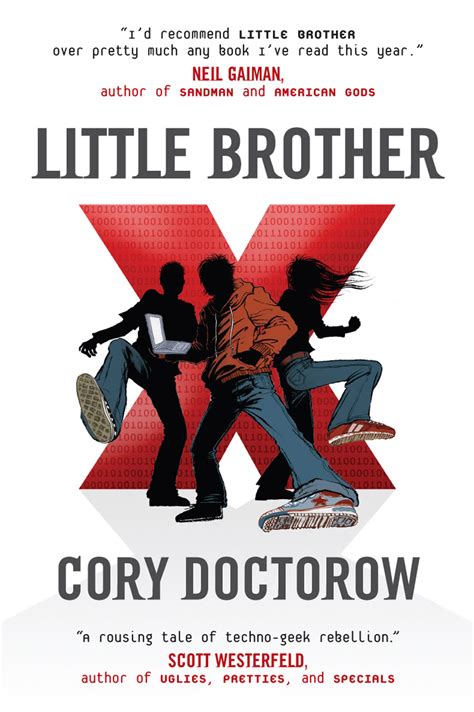
Little Brother
Little Brother
© 2008 Corey Doctorow
380 pages
Following the destruction of the Bay Bridge in San Francisco, a nightmare begins for a high school student who is scooped up by police in the aftermath. Not only has one of his friends been seriously wounded, but Marcus' presence near the bridge and his suspicious computer equipment make him a person of interest to the authorities, doubly so when he refuses to unlock or decrypt his devices and information for them. If he’s innocent, he has nothing to hide, right? But Marcus has been rebelling before this, mostly to elude his school’s draconian security measures. and his initial stubbornness turns into revolutionary resolve when he realizes that the authorities are not merely mistaken: they are malevolent. He seems doomed in the police state that San Francisco has become overnight, where the demonization of any dissent alienates Marcus from his family and friends, but there are other allies waiting in the wings, and they and his own resolve will spur him on.
So begins Little Brother, a man vs state story that combines the alienation and surveillance of 1984 with modern cybersecurity tools. At its best, Little Brother is a technologically savvy thriller, a defiant championing of civil liberties amid the war on terror, and a call to arms to readers to get serious about learning to defend themselves against abuse. This continues after the novel: there are several essays included after the story on the nature of security. At its worst, the arguments are one-sided, with only one attempt at mutual understanding. The security apparatus of the State is so extensive, however – both in the story in real life – that I can’t seriously begrudge Doctorow just wanting to fire up righteous indignation. Easily my favorite aspect of Little Brother was the pervasive cybersecurity information: Marcus doesn't just do things, but as a narrator he's conscious that he's speaking to an audience, and explains how encryption or whatever is he's doing at the moment works. Winston's intelligence as cyberpunk rebel extends not only to tech, but to the nature of resistance: he realizes that certain tactics will only strengthen the government's hand against him, so the trick is to find ways to keep them off balance -- sometimes by appearing to retreat.
Little Brother is an exceptional read, a smart thriller that takes its teen readers seriously. If you are concerned about the status of civil liberties across the world, the surveillance state, or curious about how tech can both amplify and mitigate the problem, it's one to take a look at.
The story's use of a couple of young dissidents who fall in love underground reminded me strongly of a song called "By Morning" by folk-punk songwriter Evan Greer. He wrote it in tribute to several young people who were imprisoned on charges of terrorism for harassing an animal testing lab. The song begins at 1:15.
And if they come for us by morning, with that "knock knock" on the door --
I'll hold you a little closer as they reach the second floor
And if I have to give my name, know I won't be giving yours
I'll run my hands through your hair, say it's them that's really scared
Because they know love is stronger than their bars can ever be.
Related:
© 2008 Corey Doctorow
380 pages
Following the destruction of the Bay Bridge in San Francisco, a nightmare begins for a high school student who is scooped up by police in the aftermath. Not only has one of his friends been seriously wounded, but Marcus' presence near the bridge and his suspicious computer equipment make him a person of interest to the authorities, doubly so when he refuses to unlock or decrypt his devices and information for them. If he’s innocent, he has nothing to hide, right? But Marcus has been rebelling before this, mostly to elude his school’s draconian security measures. and his initial stubbornness turns into revolutionary resolve when he realizes that the authorities are not merely mistaken: they are malevolent. He seems doomed in the police state that San Francisco has become overnight, where the demonization of any dissent alienates Marcus from his family and friends, but there are other allies waiting in the wings, and they and his own resolve will spur him on.
So begins Little Brother, a man vs state story that combines the alienation and surveillance of 1984 with modern cybersecurity tools. At its best, Little Brother is a technologically savvy thriller, a defiant championing of civil liberties amid the war on terror, and a call to arms to readers to get serious about learning to defend themselves against abuse. This continues after the novel: there are several essays included after the story on the nature of security. At its worst, the arguments are one-sided, with only one attempt at mutual understanding. The security apparatus of the State is so extensive, however – both in the story in real life – that I can’t seriously begrudge Doctorow just wanting to fire up righteous indignation. Easily my favorite aspect of Little Brother was the pervasive cybersecurity information: Marcus doesn't just do things, but as a narrator he's conscious that he's speaking to an audience, and explains how encryption or whatever is he's doing at the moment works. Winston's intelligence as cyberpunk rebel extends not only to tech, but to the nature of resistance: he realizes that certain tactics will only strengthen the government's hand against him, so the trick is to find ways to keep them off balance -- sometimes by appearing to retreat.
Little Brother is an exceptional read, a smart thriller that takes its teen readers seriously. If you are concerned about the status of civil liberties across the world, the surveillance state, or curious about how tech can both amplify and mitigate the problem, it's one to take a look at.
The story's use of a couple of young dissidents who fall in love underground reminded me strongly of a song called "By Morning" by folk-punk songwriter Evan Greer. He wrote it in tribute to several young people who were imprisoned on charges of terrorism for harassing an animal testing lab. The song begins at 1:15.
And if they come for us by morning, with that "knock knock" on the door --
I'll hold you a little closer as they reach the second floor
And if I have to give my name, know I won't be giving yours
I'll run my hands through your hair, say it's them that's really scared
Because they know love is stronger than their bars can ever be.
Related:
- 1984, George Orwell. Little Brother is commonly referred to as "1984 for the 21st century", which is a gross exaggeration. Even so, Little Brother makes numerous hat-tips to Orwell's dystopia beyond the surveilliance state: one of Marcus' online pseudonyms is pronounced "Winston", for instance.
- No Place to Hide, Glenn Greenwald. The story of Edward Snowden and the surveillance apparatus of the NSA.
Saturday, June 2, 2018
9 Dragons
9 Dragons
© 2009 Michael Connelly
544 pages
Harry Bosch doesn't know who they are. He doesn't know what they want. If they're looking for ransom, he doesn't have money, but he does have is a very particular set of skills, acquired over a long career, skills that make him a nightmare for people who might have abducted his daughter to threaten him away from a case involving a Hong Kong gang. If they don't let his daughter go, he will look for them, he will find them, and he will kill them. And he'll still close his case, because that's what Harry Bosch does. He takes down baddies and then he sits in the dark and listens to jazz.
9 Dragons is an unusual Harry Bosch novel in that it begins as a police procedural before quickly becoming an international action-adventure thriller. Usually, Harry is dealing with pedestrian scum of the earth -- rapists, robbers, etc -- but this time his investigation of an apparent robbery and homicide turns him on to a Chinese gang, one that imperils his ex-wife and daughter living in Hong Kong. He's definitely out of his element, away from his usual resources and forced to rely on people he would otherwise distrust: like an Asian Gang Unit cop who talks too much and his ex-wife's mysterious Chinese valet. Although the book is bookended as a procedural, with respect paid to the chain of evidence, laws, that sort of thing, the great in-between is a rip-roaring manhunt as Bosch tears through Hong Kong's underbelly looking for his daughter -- and adding to the pile of bodies he finds with his own freshly-minted ones. It really isn't smart to kidnap a street detective's daughter and try to sell her for organs, it really isn't.
I enjoyed 9 Dragons well enough as the action thriller it was, especially with the little cameo played by Mickey Haller (Connelly's other novel series character), but the intrigue of the initial case was quickly sidelined by the action itself. Still, Connelly kept my attention, and it can't be said that he gave Bosch a quick and easy shoot `em up solution: Bosch has to surrender his pound of flesh before all is said and done. The greatest appeal of this novel for me -- as someone who always imagines Liam Neeson in the role of Bosch -- was the ability to quote Taken while reading it.
© 2009 Michael Connelly
544 pages
Harry Bosch doesn't know who they are. He doesn't know what they want. If they're looking for ransom, he doesn't have money, but he does have is a very particular set of skills, acquired over a long career, skills that make him a nightmare for people who might have abducted his daughter to threaten him away from a case involving a Hong Kong gang. If they don't let his daughter go, he will look for them, he will find them, and he will kill them. And he'll still close his case, because that's what Harry Bosch does. He takes down baddies and then he sits in the dark and listens to jazz.
9 Dragons is an unusual Harry Bosch novel in that it begins as a police procedural before quickly becoming an international action-adventure thriller. Usually, Harry is dealing with pedestrian scum of the earth -- rapists, robbers, etc -- but this time his investigation of an apparent robbery and homicide turns him on to a Chinese gang, one that imperils his ex-wife and daughter living in Hong Kong. He's definitely out of his element, away from his usual resources and forced to rely on people he would otherwise distrust: like an Asian Gang Unit cop who talks too much and his ex-wife's mysterious Chinese valet. Although the book is bookended as a procedural, with respect paid to the chain of evidence, laws, that sort of thing, the great in-between is a rip-roaring manhunt as Bosch tears through Hong Kong's underbelly looking for his daughter -- and adding to the pile of bodies he finds with his own freshly-minted ones. It really isn't smart to kidnap a street detective's daughter and try to sell her for organs, it really isn't.
I enjoyed 9 Dragons well enough as the action thriller it was, especially with the little cameo played by Mickey Haller (Connelly's other novel series character), but the intrigue of the initial case was quickly sidelined by the action itself. Still, Connelly kept my attention, and it can't be said that he gave Bosch a quick and easy shoot `em up solution: Bosch has to surrender his pound of flesh before all is said and done. The greatest appeal of this novel for me -- as someone who always imagines Liam Neeson in the role of Bosch -- was the ability to quote Taken while reading it.
Harry Bosch. He likes brooding, jazz, and fighting with FBI agents over jurisdiction.
Labels:
Michael Connelly,
police-detective stories,
thriller
Monday, January 1, 2018
The Rooster Bar
The Rooster Bar
© 2017 John Grisham
352 pages
The third year of law school is supposed to be the easiest, but for Todd, Mark, and Zola...eh, not so much. Their best friend just committed suicide, leaving behind a tangled web of conspiracy on his apartment wall. Zola's Senegalese parents were just picked up by customs for deportation, the guys' families are likewise unstable, they're all unemployed, and between them they owe over half a million dollars in student loans. Not that all that debt has given them anything in return: half of their school's graduates fail the bar exam, a fact they've picked up on much too late. They're all a semester away from graduation, and after that loom the licensing exam and impossible loan payments With the banks holding all the aces, what's left to do but kick over the table?
Todd and Mark have an idea: stop going to law school, and start going to the courthouse to hustle cases, small fry that they can do cash jobs for, under assumed identities. With all of the lawyers crawling around DC, like rats in a landfill, who would know they didn't have licenses? They'll use their last student loans as startup money, hit the streets, and see if they can't scrape up a living. They were headed for bankruptcy anyway, so why not go for broke? The Rooster Bar follows the two guys (and Zola, who is distracted by her family and dubious about the scheme to the point that she never nets any cases) as they embark on a life of deceit, fraud, and confidence games, though one of them has a bigger fish in mind. The same company that owns their diploma mill also owns the bank they borrowed the money from, through the usual legal shell game that protects them from antitrust suits. The guys would love to take vengeance on the racket, not just for ruining their lives but from driving their friend to suicide. Surely there's a way.
Well, yes. It seems implausible, but as Grisham points out in his afterward, he played fast and loose with the facts for the story's sake. ("Especially the legal stuff,"says he. That's nice to know when it's a novel about the legal profession.) Although this is a fresh story -- and an interesting one, as readers see the characters having to learn the ropes -- the way it develops is not too dissimilar from The Litigators, in that some characters' ambitious idea goes...awry in a Wile E. Coyote fashion. Just like the Coyote, however, repeatedly falling off of cliffs, blowing up bombs next to their heads, and launching themselves into the stratosphere doesn't stop Todd and Mark from rebounding.
The Rooster Bar is more memorable than The Whistler, but I'd still put it near the bottom of the second tier, as far as Grisham books go. Good title, though.
© 2017 John Grisham
352 pages
The third year of law school is supposed to be the easiest, but for Todd, Mark, and Zola...eh, not so much. Their best friend just committed suicide, leaving behind a tangled web of conspiracy on his apartment wall. Zola's Senegalese parents were just picked up by customs for deportation, the guys' families are likewise unstable, they're all unemployed, and between them they owe over half a million dollars in student loans. Not that all that debt has given them anything in return: half of their school's graduates fail the bar exam, a fact they've picked up on much too late. They're all a semester away from graduation, and after that loom the licensing exam and impossible loan payments With the banks holding all the aces, what's left to do but kick over the table?
Todd and Mark have an idea: stop going to law school, and start going to the courthouse to hustle cases, small fry that they can do cash jobs for, under assumed identities. With all of the lawyers crawling around DC, like rats in a landfill, who would know they didn't have licenses? They'll use their last student loans as startup money, hit the streets, and see if they can't scrape up a living. They were headed for bankruptcy anyway, so why not go for broke? The Rooster Bar follows the two guys (and Zola, who is distracted by her family and dubious about the scheme to the point that she never nets any cases) as they embark on a life of deceit, fraud, and confidence games, though one of them has a bigger fish in mind. The same company that owns their diploma mill also owns the bank they borrowed the money from, through the usual legal shell game that protects them from antitrust suits. The guys would love to take vengeance on the racket, not just for ruining their lives but from driving their friend to suicide. Surely there's a way.
Well, yes. It seems implausible, but as Grisham points out in his afterward, he played fast and loose with the facts for the story's sake. ("Especially the legal stuff,"says he. That's nice to know when it's a novel about the legal profession.) Although this is a fresh story -- and an interesting one, as readers see the characters having to learn the ropes -- the way it develops is not too dissimilar from The Litigators, in that some characters' ambitious idea goes...awry in a Wile E. Coyote fashion. Just like the Coyote, however, repeatedly falling off of cliffs, blowing up bombs next to their heads, and launching themselves into the stratosphere doesn't stop Todd and Mark from rebounding.
The Rooster Bar is more memorable than The Whistler, but I'd still put it near the bottom of the second tier, as far as Grisham books go. Good title, though.
Thursday, October 19, 2017
Lockout
Lockout
© 2016 John J. Nance
412 pages
Something very strange is happening at 35,000 feet. A lost and unresponsive Airbus is feeding false data to its pilots, assuring them that they're halfway over the Atlantic and nearing New York, but any glance out the window tells the crew they're headed across France and seemingly towards Tel Aviv. The Airbus is carrying an ousted Israeli prime minister, who did everything he could to push Israel and Iran over the brink of war while in office. In DC, three intelligence agencies and the Department of Defense are scrambling over one another's toes and endangering innocent lives trying to figure out what's going on and what to do next. If the Airbus continues on its present course, it could very well pass over the border of Iran and trigger a nuclear war between the mullahs and the Israelis. Such is the story of Lockout, in which a couple of pilots and their passengers become the unwitting collateral damage of one or more black ops projects.
Confession: I didn't realize aviation thrillers were a genre. I've seen plenty of crisis-on-an-airplane movies course -- Air Force One, Taken, Flightplan, Nonstop, etc -- but didn't imagine that kind of drama could be rendered in books. Well, John Nance has certainly proven me wrong. Lockout's narrative takes readers through diplomatic intrigue, technical puzzles, street chases, counterespionage schemes, jet combat, and ordinary "whodunit" questions. The author, a Vietnam pilot turned airline pilot, doesn't shy away from putting his technical knowledge about jet aircraft to work; the key problem of the story is that computer controls over the Airbus have ceased to function, and manual control systems...well, those are soooooo 1980s. Restoring control of the plane to the pilots involves descending into the pit of the electronics bay and figuring out the power and wiring relays down there enough to interrupt the automatics without reducing the plane to a falling airframe. Admittedly, characters working through circuit logic with one another might not reach a large audience, so these scenes are only part of the ensemble of mystery. The main plot takes place over a matter of four hours, as several on-the-ground mysteries converge into the one -- a plane that delivered where it shouldn't have been, whose electrical work doesn't match Airbus specs, who had intelligence agencies looking for it before they even knew it was in trouble, and which might provoke World War 3. For fans of thrillers and airflight, this is a fun one.
© 2016 John J. Nance
412 pages
Something very strange is happening at 35,000 feet. A lost and unresponsive Airbus is feeding false data to its pilots, assuring them that they're halfway over the Atlantic and nearing New York, but any glance out the window tells the crew they're headed across France and seemingly towards Tel Aviv. The Airbus is carrying an ousted Israeli prime minister, who did everything he could to push Israel and Iran over the brink of war while in office. In DC, three intelligence agencies and the Department of Defense are scrambling over one another's toes and endangering innocent lives trying to figure out what's going on and what to do next. If the Airbus continues on its present course, it could very well pass over the border of Iran and trigger a nuclear war between the mullahs and the Israelis. Such is the story of Lockout, in which a couple of pilots and their passengers become the unwitting collateral damage of one or more black ops projects.
Confession: I didn't realize aviation thrillers were a genre. I've seen plenty of crisis-on-an-airplane movies course -- Air Force One, Taken, Flightplan, Nonstop, etc -- but didn't imagine that kind of drama could be rendered in books. Well, John Nance has certainly proven me wrong. Lockout's narrative takes readers through diplomatic intrigue, technical puzzles, street chases, counterespionage schemes, jet combat, and ordinary "whodunit" questions. The author, a Vietnam pilot turned airline pilot, doesn't shy away from putting his technical knowledge about jet aircraft to work; the key problem of the story is that computer controls over the Airbus have ceased to function, and manual control systems...well, those are soooooo 1980s. Restoring control of the plane to the pilots involves descending into the pit of the electronics bay and figuring out the power and wiring relays down there enough to interrupt the automatics without reducing the plane to a falling airframe. Admittedly, characters working through circuit logic with one another might not reach a large audience, so these scenes are only part of the ensemble of mystery. The main plot takes place over a matter of four hours, as several on-the-ground mysteries converge into the one -- a plane that delivered where it shouldn't have been, whose electrical work doesn't match Airbus specs, who had intelligence agencies looking for it before they even knew it was in trouble, and which might provoke World War 3. For fans of thrillers and airflight, this is a fun one.
Tuesday, August 29, 2017
Tyrannosaur Canyon
Tyrannosaur Canyon
© 2006 Douglas Preston
416 pages
What do a 'misplaced' lunar sample and a fossil hunter shot dead in the high mesas of New Mexico have in common? Their shared secret is one that would answer one of humanity's oldest questions...and threaten our extinction. Preston, who has traveled Arizona and New Mexico extensively on horseback, puts his intimacy with the landscape of the Four Corners to use here, leading readers through ancient and winding canyons, perfect for ambushes and plot twists.
For the most part, Tyrannosaur Canyon seems like a straightforward murder mystery, made perfectly interesting by its setting of paleontological intrigue. Before going the way of the dinosaurs, the slain fossil hunter conveys a message to a local, swearing him to secrecy and begging him to get a notebook of mysterious numbers to his daughter, Robbie. The notebook is coveted by the murderer and the man who hired him, and eventually by a retired CIA spook turned Benedictine novitiate, but when a mysterious organization armed with Predator drones surfaces, everyone realizes they're in over their heads. At stake is not a lusted-for paleontological prize, but something more dangerous -- so dangerous that it merits a black-ops detachment known only by a number to monitor and contain it.
Tyrannosaur Canyon found a happy audience in me for various reasons; its main character, who values his word more than his fear; the setting of New Mexico; the supporting character whose contribution was her scientific work, which was shown to the reader and not merely declared; and of course, the dinosaur angle. Science and mystery give way to action scenes halfway through, but there are four unfolding simultaneously, involving all the characters. Prolonged peril loses its point, but on the whole I enjoyed this first encounter with Preston's fiction.
Note: reading this and Dragon Teeth side by side was an accident. I started this one first, then a long-forgotten hold for Crichton's came in on Friday, with a short-term loan. Worked out well, though..
Related:
The Monkey Wrench Gang, also involving long chases in slot canyons.
© 2006 Douglas Preston
416 pages
What do a 'misplaced' lunar sample and a fossil hunter shot dead in the high mesas of New Mexico have in common? Their shared secret is one that would answer one of humanity's oldest questions...and threaten our extinction. Preston, who has traveled Arizona and New Mexico extensively on horseback, puts his intimacy with the landscape of the Four Corners to use here, leading readers through ancient and winding canyons, perfect for ambushes and plot twists.
For the most part, Tyrannosaur Canyon seems like a straightforward murder mystery, made perfectly interesting by its setting of paleontological intrigue. Before going the way of the dinosaurs, the slain fossil hunter conveys a message to a local, swearing him to secrecy and begging him to get a notebook of mysterious numbers to his daughter, Robbie. The notebook is coveted by the murderer and the man who hired him, and eventually by a retired CIA spook turned Benedictine novitiate, but when a mysterious organization armed with Predator drones surfaces, everyone realizes they're in over their heads. At stake is not a lusted-for paleontological prize, but something more dangerous -- so dangerous that it merits a black-ops detachment known only by a number to monitor and contain it.
Tyrannosaur Canyon found a happy audience in me for various reasons; its main character, who values his word more than his fear; the setting of New Mexico; the supporting character whose contribution was her scientific work, which was shown to the reader and not merely declared; and of course, the dinosaur angle. Science and mystery give way to action scenes halfway through, but there are four unfolding simultaneously, involving all the characters. Prolonged peril loses its point, but on the whole I enjoyed this first encounter with Preston's fiction.
Note: reading this and Dragon Teeth side by side was an accident. I started this one first, then a long-forgotten hold for Crichton's came in on Friday, with a short-term loan. Worked out well, though..
Related:
The Monkey Wrench Gang, also involving long chases in slot canyons.
Friday, July 14, 2017
Cell
Cell
© 2014 Robin Cook
416 pages
The future of medicine is here, in the form of a smartphone that can function as a medical diagnostic tool, complete with a machine-learning program called "iDoc" which monitors patients' diets and vitals, chatting with them about their health and prescribing advice or pills as appropriate. iDoc is poised to revolutionize medicine, reducing costs and focusing on long-term preventive care rather than crisis response. Why then, does a small but chronic percentage of its beta test group keep dying?
The premise is the most interesting part of Cell, and once it's absorbed early on everything else is downhill. The main character is a radiologist trying to cope with the sudden death of his fiance, and perhaps his grief keeps him distracted: as a main character goes, he's not particularly savvy. He's kind of dumb, in fact; at one point he's being transparently probed for info by a woman in a bar and is completely oblivious, despite the fact that he didn't seem all that interested in her to begin with. (Why is he even dating a couple of months after the love of his life died? Plot demands, I suppose.)
Fortunately for him, the 'bad guys' aren't really bad guys, they're just managing a problem and at the end of the day, everyone goes home happy despite deaths, car chases, kidnappings, and burglary; the main character's faint worries are taken care of by dropping a letter to a friend with the message "If anything happens to me, read this and do what you will" attached to a longer report. At the heart of the story Cook is embedded a serious question about medical ethics, one iDoc ignores with HAL-9000esque execution. Robin Cook seems to be a very popular author, so I may give him another try, focusing on his earlier work in which the medical thrills were more important than the author's brand name.
As thrillers go, this was an excellent premise that unfortunately flatlines once the stage is set.
© 2014 Robin Cook
416 pages
The future of medicine is here, in the form of a smartphone that can function as a medical diagnostic tool, complete with a machine-learning program called "iDoc" which monitors patients' diets and vitals, chatting with them about their health and prescribing advice or pills as appropriate. iDoc is poised to revolutionize medicine, reducing costs and focusing on long-term preventive care rather than crisis response. Why then, does a small but chronic percentage of its beta test group keep dying?
The premise is the most interesting part of Cell, and once it's absorbed early on everything else is downhill. The main character is a radiologist trying to cope with the sudden death of his fiance, and perhaps his grief keeps him distracted: as a main character goes, he's not particularly savvy. He's kind of dumb, in fact; at one point he's being transparently probed for info by a woman in a bar and is completely oblivious, despite the fact that he didn't seem all that interested in her to begin with. (Why is he even dating a couple of months after the love of his life died? Plot demands, I suppose.)
Fortunately for him, the 'bad guys' aren't really bad guys, they're just managing a problem and at the end of the day, everyone goes home happy despite deaths, car chases, kidnappings, and burglary; the main character's faint worries are taken care of by dropping a letter to a friend with the message "If anything happens to me, read this and do what you will" attached to a longer report. At the heart of the story Cook is embedded a serious question about medical ethics, one iDoc ignores with HAL-9000esque execution. Robin Cook seems to be a very popular author, so I may give him another try, focusing on his earlier work in which the medical thrills were more important than the author's brand name.
As thrillers go, this was an excellent premise that unfortunately flatlines once the stage is set.
Sunday, June 4, 2017
Zero Day
Zero Day
© 2011 Mark Russonovich
328 pages
328 pages
Two cybersecurity experts, both with government backgrounds, realize their current cases have a connection. The more they dig the more widespread the danger grows, and to their horror they realize what seems like an ordinary bit of digital vandalism is merely the prelude to a total infrastructure attack that is planned for the anniversary of September 11th. Computer systems in the United States and Europe -- from private PCs to those controlling ships and power plants -- are being hit with an array of distinct but related viruses, all of which have the simple goal of turning their targets into complete bricks. The effect on the west will be catastrophic when the full attack is released.
Zero Day is a technical thriller, with cyber-forensics constituting most of the book. The ending chapters are a brief switch into action, but on the whole only readers with a serious interest in computer crime stories should try. Unfortunately, those are the very readers who are liable to be annoyed by the multitude of electronic conversations here being rendered in highly abbreviated form, with so many missing vowels one might as well be reading Hebrew. There's also a bit of l33t speak, which -- seriously, is that still a thing? I enjoyed this book's sequel, Trojan Horse, far more, as it had more balanced characters (here we have evil Arabs, Russian hackers, and corrupt bureaucrats), and hope that means Russinovich continued to improve.
This completes my WannaCry-inspired sweep of books, although they've led me to an older history of the hacking community, publishyed in 1995.
WannaCry Sweep: The Dark Net | Kingpin | Countdown to Zero Day | Zero Day
Wednesday, May 31, 2017
Mind's Eye
© 2014 Douglas E Richards
362 pages
A man wakes in a dumpster, covered in blood. He has no idea who he is, but there are men trying to kill him. This dumped stranger isn't completely defenseless, however. he wakes to find the killers' and everyone else's minds wide open to him. He can read minds, and what's more, his brain has its own wireless connection, allowing him to dive into the internet and pull up any bit of information he needs, all without blinking. The man soon discovers himself to be the victim of an arrogant bioengineer whose motives are utterly sinister, and the fantastic expansion of his mental abilities will be desperately needed as the man flees and fights mercenaries, false friends, and the US military. At its best, The Mind's Eye offers a look at the fascinating possibilities and problems that widespread cranial implants could present humanity; at its worst, the writing veers to the awkward, and the villains indulge in those "I'm about to kill you, so why don't I tell you my ultimate plan?" kinds of speeches. (The uber-villian's ultimate motive is also wholly unbelievable -- the mad scientist/technocrat unmasks himself as a crusader for a completely unrelated cause, and there's been no hint, not even a shadow, of the other identity. )
The only reason I made it through this novel was the technical concept. I can only hope the characterization and dialogue improve in Richards' later novels..
362 pages
A man wakes in a dumpster, covered in blood. He has no idea who he is, but there are men trying to kill him. This dumped stranger isn't completely defenseless, however. he wakes to find the killers' and everyone else's minds wide open to him. He can read minds, and what's more, his brain has its own wireless connection, allowing him to dive into the internet and pull up any bit of information he needs, all without blinking. The man soon discovers himself to be the victim of an arrogant bioengineer whose motives are utterly sinister, and the fantastic expansion of his mental abilities will be desperately needed as the man flees and fights mercenaries, false friends, and the US military. At its best, The Mind's Eye offers a look at the fascinating possibilities and problems that widespread cranial implants could present humanity; at its worst, the writing veers to the awkward, and the villains indulge in those "I'm about to kill you, so why don't I tell you my ultimate plan?" kinds of speeches. (The uber-villian's ultimate motive is also wholly unbelievable -- the mad scientist/technocrat unmasks himself as a crusader for a completely unrelated cause, and there's been no hint, not even a shadow, of the other identity. )
The only reason I made it through this novel was the technical concept. I can only hope the characterization and dialogue improve in Richards' later novels..
Monday, March 20, 2017
The Big Sleep
The Big Sleep
© 1939 Raymond Chandler
277 pages
A dying old man who lives in a greenhouse, sustained only by its heat and the fear of his children shaming the family, has summoned Philip Marlowe for a job. The family is being blackmailed, and old man Sternwood wants Marlowe to find out who's doing it, what they've got on him, and to handle the actual paying-off if need be. Turns out the blackmailer is a local cretin mixed up with other lowlifes who want him dead, and what seems like a simple job will have Marlowe stumbling into a river of blood. The phrase 'big sleep' explicitly refers to death, the equalizer of punks and patricians alike, What is not dead is Chandler's writing; only PG Wodehouse rivals him for sheer prosaic fun. Having watched the movie months before didn't too much spoil the outcome here, as the stories develop somewhat differently. (One plus: Bogart did all of the narration while I read.) This is enormous fun as a noir thriller, in part because the narrator doesn't take anyone's games seriously. He has a job to do and his own sense of honor to abide by -- and no amount of coy women or thugs with guns is going to get him off the case.
Some early lines:
"I was neat, clean, shaved and sober, and I didn't care who knew it."
"I'm thirty-three years old, went to college once and can still speak English if there's any demand for it. There isn't much in my trade."
"I don't mind if you don't like my manners. They're pretty bad. I grieve over them during the long winter evenings."
"Neither of the two people in the room paid any attention to the way I came in, although only one of them was dead."
"Tsk, tsk," I said, not moving at all. "Such a lot of guns around town and so few brains. You're the second guy I've met within hours who seems to think a gat in the hand means a world by the tail."
© 1939 Raymond Chandler
277 pages
A dying old man who lives in a greenhouse, sustained only by its heat and the fear of his children shaming the family, has summoned Philip Marlowe for a job. The family is being blackmailed, and old man Sternwood wants Marlowe to find out who's doing it, what they've got on him, and to handle the actual paying-off if need be. Turns out the blackmailer is a local cretin mixed up with other lowlifes who want him dead, and what seems like a simple job will have Marlowe stumbling into a river of blood. The phrase 'big sleep' explicitly refers to death, the equalizer of punks and patricians alike, What is not dead is Chandler's writing; only PG Wodehouse rivals him for sheer prosaic fun. Having watched the movie months before didn't too much spoil the outcome here, as the stories develop somewhat differently. (One plus: Bogart did all of the narration while I read.) This is enormous fun as a noir thriller, in part because the narrator doesn't take anyone's games seriously. He has a job to do and his own sense of honor to abide by -- and no amount of coy women or thugs with guns is going to get him off the case.
Some early lines:
"I was neat, clean, shaved and sober, and I didn't care who knew it."
"I'm thirty-three years old, went to college once and can still speak English if there's any demand for it. There isn't much in my trade."
"I don't mind if you don't like my manners. They're pretty bad. I grieve over them during the long winter evenings."
"Neither of the two people in the room paid any attention to the way I came in, although only one of them was dead."
"Tsk, tsk," I said, not moving at all. "Such a lot of guns around town and so few brains. You're the second guy I've met within hours who seems to think a gat in the hand means a world by the tail."
Sunday, February 19, 2017
Drone
Drone
© 2013
432 pages
In El Paso, Texas, the raging narco-wars between drug trafficking gangs in Mexico has bled over into American streets -- claiming the life of the American president's son. Having run on a platform of balancing the budget and reversing foreign-policy foul-ups that have lost countless American lives and money overseas, President Meyers nevertheless realizes something has to be done. After diplomatic and above-board covert ops fail to produce results, she turns to an ex-CIA spook named Pearce, who is now the head of a private military contractor that specializes in combat drones. His deadly campaign against one drug cartel will stir up a hornet's nest of woes, because several factions within Mexico are being manipulated by an Iranian who is involved in a multinational conspiracy. More an intelligent technothriller than a Duke Nukem action-American novel, Drone offers speculation as to how drones might be employed -- and legally justified -- in the near future. Drones are depicted here not just providing recon and a platform to launch missiles, but sniping targets using facial-recognition software. Maden's presidential figure is an interesting character, a populist who achieved office by running against her own party and vowing to end endless foreign wars; she struggles to keep her desire for justice and order in line with a firm commitment to Constitutional government. A downside of the novel, but a necessary part of its drama, was the domestic chaos that erupts from Meyer's new policies toward Mexico. After the narco-gangs strike back and the border is functionally militarized, the media casts Meyers as an anti-Mexican tyrant, creating 'a day without immigrant' labor strikes, etc. Maden has a good mind for the diverse kind of political chaos imaginable in the United States today, but -- alas for those of us who read this presently -- that sort of chaos is going on now, so it's not enjoyable in the least to read about. Everyone in this novel has a little schmutz on their face, including the principled executive who can only take the least-worst option of a list of bad choices.
© 2013
432 pages
In El Paso, Texas, the raging narco-wars between drug trafficking gangs in Mexico has bled over into American streets -- claiming the life of the American president's son. Having run on a platform of balancing the budget and reversing foreign-policy foul-ups that have lost countless American lives and money overseas, President Meyers nevertheless realizes something has to be done. After diplomatic and above-board covert ops fail to produce results, she turns to an ex-CIA spook named Pearce, who is now the head of a private military contractor that specializes in combat drones. His deadly campaign against one drug cartel will stir up a hornet's nest of woes, because several factions within Mexico are being manipulated by an Iranian who is involved in a multinational conspiracy. More an intelligent technothriller than a Duke Nukem action-American novel, Drone offers speculation as to how drones might be employed -- and legally justified -- in the near future. Drones are depicted here not just providing recon and a platform to launch missiles, but sniping targets using facial-recognition software. Maden's presidential figure is an interesting character, a populist who achieved office by running against her own party and vowing to end endless foreign wars; she struggles to keep her desire for justice and order in line with a firm commitment to Constitutional government. A downside of the novel, but a necessary part of its drama, was the domestic chaos that erupts from Meyer's new policies toward Mexico. After the narco-gangs strike back and the border is functionally militarized, the media casts Meyers as an anti-Mexican tyrant, creating 'a day without immigrant' labor strikes, etc. Maden has a good mind for the diverse kind of political chaos imaginable in the United States today, but -- alas for those of us who read this presently -- that sort of chaos is going on now, so it's not enjoyable in the least to read about. Everyone in this novel has a little schmutz on their face, including the principled executive who can only take the least-worst option of a list of bad choices.
Labels:
Mexico,
military,
robots,
technology,
Technology and Society,
thriller
Thursday, December 29, 2016
The Whistler
The Whistler
© 2015 John Grisham
384 pages
The offices of the Board of Judicial Conduct rarely see excitement. Responsible for investigating claims of judicial abuse and defrocking offenders, their rowdiest target has been an old lech who forgot which bar he was a member of and attempted to seduce various women in the courtroom. But now a disbarred lawyer who represents a shadowy chain of confidants claims to have information that might expose the most corrupt judge in American history. According to the ex-lawyer, the mysterious robed one is in bed with a swamp gang, skimming millions from an Indian casino. After a series of deaths and disappearances, lead character Lacey Stolz and the BJC are forced to call in the FBI to help bring the errant judge and the conspiracy to justice. (Which they do, rather quickly.)
Although I faithfully read the latest Grisham book every year, I've been enormously disappointed in most of his recent works -- so much so that I didn't even look forward to trying this one, I merely cracked it open for tradition's sake. I'm happy to report that the book was not awful; it was even moderately enjoyable. Huzzah for mildness! Execution-wise there's not a like to brag about: forgettable characters, flat dialogue, and repetition. (Seriously, Lacy Stolz mentions how glad she is not to be married so many times that I hope Grisham's wife doesn't read this and think he's complaining vicariously.) On the bright side, the Board of Judicial Review is fresh ground for Grisham, and the extensive time spent on an Indian reservation is new as well. (Grisham did poke into this area in Ford County, but that was only one story.) Grisham also stays technologically relevant by having one character monitor a house break-in through an app on her phone. Best of all, though, the characters are not the abysmally awful cretins of Rogue Lawyer. They even have friends who like them.
The Whistler is a very vanilla sort of book; tasty enough not to put down, but not so compelling that it consumes the reader. It's genuine airplane/vacation reading, with a rushed ending in case boredom sets in.
© 2015 John Grisham
384 pages
The offices of the Board of Judicial Conduct rarely see excitement. Responsible for investigating claims of judicial abuse and defrocking offenders, their rowdiest target has been an old lech who forgot which bar he was a member of and attempted to seduce various women in the courtroom. But now a disbarred lawyer who represents a shadowy chain of confidants claims to have information that might expose the most corrupt judge in American history. According to the ex-lawyer, the mysterious robed one is in bed with a swamp gang, skimming millions from an Indian casino. After a series of deaths and disappearances, lead character Lacey Stolz and the BJC are forced to call in the FBI to help bring the errant judge and the conspiracy to justice. (Which they do, rather quickly.)
Although I faithfully read the latest Grisham book every year, I've been enormously disappointed in most of his recent works -- so much so that I didn't even look forward to trying this one, I merely cracked it open for tradition's sake. I'm happy to report that the book was not awful; it was even moderately enjoyable. Huzzah for mildness! Execution-wise there's not a like to brag about: forgettable characters, flat dialogue, and repetition. (Seriously, Lacy Stolz mentions how glad she is not to be married so many times that I hope Grisham's wife doesn't read this and think he's complaining vicariously.) On the bright side, the Board of Judicial Review is fresh ground for Grisham, and the extensive time spent on an Indian reservation is new as well. (Grisham did poke into this area in Ford County, but that was only one story.) Grisham also stays technologically relevant by having one character monitor a house break-in through an app on her phone. Best of all, though, the characters are not the abysmally awful cretins of Rogue Lawyer. They even have friends who like them.
The Whistler is a very vanilla sort of book; tasty enough not to put down, but not so compelling that it consumes the reader. It's genuine airplane/vacation reading, with a rushed ending in case boredom sets in.
"The covers are the same? ....make the new one red. They'll never know."
Wednesday, November 30, 2016
Conclave
Conclave
© 2016 Robert Harris
484 pages
Inside the Casa Santa Marta, the elders of Rome are again assembling to choose the next bishop of Rome, and thereby the governor of Catholics the world over. The Dean of the College of Cardinals labors in sadness prompted not only by the death of his friend and boss, but by the fact that he now has to manage the conclave of cardinals, in which over a hundred men are hidden in a secret chamber until such time as they elect St. Peter's successor. Although it is an election covered in the shroud of holiness, it is an election still, and the cardinals who vote are men of ambition. Their desires and foibles bring endless complication -- blackmail and simony do stir the pot -- leading to numerous dramatic shifts during successive ballots. The finale, which unfolds in a Europe smoldering under terrorist attack, includes another twist ending which proved an Achilles heel, for me. Anyone who has followed my reading here knows I read anything Harris writes, delighting in his diverse settings (Rome, Cold War Russia, Belle Epoque France...and so on!) Everything that lead ups to it was first-rate: the descriptions of places and processes within the Vatican usually hidden away, the arguments between the cardinals over what sort of man and what sort of direction were needed -- and then Harris has this Dan Brown, Angels and Demons moment in the last ten pages. Ah, well.
© 2016 Robert Harris
484 pages
Inside the Casa Santa Marta, the elders of Rome are again assembling to choose the next bishop of Rome, and thereby the governor of Catholics the world over. The Dean of the College of Cardinals labors in sadness prompted not only by the death of his friend and boss, but by the fact that he now has to manage the conclave of cardinals, in which over a hundred men are hidden in a secret chamber until such time as they elect St. Peter's successor. Although it is an election covered in the shroud of holiness, it is an election still, and the cardinals who vote are men of ambition. Their desires and foibles bring endless complication -- blackmail and simony do stir the pot -- leading to numerous dramatic shifts during successive ballots. The finale, which unfolds in a Europe smoldering under terrorist attack, includes another twist ending which proved an Achilles heel, for me. Anyone who has followed my reading here knows I read anything Harris writes, delighting in his diverse settings (Rome, Cold War Russia, Belle Epoque France...and so on!) Everything that lead ups to it was first-rate: the descriptions of places and processes within the Vatican usually hidden away, the arguments between the cardinals over what sort of man and what sort of direction were needed -- and then Harris has this Dan Brown, Angels and Demons moment in the last ten pages. Ah, well.
Labels:
Catholicism,
politics,
Politics-CivicInterest,
Robert Harris,
thriller
Subscribe to:
Posts (Atom)