Showing posts with label Kurt Vonnegut. Show all posts

Wednesday, November 5, 2014

Player Piano

Player Piano
© 1952 Kurt Vonnegut
352 pages

"I'd be in exile now, but everywhere's the same..."

     Not since the roaring twenties was American society so giddily obsessed with newfangled stuff than in the 1950s.  Americans were awash in material prosperity, filling their homes with labor-saving devices -- the future had arrived, buddy-boy, in gleaming chrome and with automatic controls. While some starry-eyed futurists looked forward to a world in which machines took care of all of the dirty work and left humans free to paint, compose, and ponder the mysteries of the cosmos, others saw a darker vision.  Player Piano casts a critical eye against the future machines might create, where mankind lingers in despair not from want of food, but want of purpose.

In this world, the entire economy is automated by massive plants of machinery, one per city, and so extensive is machining that most of the  population is functionally idle. Aside from an infinitesimally small group of people with jobs machines cannot usurp (among them, bartenders and barbers offering a friendly ear), the only truly employed people are the managerial elite, who run the machines and think up new ones.

Vonnegut escapes being predictable in that the misery of his novel is not a luddite view of poor, starving wretches denied wages because machines do their jobs more effectively. Indeed, the standard of living for Americans, from an economic point of view, has never been better. Taxes on capital support most of the population, who can have a world of consumer good before them for pennies. Their homes are filled with miraculous wonders that make our laundry machines and ovens look like Franklin stoves and washboards. Yet for all their material prosperity, the characters throughout the book are deeply miserable. The masses huddle in bars, drinking and talking about the good ol' days, when a man's work was worth something, while management tends to its machines and seeks relief from tedium in petty office politics.  

Main character Dr. Paul Proteus is a late-blooming reactionary; having been accepted by the managerial class, indeed being one of its most promising up-and-comers, he finds no satisfaction in his work and often steals over into the other part of town to sit in a bar, drink, and listen to chatter. Eventually he becomes a key figure in a revolution against the machines, as disgruntled people attempt to seize control of their lives again, to restore dignity and purpose to their work.

Player Piano is one of Vonnegut's earliest works, but for me the most poignant.  There are obvious marks of a writer beginning his craft;  the seams as Vonnegut switches from character to character are rough, and the revolution lacks a lot of dramatic punch.  Vonnegut's essential vision, however, has never been more potent;  there are many elements of the story that seem prophetic, but Vonnegut's predictions are more chilling than those of 1984's or Brave New World's because his world is so ordinary, not nearly as removed from our own as are those two dystopian classics. Player Piano's modernity is Plato's republic, realized in full, with the Machine set as the ultimate ideal form. People are judged by this ideal their entire lives long;  nothing matters except for the economy, and the computer analyzes them and determines their place within the economy, and by extension within society.  They are constiuent parts serving it.  In our own world,  even those applying for a job in fast food must submit to lengthy psychological assesstments of dubious merit, which are graded by no one but a machine, and whost will not even managers can contest.  We are beholden to systems that not even the operators understand fully, and no aspect of life escapes being reduced to the machine's standardized level.

In the end, the revolution of Player Piano is one against anomie and emasculation, an attempt to restore the striving to life. It provokes questions. How close are we to Player Piano's despair? How engaged in our lives are we?  Do we Live, or do we merely exist, producing and consuming -- does the work of our hands makes a difference? It is difficult these days not to be overwhelmed by the machine. We rely on them for entertainment, for sustenance, for validation. But people don't simply want to be administereds, clients of some system;  this race that conquered the world is filled with restless energy that must find some creative outlet, and  our souls contain greatness that cannot be contained by chronic subservience. Man yearns to be free, to act independently, to be the agent of his own prosperity.  It is a yearning ignored in Player Piano, and increasingly overlooked in our own world  of automated cars, canned music, factory food,  and a state that wants to take care of everything.

Ultimately, Player Piano is less a triumph than a tragedy, an ominous suggestion of the world to come.


Related:
The Sea Wolf, Jack London, with a similar theme of man's actualization in striving against the world on his own merits
Technopoly, Neil Postman, whose work was mentioned prior
Average is Over and The Glass Cage, two recent works on automation and social stratification by Tyler Cowan and Nicholas Carr
Compendium of the Social Doctrine, which calls for meaningful work.


Sunday, November 27, 2011

Timequake

Timequake
© 1997 Kurt Vonnegut
219 pages


Timequake may be the oddest novel I've ever read. Scratch that: it is the oddest novel I've ever read, but despite its utter lunacy I loved it anyway, because it is so much the product of its author. The tacit premise of Timequake is that in 2001, after billions of years of expansion, the universe hiccoughed, reversed its course to 1991, and then -- decided to continue expanding after all. Every being on Earth was forced to live out the last ten years of their life exactly as they had before. When free will kicks in again, everything goes to hell.

Vonnegut never tells the story of those relived years in away one might expect in a conventional novel. There's no setup; the Quake never happens within the plot. Instead, the reader is introduced to what happened by Vonnegut, and he continues to refer to it tangentially as he rambles merrily about whatever he likes, often using the consequence of the quake on those who lived through it to illustrate a point he's in the middle of making. Chapter divisions are utterly arbitrary, and Vonnegut will often stop to to introduce a random through before returning to the subject of his musings, which range widely from nostalgic thoughts about his family to opinions on faith and human community. A favorite section for me describes Vonnegut's labors to send some of his work to be edited. Rather than emailing or faxing it, he sends in a bundle of typewriter-produced pages and makes a jaunt downtown to fetch the appropriate stationary and postage, thoroughly enjoying his time out and about socializing with others. True, he could be efficient and use faxes or buy envelopes and stamps in bulk, but for Vonnegut that isn't the point. He valued the experience of human interaction, and ends the passage by declaring, "Listen! We're here on Earth to fart around. Don't let anyone tell you different."

Vonnegut is at times heartwarming and sometimes cynical, but he's always present. Kilgore Trout, his alter-ego, makes frequent appearances and Vonnegut works Trout's short stories -- usually with a cynical point -- into his own thoughts. Timequake is pure Vonnegut -- "talking lazily back and forth, almost buzzing like honeybees" with the reader --  and I would recommend it on that basis. If it's a proper story you want, and you've never read Vonnegut before, perhaps introducing yourself to him via Slaughterhouse-5 or Jailbird would be in order. If, however, Kurt Vonnegut's personality and humor have already appealed to you in times past, Timequake will satisfy enormously. To quote his uncle Alex, "If this isn't nice, what is?"

Friday, September 25, 2009

Fates Worse than Death

Fates Worse than Death
© 1990 Kurt Vonnegut
240 pages

Photobucket

Kurt Vonnegut’s Fates Worse than Death is a collection of semi-autobiographical essays that function as reflections of portions of Vonnegut’s life. The essay texts come chiefly from lectures given by Vonnegut, with comments from him before, during, and after the talks are finished. The threat of nuclear annihilation seems to hang over this book, and Vonnegut’s cynical jokes and comments create a whistling-in-the-graveyard effect. The setting of the lectures tends toward the 1980s, and there are many potshots taken at then-president Reagan, some better than others.

Vonnegut displays mixed feelings about the history and future of humankind: while lamenting about where we very well may be headed, he also scoffs at Reaganites who are obsessed with restoring some lost, golden time and brings up America’s history of social progress (the ending of slavery, universal suffrage, civil rights) to champion liberal progressivism’s cause. This might indicate a hopefulness on his part that things will get better still, but it might just be an attack on conservatism. I tend to think it’s both: no matter how despairing Vonnegut sounds, it always seems as if he has a little glimmer of hope he keeps in his pockets and takes out to look at every once and a while.

The book sees him amend his opinions about some matters -- the feasibility of “folk societies”, which he expressed in Wampeters, Foma, and Grandfallons. He still wishes they would work, he just accepts that their time has past and they weren’t really all that great in the first place. Vonnegut voices opinions on all manner of subjects. One of the more interesting essay-lectures was addressed to a Unitarian Universalist congregation in which Vonnegut spoke on the failures of Imperial Christianity (that is, Christianity based on doctrine and power-wielding organizations instead of smaller communities) and expressed his hopes that Unitarian Universalism would not destroy itself in a similar fashion. Other topics include "Occidental Meditation" (reading), war, pacifism, and work. This is a definite recommendation to Vonnegut fans, but to readers in general.

Sunday, June 21, 2009

Bagombo Snuff Box

Bagombo Snuff Box: Uncollected Fiction
© 1999 Kurt Vonnegut
295 pages

For some reason, I enjoy reading Kurt Vonnegut. I find his novels and most of the short stories I've read of his hard to follow, but I enjoy them still. I was delighted to find this book a collection of very readable short stories -- twenty-two, in fact, with an introduction by Vonnegut and a "Coda to my Career as a Writer for Periodicals" serving as literary bookends. He refers to them as a collection of "Buddhist catnaps". The stories seem to be of his early works (pre-1953), and their settings are diverse. One takes place in Czechoslovaka as the war ends, while most seem to be set in immediate or early post-WW2 America. There is at least one speculative fiction story covering the otherworldly results from the US military's attempt to put an intelligence operative into Earth orbit. Interestingly, three of the stories involve the same character -- a high-school band teacher whose obsession with winning every band competition he can provides fuel for conflict. There are a lot of interesting stories here --what happens a brutal Godfather-type character who pretends to be Santa Claus is one of them. Most of the stories seem to be sly commentary about some issue or another, but even without this they would be quite enjoyable. If you can find it, do give it a try.

Friday, November 28, 2008

Armageddon in Retrospect

Armageddon in Retrospect
© 2008 Kurt Vonnegut Jr. Trust
232 pages.

Reading and writing are in themselves subversive acts. What they subvert is the notion that things have to be the way they are, that you are alone, that no one has ever felt the way you have. What occurs to people when they read Kurt is that thigns are much more up for grabs than they thought they were. The world is a slightly difference place just because they read a damn book. Imagine that. - Mark Vonnegut

Armageddon in Retrospect, published posthumously, is Kurt Vonnegut's final collection of short stories and essays. A fan of Vonnegut recommended the book to me, although I probably would have read it anyway. (He works in the university library and so was able to check it out before I spotted it.) I had hoped the book is a collection of anti-war essays, but it is closer to a collection of short stories than a collection of essays. The book opens with a letter written from Vonnegut to his family during the war -- he fought during World War 2 for a few minutes before being captured by Germans during the Battle of the Bulge -- and a speech he gave, and all that follows is short stories.

Vonnegut's short stories tend to be hit and miss for me, although I did enjoy most included in this book. There were a couple that I read through without really understanding them, but they were happy exceptions. Most of the stories deal with the war in some form or another: in "Guns Before Butter", a gang of POWs are obsessed with food recipies, to the annoyance of their German supervisier; in "Brighten Up", Vonnegut tells the story of a prisoner-turned-collaborator; in "The Commandant's Desk", Vonnegut examines Amerian occupation. "The Commandant's Desk" is probably my favorite of the stories.

My favorite piece in the book is "Wailing Shall Be in All Streets", which is a nonfiction essay where Vonnegut describes the Dresdren bombing. All in all, rather interesting. I'm glad I read the book.

Thursday, October 30, 2008

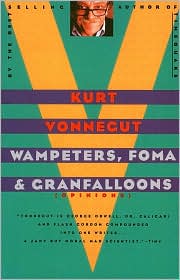
Wampeters, Foma, and Granfalloons

Wampeters, Foma, and Grandfollons (Opinions)
© 1974 Kurt Vonnegut
Bantam Doubleday Dell Publishing, NY

I began this week with a collection of essays by and interviews with the late Kurt Vonnegut entitled Wampeters, Foma and Granfalloons. The title confused my friendly community librarian. Vonnegut introduces the book with an explanation:

Dear Reader: The title of this book is composed of three words from my novel Cat's Cradle. A "wampeter" is an object around which the lives of many otherwise unrelated people may revolve. The Holy Grail would be a case in point. "Foma" are harmless untruths, intended to comfort simple souls. An example: "Prosperity is just around the corner." A "granfalloon" is a proud and meaningless association of human beings. Taken together, the words form as good an umbrella as any for this collection of some of the reviews and essays I've written, a few of the speeches I made.

The book is difficult to comment on, particularly the first half. Reading Vonnegut is like making your way through a literary funhouse -- you don't really know where you're going and the rules, if any, are completely unknown to you. So unpredictable is Vonnegut that when he wrote a chapter on his experience living in Biafra, I thought he had made up a country to make some human-interest point. As it turns out, Biafra was a real country. The book is a collection of various pieces of Vonnegut's work -- a few speeches, a book review, a short play, a travel account, and a few essays. Vonnegut comments: "It is, after all, a sort of map of places I've supposedly been and things I've supposedly thought during a period of about twenty years. I have arranged these clues in a supposedly chronological order. If time is the straight and uniform string of beads most people think it is, and if I have matured gracefully, then the second half of this book should be better than the first half."

It is difficult to characterize a compilation of miscellaneous works like this, but I did notice that a common idea seemed to penetrate Vonnegut's writing and interviews in the second half of the book -- the idea that human beings are meant to live in small social groups and that we are uncomfortable in other situations.

Until recent times, you know, human beings usually had a permanent community of relatives. They had dozens of homes to go to So when a married couple had a fight, one or they other could go to a house three doors down and stay with a close relative until he was feeling tender again. Or if a kid got so fed up with his parents that he couldn't standi t, he could march oer to his uncle's for a while. And this is no longer possible Each family is locked into its little box. The neighbors aren't relatives. Thyere aren't other houses where people can go to and be cared for. When Nixon is pondering what's happening to America -- "Where have the old values gone?" -- and all that -- the answer is perfectly simple. We're lonesdome. We don't have enough friends or relstives anymore. And we would if we lived in real communities. [...] Human beings will ber happier -- not when they cure cancer or get to Mars or eliminate racial prejudice or flush Lake Erie but when they find ways to inhabit primitive communities again. Thats' my utopia. That's what I want for me.

The above quotation is from his Playboy interview where he articulates this idea most directly. It reminds me of a lecture I heard recently by James Kunstler on "Life After Peak Oil": he predicts that as the automobile becomes a smaller part of our lives, communities will become smaller and life will become more local again -- back to small, intimate communities. Outside of this idea that pops up several times in the later half of the book, there's not that much cohesion to the book outside of the broad title he gave it. There are a number of pieces of interest:
  • "Science Fiction": Vonnegut recalls that he is categorized as a science fiction author simply because some of his stories feature technology. "I didn't know that. I supposed I was writing a novel about life. [...] I have been a soreheaded occupant of a file drawer labeled "science fiction" ever since, and I would like out, particularly since so many serious critics regularly mistake the drawer for a urinal."
  • "Yes, We Have No Nirvanas": Vonnegut writes about the rise of transcendental meditation. According to him, he looked into it after his wife and daughter became Transcendentals. He writes about his efforts to find out what it was about, and the essay turns into a critique of the "religion-that-is-not-a-religion-but-a-technique" and the Mariashi that created it. I found it humorous.
  • "Excelsior! We're Going to the Moon! Excelsior!": He writes on the space program's reception with people and science fiction. He quotes Isaac Asimov's perception that there are three stages to science fiction: adventure dominate, technoloy dominant, and sociology dominant.
  • "The Mysterious Madame Blavatsky": an essay on one of the founders of Theosophy that proved to be interesting.
  • "Biafra: A People Betrayed": This is Vonnegut's account of his experiences in Biafra, before it was conquered by the Nigerian army. I actually thought this essay was about a fictional place.
  • "Address to Graduation Class at Bennington College", 1970. Vonnegut describes becoming a cultural pessimist and instructs the graduating class to go back to believing that humanity is at the center of the universe, the greatest concern of the gods: perhaps then they will be motivated to treat people decency. (Speaking as a student of history, I can safely say that this won't work.) He also urges them to not buy into the idea that their generation must change the world: he tells them to relax, to "skylark", to enjoy life. One day they will be in charge, and then they can worry about saving the planet.
  • "Address to the National Institute of Arts and Letters, 1971": Vonnegut expounds on his idea that we are made of nothing more than chemicals that make us yearn for community.
    How lucky you are to be here today, for I can explain everything. Sigmund Freud admitted that he did not know what women wanted. I know what they want. Cosmopolitan magazine says they want orgasms, which can only be a partial answer at best. Here is what women really want: they want lives in folk societies, wherein everyone is a friendly relative and no act or object is without holiness. Chemicals make them want that. Chemicals make us all want that. Chemicals make us furious when we are treated as things rather than persons. When anything happens to us which would not happen to us in a folk society, our chemicals make us feel like fish out of water. Our chemicals demand that we get back into water again. If we become increasingly wild and preposterous in modern times -- well, so do fish on river banks, for a little while."
  • "In a Manner that Must Shame God Himself: reflections on politics.
  • "Address at Rededication of Wheateon College Library, 1973": Vonnegut writes on the importance of books and the meaning of social narratives.
  • Playboy Interview: one of the longest parts of the book.
As you can see, there's a lot here. I rather enjoyed the experience of reading it, particularly the interviews and speeches. I'll end this with one of my favorite quotations from the book. I don't know why I like it, but I do.

"You have called me a humanist, and I have looked into humanism some, and I have found that a humanist is a person who is tremendously interested in human beings. My dog is a humanist. His name is Sandy. He is a sheep dog. I know that Sandy is a dud name for a sheep dog, but there it is."

Wednesday, September 3, 2008

This Week at the Library (3/9)

Books this Update:
  • Jailbird, Kurt Vonnegut
  • The Ascent of Science, Brian Silver
  • Foundation and Empire, Isaac Asimov
  • It’s Been a Good Life, Isaac Asimov
  • For the Love of Life, Erich Fromm

I began this week by reading Kurt Vonnegut’s Jailbird, which I had not planned to read at first. I’ve read a little bit of Vonnegut before, although his fictional style is a unlike anything I’m used to. I picked up Jailbird and began to read through it: it seemed interesting, so I checked it out. The book is about a man named Walter F. Starbuck, a well-intentioned and little-appreciated bureaucrat in the Nixon White House, having earned a meaningless post by accidentally advancing Nixon’s career. Starbuck’s life is quite interesting, and the story of that life unfolds throughout the book as he or an author telling the story of his life recollects them -- think of the approach taken with Forrest Gump. In a very limited way, Gump and Starbuck’s stories are similar in that they are frequently and accidentally involved in the stories of history. The plot is much easier to understand than Slaughterhouse-5, although the latter is far more popular given that it’s a criticism of the Dresden firebombing. The story is quite interesting, as is the book. Oddly enough, even though it is a fiction book, it has an index. The book is described by Vonnegut through the voice of one of his characters as being about economics. Many of the characters’ lives are influenced by both the industrialists/capitalists and the socialist movement then present in the United States.

Last week I began reading Brian Silver’s The Ascent of Science, but didn’t finish it as it is rather lengthy and I was reading other books at the same time. Silver’s book is essentially a history of western science, but it is presented more as a history of scientific ideas -- the controversies they generated and the influence they had. The book, written for lay audiences, explains scientific concepts fairly well while maintaining an informal spirit. The author includes himself in the book, offering opinions and making comments. The book is written well, and Silver takes care to explain how scientific ideas influenced political and social history. Despite this, I would only recommend it over Ray Spangenburg and Kit Moser’s two series if you’re an adult who doesn’t want to be bothered with an entire series to start getting a handle on the wide world of science.

Last week I read Isaac Asimov’s Second Foundation and commented that it was set far enough apart from Foundation that there was probably a novel in between. There is -- Foundation and Empire. In Foundation and Empire, we see that the Foundation has grown into a large trading empire, and its elected “Mayors” have become autocrats -- which is resented by a sizeable group on the planet, who maintain a “democratic underground”. I wonder if that’s where that’s where the website of the same name gets it from. What’s left of the Galactic Empire vanishes in this book, but before the Foundation can capitalize on the opportunity, they are toppled by the Mule, a mutant who can his mind to inflict or induce strong emotions in people -- “hypercharismatic” is the way I described him last week. The book was an interesting read, although I think it’s the weakest of the trilogy.

Quotation of the Week:
“Know then thyself, presume not God to scan;
The proper study of mankind is Man.
Go Wond’rous creature, mount where Science guides.”
- Alexander Pope, "Esssay on Man", quoted in The Ascent of Science.

This post is a little unusual because of my return to Montevallo. I read the aforementioned books two weeks ago. Last week I was unable to post about them because of computer problems, but now I am online again. This past week, I read Isaac Asimov’s posthumous autobiography, It’s Been a Good Life. The autobiography was published by his wife, Janet Asimov, from text he had written and from his letters to her. Despite of the fact that it is a loose compilation, the book is put together well. Asimov’s style is perfectly engaging and is quite conversational. I enjoyed it thoroughly.

Lastly I read Erich Fromm’s For the Love of Life. Fromm was a German social critic, and I’m not quite sure how I found the book. The book is composed of essays by Fromm and interview transcripts, so the topic of the book drifts. The first part was about “Affluence and Ennui” and is essentially a critique of a society obsessed with consumerism. The book also contains a lot of psychoanalysis: Fromm maintains that various thought-systems -- the Judeo-Christian tradition, Zen Buddhism, Freudian psychology, and Marxism -- all inform his worldview. (Fromm is described as a humanistic philosopher, but I don’t think that refers to contemporary humanism: humanism means different things in different contexts, and the rational “life stance” of humanism would be a strange bedfellow to most of the systems he mentioned. I say most because I’m not that familiar with Zen Buddhism.)

My enjoyment of the book changed depending on which section I was reading. While I liked “Affluence and Ennui”, the bits on dream interpretation and the psychoanalysis of Adolf Hitler weren’t all that enjoyable. I’m very skeptical when it comes to dream interpretation and psychoanalysis. Given that our dreams are our thoughts, I’m sure they betray things about us. The level of analysis Fromm goes into is too much for me. One of the examples Fromm uses is one of Freud’s dreams. Freud dreamed about a white flower that was shriveled and behind a bell-jar. Freud wanted to give the flower to his wife, but he could not remove it from the bell-jar. This is supposed to mean that Freud had reduced sexuality -- the flower -- to a thing to be studied and so could not really enjoy it. I don’t follow the logic: is it supposed to be another instance of “unweaving the rainbow”? The analysis of Hitler was the same. Fromm’s conclusion was that Hitler was a necrophiliac and hated all living things, so he was possessed by this enormous urge to destroy.

Pick of the [Update]: It’s Been a Good Life, Isaac Asimov

Quotation of the Week: “To learn is to broaden, to experience more, to snatch new aspects of life for yourself. To refuse to learn or to be relieved at not having to learn is to commit a form of suicide; in the long run, a more meaningful type of suicide than the mere ending of physical life." - Isaac Asimov, It’s Been a Good Life.

Next Week:
  • When You Are Engulfed in Flames, David Sedaris. Sedaris is a comedian that I particularly enjoy. The title (for those of you whose curiosity has been piqued) comes from a translation error Sedaris observed while visiting Japan. I know this because he talked about it when promoting the book on The Late Show with David Letterman.
  • Me of Little Faith, Lewis Black. I like Lewis Black’s comedy, having become a fan of him via YouTube.
  • Carl Sagan: A Life by Keay Davidson. Carl Sagan is on my shortlist of “heroes”.
  • Survival in Auschwitz, Primo Levi. Required reading for one of my classes, but I'm reading it early as it looks interesting.

Monday, August 13, 2007

This Week At the Library (13/8)

Smellincoffee003: I read my first Harry Potter book today.
Potterhead: excellent
Potterhead: and?
Smellincoffee003: I kinda liked it.

Potterhead: muhuhahahaha

Image Hosted by ImageShack.us

They're out to get me! This is the library I have gone to all of my life, by the way. I literally grew up with this library, as it added a new wing when I was in seventh grade. If you look at the second chimney, you can see where the library used to end. Everything to the right of that chimney is new, as is the courtyard below. The nonfiction and reference sections are in the upstairs of the older part, and the adult fiction is downstairs. The children's section is in the upstairs of the new wing, and the downstairs is mainly offices and conference areas. The inside hall facing the courtyard serves as an art gallery.


My first read last week was Harry Potter and the Sorcerer's Stone, which is first in the seven-book series. The majority of my online friends have been insisting (with varying degrees of intensity) that I read the the first book. Annoying as this was, it did prompt me to investigate. The Sorcerer's Stone is an enjoyable book. I enjoyed the storytelling, although I didn't really like "Lord Voldemort's" backstory. Too much supernatural weirdness for me, what with the "talking out of the back of other people's heads" thing. He'd better get his own body pretty quick-like.

There's little point in writing about the plot of the book, seeing as everyone who reads this has probably already read the Potter novels…but I will anyway. This is the story about a young boy named Harry Potter who is orphaned and sent to live with his relatives. His relatives don't like him and they mistreat him as he grows up. When Harry is very scared or angry or whatever, strange things happen -- like a large snake being released from its cage. Harry is magical, you see.

In this, the book reminded me a lot of Roald Dahl's Matilda. Matilda is about a young girl who is raised by obnoxious relatives who mistreat her as she grows up. When they are making her life miserable, however, strange things happen...like the television blowing up. Matilda has telekinesis, you see. Both Harry and Matilda get to escape to school. Despite having trouble there with other students and teachers, Harry and Matilda are both enormously helped by school. Matilda is adopted by her teacher, Miss Honey, and Harry gets six more books.

The Sorcerer's Stone also reminded me of The Sims: Makin' Magic, which I never bought for a number of reasons. I have read numerous reviews and Sim-stories, so I know what the game is like. Magic is treated the both way in both the novel and the game expansion. Overall, I enjoyed the book. My favorite part was the interplay between Ron Weasely and Hermione and Wizards' Chess. Much better than three-dimensional chess from Star Trek.

The Complete Idiot's Guide to Turtles and Tortoises was wholly devoted to the subject of turtles as pets. I have given thought to how my life will be after university and such, and I figure I'll have a few pets -- a cat if I can, plus a smaller pet like a hamster or turtle. After reading the book, I am now certain that turtles deserve more care than I may be able to give them. I had already come to this decision a few weeks ago. Of course, if I move to a place where cats are prohibited (and that will factor in, as I want one), I may rethink this issue. The book is informative, but doesn't get into the behavior of wild turtles so its appeal is limited.

The Rising Tide is a novel of the Second World War, written by Jeff Shaara. I've read everything else Shaara has written, and had high expectations for this book. Those expectations were met; I think this is one of his better works. Shaara writes about the war through the eyes of the men who fought it. He writes in the same style as his father -- a style that attempts to convey the character's thoughts as they would think them. It's a curious style, but effective. I was pleased to learn that The Rising Tide is in fact first in a three-part series about the second world war. This one concentrated on North Africa, moved to the invasion of Sicily, and ended with the deposition of Mussolini and the invasion of Italy. The principal characters were General Dwight "Ike" Eisenhower, Field Marshal Erwin Rommel, and two enlisted men named Logan and Adams. Logan was a tank gunner in Africa, and Adams was a paratrooper. I don't recall their first names. I found this book, like all the others written by the Shaaras, to be both informing and entertaining, and I look forward to the second and third books of the series. Both are as yet unwritten, but the first is supposedly centered around Operation Overlord -- the invasion of Normandy.

I checked out Blood and Iron thinking it was a novel of German history, focusing on one particular family. It turns out that this is a novel of genealogical history, focusing on one particular family, with German history providing the setting. I'm not all that interested in familial histories; I wouldn't even read a book on the Roosevelts.

The last book I finished was Kurt Vonnegut's "Slaughterhouse-5", a work of fiction inspired by his experiences as a POW in Dresden when it was firebombed. It is a rather curious book. It was very interesting and entertaining, but it was such a peculiar read that I'm really not sure what to say about it. Vonnegut tells his story through the character of a man named Billy Pilgrim. Pilgrim isn't Vonnegut, but he is supposed to have been one of Vonnegut's fellow POWs. The book tells about Pilgrim's war experiences, but it also tells about what happens after the war, even covering his death. The book doesn't do this in a chronological fashion, though. Pilgrim thinks he has been abducted by aliens and they allow him to experience all of life all at once, so that he can be in 1964 in one minute and in 1934 in another. While Vonnegut is telling this story, he's also commenting on greed and war. However peculiar a read this was, I think I may read more of Vonnegut's fiction in the future.

Pick of the Week: The Rising Tide by Jeff Shaara.

This week, I didn't really make a reading list. I had two books I knew I would get, but I hadn't gone beyond that. First, I was planning to check out Shelters of Stone to finish the Earth's Children series (as it is written so far; Auel hasn't finished the sixth book yet). Secondly, I decided to read the second Harry Potter novel.

Last week, I visited the children's section first to covertly check out the first Harry Potter book. I was more than a tad uncomfortable being present in the children's section, seeing as I haven't fit that label for quite some time. I felt the same way when I sneaked in there to check out a Redwall book, but not as embarrassed as I felt to be walking around with Left Behind novels. After I checked out the book, I placed it my car and re-entered the library through the main doors. That way, no one saw me walking about with a "kiddy" book. This week I decided to check out my adult books first, then exit the library through the children's section and pick up Harry Potter and the Chamber of Secrets on my way out. After I picked up Shelters of Stone, I had no real idea what to get upstairs. I thought I should get another book on Germany, so I picked out The Germans. Then I saw a book called Storms from the Sun that looked interesting. After that, I decided to dart inside the children's section.

As it turns out, the librarians were having a meeting right beside the shelf where the Harry Potter books were. I'd be spotted by two of the main librarians! I stood there dumbly for a minute, then realized they could see my head over the short shelves and went to get the book. It wasn't there. I kneeled there listening to them speak, but the book wasn't there. I thought maybe they had isolated some of the books and put them in a special display. I went to get the movies -- I was checking out the first two movies as well -- but still couldn't find the books. Eventually one of the librarians noticed me wandering about (looking uncomfortable) and asked me if I needed help.

It turns out the web catalog was showing the book as "in" when it was really "out" and due in tomorrow. She gave me a "hold request" to sign, so they're going to call me tomorrow to come fetch the book. I chatted a bit with one of the librarians, and she says lots of adults check out books in the children's section. It was really a moot issue by then; I had been wandering about the children's books for so long by this point that whatever "adult dignity" I had was gone. I felt as comfortable as I felt when I was little and one of the founding members of the Goosebumps Fan Club.

So, the reading for this week:

  1. Harry Potter and the Chamber of Secrets (if it's returned on time)
  2. Harry Potter and the Prisoner of Azkaban (I'll pick it up when I pick up the second.)
  3. Shelters of Stone, Jean M. Auel
  4. The Germans, by Gordon Alexander Craig
  5. Storms from the Sun by Michael J. Carlowicz


I'll also be watching the first two movies. I actually already watched the first movie today, and I enjoyed it immensely.

Special thanks to Mikado, for spotting the errors that I miss. I've gone a lifetime thinking Charlie and the Chocolate Factory was written by "Ronald" Dahl!

Monday, August 6, 2007

This Week at the Library (6/8)

It didn't take me long to zip through this week's reading for whatever reason; the gods directed me to a select some very readable books, I suppose. The first book I read was Al Franken's Lies and the Lying Liars Who Tell Them. I had wanted to read something by Franken, but the main reason I picked this one up was because it featured Bill O'Reilly and Ann Coulter on the front cover. Bill is pointing his finger and shouting, presumably "SHUT UP!". I used to listen to W-MRK, this local AM station that plays fifties/sixties rock and features a lot of conservative talk radio hosts. I sometimes listened to O'Reilly, but I thought he was an abusive ass and only listened when I wanted to be amused by his antics. I can't even laugh about Ann Coulter, though; listening to her is like walking in a graveyard and seeing the grave of a child who died in a fire. It's sad, you know?

When I picked up the book, I wanted to read about those two being taken to task, and Franken does it quite well. Franken and I are both liberal idealists, so I don't think we'd have much to argue about. The book does put President Clinton a bit of a pedestal, though. I generally like Clinton, but I'm wary of a book that doesn't mention any failings of his. Then again, Clinton wasn't the subject of this book and he's mentioned only when Franken is addressing lies about him. This book was written before the '04 election, and so references Bush's "Not Really Elected" status more than a few times. I found the book to be informative and hilarious. One similar book I want to read is Soulless. You can probably guess who that one is about.

After the book on Franken, I read Kurt Vonnegut's A Man Without a Country. The initial few chapters don't seem to have a common theme, but the latter half of the book drifts toward idealism and sticks there. I have to say that the hour I spend reading this book was one of the most enjoyable hours I ever spent alive. The title of the book comes from Vonnegut's conviction that the America he loves has started to pass away in recent years. He does say this, though:

"While on the subject of burning books, I want to congratulate librarians, not famous for their physical strength, their powerful political connections or great wealth, who have staunchly resisted anti-democratic bullies who have tried to remove certain books from their shelves, and destroyed records rather than to reveal to thought police the names of persons who have checked out those titles.So the America I loved still exists, if not in the White House, the Supreme Court, the Senate, the House of Representatives, or the media. The America I love still exists at the front desk of our public libraries."

You might notice in that quoted section that Vonnegut uses commas a lot. I don't know if that's his literary style or if it's common of writers in his generation, but I noticed it throughout the book. He never uses semicolons as a matter of principle, which I find to be an interesting quirk. I enjoyed reading Vonnegut's words so much that I copied down a number of his quotations into my journal. You can browse his WikiQuote page to see others. I also have some of my favorites in my blog for those of you in the know. Vonnegut has been described this century's Mark Twain, which is funny considering that he asks where this century's Mark Twains and Abraham Lincolns are. I like reading this book, will look for other nonfiction works by him, and may even give his fiction another try.

Rickles' Book was the third I read this week. I said last week that the most memorable part of Don Rickles' appearance on Letterman was the fact that he kept insulting Dave throughout the course of the interview. As I read the book, I learned that insult humor is Rickles' shtick. That's how he makes a living; people pay him to come to their hotel or show, and he insults the audience and host. The main reason I checked this book out was to read anecdotes about Frank Sinatra. They were there as promised; in fact, Rickles opens and closes with stories about Frank. Anyone who knows me well knows that I am a passionate fan of Frank Sinatra; his music, his movies, the man himself. There are plenty of stories about Frank in this book, and I hadn't heard any of them. Rickles describes Frank's voice as "the best voice in the history of music", which of course I agree with. I had personally never heard of Rickles before I saw him on Letterman, but I found this book to be enjoyable because the stories about the Ratpack and Johnny Carson alone.

Next up, I read President Carter's Our Endangered Values. In it, Carson addresses contemporary issues and explains his stance on them as it is informed by his faith and such. I've been meaning to read some of his books, and when he mentioned this one in an interview I decided to go with this one. President Carter explores issues like science (evolution, Big Bang), fundamentalism, the death penalty, abortion, environmentalism, and nuclear disarmament. I must admit that I used to harbor sort of a grudge against Carter for beating President Ford in the '76 election. It was a rather silly reason. I am a fan of Carter because of his activities in his post-presidential years; for a while my computer wallpaper included a picture of him working with Habitat for Humanity. Some of Carter's stances, as explained in the book:

  • Evolution & Big Bang, science in general: No problem. He says biblical authors didn't know what we know. He doesn't explain how Original Sin factors in to this. I think maybe he doesn't believe in Original Sin. I googled around to see if I could find out, but I didn't turn up anything conclusive.
  • Homosexuality: Considers it a sin based on Paul's writings, but also supports civil unions.
  • Death Penalty: Inhuman. He doesn't even argue against it, really; he quotes some statistics, mentions that the penalty is still on the book and still used, and expresses the thought that there needs to be a better effort to get rid of it. He discusses it in the same tone as you or I would anti-miscegenation laws.
  • Abortion: Against it; he said he supported Roe v. Wade because it was his duty as the chief executive, and he couldn't allow his religious convictions to interfere with his job as a secular leader. He believes that all babies should be wanted babies. Because of this…
  • Birth Control: Very supportive.
  • Stem Cell Research: Supportive; based on Carter's seemingly contradictory stances on abortion and stem cell research, It would seem that he doesn't believe fertilized eggs are really human yet. That would also make sense given his stance on birth control, as some methods of that are abortive anyway. Stem cell research may not be an issue in the future; I heard that we may have found a way of using skin cells to supply the same benefits as stem cells.
  • Fundamentalism: Opposed; claims it's against Christian ideals.
  • Church/State Separation: Very supportive.
  • Left Behind: Bizarre.
  • Pretty much policy decision made by George W. Bush: Wrong.
Carter's tone throughout the book is perfectly civil, even when talking about people who are past civility. That's one of the things I like about him; he's unfailingly polite. The closest he comes to making fun of or insulting anyone is when he comments that Left Behind's influence on American politics in Israel is "bizarre". On a similar note, I am again recommending Slacktivist's running commentary on Left Behind. I read it religiously, and the author never fails to amuse me. An example of Carter's genteelness:

"Although we often had discussions about the meaning of weekly lesson texts (divided equally between the New Testament and the Hebrew Scriptures), there was no thought of questioning the standard theology that characterized our devotion."

Notice what he does there? It's subtle; he refers to the Hebrew scriptures -- the Torah and Prophets and such -- as the Hebrew scriptures. He doesn't call them "The Old Testament". Why? Because oddly enough, Jews are mildly insulted when Christians refer to their Torah as "old", like it's "outdated" or "defunct". I discovered this a year or so ago when I began to research Judaism out of curiosity, although it should have been common sense. Another example: in a chapter on subservience of women in Christianity, President Carter uses a translation of the Bible that says "humankind" instead of "mankind". That's less subtle given the context, but still nice. He did amuse me when he mentioned "The War Between the States". I can almost hear him saying "Well, you know, there was nothing really civil about it."

The last book I read was The Plains of Passage. This describes Ayla and Jondolar's journey from the summer camp of the Mamutoi to the camps of the Zelandonii, who are Jondolar's people. It reminded me a lot of The Valley of Horses. Ayla spent most of Valley sitting in her cave learning to be self-sufficient, but Jondolar went on a journey with his brother and half the book was devoted to exploring his and his brother's travels as they walked across the landscape and met various people. That's what this book is about; Ayla and Jondolar walking from Asia Minor to France, meeting various people along the way. (The books my local library has feature maps that allow the reader to track what's going on.)

This book actually introduces the closest thing I've seen to villains since Broud. The first and most interesting is a psychotic feminazi named Attaroa. She murders the leader of the camp she lives in (her husband) and shoves all of the males into a caveman concentration camp. She's doing this because she thinks if only female spirits "mix", then only females will be born. She manages to capture Jondolar and tie him to a wooden stake used for target practice. Ayla shows up just in time, although to my disappointment she hails from the Jean-Luc Picard school of confrontation. (That is, talk the villain to death until their own character flaws do them in. It's poetic justice and that makes for nice literature, but in real life Ayla probably would've greeted Attaroa by killing her.)

The author, Jean M. Auel, often takes time while writing the books to describe what the landscape is like, what the animals are like, and how exactly humans are altering their environment to suit their needs. Sometimes this approach is interesting; sometimes it isn't. I enjoy learning about the mammoths and aurochs and onagers, but I couldn't stay interested in flint knapping. (Although I did pick up the word "knapping".) I think this is the reason some people (judging by reviews on Amazon and iRead) lose interest in this book. We're already familiar with most of the people Ayla and Jondolar encounter, so things can get a little bit tedious.

The most interesting part of the book for me came near the very end, when Jondolar and Ayla rescue a man and woman of the Clan who are being attacked by a band of thugs. I was very glad to see the Clan again; I like them. The Others aren't all that interesting, because there's no real difference between Cro-Magnons and modern humanity except that Cro-Magnons were a bit bigger. That makes sense considering that they live during the Ice Age and needed to be made of sterner stuff. I suppose we've atrophied since.

What I didn’t like about the book (and the series) is that things fit together too well. Ayla is almost a Mary Sue character; she's too perfect. She was raised by two people who were considered the best in the fields; one of them is a legendary figure who people across the continent know about. Her moral integrity is beyond reproach. She's wonder woman: she's the Ice Age version of Benjamin Franklin. Horseback riding, dogs, sewing needles...you name it, Ayla of the Mamutoi invented it.

Plains of Passage ended my reading for this week. I'm going to guess in the next book that her new family throws a fuss over her being raised by the Clan, and Jondolar will have to choose between the Family He Returned For and the Woman He Loves.

Pick of the Week: I'm going to go with Vonnegut's A Man Without a Country.

So that ends last week. This week, I wanted to get a book on turtles, as I've always liked turtles and frogs. Turtle biology in particular has always intrigued me. What's with the shells? I did some background reading in case whatever book I pick up is technical, and it seems that the shell is essentially the turtle's ribcage, but has been fused together. The book I want (which covers turtles, frogs, and lizards) is checked out, so I go with Turtles and Tortoises For Dummies. It's focused more at people who want to keep turtles as pets (something I've considered in the past), but I think I will learn from it anyway. I trust the for Dummies books.

In fiction, I plan to read Jeff Shaara's The Rising Tide. Back 2002 or 2003, my folks and I went to Kentucky. At my behest, we went to a Abraham Lincoln museum there. I thought ol' Abe was overrated (and still do, as far as civil rights is concerned*), but was nonetheless interested. While there, I saw a book called The Killer Angels by Michael Shaara and a movie called Gettysburg. I realized while watching the movie that the movie was based largely on the book, and follows it almost word for word. Gettysburg is one of my favorite movies, and I can still quote large portions of it from memory -- especially scenes with General Pickett. While Gettysburg was being filmed, someone told Jeff Shaara -- Michael's son -- that he should write a sequel to his father's book. So he did; he wrote Gods and Generals, which is a prequel. He then wrote The Last Full Measure, which is a sequel. He must've found this line of work to be most interesting, because he continued writing books that take place during American wars. I've read all of them but his last one, which was based on World War 2. It's called The Rising Tide.

On a similar note -- the second World War -- I plan on reading Kurt Vonnegut's "Slaughterhouse-5". I say "on a similar note" because Vonnegut says it is an account of his experiences as a POW held by the Germans during the Dresden bombing. Brief history lesson: the British had to bomb cities at night because the RAF was so small and Nazi Germany's air defenses so stellar. Since precision bombing at night was impossible back then, the British adopted the strategy of carpet-bombing whole cities to ensure that damage was done. Fire-bombing was introduced to make even more of an impact, and Dresden was one city targeted in that fashion. The United States also indulged in firebombing. The USAAF's most well known experience with that is the Tokyo firebombing. I'm looking forward to encountering more of Mr. Vonnegut's personality. I share some of my favorite quotations from the book here.

In keeping with my studies, I plan to check out another book on German history -- Blood & Iron. The secondary title is "From Bismarck to Hitler, the von Moltke Family's Impact on German History". That makes three books this week that are somehow tied to Nazis, so I think next week I'll check out something cheery and light.

Against my better judgment and good taste -- and solely at the behest of numerous friends -- I am planning to read the first Harry Potter novel. I'm not into magic and fantasy, but my friends keep asking me to read these. One of those friends is likewise disinterested in magic, and he described the first book as "charming". We'll see. I'll read the book with an open mind and a straight face; if I could read all sixteen Left Behind books, I can surely read one Harry Potter novel. This way, if I read the first book and don't like it, I'll have a legitimate reason to not have read the series. I think I'll probably like it, but not enough to become a "Potterhead". (I have another friend who refuses to read the Potter books, and that's the way he referred to Potter fans when he threatened my life in the event I became a fan. )

That gives me five books, and I check them out with no problems. While in the library, I see a book written against James Dobson. I'm very much interested in reading, but I don't know how long it will take me to read the Shaara novel. I'll save it for next week. I'm also saving the final Earth's Children novel for next week. I'll miss Wonder Woman, but Auel is working on a sixth and final book.

So, this week:
  1. Turtles and Tortoises for Dummies by Liz Palika.
  2. Harry Potter and the Sorcerer's Stone by J. K. Rowling
  3. Blood & Iron by Otto Friedrich.
  4. The Rising Tide by Jeff Shaara.
  5. Slaughterhouse-5 by Kurt Vonnegut.

[*] I've read a lot of Lincoln's own words, and firmly believe Lincoln's "civil rights" achievements were inspired by political strategy. He was firmly in the "necessary evil" camp until the Civil War, then realized he could use slavery against the South as a strategic advantage. That doesn't detract from what he accomplished, but I tire of people making him out to be a saint.