Before we head further into July, here are a few 'missed' reviews..
First up, The Patient Will See You Now. This book was part of the "Rebuilding Towards the Future" series, in which I read books about ways that ideas and work of regular people, as well as technology, are allowing us to make a better life for one another. This particular book argues that smartphones and big data will (1) give control of their medical data to people by making them the originators of it, and (2) use that data in conjunction with everyone else's to fight big diseases like cancer. He documents the incredible functionality of apps and sensors that can turn smartphones into diagnostic scanners taking all measure of readings. I was suitable awed, but so poorly-read in the area of medical technology that I can't comment too much. I was introduced to this book by EconTalk, as Russ Roberts interviewed its author back in May 2015.
Next: Edward Abbey's Black Sun. Abbey opens with a character very much like himself, a disgusted ex-professor who has found solace in the wilderness. For half the year, Will Gatlin lives by himself in the southwest wilderness, manning a fire tower. His chief human contact is the radio, and a friend of his who writes letters entreating him to come to town and chase skirts like a normal human being. A girl shows up, and seduction follows; he is seduced by her despite having twenty years on her, and she is seduced by the wilderness. In terms of content it's much like Hayduke Lives! -- nature writing mixed with utter randiness. Unlike Hayduke, I finished this one, as it was rather short.
Lastly, this past week I read Who Controls the Internet, an interesting mix of internet history and law. The author begins by reminding readers of a time when cyberspace was a discrete thing, not part of our everyday life, and as an imagined world, people hoped the usual rules would not apply. They imagined a border-less new world, where people could be who they wanted, without regard to culture or the states in power. The book then goes on to explain and document how borders re-asserted themselves. Because the internet originated as a military research project, the US did not want to lose control of it, and other governments have no interest in losing control of their people. China, for instance, aggressively pursues internet connectivity in order to propel itself forward economically, but also works with manufacturers of internet hardware like Cisco to block 'undesirable information' from entering the Chinese web. Much of the borderization was driven on by people themselves, however: as more 'common' people started using the internet, they began congregating with like-minded people (fellow Chinese speakers, for instance) and when they began using the internet for goods and services, businesses like Yahoo found that having region- or language-specific portals a necessity.
As Tuesday is the Fourth of July, expect some American lit and a dash of American history or biography this week. More internet books to come as the summer progresses, too!
Pursuing the flourishing life and human liberty through literature.
"Once you learn to read, you will be forever free." - Frederick Douglass
Showing posts with label Edward Abbey. Show all posts
Sunday, July 2, 2017
Sunday, October 23, 2016
Short rounds: explosives and Martians
Tonight I finally gave up on Hayduke Lives!, the sequel to Edward Abbey's Monkey Wrench Gang. The plot only arrives four-fifths of the way into the book, having been preceded by lots of stream-of-consciousness rambling, pointless arguments, and enough breast fixation to embarrass even a frat brother. There's more bosom-gazing here than in a supermarket romance novel, making me wonder if Abbey was yanking his readers' chains. I like Abbey, but not enough to make it the last forty pages. I signed on for manhunts and rants, gosh-darn it!
Another quick comment: while I was waiting for my flight to take me to Texas and New Mexico back in late September (a month ago this very day), I started reading Out of the Silent Planet. I thought a story about a man whose country walk was interrupted by an unexpected trip to Mars might be apropos for a plane ride. There are some maliciously ambitious scientists, see, performing an experiment, and while doing a favor for an old lady and trying to find her son, Dr. Ransom happens upon them and is abducted. He wakes up to find himself on a ship, and later on a bizarre planet full of creatures who seem terrifyingly weird, but prove to be peaceful and rational company -- much more so than the men who abducted Ransom. The book's most interesting point is the metaphysics of its world, I suppose, as Lewis infuses science fiction with medieval cosmology. The planets are not merely islands of matter in an ocean of nothingness, but part of a heavenly plane where ethereal creatures known as Oyéresu rule. Earth is an anomaly, its presiding Oyarsa having rebelled against the heavenly higher-ups. Having read the third book in the 'space trilogy' already, I know the cosmology gets even more interesting, with the Oyarsa of other planets being the basis of the Greek gods. A medievalist like Lewis definitely brings the unexpected to the table when he tries his hand at science fiction.
Labels:
American Southwest,
C.S.Lewis,
CS Lewis,
Edward Abbey,
fantasy,
science fiction
Reads to Reels: Brave Cowboy/Lonely are the Brave
Lonely are the Brave dramatizes Edward Abbey's Brave Cowboy, and I daresay improves upon it. As with Abbey's original, the plot features a cowhand who still lives and breathes in the Old West, thrown into conflict against the forces of the modernizing west. When he learns that a friend is imprisoned, he rides to the rescue, arranging a jailbreak and fleeing to the mountains to elude the law. But in the modern west, sheriff's posses include Jeeps, helicopters, and CB-radio coordination.
Here again is the solid story, of a man defending his friends and their conscience against cold, bureaucratic tyranny. The sheriff here is a warmer character, though, played by Walter Matthau, who admires his foe from afar. The acting in general is superb, and the cast includes many a familiar face aside from the stars. Carroll O'Connor, better known as Archie Bunker, appears several times as a truck driver....and George Kennedy, whose booming voice and massive teeth appear in Cool Hand Luke to Oscar-winning fame, shows up here as one of the cruel deputies. The cinematography manages to capture the beauty of New Mexico even rendered without color. The ending, too, is improved with a dash of ambiguity, creating ample reason to believe the cowboy will hit the saddle again. I enjoyed the music, done by the same fellow who later scored several Star Trek films, and could only find one little fly in the ointment. The cowboy's friend, Paul, is imprisoned not for fighting the draft, but for helping Mexicans cross the Rio Grande. I suppose on the eve of American involvement in Vietnam, defying conscription wasn't quite as palatable as it might have been in the early fifties when the book was set. (Central characters Jack and Paul had served in the Army, after all; their contempt was not against fighting, but what they and Murray Rothbard viewed as state slavery.)
Lonely are the Brave is easily the best book-to-film adaptation I've seen, in terms of faithfulness and cinematic quality.
Friday, October 21, 2016
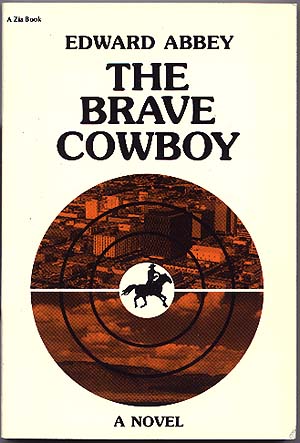
The Brave Cowboy
The Brave Cowboy: An Old Tale in a New Time
© 1956 Edward Abbey
277 pages
When stock wrangler Jack Burns heard tell that his old friend Paul had gotten himself thrown in the can, he knew there was only one thing to do: get himself thrown in so he could arrange for a jailbreak. So, riding north he goes on his not-so-faithful horse, Whisky. Two problems: one, Paul doesn't want to be jailbroken, because it's only a two-year sentence and that's a lot easier for his young family to bear than a lifetime of being hunted. Two, the sheriff isn't an old-timey fellow with a tin star and nothing else. He's got helicopters.
The Brave Cowboy is a western in the modern era, and ends fairly badly for those who pay more attention to the 'western' part than the 'modern' part. One of Edward Abbey's earlier works, it features two quasi-anarchists, one of whom is imprisoned for resisting the draft, and several other characters whose paths violently intersect toward the tale's end. It's a sad story, almost announcing the Death of the West. Burns isn't a lantern-jawed hero on a white horse, but he holds to an older sense of honor, and he counts among his friends more recognizably 'good' characters. (Paul is such a fellow, a pillar of his community who refused to comply with the Selective Service: not because he objected to soldiering, he objected to the government's assumption of ownership over citizens' lives.) Abbey's terrain description is more functional than poetic here; his talent for conveying the ecstatic beauty of western vistas may have still been in the honing. What's not absent is Abbey's attitude, his righteous beef against the government and corporate power, against anything oversized and overmighty: half the book is a chase scene through the New Mexico wilderness, as Burns on his horse defies and eludes the local cops, State Police, and even the Air Force, while living off the land.
Dated and crude, but it's hard to lose with a cowboy fighting the Man. Burns may be a prefigure of Hayduke, from The Monkey Wrench Gang -- there's even a horse named Whisky in Abbey's sequel to MWG, Hayduke Lives! Another note: this book was the basis of Lonely are the Brave.
A few interesting covers:
© 1956 Edward Abbey
277 pages
"Where're your papers?"
"My what?"
"Your I.D. -- draft card, social security, driver's license."
"Don't have none. Don't need none. I already know who I am."
When stock wrangler Jack Burns heard tell that his old friend Paul had gotten himself thrown in the can, he knew there was only one thing to do: get himself thrown in so he could arrange for a jailbreak. So, riding north he goes on his not-so-faithful horse, Whisky. Two problems: one, Paul doesn't want to be jailbroken, because it's only a two-year sentence and that's a lot easier for his young family to bear than a lifetime of being hunted. Two, the sheriff isn't an old-timey fellow with a tin star and nothing else. He's got helicopters.
The Brave Cowboy is a western in the modern era, and ends fairly badly for those who pay more attention to the 'western' part than the 'modern' part. One of Edward Abbey's earlier works, it features two quasi-anarchists, one of whom is imprisoned for resisting the draft, and several other characters whose paths violently intersect toward the tale's end. It's a sad story, almost announcing the Death of the West. Burns isn't a lantern-jawed hero on a white horse, but he holds to an older sense of honor, and he counts among his friends more recognizably 'good' characters. (Paul is such a fellow, a pillar of his community who refused to comply with the Selective Service: not because he objected to soldiering, he objected to the government's assumption of ownership over citizens' lives.) Abbey's terrain description is more functional than poetic here; his talent for conveying the ecstatic beauty of western vistas may have still been in the honing. What's not absent is Abbey's attitude, his righteous beef against the government and corporate power, against anything oversized and overmighty: half the book is a chase scene through the New Mexico wilderness, as Burns on his horse defies and eludes the local cops, State Police, and even the Air Force, while living off the land.
Dated and crude, but it's hard to lose with a cowboy fighting the Man. Burns may be a prefigure of Hayduke, from The Monkey Wrench Gang -- there's even a horse named Whisky in Abbey's sequel to MWG, Hayduke Lives! Another note: this book was the basis of Lonely are the Brave.
A few interesting covers:
Monday, September 26, 2016
Fire on the Mountain
© 1961 Edward Abbey
211 pages
Beneath the shadow of Thieves' Mountain, Billy Starr has arrived to spend a summer with his grandfather. He has arrived in the middle of a six-month siege, however, one of increasing intensity. The US Corps of Engineers is determined to expand its missile testing range at White Sands (Alamogordo, NM), and has been generous with the public purse to do it. Virtually every rancher in the area has sold their land to the army -- but not Old Man Voeglin. Voeglin's ranch was established by his grandfather in the 1890s, defended against the Apache, and has survived both drought and depression. Voeglin rarely breaks even on it, but neither the farm nor his will has ever broken. The army offers money? Threats? Doesn't matter. Let them shoot the horses, break the fences, run off the cattle: this was the farm that gave life to Voeglin and his father, the place that sustained them. There's no money that can buy out Voeglin's sense of responsibility, nor lessen his indigence that the government would presume to simply seize the land and remove him by force if he didn't roll over. So he resists, and with him are his grandson and an old friend. Together they mend the fences, ride out into the brush to find the straying cattle, and continue to tend to the ranch's everyday needs even as they are watched by Army jeeps and bureaucrats in sweat-soaked suits.
Fire on the Mountain is a short but powerfully written piece pitting man -- affectionate and frail -- against the implacable will of the Man, personified here in the form of a judge, a marshal, and more than a few soldiers. They are not pitiless executors of a grand plan from above; while the plan itself is pitiless, its human agents show as much mercy as the pressure pushing them from above can allow. Voeglin's obdurancy -- born of both love for his ancestral home and of contempt for those who would reduce it to test-range debris, abandoning generations of work to occasionally-bombed fallowness -- is such that they even decide to let him say, provided he vacates the area during monthly missile tests. Yet he persists; the same sentimental attachment to the ground and the cause that has allowed him to stand up to neighbors, men with guns, and the entire Cold War might of the US Army, keeps him from making even the slightest concession. For him, the story ends in heartbreak. It's not quite so wrenching for the reader, for the ending has a certain noble appropriateness to it.
Fire on the Mountain has now become the Edward Abbey book I would give to someone who had never read him. The book builds on devotion, not bitterness or rancor. His main characters are three men who love the New Mexican wilderness, and their place in it: they are deeply attached to one another. Even when the twelve-year old Billy is put on a train to El Paso to save him from the rage of the marshals, such is his devotion that he escapes the train and navigates his way back to the mountains. Abbey's bellicose attitude is still there, reflected most through Voeglin's utter refusal to back down, but it's directed at the book's 'villains'. Add to this the writing -- over and over, Abbey's descriptions mesmerize me, both of the landscape and of the tortuous love the characters have for it.
© 1961 Edward Abbey
211 pages
Beneath the shadow of Thieves' Mountain, Billy Starr has arrived to spend a summer with his grandfather. He has arrived in the middle of a six-month siege, however, one of increasing intensity. The US Corps of Engineers is determined to expand its missile testing range at White Sands (Alamogordo, NM), and has been generous with the public purse to do it. Virtually every rancher in the area has sold their land to the army -- but not Old Man Voeglin. Voeglin's ranch was established by his grandfather in the 1890s, defended against the Apache, and has survived both drought and depression. Voeglin rarely breaks even on it, but neither the farm nor his will has ever broken. The army offers money? Threats? Doesn't matter. Let them shoot the horses, break the fences, run off the cattle: this was the farm that gave life to Voeglin and his father, the place that sustained them. There's no money that can buy out Voeglin's sense of responsibility, nor lessen his indigence that the government would presume to simply seize the land and remove him by force if he didn't roll over. So he resists, and with him are his grandson and an old friend. Together they mend the fences, ride out into the brush to find the straying cattle, and continue to tend to the ranch's everyday needs even as they are watched by Army jeeps and bureaucrats in sweat-soaked suits.
Fire on the Mountain is a short but powerfully written piece pitting man -- affectionate and frail -- against the implacable will of the Man, personified here in the form of a judge, a marshal, and more than a few soldiers. They are not pitiless executors of a grand plan from above; while the plan itself is pitiless, its human agents show as much mercy as the pressure pushing them from above can allow. Voeglin's obdurancy -- born of both love for his ancestral home and of contempt for those who would reduce it to test-range debris, abandoning generations of work to occasionally-bombed fallowness -- is such that they even decide to let him say, provided he vacates the area during monthly missile tests. Yet he persists; the same sentimental attachment to the ground and the cause that has allowed him to stand up to neighbors, men with guns, and the entire Cold War might of the US Army, keeps him from making even the slightest concession. For him, the story ends in heartbreak. It's not quite so wrenching for the reader, for the ending has a certain noble appropriateness to it.
Fire on the Mountain has now become the Edward Abbey book I would give to someone who had never read him. The book builds on devotion, not bitterness or rancor. His main characters are three men who love the New Mexican wilderness, and their place in it: they are deeply attached to one another. Even when the twelve-year old Billy is put on a train to El Paso to save him from the rage of the marshals, such is his devotion that he escapes the train and navigates his way back to the mountains. Abbey's bellicose attitude is still there, reflected most through Voeglin's utter refusal to back down, but it's directed at the book's 'villains'. Add to this the writing -- over and over, Abbey's descriptions mesmerize me, both of the landscape and of the tortuous love the characters have for it.
Comments are welcome, but I am in the Land of Enchantment until October!
Labels:
American Southwest,
Edward Abbey,
Man vs State,
New Mexico
Thursday, July 21, 2016
The Journey Home
The Journey Home: Some Words in Defense of the American West
© 1977 Edward Abbey
242 pages
The desert is no place for decent men, which is why Edward Abbey likes it so much. Born on the eastern seaboard, on a farm between the cities and the woods, young Abbey was seized by wanderlust and wandered westward. There he found mysterious monoliths, painted deserts, winding canyons penetrated only by the foolhardy, and interminable expanses of prickly plants and even pricklier critters. Prickly might well describe Abbey -- or irascible, or cantankerous, or resentful, even indolent. Most of those terms are self-applied here as Abbey describes first his journey to the American west, his finding a home in Arizona, and his disgust at realizing that Industrial Civilization was following close on his heels. They ruined the view with power lines, flooded canyons with dams, and filled the air with smoke -- and so he writes, not to defend pretty views but to defend the very idea of wildness. Man is wild, can't be broken completely -- and he needs undisturbed space to go crazy in every once in a while.
There are two reasons to read books by Edward Abbey; the first is for his descriptive writing, which wholly absorbed me when I first read Desert Solitaire years ago. The man is a grumpy poet writing prose; he describes the land like a lover, though he doesn't use so intimate a language as say, the author of Song of Solomon. Certainly he finds enough here to wax poetic about. Making cloudbanks marvelous in Desert Solitaire was child's play; here he even makes a poisonous tick sound intriguing. The early book is biographical, but once he arrives at the mountains, they take over, for there are small ranges all over the southwest. The second is for Abbey's personality, which is...colorful, to say the least, and a delight in small doses. Rough-hewn is Abbey; there's no machine-made box to slide him in. He is a passionate loather of big business and big government, but his contempt for the EPA lies in the fact that it isn't doing enough to curb the industrialization of the west, that it sides with the power plants and oilers over the small ranchers and rambling eccentrics. His passion borders on reckless. He writes that his motto regarding wilderness hikes is "be prepared", but that his practice is to go off half-cocked, daring Nature to do its worst. One story has him utterly destroying his fiance's brand new gift-from-daddy convertible to transverse a washed-out road. That particular relationship didn't survive the long hike back. In another account, he follows a mountain lion's tracks and encounters the fearsome creature, poetry and power in one awe-inspiring package.
What Abbey fears most is the triumph of deary mediocrity. He can appreciate the city, as he does in here in a piece on Hoboken and Manhattan. It's not a loving appreciation, but he does recognize that urban life has its consolations. But man is too wild a thing for the city, and the city itself can only be endured for long if there is some place to escape to. Abbey likens it to prisoners of Siberia, able to endure their brutal treatment by the sight of the beckoning expanse of forest; never mind that the forest has its own dangers, it is there -- unconquered, open, a warren of escape. Abbey shudders to see Tuscon and Phoenix marching toward one another, soon to form one long contiguous blob of parking lots and neon -- and not just because their unchecked growth is draining water reserves or concentrating filth, but because it makes escape ever more difficult. We crave adventure, Abbey writes, danger -- the wilderness offers it. Abbey If we live in constant security and predictability, we're effectively living the life of zoo animals. We climb mountains for the same reason we fill the air with soaring music and vibrant poetry: our souls are restless and craving. Craving what? Something to do, some meaning, some thrusting of ourselves into reality.
There is a lot to ponder in this slim little collection of essays and bar-room ramblings given life in paper. Certainly, as far as 'current' crises go, the book is dated. I am certain many battles have been lost since the decades since Abbey first discovered the soul-stilling expanse of the west. Given Abbey's gruffness here, I would refer new readers to Desert Solitaire...but once a friendlier introduction is made then by all means return here to experience more of that beautiful description, that delightful cussedness, that adventurous what-the-hell-carpe-diem view Abbey took to life, its appeal aided by his thoughtfulness.
© 1977 Edward Abbey
242 pages
The desert is no place for decent men, which is why Edward Abbey likes it so much. Born on the eastern seaboard, on a farm between the cities and the woods, young Abbey was seized by wanderlust and wandered westward. There he found mysterious monoliths, painted deserts, winding canyons penetrated only by the foolhardy, and interminable expanses of prickly plants and even pricklier critters. Prickly might well describe Abbey -- or irascible, or cantankerous, or resentful, even indolent. Most of those terms are self-applied here as Abbey describes first his journey to the American west, his finding a home in Arizona, and his disgust at realizing that Industrial Civilization was following close on his heels. They ruined the view with power lines, flooded canyons with dams, and filled the air with smoke -- and so he writes, not to defend pretty views but to defend the very idea of wildness. Man is wild, can't be broken completely -- and he needs undisturbed space to go crazy in every once in a while.
There are two reasons to read books by Edward Abbey; the first is for his descriptive writing, which wholly absorbed me when I first read Desert Solitaire years ago. The man is a grumpy poet writing prose; he describes the land like a lover, though he doesn't use so intimate a language as say, the author of Song of Solomon. Certainly he finds enough here to wax poetic about. Making cloudbanks marvelous in Desert Solitaire was child's play; here he even makes a poisonous tick sound intriguing. The early book is biographical, but once he arrives at the mountains, they take over, for there are small ranges all over the southwest. The second is for Abbey's personality, which is...colorful, to say the least, and a delight in small doses. Rough-hewn is Abbey; there's no machine-made box to slide him in. He is a passionate loather of big business and big government, but his contempt for the EPA lies in the fact that it isn't doing enough to curb the industrialization of the west, that it sides with the power plants and oilers over the small ranchers and rambling eccentrics. His passion borders on reckless. He writes that his motto regarding wilderness hikes is "be prepared", but that his practice is to go off half-cocked, daring Nature to do its worst. One story has him utterly destroying his fiance's brand new gift-from-daddy convertible to transverse a washed-out road. That particular relationship didn't survive the long hike back. In another account, he follows a mountain lion's tracks and encounters the fearsome creature, poetry and power in one awe-inspiring package.
What Abbey fears most is the triumph of deary mediocrity. He can appreciate the city, as he does in here in a piece on Hoboken and Manhattan. It's not a loving appreciation, but he does recognize that urban life has its consolations. But man is too wild a thing for the city, and the city itself can only be endured for long if there is some place to escape to. Abbey likens it to prisoners of Siberia, able to endure their brutal treatment by the sight of the beckoning expanse of forest; never mind that the forest has its own dangers, it is there -- unconquered, open, a warren of escape. Abbey shudders to see Tuscon and Phoenix marching toward one another, soon to form one long contiguous blob of parking lots and neon -- and not just because their unchecked growth is draining water reserves or concentrating filth, but because it makes escape ever more difficult. We crave adventure, Abbey writes, danger -- the wilderness offers it. Abbey If we live in constant security and predictability, we're effectively living the life of zoo animals. We climb mountains for the same reason we fill the air with soaring music and vibrant poetry: our souls are restless and craving. Craving what? Something to do, some meaning, some thrusting of ourselves into reality.
There is a lot to ponder in this slim little collection of essays and bar-room ramblings given life in paper. Certainly, as far as 'current' crises go, the book is dated. I am certain many battles have been lost since the decades since Abbey first discovered the soul-stilling expanse of the west. Given Abbey's gruffness here, I would refer new readers to Desert Solitaire...but once a friendlier introduction is made then by all means return here to experience more of that beautiful description, that delightful cussedness, that adventurous what-the-hell-carpe-diem view Abbey took to life, its appeal aided by his thoughtfulness.
Friday, July 1, 2016
The Monkey Wrench Gang
© 1975 Edward Abbey
352 pages
They say you can't stop progress, but with with plastic explosives, thermite, and a few friends, it's worth a shot. The Monkey Wrench Gang is the madcap adventure story of four very disgruntled folk -- a brain surgeon with a predilection for chainsawing billboards, a wayward Mormon, a Green Beret out to wage a one-man war, and a lady-type -- who join together to wage a war of sabotage against the industrialists despoiling the Southwest. New Mexico, Utah, Arizona -- wherever there's an unguarded bulldozer, they'll gum its workings and set it on fire. Where there's a bridge built at public expense for private gain, with smoggy air thrown in as a bonus gift, they'll blow it. And where there's a dam...they will dream and pray for a way to destroy it. The Monkey Wrench Gang chronicles their private beginnings, their chance meeting at the Grand Canyon, and their joint missions which draw down not only entirely too many helicopters, but the wrath of a bishop of the Mormons, who is working on his gubernatorial prospects and can't have a bunch of anarchists running around setting fire to his plans. Time and again they narrowly escape, but eventually things go south. This is a novel for those who see in the wilderness relief from lunacy, who have wished for a "pre-cision" earthquake to topple the godawful constructs that often mar it.
The Monkey Wrench Gang is a adventure novel in which explosive sabotage mixes with similarly fiery dialogue and humor. A reader who has already encountered Edward Abbey will see him again in these characters; his ardent love for the southwestern wilderness, the thoughtful yearning that it not be ruined, both for its sake and for humanity's, the contempt for the outsized. It comes through in his characters' conversations with one another, in their narrative of their ambitions and plight. Abbey is sometimes serious, sometimes farcical. What he takes seriously is the desert wilderness, a vast landscape of breathtaking beauty: what he does not take seriously is ego of man, who thinks he can tame it. Tame it, never -- ruin it for others, maybe. That's what Abbey and his characters aim against. They are against coal factories puffing vile plumes into the open air of the desert, against power lines and roads that only said factories and mines put to use; against the invasion of the southwest by 'consumers" who want to check the Grand Canyon off their list, for whom the desert is not a profoundly moving -- challenging, even -- experience, and merely a section of the photo album. Each of the characters have their separate motives: the Green Beret is furious that his home is being ruined by the same corporate SOBs who sent him to Vietnam, Seldom Seen Smith has lost his living because of the damned dam damming up the damned river, and the brain surgeon attributes growing health problems to the increasing amount of factories and mines. (The lady-type is involved because she majored in Classic French Literature, and what else are you going to do with that degree but blow up billboards?) . Mostly, however, there is the conflict between the grand wilderness and the corporate-government complex that has delusions of grandeur but is only a major pain in the tuchus for the common man. Abbey is, and his characters are shadows, of a kind of anarchism. Not the bomb-throwing type (they carefully set their bombs, no reckless flinging-about), but the kind that rages against the Man, embodied in the corporate-government complexes of power plants, mines, and the like.
I enjoyed The Monkey Wrench Gang, having long found in Abbey a kindred spirit, at least as far as his small-is-beautiful political convictions and love for the wilderness go. (I hasten to add that I do not share Abbey's habit of billboard-sawing.) Although Abbey's books were written during the dawn of the environmentalist movement, no one will find in him a stereotype. His characters, for instance, enthusiastically litter the highways they hate with beer cans, because the vista has been so bespoiled that they are really only defacing the defacement. While the Monkey Wrench Gang isn't exactly a moral mark to aim at, the dialogue makes this a fun novel, especially if you share Abbey's preference for decentralization. It's a nice rebels against the Man sort of tale, at any rate. Abbey is a man to spend time with. What a kick he must have been a few sheets to the wind...
© 1975 Edward Abbey
352 pages
"Three things my daddy tried to learn me. 'Son', he always said, 'remember these three precepts and you can't go wrong. One, never eat at a place called Mom's. Two, never play cards with a man named Doc.'
'That's only two.'
'I can never recollect the third, and that's what worries me.'"
The Monkey Wrench Gang is a adventure novel in which explosive sabotage mixes with similarly fiery dialogue and humor. A reader who has already encountered Edward Abbey will see him again in these characters; his ardent love for the southwestern wilderness, the thoughtful yearning that it not be ruined, both for its sake and for humanity's, the contempt for the outsized. It comes through in his characters' conversations with one another, in their narrative of their ambitions and plight. Abbey is sometimes serious, sometimes farcical. What he takes seriously is the desert wilderness, a vast landscape of breathtaking beauty: what he does not take seriously is ego of man, who thinks he can tame it. Tame it, never -- ruin it for others, maybe. That's what Abbey and his characters aim against. They are against coal factories puffing vile plumes into the open air of the desert, against power lines and roads that only said factories and mines put to use; against the invasion of the southwest by 'consumers" who want to check the Grand Canyon off their list, for whom the desert is not a profoundly moving -- challenging, even -- experience, and merely a section of the photo album. Each of the characters have their separate motives: the Green Beret is furious that his home is being ruined by the same corporate SOBs who sent him to Vietnam, Seldom Seen Smith has lost his living because of the damned dam damming up the damned river, and the brain surgeon attributes growing health problems to the increasing amount of factories and mines. (The lady-type is involved because she majored in Classic French Literature, and what else are you going to do with that degree but blow up billboards?) . Mostly, however, there is the conflict between the grand wilderness and the corporate-government complex that has delusions of grandeur but is only a major pain in the tuchus for the common man. Abbey is, and his characters are shadows, of a kind of anarchism. Not the bomb-throwing type (they carefully set their bombs, no reckless flinging-about), but the kind that rages against the Man, embodied in the corporate-government complexes of power plants, mines, and the like.
I enjoyed The Monkey Wrench Gang, having long found in Abbey a kindred spirit, at least as far as his small-is-beautiful political convictions and love for the wilderness go. (I hasten to add that I do not share Abbey's habit of billboard-sawing.) Although Abbey's books were written during the dawn of the environmentalist movement, no one will find in him a stereotype. His characters, for instance, enthusiastically litter the highways they hate with beer cans, because the vista has been so bespoiled that they are really only defacing the defacement. While the Monkey Wrench Gang isn't exactly a moral mark to aim at, the dialogue makes this a fun novel, especially if you share Abbey's preference for decentralization. It's a nice rebels against the Man sort of tale, at any rate. Abbey is a man to spend time with. What a kick he must have been a few sheets to the wind...
Wednesday, December 4, 2013
Down the River
Down the River
© 1982 Edward Abbey
In Desert Solitaire, Edward Abbey collected contemplative pieces he had written while a park ranger in the high desert, putting his passion for the wilderness into action by working to conserve it. The volume mixed poetic descriptions of the wild beauty of the desert with reflection on the value of wilderness; not as an avenue of resources yet-to-be-exploited, but as a place for reflection and the realization of an authentic life. Down the River follows the same course, though the pieces here are connected not to a season living as a park ranger, but to various adventures Abbey embarked upon while exploring the rivers of the American Southwest. Abbey simultaneously recounts his journeys with friends with the thinking the landscape inspired, and since often he made a journey to find something out, those thoughts are not as random as might be supposed. In one essay Abbey explores an area that will soon be off limits to him, for it will be shut to the public to protect an incoming missile installation. Here his descriptions of what is seen combine with condemnation of the military-industrial complex and thoughts on Cold War geopolitics in general. This at least has a happy ending, for Abbey’s kindred spirits in the region were able to rouse enough local protest to prompt President Reagan to put off building the complex. This is certainly a happier piece than the similar essay in Desert Solitaire which saw him exploring Glen Canyon River shortly before it was dammed up. There are a few odds and ends, like his faux-review of Zen and the Art of Motorcycle Maintenance from the perspective of a Hells Angel who critiqued the book on its mechanical advice. This is presented in all seriousness.
Although not quite on the level of Desert Solitaire, Down the River is worth reading purely for its opening essay, “Down the River with Henry David Thoreau”. Abbey is a modern Thoreau, in that their works see them retreating into Nature in search of a more authentic life; they find solace and fullness in the wilderness, and distantly removed from ‘civilization’ they can reflect both on its merits and flaws more objectively. The principle difference is that while Thoreau is a gentle Puritan from the forest; Abbey a cantankerous free spirit in the desert. Thoreau ruminates, Abbey complains, but while Thoreau is a lonely sage of the wilderness, Abbey is almost never alone and always in the middle of a good time. Whether he's touring with cowboys in Desert Solitaire or swapping jibes with boatmen here in Down the River, Abbey is plainly enjoying the wilderness. Regardless of the sheer animal pleasure Abbey takes in the wild, he is thoughtful, as well. Thoreau appears through the volume, for in Abbey’s words his is a spirit which has only grown larger through the ages as we continue to replace the wild with lifelessness. In addition to again defending the virtues of the wilderness -- both for its own sake, in its beauty, and for the practical importance the wild has as a place of refuge or comparison for the civilized man -- Abbey continues his grousing against the 20th century's fondness for size and complexity, in abandoning small, resilience farms run by homesteaders for massive agribusinesses run by men in suits whose every solution is even more energy- and system-dependent.
Again I owe a debt of gratitude to the commenter who suggested I might like Abbey a few years ago.
Related:
Desert Solitaire, Edward Abbey
Walden, I to Myself, Henry David Thoreau
The Unsettling of America, Wendell Berry, which he references
Small is Beautiful, E.F. Schumacher
© 1982 Edward Abbey
In Desert Solitaire, Edward Abbey collected contemplative pieces he had written while a park ranger in the high desert, putting his passion for the wilderness into action by working to conserve it. The volume mixed poetic descriptions of the wild beauty of the desert with reflection on the value of wilderness; not as an avenue of resources yet-to-be-exploited, but as a place for reflection and the realization of an authentic life. Down the River follows the same course, though the pieces here are connected not to a season living as a park ranger, but to various adventures Abbey embarked upon while exploring the rivers of the American Southwest. Abbey simultaneously recounts his journeys with friends with the thinking the landscape inspired, and since often he made a journey to find something out, those thoughts are not as random as might be supposed. In one essay Abbey explores an area that will soon be off limits to him, for it will be shut to the public to protect an incoming missile installation. Here his descriptions of what is seen combine with condemnation of the military-industrial complex and thoughts on Cold War geopolitics in general. This at least has a happy ending, for Abbey’s kindred spirits in the region were able to rouse enough local protest to prompt President Reagan to put off building the complex. This is certainly a happier piece than the similar essay in Desert Solitaire which saw him exploring Glen Canyon River shortly before it was dammed up. There are a few odds and ends, like his faux-review of Zen and the Art of Motorcycle Maintenance from the perspective of a Hells Angel who critiqued the book on its mechanical advice. This is presented in all seriousness.
Although not quite on the level of Desert Solitaire, Down the River is worth reading purely for its opening essay, “Down the River with Henry David Thoreau”. Abbey is a modern Thoreau, in that their works see them retreating into Nature in search of a more authentic life; they find solace and fullness in the wilderness, and distantly removed from ‘civilization’ they can reflect both on its merits and flaws more objectively. The principle difference is that while Thoreau is a gentle Puritan from the forest; Abbey a cantankerous free spirit in the desert. Thoreau ruminates, Abbey complains, but while Thoreau is a lonely sage of the wilderness, Abbey is almost never alone and always in the middle of a good time. Whether he's touring with cowboys in Desert Solitaire or swapping jibes with boatmen here in Down the River, Abbey is plainly enjoying the wilderness. Regardless of the sheer animal pleasure Abbey takes in the wild, he is thoughtful, as well. Thoreau appears through the volume, for in Abbey’s words his is a spirit which has only grown larger through the ages as we continue to replace the wild with lifelessness. In addition to again defending the virtues of the wilderness -- both for its own sake, in its beauty, and for the practical importance the wild has as a place of refuge or comparison for the civilized man -- Abbey continues his grousing against the 20th century's fondness for size and complexity, in abandoning small, resilience farms run by homesteaders for massive agribusinesses run by men in suits whose every solution is even more energy- and system-dependent.
Again I owe a debt of gratitude to the commenter who suggested I might like Abbey a few years ago.
Related:
Desert Solitaire, Edward Abbey
Walden, I to Myself, Henry David Thoreau
The Unsettling of America, Wendell Berry, which he references
Small is Beautiful, E.F. Schumacher
Labels:
American West,
Edward Abbey,
essays,
Nature,
rivers,
social criticism,
Society and Culture
Friday, February 10, 2012
Desert Solitaire
Desert Solitaire: A Season in the Wilderness
© 1968 Edward Abbey
269 pages
Journey to the expansive southwestern American desert and take it in -- the vast stretches of open ground, bounded by mountains and broken by marvelously intriguing rock formations that catch the imagination. Tarry there with Edward Abbey, seeking shelter from the blazing sun under his homemade ramada, and listen to him talk a while about the fragile beauty of these lands, the importance of preserving them, and of human life in general. Such is the promise of Desert Solitaire, an immensely satisfying collection of meditations on the wilderness.
I was introduced to Edward Abbey a few weeks ago via a comment on a blog; the author's listed quotations seemed compelling, and so I decided to sample his works at my local library. It carries only one of Abbey's works, his first nonfiction piece. He spent two years working as a park ranger in the Arches National Park, and offers Desert Solitaire as a memorial of that time spent. He writes not only about the beauties of the park itself, but shares a collection of meditative essays. Abbey describes himself as an 'earthist'; he finds profound meaning in nature, and the wilderness a sanctuary from the noisy busy-ness of of modernity -- soulless jobs, endless petty responsibilities, an ugly and neverending cycle of meaningless tasks. Wilderness' place as a refuge from this is one of the reasons he champions its preservation; not only from development, but from attempts to commodify the experience through "industrial tourism", a destructive approach that turns nature from an experience that must be earned into an attraction that is merely seen..and then passed on. Although a work of prose, Abbey's writing often waxes poetic. The chapter "Water", in which he describes the life of a summer storm in the desert, is worth reading itself alone.
Abbey passion and style enraptured me. It reminds me of nothing so much as Henry David Thoreau's Walden; only instead of living deliberately in a lush forest beside Walden Pond, Abbey spends his in the wild, untamed west, spending his nights under the stars and writing of vast canyons and cowboys. The authors share a common spirit; both are ill at ease and disgusted with society's mindless norms and find respite from the intrusiveness in the wild. As with Walden, I found Desert Solitaire inspiring and thought-provoking. I highly recommend it.
© 1968 Edward Abbey
269 pages

Journey to the expansive southwestern American desert and take it in -- the vast stretches of open ground, bounded by mountains and broken by marvelously intriguing rock formations that catch the imagination. Tarry there with Edward Abbey, seeking shelter from the blazing sun under his homemade ramada, and listen to him talk a while about the fragile beauty of these lands, the importance of preserving them, and of human life in general. Such is the promise of Desert Solitaire, an immensely satisfying collection of meditations on the wilderness.
I was introduced to Edward Abbey a few weeks ago via a comment on a blog; the author's listed quotations seemed compelling, and so I decided to sample his works at my local library. It carries only one of Abbey's works, his first nonfiction piece. He spent two years working as a park ranger in the Arches National Park, and offers Desert Solitaire as a memorial of that time spent. He writes not only about the beauties of the park itself, but shares a collection of meditative essays. Abbey describes himself as an 'earthist'; he finds profound meaning in nature, and the wilderness a sanctuary from the noisy busy-ness of of modernity -- soulless jobs, endless petty responsibilities, an ugly and neverending cycle of meaningless tasks. Wilderness' place as a refuge from this is one of the reasons he champions its preservation; not only from development, but from attempts to commodify the experience through "industrial tourism", a destructive approach that turns nature from an experience that must be earned into an attraction that is merely seen..and then passed on. Although a work of prose, Abbey's writing often waxes poetic. The chapter "Water", in which he describes the life of a summer storm in the desert, is worth reading itself alone.
The clouds multiply and merge, cumuli-nimbi piling up like whipped cream, like mashed potatoes, like sea foam, building upon one another into a second mountain range greater in magnitude than the terrestial range below.
The massive forms jostle and grate, ions collide, and the sound of thunder is heard over the sun-drenched land. More clouds emerge from the empty sky, anvil-headed giants with glints of lightening in their depths. An armada assembles and advances, floating on a plane of air that makes it appear, from below, as a fleet of ships must look to the fish in the sea.
Abbey passion and style enraptured me. It reminds me of nothing so much as Henry David Thoreau's Walden; only instead of living deliberately in a lush forest beside Walden Pond, Abbey spends his in the wild, untamed west, spending his nights under the stars and writing of vast canyons and cowboys. The authors share a common spirit; both are ill at ease and disgusted with society's mindless norms and find respite from the intrusiveness in the wild. As with Walden, I found Desert Solitaire inspiring and thought-provoking. I highly recommend it.
Labels:
American West,
Edward Abbey,
essays,
Nature,
social criticism,
Society and Culture
Subscribe to:
Comments (Atom)