Friday, March 29, 2019

Alice Roosevelt, Linux, and Death

Approaching the end of the month, as we are, time to post a few also-reads:


Alice and the Assassin, R.J. Koreto. Entertaining historical fiction following the infamous pistol-packing Alice Roosevelt and her cowboy Secret Service bodyguard.  Following the assassination of President McKinely, Alice's father is made president and Alice herself turns detective. Declaring that it doesn't make sense for a feeble-minded Polish anarchist to randomly go after the president, Alice and Agent St. Clair begin following leads on their own -- to the faint horror of Alice's official guardians, Teddy excepting.   The chase takes them into private society clubs and public brothels, alike, consorting with the likes of Emma Goldman, Sicilian crimelords, and members  of the New York yacht club.   Most interesting is the relationship between St. Clair and Alice;  St. Clair is a former cavalrymen, former frontier sheriff turned federal agent, while Alice -- for all her wildness --  is a teenage girl who has been far more sheltered than she realizes. The two have an interesting fondness for one another by the end.


From Here to Eternity, by Caitlin Doughty, visits several cultures around the world to examine particularly interesting death customs, in a bid to convince western readers that pickling the dead and shoving them into an airtight vault at ludicrous costs to ourselves,   is neither normal nor attractive. Although  it doesn't have nearly the strength of her first book (Smoke Gets In Your Eyes, her account if becoming a mortician and developing a funerary style more in keeping with older customs. She promotes, for instance, the practice of families washing and dressing their deceased loved ones themselves, and taking part in the burial or pushing the button on the crematory. Traditions like those are those she explores here,  though she's naturally drawn to more...unusual death traditions, like people collecting and decorating human skulls to use as magical tokens, or  occasionally exhuming their dead kinfolk to  dress them and give them tea.  As with her previous book, this one is laden with humor, both in the writing and in happenstance; at one point Doughty was left alone in a cave of skulls and was stumbled upon by tourists, who immediately asked if they could take her picture in terms taken from Emily Post, circa 1915.    Although the book's contents were not as deep as the last one, I was cheered by the promotion of natural-burial movements within the US,  which is also covered here.


Open Life: The Philosophy of Open Source. Penned in 2004. Open Life offers a history of the open source software movement, an appraisal of its financial prospects, and a look at how the open source philosophy might be applied to matters other than software.  Admittedly, this is esoteric, and...dated. Most people use open source tech, even if they don't realize it: Android devices, for instance,  and even chromeOS, use Linux at their base,  as do many internet servers, and IOT devices will only bring more of it into people's homes.  A lot of the projects that Ingo mentions here (in examining different ways open-source software companies can be profitable while maintaining their roots)  have since been discontinued, though others (Red Hat) are still around.  One of the bigger success stories is Mozilla,  the first great challenger to Internet Explorer which has matured into Firefox. 


Finally, I also read my two classic club entries for this month, both by Walker Percy.  It turns out I'm not much for existentialist novels, even  if they are by a southern author.

Tip of the Iceberg

Tip of the Iceberg: My 3,000-Mile Journey Around Wild Alaska, the Last Great American Frontier
© 2018 Mark Adams
336 pages


In 1899, railroad tycoon Edward Harriman organized a multidisciplinary expedition to Alaska, bringing with him some of the best scientists and artists in America. They sailed -- or rather, steamed -- their way around the coast of Alaska, pushing as far north as possible.  Over a century later, Mark decided to repeat their journey,   to discover for himself the stirring beauty of America's 'last frontier', and to compare his experience with those of Harriman's. The result is a winsome mix of history, nature writing, and travel that concludes with Adams' urgent message to readers: if you want to see Alaska,   go now, because  it's a land continually re-created, and even now many of its places are melting away, are being reclaimed by the sea, or likewise stand on the brink of transformation.

The Alaska witnessed by Mark Adams here is, in every respect, an utterly beautiful place -- and a strange one, where people are often more dependent on the ocean and bush pilots for transportation, where a given town's entire population fishes for their own food. In its remoteness, self-sufficiency,  and  scorn for Outside oversight, Alaska fully lives up to its motto of the Frontier state.  I could not help but think of the American west when reading this, or of the eastern frontier even earlier in American history.  There is danger in that isolation; bears are a common menace, and Alaskans actually experience the majority of earthquakes within the United States.  They're more at risk from tusnamis, too; while Hawaaians may have several hours warning of a tsunami, Alaskans may only have minutes to prepare.  To the beauty of the landscape -- the mountains, glaciers, and wilderness expanses --  Adams adds historical interest not only by retelling the story of the Harriman expedition, but pointing to its effects. The conservation movement was born around this same period, urged on not only by near-mystics like John Muir, but by would-be hunters in the form of Harriman and Theodore Roosevelt.  (Roosevelt wanted to go to Alaska, but that bum McKinley got himself shot, so TR had to be president, instead.)

Although I've never previously been interested in Alaska, Tip of the Iceberg has made it a far more compelling place, both for its natural grandeur and its culture.

Thursday, March 28, 2019

Head On

Head On: A Novel of the Near Future
© 2018 John Scalzi
328 pages


Agent Chris Shane of the FBI saw the man decapitated on the playing field. before his very eyes.  But so did thousands of other people; decapitations  were, in fact,  the point of the game. Hilketa, after all, is a sport in which human-controlled droids go into battle against one another,  trying to tear the head off a randomly-designated player-droid and carry it across the goalposts while the defending team stops them.  This is a game played with swords. Of course heads are supposed to come off....but people aren't supposed to die.   And yet, the moment Duane Chapman's droid lost his head, the human controlling him inexplicably died.   So it was that Chris and his training partner Van, abuser of many substances,  had their second huge case.  In Head On, Scalzi explores the world of Hadens more thoroughly, from their elaborate digital world to specialized droids -- some for lovers and some for fighters.  Although Van and Chris are able to establish the means easily enough, the question remains: why? Why would someone murder a reasonably popular, reasonably talented  athlete?  The mystery takes readers down familiar paths, from the noir staples like jealous wives, to Scalzi's running joke of Shane destroying a series of personal threeps (the humanoid droid he moves in the world through, his real body being locked-in from Haden syndrome).  Scalzi's Haden-world is just as interesting this time around, though I was more fascinated by Haden culture than the actual murder mystery.

Wednesday, March 27, 2019

Elusive Salvation

Star Trek: Elusive Salvation
pub. 2016 Dayton Ward
365 pages


Buckle up, readers, this one is a fun one. In the 19th century, a group of scientists with a cure to saving their people from tyranny were forced to take refuge on Earth after their ship was injured. In the 23rd century, these scientists' people have appealed to the Federation to help them find the remains of their lost comrades, for they are still in need of the cure and it could be found within the scientists' bodies or ships. Because there's no way to find them in the 23rd century, Kirk decides to use his previous contact with 20th century personalities Gary Seven and Roberta Lincoln to enlist their help, and -- fifteen years "later" in Seven/Lincoln's POV -- the action culminates in NYC, circa 1985. All the while, a secret government agency organized in 1947 to investigate and sequester all information regarding alien visits to the Earth, follows the trail of both the aliens, Lincoln, and -- finally, Kirk, wondering: WHY ON EARTH IS EARTH SO POPULAR WITH ALIENS?

The last time Dayton Ward played with history like this I enjoyed it enormously, and Elusive Salvation was in that same neighborhood. It wasn't quite as novel this time, but I liked the connections Ward tried to draw between the plot and what was happening in real life, like Reagan's "Star Wars" program. The last time Ward did this there were numerous connections to the Star Trek time-traveling shows; those are here as well, but they don't fit in the context of the actual story so they're moved to the epilogue. The big exception is Mestrel, the Vulcan left on Earth from ENT's Carbon Creek episode, who also had a big part in Ward's previous playing-with-history title, From History's Shadow. The epilogue also contains an oblique reference to Section 31, which has probably caused raging arguments on Treklit forums given that Ward is apparently advancing an alternate explanation for why S31 has that particular name.

Monday, March 25, 2019

Top Ten Tuesday: Games to Audiobook To


Today’s Top Ten Tuesday is an audiobook-related freebie, annnnd...I’m really going to run with that “freebie” designation, because below follow my Top Ten Favorite Games to Play While Listening to Audiobooks!  


Christmas as usual at the Schaefer household...


    1. The Sims.   I’ve played The Sims  on a regular basis – several times a week – since 2000, a fate that no other game series can challenge. Whether I’m exploring their digital worlds, telling fanciful stories, or fooling around with the architectural tools, it’s my favorite game to play to just relax  with.


 2. EuroTruck Simulator II/American Truck Simulator.  These games, identical save their maps, allow players to take jobs shuttling goods from city to city, all the while dodging police, navigating traffic,  watching out for hazards, and going through weigh and toll stations.   Unless you're navigating a roundabout, boarding the Channel tunnel, or parking, though..it doesn't require a lot of attention, so it's good to have something to listen to.


3.Sid Meier’s Pirates (2004).  A rare instant favorite, Pirates allows players to sail the Carribean, and...do whatever they want, really.  Sacking ships, hunting pirates,  ballroom dancing, fencing, treasure hunting, scoundrel-chasing,   fighting battles on land and at sea -- it's all here.

A playthrough of the Medieval scenario in which I, playing the Byzantine Empire, took back the Holy Land and then Europe, starting with the 'other' Rome.

  4. Civilization III.  I say Civ3 deliberately, because I know it so well I can play without having to be too attentive. I've modded mine extensively over the years,  from adding new units just to play with, to turning my advisors into Star Trek  officers. (I even found how to edit the game's script to have a little fun...)


 5-7. Vice City/San Andreas/GTAV.   Although the GTA series is mostly known for the amount of chaos players can create,   I’m perfectly happy just driving the taxi and listening to podcasts while picking up virtual passengers, or in the case of San Andreas, going on trucking missions. 


8. Mafia is another favorite to combine tax missions and podcasts, set in a thirties-era city reminiscent of Chicago or New York.


9. Star Wars Battlefront (the original) is another where I can just zone out, shooting droids or clones.


10. Red Dead Redemption 2 may find itself on the list, as I spend more time hunting all the critters -- or fishing -- and less time being an outlaw.   I include it in anticipation, since I've been playing it nonstop for going on a week now.

That's it, really!


Thursday, March 21, 2019

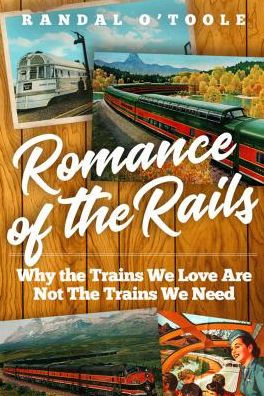
Romance of the Rails

Romance of the Rails: Why the Trains We Love Are Not the Transportation We Need
© 2018 Randal O'Toole
300 pages


"These are the 1930s again, with all the charm and romance, all the gaiety! That was a carefree world, Danny, and I'm gonna make it that way again!"
"You can't! It's nostalgic, it's nice, but it's not true, it's phony!"
"It doesn't have to be phony. If I wish hard enough, it doesn't have to be phony.."
(The Twilight Zone, S01E04. "The 16-Millimeter Shrine")


There was a time when America was knit together with ribbons of steel, linking not only metropolises, but bedroom suburbs.  That time was yesteryear, and it cannot come again – no matter how much we might wish it so. Romance of the Rails is written as a letter to a dying if beloved friend;  former rail advocate author Randal O’Toole reviews the history of passenger trains and their offspring, and scrutinizes the ongoing attempt to bring them back to life, comparing  transit and high-speed rail networks across the globe.  Just as railroads replaced demonstrably less effective modes of transportation,  so they have been replaced – and it is both wasteful and unjust, he argues, to continue propping up a dying industry to benefit a scarce few, in pursuit of recapturing America's boom years.  Although by the end few readers would remain willing to argue for rail transit on economic grounds, O’Toole only briefly touches on other veins of rail support.  

 O’Toole begins with a history of the rise of rail transportation in the United States,   exploring why trains were so successful and what they accomplished.  Trains and other contemporary technologies allowed for a novelty: the  nucleated city, with  superdense business district. Before the Victorian age,  cities consisted of a fairly even mix of residential, commercial, and other areas;    most people traveled on foot (horses and carriages being too expensive), but rails allowed cities to expand outward and upward simultaneously, giving those who could afford it the chance to escape the noise into streetcar suburbs, but also allowing more people ready access into the city. 

In the early 20th century, however,  that began to change – again, because of new technologies. Mass-produced automobiles meant that the same workers who couldn’t afford a carriage a century ago could now afford a different kind of carriage.   Buses, after internal combustion became much cheaper, suddenly emerged as such viable alternatives to trolleys that railroad magnates were investing in them.  The government, too,   was investing in the competition, helping at all levels – from widespread efforts to pave streets, to the federal project of a national highway system.  And then there were airplanes, far faster than trains and buses  and increasingly cheap.  

So it goes. Trains had been completely replaced by services which were cheaper,  which carried more people, which served  more sectors of  the  population, and which were far more nimble.  By every measure,  passenger rail should have been retired to the museums with a hearty “Well done, good and faithful servant”.   Instead, there are continued and expensive attempts to revive rail transit, both trolleys inside cities (which carry less people, at far greater cost,  and consume more space), and passenger rail between cities – either through Amtrak or new high-speed lines modeled on those which were a success in Japan.  Amtrak’s problems are so  severe that even a former creator of the company has written a book urging the public to let it die, and high speed rail is a boondoggle of such great expense that not even California could manage to do it to connect SF and LA.  The economics simply don’t work, O’Toole writes:  trains perform well in Europe and Japan because the populations are so dense and  car ownership so low; that latter is especially important, because it’s why Japanese bullet trains were a success and European ones drove Italy and Spain to the verge of fiscal ruin.  The only thing trolleys do better than at busses, O’Toole says with a bit of snark, is shifting public money from the public itself to the pockets of corporate engineers and lobbyists.  

As someone who has drunk deeply of train nostalgia, I found Romance of the Rails a daunting but sobering read.  I’ve read both histories of trains, and books advocating more mass transit in the form of trolleys, and Romance thoroughly challenges both.  Its amount of documentation is particularly enlightening, as we realize for the cities considered, the introduction of trolley lines to a city already covered by buses often caused a decrease, not an increase, in the amount of transit users. This problem is especially bad when trolleys are deliberately introduced to 'replace' a  bus line, and here O'Toole draws from Human Transit. The history itself was eye opening, as O’Toole argues that commuter trains and inter-city trains were never the transport of the common man, but remained a middle class or above experience.     

There’s part of the story that’s missing here, however,  in that one of the reasons people promote trolleys and such is that they’re more environmentally friendly – not polluting or emitting greenhouse gases.  O’Toole only addresses this lightly, arguing that there is no effective gain in passenger transit over cars, because  passenger trains only displace freight traffic which then has to travel by more polluting trucks. This area of the argument is never explored in full, which I think diminishes the book because it’s such a prominent part of rail advocacy. There's a lot to explore in that vein,  especially given that we can have electric buses which don't have any direct emissions. 

Ultimately, O’Toole believes that there is no evidence-based reason to support trolleys and passenger transit in the United States. Our efforts to do so, he suggests, are based more in nostalgia than the facts. His argument presenting the facts is most impressive, but without  addressing environmental concerns this book is not as excellent as it could have been. Even so,  it's  probably one of the better books on public policy which I’ve read,  and I wish were were more like this, which are written by someone who has changed his position over the years, and so can argue on facts rather than passion which is deaf to any opposition.  Transportation will change enormously in the coming decades, and cities which are serious about a productive transit system would do well to consider how sometimes the best-looking options can perform so poorly. 

And it's not as if cities can't enjoy the best of both worlds....

A bus designed to look like a trolley! (Montgomery, Al.)

Wednesday, March 20, 2019

Magnificent Nine

Firefly: The Magnificent Nine
pub. 2019 James Lovegrove
384 pages


Jayne Cobb is not the most conventionally faithful man aboard the good ship Serenity; he did, after all, enter Mal's service for purely mercenary ends.  But there's more to him than a surly hired gun; he is, as the show indicated, a man who works to support an ailing mother and brother. He has loyalties, and when he receives a wave from an old friend whose planet is being taken over by a criminal gang who ape Reavers,, that troth-keeping Jayne emerges.    Though Serenity is, as usual, flying on a wing and a prayer, with little reserves in food, money, or ammunition,   Mal is too good a man to pass up a hopeless cause involving fighting cretinous bullies.   When the old flame reveals she has a daughter....named Jane....things get complicated.

Magnificeent NIne is a straightforward action tale, though replete with the fun banter one expects from the Firefly crew, and  a couple of ridiculous situations. Lovegrove again displays a good grasp on the characters' voices and the interplay of their personalities;  Zoe and Wash are especially fun, but of increasing interest in this book is that between Jayne and River.  As with Lovegrove's previous novel, every member of Serenity has a role to play.  I thoroughly enjoyed the story, as well as the deepening of Jayne Cobb.