Friday, October 31, 2008

Communism

Communism
Richard Pipes

While wandering aimlessly through the stacks at my university library recently, my eyes fell upon Communism by Richard Pipes. I opened it up and it appeared to contain a history of the Russian Revolution. Since this is a particular area of history where I have very little knowledge, I thought I might begin remedying the situation by reading this. I've been reading it off and on during note-taking sessions in the university library, and I finished it today. I don't really know who Pipes is: he served under Reagan as an adviser, but I couldn't find any criticism of his value as a source. In any case, he's a good writer. The book is short and has a lot of information in it, but Pipes is able to weave it all together into a quick and informative read that left me with a better grasp on the situation.


The book is divided into six parts:
  • Communist Theory and Practice
  • Leninism
  • Stalin and After
  • Reception in the West
  • The Third World
  • A Look Back
In "Communist Theory in Practice", Pipes writes briefly on the history of communist ideals, going back as far as Greece, to Plato's Republic. He then goes quickly to the late 19th century, describing the condition of the workers and going into the growth of socialism in the early 19th century. It was in the second chapter, "Leninism", that I became interested. Pipes offers a brief history of the late 19th and early 20th century Russian Empire -- an empire ruled by an absolutist dictator who owned all of the land in Russia like a 13th century feudal lord -- who allowed peasants to work the land for him. The peasants and kulaks did not want to live their farms: they were content working the land and viewed with suspicion anyone who made a living otherwise. In return for their loyalty to the czar, they expected that he would allow them to develop more land so that they could further increase their fortunes. After establishing the state of Russia at this time, Pipes goes to Lenin. Lenin was born to the upper class, but was expelled from university after his brother was engaged in some criminal activity. Lenin blamed the nobility and the bourgeoisie for his family's ill fortunes, and determined to bring it down. This strikes me as typical: rather than being an idealist, Lenin was just a punk -- a bitter man who wanted revenge against the people he blamed for making his life difficult. This is not all that dissimilar from Hitler.

Pipes describes Lenin's rise to power and the Russian Civil War, briefly. It seems to me, judging by this book's narrative, that the entire Russian "revolution" was a farce. The peasants didn't want state control of their property: they wanted their own property to be increased. The communist "revolution" seems to just be the rhetoric behind a new class of aristocrats who wanted to rule the empire their own way. Next Pipes goes to Stalin, who assumes power after the death of Lenin. He describes Stalin's establishment of a state that was truly different -- with an established Party and collectivized farms. The reader learns of the rebellion by the peasants, who set their fields ablaze rather than give them to the state. The result was artificial famine that killed millions. Pipes writes about Stalin's need for a "counterrevolution" to unify his supporters in opposition to -- leading to the great purges of the late 30s.

What is left of "Stalin is After" is a very brief history of the Soviet Union until its demise in the late 1980s during Gorbachev's administration. In "The Third World", Pipes writes about communism in China, southeast Asia, and the Americas. Interestingly, during the Chinese civil war (between the Nationalists and the Communists), Stalin supported the Nationalists, believing that they were better suited to keep a strong Japan at bay. The rivalry between "Communist" Russia and "Communist" China supports my own belief that both political entities were no more communistic than they were republics -- both were just empires, supported by idealistic rhetoric.

Pipes concludes with "A Look Back", where he examines the flaws of political communistic theory and the states that tried it. He points out that the ideal of land and property being jointly held by all members of a state is a historical myth: it has never happened will never happen. The Russian peasants who wanted to increase their own profits are exactly like unionized workers in industrial societies: they're interested in making more money, not egalitarianism. He also points out that human beings are not infinitely malleable as the Communist governments would like to believe. This reminds me of Stephen Pinker's Blank Slate, which I read during the summer. I believe he cited the Communist regimes as examples of how a belief in biological "blank slates" were flawed.

All in all, a good read. I want to read more to get a firmer grasp on the subject from other authors. I think it's a solid introduction. You can read another review here.


Thursday, October 30, 2008

Wampeters, Foma, and Granfalloons

Wampeters, Foma, and Grandfollons (Opinions)
© 1974 Kurt Vonnegut
Bantam Doubleday Dell Publishing, NY

I began this week with a collection of essays by and interviews with the late Kurt Vonnegut entitled Wampeters, Foma and Granfalloons. The title confused my friendly community librarian. Vonnegut introduces the book with an explanation:

Dear Reader: The title of this book is composed of three words from my novel Cat's Cradle. A "wampeter" is an object around which the lives of many otherwise unrelated people may revolve. The Holy Grail would be a case in point. "Foma" are harmless untruths, intended to comfort simple souls. An example: "Prosperity is just around the corner." A "granfalloon" is a proud and meaningless association of human beings. Taken together, the words form as good an umbrella as any for this collection of some of the reviews and essays I've written, a few of the speeches I made.

The book is difficult to comment on, particularly the first half. Reading Vonnegut is like making your way through a literary funhouse -- you don't really know where you're going and the rules, if any, are completely unknown to you. So unpredictable is Vonnegut that when he wrote a chapter on his experience living in Biafra, I thought he had made up a country to make some human-interest point. As it turns out, Biafra was a real country. The book is a collection of various pieces of Vonnegut's work -- a few speeches, a book review, a short play, a travel account, and a few essays. Vonnegut comments: "It is, after all, a sort of map of places I've supposedly been and things I've supposedly thought during a period of about twenty years. I have arranged these clues in a supposedly chronological order. If time is the straight and uniform string of beads most people think it is, and if I have matured gracefully, then the second half of this book should be better than the first half."

It is difficult to characterize a compilation of miscellaneous works like this, but I did notice that a common idea seemed to penetrate Vonnegut's writing and interviews in the second half of the book -- the idea that human beings are meant to live in small social groups and that we are uncomfortable in other situations.

Until recent times, you know, human beings usually had a permanent community of relatives. They had dozens of homes to go to So when a married couple had a fight, one or they other could go to a house three doors down and stay with a close relative until he was feeling tender again. Or if a kid got so fed up with his parents that he couldn't standi t, he could march oer to his uncle's for a while. And this is no longer possible Each family is locked into its little box. The neighbors aren't relatives. Thyere aren't other houses where people can go to and be cared for. When Nixon is pondering what's happening to America -- "Where have the old values gone?" -- and all that -- the answer is perfectly simple. We're lonesdome. We don't have enough friends or relstives anymore. And we would if we lived in real communities. [...] Human beings will ber happier -- not when they cure cancer or get to Mars or eliminate racial prejudice or flush Lake Erie but when they find ways to inhabit primitive communities again. Thats' my utopia. That's what I want for me.

The above quotation is from his Playboy interview where he articulates this idea most directly. It reminds me of a lecture I heard recently by James Kunstler on "Life After Peak Oil": he predicts that as the automobile becomes a smaller part of our lives, communities will become smaller and life will become more local again -- back to small, intimate communities. Outside of this idea that pops up several times in the later half of the book, there's not that much cohesion to the book outside of the broad title he gave it. There are a number of pieces of interest:
  • "Science Fiction": Vonnegut recalls that he is categorized as a science fiction author simply because some of his stories feature technology. "I didn't know that. I supposed I was writing a novel about life. [...] I have been a soreheaded occupant of a file drawer labeled "science fiction" ever since, and I would like out, particularly since so many serious critics regularly mistake the drawer for a urinal."
  • "Yes, We Have No Nirvanas": Vonnegut writes about the rise of transcendental meditation. According to him, he looked into it after his wife and daughter became Transcendentals. He writes about his efforts to find out what it was about, and the essay turns into a critique of the "religion-that-is-not-a-religion-but-a-technique" and the Mariashi that created it. I found it humorous.
  • "Excelsior! We're Going to the Moon! Excelsior!": He writes on the space program's reception with people and science fiction. He quotes Isaac Asimov's perception that there are three stages to science fiction: adventure dominate, technoloy dominant, and sociology dominant.
  • "The Mysterious Madame Blavatsky": an essay on one of the founders of Theosophy that proved to be interesting.
  • "Biafra: A People Betrayed": This is Vonnegut's account of his experiences in Biafra, before it was conquered by the Nigerian army. I actually thought this essay was about a fictional place.
  • "Address to Graduation Class at Bennington College", 1970. Vonnegut describes becoming a cultural pessimist and instructs the graduating class to go back to believing that humanity is at the center of the universe, the greatest concern of the gods: perhaps then they will be motivated to treat people decency. (Speaking as a student of history, I can safely say that this won't work.) He also urges them to not buy into the idea that their generation must change the world: he tells them to relax, to "skylark", to enjoy life. One day they will be in charge, and then they can worry about saving the planet.
  • "Address to the National Institute of Arts and Letters, 1971": Vonnegut expounds on his idea that we are made of nothing more than chemicals that make us yearn for community.
    How lucky you are to be here today, for I can explain everything. Sigmund Freud admitted that he did not know what women wanted. I know what they want. Cosmopolitan magazine says they want orgasms, which can only be a partial answer at best. Here is what women really want: they want lives in folk societies, wherein everyone is a friendly relative and no act or object is without holiness. Chemicals make them want that. Chemicals make us all want that. Chemicals make us furious when we are treated as things rather than persons. When anything happens to us which would not happen to us in a folk society, our chemicals make us feel like fish out of water. Our chemicals demand that we get back into water again. If we become increasingly wild and preposterous in modern times -- well, so do fish on river banks, for a little while."
  • "In a Manner that Must Shame God Himself: reflections on politics.
  • "Address at Rededication of Wheateon College Library, 1973": Vonnegut writes on the importance of books and the meaning of social narratives.
  • Playboy Interview: one of the longest parts of the book.
As you can see, there's a lot here. I rather enjoyed the experience of reading it, particularly the interviews and speeches. I'll end this with one of my favorite quotations from the book. I don't know why I like it, but I do.

"You have called me a humanist, and I have looked into humanism some, and I have found that a humanist is a person who is tremendously interested in human beings. My dog is a humanist. His name is Sandy. He is a sheep dog. I know that Sandy is a dud name for a sheep dog, but there it is."

Wednesday, October 29, 2008

This Week at the Library (29/10)

Books this Update:
(Click titles for individual comments.)

I began this week with A Life of Her Own by Emilie Carles, the autobiography of an extraordinary woman who is born into an ultraconservative farming village in the French alps, but who develops into a strong-minded woman who thinks freely and offers her insightful commentary about social, historical, and political changes in France during the first half of the twentieth century. I found her personality to be exquisite, for lack of a better word. It is astonishing that someone of her background -- discouraged from thinking or feeling freely, raised in a society where loyalty to the king and to the church are paramount, where education is suspect -- could develop into such a humanistic intellectual.

Next I finished Harry Turtledove's Worldwar series, which did not end quite the way I thought but in a way that wasn't all that surprising. The Worldwar series depicts what might have happened had a race of short lizards invaded Earth in May 1942. Unprepared for lengthy resistance, the Lizards grow more and more desperate as they begin to run out of surprise. The industrialized societies, paralyzed by the damage to their infrastructure, are not that much better off. The reader is led to wonder what will become of Earth: will the Lizards abandon it to the nuclear pyre? Will they seek a truce? Will they continue the war, somehow?

Although my reading since this summer has been dominated by fiction, I'm still a student at heart and it was enjoyable to return to history this week. I read Life in a Medieval Castle by Frances and Joseph Gies, a short but quite interesting book about what life was like for castle-dwellers. That part you may have surmised, but the authors explain what it was like to live in the society that castle-dwellers found themselves in. They explain feudalism, manorialism, the making of knights, the role of women, village life, the castle's role in military and political history, and various other medieval topics. On the whole I found the book to be very interesting, and I definitely recommend it.

Lastly, I read a bit of Star Wars fiction. Death Star concerns the late-stage construction and service of the Death Star. The book is divided into two parts: "Construction" and "Shakedown". Construction introduces a wide range of richly-developed characters whose life stories bring them all to the Death Star. As they interact with one another and begin to adjust themselves to life on the Station, the station itself is completed and undergoes a shakedown. In the subsequent part of the book, the stories of those on the ship are connected to that of A New Hope. Through the eyes and mind of Darth Vader and Grand Moff Tarkin, we are told that particular story -- and the authors successfully weave the stories of their own characters and their own plots into the plot of A New Hope. It was a quick read and quite interesting.

Quotation of the Week: A Life of Her Own. Yes, the entire book. I cannot possibly choose a single line to do justice to the book, but I'll go with a short one: "I believe it is splendid to leave life with the thought that you have done the maximum possible to defend the ideas you believe just and human, and to help those who need to be helped without discrimination. For me, that is a wonderful feeling."

Pick of the Week
: Frankly, this week generated three favorites. I have to go with A Life of Her Own, though.

Next Week:
  • Nemesis, Isaac Asimov.
  • Marriage and Family in the Middle Ages, Frances and Joseph Gies.
  • Wampeters, Foma, and Granfallons, Kurt Vonnegut.

Tuesday, October 28, 2008

Death Star

Death Star
Michael Reaves, Steve Perry © 2007
Random House, New York
363 pages.

"That's no moon. That's a space station." - Obi-Wan Kenobi, A New Hope

The Death Star. It dominated the first Star Wars movie. Its destruction at Yavin, in the Star Wars chronology, is of pivotal importance for fans -- events are dated as being "Before the Battle of Yavin". We see the Death Star for the "first time" in Attack of the Clones, when the Genosian admiral displayed a holographic image of it to Count Dooku. At the end of Revenge of the Sith, Darth Vader and Emperor Palpatine stand before the skeleton framework of the Death Star. This book begins nearly two decades later. The Death Star, rapidly approaching completion, has drawn many different characters to it -- almost all of them by the will of the Emperor. In its opening chapters, we meet:
  • Atour Riten, an apolitical librarian assigned to the station.
  • Ratua, a convicted smuggler with the ability to photosynthesize who sneaks on board the station while trying to escape a prison planet.
  • Uli Divini, a surgeon assigned to the statio.
  • Nova Stihl, an imperial guardsman and student of philosophy.
  • Tenn Graneet, a gunner whose abilities are rewarded with a post manning the Superlaser.
  • Villian Dance, an Imperial TIE fighter
  • Roothes, a Twi'Lek bartender
  • and Teela Kaarz, an architect and an imperial prisoner.
All of their lives are drawn together at the Death Star, intersecting those of Darth Vader's, Grand Moff Tarkin's, Admiral Motti, and countless others. All the ones mentioned (excluding Motti) are viewpoint characters. The novel is split into two parts: "Construction", detailing how the various characters lives drew them to the Death Star and telling their story during its final days of completion, and "Shakedown", telling the story of the characters as the events of A New Hope unfold around them -- until the very end, when the Death Star meets its fiery end. "Shakedown" thus tells us the story of A New Hope from the perspective of Darth Vader and Grand Moff Tarkin.

Vader smiled under his helmet as a file of stormtroopers arrived with Leia Organa in tow. It was reported that she had shot a trooper before they stunned her. It was hard to think of her showing such bravery -- she was so young, so beautiful, dressed in that simple white gown. She reminded him very much of...

No. He would not allow that thought.

She glared at him, managing to look disdainful even though her hands were cuffed. "Darth Vader," she said, making no effort to hide her contempt. "Only you could be so bold. The Imperial Senate will not sit still for this -- when they hear you've attacked a diplomatic --"

He cut her off. "Don't act so surprised, Your Highness. You weren't on any mercy mission this time."


(Click to see the scene on YouTube.) The book is dominated by the pre-A New Hope section, which was fine by me. I found the story quite interesting, especially the characterization -- I think it is well done. The last chapter -- detailing what happens to the various characters in the last moments before the station is destroyed -- jumps around a bit, but not too much. The authors work their characters into the story. The helmeted, anonymous gunner who receives the order to fire the superlaser on Alderaan and the expressionless guard in the conference room, as well as so many others, are given personalities -- becoming more than just floating heads in the background.

Tenn felt sweat dripping down his neck, under that blasted helmet. He looked at the timer. 00:58:57.

He pulled the lever. [...]

The superlaser beam lanced from the focusing point above the dish.

The image of Alderaan on the screen was struck by the green ray.

It took no more than an instant. [...] Alderaan exploded into a fiery ball of eye-smiting light almost instantaneously, and a planar ring of energy reflux -- the "shadow" of a hyperspace ripple -- spread rapidly outward.

The timer read: 00:59:10.

So little time. So much damage. It was incredible.

[...] Billions of lives snuffed out. Just like that.

There was no sense of triumph in it, none. He had not destroyed a Rebel base or a military target. Instead, a planet full of unarmed civilians had been...extinguished.
And he had done it.

It made him feel sick.


The book also tells the story of the characters we don't get to see -- the civilian cantine barkeeps, the common soldiery. The authors have these characters interact with one another, establish relationships, develop patterns. It's an enjoyable story, and all the while their story is happening as imperial troopers are searching Tatooine for the droids, driving Luke and Obi-Wan off the planet and to the remains of Alderaan, to the Death Star. The authors weave all of these stories together into one cohesive story, one I found interesting until the last. It was worth my while in reading.

Sunday, October 26, 2008

Life in a Medieval Castle

Life in a Medieval Castle
© Frances and Joseph Gies 1974
Harper & Row, NY
261 Pages


A few years ago while wandering aimlessly in a bookstore -- a good way to spend one's time, I might add -- I happened upon a small book titled Life in Medieval City by Frances and Joseph Gies. I skimmed through it and found it to be of interest, and so bought it. The book turned into a favorite, and for while I've been intending to see if the two wrote anything else, and so they have. They've written an entire series of books about life in the medieval era, and as it happens I have access to a number of them. I'll be reading them, and I begin with Life in a Medieval Castle.

While it was my intention to read Gies again, until recently I'd forgotten about them. Then while trying to find a book on the history of citadels, castles, and similar fortifications, I found this book and knew immediately I had to read it. The book isn't terribly long, and was wholly interesting -- at least for me. I like learning about how people have lived, so this book was of particular interest to me. In Life in a Medieval Castle, the authors use one main castle as their case study. They did the same in Life in a Medieval City, using the city of Troyes in France. In this book, Chepstow Castle features as the 'case study'. If you click the preceding hyperlink, you'll be taken to an information page about the castle. Be warned: the page has large-resolution pictures. I like the outline of a sword that is carved into the wall and which may have served a slot to fire arrows through. That particular part of the castle graces the cover of the version of the book I have. (Sword-shaped slots are in the second picture, as well as a few others.)

The book begins with a brief history of castles and like fortifications -- quite brief, as is necessary for such a small book, and going into the basic architecture of castles. Beyond the obvious structures (the outer walls with turrets, the keep, the gatehouse), the authors mention elements I'd never heard of of. They say that many castles kept a large reservoir of water on their upper stories, and water would run down through pipes for the lord's convenience. The next chapter, "The Lord of the Castle", explains the political and economic systems (feudalism and manorialism) that European castles formed a part of. I've taken several classes dealing with the medieval period, and based on my own knowledge, they explained the two systems well.

The next chapter is titled "The Lady" and goes into the role of blue-blooded women in medieval society. This chapter did introduce new material:

Medieval ideas were far from the Victorian notion that nice women did not enjoy sex. Physiologically, men and women were considered sexual equals -- in fact, as in William IXX's verses, women were commonly credited with stronger sexual feelings than men. [...] German scholar Albertus Magnus, widely circulated under the title On the Secrets of Women, asked the question, Was pleasure in intercourse greater in men than in women? The answer was no. In the first place, according to the sages, since matter desires to take on form, a woman, an imperfect human being, desires to come together with a man, because the imperfect naturally desires to be perfected. Therefore the greater pleasure of appetite belonged to the woman.


The authors quote liberally from various medieval documents. They mention one particular ditty where a lord tried to remember how many times he "tupped" women during a given feast. (The lord isn't sure, but he maintains that he nearly "broke his equipment.") Also, medieval people took pregnancy as a sign that the woman had enjoyed intercourse, and so rape cases were dismissed if she were to become pregnant. Other chapters cover the various ranks of servants who served the lord and lady of the castle, daily life in a castle, what castles were like during war, and so on. There are other chapters that deal with elements of medieval life for the blue-bloods that are not directly tied to the castle. For instance, chapter seven covers "Hunting as a Way of Life". It describes the creation of royal forests, goes into how law enforcement positions were created to ensure that the forests of the king and the parks of his lords stayed free of poachers, describes the hunting process, and so on. There is a generous section on falconry in this chapter, where the authors quote from Frederick II (of the Holy Roman Empire, not Prussia -- the Prussian Frederick lived during the time of Voltaire and Goethe. This one lived in the time of the crusades.)'s On the Art of Falconry.

The falconer's first task was to have the [baby] bird prepared for training. The needle points of the talons were trimmed, the eyes usually "seeled" -- temporarily sewn closed -- and two jesses, strips of leather with rings at the end, were fastened around the legs. Small bells were tied to the feet to alert the falconer to the bird's movements. She was then tied to a perch by a long leather strap called a leash.


Reading this, I am prompted to wonder: who decided that sewing a baby falcon's eyes shut was to be part of training? One of the most interesting parts of the book for me was the chapter on the villagers. It describes village life under manorialism. In the feudal system, most people were serfs -- servants who were bound to a manorial estate. Apparently, they weren't just peasants who spent their days working, going to church, and dying of plague: they had government going on.

The village community met at intervals in an assembly called a bylaw, a term that applied to the body as well as to the rules it passed. At these bylaws, all matters were decided that were not automatically regulated by custom -- the choice of herdsmen, problems of pasture and harvest, the repair of fences, and the clearing of ditches. It was decided who should be hired to glean and reap, when and how the harvesting should take place, in what order animals should be allowed to graze after the harvest. Every villager had a voice. Decisions were made not by vote but by consensus: everyone expressed his view, but once a general agreement emerged from the discussion, it became unanimous. No lengthy disagreement was tolerated, and the stubborn or rebellious were threatened with fines.


My view until this was that medieval peasants just did their work, collapsed at the end of the day, and then got up with the dawn the next morning to do it again -- but clearly that's simplistic. After this, the authors write on the decline of the castle. According to them, it was not gunpowder, but the growing centralization of power and the decline of feudalism, that lead to the castle's own decline. They end with a brief summary of how castles have been used since the days of lords and peasants. Apparently, castles have been used in many European wars, even in the industrial age, as a shelter for troops -- with anti-aircraft guns being installed in the castle walls during the Second World War instead of Roman-style ballistas.

The book ends with a listing of castles in Europe. The listings go like so:

Marksburg. On the Rhine. Built originally in the thirteenth century to collect tolls on the Rhine, enlarged in the thirteenth to the fifteenth centuries, restored by Kaiser Wilhelm II; square central tower, residential quarters, series of gatehouses guarding approach to upper castle.


A lengthy bibliography follows. I enjoyed the book. It was quite interesting, well written, and used a lot of primary sources. The sources were often mentioned in-text -- in the case of the sections on Falconry, for instance. This book introduced a good bit of new material, and considering the reading I've done in to medieval life, that's saying something. I would recommend this book to anyone who is interested in a brief introduction to feudal and manorial life and the warfare of the age.

Friday, October 24, 2008

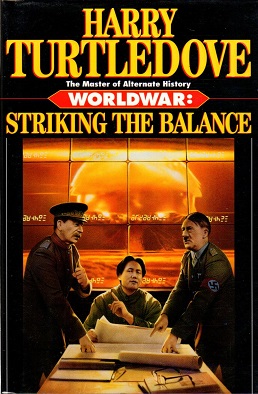
Worldwar: Striking the Balance

Worldwar: Striking the Balance
Harry Turtledove, © 1997
Random House, NY
547 pages.


I concluded Harry Turtledove's Worldwar series this week, reading Striking the Balance. To recap, in May 1942 Earth was invaded by a race of short lizard-y aliens who call themselves "the Race". The Race has maintained an empire for fifty thousand years, but their technological progress has been limited by virtue of their strong conservativeness. Consequently, even though their technology ability is far beyond that of 1940s eras humans, they are not so far removed that they can run over their foes. The Second World War ends as the various industrial powers rally together to fight the alien invader.

The Race did not come to Earth expecting industrialized societies. Their probes initially revealed a medieval world, and considering their own conservatism, they did not expect humanity to progress much in the eighteen years it took to ready an invasion fleet and army. Consequentely, they came to Earth with comparively low stores of ammunition and find themselves flummoxed by the ever-changing tactics of the industrial powers -- who up the ante when their various nuclear programs achieve fruition.

The war becomes increasingly more desperate. The Lizards, reduced to rationing their weapons, must subjugate the planet in time for their colonization fleet, but even as they submit city after city to nuclear weapons, human resistance continues and even stiffens. On the human side, strained relationships between bitter enemies -- Germans and Russians, Russians and Poles, Germans and Poles, Jews and damn near everyone -- begin to unravel, especially in this book. Striking the Balance is less military in nature and more political than previous books. Hitler's madness threatens humanity's future, as the struggle versus the lizards cannot succeed without the technological prowess of Germany. The United States is nothing near the industrial powerhouse it became in real life, courtesy of the fact that the Lizards own large blocs of land and have destroyed much of the American infastructure. Fighting seems to wear down early on in the book, and most of it concerns political intrigue and the continual attempt by one German officer to prevent his country from destroying humanity's hopes for survival -- hopes that involve a ceasefire and a truce. I'd rather not spoil anything -- but considering that this series continues with the Colonization series, you may safetly predict that even if the "War of the Worlds" is over, the conflict between humanity and the Lizards is far from over.

And so to end: how was the series? I agree with another reader who has commented on the series: it does grow a bit repetitive. It was quite interesting. There were three human characters in particular that I really enjoyed reading, and some of the alien characters were well-done as well. Turtledove repeated turns of phrase and characterizations in his so-called "Southern Victory" series as well. In that series, we were told again and again that Sam Carsen was fair-skinned and burnt easily. In this series, we were told again and again that Ludmila was a loyal child of the October Revolution, a devout atheist, that sort of thing. It grew tiresome.

I will probably read the Colonization series, but not immediately. I plowed through the last book in nearly a day, and so I'm a bit burnt on it.

Thursday, October 23, 2008

A Life of Her Own

A Life of Her Own: the Transformation of a Countrywoman in Twentieth-Century France.
Emilie Carles, © 1991
Penguin Books -- Harmondsworth, Middlesex, England

This book came to me through one of my university courses. I picked it up on Tuesday intending to get a head start on it, but I was so enthralled by the story of this French woman that I continued reading it, and I finished it early this morning. A Life of Her Own is the story of a French woman who lived in a small village in the mountains near the French border with Italy. Her village is thoroughly agricultural, and for most of her life she knows nothing but the farm. Her life is harsh -- the environment unforgiving. Her mother is struck by lightening at the age of 23 as she works in the fields, and her unread and patriarchal father must raise his large family alone.

For most people in the village, the village itself is all they know. Their lives are controlled by the weather and by the fickleness of their mayor, who seems to rule without concern for his people. For the people of Val-des-Prés, their lives are literally not their own. But Emile yearns for something more, even as she assumes her place in the valley as a good daughter. She witnesses the young men of her valley march off to war -- but sees precious few of them return. For Emilie, the war is an enormous waste -- the result of French and German autocrats fighting for a scrap of land and glory, with no regard to the workers, whose lives they ruin.

Emilie develops into an independent thinker, remarkable given her surroundings. While education is scoffed at by the farmers -- do books bring in the harvest or repair the leaky roofs? -- books become an early passion for Emilie. Her intelligent is recognized by the prefecture, and her teachers persuade her father to accept a scholarship so that Emilie can continue her education into what we would call "high school". Emilie's family seems to be singled out by the gods, as death claims nearly all of her brothers and sisters save one -- and the one sister is committed to an institution. The sister's husband is irresponsible drunk, and so Emilie and her father take care of four young ones.

As Emilie continues her education with aspirations of becoming a teacher, her mind continues to grow. The Great War ends any trust she has in the government or religion. She realizes the injustice of everything -- the millions of farmhands dying for the sake of aristocrats in Paris. She remembers a conversation with her brother, one that had a profound impact:


"You'd see," he'd tell me, "All that stuff the teacher told us, about patriotism and glory -- well, it's nothing but nonsense and lies. He had no right to have us sing 'Wave little flag'. What does it mean, anyway! Can you tell me?"

I did not know. I did not see.

"Emilie, if you do teach some day, you must tell children the truth, because it's very simple; the guy on the other side, the German, certainly has a plow or some work tool waiting for him back home. After the war, he and I, if we're not dead, if we haven't lost every shred of our human dignity, we'll have to get back on the job fixing up the ruins left by the war. But the war, well, neither he nor I will get anything out of it. When it's all over, the profits will be in the hands of the capitalists and the guys rolling in money from selling their weapons, the career soldiers will have the stripes and promotions they've won, but not us, we won't have anything to show fir it, we won't have won anything. You understand?"

So many words, so much rebellion left me dumbstruck. I had never seen him like that, he'd been gentleness incarnate.

"You understand, Emilie? When all is said and done, what's going to happen when they decide it's enough? We'll be the turkeys, us in the trenches, me and the man on the other side. No, war is not what they told us, it's monstrous. I'm against it, a thousand percent against it. I have not killed anyone and I am not going to kill, I won't have any part of it, and the only thing I ask is that they don't kill me either because I didn't do anything to them."

She also has a cousin, a 'libertarian draft evader', who introduced her to anarchism.

"You know, Emilie, most people don't know what it means to be a deserter. They think it's cowardly, and if they think so, it's because they don't know any better and they haven't thought it through. How can you expect them to think when society doesn't give them the means and even does everything possible to keep them from thinking? From childhood on, their heads are stuffed with false ideas; they hear about heroism and patriotism, but it's all hot air. Emilie, when you're in the classroom, you've got to remember, the civics lessons and all the baloney are put in to lull the conscience. Nothing is as vulnerable as a kid; he believes everything you tell him, too bad if it's a pack of lies. Desertion is to refusing to say yes to human stupidity. Sure, they all went off to war, they fought in the trenches, and they risked their lives. [...] You are refusing the system when you desert, you are saying no to the whole setup. You are saying no to the rich guess who decided on the war, you are saying no to the arms dealers, you are saying no to the colonels who play servant to the rich, and you are saying no to the priests who give them their blessing. War is state-sponsored savagery, and its first victim is the man who goes off to serve, the workers and the peasants, the people like your brother who go off to fight because they do not understand."


Realizing what mental stagnation had wrought to her country, Emilie does teach her children to question, to think. She teaches them to question racism, and nationalism, and all these other systems of ideas that take hold of young people's minds and never let go. Between teaching and caring for her aging father and her four nieces, her life becomes full of service to others. And then one night she encounters a man named Jean Carles, who tells her, "At your age, it would be a crime to sacrifice yourself for your family, and you don't do anyone a favor when you slight yourself. Imagine giving your father the poisoned gift of telling him at the last, "I sacrificed my life to you'. That would be so sad. No, you should help others, but you have to think of yourself, too. Otherwise, it's no good. You will be better armed, you will have more strength to do what you have to do.

Jean was a workingman, but an intellectual. He read voraciously, enjoyed talking about ideas, and liked to express himself in poetry to add to the beauty of life. Carles said he was 'head over heels in love with liberty'. The two soon wed and began to raise a family. They raised their children with the principles of liberty -- "You have to let [children] live free; children are not property, so people do not have the right to decide for them,'. Misfortunes continues to follow her, as she loses one of her children under the wheels of a troop transport vehicle as France readies itself for the Second World War.

Once and for all, I lost my faith and i broke with the church. It was impossible for me to accept the idea of such an unjust God. If I had abandoned my nieces to Public Assistance, Nini's death might have been a kind of punishment from heaven. Imagining a God of vengeance is harsh; but even so my case was the opposite, [...] and when I saw my little girl dead, right away I said: but there is no God of goodness, and if there is, where is He? What is He doing? It's not be true, it can't be true, that god is a monster.


War comes to France again, but her village is scarcely bothered. It is a world unto itself, and the rest of France might as well not exist. So disconnected are they from the national identity that life doesn't seem to change under the rule of Vichy: food is not as abundant, but life goes on, and they call it the "Phony War". Then her husband is put on a list of potential hostages in case someone from the valley was to assassinate a German soldier. In that case, hostages would be round up and shot to intimidate the townsfolk. The mayor, quite supportive of Vichy, is all too eager to list Jean Carles -- an anarchist, an atheist, and probably even a Commie -- at the top of the list. Consequently, Jean Carles goes on the run and remains away from the village until war's end.

After the war, she continues to take her job as teacher seriously.

Teaching youngsters to read and write is one thing, it is important but not sufficient. I have always had a loftier notion of school -- the role of the school and teacher. In my view, children take stock of the world and society in the communal school: Later on, whatever their trade, whatever direction their lives take, it is too late, the mold is already set. If it is good, so much the better. If not, nothing further can be done.

In a backward region like ours, considering the life I had led, what seemed indispensable to me was opening their minds to life, shattering the barriers that shut them in, making them understand that the earth is round, finite, and varied, and that each individual, white, black, yellow, has the right -- and the duty -- to think and decide for himself. I myself had learned as much through life as through study. That is why I could not judge my pupils solely on the basis of their schoolwork, and why I also took into account they way they behaved in their daily lives. For example, I never hid the fact that every last one of them would have to face social reality, and that when all was said and done, they would have to work for a living. But at the same time, I put them on their guard against abuses. I told them that a man must defend himself against exploitation and the stultifying effect of work. I also told them:

'The most important thing for a young person is to choose a trade he likes and enjoys, otherwise he will be a slave, unhappy and consumed with rage."

To conclude this line of argument, I always spoke to them about liberty, repeating that our famous Liberty should not simply be a word inscribed on pediments along with Equality and Fraternity -- those basic Rights of Man, an abstract and illusory liberty -- but rather that it should be a reality for each one of them.

'Beware of politicians, beware of silver-tongued orators, do your utmost to judge for yourself, and above all, take advantage of the beauty life offers."

As life wears on, Emilie speaks of the war between Algeria and France, of her children growing up, of her husband dying, and of life gradually changing. Even after her retirement, she continues to work on behalf of her community -- leading an association of citizens to stop a freeway from passing through their valley and destroying it. Despite this victory, she remains pessimistic about her government.


"Whatever the results may be, I am afraid there won't be much change. It is a harsh thing to say, but you'd have to be crazy to believe otherwise. Around me, in the papers, on television, the only thing I see and hear are men solely concerned with success and power. What sickens me the most is the blablabla, the eternal blablabla rising up from all sides: from the center, from the right, and from the left. What these men want is to win votes, get elected, and trumpet everywhere that there are the strongest and best. They are far from sharing the true interest and deep wishes of the people who work and produce. In my opinion, the big guys, the ones they call the big politicians, do nothing but repeat the same words , Liberty, Equality, Fraternity; the worst thing is that with many people it works: they're such practiced demagouges that many believe them and follow them.

With people repeating those words ever since 1789, we should certainly found out what they mean someday. But we don't. They make promises, they get themselves elected, and then they forget, or Else they use lack of funds as an excuse. I think those professional politicians ought to be set to work in a mine a thousand meters down, if only for a day; maybe then they would understand what it means to be a worker, what it means to be a miner, spending one third of his life underground: maybe then they would understand that a four-hour day is sufficient for an underground worker! But they don't, the men who run the show, the money men, do not know what it is to sweat.p...] I'd like them to know what a worker's or peasant's day means. Once they have felt it in their flesh and in their minds, perhaps they would be the first to shout: "That's enough!" And perhaps they would favor reducing the length of the working day.


As the book ends, she comments more on life. Emilie emerges as a magnificent human being: someone who is passionate about enjoying life, who cares for others, who helps them and who lives freely -- free from consumerism, free from being manipulated by those who abuse their power over others. She seems to have been an extraordinary woman, and I loved reading her story. There is so much more to share from her memoirs, but this is long enough.

"I believe it is splendid to leave life with the thought that you have done the maximum possible to defend the ideas you believe just and human, and to help those who need to be helped without discrimination. For me, that is a wonderful feeling."