Star Wars Han Solo Trilogy Vol III: Rebel Dawn
© 1998 A.C. Crispin
400 pages
Rebel Dawn is the final volume in the "Han Solo" trilogy, a volume that stands more as an immediate prequel to the original Star Wars movie than a novel solely about Han. At its beginning, Solo is on top of the world; his new ship has him ahead of the other smugglers, he can't walk into a room without gathering female attention, and he's raking in the cash. At its end, Solo has been betrayed and unwittingly duped, made into an outcast with a bounty on his head, desperate for anything that will pay off his enemies and keep him alive. And in the middle...well, that's mostly someone else's story. Rebel Dawn takes side trails in previous novels and brings them front and center here - -chiefly, competition between two major Hutt clans that threatens to turn into civil war, and Han's old flame uniting disparate groups into one Rebellion -- one whose seed money can be had by sacking the place where she was once a slave, the place where she and Solo's love was as they fought an insidious slave racket, one that used ecstatic drugs and religion to keep captives working of their own free will. But Brea loves the fight more than she loves Han, and that will put him into a seedy cantina looking for fares.
Rebel Dawn conlcudes a series which is mostly light-adventure, not to be taken too seriously. The writing definitely had weaknesses in the form of awkward dialogue. I enjoyed the character of Brea -- Han's old flame and the leader of the rebellion -- the most, and Crispin's treatment of the Hutts and Boba Fett were also appealing. Imagine Jabba the Hutt as a sympathetic character!
Pursuing the flourishing life and human liberty through literature.
"Once you learn to read, you will be forever free." - Frederick Douglass
Showing posts with label Star Wars. Show all posts
Thursday, June 14, 2018
Tuesday, June 12, 2018
The Hutt Gambit
The Han Solo Trilogy, Vol II: The Hutt Gambit
© 1997 A.C. Crispin
352 pages
At the end of The Paradise Snare, Han Solo was a heartbroken man moving on with his life, doing his best to forget about the woman who left him with a "Dear John" letter as he entered the pilot academy and the service of the Empire. As The Hutt Gambit opens, readers realize how short-lived both Solo's tenure in the Imperial Navy and his determination to avoid romantic entanglements were: not only has he been cashiered from the service and blacklisted from commercial piloting, but he can't move to a planet without falling in love again. Turning again to that faithful standby, a life of crime, Solo begins working for the Hutts and acquiring the money and reputation he needs to make it as as first-rate smuggler. Too bad the Empire has decided to slag his and other smugglers' favorite retreat, Nar Shadaa. The Hutt Gambit serves a steady course of light action-adventure that builds Solo's character, introducing him to Jabba, Lando, the Falcon, and even Boba Fett, and ends with a desperate attempt by the smugglers to stave off an Imperial attack fleet. Fortunately it's one of older ships, left by a man who is both hesitant to commit genocide and very susceptible to bribes. I thought the ending was contrived, to say the least, but enjoyed the characterization given to both the Hutts and Boba Fett, who -- in a nod to Return to the Jedi -- does a low pass over the Sarlaac pit while visiting Tatooine, unwittingly walking over his own grave.
© 1997 A.C. Crispin
352 pages
At the end of The Paradise Snare, Han Solo was a heartbroken man moving on with his life, doing his best to forget about the woman who left him with a "Dear John" letter as he entered the pilot academy and the service of the Empire. As The Hutt Gambit opens, readers realize how short-lived both Solo's tenure in the Imperial Navy and his determination to avoid romantic entanglements were: not only has he been cashiered from the service and blacklisted from commercial piloting, but he can't move to a planet without falling in love again. Turning again to that faithful standby, a life of crime, Solo begins working for the Hutts and acquiring the money and reputation he needs to make it as as first-rate smuggler. Too bad the Empire has decided to slag his and other smugglers' favorite retreat, Nar Shadaa. The Hutt Gambit serves a steady course of light action-adventure that builds Solo's character, introducing him to Jabba, Lando, the Falcon, and even Boba Fett, and ends with a desperate attempt by the smugglers to stave off an Imperial attack fleet. Fortunately it's one of older ships, left by a man who is both hesitant to commit genocide and very susceptible to bribes. I thought the ending was contrived, to say the least, but enjoyed the characterization given to both the Hutts and Boba Fett, who -- in a nod to Return to the Jedi -- does a low pass over the Sarlaac pit while visiting Tatooine, unwittingly walking over his own grave.
Sunday, June 3, 2018
The Paradise Snare
The Han Solo Trilogy: The Paradise Snare
© 1997 A.C. Crispin
338 pages
Han Solo easily has the most personality of any of the original trilogy's characters, but where did he come from? A.C. Crispin's Solo Trilogy was the first to try and answer that question. The Paradise Snare opens on a young orphan impressed into a gang, who has been brought up hustling and conning wealthy marks -- but longs to escape, and be a pilot. Just getting away from the gang is a great challenge, and there's no easy path forward. Solo seems to jump from the frying pan into the fire into a swollen pit of molten lava, eventually angering even the Hutts. Happily A Paradise Snare is Solo's book, with no early appearances of other major characters -- and Solo himself is a work in progress. The Paradise Snare takes a hopeful young escapee and throws him around like a rag doll until the more cynical gunslinger of A New Hope seems to taking shape before us. Crispin's approach in working Solo gives readers an idea as to why Solo is so easy with Wookiees, and why he is loathe to trust others -- especially a woman who's he's falling for. The Paradise Snare is a solid first step in the trilogy.
Interestingly, Crispin also wrote a background novel for the character of Sarek, from Star Trek TOS and The Next Generation.
© 1997 A.C. Crispin
338 pages
Han Solo easily has the most personality of any of the original trilogy's characters, but where did he come from? A.C. Crispin's Solo Trilogy was the first to try and answer that question. The Paradise Snare opens on a young orphan impressed into a gang, who has been brought up hustling and conning wealthy marks -- but longs to escape, and be a pilot. Just getting away from the gang is a great challenge, and there's no easy path forward. Solo seems to jump from the frying pan into the fire into a swollen pit of molten lava, eventually angering even the Hutts. Happily A Paradise Snare is Solo's book, with no early appearances of other major characters -- and Solo himself is a work in progress. The Paradise Snare takes a hopeful young escapee and throws him around like a rag doll until the more cynical gunslinger of A New Hope seems to taking shape before us. Crispin's approach in working Solo gives readers an idea as to why Solo is so easy with Wookiees, and why he is loathe to trust others -- especially a woman who's he's falling for. The Paradise Snare is a solid first step in the trilogy.
Interestingly, Crispin also wrote a background novel for the character of Sarek, from Star Trek TOS and The Next Generation.
Thursday, December 26, 2013
The Phantom Menace
Star Wars Episode I: The Phantom Menace
© 1999 Terry Brooks
The Phantom Menace was the first movie in the new 'prequel' trilogy of the Star Wars saga, which told the story of a promising young Jedi who was seduced by the Dark Side of the Force, even as the Republic which he served was corrupted by the master of the dark inside into the Galactic Empire. It is easily the least-liked of the Star Wars movies, featuring a young boy who is far too precocious ("Are you an angel?") and the majestic silliness of Jar-Jar Binks. Terry Brooks' challenge in creating a novelization of this story was thus considerable, and he tries valiantly. He cleans up parts of Jar-Jar's language; while much the psuedo-ebonics remains ("Dat", "dis", and so on), his unique turns of phrase ("Dat's baaaad bombin'!") are sterilized, with mixed effect. The dialogue is fleshed out to make some of the characters' decisions more understandable; Qui-Gonn Jinn only takes a fourteen year old girl with him into a wretched hive of scum, villainy, and obnoxious aliens only after she reveals her extensive self-defense training. Anakin, too, gets a little development, demonstrating his awareness of how he can manipulate his own mental state; he tells Jar-Jar that the bumbling Gungan's fear attracts abuse to him. There's also a scene with the Sand People that becomes more interesting when the plot of Attack of the Clones is taken into consideration, though I don't know if Brooks knew what Lucas had planned for Anakin's poor mother. While Brooks doesn't improve the original nearly as much as Matthew Stover did with Revenge of the Sith, it's a step in the right direction, making a previously juvenile story a bit more sensible. Books in the EU universe like Darth Maul: Shadow Hunter and Cloak of Deception do the lion's work in that department, however.
Related:
Revenge of the Sith, Matthew Stover. For my money, the gold standard of movie novelizations.
Darth Maul. Shadow Hunter; Michael Reaves
Cloak of Deception, James Luceno
© 1999 Terry Brooks
The Phantom Menace was the first movie in the new 'prequel' trilogy of the Star Wars saga, which told the story of a promising young Jedi who was seduced by the Dark Side of the Force, even as the Republic which he served was corrupted by the master of the dark inside into the Galactic Empire. It is easily the least-liked of the Star Wars movies, featuring a young boy who is far too precocious ("Are you an angel?") and the majestic silliness of Jar-Jar Binks. Terry Brooks' challenge in creating a novelization of this story was thus considerable, and he tries valiantly. He cleans up parts of Jar-Jar's language; while much the psuedo-ebonics remains ("Dat", "dis", and so on), his unique turns of phrase ("Dat's baaaad bombin'!") are sterilized, with mixed effect. The dialogue is fleshed out to make some of the characters' decisions more understandable; Qui-Gonn Jinn only takes a fourteen year old girl with him into a wretched hive of scum, villainy, and obnoxious aliens only after she reveals her extensive self-defense training. Anakin, too, gets a little development, demonstrating his awareness of how he can manipulate his own mental state; he tells Jar-Jar that the bumbling Gungan's fear attracts abuse to him. There's also a scene with the Sand People that becomes more interesting when the plot of Attack of the Clones is taken into consideration, though I don't know if Brooks knew what Lucas had planned for Anakin's poor mother. While Brooks doesn't improve the original nearly as much as Matthew Stover did with Revenge of the Sith, it's a step in the right direction, making a previously juvenile story a bit more sensible. Books in the EU universe like Darth Maul: Shadow Hunter and Cloak of Deception do the lion's work in that department, however.
Related:
Revenge of the Sith, Matthew Stover. For my money, the gold standard of movie novelizations.
Darth Maul. Shadow Hunter; Michael Reaves
Cloak of Deception, James Luceno
Friday, June 7, 2013
This Week at the Library: Star Wars, bikes, and evil farms
Fool's Bargain, Timothy Zahn
Just Ride, Grant Peterson
Against the Grain, Richard Manning
This week my local library began officially offering electronic books via membership in a regional e-book collective. Although I much prefer real books (see my printed-book snobbery? "real books", I said), I've been checking titles out and reading them on my computer to practice with the software...since I'll soon be explaining to people how to use it. My first read was a Star Wars novella by Timothy Zahn called Fool's Bargain. Set sometime after the destruction of the empire and starring a squad of stormtroopers who are loyal to "The Empire of the Hand", it follows them as they attempt to capture a warlord in a secret underground hideout. The tension comes from their having to recruit allies on the ground...possibly treacherous ones. It's more a short story than anything else, but I enjoyed it.
My second e-read through this system is one of the rare nonfiction titles available through our consortium, and it's called Just Ride. As you might guess from the cover, its subject is bicycling. The author is a cycling advocate, and believes that the United States bicycling culture has for too long been dominated by the racing scene, which sees bikes as Serious Business, demanding special pedals, special shoes with clips for the special pedals, special clothes, hi-tech gadgets, and hours upon hours of grueling practice. Nonsense! Phooey! Quatsch! Baloney! says he. Bikes are fun. Bikes take you places. Explore that more. After introductions in which he grumbles about this or that aspect of race culture, most of the book consists of simple advice on how to get the most out of cycling. Wear street clothes; ride anytime you like, just for fun, no matter how little a distance; rig your bike with practical accessories, like baskets; don't try to turn a bicycle into a weight-loss machine. He also provides day-to-day maintenance tips along with actual cycling advice, as with the chapter on how to drift in turning. Just Ride was a fun read, and if you're on facebook there is a "Slow Bicycle" group dedicated to ideas like the author's.
In terms of 'real' reading, May was a fairly fat month. I'm not sure why, but that was also true last year: after a quiet April, May exploded. It helped that a lot of the reads were on the shorter side, with some energetic authors, especially Jim Kunstler and Joel Salatin. I'm apparently doing a series on food at the moment; something about the explosion of color in the produce isle in late spring brings out my inner foodie. I've just finished Against the Grain: How Agriculture Hijacked Civilization, which isn't quite what I was expecting. The author's primary contention is that agriculture isn't about producing food, it's about the accumulation of wealth. Considering the health disparities between hunter-gatherers, who had a broad diet, and agriculturalists who subsisted on grains (leading to malnutrition, stunted growth, and early death), early agriculture didn't feed people fully so much as it kept workers alive so they could continue working to enrich the plantation owners. Also, monocultures and processed foods suck. These were the author's chief contentions, but they weren't developed in any thorough, systematic way; the book was more a collection of musings than an argument. A recurring theme was that of sensualism; in the author's view, agriculture keeps us from experiencing life fully, both because hunting enlivens the senses in a way that farming and buying food don't, and because farming is a dull, monotonous, body-killing lifestyle that only succeeded through imperialism, both military and ecological.
My next read in that neighborhood may be Diet for a Hot Planet, but after the last couple of months I'm in the mood for something light, fun, and comforting, so I think I'll try a Wendell Berry novel. Also, seeing as the Fourth of July is less than a month away, I'm beginning to think of what my celebratory reading will be. I'm currently considering a biography of George Washington by Joseph Ellis, whose work I like, and a biography of Alexander Hamilton by Ron Chernow, which was reccommended to me as an antidote to all of the anti-Hamiltonian views I was exposed to in my John Adams obsession last year.
In the post this week I received three books: Glimpses of World History, by Jawaharlal Nehru, the first president of India; The Story of my Experiments with Truth, by Mohandas Gandhi, and An Edible History of Humanity by Tom Standage. Actually, that may be my light-and-fun read. A confession: while most of my books come from libraries or used stores online, whenever I drive to the "big city" of Montgomery, I stop in at a Books-A-Million to look at the magazines. Somehow in the bible belt they manage to sell magazines as scurrilous as Free Inquiry, and even offer magazines for obscure hobbies like model train collecting. (Not that I've bought one, I just see it when I'm getting my own copies of Trains and Classic Trains and...well, you get the picture.) Invariably I am harassed by the clerk who wants me to buy one of those membership cards, in which you pay $20 and then get discounts on books and shipping. Well, the clerk at the BAM! I tend to go to the most is very persuasive, and a couple of months ago I finally broke down and bought one of the things. (I was in a good mood: I'd been to the zoo and to a most excellent play, a performance of "Around the World in 80 Days"). Early this week I decided to go to the BAM website to see there were any opportunities for recouping my $20 investment, and so help me if they weren't offering a copy of a book on my to-read-eventually list (Edible History) in the online bargain bin, for such a low price that I'd pay more to borrow it through interlibrary loan. Assuming I saved something like $3 for shipping (I would have never gone for express were it not "Free"), I figure the card's real cost is now $17. I suppose if I bought more, I could recoup more of that, but that's exactly what they want me to do, so I'm just going to see if I can earn that $17 back on bargain books that I would have paid $3 for interlibrary loan shipping anyway.
Just Ride, Grant Peterson
Against the Grain, Richard Manning
This week my local library began officially offering electronic books via membership in a regional e-book collective. Although I much prefer real books (see my printed-book snobbery? "real books", I said), I've been checking titles out and reading them on my computer to practice with the software...since I'll soon be explaining to people how to use it. My first read was a Star Wars novella by Timothy Zahn called Fool's Bargain. Set sometime after the destruction of the empire and starring a squad of stormtroopers who are loyal to "The Empire of the Hand", it follows them as they attempt to capture a warlord in a secret underground hideout. The tension comes from their having to recruit allies on the ground...possibly treacherous ones. It's more a short story than anything else, but I enjoyed it.
My second e-read through this system is one of the rare nonfiction titles available through our consortium, and it's called Just Ride. As you might guess from the cover, its subject is bicycling. The author is a cycling advocate, and believes that the United States bicycling culture has for too long been dominated by the racing scene, which sees bikes as Serious Business, demanding special pedals, special shoes with clips for the special pedals, special clothes, hi-tech gadgets, and hours upon hours of grueling practice. Nonsense! Phooey! Quatsch! Baloney! says he. Bikes are fun. Bikes take you places. Explore that more. After introductions in which he grumbles about this or that aspect of race culture, most of the book consists of simple advice on how to get the most out of cycling. Wear street clothes; ride anytime you like, just for fun, no matter how little a distance; rig your bike with practical accessories, like baskets; don't try to turn a bicycle into a weight-loss machine. He also provides day-to-day maintenance tips along with actual cycling advice, as with the chapter on how to drift in turning. Just Ride was a fun read, and if you're on facebook there is a "Slow Bicycle" group dedicated to ideas like the author's.
In terms of 'real' reading, May was a fairly fat month. I'm not sure why, but that was also true last year: after a quiet April, May exploded. It helped that a lot of the reads were on the shorter side, with some energetic authors, especially Jim Kunstler and Joel Salatin. I'm apparently doing a series on food at the moment; something about the explosion of color in the produce isle in late spring brings out my inner foodie. I've just finished Against the Grain: How Agriculture Hijacked Civilization, which isn't quite what I was expecting. The author's primary contention is that agriculture isn't about producing food, it's about the accumulation of wealth. Considering the health disparities between hunter-gatherers, who had a broad diet, and agriculturalists who subsisted on grains (leading to malnutrition, stunted growth, and early death), early agriculture didn't feed people fully so much as it kept workers alive so they could continue working to enrich the plantation owners. Also, monocultures and processed foods suck. These were the author's chief contentions, but they weren't developed in any thorough, systematic way; the book was more a collection of musings than an argument. A recurring theme was that of sensualism; in the author's view, agriculture keeps us from experiencing life fully, both because hunting enlivens the senses in a way that farming and buying food don't, and because farming is a dull, monotonous, body-killing lifestyle that only succeeded through imperialism, both military and ecological.
My next read in that neighborhood may be Diet for a Hot Planet, but after the last couple of months I'm in the mood for something light, fun, and comforting, so I think I'll try a Wendell Berry novel. Also, seeing as the Fourth of July is less than a month away, I'm beginning to think of what my celebratory reading will be. I'm currently considering a biography of George Washington by Joseph Ellis, whose work I like, and a biography of Alexander Hamilton by Ron Chernow, which was reccommended to me as an antidote to all of the anti-Hamiltonian views I was exposed to in my John Adams obsession last year.
In the post this week I received three books: Glimpses of World History, by Jawaharlal Nehru, the first president of India; The Story of my Experiments with Truth, by Mohandas Gandhi, and An Edible History of Humanity by Tom Standage. Actually, that may be my light-and-fun read. A confession: while most of my books come from libraries or used stores online, whenever I drive to the "big city" of Montgomery, I stop in at a Books-A-Million to look at the magazines. Somehow in the bible belt they manage to sell magazines as scurrilous as Free Inquiry, and even offer magazines for obscure hobbies like model train collecting. (Not that I've bought one, I just see it when I'm getting my own copies of Trains and Classic Trains and...well, you get the picture.) Invariably I am harassed by the clerk who wants me to buy one of those membership cards, in which you pay $20 and then get discounts on books and shipping. Well, the clerk at the BAM! I tend to go to the most is very persuasive, and a couple of months ago I finally broke down and bought one of the things. (I was in a good mood: I'd been to the zoo and to a most excellent play, a performance of "Around the World in 80 Days"). Early this week I decided to go to the BAM website to see there were any opportunities for recouping my $20 investment, and so help me if they weren't offering a copy of a book on my to-read-eventually list (Edible History) in the online bargain bin, for such a low price that I'd pay more to borrow it through interlibrary loan. Assuming I saved something like $3 for shipping (I would have never gone for express were it not "Free"), I figure the card's real cost is now $17. I suppose if I bought more, I could recoup more of that, but that's exactly what they want me to do, so I'm just going to see if I can earn that $17 back on bargain books that I would have paid $3 for interlibrary loan shipping anyway.
Monday, February 6, 2012
Outbound Flight
Star Wars: Outbound Flight
© 2006 Timothy Zahn
464 pages

Five years after his ascendacy to leadership of the Republic, Supreme Chancellor Palpatine endorsed an extraordinary project: the launching of a flotilla of ships into the far expanses of space, on a journey to explore a distant galaxy. Headed by a tempermental Jedi, the bold project promised to invigorate the spirit of the galactic body-politic in an era of increasing corruption and declining faith in the government...but faith had something else in mind for this Outbound Flight.
Though Obi-Wan Kenobi and his adolescent apprentice Anakin Skywalker play minor parts in this story of political mystery and thrilling action at the galaxy's edge, the lead characters are a handful of smugglers whose malfunctioning hyperdrive delivers them into the hands of a mysterious commander from the "Chiss Ascendancy". The urbane military genius has a passion for understanding the personalities and nations he is put into contact with, and a gift for winnowing out the details from subtle clues. Those wits come into demand when a skulking agent of Lord Sideous causes his path to collide violently with those of Outbound Flight's. The story serves as an ominous prelude to the Yuuzhan Vong arc, as well as giving a full and proper introduction to one of Timothy Zahn's most admired characters -- Thrawn.
Thrawn never fails to delight when he appears. The character himself is utterly fascinating -- a "good" villain who is often more likable than than the heroes of the book who he opposes. Outbound Flight is the kind of a mystery-action thriller that Thrawn thrives in, impressing readers with his cunning, audacity, and ability to work steps ahead of his foes. He's as though he's a chess master playing in deep space: here, he goes against alien fleets, a covert agent, and his own people in attempting to strike the best effective blow for the Chiss. Although I've read previous mentions of the Outbound Flight 'disaster' and assumed the project wouldn't end well, Zahn kept me on my toes; the role played by Sideous is especially interesting; the character is so duplicitous, manipulating even his closest allies, that his ultimate motives remain in the shadows.
As usual for Zahn, this is a fantastic thriller, and an especially exciting one for fans of Thrawn.
© 2006 Timothy Zahn
464 pages

Five years after his ascendacy to leadership of the Republic, Supreme Chancellor Palpatine endorsed an extraordinary project: the launching of a flotilla of ships into the far expanses of space, on a journey to explore a distant galaxy. Headed by a tempermental Jedi, the bold project promised to invigorate the spirit of the galactic body-politic in an era of increasing corruption and declining faith in the government...but faith had something else in mind for this Outbound Flight.
Though Obi-Wan Kenobi and his adolescent apprentice Anakin Skywalker play minor parts in this story of political mystery and thrilling action at the galaxy's edge, the lead characters are a handful of smugglers whose malfunctioning hyperdrive delivers them into the hands of a mysterious commander from the "Chiss Ascendancy". The urbane military genius has a passion for understanding the personalities and nations he is put into contact with, and a gift for winnowing out the details from subtle clues. Those wits come into demand when a skulking agent of Lord Sideous causes his path to collide violently with those of Outbound Flight's. The story serves as an ominous prelude to the Yuuzhan Vong arc, as well as giving a full and proper introduction to one of Timothy Zahn's most admired characters -- Thrawn.
Thrawn never fails to delight when he appears. The character himself is utterly fascinating -- a "good" villain who is often more likable than than the heroes of the book who he opposes. Outbound Flight is the kind of a mystery-action thriller that Thrawn thrives in, impressing readers with his cunning, audacity, and ability to work steps ahead of his foes. He's as though he's a chess master playing in deep space: here, he goes against alien fleets, a covert agent, and his own people in attempting to strike the best effective blow for the Chiss. Although I've read previous mentions of the Outbound Flight 'disaster' and assumed the project wouldn't end well, Zahn kept me on my toes; the role played by Sideous is especially interesting; the character is so duplicitous, manipulating even his closest allies, that his ultimate motives remain in the shadows.
As usual for Zahn, this is a fantastic thriller, and an especially exciting one for fans of Thrawn.
Monday, January 23, 2012
Choices of One
Star Wars: Choices of One
© 2011 Timothy Zahn
366 pages

Timothy Zahn's Allegiance (2006) introduced us to the Hand of Judgment, a band of "rogue stormtroopers" -- deserters turned do-good vigilantes. In Choices of One, these four hook up with Emperor Palpatine's favored agent, Mara Jade, to 'correct' a governor in the hinterlands who is rumored to be meeting with the leaders of the rebellion. Though the Death Star has been destroyed, the Empire is far from finished, and the rebels badly need a new base of operations. Luke and Han -- the latter struggling with his place in a military organization -- are dispatched to investigate the governor's offer, and at the edges of known space they, Jade, the Hand of Judgment, Senior Captain Thrawn, and Commander Palleon are drawn into a web of intrigue, spun by an unknown individual with a concealed agenda.
Although the plot proper doesn't add much to the Star Wars canon, other than setting up The Empire Strikes Back, it offers first a mystery and then an action thriller that sees the character growth we missed between A New Hope and its sequel; Luke is still "the kid", still growing in confidence and ability. Han's connection to the rebellion, formerly tenuous, grows here -- and he and Leia bounce off each other nicely. It is Zahn's characters who steal the show, though: despite the fact they're all villains in that they serve the Empire in one form or another, their motivations are wholly respectable -- or in Jade's case, at least understandable -- and I couldn't help but root for them, especially for the "Hand of Judgment" and the Thrawn-Palleon duo which has its beginnings here. Like the films, the action steadily increases, and at its height all of the characters are involved in desperate fights of their own, all of which are part of a greater conflict between the characters and whoever is responsible for drawing both the Empire and the Rebellion to this previously-forgotten world on the fringes of the empire.
Fun thriller with great characters; recommended.
© 2011 Timothy Zahn
366 pages

The choices of one shape the futures of all. (Jedi saying)
Although the plot proper doesn't add much to the Star Wars canon, other than setting up The Empire Strikes Back, it offers first a mystery and then an action thriller that sees the character growth we missed between A New Hope and its sequel; Luke is still "the kid", still growing in confidence and ability. Han's connection to the rebellion, formerly tenuous, grows here -- and he and Leia bounce off each other nicely. It is Zahn's characters who steal the show, though: despite the fact they're all villains in that they serve the Empire in one form or another, their motivations are wholly respectable -- or in Jade's case, at least understandable -- and I couldn't help but root for them, especially for the "Hand of Judgment" and the Thrawn-Palleon duo which has its beginnings here. Like the films, the action steadily increases, and at its height all of the characters are involved in desperate fights of their own, all of which are part of a greater conflict between the characters and whoever is responsible for drawing both the Empire and the Rebellion to this previously-forgotten world on the fringes of the empire.
Fun thriller with great characters; recommended.
Sunday, July 25, 2010
Dynasty of Evil
Darth Bane: Dynasty of Evil
© 2009 Drew Karpyshyn
296 pages

Twenty years ago, a disgruntled miner-turned-revolutionary-turned Sith Lord destroyed the whole of the Brotherhood of Darkness and became the sole Dark Lord of the Sith. Taking the name Darth Bane, he quietly eradicated the remnants of his old life. Taking a young girl named Zannah with him, Bane transformed what it meant to be a Sith, beginning a new order that maintained only two Sith should ever exist -- a Master to embody power and and apprentice to crave it, seek it, and claim the title of Master for herself through a challenge to the death. The weak perish and the strong survive; this is Bane's way of the Sith.
A lifetime of wielding the dark energies of the Force have atrophied Darth Bane, but his apprentice -- an accomplished Sith sorceress whose manipulation of the Force can drive her enemies insane -- has yet to challenge him and claim the title of Dark Lord for herself. Disgusted by her apparent lack of ambition, Bane searches for a way to lengthen his own life so that he might find and train a better apprentice. Dispatching Zannah on a mission to investigate the murder of a Jedi knight -- for anyone who can overcome a skilled Jedi is of interest to Bane -- the Dark Lord himself travels to the galaxy's perilous deep core to look for a planet where a Sith lord once ruled for centuries, relying on arcane knowledge to achieve near-immortality.
Zannah takes opportunity of her liberty to find her own apprentice in preparation for her overthrow of Bane, and she is not alone in seeking a confrontation with him: a woman who witnessed her father tortured at the hands of Bane in The Rule of Two has come into money, and is using it to pay a talented bounty hunter and assassin to track Bane down. The characters' journeys come together in the depths of a mountain prison, where the five stalk each other -- some looking for salvation, others for revenge and glory.
Although somewhat short -- fontsize is fairly large, making the page count misleading -- Karpyshyn succeeds in giving his central character a fitting resolution, a demanding task considering the amount of tension Karpyshyn has been developing since The Rule of Two. His cast of characters is strong and must be so, for the novel is dominated by character drama: while Bane, Zannah, Princess Serra, and the others all have action-laden jobs to fulfill, they're only background. Two of the new characters held my attention: Serra, the royal princess whose hatred and desire for revenge against Bane draws her into the dark side, a move contested only by her faithful bodyguard Lucia -- who once idolized Bane during his revolutionary years in the Sith army. The fifth character makes the ending almost unpredictable: before completing the novel, I could not say with surety which resolution Karpyshyn would choose.
The Darth Bane trilogy has been a pleasure throughout, and its capstone is fitting if a bit light.
Related:
© 2009 Drew Karpyshyn
296 pages

Twenty years ago, a disgruntled miner-turned-revolutionary-turned Sith Lord destroyed the whole of the Brotherhood of Darkness and became the sole Dark Lord of the Sith. Taking the name Darth Bane, he quietly eradicated the remnants of his old life. Taking a young girl named Zannah with him, Bane transformed what it meant to be a Sith, beginning a new order that maintained only two Sith should ever exist -- a Master to embody power and and apprentice to crave it, seek it, and claim the title of Master for herself through a challenge to the death. The weak perish and the strong survive; this is Bane's way of the Sith.
A lifetime of wielding the dark energies of the Force have atrophied Darth Bane, but his apprentice -- an accomplished Sith sorceress whose manipulation of the Force can drive her enemies insane -- has yet to challenge him and claim the title of Dark Lord for herself. Disgusted by her apparent lack of ambition, Bane searches for a way to lengthen his own life so that he might find and train a better apprentice. Dispatching Zannah on a mission to investigate the murder of a Jedi knight -- for anyone who can overcome a skilled Jedi is of interest to Bane -- the Dark Lord himself travels to the galaxy's perilous deep core to look for a planet where a Sith lord once ruled for centuries, relying on arcane knowledge to achieve near-immortality.
Zannah takes opportunity of her liberty to find her own apprentice in preparation for her overthrow of Bane, and she is not alone in seeking a confrontation with him: a woman who witnessed her father tortured at the hands of Bane in The Rule of Two has come into money, and is using it to pay a talented bounty hunter and assassin to track Bane down. The characters' journeys come together in the depths of a mountain prison, where the five stalk each other -- some looking for salvation, others for revenge and glory.
Although somewhat short -- fontsize is fairly large, making the page count misleading -- Karpyshyn succeeds in giving his central character a fitting resolution, a demanding task considering the amount of tension Karpyshyn has been developing since The Rule of Two. His cast of characters is strong and must be so, for the novel is dominated by character drama: while Bane, Zannah, Princess Serra, and the others all have action-laden jobs to fulfill, they're only background. Two of the new characters held my attention: Serra, the royal princess whose hatred and desire for revenge against Bane draws her into the dark side, a move contested only by her faithful bodyguard Lucia -- who once idolized Bane during his revolutionary years in the Sith army. The fifth character makes the ending almost unpredictable: before completing the novel, I could not say with surety which resolution Karpyshyn would choose.
The Darth Bane trilogy has been a pleasure throughout, and its capstone is fitting if a bit light.
Related:
- Dynasty of Evil's Wookiepedia entry
- Reviews from TheForce.net
Thursday, May 27, 2010
Revenge of the Sith
Revenge of the Sith
© 2005: Screenplay, George Lucas; novelization, Matthew Stover.
419 pages

An article on TvTropes convinced me to read the novelization of Revenge of the Sith, primarily because it mentioned that Stover remedied my primary gripe with the movie, the way it turned Padme Amidala into a two-dimensional prop for Anakin whose only function seemed to be crying and wringing her hands in helplessness. Happily, I was not mislead here, for Revenge may be one of the better Star Wars works I've yet read.
Revenge of the Sith is the last of the prequel movies, depicting the downfall of the Galactic Republic and the fall of Anakin Skywalker to the Dark Side. Skywalker is the hero of the hour, a lifetime prodigy whose exploits are known far and wide. He and his mentor Obi-Wan Kenobi have served the Republic tirelessly throughout the Clone Wars, but political stresses tug them apart. The Jedi council has grown concerned over the increasing amount of power invested in the Supreme Chancellor, and doubly wary given the Chancellor’s strong connection to young Anakin, who -- while powerful, brave, and fiercely loyal -- possesses fear and pride in abundance. While the Republic struggles to bring an end to the civil war which has so undermined its foundations, the JedI attempt to defend the integrity of both the Republic and Anakin. In the shadows, the Dark Lord of the Sith pulls the strings and anticipates his greatest triumph: unlimited and unquestioned mastery over the galaxy and its citizens.
What Stover adds to this is not just a few extra scenes that tie up loose ends, but passages that give the players involved in this great tragedy emotional depth, depth that explains and possibly even redeems some of the film’s weaker portions. Stover occasionally breaks from the usual third-person past-tense narration to focus on a character in the second tense, bringing the reader inside a character’s head. This approach handled character exposition well, and proved to be efficient in tackling Order 66. The added character depth allows Stover to create more believable tension between Anakin and the main characters, particularly Obi-Wan and Amidala, the latter of whom is active throughout the book in an attempt to restore the Constitution to its pre-Palpatine form: Palpatine regards the 2,000 senators who join her cause as traitors, and links them with the alleged attempt on the part of the Jedi to overthrow the republic and place it under their rule. Thus, Anakin’s hostility toward Padme and Obi-Wan arriving on Mustafar together at the end of the movie has greater significance. Although this a dark book, Stover adds in surprising and sometimes odd amounts of humor: Anakin starts throwing out snaky one-liners as soon as he steps foot on Mustfar and doesn’t quit until the last of the separatists are dead. Curiously, he underplays some of the more dramatic moments in the movie, particularly Anakin's wail of unbelief when the Emperor tells him of Padme's death.
Revenge of the Sith made for a great read even though I’m so familiar with the movie. It added depth and humor to the original screenplay, maintaining a strong stride until Mustafar. I can easily recommend it to Star Wars readers.
Related:
© 2005: Screenplay, George Lucas; novelization, Matthew Stover.
419 pages

Blade to blade, they were identical. After thousands of hours in lightsaber sparring, they knew each other better than brothers, more intimately than lovers; they were complimentary halves of a single warrior. In every exchange, Obi-Wan gave ground. It was his way. And he knew that to strike Anakin down would be to burn his own heart to ash. (397)
An article on TvTropes convinced me to read the novelization of Revenge of the Sith, primarily because it mentioned that Stover remedied my primary gripe with the movie, the way it turned Padme Amidala into a two-dimensional prop for Anakin whose only function seemed to be crying and wringing her hands in helplessness. Happily, I was not mislead here, for Revenge may be one of the better Star Wars works I've yet read.
Revenge of the Sith is the last of the prequel movies, depicting the downfall of the Galactic Republic and the fall of Anakin Skywalker to the Dark Side. Skywalker is the hero of the hour, a lifetime prodigy whose exploits are known far and wide. He and his mentor Obi-Wan Kenobi have served the Republic tirelessly throughout the Clone Wars, but political stresses tug them apart. The Jedi council has grown concerned over the increasing amount of power invested in the Supreme Chancellor, and doubly wary given the Chancellor’s strong connection to young Anakin, who -- while powerful, brave, and fiercely loyal -- possesses fear and pride in abundance. While the Republic struggles to bring an end to the civil war which has so undermined its foundations, the JedI attempt to defend the integrity of both the Republic and Anakin. In the shadows, the Dark Lord of the Sith pulls the strings and anticipates his greatest triumph: unlimited and unquestioned mastery over the galaxy and its citizens.
What Stover adds to this is not just a few extra scenes that tie up loose ends, but passages that give the players involved in this great tragedy emotional depth, depth that explains and possibly even redeems some of the film’s weaker portions. Stover occasionally breaks from the usual third-person past-tense narration to focus on a character in the second tense, bringing the reader inside a character’s head. This approach handled character exposition well, and proved to be efficient in tackling Order 66. The added character depth allows Stover to create more believable tension between Anakin and the main characters, particularly Obi-Wan and Amidala, the latter of whom is active throughout the book in an attempt to restore the Constitution to its pre-Palpatine form: Palpatine regards the 2,000 senators who join her cause as traitors, and links them with the alleged attempt on the part of the Jedi to overthrow the republic and place it under their rule. Thus, Anakin’s hostility toward Padme and Obi-Wan arriving on Mustafar together at the end of the movie has greater significance. Although this a dark book, Stover adds in surprising and sometimes odd amounts of humor: Anakin starts throwing out snaky one-liners as soon as he steps foot on Mustfar and doesn’t quit until the last of the separatists are dead. Curiously, he underplays some of the more dramatic moments in the movie, particularly Anakin's wail of unbelief when the Emperor tells him of Padme's death.
Revenge of the Sith made for a great read even though I’m so familiar with the movie. It added depth and humor to the original screenplay, maintaining a strong stride until Mustafar. I can easily recommend it to Star Wars readers.
Related:
- Shatterpoint, by the same author -- to my surprise.I struggled through Shatterpoint, but Revenge was a breeze.
- Dark Lord: the Rise of Darth Vader, by James Luceno. I've read this and enjoyed it, although since it's been so long (before I started this blog, even), I can't remember too many details. The novel is set immediately after Revenge of the Sith and focuses on Anakin as he grows accustomed to his new role as Darth Vader.
Tuesday, May 4, 2010
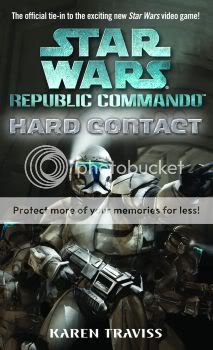
Hard Contact
Star Wars Republic Commando: Hard Contact
© 2004 Karen Traviss
293 pages
A few weekends ago I finished Star Wars: Republic Commando, a particularly fun first-person shooter set during the Clone Wars, placing the character as the lead of "Delta Squad", a band of elite soldiers tasked with the Clone Wars' toughest assignments. I enjoyed the game immensely for its humor and style, and decided when I found that book series had been written to tie into the game that I'd like to read part of it. That's what brought me to Hard Contact, a straightforward military science fiction story about the misson of four Clone Commandos. They are not, alas, the four Commandos I became familar with in the game, being a different squad of troops.
The commandos are tasked with eliminating a planetary despot who controls a biogenetic agent targeting the Republic's clone army, the potential of which earned that despot a place in the Confederacy of Independent Systems' hierarchy. Succeeding in destroying his labs and freeing the planet from his rule will earn the Republic a new planet: failure might well see the annihilation of the entire Grand Army. The four soldiers are seperated when infiltrating the planet, and the Jedi master with whom they expected to join forces with was killed: they are left only with his woefully inexperienced and somewhat disgraced Padawan, who is on the verge of being expelled from the Jedi Order for her ineptitude. The squad must rally together against great difficulty to accomplish their goal.
Books that are purely combat rarely resonate with me and given that I didn't see the characters I had hoped to see, this wasn't an exception. I generally enjoyed the book, and understand the series' appeal to other readers. I understand Delta Squad is in other books of the series: I may like those better if I'm able to gain access to them.
© 2004 Karen Traviss
293 pages
A few weekends ago I finished Star Wars: Republic Commando, a particularly fun first-person shooter set during the Clone Wars, placing the character as the lead of "Delta Squad", a band of elite soldiers tasked with the Clone Wars' toughest assignments. I enjoyed the game immensely for its humor and style, and decided when I found that book series had been written to tie into the game that I'd like to read part of it. That's what brought me to Hard Contact, a straightforward military science fiction story about the misson of four Clone Commandos. They are not, alas, the four Commandos I became familar with in the game, being a different squad of troops.
The commandos are tasked with eliminating a planetary despot who controls a biogenetic agent targeting the Republic's clone army, the potential of which earned that despot a place in the Confederacy of Independent Systems' hierarchy. Succeeding in destroying his labs and freeing the planet from his rule will earn the Republic a new planet: failure might well see the annihilation of the entire Grand Army. The four soldiers are seperated when infiltrating the planet, and the Jedi master with whom they expected to join forces with was killed: they are left only with his woefully inexperienced and somewhat disgraced Padawan, who is on the verge of being expelled from the Jedi Order for her ineptitude. The squad must rally together against great difficulty to accomplish their goal.
Books that are purely combat rarely resonate with me and given that I didn't see the characters I had hoped to see, this wasn't an exception. I generally enjoyed the book, and understand the series' appeal to other readers. I understand Delta Squad is in other books of the series: I may like those better if I'm able to gain access to them.
A shot from Republic Commando. (Click for full-size.) Delta 07, or "Sev", finds Wookie architecture peculiar.
Tuesday, April 20, 2010
Tatooine Ghost
Tatooine Ghost
© 2003 Troy Denning
416 pages

Tatooine Ghost is set early in the expanded universe, focusing on Leia and Han in their first year of marriage. Mon Montha of the New Republic has sent the newlyweds to Tatooine, where a unique painting – the lone survivor of an Alderaanean art form known as ‘moss painting’ – has surfaced in an auction. While Leia – who saw the painting every day in her childhood home – places great sentimental value in the artifact, buried within it is the key to the New Republic’s communications protocol concerning military and intelligence operations. Leia must prevent the painting from falling into the hands of the Empire while simultaneously confronting her father’s presence on Tatooine.
Tying into events of The Phantom Menace, Attack of the Clones, and Revenge of the Sith*, Tatooine Ghost sees Leia and Han infiltrate the auction under heavy disguise. The book would be short indeed if Leia was able to obtain the painting merely by bidding for it, and in no time at all grenades are thrown and our happy couple – along with Chewbacca, Threepio, Artoo, and a few minor characters from the original trilogy who knew Leia’s father as a little boy on Tatooine – are forced to chase the painting across the sands of Tatooine in a manner reminiscent of the Empire’s attempt to recover its Death Star plans in A New Hope. As Leia begins to experience her father’s past – to talk with his friends, to visit his home and familiar haunts – she is forced to come to terms with the legacy of her father, particularly in light of the fact that she is beginning to experience the Force which he served and which corrupted him.
I lost interest in the main plot early on, being more interested in Leia’s reckoning. Portends of the extended universe’s history abound: the imperial officer heading the Imperial search for the painting just ‘happens’ to have red eyes set against blue skin. Although I thought the search for the painting was a bit derivative of A New Hope, I enjoyed the book overall given the emphasis on Leia’s character growth.
*The book was published in 2003, yet references events (Shmi's abduction and torture at the hands of Sand People, Anakin's retaliation and graveside confession) that only took place in a movie not released until 2005. I'm not sure how that happened.
© 2003 Troy Denning
416 pages

Tatooine Ghost is set early in the expanded universe, focusing on Leia and Han in their first year of marriage. Mon Montha of the New Republic has sent the newlyweds to Tatooine, where a unique painting – the lone survivor of an Alderaanean art form known as ‘moss painting’ – has surfaced in an auction. While Leia – who saw the painting every day in her childhood home – places great sentimental value in the artifact, buried within it is the key to the New Republic’s communications protocol concerning military and intelligence operations. Leia must prevent the painting from falling into the hands of the Empire while simultaneously confronting her father’s presence on Tatooine.
Tying into events of The Phantom Menace, Attack of the Clones, and Revenge of the Sith*, Tatooine Ghost sees Leia and Han infiltrate the auction under heavy disguise. The book would be short indeed if Leia was able to obtain the painting merely by bidding for it, and in no time at all grenades are thrown and our happy couple – along with Chewbacca, Threepio, Artoo, and a few minor characters from the original trilogy who knew Leia’s father as a little boy on Tatooine – are forced to chase the painting across the sands of Tatooine in a manner reminiscent of the Empire’s attempt to recover its Death Star plans in A New Hope. As Leia begins to experience her father’s past – to talk with his friends, to visit his home and familiar haunts – she is forced to come to terms with the legacy of her father, particularly in light of the fact that she is beginning to experience the Force which he served and which corrupted him.
I lost interest in the main plot early on, being more interested in Leia’s reckoning. Portends of the extended universe’s history abound: the imperial officer heading the Imperial search for the painting just ‘happens’ to have red eyes set against blue skin. Although I thought the search for the painting was a bit derivative of A New Hope, I enjoyed the book overall given the emphasis on Leia’s character growth.
*The book was published in 2003, yet references events (Shmi's abduction and torture at the hands of Sand People, Anakin's retaliation and graveside confession) that only took place in a movie not released until 2005. I'm not sure how that happened.
Monday, April 5, 2010
Millennium Falcon
Millennium Falcon
© 2008 James Luceno
317 pages

The Millennium Falcon is almost a character in its own right in the Star Wars canon, perhaps beloved of by more than than perhaps some of the people in the franchise. In looking for an adventure story, I assumed Millennium Falcon would be a collection of short stories about the Falcon's former owners, but Luceno has delivered a novel with a more elegant structure. Although he opening chapters introduce us to a few of the Falcon's earliest owners and pilots, each merits only a chapter and each character will play a part in a larger story. The novel proper is set in the Expanded Universe, decades after The Empire Strikes Back and the Thrawn trilogy. The twins that Lei gave birth to there are adults now, who have been as involved in the history of the post-imperial universe as their parents were during the first three movies. Some of them have even died. When the novel opens, Han and Lei are preparing to begin a quest of sorts, along with their granddaughter: they're going to track down as many of the previous owners of the Falcon as they can. Across the galaxy, a man who has been kept in stasis since his supposed death at the close of the Clone Wars has just woken up to a galaxy very different from the one he grew up in. The Republic has fallen, as has the Empire that destroyed it. The decades between Jadak's "death" following the partial destruction of his ship The Stellar Envoy in the course of an intelligence mission have seen decades of brutal wars, but the disconnect does not prevent him from feeling the urge to complete his mission. Something aboard the Envoy was the key to fulfilling his mission, and so he must find it so that his last orders can be carried out. Only then can he move on with his life.
The Stellar Envoy would take on many names in the decades that followed as she was transferred from one organization or individual to another. Eventually, of course, she acquires the name Millennium Falcon and serves Han Solo through the wars that followed the destruction of the Empire. While Han works backwards -- beginning with finding out who owned the ship before losing it to the man who would lose it to Solo -- Jadak attempts to find out what happened to the Envoy after it was salvaged following his accident. Both men hear stories of their ship, serving both scoundrels and saints through the years. Eventually their paths will intersect, but in the shadows one man watches them both. The novel will eventually take both Solo and Jadak to a forgotten planet in its death throes, where the key to the mystery surrounding Jadak's mission waits.
I have read Luceno before, although not recently enough to have mentioned his work here. I enjoyed those, and Millennium Falcon is not an exception. The various stories in which the Falcon has played a large part were interesting enough in themselves, but the way Luceno fits them together is especially enjoyable. His use of a character from the past provides an interesting perspective, and the "history" he is filled in on also serves as background exposition, helping readers alien to the extended universe establish context. As I have not read beyond the Thrawn series, I appreciated this. I doubt Extended Universe readers would need a recommendation to read this, but even those who just enjoyed the movies will be able to pick this up and read it given the background exposition.
© 2008 James Luceno
317 pages

Han Solo: Fast ship? You've never heard of the Millennium Falcon?
Obi-Wan: Should I have?
Han Solo: It's the ship that made the Kessel Run in less than twelve parsecs!
The Millennium Falcon is almost a character in its own right in the Star Wars canon, perhaps beloved of by more than than perhaps some of the people in the franchise. In looking for an adventure story, I assumed Millennium Falcon would be a collection of short stories about the Falcon's former owners, but Luceno has delivered a novel with a more elegant structure. Although he opening chapters introduce us to a few of the Falcon's earliest owners and pilots, each merits only a chapter and each character will play a part in a larger story. The novel proper is set in the Expanded Universe, decades after The Empire Strikes Back and the Thrawn trilogy. The twins that Lei gave birth to there are adults now, who have been as involved in the history of the post-imperial universe as their parents were during the first three movies. Some of them have even died. When the novel opens, Han and Lei are preparing to begin a quest of sorts, along with their granddaughter: they're going to track down as many of the previous owners of the Falcon as they can. Across the galaxy, a man who has been kept in stasis since his supposed death at the close of the Clone Wars has just woken up to a galaxy very different from the one he grew up in. The Republic has fallen, as has the Empire that destroyed it. The decades between Jadak's "death" following the partial destruction of his ship The Stellar Envoy in the course of an intelligence mission have seen decades of brutal wars, but the disconnect does not prevent him from feeling the urge to complete his mission. Something aboard the Envoy was the key to fulfilling his mission, and so he must find it so that his last orders can be carried out. Only then can he move on with his life.
The Stellar Envoy would take on many names in the decades that followed as she was transferred from one organization or individual to another. Eventually, of course, she acquires the name Millennium Falcon and serves Han Solo through the wars that followed the destruction of the Empire. While Han works backwards -- beginning with finding out who owned the ship before losing it to the man who would lose it to Solo -- Jadak attempts to find out what happened to the Envoy after it was salvaged following his accident. Both men hear stories of their ship, serving both scoundrels and saints through the years. Eventually their paths will intersect, but in the shadows one man watches them both. The novel will eventually take both Solo and Jadak to a forgotten planet in its death throes, where the key to the mystery surrounding Jadak's mission waits.
I have read Luceno before, although not recently enough to have mentioned his work here. I enjoyed those, and Millennium Falcon is not an exception. The various stories in which the Falcon has played a large part were interesting enough in themselves, but the way Luceno fits them together is especially enjoyable. His use of a character from the past provides an interesting perspective, and the "history" he is filled in on also serves as background exposition, helping readers alien to the extended universe establish context. As I have not read beyond the Thrawn series, I appreciated this. I doubt Extended Universe readers would need a recommendation to read this, but even those who just enjoyed the movies will be able to pick this up and read it given the background exposition.
Thursday, October 1, 2009
The Last Command
The Last Command
© 1991 Timothy Zahn
496 pages
In The Last Command, Timothy Zahn draws the Thrawn trilogy to its close. As the book opens, the Republic is in dire straits: the Empire has been strengthened by both its capture of an abandoned fleet from the Clone Wars era and the fact that hidden cloning cylinders under the control of Grand Admiral Thrawn have are now fully operational -- giving the Empire trained crews to man those ships. Thrawn's military genuis is further supplemented by an intelligence source within the a dark Jedi using the Force to coordinate imperial movements using "battlefield mediation". In order to survive, the New Republic has to survive Thrawn's first full-frontal assault against their borders, find and and eliminate the intel source, and somehow destroy the cloning centers inside the Emperor's secret mountain hideout.
The cast includes all of our heroes -- Luke, Leia, Han, Threepio, Artoo, Lando Calrissian, and Wedges Antilles in addition to "Emperor's Hand" Mara Jade and Talon Kardde, the smuggler who helps the New Republic a bit more often than a truly neutral character might. Jade's characterization is one of the more interesting elements of the book: the last command given to her by the Emperor was to kill Luke Skywalker, which makes their working relationship interesting. The lead characters are maturing more, Han Solo in particular. The series' end was unexpected, but the third book reads much better than the second and the trilogy ended on a high note.
© 1991 Timothy Zahn
496 pages
In The Last Command, Timothy Zahn draws the Thrawn trilogy to its close. As the book opens, the Republic is in dire straits: the Empire has been strengthened by both its capture of an abandoned fleet from the Clone Wars era and the fact that hidden cloning cylinders under the control of Grand Admiral Thrawn have are now fully operational -- giving the Empire trained crews to man those ships. Thrawn's military genuis is further supplemented by an intelligence source within the a dark Jedi using the Force to coordinate imperial movements using "battlefield mediation". In order to survive, the New Republic has to survive Thrawn's first full-frontal assault against their borders, find and and eliminate the intel source, and somehow destroy the cloning centers inside the Emperor's secret mountain hideout.
The cast includes all of our heroes -- Luke, Leia, Han, Threepio, Artoo, Lando Calrissian, and Wedges Antilles in addition to "Emperor's Hand" Mara Jade and Talon Kardde, the smuggler who helps the New Republic a bit more often than a truly neutral character might. Jade's characterization is one of the more interesting elements of the book: the last command given to her by the Emperor was to kill Luke Skywalker, which makes their working relationship interesting. The lead characters are maturing more, Han Solo in particular. The series' end was unexpected, but the third book reads much better than the second and the trilogy ended on a high note.
Wednesday, September 16, 2009
Dark Force Rising
Dark Force Rising
© 1992 Timothy Zahn
376 pages

I'm continuing in the Thrawn trilogy with Dark Force Rising. When we left the series at the end of Heir to the Empire, Leia Organa Solo was about to pay a visit to a mysterious alien planet with a strong affection for the recently deceased Lord Vader and his progeny. Leia hopes to use her "royal" influence to encourage the Noghri to break with the old Empire. Luke is drawn to a man who is rumored to be a Jedi master from before the great purge, while Han and Lando Calrissian participate in numerous action sequences.
The title can again be taken in two ways: the Empire is growing more strong thanks to Thrawn's leadership, but much of the second half of the book concerns the discovery of a "Lost Fleet". In the last decades of the Republic, a fleet of largely automated ships was lost when their crews went mad from disease. The location of the lost Fleet -- the "Dark Force" -- has been every merchant's Holy Grail since. In this book we learn that Talon Kardde, the smuggler-merchant who was sch a strong character in the last book, knows where it is and he might be persuaded to sell them to the Republic if they make a good offer. Things will not go the way anyone expects, however.
This book didn't seem as strong as the first book, although the ghost-fleet was a strong element. Still, I will be finishing the series.
© 1992 Timothy Zahn
376 pages

I'm continuing in the Thrawn trilogy with Dark Force Rising. When we left the series at the end of Heir to the Empire, Leia Organa Solo was about to pay a visit to a mysterious alien planet with a strong affection for the recently deceased Lord Vader and his progeny. Leia hopes to use her "royal" influence to encourage the Noghri to break with the old Empire. Luke is drawn to a man who is rumored to be a Jedi master from before the great purge, while Han and Lando Calrissian participate in numerous action sequences.
The title can again be taken in two ways: the Empire is growing more strong thanks to Thrawn's leadership, but much of the second half of the book concerns the discovery of a "Lost Fleet". In the last decades of the Republic, a fleet of largely automated ships was lost when their crews went mad from disease. The location of the lost Fleet -- the "Dark Force" -- has been every merchant's Holy Grail since. In this book we learn that Talon Kardde, the smuggler-merchant who was sch a strong character in the last book, knows where it is and he might be persuaded to sell them to the Republic if they make a good offer. Things will not go the way anyone expects, however.
This book didn't seem as strong as the first book, although the ghost-fleet was a strong element. Still, I will be finishing the series.
Monday, September 7, 2009
Heir to the Empire
Heir to the Empire
© 1991 Timothy Zahn
404 pages
A few weeks ago I decided to read the Thrawn trilogy in full. Set in the Star Wars expanded universe five years after Return of the Jedi, it seemed an apt introduction to the post-trilogies universe. Although I am not a stranger to Star Wars fiction, the majority of my reading -- except for this book, I think -- has been set before the original trilogy. I haven't sampled any of the vast post-ROTJ offerings for the same reason I was wary about starting Isaac Asimov's Foundation novels and for the same reason I am finding it difficult to get back into post-Nemesis Trek literature: people have been writing these novels long enough for the stories to be completely unrecognizable to the new reader, and I would rather not immerse myself in a pool of stories if I can't swim.
But, the Thrawn trilogy has a background not too unlike the movies. Five years have passed and the Rebellion has formed a provisional "New Republic" which still fights the Imperial remnant recently strengthened as it rallies around Grand Admiral Thrawn, a mysterious and devious imperial commander -- but it's still the Star Wars I know. The title is ambiguous as to who the empire's heir is: is it the fledging New Republic, still mostly ruled by the military leadership of the Rebellion, or is it the new face of the Empire -- Grand Admiral Thrawn? This opening story sees Princess Leia, now expecting "Jedi twins", attempt to rally support for the Republic while Han Solo tries to convince smugglers that the Republic welcomes their shipping. Naturally, neither of their missions go perfectly and the plot soon involves space battle, multiple attempts on the heroes' lives or general well-being, Lando Calrissian, and several new characters who will play important parts in the story to come.
Zahn delivers a prime Star Wars novel with elements of everything that made the movies enjoyable while making believable modifications to the now-late ROTJ universe.
Saturday, August 15, 2009
Star Wars: the Force Unleashed
© 2008 LucasFilm & Sean Williams
319 pages
Jar Jar Binks: Where wesa goin?
Qui-Gon Jinn: Don't worry. The Force will guide us.
Jar Jar Binks: Ohh, maxi big 'da Force'. Well, dat smells stinkowiff. (The Phantom Menace)
When I saw this in the library catalogue, I blinked -- wasn't The Force Unleashed a video game? Indeed it is, but it's also a book. LucasFilm decided to do something they've done before, which is to present a story told across multiple mediums. I'm assuming Williams took a general plot from one of LucasFilm's creative types and turned it into a book.
Star Wars legend has it that Luke Skywalker's original last name was Starkiller, but Lucas changed it to prevent damage being done to his hero's "feel". That our main character here - a young apprentice who has been raised as a child to be Darth Vader's protege -- has the name "Starkiller" is no accident. I wonder if this is the story that would have been told had Luke Skywalker been not hidden away on Tatooine, but raised by Vader in secret. Our protagonist is being raised to help Vader overthrow the Emperor, which Anakin was already thinking about on Mustafar, when he told Padme that they could rule as an imperial couple and "make things the way [they] want them to be".
When the book begins, Starkiller is nearing the end of his training. To test him, Vader dispatches him on a number of assassination missions in which he is to fulfill Order 66 by killing a few Jedi masters who have been hiding in the ten or fifteen years that have apparently passed since Revenge of the Sith. He is joined by a young pilot named Juno Eclipse (Darth Vader evidently forgetting the effect spending a lot of time in dangerous situations has on young people who are attracted to one another) and a droid named PROXY who is able to project holographic images of various dead Jedi and mimic their fighting styles. PROXY has been Starkiller's nursemaid and friend, although his primary programming is to test Starkiller's saberfighting by attempting to kill him periodically.
The first 77 pages or so are a bit tedious: they remind me most of a video game in that Darth Vader shows up only to say "Go here, kill him" and the main characters fly off to dispatch their foes within a few pages. Things pick up once the Emperor discovers Vader's secret apprentice and Starkiller is thrown out of an airlock. I haven't read very many novels in which the main character is killed within eighty pages, but this is one of them. That's not the end of it, as you might imagine, but I won't spoil anything. After this, the novel picks up strength and becomes a fairly enjoyable read for Star Wars fans. Additionally, the book feeds into A New Hope: the Alliance to Restore the Republic, hinted at very strongly in Revenge of the Sith's deleted scenes, will feature in the plot.
Friday, February 13, 2009
Shatterpoint
Shatterpoint
© 2004 Matthew Stover
406 pages
Set very soon after the conclusion of Attack of the Clones, Shatterpoint is an Extended Universe Star Wars novel centered around the character of Mace Windu and a personal trial of his at the beginning of the Clone War. A former padawan who was almost a daughter to him has vanished under questionable circumstances. She, like many Jedi knights, had been sent to a Seperatist world to stir up trouble for the Confederacy of Independent Systems and allow the Republic time to get on its feet after being thrust into an unexpected war -- but there are hints that she has gone over to the Dark Side.
Such is the way of padawans and Jedi masters. I sometimes wonder if there is a Jedi master in the Star Wars universe who has not lost a padawan to the dark side. It's obviously a good source of drama, but at this point I think it's overused. The wayward padawan in this novel, Depa, has been sent to the jungle world of Haruun Kal to organize resistance against the Confederacy -- and Mace takes it upon himself to rescue her from the darkness she may have fallen into. The beginning of the book is strong, allowing us to see the Republic attempting to transition into a wartime government. The author gives us insight into the character of Windu and his relationship with Chancellor Palpatine. Once the book's setting shifts to Haruun Kal, Windu has to struggle with questions of morality and ethics in wartime. Stover does a good job of showing the stresses war places on peacekeeping Jedi who have been thrust into the position of being generals. The combat situation on Haruun Kal reminds me of the Vietnam War, and the author paints the political situation well. The last two hundred pages of the book are expressly military.
The beginning of the book was very strong, as said, but after the two-hundred page park my interest began to wane. This book was the first book I began reading this past week, but it was almost the last one I finished, largely because I couldn't stay interested. Even Windu's self-conflict became tiresome after a while: it seemed like gilded drama, if that makes any sense. It was overdone. Books have varying appeals, though, and I don't imagine that my response is a universal one.
© 2004 Matthew Stover
406 pages
Set very soon after the conclusion of Attack of the Clones, Shatterpoint is an Extended Universe Star Wars novel centered around the character of Mace Windu and a personal trial of his at the beginning of the Clone War. A former padawan who was almost a daughter to him has vanished under questionable circumstances. She, like many Jedi knights, had been sent to a Seperatist world to stir up trouble for the Confederacy of Independent Systems and allow the Republic time to get on its feet after being thrust into an unexpected war -- but there are hints that she has gone over to the Dark Side.
Such is the way of padawans and Jedi masters. I sometimes wonder if there is a Jedi master in the Star Wars universe who has not lost a padawan to the dark side. It's obviously a good source of drama, but at this point I think it's overused. The wayward padawan in this novel, Depa, has been sent to the jungle world of Haruun Kal to organize resistance against the Confederacy -- and Mace takes it upon himself to rescue her from the darkness she may have fallen into. The beginning of the book is strong, allowing us to see the Republic attempting to transition into a wartime government. The author gives us insight into the character of Windu and his relationship with Chancellor Palpatine. Once the book's setting shifts to Haruun Kal, Windu has to struggle with questions of morality and ethics in wartime. Stover does a good job of showing the stresses war places on peacekeeping Jedi who have been thrust into the position of being generals. The combat situation on Haruun Kal reminds me of the Vietnam War, and the author paints the political situation well. The last two hundred pages of the book are expressly military.
The beginning of the book was very strong, as said, but after the two-hundred page park my interest began to wane. This book was the first book I began reading this past week, but it was almost the last one I finished, largely because I couldn't stay interested. Even Windu's self-conflict became tiresome after a while: it seemed like gilded drama, if that makes any sense. It was overdone. Books have varying appeals, though, and I don't imagine that my response is a universal one.
Friday, January 30, 2009
Jedi Trial
Jedi Trial: A Clone Wars Novel
© 2004 David Sherman and Dan Cragg
345
Continuing in my Star Wars kick this week, I read Jedi Trial. As you might guess from the title, it's set during the Clone Wars. Anakin Skywalker is still the Padawan of Obi-Wan Kenobi and is anxious about the Jedi Council's lack of interest in knighting him. His anxiety increases when Master Obi-Wan is sent off on a private mission, leaving Anakin to sit on his hands. Advised to put the time to good use in the library, he spends his time there studying and sparring with a disgraced Jedi knight, Master Halcyon. A Seperatist attack on a vital communications hub provides both Halcyon and Skywalker a chance to prove themselves -- hence the title Jedi Trial.
The book is essentially after that point a combat book detailing the battle surrounding this communications up, with a few minor subplots surrounding somewhat interesting characters thrown in. It's readable, but military plots don't interest me much. Anakin's character does develop in this book: it is here that he begins to become the military commander we see in Revenge of the Sith, the Clone Wars animated cartoon, and the Clone Wars movie. It's probably worth reading for Star Wars fans.
© 2004 David Sherman and Dan Cragg
345
Continuing in my Star Wars kick this week, I read Jedi Trial. As you might guess from the title, it's set during the Clone Wars. Anakin Skywalker is still the Padawan of Obi-Wan Kenobi and is anxious about the Jedi Council's lack of interest in knighting him. His anxiety increases when Master Obi-Wan is sent off on a private mission, leaving Anakin to sit on his hands. Advised to put the time to good use in the library, he spends his time there studying and sparring with a disgraced Jedi knight, Master Halcyon. A Seperatist attack on a vital communications hub provides both Halcyon and Skywalker a chance to prove themselves -- hence the title Jedi Trial.
The book is essentially after that point a combat book detailing the battle surrounding this communications up, with a few minor subplots surrounding somewhat interesting characters thrown in. It's readable, but military plots don't interest me much. Anakin's character does develop in this book: it is here that he begins to become the military commander we see in Revenge of the Sith, the Clone Wars animated cartoon, and the Clone Wars movie. It's probably worth reading for Star Wars fans.
Tuesday, January 20, 2009
Yoda: Dark Rendezvous
Yoda, Dark Rendezvous: A Clone Wars Novel
© 2004 Sean Stewart
The long day of the Republic had come to an end. (Pg. 1)
I've been in a Star Wars frame of mind ever since Thanksgiving when I began to anticipate enjoying my Christmas Star Wars viewing. As such, I keep wanting to read more, and so this week I did. As you might surmise from the title, the book is set during the Clone Wars, which began at the end of Attack of the Clones and which concluded at the end of Revenge of the Sith. For the uninitiated, the Clone Wars refer to the war between the Republic and the Confederacy of Independent Systems. The CIS is led by Count Dooku, General Grevious, and (secretly) Lord Sideous. Their armies consist of massive amounts of droids (who are kind enough to provide comic relief before they are destroyed) and odd-looking battle machines that look rather ungainly. The Republic's armies consists of Clone Troopers, commanded by Jedi knights. Count Dooku was once a Jedi knight, but left the order and now wars against his former brethren.
During a high point of this war, a Jedi escapes from fighting Dooku and one of his force-using minions with a message from Count Dooku. It seems he wants to parley with his former master and seek an end to the war. His former master is Yoda, perhaps best known for hitting R2-D2 with a stick. Yoda is actually one of the more recognizable characters in the Star Wars universe -- alongside Darth Vader, I would guesstimate those two are the two most well-known. Yoda, two Jedi knights, and their padawans set off in secret to meet Dooku. Meanwhile, the two young padawans are struggling with self-conflicts. One, Whie, keeps have disturbing dreams that suggest he will turn to the Dark Side, while the other -- Scout -- copes with being weak in the Force.
Dooku's plea is of course a ruse, and there's lot of political intrigue here. The book climaxes on a planet steeped in the Dark Side (there seem to be a lot of those in the Extended Universe), where Yoda and Dooku's personalities come into conflict -- first in discussing their philosophies, and then putting a finer point on said discussion. While the main characters are Yoda, the two Padawans, and Dooku, there are a number of assisting characters. Obi-Wan and Anakin Skywalker appear in the end, and the author weaves in foreboding passages about Anakin's character. A character from the Clone Wars cartoon series who is Anakin's arch-nemesis also appears. She's a Dark Jedi who is not apprenticed to Dooku, but does his bidding in the hopes that he'll off Sideous and they can rule the galaxy. (Say what you will about Palpatine, but he does realize the "Apprentice someone who will try to kill you" tradition of the Sith does not lend itself well to job security.)
The story is quite interesting, as is the characterization. It's a worthy addition to the EU universe, but what I really want to compliment is the author's ability to really give background: we see the Republic changing as the war wears on, in both their view of the Chancellor and of the Jedi. Given the attitudes we witness in this book, it's not hard to contemplate the public's lack of response to Order 66. Also, the ongoing discussion of Sith and Jedi philosophy is really intriguing. The author makes insightful comments about human nature through his characters' discussion of these matters. One quotation I liked was "Loyalty is stronger going up than coming down." Another -- "It's always so easy to avoid other people's vices, isn't it?"
This was an excellent book. I recommend it even over the Darth Bane books, which is saying something given how much I enjoyed them.
© 2004 Sean Stewart
The long day of the Republic had come to an end. (Pg. 1)
I've been in a Star Wars frame of mind ever since Thanksgiving when I began to anticipate enjoying my Christmas Star Wars viewing. As such, I keep wanting to read more, and so this week I did. As you might surmise from the title, the book is set during the Clone Wars, which began at the end of Attack of the Clones and which concluded at the end of Revenge of the Sith. For the uninitiated, the Clone Wars refer to the war between the Republic and the Confederacy of Independent Systems. The CIS is led by Count Dooku, General Grevious, and (secretly) Lord Sideous. Their armies consist of massive amounts of droids (who are kind enough to provide comic relief before they are destroyed) and odd-looking battle machines that look rather ungainly. The Republic's armies consists of Clone Troopers, commanded by Jedi knights. Count Dooku was once a Jedi knight, but left the order and now wars against his former brethren.
During a high point of this war, a Jedi escapes from fighting Dooku and one of his force-using minions with a message from Count Dooku. It seems he wants to parley with his former master and seek an end to the war. His former master is Yoda, perhaps best known for hitting R2-D2 with a stick. Yoda is actually one of the more recognizable characters in the Star Wars universe -- alongside Darth Vader, I would guesstimate those two are the two most well-known. Yoda, two Jedi knights, and their padawans set off in secret to meet Dooku. Meanwhile, the two young padawans are struggling with self-conflicts. One, Whie, keeps have disturbing dreams that suggest he will turn to the Dark Side, while the other -- Scout -- copes with being weak in the Force.
Dooku's plea is of course a ruse, and there's lot of political intrigue here. The book climaxes on a planet steeped in the Dark Side (there seem to be a lot of those in the Extended Universe), where Yoda and Dooku's personalities come into conflict -- first in discussing their philosophies, and then putting a finer point on said discussion. While the main characters are Yoda, the two Padawans, and Dooku, there are a number of assisting characters. Obi-Wan and Anakin Skywalker appear in the end, and the author weaves in foreboding passages about Anakin's character. A character from the Clone Wars cartoon series who is Anakin's arch-nemesis also appears. She's a Dark Jedi who is not apprenticed to Dooku, but does his bidding in the hopes that he'll off Sideous and they can rule the galaxy. (Say what you will about Palpatine, but he does realize the "Apprentice someone who will try to kill you" tradition of the Sith does not lend itself well to job security.)
The story is quite interesting, as is the characterization. It's a worthy addition to the EU universe, but what I really want to compliment is the author's ability to really give background: we see the Republic changing as the war wears on, in both their view of the Chancellor and of the Jedi. Given the attitudes we witness in this book, it's not hard to contemplate the public's lack of response to Order 66. Also, the ongoing discussion of Sith and Jedi philosophy is really intriguing. The author makes insightful comments about human nature through his characters' discussion of these matters. One quotation I liked was "Loyalty is stronger going up than coming down." Another -- "It's always so easy to avoid other people's vices, isn't it?"
This was an excellent book. I recommend it even over the Darth Bane books, which is saying something given how much I enjoyed them.
Thursday, January 8, 2009
Darth Bane: Rule of Two
© 2008 Drew Karpyshyn
318 pages.
I began this year with Darth Bane:Rule of Two, the second in a yet-unfinished trilogy of books about Darth Bane, creator of the Sith order that Darth Vader and Emperor Palpatine were members of. At the end of Darth Bane: Path of Destruction, the Sith lord acquired an apprentice in the form of a young girl, Zannah. The story picks up shortly the end of Path of Destruction, where all of the Army of Darkness (the Sith) and many of the Army of Light (Jedi) have been destroyed (via events in Path of Destruction). After spending a little time here, we move ten years into the future. Bane is continuing his study of the old Sith ways to further develop his power in the Dark Side while being a mentor to Zannah. We see Bane beginning to subtly interfere in politics to bring about changes more amicable to his desires: this slow sabotage may continue until Palpatine is able to realize it in the three prequel movies. Meanwhile, one Jedi is not as confident as his brethren that the Sith have been wiped out completely. There are multiple threads: Bane's growth as a Sith Master, Zannah's growth as an apprentice, the Republic adjusting itself after the Sith Wars, the Jedi Council adjusting itself along with the Republic, and the lone Jedi's quest to expose the Dark Side. The author is good at developing stories and characters and so on, but what is particularly interesting to me is the way he develops Sith philosophy. While I certainly don't agree with it, the author actually makes it coherent. Palpatine, Maul, Dooku, and Anakin all seemed to join the dark side out of "Eh, this golden rule thing blows. How about I just give myself permission to be an ass by dressing in black and glaring?" Anakin's descent is more complex than that, but the end result is the same. The case is different with Bane. He's evil, but he's principled about it. His reasons are complex, and seemingly authentic. He grows, finds meaning in Sith teachings. This is very different from the Palpatine-esque "Being evil is so much FUN!" attitude. (Zannah, however, subscribes to the "Yay evil!" school Hopefully this will change as she gets older).
All in all, a pretty good read. I enjoy the story, the characterization, the political intrigue, and especially the orbalisks. I won't spoil anything, but they're a really interesting idea and I'd like to see EU authors do something with them.
© 2008 Drew Karpyshyn
318 pages.
I began this year with Darth Bane:Rule of Two, the second in a yet-unfinished trilogy of books about Darth Bane, creator of the Sith order that Darth Vader and Emperor Palpatine were members of. At the end of Darth Bane: Path of Destruction, the Sith lord acquired an apprentice in the form of a young girl, Zannah. The story picks up shortly the end of Path of Destruction, where all of the Army of Darkness (the Sith) and many of the Army of Light (Jedi) have been destroyed (via events in Path of Destruction). After spending a little time here, we move ten years into the future. Bane is continuing his study of the old Sith ways to further develop his power in the Dark Side while being a mentor to Zannah. We see Bane beginning to subtly interfere in politics to bring about changes more amicable to his desires: this slow sabotage may continue until Palpatine is able to realize it in the three prequel movies. Meanwhile, one Jedi is not as confident as his brethren that the Sith have been wiped out completely. There are multiple threads: Bane's growth as a Sith Master, Zannah's growth as an apprentice, the Republic adjusting itself after the Sith Wars, the Jedi Council adjusting itself along with the Republic, and the lone Jedi's quest to expose the Dark Side. The author is good at developing stories and characters and so on, but what is particularly interesting to me is the way he develops Sith philosophy. While I certainly don't agree with it, the author actually makes it coherent. Palpatine, Maul, Dooku, and Anakin all seemed to join the dark side out of "Eh, this golden rule thing blows. How about I just give myself permission to be an ass by dressing in black and glaring?" Anakin's descent is more complex than that, but the end result is the same. The case is different with Bane. He's evil, but he's principled about it. His reasons are complex, and seemingly authentic. He grows, finds meaning in Sith teachings. This is very different from the Palpatine-esque "Being evil is so much FUN!" attitude. (Zannah, however, subscribes to the "Yay evil!" school Hopefully this will change as she gets older).
All in all, a pretty good read. I enjoy the story, the characterization, the political intrigue, and especially the orbalisks. I won't spoil anything, but they're a really interesting idea and I'd like to see EU authors do something with them.
Subscribe to:
Comments (Atom)