Showing posts with label France. Show all posts

Thursday, December 7, 2017

Down and Out in Paris and London

Down and Out in Paris and London
© 1933 George Orwell
224 pages
"Have they no refuge or resource?" cried Scrooge.
"Are there no prisons?" said the Spirit, turning on him for the last time with his own words. "Are there no workhouses?"
(A Christmas Carol)


In 1933, young George Orwell took a room in the warrens of Paris and was promptly rendered penniless when someone broke into his room and stole his savings. Struggling to find work teaching English, Orwell drifted into poverty, until he found himself back in England, living as a tramp. Or...did he?  Down and Out in Paris and London describes itself (in my edition) as a novel;   elsewhere, it is described as a memoir of Orwell's, one that took real events and made a proper story out of them.   Regardless,  Down and Out delivers a convincing picture of life in the dregs, both employed and not.

The story begins in Paris, where a struggling narrator links up with a Russian friend of his as they both try to avoid being thrown out of their penny flats. They try everything from the circus to  writing Communist propaganda, but most of these opportunities melt away as soon as they get close. (Orwell concludes that  the communists are swindlers; brother, you ain't see nothin' yet.)   At last they find work -- and plenty of it -- in the kitchens of a classy hotel, which is far from classy behind the servants' doors. There the scene is chaos, insults, heat, and staff wading their way around one another through floors wet with discarded lettuce leaves and oil.  Seventeen hours a day -- broken by a mid-afternoon break to relax in the bistros --  is not unusual.  This provides a secure existence until the two friends break away to help launch a Russian restaurant. It never ignites, and eventually Orwell drifts to England where he takes up tramping and tries various boarding houses and so on.

Most of this is strictly memoir, but Orwell pauses to reflect on what he is seeing from time to time. He notes, for instance, that the high class meals are an utter farce: if the gentlemen outside were to witness their food being prepared, they would hesitate to feed the result to their dogs -- what between the steaks being rescued from dustbins and the hair grease-tainted soup. The work was badly organized, Orwell wrote, highly inefficient, and he suspected motive at work. Keep the lower classes running hither and yon, and they wouldn't have time to get in trouble.  Similarly inefficient is the waste of human energy he sees in London:  the tramps spend their time on the move because they're only permitted to use a given relief house once, so they move from house to house. All of this time spent walking and waiting for hostels to open could be made more productive, Orwell muses, if lodging homes for the poor included some element of farming: those who stayed would work towards their own support.

Down and Out is utterly readable in the Orwell way and despite its subject is funny from time to time. One man is described as rather ambiguous, for he wore sidewhiskers and those were the mark of either an apache or an intellectual -- and no one knew how to place him.  In the Paris segment, when the narrator considers a job at the circus, the requirement include: cleaning up litter,  moving benches, and standing astride two chairs so that a lion might pass through one's legs. One of those things is not like the other.   Orwell captures a great many human stories, some of them curiosities of the time -- like the Russians who fled Stalinist Russia.  Part of his argument made a certain sense and others do not. He writes that beggars' labors should be considered as work, since they perform actions -- wailing a song, or drawing on the sidewalk -- that are responded to (albeit grudgingly) with money.  What's the difference between that and a man swinging a pick at the railroad, he asks -- they're both labor.  That would be the labor theory of value, which is of interest to middle schoolers who spend all day half-hardheartedly picking at their bedrooms and then claim they've worked all day at it.   The difference between a man paying to go to an Enrico Caruso concert and a man giving a dollar to a street yodeling is that he actually wants to listen to Caruso, and he wants to get away from the yodeler.  The London system does seem inefficient, but equally counterproductive is encouraging unemployed people to remain in one county forever through social support, when there are neither jobs nor the prospect of jobs in then near future. People used to move away when opportunities failed; now problems just fester.  It just goes to show that there are no solutions, merely trade-offs.


Thursday, August 17, 2017

The Age of Napoleon

The Age of Napoleon
© 1975 will Durant
870 pages


Because I could not stop for Death, he kindly stopped for me – or didn’t.  Will and Ariel Durant intended for Rousseau and Revolution to be the final volume in their epic history of Western Civilization, but grew bored waiting for the Grim Reaper to show up and claim them.  They decided, therefore, to scratch an itch, and devote a final volume to Europe in the age of Napoleon.  No individual has ever dominated a single volume in this fashion; even Charles the Fifth,  in The Reformation, would disappear  in chapters chronicling Persia and Arabia.   But Napoleon’s story encompasses not just France and England, but Spain, Italy, Germany, Austria,  and Russia.  The emperor does move backstage at times – in the chapters on  English poetry and novels, for instance – but he is never completely gone.  This final volume manages through Napoleon’s person to be just as comprehensive, but more tightly bound.

The Durants open with a more involved chronicle of the French revolution that concluded Rousseau and Revolution, this one making more obvious that the revolution was a slow but quickening crumbling of royal legitimacy that collapsed into the chaos of revolution after a few sudden shocks.  The king’s decision to attempt to escape France in fear of his life was one such shock, demonstrating that he was and remained an actor – not a prop.  From here, the Durants follow the Wars of the Coalitions, as the various nations of Eurrope fell in to and out of alliances with or against France, with the enmity between England and France being the only fixed point.  In 1807, with Napoleon  enjoying one of his greatest triumphs – the subjugation of Prussia, and the pretended friendship of Russia –  the Durants pause to cover  both French and English culture, including one hundred pages on English poetry alone.   They then alternate  sections on the culture of Germany, Russia, Italy, Iberia, etc and sections on the Napoleonic wars as they encompassed these regions.

Related to this volume’s unusual dominance by one person is the unusually heavy amount of military coverage here. The Durants typically dispatch wars in  a few sentences, concerned with them only as a background to  the social or political events that develop as a consequence.  There’s no getting away from battles and Napoleon, though, even considering the energy he poured into the political administration of France and Europe, and the long-term effects that energy would have.  The result is not a military history, however; there are no maps of battles.  Instead, the Durants treat the readers with their usual balance of literature, science, economics, etc.   there is a section on Jane Austen, for instance.  Another prominent author, Germaine de Staël,  maintained a long rivalry with Napoleon; she wrote a celebratory survey of German culture that pined for more amity between France and the Germans, and was present in Russia when Napoleon drove towards Moscow.  Beethoven, of course, merits a full section of his own.

Napoleon reliably described himself as a Son of the Revolution, even though his policies ended some revolutionary dreams.  His concordant with Rome, for instance,  re-established the Catholic Church in France, albeit in a corralled form. That was a far cry from the total secularization (or de-christianization, depending on the revolutionary), dreamed of by many – those who redrew the calendar and butchered France's artistic legacies,  those who in a just heaven will be consigned to  war forever with the whitewashing Puritans and the sculpture-smashing Wahhabis,   as well as others who would destroy art and heritage for ideology. Napoleon did apply much of the revolutionary, modernizing spirit to those parts of Europe he conquered  -- overwriting their ancient laws and traditions with constitutions from his own pen.   Although Napoleon kept faith with some of the past as convenient -- his concordant with Rome, for instance -- the Durants observe that in his army and state,  merit reigned, allowing even commoners to advance.

Although the Napoleonic wars have never been of great interest to me, the Durants' volume created an actual enthusiasm in me about the subject. As usual, I was impressed with their critical but forgiving evaluation of Napoleon, whom they regard as one of the singular men of history.  His reputation owes not just to his role in closing the violence of the revolution, or in his spectacular battles -- but pouring so much energy into his work, and being so successful in combat and in administration, that he transformed Europe,  planting seeds that would flourish throughout the 19th century. A century after his final defeat at Waterloo, an even greater war -- one spurred by changes Napoleon wrought -- would be harrowing the soil of France in blood, bones, and cannon once more.

And now, dear readers, what's next in Will Durant's Story of Civilization?


C'EST FINI! 


Wednesday, August 2, 2017

Rousseau and Revolution

Rousseau and Revolution
© 1957 Will and Ariel Durant
1092 pages


"...little did I dream that I should have lived to see such disasters fallen upon her, in a nation of gallant men, in a nation of men of honor, and of cavaliers! I thought ten thousand swords must have leaped from their scabbards, to avenge even a look that threatened her with insult. But the age of chivalry is gone; that of sophisters, economists, and calculators has succeeded, and the glory of Europe is extinguished forever."

Edmund Burke, on the execution of Marie-Antoinette

In the tenth volume of Will Durant's  Story of Civilization, we now approach the latter half of the 18th century.  This is an age of titanic personalities, in every field.  Frederick the Great of Prussia, Catherine the Great of Russia,  Samuel Johnson, Goethe, Bach, Schiller, Gibbon, Adam Smith, Rousseau, Voltaire -- what an age to be alive in!    For those unfamiliar with Durant's epochal series, his approach was a symphonic history that covered politics, economics, religion, architecture, music,  and literature. This particular volume opens with Jean-Jacques Rousseau's critique of reason, and -- amid all the politics -- examines the influence of the Romantic reaction on the arts and politics, ending with the storming of the Bastille.

This is an age of enormous change; the industrial revolution has spread beyond England, and its social consequences are brewing political revolution, especially in France. It is an age of war, like most ages; Russia, Austria, and Turkey bicker incessantly over the Black Sea, and western Europe sees several wars of succession. The most influential conflict, however,  is the Seven Years War. This saw most of Europe allied against Prussia and England, with from some instability on Russia's part. While the consequences in Europe were minimal,  this was the war that made England an superpower.  While everyone invaded (and was rebuffed by) Prussia, the English chased the French out of  both India and North America, creating an incredible global empire.  The Seven Years War would set the stage for the American War of Independence, removing as it did America's great opponent on the continent, and pressuring the British to make the colonies pay for themselves via taxation.

Although the Enlightenment has already provoked its reaction in the form of the Romantic movement in the arts, the 'age of reason' itself is not yet spent: it is only now beginning to enter some subjects, like economics.  Irreligion among the intellectual caste is de rigeur, although in the Protestant north, a few individuals (Boswell and Gibbon, for instance) get their subversive kicks by embracing Catholicism, if only temporarily.  Writers like Voltaire and Rousseau write constantly of novel approaches to old problems: Emile, for instance,  is ostensibly about the proper education of a human being. (A curious subject, given that the author sent his own children to an orphanage on their birth.)  In the decline that which had been sustaining public morality, the Church and faith in general, people tried to find new ways of justifying a moral life. Some, like the Marquis de Sade, didn't bother; they rejoiced in the fact that without God, all things were permissible. Much of the philosophy here, skeptical as it was of the old authority, also rebelled against reason; this was an age of Feeling, of sensibility -- hence a larger role here for literature, theater, and other arts in the history. Rousseau in particular is used to epitomize the beginning of the romantic age, for his writings condemned cities, civilization, and material learning as corruptive elements leading the inherently good hearts of men astray. (Burk's comment about sophisters and economists almost echoes him there.) His emphasis on humanistic morals, however, did not make him a traditionalist; he regarded the Church with suspicion because it threatened patriotism, being an institution which transcended nations. (This was an age of French literature, Italian opera, and German music -- every nation had something to be extremely proud of.)  Rousseau is most remembered for his political philosophy, which emphasized the 'will of the people'.  While sometimes cited as an inspiration for the American revolution, Rousseau did not believe that representative legislatures truly served the will of the people; that had to be effected through full democratic assemblies, and so genuine democracies must remain small.   Rousseau's emphasis on popular will  and republics put him at odds with Voltaire, who distrusted the populace and smiled upon enlightened kings. In general, Durant noted, the revolutions of the 19th century would follow Rousseau in politics and Voltaire in religion.

Rousseau and Revolution is, like  all of the books in Durant's series, formidable in its size but not in its writing. Durant, when he shows his personality, is utterly amiable. He is not as personal with his pen here as he was in The Age of Faith or The Reformation, but at times we witness the human being behind the pen, mindful that he is not writing of abstractions but of real people. He cautions the reader to never lose sight of the individual people whose lives were creating what we perceived as larger trends. Accordingly,  Durant writes not just of big things -- the epic novels, the epic personalities -- but of passing affections, like fashion and frivolities, the concerns of the flesh and blood creatures who then walked abroad. The Durants are gentle and humane authors, students of the very history they write, forgiving of their subjects' sins and excesses.  We'll see if that lasts throughout the French Revolution, for this book ends with the storming of the Bastille.

We move now to Napoleon and the end of civilization; or at least, the end of Will and Aerial Durant's Story thereof.

Wednesday, March 8, 2017

Florida Under Five Flags

Florida Under Five Flags
© 1945 Rembert Patrick
160 pages


Note: I read from the 1st edition. This cover is from the 5th edition,  which has been updated and presumably revised.

The State of Florida entered the Union in 1845; in 1945, presumably as a centennial celebration, Florida Under Five Flags was published to provide an outline history of the state, from its beginnings as a Spanish frontier post through to the 'present day'. It is a history which can be enjoyed in a single evening, and is amply illustrated with historical art depicting cities like St. Augustine and Jacksonville; photographs of street scenes and prominent personalities are also included.

Florida titular historical accomplishment is having been an object of contention between virtually every European power with an eye toward American colonization. (Fernandina Beach cheekily claims to be the city of eight flags.)  The Spanish arrived first, though Ponce de Leon perished amid his explorations. The French were the first to plant a settlement, though the Spanish bloodily drove them out and began establishing a fuller colony, one with several towns and a network of missions. While Florida was expensive for the Spanish to maintain, its forts were crucial in protecting access to Mexico and the rest of "New Spain". The English quickly took an interest in Florida, but despite capturing the city of St. Augustine, were unable to triumph over its fortress, the Castille de San Marcos. What eluded them in combat was won in treaties, however, and Spanish Florida became British-controlled West and East Florida -- governed from Pensacola and St. Augustine, respectively. Florida flourished under British rule, but would be ceded back to Spain following the American Revolution. Amid the turmoil of the Napoleonic years, Louisiana and Florida were both juggled by France and Spain, and the aggressive interest of the nearby United States made selling the land more feasible than defending it into the poorhouse.

Florida, having been depopulated virtually every time it switched hands, began attracting settlement from the Southern coast; the multitude of planters from Virginia, Georgia, and the Carolinas who took a part in creating a new American state meant that despite Florida's radically different climate, in culture it was part of the South, and would follow where the southern states led. That meant secession only twenty years after becoming formal members of the Union. Florida's ports were immediately targeted by the Union navy, falling before the war was even a year old, but Florida itself was spared most of the devestation of the conflict. Only a few minor skirmishes occured within the state, mostly over the control of salt-works. Florida was still subjected to Reconstruction, but plagued by corruption that set back genuine progress for decades. Florida soon recovered, and as railroads unified the state and linked it more firmly to the rest of the county, its cities began growing all the more. A once economically-sleepy peninsula home only to rude huts and subsistence agriculture had been transformed into a prosperous State, one which played an important role in the Spanish American war and which was poised to participate even more fully in American life.

I read this principally interested in colonial Florida. While it is only an outline history, the narrative is perfectly enjoyable as a story. I suspect parts of it would be rendered differently were it published in the modern era, particularly the author's mere mild condemnation of slavery. I didn't realize how long Florida took to become fully "settled"; the author writes that Florida's frontier wasn't closed until 1920. A book published so long ago is arguably irrelevant for understanding modern Florida, considering how radically it has changed in demographics, culture, and in its standing with the rest of the Union -- but as a survey of Florida's early history, it is perfectly enjoyable and helpful.

Original cover:


A scene from colonial St. Augustine.


Sunday, September 18, 2016

Turbulent Skies

Turbulent Skies: The History of Commercial Aviation
© 1995 T. H. Heppenheimer
408 pages


What a century was the 20th, which turned everyday life into the stuff of yesteryear's science fiction. Who would believe at its dawning that one day people would travel the world primarily through the air, soaring through it in great machines made of iron?  Turbulent Skies is a history of commercial aviation in the United States, Great Britain, and (occasionally) Europe. Part of the Sloan Technology Series, it mixes business and social history with extensive commentary on aviation engineering.  Between the generous expanses devoted to airframe and compressor problems to the play-by-play of mergers and expansion plans, Turbulent Skies is a through bit of reference reading.   The author includes as many diagrams of jet engines as he does of the planes themselves, which I found curious.

Turbulent Skies largely focuses on the United States, with occasional chapters on Britain and a few mentions of French and German development.  The chapter on World War 2 features Germany heavily, but this is not a book of aerial strategy; instead, Heppenheimer records the respective powers'  pursuit of jet technology.  (Germany was able to produce the Me-262, a potential fighter that was thankfully squandered as a light bomber.  Considerable resources were diverted from planes to the V2 bombing programs,  again mercifully.)   What leaps out in Turbulent Skies is how utterly the creature of government air travel is. Unlike trains, which had their origin in commercial mining, the first air-commerce companies in the United States  balanced their budgets on mail contracts.  The world wars were likewise a boon to aviation, producing technologies like radar that were put to use in the consumer market. The amount of airplanes produced for military service and then dumped onto the consumer market likewise produced a multitude of small companies buying planes for pennies and trying to build regional empires.  The government  also bankrolled municipal airports and then forbade city governments from making a fuss about the noise. (Mind your business, peasants...)

With such support behind it, little wonder the airplanes had a quick triumph over their transport rivals, the train companies. (The quickness of aerial ascent is made obvious in the life of Juan Trippe: he created Pan-Am in the early days of aviation, and was still its lord and master when the 747 was created.) Of course, air travel had honest advantages -- speed and novelty.  Passenger ships also lost out to the planes, but the industry as a whole survived by shifting its focus to cruises. The seagoing experience, rather than being a comfortable means of transportation, became instead a vacation in itself: the ship was the party.  (Heppenheimer doesn't mention this, but trains tried doubling-down on luxury, too; unfortunately, toodling along at 30 mph speed limits inside cities isn't quite as relaxing as cruising the Caribbean.)     The happy days didn't last forever, though; in the 1970s, oil crises and recession saw some of the mainstays begin to flounder and perish.  The most notable death, prolonged until 1991, was Pan-Am. It  achieved early success by focusing on connecting the United States to the outside world, snagging a government-granted monopoly of the  Central-South American routes.   The recession and energy spike caught Pan-Am at just the wrong time, when it was borrowing billions to launch a vast period of expansion with 747s.  Perhaps it will be revived when we begin passenger service to the Moon.

Though informative, casual readers should be aware this is more about technology and business contracts than the social/human side of air transport.

Related:
Getting There: The Epic Battle Between Road and Rail, Stephen Goddard
The Great Railroad Revolution, Christian Wolmar

Tuesday, April 19, 2016

Waterloo

Waterloo: The History of Four Days, Three Armies, and Three Battles
© 2015 Bernard Cornwell
352 pages


Bang upon the big drum, crash upon the cymbals
We'll sing as we go marching along boys, along
And although on this campaign
There's no whiskey or champagne
Still we'll keep our spirits going with a song, boys!
("Songs and Music of the Redcoats")

Bernard Cornwell's most famous work is his Sharpe's series, well over a dozen novels following a rifleman all around the Napoleonic world -- over the hills and far away, through Flanders, Portugal, and Spain, with India and France as bookends.  In Waterloo: the Story of Four Days, Three Armies, and Three Battles, he attempts to parlay his considerable research into the Napoleonic wars to a work of nonfiction.  He introduces his latest with a question: why write another book on one of the most studied and famous battles in Western history?   Indeed, while Waterloo succeeds as popular history, considering the lavish visual detail it's practically more of a tribute than a study.

For me, Waterloo is a welcome arrival. Not only do I enjoy Cornwell enormously, but my knowledge of the Napoleonic period is fairly dismal; what little I possess is what I've gleaned from novels like Cornwell's and C.S. Forester's, not to mention the odd computer game. By way of background: following the Battle of Leipzig, Napoleon Bonaparte, Emperor of France,  Europe's tyrannical spectre for well over a decade, was sentenced to rule the little island of Elba. Frustrated by his island kingdom's lack of funds, Napoleon returned to Paris and the Allies' war against him renewed.  Hoping to deal with his enemies (England, Holland, Prussia, and Russia) piecemeal, Napoleon marched north to confront the Anglo-Dutch in Holland.  Rout them, and the other Allies might just call the whole thing off.  Thus did Bonaparte finally meet the Duke of Wellington, the man who had helped drive France's armies from Spain.

Like Gettysburg, Waterloo was less one battle than a campaign. Cornwell's tale unfolds across several days. Napoleon has to strike before the Anglo-Dutch and Prussian armies can meet, and fights two simultaneous battles at Quatre Bras and nearby Ligny in the hopes of pushing the Allies away from one another. While this isn't a roaring success for France, it does strain communications and gives Napoleon a day to push at the Anglo-Dutch.  Waterloo is that day of battle, the longest day of the year in which the bullets were still flying at nearly nine o'clock.   In addition to reporting on the campaign's development as the French pushed steadily toward the English lines, Cornwell explains  the nuances of  Napoleonic warfare to the reader.  Key to understanding this kind of war is the relationship between infantry, cavalry, and artillery; Cornwell describes it as a paper, rock, and scissors game.  Infantry moving in a line were effective offensively, but woefully exposed to cavalry charges; if they formed into a square,   they were deadly obstacles to cavalry but inviting targets to the artillery.  The armies involved are constantly attempting to out-manipulate the others and press an advantage.

Cornwell's extensive experience as a novelist is clearly present here: he frequently shifts between past and present tense, and employs the same kind of sentence combinations he uses for dramatic effect in the novels. (It's a one-two literary punch; a series of sentences leading the reader in one direction is suddenly reversed by a following and much shorter second sentence.)  The narrative thus brings to mind a novel, but there's no denying Cornwell's ability to communicate the sheer drama of these armies maneuvers as well as the horrendous cost the chaos of the battle was inflicting on the participants. I mentioned the lavish detail earlier, but it bears more comment. I have never seen a work of history this extravagantly illustrated.  There are two-page spreads of paintings depicting moments in the action, and not just one but interspersed throughout the text. Even the maps are indulgent, abounding and presented in full-color.   It's this kind of loving attention that makes Waterloo seem like something rendered more to honor and remember than merely to inform. While it sometimes seemed he wanted to write a novel, Waterloo is a fantastic first offering of nonfiction from Cornwell's pen.

Related:
Sharpe's Series, Bernard Cornwell.

Friday, November 20, 2015

Blitzkrieg

Blitzkrieg
© 1979 Robert Warnick
200 pages


As much as I'd hoped to read Len Deighton's Blitzkrieg, it's weeks overdue at the library and I'm ready to close out the first stage of this WW2 reading set.  This volume of the Time-Life history of World War 2 focuses on an area familiar to virtually anyone with an interest in the war; the sudden German attack on Poland, the Allied declarations of war, a winter peace save on the Atlantic and in Soviet-attacked Finland, and an even more terrible assault in the spring that took down Norway, Denmark, the Netherlands, Belgium, and France in a matter of weeks.  This being part of the time-life series, graphics are lavish;  there is a full-scale diagram of the Panzer Mk IV, Germany's workhorse, and bountiful photographs. Some are even colorized, and depict diverse scenes:  French soldiers playing poker in the Maginot line, Russian soldiers frozen to death in their Finnish foxholes, an English matron serving tea to arriving French solders rescued from Dunkirk and stealing a laugh with them in the midst of the death of all they held dear.  One of the photo essays covers Hitler's art programs, and would have made this volume quite popular in the schoolroom had anyone known it existed:  aside from a few pieces lionizing strong but docile farmers, most of the prints and sculptures are nudes, and not all of the heroic Greek variety.    Content-wise, this is certainly helpful;  the text plays second fiddle to the photographs, but there are a few surprises in here. The spring invasion should not have been as large a surprise as it was, given that German pilots had crashed-landed in Belgium with sensitive information. The allies disagreed over its validity, however, and mutual distrust between them would weaken Franco-Belgian defense.  I also wasn't aware that Stalin evicted Germans living in the Baltic states. There are connections to other books in the Time-Life series, like the chapter on the invasions of Finland and Norway. Blitzkrieg gives a better rendering of the British almost-invasion of Noway than Battles for Scandinavia, I think, dwelling more on the strategy.   Blitzkrieg is fine for an outline or survey of the war's early action, but is most attractive for its full-page photographs, quite large given the proportions of the book.

Having covered the Blitzkrieg, the Battle of Britain, and the war in the Atlantic, it's time to move on to 1941: bring on Barbarossa and bombers!


Friday, October 23, 2015

The Miracle of Dunkirk

The Miracle of Dunkirk
© 1982 Walter Lord
323 pages


In September 1939, British troops arrived in Europe to defend France against a rapidly expansionistic Nazi regime.  Germany's leader of six years, Adolf Hitler, had already annexed Austria and Czechslovakia, and following his invasion of Poland, the western powers had no choice but to declare war. For eight months following, however, Hitler's tanks were quiet, the only action being at sea. In May 1940, however, they sprang into action and with such ferocity that the entire Allied campaign seemed doomed.  Roaring through the Ardennes Forest, thought impassable by tanks, the German blitzkrieg quickly claimed northern France and surrounded entirely the British forces.  As a stream of routed and retreated Franco-English forces converged on what few port towns were yet untaken, their defeat seemed imminent.  But loss was not to be:  the tanks would stop, the  English would regroup, and in a brief snatch of grace they would organize a plan to evacuate the army from France so that it might live to fight another day.  Under the very nose of the Wehrmacht, amid the bombs of the Luftwaffe,  the British admiralty and its merchant marine stole a march and saved not only the British expeditionary force, but over a hundred thousand French soldiers as well. The Miracle of Dunkirk  tells a story of salvation in a dark  hour.

Walter Lord is best known for A Night to Remember  a narrative history of the Titanic disaster based on extensive interviews with survivors. The same style is employed here,  an easy kind of story-telling strengthened by the constant presence of the participants' accounts.  Like Washington's retreat from New York,  Dunkirk is a strange duck, a victorious defeat. What most impresses a reader in Miracle is the fact that the admiralty was able to effect a rescue amid so much confusion. The invasion of France  struck through Allied lines so abruptly that unit cohesion was virtually a lost cause.  The cry was, "Every man for himself -- make for Dunkirk!".   At first, Allied command waffled on what to do:  attempt a breakout and  rejoin the French army in the south,  or quit the continent altogether?  Fortunately for free Europe,  they chose discretion.  Equally impressive is how quickly a rescue fleet was cobbled together, made of not just whatever ships of the Royal Navy could be spared, but of whatever could be found that floated. Tugs, barges, ferries, fishing boats, pleasure yachts -- the whole of the English marine seemed present.   

Despite the chaos the admiralty had to manage,  some circumstances favored the evacuation. Smoke from burning oil tanks shielded parts of the beach and harbor from Luftwaffe attacks, at least part of the time,  and the German pause had given the BEF time to establish a few strongholds.  When the German advance continued, it was without much of its strength, with far fewer tanks:   most were being re-concentrated and repaired for the drive south.  In the nine days it took for the Wehrmacht to take Dunkirk,  the British marine managed to evacuated over 300, 000 British troops and 100, 000 French troops.  Miracle is replete with fascinating stories, like the presence of Charles Lightoller:  the only officer on the Titanic to survive its sinking, he commanded his ship to France and back, rescuing another generation from the perils of the sea and war.   Lord's heavy use of first-hand experience and storied style commend Miracle to readers with an interest in learning how the British and free French lived to fight another day at the port of Dunkirk.


Monday, September 28, 2015

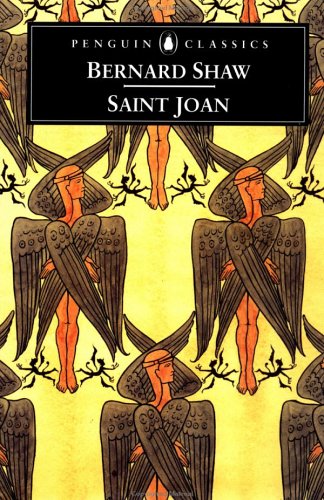
Saint Joan

Saint Joan
© 1924 George Bernard Shaw
160 pages


In the darkest hour of the Hundred Years War, a teenage girl re-inspired both a defeated nation and a despondent king to fight again for what was theirs. She -- Joan of Arc -- would be captured by her enemies and condemned a heretic by the English, but later vindicated by the Church. In 1920, in fact, Joan was pronounced a saint. Shaw's play no doubt follows on the heels of the news of her canonization.  Scoffing at saintly romanticization of the Maid, Shaw chose to pay tribute to her in his own way, making her an apostle of Whiggism.  “Saint Joan” pays tribute to the Maid’s time in the historical sun, relegating unpleasant battle-and-execution bits  to the background and focusing instead on her conflicts with the silly men she is forced to enlighten. Considering that the title character is burned alive, the play is far funnier than it has a right to be, from the opening scene with a duke arguing with his page almost to the end, where the man Joan made king is visited by the shades of his past after her vindication.   Shaw fills the play with modern conceits; his characters seem to wish they were living in the 1920s instead of the rotten ol’ middle ages. They even invent words like Protestant and Nationalism to describe how Joan makes them feel. 

Shaw’s Joan is more ambiguous than this, however; he endeavors to save her from beatification and her enemies from damnation in the same stroke.  Joan as written is not ‘saintly’ she is cheeky. Assuming familiarity with lords of the realm and lords of the church alike, she gives as good as she gets when they argue her down with reason, or scold her for acting so presumptuously. The irreverent, tomboyish Joan may be the star of the play, but her opponents are no villains. They may be guilty of pious fraud at times, but their arguments seem perfectly sensible, and prompt a reader to wonder just where Shaw’s sympathies lie.  When the churchmen accuse Joan’s patriotic  zeal of threatening to divide Christendom into nations and in so doing, dethrone Christ and allow the world to perish in a welter of war,  the graveyards of the Great War do not seem far removed from Shaw’s mind.  They are less villains than men moved to horror through fear, and happily ere the conclusion is reached they experience the genuine crisis of remorse, repenting in turn.  Although Shaw is just as guilty as having the Maid carry his own standard as any of the old romanticists,  “Saint Joan” succeeds in granting both her and her enemies humanity and redemption.


Monday, July 6, 2015

I Am Forbidden

I Am Forbidden
© 2012 Anouk Markovits
302 pages


Darkness grips Eastern Europe in the 1940s as war devours millions and the hopes of generations. Jewish residents of Romania are especially hard-pressed; already viewing themselves as a people in exile, they are dispersed further afield as they flee persecution. I Am Forbidden follows the family of a Jewish scholar who rescues two orphans and raises them with his own children,  first in Paris and then in England. Sadly, not only war threatens their peace,  as two daughters growing up in an archly traditional sect of Judaism struggle to find their role within it. I Am Forbidden is a heartbreaking story of lives ruined by secrets and scrupulosity, of hardened hearts sinking any hopes for happiness.  In using  the coming-of-age of two friends (here sisters) to explore the tensions between Hasidim and modernity, I Am Forbidden is rather like The Chosen; but where the latter offered a hopeful conclusion,  this leaves the reader in despair.  There is interest here, of course, the insight given here about Hasidism -- but the utter absence of mercy makes it an artfully written but distressingly sad tale.

Related:
The Chosen, Chaim Potok

Saturday, June 13, 2015

American Colonies


American Colonies: The Settling of North America
© 2001 Alan Taylor
526 pages          


American Colonies is a sweeping history of the New World,  one that attempts to convey the full American experience, beginning with the arrival of natives and then covering Spanish, French, English, Dutch,  and Russian colonial efforts in turn.  (Hawaii is also addressed, though it’s a bit of a two-thousand mile stretch to call it ‘American’.)  Taylor's declared intention is to tell more than simply the Anglo-American story, which relegates the Indians and other European powers to the role of villains.  At this, he is largely successful, providing a complete survey of native and European settlement and rendering the history of their relations with one another.  The work demonstrates how profoundly diverse both the natives and the Europeans were, documenting the extent of their tangled military and diplomatic relationships. The tacks taken against the natives by Europe varied not only from country to country (in Spain's case, no tact was involved), but from colony to colony, as varied geography and the nature of the neighbors demanded intelligent adaptation. The story of the New World is not simply one of Europeans plowing over the war-and-disease-ravaged lands of peoples like the Iroquois and the Lakota, however, for Europe’s nations also waged war against one another in this new battlefield.

Taylor's narrative style is pleasant enough, even if bothered with a little factual repetition. The content itself is a different story, being nearly five hundred pages of disease, war, slavery,  misery, and death.  No group discussed here comes off particularly well, not even the one-paragraph Vikings. Both the European and native powers wage war against one another and themselves, and in utterly vicious ways;  every chapter brings descriptions of  women raped, children executed, homes and fields burned, men tortured. There are no noble savages here,  and no exemplars of Christian civilization -- only ambitious and wrathful men with blood on their hands.

Taylor's narrative gives a good general view of European evolution, as explorers turned to nation-builders. Death ended to follow in the wake of the pioneers, as many of the diseases Europeans were exposed to as children never existed in the Americas, particularly those which originated from domestic animals, like smallpox.  Early colonists arrived with varying motives; some seeking fortune,  some to create a new society in their own ideal image, and others because it beat starving to death at home.  Invariably they offended their new neighbors, and war erupted.  Conflict between the native peoples and the newly-arriving colonists forced them to adapt to one another:   after seizing Canada, for instance, the English realized it was easier to give their new neighbors tribute every now and again than to maintain a war-footing. The natives, too, had adjustments to make: in the first pitched battle between European forces and Indians, for instance, the tribe in question attacked in a massed formation that fared none too well against organized gunfire. They quickly adopted the guerrilla tactics now associated with 'Indian warfare'.  

Taylor also puts forth a few theories of his own, all rooted in a worldview that sees economic warfare as the driver of everything else. In his view, the French and Iroquois maintained war between themselves for economic advantage,  as the warzone between their territories prevented regional competition with other powers for their goods. Though no fan of capitalism, Taylor's punches against mercantilism could be thrown by Adam Smith himself, pointing out how mother-country meddling smothered economic development time and again. Intriguingly, he suggests that the tax policies that sparked the American Revolution were not simply enacted to cover the costs of the French and Indian War, but to discourage too much emigration to the colonies. 
Slavery is a recurring topic here; a common byproduct of war,  in the age of discovery and colonization it became an economic institution,  especially as practiced in the colonies of the deep south and in the Caribbean.  The sugar plantations of the Indies were particularly dependent on slave labor; for this reason the abolitionists of William Wilberforce’s day avowed that those who took sugar in their tea might as well be drinking the blood of captives. The ranks of slaves were initially more diverse, consisting of captive natives who died in great numbers, and indentured Europeans who ran away and assumed the identity and status of free settlers.  Africans were already accustomed to Old World domestic diseases, and stood out from among both the native and European populations. Consequently,  the plantation lords drew more from African markets, and slavery assumed a racial-and color-based nature, the legacy of which continues to poison the society of the New World.   Before this, however, African slaves had been treated like any other indentured servants,  freed after a time of service and thereafter at liberty to create their own fortune – sometimes by investing in slaves.

American Colonies is a book to be considered,  taking on centuries of North American history  and taming it. Taylor's stated goal was to go beyond the English colonies on the seaboard, and this he does -- taking the reader as far south as Mexico, and galloping through the plains of the Apache to the northern wastes of Alaska.  He makes the complex comprehensible and is especially valuable in the time spent on Spain and France. He has a particular animus against the English and their American 'spawn' that grows tiresome; to his credit, however, he does not make their rivals into moral paragons.  Perhaps it's not so easy to be detached from one's ancestors as those in academia might wish.

Related:


Sunday, May 24, 2015

Agincourt

Agincourt: Henry V and the  Battle that Made England
better subtitled in the UK as The King -- The Campaign -- The Battle
© 2006 Juliet Barker
464 pages


In the fourteenth century, nation-states as we know them did not exist. There was a England, and a France, but their borders were more fluid -- and entangled.  The English crown held title to much of France through marriage and ancestry, and because the English royal house descended from a Franco-Norman duke,  the king of England was technically a vassal of France.  This created the kind of tension  released only with knights and massed formations of archers: the Hundred Years War, a series of conflicts between two nations and several royal houses.  One of the most memorable episodes of the war was the upset at Agincourt, in which a small English force triumphed against a larger French array. In Agincourt, Juliet Barker tells the story of the battle in such

Henry V's motives for invading France were varied. The old claim of Edward III which inaugurated the Hundred Years War was not his; Henry could barely claim kingship of England, let alone France. His own father was a naked usurper who died early fighting resistance to his claim, and though the cloud of scandal was mostly lifted by the time the handsome young Harry succeeded, it hovered still.  France needed addressing, however: it remained a nuisance to English interests on the Continent, not only around Aquitaine but in Flanders.  England's prosperity came from trade, lately the Channel had become dangerous for shipping. Securing the coast would make it easier for England to smother piracy, and if the lush interior of France became a crown possession, so much the better!

It was not to be, however.  Initial hopes for a display of overwhelming force against the French countryside fell apart during a siege of a French harbor, Harfleur. The port was taken eventually, but its defenders' obstinacy cost the English army dearly. By the time the gates opened,  the invading force's strength had been sapped by disease. His numbers too much for the battered city to sustain, Henry decided to retire to the English held-port of Calais. He could limp to safety only through a country of enemies, whose watch over the rivers prevented a quick dash north.  After watching the dwindling army for several days, the French finally checked the king's march near the tiny village of Azincourt. Grossly outnumbered and weakened by sickness, the English should have been crushed. Instead, the Battle of Agincourt turned out to be one of the greatest upsets in western history. The  section on the actual battle isn't enormous, this is a story of why Agincourt happened and why it was important, and while the full story of the battle is delivered with talent, this isn't a military history.  The reasons for victory are there:   Henry drawing the French into battle on ground of his choosing, in an area that undermined the French cavalry and allowed the English to make the most of their excellent longbows -- and when the French desperately pushed through the mud and rain of death to assail the archers,  the English knights pounced!    In later campaigns Henry would achieve his aims (briefly) against the French crown; history would see them reversed, however, squandered by less heroic successors. No one save historians can remember the Treaty of Troyes -- but Agincourt has achieved greater fame. Not only did it save Henry from capture or death, but the miraculous upset seemed to impress upon the English that regardless of the spurious actions of his father, Harry was God's own anointed.  Why else would he have been spared? It was a triumph of not just arms, but belief.

There are undoubtedly more detailed military histories of the battle, but Barker's narrative gives the reader both a heroic champion whose surprising victory comes as a delight, and a lot of background information on early 15th-century English society and trade. For an introduction to the battle, it's quite serviceable and easy reading.


Friday, December 12, 2014

The Personal Recollections of Joan of Arc

The Personal Recollections of Joan of Arc
© 1896 Mark Twain
455 pages       


 In 1428,  a young French teenager arrived at the court of Robert Baudricourt and announced that she and he were to be allies in a mission from God: a mission to save France from conquest and disillusion.  The girl, Joan, was to lead an army to the besieged city of Orleans, but she needed first men to take her to Chinon, the residence of king in exile. Skeptical at first, then persuaded by an apparent prophecy,  the astonished Baudricourt sent Joan on her mission, where she took center stage in a complete reversal of the ninety-year conflict between the nobles of England, Orleans, and Burgundy.  Though eventually captured and burned alive by a small council of hostile Anglo-Burgundian partisans,  within a few years of her death Paris was captured,    England’s alliance with Burgundy abandoned,  and France on its way to salvation. Joan would be hailed as France’s savior, declared a saint by the Church, and serve as a icon of hope to the French French in World War 2. Perhaps more remarkable than her military victories, however, is her complete conquest over the melancholic heart of one Samuel Clemens, better known as Mark Twain.

 The Personal Recollections of Joan of Arc is a  biographical novel,  the story of her life as told through a childhood friend.  Sieur Louis de Conte thought she was a marvel even as a child, enchanted with her dreams and startled by her courageous intelligence. When the local priest attacked a 'fairy tree' that the children enjoyed spending time in, delighting in the company of gentle spirits, she argued him into abashedness.  When she confided to Louis that God had spoken to her in a vision and told her she must inspire the dauphin -- the rightful heir to France's throne, disavowed by his mother in the Treaty of Troyes -- to claim his crown by leading an army against the English, he was among the first to join her. Fighting in her every campaign, and then infiltrating Rouen during her trials, securing a position as an assistant court clerk, Louis delivers a full account of her life.  Based on Twain's twelve years of research into  her life, it's remarkable in many respects.  It's easily the most personable biography of Joan I've read;   Louis allows the reader to not just admire her from afar, or idealized her as a remembered saint, but to love her as a friend.  Such adoration is startling from a man like Twain, known for his irreverence and cynicism.  There are traces of the familiar Twain here,  as Louis describes how men are inheritors of their beliefs and foibles, repeating a sentiment expressed more stridently in A Connecticut Yankee in  King Arthur's Court.  But this is a story replete with the miraculous;  Joan's visions extend not just to commanding her to battle and giving her moral courage, but she's an intermittent prophet, predicting her own death within a year and -- at the trial -- announcing to her captors that within seven years' time,  disaster will strike and English power in France will be broken for a thousand years.  Louis does not doubt Joan's word; he has no reason not to believe, for throughout the tale she demonstrates foreknowledge. 

Joan's story is easy to enrapture; how could a girl so dramatically change the course of history? There are circumstances Twain overlooks, of course;  the Duke of Bedford is mentioned, but not his marriage to a Burgundian princess that knit England and Burgundy's interests together, turning a French succession war into a very happy phase of England's on-again, off-again attempt to secure its ancient territory in France by subduing the whole of France.  And yet Joan inspires, both as an ideal -- the quinessence of strength, wisdom, courage, innocence, and purity, all at the same time --  and in practice. The trial transcripts do reveal a staggeringly intelligent and feisty woman.  Yes, her family had repute on its own; Jacques d'arc was no struggling peasant, but a man commendable enough to be named the mayor of a village he had immigrated to, how much of his strength had he imparted to Joan, and how much did she create from her own life?  Even if Joan were the purest of fiction, this tale would be a lovely one,  depicting as it does how a band of grizzled war veterans who had known only defeat could become pious, reverent, and driven in her presence; how  masses could leapt to their feet and throne to touch her banner, fixating on a child as their hope. We are strange creatures, we humans, strange and marvelous. Such is are The Personal Recollections of Joan of Arc.    Highly recommended for anyone interested in Joan or the tender side of Mark Twain.

Related:


Thursday, November 20, 2014

Joan of Arc

Joan of Arc: A Spiritual Biography
© 1998 Siobhan Nash-Marshall
176 pages


In 1429, France in her darkest hour was startled by the sudden appearance of a shining star -- a teenage girl from a minor village, wielding a standard and claiming that God had ordered her to  lead the nation to victory. The Hundred Years War,  the long struggle between the French and English nobility over Guyenne, Normandy, and the French crown, had left France seemingly nothing but a lost dream.  France had no leader; her last king had gone mad, his queen denounced the heir, and now civil war between the Dukes of Orleans and Valois paved the way for English triumph. But Joan answered the call, raised an army, and within twenty years the war was over. She is one of the most remarkable characters in European history, and this brief biography is a highly complimentary if slightly restrained story of her life.  Though it avoids being too mythical -- the author discounts stories of animals sounding off in happiness at her birth, and does not attempt to make her out to be a poor peasant girl when her father was a fairly well-established landowner --  it avoids being critical as well. The voices and the miracles attributed to Joan -- her foresight in ordering men to move a bit to the left so they wouldn't be stricken by a cannonball, her raising an infant to life long enough to be baptized so its wee soul would be saved, and not linger in limbo -- are repeated here, without either affirmation or skepticism.  [Author]'s focus is on Joan's drive and intelligence,  whpch imparted courage to the French people and struck a blow to build a victory upon. Even when in the custody of her enemies, assailed and jeered at by a hostile court, she maintained  the presence  of mind and the strength of spirit to deliver enigmatic answers that mocked their wrath --  the fury of a band of warriors, priests, and kings focused on a teenage girl.  [Author] provides solid context, however, demonstrating how the Hundred Years War was less an English invasion of France, and more of a French civil war, and an exercise of feudal peculiarities in which the English king was a vassal to the French king, despite legitimately controlling more of France (through inheritance and marriage) than le roi himself.  It's not the strongest of biographies, but delivers a feeling of Joan that is saintly, strong, and sweet.

Related:
Joan of Arc: Legend and Reality, Frances Gies


Tuesday, September 30, 2014

The Age of Voltaire

The Age of Voltaire: A History of Civilization in Western Europe from 1715 to 1756
898 pages
© 1965 Will and Ariel Durant


            The ninth work in Will Durant’s sweeping Story of Civilization, The Age of Voltaire picks up with the death of the Sun King in the dawn of the Enlightenment.   It’s an age of tumultuous change; though its survey ends before the French revolution, Europe is already in the throes of the industrial and scientific revolutions. New worlds are opening; not only are new goods flowing in from the recently-discovered parts of the globe,  but western man’s entire worldview is shifting. The modern age is dawning.

           Voltaire follows the titular philosopher as he travels from France to England, Germany, and later Switzerland, though the first three countries are Durant’s focus here.  As with the rest of Durant’s integral history,  this book carries weight because it examines not only political and military history, but considers in depth the literary, artistic, philosophical, and religious developments of the time. These ideas are not isolated from one another;   individualistic philosophy drives changes in both politics and religion, weakening the claims of absolutist monarchy and state churches alike. England grows with the times;  her king is superseded by Parliament and the prime minister. France hardens and resists, but the tide of history sweeping Europe will break it as surely as the waves break shorelines. 

           Of course, in this era it's less a gentle tide and more of a water-cannon. The radicals of the era are not content with careful, prudent change; no, things must be set on fire. Christianity is beyond reform for the rising philosophes; the world must be overturned, priests must die, churches must be burned. This is the  cradle of the French revolution, the nursery of those who would  take a machete to society until their ideals are satisfied. On a more constructive note, science and technological prowess are abounding, and Durant sets aside a large segment of the book to look at it seperately. 

       Durant is a genteel moderate on the religion and philosophy debate; from Our Oriental Heritage on, he has favored religion as an institution offering stability, comfort,  beauty, and more to the human race, though he is never blind to its abuses. His conclusion, a dialogue between a pope and Voltaire, makes plain his attitude that the tumultuous era his history is heading into is one of mixed blessings; while Durant is thankful that the rise of the philosophes advanced human liberty, checking the abuses of monarchy and organized religion alike, in their enthusiasm they became arrogant.


Benedict: You thought it possible for one mind, in one lifetime, to acquire such scope of knowledge and depth of understanding as to be fit to sit in judgment upon the wisdom of the race --upon traditions and institutions that have taken form out of the experience of the centuries. Tradition is to the group what memory is to the individual; and just as the snapping of memory may bring insanity, so a sudden break with tradition may plunge a whole nation into madness like France  and the revolution. [....] We should be allowed to question traditions and institutions, but with care that we do not destroy more than we can build. 

p. 788

As with his judgment of the impact of the reformation, the entire dialogue puts his tender appreciation for both sides, and the wisdom in appreciating them both, on display.  I suspect his criticism will grow a little sharper in the next volume.

Saturday, August 16, 2014

Drink

Drink: A Cultural History of Alcohol
© 2008 Ian Gately
546 pages


"We should thank God for beer and burgundy by not drinking too much of them." 
- G.K. Chesterton, Orthodoxy

A substance that a third of the world institutionalizes as a religious sacrament and another third expressly forbids  on religious grounds is one to be reckoned with. Since time immemorial, humans have been getting themselves sloshed in one way or another, putting their ingenious minds to work creating alcoholic beverages from whatever plants were available.  Drink is a sweeping history of the potent brew in its many forms, created and consumed by every culture and on nearly every continent.  It's a social history of a sociable subject -- for when people drink, they rarely do so alone. 

Alcohol's roots extend to the beginnings of civilization itself;  where there were grains, there was booze. Wheat rendered beer and rice, sake, and both beverages were the staple of many civilizations' diets. This owes not only to the human race's fondness for getting itself knackered,  but to the fact that bacteria-killing alcoholic content made beer a safer source of water than water itself.  Processing wheat products into potable beverages extended their lives, and sometimes gave people an edge, especially as distillation created drinks with long shelf lives. 

Beyond economic contributions, the communal consumption of alcohol created social ties as well. Not only was wine considered a doorway to inspiration from the muses -- a place later assumed by absinthe -- but drinking it together at feasts loosened tongues and allowed for more honest conversation. Not for nothing did the Romans say "in wine, there is truth.”   Not that true and alcohol were steady partners; mead-drinking also went hand and hand with vigorous boasting about deeds in battle. 

Abuse of alcohol has existed since  its cultivation,  something it lends itself to in affording an escape. Early industrial mill workers steeled themselves with ale to ensure the day, and the Romans were absolutely riotous. While the prevailing  view expressed by people throughout the book is that alcohol is an exquisite complement to life, in moderation,  in view of its power some have attempted to ban it altogether. Islam, for instance, forbids it, and has for centuries. Far less successful was the west's own attempt at prohibition, which led to the rise of organized crime and contempt for government.  

Drink, like those who have imbibed a bit too much, is outstandingly ambitious in trying to render a comprehensive history of alcohol and culture. While he's most thorough covering  the western world,   recurring chapters also address alcohol in China,  Japan, the middle east, and South America.  A 'cultural' history verges on the literal, as Gately examines alcohol's depiction and relationship with art, literature, and the movies.  Yet for all the ground to be covered, Gately does rather well;   the book's bar is well-stocked with stories, and if one doesn't suit your taste another setting and different subject are right behind it.


Related:
A History of the World in Six Glasses, Tom Standage.  A history of the world as told over wine, beer,  coffee, tea, rum, and Coca-Cola.. 


Wednesday, July 9, 2014

Jefferson

Jefferson: A Novel
© 1998 William Brant
448 pages


In  the late 1780s,  William Short put pen to paper to create a biography of his boss and mentor, Thomas Jefferson. Then serving as ambassador to France, Jefferson was already a seasoned American politician, having previously been in the Congress that declared independence, and shortly thereafter held office as Virginia’s governor. That biography is a novel going in two directions;   the main thread follows Jefferson’s social life in France during the 1780s,  with interruptions by Short to tell Jefferson’s story from boyhood to his travels abroad.  The text is heavy with dialogue; the major activity is talking before dinner, or during it, or after it --  and the expressions seem drawn mostly from Jefferson’s letters. Because the storyteller is Jefferson’s protégé, is a tale largely sympathetic to the quiet man whose presence looms so large over his friends and American history; Short puts several stories about Jefferson to rest, offering his own interpretation of events.  It’s a strange novel, one that doesn’t so much go somewhere as give readers a chance to spend dinner after dinner with Jefferson,  coming to know his mind and the stories of his life. Other personalities like John Adams (a man of "granite flecked with sugar"), Ben Franklin,  and the Marquis de LaFayette are regular companions. The heavy but agile use of Jefferson's actual writings, and the abundance of historical characters, make it a book worth reading for anyone passionate about the Revolution and its lingering meaning. Like American Sphinx, it's more of a study in character, but this time from a more intimate angle -- face to face over a course of French fare.