Showing posts with label biography. Show all posts

Friday, June 28, 2019

The Thinking Man's Gangster

Meyer Lansky: The Thinking Man's Gangster
Revised and expanded reprint of Little Man: The Gangster Life of Meyer Lanksy 
457 pages
© 2019 Robert Lacey

There's no such thing as a lucky gambler. There's only winners and losers, and the winners are the ones who control the game.

Meyer Lanksy is the mob associate of legend,  considered with Charles Luciano as the co-creator of the Commission governing the Sicilian mob in America. If Lansky had gone straight, an anonymous FBI agent is supposed to have said,  he could have been the chair of  General Motors.   Judging from Little Man, however,  that may not be the case: every time Lanksy tried to go straight, investing in television distribution or hotels, he lost money. Admittedly, it wasn't always his fault; he wasn't the only one to lose millions on Cuba when it went red.   Lanksy was, from childhood on, a gambler:  he had his introduction as a kid, watching craps games and realizing how it really worked, and  the whole of his fortune at his peak was built on casinos and gaming rooms -- whether in Florida, Nevada, or Cuba.  But Lanksy wasn't just the brains behind the brawn, the grey eminence in the background. Little Man  demonstrates that Lanksy was more than capable of being the brawn himself: he was a teenage union thug who  also tried to make a living for himself as a pimp -- but then came Prohibition, and the partnership with Luciano that would get Lanksy running.   Robert Lacey's biography is far more thorough than I had expected, though not in the most constructive of ways, and -- presumably, given its sources --   cleans and makes  as presentable as possible its subject.

To  be sure, Lanksy is an interesting fellow, with a character much different from those of other gangsters or mob associates. When the FBI first began a detailed investigation of him, they found a quiet man who preferred good, but not flashy, suits -- the kind that any respectable insurance broker or bank executive might wear.  The same was true for his house, which was comfortable but modest.  Lanksy himself was the epitome of self-control and reserve, so much so that his doctor thought such qualities were the cause of his stomach ulcers.   Lanksy left school early, but he was a devoted reader and used his adult wealth to retain a tutor.  The bulk of his illegal income, after Prohibition, came from gambling -- and in the thirties and forties,  law enforcement largely turned a blind eye or was an active participant.   In the fifties, however, moral and red panics meant more stringent and targeted laws, active enforcement, and constant investigation into  Lansky's deep-gray affairs.   Cuba allowed for a partial recovery, at least until Castro destroyed most businesses following his seizure of power --  and it was downhill from there.   The last stages of the book see a weary Lanksy taking refuge in Israel, only to be ousted after two years when he applies for citizenship; he's eventually  apprehended while trying to make for Paraguay,  although in the resulting trial he's acquitted. The state's evidence consisted largely of testimony from a gross loan shark who few on the jury believed.  Eventually cancer would do what the state could not.

Lacey's treatment of Lanksy is interesting; though not denying Meyer's association with men who did evil things, sitting in the shadow of evil and cooperating with it to his own gain, he largely depicts Meyer's business as being in the deep grey area, rather than darkly criminal.  Beyond his youth,  Lacey doesn't depict Lansky as doing anything more than promoting gambling and dodging taxes,  which would hardly make him a bad guy in many readers eyes. I'm sure there was more to him than that, but one can't deny Little Man's depth of coverage into Lansky's family life and the trials. The problem, I think, is that Lanksy's accomplishments were  so under the table -- no flashy murders or robberies, just subtle manipulation of funds -- that there's no positive evidence of him. Even his family didn't even really know how much he was worth, since he seemed to live near poverty for much of his endgame despite the FBI claiming he was worth $300 million.   What I appreciated most about Lacey's work is that he avoided the cutesey nicknames like Lucky and Bugsy in favor of proper ones, like Charlie and Ben. 

If someone is interested in Lansky and doesn't object to  movies with violence, Mobsters may be of interest. I watched it during my Mafia obsession, bought it later on, and have watched it since.   Lansky is depeicted second on the left -- without a Thompson. (In order, the actors are playing Charlie Luciano, Meyer Lansky,   Ben Siegel, and Frank Costello.) Of interest is the presence of Michael Gambon, playing one of the two bosses that Luciano disposes of on his rise to power.  The weird thing about this movie is that it refers to Marazano as Faranzano. I haven't the foggiest idea as to why.


Monday, March 11, 2019

A Forest in the Clouds

A Forest in the Clouds
© 2018 John Fowler
336 pages


John Fowler’s A Forest in the Clouds is his account of studying gorillas alongside famous naturalist Dian Fossey.   Although I picked it up for the gorillas (as one would), the memoir is overwhelmed by Fossey, who by Fowler’s account was an astonishingly eccentric and belligerent woman who viewed the science lab as a necessary evil to allow her to live on the mountain near the wildlife she loved.  Fowler presents Fossey as a  mercurial  control freak who regarded any gathering of students as a potential mutiny and waged a private war against local poachers.  Fowler contends that Fossey had little use for most people, especially the locals who she constantly verbally abused (employing both sounds imitating the gorillas and a polyglot mishmash of profanities to do so), and the amount of time readers spend in this unpleasant company does not make for an enjoyable  book. The narrative is easy to read, but the poor gorillas are nearly relegated to the background;  Fowler writes about what they’re doing often enough, but there’s little to learn about them here, besides the fact that their noses can be used like fingerprints, and they have no qualms about peeing all over a human they’re affectionately holding on to.  I’ve never read anything else about Fossey, so I don’t know if Fowler’s memory is perfect or exaggerating Fosser any. I’ll say this, though: my attempt to find background info on the African setting let me to this stunning photo.

Friday, February 22, 2019

Rebel Without a Green Card

Americanized: Rebel Without a Green Card
288 pages
© 2018 Ssara Saedi


Sara Saedi and her older sister Samira were both born in Iran, but following the revolution their parents fled to America by way of Italy.  Although Sara had virtually no memory of her home country, she was marked by it, growing up as an undocumented resident when her family visa lapsed and the green card applications were endlessly delayed. In Americanized, Saedi offers a memoir of her coming of age,  most of which is humorous takes on the indignities of youth: fighting with older relatives, stressing out over acne and puberty, worrying about boys, etc.  Occasionally, however, the memoir grows more serious when her parents' on-going attempt to move forward with permanent legal residency and citizenship is stalled again and again.   The memoir is obviously political in its intent, as Saedi  frequently frets over residential attitudes regarding illegal immigration,  so Rebel can be read as an attempt to put a human face on an abstract policy. Her family would certainly be poster children for more inclusive immigration policies (being good, passionate people who want nothing more than the freedom to live their lives and pursue their dreams, etc),  but the Saeds are only one family, and not necessarily representative. Immigration offices can be painfully difficult to navigate, however, and needlessly burdensome: as a public librarian, I've personally witnessed struggles by my city's Yemeni and Bangladeshi immigration population to make any any progress with naturalization,  with form after form being rejected because a jot was a little too tiddlish -- there being specific requirements for only using capital letters, for instance. I've no doubt it could be made far more humane.

As a book, Americanized has some interest -- but honestly, it's more of a teen-girl-in-the-90s memoir than a serious discussion about immigration.  Firoozeh Dumas'  Funny in Farsi offers a much fuller idea of the immigrant experience, partially because Firoozeh remembered more of her childhood in Iran. 

Saturday, February 9, 2019

Ghost in the Wires

Ghost in the Wires: My Adventures as the World's Most Wanted Hacker
© 2011 Kevin Mitnick, William Simon. Forward by The Woz.
393 pages


CYBERPUNK introduced me to the story of Kevin Mitnick, a teenage phone phreaker turned celebrity hacker,  who boasted that he never used an outside program to break into a company. Instead,  all of his access was obtained by manipulating people within companies into giving him the information.  Writing later as a security consultant, he explained the workings of this manipulation in the book Art of Deception, which I referred to as "interesting but highly repetitive". Well....ditto for Ghost in the Wires.  It's the memoir of a serial, and apparently compulsive, hacker, whose obsession with accessing networks he has no authorization for,  and obtaining information he has no right to have,  utterly consumes his life.  He admits that hacking was like booze for him -- his entertainment, his addiction.  Even when he's barely escaped from one episode, he's already starting the other....and his enormous pride in getting one over on the hapless clerks,  alarmed security admins, and frustrated federal agents is so hubristic that he routinely calls the FBI or accesses their computer network during investigations to see how close they are to the scent. 

It's his compulsiveness that does him in time and again: even when he was relatively safe on the run, with a stolen identity (several, actually) and a comfortable job,  Mitnick is so consumed by his desire to hack that it attracts the attention of his employers, who  fire and investigate him. At one point while working there, for instance, he was on his cell phone putting on a presumably awful Japanese accent to convince an engineer that his counterpart in the Tokyo office needed him to upload cellphone source code to a server Mitnick had access to. One of his coworkers heard this outside the door and could only wonder what on earth was going on.)  When the FBI found his scent, it was because he was trying to collect the source codes for a UNIX release, as well as various next-gen cell phones that were hitting the market. Was he selling them to rival businesses? No. He was collecting them as trophies.  Mitnick is the movie villain who undermines himself by  pausing mid-kill to gloat at the hero, or  decides to consign him to a slow death in an elaborate trap.

This book was informative, however;  Mitnick proves to be far more dangerous than I'd previously believed. He wasn't  just exploring networks as portrayed in CYBERPUNK:   for him, there was no limit to the systems he'd compromise. The DMV, Social Security, Vital Records? Grist for the mill for Kevin to do what he wanted. Admittedly, his technical expertise is admirable, in the same way that Napoleon's army or the Luftwaffe  were technically admirable.  He certainly wasn't just relying on people giving him information, as  he frequently applied patches to systems to give himself  backdoor access later on. What's less admirable is Mitnick's ability to lie to so many people so habitually, to manipulate them like switches on a board. The act is deeply disturbing in itself, but  what happened to the hundreds of receptionists, clerks, and engineers who became Mitnick's unwitting dupes? 

While I began this book guardedly sympathetic to Mitnick (impressed by his talents, a little wary of his lying), by the end I regarded him as a compulsive, hubristic ass. I'm glad he's turned semistraight, in managing to squelch his desire to thwart everyone else,  but the book has virtually no information on that. Was there any soul-searching at all, or was it just a mercenary decision?   Mitnick may be a nice guy in person; he's friends with Steve Wozniak, who has experience with egotistical personalities before  and would presumably recognize it in Mitnick,  but based on this book I wouldn't trust him.

Related:
Exploding the Phone
Books by Kevin Mitnick

Wednesday, January 30, 2019

Odd Egg Editor

Odd-Egg Editor
© 1990 Kathryn Tucker Windham
170 pages


Anyone who grew up in Selma, Alabama, prior to 2011 had heard of Kathryn Tucker Windham, and odds were they cherished her.  A master storyteller, she inspired an annual Tale-Tellin' Festival that survives today.  Odd-Egg Editor is a brief memoir of her newspaper days, before she became a local legend.  Beginning with the Montgomery Advertiser in the 1940s,  covering the police beat,  Tucker expanded her career to land a position in Birmingham and later settled in her hometown of Selma just as the civil rights movement was warming up in the 1960s.   This memoir has a lot of little stories, with colorful characters -- a playful judge who once busied himself creating spitballs during testimony,  an inveterate escapee named Billie Jean who counted herself a friend of the cops and her regular judge-- as well as a few sadder stories.  The title of the book comes from Tucker being assigned all the odd stories at the Montgomery Advertiser, and is itself a colorful collection. One could easily read it as two decades of journalism from  mid-20th century Alabama , but I was drawn to it for the author's voice. Although she was too advanced in age to do a lot of storytelling during my youth, I heard her a time or two at Cahaba Day festivals. Even in her last years she was a volunteer at the Selma-Dallas County Library,  firmly ensconced in the town she loved and which loved her back.  I enjoyed this account of her getting started -- of overcoming prejudice against her as a young woman invading male spaces like  the cop beat and the governor's hunting camp -- very well.


Kathryn Tucker Windham, from the second-floor balcony of the Selma-Dallas County Library

Related:

Tuesday, December 11, 2018

Jobs

Steve Jobs
© 2011 Walter Isaacson
656 pages


The past twenty years have been an amazing ride for Apple Computers, in which the ailing and speeding towards bankruptcy company suddenly metamorphosed into the most valuable company in the world, responsible for creating some of the most iconic products of the modern age.  Walter Isaacson's Jobs chronicles the life of the man who co-created Apple, fell out with it, and then came back to orchestrate the biggest brand revival ever   Throughout  it, Isaacson illustrates how pivotal Jobs and Apple were to not just the computer age, but to the opening of the 21st century as a whole. Although I am not an Apple user,  I enjoyed this biography like few others.

While many computer tinkerers of the day, Jobs' partner Steve Wozniak included, were interested in computers as tools, Steve Jobs’  background in the youth movements o the 1960s prepared him to see computers as revolutionary. He saw them as a way to marry technology and the humanities, and to ignite human potential  -- but he took. His lack of zeal for the tech side for it's own merits meant that he wasn’t particularly supportive of building machines that could be physically altered and expanded. He had a vision of how a thing should be, and didn't anyone else tampering with it.

For Jobs, computers were not merely a technological tool; they were more like art in their ability to expand horizons.  He wholly attached himself to his vision, and resisted the view of computers as open systems to be altered at will. Early in his career at Apple, he and Steve Wozniak argued over how many open slots the Apple II board should come with; Jobs only wanted two, for printers or modems, while the tinkerer Wozniak insisted on eight.  While Wozniak won that battle, he would lose all the  rest, as future creations presided over by Jobs were far more closed off to modding. Apple later used custom screws in their products, for instance, to stymie attempts at would-be home modders or consumers who wanted to repair their products at doing so. (Jobs’ vision for controlling products end to end has continue: just recently news broke that OSX systems would soon be capable of identifying hardware changes and then locking themselves down if someone other than an Apple-sanctioned repairman had replaced  a part.) 

Jobs’ insistence on controlling the vision he had for Apple products made him a domineering and mercurial boss, obsessive about seemingly small details and abusive in their implementation.  Associates at Apple joked about the 'reality distortion field' around Jobs,  the means by which he could convince himself that the impossible was practicable, and even convince  others to join him in the pursuit.  (Sometimes, with enough ninety-hour workweeks, they even achieved the impossible.) Such was his behavior that once Apple had grown from a two-man garage company into a full corporation, its board of directors effected his removal, hoping to dampen the disruptuons he caused.  He would later return after Apples’ drifting performance nearly bankrupted it, but in the meantime he developed his own computer system (Next) and  gained more management experience as Pixar. Next would be a failure, hardware wise, but the kernel of its OS would later be incorporated into Mac’s OS and even help Jobs get  his old  position of power back. At Pixar he was more able to pursue the intersection of art and tech, as  computer-generated graphics proved themselves capable of stories that gripped the human soul in Toy Story.

It was after Jobs’ return to Apple that things got really interesting, however. Jobs’ essential personality never changed, but he learned to be less meddlesome and gave to Apple the ability to focus.  He forced them to target on four products instead of a menagerie; these products were to be the best imaginable, “insanely great”. He often used novel designs that played with the imagination. Instead of familiar beige boxes, for instance, the iMacs of 1997 were colorful egg-shaped units that stood out and were advertised as being especially made for the internet, which by then was roaring.  Jobs focused not just on function, but on feeling; he wanted product to resonate with people, to give them a certain joy in using them, and that was part of the reason he was so obsessive about small details. Everything mattered, even the arrangement of the interior which might not ever be seen.  Jobs was the first to make aesthetics a key consideration in build quality. Jobs' vision prove itself when he pushed Apple beyond computers, into consumer products, with the ipod -- and later, the best-selling consumer device of all time, the iPhone.

Although Jobs was not an easy person to work with or know, there can no denying his pivotal role in the making of 21st century technological society. While Apple's hostility towards the right to repair makes me shudder, I can appreciate the commitment to exquisite design that Jobs made part of Apples culture; every time I help someone at work with an iPhone or a MacBook I enjoy the experience.    As much as I prefer the open moddability of Windows and Androids systems,  Isaacs' book made me far more curious about the 'other side' than I would have imagined.

Tuesday, August 14, 2018

The New Tsar

The New Tsar: The Rise and Reign of Vladimir Putin
© 2012 Steven Lee Myers
592pages


When the Soviet Union collapsed abruptly at the dawn of the 1990s, the world order changed overnight. Optimists predicted the 'end of history'.   Such an end wasn't kind to Russia, which faced a sinking economy,  dysfunctional attempts at democratic governance, and evaporating infrastructure. It could only watch in frustration as its former adversaries in the west made geopolitical moves in its backyard,  like attacking Serbia to help a breakaway province gain independence. That began to change in 2000, however, when a largely unknown spy-turned-administrator became president, and the oil crunch jump-started the Russian economy.  Vladimir Putin has been at the center of Russian politics ever since,  slowly becoming a bête noire to the power-circles in DC and Brussels.    Although his administration was initially known for an imposition of order and a revival of Russian interests abroad,   in twenty years Putin has  become more inflexible and less effective.   The new order has been built around the man, and even if he wanted to leave, it's an open question as to whether could survive the sudden vacuum.

As a little boy, Vladimir Putin didn't want to grow up to be a global leader.  He was more interested in being a spy.  He said as much when he walked into a KGB office and asked for employment. While they turned him down -- a literal case of don't call us, we'll call you -- the officer in charge suggested what academic credentials might serve Putin will in the future.  In 1975, the KGB did come a-calling, eventually stationing Putin in Eastern Germany. That's where Putin was when the Berlin wall fell and the DDR disappeared. With a mob gathering around the Soviet embassy, and no word from Moscow despite repeated signals for instructions, Putin confronted the mob alone.   Myers suggests that that silence from Moscow -- the lack of authority in the face of mounting chaos -- haunted Putin and strongly influenced his political career.  That career began when the mayor of St. Petersburg needed a liason with the state security forces; from there Putin would become a deputy mayor, and serve two key men so efficiently that at the end of the nineties, he was a deputy in the national government.  A sick and ailing Boris Yeltsin thought his quietly efficient, politically un-connected lieutenant would be an able successor to continue guiding Russia closer toward concord with the west, complete with a growing economy and growing democracy.  Well...nyet.

It is fascinating to learn that Putin's rise to power came through his decision to support the liberal, democratic forces within Russia, and particularly when he backed the nascent government against an attempted old-order coup.   We in the west tend to think of Putin as more authoritarian and un-democratic, and by our standards he certainly is.  In his twenty-year reign,  regional democracy has faded away, replaced by appointed governors;   at least two dissident journalists have died , and activists who stage protests seem to find security waiting for them before they begin.   Most of the domestic criticism around Putin's administration erupted during the 'tandem' period: the Russian constitution forbids more than two consecutive terms,  but Putin effectively remained in power despite that limitation by stepping down,  championing a supporter as his successor, and then doing much of the same job from a different office for four years, overshadowing his official boss.  When Putin re-assumed the presidency, Russians objected to the transparent self-serving operation.

I read this primarily to understand more about Russia and the west's inability to maintain any kind of amicable relationship.  Both American presidents covered in this book approached  Putin hoping for amity and a reset, but each sides' foreign adventures have undermined those efforts.  Russia's attempts to maintain its influence in Crimea and the Ukraine, resisting the  latter's courting by the west, have succeeded only in alienating Ukrainians further and making Europe regard Putin with fearful hostility.  The American wars in Iraq and Afghanistan, and western adventures in regime-toppling with subsequent  chaos and monsters like ISIS,  have led Putin to regard the west as irresponsible fools.  As the west continues to try to contain Russia, Russia continues to boil with predictable resentment about being encircled with  bases and missiles.   Over time,  a desire for respect and legitimacy in Putin's first two terms has slowly grown into a cool contempt --  while Yelstin wanted to move Russia closer towards the west, Putin's Russia is increasingly removed from it.

The New Tsar is compelling reading for those interested in Russia's role or the man himself.  Myers  does a fairly good job at keeping himself out of the text and focusing on how the subject himself came to power and how the position has changed both him and Russia.   Putin is not villainized and turned into a monster-in-the-making,  but he isn't admired either. Instead, readers are allowed to see why different Russians can value Putin's  emphasis on strength and stability, or lament his lack of support -- and resistance to --  democracy.    Putin has indicated as recently as May 2018 that he plans to step down as president in 2024,     but  his quarter-century of power will cast a long shadow over where Russia goes from there -- even assuming he doesn't exercise influence from semi-retirement, a grey eminence pulling the strings from behind the curtain.  He is a figure well worth understanding.


Thursday, August 9, 2018

Broad Band

Broad Band: The Untold Story of the Women Who Made the Internet 
© 2018 Claire Evans
288 pages


When the ENIAC was first displayed for the public, its proponents bragged that it could do complex mathematical calculations in seconds which would have taken a skilled man hours upon hours.   Well...baloney. The ENIAC was an admirably complex array of metal, but without the human beings who had pored over its every component, turning their brains into maps of circuit boards,  creating the very language that was needed to put that array of metal to work -- it was useless. Hours and hours of human effort had gone into that little calculation, but they weren't man-hours.   The programmers of the ENIAC were six women, descendants of the calculating computer pools of the late 19th century. Broad Band is their story, and the story of other lady pioneers of the computer age.


I'll admit that I had no idea any of these women existed. Histories of of early computing and the internet are a favorite of mine, but I usually begin further along in the story, with more user-friendly machines like the PDP-10 and the advent of networks. I was a little leery of the book given the asinine blurb on the back -- "alpha nerds and brogrammers"?  Really?  Thankfully, the funny title brought me, and glad I am because I never heard of these women...and some of them are really worth knowing.   Grace Hopper, for instance, was deeply involved in the Harvard Mark-1 and the UNIVAC, and she pionered the use of subroutines to speed up coding, as well as created the first compilers.    COBOL, which at one time was the language of 80% of existing code,  was based on her work.  A woman once refused admittance to the services during World War 2 because of her age would become a Rear Admiral before her life's computing work was done. Another remarkable subject here is Elizabeth "Jake" Feinler,  whose Network Information Office created and maintained a directory of...the internet.  Working for the still-nascent ARPANet, Feinler was the master of all information about it. Her team also created many basic protocols, both under-the-hood things most users wouldn't recognize as well as creating the original web extension: ".com".   The women who follow were also trail-blazers, experimenting with social networks (New York's "ECHO" bbs,  which could boast a  40% female population), as well as digital magazines distributed on floppy disks.  Surprisingly, ECHO is still around, though other projects like Word magazine are long gone. 

Broad Band effectively mixes biography and tech history, and the goal from the start doesn't overshadow the actual content.  That is,   most of the subjects should be included in histories of web regardless of their sex, given their importance. I say most because I'm not sure about the website creators of the nineties; I don't know enough about the web at that transitional moment to read Broad Band in context.  There were some claims that seemed specious, like references to Al Gore being the key player in making the internet a thing known to the public, and  there's a huge discrepancy in the estimate given for ECHO membership. Evans says it peaked at 40,000, while The Atlantic marks the peak as...2,000.  There's no way of knowing which is more accurate,  but given that it was only accessible via a paid membership,  I'm tempted to think Evans' is closer -- she interviewed the ECHO host herself.   The meat of the book seems to get leaner and leaner as it wears on, until at the end we're reading about how computers are couched in "masculine" language like..."crash" and "execute".    Despite the late-game weaknesses, there's a lot of fun information here about how the web as we know it evolved.


Friday, June 22, 2018

Forgotten Founders

America's Forgotten Founders
© 2011 ed. Gary Gregg II
185 pages


After reading several thoughtful full-length biographies in this series, I expected the same quality in miniature from this collection. That is not the case at all; after a lengthy opening essay on what constitutes a founding father, and why some are forgotten and others not, the reader is treated to ten brief articles about revolutionary-area personalities. Some of these men are unequivocally  not forgotten, like Patrick Henry and Thomas Paine. A few others are more obscure, but the information included here is so slight that one could just as well read any entry in a biographical dictionary about them. I liked the organization of each article: a biographical sketch, an outline of their chief contributions, and an excerpt of their writing. There's just not enough content here. One gentleman's writing excerpt is the Preamble of the Constitution. The full-length volumes in this series, particularly American Cicero and The Cost of Liberty are much more helpful.


The men considered:  James Wilson, George Mason, Gouverneur Morris, John Jay, Roger Sherman, John Marshall, John Dickinson, Tom Paine, Patrick Henry, and John Witherspoon. According to the introduction, many names were submitted and considered, but the editor chose the names which were suggested most often. The native American and female contributors teased at in the introduction don't actually get sketches.

Friday, June 1, 2018

How Microsoft's Mogul Reinvented an Industry

Gates: How Microsoft's Mogul Reinvented an Industry-and Made Himself the Richest Man in America
© 1994 Stephen Manes and Paul Andrews
560 pages


I recently watched Pirates of Silicon Valley, a questionably-acted movie based on the rise of  Bill Gates and Steve Jobs, and found myself curious about the facts. Did a young Bill Gates really race bulldozers and ram his buddy's sportscar?   Gates is an astonishingly detailed biography of not just Gates himself, but of the computer industry as it developed throughout the seventies, eighties, and early nineties. The book culminates with the release of the then-revolutionary Windows 95, an OS that merited even Rachel and Chandler from Friends pitching it.  The evolution of computing hardware and software overshadow Gates himself, not surprising given that developing software was his singular obsession from high school on.   This mix of biography and technical history makes itself more attractive as computer history than personal, but it still presents a more interesting Gates than "Brilliant, Nerdy Billionare".  He really did race bulldozers, and they weren't his.

Gates is not a rags to riches stories, as young William Gates started off fairly comfortably: his parents sent him to a private school that exposed its older students to computer programming, and one of Gates' classmates there would become his partner in founding Microsoft later on -- Paul Allen. Both were enthusiastic members of a student club called the Lakeside Programmers Group,  who were allowed free computer time -- back when computer users could be billed on how many seconds of computer processing they used --  in  exchange for helping debug programs and and machines.   Being both self-confident teens and curious about what they could do, Gates and his friends also found ways to cheat the billing cycle outside their arrangement -- and when Gates took on the challenge of creating student schedules,  he somehow found himself the only boy in a class otherwise filled with girls.

Even before they were out of high school, Gates and Allen were making a name for themselves as programmers, and exploring the possibilities of this for their future. Their first huge coup was writing a language to use with the first consumer-marketed microcomputer, the Altair.  The Altair was amazing popular considering it had to be assembled, component by component, by the buyer, and that the finished product was initially only capable of blinking its lights. Programming was done not with a keyboard, but by flipping toggle switches.   Although Gates and Allen did attempt building their own computer, one pitched at municipal governments for managing traffic,  their talents lay in software.  Gates was both obsessive and aggressive:  he had no objections to working eighty hours a week trying to iron out bugs, and expected that from whomever he hired later on.  Gates hated to lose, and if that meant selling products he hadn't even built yet-- hadn't even planned yet --  to prevent someone else from making the pitch, he would.  (Hence the reason for those eighty hour workweeks..)  Gates' success came not just from his gifts with programming language, but because he and his partners were so intent on making sales: one of Gates' tricks was to use one product to sell another.  His dream was a computer in every home, on every desk, running Microsoft software. It didn't matter who the manufacturer was: Microsoft did work for both IBM and Apple, as well as smaller computer companies which have fallen away, and Gates' goal was to create a hardware ecosystem where everyone was using a common software, with the effect that devices would be cross-compatible.  A monitor made by one manufacturer -- IBM, say -- would be compatible with a computer made by another firm, like Hewlett Packard.

Gates  delves into an astonishing amount of detail both on the technical hurdles and on the business deals that Gates made: there's an entire chapter on a font battle with Adobe, for instance.  Readers do see the man behind the machine, however: Gates the crazy-competitive, Gates the parsimonous executive who regarded hotel rooms and first class as decadent,  Gates the teenage millionare, Gates the spectacularly reckless driver, Gates the bellicose boss who liked people who stood up and yelled right back at him.    Although Gates is not necessarily the ideal book for someone merely curious about the man, its depth of technical and business history would recommend to those interested in the  microcomputer revolution.  Oh, and the bulldozers? Gates literally saw them sitting in a rural construction yard, discovered the keys were in them, and decided to figure out how they worked. Then he and a buddy drove them around and raced, because that's what you do when you're twenty and it's 3 am.

Related:
Pirates of Silicon Valley, trailer below
CYBERPUNK: Outlaws and Hackers on the Computer Frontier

"I got the loot, STEVE!"


Sunday, April 8, 2018

The Letters of CS Lewis

Letters of C.S. Lewis
© 2017 Harper Collins
Edited by Warren Lewis and Walter Hooper
688 pages


After the death of his younger brother, Warren Lewis released a collection of his letters for posterity’s sake. Perhaps it was to repay a debt, as Jack spent much of his adult years trying to keep Warren from drinking himself to death. The collection is rather a selection, a sampling of Lewis’ vast correspondence that reveals his captivity by literature, his wrestling with ideas, his debates and warm exchanges with friends. The original edition produced by Warren included his active mark as an editor, with improvements to word choice;  this edition by Lewis’ secretary Walter Hooper presents the original. It also incorporates excerpts from Lewis’ diary where correspondence was slight, as well as editorial comments in brackets to provide context for particular letters. 

Casual Lewis fans who are expecting something like Surprised by Joy will be in for more work than they anticipate, because the first half of this is a bit of a slog, really.  It’s tremendously helpful if you’re writing a paper on Lewis and want to incorporate something like first-hand sources,  but it’s lots of minutiae: Lewis talking about outings with friends, or going on and on and on about the virtues of taking this approach in school rather than that approach, and the English uni system at that time bewilders me -- it’s almost medieval, with students seeming choosing day by day if they want to go to this lecture by Dr. Waugh or that lecture by Dr. Granthum. The Great War is curiously muted, with the exception of its effect on Oxford. Even when Lewis is deployed in France, he mostly writes about books. 

Lewis is most famous for his reluctant conversion to Christianity, and thereafter becoming one of the foremost defenders of Christianity in the modern age until his death in November 1963 -- a death overshadowed by another Jack the same day --  but these letter don’t reveal much about his conversion. An early Lewis comments to his friend that of course all religions are alike, just made-up stories, and a later Lewis dashes off to his friend that some metaphysical concept in his head is quickly becoming rather like God, and if something isn’t done quickly he’s going to find himself in a monastery.  And then he’s a bestselling author and receiving letters asking for religious and personal advice.   This familiar Lewis enters about halfway through the volume, and then religious discussion mixes with the usual literary stuff and social banter.

If one only knows Lewis as the author of beloved stories and apologia, the letters here reveal the more human one -- and a very long suffering one.  He spends much of his adulthood caring for the mother of a friend who perished in the Great War (they’d promised the other that in the event of their dying, the survivor would look after the other’s parent);   once she passes, he has an alcoholic brother and a cancer-stricken wife to tend to. The few years of his marriage were among his happiest, however, and a brief respite from her pain allowed them both to visit Greece. He writes to a friend that the ancient splendor had him worried he might become a pagan once more and pray to Apollo.

I for one find “Jack” to be extremely pleasant company, with the effect that I often re-read his autobiography. After clearing the hurdle of his university days, the letters here were largely engaging or amusing,, particularly his advice to young students on writing, and his eternal literary discussion with his friends.

 This collection is of great interest to devoted Lewisians.

Thursday, April 5, 2018

Wisdom and Innocence

Wisdom and Innocence: A Life Of G.K. Chesterton
© 1996 Joseph Pearce
540 pages

"I cannot help but thinking you were England -- the Merry, chivalrous, simple-hearted, fearless England that I loved." - an old friend's letter to Chesteron


Mention the name G.K. Chesterton today, and most who have a glimmer of recognition will venture that he was a Christian apologist. Chesterton was no theological pendant, however; at the peak of his career, which he still occupied at the time of his death, he was a bestselling author, editor, and journalist  recognized by many as something unique.  More than that, however, he was fun, with an amiability that led even his antagonists to maintain warm relations with him even as they heatedly debated through public newspapers. Pearce's title, Wisdom and Innocence alludes to a core dynamic expressed in the life of Chesterton -- the embrace of romance and reality, wonder and wisdom, faith and reason. The same man who could earn praise from medieval scholars for his biography of St. Thomas Aquinas and hold public debates against H.G. Wells and Bertrand Russell might just as easily entertain a house of small children single-handedly the same night, with equal joy. 

Although Chesterton was baptized into the Anglican church, his parents were  merely bowing to social convention when they brought him before the fount and priest;  they were hazy Unitarians and spiritualists. In his youth, Chesterton experimented with the occult, becoming convinced that there was something more than the material world, and had a distinct appreciation for what we might now call the divine feminine.  Chesterton did not write a Surprised by Joy equivalent about his embrace of Christianity via the Anglican church, but the tipping point occurred when he was beginning to teach and met a young nihilist who believed in nothing, not even the possibility of truth. Judging by letters Chesterton wrote thereafter, encountering this man was a staring-into-the-abyss movement that set him searching for meaning and order. He found it in the Anglo-Catholic movement of the Anglican church, and his sympathy for Catholicism would only strengthen over the years, until he finally converted and became one of the Church's most vocal champions.

Chesterton didn't unsheath his pen only to defend the Church on  theological grounds, however. For him, the Catholic faith undergirded western civilization, and even the material expression of society – the organization of the means of production, for instance - -had a religious importance. From an early age Chesterton held the large industrialists of the day in contempt, and critiqued capitalism first from the left, and then later from Catholic theology.  Marx may have cheered the fact that the family had been destroyed as an economic unit, but for Chesterton this was the crux of the problem.  He objected and resented to the fact that so much land and property were pooling into the hands of a few titanic industrialists and their bankers. To take away a man's economic independence, to reduce him to a proletarian laboring for nothing but money – to force him  and his children to abandon a home for a hovel, and spend their energy for another besides improving their own home and familial enterprise, was to undermine human dignity and tarnish a creature made in the image of God.  In general, Chesterton found modernity absurd, unhealthy, and (in the case of fascism) regressive.   He regarded the strident nationalism of the early 20 century as a return to tribal barbarism, and a betrayal of the cosmopolitan aura of the Roman and Catholic world.   His early denouncement of Hitler, at a time before democratic leaders were eying the ill-shaven Austrian with envy for his energy, earned Chesterton kudos after the evils of Hitler's regime became apparent. 

Wisdom and Innocence is an incredible biography, a review of not only GKC's life, but his work.  Pearce is exhaustive, poring into Chesterton's poetry and smaller stories as well. Pearce also visits Chesterton in the company of his friends and rivals.  Chesterton and an Anglo-French writer named Hillaire Belloc were especially close, united in their love for their faith, literature,  and wine, and Chesterton himself inspired many who became friends  His two chief friendly antagonists were George Bernard Shaw and H.G. Wells, who shared his concern about the power of tycoons but little else.  This book is nearly as big as its subject, and well worth reading for anyone who has a serious interest in Chesterton.  The depth which it goes into may be a little much for very casual readers, however:  it had chops scholarly enough to merit Aleksandr Solzhenitsyn  granting Pearce an interview for his later biography, Solzhenitsyn: A Life in Exile

Wednesday, March 28, 2018

The World as Stage

Shakespeare: The World as Stage
© 2007 Bill Bryson
245 pages


Shakespeare: The World as Stage surprised me when it arrived. Such a slender little volume for a man whose legacy is strong even today!  Bryson’s aim is not to deliver a volume of literary criticism, or even to fix on some minor detail and create an revisionist vision of Shakespeare, but to stick to the facts.  As it turns out, there aren’t that many.  While we know bounds more about Shakespeare than many of his contemporaries -- and more of his works have survived him than them as well --  the man didn’t leave much documentation.    In creating a narrative that connects the few facts we have  -- birth,  employment as an actor, success as a  playwright, death --  Bryson also supplies background information about Elizabethan and Jamesian England, and concludes that Shakespeare’s greatest accomplishment was not “Hamlet”, but rather managing to survive childhood.   England was plagued by disease after disease, so much so that public records sometimes inserted the phrase (in Latin), “here begins plague”, as if to assure future historians that no, this isn’t an error, that many people really did die in that April with its shoures soote. 

If a reader is looking for a light history of Shakespeare that won’t lead them off the road into some niche theory of the bard,  Bryson here provides a concise, cautious, and enjoyable biography of the man and his times that will fill the bill admirably.

Tuesday, January 30, 2018

The Chairman

Sinatra: The Chairman
© 2015 James Kaplan
994 pages


Sinatra: "May I? -- it's your stage, figured I'd ask.."
Dean Martin: "Hey, it's your world! I'm just livin' in it."
(The Rat Pack: Live at the Sands)

In 2010, James Kaplan wrote an eight-hundred page volume about a poor kid from Hoboken, who made it good as a singer, seemed to flame out in the early '40s, and came back with a bang on the silver screen. The kid who was once floored by punches and got back up is now gone, replace by an increasingly wealthy artist-producer who can seemingly get away with anything, and who will remain an icon for the rest of his life, long after  the Beatles and all that follow take over the pop charts.  If The Voice followed 'Frankie' from the gutter to the top, The Chairman  is a chronicle of Sinatra's use and abuse of his cultural and financial power  as the king of entertainment -- for even as his behavior became worse under the influence of constant adulation, his growing wealth and legendary status allowed him to get away with the same behavior that nearly ended young Frankie's career.  This is not a biography for the reader who merely wants to delight in how cool Sinatra was -- there are other books for that --  because the Sinatra here is frequently drunk, ugly, and...well, very un-cool. But Kaplan has produced in these two books a definitive biography,  one that dwells at length on Sinatra's artistry as well as his relationships with others, and the good and bad flow together.  Although its sheer volume nearly exhausted my considerable interest,  at the end I had to count it worth it.

Artistically, Sinatra seems to have peaked in the 1950s:  after that,  both the changing tastes of the music-buying populace,  and Sinatra's growing age and iconic status cut his edge. He never ceased to take music seriously, and after initially dismissing Elvis and the Beatles as so much noise, he would listen to them attentively in hopes of figuring out why kids liked them so much, but movies were a different story.  Sinatra's comeback was based on his outstanding performance in From Here to Eternity, and while there would be a few more stellar roles to come,  after Sinatra gained the wealth and stature to start trying to make his own movies, he would produce films that sold through star power alone.  Sinatra couldn't lose himself in acting the way he did while singing, and as a result a lot of his later movies have characters who are  just Frank Sinatra with a different name; there's no suspension of disbelief.  On the set, Sinatra was increasingly disinclined to heed direction, and produced a lot of films that were panned by critics and lukewarmly attended, but  let him pal around with his buddies.   He remained committed to music, however, and the main reason I kept plugging along was for Kaplan's evaluations of different songs and records; aside from his late Capitol years, when Sinatra was utterly resentful of their refusal to let him go to develop his own label,  Sinatra was a consummate professional about not just singing, but musical performance.  Sinatra didn't just stand in front of a microphone and sing; he played the mic like an instrument, using it to hide his deficiencies and embellish his strengths.  He also experimented with different musical styles, though he was at his happiest giving performances like those of his youth: the singer and a big band behind him, thrilling now grey-haired bobby soxers.

A major part of The Chairman is Sinatra's relationships with others, as Kaplan covers his string of wives, his panel of good and lose friends, and his allies and enemies.  Sinatra liked to have a good time, preferring to stay up all night drinking Jack Daniels with his friends, and he was rarely without female company whether or not he was married at the time. (Sinatra definitely got around,  often seeing several women simultaneously, and apparently without an attempt to be secretive.) Sinatra's serial romances weren't just about having an interesting dinner companion for the evening;  he was ever restless, always looking for someone who could fill a lonely void.  His frequent heartache, particularly the long-burning torch for his second wife Ava, also informed his music, allowing him to sing songs about lost love like no one else.  He was attracted to power and swagger; throughout his life he'd pal around with members of the Mafia, despite being hauled into court several times to be questioned about mob ties.  Sinatra embodied that swagger himself, and without a powerful person to manage him,  he wasn't far from acting out if someone angered him.  (He once drove a golf cart through a casino window after they changed owners and stopped his line of credit.)  The lure of power also brought him to DC,  as he sought the friendship of JFK, and would later schmooze with Governor Ronald Reagan and President Nixon despite being a Democrat. Kennedy, whose own lechery was on par with Sinatra's, was the only person whose fame ever rivaled Sinatra's, but his wife and brother did their best to keep Sinatra away from  Kennedy.  Kaplan also covers the Rat Pack at length, Sinatra's clan of buddies who made films with him and who for a while took over Las Vegas with their shenanigans. While filming Ocean's Eleven, they began disrupting and then taking over each other's shows, to the point that it didn't matter who was booked: Sinatra, Martin,  or Davis. They'd all wind up on stage together, drinking and carrying on. The jokes and act grew old after a while,  but in the early sixties nothing like this had been seen before.

The Chairman covers Sinatra's life at length until the early seventies, when he entered into a "retirement" that was shorter than his marriage to the child-bride Mia Farrow. He came back in less than two years,  and would continue to perform until the 1990s...but this last chapter of  his life is a very small part of the book, and mostly chronicles his friends dying and Sinatra himself growing more tired, until his death in 1998.   Kaplan also includes a touching epilogue about a visit to Sinatra's grave in Cathedral City,  where the larger-than-life singer rests under a very ordinary marker that will probably be completely sun-bleached in another generation. The music, however, will persist.  There many singers who are descended in chaos  after imbibing too much fame and money,  but what they produce overshadows it: that's definitely the case with Sinatra.   He was a complex man who could give to charities lavishly, with complete anonymity, and then cause a public scandal -- but when I listen to something like "Summer Wind",   all of the tabloid  bits are blown away.  The voice takes over, and I can only marvel at the story of this poor kid from the wrong side of the river who became an icon -- and one whose wealth was produced not through dishonest means, like politics and  crime, but through the sheer joy he brought to people who bought his records.  It's a heckuva story, and in Kaplan's version, a heckuva read.


Related:
Frank: The Voice, Jame Kaplan. The first part of this definitive biography, The Voice covers Sinatra's early rise, fall, and rebound, culminating in his award-winning performance in From Here to Eternity


Saturday, December 9, 2017

Empires of Light

Empires of Light: Edison, Tesla, Westinghouse, and the Race to Electrify the World 
© 2004 Jill Jonnes
464 pages


Empires of Light is less a history of how the United States became electrified and more a biography of three electrical titans – Edison, Tesla, and Westinghouse -- as they pursued their own electrical projects in cooperation and bitter conflict. All three were passionate, heedless inventors who loved plowing their money in money into new ideas, sometimes at the cost of bankruptcy. They differed sharply, however, on the best way to distribute electricity. Edison preferred the safe, expensive, and density-demanding direct current. Westinghouse and Tesla both viewed alternating current -- which was easy to ramp up the voltage or ‘speed’ of electricity, and transmit at long distances -- as far more promising, allowing them to reach places that didn’t have the population density of New York City or Pittsburgh. Alternating current was more dangerous to work with, however, and Edison used his rivals’ volatility for all it was worth. When the State of New York considered using electricity for the death penalty, Edison – borrowing a page from Marc Anthony’s funeral speech lauding Caesar’s assassins – praised the merits of Westinghouse’s AC for killing people. He hopefully speculated that perhaps in the future death row would be the “westinghouse”, and killing someone with electricity would be a verb – “He was westinghoused”. Sheer economics, however, shifted favor to AC’s court, and by 1930 even Midwest towns could count on the lights being on. Edison would return to his phonograph and open the doors for moving pictures and Hollywood, while Tesla – whose AC projects had made possible the electrification of Niagra Falls – would drift from idea to idea, all of which were ‘ahead of their time’, and none of which ever became realized. One that came close was a radio-controlled mini-boat.

Although Empires is often entertaining – between chapters on patent wars, anyway – the combination of biography and business/technical history didn’t quite click for me, possibly because I was chiefly interested in the electrification of the US and less so in the projects (The White City, Niagra) that allowed Westinghouse to prove AC’s worth. Readers will glean only a flicker of information about the pace of electrical expansion, chiefly through the cited sales of AC light bulbs. These men certainly merit reading about: Edison and Tesla are both legends, but Westinghouse made his reputation in brilliant but boring improvements to railroad brakes and such, and his and Teslas’ expansion of the AC system accomplished the same for the electrical infrastructure of the US.


Related:
Phillip Schewe's The Grid: A Journey into the Heart of Our Electrified World is more about national electrification, but its history jumped from Edison's early attempts at municipal power transmission to governments co-opting power companies as public utilities.

Tuesday, November 14, 2017

The Hemingway Patrols

The Hemingway Patrols: Ernest Hemingway and his Hunt for U-boats
© 2009 Terry Mort
272 pages


For some people, getting involved in the war effort meant collecting cans. For Ernest Hemingway, it meant patrolling the waters between the Florida Keys and Cuba and looking for U-boats.  The Hemingway Patrols  mixes World War 2, biography, and literary reflection to interesting effect. Although Hemingway's attempts to identify U-boats, Nazi supply stashes, and potential spies never bore any military fruit,  the very idea is so audacious as to make a good story in itself. (Hemingway must have thought so, as he incorporated some of his experience in a story about men hunting for a U-boat..)  Hemingway Patrols largely focuses on the character of Hemingway himself, his values and approach to life as expressed in both his actions and in his stories.  His own life was a story that he intended to drive with gusto. It wasn't enough for Hemingway to write about the war as a journalist; he actively hated fascism and other authoritarian movements. (In a crisis, he is quoted, he would look to himself, his family, and his neighbors. The state  could go hang itself.) The author compares Hemingway's patrol for u-boats to his long fishing expeditions, in which one man and a little tackle would try to wrest a great fish from the sea, exposing himself to the elements as he did.  He lived for that moment when the marlin emerged from the sea, fighting, and even if it escaped that moment itself was worth all the waiting.  Had Hemingway encountered a U-boat he would have found a great fish, indeed, and one unlikely to  allow him to throw grenades inside as he planned. Fortunately for him and his later readers, the equipping of planes with sonar ended the worst days of the U-boat peril.

Although  World War 2 in the Carribean and Gulf Coast is a rarely-explored area, the chief appeal here is for Hemingway fans.  I've only read one of his books and a collection of short stories, but was captivated by the idea of a man in a wooden boat hunting for submarines. What a character Hemingway was! 


Thursday, September 28, 2017

Wild Swans

Wild Swans: Three Daughters of China
© 1991 Chang Jung
525 pages

(My edition uses Chang's family name first, following the Chinese custom.)


Read the records of the 20th century totalitarian states, and the number of lives destroyed numbs the brain. Eleven million in Germany, twenty million in Russia -- such a mass of suffering is too large to grasp. Distill that suffering into three lives, however, and it is conveyed with intimate efficiency.  Wild Swans uses the family history of three women -- a concubine of a warlord, a young Communist, and an untrained doctor turned untrained electrician turned writer in exile -- to deliver a history of China's brutal 20th century.   Although a three-part biography, the real weight of of the book lays in the middle, in the lives of the author's mother and father. Through them -- both Communists from their teens on, who  resisted the Japanese and the Kuomintang, who advanced the Communist revolution -- we see the hopes of China turn to ashes as Mao commits everything that isn't worship of the Chairman to the flames.

The story begins at the turn of the 20th century,  when a poor-but-pretty girl caught the eye of a warlord. Though her family's rank and wealth  disqualified her as a marriageable mate,  she was -- just barely -- acceptable as a concubine. Living alone in a gilded cage,  Chang Jung's grandmother had to face the hostility of the warlord's other concubines after she became pregnant. Her response was to escape, faking illness so she could smuggle her daughter and herself out.  Chang's grandmother married a Manchu doctor, a connection that came in handy after the Japanese invaded northern China and created a Manchurian puppet state.   Although the family had to live through the casual tyranny of the Empire and the food shortages of war,  the only fighting that ever threatened their village was between the Nationalists and the Communists guerillas.  Chang's mother, growing up in this environment, looked to the Communists as poor heroes against the imperial Japanese and the utterly corrupt Kuomintang.  As an adolescent, she smuggled in literature and helped the Communists gain intelligence inside the city for their covert actions,  aiding the cause.  Eventually she would meet and marry a young official, who was even more ardent than she. Together, they would witness the triumph of the war against the Kuomintang: the declaration of a People's Republic of China.

The dream would not last long. As this memoir-biography develops,  the faith of these two Communists is stressed, strained, and eventually crushed.  Chang's father was a New Communist Man through and through: he was effectively married to the Party, treating his wife as the other woman.  Devoted to the republic, he stood on principles absolutely, time and again choosing the party before his family.  He was assigned to another province?  Very well, his wife would have to wallk; her rank in the party didn't merit riding in a truck.  Was she pregnant? She would have to work until the delivery, because peasant women didn't have the luxury of taking it easy. Had he been given a ticket to a play for his daughter?  Yes, but she would need to trade it for an inferior ticket. It wouldn't do for a young girl to take a front seat just because her father was a senior official.   Chang's father was a hard man, but he believed that after centuries of imperial corruption, a new China needed to be built on the foundation of principled citizens.   As puritanical and cold as he could seem to his family, readers can only praise him after living through the Cultural Revolution via his family.

There's no shortage of brutality, inhumanity, and mass terror in this book: the Japanese and Kuomingtang give us a taste early on, and as soon as the Communists take control there are the murderous purges and the equally deadly incompetence-induced famine that killed millions.  As the biography develops, however, more and more of the problems have one man at their root: Mao,  who was creating a new imperial system around himself.    After a period of relative freedom of expression he suddenly purged those expressing themselves,  Mao claimed it was a premeditated act designed to draw out the traitors-in-waiting.  But with the cultural revolution, Mao would top himself. He would make Hitler the mean kid on the playground, make Stalin look like a common gangster. Mao, facing resistance from the Party itself, decided to destroy the party, destroy what institutions had been built upon since his victory, and destroy everything from China's past. He appealed to the first generation of children raised in the People's Republic to  rise against their teachers, their parents,  and the legacy of the past:  burn it all. Nothing could be great in China but Mao,  the man who praised poverty and lived in mansions,  who waged war against even the grass.  The Chinese would be set against one another and their own past, creating an atmosphere of constant abuse, paranoia, and savagery.

Chang herself was a student during the Cultural Revolution,  and through her we witness the complete breakdown of society.  Her father, a man of principle who stood on self-control and had reason to be confident in his solid Party Man reputation,  became the target of the "Rebels".  Both he and Chang's mother -- whose youthful devotion to the Party had fast waned thanks to the famine and her treatment during pregnancy --   were detained and tormented, After her parents took the bold step of appealing to Mao personally,  matters grew worst still.  Although many Rebels appreciated his principled defiance -- he refused to recant and declared he would stand against the cultural revolution even if  Mao had ordered it -- a key feature of the  rebel reign of terror is that it was unorganized chaos. At first was was merely bands of students harassing teachers, but their numbers grew and the Party was dumped from power in favor of the new student groups, they began fighting against one another.  Chang's father lost his sanity after one period of detention, and when he died it was a consequence of a long period of constant abuse. Chang could only wonder, as she witnessed her parents' emotional destruction at the hands of the regime -- if this was Paradise, what could hell be like?   The devotion she had for Mao perished in the orgy of murder and mayhem that he inaugurated.

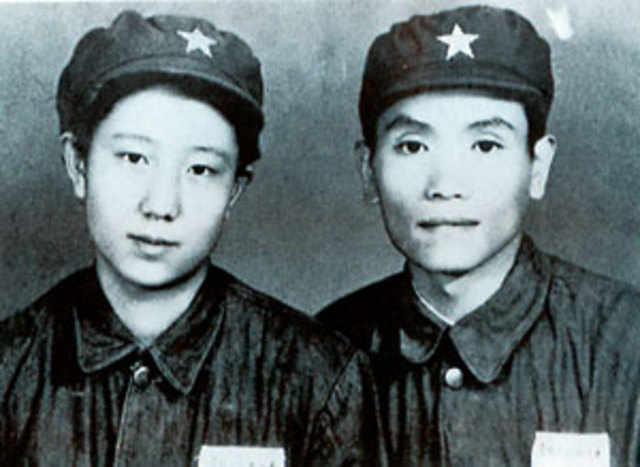
Bao-Quin and Wang-Yu,  Chang's parents


Wild Swans is an incredible look into some of China's most horrible years, particularly given the way the Changs are put on the rack for being too faithful to the cause.  Anyone who has believed in something -- a politician, an ideology, a religion -- and truly loved it, only to have to abandon it because of mounting evidence that it is not what it promised to be -- will sympathize with the Changs' plight. They never changed; Mao did. In fact,  many people were punished throughout Mao's regime for following instructions, merely because the managing authorities had changed.  Reading this and witnessing the idealism of the Communists giving way immediately to nepotism and human nature makes me more aware of both the immutable frailty of human society,  and the treasure that is the rule of law which we in the west enjoyed for so long.


Friday, September 15, 2017

My Life with the Saints

My Life with the Saints
© 2007 James Martin, SJ
414 pages


The church I grew up in consistently referred to Rome as the whore of Babylon, so needless to say I didn't learn anything about saints. I knew Biblical personalities, sure, but was completely oblivious to the hundreds of men and women throughout the Christian era who served as outstanding examples, witnesses, or reproaches to the rest of us. I encountered a few in history books, like St. Augustine,  but they were more statuesque than human. The sole exception was Joan of Arc, who began as a figure from history but became (as I read various biographies) someone I felt an odd sense of affection for.  James Martin grew up Catholic, but his saintly education seems to have been almost as paltry as mine, discovering most of them as he attended seminary and trained to be a Jesuit. In the beginning, Martin notes that Catholics approach saints as both intercessors and companions; the latter approach inspiring most of this book.

My Life with the Saints mixes biography -- his, the saints, and others -- with spiritual reflection. In each chapter, Martin recounts his encounter with each personality, sharing how they shaped and informed his own spirituality while connecting their lives to people he has worked with through the years.  St. Francis,  "the fool for Christ", is revisited in the story of another 'fool', a priest who worked with gangs in Chicago and would try to disrupt fights by walking into the middle of the fracas, dressed in a blue-jean robe.  Martin mixes Biblical, medieval, and modern personalities, and includes a fair few people (notably Thomas Merton and Dorothy Day) who aren't "official" saints.   Although I purchased this hoping to meet a lot of obscure personalities, the mix meant only a handful were  completely new to me. Even so, I found Martin's meditations  refreshing, particularly the conclusion in which he remarked on the variety of the saints -- old, young, rural, urban, intellectual, hardy, mystical, rational -- and the hope that presents  to readers, that sainthood isn't limited to a superhero type.

Related:
The Long Loneliness, Dorothy Day
The Seven Storey Mountain, Thomas Merton
The Personal Recollections of Joan of Arc, Mark Twain

Tuesday, July 11, 2017

Passionate Sage

Passionate Sage: The Character and Legacy of John Adams
© 1993 Joseph Ellis
288 pages


G.K. Chesteron once wrote that the Catholic Church is the only thing that saves a man from the degrading slavery of being a child of his age. I don't know that the Church has a monopoly on timelessness, but some historic personalities have  a sense of integrity that bids me think they would remain who they were if they were plucked up bodily and thrown into another age. Robert Ingersoll is one such man; John Adams is another.    This sense of integrity isn't magically imbued;  it requires a certain force of mind, and the decision to root one's self in deeper principles.  Passionate Sage is a rare treatment of John Adams which focuses on him not as an architect of the revolution, or as an executive officer, but as a retired statesman coming to terms with what he and others had wrought --  satisfied with what he'd done, even if he was regarded as an anachronism. He had followed his own convictions, and that was enough.

Ellis' treatment of Adams make me suspect that Adams would be his own man in any time because while classical allusions were rife in the founding era,   Adams' very soul was grounded in the classical tradition. Some revolutionaries like Thomas Jefferson believed that the Revolution had made all things new again, that institutions like monarchy which prevented people from fulfilling an innately good nature had been escaped from.  Adams held to an older view, however, that man was flawed and would constantly struggle with his inner demons -- that virtue and vice hold us in a perpetual tug of war. Our greatest flaw, Adams believed, was pride and vanity; these would drive men to compete ferociously with one another even if they were economic equals.  For Adams, the great problem of politics was how to build a productive government that took human frailty in mind. He was a grim realist in an age of idealism.   This led him to promoting unpopular ideas -- for instance, that the presidency should be invested with a certain sense of awe, not to honor the person but for the office and for the law's sake. If people do not believe in the law, have a certain respect for it, it loses its persuasive power.  If awe does not work, people resort to brute force -- and things go to pieces. His pragmatism also led him taking a high and lonely road during his administration, when he doggedly pursued a course of non-interference during the Franco-English spats of the time. Federalists looked to trade and defense deals with England,  and Republicans looked to France. Adams defied them both,  following his studies of philosophy that indicated one must do the right thing even if it was unpopular. Adams hoped that history would vindicate him, and on that matter it has. (Ellis notes that Adams often chose the course of action that would alienate the most people, being suspicious of popularity even as he desired it.)

Although Ellis focuses on Adams' thinking and writing, even still we get glimpses of Adams the man -- reading ferociously, for instance. Adams  not only challenged Jefferson in terms of the piles of books they both read, but filled his books with notes arguing and debating the authors. Adams loved a good intellectual bout, though his approach was more a pugnacious boxer's than an exercise in rapier wit.  In his exchange of letters to Thomas Jefferson, for instance, he fired off as twice as many letters as he received.  Although  often bombastic in his criticisms (especially where the "bastard brat of a Scotch pedlar", Alexander Hamilton, was concerned),   Adams' delight in conversation meant that he'd mend bridges with people like Jefferson or Mary Otis Warren just so he could  lock horns with them again. Although by the time he died Adams was regarded as highly as Jefferson, throughout the 19th century his reputation was steadily surpassed by his old friend, who sometimes seemed to be shadowing Washington.   Ellis attributes this to the triumph of Jacksonian democracy, which had and less use for Adams' caution, and still  less for his philosophic intransigence.

For my own part, I have found Adams endearing and redoubtable ever since discovering him via 1776 and David McCullough.  Although self-conscious about his frailties, particularly his vanity and temper, that never stopped him from charging ahead in a roar, with a mouth firing off fusillades.  He had a rare energy that left him only when the grave took him.


Related:
John Adams, David McCullough. Selected  Adams quotations from the same.
First Family: John and Abigail Adams, Joseph Ellis

Wednesday, June 28, 2017

Forgotten Founder, Drunken Prophet

Forgotten Founder, Drunken Prophet: The Life of Luther Martin
© 2008 Bill Kauffman
227 pages


There isn't enough whitewash in the world to create a Luther Martin hagiography, Bill Kauffman admits, but in the spirit of lost causes he does his best. Billed as a biography, Drunken Prophet is truly more about Martin's role in the Constitutional debates, in which he warned the assembly that the Constitution they were debating would destroy the States altogether  Few realize today that the Constitution - -regarded as a guardian of our liberties, however much a token now -- was rightfully feared in its day as a tool of big-government enterprise.  In this biography of Martin, Bill Kauffman gives voice to one of the Constitution's chief opponents, a man who refused service in the government it created.

When the delegates invited to reform the Articles of Confederation chose instead to create an entirely new government, Luther Martin took a stand against it. He could do no other.  He wasn't alone in being suspicious of the Constitution; Patrick Henry wouldn't even attend the convention, claiming to smell a rat. The convention contained radicals who wanted to do away with the States themselves, men like Hamilton, and Martin was their steady opponent.  He promoted the New Jersey plan against the Virginia plan, arguing that Virginia's bicameral legislature was beyond the scope of what was necessary. A government that need so many checks and balances was oversized to begin with.

Following the conclusion of the convention,  Kauffman's usual energy and the book's point drift. Technically, this is a biography of Martin, but little of import happened in his life  beyond the convention, other than a couple of court cases. Oddly, the staunch anti-Federalist became a defender of Federalist politicians, defending Sam Chase in the first-ever Supreme Court impeachment, and later defending Aaron Burr. (Kauffman notes that Burr's only crime was invading the Southwest too early, and shooting Hamilton too late.)  Kauffman suspects that Martin's defense of Federalists owed principally to his hatred for Thomas Jefferson.  Another case Martin participated in was the famous McCullough v. Maryland, arguing against the expansion of Federal powers.   Martin was evidently regarded well-enough in Maryland that the state imposed a tax on all lawyers just to give the aging attorney fiscal support after stroke and alcohol forced him to retire.

Drunken Prophet is the first Bill Kauffman book I've read that didn't absolutely bowl me over, but those interested in the anti-federalist or republican case against the Constitution will definitely find it of interest.

The Anti-Federalists stood for decentralism, local democracy, antimilitarism, and a deep suspicion of central governments.  And they stood on what they stood for. Local attachments. Local knowledge. While the Pennsylvania Federalist Gouverneur Morris 'flattered himself he came here in some degree as a Representative of the whole human race', Anti-Federalists understood that one cannot love an abstraction such as'the whole human race'. One loves particular flesh-and-blood members of that race. 'My love must be discriminate / or fail to bear its weight,' in the words of a modern anti-Federalist, the Kentucky poet-farmer Wendell Berry. He who loves the whole human race seldom has much time for individual members thereof.

From the introduction, "The People Who Lost".


Previous books in the Forgotten Founders series:
American CiceroCharles Carroll (Brad Birzer)
The Cost of LibertyJohn Dickinson (William Murchinson)