Showing posts with label the play is the thing. Show all posts

Friday, January 12, 2018

Fools and Mortals

Fools and Mortals
© 2017 Bernard Cornwell
384 pages


Brevity is the soul of wit, so here's an attempt at a quick  review.  Bernard Cornwell usually writes war novels, and he's magnificent at it. But he surely gets tired of it, and every so often he delivers a mystery or something that's not dashing heroics.   Fools and Mortals is such a book,  a celebration of the birth of western theater and of Shakespeare in general. Our main character is Richard Shakespeare, the struggling younger brother of much-hailed William.  In a age where only men acted on stage, Richard's days as an actor are seemingly numbered: he's too old to play most women, as his voice has already broken, but actors abound and male roles are competitive. What's worse, Will seems to be deliberately mocking Richard's desire to be taking seriously: his latest  role is a man...pretending to be a woman, and doing it clumsily.   But now isn't the time for jumping ship: the company is the middle  of rehearsals for a high-profile gig that the Queen might attend, and just showing up at practice gives him a chance to swoon over one of the serving girls.   Besides, he's too poor to take chances on pay:  Richard already has to make ends meet by nicking small articles and selling them on the side. When the company's plays are stolen,   Richard's moody resentment of his brother, not to mention his reputation for having sticky fingers, make him the obvious suspect. To clear his name, save the company's hides, and perhaps nail a proper male role, Richard decides to find out who stole the plays and get them back.

...and he does, within a few pages.  And then he exits , pursued by a bear.  The drama promised on the front cover is only a small, brief episode within the larger story of Shakespeare trying to deliver "A Midsummer's Night's Dream", and finish his script for "Romeo and Juliet". It's not easy, because  secret police keep breaking in to nose around, and why would priest-hunters be bothering an acting company?  Most of the novel's action takes place in and around rehearsals or performances. Cornwell notes in his afterword that the novel is largely a tribute to the men and women of his local acting company, who have given him so many happy evenings.  Fools and Mortals is thus a celebration of the English stage -- a novel that allows readers to experience the England which created and nurtured the likes of Shakespeare. Cornwell's usual strengths are here, in humor and in a few action scenes (I wasn't kidding about the bear),  but the weight of the story is its theatrical setting. I enjoyed it well enough, but I'm a regular patron of my local Shakespeare Festival and am thus an ideal audience for this kind of thing. I particuarly liked the way Cornwell included historical flavor: the inclusion of jigs after performances,  for instance, or the use of period slang.  I'm not sure that those who come to Cornwell for his Sharpes and Uhtreds will necessarily like this one, however, given how different it is from his usual work.

Well, so much for brevity. But Polonius was a rubbish advice-giver, anyway.

Related:
Ruled Britannia, another Shakespeare novel. This one is alt-history instead of historical fiction, and has Shakespeare incite  English rebellion against the conquering Spanish empire.
Gallows Thief, Bernard Cornwell. Another non-military work, this one a detective story set in 1817 England.

Tuesday, October 17, 2017

Rossum's Universal Robots

R.U.R
© 1920 Karel Capek
120 pages


ALQUIST: . Has Nana got a prayer book?
HELENA Yes, a big thick one.
ALQUIST And has it got prayers for various occasions? Against thunderstorms? Against illness?
HELENA Against temptations, against floods!––
ALQUIST But not against progress?
HELENA I don't think so.
ALQUIST That's a pity.


Introducing....the robots! Literally.  This 1920 play  by Karel Capek  introduced the term into English, in a story about manufactured people who revolt against their masters. The play opens with the arrival of the President's daughter to a remote island, the manufacturing base and headquarters of Rossum's Universal Robots. These robots are not mechanical mock-ups of human beings, but rather living creatures  whose tissue is chemically manufactured. The creatures themselves are 'simplified', their insides rearranged or reduced for maximum efficiency, and all of the messy human stuff -- pleasure,  ambition, et -- taken out. All that remains is a super-strong body with an obsessive interest in work -- at least, at first.   What began as an experiment from a pair of mad scientists is completely taking over the global workforce, reducing the price of goods to pennies. The dream of the RUR industrialist, "Domin", is to liberate mankind from slavery to itself.   He dreams of a future where humans spend their days painting and playing the lyre or lolling about in the sun, while all of their needs are taken care of by robots.  Of course, there will be some unpleasantness first. What he doesn't reckon with is that his own engineers' own curiosity will mean not just unpleasantness, but the extinction of both humans and robots.

"R.U.R". may seem like a period piece given its steamboats, steam locomotives, and telegraphs, but those are mere props.  The story irself -- the slow death of humanity via dependence on robots --  is one we are perfectly capable of seeing come to fruition.  We won't be executed by brigades of rifle-toting androids, no, but RUR demonstrates another kind of death.  The play takes place over a decade, in which robots take over so much labor and service that humans stop living. They exist, but they're no longer working, no longer struggling for the future; most people do not even have children. Even war has become a robotic domain, as armies of drones are used to invade countries and butcher people (once it's destroyed the opposing army of drones, of course).   Consider our own lives; every passing year brings more automation, and those who live beyond just the moment may wonder what will be the result. How  will governments cope with rising unemployment -- and will we reach a point where the majority of people have nothing to do? And even if people's material needs are met (in a Player Piano scenario, with sustaining welfare for the unemployed masses), how  will society absorb their energy, their itching will to be doing SOMETHING? Regardless of the hopes of optimists, not everyone wants to spend their time reading and painting and playing the lyre. Some people want to build, to compete, to do something mighty....but what will be left?

Though a short read, RUR remains thought provoking close to a century after its publication.

Monday, October 10, 2016

This week: MURDER! and leftovers


From The Montgomery Advertiser. 


Last night I enjoyed the Alabama Shakespeare Festival's final performance of "The Mousetrap", based off of Christie's "Three Blind Mice".  (The play is still running in the west end, of course, sixty four years and counting...)   A spooky locked-room murder mystery is just the thing to kick off October, especially when executed by fine actors like those of the ASF.  Theater-goers filled the parking lot and invaded the park the theater is set in; I have never seen such a crowd there!  "The Mousetrap" takes place in the wintry English countryside, some time after the war. A young couple has inherited a roomy house and decided to run it as a country inn, and on the night the play kicks off, they are expecting their first guests.  A blizzard cuts the inn off from civilization just as the last guest arrives, and the tension inside the house is soon just as thick as the snow outside.  The guests are eccentric and opinionated,  and stress levels only increase when the house receives a phone call. There's been a grisly murder in London, with a possible connection to this address. The police are coming.   Soon there's an actual body on the floor, and the inspector's questions cast suspicion on everyone, reducing even the husband and wife to being fearful of one another.

I was quite surprised by the ending,  more for the dramatically quick resolution than the twist. .  My only disappointment was that the theater didn't sternly admonish us against spoiling the ending.  It certainly put me in the mood for a few more gloomy mysteries, just the thing for October with Halloween not far off.  In the short term, though, this week will see a little more history (leftovers, really, consumed reluctantly), and more posts from my week in New Mexico, this time including Albuquerque and Santa Fe. (Fun fact: did you know that in 1862, the Confederates invaded New Mexico? I didn't, and I've been reading about the war since adolescence!)   I'm still waiting for things to get back to 'normal'...I suppose eventually the magic will wear off and I'll stop dreaming of the mountains.. Then it will be time to go again.


Saturday, October 8, 2016

Harry Potter and the Cursed Child

Harry Potter and the Cursed Child
© 2016 Jack Thorne, J.K. Rowling, and John Tiffany
320 pages


Harry Potter and the Cursed Child is the book young adults who grew up with Harry have been waiting for....though it's not quite what they expected.   Principally featuring his  youngest son Albus's adventures in Hogwarts, the play at is core is about family and relationships instead of magic and epic adventures.  Harry Potter isn't the boy who lived, he's a father trying to live through his son's adolescence, something a fair few of his original readers probably have on their mind as their own children near that age.  

Like the prophecy that could refer to both Harry and Neville, the 'cursed child' seems to apply equally to Albus and his best friend, Scorpio. The son of Draco Malfoy, neither Scorpio nor Albus are made in their fathers' image.  Scorpio is a geek, one infatuated by the daughter of Hermione Granger. Albus himself is more of a mystery; his main characteristic seems to be that he finds living under the shadow of his father to be awkwardly oppressive. (It doesn't help that he was sorted into Slytherin....)     Scorpio is dogged by his father's legacy, and constantly accused of being not only a wolf in sheep's clothing, but the actual son of Voldemort.  United in their misfit status, the boys decide to go back in time and prevent Cedric Diggory from being killed -- Albus will have accomplished something his father failed at, and Scorpio will have good guy credentials. Unfortunately  for these two, they've never seen a single time-travel movie and have no idea what an utterly bad idea monkeying about with time can be. (And naturally, there's a confederate with a diabolical scheme manipulating these two to other ends...)

The good news for the reader is that, in their visits to the past and then to alternate realities, old characters return if only temporarily. Snape, for instance, makes an appearance, and finds the thought of his other self being killed by Voldemort 'profoundly irritating'.  When the adults realize what their kids are up to, they're forced to attempt to intercede, so that at one point adults and children are working together in different time frames.  The writers don't just use the power trio, though, but create different combinations throughout the story. We see much of Draco, who has grown far beyond his petty upbringing, but is still isolated and haunted by the memory of his family's malice. Although being a play there's no narrative, the dialogue brought to mind some of the humor and warmth of the original books.  Albus is an interesting character only to the degree that he is a partner in banter with Scorpio and Rose (Hermione and Ron's daughter). Although his growing distance from Harry is explained TO the reader, the early scenes jump around so much that I simply had to take his sullen rebellioness for granted. It's a case of being told, not shown, and unfortunately this arbitrary distance is  Albus' main attribute.

Although it's definitely not a Harry Potter adventure in the old style, as someone who long resisted and then fell for Pottermania utterly, I found it fun. It's fun in the sense of fanfiction, I suppose, and fleshes out that epilogue at the end of  Deathly Hallows, but it's more serious than that. Most of the fanfiction I've seen has infantile premises -- fetishizing Draco, making Harry a girl who knows martial arts, that sort of thing.  (I omit Harry Potter and the Methods of Rationality, which is The Best Fanfiction Ever.)   The Cursed Child covers an adult topic -- a genuinely adult topic, not a 'let's be gratuitous and pretend it's mature discussion'   --   while remaining of interest to adolescent readers.   It makes me want to cozy up under a fall tree and read the books yet again!

Monday, November 23, 2015

Jacob Marley's Christmas Carol


Another week gone, another entry from the 2015 reading challenge: earlier I received "Jacob Marley's Christmas Carol" and couldn't help reading it waaaay too early. It didn't take long, being a fifty-page play that's essentially a retelling of "A Christmas Carol", with Marley pretending to be the Ghosts of Christmas Past and Present, and being redeemed himself when he tries to take Scrooge's place when Death appears and Marley believes his own toils with Scrooge have not yet borne fruit.  I didn't like it nearly as much as I thought I would, in part because it's so rushed. In Dickens' original, Marley claims that for many years he has tried to reach Scrooge, but here he dies, learns he's been a bad boy, and is immediately offered a chance out of foul punishment: he has to save Scrooge.  The play picks up right where A Christmas Carol starts. There's no seven years of anguish as Marley is tormented by the weight of his selfishness, just the faint realization that all of the scorn he heaps upon Scrooge applies to him as well.  There are nice moments, though: Marley pausing during a speech on Scoorge having forged his chains link by link, yard by yard in recognition that he is damning himself, and some dark comedy when Marley and his guardian angel/demon-thing congratulate one another on a superb Death costume, only  to realize that's actually DEATH approaching Scrooge.  That does take care of a work set during Christmas, though, so all that's left is A Classic Romance.  It doesn't seem hard, but I'm constantly distracted  by war and horses and -- I've just purchased a book on the electrical grid. I'm not making it easier on myself, am I?

Saturday, October 3, 2015

A Man for All Seasons

"A Man For All Seasons"
© 1966 Robert Holt
163 pages

"...the king wants either Sir Thomas More to bless his marriage or Sir Thomas More destroyed."
"They seem odd alternatives, Secretary."


            The king wants a son, Sir Thomas – what are you going to do about it?   King Henry, eight of that name and possibly last of the Tudors,  has decided to change wives. His lawful queen, Catherine of Aragon, has so far only given him one long-lived child: a girl, utterly useless for succession purposes.   Convinced that his marriage is cursed, Henry seeks to have it declared null and void by the Pope, but said pontiff is unwilling. He already made special dispensation for Henry to marry his brother’s widow in the first place; now they want to him to un-dispensate?   Anxious to replace Catherine with a younger model, and in fear of dying without a proper heir, Henry decides to resolve the succession  problem via secession.   Assume leadership of the Church  in England, appoint someone pliable as archbishop, and hey presto, instant divorce.    Henry can do nearly what he wants; the Pope may object, but he is across the Channel, and even the Queen’s Hapsburg family doesn’t have the energy to invade England just for marriage counseling.  Henry intimidates both Parliament and the church into giving in, but still—there is an itch of sanction. The compliance of dogs is easy to find; they can be appeased with food or cowed with beatings, and dog-men abound here, epitomized in the person of Richard Rich   What Henry needs to sooth any lingering qualms that he is following the straight and narrow path is approval from a man of virtue and conscience – a man like his Chancellor, Sir Thomas More. But More cannot approve; he is a faithful husband and doting father to several daughters, and a good Catholic who finds Henry’s easy disposal of his wife and the Church’s authority to be utterly alarming.   Choosing discretion as the better part of valor,  More retires from the court in the wake of Henry’s break with the church, but Henry is not content. He and his minions want either More’s sanction, or his destruction.  “A Man for All Seasons” follows the king’s pursuit of More,  a path that ends only with the subject's martyrdom.   More never explicitly opposes the king’s behavior;  never writes a tract, never denounces him from the chair of office,  never even says a word to his wife.   His silence, however, is forbidding, and the king will not have it.  There can be no law in   England save the King’s – not even More’s private reign over his conscience.   The import of “A Man” is not lost centuries ever the times they portray, nor decades after the play was written. Its championing of conscience against coercion, of moral conviction against swaggering license, remain relevant so long as those in authority continue to pursue their every impulse,  dressing their wrath and lust for power in the clothes of law and demanding obedience. Sophie Scholl lost her head for the same reason More lost his;  they had a better one than the king’s.  More’s stand for conscience was such that the Church of England – which More opposed – hails him as a saint.  Truly he was as Holt describes him, a man for all seasons,  including ours.


Monday, September 28, 2015

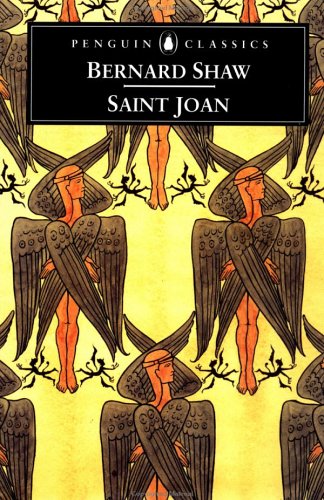
Saint Joan

Saint Joan
© 1924 George Bernard Shaw
160 pages


In the darkest hour of the Hundred Years War, a teenage girl re-inspired both a defeated nation and a despondent king to fight again for what was theirs. She -- Joan of Arc -- would be captured by her enemies and condemned a heretic by the English, but later vindicated by the Church. In 1920, in fact, Joan was pronounced a saint. Shaw's play no doubt follows on the heels of the news of her canonization.  Scoffing at saintly romanticization of the Maid, Shaw chose to pay tribute to her in his own way, making her an apostle of Whiggism.  “Saint Joan” pays tribute to the Maid’s time in the historical sun, relegating unpleasant battle-and-execution bits  to the background and focusing instead on her conflicts with the silly men she is forced to enlighten. Considering that the title character is burned alive, the play is far funnier than it has a right to be, from the opening scene with a duke arguing with his page almost to the end, where the man Joan made king is visited by the shades of his past after her vindication.   Shaw fills the play with modern conceits; his characters seem to wish they were living in the 1920s instead of the rotten ol’ middle ages. They even invent words like Protestant and Nationalism to describe how Joan makes them feel. 

Shaw’s Joan is more ambiguous than this, however; he endeavors to save her from beatification and her enemies from damnation in the same stroke.  Joan as written is not ‘saintly’ she is cheeky. Assuming familiarity with lords of the realm and lords of the church alike, she gives as good as she gets when they argue her down with reason, or scold her for acting so presumptuously. The irreverent, tomboyish Joan may be the star of the play, but her opponents are no villains. They may be guilty of pious fraud at times, but their arguments seem perfectly sensible, and prompt a reader to wonder just where Shaw’s sympathies lie.  When the churchmen accuse Joan’s patriotic  zeal of threatening to divide Christendom into nations and in so doing, dethrone Christ and allow the world to perish in a welter of war,  the graveyards of the Great War do not seem far removed from Shaw’s mind.  They are less villains than men moved to horror through fear, and happily ere the conclusion is reached they experience the genuine crisis of remorse, repenting in turn.  Although Shaw is just as guilty as having the Maid carry his own standard as any of the old romanticists,  “Saint Joan” succeeds in granting both her and her enemies humanity and redemption.


Thursday, March 19, 2015

The Importance of Being Earnest

"The Importance of Being Earnest"
© 1895 Oscar Wilde


The truth is rarely pure and never simple. Modern life would be very tedious if it were either, and modern literature a complete impossibility! (Algernon, Act I.)

         Algernon and Earnest are two pals who have more in common than they realize. When Earnest visits Algernon, planning on proposing to Algie’s cousin at a family lunch,  a mystery is waiting for him. Algernon has recovered a lost cigarette case, one he knows to belong to Earnest, but which for some reason is inscribed to an Uncle Jack from his adoring niece Cecily. Who is Jack?   

            Who is Jack, indeed?  That’s a three-act question.  Jack, it turns out, is the real name of Earnest.  In real life, he’s a respectable gentleman in the country with a young ward, for whom he must be very proper and upright. When it gets too much, he likes to escape to the city to see after his libertine brother, Earnest.  Algernon isn’t in the least bothered to learn that he knows his friend under an assumed name –  Algy likes to pretend he has a sick friend in the country, Bunbury, who occasionally needs help. (The occasion invariably coincides with party invitations from Algernon’s aunt.)  When Algernon decides to visit Jack’s country estate pretending to be the scoundrel brother Eanrest, hilarity ensues. 


            Strictly speaking, hilarity was ensuing long before that.  Wilde once equipped that nothing succeeds like excess, and this play’s abundance of witty dialogue may hint at truth in the saying.  Part of the humor comes from Wilde turning social conventions on their head; his rich characters complain that the lower orders aren’t setting a good example for the uppers, characters despair of hypocrisy in a good man who pretends to be naughty,  and at least one woman proclaims that men’s proper place is in the home, and once they leave it they become altogether too feminine.  It’s a very silly play, and even a little meta: towards the end Aunt Augusta complains that contrived coincidences like this simply have no place in ‘good’ families like hers.  This is a topsy-turvy plot, wherein characters are alternatively sparring and then defending one another, traveling from  sobs to shrieks of joy at a moment’s notice. It’s magnificent fun, especially in the hands of talented actors. 

Sunday, November 22, 2009

Marx in Soho

Marx in Soho
© 1999 Howard Zinn
88 pages


"Oh, ja -- 'capitalism has triumphed!' -- but over whom?" - Marx, Marx in Soho

Although The Zinn Reader held a near-monopoly on my attention last week, there was a brief thirty-minute timeframe in which I visted my post box, discovered to my happy surprise that a book had come in early, and excitedly read through it. As you might guess from those comments, Marx in Soho is not a lengthy work: it is not even a book in the usual sense, but a play written by Howard Zinn. I came to Marx in Soho by the same means I came to The Zinn Reader:  You Can't Be Neutral on a Moving Train,  a documentary on Zinn's life.  Film from a production of Zinn's speculative play in which Karl Marx visits the present day from the "beyond" featured in the movies, and it intrigued me enough that I started looking for recordings on YouTube. Those were well-done enough to merit my looking for the book, which I did.

As said, the play's premise is one of speculative fiction. Karl Marx, annoyed that his name and life's work are being slandered in the modern world, is able to badger the Powers that Be into letting him visit the living world just for one hour -- although, due to a bureacratic mix-up, he finds himself in Soho, New York instead of Soho, England. The play is a monolouge, although we hear from other characters through Marx's reflectings on the past. Most of his attention is focused firmly on the present, as he admits that his predictions of class revolution and Communism were off, muses on why, and applies his criticisms of capitalism in the 19th century to capitalism in the 20th. Marx is portrayed not as a sage-like Gentleman Scholar in this play, but as an ordinary human who loved his wife and children, endured a bad cough,  turned his home into a salon for the dicussion of economic and political matters, and who is passionate about his work. Zinn's Marx has a sense of humor, sometimes making wry comments to the audience after his more spirited rants have attracted negative attention from "Heaven" -- lightening flashes whenever Marx becomes too animated.

Marx in Soho is a fun little read. It's almost a modern Communist Manifesto, communicating Marx's ideas to a lay audience. It's nowhere near as thorough as the Manifesto, but the 21st century's attention span may be too short to endure even the short work that is the Manifesto.  Marx in Soho is fairly well done -- it's readable, presents the Manifesto's basic tenents, entertains, and humanizes a figure who is more legend than man. My only raised eyebrow comes from Marx speaking in Zinn's voice toward the end.