Johnny Reb's War: Battlefield and Homefront
pub. 2001 David Williams
102 pages
Johnny Reb's War is a curious collection of two historical articles by David Williams, the contents of which were later encompassed by his impressively depressing People's History of the American Civil War as well as Bitterly Divided: The South's Inner Civil War. The two articles review the miserable conditions of the Confederate army (starving, barely clothed, and shoeless by 1862) on the eve of Antietam, as well as the prolonged plight of the southern poor in Georgia at home. The two intersect nicely, because the wretched conditions at the front, combined with the fact that their wives and children were starving, sick, and being plundered by their own government, led to crippling desertion; Jefferson Davis estimated in 1864 that as much as two thirds of the entire army had simply given up.
Those who have never explored this part of the Civil War before, of course, are in for surprises -- they will learn, from a source who is by no means sympathetic to the southern cause, that most southern combatants were poor yeomen who rallied to the Confederate banner only when Lincoln announced an invasion; that the wealthy planters who voted for secession not only exempted themselves from fighting in the war, but drastically weakened the army by focusing on cash crops they could only sell to the 'enemy', rather than food to supply their countrymen; and that the Confederate government bankrupted its moral support fairly quickly by imposing subscription, suspending habeaus corpus, and not checking corruption.
Williams provides a long train of stories and scathing comments pulled from contemporary newspapers and letters, but -- as with Williams' previous works -- I find myself wishing I could find similar information from different sources to get better perspective. However, this was absolutely worth reading just for the excuses southern soldiers would render to their superiors for killing livestock in Maryland. One insisted he'd been attacked by the pig and had been obliged to kill the porker in self-defense; another claimed he'd felt sorry for all the dislocated animals after the battle and decided to put them out of their misery. A related chuckle came from the report of a Confederate officer who detailed how Lee ordered a man executed for stealing a civilian hog; Stonewall Jackson left the execution to fate by putting the man into the frontlines. When the man survived Antietam, the recording officer noted that the accused had lost his pig, but saved his bacon.
Pursuing the flourishing life and human liberty through literature.
"Once you learn to read, you will be forever free." - Frederick Douglass
Showing posts with label American Civil War. Show all posts
Sunday, March 3, 2019
Wednesday, January 23, 2019
Short rounds and the week ahead
On Saturday the library was partially evacuated owing to a tornado warning, and today Father Winter has well and truly hit the town. I'm currently reading a scrutiny of political utopias, transhumanism, and religious-spiritual ideas about life beyond death (from heaven to ghosts), as well as listening to an audiobook based on a long-favorite podcast of mine, The Skeptics Guide to the Universe. The latter is 15 hours, so it will be a good while before I finish it. But what about books I have finished? Well, recently, that makes two: The Long Game, on Obama's foreign policy, and View from the Ground, an anthology of historical articles based on the primary-source materials of solders embroiled in the war between the states.
First up, The Long Game, which argues that President Obama entered office with a distinct foreign policy and that more often than not, he was able to apply it to the problems he encountered, if with mixed results.Chollet describes Obama's approach as the 'long game', and identifies eight various elements of it. Summarized: while the United States is in a unique position to effect change globally, it also can't do everything it wants or even needs to do, necessarily. Careful thought should be given to balance the nation's attention and resources between domestic and foreign priorities. Actions taken should be both sustainable in themselves, and lead to stable results. Small moves are best. Although approaches can be tailored on the fly to adjust to changing circumstances on the ground, or tangible proof that a given policy is not working, patience is also vital. When something has failed, the best thing to do is figure out what to learn from from the experience and move forward, not sink new resources into the mistake. Chollet then reviews some of the foreign policy stories of the Obama administration, examining Obama's careful attempts to work with Russia and reluctance to engage with Libya or Syria (pre-2014). Discussion of North Korea is noticeably absent from The Long Game, but it's a refreshing reminder of a president who challenged DC in a constructive way.
Next up, View from the Ground, which I read because a transplanted northern friend of mine was insistent that I read it. I'd assumed it was just soldiers' recollections of various battles, which I wasn't too much interested in, but after I took a look at it I realized it was far more varied than that. The book is an anthology of different pieces, examining this or that aspect of life on the ground -- from religious soldiers' attempts to reconcile piety with burning and killing, to exploring the "abolitionizing" effect the war had on Union soldiers, who began fighting to protect the Union and only later were convinced of the necessity for ending slavery, which in their view had undermined the south both economically and morally. There are strictly military-related pieces, too, towards the end. Given that in college I used the songs of Civil War soldiers to explore their lives, motives, and view of the conflict as it developed, I largely enjoyed this.
Wednesday, November 22, 2017
These Rugged Days
These Rugged Days: Alabama in the Civil War
© 2017 John Sledge
296 pages
Although Alabama was not the site of as many bloody battles as Virginia and Tennessee in the Civil War, it was not a quiet backwater only troubled at the war’s end. From the Confederacy’s birthplace in Montgomery in 1861 to the coup de grâce burning of Selma in 1865, Alabama saw altercations, skirmishes, and at least one major battle throughout the war. These Rugged Days is a personal history of Alabama in the civil war, in which the accounts of battle are made more intimate and entertaining by unique stories from the ground.
When South Carolina seceded from the union, Alabama was one of the first states to follow, and its central location in the deep south seemed to recommend Montgomery as a capital – one supported by two major commercial rivers, no shortage of rich farmland, a secure port, and ample mineral deposits. As an example of like repelling like, however, the politicians who gathered in Montgomery in that humid spring were put off by the clouds of mosquitos. Although the seat of government moved to Virginia, Alabama’s rail lines and rivers were of great interest to the enemy. Union cavalry raided and captured several cities in northern Alabama early on, only to be driven out. Sledge notes that Florence and Huntsville would change hands several times throughout the war. Although many citizens of northern Alabama were unionists, and the first Union troops were careful not to step on toes, the eventual Union reprisals against civilian populations in the wake of guerilla war alienated the military and their civilian hosts against one another. Larger in scale was the siege of Mobile, the port of which fell in 1864. Mobile was an important port city for the entire South, hosting blockade runners who darted to Cuba and back with supplies long after New Orleans had fallen. The battle of Mobile Bay involved several ironclads, as well as the use of naval mines (or “torpedoes” – this battle gave birth to the expression, “Damn the torpedos, full speed ahead!”). The city itself, however, would not be taken until 1865.
Sledge opens the book with a story from his childhood, recounting the moment in which history became real: he and a friend discovered a half-buried Spencer carbine along a creek bed, one presumably dropped by an invading Yankee during Wilson’s raid. Throughout These Rugged Days, he draws on stories that add a human touch to the already lively account of daring raids, rebellious farmhands, and steady action. The chapter on Streight’s Raid, for instance, includes several humorous accounts – though the raid was bound for some level of absurdity from the beginning. It was a cavalry raid conducted on mules, who frequently gave their riders trouble and drew amused crowds. The troopers had their own laughs; in one abandoned town, a few newspapermen turned cavalry broke into the town’s news office and printed a broadsheet that presented the arrival of the Yankees as if they were a group of young men come to pay a social call. (“It is unknown how long the general and his friends will stay with us.”) The conclusion of that raid saw the troopers surrender to a force a third of their size after being bloodily harried for days. The rebel commander Nathan Bedford Forrest ‘put the skeer in’ his opponents by sending aides with orders to nonexistent companies and shuffling his two guns to appear like a battery of fifteen. Streight was not amused when he realized how small a force had taken him in. The book concludes with Wilson’s Raid, a large cavalry action that involved a running battle between carbine-carrying Yank cavalrymen fighting against a much smaller Confederate force led by Forrest. They sparred from Montevallo to Selma, where Wilson achieved his aim in burning the city and its naval foundries, which had helped make Mobile such a tough nut to crack. (Selma’s contribution to the naval war were honored in the good ship Selma, which was the last to surrender at Mobile Bay. )
Although there are other books on Alabama in the civil war, These Rugged Days is easily the most entertaining book I’ve read on the subject. The author has obviously inherited his father’s ability to weave a story that keeps audiences spellbound.
Related:
With the Old Breed, Gene Sledge. (Literally related: Gene Sledge is John's father.)
The Yellowhammer War: The Civil War and Reconstruction in Alabama
Labels:
Alabama,
American Civil War,
American South,
history,
John Sledge,
military,
Selma
Tuesday, March 21, 2017
The Unvanquished
The Unvanquished
© 1938 William Faulkner
254 pages
Years ago in a ninth-grade literature class, I chose to read a book by William Faulkner for a class project on the basis that he was a southern writer. My teacher cautioned me against trying The Sound and the Fury, warning me that it was difficult -- a challenge out of scale for a minor paper. Well, dear readers, I persisted -- for about a chapter. Then, faced with Faulkner's bewildering narrative style --,a torrent of words with few marks of punctuation, flowing ceaslessly like the Mississippi -- I returned to my teacher with tail between my legs and asked for something else, and thus read The Old Man and the Sea for the first time. Ever since then, the memory of Faulkner has haunted me. I associate his writing with both brain-melting difficulty and with embarrassment, and yet...still I've wanted to read him. The prevailing reason is the same: William Faulkner is a southern writer. He is not just a southern writer, though, he's one of The Southern Writers, always mentioned with Flannery O'Connor as though the two were manufactured as a set, like a pair of pants.
The Unvanquished is the story of a young boy (Bayard Sartoris) who comes of age amid the Civil War and reconstruction, along with his close friend Marengo ("Ringo"). Ringo begins the novel as a slave, but the narrator mentions early on that he and Bayard were so close in age that they suckled at the same breast, and both lived in dread awe of The Colonel and Granny. While The Colonel (John Sartoris) is off at war, fighting to keep the damyanks out of Vicksburg, Granny is the boss. Actually, I almost suspect she remains the boss when The Colonel is home, for this is a woman who trucks into the middle of a warzone to demand the Yankees return her stolen mules, her slaves, and her chest of silver. Fearless, she uses fabricated requisition papers to steal and sell livestock to the invading army -- not growing rich, but using the proceeds to support her community of Jefferson, burnt-out by the war. Shady business brings forth shadier persons, though, and soon death visits the Sartoris family. In the collection's conclusion, young Bayard -- who is now a twenty-something law student -- must confront the man who robbed him of his father upholding the family's honor but heedful of the consequences should he make the wrong choice.
If you have never read Faulkner, The Unvanquished is a promising work to test the waters, It's one of his shorter pieces, and the stories' length allow an unfamiliar reader to dive into Faulkner without chance of drowning. That style of writing, the torrent of consciousness ("stream" won't do for Faulkner), is present here, but not nearly as overwhelming as I remembered from Sound and Fury. Although these stories are filled with death, as the State's armies lay waste to the South, Granny's confrontations with the Yank officers always have humor about them, as the officers regard her with astonished admiration. One of them thanks God that Jefferson David never thought to draft an army of grannies and orphans, for a regiment of Sartorises would be the Union's undoing.
(Bayard and Ringo, Spanish cover)
Thursday, March 9, 2017
Robert E Lee
Robert E. Lee: A Life
© 2003 Roy Blount Jr
272 pages
Recently a patron returned this biography of Robert E. Lee to the library, complaining that as much as he enjoyed it, Lee remained...distant, unknowable, aloft. "Like Washington?" I suggested, and his eyes lit up in recognition, for both men share the same unimpeachable aura in the South. It's an aura of old words -- honor, humility, grace, dignity -- that has long departed politics, and was rapidly dissipating even then. I decided to give the biography a try myself, partially out of deference to its subject (of whom I've read nothing except for military histories) and partially because the author's name rung a bell. I found this Penguin books biography to be short, surprisingly fair-minded, and..a little weird.
Lee's life in brief: born to a dashing Revolutionary War hero who died in disgrace, Lee joined the military to support himself and continued serving even after he married into another elite family, this one with money and a close connection to George Washington. He served with distinction in the Mexican War as a scout and aide to General Scott, and traveled throughout the southern and western parts of the country shoring up fortifications and fighting Indians. Lee's sympathies were not with the Confederacy, and he shared the attitude that the Virginia legislature displayed when it voted against secession. However, after Lincoln inaugurated civil war by calling for troops to invade the South, Virginia turned about completely -- seceding and organizing its own defense. After turning down an opportunity to lead the northern army against the South, Lee resigned his commission and went to Virginia's aid. Within a year's time he would be given command of the Army of Northern Virginia, and there wrestle down a series of generals until Grant and material exhaustion defeated the cause. In the postwar years, he served a the president of a college and then passed away before reconstruction ended.
Roy Blount Jr's name is not one I have heard associated with Civil War history, military history, southern history, law, politics, or anything that would suggest connection to writing about a Civil War personality. He is a humorist, a fellow I've only heard on NPR. His literary nature comes out strongly here, with numerous digressions in which Blount chats about grammar or Lee's connection with men of letters . Stranger are the Freudian digressions in which Blount speculates Lee charged the high ground at Gettysburg to psychologically overcome his father's beating at the hands of an anti-British mob in 1812. Media personalities are allowed a bit of eccentricity in their writing, I suppose. What I did appreciate is that Blount admires Lee's character without lionizing him, and admits his faults without condemning him. Specifically, Blount writes that Lee had been born into a morally compromised position: as much as he might detest slavery, he never forthrightly condemned it. Blount attributes this to authentic paternalism of Virginia's old blood, in which they earnestly believed that people held in American slavery were better off than living in a state of nature in Africa. A letter written by Lee in 1856 expressed his hope that Providence was guiding America to be able to free itself of the burden of slavery, though he objected to the abolitionist's desire to do it immediately by force. This was not an effort by Lee to protect his 'property', for he began working to free his father-in-law's slaves as soon as he inherited them. It was rather Lee's attempt to keep himself conciliated with his home, for who wants to regard their own culture and country as vicious? Hope allowed him to serve Virginia's defense. While the ruling planter class initiated secession to protect slavery from Republican abolitionists, the war itself was fought by men like Lee and the common soldiery for more universal motives: duty to home and brothers-in-arms; sheer cussedness, and because they had to. (Drafts were forcefully used by both the ruling classes in both states, union and confederate.)
Blount's cover of Lee is thus a very general biography, one that should suffice if a reader knows nothing about Lee at all. Most of this I had absorbed through various Civil War histories, but enjoyed the narrative even with its Freudian quirks.
© 2003 Roy Blount Jr
272 pages
They say that God in heav'n
is everybody's god
I'll admit that God in heav'n
Is everybody's god
But I tell ya John, with pride,
God leans a little on the side
of the LEES! The LEES OF OLD VIRGINIA!
("The Lees of Old Virginia", 1776)
Recently a patron returned this biography of Robert E. Lee to the library, complaining that as much as he enjoyed it, Lee remained...distant, unknowable, aloft. "Like Washington?" I suggested, and his eyes lit up in recognition, for both men share the same unimpeachable aura in the South. It's an aura of old words -- honor, humility, grace, dignity -- that has long departed politics, and was rapidly dissipating even then. I decided to give the biography a try myself, partially out of deference to its subject (of whom I've read nothing except for military histories) and partially because the author's name rung a bell. I found this Penguin books biography to be short, surprisingly fair-minded, and..a little weird.
Lee's life in brief: born to a dashing Revolutionary War hero who died in disgrace, Lee joined the military to support himself and continued serving even after he married into another elite family, this one with money and a close connection to George Washington. He served with distinction in the Mexican War as a scout and aide to General Scott, and traveled throughout the southern and western parts of the country shoring up fortifications and fighting Indians. Lee's sympathies were not with the Confederacy, and he shared the attitude that the Virginia legislature displayed when it voted against secession. However, after Lincoln inaugurated civil war by calling for troops to invade the South, Virginia turned about completely -- seceding and organizing its own defense. After turning down an opportunity to lead the northern army against the South, Lee resigned his commission and went to Virginia's aid. Within a year's time he would be given command of the Army of Northern Virginia, and there wrestle down a series of generals until Grant and material exhaustion defeated the cause. In the postwar years, he served a the president of a college and then passed away before reconstruction ended.
Roy Blount Jr's name is not one I have heard associated with Civil War history, military history, southern history, law, politics, or anything that would suggest connection to writing about a Civil War personality. He is a humorist, a fellow I've only heard on NPR. His literary nature comes out strongly here, with numerous digressions in which Blount chats about grammar or Lee's connection with men of letters . Stranger are the Freudian digressions in which Blount speculates Lee charged the high ground at Gettysburg to psychologically overcome his father's beating at the hands of an anti-British mob in 1812. Media personalities are allowed a bit of eccentricity in their writing, I suppose. What I did appreciate is that Blount admires Lee's character without lionizing him, and admits his faults without condemning him. Specifically, Blount writes that Lee had been born into a morally compromised position: as much as he might detest slavery, he never forthrightly condemned it. Blount attributes this to authentic paternalism of Virginia's old blood, in which they earnestly believed that people held in American slavery were better off than living in a state of nature in Africa. A letter written by Lee in 1856 expressed his hope that Providence was guiding America to be able to free itself of the burden of slavery, though he objected to the abolitionist's desire to do it immediately by force. This was not an effort by Lee to protect his 'property', for he began working to free his father-in-law's slaves as soon as he inherited them. It was rather Lee's attempt to keep himself conciliated with his home, for who wants to regard their own culture and country as vicious? Hope allowed him to serve Virginia's defense. While the ruling planter class initiated secession to protect slavery from Republican abolitionists, the war itself was fought by men like Lee and the common soldiery for more universal motives: duty to home and brothers-in-arms; sheer cussedness, and because they had to. (Drafts were forcefully used by both the ruling classes in both states, union and confederate.)
Blount's cover of Lee is thus a very general biography, one that should suffice if a reader knows nothing about Lee at all. Most of this I had absorbed through various Civil War histories, but enjoyed the narrative even with its Freudian quirks.
Labels:
American Civil War,
American South,
biography,
Virginia
Sunday, February 26, 2017
Selma: A Bicentennial History
© 2017 Alston Fitts III
384 pages
As a modern history of Selma, Dr. Fitts has done a superb job of presenting the most essential elements of previous histories, connecting them to broader histories of the South and southern institutions (black churches, for instance, via use of Wilson Fallin's Uplifting the People), His heavy use of interviews and the photographs of Selma citizens make it a community story, almost, and one that the generations are able to contribute to given that he references one older history written by a Selma mayor. As a native son of the Queen City, I found quite a few questions answered here, learned some interesting tidbits along the way, and finished the book feeling ever more affectionate toward this, my storied hometown.
Related:
Selma 1965, Chuck Fager
Reporter: Covering Civil Rights...and Wrongs in Dixie, Al Benn
© 2017 Alston Fitts III
384 pages
On December 4th, 1820, the Alabama legislature granted a town charter to a burgeoning community established on a high bluff overlooking the Alabama river. The place, named after a cities of heroes from a Scottish poem in the romantic period, would quickly create its own heroes and stories. In Selma: A Bicentennial History, longtime Selma resident Alston Fitts delivers a celebratory history of the town and its proud yet troubled heritage, in advance of its 200th birthday. He builds on his initial history (Selma: Queen City of the Blackbelt), which was published in the 1980s; here, his initial history is greatly expanded, using references to other works to take readers through the Civil War, Reconstruction, and the 20th century through one city's experiences. The work never shies away from the city's most controversial moments, but strives to be fair to all parties. For a Selmian, this is a history that does the city justice, with a multitude of fascinating little stories based not just on old records, but interviews with the city's residents. Their many contributions to the book, in interviews and photographs, make it a true reflection of the city rather than just the view of one author.
To those only familiar with Selma's modern history, as a small city only remembered for being the site of the Civil Rights movement's crowning moment, Selma reveals another place -- a center of industry and trade that rivaled Montgomery for prosperity and political influence; a city sure enough of its future to argue for its selection as the Confederate capital during the war between the States. Selma and its mother county, Dallas, contained some of the richest soil in Alabama, and both civic and business leaders made the most of that wealth by aggressively pursuing railroads; long after the great river had ceased to be the chief commercial artery of the state, Selma's network of banks and railroads were poised to prosper further in the 20th century. Its rails and river made a commercial center, but it was no slouch in regards to industry: Selma housed an arsenal rivaling Richmond's as well as a principal naval foundry during the war, making it a target for Union troops; still later, during World War 2, Selma hosted an air force base that survived into the 1970s. Selma's wealth was not merely monetary, however; her citizens were truly dedicated to the city, pouring themselves into creating civil institutions like schools, hospitals, and the library. They created block after block of magnificent buildings, many of which still stand today: the historic district of Selma is one of the nation's largest.
Selma's past as an agricultural titan would bear unexpected fruit throughout the 20th century, however. The economic culture of the antebellum South meant that Selma and Dallas County' wealth came from fields worked by slaves, to the degree that Dallas County has maintained one of the largest black populations in Alabama for generations. When Reconstruction began in the postwar South, it contributed many black businessmen and politicians. These gains would fade and be reversed by the end of the 19th century, however, culminating in the establishment of Jim Crow segregation laws and the 1901 Alabama Constitution. The latter document established barriers to voting which included poll taxes, property holdings, and the explication of Constitutional articles; these requirements together reduced the black voting population in Dallas County from several thousand to under a hundred. These barriers, disenfranchising poor blacks and whites alike -- and flying in the face of Alabama's original constitution, which incorporated universal white male suffrage -- would not fall for over sixty years. Selma entered the national spotlight again in 1965, when a local voting league invited Martin Luther King, Jr. to help draw attention to the cause of suffrage in the city. Fitts notes that the league was able to accomplish what it did largely because the black community in Selma was so healthy, with a strong middle class supporting several hospitals and two colleges. One of the most dramatic moments of the Selma campaign, for instance, was the mass support black teachers lent to it when they absented themselves from teaching to march instead. Visiting in 1968, King himself was astonished by the progress of the black community, and the strengthening relationship between it and the city's white population. Legendary mayor, Joe Smitherman, had just been elected to the office in '65, and continued to sit the big seat throughout the rest of the century in part because he made himself a ready ally of of the black community. Unfortunately, racial harmony would be disrupted as Selma entered the 1990s, as a certain group of lawyers created such a hostile atmosphere in the city that one of the state's most integrated systems fell to pieces. Still, the city is doing what it can to move past that episode, as the actors involved are now dying off. Perhaps their bitterness will buried with them. The city now has a young mayor in Darrio Melton who has already demonstrated a strong intent to scrape away the old barnacles and begin making progress once more.
As a modern history of Selma, Dr. Fitts has done a superb job of presenting the most essential elements of previous histories, connecting them to broader histories of the South and southern institutions (black churches, for instance, via use of Wilson Fallin's Uplifting the People), His heavy use of interviews and the photographs of Selma citizens make it a community story, almost, and one that the generations are able to contribute to given that he references one older history written by a Selma mayor. As a native son of the Queen City, I found quite a few questions answered here, learned some interesting tidbits along the way, and finished the book feeling ever more affectionate toward this, my storied hometown.
Related:
Selma 1965, Chuck Fager
Reporter: Covering Civil Rights...and Wrongs in Dixie, Al Benn
Labels:
Alabama,
American Civil War,
Civil Rights,
history,
race,
Selma
Thursday, July 7, 2016
The Red Badge of Courage
© 1895 Stephen Crane
170 pgs
Stephen Crane practically introduced Civil War historical fiction, writing this tale set during a war that was ended six years before his birth. The Red Badge of Courage is the account of a young soldier's baptism by fire when he eagerly joins Lincoln's war against the south, wondering -- as the day of battle draws near, caught in the grips of nervous anticipation -- if he can really pull it off. Will he be a daring soldier, or cower in the face of the enemy? He seems to survive his first brush with the southerners, but when they launch a second attack, an unexpected one, his inner reserve melts, and he flees the line for the safety of the wilderness. There he encounters the dead and dying, sees a friend fall before his very eyes, and responds by ashamedly returning to his regiment, where he distinguishes himself in action against the enemy, losing himself to a kind of battle madness. Crane's tale combines vivid descriptions of the landscape and battle -- the literary depiction of the enemy's fires reflected in a dark river at night is especially haunting -- with inane and repetitive dialogue. It is a pity Crane didn't live long to refine his craft.
Saturday, June 18, 2016
Green, Blue, and Grey
Green, Blue, and Grey: the Irish in the American Civil War
© 2009 Cal McCarthy
325 pages
The music of the Civil War reflects the sheer variety of men fought in it; they were not all Americans, but many were recent immigrants from across Europe, who retained their national identities. Germans, for instance, sang the Battle Hymn of the Republic in their own tongue -- and the songs of the combative Irish are a genre unto themselves. It was through their music that I first heard references to the Irish revolution of 1798, a bid for independence that would, like the South's, fail. These references came from Irishmen fighting on both sides of the Civil War, however, and it was to learn more about how Irish immigrants viewed the conflict that I first picked up The Green, the Blue, and the Grey. It is, however, purely a military history of the various regiments and brigades who were constituted wholly of Irish-Americans. (Two of the most notable are the 69th New York and the 10th Tennessee.) Some were directly recruited from Ireland, occasionally under false pretenses. (Irish laborers were recruited to the US to work for companies which proved fictitious, then shanghaied into the Union army. Welcome to the land of the free, boys.)
The history covers virtually all of the major battles of the conflict -- Bull Run, Fredericksburg, Antietam, Gettysburg, the usual suspects -- along with minor ones that I've never heard of, like the skirmish of 'Desert House'. While the author's focus is on battles in which Irish forces played a major role, especially when they fought against one another, the filled-in narration is such that this easily serves as a general military review of the Civil War. He covers both theaters and even includes some naval goings-on. Learning how the Irish interpreted the sectional conflict in the light of Ireland's own relationship with Britain, however, will wait for another book. The Irish in this book fought for whichever region they happened to be living in, and at Gettysburg, Catholic and Orange Order immigrants fought side by side.
Some Music of the Irish
"The Irish Volunteer", David Kincaid. Union.
"Song of the Irish Brigade", David Kincaid. My personal favorite. Southern.
"Kelly's Irish Brigade", David Kincaid. Southern.
"We'll Fight for Uncle Sam", Union, and set to 'Whiskey in the Jar'.
"Pat Murphy of the Irish Brigade", Union. Performed by Bobby Horton.
"The Green, the Red, the White, and Blue", Derek Warfield. Southern. This is an interesting one; it's a heavily modified version of "Dixie, Land of King Cotton".
"The Southern Wagon (Irish)". Derek Warfield. Southern.
These are all high-energy except for "Pat Murphy", which is mournful. These songs have some of the best lyrics of any in the ACW canon.
© 2009 Cal McCarthy
325 pages
Three cheers for the red, white, and blue!
For the green flag of Erin so true..
The music of the Civil War reflects the sheer variety of men fought in it; they were not all Americans, but many were recent immigrants from across Europe, who retained their national identities. Germans, for instance, sang the Battle Hymn of the Republic in their own tongue -- and the songs of the combative Irish are a genre unto themselves. It was through their music that I first heard references to the Irish revolution of 1798, a bid for independence that would, like the South's, fail. These references came from Irishmen fighting on both sides of the Civil War, however, and it was to learn more about how Irish immigrants viewed the conflict that I first picked up The Green, the Blue, and the Grey. It is, however, purely a military history of the various regiments and brigades who were constituted wholly of Irish-Americans. (Two of the most notable are the 69th New York and the 10th Tennessee.) Some were directly recruited from Ireland, occasionally under false pretenses. (Irish laborers were recruited to the US to work for companies which proved fictitious, then shanghaied into the Union army. Welcome to the land of the free, boys.)
The history covers virtually all of the major battles of the conflict -- Bull Run, Fredericksburg, Antietam, Gettysburg, the usual suspects -- along with minor ones that I've never heard of, like the skirmish of 'Desert House'. While the author's focus is on battles in which Irish forces played a major role, especially when they fought against one another, the filled-in narration is such that this easily serves as a general military review of the Civil War. He covers both theaters and even includes some naval goings-on. Learning how the Irish interpreted the sectional conflict in the light of Ireland's own relationship with Britain, however, will wait for another book. The Irish in this book fought for whichever region they happened to be living in, and at Gettysburg, Catholic and Orange Order immigrants fought side by side.
Some Music of the Irish
"The Irish Volunteer", David Kincaid. Union.
"Song of the Irish Brigade", David Kincaid. My personal favorite. Southern.
"Kelly's Irish Brigade", David Kincaid. Southern.
"We'll Fight for Uncle Sam", Union, and set to 'Whiskey in the Jar'.
"Pat Murphy of the Irish Brigade", Union. Performed by Bobby Horton.
"The Green, the Red, the White, and Blue", Derek Warfield. Southern. This is an interesting one; it's a heavily modified version of "Dixie, Land of King Cotton".
"The Southern Wagon (Irish)". Derek Warfield. Southern.
These are all high-energy except for "Pat Murphy", which is mournful. These songs have some of the best lyrics of any in the ACW canon.
Wednesday, March 9, 2016
All Other Nights
All Other Nights
© 2009 Dara Horn
400 pages
Why is this night different than all other nights? Well, for starters, Joseph Rappaport is going to poison his uncle, on suspicion that he is plotting to kill Abraham Lincoln. That move is the beginning of Rappaport’s career as an intelligence agent, using his family connections to infiltrate a Southern spy ring. All Other Nights is the enthralling story that emerges as he descends deeper into the shadows, finding – even as his body collects injuries from narrow escapes – a purpose worth living for. Although running away from an arranged marriage at his father’s hands puts Rappaport into the ranks of the Union army, it is when he tasked with seducing and marrying a young woman undermining the Federal campaign that the story fully begins.
Romance and work are a poor mix, as Rappaport soon finds. He wins the affections of his dazzling spy-rival, a star of the theater who excels in sleight of hand. Her theft of his heart, however, is no parlor trick. The war makes a tragedy of their love, however, doomed as their work was toward mutual self-destruction. Joseph is soon broken in heart and body, marooned in the Tennessee wilderness. A chance connection leads him to realize that not all hope is lost, however, and soon he is back in Virginia, at the side of the Confederate Secretary of State, Judah Benjamin. His masquerade is two-fold, however; while posing as a Confederate agent and gathering information for the Union, his true purpose in returning to Richmond is to find the family he helped destroy and save them and what little he feels of his soul from further ruin.
What a fascinating novel this is! There's a touch of small-world coincidence, but it's handled deftly enough. Joseph’s Jewish heritage isn’t just character flavoring; the book opens at a Passover seder, the remembrance of Hebrews escape from Egyptian bondage the call for retribution. Most of what Rappaport does throughout the novel is escape – flee the obligations his father seeks to impose on him, out-run the consequences of his own actions – but once he loses an eye he begins to see his way more clearly, embracing a new life for himself even as Richmond burns. The story thus combines historic espionage (ciphers, messages hidden in riding crops) and agonizing soul searching. There's romance here, but unlike other authors Ms. Horn doesn't force a play-by-play on the readers. She teases, as characters gaze at one another longingly, and then discretely moves on. It has substance, too too, for Jacob's is a love discovered accidentally and kindled slowly. The final scene is a true finish, one that complete's Jacob's growth as a man capable of decision, not merely running or obeying masters above.
This is one of the best Civil War novels I've read in a long, long time.
Wednesday, December 23, 2015
Horses at Work
Horses at Work: Harnessing Power in Industrial America
© 2008 Ann Norton Greene
322 pages
The quintessential image of horses in American history is the cowboy, of rough men moving cattle in the wilderness on horseback. But follow the cattle, and their destination is invariably the cities, for cowboys were actors in the industrial economy, moving cattle from ranches in the prairies to the railheads expanding throughout the west. Horses and industry were never far from one another; indeed, as Horses at Work bears out, horses and industrialization complemented the other, each allowing the other to flourish. The 19th century was a golden age for horses, not in spite of but because of the burgeoning industrial economy.
Horses have been working companions for humans for millennia, for reasons the author details in the beginning of her work, evaluating them against their leading competitors, oxen and camels. In the 19th century, however, they were successful beyond all prior imagining: never before had there been so many horses, and they were doing everything. Horses didn’t just pull carriages for wealthy aristocrats and up-and-coming merchants: they tugged canal boats down their courses, and treading engines allowed them to power ferries as well. The same apparatus made horses the prime movers within early industrial technology. Steam was their ally, not a threatening foe. Rail lines could cut across distances, linking central points to one another, but they required horses to deliver goods to the consumer. Horses created early industrial infrastructure and prospered from the opportunities it created, but they were also direct beneficiaries of its output. The industrial system created a massive and steady supply of constantly-needed horseshoes, for instance, without which horses were at risk for lameness, and new wagons and tackle developed that made their work both less strenuous and more profitable for their owners. Their growing numbers and economic ubiquity led to an intense amount of study, both in breeding and in science, with equine healthcare increasing in measure. Eventually steam and horses would both run afoul of electricity, internal combustion, and political movements aimed at "cleaning up" the city, both by clearing out worker housing and getting rid of urban animal residents, The work of overhauling the economy's circulatory system would take time, however: horse populations peaked in the 1890s, even as electric rail lines, bicycles, and primitive automobiles were appearing, and didn't fall away significantly until the end of the Roaring Twenties.
Although written and published at nearly the same time as Clay McShane and Joel Tarr's The Horse in the City, these two books do not step on one another's toes too much. Both address the role of horses in industrial America, but Horses at Work examines technical issues more in-depth -- the technology used in ferry and mill transmission, the development of stagecoach lines -- and features even rarer photographs. The two books together are a perfect pair for understanding horses' impact on early industrial America.
Related:
- Waste and Want: A Social History of Trash, Susan Strasser
- The Horse in the City, Clay McShane and Joel Tarr
Friday, July 17, 2015
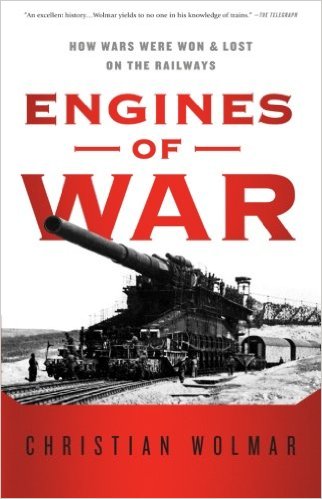
Engines of War
Engines of War: How Wars Were Won and Lost on the Railways
368 pages
© 2010 Christian Wolmar
An army marches on its stomach, but for a hundred years it rode to victory only on the rails. It was Napoleon who observed the importance of supplies the military, and well he should know, for the nigh-twenty years of wars he raged on the European continent were the last major conflict prior to the advent of rails. In Engines of War, veteran railway historian Christian Wolmar addresses how trains transformed war, allowing for greater conflicts to be sustained over a wider front, and often serving as the locus of conflicts themselves. Although the American Civil War and the Great War feature most prominently, Wolmar also dwells on the Boer and Russo-Japanese wars, and includes many minor episodes which are fascinating. Who knew, for instance, the role of railroads in the Arab revolt from Ottoman rule?
The most important aspect of the railroads to war, of course, is logistics -- the transport of men and material to the battle, including food, ammunition, and forage. Mankind has waged war against itself since human history began, but not until the industrial age did he do it on so terrible a scale. Wars between ancient empires -- the Roman and Carthaginian, for instance -- might last decades, but these lengthy conflicts did not tax their nations they way they do now for most of the 20th century. Battles were comparatively much smaller, and more seasonal. Invading armies relied on raiding hostile territory to supply themselves, and as professional armies were rare, generally consisting of private subjects whose labor was needed back at home. Rail lines made projecting and sustaining a force in the field far easier -- as they did early in Crimea, allowing Britain to sustain a siege halfway across the world. Or, take Sherman's famed march to the sea, for instance, his bloody chevauchée from Atlanta to the southeast coast of Georgia. Despite a reputation for feeding his troops off the land, his initial push was fueled by a rail-fed stockpile.. The incorporation of railroads allowed for intense strategic planning: the Schlieffen Plan, Germany's strategy for a quick resolution to the Great War, was essentially a train timetable. Despite how quickly trains could deliver men to the front, however, Wolmar maintains that the rails favored defensive warfare more than the offensive. Any advance made by an invading army would take them into territory with sabotaged infrastructure, often incompatible with the invaders' systems.
The rail lines could also be used as weapons themselves; carrying artillery or serving as mobile gunships. Armored cars first appeared in the Boer war, and were used to suppress insurrection in vital areas. The importance of defending the rails, even with trains themselves, is made obvious by the Arab revolt from Ottoman rule. The Ottomans created a rail line stretching down the Arabian peninsula to allow pilgrims on the hajj to more easily reach Mecca, but during the revolt it was subjected to such chronic attack that the troops which depended on it for supplies were forced to surrender. Other methods of attacking rails were less successful: airplane-born bombs, for instance, were rarely accurate enough to touch down on so narrow a line drawn on the landscape. Even when lines were rendered inert, every military of the period created divisions which specialized in rail repair. Germany was especially diligent about maintaining large stockpiles of extra rail supplies, to allow for nigh-instantaneous repair. Only when its entire war effort was failing did the rail lines finally collapse. In his other works, Wolmar analyzes the comparative advantages of government and private management of rail systems; here the insistence on efficiency takes on a more awkward tone when it results in more prolonged wars and the horror of the holocaust.
Despite their importance for nearly a century, so linked to the projection of power that their construction could spark wars (as between Russia and Japan in 1905), even a rail enthusaist like Wolmar has to admit the age of the train is past, militarily speaking. The nature of war itself has changed.. We are as unlikely to see massed armies butchering each other with Maxims and artillery as we are to see cavalrymen running about with sabers in the next war. This is the age of cruise missiles, drones, and small groups of soldiers deployed in surgical strikes by helicopters. Even in larger operations, troop transports that can transverse alien territory are more efficient than building even the light strategic rail of the Second World War.
Engines of War is an altogether fascinating book, revealing how the vital necessity of rail lines during wars not only altered weapons and strategy, but changed both the role of the government and the behavior of the rail lines in peacetime.
Labels:
Africa,
American Civil War,
Germany,
Middle East,
military,
Near East,
Russia,
The Great War,
trains,
transportation
Saturday, May 16, 2015
The South since the War
The South Since the War: As Shown by Fourteen Weeks of Travel and Observation in Georgia and the Carolinas
© 1866 Sidney Andrews
400 pages
In the autumn of 1865, as the dust and ashes were still settling over the graves of the Union and southern dead, an Illinois journalist decided to spend the season exploring the land of prodigal brothers and late enemies. His The South Since the War combines a travel diary with obsessive political journalism, recording the proceedings of three state conventions (the Carolinas and Georgia) as well as a conference of freedmen. He is, upon completion, not a fan -- disappointed in shabby hotels, defunct railroads, and the fact that the war has not given the southerners a thirst to transform themselves into New Englanders. They remain a people apart -- ruined, owing to having been beaten in the fields, but still defiant.
There is immediate interest in Andrews' timing; so close does he follow on the heels of the war that some held in slavery have not yet heard that the institution was abolished. Andrew Johnson is President, and for the moment charity prevails: pardons are being granted liberally, and the old aristocracy ready to resume their seats in Congress. After witnessing the three conventions, Andrews closes with a warning that to forgive the south too easily would be to throw away the best chance the North has at remolding the old confederacy in its own image. Indeed, in the year following Congress will rebuke President Johnson for his grace, and they will institute some of the measures Andrews suggests, like granting suffrage en masse to male freedmen to undermine the old elite. But the hour of Reconstruction is not yet, and here readers are granted a look into that fleeting moment when the old South's destiny was in its hands.
Andrews is primarily interested in politics, and endeavors to take the temper of the polis by not only attending back-to-back conventions, but in engaging southerners in conversation -- at least, planters, freedmen, and some merchants. He is more revolted than interested in poor whites, who don't take baths, don't have manners, show none of that Puritan work ethic, and don't have an excuse. The freedman may be ignorant moral wretches, Andrew muses, but their growth was smothered by the old planters, who used it as a justification to keep them in bondage. The conversations reveal a South defeated in arms, but not in spirit: at best, people acknowledge losing the war and are resolved to make the best out of the peace. At worse, they echo the lyrics of a popular song at the time:
The south was beaten -- thousands upon thousands of young men dead, leaving a generation of spinsters and orphans and its finest cities were smoking ruins -- but the southerners remained obstinate. Andrews is baffled, appalled, and greatly annoyed. Their heroes are dead, in prison, and surrendered, but the conventions act as though the first Federal boot never crushed southern soil. They abolish slavery and repudiate the secession ordinances only grudgingly and debate whether or not they should petition the North to release Davis as a token of good faith. Do they not realize they lost? The crusade was triumphant, but still the "heresy of States' rights" persists. Although there are a few who own to being true-blue Unionists, who regret the late unpleasantness and the secession that led to it, by the large southerners are still unrepentant. A great many of them may scorn the fools who led them into the war, and the fools who bumbled it (Davis is either praised or scorned here, with no one offering a moderate opinion of him), but their devotion remains to the states which bore them. The question put to every delegate is this: did he, in the conflict, go with the State, or with the Union? No one quotes Stephen Decatur -- "Our country! In her intercourse with foreign nations, may she always be in the right; but our country, right or wrong." -- but the Marylander's spirit is theirs.
Andrews' attitude is certainly skewed by the fact that he is writing for an audience back home, one thrilled with his reports of southern savagery like the account of Andersonville. Could he as a private individual have really expected southerners to act like chastened schoolchildren, repenting of naughtiness? Eventually southerners would embrace the Union, grow to love again the striped banner that the good ol' rebel 'fit all he could', but an embrace of the old was never lost. Could Andrews seriously expected southerners to want to become northerners, to rebuild Charleston in the shape of Boston? He certainly believes they should: can they not see how scornful their rulers are of them? They are without education, with no exposure to grace and beauty: their lives are bereft of civilization itself. His own horror at prolonged exposure to belching, burping, cussing farmers is matched by pity for them. Although his constant sniffing at railroads and poor food can be annoying, his attempts at brotherly love are noble considering that at one point he is literally run out of town by a mob for interfering in a fight between a freedman and a cantankerous soldier.
Andrews' scornful Yankee-ness will no doubt be grating to a southern reader, but he raises a few interesting points, like the need for education and and the curbing of economic centralization. One man, an intellectual descendant of the brothers Gracchi, says:
© 1866 Sidney Andrews
400 pages
In the autumn of 1865, as the dust and ashes were still settling over the graves of the Union and southern dead, an Illinois journalist decided to spend the season exploring the land of prodigal brothers and late enemies. His The South Since the War combines a travel diary with obsessive political journalism, recording the proceedings of three state conventions (the Carolinas and Georgia) as well as a conference of freedmen. He is, upon completion, not a fan -- disappointed in shabby hotels, defunct railroads, and the fact that the war has not given the southerners a thirst to transform themselves into New Englanders. They remain a people apart -- ruined, owing to having been beaten in the fields, but still defiant.
There is immediate interest in Andrews' timing; so close does he follow on the heels of the war that some held in slavery have not yet heard that the institution was abolished. Andrew Johnson is President, and for the moment charity prevails: pardons are being granted liberally, and the old aristocracy ready to resume their seats in Congress. After witnessing the three conventions, Andrews closes with a warning that to forgive the south too easily would be to throw away the best chance the North has at remolding the old confederacy in its own image. Indeed, in the year following Congress will rebuke President Johnson for his grace, and they will institute some of the measures Andrews suggests, like granting suffrage en masse to male freedmen to undermine the old elite. But the hour of Reconstruction is not yet, and here readers are granted a look into that fleeting moment when the old South's destiny was in its hands.
Andrews is primarily interested in politics, and endeavors to take the temper of the polis by not only attending back-to-back conventions, but in engaging southerners in conversation -- at least, planters, freedmen, and some merchants. He is more revolted than interested in poor whites, who don't take baths, don't have manners, show none of that Puritan work ethic, and don't have an excuse. The freedman may be ignorant moral wretches, Andrew muses, but their growth was smothered by the old planters, who used it as a justification to keep them in bondage. The conversations reveal a South defeated in arms, but not in spirit: at best, people acknowledge losing the war and are resolved to make the best out of the peace. At worse, they echo the lyrics of a popular song at the time:
I can't pick up my musket
And fight 'um down no more
But I ain't gonna love 'um
Now that is certain sure
And I don't want no pardon
For what I was and am
I won't be reconstructed
And I do not give a damn
("I'm A Good Old Rebel", Maj. James Randolph)
Andrews' attitude is certainly skewed by the fact that he is writing for an audience back home, one thrilled with his reports of southern savagery like the account of Andersonville. Could he as a private individual have really expected southerners to act like chastened schoolchildren, repenting of naughtiness? Eventually southerners would embrace the Union, grow to love again the striped banner that the good ol' rebel 'fit all he could', but an embrace of the old was never lost. Could Andrews seriously expected southerners to want to become northerners, to rebuild Charleston in the shape of Boston? He certainly believes they should: can they not see how scornful their rulers are of them? They are without education, with no exposure to grace and beauty: their lives are bereft of civilization itself. His own horror at prolonged exposure to belching, burping, cussing farmers is matched by pity for them. Although his constant sniffing at railroads and poor food can be annoying, his attempts at brotherly love are noble considering that at one point he is literally run out of town by a mob for interfering in a fight between a freedman and a cantankerous soldier.
Andrews' scornful Yankee-ness will no doubt be grating to a southern reader, but he raises a few interesting points, like the need for education and and the curbing of economic centralization. One man, an intellectual descendant of the brothers Gracchi, says:
Give a man a piece of land, let him have a cabin upon his own lot, and then you make him free. Civil rights are good for nothing, the ballot is good for nothing, till you make some men of every class landholders. Give the negroes and poor whites a chance to live -- what [do they] want of a vote? (p. 371)Andrews doesn't dwell on this, viewing a man with a ballot as king, but a vision of the south peopled by an abundance of citizen-farmers, secure on their homesteads and dependent on nothing but open lanes for trade, is obviously superior to an empire of massive plantations run on slavery with the poor white remainder existing on the fringe. A republic of homesteads is a positively Jeffersonian vision -- one the south would have shared in. Of course, that's not the way reconstruction actually developed; modernity has made resourceless proletarians of us all. There is no doubting the importance of Andrews' work, though, given how many Reconstruction measures would be drawn up to address the other issues he raises: the need for moral and and technical education among the freedman, for instance, the matter of power still being in the hands of the elite. As a proponent of local autonomy myself, I despite the specter of outside meddling...but this is, sadly, a case where we had it coming.
Labels:
American Civil War,
American South,
history,
memoir,
Reconstruction,
travel
Monday, May 4, 2015
The Copperhead
The Copperhead
© 1893 Harold Frederic
108 pages
War can destroy a city without the first shell falling on it. Such was nearly the fate of Four Corners, New York, a small farming community in its upper reaches. Far removed from the battlefields of the Civil War, the village nonetheless suffered its injuries. So far as Abner Beech was concerned, the world consisted of the Four Corners; the South was a distant land, its problems those of its own people. Before the crisis erupted, he was not alone in his sentiment: most of his neighbors were kindred spirits, one Methodist lunatic excepting. That was Jee Hagadorn, from a long and illustrious line of puritanical scolds. He is, among other things, an Abolitionist, and once the war begins he ascends from the fellow everyone avoids to spearheading the town's support of the war effort. Abner Beech is astonished at how quickly his neighbors become enthusiastic about the prospect of great hordes of young men lining up to kill one another, and scandalized by the impending doom that lays in store for the Constitution in the wake of Abe Lincoln's assumption of war powers, and widespread support of it. Beginning the book as a pillar of the community, Abner quickly falls from grace to become a pariah, spurned at church and forced by his own contrariness to keep to himself on his own farm. Matters worsen as his own child marches off to war, wooed by the lunatic warmonger's daughter, and eventually he is subjected to a torchbearing mob outside his home. Although the original novel's Beech is not nearly as sympathetic as his dramatized counterpart in Copperhead (the viewing of which prompted me to read this), he is nonetheless heroic in both holding on to his principles, and his in being easy to forgive. The story ends on a happy note, indeed far happier than the movie's. Modern readers will find Beech prickly, but the enduring lesson has not changed regardless. War is a sinister thing, able to turn friends into bitter enemies simply for holding the wrong opinion.
Wednesday, March 25, 2015
Born Fighting
Born Fighting: How the Scots-Irish Shaped America
© 2004 Jim Webb
384 pages
Born Fighting is a family story of the Scots-Irish, a clan of forgotten men. Beginning with the Celts, author Jim Webb moves swiftly through British history to the establishment of the Ulster Plantation. Faced with continued resistance to the British crown by the feisty Irish, who were even more suspect by their frequent fraternization with Catholic powers like France and Spain, King James hit on a novel solution: move in their equally feisty, but virulently Protestant, Scottish cousins. As anyone remotely familiar with Irish history can guess, that didn't end well; northern Ireland was a warzone even throughout the 20th century. But the Scots of the Ulster Plantation didn't stay there; they emigrated to the United States in large numbers, where they continued being...lively. Constitutionally incapable of bending a knee to a king, they pushed into the American interior, driving the frontier of colonization forward, provoking the natives into war and prompting a revolution. Although some would eventually make it to the west coast, the hills of Appalachia and the American South were settled in large number by these rebellious Presbyterians. Settling down didn't change too much, though; when Abraham Lincoln called for troops to suppress the secession of South Carolina, the size of the nascent Confederacy doubled as the distant descendants of Robert the Bruce closed ranks to defend their land and kinsmen from invasion. Although they were defeated in battle, they continued to shape American history, swelling the ranks of the soldiery and producing country music.
Although Born Fighting has the scope of a historical survey, it's much more personal. As mentioned, this is a family story, and it's framed by Jim Webb's journey into the Appalachian mountains to find his family's bones, and the quest that ends at an ancestral graveyard causes him to ruminate on how his people came to be in that land, so far removed from the hills of Britain and Ireland. It's thus quite romanticized, its characters assuming airs of heroism or tragedy as the story waxes on. The rough, ornery wildness that Webb celebrates here as an antidote to tyranny is the same 'cracker culture' that Thomas Sowell condemned in Black Rednecks, White Liberals as completely-self defeating. Webb doesn't completely overlook his kinsmen's flaws; his defense of the South owns up to slavery as the cause of secession, but he rightly distinguishes that from the motive for fighting. Slaves, like private jets and palatial estates today, were not owned by most southerners; most, in fact were owned by a few dozen elite families. The country boys wearing grey weren't fighting to keep their slaves, they were fighting because fighting rule from on high is a family tradition. The Scots-Irish, Webb writes, could respect authority from men who literally led them in battle, but never from enthroned men who dictate from afar, whether they be Caesar and Pope in Rome, or the president in D.C.
Born Fighting makes for fun reading, and it's not immaterial: there are reasonable arguments here, taken from completely respectable surveys like Churchill's History of the English Speaking Peoples, and WJ Nash's The Mind of the South. There's always more to the story, though, and southern whites have not always been completely opposed to authority on principle. The New Deal that Webb mentions resistance to was much beloved by the poor South, black and white alike. In fact, a song mentioned in Webb's section on country music refers to Roosevelt "saving us all", creating programs like the TVA that put the singer's family back on its feet. Taken as a fond retelling of family drama, however, its weaknesses can be forgiven. There are other works for the serious readers. Like Cool Hand Luke, this is a celebration of a man, of a people, who can't be told what to do and won't give up going their own way, no matter how many times they're beaten.
Related:
Poor but Proud / Dixie's Forgotten People, Wayne Flynt
The Redneck Manifesto, Jim Goad. Similar in intent, but much more vulgar.
A Renegade History of the United States, Thaddeus Russell
Labels:
American Civil War,
American South,
Britain,
Celts,
Europe,
history,
Ireland,
race
Thursday, January 22, 2015
Casualties
Casualties: A Novel of the Civil War
© 2010 David Rothstein
465 pages
The year is 1863, and Tom Connor just survived the Battle of Gettysburg. His kid brother didn't, though, and agonized emotionally he is looking forward to a Christmas furlough with his wife, Laura, in Indiana. But war's not that simple, and instead of going home for Christmas, Tom is captured by the Confederate army and sent south, to a town that has been abandoned several times because of yellow-fever epidemics and chronic flooding: Cahaba. The Connors have been separated by the war for years, and this latest incident is too much for Laura to take. Her childhood home ruined by war, her brother-in-law perished, and now her husband, abandoned by General Grant to whatever fate will befall him, deep in the misty swamps of Alabama? Leaving the family store in the care of kin, Laura decides to travel to Alabama and fetch her husband out of prison. Can one woman travel through a war-torn wasteland, evading bushwhackers and starving refugees? Such is the premise of Causalities, a novel that uses Laura's descent from civilization into the wilderness to shock readers with the brutalities war visits not only on soldiers, but on innocents.
The tale is told back and forth, through both Laura and Tom's perspectives. Although Cahaba doesn't have as bad a reputation as Andersonville, it may deserve it, for prisoners were housed in a frequently-flooded warehouse presided over by a man whose response to pointed inquiries about prisoner neglect is to drone on existentially about the meaning of honor and duty in war. Prison camps during the war were aatrocious sanitation was nonexistent, and the food was miserable if available. Starvation and disease visited the camps every night, and escapees or rabble-rousers were shot in cold blood by guards. Some of Tom's experience seems to have been drawn from Andersonville, like a gang of hoodlums preying on their fellow prisoners, and eventually being put on trial and executed by the prisoners themselves. Laura's story is no less traumatic: while she is able to navigate through the country on the kindness of strangers, as she hits the war-ravaged south things change. Armies are active here, and leave behind them an expanse of burned-out homes and fields littered with diseased bodies. In the absence of law, gangs of highwaymen prey on villages whose men are off at war. Laura is in turn dependent on the kindness of others, and the agent of it: after serving as a nurse after a battle, she is stricken with disease and rescued by newly-freed slaves. Laura, in her journey, will experience both extraordinary kindness and utter depravity.
Although Rothstein's characters can get a bit formal and preachy at times, the research is well-grounded. Neither side is particularly heroic, and the easy companionability between "the Yankee woman" and the southerners who she helps and helps in turn hints that the people of America are not divided, hostile camps doomed to enmity, but have been abandoned to that by willful politicos on either side. Laura's journey touches on the major calamities of the war -- disease, starvation, raids by armed forces; families torn apart by divided loyalties, or destroyed completely by the butchery of battles like Gettysburg and Cold Harbor. Tom's quieter role would be a rude introduction to the obscenity of POW camps for any reader who has not experienced a place like Andersonville. Although it has its limitations, this was quite good for a first-time author, and the focus on civilian life sets it apart from most Civil War fiction.
Related:
This Republic of Suffering, David Faust
[2015 Reading Challenge -- A Book Set In Your Hometown, 4/52)
Thursday, June 5, 2014
The Smoke at Dawn
The Smoke at Dawn
© 2014 Jeff Shaara
528 pages
The bells of the South in 1863 rang death knells, not peals of joyous victory. In July, on the same day that Lee's army suffered a staggering loss at Gettysburg, General Grant of the Union army took possession of Vicksburg, and within it gained complete command of the Mississippi river. The South fractured and its strength wasted, the Confederates needed a fresh triumph. In November, General Braxton Bragg commanding rebel forces in Tennessee thought he might be the man to deliver it. After routing a Union army, he cornered them in Chattanooga, where he hoped a quick siege would see their surrender and regain the South its lost momentum. The Smoke at Dawn is the story of the Chattanooga Campaign, of armies stumbling in the night through battlefields that soar into the sky. It's also the tale of commanding personalities, of men set at odds even against their comrades. The third book in Shaara's new Civil War series is a third triumph for the author -- and General Grant.
Like Shaara's other works, The Smoke at Dawn is a swiftly-moving narrative composed largely of the thoughts and conversations of generals commanding the battle. This combined with more conventional narration is highly effective at putting the reader into the generals' position without being rambling. Many of the characters are familiar names; Grant, Longstreet, and Sherman among them. The greatest maneuvers and best battlefield performances, however, are put on by generals who fame has ignored. The focus on the generals from across the field give the reader a strategic understanding of what is happening, allowing witness of the way the armies wrangled around one another, attempting to control supply lines or use the river to land by stealth and deliver devastating stealth attacks. The river puts the generals in the curious place of sometimes being closer to their foes than their friends; Generals Thomas and Grant, commanding, can view Burnside's own headquarters from their own positions.
As in his more recent work, Shaara also employs a few infantrymen to deliver combat scenes; the most notable here is Fritz Bauer, a Wisconsin orphan who would be alone in the world were it not for his best friend Willis. When Willis leaves the volunteers for the regular army, Bauer follows suit, and their course through the campaign gives not only plentiful action scenes, but the realization that soldiers often fought not for ideals but for their comrades. The book as a whole is steeped in the power of human relationships; the obstinate and autocratic Braxton Bragg's contemptuous attitude toward his subordinates withers away his own army's effectiveness. He earns no one's trust save Jefferson Davis', spending the entire battle fighting with his own officers and once sending an entire corps away just to be delivered from a potential threat to his authority. Between Bauer's devotion and Bragg's contempt is the happy medium of rivalry, most prominently Sherman's running duel with his equally highly effective Confederate counterpart. Despite Sherman's reputation and Grant's high esteem of him, Sherman can't seem to best Patrick Cleburne. For all of Bragg's discipline and Sherman's speed, however, ultimately the battle's upset is decided by unpredictable forces -- like a diversionary force that advances further than planned, attempting to avoid being slaughtered by artillery, and results in routing an entire army.
Readers of Civil War fiction will find The Smoke at Dawn most attractive. The fourth book in Shaara's series will concern the Fall of Atlanta.
Labels:
American Civil War,
historical fiction,
Jeff Shaara,
military
Saturday, May 31, 2014
Away Down South
Away Down South: A History of Southern Identity
© 2007 James C. Cobb
416 pages
What does it mean to be southern,
beyond a fondness for turnip greens and cornbread? The answer is an evolving one, as the South’s
distinctiveness has changed its expression throughout the United States’ history. Away Down South follows national and southern attitudes about southern-ness from settlement days to the present. The Civil War, the South's stand against the rest of the nation, sets the stage for most of the book, including reconstruction and the continuing problem of race relations. The work looks at the southern mind and heart, exploring not only intellectually-steeped expressions of the South like I'll Take my Stand and The Mind of the South, but delves deeply into southern literature, black and white. The South as a concept remains negative throughout. Not that the South is without its virtues, but from the country’s beginnings James C. Cobb maintains that the south has been seen both by itself and the rest as a country as a place apart; first a wild frontier infested by poisonous snakes and Indians, a no-man's-land fit only for criminals, and later as the cesspool of American culture; the hiding place of aristocracy, slavery, ignorance, and all things foul. Having no France across the Channel, or a Germany across the border, the South is the “other” which the rest of the country, with progressive, industrial New England as its model, can hold itself superior. The south's wild gave way to plantations and then Jim Crow, but regardless of changes the taint of ‘other’ remained. This is a view not preached by Cobb, a man of the south himself, but the attitude haunts the imagination of the southern intellectuals and artists who later claim the story. What makes Away Down South stand out for me is the space given to black southerners, who left the fields for the northern cities only to return in part to the southland. Despite its tragic history, its story is one they share; the southern scene is the one fixed in their memories of home. That coming-to-terms with the past can't help but hold a fascination for a southern student of history such as myself.
Thursday, April 17, 2014
The Yellowhammer War
The Yellowhammer War: The Civil War and Reconstruction in Alabama
© 2013 ed. Kenneth Noe
University of Alabama press
320 pages
Related:
Alabama: the History of a Deep South State, Wayne Flynt
© 2013 ed. Kenneth Noe
University of Alabama press
320 pages
First home of the Confederacy's
government, and site of some of its final battles, Alabama's involvement in the
Civil War was intense from the beginning-- and given its diverse geology,
loyalties were mixed from the Union-sympathizing hill folk to the secessionist
plantation owners living in the coastal plains. The Yellowhammer War collects
articles from southern historians that delve into how Alabamians experienced
the war's strife and Reconstruction's havoc. Most are domestic, with only two
pieces centered on combat. The detail throughout is considerable, and
well-documented, making it an absolute boon to students of Alabaman
history. It is valuable, too, in
presenting so many thoughtful voices, working from the letters from a diverse
set of southerners.
An opening section examines the motives of
the most stereotypical secessionist – the elite lawyer-plantation master – but
the articles which follow give repeated attention to the role of women in
supporting the rebellion, and the waxing and waning of support for the
Confederacy among the poor laborers. Reconstruction, often ignored, is given
special attention here, and the author opines that compared to the experience
of other defeated nations by the victors, the south’s treatment was
comparatively mild – not a trace of ethnic cleansing followed, for instance. (Still-grumpy southerners will no doubt appreciate the basis for comparison: "Well, it wasn't as bad as an ethnic cleansing...") Especially
of interest are essays examining the roots of white Republicans in the postwar
period, and a history of the Freedman’s Bureau, which attempted to convert
ex-slaves into citizens of the republic with mixed results. What all of the
essays convey is a sense that Alabamians played no simple role in the story
of the Confederacy; loyalties were mixed, and even some ardent secessionists did not believe themselves to be leaving the Union voluntarily Students of southern history, and especially Alabamians, will find this a treasure.
Tuesday, April 15, 2014
Fire on the Waters
Fire on the Waters
© David Poyer 2003
448 pages
When Eli Eaker volunteered his services to the USS Owanee, his chief intention was to get away from his domineering father and an arranged marriage to his beautiful but sisterly cousin Araminta. That, and physicians suggested the sea air to him as a cure for his ailing lungs. He never expected that the threat of secession, which he used as an excuse for running away from father dear's iron hand, would be realized in the form of open war, but soon Mr. Eaker finds himself an increasingly needed officer on a cantankerous ship, a sailing-steaming hybrid tasked with the resupply of Fort Sumter. Those with a little historical savvy might guess that such a mission doesn't pan out, but that's not the worst of it. The union's hemorrhage of southern states takes a toll on its officers and enlisted ranks, meaning that Mr. Eaker -- a rich scion whose naval experience is limited to adventures on his father's yacht -- finds responsibility thrust upon him, while at the same time he's distracted by a possibly deathly illness (tuberculosis, known as 'consumption') and the woes of his fiance-cousin who is likewise desperate to escape Eaker Sr.
Fire on the Waters is the 'hardest' historical fiction I've read; not difficult, but hard in the sense of science fiction that is based on 'hard' fact. This is a novel heavy with details, and delivered with the authenticity of a cast-iron skillet to the head; Poyer uses old literary conventions and archaic spellings of words to give his narrative real historic grounding. The charm this adds distracts the reader from the fact that the story consists of one dismal failure after another for its characters - though such reverses give Eaker a chance to prove his worth. Though this is a novel of the Civil War at sea, and most of the characters are sailors, combat is minimal and occurs mostly on land. The real strife of the novel is between the characters over competing loyalties the Owannee's captain and first officer are both southerners, and each are torn between the home they were raised in and the flag they have fought under for so long. The first novel in a trilogy, Fire on the Water impresses most with its detail, and its maritime setting is quite different from most Civil War-related historical fiction.
Labels:
American Civil War,
historical fiction,
military,
sea stories
Thursday, April 3, 2014
Confederates in the Attic
Confederates in the Attic: Dispatches from the Unfinished Civil War
© 1999 Tony Hortwitz
432 pages
© 1999 Tony Hortwitz
432 pages
For most
of the United States, the Civil War is like any other entry in the history books, of interest but not
very consequential. . For the South, however, the war was and is a conflict that left deep scars across its fabric. Long after the surrender of the Confederacy, its
flag still flies from countless homes throughout the region; old arguments and
symbols continue to be reinterpreted and invigorated through new arguments. In Confederates In the Attic, Tony Horwitz
builds on his lifelong interest in the Civil War to take an extensive tour
through the old Confederacy. Spanning at
least three years, his visits take him from the study of Shelby Foote to the
trenches of the Antietam battlefield,
sojourning with ‘hard core’ reenactors.
He visits with the not-quite-so-obsessed, as well, citizens black and
white, about the lingering legacy of the Civil War. The result is a
triumph, a book entertaining to read, and balanced to book, providing both
laughs, reflections, and twinges in spades.
Confederates is essentially a travel
diary with meaning; as Howitz moves through the south, he attempts to absorb
the experiences of the war through its museums and battlefields, as well as the
attitudes of the people who live with this history. Most of the people recorded
tend toward the eccentric, like the aforementioned ‘hardcore’ reenactors who
purposely march for days on blistered feed scarfing hardtack and staining their
woolen uniforms to go for the ‘authentic’ look. There are more moderate voices,
like that of Shelby Foote, who illustrate why the Civil War remains so visceral
for southerners, especially whites. In an era of tumultuous social and
political change – when jobs vanish, cities are destroyed, and families riven apart -- the glory days of the Old South, and its
Confederacy, are something to hold on to. They symbolize resistance to change,
defiance of pushy outsiders. The Civil War, in storied memory, was an age of
flamboyant heroes defying the odds in style.
The Confederacy’s dramatic attempt at defending its autonomy serves as a
source of inspiration to working class guys being antagonized by their bosses
or ‘the system’; on a larger level it inspires libertarians and conservatives
who wish to keep the Federal government within certain constitutional limits.
For all
the remembrance, however, the Civil War was not a feud fought on principle
between gentlemen over ‘rights’. It was an economic battle, the doubly
misguided defense of slavery by the planters and their armies against the
armies of the north. That slavery, based on race, continues to enslave the
minds of black and white southerners alike. Although many of Horwitz’s experience
tend toward the humorous, there are dark passages here. Strife between the black and white people of
the nation continues, driven by ignorance and the time-honored custom of one
generation poisoning another with learned hatred. In one chapter, Horwitz visits a town that
saw a murder when a carload of young black men gave chase to a truck flying the
rebel flag and fired shots into the truck, killing him. When interviewed, the
chief suspect said he knew little about the Civil War, only that he’d been told
that flag was flown by whites to antagonize blacks. Before moving to the South, he said, he only
knew it as the Dukes of Hazzard
flag. Where poorer whites are acculturated
to see the Confederate flag as a symbol of self-defense, blacks are raised to
see it as a symbol of antagonism. People continue to fight over the meaning,
and literally, as Horwitz sees a school coalescing into two race-gangs wearing
shirts to provoke the other into fistfights. It is tragic, and if the ethnic
brawling in the Balkans and the middle east are any indicator, the tragedy may continue for centuries hence.
Although
Horwitz is a self-professed Yankee, and his account takes tragic turns, as a
southern reader I found it fair. Of course, most southerners are not as extreme
as the ones the author mentions; I know of no one who submits their children to
learning a Southern Catechism, like the Sons and Daughters of Confederate Veterans
do in one chapter, so readers living in the south might object to the slightly exaggerated
take of most of his subjects. Racial tension exists throughout the nation, not
simply in the South, and the battle flag’s symbolic power is appreciated or
despaired over likewise across the United States. But even the craziest of characters in Confederates in the Attic is treated
with respect; Horwitz never breezes by
anyone; they receive extensive time to tell their story, and they do. Horwitz
is perfectly respectful of the issues at hand’s complexity, and his work is a
standout.
Subscribe to:
Posts (Atom)