Tuesday, August 31, 2010

The Life and Times of Horatio Hornblower

The Life and Times of Horatio Hornblower
© 1970 C. Northcote Parkinson
304 pages


Last week I finished C.S. Forester's series of sea stories following the adventures of Horatio Hornblower, a navy man who rose to prominence during the Napoleonic Wars. I began the series in the spring, and early in the summer a fellow student -- also a Hornblower reader -- brought this book to my attention. The idea of a Hornblower biography amused me immediately, although I doubt I would have heard of it had she not asked me about it. (I had to send for the book through England.)

Parkinson's account begins by expressing his gratitude to Forester for having brought the life of Hornblower to the attention of the British public, as well a his sorrow that Forester died before completing his fiction series based on the life of Hornblower. This biography, drawing from Forester's sources as well as from newly-discovered boxes of letters and other correspondence that Forester did not have access to, aims to complete the story of Hornblower and fill in the gaps that Forester left for one reason or another. It is a tribute to both Forester and Hornblower.

"Portrait of Sir Horatio Hornblower, K.B., painted by Sir William Beechey, R.A. in 1811 and now in the possession of the present Viscount Hornblower."' From the inside cover.

The chapters are separated by rank, which coincides nicely with the books, particularly the omnibus collections. When Parkinson's text overlaps with Forester's novels, the result tends toward concise summaries supplemented by maps and letters written by or about Hornblower. There are also image plates: a portrait of Hornblower, the title page of a book he owned in childhood with his signature, that sort of thing. Parkinson doesn't give Hornblower many new adventures in his twenty years at sea: I assume he's somewhat constricted by Forester's timeline. Beyond background information, there is new material here both in the chapter on Hornblower's early life and the chapters which focus on his later years following the final defeat of Napoleon. Hornblower takes an interest in steam-driven vessels and helps establish a commercial shipping firm whose fleet is wholly steam-based.  Appendices include information on Hornblower's descendants (his progeny were at Dunkirk and D-Day) and a letter written by Hornblower in regards to the Renoun affair, in which he was nearly branded a mutineer when the mentally unfit Captain Sawyer mysteriously fell down into the hold prior to the ship's encounter with a Spanish fort. (Parkinson's account of the events is considerably less dramatic than Forester's:  Hornblower and his fellow lieutenants are court-martialed for mutiny and attempted murder of a Royal officer in Forester's stories, whereas in Parkinson's "real" account, only the first lieutenant was placed on trial -- and not for attempted murder, either, but for presuming command when Sawyer was only insane and not yet dead.)

The intended audience is limited from the start -- consisting wholly of Hornblower readers, I imagine -- and it is they who will enjoy this. While it isn't a must-read for Hornblower fans, it will probably be enjoyable to those who enjoyed Forester's stories of his life at sea.

Teaser Tuesday (31 August)

Teaser Tuesdays are...epic! And oversized, but their subject warrants it. From ShouldBeReading, as ever.

How small they appear from the long road that approaches them; did we come so far to see so little? But then they grow larger, as if they were being lifted up into the air; round a turn in the road we surprise the edge of the desert; and there suddenly the Pyramids confront us, bare and solitary in  the stand, gigantic and morose against an Italian sky.[...] We stand where Caesar and Napoleon stood, and remember that fifty centuries look down upon us; where the Father of History came four hundred years before Caesar, and heard the tales that were to startle Pericles. A new perspective of time comes to us; two millenniums seem to fall out of the picture, and Caesar, Herodotus, and ourselves appear for a moment contemporary and modern before these tombs that were more ancient to them than the Greeks are to us. 

p. 139, Our Oriental Heritage. From Will Durant's opening tome in his Story of Civilization series.

Monday, August 30, 2010

Disease Fighters Since 1950

Disease Fighters since 1950
© 1996 Ray Spangenburg and Diane Kit Moser
164 pages

Spotting this excited me, as Spangenburg and Moser's history of science series (On the Feet of Giants and its expanded and revised successor) were delights for me in the past two summers. Disease Fighters is less a history of medical science and more a collection of interrelated biographies in science. The authors frequently tell what the scientist in question discovered, but never explain what that something is. There's not a lot of science here, and the only audience I imagine it being useful to are children and teenagers who  are curious about careers in the medical field. Possibly they might be inspired by these stories of people who put their minds to work for the benefit of all humanity.


Related:
Medical Firsts, Robert Adler
The Greatest Benefit to Mankind, Roy Porter

These are both titles in medical history.  Porter's is grander in scale.

Thursday, August 26, 2010

Booking through Thursday: Giving

Booking through Thursday asksIf you’re not enjoying a book, will you stop mid-way? Or do you push through to the end? What makes you decide to stop?


It's rare that I find a book I don't enjoy, because I tend to rifle through books before I leave the library with them. I examine them to ensure that the author's style is readable. There are occasions in which a book fails to 'grab' me, at which point I simply switch to another book: I'm constantly reading, and don't want to stopped. I'll return to the book every few days to see if it clicks, but if not it'll find its way back to the library.  Unfinished books are like challenges to my honor, though: I will seek satisfaction, provided I didn't quit out of disgust. It took me three tries scattered across two years to read The Selfish Gene, for instance, but after I did a little background reading in biology I made it through. (My hurdle was the section of the book that focused on chromosomal crossover.)

There are times in which I make myself work through a book: maybe it's mandatory reading for school, or because I am determined to learn about the subject, read something from the author, or finish the book because it has a reputation. Most of my school texts have been interesting, though it takes force of will to make it through articles by Max Weber. Sometimes books are hard to get into, but with a little perseverence I can crack its shell and start making progress.

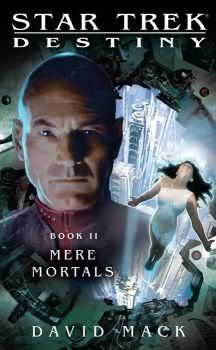
Mere Mortals

Star Trek Destiny: Mere Mortals
© 2008 David Mack
433 pages

The small, finite lives of mere mortals carry little weight in the calculations of gods. But even gods may come to understand that they underestimate humans at their peril. 
(From the back of the book.)

In 2158*, the Earth ship Columbia limped its way to a nearby planet to find repair.  Instead, they were trapped by a hospitable if overly cautious race of highly advanced beings called the Caeliar, who were adamant about keeping their galactic profile to a minimum, so much to the point that any visitors were either forced to stay or flung across the galaxy to be forever cut off from their homes.  Hundreds of years later, the crew of the USS Titan stumbled upon these same Caeliar while tracking the transwarp energy lanes that Starfleet believes the Borg were using to mount their incursions into Federation space. Titan's crew met the same fate as Columbia's: friendly imprisonment. To their astonishment, the captain of the Columbia -- Ericka Hernandez -- greeted them upon their arrival, in the best of health despite being hundreds of years old. Meanwhile, Captains Picard and Dax begin attempting to access the energy lanes and find the route the Borg have been using to launch their invasions. While Picard's initial desire is to destroy the subspace lanes, the task is seemingly impossible. While the Federation's best minds attempt to sort out how to shut these pathways down, Picard believes they can be used to the Alpha Quadrant's advantage. He proposes that the Federation build a coalition of Alpha- and Beta- quadrant powers ready and willing to take the Borg on directly -- that the allied powers send a combined expeditionary force into the Delta Quadrant to destroy the Borg's staging ground and prevent Borg forces from accessing the lanes until the Federation can destroy them safely.

Although Mack focuses on the same four crews -- the Enterprise, Aventine, Titan, and Columbia,  Mere Mortals  primarily focuses on the combined efforts of Picard and Dax to find the lane leading to the Delta Quadrant. Titan is only a sideline story, as her characters are essentially powerless to do anything: they're barely there. The inclusion of a Columbia story thread surprised me, but Mack follows Hernandez and her crew as they adjust -- or fail to adjust -- to their benign captivity, eventually linking Hernandez' story with that of the Titan crew's.  Most of the book is simply setting the stage for the final chapter, but tension mounts as Picard and Dax continue to narrow down which lane leads to the Delta Quadrant: one bridge officer comments that their efforts remind him of Russian roulette. While this is happening, an Allied fleet -- hundreds of ships from the Federation, the Klingon, Cardassian, and Romulan empires, and the Ferengi Alliance (with Breen mercenaries tagging along) -- slowly gathers. In the book's final chapters, Mack forces the fleet to stare into the Abyss -- into the mouth of hell, to borrow from Tennyson -- and then sends it hurtling in.

Destiny continues to impress. Gods of Night was interesting, but Mack uses drama to a greater effective here -- slowly lulling the reader into the feeling that this book is just filler, just a train between two ports. Then the tracks disappear and you realize this is a roller coaster, and you no idea where  the fall will stop, or what gut-wrenching turns await.  I have a feeling that once I finish Lost Souls next week, I'm going to need to watch a few warm and fuzzy episodes of TNG or the original series to recover.

On the cover:  Sir Patrick Stewart as Captain Jean-Luc Picard; Ada Maris as Captain Hernadez-pretending-to-be-Wonder-Woman.

*Give or take a decade. 2168 is when the Columbia was lost, but she'd been traveling at near-light speeds long enough that they were out of sync with Earth's calendar, so I'm not exactly sure.

Related:

Wednesday, August 25, 2010

The Birth of the United States

The Birth of the United States
© 1973 Isaac Asimov
274 pages, including a table of dates.


While trolling Amazon in search of elusive copies of Isaac Asimov's Roman history books, I chanced to find evidence of a four-book history series on the United States, beginning with European colonization and ending at the Great War. They're decades out of print, alas, and I won't be able to read all of them. The Birth of the United States picks up at the end of the French-Indian war (known in Europe as the Seven Years' War) and the beginnings of mutual Anglo-American resentment. Asimov then takes us through the Revolution, the Constitutional Convention, and up to the end of the War of 1812.

Asimov didn't achieve success as a writer by being poor at it: Birth is perfectly lucid. I don't think I've followed any account of the Revolutionary War as easily as this one. The political wrangling that followed the war, as the states with varying interests  who proposed national constitutions that protected them from the others, could easily be dull -- but it isn't. Impressively, the normally opinionated Asimov is fair to the various clashing interests he covers. The British are not presented as tyrants, for instance, nor does he take sides when recounting the numerous issues between the states. He simply explains why everyone thought as they did, and detailed the ways in which varying decisions helped and hurt either side. In retrospect I am not surprised at his approach. There are rarely villains in his fiction works: he preferred instead to bounce characters with justified but opposing interests off one another. (He does opine against incompetent generals, though, and disapproves strongly of characters like Banastre Tarleton.) He's obviously fond of the subject matter, being a naturalized citizen of the US and an ardent humanist who believed in the United States' Enlightenment-era ideals. Asimov frequently takes the reader aside to mention trivial tidbits, like that after the Battle of Lexington,  settlers in Kentucky renamed their settlement to commemorate the dawn of America's war for independence.

Reading The Birth of the United States was an experience both helpful and enjoyable. It filled in my own gaps of the period, and I'd recommend it to any reader needing or wanting an introduction to the early United States.

This Week at the Library (18 Aug - 25 Aug)

This week at the library...


  • Working IX to V, a romp through odd jobs of the ancient and classical worlds. Though informative, the author relies heavily on humor to connect with the reader.
  • Admiral Hornblower in the West Indies was my last Hornblower read by C.S. Forester, alas, but the series enjoyed on an enjoyable note. In the West Indies is more cozy than dramatic, though.
  • Gods of Night by David Mack is the first in the Destiny trilogy, which ties together various threads in the Treklit canon (the TNG relaunch and the USS Titan series, mostly, but with nods given to the DS9 and Voyager relaunches) and sends the Federation into a final, deadly grapple with the Borg.
  • Sharpe's Eagle is the story of an English riflemen during the Napoleonic wars, who has to overcome the sturdy French army and the incompetence of his aristocratic overseers to redeem the honor of his regiment. Fun read. 
  • The Lost World is Michael Crichton's sequel to his Jurassic Park, and follows the same general plan. Crichton does drama well, and the information he has his characters deliver on dinosaurs will of course entertain.


Quotation of the Week:
     "Then this is a whole lot of coincidences," Keru said. "A mysterious power source with an energy profile that resembles transwarp, shooting beams that point at Federation space, Borg space, and a planet in the Gamma Quadrant, where an old Earth ship has been sitting for two centuries."
     Tuvok arched one eyebrow to indicate incredulity.

(p. 222, The Gods of Night. This statement ties the stories of the four starship crews featured in the book together.)

Potentials for Next Week:

  • The Birth of the United States, Isaac Asimov. 
  • Disease Fighters Since 1950, Ray Spangenburg and Diane Kit Moser. Spangenburg and Moser's history of science books were staples of two of my last few summers, and their names caught my eye when browsing today. 
  • I'll be tipping my toe into Will Durant's Story of Civilization series by beginning Our Oriental Heritage, which appears to be a largeish text on the Indians, Chinese, Egyptians, Babylonians, and company. 
  • Odds are good that I'll pick up the second book in the Destiny trilogy at some point. If it's anything like Gods of Night, I won't be able to put it down for several hours.
  • I also checked out Master and Commander by Patrick O'Brien. I tried it once a few years back but all the naval terminology kept me from getting into it. In the meantime I've read an entire series of sea stories set in the age of "wooden ships and iron men", though, so perhaps I'm better prepared this time. 
  • And a mystery entry, when I have been waiting to read for weeks.
In the future...

  • I wanted to read Michael Crichton's Timeline this week, but despite being checked in, it's not on the shelf. I'm guessing that like The Lost World, it was lost. Maybe this one is lost in time. 
  • Although Alexandria by Lindsey Davis seemed readable, it never grabbed me. I'll return to her series of Roman novels at some point, though.