Star Trek Typhon Pact: Brinksmanship
© 2012 Una McCormack
352 pages
Who's up for the Cuban Missile Crisis....in spaaaaaaace? When an otherwise friendly nation on the borders of the Federation and two of its allies signs a treaty with a hostile power, allowing them bases for repair and refueling along the Federation border, Starfleet is understandably concerned -- and doubly so when news arrives that a fleet is enroute to supply the bases for their new tenants, carrying chemicals that could be used in biogenic warfare attacks on the Federation. While the USS Enterprise speeds to meet with the Space Cubans to work the diplomatic angle, the USS Aventime is dispatched to do a little friendly snooping near the proposed base nearest the Federation border. When the Cardassians -- who, along with the Ferengi are the other two threatened allies -- arrive ready for war, and the Space Cubans catch wind of possible spies inserted in their country, events begin to spiral out of control, heading towards a war that no one wants but no one seemingly can avoid. But the drama unfolding in open view is only the smoke and mirrors for another maneuver, one that is using parties on both sides.
I bought this book a couple of years back, intrigued by the possible historical parallels and interested in a book which includes both Picard and Dax. The primary appeal of the book is learning about the Tzenkethi, who along with the Breen were pretty much black holes before the Typhon Pact series began. Romulans, we know, love, and fear; while the Gorn and Tholians can be wrapped up in primal fears about reptiles and insects, respectively. The Tzenkethi are presented as a very stable, very hierarchical society who have a natural affinity for the Space Cubans, another stable and hierarchical society. The Tzenkethi view the Federation as some kind of chaos monster, however, the epitome of their every social fear: it's all argument, class-and-racial intermixing, cats and dogs living together, mass hysteria! Who can tell what they'll do, what new planet will sudden fall under their spell?
Having read beyond this series, I knew that no epic war between the Federation and the Typhon Pact broke out, so the drama was largely dampened for me. I assumed the drama would keep ramping up until something happened out of left field to defuse things, and that's more or less what happens. Still, it's nice to see Picard being the commanding diplomat again, and I'll never say no to a story with Ezri Dax and her ship, in part because the Relaunch developed her in such a commendable way -- turning the awkward 20-something shrink of 2000 into the Captain on the Bridge, and in part because the Aventine looks much different than the other Starfleet ships and I 'm ever curious about it.
Pursuing the flourishing life and human liberty through literature.
"Once you learn to read, you will be forever free." - Frederick Douglass
Showing posts with label TNG Relaunch. Show all posts
Saturday, June 16, 2018
Monday, January 8, 2018
Peaceable Kingdoms
Star Trek, The Fall: Peaceable Kingdoms
384 pages
© 2013 Dayton Ward
Nearly two months have passed since the most popular and widely respected president in Federation history was publicly assassinated, but in that time her temporary replacement has not been standing strong, offering a reassuring presence to a troubled people. Instead, he's been losing friends and alienating people in a misguided effort to renew the Federation as a galactic superpower. With a declared object of making Starfleet a force to be reckoned with, he has instead begun corrupting it by ignoring the chain of command, creating black-ops squads and playing hell with Starfleet schedules by using them for his off-the-books wetwork. Frustrated and wary of his commander in chief's motives, Fleet Admiral Akaar has recalled Captain Riker, promoted him to admiral, and is relying on him to be the one trustworthy man in his office. Riker has thus become the point man in an effort to find out what el presidente is up to. Together, he, Captain Picard, and their respective crews will unearth a few skeletons and put the Federation to rights again. A tale of action and intrigue, Peaceable Kingdoms takes The Fall out on a good step, if not one as strong as previous titles in the series.
The Enterprise has been hovering out of sight for most of this series, consigned by the president to keep station at Ferenginar. It's an obvious misuse of the Federation flagship and its most seasoned captain, not to mention a fairly crappy place for shore leave. Who wants to take their liberty on a swamp-planet? Now the Big E is entering center stage, however, dispatching Dr. Crusher and a few others on a secret mission to an abandoned world where some secrets are buried, there to follow up on one of Riker's leads. They'l have to contend with the president's schemes, though. A welcome relief here is T'Ryssa Chen, who since the Borg War books has added some humor to the Enterprise . She's an oddly irrepressible half-Vulcan with a smart mouth, who a mellowing Picard tolerates with paternal affection. Given the tension of these books -- what is with that title, anyway? Are we anticipating the fall of the Federation? The Typhon Pact? -- her sass evens things out a bit. The series as a whole has been good about leavening the drama with laughs, though.
Peaceable Kingdoms is an enjoyable end to a great series, and its end is a hopeful one -- assuring readers that after the bloodshed and horror of the Great Borg War, and the constant tension of the Cold War in Space, Starfleet is about to commend another grand era of exploration
384 pages
© 2013 Dayton Ward
Nearly two months have passed since the most popular and widely respected president in Federation history was publicly assassinated, but in that time her temporary replacement has not been standing strong, offering a reassuring presence to a troubled people. Instead, he's been losing friends and alienating people in a misguided effort to renew the Federation as a galactic superpower. With a declared object of making Starfleet a force to be reckoned with, he has instead begun corrupting it by ignoring the chain of command, creating black-ops squads and playing hell with Starfleet schedules by using them for his off-the-books wetwork. Frustrated and wary of his commander in chief's motives, Fleet Admiral Akaar has recalled Captain Riker, promoted him to admiral, and is relying on him to be the one trustworthy man in his office. Riker has thus become the point man in an effort to find out what el presidente is up to. Together, he, Captain Picard, and their respective crews will unearth a few skeletons and put the Federation to rights again. A tale of action and intrigue, Peaceable Kingdoms takes The Fall out on a good step, if not one as strong as previous titles in the series.
The Enterprise has been hovering out of sight for most of this series, consigned by the president to keep station at Ferenginar. It's an obvious misuse of the Federation flagship and its most seasoned captain, not to mention a fairly crappy place for shore leave. Who wants to take their liberty on a swamp-planet? Now the Big E is entering center stage, however, dispatching Dr. Crusher and a few others on a secret mission to an abandoned world where some secrets are buried, there to follow up on one of Riker's leads. They'l have to contend with the president's schemes, though. A welcome relief here is T'Ryssa Chen, who since the Borg War books has added some humor to the Enterprise . She's an oddly irrepressible half-Vulcan with a smart mouth, who a mellowing Picard tolerates with paternal affection. Given the tension of these books -- what is with that title, anyway? Are we anticipating the fall of the Federation? The Typhon Pact? -- her sass evens things out a bit. The series as a whole has been good about leavening the drama with laughs, though.
Peaceable Kingdoms is an enjoyable end to a great series, and its end is a hopeful one -- assuring readers that after the bloodshed and horror of the Great Borg War, and the constant tension of the Cold War in Space, Starfleet is about to commend another grand era of exploration
Tuesday, March 25, 2014
The Body Electric
Star Trek Cold Equations, Book Three: The Body Electric
© 2013 David Mack
352 pages
Bad news. There's a planet-sized machine with a companion black hole ominously named "Abaddon" using artificial wormholes to suck entire star systems into its maw. Worse news: the machine is a Borg-like collective of artificial intelligence systems with a serious attitude problem regarding organic lifeforms. To wit, it wants us all dead, and when it collides itself with the supermassive black hole at the heart of the Milky Way, dead we shall be. It's up to Captain Jean-Luc Picard to somehow find a way to save the galaxy, with a little help from his once-dead-now-resurrected-android-friend, Data. The Body Electric concludes David Mack's Cold Equations series, which started out as a political spy-thriller but ends in a bittersweet triumph for the now-returned Data.
Although the third and final piece of a trilogy, The Body Electric leaves behind what I thought to be the primary story of the Cold Equations trilogy, the latest chapter in the Cold War in Space series of books. Instead, the 'other' story in the two previous novels, the return of Data, rises to dominance, with the positronic commander taking a starring role in the Enterprise's efforts to stop the Machine's subspace-shattering kaboom. Wesley Crusher's rare fans will be gratified at his role in the story; it is he who learns of the threat, but he's powerless to combat it..The Body Electric is easily more on the side of 'soft' science fiction, being more about its characters - - Data and the ever lively T'Ryessa Chen, for instance -- than science, but many of the characters put the spotlight on the future of artificial intelligence, being as they are droids. There's even a little philosophy of the soul throne in as the AIs debate the merits of joining or fighting The Machine, which is a larger, meaner version of V'Ger from The Motion Picture. Although the-Enterprise-saves-the-galaxy plots border on ludicrous after so many movies, David Mack executes it well, especially in building tension. Readers will find it most interesting for the continuing evolution of Data, who has grown quite beyond his old limitations.
© 2013 David Mack
352 pages
Bad news. There's a planet-sized machine with a companion black hole ominously named "Abaddon" using artificial wormholes to suck entire star systems into its maw. Worse news: the machine is a Borg-like collective of artificial intelligence systems with a serious attitude problem regarding organic lifeforms. To wit, it wants us all dead, and when it collides itself with the supermassive black hole at the heart of the Milky Way, dead we shall be. It's up to Captain Jean-Luc Picard to somehow find a way to save the galaxy, with a little help from his once-dead-now-resurrected-android-friend, Data. The Body Electric concludes David Mack's Cold Equations series, which started out as a political spy-thriller but ends in a bittersweet triumph for the now-returned Data.
Although the third and final piece of a trilogy, The Body Electric leaves behind what I thought to be the primary story of the Cold Equations trilogy, the latest chapter in the Cold War in Space series of books. Instead, the 'other' story in the two previous novels, the return of Data, rises to dominance, with the positronic commander taking a starring role in the Enterprise's efforts to stop the Machine's subspace-shattering kaboom. Wesley Crusher's rare fans will be gratified at his role in the story; it is he who learns of the threat, but he's powerless to combat it..The Body Electric is easily more on the side of 'soft' science fiction, being more about its characters - - Data and the ever lively T'Ryessa Chen, for instance -- than science, but many of the characters put the spotlight on the future of artificial intelligence, being as they are droids. There's even a little philosophy of the soul throne in as the AIs debate the merits of joining or fighting The Machine, which is a larger, meaner version of V'Ger from The Motion Picture. Although the-Enterprise-saves-the-galaxy plots border on ludicrous after so many movies, David Mack executes it well, especially in building tension. Readers will find it most interesting for the continuing evolution of Data, who has grown quite beyond his old limitations.
Tuesday, July 9, 2013
The Persistence of Memory - Silent Weapons
Star Trek TNG Cold Equations, Books 1 & 2: The Persistence of Memory and Silent Weapons
© 2012 David Mack
400 and 352 pages
The last time David Mack penned a Trek trilogy, billions upon billions died (Destiny), the Borg were vanquished, and thousands of readers' minds were blown by the intensity of it all. Now he's at it again with Cold Equations, set in the era of the Typhon Pact. A half-score of the Federation's most chronic enemies have their own confederacy, and the two states have been engaged in a cold war of sorts for the last couple of years, vying for power through covert missions. The Persistence of Memory opens with an attack on one of the Federation's most important research laboratories, one housing the deactivated bodies of B4, Lore, Lal, and various other Soong-type androids...the deceased Commander Data's family, as it were. A cloaked ship, later to be revealed Breen, raids the lab and nicks the bodies...and as the Enterprise-E is conducting its investigation, a man is spotted on the streets who looks very much like Data. The man is none other than Noonien Soong, Data's inventor-father -- a man who was supposed to have died years ago. But there he is, and looking rather young to boot -- what gives? The Persistence of Memory is largely his story, the tale of one slightly-mad scientist to achieve immortality while watching the drama of his offspring from afar, with some political drama tacked on at the end.
That drama takes on a life of its own in Cold Equations, where Breen intrigue threatens to disrupt a delicate negotiation between the Federation president, Naniette Bacco, and the Gorn Hegemony. Shenanigans from a Soong-type android lead to Data's arrest (did I mention? he's back), and then come explosions and assassinations. The Enterprise is on the scene, attempting to solve the mystery to both get their friend exonerated and to prevent their president's untimely demise, but something is screwy. Their mystery-solving works all too well, aided by a series of anonymous tips that raise Worf's hackles (and Klingons have very big hackles), and lead him to suspect that someone, somewhere, is pulling the strings, manipulating the Enterprise, the Federation, and even the Gorn into playing parts in a bigger scheme. Thus a murder mystery becomes a massive political drama in which the struggle for power between Typhon Pact members proves to be more interesting than the Cold War-like tension between the Federation and Space-Moscow. Unlike the Federation, which is more or less united (forgetting for the moment the angsty Andorians), the Typhon Pact members all have separate agendas, and they view one another as temporary expedients to their eventual nationalistic supremacy than actual partners.
After the epic-beyond-words achievements of Destiny, poor David Mack has a lot to live up to. Cold Equations doesn't feature thousands of Borg cubes running willy-nilly, eating planets and inspiring mesmerizing speeches from doomed civic leaders, it's still a fantastic trilogy so far. The Persistence of Memory not only brought Data back (sort of), but gave his, Lore's, and other androids' stories utter cohesion: what Christopher Bennett did for time travel threads, Mack does with robotics, linking not only the Soong family but episodes from the original series. Soong's perspective on watching his sons grow up is captivating, and then right behind that comes an intelligent political thriller that doesn't simply throw two entities against one another, but has at least five participating in a tangled web of self-interest and lies. I already purchased the finale, The Body Electric, and look forward to reading that soon.
Related:
Cold Equations on TvTropes
© 2012 David Mack
400 and 352 pages
The last time David Mack penned a Trek trilogy, billions upon billions died (Destiny), the Borg were vanquished, and thousands of readers' minds were blown by the intensity of it all. Now he's at it again with Cold Equations, set in the era of the Typhon Pact. A half-score of the Federation's most chronic enemies have their own confederacy, and the two states have been engaged in a cold war of sorts for the last couple of years, vying for power through covert missions. The Persistence of Memory opens with an attack on one of the Federation's most important research laboratories, one housing the deactivated bodies of B4, Lore, Lal, and various other Soong-type androids...the deceased Commander Data's family, as it were. A cloaked ship, later to be revealed Breen, raids the lab and nicks the bodies...and as the Enterprise-E is conducting its investigation, a man is spotted on the streets who looks very much like Data. The man is none other than Noonien Soong, Data's inventor-father -- a man who was supposed to have died years ago. But there he is, and looking rather young to boot -- what gives? The Persistence of Memory is largely his story, the tale of one slightly-mad scientist to achieve immortality while watching the drama of his offspring from afar, with some political drama tacked on at the end.
That drama takes on a life of its own in Cold Equations, where Breen intrigue threatens to disrupt a delicate negotiation between the Federation president, Naniette Bacco, and the Gorn Hegemony. Shenanigans from a Soong-type android lead to Data's arrest (did I mention? he's back), and then come explosions and assassinations. The Enterprise is on the scene, attempting to solve the mystery to both get their friend exonerated and to prevent their president's untimely demise, but something is screwy. Their mystery-solving works all too well, aided by a series of anonymous tips that raise Worf's hackles (and Klingons have very big hackles), and lead him to suspect that someone, somewhere, is pulling the strings, manipulating the Enterprise, the Federation, and even the Gorn into playing parts in a bigger scheme. Thus a murder mystery becomes a massive political drama in which the struggle for power between Typhon Pact members proves to be more interesting than the Cold War-like tension between the Federation and Space-Moscow. Unlike the Federation, which is more or less united (forgetting for the moment the angsty Andorians), the Typhon Pact members all have separate agendas, and they view one another as temporary expedients to their eventual nationalistic supremacy than actual partners.
After the epic-beyond-words achievements of Destiny, poor David Mack has a lot to live up to. Cold Equations doesn't feature thousands of Borg cubes running willy-nilly, eating planets and inspiring mesmerizing speeches from doomed civic leaders, it's still a fantastic trilogy so far. The Persistence of Memory not only brought Data back (sort of), but gave his, Lore's, and other androids' stories utter cohesion: what Christopher Bennett did for time travel threads, Mack does with robotics, linking not only the Soong family but episodes from the original series. Soong's perspective on watching his sons grow up is captivating, and then right behind that comes an intelligent political thriller that doesn't simply throw two entities against one another, but has at least five participating in a tangled web of self-interest and lies. I already purchased the finale, The Body Electric, and look forward to reading that soon.
Related:
Cold Equations on TvTropes
Labels:
David Mack,
Star Trek,
The Next Generation,
TNG Relaunch
Saturday, September 22, 2012
Raise the Dawn
Star Trek Typhon Pact: Raise the Dawn
© 2012 David R. George III
400 pages
The ending of Plagues of Night saw me stand to my feet in shock. Not since the Destiny trilogy has there been such a cliffhanger in Trek literature. Raise the Dawn sees David R. George finish what he began, with brilliant success.
Tensions were high between the Federation and the Typhon Pact before this duology, but however much the leaders of the Federation and Romulan Empire might wish to maintain the peace, other members of the Typhon Pact -- and certain blonde, notoriously villainous elements within the Empireitself -- are more bellicose, and their actions have already led to catastrophe. As the president of the Federation resigns herself to the fact that her heavily fatigued people are in for yet another conflict, the Romulan praetor makes a stunning move, one that confirms that the days of two-dimensional bad guys are over.
Trek literature has steadily been pushing the envelope since the publication of the first Avatar books. George doesn't just overturn the apple cart of the status quo; since Rough Beasts of Empire, he's set it on fire. A few of Trek's characters have been going through the meatgrinder, and while that's been rough going for readers who feel for these characters, Raise the Dawn offers resolution. All of the stresses introduced in the first four Typhon Pact novels have coalesced here, putting our characters through the fire, even as they battle private battles of their own, like Prynn Tenmei's struggle to let her father go, and Sisko's alienation from his family. Raise the Dawn continues to be expansive; like Plagues of Night, its characters are drawn from across the Trek verse, excluding only the Titan and Voyager crews. But George goes even further by playing with prophetic visions of the kind we saw in "Far Beyond the Stars" and "Image in the Sand"; characters seem to be inhabiting multiple planes of existence at the same time, interacting with one another when they can't possibly be doing so, and it's too brilliantly done to be confusing, except in a delighted way.
George's duology is a must read for fans of Trek literature. I have not been this mesmerized or moved since the Destiny series; only Full Circle has even come close.
© 2012 David R. George III
400 pages

Tensions were high between the Federation and the Typhon Pact before this duology, but however much the leaders of the Federation and Romulan Empire might wish to maintain the peace, other members of the Typhon Pact -- and certain blonde, notoriously villainous elements within the Empireitself -- are more bellicose, and their actions have already led to catastrophe. As the president of the Federation resigns herself to the fact that her heavily fatigued people are in for yet another conflict, the Romulan praetor makes a stunning move, one that confirms that the days of two-dimensional bad guys are over.
Trek literature has steadily been pushing the envelope since the publication of the first Avatar books. George doesn't just overturn the apple cart of the status quo; since Rough Beasts of Empire, he's set it on fire. A few of Trek's characters have been going through the meatgrinder, and while that's been rough going for readers who feel for these characters, Raise the Dawn offers resolution. All of the stresses introduced in the first four Typhon Pact novels have coalesced here, putting our characters through the fire, even as they battle private battles of their own, like Prynn Tenmei's struggle to let her father go, and Sisko's alienation from his family. Raise the Dawn continues to be expansive; like Plagues of Night, its characters are drawn from across the Trek verse, excluding only the Titan and Voyager crews. But George goes even further by playing with prophetic visions of the kind we saw in "Far Beyond the Stars" and "Image in the Sand"; characters seem to be inhabiting multiple planes of existence at the same time, interacting with one another when they can't possibly be doing so, and it's too brilliantly done to be confusing, except in a delighted way.
George's duology is a must read for fans of Trek literature. I have not been this mesmerized or moved since the Destiny series; only Full Circle has even come close.
Monday, September 3, 2012
Plagues of Night
Star Trek Typhon Pact: Plagues of Night
© 2012 David R. George III
388 pages

After the events of Star Trek: Destiny, billions were dead and the Federation utterly exhausted, and yet no relief was to be found. In the wake of such calamity, six powers hostile to the Federation and ringing its borders sought strength in unity. They created the Typhon Pact, a confederacy of scum and villainy, and changed the map forever. The Federation and its greatest ally, the Klingon Empire, were soon engaged in a "cold war" with the Typhon Pact. The first four novels of the series each focused one of the constituent members of the Pact (the Breen, the Romulans,) while following the opening power plays between the two polities. Tales of espionage and political wrangling followed, and the stage was set. David R. George has delivered the first Typhon Pact "epic", one which spans the quadrants and involves both the Enterprise-E and the far-flung crew of Deep Space Nine. Plagues of Night is the opening act, ending on a cliffhanger that saw me stand to my feet in astonishment.
The Federation and the Typhon Pact are not, technically, at war, but both strive to maintain the balance of power that will keep the peace -- through means that threaten it, like covertly attacking one another's shipyards to steal data. Although the Typhon Pact novels established the Pact as a potent force to be reckoned with, they aren't simple villains. Each power has its own ambitions, and the leaders of the Romulan Star Empire dearly want peace. Plagues of Night uses the events of the first four novels (especially Zero Sum Game and Paths of Disharmony) to establish rising tension between the Federation and the Pact, and both the RSE and Federation leaders want to prevent said tension from erupting into open war. But the achievements of diplomacy -- trade agreements and a joint scientific mission into the Gamma Quadrant -- are threatened to perversely turned into the spark of war when things go terribly wrong.
In addition to creating a thriller of a scope we've not seen since the Destiny books, George provides the long-awaited return to the Deep Space Nine cast of characters. The DS9 relaunch was seemingly abandoned when Destiny came onto the scene: there's a five-year gap between the last DS9 book and the events of that magnificent trilogy. Readers were teased with what might have happened in the meantime in Rough Beasts of Empire, and here the station takes center stage under its new commanding officer, Ro Laren. Character growth in Plagues of Night centers on Sisko, who is still grappling with the aftermath of decisions he made after Unity. Abandoned by the prophets, and fearful for his family's safety, Sisko is a man without a friend -- tremendously lonely. And bless his heart, it's going to get worse.
I purchased this book online, and I figured after I read it I'd buy the second book. I couldn't wait. Yesterday, I drove an hour or so to the nearest bookseller and hunted down a copy of the conclusion. I...cannot wait.
Related:
Star Trek Typhon Pact on TvTropes
Thursday, July 19, 2012
Ship of the Line
Ship of the Line
© 1997 Diane Carey
320 pages
Two captains, each without a ship. The first, Captain Picard, lost his when it plowed into the surface of Viridian III while he struggled to prevent a grief-stricken madman from destroying a world. The other's, Captain Bateson's, became a historical artifact when he was thrust into the future in the midst of a battle against a Klingon cruiser. His attempt at self-sacrifice saved a starbase from destruction and prevented a war, but his legendary ship is still not viable against the Federation’s modern foes, like the Dominion and the Borg. After running into one another (dozens of times) in “Cause and Effect”, Bateson and Picard’s fates are again linked with the creation of the USS Enterprise-E. While Picard questions his future as ship’s captain, Bateson is eager to earn the captaincy of the not-yet-commissioned Enterprise despite being ninety years behind the times. While Picard is dispatched on a secret mission inside Cardassian lines, Bateson sees cracks in the Khitomer Accords and is eager to prove himself against an old enemy. Thus the two captains struggle for their reputations at the brink of war.
Ship of the Line is a strikingly odd but fun book. Diane Carey seems to have wanted to write a classic naval adventure novel. Not only do the characters speak and think as though they're living in the Romantic period, but Captain Bateson is a walking anachronism, a man who seems to live in the heyday of the age of "iron ships and wooden men". His ship is a "clipper", and when he's not cheerfully pointing out the etymology of a given expression, he's musing on naval traditions. This combined with his status as a temporal refugee plays off well, though, because Picard relates to this man the way we would relate to someone from the 18th or 19th century. References to the Horatio Hornblower series abound: not only do quotations from various Hornblower stories start off each section, but at least two characters seem to have been named after members of Hornblower's crew, which actually spoiled part of the book for me because I knew straightaway who the turncoat in Bateson's crew was.
TNG fans in general will find a lot to appreciate it here, for Carey gives us a story of Picard and his people after they were off the air, connecting their stories to those of the then-contemporary Star Trek universe. going for it, giving TNG readers a look at their captain and his crew between ships and connecting their stories (post "All Good Things...") to Deep Space Nine's Klingon story arc. The novel takes place at the same approximate time as DS9's "Way of the Warrior": Commander Wof has already accepted a position onboard the station, but the Klingons have not yet invaded Cardassia nor revoked the Khitomer Accorrds. The Federation and the Klingon Empire are thus at peace, but Klingon belligerence strains relations.The Klingon captain whose invasion Bateson thwarted ninety years ago is enraged and humiliated that his 'vanquished' foe is alive and well, and both he and Bateson are easy for a rematch. Relations between the UFP and Klingon Empire are already strained, and the feud may be the firestarter for war. Picard is also engaged with an old enemy -- Gul Madred, the man who tortured him in "Chain of Command". He gets some marvelous comeuppance.
Carey is an efficient writer, never wasting time with extensive transitions or letting a conclusion drag out. The pace is fast, but not hurried, and there are scenes of rich, thoughtful dialogue that allow for a break in the action and give the reader a chance to savor the interplay between characters -- particularly between Picard and Captain Kirk, who Picard visits in holographic form as a way of searching his own soul. It captures an opportunity that wasn't quite taken advantage of fully in Generations.
Although I've had this novel for years, I shied away from reading it at first because I found the idea of anyone but Picard manning the Enterprise-E to be distasteful. I'm glad I gave it a chance: its quaintness ensnared my interest, and it fleshes out a hole in the TNG timeline rather nicely with a dandy 'good show'.
© 1997 Diane Carey
320 pages

Two captains, each without a ship. The first, Captain Picard, lost his when it plowed into the surface of Viridian III while he struggled to prevent a grief-stricken madman from destroying a world. The other's, Captain Bateson's, became a historical artifact when he was thrust into the future in the midst of a battle against a Klingon cruiser. His attempt at self-sacrifice saved a starbase from destruction and prevented a war, but his legendary ship is still not viable against the Federation’s modern foes, like the Dominion and the Borg. After running into one another (dozens of times) in “Cause and Effect”, Bateson and Picard’s fates are again linked with the creation of the USS Enterprise-E. While Picard questions his future as ship’s captain, Bateson is eager to earn the captaincy of the not-yet-commissioned Enterprise despite being ninety years behind the times. While Picard is dispatched on a secret mission inside Cardassian lines, Bateson sees cracks in the Khitomer Accords and is eager to prove himself against an old enemy. Thus the two captains struggle for their reputations at the brink of war.
Ship of the Line is a strikingly odd but fun book. Diane Carey seems to have wanted to write a classic naval adventure novel. Not only do the characters speak and think as though they're living in the Romantic period, but Captain Bateson is a walking anachronism, a man who seems to live in the heyday of the age of "iron ships and wooden men". His ship is a "clipper", and when he's not cheerfully pointing out the etymology of a given expression, he's musing on naval traditions. This combined with his status as a temporal refugee plays off well, though, because Picard relates to this man the way we would relate to someone from the 18th or 19th century. References to the Horatio Hornblower series abound: not only do quotations from various Hornblower stories start off each section, but at least two characters seem to have been named after members of Hornblower's crew, which actually spoiled part of the book for me because I knew straightaway who the turncoat in Bateson's crew was.
TNG fans in general will find a lot to appreciate it here, for Carey gives us a story of Picard and his people after they were off the air, connecting their stories to those of the then-contemporary Star Trek universe. going for it, giving TNG readers a look at their captain and his crew between ships and connecting their stories (post "All Good Things...") to Deep Space Nine's Klingon story arc. The novel takes place at the same approximate time as DS9's "Way of the Warrior": Commander Wof has already accepted a position onboard the station, but the Klingons have not yet invaded Cardassia nor revoked the Khitomer Accorrds. The Federation and the Klingon Empire are thus at peace, but Klingon belligerence strains relations.The Klingon captain whose invasion Bateson thwarted ninety years ago is enraged and humiliated that his 'vanquished' foe is alive and well, and both he and Bateson are easy for a rematch. Relations between the UFP and Klingon Empire are already strained, and the feud may be the firestarter for war. Picard is also engaged with an old enemy -- Gul Madred, the man who tortured him in "Chain of Command". He gets some marvelous comeuppance.
Carey is an efficient writer, never wasting time with extensive transitions or letting a conclusion drag out. The pace is fast, but not hurried, and there are scenes of rich, thoughtful dialogue that allow for a break in the action and give the reader a chance to savor the interplay between characters -- particularly between Picard and Captain Kirk, who Picard visits in holographic form as a way of searching his own soul. It captures an opportunity that wasn't quite taken advantage of fully in Generations.
Although I've had this novel for years, I shied away from reading it at first because I found the idea of anyone but Picard manning the Enterprise-E to be distasteful. I'm glad I gave it a chance: its quaintness ensnared my interest, and it fleshes out a hole in the TNG timeline rather nicely with a dandy 'good show'.
Labels:
adventure,
Diane Carey,
Star Trek,
The Next Generation,
TNG Relaunch
Friday, February 25, 2011
Paths of Disharmony
Star Trek Typhon Pact: Paths of Disharmony
© 2011 Dayton Ward
459 pages

Andoria hangs over the edge of a precipice, only generations away from extinction. Founding members of the Federation, Andorians are unique in possessing four sexes, all of which are required to produce offspring -- a single offspring, for twins are rare to the point of nonexistence. Such an arrangement makes it difficult for the population to maintain its own numbers, and they have been in steep decline for decades. If trends continue, the population will vanish.The crisis has been a long time coming, appearing first in the Deep Space Nine relaunch "Mission: Gamma" series, but attacks on Andoria by the Borg have made the problem more acute, and Federation attempts to help -- which involve complementing the Andorian genome with alien strains that will allow two-sex pairs to produce young, and which will increase the instance of twins -- have produced only mixed results and are regarded by many Andorians, particularly religious "Visionists", as repugnant. In the wake of increasing hostility toward the Federation, the USS Enterprise has arrived in orbit carrying scientists from across the galaxy to attend a genetics conference in hopes of finding some answer to this troublesome dilemma.
As eager as I was to finish the Typhon Pact miniseries off, its setting of Andoria gave me pause. Relaunch Andorians are a whiny bunch, so much to the point that while reading the Mission: Gamma series, I hurried through the chapters featuring Shar, who appears on the front cover of this book. I like Ward's style, though, so I read Paths -- and found it a political thriller which beats even Rough Beasts of Empire in giving the Trek universe a shake-up. Though the reader is treated to character development a plenty (Picard is now a father to little René), most of the action takes place on-planet, as Picard and the Andorian government attempt to carry out the conference amid much moodiness, terrorist attacks, and outright conspiracies while inthe shadows, the Typhon Pact lurks and schemes. This is an excellent conclusion to the miniseries which focuses on the Federation's new rival: they're obviously growing in strength, and accomplish a masterstroke here: the book's conclusion is stunning -- and a bit of downer.
Paths of Disharmony makes it clear how subtle and potent a foe the Federation now faces and sets the stage for the books to come. Interestingly, Paths' impetus is more the Vanguard series than the other Typhon Pact books, and it's worth nothing that Ward is one of the two authors (along with David Mack) who has contributed the most to that series. Though it doesn't end on a happy note, Paths should please most Trek readers with the growth of the Enterprise-E staff and fast-paced plot of political intrigue.
Related:
© 2011 Dayton Ward
459 pages

Andoria hangs over the edge of a precipice, only generations away from extinction. Founding members of the Federation, Andorians are unique in possessing four sexes, all of which are required to produce offspring -- a single offspring, for twins are rare to the point of nonexistence. Such an arrangement makes it difficult for the population to maintain its own numbers, and they have been in steep decline for decades. If trends continue, the population will vanish.The crisis has been a long time coming, appearing first in the Deep Space Nine relaunch "Mission: Gamma" series, but attacks on Andoria by the Borg have made the problem more acute, and Federation attempts to help -- which involve complementing the Andorian genome with alien strains that will allow two-sex pairs to produce young, and which will increase the instance of twins -- have produced only mixed results and are regarded by many Andorians, particularly religious "Visionists", as repugnant. In the wake of increasing hostility toward the Federation, the USS Enterprise has arrived in orbit carrying scientists from across the galaxy to attend a genetics conference in hopes of finding some answer to this troublesome dilemma.
As eager as I was to finish the Typhon Pact miniseries off, its setting of Andoria gave me pause. Relaunch Andorians are a whiny bunch, so much to the point that while reading the Mission: Gamma series, I hurried through the chapters featuring Shar, who appears on the front cover of this book. I like Ward's style, though, so I read Paths -- and found it a political thriller which beats even Rough Beasts of Empire in giving the Trek universe a shake-up. Though the reader is treated to character development a plenty (Picard is now a father to little René), most of the action takes place on-planet, as Picard and the Andorian government attempt to carry out the conference amid much moodiness, terrorist attacks, and outright conspiracies while inthe shadows, the Typhon Pact lurks and schemes. This is an excellent conclusion to the miniseries which focuses on the Federation's new rival: they're obviously growing in strength, and accomplish a masterstroke here: the book's conclusion is stunning -- and a bit of downer.
Paths of Disharmony makes it clear how subtle and potent a foe the Federation now faces and sets the stage for the books to come. Interestingly, Paths' impetus is more the Vanguard series than the other Typhon Pact books, and it's worth nothing that Ward is one of the two authors (along with David Mack) who has contributed the most to that series. Though it doesn't end on a happy note, Paths should please most Trek readers with the growth of the Enterprise-E staff and fast-paced plot of political intrigue.
Related:
- Star Trek Vanguard
- Typhon Pact on TvTropes
- Vanguard on TvTropes
- Author's Website
Labels:
Star Trek,
The Next Generation,
TNG Relaunch,
Typhon Pact
Saturday, December 18, 2010
Losing the Peace
Losing the Peace
© 2009 William Leisner
365 pages

Losing the Peace is the first TNG novel set after Destiny, and like A Singular Destiny it follows right behind David Mack's heels, covering the last great Borg War's aftermath. Singular Destiny provided a political mystery that leads into the Typhon Pact, but Losing the Peace is more personal, focusing on our characters as they attempt to pick up the pieces of their lives and those of their fellows in the wake so much destruction and death. Entire worlds are gone, and others have been hit badly: billions are dead, including friends and family of the Enterprise crew.
For whatever reason, I didn't expect much of the book: I didn't know the author and its cover art isn't exactly provocative. I regarded Greater than the Sum the same way before reading it, though, and like it Losing the Peace cast my preconceptions aside and stunned me. While Captain Picard and the Enterprise mount general search-and-rescue operations, Dr. Beverly Crusher travels to Pacifica to investigate claims of a humanitarian crisis related to the refugee camps there. While the work is disheartening enough -- disease is rampant among the refugees, and when the Enterprise finds precious little good news in its own searches -- the reaction of Federation worlds who did not taste the bitterness of war adds insult to injury. Refugees are seen a pesky burden by many, and the governor of Alpha Centaur is so disgruntled about having to divert resources to help distressed planets like Vulcan and Tellar that he threatens to lead his planet to secession. While the Federation survived this great Borg war, it may yet tear itself apart.
As difficult all that sounds, this is a good story -- one of the human spirit struggling to its feet in triumph not just over an outside evil, but over despair, bitterness, and desolation. Our heroes are thrown into the rubble but persist in picking themselves up and rooting around to find the good which remains. Losing the Peace is very much about the characters, and Leiser is as good as Beyer, Mack, and Bennett in that department, judging by this: dialogues is also strong, and the book touched me as a few books do. I laughed, I got teary-eyed, I stood to my feet in indignation and fell back down again in laughter at Picard's Kirk-like response to a diplomatic quandary.
Losing the Peace is an excellent conclusion to the Destiny story: readers who are interested should note that it, A Singular Destiny, and Full Circle unfold concurrently: Losing starts before either, and ends shortly after A Singular Destiny but before Full Circle.
The below image is an alternate bit of cover art, one considerably more varied and attractive.
© 2009 William Leisner
365 pages

Somewhere, up ahead, were people in trouble, in need of help. Picard allowed himself a small, private smile. And the Enterprise is on its way.
Losing the Peace is the first TNG novel set after Destiny, and like A Singular Destiny it follows right behind David Mack's heels, covering the last great Borg War's aftermath. Singular Destiny provided a political mystery that leads into the Typhon Pact, but Losing the Peace is more personal, focusing on our characters as they attempt to pick up the pieces of their lives and those of their fellows in the wake so much destruction and death. Entire worlds are gone, and others have been hit badly: billions are dead, including friends and family of the Enterprise crew.
For whatever reason, I didn't expect much of the book: I didn't know the author and its cover art isn't exactly provocative. I regarded Greater than the Sum the same way before reading it, though, and like it Losing the Peace cast my preconceptions aside and stunned me. While Captain Picard and the Enterprise mount general search-and-rescue operations, Dr. Beverly Crusher travels to Pacifica to investigate claims of a humanitarian crisis related to the refugee camps there. While the work is disheartening enough -- disease is rampant among the refugees, and when the Enterprise finds precious little good news in its own searches -- the reaction of Federation worlds who did not taste the bitterness of war adds insult to injury. Refugees are seen a pesky burden by many, and the governor of Alpha Centaur is so disgruntled about having to divert resources to help distressed planets like Vulcan and Tellar that he threatens to lead his planet to secession. While the Federation survived this great Borg war, it may yet tear itself apart.
As difficult all that sounds, this is a good story -- one of the human spirit struggling to its feet in triumph not just over an outside evil, but over despair, bitterness, and desolation. Our heroes are thrown into the rubble but persist in picking themselves up and rooting around to find the good which remains. Losing the Peace is very much about the characters, and Leiser is as good as Beyer, Mack, and Bennett in that department, judging by this: dialogues is also strong, and the book touched me as a few books do. I laughed, I got teary-eyed, I stood to my feet in indignation and fell back down again in laughter at Picard's Kirk-like response to a diplomatic quandary.
Losing the Peace is an excellent conclusion to the Destiny story: readers who are interested should note that it, A Singular Destiny, and Full Circle unfold concurrently: Losing starts before either, and ends shortly after A Singular Destiny but before Full Circle.
The below image is an alternate bit of cover art, one considerably more varied and attractive.
Saturday, November 6, 2010
A Singular Destiny
Star Trek: A Singular Destiny

© 2009 Keith R.A. Decandido
384 pages

Only days have passed since the culmination of Destiny. The Federation and the Klingon empire, still licking their wounds from the Dominion War, have been ravaged: billions are dead, and large portions of both their fleets are destroyed or remain only as shattered hulks. Although other powers contributed ships to the Battle of the Azure Nebula, the Borg's collective wrath (ho, ho) targeted the longtime allies. Now, overwhelmed by refugees and the detritus of war, both the Klingon chancellor and the Federation president are working overtime with too few ships to maintain a semblance of civilization.
Unlike most Star Trek books, A Singular Destiny focuses on civilians -- the Federation president, a university professor who moonlights as an diplomat, and the supervisor of a civilian mining operation. (Most civilians seen in the Star Trek and TNG shows wear strange uniforms, run science and mining posts in the middle of nowhere, and show up only when their planet or their sun is about to be destroyed in some way.) Starfleet isn't absent from the book, as Captain Ezri Dax and the Aventine's efforts tie the book's various subplots together to reveal that in the wake of the Federation and Klingon defeats, other minor nations are attempting to take advantage of the power vacuum...and the result will change Alpha-Beta quadrant politics forever.
Singular Destiny ties together the now-laid-to-rest Borg-themed TNG relaunch and the next generation of Relaunch books. In essence, it's a light political mystery in which professor/diplomat Sonek Pran sees a pattern emerging from various incidents -- mine explosions, diplomatic snubs, and trouble for the Klingon Empire after a border polity declares war on them and uses ships sporting Breen disruptor's and Romulan shields. DeCandido works Destiny into the overall continuity nicely: before sending the Aventine to Romulus, we get a neat recap of the civil conflict and secession that resulted from the death of Shinzon: there are now two Romulan factions, the old Star Empire under Shinzon's co-conspirator, and the new Imperial Romulan State under Donatra, the captain who assisted Picard at the end of Nemesis. DeCandido uses letters, memos, casualty reports, and news service articles to tell the story of the week following Destiny, and works subtle references to other Trek books into them. The casulty lists mention two people who are officially dead but who aren't really, referencing the events of Kirsten Beyer's Full Circle and Unworthy.
A Singular Destiny was...good, though it pales beside Destiny, Full Circle, and Greater than the Sum. I knew the grand revelation beforehand, which may have spoiled my reading. The author is one of the regulars in the Relaunch series, though, so I expect I'll read more of him sooner or later. I wonder if we'll be seeing more of Pran, his...fascinating Bajoran/Vulcan/Betazoid/human character who has pointed ears, a Bajoran nose, a Vulcan's philosophical disposition, and a human kind of folksiness -- complete with slang and a banjo. According to DeCandido's annotations, he's based on Arlo Guthrie.
On a minor note, I was amused and pleased to see that Doctors without Borders is around in the 24th century.
Related:
- A Singular Destiny at Memory Alpha
- KRAD at Memory Alpha
- Star Trek Relaunch on TvTropes
- Author's annotations
Wednesday, September 1, 2010
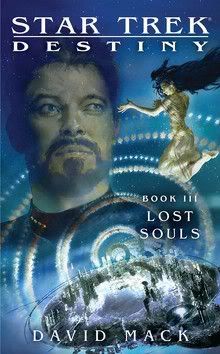
Lost Souls
Star Trek Destiny: Lost Souls
© 2008 David Mack
453 pages

As far as cliffhangers go, I don't think I've ever encountered one as dramatic as the final pages of Mere Mortals, the second in the Destiny trilogy, but Lost Souls' conclusion exceeds it in intensity. It is easily the most emotionally provocative Trek book I've ever read. Lost Souls begins in the horror of a general Borg invasion of the Alpha Quadrant: the Allied fleet is literally smashed to pieces, powerless against the Borg armada -- seven thousand ships strong.
Captains Picard, Dax, Hernandez, and Riker were spared from the opening moments of invasion by their own missions and perils, but regroup at the eye of the hurricane: while the Borg armada deploys in all sectors of the quadrant, attacking the Allies' worlds simultaneously, their three ships make repairs and contemplate the apocalypse. While fleets throughout the quadrant charge at the Borg fleets with a courage born of desperation, the four captains contemplate what, if anything, can be done. They only have hours, a few days at most before every Allied planet in the Alpha quadrant have been destroyed -- but there remain still a few straws to grasp at.
The action unfolds quickly here, throughout a half-day. Although Mack's emphasis is on the struggles and actions of the four captains and their respective crews, he frequently cuts to Klingon commanders fighting holding actions and the Federation president, who can only watch the ominous black fleets devour her worlds and advance steadily toward Andoria, Betazed, Vulcan, and Earth. Mack also takes breaks from the action to follow a group of temporal refugees, the MACOs (space Marines) from Captain Hernandez' ship, whose mutinous actions nearly destroyed the Caeliar. The squad is trapped seven thousand years in the past on a bitterly cold planet, facing death with a few members of the Caeilar who were flung into time with them. At first I thought the diversion odd, but they play a most important part in the momentous finale.
The finale is...epic, and turns an already successful story into a staggeringly well-done work. Horror is transformed into a joy and a nightmare scenario into a conclusion that is truly in the spirit of Star Trek's highest aspirations. Lost Souls is a stunning finale, well-worthy of being read not only by Trek lit fans, but by anyone who has watched The Next Generation or Voyager enough to become interested in the Borg. I highly recommend Destiny.
On the cover: Johnathan Frakes as Captain William Riker and (I assume) Ada Maris as Captain Erica Hernandez.
Related:
- Lost Souls on Memory Alpha
- Destiny on Memory Alpha
- David Mack on Memory Alpha
Labels:
David Mack,
Destiny Trilogy,
Star Trek,
TNG Relaunch
Thursday, August 26, 2010
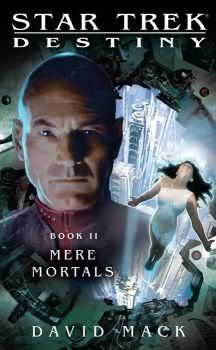
Mere Mortals
Star Trek Destiny: Mere Mortals
© 2008 David Mack
433 pages

In 2158*, the Earth ship Columbia limped its way to a nearby planet to find repair. Instead, they were trapped by a hospitable if overly cautious race of highly advanced beings called the Caeliar, who were adamant about keeping their galactic profile to a minimum, so much to the point that any visitors were either forced to stay or flung across the galaxy to be forever cut off from their homes. Hundreds of years later, the crew of the USS Titan stumbled upon these same Caeliar while tracking the transwarp energy lanes that Starfleet believes the Borg were using to mount their incursions into Federation space. Titan's crew met the same fate as Columbia's: friendly imprisonment. To their astonishment, the captain of the Columbia -- Ericka Hernandez -- greeted them upon their arrival, in the best of health despite being hundreds of years old. Meanwhile, Captains Picard and Dax begin attempting to access the energy lanes and find the route the Borg have been using to launch their invasions. While Picard's initial desire is to destroy the subspace lanes, the task is seemingly impossible. While the Federation's best minds attempt to sort out how to shut these pathways down, Picard believes they can be used to the Alpha Quadrant's advantage. He proposes that the Federation build a coalition of Alpha- and Beta- quadrant powers ready and willing to take the Borg on directly -- that the allied powers send a combined expeditionary force into the Delta Quadrant to destroy the Borg's staging ground and prevent Borg forces from accessing the lanes until the Federation can destroy them safely.
Although Mack focuses on the same four crews -- the Enterprise, Aventine, Titan, and Columbia, Mere Mortals primarily focuses on the combined efforts of Picard and Dax to find the lane leading to the Delta Quadrant. Titan is only a sideline story, as her characters are essentially powerless to do anything: they're barely there. The inclusion of a Columbia story thread surprised me, but Mack follows Hernandez and her crew as they adjust -- or fail to adjust -- to their benign captivity, eventually linking Hernandez' story with that of the Titan crew's. Most of the book is simply setting the stage for the final chapter, but tension mounts as Picard and Dax continue to narrow down which lane leads to the Delta Quadrant: one bridge officer comments that their efforts remind him of Russian roulette. While this is happening, an Allied fleet -- hundreds of ships from the Federation, the Klingon, Cardassian, and Romulan empires, and the Ferengi Alliance (with Breen mercenaries tagging along) -- slowly gathers. In the book's final chapters, Mack forces the fleet to stare into the Abyss -- into the mouth of hell, to borrow from Tennyson -- and then sends it hurtling in.
Destiny continues to impress. Gods of Night was interesting, but Mack uses drama to a greater effective here -- slowly lulling the reader into the feeling that this book is just filler, just a train between two ports. Then the tracks disappear and you realize this is a roller coaster, and you no idea where the fall will stop, or what gut-wrenching turns await. I have a feeling that once I finish Lost Souls next week, I'm going to need to watch a few warm and fuzzy episodes of TNG or the original series to recover.
On the cover: Sir Patrick Stewart as Captain Jean-Luc Picard; Ada Maris as Captain Hernadez-pretending-to-be-Wonder-Woman.
*Give or take a decade. 2168 is when the Columbia was lost, but she'd been traveling at near-light speeds long enough that they were out of sync with Earth's calendar, so I'm not exactly sure.
Related:
© 2008 David Mack
433 pages

The small, finite lives of mere mortals carry little weight in the calculations of gods. But even gods may come to understand that they underestimate humans at their peril.
(From the back of the book.)
In 2158*, the Earth ship Columbia limped its way to a nearby planet to find repair. Instead, they were trapped by a hospitable if overly cautious race of highly advanced beings called the Caeliar, who were adamant about keeping their galactic profile to a minimum, so much to the point that any visitors were either forced to stay or flung across the galaxy to be forever cut off from their homes. Hundreds of years later, the crew of the USS Titan stumbled upon these same Caeliar while tracking the transwarp energy lanes that Starfleet believes the Borg were using to mount their incursions into Federation space. Titan's crew met the same fate as Columbia's: friendly imprisonment. To their astonishment, the captain of the Columbia -- Ericka Hernandez -- greeted them upon their arrival, in the best of health despite being hundreds of years old. Meanwhile, Captains Picard and Dax begin attempting to access the energy lanes and find the route the Borg have been using to launch their invasions. While Picard's initial desire is to destroy the subspace lanes, the task is seemingly impossible. While the Federation's best minds attempt to sort out how to shut these pathways down, Picard believes they can be used to the Alpha Quadrant's advantage. He proposes that the Federation build a coalition of Alpha- and Beta- quadrant powers ready and willing to take the Borg on directly -- that the allied powers send a combined expeditionary force into the Delta Quadrant to destroy the Borg's staging ground and prevent Borg forces from accessing the lanes until the Federation can destroy them safely.
Although Mack focuses on the same four crews -- the Enterprise, Aventine, Titan, and Columbia, Mere Mortals primarily focuses on the combined efforts of Picard and Dax to find the lane leading to the Delta Quadrant. Titan is only a sideline story, as her characters are essentially powerless to do anything: they're barely there. The inclusion of a Columbia story thread surprised me, but Mack follows Hernandez and her crew as they adjust -- or fail to adjust -- to their benign captivity, eventually linking Hernandez' story with that of the Titan crew's. Most of the book is simply setting the stage for the final chapter, but tension mounts as Picard and Dax continue to narrow down which lane leads to the Delta Quadrant: one bridge officer comments that their efforts remind him of Russian roulette. While this is happening, an Allied fleet -- hundreds of ships from the Federation, the Klingon, Cardassian, and Romulan empires, and the Ferengi Alliance (with Breen mercenaries tagging along) -- slowly gathers. In the book's final chapters, Mack forces the fleet to stare into the Abyss -- into the mouth of hell, to borrow from Tennyson -- and then sends it hurtling in.
Destiny continues to impress. Gods of Night was interesting, but Mack uses drama to a greater effective here -- slowly lulling the reader into the feeling that this book is just filler, just a train between two ports. Then the tracks disappear and you realize this is a roller coaster, and you no idea where the fall will stop, or what gut-wrenching turns await. I have a feeling that once I finish Lost Souls next week, I'm going to need to watch a few warm and fuzzy episodes of TNG or the original series to recover.
On the cover: Sir Patrick Stewart as Captain Jean-Luc Picard; Ada Maris as Captain Hernadez-pretending-to-be-Wonder-Woman.
*Give or take a decade. 2168 is when the Columbia was lost, but she'd been traveling at near-light speeds long enough that they were out of sync with Earth's calendar, so I'm not exactly sure.
Related:
- Mere Mortals on Memory Alpha
- Destiny trilogy on Memory Alpha
Labels:
David Mack,
Destiny Trilogy,
Star Trek,
TNG Relaunch
Saturday, August 21, 2010
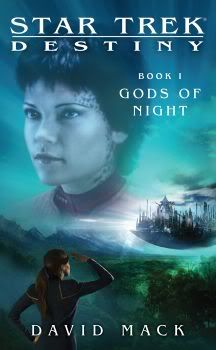
Gods of Night
Gods of Night
© 2008 David Mack
431 pages

Since their introduction in "Q Who", the Borg have remained the Federation's greatest nemesis. They are remarkable villains not for their power or technological prowess, but for their soulnessness. The Borg embody passionless inhumanity: though they dominate nearly a quarter of the galaxy, their conquests have been achieved not through the zeal for power or glory. The Borg are ruthlessly pragmatic, acquiring and destroying species as needed to move forward towards their goal of perfection. Their every advance into the Federation sees fleets of starships destroyed -- and every assault is more pointed, more dangerous than the last. As the Borg renew their goal of subduing the Federation, Captain Jean-Luc Picard fears in his bones that the coming battle is more than those who have come before: to him, the man who hears the Borg whispering in his thoughts at time, the coming conflict will be the last. The Borg are coming, and the Apocalypse is at hand.
Gods of Night is the first in a trilogy portraying this final, deadly grapple between the Federation and the Borg. It is the story of three crews: in the Alpha Quadrant, Captain Picard and the Enterprise-E serve as the Federation's greatest weapon against the increasingly frequent Borg incursions into Federation space. In the far reaches of the Beta Quadrant, Captain Riker of the USS Titan is engaged in an extended mission of scientific exploration, but he and his crew have found a way to contribute to the war effort by investigating a mysterious dark solar system that seems to be projecting transwarp lanes across the whole of the Milky Way. In the Gamma Quadrant, Captain Ezri Dax of the USS Aventine is investigating the wreck of the NX-02 Columbia, an Earthship more than 200 years old. The Columbia is far from home: too far to have made it there on her own.
Mack weaves these three stories together into one grand fabric of peril and mystery, and tacks on a fourth -- the story of the Columbia's crew, who were crippled at the outset of a great war at the birth of the Federation between Earth and the Romulan Star Empire -- for good measure. Despite the abundance of characters and minor substories, the novel remains impressively cohesive. Aside from history, scientific mysteries, and war, Mack gives time to personal issues. Picard is possessed by the war, Riker and Troi are struggling to have a child, and Dax is attempting to adjust to her new role as ship's captain, haven taken over the Aventine when most of its senior staff perished in battle.
Destiny's formidable hype is so far warranted, and Mack has my attention.
On the cover: Nicole de Boer as Captain Ezri Dax; Ada Maris' ponytail as Captain Erika Hernandez' ponytail.
Related:
© 2008 David Mack
431 pages

"The moment I have dreaded for [...] years has finally arrived. The Borg, our most lethal enemy, have begun an invasion of the Federation...and this time there may be no stopping them." (Jean-Luc Picard, First Contact)
Since their introduction in "Q Who", the Borg have remained the Federation's greatest nemesis. They are remarkable villains not for their power or technological prowess, but for their soulnessness. The Borg embody passionless inhumanity: though they dominate nearly a quarter of the galaxy, their conquests have been achieved not through the zeal for power or glory. The Borg are ruthlessly pragmatic, acquiring and destroying species as needed to move forward towards their goal of perfection. Their every advance into the Federation sees fleets of starships destroyed -- and every assault is more pointed, more dangerous than the last. As the Borg renew their goal of subduing the Federation, Captain Jean-Luc Picard fears in his bones that the coming battle is more than those who have come before: to him, the man who hears the Borg whispering in his thoughts at time, the coming conflict will be the last. The Borg are coming, and the Apocalypse is at hand.
Gods of Night is the first in a trilogy portraying this final, deadly grapple between the Federation and the Borg. It is the story of three crews: in the Alpha Quadrant, Captain Picard and the Enterprise-E serve as the Federation's greatest weapon against the increasingly frequent Borg incursions into Federation space. In the far reaches of the Beta Quadrant, Captain Riker of the USS Titan is engaged in an extended mission of scientific exploration, but he and his crew have found a way to contribute to the war effort by investigating a mysterious dark solar system that seems to be projecting transwarp lanes across the whole of the Milky Way. In the Gamma Quadrant, Captain Ezri Dax of the USS Aventine is investigating the wreck of the NX-02 Columbia, an Earthship more than 200 years old. The Columbia is far from home: too far to have made it there on her own.
Mack weaves these three stories together into one grand fabric of peril and mystery, and tacks on a fourth -- the story of the Columbia's crew, who were crippled at the outset of a great war at the birth of the Federation between Earth and the Romulan Star Empire -- for good measure. Despite the abundance of characters and minor substories, the novel remains impressively cohesive. Aside from history, scientific mysteries, and war, Mack gives time to personal issues. Picard is possessed by the war, Riker and Troi are struggling to have a child, and Dax is attempting to adjust to her new role as ship's captain, haven taken over the Aventine when most of its senior staff perished in battle.
Destiny's formidable hype is so far warranted, and Mack has my attention.
On the cover: Nicole de Boer as Captain Ezri Dax; Ada Maris' ponytail as Captain Erika Hernandez' ponytail.
Related:
- Gods of Night's Memory Alpha page
- Destiny's Memory Alpha page
Labels:
David Mack,
Destiny Trilogy,
Star Trek,
TNG Relaunch
Wednesday, August 4, 2010
A Time to Be Born
A Time to Be Born
© 2004 John Vornholt
284 pages

Captain Jean-Luc Picard and the Enterprise-E have been dispatched to the site of a terrible battle during the Dominion Wars, a site filled with dangerous anamolies and mysteries. His orders are to collect the dead from Starfleet vessels and, analyzing the site's physicial remains and examining ships' logs, attempt to explain what happened during the conflict. He is accompanied by the Juno, an older Excelsior-class starship, and a few new allies who appear to have ulterior motives for infiltrating the rubble. Picard needs the help of his comrades and allies, for an unexplicable gravity sink, apparantly sourceless energy discharges, and a swirling vortex of debris are not the only dangers: combative scavengers flit among the remains, stealing parts and ambushing the Starfleet crews. In the perilous darkness, nothing is as it seems, and Picard will have to make quick choces that end his career in Starfleet.
I bought A Time to be Born four years ago, although my reading of it stalled half-way through. In trying to get back into Trek lit, I figured I'd give the A Time to... series another shot. The series consists of nine parts, the titles of each coming from the Hebrew book of Ecclesiastes -- though that may be more familar to some readers as being from Pete Seeger's "Turn, Turn, Turn". The series aims to bridge Insurrection and Nemesis, exploring character development, Alpha Quadrant politics, and answering questions about or mending mistakes of Nemesis. The premise of this initial book is interesting, and I liked the ending, but the development of Picard's time within the battleground was a struggle to read through. If I'd only wanted the general story or events of consequence, I could read the introductory chapters and then skip ahead to Picard's trial.
Rough start but a promising ending. I intend on reading through the A Time To series, but not immediately.
Related
© 2004 John Vornholt
284 pages

On the cusp of their epic battle with Shinzon, many of Captain Jean-Luc Picard's long-time crew were heading for new assignments and new challenges. Among the changes were William Riker's promotion to captain and his new command, Riker's marriage to Counselor Deanna Troi, and Dr. Beverly Crusher's new career at Starfleet Medical. But the story of what set them on a path away from the Starship Enterprise has never been told.UNTIL NOW.
Captain Jean-Luc Picard and the Enterprise-E have been dispatched to the site of a terrible battle during the Dominion Wars, a site filled with dangerous anamolies and mysteries. His orders are to collect the dead from Starfleet vessels and, analyzing the site's physicial remains and examining ships' logs, attempt to explain what happened during the conflict. He is accompanied by the Juno, an older Excelsior-class starship, and a few new allies who appear to have ulterior motives for infiltrating the rubble. Picard needs the help of his comrades and allies, for an unexplicable gravity sink, apparantly sourceless energy discharges, and a swirling vortex of debris are not the only dangers: combative scavengers flit among the remains, stealing parts and ambushing the Starfleet crews. In the perilous darkness, nothing is as it seems, and Picard will have to make quick choces that end his career in Starfleet.
I bought A Time to be Born four years ago, although my reading of it stalled half-way through. In trying to get back into Trek lit, I figured I'd give the A Time to... series another shot. The series consists of nine parts, the titles of each coming from the Hebrew book of Ecclesiastes -- though that may be more familar to some readers as being from Pete Seeger's "Turn, Turn, Turn". The series aims to bridge Insurrection and Nemesis, exploring character development, Alpha Quadrant politics, and answering questions about or mending mistakes of Nemesis. The premise of this initial book is interesting, and I liked the ending, but the development of Picard's time within the battleground was a struggle to read through. If I'd only wanted the general story or events of consequence, I could read the introductory chapters and then skip ahead to Picard's trial.
Rough start but a promising ending. I intend on reading through the A Time To series, but not immediately.
Related
- Psi Phi's A Time to page, offering general descriptions of the books and their covers.
- A Time to be Born on Memory Alpha
- A Time to.... series on Memory Alpha.
Labels:
A Time To,
Star Trek,
The Next Generation,
TNG Relaunch
Wednesday, July 7, 2010
Greater than the Sum
© Christopher L. Bennett 2008
368 pages

Fresh from his honeymoon with Dr. Beverly Crusher, Jean-Luc Picard has returned to the Enterprise-E to assemble a new command staff in the wake of recent losses in battle. Finding the right people to meet the demands of the Federation flagship is problematic, but news from the Beta Quadrant will render staffing problems trivial: the Borg are back.
After the events of Death in Winter, a Borg cube launched an attack on the Federation and brutalized it in a way not seen since Wolf 359. They were driven way, but assimilated a Federation science vessel before vanishing completely. That science vessel, the USS Einstein, was reported destroyed, but its attack on the USS Rhea, a Federation starship assigned to investigate a system in the Beta Quadrant proves otherwise. The Borg-controlled Einstein -- known in Starfleet enlisted ranks now as the Frankenstein -- is a threat to the Federation, not for its own armament but for the knowledge it possesses. The Federation's greatest defense against the Borg is the gulf of space between the Federation and the Borg Collective -- but that curious system in the Beta Quadrant may hold the secret to quantum slip-stream warp drives, which would make the Milky Way as transversable as a local star system. The Frankenstein cannot be permitted to return to the Delta Quadrant, lest the Borg gain that knowledge.
Picard is given ultimate discretion in how he chooses to combat the threat, and reluctantly chooses to include the young officer who survived the attack on the Rhea as part of his staff. The excitable, immature officer doesn't appear to be Starfleet material, let alone an officer distinct enough to serve on the bridge of the Federation flagship -- but something about her compels Picard to give her a chance. Together with a ship of ex-drones -- the Liberated, led by Hugh -- Picard must find a way to destroy the ever-adaptive and increasingly aggressive Borg before they are able to adapt slipstream technology to their uses and return to the Collective, where they will share that knowledge and give the Borg a way to dominate the entire Milky Way.
Greater than the Sum is one of the best Trek books I've read. Although the mission is essentially military, Bennet focuses on character development, diplomacy with a new form of life, and scientific investigation. Bennett's pacing worked well for me: ultimate confrontation with the ship is delayed, allowing tension to build. In the meantime, Bennett focuses on Picard and his new officer, Lieutenant Chen. I didn't like Chen at first, thinking her sophomoric: I didn't realize her immature disposition was deliberate until Bennett starting bouncing her personality off of Picard's, at which point hilarity ensued. While she begins as a hyperactive and childish Ro Laren-type with pointed ears, Chen matures throughout the book and I looked forward to her scenes. Bennett also explores Picard and Crusher's married life, particularly the motives behind Picard's reluctance to start a family. His official explanation is that having children would be irresponsible in light of the Borg threat, but the real motives are more nuanced and draw from various Trek episodes, including The Inner Light. Although Greater than the Sum continues the story begun in previous TNG Relaunch novels, Bennett's background exposition was sufficient and unintrusive. It's thus a easy recommendation for both fans of Trek literature and of The Next Generation itself.
Related:
© Christopher L. Bennett 2008
368 pages

Fresh from his honeymoon with Dr. Beverly Crusher, Jean-Luc Picard has returned to the Enterprise-E to assemble a new command staff in the wake of recent losses in battle. Finding the right people to meet the demands of the Federation flagship is problematic, but news from the Beta Quadrant will render staffing problems trivial: the Borg are back.
After the events of Death in Winter, a Borg cube launched an attack on the Federation and brutalized it in a way not seen since Wolf 359. They were driven way, but assimilated a Federation science vessel before vanishing completely. That science vessel, the USS Einstein, was reported destroyed, but its attack on the USS Rhea, a Federation starship assigned to investigate a system in the Beta Quadrant proves otherwise. The Borg-controlled Einstein -- known in Starfleet enlisted ranks now as the Frankenstein -- is a threat to the Federation, not for its own armament but for the knowledge it possesses. The Federation's greatest defense against the Borg is the gulf of space between the Federation and the Borg Collective -- but that curious system in the Beta Quadrant may hold the secret to quantum slip-stream warp drives, which would make the Milky Way as transversable as a local star system. The Frankenstein cannot be permitted to return to the Delta Quadrant, lest the Borg gain that knowledge.
Picard is given ultimate discretion in how he chooses to combat the threat, and reluctantly chooses to include the young officer who survived the attack on the Rhea as part of his staff. The excitable, immature officer doesn't appear to be Starfleet material, let alone an officer distinct enough to serve on the bridge of the Federation flagship -- but something about her compels Picard to give her a chance. Together with a ship of ex-drones -- the Liberated, led by Hugh -- Picard must find a way to destroy the ever-adaptive and increasingly aggressive Borg before they are able to adapt slipstream technology to their uses and return to the Collective, where they will share that knowledge and give the Borg a way to dominate the entire Milky Way.
Greater than the Sum is one of the best Trek books I've read. Although the mission is essentially military, Bennet focuses on character development, diplomacy with a new form of life, and scientific investigation. Bennett's pacing worked well for me: ultimate confrontation with the ship is delayed, allowing tension to build. In the meantime, Bennett focuses on Picard and his new officer, Lieutenant Chen. I didn't like Chen at first, thinking her sophomoric: I didn't realize her immature disposition was deliberate until Bennett starting bouncing her personality off of Picard's, at which point hilarity ensued. While she begins as a hyperactive and childish Ro Laren-type with pointed ears, Chen matures throughout the book and I looked forward to her scenes. Bennett also explores Picard and Crusher's married life, particularly the motives behind Picard's reluctance to start a family. His official explanation is that having children would be irresponsible in light of the Borg threat, but the real motives are more nuanced and draw from various Trek episodes, including The Inner Light. Although Greater than the Sum continues the story begun in previous TNG Relaunch novels, Bennett's background exposition was sufficient and unintrusive. It's thus a easy recommendation for both fans of Trek literature and of The Next Generation itself.
Related:
- Greater than the Sum Memory Alpha article.
Saturday, June 5, 2010
Death in Winter
Death in Winter
© 2007 Michael Jan Friedman
368 pages

I've been meaning to dive back into contemporary Trek lit for some time now, but have been somewhat daunted by a shift in the literature: instead of new releases being published as self-contained novels, Star Trek books today tend to fit into a newly-created extended universe canon that roared into existence following the end of Deep Space Nine and the rise of the "Deep Space Nine Relaunch", a collection of individual books and series set in the post-"What You Leave Behind" era and which gave the show an eighth season in book form. The Next Generation, Voyager, and Enterprise soon experienced their own "relaunches", all of these relaunches tied to one another creating the type of expanded universe that Star Wars readers have so long enjoyed. The downside of this is that it increases the amount of background needed to be absorbed to enjoy a given book fully dramatically. I thus posted on TrekBBS and asked for a map of sorts to prepare me to read the newly released Star Trek: Destiny series, and the information I compiled suggested that Michael Jan Friedman's Death in Winter was the place to start.
I could think of no matter, for Friedman is my favorite Trek author: I enjoyed his Stargazer series depicting Captain Picard's first command immensely, falling in love with the characters and eagerly waiting more. Now Friedman tackles Picard in the days following Nemesis: the Romulan empire is in turmoil after the assassination of most of its senate, and most of Picard's command crew has left him. Riker is now the captain of the USS Titan (and has his own book series, along with Troi): Data is dead, and Dr. Crusher has decided to become the head of Starfleet medical once more, leaving Picard with only LaForge and Worf to help him oversee the Enterprise's extensive repair and retrofitting following its fight in Nemesis.
Of those lost crewmembers, Picard misses Crusher the most: one of the first season's opening episodes established romantic tension between the two, and they enjoyed a special relationship throughout the series. Recent events have made their mutual love for each other more acute, making Crusher's departure hard to bear. While Picard sees to his ship, Crusher is sent on a secret mission to the outskirts of Romulan territory to prepare a vaccine on a plague planet. Her mission goes awry when the half-human, half-Romulan Commander Sela learns of a Federation officer's presence on her planet, and Picard is tasked with escorting another doctor to the planet and -- if he can -- finding the newly-imprisoned and possibly dead Dr. Crusher. Picard, along with old comrades from the Stargazer, steal into Romulan territory and try to find allies while a political battle for control of Romulus wages. If Picard is not careful -- and if he cannot keep his emotions concerning the doctor from interfering with the mission -- he, Crusher, and their comrades may be used as political pawns by the various senators and admirals who want their voice to guide the battered Star Empire.
Friedman lives up to expectations, doing justice to the TNG crew and handling Romulan politics well enough that I did not tire of it. I particularly enjoyed the inclusion of Stargazer officers given my fondness for that series. The four threads of the book -- Picard's efforts to find Crusher, political espionage and maneuverering between Romulan factions, Beverly's role in those maneuverers, and Worf and Geordi's struggle to do their duty -- mesh neatly together to make for a compelling read.
© 2007 Michael Jan Friedman
368 pages

I've been meaning to dive back into contemporary Trek lit for some time now, but have been somewhat daunted by a shift in the literature: instead of new releases being published as self-contained novels, Star Trek books today tend to fit into a newly-created extended universe canon that roared into existence following the end of Deep Space Nine and the rise of the "Deep Space Nine Relaunch", a collection of individual books and series set in the post-"What You Leave Behind" era and which gave the show an eighth season in book form. The Next Generation, Voyager, and Enterprise soon experienced their own "relaunches", all of these relaunches tied to one another creating the type of expanded universe that Star Wars readers have so long enjoyed. The downside of this is that it increases the amount of background needed to be absorbed to enjoy a given book fully dramatically. I thus posted on TrekBBS and asked for a map of sorts to prepare me to read the newly released Star Trek: Destiny series, and the information I compiled suggested that Michael Jan Friedman's Death in Winter was the place to start.
I could think of no matter, for Friedman is my favorite Trek author: I enjoyed his Stargazer series depicting Captain Picard's first command immensely, falling in love with the characters and eagerly waiting more. Now Friedman tackles Picard in the days following Nemesis: the Romulan empire is in turmoil after the assassination of most of its senate, and most of Picard's command crew has left him. Riker is now the captain of the USS Titan (and has his own book series, along with Troi): Data is dead, and Dr. Crusher has decided to become the head of Starfleet medical once more, leaving Picard with only LaForge and Worf to help him oversee the Enterprise's extensive repair and retrofitting following its fight in Nemesis.
Of those lost crewmembers, Picard misses Crusher the most: one of the first season's opening episodes established romantic tension between the two, and they enjoyed a special relationship throughout the series. Recent events have made their mutual love for each other more acute, making Crusher's departure hard to bear. While Picard sees to his ship, Crusher is sent on a secret mission to the outskirts of Romulan territory to prepare a vaccine on a plague planet. Her mission goes awry when the half-human, half-Romulan Commander Sela learns of a Federation officer's presence on her planet, and Picard is tasked with escorting another doctor to the planet and -- if he can -- finding the newly-imprisoned and possibly dead Dr. Crusher. Picard, along with old comrades from the Stargazer, steal into Romulan territory and try to find allies while a political battle for control of Romulus wages. If Picard is not careful -- and if he cannot keep his emotions concerning the doctor from interfering with the mission -- he, Crusher, and their comrades may be used as political pawns by the various senators and admirals who want their voice to guide the battered Star Empire.
Friedman lives up to expectations, doing justice to the TNG crew and handling Romulan politics well enough that I did not tire of it. I particularly enjoyed the inclusion of Stargazer officers given my fondness for that series. The four threads of the book -- Picard's efforts to find Crusher, political espionage and maneuverering between Romulan factions, Beverly's role in those maneuverers, and Worf and Geordi's struggle to do their duty -- mesh neatly together to make for a compelling read.
Subscribe to:
Comments (Atom)