Showing posts with label DS9 Relaunch. Show all posts

Monday, December 18, 2017

Revelations and Dust

Star Trek the Fall:  Revelation and Dust
401 pages
© 2013 David R. George III


David R. George takes a bullet for the team in The Fall: Revelation and Dust. First in a five-part series with five participating authors, Revelation and Dust largely consists of recap, introduction, and assassination. Well, something had to happen, right? There's four books after this, so something extraordinary had to hook us for the rest. We've had the Borg invasion, we've blown up Deep Space Nine already, the Dominion are SO yesterday, and the hostile takeover of the Federation by the Ferengi Alliance is unlikely. So, gunshots it is.

At the end of George's DS9/Typhon Pact duology, Deep Space Nine was blown up with the lost of most of its hands.  Two years later, the station has been rebuilt, this time as a proper  deep space installation instead of an ore-processing plant turned command post. Its formal opening coincides with the two year anniversary of the old station's destruction, and now the gang is back together to pay respects to their fallen comrades, and their now-vaporized home.  Tensions from the previous Typhon Pact novels -- Sisko's estrangement from his wife Kasidy,  Bashir and Dax's falling out over Bashir's determination to destroy Section 31 from the inside -- are buried, making room for new and exciting arguments.The novel largely follows the characters as they make their way to the station and renew old acquaintances, musing over the good times until the speeches and gunfire start. Part of this catching-up is an unfortunate series of chapters that re-uses a plot device from one of the early Relaunch novels:  readers are subjected to completely new characters in some quasi-fantasy setting involving a tribe called the 'Bajora'.  As with last time this is an extended vision effected by the Prophets,  because the mystical goings-on here translate parable-like to something "real" that has happened . The upshot of this thread seems to be that Sisko can have his life back from Prophets.  He can  have his family and they won't kill him. Yay. In any case, I don't want to read about random fantasy Bajorans, I want to read about President Bacco. She's always fun.

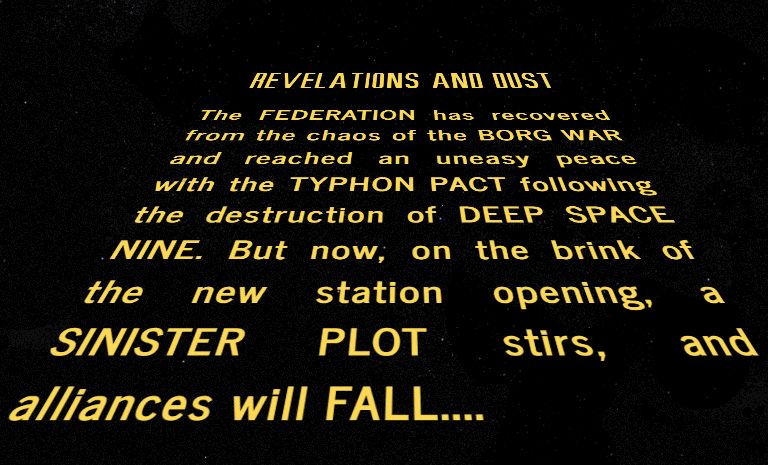
George's previous DS9 novels have all been great reads, but this one is lacking...story. This is essentially a Star Wars scrolling text intro, expanded to 400 pages.  See for yourself!


(camera pans from starfield to new station)


Saturday, September 22, 2012

Raise the Dawn

Star Trek Typhon Pact: Raise the Dawn
© 2012 David R. George III
400 pages


The ending of Plagues of Night saw me stand to my feet in shock. Not since the Destiny trilogy has there been such a cliffhanger in Trek literature. Raise the Dawn sees David R. George finish what he began, with brilliant success.

Tensions were high between the Federation and the Typhon Pact before this duology, but however much the leaders of the Federation and Romulan Empire might wish to maintain the peace, other members of the Typhon Pact -- and certain blonde, notoriously villainous elements within the Empireitself --  are more bellicose, and their actions have already led to catastrophe. As the president of the Federation resigns herself to the fact that her heavily fatigued people are in for yet another conflict, the Romulan praetor makes a stunning move, one that confirms that the days of two-dimensional bad guys are over.

Trek literature has steadily been pushing the envelope since the publication of the first Avatar books. George doesn't just overturn the apple cart of the status quo;  since Rough Beasts of Empire, he's set it on fire. A few of Trek's characters have been going through the meatgrinder, and while that's been rough going for readers who feel for these characters, Raise the Dawn offers resolution.  All of the stresses introduced in the first four Typhon Pact novels have coalesced here, putting our characters through the fire, even as they battle private battles of their own, like Prynn Tenmei's struggle to let her father go, and Sisko's alienation from his family. Raise the Dawn continues to be expansive; like Plagues of Night, its characters are drawn from across the Trek verse, excluding only the Titan and Voyager crews. But George goes even further by playing with prophetic visions of the kind we saw in "Far Beyond the Stars" and "Image in the Sand"; characters seem to be inhabiting multiple planes of existence at the same time, interacting with one another when they can't possibly be doing so, and it's too brilliantly done to be confusing, except in a delighted way.

George's duology is a must read for fans of Trek literature. I have not been this mesmerized or moved since the Destiny series; only Full Circle has even come close.


Monday, September 3, 2012

Plagues of Night


Star Trek Typhon Pact: Plagues of Night
© 2012 David R. George III
388 pages


The dust had scarcely settled after the last great Borg War when the battered Federation found itself facing yet another threat when numerous hostile species on its borders created the Typhon Pact, a confederacy that soon entered into a Cold War with the gravely wounded Klingon and Federation powers. The first four Typhon Pact novels (and a fifth work, a novella) each explored one of the constituent members of the Pact while at the same time establishing the new polity as a potent force to be reckoned with. Those tales of espionage and politics set the stage, and now David R. George has delivered the first Typhon Pact 'epic', one which spans the quadrants and involves the Enterprise-E and the far-flung crew of Deep Space Nine.

After the events of Star Trek: Destiny, billions were dead and the Federation utterly exhausted, and yet no relief was to be found. In the wake of such calamity, six powers hostile to the Federation and ringing its borders sought strength in unity. They created the Typhon Pact, a confederacy of scum and villainy, and  changed the map forever. The Federation and its greatest ally, the Klingon Empire, were soon engaged in a "cold war" with the Typhon Pact. The first four novels of the series each focused one of the constituent members of the Pact (the Breen, the Romulans,) while following the opening power plays between the two polities. Tales of espionage and political wrangling followed, and the stage was set. David R. George has delivered the first Typhon Pact "epic", one which spans the quadrants and involves both the Enterprise-E and the far-flung crew of Deep Space Nine. Plagues of Night is the opening act, ending on a cliffhanger that saw me stand to my feet in astonishment.

The Federation and the Typhon Pact are not, technically, at war, but both strive to maintain the balance of power that will keep the peace -- through means that threaten it, like covertly attacking one another's shipyards to steal data.  Although the Typhon Pact novels established the Pact as a potent force to be reckoned with, they aren't simple villains. Each power has its own ambitions, and the leaders of the Romulan Star Empire dearly want peace.  Plagues of Night uses the events of the first four novels (especially Zero Sum Game and Paths of Disharmony) to establish rising tension between the Federation and the Pact,  and both the RSE and Federation leaders want to prevent said tension from erupting into open war.  But the achievements of diplomacy -- trade agreements and a joint scientific mission into the Gamma Quadrant -- are threatened to perversely turned into the spark of war when things go terribly wrong.

In addition to creating a thriller of a scope we've not seen since the Destiny books, George provides the long-awaited return to the Deep Space Nine cast of characters.  The DS9 relaunch was seemingly abandoned when Destiny came onto the scene: there's a five-year gap between the last DS9 book and the events of that magnificent trilogy.  Readers were teased with what might have happened in the meantime in Rough Beasts of Empire, and here the station takes center stage under its new commanding officer, Ro Laren. Character growth in Plagues of Night centers on Sisko, who is still grappling with the aftermath of decisions he made after Unity. Abandoned by the prophets,  and fearful for his family's safety, Sisko is a man without a friend -- tremendously lonely. And bless his heart, it's going to get worse.


I purchased this book online, and I figured after I read it I'd buy the second book. I couldn't wait. Yesterday, I drove an hour or so to the nearest bookseller and hunted down a copy of the conclusion. I...cannot wait.  

Related:
Star Trek Typhon Pact on TvTropes

Friday, May 18, 2012

Hollow Men

Star Trek Deep Space Nine: Hollow Men
© 2005 Una McCormack
368 pages


            Deep Space Nine is notoriously the darkest of the six Star Trek series, repeatedly exploring corridors of the human experience that other series gave a wide berth. The horrors of war dominated the latter half of the series, and no character escaped the grim costs of war…especially not Captain Benjamin Sisko, who, in “In the Pale Moonlight” struck a Faustian bargain to save the Alpha Quadrant from outright conquest at the hands of the Dominion.  What began as a devious exercise in manipulation ended in murder, twice over, with a succession of increasingly dubious steps connecting the two.  Uma McCormack follows up on this most intriguing episode by exploring the consequences of Captain Sisko’s actions when he and his co-conspirator Garak are summoned to Starfleet Headquarters. Sisko, morally plagued, hopes for punishment and redemption; Garak anticipates savage treatment at the hands of Starfleet Intelligence, almost hopefully so – but neither man has any idea what is in store for them.

            Hollow Men is almost a creature from Trek literature’s previous generation in that it seems episodic; there’s a large A-story, and two smaller threads that connect together for a B story.  The primary action takes place on Earth, where Sisko explores his conscience, and Garak, paradise. On the action, Odo deals with a security crisis and his thawing relationship with Colonel Kira.  The two stories share a common theme, however; the cost of war.  When an old nemesis of Odo arrives on the station, the constable is absolutely positive the recently-released convict is there to commit a latinum heist. New Federation security measures give him a lot of leeway in times of war, but is his personal satisfaction worth using such extreme measures? On Earth, both Sisko and Garak confront a Starfleet captain turned peace activist – but for their own reasons, and Garak’s are not his own, for powers on Earth attempt to convert him into a pawn in their own game.

            Deep Space Nine stands apart from the rest of the franchise not only for its darker themes, but its reliance on long-running arcs and rich characters. McCormack’s narrative definitely keeps with DS9’s tradition there;  weaving the story’s threads seamlessly into Deep Space Nine’s sixth season – building on content from the show, or setting it up. All this she does and delivers two mysteries and a lot of room for thought. This is very much a keeper for Niners.
            

Wednesday, May 9, 2012

Worlds of Ds9: The Dominion and Ferenginar

Star Trek Worlds of Deep Space Nine, Volume III: The Dominion and Ferenginar
© 2010 David R. George III, Keith R.A. DeCandido
(Trade Paperback) 352 pages


The Dominion and Ferenginar is the final volume in the Worlds of Deep Space Nine series, and the only one to focus on worlds completely outside the sphere of Federation influence. Like its predecessors, Andor and Cardassia and Bajor and Trill, D&F consists of two novellas. This volume is penned by two of modern Trek's most popular authors. DeCandido opens the collection with "Satisfaction is Not Guaranteed", a tale of business politics in which a cabal of angry Ferengi attempt to enlist Quark's support in a conspiracy aimed against his brother, Grand Nagus Rom, whose reforms (allowing women to wear clothes and earn profit, mandating an income tax) they despise. Quark is torn between his own contempt for the "New Ferenginar" and family loyalty, but the decision is made somewhat easier when he finds out the cabal is hoping to seat his old enemy Brunt as the new nagus.  This is a story interesting and sometimes funny, albiet not remarkable -- the standard for Ferengi stories has been set by The 34th Rule, and that's a book which won't be beat anytime soon.

David R. George follows this with a novella set in the Gamma Quadrant, "Olympus Descending". At the end of Deep Space Nine's series, Odo decided to stay with his people, becoming an exile from his friends in the hopes of teaching the Dominion more peaceful ways. Meanwhile, an elderly Jem'Hedar soldier who Odo sent to the Alpha Quadrant in hopes of reforming, is finding life increasingly difficult to bear. The Federation's vicious enemy has never been fully explored in novel. The length of George's story doesn't allow for a lot of expansion here, and George paints the Founders as largely detatched from the everyday affairs of empire. This is somewhat disappointing, but understandable. Odo's quest to understand his people and his own origins ends with a staggering turn of events, one I'm surprised no one has followed up on. The last great Borg War may have taken precendence, though.

These are both fine stories; "Olympus Descending" is the stronger of the two,  helped by its subject matter being more exotic.

Monday, January 3, 2011

Rough Beasts of Empire

Rough Beasts of Empire
© 2010 David R. George III
304 pages
On the cover: Leonard Nimoy as Spock; Avery Brooks as Captain Sisko


Ever since the mass assassination of the Romulan senate in Nemesis, the Romulan Empire has existed in a state of disunity. Praetor Tal'Aura seized control of the government shortly after the events of Nemesis, but the Romulan fleet regards her as suspect -- and for good reason, for she carried out the assassination. In an apparent attempt to prevent the Empire from falling completely into the hands of a traitor,  Commander Donatra of the Valdore established her own rival state to arrest Tal'Aura's ambitions. Controlling most of the Empire's agricultural worlds and allied to the Federation, Donatra needed only sit and wait for Tal'Aura's power base to erode -- but the woman who conspired with Shinzon to destroy her entire government in the pursuit of power is not one to wait for her own death. Instead, Tal'Aura partially arranged the Typhon Pact, a six-member alliance of nations composed of some of the Federation's oldest enemies.  In Rough Beasts of Empire, two Federation citizens -- Ambassador Spock and Captain Bejanmin Sisko -- attempt to work out their fates in this dangerous new political environment.

Previous novels in the Typhon Pact series have focused on one story, but David R. George follows the lives of two men. On Romulus, Spock continues to lead the Reunification movement despite a narrow escape from an assassin, preaching peace and working toward the day when Vulcans and Romulans can look on one another as kindred spirits. Though Spock is the viewpoint character here,  he's used by George to observe the power struggle between Donatra and Tal'Aura: his story is more one of Romulan politics than his own philosophical labors. Meanwhile, Captain Sisko -- who rejoined Starfleet during the last great Borg War --  commands the USS Robinson, a Galaxy-class starship patrolling the Romulan borders, tormented by what he had to leave behind on Bajor and haunted by memories of the Tzenkethi war.  As difficult as it was for me to see Sisko put through an emotional meatgrinder here, it's rather refreshing.  In the early Relaunch books, Sisko was more a Legend than man: he vanished inside the Bajoran wormhole at the end of Deep Space Nine,  though no one on the station in the months that followed could escape his memory. His reappearance at a pivotal moment only boosted the legendary aura, and  shortly thereafter he read like a saint, above the cares of the world. George brings him back down to Earth again -- where he's back to being human, back to struggling with issues and making hard, wrenching decisions.  Thus Rough Beasts offers heaps of political and character drama, though I think Sisko's thread has the stronger ending.

Aside from this, Rough Beasts also reintroduces some characters who have not been seen recently --  Kira Nerys, and the master villain of TNG's 'Unification'  episode.  George also elaborates on the Tzenkethi, whose appearances was the source of great speculation when Pocket and CBS announced the Typhon Pact series.  They're interesting sorts, though I wouldn't care to see them again. Like Tal'Aura, I wished them defeat and disappearance every time they showed up in the book.

I've read George before, in Provenance of Shadows, and this was even more a page-turner. I probably would have finished it in one sitting had I not resisted reading it. I try not to read more than one Trek book per reading week (starting on Wednesdays) , but as you can see I failed. It's all George's fault -- the book was too interesting to stop reading for too long, and the pages flew by so quickly that I was done before I knew it.  Of the three Typhon Pact books I read, I've enjoyed this the most -- owing, in part, to my being a Sisko fan .

The next Typhon Pact read, Paths of Disharmony, is scheduled to be released anywhere from mid-January to early February. It is a TNG novel that is expected to focus on the Tholians ("The Tholian Web", "In a Mirror Darkly") and Andor.

Related:

Friday, December 3, 2010

Zero Sum Game

Star Trek Typhon Pact: Zero Sum Game
© 2010 David Mack
336 pages


'I think it's safe to say that Julian Bashir, Secret Agent, will return.' - Bashir, "Our Man Bashir"

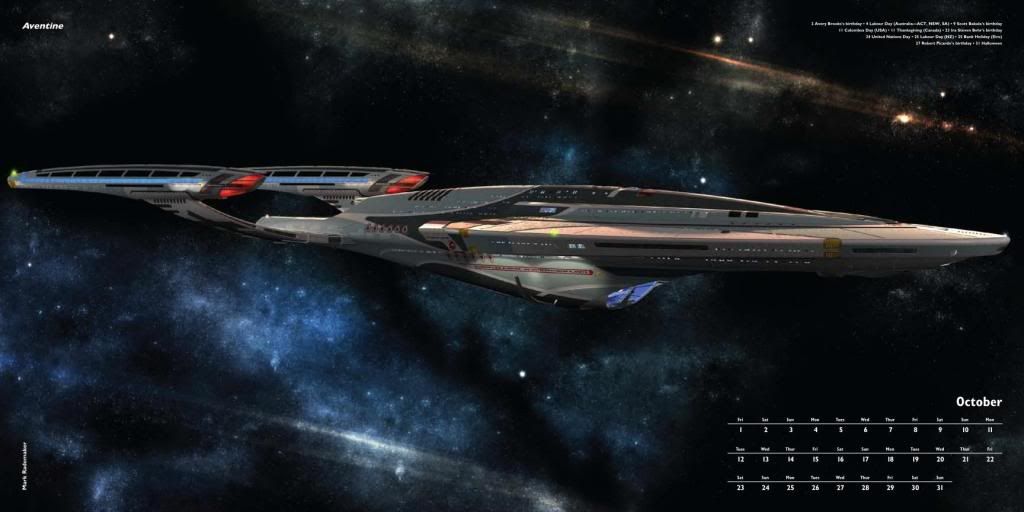
On the cover: Nicole de Boer as Captain Ezri Dax, Alexander Siddig as Dr. Julian Bashir, who has apparently grown a Beard of Sorrow. CGI as the USS Aventine.

The Federation has known many great enemies in its few centuries of existence -- the Klingons, the Romulan Star Empire, the Cardassians, the Dominion, and the Borg have been the most notable. Time has worn them all down: the Klingons have become allies, the Romulans are weakened by civili War, Cardassia is impotent, the Dominon has retreated into the Gamma Quadrant, and the Borg are...gone. In the wake of the last great Borg war, various second-class powers of the galaxy (Gorn, Tholians, Breens, and more) have banded together in a military and partial civil union known as the Typhon Pact. The Pact has existed in a state of cold war with the Allied powers since A Singular Destiny, but their recent theft of the plans for Starfleet's latest and greatest asset -- the Slipstream War Drive -- threatens to turn hostility into a general war.

The slipstream drive is vastly superior to standard warp drives and has so far discouraged the Pact from waging open war against the battered and diminished allied powers. They cannot be allowed to turn their stolen data into effective plans for a slipstream drive of their own, and so Starfleet tasks Captain Ezri Dax with inserting two operatives into the suspected home of the Breen slipstream project. Dr. Julian Bashir and his genetically modified peer Sarina Douglas have been hand-picked for their improved physical and mental abilities, which include a heightened ability to adapt to strange and changing situations. Given that next to nothing is known about Breen culture, adaption is a necessity. While the two operatives descend into the belly of an alien city, Dax lurks outside the Breen orders attempting to evade a Breen-Romulan* fleet which knows that the Aventine is up to something.

Zero Sum Game is an interesting change of pace: political/spy thrillers aren't all that pervasive in Trek lit to my knowledge.  I enjoyed David Mack's worldbuilding; I imagine giving life to a long-established power was quite the responsibility, but the civilization that Bashir and Douglas explore is fascinatingly believable. He treats them as more than just villains, although the Breen Confederacy is plainly ruled by an intrusive military state with a kind of secret police. When the Breen official in charge of the shipyard discovered his operations center littered with dead bodies, he is horrified that the enemy operative (in this case our hero)  had taken so much innocent life just to destroy the slipstream project.  On that note, readers are also treated to Dr. Bashir's inner conflict, as he is driven by his responsibility as a physician to "do no arm" and his duties as a Starfleet officer to do what needs to be done.

Par for the course for Mr. Mack; Zero Sum Game has a lot to offer Trek fans beyond the fast action-spy plot and discovery of Breen civilization. Bashir's long been my favorite DS9 character and I enjoyed the spotlight being on him for a change: the last time that happened was during the first run of Trek relaunch books. He's changed quite a bit from the bubbling young lieutenant who first appeared in "Emissary": once full of idealism and energy, he's now a mature veteran of several horrific wars who feels lonely in a station now populated by total strangers: aside from Quark and Nog, no one remains on the station from the old (television run) crowd, and now even his newly-met comrades from the relaunch have been leaving him. It's tough to see him put through the mill like this, especially considering a revelation at the end of the book. The action remains interesting and varied throughout the book: while Bashir and Douglas are exploring the Breen industrial center, Ezri is engaged in a cat-and-mouse game with some irritated Romulans, and by the time that action settles down our two operatives are in the thick of things.  Even the Federation president gets a little attention. 

Recommended to Trek lit readers, especially given that this is the first book in the Typhon Pact series, which will explore the 'new political reality' throughout next year. Book #2, Seize the Fire, came out in the last week or so. 

Related:
  • Abyss, the last Bashir novel (not counting Worlds of Deep Space Nine #1, where he just tagged along behind Ezri) One of my favorites, focusing on Bashir, Ro Laren, and Taran'atar. 
  • David Mack's homepage and Memory Alpha bio.
  • Typhon Pact on TvTropes. Note: this book was released in late October, and it's already got a full page. Some of the people in TrekBBS's TrekLit forum have been busy. 


Friday, October 29, 2010

Warpath

Warpath
© 2006 David Mack
339 pages
On the cover: unknown model as Taran'atar, looking "dangerous, yet vulnerable, awash in the amber of Jem'Hadar blood".

I am dead. I go into battle to reclaim my life. I do this because I am Jem'Hadar. Victory is life.

The opening Deep Space Nine Relaunch novels introduced Taran'atar, an elder soldier of the Dominion who was assigned to Deep Space Nine to serve its commanding officer, Captain Kira Nerys. Such an assignment is unusual, for Taran'atar is a Jem'Hadar: a genetically-engineered soldier bred for fighting and obedience to the Founders, the shape-shifting race of creatures who created and controlled the Dominion which attempted to conquer the Federation and the Klingon and Romulan empires through Deep Space Nine's final two seasons. Taran'atar proves to be a prickly, but valuable asset to Kira and her command crew,  rendering to her the obediance he once gave to his masters in the Dominion.

That makes the opening of this novel, in which he stabs her in the heart and breaks Security Chief Ro Laren's back a bit unexpected.  While Kira and Ro lay dying, Taran'tar sneaks aboard a station craft about to test its newly improved warp engines and takes the vessel's lone pilot hostage before speeding away toward an unknown destination.  Dr. Julian Bashir works desperately to save the lives of his captain, his coworkers, and his old friends while the station's XO, Elias Vaughn, pursues the craft in the USS Defiant. Meanwhile, Ensign Prynn Tenmei,  Vaughn's daughter, flies the craft at Taran'atar's knifepoint and wonders how she is going to overcome a super-soldier fully expecting her to stop him from from fulfilling his plan -- which, he's not entirely sure of himself. He only knows that he must make a rendezvous with a face he knows to be familar, but who is yet a stranger -- an ambitious, hateful stranger who we witness overcoming skilled bounty hunters.

This is the opening chapter, but not the origin, of a larger story arc which Deep Space Nine pursues in later books,  in which Illiana Ghemor -- a Cardassian intelligence operative genetically altered to appear to be Kira Nerys and implanted with false memories that make her think she really is Kira  -- goes insane and decides to kill every Kira Nerys she can get her hands on, which means knocking off the Mirror Universe's Intendant Kira as well. This story arc concerns me; I think of it as convoluted, and the other story arc being developed -- in which Bajor will be expected to defend its dominant religion and the Wormhole against the Ascendants, a Gamma-Quadrant power who also worship the wormhole aliens ("The Prophets"), but are imperial and fanatical, like Islamic extremists and Christian dominionists today  -- is likewise problematic. The last time I read of Ascendants and Bajor's religion, the universe was destroyed.

The arcs are just getting started in Mack's book, though, so they're not terribly...developed yet. Warpath is good. It's not Destiny, but nothing is Destiny.  Vaughn and Tenmei are the most compelling characters for me: they are an estranged father and daughter, and the moment in which they find forgiveness and a new start was for me the best moment of the book. The fight scenes were curiously compelling, keeping my attention -- and the humor was excellent, particularly one inside joke Mack included for Bashir fans.* The only part of the book that through me was Kira's experience laying in surgery: while Doctor Bashir operates, she dreams that she is attempting to lead a medieval army against a medieval fortress, only to find it's held by another medieval army and a third medieval army is on its way to take the fortress for themselves. At first I thought the General Kira of the dream was another universe's Kira, but I realized the dream was a metaphor for Bajor's future story arc.

Good read, though...I'm not really enthusiastic about these arcs. I'm fine with Ghemor on Kira, but the inclusion of a lot of alternate-reality Nerys makes potential confusion a safe bet. I'm still going to continue in the DS9 relaunch, but...well, it's lower priority than the TNG relaunch at the moment.

Related:


*As soon as Bashir returned his attention to the monitor, Tarses resumed his presentation. "Now," he said, "as you see here, the postganglionic nerve--"
"That's a preganglionic fiber," Bashir interrupted.
Tarses did a double take toward the screen. "Are you sure?"
"Positive." Bashir made a sweeping, it-doesn't-matter- gesture with his hand. "Please, continue." (p. 148)

Tuesday, October 19, 2010

Worlds of Deep Space Nine (Volume 2)

Worlds of Deep Space Nine, Volume 2: Trill and Bajor
© 2005 Martin, Mangels, and Kym
380 pages

On the cover:  Nicole de Boer as Lieutenant Ezri Dax; Avery Brooks as Captain Benjamin Sisko.

S.D. Perry's Unity ended the first major phase of Star Trek relaunch literature, bringing multiple Deep Space Nine storylines together and capping them off with the assassination of Bajor's prime minister on the eve of its admission into the United Federation of Planets. The assassin, working on behalf of the government of Trill, operated on the concealed knowledge that the minister was posessed by a parasite genetically related to the symbionts of the Trill homeworld.  Trill's government, highly protective of the symbionts that so many of its leaders are joined to, was desperate to hide the symbiont/parasite connection.  In the midst of this chaos, Benjamin Sisko returned to the land of the living just in time for the birth of his daughter; previously, in "What you Leave Behind", he vanished into the etheral realm of the Prophets, aliens who occupy a nearby wormhole and are the objects of Bajoran religion.

Worlds of Deep Space Nine is a three-part series that explore the aftermath of Unity while TNG launched its own arc which eventually culiminated in Destiny. The book contains two novellas that are set four days apart from the other and on their respective worlds. In Unjoined, authors Martin and Mangels depict a Trill on the edge of chaos. Its streets are filled with citizens brimming with anger, demanding full transparency from the government -- and some, giving into fear, demanding an end to the custom of joining. After Lieutenant Ezri Dax and Lieutenant Commander Julian Bashir are called to Trill to give testimony at an official inquiry into Trill's role in the assassination, terrorist groups target the symbionts and government officials while Dax discovers buried history that may forever change Trill.  While the political story and cultural examinations are interesting enough, Unjoined is most notable for me in seeing Lieutenant Dax come into her own as a character: she's finally adjusted to being joined, and her experiences since then are setting her on a path away from her old life.

Fragments and Omen's major theme is adjustment: Bajor is now a member of the Federation,  and while the general populace is looking forward to the future, there are others who fear Bajor's individuality will be left behind. Jake Sisko is also trying to find a life for himself now that his father has returned -- and Ben Sisko believes that he was sent back because Bajor is about to undergo a crisis.  While Kym's novella is perfectly enjoyable to read for DS9 fans, it lacks the active punch of Martin and Mangels: it's more a prolouge for what is to come, though readers are only teased by this in the last chapter of the book.

I haven't read a novel from the Deep Space Nine relaunch for five years: I bought this and another book in the "Words of Deep Space Nine" series, but found both too dense to get in. I'm apparantly better at reading now, for this read was smooth sailing. In the five years that have past, I've forgotten most of the details of Unity, but was able to piece them together from this book's infrequent exposition. While Unjoined is the Dax-and-Bashir show, Fragments and Omens draws from most of DS9's officer ensemble plus a Bajoran politician or two.

Good read for general Trek readers, particularly Unjoined. As said, Fragments and Omens is mostly prologue.

Related: