Showing posts with label David Mack. Show all posts

Friday, November 30, 2018

Disavowed

ST Section 31: Disavowed
© 2014 David Mack
304 pages
"Murder is murder, regardless of whether it is committed by an individual, a group of persons, or the state." - Disavowed, David Mack

Disavowed is the brilliant result of multiple spy plots intersecting one another, bringing together the standard and 'mirror' universes. Following Rise like Lions, a political entity much like the Federation has established itself in the Mirror Universe, and is strengthened by a hidden  organization called Memory Omega.  Established by Emperor Spock to conceal itself and to become a galactic puppetmaster, Memory Omega functioned rather like Hari Seldon intended the Second Foundation to function in his attempt to shorten the galactic dark age and create a second Republic.   Because of Omega,   the nascent Commonwealth has tremendous weapons at its disposal -- weapons the Breen of the standard universe have caught wind of, and are planning a covert invasion of the mirror universe in order to steal.  Section 31, the amoral organization which pledges itself to protect the Federation without sanction  or oversight, which previously nearly effected genocide by turning Constable Odo into a Typhoid Marry,  is intent on preventing the Breen from gaining this kind of advantage -- and to help scotch the Breen's plan, they are putting Julian Bashir -- who is helping them only because of the threat the Breen might pose with these weapons -- into play.  But there's always another level of conspiracy,  and before this one runs its course we'll see a Dominion invasion of the mirror Alpha Quadrant, a beloved character on trial, and a faction who are even better at pulling strings than Section 31. This is, in short, a very cool book.

Many years ago one of Trek lit's best miniseries hit the shelves: Section 31, telling stories of  that very interesting organization as it acted in TOS, TNG, DS9, and VOY;  I was very glad to see their return,  especially under the able pen of David Mack. Mack here writes a sequel to both Rise like Lions and The Fall series, bringing two universes together, and allows us to spend time with a lot of beloved characters who are long gone in the standard universe, but still active in the mirror. People like Weyoun, that merry villain, and Eddington -- a rebel in one universe, an admired head of state here.  And not to mention Saavik, whether you're imagining her as Kirstie Alley or Robin Curtis.  We get glimpses of some of Section 31's toys,   there are the expected allusions ("Not good enough, damn it, not good enough! -- thank you, Captain Picard), and a fair bit of comedy to balance out what is one edge of the seat moment after another.  Bashir, for instance, is entering Section 31's service as a double agent; he intends to work for them only to bring them down, and so does his girlfriend. When she 'seduces' him into joining 31, however,  members of 31 are in fact observing them and mocking their poor acting skills...even the Vulcan.  Why 31 is still using Bashir and Sarina Douglas is one of the wheels-within-wheels ops that won't be unveiled until the end. We also receive regular insights into the Breen and into the mirror-Dominion, who are..very much the same, but different in an important way. 

This is a thoroughly gripping tale, and I'm looking forward to the sequel, Control.

Other Highlights:
“Because this isn’t about strength. Justice isn’t decided by power. It isn’t born through the force of arms. It comes from people of conscience taking responsibility for their own lives—and accepting the consequences of their actions.”

Friday, May 4, 2018

Rise Like Lions

Star Trek Mirror Universe: Rise Like Lions
© 2011 David Mack
352 pages


“That’s what passes for good news, now? We have a good chance of not dying if we crawl into a hole and keep our heads down? I’d hoped we’d have higher standards by now.”
 “We play the cards we’re dealt,” Eddington said. “The real question is: What are we going to do next?

Rise Like Lions is the triumphant conclusion of the Mirror Universe lit series, opening with a catastrophic defeat for the Rebellion that sees the seemingly victorious Alliance undermined by its success. As the rebellion retreats to shelter what's left of its men and material, the Klingons and Cardassians' pride drives them to internecine war, and a long-dead emperor's secret project to build a new Republic activates. Although the Rebellion receives new life by unifying with a slave revolt from the Romulans and is further strengthened by Spock's  version of the Foundation,  its leaders remain  divided and can only be saved by...Luc Picard, tomb raider turned  George Washington in Space.  Although readers may object to a few deus ex machina moments, overall Mack's redemption of the mirror universe is a terrific action novel that redeems the mirror universe.

Star Trek stands apart from most SF series in its unyielding optimism about the nature of man and the future,  which is part of why the Mirror Universe has had such a lingering attraction for trek writers since -- allowing them to write our familiar characters as weak and corruptible instead of icons of Federation goodness. Even so, in Trek good wins out:  Rise Like Lions not only features a Miles O'Brien who would prefer to exile himself from power rather than behave like his enemy, but continues to uplift a former tomb raider to make him a model hero.  The soul-deadening violence and general viciousness of the MU stories in general here fast give away to familiar patterns, heroes resisting the darkness and making it flee from them.  A new way is being forged from the wilderness of violence and waste. There are a few epic battles here, all edge-of-the-seat events, although towards the end it becomes apparent that Spock's secret project is a little overpowered. One of the battles isn't militarily necessary, but happens because the Rebellion wants to prove to itself that it has moral legitimacy: it's not fighting to restore the old Terran Empire, but to establish something greater and better, a republic that offers freedom, peace, and respect for all persons.

I like Rise like Lions, and not just because its general theme is redemption, and despite my frequent cynicism about the world I really do live in hope -- or want to, anyway.  I appreciate how formerly minor or misunderstood characters like Michael Eddington here play a major stabilizing role (he's the rebellion's voice of reason), and characters who are regarded as rather mundane in the 'real' universe  (O'Brien and Keiko) here are the heroes.  That was a mark of the series in general, allowing readers to see more of Cal Hudson, Sito Jaxa,  and Eddington than we did on screen.  The book was full of memorable moments,  particularly a assassination that  is utterly unexpected to those who have seen Deep Space Nine. No spoilers,  but if you like Corat Damar already you're going to want to give him a high five.  Although the ending has a feeling of fulfillment, Mack also tacks on an epilogue that hints that another book may follow if readers are aching to see what happens when the Dominion enters the new arena.


Wednesday, May 2, 2018

Obsidian Alliances

Star Trek Mirror Universe: Obsidian Alliances
© 2007 Keith DeCandido, Peter David, and "Sarah Shaw"
448 pages


Noticeably absent from Glass Empires were any characters or stories from Deep Space Nine,  the series which revived and expanded the premise of the Mirror Universe. Obsidian Alliances remedies that absence, with three MU stories from both Deep Space Nine and Voyager. The third story is from New Frontiers, which I ignored completely, having zero interest in that (lit-only) series.   The stories are grimmer in general than those in Glass Empires, and again are largely action and personal drama.

In "The Mirror Scaled Serpent",  two beings from the Delta Quadrant are mysteriously thrown across the galaxy and arrive in the badlands, smack in the middle of a chase scene involving a small resistance craft and a Klingon-Cardassian Alliance warship.   After being "rescued",  Neelix and Kes are of great interest to both sides: Kes is telepathic, and the Terran Empire destroyed all telepathic species long ago, save for the Vulcans who had the good sense not to expose theirs. Weaponizing Kes could swing the balance of the  war. Chakotay and his Maquis crew are transposed as rebels, with slight tweaks:  B'Elanna Torres is their enemy,  and Kathryn Janeway is now "Kate", running the rebel engine room with a snarl  even after she's had her coffee. These are not the Voyagers you know and love, of course; Torres is self-loathing and matricidal,   Harry Kim is an emotionally scarred orphan whose aim in the resistance is to kill Klingons, and Tom Paris is a er..sex slave to Torres.  Neelix and Kes' characters are largely unchanged, confirming my suspicion that the mirror universe is less a polar opposite of the 'real' universe and more of an alternate history where the point of departure happened on Earth somewhere in the past. (Where, who knows? The mirror-Enterprise  title sequences hint that powers like the Nazis won in wars instead of losing, and that some power had taken control of Earth prior to the moon landing.)

The Deep Space Nine story, "Saturn's Children", revisits Miles O'Brien, leader of the rebellion, as he struggles with his conscience over the rebellion's actions in the wake of having spent so much time in the Federation. He knows now that Terrans can be principled and compassionate, instead of acting like  Klingons with better teeth,  and objects to the scorched earth practices of his peer-generals.A disgraced Intendant Kira is forced to serve Chancellor Martok's bed, but being the Intendant, promptly hatches a plan to return herself to grace and supplant her successor – the ice-cold Intendant Ro Laren.    This stories has a host of characters I was delighted to see  -- Ro, of course, but also Sito Jaxa, a two-episode ensign from TNG who disappeared on a secret mission in Cardassian space. Unfortunately, her tenure here is similarly abridged. 

Both tales are enjoyable-enough action stories,  but again I was mostly interested in the characterization,  and sorely disappointed that Ro and Sito played such minor parts.  The continuing growth of the alternate Miles O'Brien is a plus, however.  He's such a doggedly good everyman character, and I'm glad to know he's fundamentally decent in any universe. The DS9 tale is also notable for its author, Sarah Shaw, who is in reality David Mack, Destroyer of Worlds.   I didn't realize this until I searched for Shaw on Memory Alpha: it was very odd to me that I'd never heard of her before or since. According to Mack, he submitted the story under a psuedonym because he'd been asked to contribute to two volumes of the mirror anthology (the first being Glass Empires) but didn't want to annoy the other authors who'd only gotten to do one story.

Next up: Shards and Shadows, which has contributions from seemingly everyone in Marco Palimeri's rolodex.  Seriously, there are thirteen authors.

Tuesday, March 25, 2014

The Body Electric

Star Trek Cold Equations, Book Three: The Body Electric
© 2013 David Mack
352 pages

Bad news. There's a planet-sized machine with a companion black hole ominously named "Abaddon" using artificial wormholes to suck entire star systems into its maw.  Worse news: the machine is a Borg-like collective of artificial intelligence systems with a serious attitude problem regarding organic lifeforms. To wit, it wants us all dead, and when it collides itself with the supermassive black hole at the heart of the Milky Way, dead we shall be. It's up to Captain Jean-Luc Picard to somehow find a way to save the galaxy, with a little help from his once-dead-now-resurrected-android-friend, Data.  The Body Electric concludes David Mack's Cold Equations series, which started out as a political spy-thriller but ends in a bittersweet triumph for the now-returned Data.

Although the third and final piece of a trilogy,  The Body Electric leaves behind what I thought to be the primary story of the Cold Equations trilogy, the latest chapter in the Cold War in Space series of books. Instead, the 'other' story in the two previous novels,  the return of Data,  rises to dominance, with the positronic commander taking a starring role in the Enterprise's  efforts to stop the Machine's subspace-shattering kaboom.  Wesley Crusher's rare fans will be gratified at his role in the story; it is he who learns of the threat, but he's powerless to combat it..The Body Electric is easily more on the side of 'soft' science fiction, being more about its characters - - Data and the ever lively T'Ryessa Chen, for instance --  than science, but many of the characters put the spotlight on the future of artificial intelligence, being as they are droids. There's even a little philosophy of the soul throne in as the AIs debate the merits of joining or fighting The Machine, which is a larger, meaner version of V'Ger from The Motion Picture.  Although the-Enterprise-saves-the-galaxy plots border on ludicrous after so many movies, David Mack executes it well, especially in building tension.  Readers will find it most interesting for the continuing evolution of Data, who has grown quite beyond his old limitations.


Tuesday, July 9, 2013

The Persistence of Memory - Silent Weapons

Star Trek TNG Cold Equations, Books 1 & 2: The Persistence of Memory and Silent Weapons
© 2012 David Mack
400 and 352 pages


The last time David Mack penned a Trek trilogy, billions upon billions died (Destiny), the Borg were vanquished, and thousands of readers' minds were blown by the intensity of it all. Now he's at it again with Cold Equations, set in the era of the Typhon Pact. A half-score of the Federation's most chronic enemies have their own confederacy, and the two states have been engaged in a cold war of sorts for the last couple of years, vying for power through covert missions. The Persistence of Memory opens with an attack on one of the Federation's most important research laboratories, one housing the deactivated bodies of B4, Lore, Lal, and various other Soong-type androids...the deceased Commander Data's family, as it were.  A cloaked ship, later to be revealed Breen, raids the lab and nicks the bodies...and as the Enterprise-E is conducting its investigation, a man is spotted on the streets who looks very much like Data. The man is none other than Noonien Soong, Data's inventor-father -- a man who was supposed to have died years ago.  But there he is, and looking rather young to boot -- what gives? The Persistence of Memory is largely his story,  the tale of one slightly-mad scientist to achieve immortality while watching the drama of his offspring from afar, with some political drama tacked on at the end.

That drama takes on a life of its own in Cold Equations, where Breen intrigue threatens to disrupt a delicate negotiation between the Federation president, Naniette Bacco, and the Gorn Hegemony. Shenanigans from a Soong-type android lead to Data's arrest (did I mention? he's back), and then come explosions and assassinations.  The Enterprise is on the scene, attempting to solve the mystery to both get their friend exonerated and to prevent their president's untimely demise, but something is screwy.  Their mystery-solving works all too well, aided by a series of anonymous tips that raise Worf's hackles (and Klingons have very big hackles), and lead him to suspect that someone, somewhere, is pulling the strings, manipulating the Enterprise, the Federation, and even the Gorn into playing parts in a bigger scheme. Thus a murder mystery becomes a massive political drama in which the struggle for power between Typhon Pact members proves to be more interesting than the Cold War-like tension between the Federation and Space-Moscow.  Unlike the Federation, which is more or less united (forgetting for the moment the angsty Andorians), the Typhon Pact members all have separate agendas, and they view one another as temporary expedients to their eventual nationalistic supremacy than actual partners.

After the epic-beyond-words achievements of Destiny,  poor David Mack has a lot to live up to. Cold Equations doesn't feature thousands of Borg cubes running willy-nilly, eating planets and inspiring mesmerizing speeches from doomed civic leaders, it's still a fantastic trilogy so far. The Persistence of Memory not only brought Data back (sort of), but gave his, Lore's, and other androids' stories utter cohesion: what Christopher Bennett did for time travel threads, Mack does with robotics, linking not only the Soong family but episodes from the original series.  Soong's perspective on watching his sons grow up is captivating, and then right behind that comes an intelligent political thriller that doesn't simply throw two entities against one another, but has  at least five participating in a tangled web of self-interest and lies.  I already purchased the finale, The Body Electric, and look forward to reading that soon.

Related:
Cold Equations on TvTropes


Sunday, June 5, 2011

Precipice

Star Trek Vanguard: Precipice
© 2009 David Mack
352 pages


To date, the Vanguard series has been marked by a vast archaeological and scientific mystery, but as its matured, the implications of the Taurus Reach discoveries have been taking precedent. We saw this in Open Secrets, where the political situation between the Federation and Klingon empires deteriorated to the point of war, and it continues here. Although the setting is the Vanguard series, most of the action takes place off-station following various characters from the series as they work to prevent future catastrophes.  Concerned that the Klingons are looking to weaponize the remnants of the Shedai technology, Starfleet is attempting to undermine their efforts through clandestine means. Meanwhile, the disgraced T'Pyrnn has fled Starfleet custody and is hoping to redeem herself by discovering the means with which the Klingons are carrying out their own cloak-and-dagger enterprises against Vanguard. Multiple plotlines converge to great success.

This is a series carried by its strong characters, and that trend continues here -- magnificently. I've been fascinated by the interplay between former intelligent officer T'Pyrnn and her journalistic adversary-turned-ally, Timothy Pennington, and it's done no better than here, where the two cooperate to spy on gangsters and Kingons in hopes to saving Vanguard. Perhaps the finest contributions of this book were the appearance of Gorkon -- a Klingon official whose political views will lead to the greatest peace in the galaxy and his own assassination --  and the reappearance of a Vanguard character thought dead. I'd hoped for for this character's return, and am eagerly looking forward to what becomes of the Vanguard crew in future books.

The next Vanguard work, not yet released, is called Declassified. It will consist of four novellas by David Mack, Kevin Dilmore, Dayton Ward, and much-beloved former Treklit editor Marco Palimeri, whose years in the editor's seat marked some of the best Trek literature produced to date.


Monday, March 7, 2011

Reap the Whirlwind

Star Trek Vanguard: Reap the Whirlwind (Book Three)
© 2007 David Mack
464 pages, including a 'Vanguard Minipedia', which combines a glossary and dramatis personae


Cover art by Doug Drexler, depicting the scoutship USS Sagittarius being pursued by a Klingon cruiser

 At the edge of known space, at the borders of three great powers -- the Federation, the Klingon Empire, and the Tholian Assembly -- lies the mysterious Taurus Reach, a region dominated by solar systems bearing the mark of having once been the seat of power for an ancient, immensely powerful, organizations. The Federation is eager to learn the Reach's secrets, but given the immense power they may unearth, their investigation must be done largely in secret. Vanguard Station sits at the edge of the reach, but only a select few of its officers know its importance in administrating this top-secret project. Lives have already been lost, but this pandora's box is only just beginning to spill out its contents -- and they will change the lives of individuals aboard Vanguard and stagger the powers involved.

David Mack created the Vanguard series with this vast mystery already in mind, and in Reap the Whirlwind the drama skyrockets. The Federation's secret is costing lives, and the awakened power is increasingly unpredictable and aggressive. Reap is easily the most eventful book in the series thus far, radically changing the destinies of several of Vanguard's officers by book's end. Commodore Diego Reyes commands most of the reader's attention, as he struggles to keep a lid on a situation that proves more deadly by the day. Meanwhile, the resident agent of Starfleet Intelligence realizes her manipulations have consequences, both personally and professionally. Though there's a fair bit of character development, the rise of the 'Shedai' and the havoc they wreak predominate the novel. Reap also introduces Dr. Carol Marcus, and given that 'Clark Terrell' is also present, it looks like this novel may tie-in to The Wrath of KHAAAAAAAAAAN! KHAAAAAAAAAAAAN! KHAAAAAAAAAAAAAN! 

Even though some of my favorite characters are being sorely absused, I'm looking forward to seeing what happens next.


Friday, February 4, 2011

Harbinger

Star Trek Vanguard: Harbinger
© 2005 David Mack
388 pages

Cover Art: Doug Drexler.  

Returning from from the edge of known space and haunted by the memory of having to kill his best friend, Captain James T. Kirk is astonished to find a massive, fully-operational Starfleet base far from the Federation's core worlds. Starbase 47, also known as Vanguard, sits at the entrance to the Taurus Reach, an unexplored area of space that has evidently caught Starfleet's attention -- for reasons unknown to Kirk, and to most of the Vanguard crew, save the four officers briefed by Starfleet Intelligence. Kirk is only too happy to put in for shore leave and enjoy the aminities of the station, but no sooner are his ship's repairs done than does terrible news reach the base: the USS Bombay, attached to Vanguard, has been attacked. Because Vanguard's other ships are away on assignments of their own, the base commander asks Kirk to investigate Bombay's disappearance -- and a mystery involving a 'map written in the stars' begins to unravel.

Star Trek Vanguard is hailed as one of the superior Trek series out there, and I've been curious about for a long while. I almost started the series at its inception in 2005, interested by the space-station setting. Like Deep Space Nine, the Vanguard books will make use of long-running plot arcs, in this case a great mystery hidden inside the Taurus Reach that has the Tholians and Klingons interested to boot. Though Jim Kirk and the Enterprise make a strong showing here, Vanguard isn't their series:  while the Enterprise will move on to the rest of its first-season adventures (the Gary Mitchell episode starting TOS) following Harbinger, Vanguard's robust set of characters will explore the mystery of the Reach and avoid war with their prickly neighbors. In addition to the usual Starfleet folks, Mack introduces a soulful Vulcan woman with a mysterious past who works for Starfleet  Intelligence; a charming rogue with his own cargo ship who sometimes breaks the law, but isn't as big a rascal as Mal Reynolds or Han Solo;  and Tim Pennington,  an enthusiastic reporter whose overactive interest in what Vanguard is up to may get  him in trouble.  The writing is superior, as is to be expected from Mack: particularly in regards to dialogues. He does emotionally difficult speeches and snappy conversation well.  There are plenty of  little references to Trek canon (and lit-canon), which help in reader immersion, and the setting (immediately following "Where No Man Has Gone Before") sees the transition from the pilot sets and uniforms into the TOS era, where command officers wear gold,  operations wear red, and "women wear less".

Excellent start to the Vanguard series: the reader is thrown into the thick of things from the get-go as the Vanguard officers try to keep a lid on their operation in the amidst of alien aggression, tragedy, and a conscientiously nosy reporter. I'm looking forward to what transpires. This series looks to have been planned well from the star: the book even includes diagrams of the station, which was most helpful.

Related:

Friday, December 3, 2010

Zero Sum Game

Star Trek Typhon Pact: Zero Sum Game
© 2010 David Mack
336 pages


'I think it's safe to say that Julian Bashir, Secret Agent, will return.' - Bashir, "Our Man Bashir"

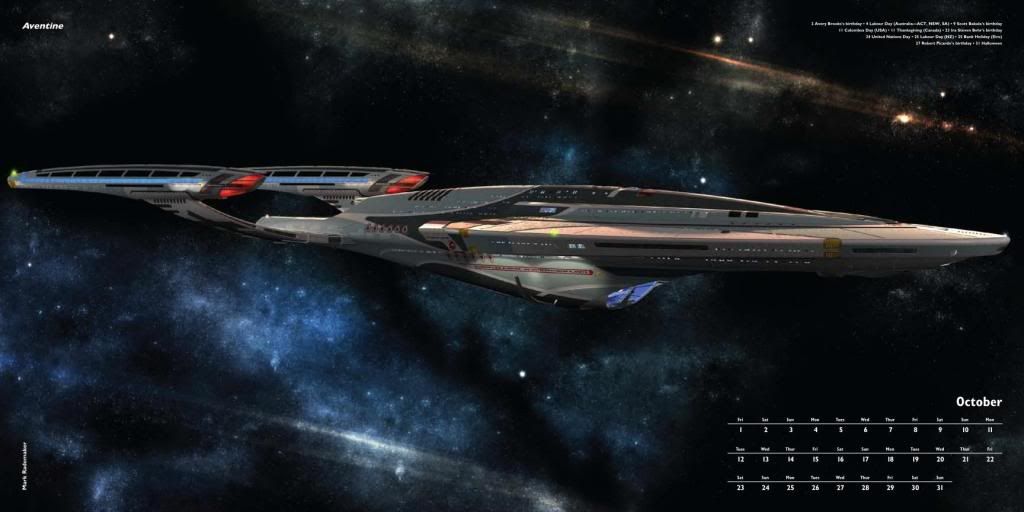
On the cover: Nicole de Boer as Captain Ezri Dax, Alexander Siddig as Dr. Julian Bashir, who has apparently grown a Beard of Sorrow. CGI as the USS Aventine.

The Federation has known many great enemies in its few centuries of existence -- the Klingons, the Romulan Star Empire, the Cardassians, the Dominion, and the Borg have been the most notable. Time has worn them all down: the Klingons have become allies, the Romulans are weakened by civili War, Cardassia is impotent, the Dominon has retreated into the Gamma Quadrant, and the Borg are...gone. In the wake of the last great Borg war, various second-class powers of the galaxy (Gorn, Tholians, Breens, and more) have banded together in a military and partial civil union known as the Typhon Pact. The Pact has existed in a state of cold war with the Allied powers since A Singular Destiny, but their recent theft of the plans for Starfleet's latest and greatest asset -- the Slipstream War Drive -- threatens to turn hostility into a general war.

The slipstream drive is vastly superior to standard warp drives and has so far discouraged the Pact from waging open war against the battered and diminished allied powers. They cannot be allowed to turn their stolen data into effective plans for a slipstream drive of their own, and so Starfleet tasks Captain Ezri Dax with inserting two operatives into the suspected home of the Breen slipstream project. Dr. Julian Bashir and his genetically modified peer Sarina Douglas have been hand-picked for their improved physical and mental abilities, which include a heightened ability to adapt to strange and changing situations. Given that next to nothing is known about Breen culture, adaption is a necessity. While the two operatives descend into the belly of an alien city, Dax lurks outside the Breen orders attempting to evade a Breen-Romulan* fleet which knows that the Aventine is up to something.

Zero Sum Game is an interesting change of pace: political/spy thrillers aren't all that pervasive in Trek lit to my knowledge.  I enjoyed David Mack's worldbuilding; I imagine giving life to a long-established power was quite the responsibility, but the civilization that Bashir and Douglas explore is fascinatingly believable. He treats them as more than just villains, although the Breen Confederacy is plainly ruled by an intrusive military state with a kind of secret police. When the Breen official in charge of the shipyard discovered his operations center littered with dead bodies, he is horrified that the enemy operative (in this case our hero)  had taken so much innocent life just to destroy the slipstream project.  On that note, readers are also treated to Dr. Bashir's inner conflict, as he is driven by his responsibility as a physician to "do no arm" and his duties as a Starfleet officer to do what needs to be done.

Par for the course for Mr. Mack; Zero Sum Game has a lot to offer Trek fans beyond the fast action-spy plot and discovery of Breen civilization. Bashir's long been my favorite DS9 character and I enjoyed the spotlight being on him for a change: the last time that happened was during the first run of Trek relaunch books. He's changed quite a bit from the bubbling young lieutenant who first appeared in "Emissary": once full of idealism and energy, he's now a mature veteran of several horrific wars who feels lonely in a station now populated by total strangers: aside from Quark and Nog, no one remains on the station from the old (television run) crowd, and now even his newly-met comrades from the relaunch have been leaving him. It's tough to see him put through the mill like this, especially considering a revelation at the end of the book. The action remains interesting and varied throughout the book: while Bashir and Douglas are exploring the Breen industrial center, Ezri is engaged in a cat-and-mouse game with some irritated Romulans, and by the time that action settles down our two operatives are in the thick of things.  Even the Federation president gets a little attention. 

Recommended to Trek lit readers, especially given that this is the first book in the Typhon Pact series, which will explore the 'new political reality' throughout next year. Book #2, Seize the Fire, came out in the last week or so. 

Related:
  • Abyss, the last Bashir novel (not counting Worlds of Deep Space Nine #1, where he just tagged along behind Ezri) One of my favorites, focusing on Bashir, Ro Laren, and Taran'atar. 
  • David Mack's homepage and Memory Alpha bio.
  • Typhon Pact on TvTropes. Note: this book was released in late October, and it's already got a full page. Some of the people in TrekBBS's TrekLit forum have been busy. 


Friday, October 29, 2010

Warpath

Warpath
© 2006 David Mack
339 pages
On the cover: unknown model as Taran'atar, looking "dangerous, yet vulnerable, awash in the amber of Jem'Hadar blood".

I am dead. I go into battle to reclaim my life. I do this because I am Jem'Hadar. Victory is life.

The opening Deep Space Nine Relaunch novels introduced Taran'atar, an elder soldier of the Dominion who was assigned to Deep Space Nine to serve its commanding officer, Captain Kira Nerys. Such an assignment is unusual, for Taran'atar is a Jem'Hadar: a genetically-engineered soldier bred for fighting and obedience to the Founders, the shape-shifting race of creatures who created and controlled the Dominion which attempted to conquer the Federation and the Klingon and Romulan empires through Deep Space Nine's final two seasons. Taran'atar proves to be a prickly, but valuable asset to Kira and her command crew,  rendering to her the obediance he once gave to his masters in the Dominion.

That makes the opening of this novel, in which he stabs her in the heart and breaks Security Chief Ro Laren's back a bit unexpected.  While Kira and Ro lay dying, Taran'tar sneaks aboard a station craft about to test its newly improved warp engines and takes the vessel's lone pilot hostage before speeding away toward an unknown destination.  Dr. Julian Bashir works desperately to save the lives of his captain, his coworkers, and his old friends while the station's XO, Elias Vaughn, pursues the craft in the USS Defiant. Meanwhile, Ensign Prynn Tenmei,  Vaughn's daughter, flies the craft at Taran'atar's knifepoint and wonders how she is going to overcome a super-soldier fully expecting her to stop him from from fulfilling his plan -- which, he's not entirely sure of himself. He only knows that he must make a rendezvous with a face he knows to be familar, but who is yet a stranger -- an ambitious, hateful stranger who we witness overcoming skilled bounty hunters.

This is the opening chapter, but not the origin, of a larger story arc which Deep Space Nine pursues in later books,  in which Illiana Ghemor -- a Cardassian intelligence operative genetically altered to appear to be Kira Nerys and implanted with false memories that make her think she really is Kira  -- goes insane and decides to kill every Kira Nerys she can get her hands on, which means knocking off the Mirror Universe's Intendant Kira as well. This story arc concerns me; I think of it as convoluted, and the other story arc being developed -- in which Bajor will be expected to defend its dominant religion and the Wormhole against the Ascendants, a Gamma-Quadrant power who also worship the wormhole aliens ("The Prophets"), but are imperial and fanatical, like Islamic extremists and Christian dominionists today  -- is likewise problematic. The last time I read of Ascendants and Bajor's religion, the universe was destroyed.

The arcs are just getting started in Mack's book, though, so they're not terribly...developed yet. Warpath is good. It's not Destiny, but nothing is Destiny.  Vaughn and Tenmei are the most compelling characters for me: they are an estranged father and daughter, and the moment in which they find forgiveness and a new start was for me the best moment of the book. The fight scenes were curiously compelling, keeping my attention -- and the humor was excellent, particularly one inside joke Mack included for Bashir fans.* The only part of the book that through me was Kira's experience laying in surgery: while Doctor Bashir operates, she dreams that she is attempting to lead a medieval army against a medieval fortress, only to find it's held by another medieval army and a third medieval army is on its way to take the fortress for themselves. At first I thought the General Kira of the dream was another universe's Kira, but I realized the dream was a metaphor for Bajor's future story arc.

Good read, though...I'm not really enthusiastic about these arcs. I'm fine with Ghemor on Kira, but the inclusion of a lot of alternate-reality Nerys makes potential confusion a safe bet. I'm still going to continue in the DS9 relaunch, but...well, it's lower priority than the TNG relaunch at the moment.

Related:


*As soon as Bashir returned his attention to the monitor, Tarses resumed his presentation. "Now," he said, "as you see here, the postganglionic nerve--"
"That's a preganglionic fiber," Bashir interrupted.
Tarses did a double take toward the screen. "Are you sure?"
"Positive." Bashir made a sweeping, it-doesn't-matter- gesture with his hand. "Please, continue." (p. 148)

Wednesday, September 1, 2010

Lost Souls


Star Trek Destiny: Lost Souls

© 2008 David Mack
453 pages


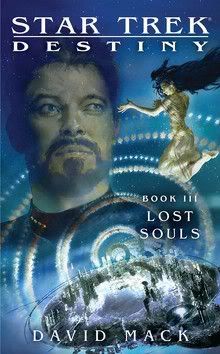
As far as cliffhangers go, I don't think I've ever encountered one as dramatic as the final pages of Mere Mortals,  the second in the Destiny trilogy, but Lost Souls' conclusion exceeds it in intensity. It is easily the most emotionally provocative Trek book I've ever read. Lost Souls begins in the horror of a general Borg invasion of the Alpha Quadrant: the Allied fleet is literally smashed to pieces, powerless against the Borg armada -- seven thousand ships strong.

Captains Picard, Dax, Hernandez, and Riker were spared from the opening moments of invasion by their own missions and perils, but regroup at the eye of the hurricane: while the Borg armada deploys in all sectors of the quadrant, attacking the Allies' worlds simultaneously, their three ships make repairs and contemplate the apocalypse. While fleets throughout the quadrant charge at the Borg fleets with a courage born of desperation,  the four captains contemplate what, if anything, can be done. They only have hours, a few days at most before every Allied planet in the Alpha quadrant have been destroyed -- but there remain still a few straws to grasp at.

The action unfolds quickly here, throughout a half-day. Although Mack's emphasis is on the struggles and actions of the four captains and their respective crews, he frequently cuts to Klingon commanders fighting holding actions  and the Federation president, who can only watch the ominous black fleets devour her worlds and advance steadily toward Andoria, Betazed, Vulcan, and Earth. Mack also takes breaks from the action to follow a group of temporal refugees, the MACOs (space Marines) from Captain Hernandez' ship, whose mutinous actions nearly destroyed the Caeliar. The squad is trapped seven thousand years in the past on a bitterly cold planet, facing death with a few members of the Caeilar who were flung into time with them. At first I thought the diversion odd, but they play a most important part in the momentous finale.

The finale is...epic, and turns an already successful story into a staggeringly well-done work. Horror is transformed into a joy and a nightmare scenario into a conclusion that is truly in the spirit of Star Trek's highest aspirations.  Lost Souls is a stunning finale, well-worthy of being read not only by Trek lit fans, but by anyone who has watched The Next Generation or Voyager enough to become interested in the Borg. I highly recommend Destiny

On the cover: Johnathan Frakes as Captain William Riker and (I assume) Ada Maris as Captain Erica Hernandez. 

Related:


Thursday, August 26, 2010

Mere Mortals

Star Trek Destiny: Mere Mortals
© 2008 David Mack
433 pages

The small, finite lives of mere mortals carry little weight in the calculations of gods. But even gods may come to understand that they underestimate humans at their peril. 
(From the back of the book.)

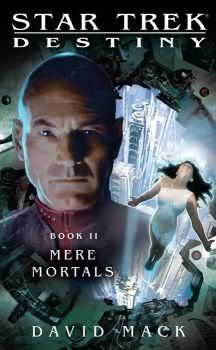
In 2158*, the Earth ship Columbia limped its way to a nearby planet to find repair.  Instead, they were trapped by a hospitable if overly cautious race of highly advanced beings called the Caeliar, who were adamant about keeping their galactic profile to a minimum, so much to the point that any visitors were either forced to stay or flung across the galaxy to be forever cut off from their homes.  Hundreds of years later, the crew of the USS Titan stumbled upon these same Caeliar while tracking the transwarp energy lanes that Starfleet believes the Borg were using to mount their incursions into Federation space. Titan's crew met the same fate as Columbia's: friendly imprisonment. To their astonishment, the captain of the Columbia -- Ericka Hernandez -- greeted them upon their arrival, in the best of health despite being hundreds of years old. Meanwhile, Captains Picard and Dax begin attempting to access the energy lanes and find the route the Borg have been using to launch their invasions. While Picard's initial desire is to destroy the subspace lanes, the task is seemingly impossible. While the Federation's best minds attempt to sort out how to shut these pathways down, Picard believes they can be used to the Alpha Quadrant's advantage. He proposes that the Federation build a coalition of Alpha- and Beta- quadrant powers ready and willing to take the Borg on directly -- that the allied powers send a combined expeditionary force into the Delta Quadrant to destroy the Borg's staging ground and prevent Borg forces from accessing the lanes until the Federation can destroy them safely.

Although Mack focuses on the same four crews -- the Enterprise, Aventine, Titan, and Columbia,  Mere Mortals  primarily focuses on the combined efforts of Picard and Dax to find the lane leading to the Delta Quadrant. Titan is only a sideline story, as her characters are essentially powerless to do anything: they're barely there. The inclusion of a Columbia story thread surprised me, but Mack follows Hernandez and her crew as they adjust -- or fail to adjust -- to their benign captivity, eventually linking Hernandez' story with that of the Titan crew's.  Most of the book is simply setting the stage for the final chapter, but tension mounts as Picard and Dax continue to narrow down which lane leads to the Delta Quadrant: one bridge officer comments that their efforts remind him of Russian roulette. While this is happening, an Allied fleet -- hundreds of ships from the Federation, the Klingon, Cardassian, and Romulan empires, and the Ferengi Alliance (with Breen mercenaries tagging along) -- slowly gathers. In the book's final chapters, Mack forces the fleet to stare into the Abyss -- into the mouth of hell, to borrow from Tennyson -- and then sends it hurtling in.

Destiny continues to impress. Gods of Night was interesting, but Mack uses drama to a greater effective here -- slowly lulling the reader into the feeling that this book is just filler, just a train between two ports. Then the tracks disappear and you realize this is a roller coaster, and you no idea where  the fall will stop, or what gut-wrenching turns await.  I have a feeling that once I finish Lost Souls next week, I'm going to need to watch a few warm and fuzzy episodes of TNG or the original series to recover.

On the cover:  Sir Patrick Stewart as Captain Jean-Luc Picard; Ada Maris as Captain Hernadez-pretending-to-be-Wonder-Woman.

*Give or take a decade. 2168 is when the Columbia was lost, but she'd been traveling at near-light speeds long enough that they were out of sync with Earth's calendar, so I'm not exactly sure.

Related:

Saturday, August 21, 2010

Gods of Night

Gods of Night
© 2008 David Mack
431 pages

"The moment I have dreaded for [...] years has finally arrived. The Borg, our most lethal enemy, have begun an invasion of the Federation...and this time there may be no stopping them." (Jean-Luc Picard, First Contact)

Since their introduction in "Q Who", the Borg have remained the Federation's greatest nemesis. They are remarkable villains not for their power or technological prowess, but for their soulnessness. The Borg embody passionless inhumanity: though they dominate nearly a quarter of the galaxy, their conquests have been achieved not through the zeal for power or glory. The Borg are ruthlessly pragmatic, acquiring and destroying species as needed to move forward towards their goal of perfection. Their every advance into the Federation sees fleets of starships destroyed -- and every assault is more pointed, more dangerous than the last. As the Borg renew their goal of subduing the Federation, Captain Jean-Luc Picard fears in his bones that the coming battle is more than those who have come before: to him, the man who hears the Borg whispering in his thoughts at time, the coming conflict will be the last. The Borg are coming, and the Apocalypse is at hand.

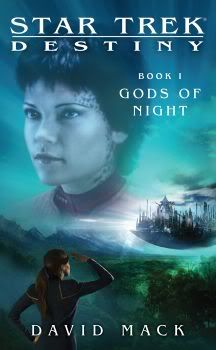
Gods of Night is the first in a trilogy portraying this final, deadly grapple between the Federation and the Borg. It is the story of three crews:  in the Alpha Quadrant, Captain Picard and the Enterprise-E serve as the Federation's greatest weapon against the increasingly frequent Borg incursions into Federation space. In the far reaches of the Beta Quadrant, Captain Riker of the USS Titan is engaged in an extended mission of scientific exploration, but he and his crew have found a way to contribute to the war effort by investigating a mysterious dark solar system that seems to be projecting transwarp lanes across the whole of the Milky Way. In the Gamma Quadrant, Captain Ezri Dax of the USS Aventine is investigating the wreck of the NX-02 Columbia, an Earthship more than 200 years old. The Columbia is far from home: too far to have made it there on her own.

Mack weaves these three stories together into one grand fabric of peril and mystery, and tacks on a fourth -- the story of the Columbia's crew, who were crippled at the outset of a great war at the birth of the Federation between Earth and the Romulan Star Empire -- for good measure. Despite the abundance of characters and minor substories,  the novel remains impressively cohesive. Aside from history, scientific mysteries, and war, Mack gives time to personal issues. Picard is possessed by the war, Riker and Troi are struggling to have a child, and Dax is attempting to adjust to her new role as ship's captain, haven taken over the Aventine when most of its senior staff perished in battle.

Destiny's formidable hype is so far warranted, and Mack has my attention.

On the cover: Nicole de Boer as Captain Ezri Dax; Ada Maris' ponytail as Captain Erika Hernandez' ponytail.

Related: